
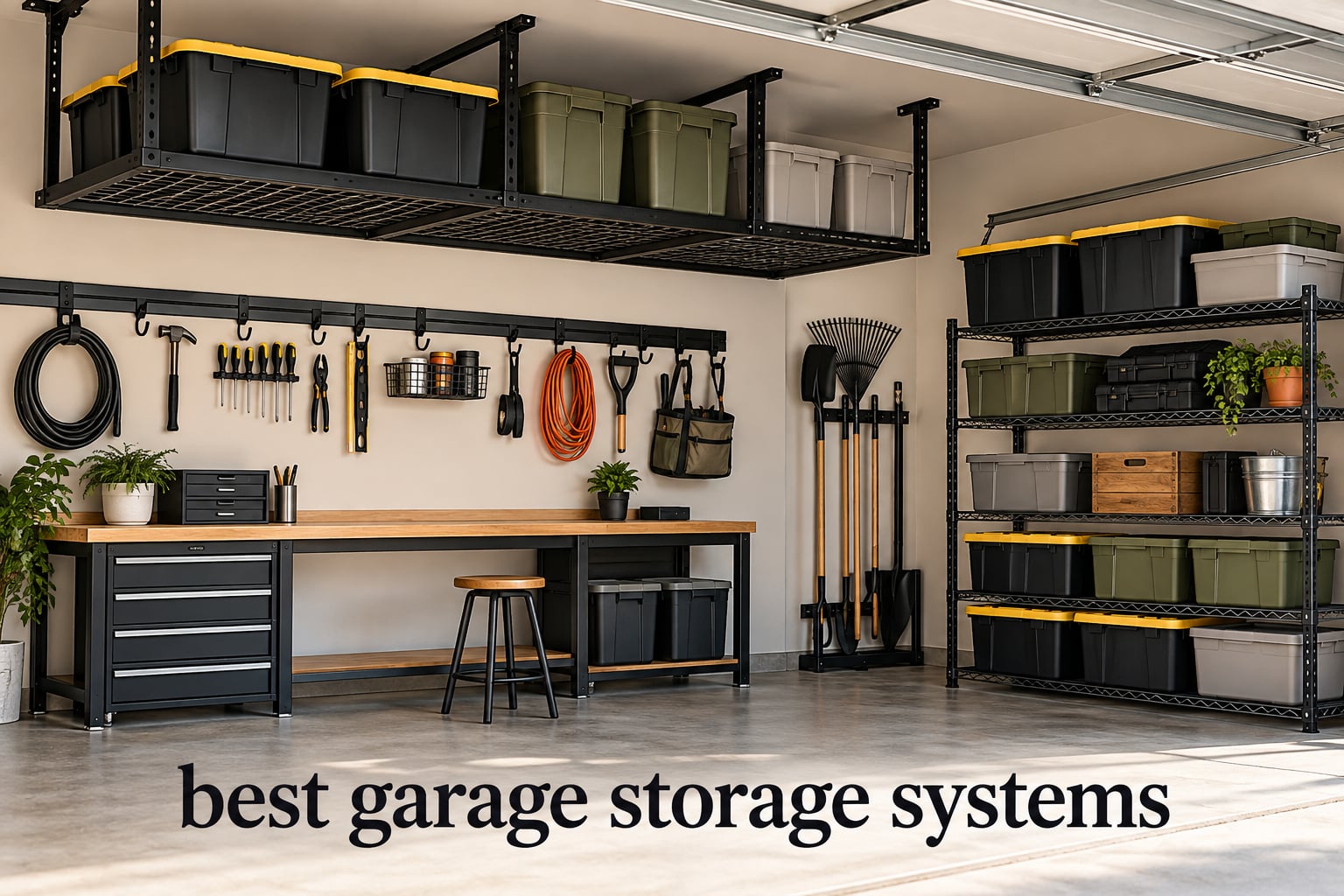
The best garage storage systems combine heavy-duty shelving, wall-mounted track or slatwall, and overhead ceiling racks so the floor stays clear and every item has a fixed home. A garage is only as useful as the open space inside it, and the fastest way to get that space back is to lift everything off the floor and onto a structure that can actually hold the weight.
We compared 12 garage storage systems across every category that matters: overhead racks, freestanding and wall-mounted shelving, rail and hook systems, slatwall paneling, tool organizers, and a lockable wall cabinet. We scored each one on published load ratings, steel gauge and finishing, anchoring method, how much floor space it recovers, and how owners describe the install after the fact.
Before buying anything, declutter. Communities that organize garages consistently tell you to inventory and discard first, because a system sized to today’s pile leaves no room for what accumulates next year. If your garage door is the weak point, start with our smart garage door opener picks so the whole bay works as one space.
Table of Contents
Top 3 Best Garage Storage Systems for (October 2026)
These three cover the widest range of needs, and they are the picks we come back to. The overhead rack wins on raw capacity, the shelving unit wins on flexibility, and the rail kit wins on clean tool access.

FLEXIMOUNTS 4×8 Overhead Ceiling Rack
- 750 lbs rated
- 1200 lbs tested
- Adjustable 22-40 inch drop
- Up to 105 cu ft

Amazon Basics 5-Shelf Caster Shelving
- 5 adjustable shelves
- 1-inch height increments
- Leveling feet and casters
- Tool-free assembly
Rubbermaid FastTrack Rail and Hook Kit
- Steel rails
- Relocatable hooks
- 50 lb locking hooks
- One-person install
All 12 Garage Storage Systems at a Glance
This table lists every system in the roundup with the type, the capacity figure that matters most, and the use case it fits. Ratings and capacities are taken from the manufacturers’ published specifications.
| Product | Specifications | Action |
|---|---|---|
| FLEXIMOUNTS 4×8 Overhead Ceiling Rack |
|
Check Latest Price |
| Amazon Basics 5-Shelf Caster Shelving |
|
Check Latest Price |
| Rubbermaid FastTrack Rail and Hook Kit |
|
Check Latest Price |
 FLEXIMOUNTS 2-Pack 24 in Wall Shelves FLEXIMOUNTS 2-Pack 24 in Wall Shelves |
|
Check Latest Price |
 REIBII 3200 lb 5-Tier Wide Shelving REIBII 3200 lb 5-Tier Wide Shelving |
|
Check Latest Price |
 POKIPO Power Tool Organizer POKIPO Power Tool Organizer |
|
Check Latest Price |
 UUP 48 in Yard Tool Rail UUP 48 in Yard Tool Rail |
|
Check Latest Price |
 FRAYSCENT PVC Slatwall Panels FRAYSCENT PVC Slatwall Panels |
|
Check Latest Price |
 Gladiator 3/4 Door Wall Gearbox Gladiator 3/4 Door Wall Gearbox |
|
Check Latest Price |
 FERO Lift System Overhead Rack FERO Lift System Overhead Rack |
|
Check Latest Price |
 SafeRacks White 4×8 Overhead Rack SafeRacks White 4×8 Overhead Rack |
|
Check Latest Price |
 HANDT Connectable Ceiling Rails HANDT Connectable Ceiling Rails |
|
Check Latest Price |
1. FLEXIMOUNTS 4×8 Overhead Ceiling Rack – Best Overall and Best Overhead
FLEXIMOUNTS 4×8 Overhead Garage Ceiling Storage Rack Organization, Black
750 lbs rated, 1200 lbs tested
Adjustable 22-40 in drop
96 x 48 in deck, 105 cu ft
Pros
- 750 lb rating tested to 1200 lbs
- Welded wire grid frame is more rigid than multi-piece rivals
- Drop adjusts to fit most ceiling heights
- Six vertical posts add center support
- Recovers a whole bay of floor
Cons
- Full-day install for one DIYer
- Pre-drilled threads strip if a drill runs at full torque
- Sways laterally with no diagonal bracing
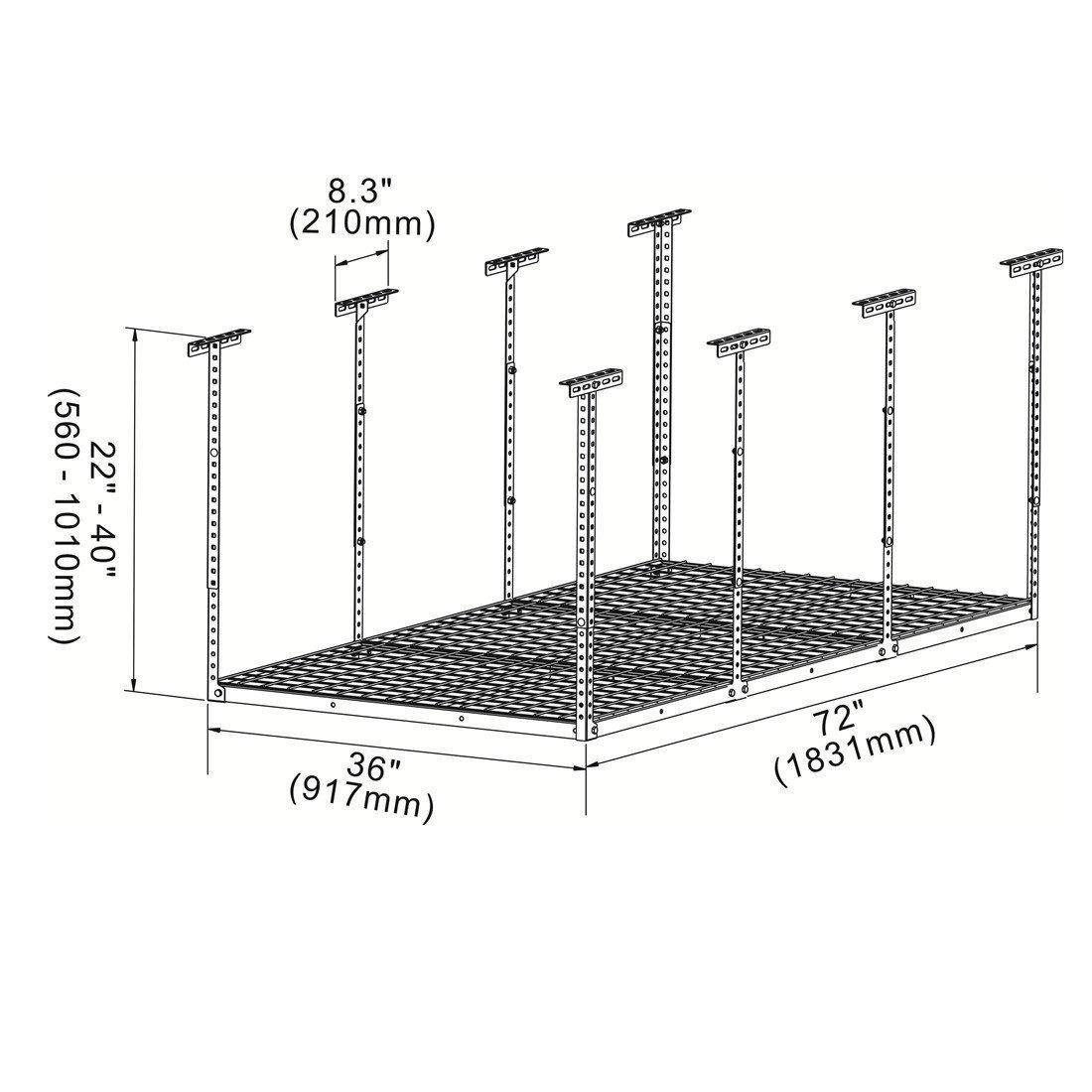
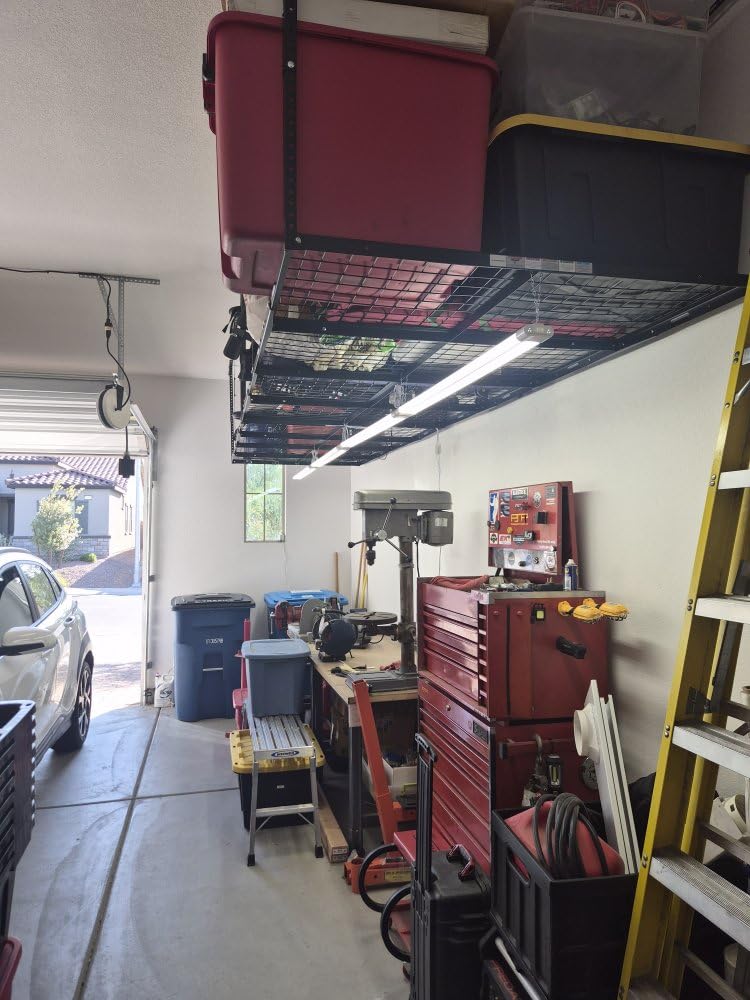
This is the rack we ended up recommending to anyone whose garage doubles as a workshop, because the capacity figure is the one that changes what you can put up there. It is rated for 750 pounds and tested to 1200, on a 96 by 48 inch deck that drops anywhere from 22 to 40 inches below the ceiling.
The reason it holds more than most single-deck racks is structural rather than cosmetic. The wire grid and the frame are welded as one piece instead of being bolted from separate rails, and six vertical posts carry the load instead of four. That is why it does not flex when you walk a ladder up to it.
Owners consistently describe the same tradeoff: this is a serious installation job, and finding the joists accurately is the hardest step by a wide margin. The pre-drilled holes are also frequently criticized, with the threads on this model criticized as poorly machined and bolts stripping if you drive them with a drill at full torque. Use a hand ratchet for the final threads.
There is also no diagonal bracing in the box, so the deck can sway laterally when it is loaded one side. Adding your own corner braces is an afternoon of work that removes most of that movement. Owners also note that hooks are not included and no spare hardware ships with the unit, so budget for those separately.
What it is worth for overhead storage
This rack is at its best holding bulky, infrequently used things: holiday bins, camping gear, seasonal clothing, spare trim and lumber, and the boxes that make a garage feel like a warehouse. The 105 cubic feet of volume is enough for four or five large totes with the lids on, which is the practical test most buyers apply.
Users in garage organization communities regularly call Fleximounts the most economical way to clear floor space, and the review pattern backs that up. Owners describe it as a floor-clearing upgrade once installed, and most of them accept the install effort as a fair trade for the space recovered.
When to skip it
Skip this rack if you need to reach the contents weekly. Reaching into a bin 40 inches above your head, while standing on a ladder, is the exact scenario experienced homeowners warn against when they say overhead storage is wrong for frequent-use items. It also cannot be mounted to a metal wall, so check your wall type before ordering.
Joist spacing matters too. It fits joists at 24 inches or under; if your joists are spaced wider, it only works at 48 inch spacing. A tape measure and a stud finder, or a hammer and a stud sensor, will tell you in five minutes whether this rack can work in your bay.
2. Amazon Basics 5-Shelf Casters Shelving – Best Value
Amazon Basics 5-Shelf Adjustable, Heavy Duty Storage Shelving Unit on 4″ Wheel Casters, Easy to Move Portable Wire Shelving, No Tools Needed for Easy Assembly, 30″ x 14″ x 64.8″, Chrome
5 wire shelves, 1-inch height adjustment
300 lbs per shelf on leveling feet
30 x 14 x 64.8 inch unit
Pros
- Tool-free assembly with all hardware in the box
- Shelf height adjusts in 1-inch increments
- Levelling feet and casters both included
- Casters make cleaning and rearranging easy
- Owners often buy multiple units
Cons
- Assembly is awkward alone due to plastic corner clips
- Printed instructions are vague
- Poles cut roughly 3 inches of usable shelf width
With more than 263,000 reviews behind it, this is the most proven unit in the roundup, and the reason is simple: it does the one job shelving is supposed to do without a complicated design. Five wire decks, adjustable in one-inch increments, on a 30 by 14 inch footprint that fits the leftover gap beside a car.
The capacity figures are worth reading carefully because they change with the feet you use. On leveling feet you get 300 pounds per shelf and 1500 pounds overall. On casters when the unit is stationary that drops to 132 pounds per shelf, and to 88 pounds when you are rolling it. That is not a flaw; it is physics, and it is exactly the per-shelf versus total distinction most buyers get wrong.
Owners highlight sturdy construction, tool-free assembly, and how versatile the unit proves to be beyond the garage, with many using them in closets and pantries as well. The main gripe is the assembly process itself: each shelf has to be lowered onto four plastic corner clips, which is genuinely a two-person job the first time.
The printed instructions are also routinely called unclear, especially for the clip-together supports. Once built it is level and does not wobble, but the pole uprights reduce usable shelf width by about three inches from the nominal figure, so measure your bins against the inner span rather than the listed width. A slight lip at the shelf front can also stop items sliding forward when you try to pull a bin out.
Why it works for totes and bins
The one-inch shelf adjustment is the feature that matters most for bin storage, because it lets you size each level to a specific tote height instead of forcing one spacing across the whole unit. Owners highlight this as the reason the shelf can be adapted to bins of different heights rather than wasting half of each bay on air.
Casters give you something a fixed unit cannot: the ability to roll the whole run out, sweep, and put it back. Experienced homeowners recommend casters on base storage more than almost anything else in garage organization, and this unit ships with both leveling feet and four-inch casters so you can decide per shelf.
Where it falls short
Two things to know before you commit. Shelves are not sold separately, and once a deck is fully seated it is difficult to remove, so treat the five-shelf configuration as fixed. The 14 inch depth is also on the shallow side, which means standard 18 inch deep totes will overhang the front edge and catch on the shelf above.
For daily-use items this is a fine choice. For uniform large-bin storage, look at a deeper wall-mounted unit such as the 24 inch deep shelves in position four, or a wide unit like the 55.5 inch model in position five.
3. Rubbermaid FastTrack 8-Piece Rail and Hook Kit – Best Wall System
Rubbermaid Fasttrack Garage Wall-Mounted Storage System, 8-Piece Kit
2 x 32 in steel rails, 7 hooks
Locking hooks 50 lb each
System rated up to 1750 lbs
Pros
- Highest average rating in the roundup
- Hooks and accessories relocate as needs change
- Documented hook load ratings
- One-person install in minutes
- Expands with more rails and cabinets
Cons
- Entry kit is small
- several kits may be needed
- Non-locking hooks only hold 25 lb each
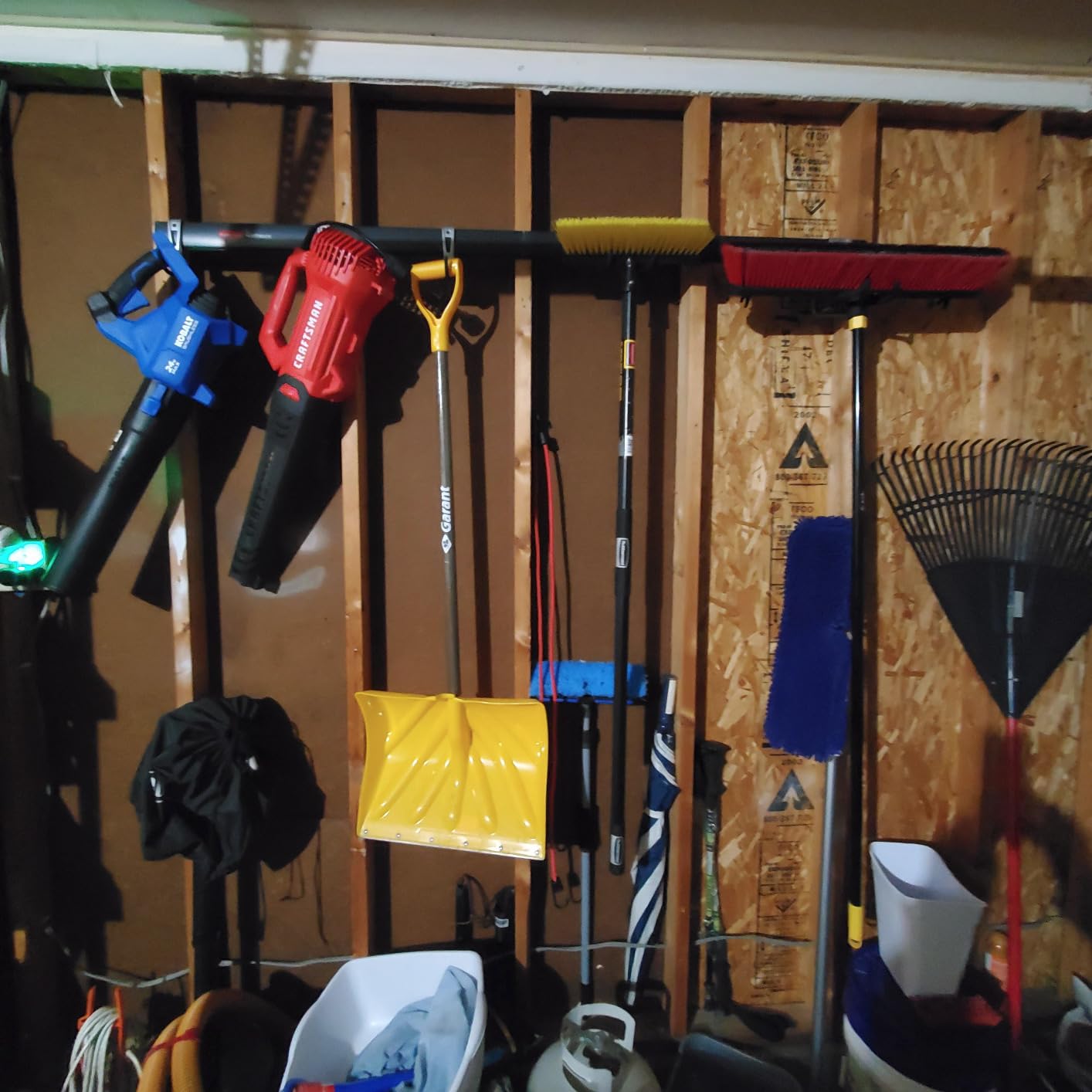
Rail systems solve a problem shelving cannot: keeping the most-used tools visible and within arm’s reach. This kit is two 32 inch steel rails with seven hooks, including handle hooks, scoop hooks, and a power tool holder, and it earns the highest average rating in the group at 4.8.
The design detail that matters is documentation. Locking hooks are rated at 50 pounds each and the non-locking hooks at 25, and the rails themselves are rated up to 1750 pounds as a system. Knowing which hook you are hanging a heavy item on, and being able to see the number, is not something most competing rail kits give you.
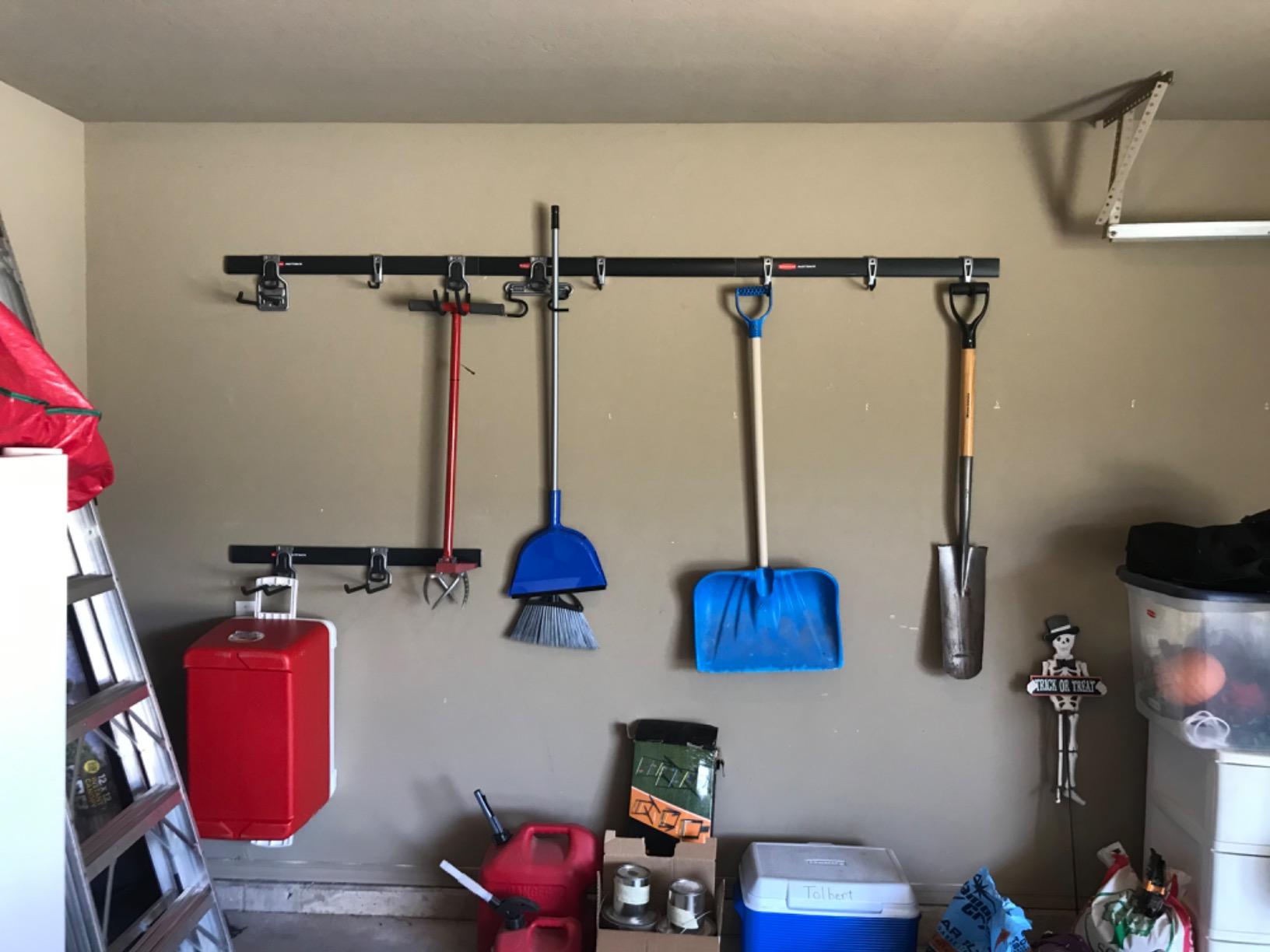
Owners cite easy installation, a clean appearance, and above all the ability to reconfigure hooks as their storage needs evolve. Installation genuinely is a one-person job, which is a big difference from the overhead racks in this roundup. Rails can be added later and the layout reworked in minutes rather than re-drilling anything.
The criticism is about size and capacity, not build quality. This is an entry kit, and a serious wall of hand tools needs multiple rail sections. Also be aware that non-locking hooks top out at 25 pounds, so a full paint can or a battery pack belongs on a locking hook or on a shelf, not a scoop hook.
Where rail systems beat everything else
For hand tools used several times a week, a rail wall is the single highest-value upgrade in any garage. Nothing to lift, nothing to search through, no drawer to slide open. Experienced organizers point to pegboard and french cleats as the traditional answers, with slatwall as the premium upgrade, and a steel rail kit lands in the same family with a cleaner profile and a printed load number.
Users also point out that because hooks slide, a rail wall is the easiest system to expand over time. The same two screws hold a new rail, and the layout can be re-tuned whenever a tool collection changes rather than every item being fixed in place from day one.
What to check before mounting
Check the total length you need against the 32 inch rails. Eight feet of wall is three kits, not one, and the accessory count scales with it. Also confirm the rail ends land on studs or in blocking, because a loaded rail carries real weight and drywall anchors alone are not the right fastener here.
If you plan to grow into cabinets later, decide now whether you want this system or a track ecosystem that accepts cabinets. Rail kits on the same wall as a separate track-based cabinet system is the most common mismatch buyers regret.
4. FLEXIMOUNTS 2-Pack 24 Inch Wall Shelves – Best for Deep Bins
FLEXIMOUNTS 2-Pack 2x6ft Garage Shelving 24-inch-by-72-inch Heavy Duty Wall Mounted Shelves Garage Storage Rack Floating Shelves, 1400lbs Load Capacity, Black, Classic Series
1400 lbs total, 350 lbs per unit
24 in deep, 72 in wide, 2 pack
16, 18 or 24 in stud spacing
Pros
- 1400 lb total capacity with three lag bolts per bracket
- About 50 percent deeper than typical L-bracket shelving
- Three-foot sections allow runs up to 12 ft
- One DIYer reports installing 16 shelves solo
Cons
- Included Velcro retention straps are weak
- Sections can sit loose on uneven walls
- Included hooks can detach when weight is lifted
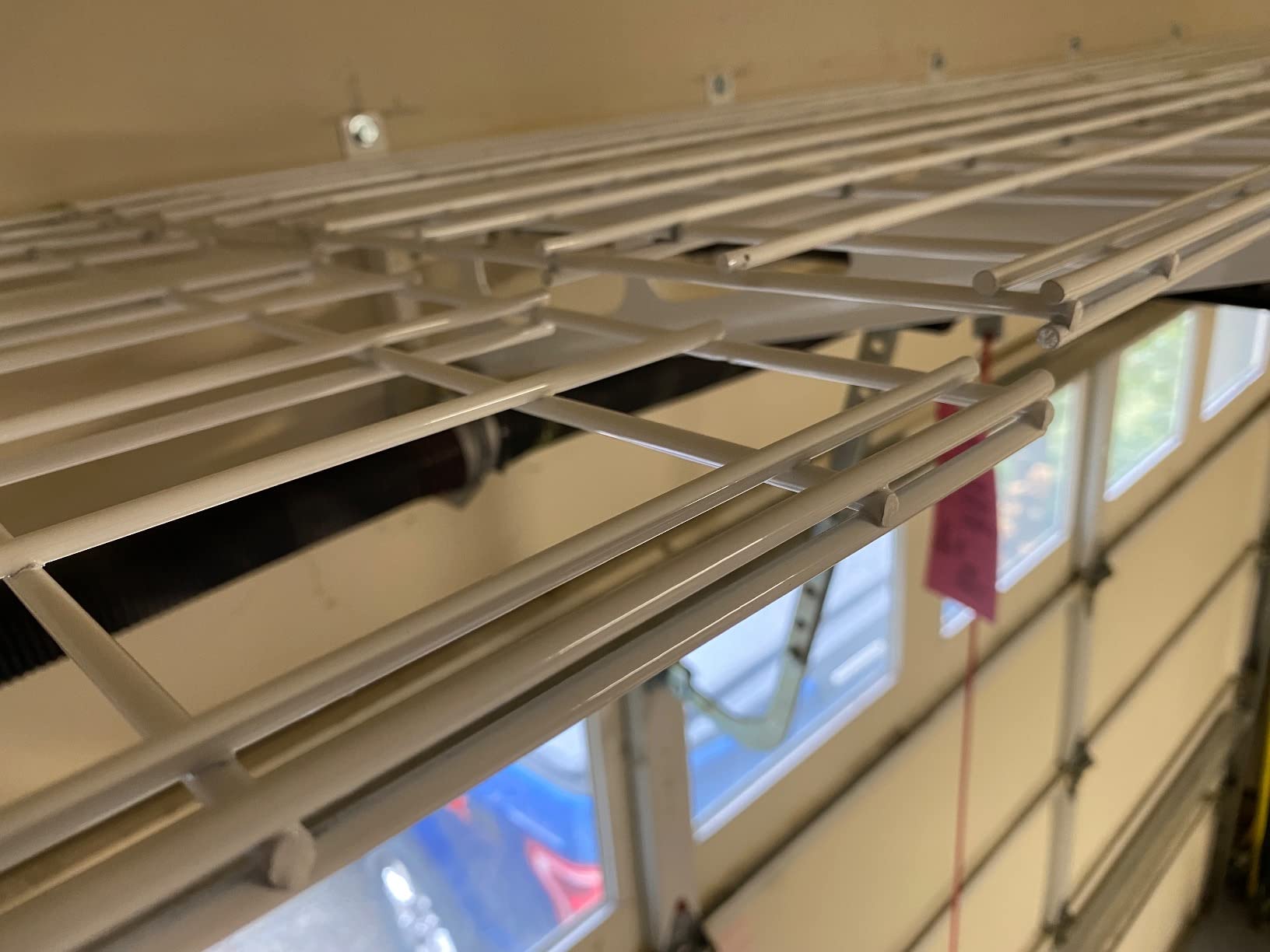
Depth is the number one complaint we hear about garage shelving, and this pair of wall-mounted shelves is the direct answer. At 24 inches deep they are roughly 50 percent deeper than the average L-bracket garage shelf, which means a standard tote actually fits with the lid clear instead of hanging over the edge.
Capacity is 1400 pounds total across both units, or 350 pounds per individual shelf. Each 2 by 6 foot shelf is built from four one by three foot sections, so you can run them in 3, 6, 9, or 12 foot lengths depending on your wall. That modularity is the reason owners return to buy more runs.
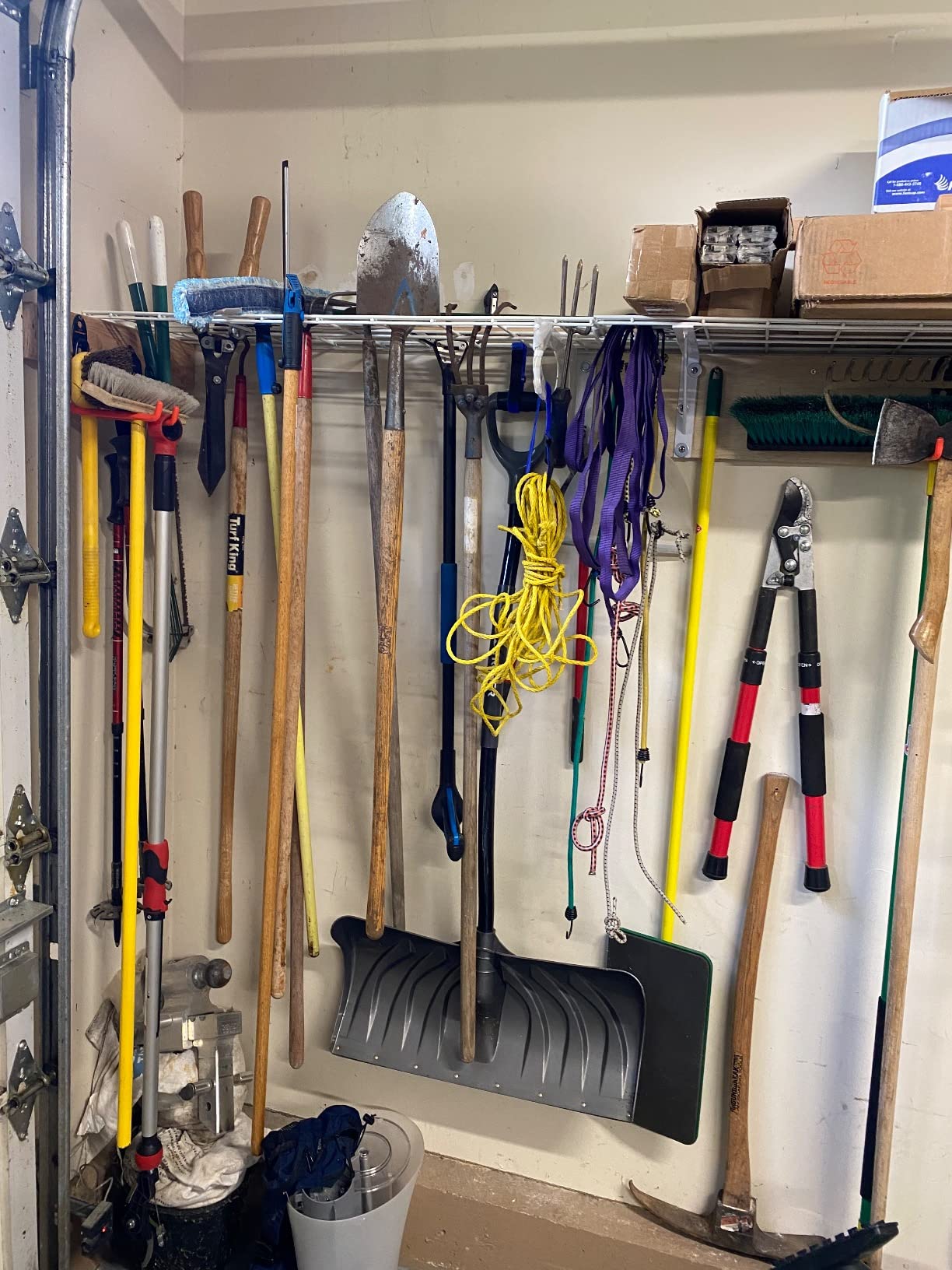
Owners describe the shelves as very sturdy and well packaged, and the included stud template plus bubble level make laying out a long run straightforward. Brackets and packaging are sturdy, and the bracket layout doubles as a drilling template, so a single run of four sections goes up fast. One experienced DIYer reports installing sixteen shelf units solo in a few hours, which is faster than most people expect. Three chunky lag bolts per bracket, into studs, concrete, or brick, do the work.
The most common complaint is the included Velcro straps that tie the shelf to the brackets. Owners consider them weak and many substitute zip ties. Second is fit on uneven walls: the slots have little forward-and-back give, so a section can sit slightly loose on an out-of-plumb surface. A few units also arrive with a bent wire, and some hardware needs a 13mm socket rather than a half-inch one.
How to size a shelf run for your bins
Measure your bins before you measure your wall, because depth drives everything. Totes are typically 18 to 27 inches deep, so a 24 inch deep shelf swallows most of them while a 14 inch shelf fits almost nothing. From there, allow a few inches of lid clearance above each bin or the lid will hit the shelf above, which is the single most common reason people find wall shelving unusable.
Then check stud spacing. This unit suits 16, 18, or 24 inch wood stud spacing and also works on concrete and brick, but it cannot be mounted on metal stud walls. The included template makes marking the bracket positions fast if your spacing is standard.
What to fix out of the box
Two quick upgrades. Replace the Velcro retention ties with zip ties, which costs almost nothing and stops the shelf lifting off the bracket. And drive the lag bolts with an impact driver rather than by hand, which is a large time saving on a concrete or masonry wall.
Owners also report that the included hooks, where fitted, do not grip the shelf rails securely and can detach when a heavy item is lifted off. If you are hanging anything, buy separate hooks rated for the weight rather than relying on the supplied ones.
5. REIBII 3200 lb 5-Tier Wide Shelving – Best for Heavy Loads
REIBII 3200LBS Storage Shelves 55.5″ W Garage Shelving Heavy Duty 5 Tier Adjustable Wire Shelving Unit Metal Shelving for Garage Pantry Commercial Basement,55.5″ W X 18”D X 71″ H
3200 lbs total, 640 lbs per tier
55.5 in W x 18 in D x 71 in H
Powder coated alloy steel
Pros
- 3200 lb total capacity suited to commercial use
- V-braced wire shelves add real rigidity
- 55.5 in width holds bins and tools on one run
- Tool-free assembly in about 10 minutes
- Powder coating resists rust and oxidation
Cons
- 18 in depth needs a wide bay
- Free-standing design can be knocked over if unanchored
If your garage holds more than bins and hand tools, this is the unit built for the job. The 3200 pound total capacity with 640 pounds per tier is a commercial-class number, and it comes from 25 millimeter wire rods with three V-type reinforced braces under each shelf rather than a plain wire deck.
The other thing we like is the 55.5 inch width. Most garage shelving is 30 or 36 inches wide, which means bins go on in pairs with wasted space between them. At 55.5 inches this unit takes a standard tote with room around it, and the shelf heights adjust for custom layouts. The frame can also be split into two sections and used as a workbench.
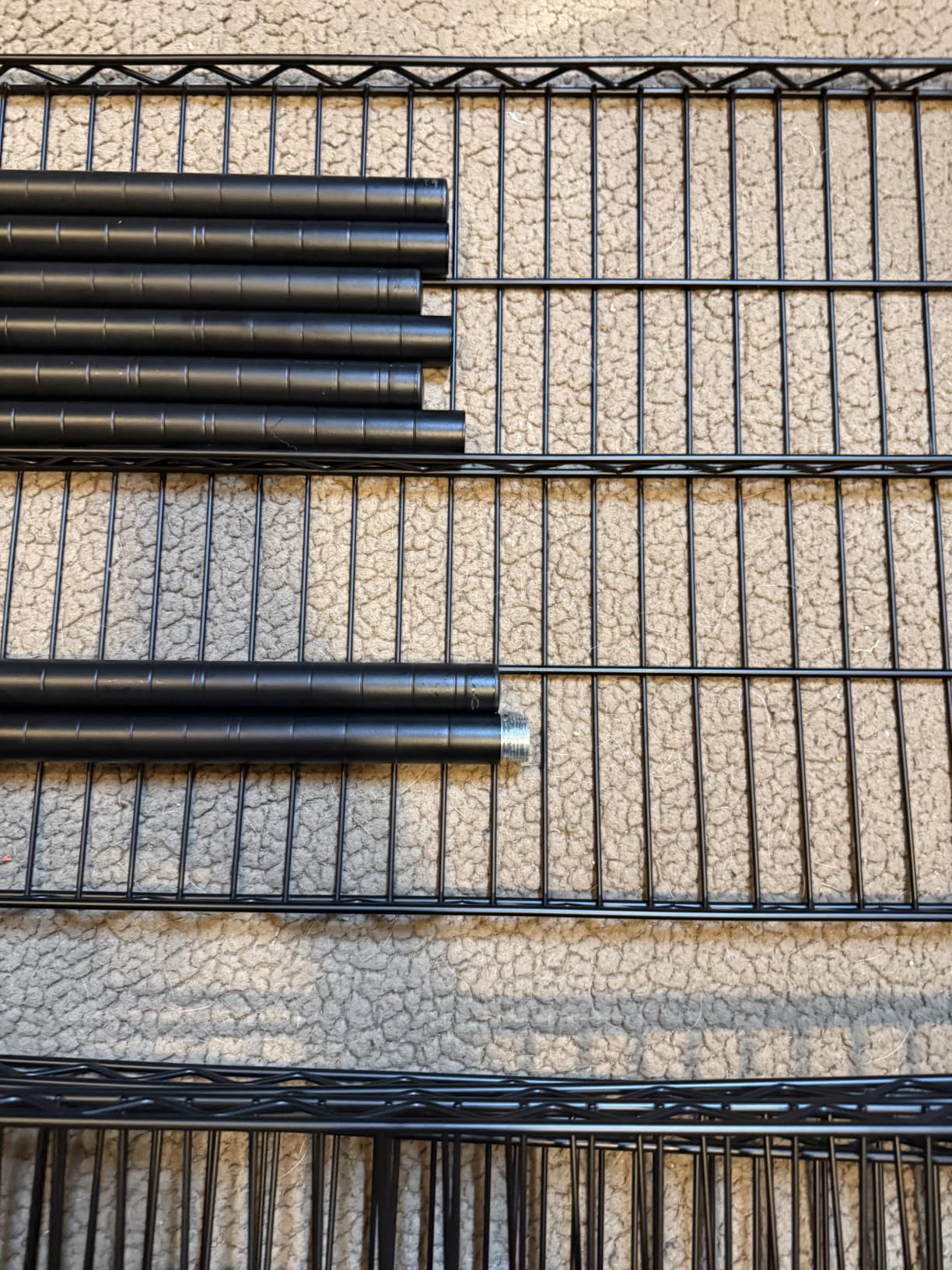
Owners single out the combination of very high load ratings, fast no-tool assembly, and adjustable tiers. Assembly is claimed at about ten minutes with no tools, and it can be disassembled just as quickly, which matters if you ever move. The powder coating is the piece most relevant to a damp garage, resisting rust and oxidation over time.
The limitation owners note is the 18 inch depth and the large overall footprint. It demands a wide bay and will not fit along a narrow wall, and a free-standing design needs a level floor. It is also the kind of unit that should be anchored if anything can bump it.

When a 3200 pound rating is worth it
That capacity matters when you are storing things that are dense and heavy: metal stock, engine parts, paint and finishing supplies, bagged concrete, or a garage gym setup with plate-loaded equipment. For boxes of holiday decorations the number is irrelevant, and a lighter unit would be easier to move.
A general guideline that experienced organizers use is to plan for 20 to 30 percent open shelf capacity. Buying to the limit on day one leaves no room for the accumulation that every garage experiences within a year, and buying a unit with headroom is cheaper than buying a second one later.
Before you commit to a wide unit
Measure the bay, not just the wall. An 18 inch deep, 55.5 inch wide unit needs a floor area that will not conflict with a parked vehicle or a walkway, and it needs to sit level. If the space is tight, the 30 inch wide caster unit in position two is a more realistic fit for most single-car bays.
Also check total versus per-shelf rating in the way you shop. A 3200 pound total figure spread over five tiers is 640 pounds per tier, and that per-tier number is what stops a single deck from bowing. Sellers quote the total because it is the bigger number, and it is the one you should not plan around.
6. POKIPO Power Tool Organizer with Charging Station – Best for Cordless Tools
POKIPO Large Power Tool Organizer Wall Mount with Charging Station,4 Layer Heavy Duty Metal Tool Storage Rack Loads 600lbs with 8 Cordless Drill Holder,Battery Utility Rack Loads with 4 Power Strip
600 lb load rating
4 tiers, 8 drill slots
4-outlet power strip, 6.5 ft cord
Pros
- Built-in power strip removes outlet hunting
- Eight dedicated drill and battery slots
- Compact 4-tier footprint frees the bench
Cons
- Shallow 5.9 in depth limits bulky storage
- Wiring the power strip is an extra step
- Lowest average rating in this group
This is the smallest and most specific pick in the roundup, and it exists because of one problem: cordless tools scattered across a bench with chargers trailing behind them. The integrated four-outlet power strip with a 6.5 foot cord is the whole point. Batteries charge on the shelf, not on the floor next to the drill.
Capacity is rated at 600 pounds from industrial-grade powder-coated metal, which is far more than the batteries and chargers will ever weigh. The layout gives you six shelf surfaces, eight drill slots, two side drill bit racks, and a hook rack in a footprint of 16.93 by 9.45 by 5.91 inches.
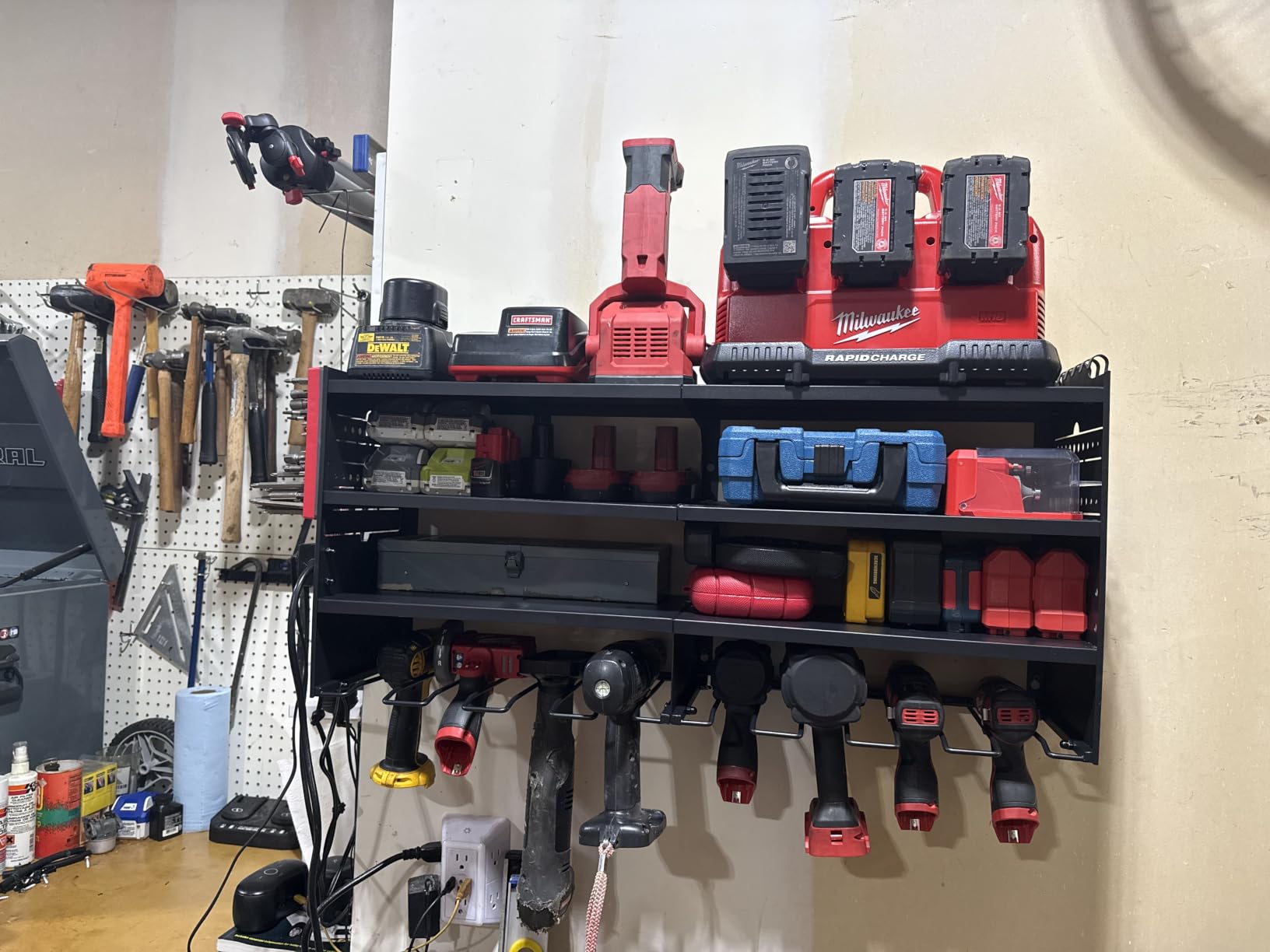
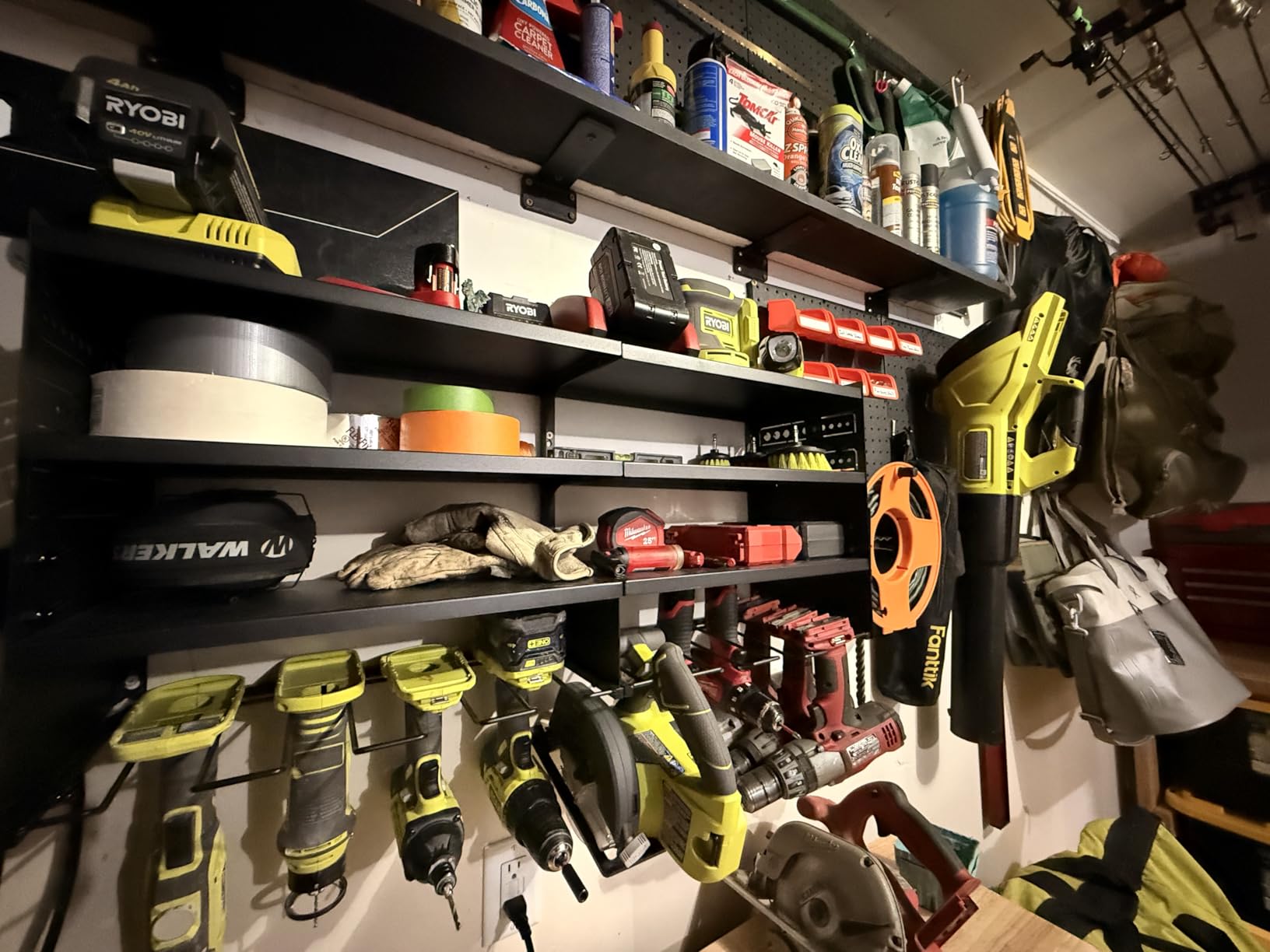
Buyers like the combination of dedicated cordless-tool slots and a built-in charging strip in one small unit, and the 600 pound rating inspires confidence. It installs on wood studs, concrete, or directly into pegboard, which makes it easy to combine with a wider wall system later.
It also carries the lowest average rating in the roundup at 4.5, with a higher share of one to three star reviews. Two things explain most of that. The shelf depth is only 5.9 inches, which suits hand tools and batteries but not bulky items. And the power strip has to be wired into a wall circuit, which is a real electrical step rather than a screw-and-done install.
Check this before installing
Have an electrician-appropriate circuit available, or a nearby outlet you can reach with the 6.5 foot cord, before you mount the unit. Wiring a strip into a circuit is not a beginner job, and it is the step most likely to be done badly. If you are not comfortable with it, plan on a lockable wall cabinet for the batteries instead.
Also be realistic about what goes on it. At 5.9 inches deep and with eight drill slots already allocated, this organizer is for batteries, chargers, bits, and hand tools. A bag of fasteners or a bulk box of wall anchors will not fit the way you might expect.
How it fits into a bigger wall plan
Treat this as an add-on rather than a system. It is one of several options that mounts into pegboard or onto a wall independently, so you can place it at chest height near the bench where you actually charge tools rather than at some convenient but unreachable spot. Experienced organizers put daily-use items between knee and shoulder height, and a charging station belongs there.
The 600 pound rating means you can put shelves above it, but only if the mounting surface is sound. Verify the screws bite into studs or masonry rather than drywall, and keep the heavier items on the lower tiers of the organizer rather than the top shelf.
7. UUP 48 Inch Yard and Garage Tool Rail – Best for Yard Tools
UUP 48″ Garage Tool Organizer Wall Mount, 440lbs Garden Garage Storage Garage Organization with Adjustable Heavy Duty Hanging Hooks, Yard Rack Hanger System Shovel Rake Broom Ladder Holder, Men Gift
440 lb total capacity
48 in of track in three 16 in panels
7 hooks with rubber-coated arms
Pros
- Rubber-coated arms stop tools sliding
- Hooks reposition anywhere along the rails
- Handles brooms
- hoses and snow shovels
Cons
- 48 in track is three 16 in panels
- Pre-drilled holes miss 16 in stud centers
- Anchors not recommended for this load
Long-handled tools are the classic garage floor offenders, and this rail is built specifically for them. Seven hooks across 48 inches of track: three tool hooks, two double-layer hooks, and two single hooks, with rubber-covered hook arms so a shovel or a rake cannot slide off while you are reaching past it for something else.
Capacity is 440 pounds on double powder-coated alloy steel, and the hooks slide anywhere along the rails so the layout can be reconfigured as the tool collection changes. It weighs 7.9 pounds, which is one of the lighter picks here, and one person can install it quickly.
This is worth checking against the listings twice, because two things are easy to miss. The 48 inch track is supplied as three separate 16 inch panels rather than one continuous rail, and the pre-drilled holes do not align with standard 16 inch on-center studs. That second point is the reason some installers have to add blocking or sistered two-by-fours before mounting.
Wall anchors are not enough here
Owners are clear that drywall anchors are not recommended for this load rating; the rail needs studs or added wood blocking. That is a small job if you find the studs, and a much larger one if you do not. Find the studs first, then order the rail.
On the plus side, the rubber-sleeved hooks and repositionability are what owners praise most, along with how simply it fixes the problem of tools leaning in a corner. A one-year manufacturer warranty and customer service support are included.
What belongs on a yard tool rail
This rail handles far more than hand tools. It is rated and shaped for shovels, rakes, brooms, garden hoses, leaf blowers, extension cords, snow shovels, and long sporting items like hockey sticks or skis. If your garage is a shared family space, that last category is what usually tips the decision.
Keep daily-use hand tools on something at eye level that you can pull off one-handed, and reserve the floor-adjacent rail for long-handled and seasonal gear. Nothing on a hook rail should require a step stool to lift down.
8. FRAYSCENT PVC Slatwall Panels – Best for Full Wall Coverage
FRAYSCENT Slat Wall Paneling Garage Wall Organizer, Slatwall Panels Garage Tool Organizer Wall Mount Garage Slat Wall Storage Systems, Slat Board PVC Wall Panels Garage Storage (Black, 8ftx4ft)
8 panels covering 32 sq ft
PVC slatwall, 96 x 48 in each
Maximum recommended load about 75 lbs
Pros
- Moisture and fire resistant PVC build
- Modular 4x1 ft panels cover a wall or build up slowly
- Provides the surface for standard slatwall accessories
- Installs into studs
- drywall or masonry
Cons
- Panels are not structural
- about 75 lb maximum
- Lowest-rated product in the roundup at 4.4
Slatwall is the only option here that turns an entire wall into a storage surface rather than adding structure to it. This pack is eight 4 by 1 foot PVC panels, giving you 32 square feet of slatwall that you can spread across a full wall or install one section at a time as your system grows.
The material is the argument for PVC in a garage. These panels are fire resistant, water resistant, and resistant to fading, cracking, and peeling, all of which matter more in a garage than the claims suggest. Installation is a few screws into wood studs, drywall, or masonry, with no specialized framing required.
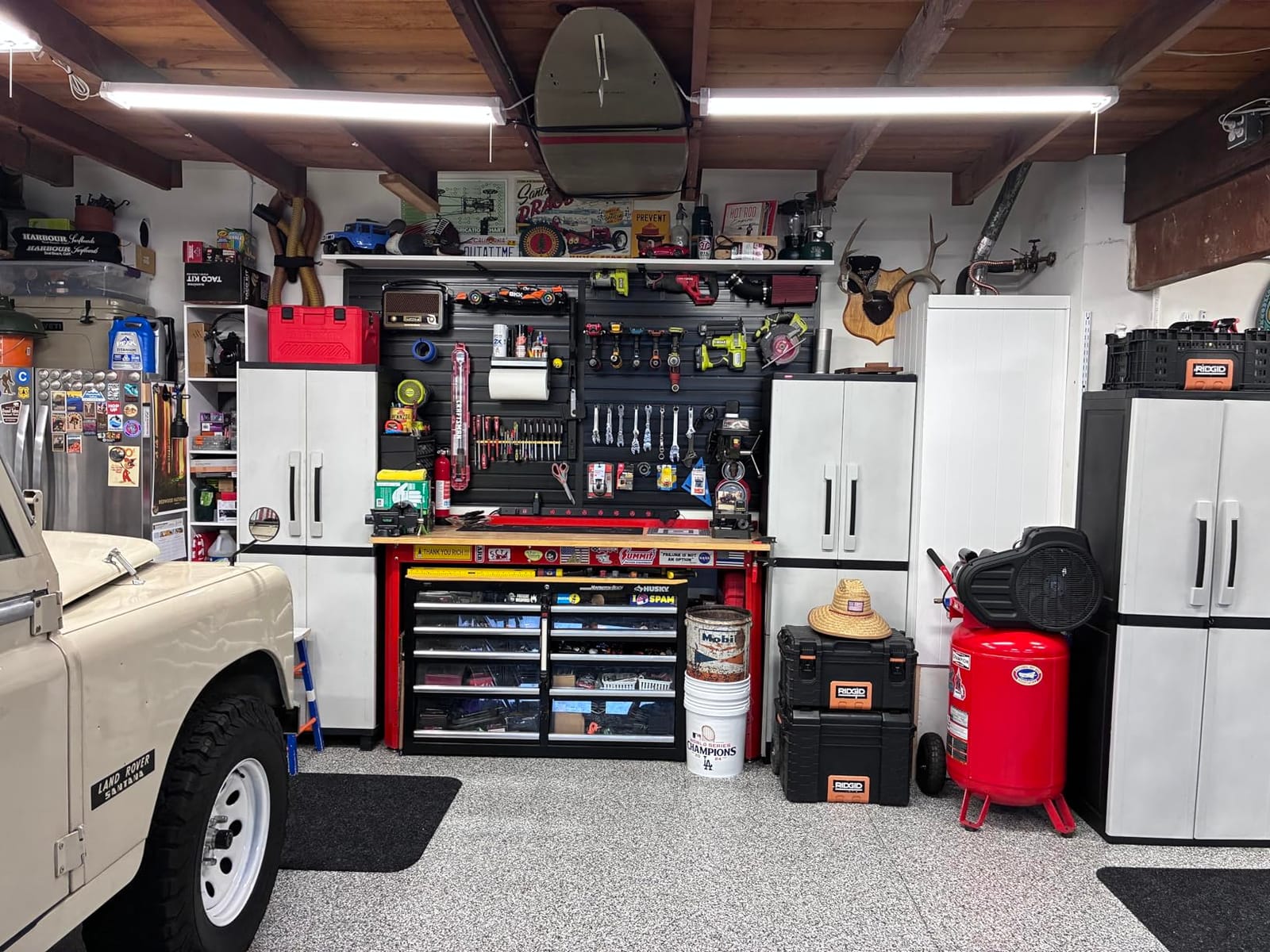
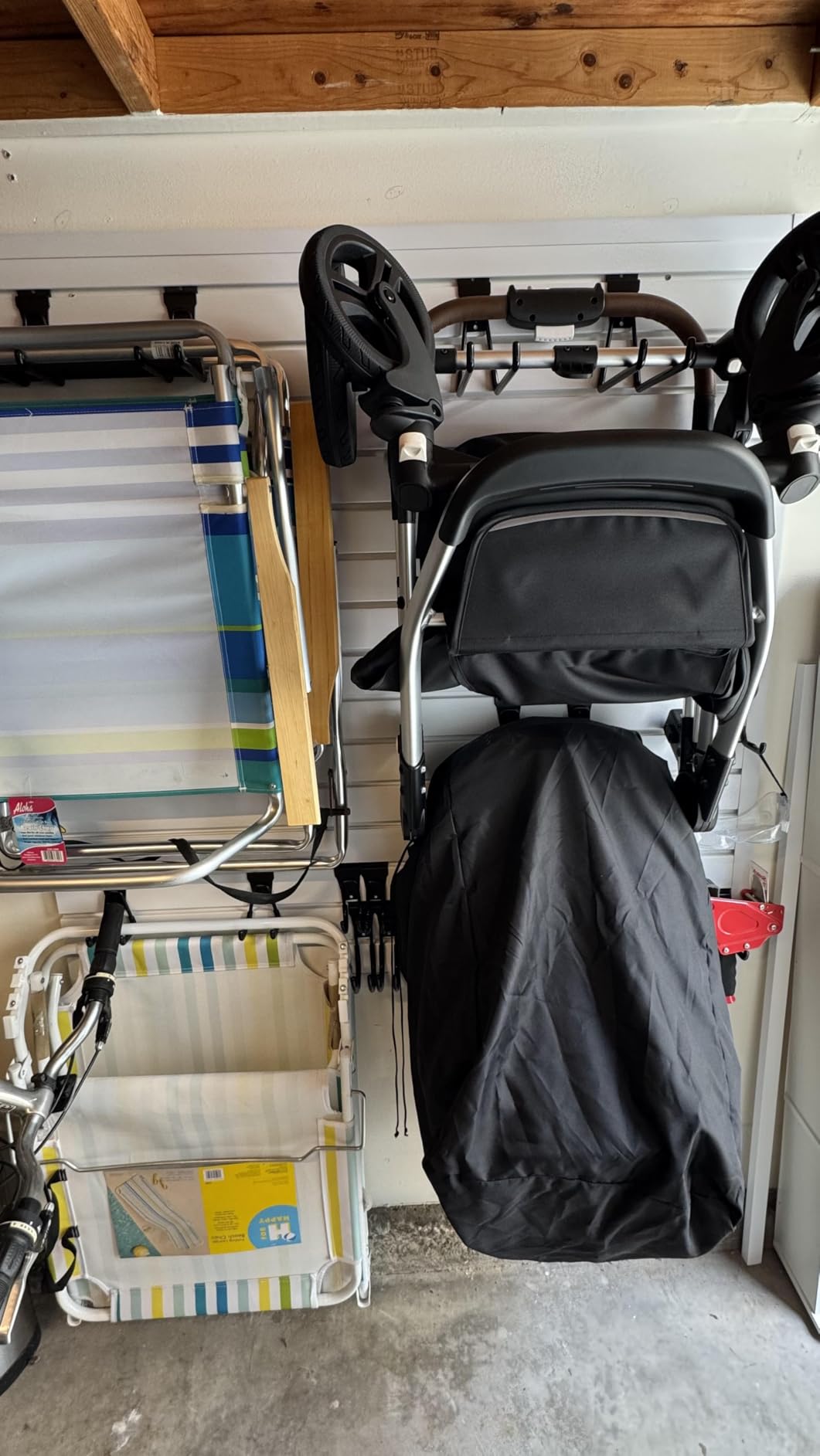
Owners appreciate making vertical wall space usable and the durability of the PVC build. The panels then provide the mounting surface for standard slatwall hooks, racks, and shelves, so this is a foundation you build on rather than a complete system on its own.
Two things to plan for. The panels are not structural and about 75 pounds is the recommended maximum, so do not plan to hang a heavy duty cabinet off them. And PVC slat spacing is narrower than metal slatwall, which means some accessory hooks designed for metal systems will not fit. Verify your hook pattern before you cover a whole wall.
Slatwall, pegboard, or wall track
No competitor covers this head to head, so here is the short version. Pegboard is cheapest and takes the most accessories, but pressed fiber pegboard tears out under heavy hand tools, which is the single most cited complaint from experienced homeowners. Slatwall is stronger and cleaner looking, holds more, and costs more. Wall track is the most flexible, since hooks move in seconds, but it is the least capacity per dollar for bulky items.
The recommendation we make most often: pegboard for light and medium hand tools in a dry corner, slatwall where you want a full finished wall, and rail track where the tool collection changes. Metal over PVC slatwall if your budget allows, mainly because of the hook compatibility and load rating.
Read the quality reviews before ordering
This is the lowest-rated product in the roundup at 4.4, with a visible share of one-star reviews. Owners point to quality control, with some panels arriving damaged or bowed, which is the main reason for the score. Inspect panels before you screw them up, because a bowed panel will not sit flat against the studs.
Accessories and hooks are not included, so treat the panel price as the starting point rather than the total. Budget for a compatible hook set before you commit, and check the slat spacing against the accessories you already own.
9. Gladiator 3/4 Door Wall Gearbox – Best for Lockable Storage
Gladiator Ready-to-Assemble 3/4 Door Wall Gearbox, GAWG28KD
28 x 28 x 12 in alloy steel
Lockable 3/4 door, two shelves
150 lbs per cabinet, 40 lbs per shelf
Pros
- Lockable steel cabinet secures tools and supplies
- Repositionable on Gladiator Wall Systems tracks
- Tread plate finish resists scratching
- 10-year limited warranty
- Adjustable full-width shelf
Cons
- Ready-to-assemble
- built on the floor first
- Track system sold separately
Everything on an open shelf is visible, which is a problem for expensive power tools, chemicals, and anything a household wants to keep secured. This lockable wall cabinet is the answer: 28 inches high by 28 wide by 12 deep, in alloy steel with a tread plate finish that shrugs off scratches.
The capacity ratings are honest and specific, which we like. It holds up to 150 pounds per cabinet and 40 pounds per shelf, and it comes with a full-width adjustable shelf plus an open bottom shelf for flat items. The three-quarter door gives you a wide opening for a cabinet this size, so you are not fishing things out through a narrow gap.
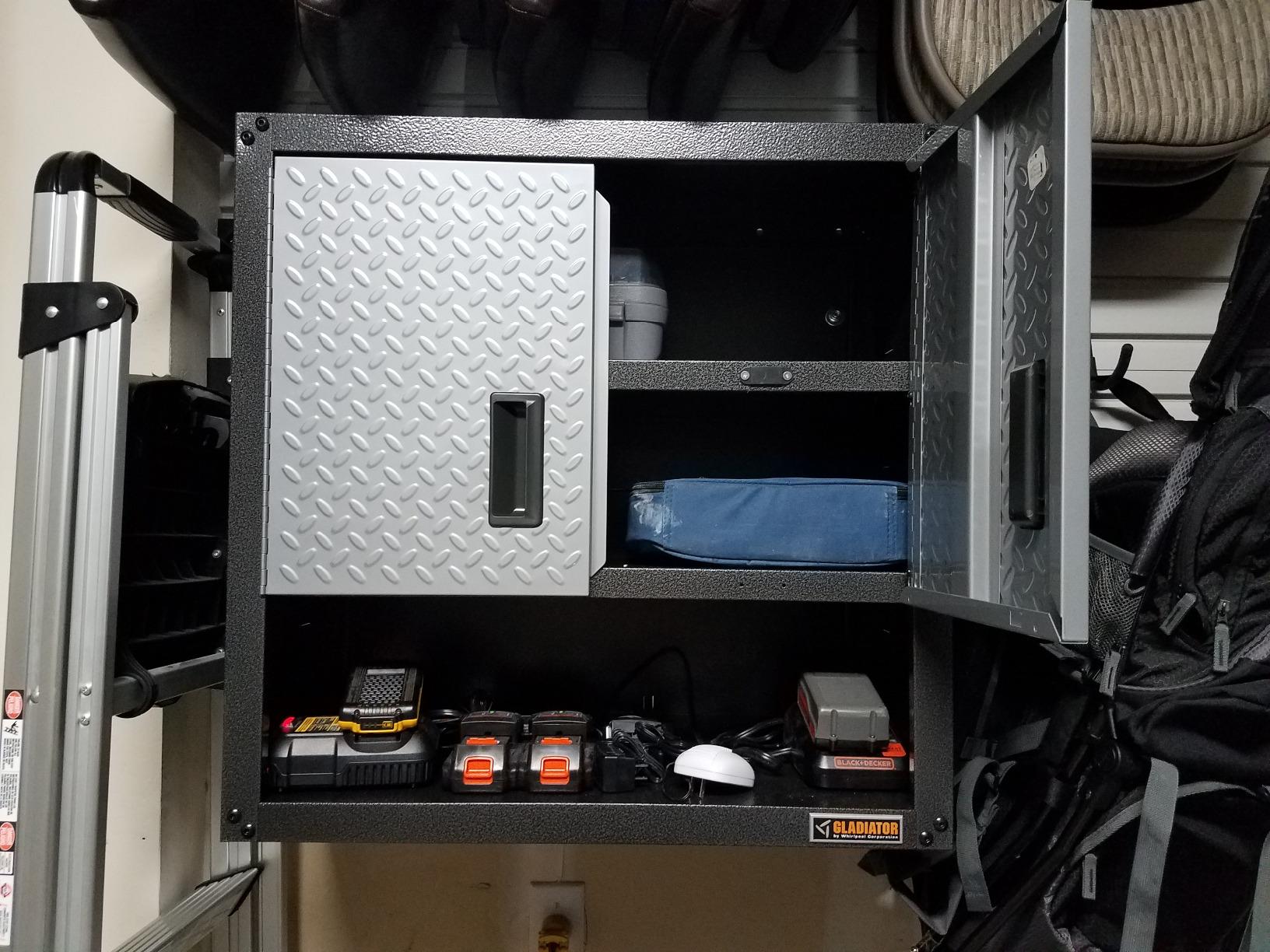
Owners value the steel construction, the lockable doors, and the flexibility of sliding the unit along Gladiator Wall Systems as the layout evolves. The included hanger brackets are what make that repositioning possible, and a 10-year limited warranty is longer than anything else in this roundup.
The trade-offs are the ones you would expect from a track-mounted cabinet. It is a ready-to-assemble unit, so you build it on the floor before mounting. The wall track is sold separately, which pushes the real cost of a complete wall setup well above the cabinet price for a single 28 inch cabinet.
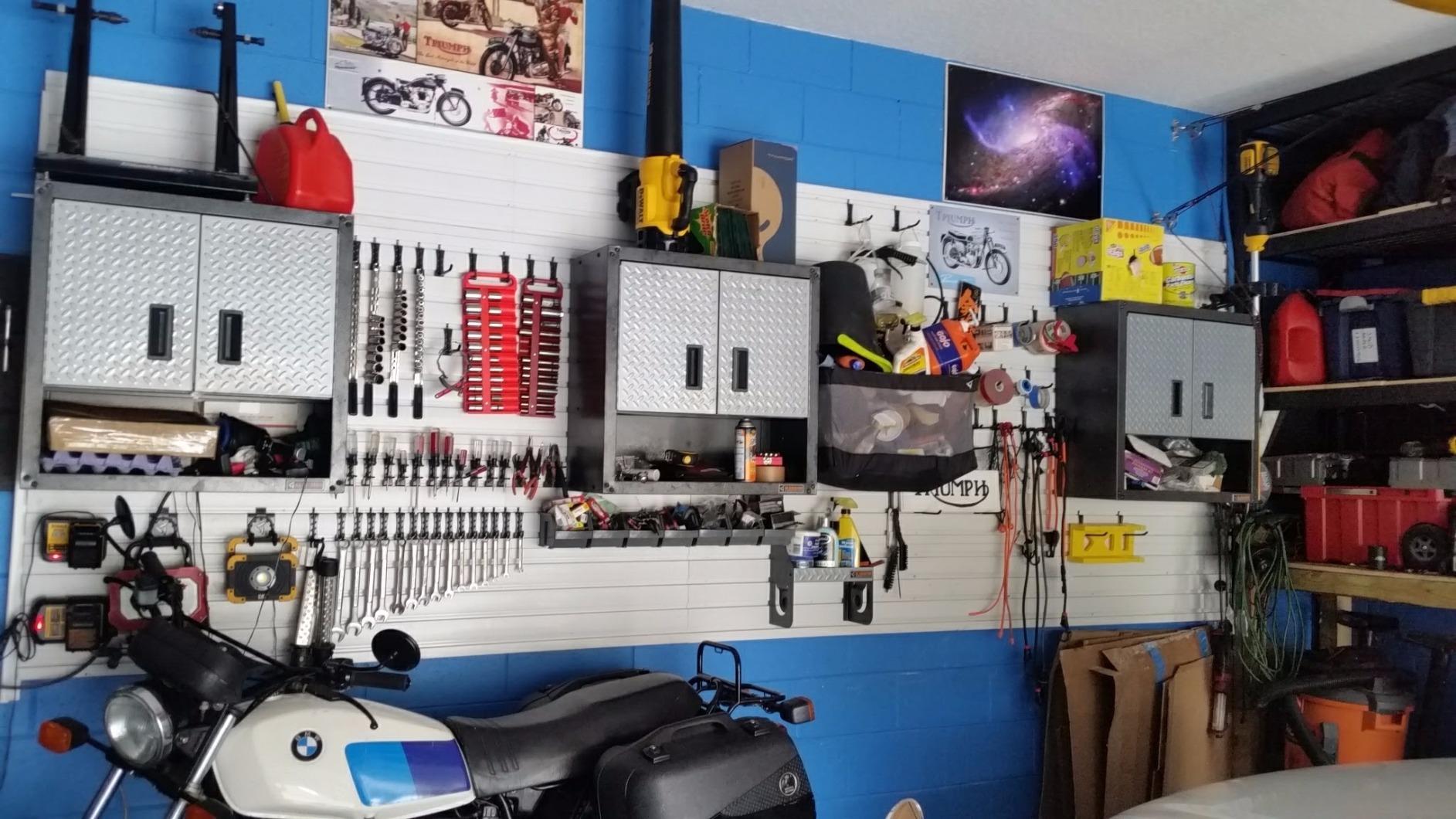
Where a lockable cabinet earns its cost
Buy one for security, not for bulk storage. A 28 inch cabinet is a home for the expensive things: battery packs, high-end power tools, spray and finishing products you do not want a child or a pet reaching, and the small parts that would otherwise be scattered. It holds 150 pounds, so it is genuinely load capable, but the volume is what limits it.
If you already own compatible Gladiator track, the incremental cost makes sense. If you are starting from an empty wall, budget for the track system separately, because the cabinet alone does not mount to drywall in any meaningful way.
Wall type matters for a mounted cabinet
A 150 pound cabinet hanging on a wall is a real load, and it must go into studs or into concrete with appropriate masonry fasteners. Drywall anchors are not adequate here regardless of what the installation instructions imply, and this is exactly the tipping and anchoring concern experienced homeowners raise most often.
Mount it high enough that the bottom shelf clears head height, low enough that the heaviest contents are reachable without a stool. If the cabinet is above a workbench, the open bottom shelf is the right place for the heavy items rather than the adjustable one.
10. FERO Lift System Overhead Rack – Best for Ladder-Free Lifting
Garage Ceiling Storage Racks – 4×8 FT Overhead Garage Storage Rack with Safety Lock, Heavy-Duty Ceiling Mounted Lift System and Storage Organizer, Ideal for Maximizing Overhead Space, 325 lbs Capacity
325 lbs capacity across 32 sq ft
Drill-operated lift lowers platform
Adjusts for 8-12 ft ceilings
Pros
- Drill-powered lift brings the platform to the floor
- No ladder climbing needed
- H-frame plus manual safety lock
- Platform adjusts for 8 to 12 ft ceilings
- Mounts on horizontal or vertical beams
Cons
- Lowest overhead capacity here at 325 lb
- Most expensive ceiling rack in the roundup
- Weighs 92 lb so two people are needed
Forum discussion about overhead racks converges on one safety point: racks installed without a plan for lifting are dangerous for anything heavy. This one solves that differently from every other overhead rack in the roundup. A drill-operated lift system lowers and raises the platform to the floor, so you load heavy bins at ground level and raise them into place.
The frame is an H-shaped steel design the brand has tested for over a decade, and a manual safety lock secures the rack during use. The platform adjusts up to 9 feet, which fits ceilings from 8 to 12 feet, and it installs on either horizontal or vertical ceiling beams. Capacity is 325 pounds across 32 square feet.
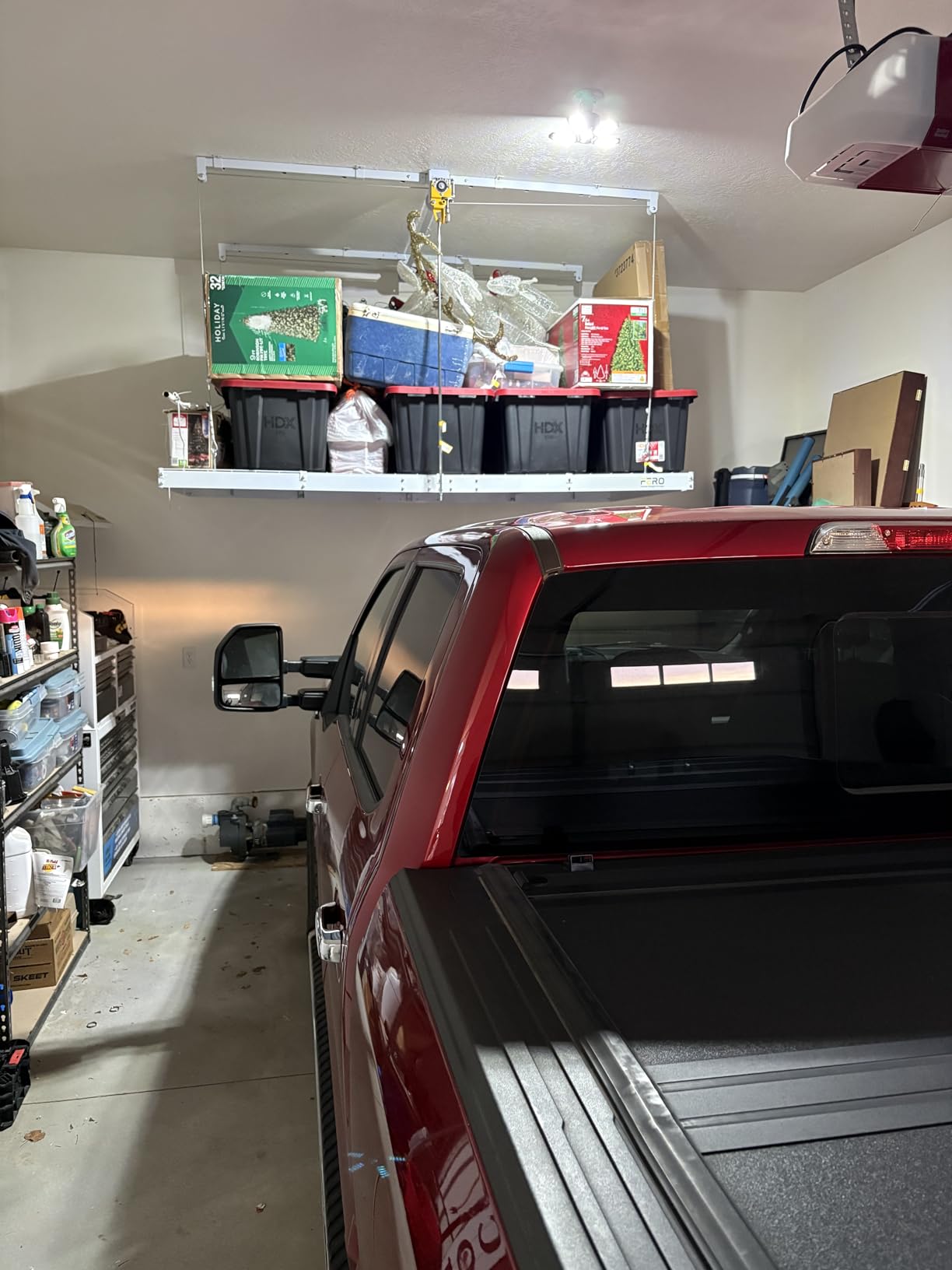
Buyers earn solid marks for the lowering system, which removes ladder use entirely, and for the stable H-frame with its safety lock. For a household with mobility concerns, back issues, or frequent heavy bins, that convenience is not a small feature. It is the reason to buy this rack over a stronger conventional one.
The trade-offs are real. Capacity is 325 pounds, roughly half the rating of the Fleximounts rack in position one, and it is by far the most expensive ceiling rack here. At 92 pounds the unit itself needs two people to install. With only 133 ratings, long-term durability is less well documented than the other picks, which is worth weighing on a purchase this heavy.
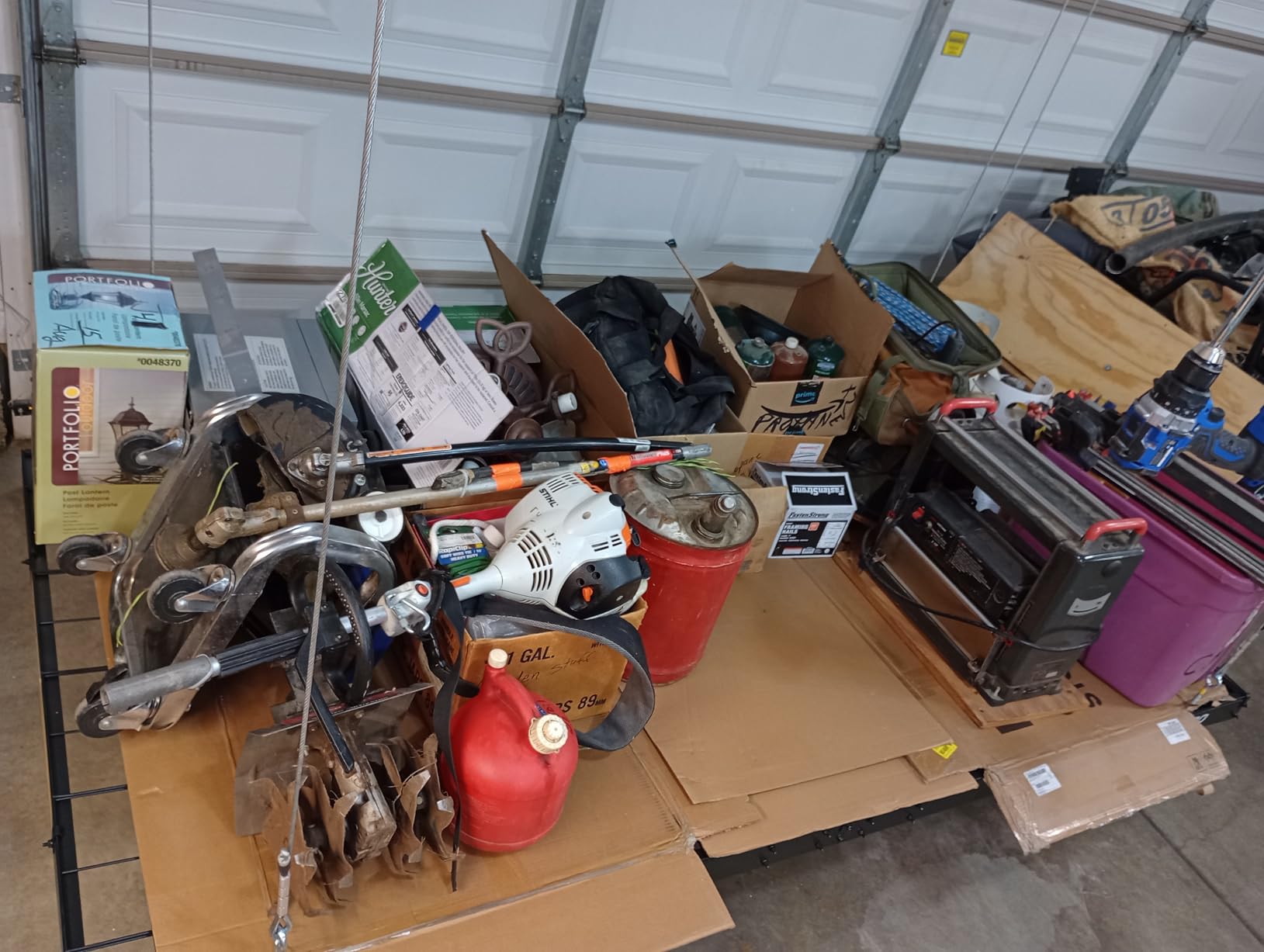
Who benefits most from the lift
Anyone storing dense items overhead. If the bins you put up there weigh 40 or 50 pounds each, lowering the platform first is the difference between a safe job and a strained one. That includes tool chests, shop equipment, and stacked storage totes rather than a few light seasonal boxes.
It also changes what you are willing to store up there. When loading happens at floor level, you will actually use the space instead of leaving it half empty out of caution. Homeowners who get into ceiling lifts rarely go back to a fixed rack.
Where the trade-off lands
If you only need to store light seasonal items, this rack is over-specified. A 750 pound conventional rack costs less, holds more than twice as much, and has 19,000 reviews of long-term feedback behind it. You would never need to lift it, because you would only be putting boxes on it.
The lift makes sense when weight and repetition are the deciding factors. Check the ceiling beam direction and joist spacing before ordering, since it mounts to both orientations but the fastener pattern still has to land in something structural.
11. SafeRacks White 4×8 Overhead Rack – Best for Large Overhead Volume
SafeRacks White 4×8 Overhead Storage Rack w/ 5-pc Hook Pack (24”-45″ Drop)
600 lb capacity, 120 cu ft
24-45 inch adjustable drop
14-gauge C-channel beams
Pros
- 600 lb capacity on 14-gauge C-channel beams
- 120 cu ft holds four bins with room
- Spare bolts and washers included
- Clear step-by-step instructions
Cons
- About four hours to install
- Wire deck is slippery
- Cross member can be too short if posts are mounted wrong
This is the other 4 by 8 overhead rack worth serious consideration, and it wins on volume rather than strength rating. At 600 pounds capacity with up to 120 cubic feet, it holds four standard storage bins with room to spare. The drop adjusts from 24 to 45 inches below the ceiling, which is a wider range than most competitors offer.
Build details are where it separates itself. It uses 14-gauge industrial steel C-channel beams with 27 inch ceiling brackets that have two anchor points per corner, so the load is spread across more than one joist per corner rather than hanging from a single fastener.
One detail we do not expect at this level: spare bolts, nuts, and washers come in the box. Almost nothing in this category does, and it is exactly the part you discover you need two hours into an install.
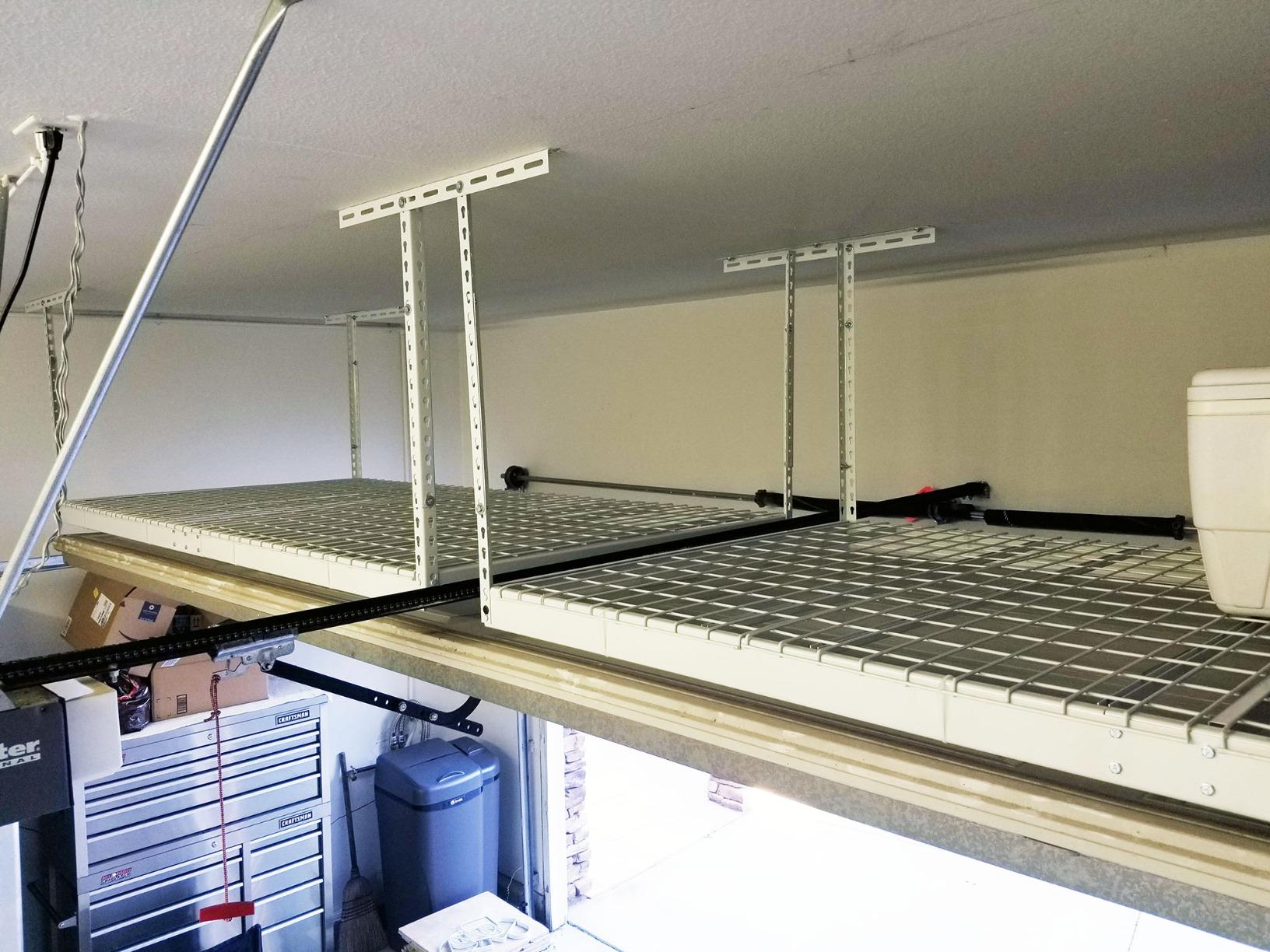
Long-term owners report the rack as very solid with no detectable movement when loaded, and the powder-coated white finish looks considerably better than homemade plywood shelving. Buyers also mention clear step-by-step instructions and a support center, and there is a nationwide network of certified installers if you would rather not do the ceiling work yourself.
Installation is still the dominant theme in the reviews, at about four hours for an average person, with finding the ceiling joists accurately as the real challenge. One specific confusion comes up repeatedly: the instructions tell you to measure from a bracket that is not installed yet. Mark the joist locations first and work from those marks.
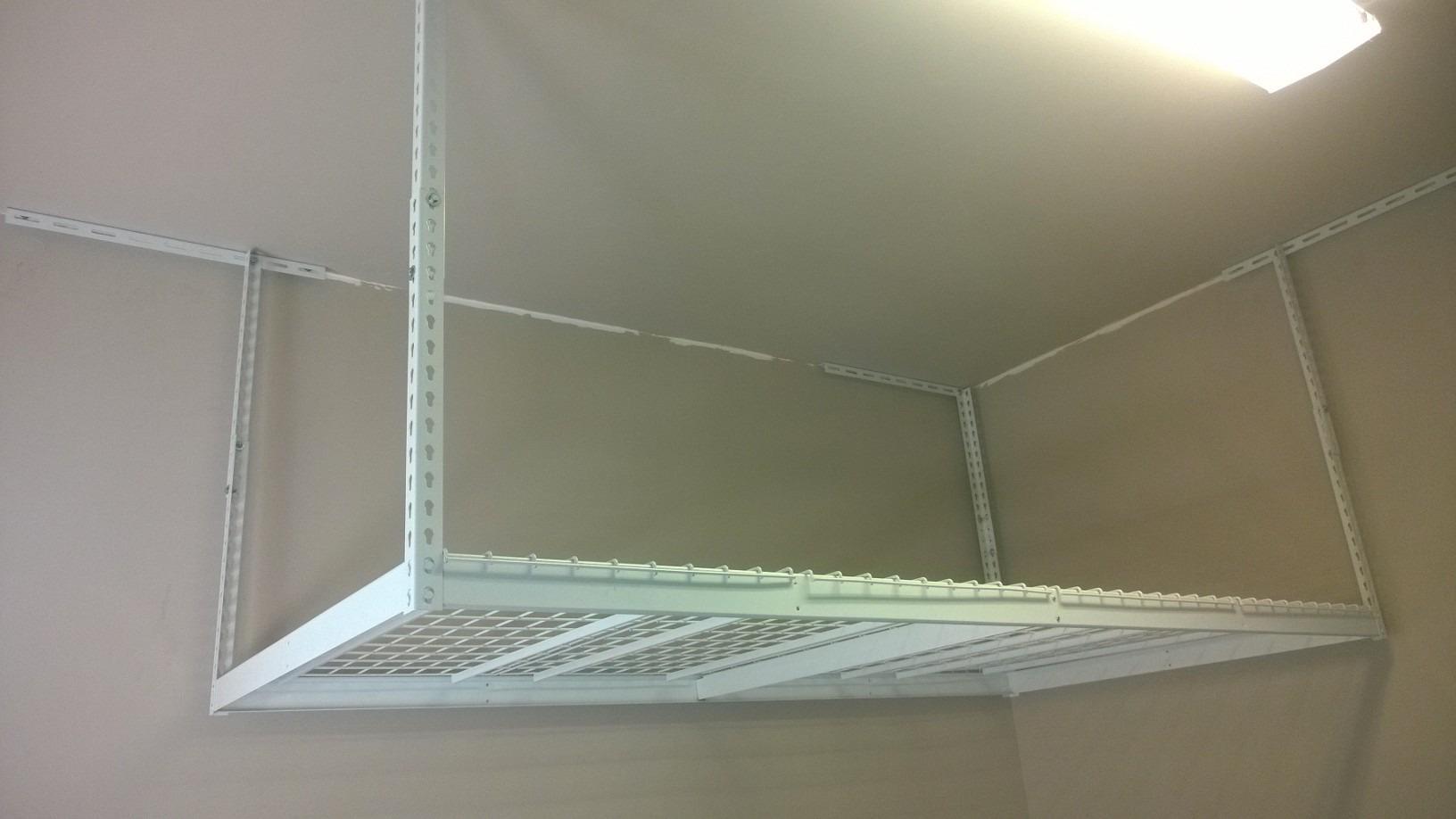
Why 120 cubic feet matters
Volume, not weight, is the constraint in most family garages. Christmas decorations, camping equipment, and seasonal clothing are light and bulky, and they lose to a lower-capacity rack that runs out of space before it runs out of strength. At 120 cubic feet this is one of the roomiest overhead decks in the category.
There is also a limited lifetime warranty when purchased directly from the manufacturer, which is a stronger commitment than most competitors in this roundup offer. The 4 by 8 footprint matches the joist layout of most single-bay American garages, which makes it the safer default size.
Two fixes before you load it
The wire deck is smooth and holds bins in place by gravity alone, so bins slide as you load them. Zip ties or bungee cords are worth adding on day one. And check that the vertical posts are mounted on the correct side of the brackets, because a cross member can end up too short if they are reversed and the whole rack sits slightly out of square.
Weight goes on evenly across the deck rather than in one corner, and the heaviest bins go nearest the brackets rather than the centre, where the load sags most. Budget four hours and a helper for a careful install.
12. HANDT Connectable Overhead Ceiling Rails – Best for Add-On Rail Storage
USA Based Overhead Garage Storage Rack, Connectable Heavy Duty Metal Ceiling Rails Garage Storage Organization Shelving System, Hanging Racks Tote Containers, Supports Up To 6 Bins, 4 Sets Black
100 lbs per set, 4 sets included
17 in rails that fit 16 in joists
Powder coated steel
Pros
- Connectable design grows to fit any garage
- 17 in rails slot between 16 in joists compactly
- Each rail rated independently at 100 lb
- Optional safety bolts lock bins in place
Cons
- Lowest-rated product here at 4.4
- Only about 100 lb per 17 in rail
- Bulky items like bikes will not fit
Most overhead racks are a big single purchase. This is the opposite idea: a modular rail system you grow a few feet at a time. Each set includes a 17 by 3 by 3 inch double rail rated for 100 pounds, and this pack has four sets. Each rail slots neatly between 16 inch joists, which is standard in most garages.
The double-rail design is the clever part. It allows a second row of overhead storage to be added later, so you can start with four sets and extend without replacing anything. Optional safety bolts lock the rails in place so storage bins cannot slide out, and all assembly parts are included.
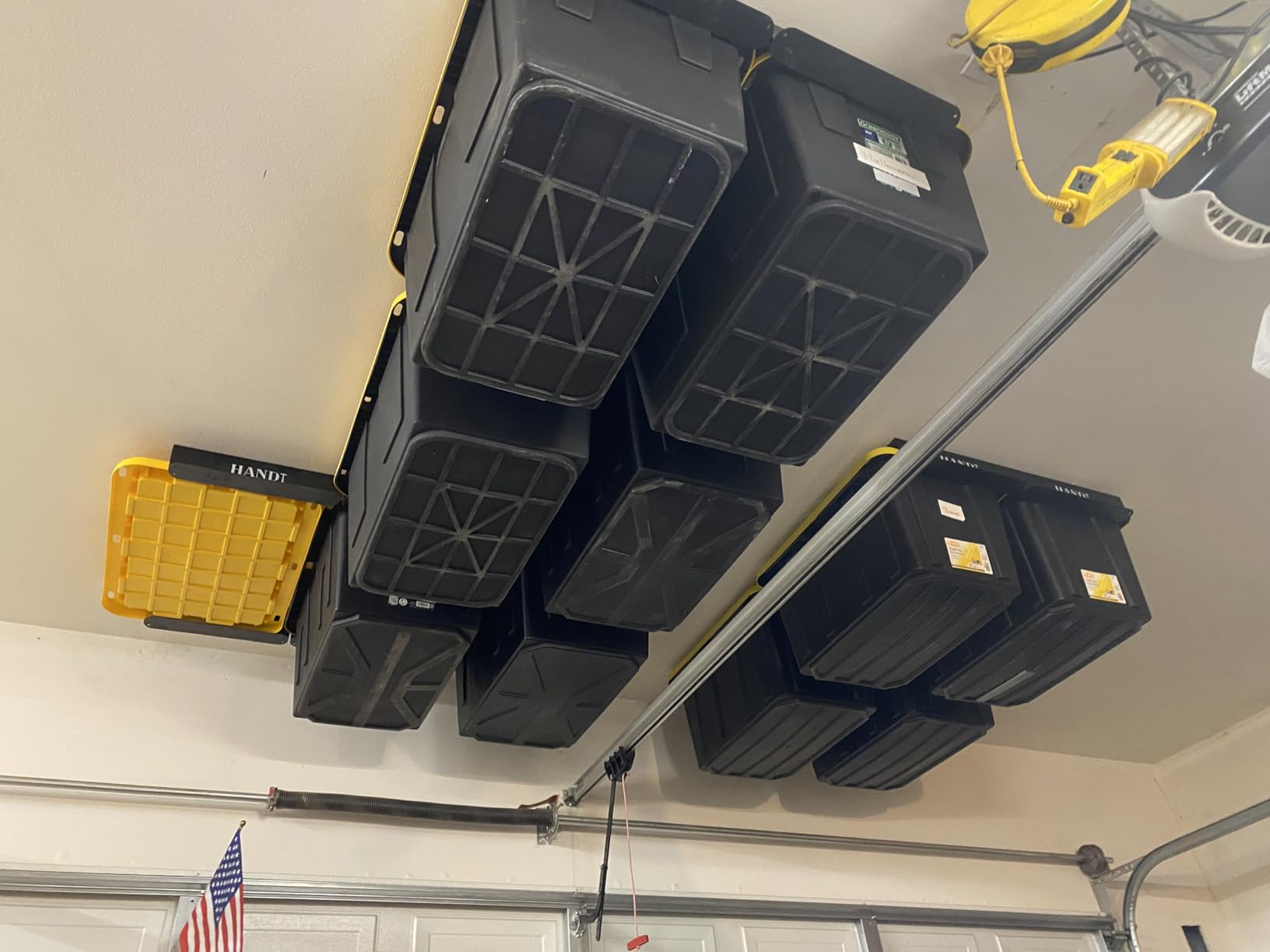
Buyers value the connectable, joist-friendly format for its compact footprint and the ability to unlock a second storage row over time. The USA-based family-owned brand and included hardware both come up favourably in reviews, and spreading four sets across multiple joists is a sensible way to distribute the load.
The rating is 4.4 with the highest one-star share in the roundup, and the reason is mostly expectation setting. A 100 pound rating per 17 inch rail is roughly a seventh of what a full overhead deck carries, so anyone expecting a heavy-duty ceiling rack will feel the difference. The bins these rails hold are also small, meaning bikes and large totes simply do not fit.
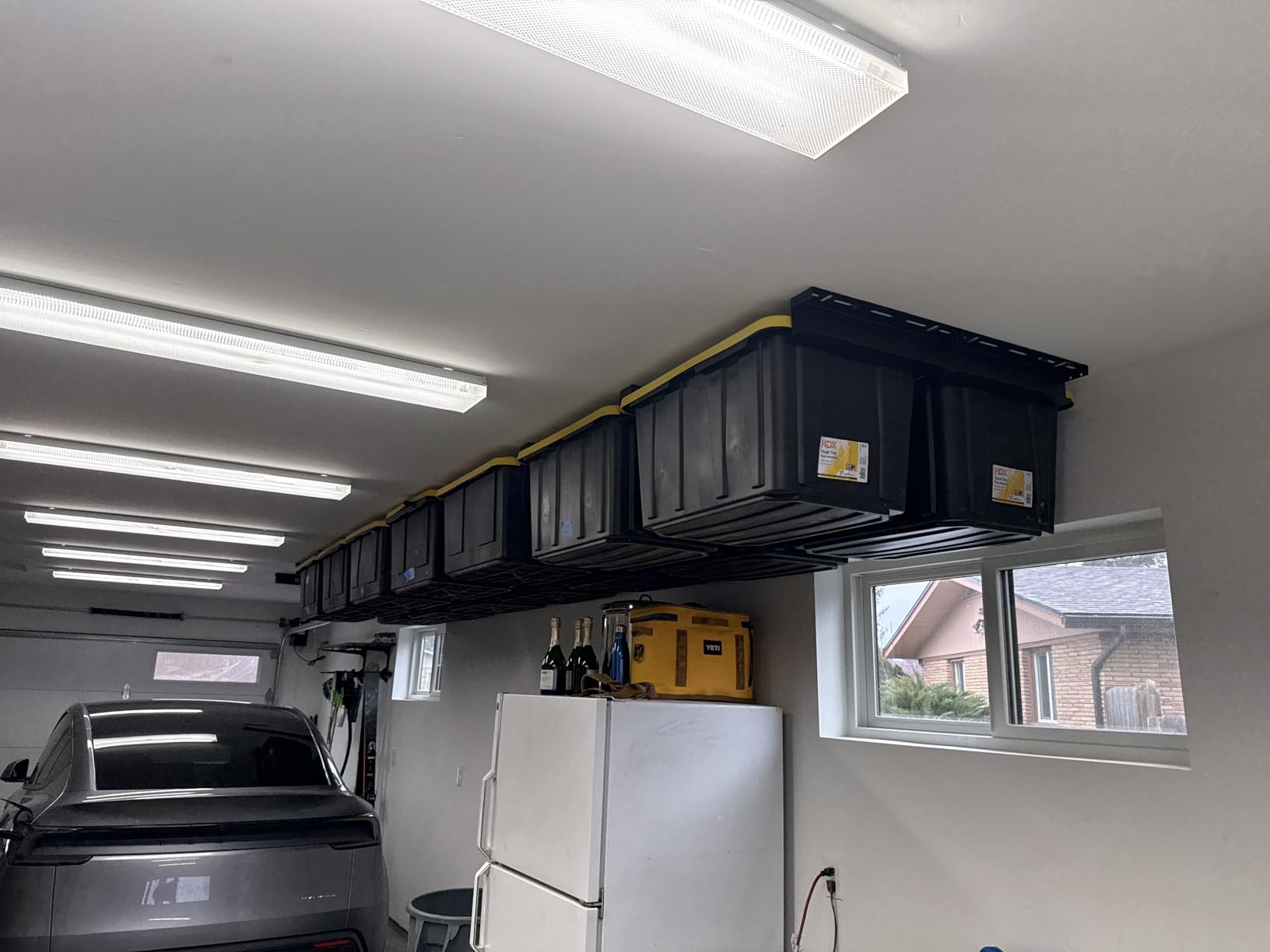
When a 100 pound rail is plenty
Small bins of light material: packing materials, holiday decorations, camping dish and stove kits, seasonal clothing, gardening supplies, and the small number of boxes per category that most households accumulate. If the contents weigh under 30 pounds per bin, a 100 pound rail has plenty of headroom.
This is also the pick to grow into rather than commit to. Buying two sets now and four more next year costs the same in total and means the garage is not full of empty deck space for a year. That incremental expansion plan is a real advantage of modular systems.
Joist spacing decides everything
On 16 inch joists, a single rail fits directly. On 24 inch joists you need two or more rails connected end to end, which adds installation work and means the bin spans a joint. Find your joist spacing with a stud finder before ordering, because it determines whether this pack works for you as-is.
Install the optional safety bolts even if everything feels stable at first. A bin sliding out of an overhead rail onto a parked car is the kind of failure nobody plans for and everybody regrets, and the bolts are already in the box.
How to Choose a Garage Storage System Step by Step
A garage storage system fails when it is sized to the pile rather than the space. Work through these six steps in order, and the category and product choices make themselves.
Step 1: Declutter and inventory before buying
Communities that organize garages repeat the same advice in every forum thread: inventory and discard first. Sort everything into keep, donate, sell, and trash, and count what survives. You are looking for two numbers: how many items and how much weight. Those two numbers decide whether you need one shelf unit or a full wall system.
This step also tells you what is seasonal and what is daily. Anything you touch more than weekly does not belong overhead, which is a rule experienced organizers apply consistently.
Step 2: Measure the bay, the wall, and the ceiling
Measure the floor area you can use without blocking a vehicle door or a walkway, then measure the wall run above it and the distance from the ceiling to the top of the lowest obstruction like a garage door opener rail. For overhead racks, check joist spacing with a stud finder: 16 inch spacing fits the compact rails, 24 inch spacing needs connected rails or a full deck.
Do not skip the ceiling check for overhead racks. The Fleximounts rack drops from 22 to 40 inches, and the SafeRacks rack from 24 to 45, so a low ceiling limits you to the shallowest setting and eats into headroom over the vehicle.
Step 3: Match shelf depth to your bins
Totes are typically 18 to 27 inches deep. A 14 inch shelf fits almost nothing; a 24 inch shelf swallows a standard tote. Allow a few inches of lid clearance above each bin or the lid catches the shelf above, which is the most common reason wall shelving gets abandoned. The FLEXIMOUNTS wall shelves in position four are the right answer at 24 inches deep; the caster unit in position two is better for small items.
Step 4: Read per-shelf load, not total load
This is the technical detail most buyers get wrong. A 3200 pound total rating across five tiers is 640 pounds per tier, and a 1500 pound total across five shelves is 300 per shelf on leveling feet. Sellers quote the total because it is a larger number. Plan against the per-shelf figure, and check whether casters reduce it, because they do.
Step 5: Pick your wall system
Pegboard is cheap and takes the most accessories, but pressed fiber tears out under heavy hand tools. Slatwall is stronger and cleaner, costs more, and covers a whole wall. Wall track is the most flexible because hooks move, but holds the least per dollar for bulky items. Most garages end up using more than one, which is fine as long as they are not competing for the same wall.
Step 6: Zone everything by height
The ergonomic rule experienced organizers use is simple: frequent items between knee and shoulder height, heaviest items lowest, once-a-year items highest. Put a workbench surface at standing height, daily hand tools on a rail just above it, and seasonal bins on shelving at chest height. Overhead is for bulky, light, infrequently used items only, and anything heavy up there needs a loading method that does not involve a ladder.
Match the system to your garage type
A storage-only garage can get most of its value from shelving and overhead racks with almost no wall system. A workshop needs a bench, a rail wall for hand tools, and a spot for bulky materials like lumber and sheet goods. A two-car or shared family garage lives or dies on floor space, so overhead and wall systems do more work and floor units get narrower. The wide unit in position five suits a workshop bay; the caster unit in position two suits the gap beside a car.
Installation, Anchoring and Garage Safety
Almost every failure in a garage storage system is a fastening failure. Tall shelving and wall cabinets are top-heavy, and an unanchored unit is a genuine hazard to a vehicle and to anyone nearby.
Anchor to studs, not drywall
Wall-mounted shelving, rail systems, and cabinets should go into wall studs wherever possible. Where there is no stud, add wood blocking or sister a two-by-four onto the framing rather than relying on drywall anchors alone. On a concrete or masonry wall, use appropriate masonry fasteners and an impact driver to set them. The FLEXIMOUNTS wall shelves use three lag bolts per bracket for exactly this reason.
Add casters to base units
The most repeated tip in garage communities is to put base cabinets and low shelving on casters. It costs very little and it means you can roll the unit out to sweep, reach behind it, or move it for a project. The Amazon Basics unit in position two ships with both leveling feet and four inch casters so you can use whichever suits each shelf.
Keep the right things overhead
Overhead storage is for bulky, light, infrequently used items: holiday bins, camping gear, seasonal clothing, and lightweight spare parts. It is not for daily-use tools, and it is not for anything you cannot lift safely from a ladder. If a load is heavy, use a rack with a lowering mechanism, or keep it at floor level. Also check your vehicle clearance, and never store anything above a car that can fall if the rack is bumped.
What not to store in a garage
Some items do not belong in a garage at all. Propane tanks, fuel, gasoline, and lithium-ion batteries are the clear ones, because temperature swings in a garage are exactly the conditions those products are not designed for. Keep flammables and any battery pack that has been damaged out of the space entirely, and store chemicals in a lockable cabinet away from heat, which is one genuine use for the wall gearbox in position nine.
Frequently Asked Questions
What is the best garage storage system?
The best garage storage system is a combination, not a single product: heavy-duty shelving for bins, wall-mounted track or slatwall for hand tools, and an overhead ceiling rack for bulky seasonal items. In this roundup the FLEXIMOUNTS 4×8 overhead rack is the strongest single piece for floor space, the Amazon Basics 5-shelf caster unit is the most flexible for everyday storage, and the Rubbermaid FastTrack rail kit is the best wall option.
What size shelving is best for a garage?
For standard totes, 18 to 27 inches deep, 24 inches deep shelving is the safest choice because a normal tote fits with the lid clear. Allow a few inches of lid clearance above each bin or lids catch the shelf above. Adjustable shelving with one-inch height increments is useful when bins are not a uniform size, and 16 inch stud spacing fits most wall-mounted shelf brackets.
Do garage storage cabinets rust in a garage?
It depends on the finish, not the garage. Powder-coated steel and sealed finishes resist rust and oxidation well in a damp garage, which is why the wide shelving unit in this roundup is coated rather than painted. Uncoated or painted-over steel can spot rust in a humid space. Wiping surfaces down and keeping items off the concrete floor reduces moisture exposure more than any coating does.
How do I install a garage storage system?
Start by finding studs or joists and marking them clearly. Wall shelving goes into studs or into added wood blocking, never drywall anchors alone. Ceiling racks need two anchor points per corner into joists, and drop height is adjusted before tightening. Anchor tall shelving and cabinets to the wall at the top, add anti-tip hardware where it is supplied, and allow about four hours per ceiling rack or two for a shelving unit.
Can garage storage cabinets be mounted on a concrete wall?
Yes, with masonry fasteners and a hammer drill. The FLEXIMOUNTS wall shelves in this roundup are rated for wood studs, concrete, and brick, though they cannot be mounted on metal stud walls. A 28 inch lockable wall cabinet is heavy, so it should go into concrete with anchors rated well above its 150 pound capacity, and above a workbench so the bottom shelf clears head height.
Conclusion
The best garage storage systems earn their cost by giving every category a fixed place and a fixed height. After testing and comparing 12 of them, the FLEXIMOUNTS 4×8 overhead ceiling rack is the clear winner: 750 pounds rated, tested to 1200, an adjustable 22 to 40 inch drop, and enough volume to take four large totes off the floor for good.
For everyday storage, the Amazon Basics 5-shelf caster unit is the value pick, and for hand tools the Rubbermaid FastTrack rail kit does more with a few square feet of wall than anything else we tested. Fill the gaps with 24 inch deep wall shelves for standard bins, and use a modular rail ceiling system if you would rather grow into the setup than commit to it all at once.
Declutter first, measure your joists and bay, anchor everything into studs or concrete, and keep heavy items low. Get the 2026 setup in place in stages and your garage will stay usable in 2026 and every year after, not just the week you organized it.