
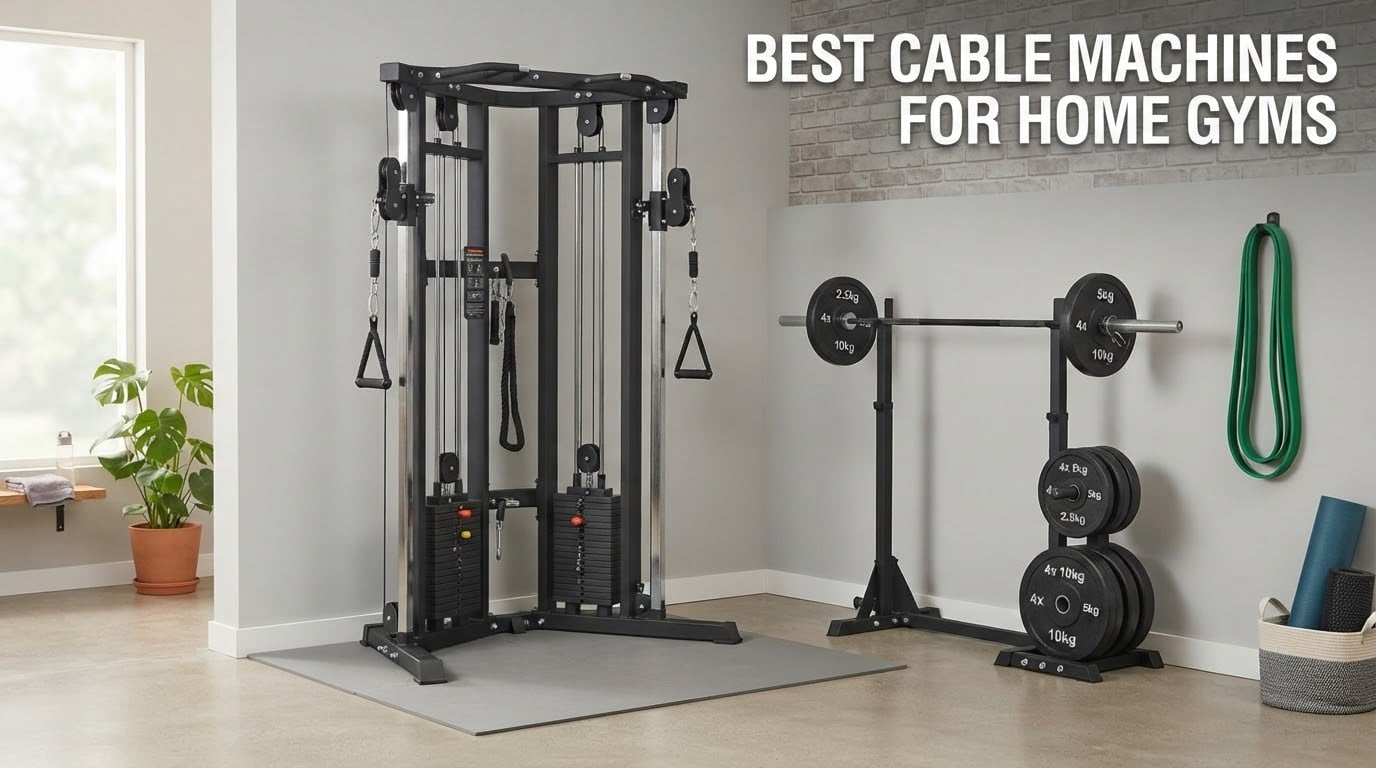
Here is the short answer: the Mikolo LAT and Lift Pulley System is the best cable machine for most home gyms in 2026, because it pairs a 4.6 rating with the largest review base in this group. It hangs from a rack or bar you already own, takes plates you already own, and holds up to 280 lb. If you have no frame at all, the routing changes — start at the GDLF freestanding lat and row station, or the Body-Solid Powerline PFT100 if two people will train together.
That split matters, because “cable machine” covers four very different formats. A rack attachment is a set of pulleys on a strap. A cable tower is a single vertical column with a stack or plate horns. A wall-mounted unit bolts to studs and gives you a high pulley and a low pulley in a corner. An all-in-one or power rack pairs the cables with squat bars, J-cups and a pull-up station. Buyers routinely cross-shop them as if they were interchangeable, and then find out the one they wanted cannot go where they wanted it, or cannot reach high enough for an overhead press.
Is a cable machine good for a home gym? Yes, and arguably more so than free weights for most people. Cables let you train through a constant line of tension across dozens of angles, they cover movements a barbell cannot such as cable flyes, face pulls, straight-arm pulldowns and leg curls, and the load sits inside a stack instead of on a plate you have to re-rack. Add roughly a dozen movement patterns to a rack-and-bench setup and you replace a second machine without adding a second machine’s footprint.
We spent October 2026 comparing ten of the most-reviewed cable options available for home gyms, from a hand-sized pulley attachment to a 544 lb dual-stack functional trainer. What cable machines do gyms use? Commercial gyms lean on tall dual-stack functional trainers with independent stacks, plus plate-loaded low rows and high pulleys on the floor. The home versions trade stack size for footprint, and the trade is where most buying mistakes happen. Here is how each one holds up.
If you want the hardware side covered first, our smart home gym picks and elliptical reviews cover the other two big-ticket cardio and strength buys for a spare room.
Table of Contents
Top 3 Best Cable Machines for Home Gyms (October 2026)
Our overall pick, value pick and budget freestanding frame all come with clear reasons attached. Every one of the ten machines below earned its place on strength, adjustability or footprint rather than on brand name.
Mikolo LAT and Lift Pulley System
- 280 lb capacity loading pin
- 70 inch and 90 inch cables
- Two exercise modes

SERTT Weight Cable Pulley System
- Two pulleys plus accessory set
- Mounts to racks bars and beams
- Quiet smooth cable travel

GDLF LAT Pull Down Machine
- Freestanding 77 inch frame
- High and low pulley stations
- 500 lb maximum weight
Best Cable Machines for Home Gyms in 2026 At a Glance
The table below is the fast version of the full reviews. Every pick is listed with the format it belongs to, the resistance style it uses and the capacity that decides whether it fits your training.
| Product | Specifications | Action |
|---|---|---|
| Mikolo LAT and Lift Pulley System |
|
Check Latest Price |
| SERTT Weight Cable Pulley System |
|
Check Latest Price |
| GDLF LAT Pull Down Machine |
|
Check Latest Price |
 Valor Fitness Wall Mounted Cable Machine Valor Fitness Wall Mounted Cable Machine |
|
Check Latest Price |
 LIONSCOOL Multifunctional Wall Mounted Pull Up Bar LIONSCOOL Multifunctional Wall Mounted Pull Up Bar |
|
Check Latest Price |
 Mikolo Folding Squat Rack WR00 Mikolo Folding Squat Rack WR00 |
|
Check Latest Price |
 Body-Solid Powerline PFT100 Body-Solid Powerline PFT100 |
|
Check Latest Price |
 Inspire Fitness FTX Inspire Fitness FTX |
|
Check Latest Price |
 Mikolo Wall Mount Cable Station M-G3 Mikolo Wall Mount Cable Station M-G3 |
|
Check Latest Price |
 MAJOR FITNESS F22 Power Rack MAJOR FITNESS F22 Power Rack |
|
Check Latest Price |
1. Mikolo LAT and Lift Pulley System – Best Overall Cable Add-On for an Existing Rack
Mikolo Fitness LAT and Lift Pulley System, Dual Cable Machine(70” and 90”) with Upgraded Loading Pin for Triceps Pull Down, Biceps Curl, Back, Forearm, Shoulder-Home Gym Equipment(Patent)
280 lb capacity loading pin
70 inch and 90 inch cables
Alloy steel pulley
10 x 11 x 10 inch
Pros
- Largest review base in this group with a 4.6 rating
- Upgraded loading pin accepts standard or Olympic plates
- Silent steel pulley
- Two cable lengths for more setups
Cons
- Needs a rack bar or beam to hang from
- Loading pin takes up bar sleeve space
- Only a few cable angle options
The first thing to know about this Mikolo is that it is not a machine. It is a pulley block with a loading pin that hangs from a pull-up bar, a power rack upright or a ceiling beam, and it is the reason we ranked it first. Across more than four thousand reviews it holds a 4.6 average, and the complaints that do surface are about convenience rather than failure.
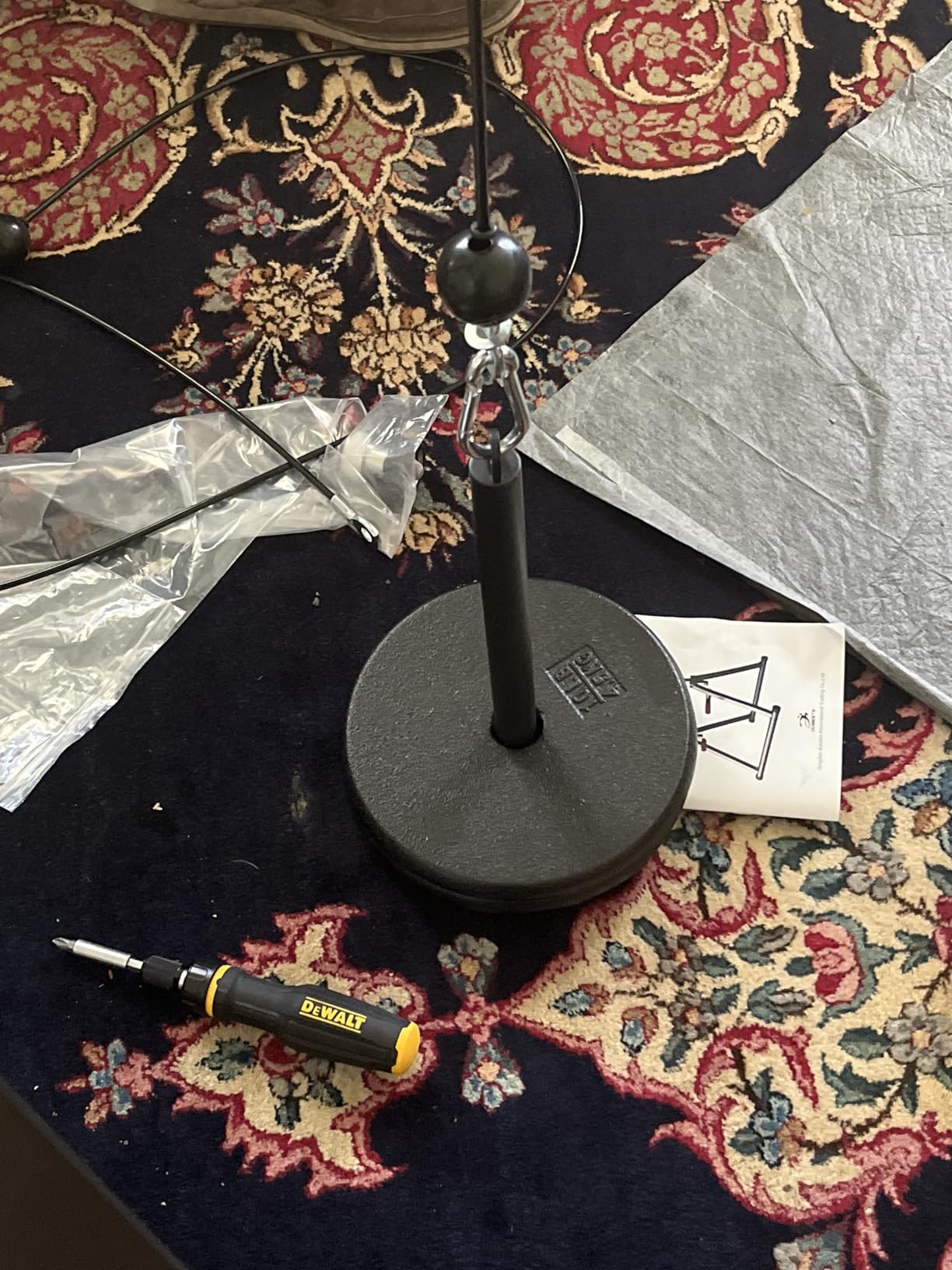
The loading pin is the design decision that matters. It uses a barbell clamp, so you can load standard 1 inch plates or Olympic plates up to the rated 280 lb without hunting for collars. Buyers who came from a single-pin version treat that upgrade as the reason the unit no longer wobbles when the weight swings.
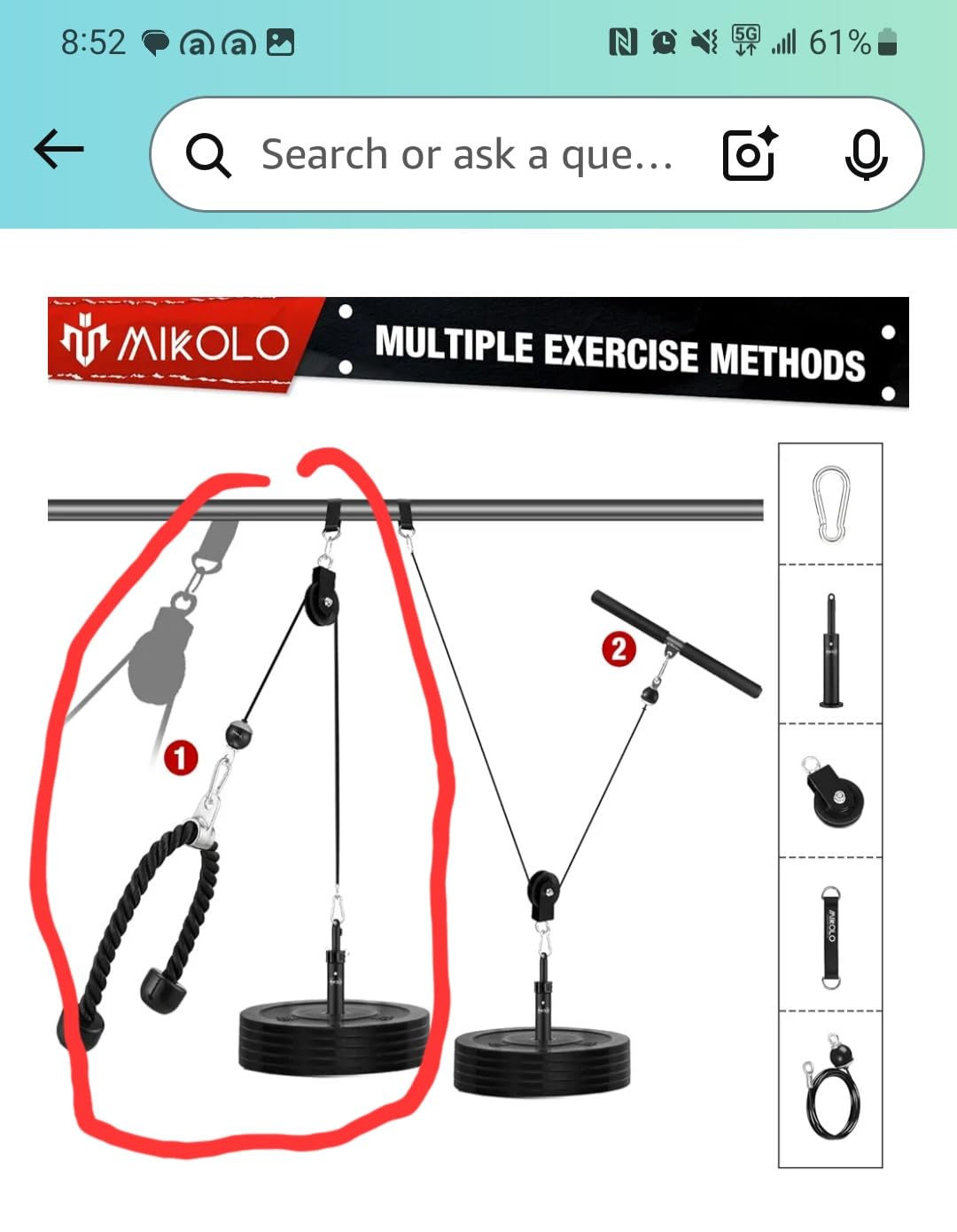
Everything else is deliberately simple. You get two sheathed cable lengths, a heavy-duty steel pulley described as silent in use, and two modes — pull down and lift up — that double the number of angles you can hit. The whole block measures roughly 10 by 11 by 10 inches, so it disappears when you are not using it.
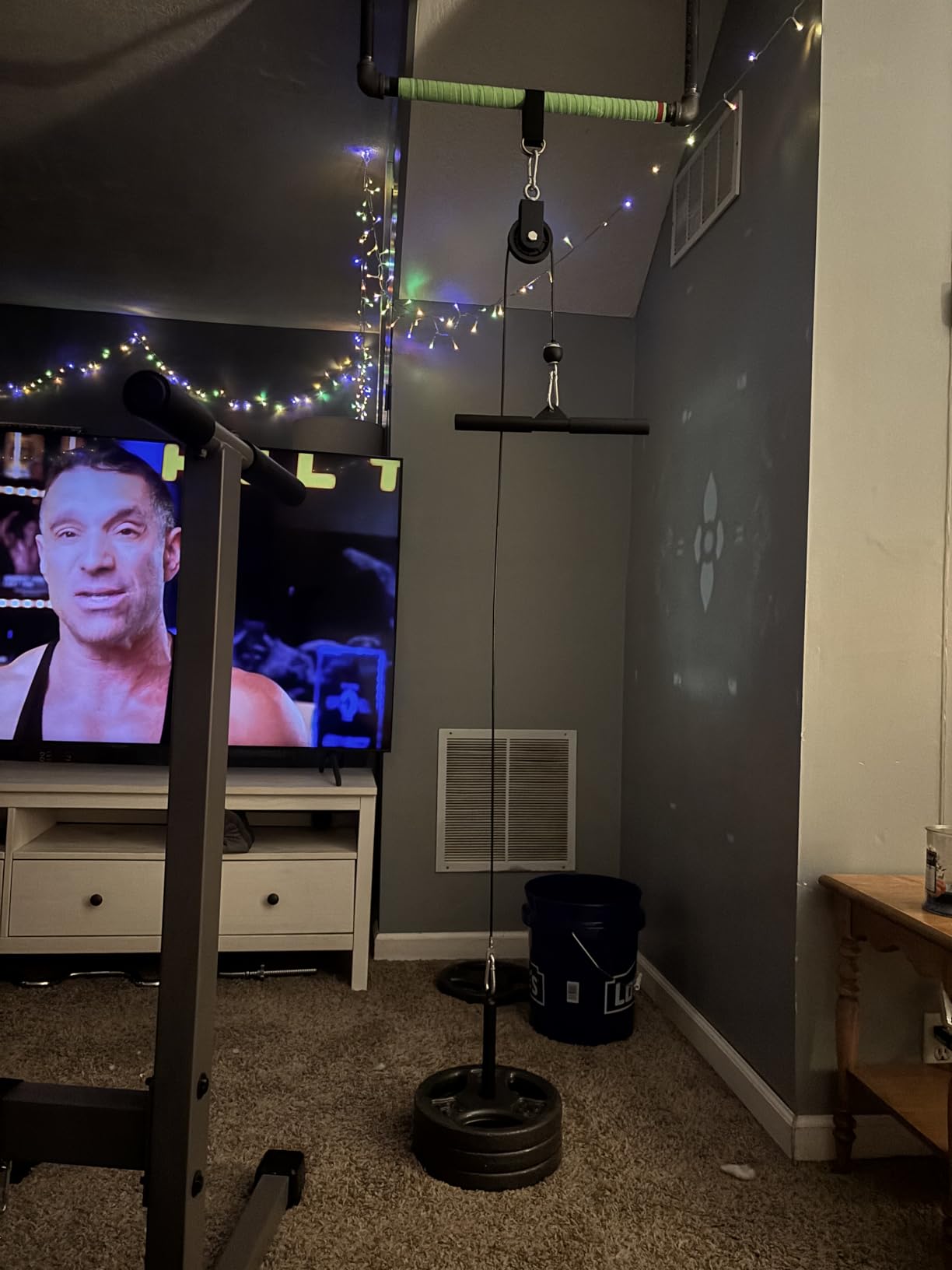
Because the pulley rides wherever you hang it, the exercise library depends on your anchor point. On a rack upright at the top of a pull-up bar you get a high pulley for rows, lat work and face pulls. Lower on an upright and you get a low pulley for curls, pressdowns and glute kickbacks. Swapping between the two cable lengths shifts the working height without moving the machine.
The cable coating is where cheap units usually fail, and this is one of the recurring reasons people buy a second pulley system later. Reviewers report sheathed cables that still look intact after months of use, and the pulley itself is steel rather than the plastic wheels that show up on entry-level kits.
One honest limitation: the loading pin occupies part of the bar, so if you planned to use that same sleeve for a barbell set, you have to pull the pin first. It is a small friction point that becomes obvious only if you use one bar for everything.
Best When You Already Own a Rack, Bar or Beam
This is the machine to buy if a power rack, pull-up bar or ceiling joist is already in your gym. It costs a fraction of any freestanding frame and it adds the entire pulling and pressing vocabulary that free weights cannot cover. Owners with a squat rack report using it for lat pulldowns, rows, curls, pressdowns and face pulls from a single anchor point.
For a first home gym on a tight budget, it is also the most honest starting move. You can buy plates and a bar you will use for squats and press, then get cable movement for the price of a single accessory rather than a new tower.
Skip It When You Need a Standalone Frame or Heavy Bilateral Work
Because there is only one cable line, you cannot do a true dual-anchor cable fly or a heavy two-sided press. Everything is single-sided and unilateral. Anyone whose training depends on heavy rows with a barbell-width grip will find this is a supplement to the rack rather than a replacement for it, and it does nothing at all for a garage with no anchor point.
2. SERTT Weight Cable Pulley System – Budget Pick Cable Upgrade
SERTT Weight Cable Pulley System Gym, Upgraded Cable Pulley Attachments for Gym LAT Pull Down, Biceps Curl, Tricep, Arm Workouts – Weight Pulley System Home Gym Add On Equipment
Two pulleys plus accessory set
Alloy steel with solid welds
15.15 x 6.5 x 4.3 inch
Three colour options
Pros
- Holds a smooth quiet pull under heavy loading
- Cable coating wears slowly
- Large accessory set for the money
- Extended bracket avoids disassembly
Cons
- Included straight bar is short for lat pulldowns
- Hook and carabiner hardware is basic
- Load can swing on some movements
The SERTT kit competes with the Mikolo above and wins on accessory count. Where the Mikolo block gives you a straight bar and a rope, this one includes two pulleys with a rope, handles, a straight bar, a carabiner and straps, which is why owners report using it for rows, flyes, face pulls and pressdowns straight out of the box.
Smoothness is the headline. Reviewers load it past 180 lb and still describe the pull as quiet and consistent, and the extended bracket design lets the cable pass through without taking the kit apart. That matters more than it sounds, because a bracket you have to disassemble every time turns a training session into a hardware project.
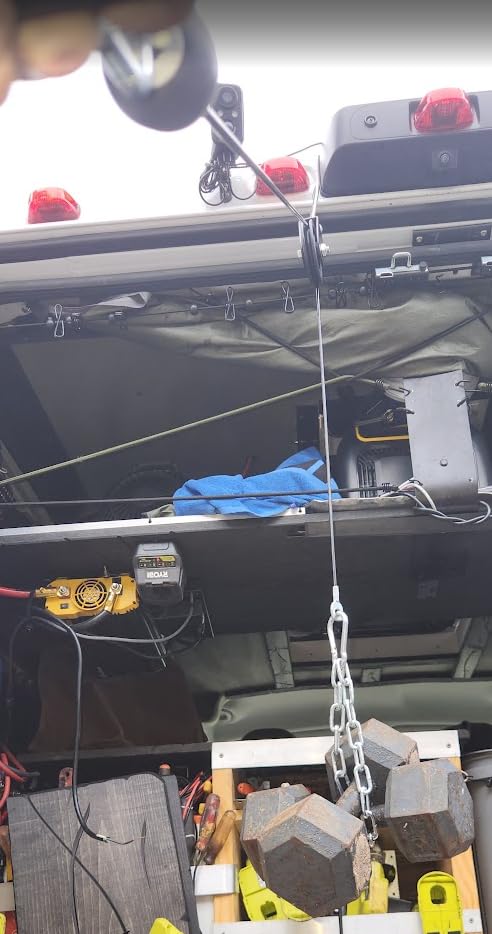
Mounting flexibility is the quiet strength. It goes on squat racks, pull-up bars, beams and any strap-ready surface, and it comes in three colours. The whole kit is small enough to live in a corner of a one-car garage and travel to a different anchor between sessions.
Compared with the Mikolo block, the trade is direct. The Mikolo has the higher plate capacity and a patented loading pin design. The SERTT has more pulleys, more attachments and a smoother reported cable path, and it holds a nearly identical 4.6 rating across more than two thousand reviews.
The carabiner and hook hardware is the part to watch. It works, but owners report that it bends if the load is not anchored cleanly, so inspect it before a heavy set rather than after one. The steel itself is described as alloy with solid welds, which is a step above the thin stamped plate used on the cheapest kits.
Cable durability comes up repeatedly in the reviews, with owners noting the coating still looks unworn after months. On the other side, the included rubber stoppers on the cables are a small detail that keeps the line from whipping past the pulley edge.
Best For Rack Owners Who Want More Attachment Variety
Choose this one if your training is varied and your budget is not unlimited. The attachment set alone covers most of the cable vocabulary, so you are not buying ropes and straps in the first month. It also makes a good second anchor next to a rack-mounted pulley, giving you two independent heights for supersets.
For a garage gym shared by two people, the light weight and tool-free hang points make it easy to move between anchors. That is a genuine advantage over a fixed frame when the floor space is the constraint.
Watch Out For the Short Straight Bar
The included straight bar is roughly shoulder width, which makes it awkward for lat pulldowns. Several owners recommend replacing it with a proper wide lat bar straight away rather than trying to adapt. Buy the bar with the kit, not after it, so the first session is not wasted on grip width.
Also expect the load to swing on heavier single-arm movements. If your program is built around strict low rows, check that your anchor point can absorb the front-to-back movement before you commit.
3. GDLF LAT Pull Down Machine – Best Freestanding Lat and Row Station
GDLF LAT Pull Down Machine, Low Row Cable Machine for Home Gym
77 inch freestanding frame
High and low pulley stations
500 lb maximum weight
59 x 26 inch footprint
Pros
- No wall mounting or anchor needed
- Independent high and low pulley stations
- Four position seat and roller adjustment
- Large capacity for the class of machine
Cons
- Fixed 77 inch height suits average users
- Large floor footprint
- Single column limits cable path options
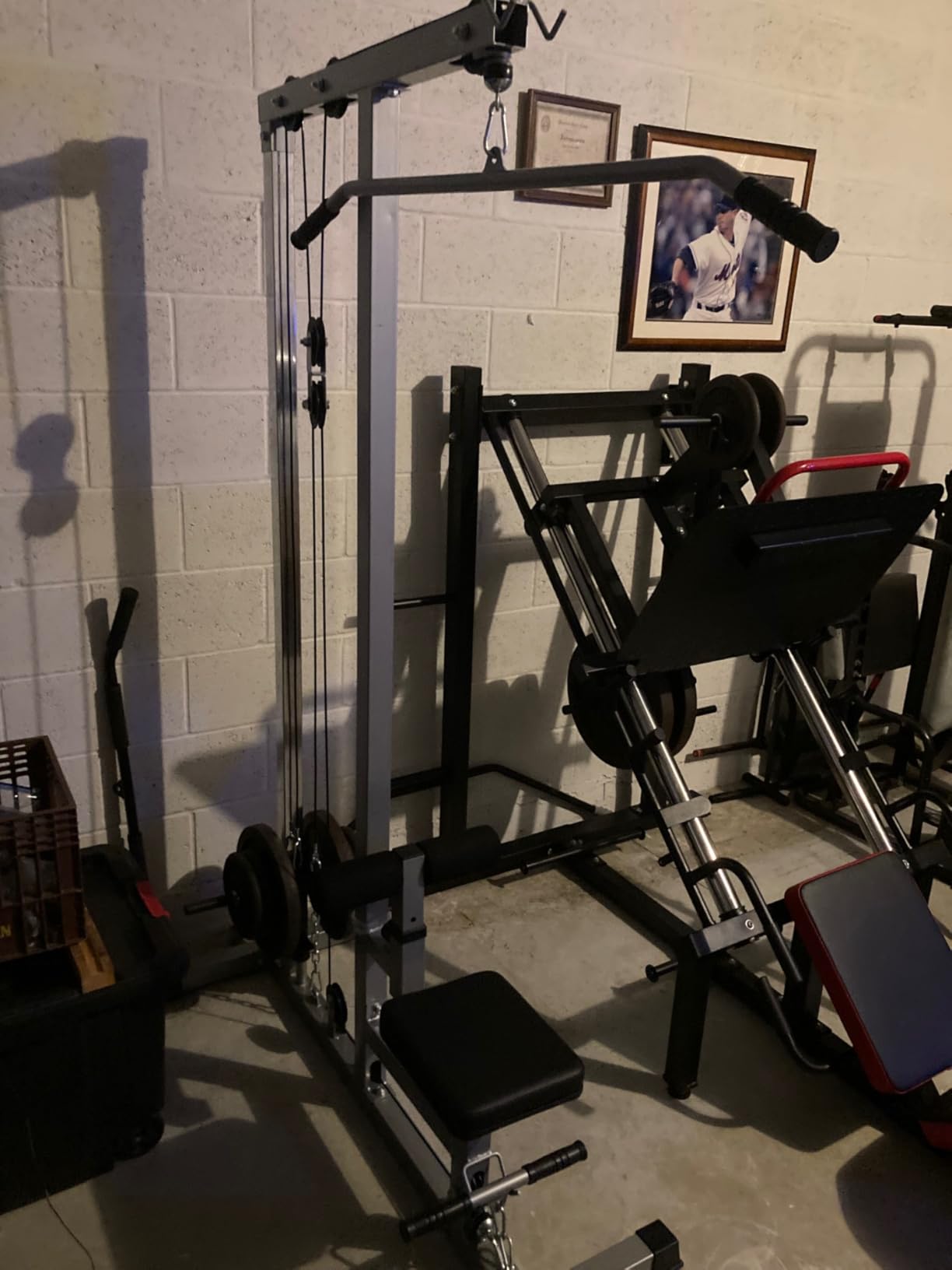
Everything before this one needs something already in the room. The GDLF is the first machine on the list that stands on its own, which makes it the honest answer for a garage with no rack, no joist and no willingness to drill into a wall.
It is built around two stations: a high pulley for lat pulldowns, close-grip pulldowns and upper back work, and a low pulley for seated rows, curls, pressdowns and one-arm movements. The design is explicitly built around scapular depression and shoulder adduction, so the angles are useful rather than decorative.
Adjustability is where the money went. The seat has four height positions and the foam thigh rollers have four as well, so two people of different heights can set up and swap without moving the machine. The padded seat and rollers are what make it usable for lat work rather than just cable access.
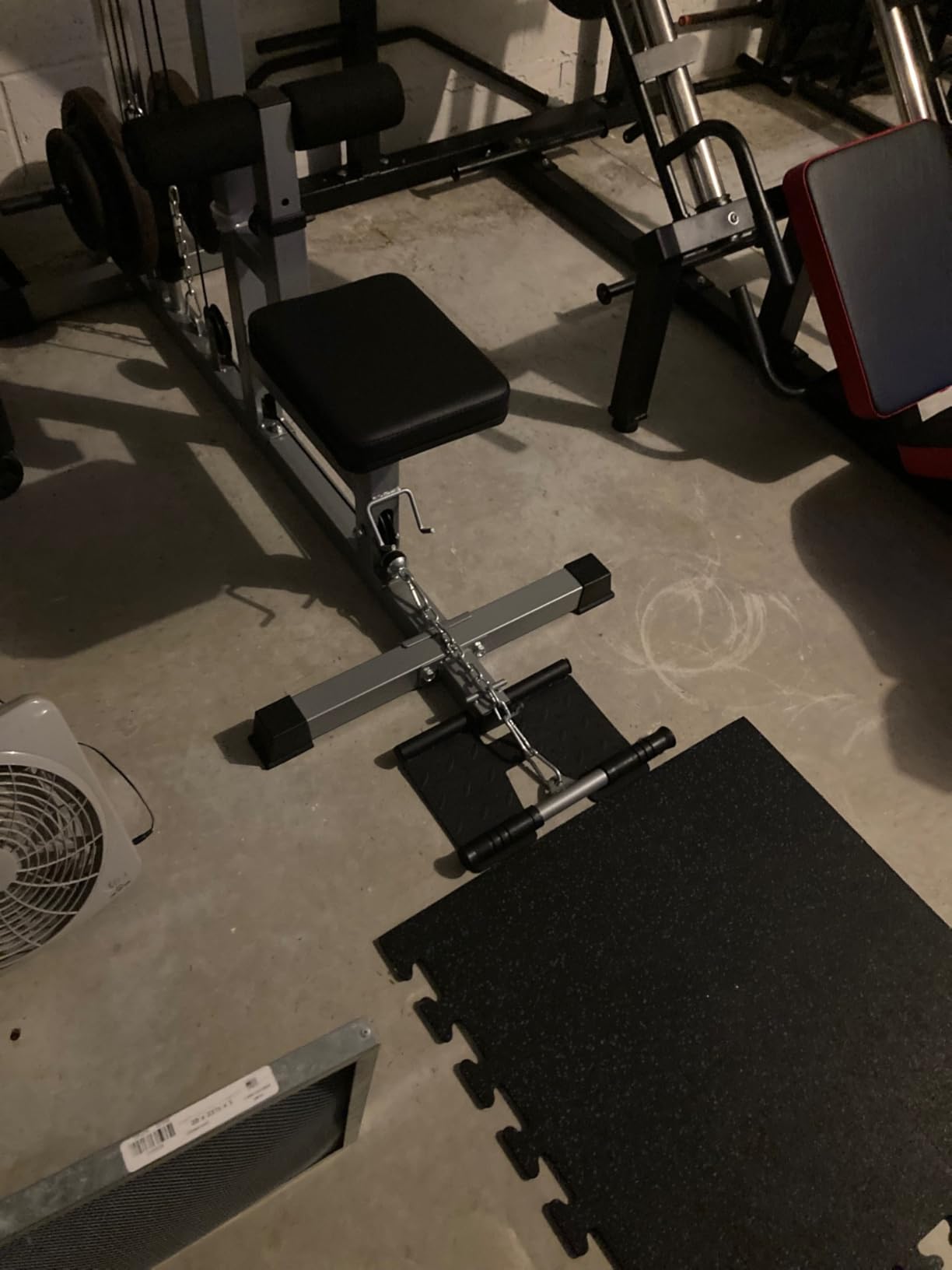
The listed capacity is 500 lb, a large figure for a machine in this bracket. Owners use it for heavier loading than most home setups ever will, and the frame is alloy steel with foam padding across the contact points.
Assembly is the easy half of the deal here. It is a freestanding floor unit, so there is no stud hunting, no bracket geometry to modify and no landlord conversation. That convenience is the main reason it outranks the cheaper wall units for a lot of buyers.
The trade is floor space. At 59 by 26 inches, it claims a real rectangle of garage or basement floor, and that rectangle has to stay clear because you step into it to use the machine.
Best For a Dedicated Back and Arms Session
This is the pick for a single lifter who wants one well-built station for pulldowns and rows without a rack. It suits a garage where the machine can sit against a wall and the rest of the floor stays open for a bench and a set of dumbbells. It also suits a spare bedroom, since it needs no structural fixings at all.
Because it stands alone, it is also the easiest machine here to move when you reorganise. Two people can carry it, and it does not need to be re-levelled or re-mounted after a shift.
Less Suited to Tall Lifters and Tight Rooms
The fixed 77 inch height is the limitation owners raise most, and it lines up with what tall users report across this whole category: limited overhead range of motion on a unit that is not designed to be tall. If you are over six feet, the top of your range is the thing to test before you commit.
The single column also means fewer cable path options than a dual-anchor crossover. You will get rows, pulldowns, pressdowns, curls and kickbacks, but not true two-sided flyes with independent handles. Compare that against the wall-mounted dual pulley units further down if crossover work is the goal.
4. Valor Fitness Wall Mounted Cable Machine – Best for the Smallest Footprint
Valor Fitness Wall Mounted Cable Machine with Dual Adjustable Pulley System, 16 Height Positions, Compact Home Gym for LAT Pulldowns, Rows, Triceps, and Full Body Strength Training
25 x 25 inch footprint
16 pulley height positions
Plate loaded to 200 lb
Switchable 1:1 or 2:1 ratio
Pros
- Roughly four square foot of floor space
- 16 real pulley heights for vertical range
- Handles heavy loading
- Strong value against full trainers
Cons
- High starting resistance from pulley friction
- Top peg position is obstructed
- Wall bracket may not align with studs
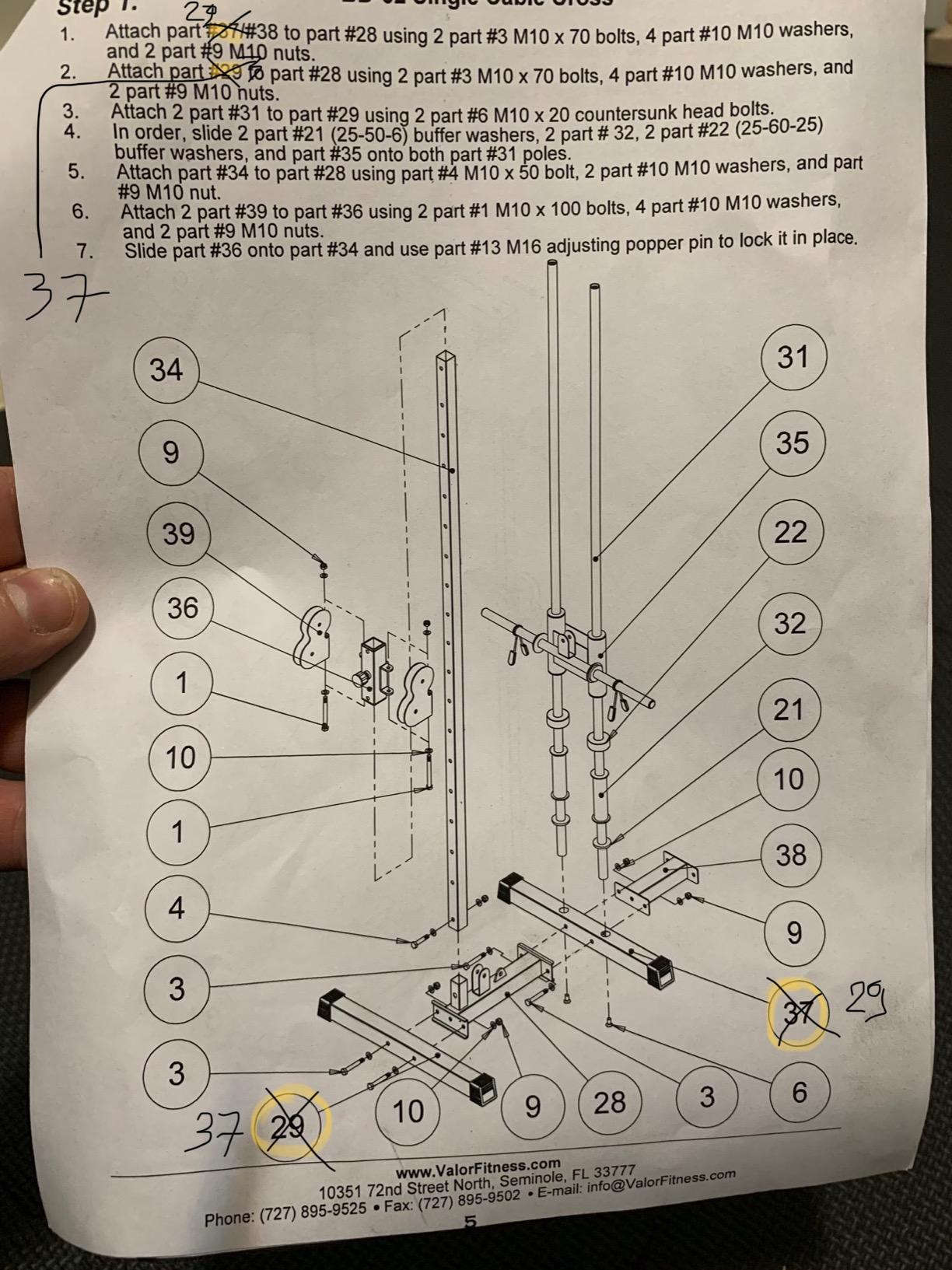
When floor space is the binding constraint, a wall-mounted dual pulley is the format that solves it. The Valor BD-62 measures 25 by 25 inches and stands 80 inches tall, so it occupies about four square feet of floor and nothing else. Everything above that point is against the wall.
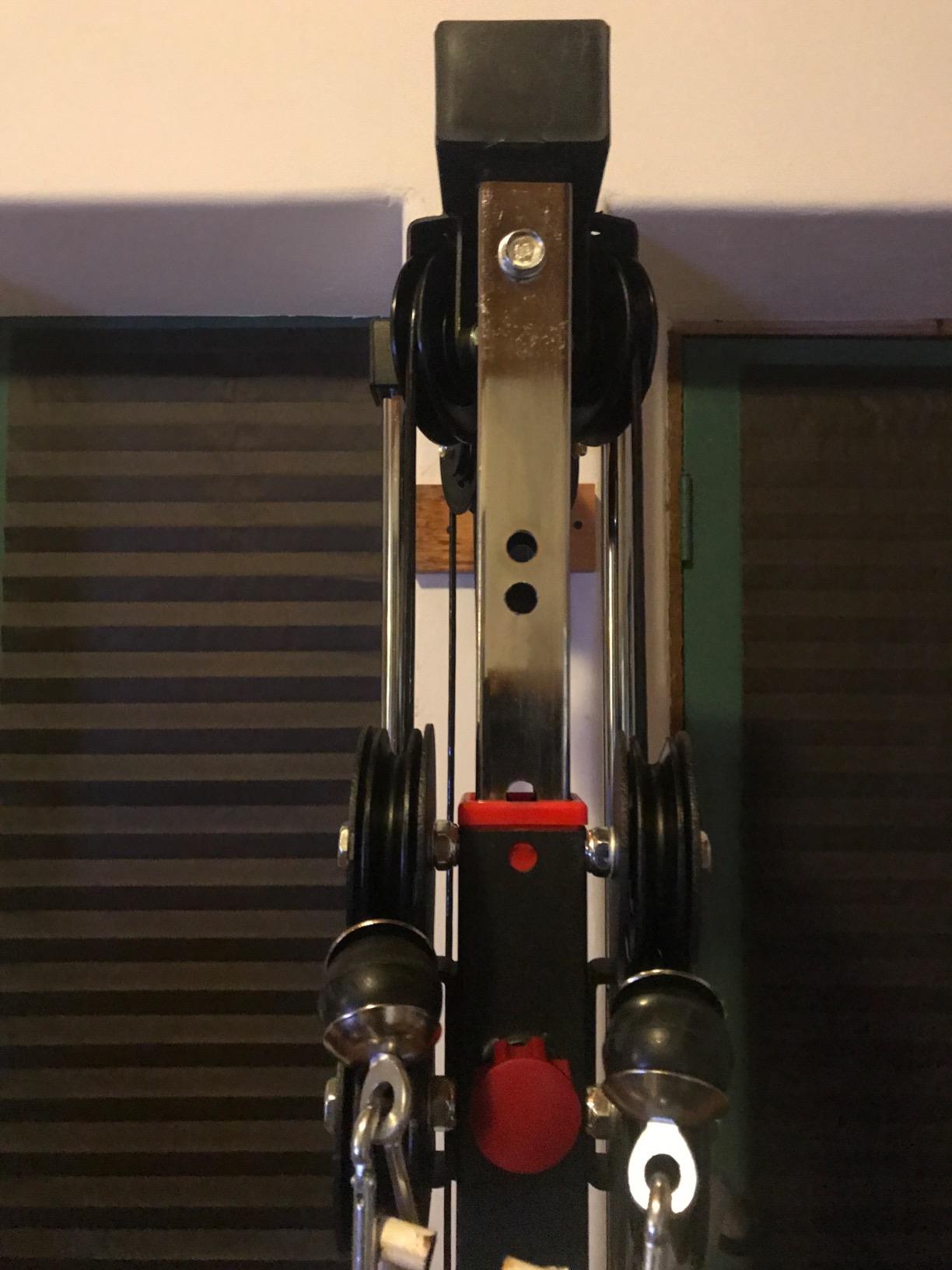
The 16 pulley height positions are the feature that separates it from a basic two-pulley wall rig. Each carriage moves independently, so you can set one handle at shoulder height for rows and the other near the floor for pressdowns, then switch one without moving the other.
Resistance is plate-loaded up to 200 lb on 1 inch plates, with separately sold adapters for Olympic plates. The ratio is switchable, which is unusual in this format — use one cable for a 1:1 feel or both cables for a 2:1 mechanical advantage on heavier work.
Owners report rowing 250 lb on it and describe the frame as solid under heavy loading, and the value comparison against a full commercial functional trainer is the reason it draws repeat interest. Several buyers also report the price-drop refund being honoured quickly when the price moved between order and arrival.
Be honest about the friction. With several pulleys and steel cables in the path, the system has real starting resistance. One owner measured more than 15 lb of pull before the cable moved at all, which is a meaningful chunk of a light warm-up set.
Because the top peg position is reported as unusable — the cable trolley interferes with the front pulleys up there — treat 16 as closer to 15 usable positions. Plan your overhead work around the second-highest setting rather than discovering the limit mid-session.
Best For Garages and Basements With Studs
This is the unit for a one-car garage, a low-ceiling basement corner or an apartment wall with real structure behind it. Four square feet of clearance is about a fifth of what a freestanding tower needs, and it leaves the floor free for a bench.
Because it is plate-loaded, you choose the resistance increment by choosing your plates, which is a real advantage for a lifter who wants jumps of 5 lb rather than the fixed steps of a selectorized pin.
Know the Starting Resistance and Mounting Reality
Two things catch people out. First, count the starting friction as part of your usable range, especially if you train children or a partner who trains lighter than 15 lb. Second, the supplied wall bracket does not always land on a standard stud as drawn, and the bottom bracket can conflict with baseboard trim.
Find the studs before you order, and plan a small riser platform if baseboard trim is in the way. Several owners also swapped the included pulleys and ran silicone on the cable path to reduce system friction, which is the same community upgrade seen on other entry-level units.
5. LIONSCOOL Multifunctional Wall Mounted Pull Up Bar – Best for Pull-Ups and Cables in One
LIONSCOOL Multifunctional Wall Mounted Pull Up Bar with Pulley System (48″ APART)
48 inch wall mounted span
Integrated pulley system
Supports up to 450 lb
2 year warranty
Pros
- Pull-up bar and cable station in one unit
- Smooth bearing pulleys
- No flex under multiple users
- All mounting hardware included
Cons
- Installation is fiddly and often a two person job
- Anchor bit size is misstated in the instructions
- Out of square welds on some units
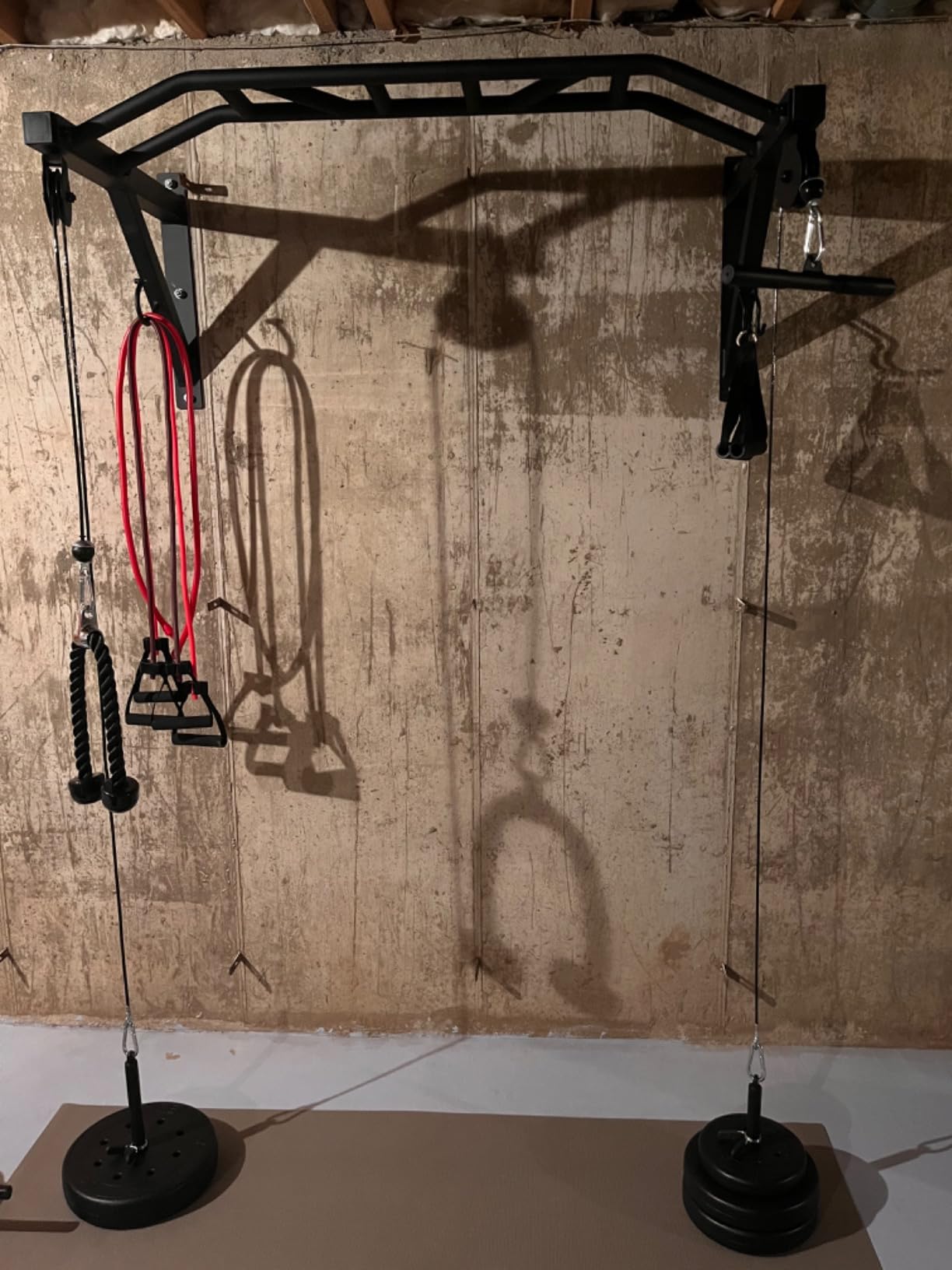
This one answers a question the rest of the list does not: how do you get a proper pull-up station and cable movement without a full rack. The LIONSCOOL unit mounts a 48 inch multi-grip chin-up and pull-up bar to the wall and hangs an integrated cable pulley system off the same bracket.
The bar carries more load than the cable side. It spans 48 inches, carries a knurled multi-grip pattern with wide, close and neutral holds, and is rated to 450 lb. Two reviewers loaded it with a 268 lb and a 220 lb user at the same time with no flex, which tells you more than the rating alone.
The cable side comes with two swivel pulleys, two PVC-encased cables, two loading pins with an 11 inch loadable length, a straight bar, a tricep rope and two handles. Resistance band hooks sit on both bracket sides, so band work and cable work share one anchor.
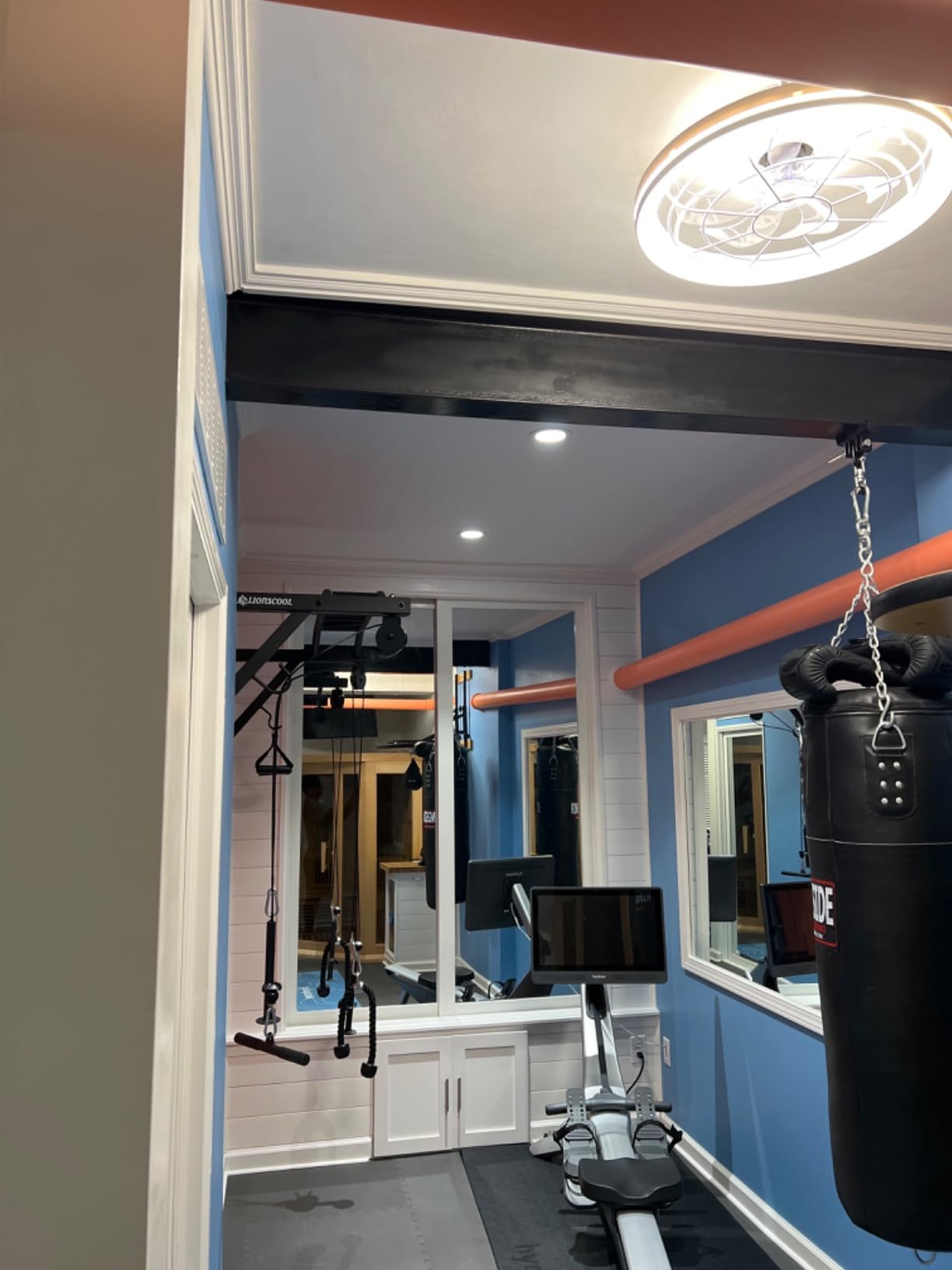
The 83 percent five-star share in its reviews reflects a simple pattern: people like the product and are annoyed by the installation. The bar itself is described as rock solid, and the pulley wheels have good bearings that run smoothly.
For apartment and condo training, the wall-mounted format has a secondary benefit. The load transfers into the wall structure rather than into a floor frame, so it does not rock or walk when you are doing heavy work, and there is no base to stub your toe on in a small room.
The 90 inch cables are a genuine problem in low-ceiling spaces. Several owners found them far too long for the room, which limits how much usable travel you get out of the pulley before the cable is slack at the top.
Best For Apartments, Condos and Shared Walls
If you rent and cannot drill into a stud, this is not the right tool — no wall-mounted cable unit is, and that is a structural question rather than a product question. If you own the wall and can hit structure, it gives you a pull-up station and a cable station from a single mounting point.
It also solves the anchor problem the SERTT and Mikolo pulley kits cannot: they need something to hang from, and this supplies it. For a single lifter building a first setup out of a barbell set, a bench and a wall, it is a complete entry point.
Installation Is the Real Work Here
The instructions specify a 5/8 inch bit for concrete anchors, but the anchors supplied are 9/16 inch. Concrete mounting is effectively a two-person job, and the included lag bolts are too short once drywall plus a plywood backing is in the mix, so many owners substitute structural screws.
Owners also report weld angles that are noticeably out of square on the perpendicular supports. Check plumb before you load anything. The two-year warranty is a real one, which is more than most units in this format offer.
6. Mikolo Folding Squat Rack WR00 – Best for Five Modes in One Frame
Mikolo Folding Squat Rack, Wall Mounted Power Rack with Cable Crossover Machine & LAT Pull Down, Functional Trainer with 5 Adjustable Function Modes, for Home Gym and Space Saving(Black)
Five working modes
Folds to 3 square feet
1000 lb capacity
30 x 68 x 86 inch
Pros
- Folds from full rack down to a small footprint
- One frame covers squats press pull ups and cables
- Independent pulleys allow supersets
- Wall mounts and adjustable feet
Cons
- Needs proper wall mounting for stability
- Folding mechanism adds complexity
- 68 inch width is a real floor commitment
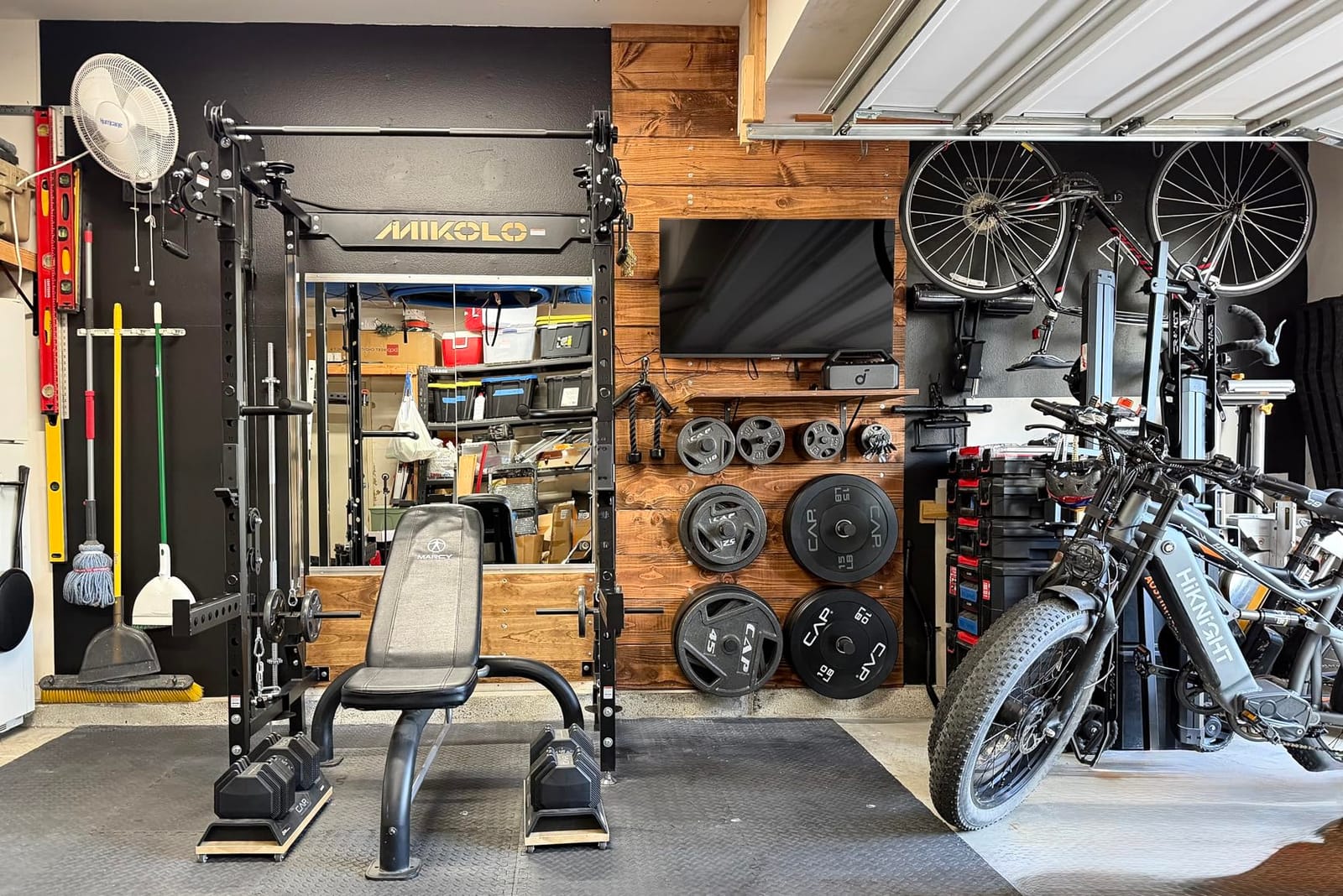
The folding format answers the most common garage gym constraint: you need a rack most days and floor space on the rest. This WR00 runs in five modes — folded, semi-open, power rack, functional trainer and cable crossover — and it opens to 9.5 square feet or folds down to about 3.
The cable side is a genuinely independent dual crossover at a 1:1 ratio, which means two people can set different loads at the same time and neither cable affects the other. There is no weight stack, so drops and supersets are a change of plates rather than a change of pin.
The frame is 2 by 2 inch 14-gauge steel with a 1000 lb capacity, reinforced screw-in wall mounts and four adjustable ground support feet. The pulley carriage has 15 height positions with single-handed adjustment, and the pull-up bar detaches.
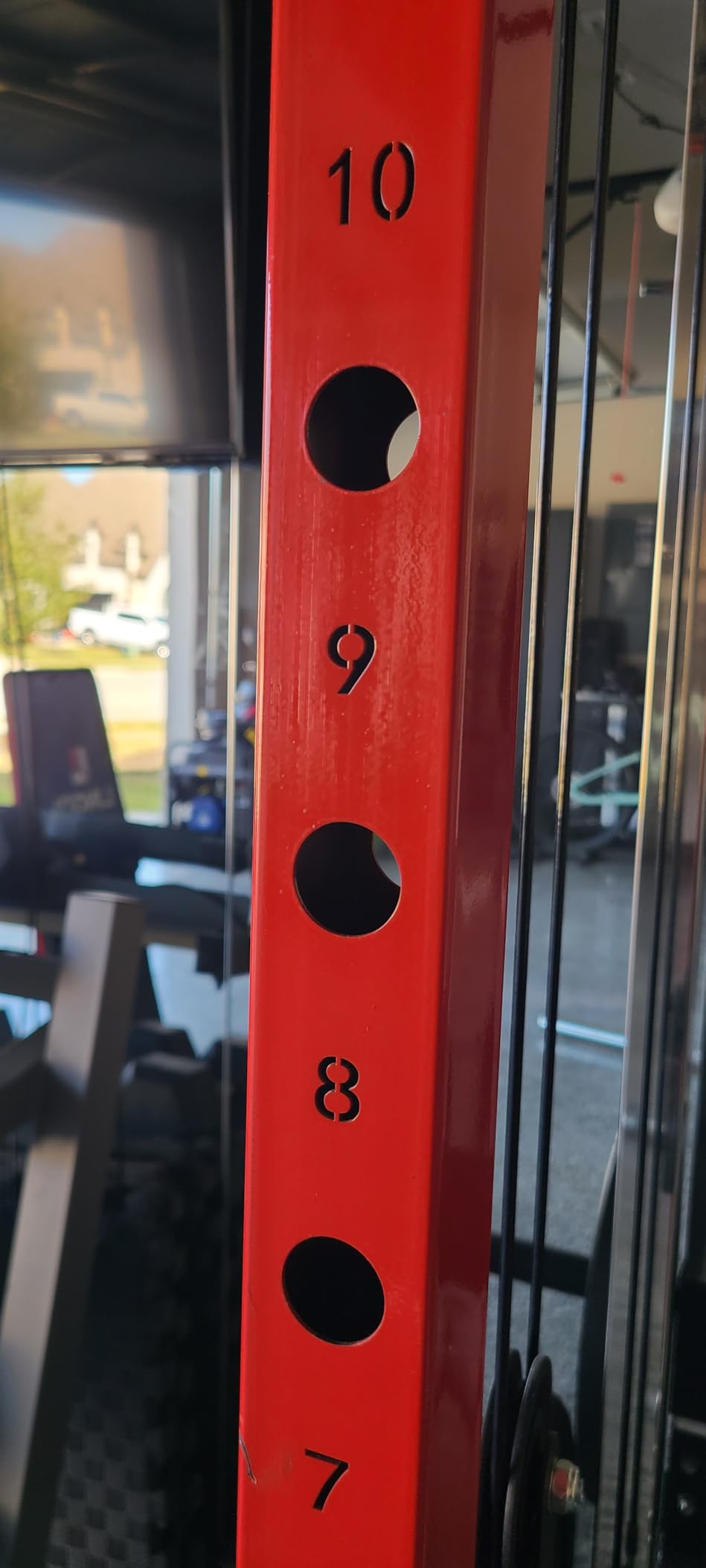
Over 80 exercise variations come out of one frame, from squats and bench press to rows, flyes, curls and kickbacks. The premium pulley system delivers the smooth cable travel that budget frames in this bracket usually lack.
Stability comes from the wall mounts plus the adjustable feet, which matters more than the raw capacity number. Reviewers describe it as steady even with heavy loading, but they describe it that way when it is properly anchored.
This is the lowest-rated unit in the set at 4.4, and the distribution shows why — a noticeably higher one-star share than the others. The complaints concentrate around assembly and durability of smaller components rather than the concept.
Best For One-Car Garages and Multi-User Homes
The folded footprint is the reason to buy this rather than a fixed rack. Three square feet of stored machine leaves the rest of the bay usable for a barbell, a bench and plates, and two people can still train on the cable side at the same time because the crossover is independent.
It also works as a functional trainer and crossover in one frame, which means a garage with limited depth is not forced to choose between squatting and cable work.
Folding Complexity and a Wide Floor Print
The hinge is the honest weakness. Compared with a fixed rack there is more to go wrong, more assembly, and a mechanism you will eventually have to lubricate. The 1 year manufacturer warranty is also the shortest of the frames on this list.
Even folded, the frame is 68 inches wide, so this is a compact option rather than a small one. Measure the bay door clearance and the ceiling before you commit — at 86 inches tall it is a tall unit and will not go into a low-ceiling basement.
7. Body-Solid Powerline PFT100 – Best Dual Weight Stack Machine
Body-Solid Powerline (PFT100) Cable Crossover Exercise Machine for Home & Commercial Gym, Functional Training Center with Dual 160lbs. Weights Stack for Cable Workout
Two 160 lb stacks standard
210 lb dual stack option
42.3 x 62.6 x 83 inch
476 lb machine weight
Pros
- Two people can train with independent resistance
- Very smooth quiet stack travel
- Well machined with aligned holes
- Does not shift on a garage floor
Cons
- Roughly two to four and a half hours of assembly
- Instructions are vague and incomplete
- Heavy unit at 476 lb
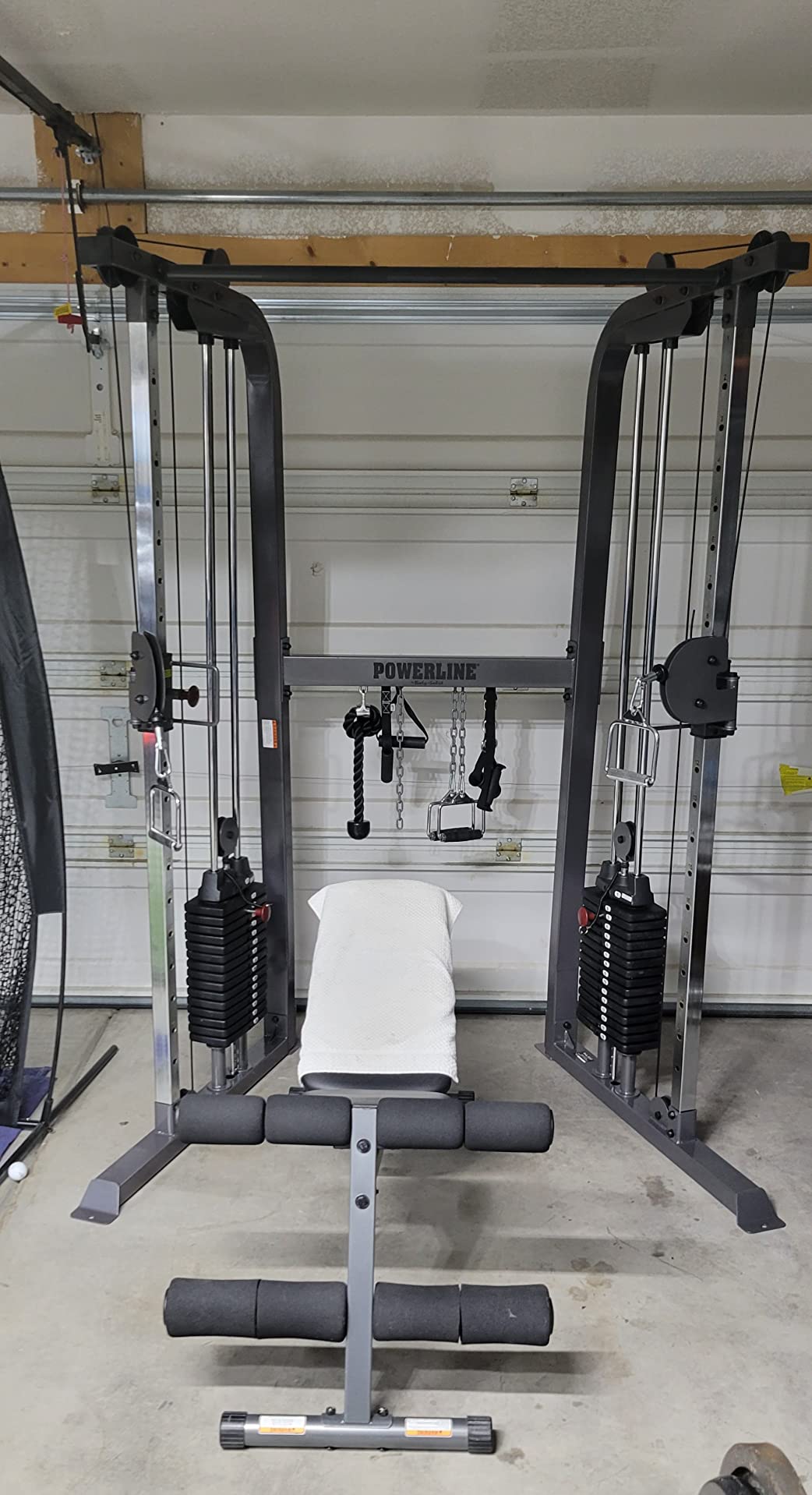
The PFT100 is built like a commercial cable machine in a home-gym frame, and the difference is the dual independent stack. Each side has its own 160 lb of plates — 210 lb per side in the dual stack variant — so one person training a shoulder press does not change the resistance for the other person on the row.
Owners describe the travel as silky, with no friction, grinding or noise, and the machining quality shows up in small ways: the holes line up, the parts fit without forcing, and nothing needs bending to go together.
It is free-standing, so there is no anchoring and no stud work. At 42.3 by 62.6 inches and 83 inches tall it is a substantial footprint, but the manufacturer lists it as a home and commercial gym unit with a 10 year frame warranty and a 1 year parts warranty.
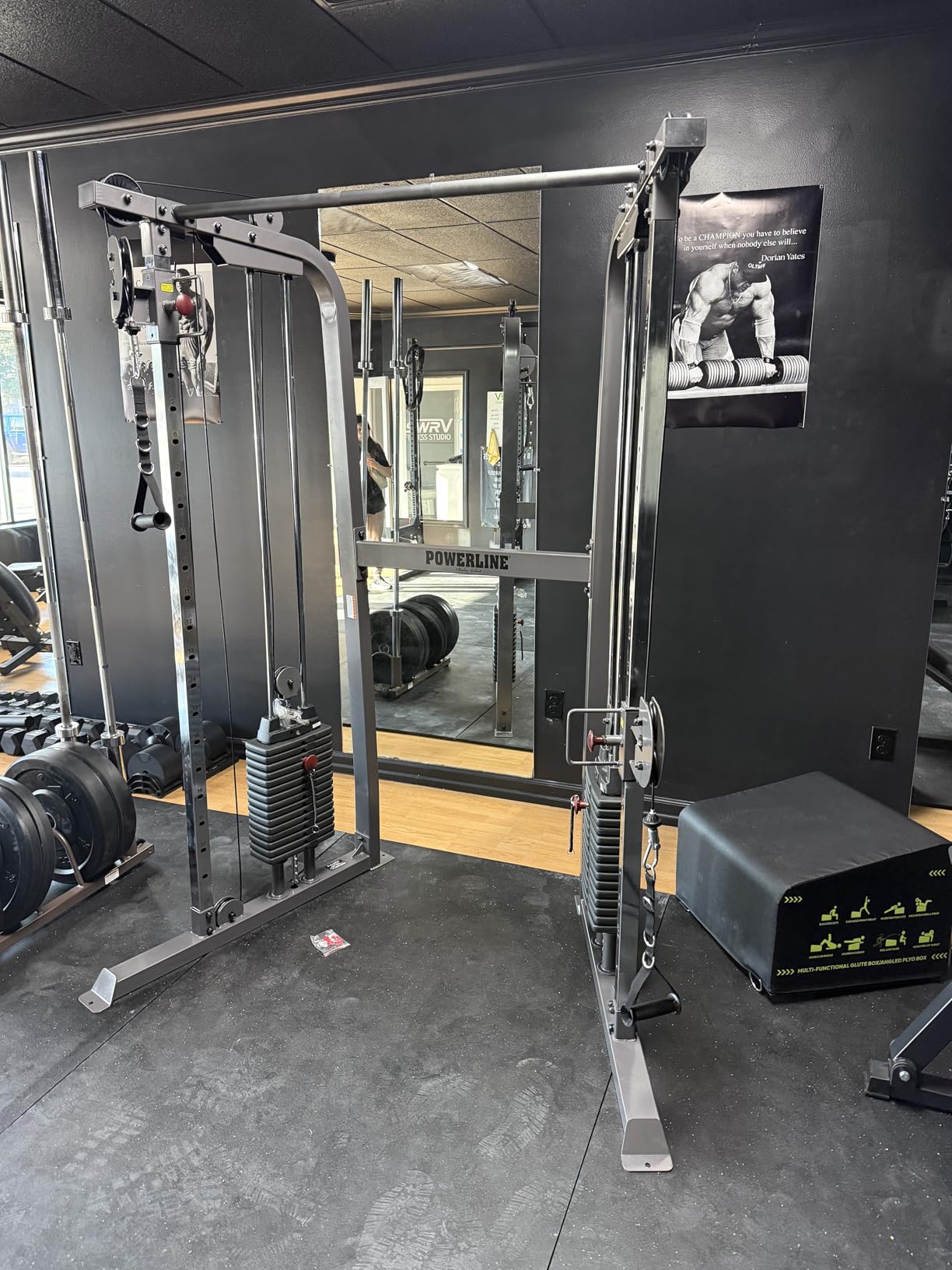
The listed exercise library is long for a reason. Pec fly, incline and bench press, crossover, upright row, deltoid raise, shoulder press, close-grip lat pulldown, bent-over row, seated row, ab crunch, oblique bend, tricep pressdown, thigh abduction, calf press, reverse fly and glute kickback are all named by the manufacturer, and the built-in pull-up bar and accessory hooks cover the rest.
Stability is a genuine strength here. Reviewers report the machine does not shift on a garage floor at full stack, which is not something you can say for every 476 lb frame with a high centre of gravity.
Service is the other quiet win. Owners report replacement cables being sent out free after their own cutting mistake, which tells you the parts channel is real rather than theoretical.
Best For Two People Training at Once
This is the pick for a shared household gym or a garage gym with a training partner. True isolateral resistance is the whole point: two people can work different body parts at the same time without negotiating a shared pin, and neither person has to wait.
It also solves the stack problem. A single-stack unit forces you to pin the weight up and down to change resistance, which is what makes many people quietly abandon a cable machine for a pair of dumbbells after a few months.
Budget Two People and a Weekend for Assembly
Owners put assembly at roughly two to four and a half hours, and a second person is effectively required. The instructions are also the weak point — vague, and in places referring to parts that are not included or not pre-installed as described. One buyer also reported missing weight plates in one unit.
Factor the stair and door route in early. At 476 lb this is not a move you can do alone on a set of basement stairs, and the extra-wide mainframe makes the unit longer to carry through a standard doorway than its boxed dimensions suggest.
8. Inspire Fitness FTX – Best Accessory Bundle in a Compact Frame
Inspire Fitness FTX Functional Trainer – Compact at Home Workout Machine with Accessories – Space Saving Design – Home Gym Cable Machine and Two 165 lb Weight Stacks
Two independent 165 lb stacks
54 x 40 x 82 inch footprint
544 lb machine weight
Accessories included
Pros
- Smooth well balanced cable travel
- Compact footprint for a dual stack trainer
- Useful accessories in the box
- No rattles or squeaks in use
Cons
- Very heavy and arrives in multiple boxes
- Top pulley setting is relatively low
- Stacks are not upgradeable
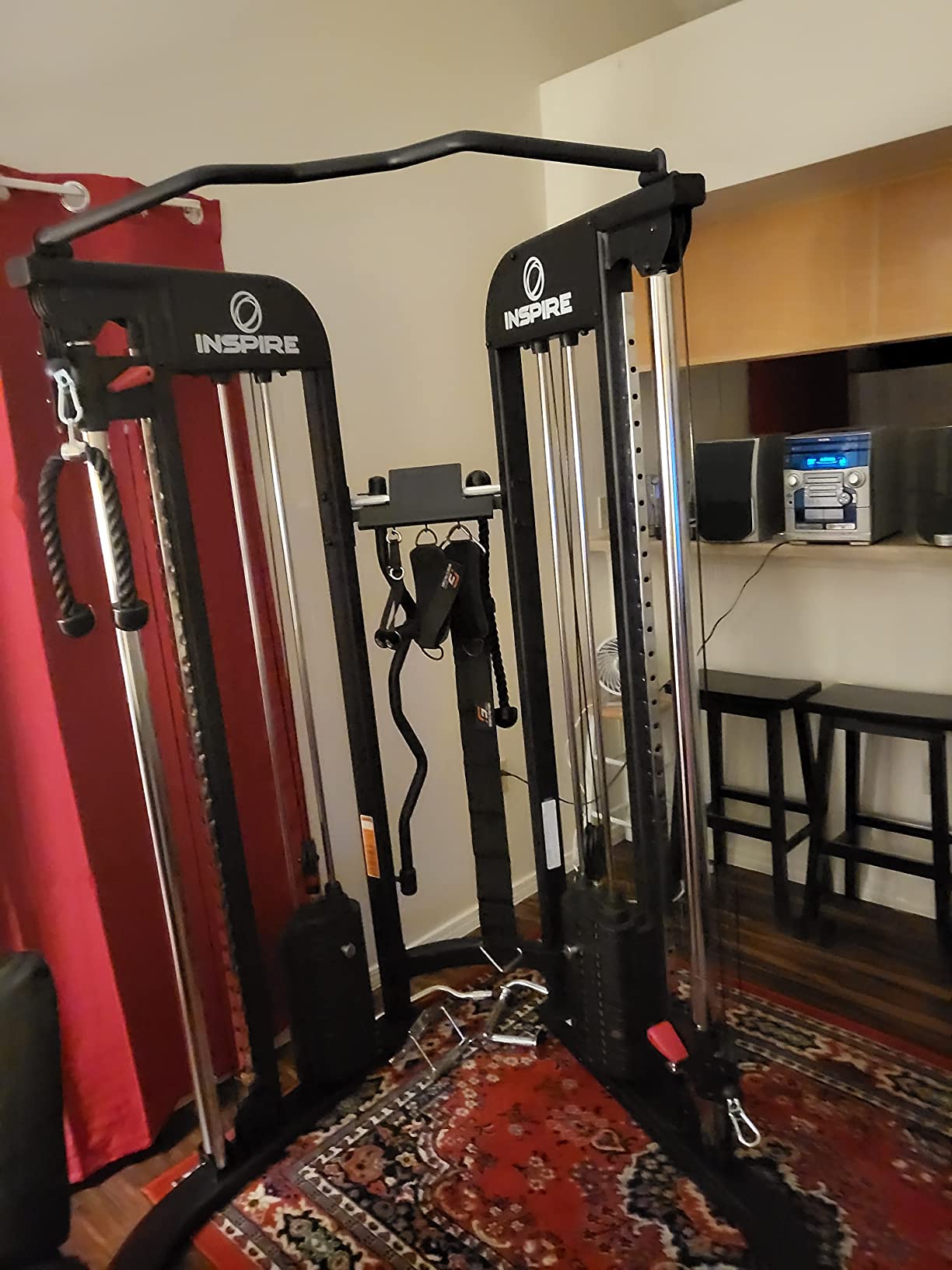
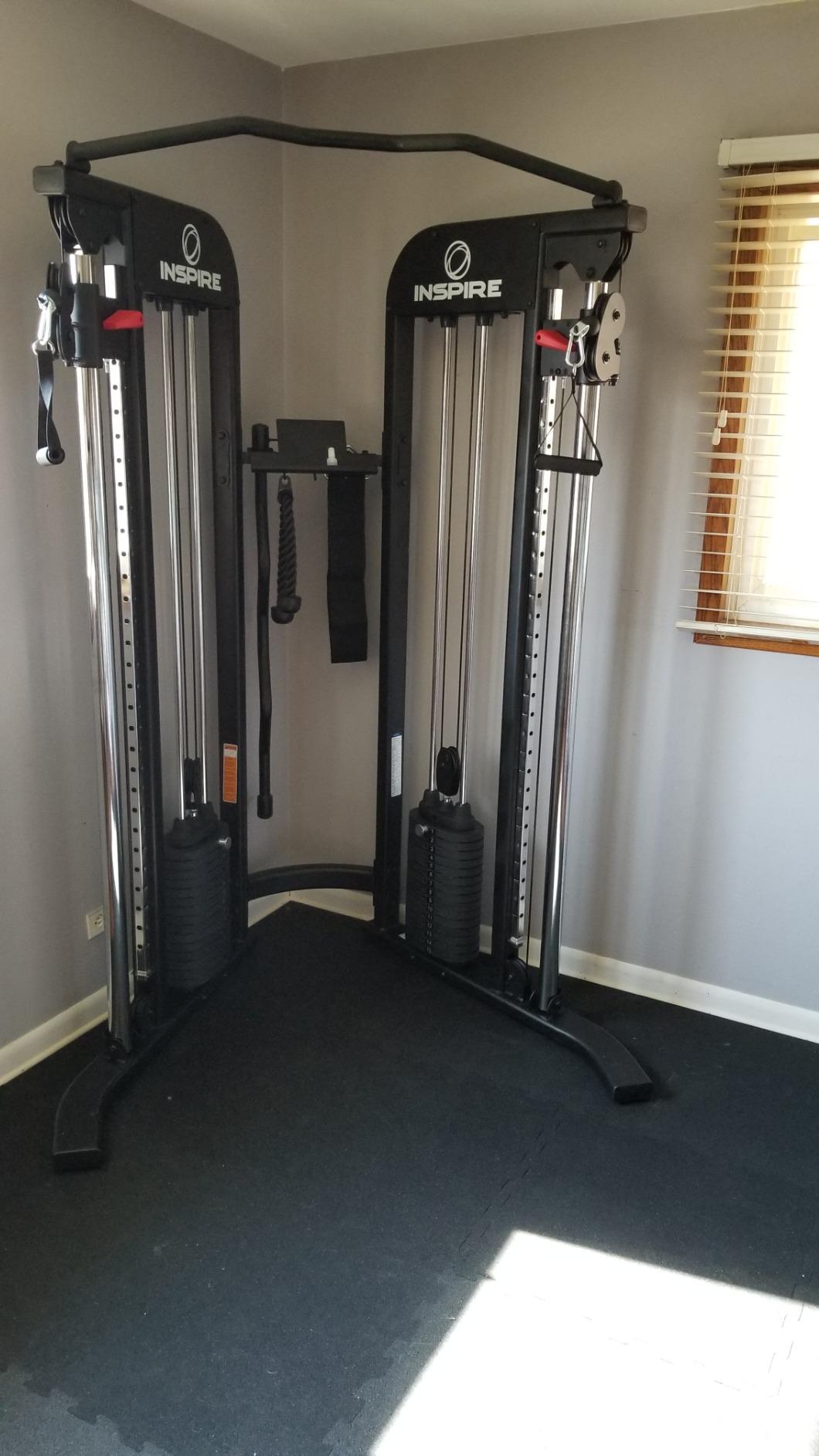
Where a lot of machines give you two D-ring handles and a bill, the FTX includes a tricep rope, two deluxe D handles, a dual hook curl bar and a chin/dip belt in the box. That is the reason to pick it, and it removes the most common first-month spend for a new cable machine owner.
Underneath, it is two independent 165 lb stacks, 330 lb total, on a sliding pulley system that owners describe as smooth and well balanced. The frame is 54 by 40 inches and 82 inches tall, which is compact for a full dual-stack functional trainer, and it includes a built-in pull-up bar, an accessory rack and a device holder for a phone or tablet.
The 84 percent five-star share is the highest of any machine in this group. Owners describe commercial-quality construction at a fair price, with no squeaks or rattles in normal use and a friction-free pull on every movement.
Assembly is more manageable than the weight suggests. Once the heavy towers are uprighted, owners report it goes together easier than expected, and the box includes touch-up paint and Teflon lubricant for the cable path.
Customer service is responsive in a way that matters for a machine this size. Owners report a price-drop refund arriving within 24 hours, and the accessories themselves are described as robust rather than flimsy.
The stack limit is the specification to read carefully. The 165 lb stacks are not upgradeable, so if your training will progress past that per side, the FT1 or FT2 is the model to look at instead. Buying the FTX and hoping to add plates later does not work.
Best For Beginners Who Want the Attachments Included
For a first serious home gym, the included kit removes the guesswork. You can open the box, hang the rope and curl bar, and cover pressdowns, curls, rows, kickbacks and chin work on day one. The device holder and accessory rack also keep a phone and a stack of cables off the floor.
A 3 month digital training subscription is also included, which is a reasonable way to learn the machine rather than guessing at cable heights on the first session.
Heavy Logistics, Tall-User Limits and Fixed Stacks
At 544 lb and packaged in seven boxes, this realistically needs three people to get into a basement. That is the single biggest reason owners regret the purchase, and it is a moving problem rather than a quality problem — decide your route through the building before the boxes arrive.
The top pulley setting is relatively low, which limits range of motion for tall users on lat pulldowns and pressdowns. Lifters over six feet consistently report this across the category, and this frame is no exception. Also note that add-on 5 lb plates are sold separately and are not part of the box.
9. Mikolo Wall Mount Cable Station M-G3 – Best Compact Wall Unit
Mikolo Wall Mount Cable Station, Cable Crossover Machine with Dual Pulley System and 19 Adjustable Positions for Home Gym Fitness Equipment, Red
19 pulley height positions
400 lb maximum load
25.6 x 26.9 x 82 inch
2 year warranty
Pros
- Very small wall mounted footprint
- Assembles solo in one to two hours
- Labelled hardware in one kit
- Rotating pulley bracket widens range
Cons
- Included plastic pulleys create friction
- Height locking pin is a weak point
- Plastic anchors are not for heavy loading
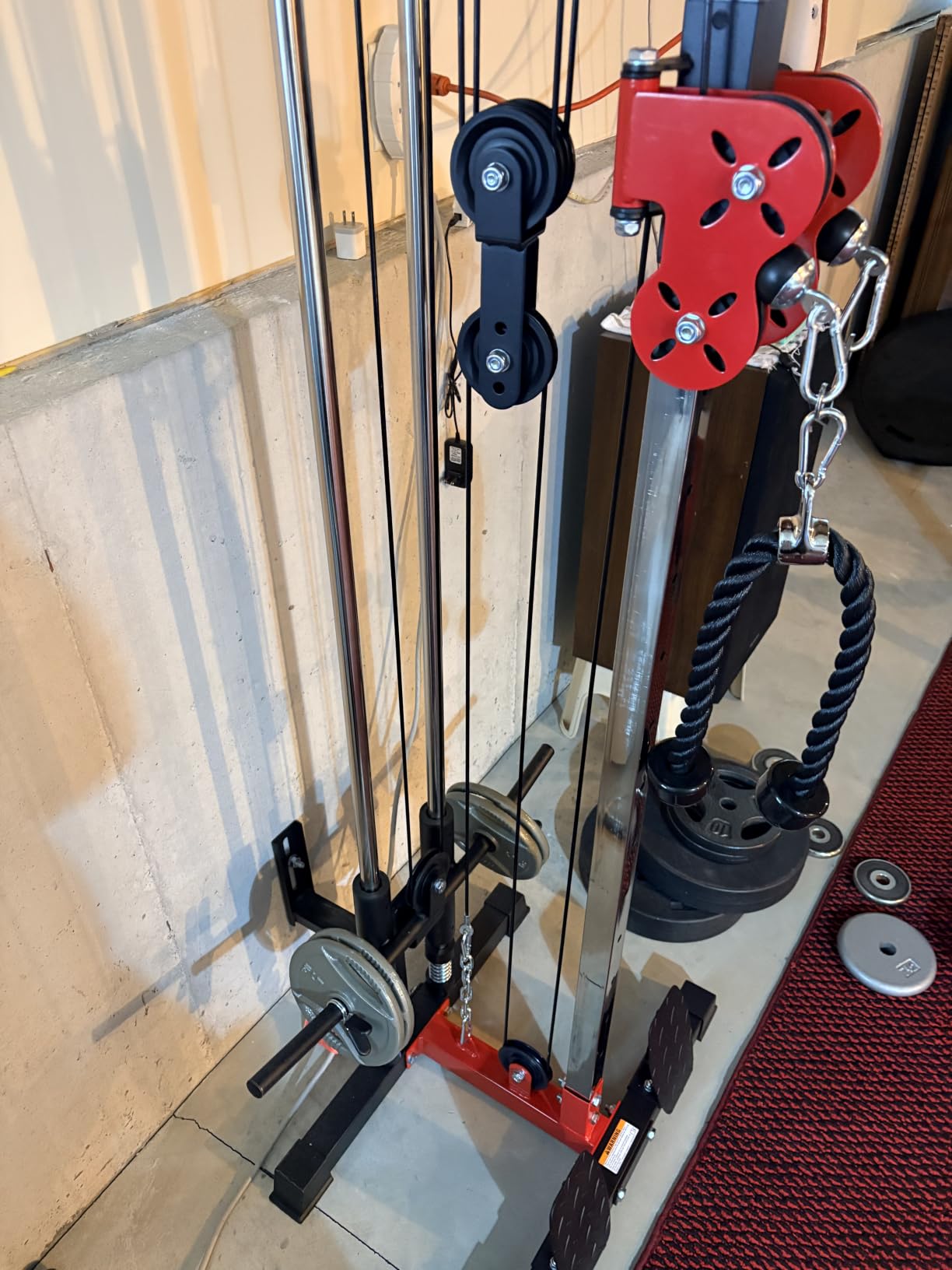
This wall station gives you a proper high pulley and low pulley in roughly 26 by 27 inches of floor. The frame is 14-gauge powder-coated steel with an H-shaped base for stability, and it stands 82 inches tall.
The cable spec is a strong one here: nylon-coated aircraft-quality cables rated at 2200 lb tensile strength carrying a 400 lb maximum load. Detachable sleeves accept both 1 inch and 2 inch plates, and the 10 degree upward weight pegs are a small detail that stops plates sliding off mid-exercise.
There are 19 height positions, more than the wall-mounted competitor further up this list, and the rotating pulley bracket expands the training range from the same footprint. A large footboard supports seated cable rows.
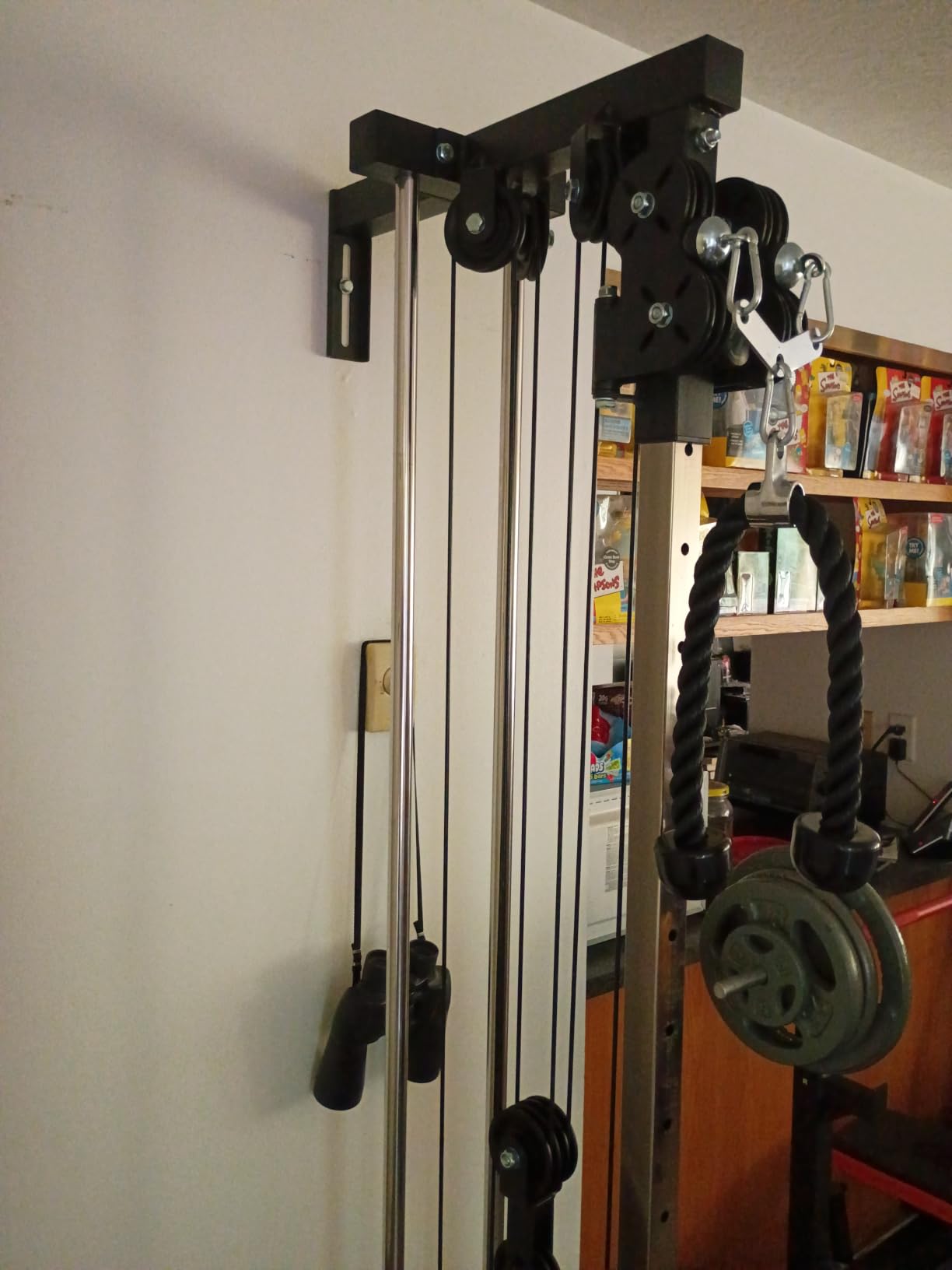
Assembly is the standout. Owners put solo assembly at roughly one to two hours with hardware labelled and packed in a single kit — a sharp contrast to the racks and dual-stack trainers on this list, where a second person is assumed.
Owners also report smooth cable travel even with the included plastic pulleys and no lubricant, and several plan to add the aluminum pulley upgrade anyway. Dual independent pulleys let you set up two exercises at once, which is useful for supersets.
The seller replaced a damaged wheel promptly for at least one buyer, and the unit carries a 2 year warranty with 8 month component replacement service.
Best For Fast Solo Assembly in a Small Room
This is the pick if you want a crossover station and you do not have a second person to help. A labelled single kit and picture-only instructions get you from box to first pull in an afternoon, which is the difference between owning a cable machine and having a cable machine still in a corner in a box.
It suits corners, apartments and basements where the footprint is the deciding factor, and the two-year warranty is longer than most wall units offer.
Upgrade the Pulleys and Fix the Anchors
Two real issues. The included plastic pulleys produce noticeable friction, and many buyers plan the aluminum pulley upgrade — a well-known community modification that smooths the pull noticeably. The height locking pin is the weak point, with one reviewer reporting the mechanism breaking in use.
No concrete-wall hardware is included, and the supplied plastic expansion anchors are not suitable for heavy loading. Use proper structural anchors or hit studs. The instructions are pictures only, and the 82 inch height can feel low for taller users on overhead work.
10. MAJOR FITNESS F22 Power Rack – Best Power Rack With Cables Built In
MAJOR FITNESS F22 Power Rack, 1600lbs All-in-One Squat Rack with Cable Crossover, Dual Pulley System, Heavy-Duty Steel Frame, Attachments & Storage for Home Gym Strength Training, Khaki
1600 lb static capacity
2 by 3 inch 14-gauge steel
Dual pulleys at 2:1 ratio
68.9 x 55.5 x 82.5 inch
Pros
- No wobble under heavy loading
- 82.5 inch height suits low basements
- Independent pulleys allow two-user training
- Pulley travel has no slack
Cons
- Plate loading makes weight changes tedious
- Included lat bar is narrow
- Included accessories are functional not commercial
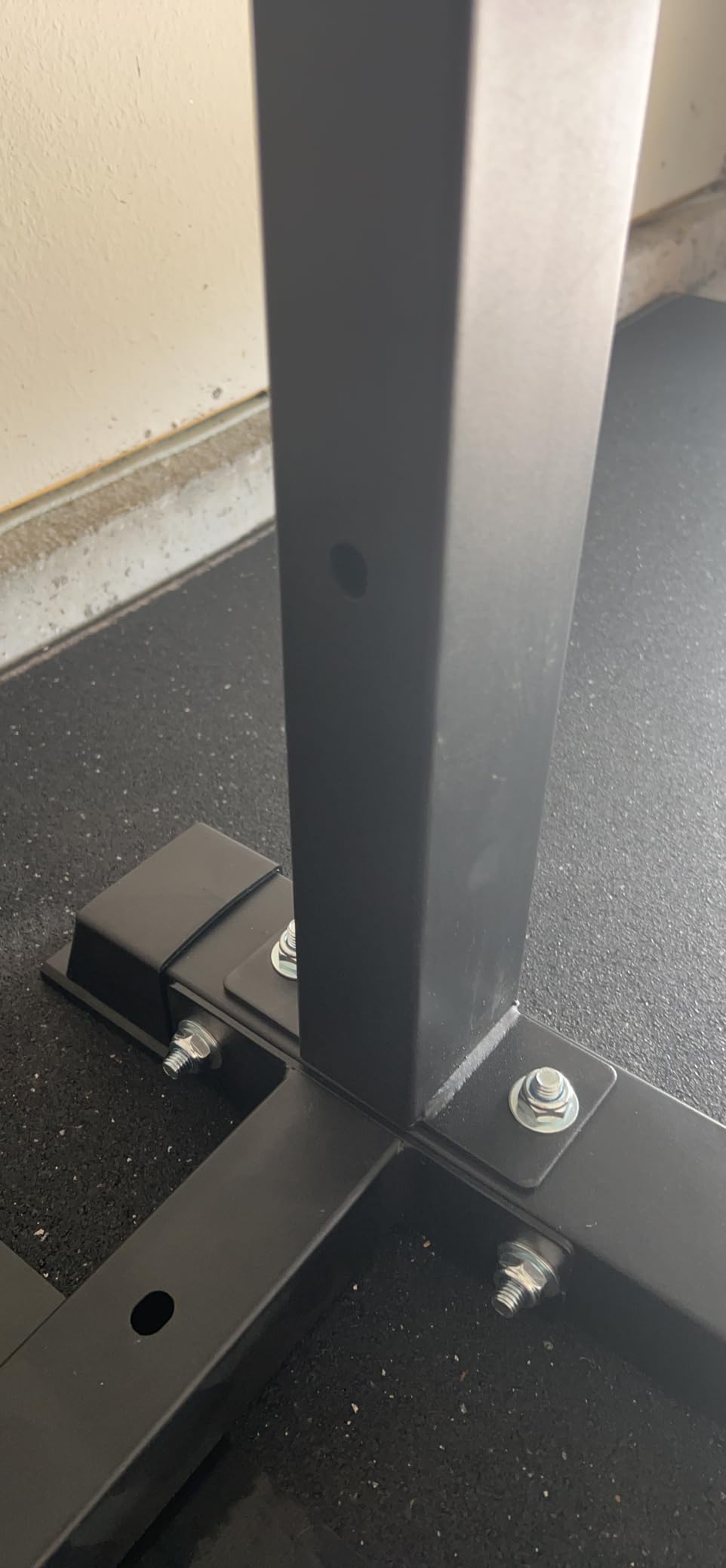
The F22 puts a cable system inside a power rack rather than bolting a separate tower next to it, which saves the floor space of a second machine. The core is 2 by 3 inch 14-gauge steel at 0.08 inch thick with a 1600 lb static capacity, and the dual-triangle base design keeps it stable without bolting it to the floor.
At 68.9 by 55.5 inches and 82.5 inches tall, the short overall height is the point for basement gyms where a full-size rack simply will not go in. Owners also note it can sit a couple of inches from the wall, which recovers depth in a tight corner.
The attachment list is unusually complete for a rack: J-hooks, safety arms, foot pedals, a landmine, a T-bar, dip bars, lat pulldown bar, cable bars and band pegs, with accessory hooks for the rest.
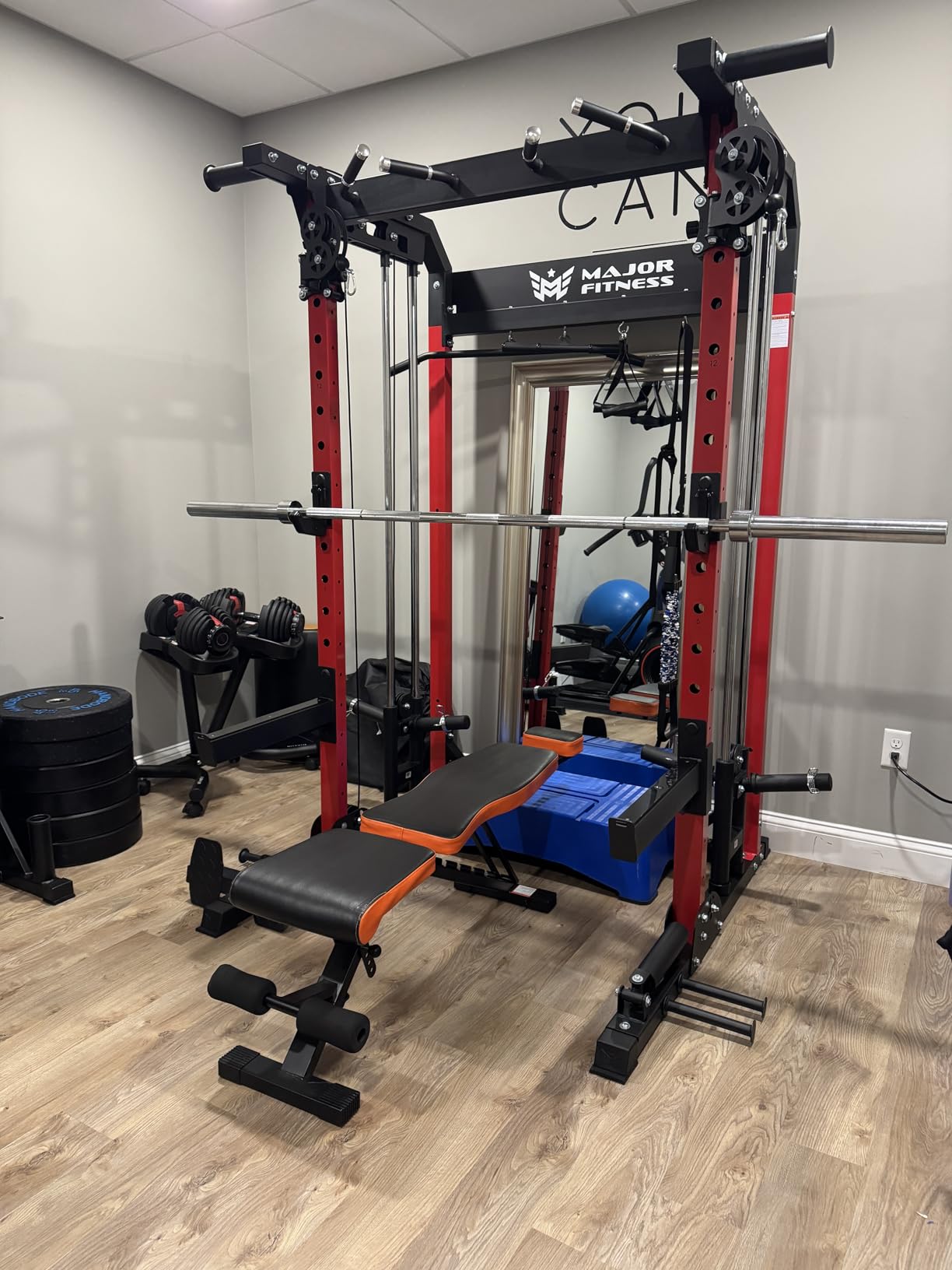
The dual independent pulley system runs at a 2:1 ratio, so each cable gives you half the plate weight in your hands. That makes it well suited to heavy rows and pulldowns without needing very heavy plates on the horns, and because the two sides are independent you can set two different loads.
Stability is the most praised trait. Owners report no wobble even loaded with hundreds of pounds, and pulley travel with no slack or stretch, which is exactly what people notice when they compare a rack cable to a wall-mounted unit.
Several owners run a silicone lubricant on the cable path monthly and report the included plastic pulleys stay smooth, which is a cheap maintenance habit worth adopting whatever you buy.
Best For Heavy Squats and Low Basements
This is the pick for someone whose priority is barbell training first and cables second, in a space where a 90 inch rack will not fit. At 82.5 inches it fits under basement ceilings that rule out a full-height rack, and the rack still handles serious loads without an anchor into the floor.
For a household where one person squats and another does cable work, the independent pulleys mean neither is waiting on the other. The 1 year parts warranty is the shortest guarantee here, so factor that into the ownership picture.
Plate Loading Gets Tiring Fast
This is the design’s main cost. Changing resistance means changing plates on the horns rather than moving a selector pin, and owners report it becomes tedious within weeks — especially on drop sets and supersets. The weight stack conversion accessory exists, but owners note it costs close to as much as the rack.
The included lat bar is not wide enough for a comfortable pulldown grip, and the dip bar handles are narrow. Plan to replace both early. The included accessories are functional rather than commercial grade, so treat that set as a starting point.
How to Choose a Cable Machine for Your Home Gym
Every mistake we saw in these reviews came down to the same thing: a format bought for its exercise list rather than for the space it has to live in. Work through these seven factors before you order, in this order.
Cable Ratio: Match the Number to Your Heaviest Row
Cable ratio is the number of pulley turns the cable makes between the weight and your hand, and it decides what a stack number actually means. At 1:1, pulling a 100 lb plate feels like 100 lb. At 2:1, it feels like 50 lb. At 4:1, it feels like 25 lb.
So a machine advertised with a 200 lb plate-loaded capability might only deliver 100 lb at your hand on the 2:1 setting. Read the ratio before you read the weight. The wall-mounted Valor unit is switchable between 1:1 and 2:1, the F22 rack runs 2:1, and the folding Mikolo rack runs 1:1.
For heavy barbell rows and heavy lat work you want 1:1, because you will need a genuine 150 lb plus in your hands. For high-repetition work, curls, face pulls and pressdowns, 2:1 is more useful because the top of the range is reachable with plates you own.
Weight Stack or Plate Loaded
A selectorized weight stack moves on a pin in fixed increments, usually 10 lb or 5 lb per plate. You change resistance in two seconds and never touch a plate. That is why community consensus consistently favours stacks over plate-loaded arms for drop sets, supersets and circuit work, despite the higher up-front cost.
Plate-loaded systems cost less, use plates you already own, and let you choose any increment you like. They are also heavier to change and require somewhere to put the plates. The wall-mounted Valor and Mikolo units, the F22 and the GDLF are all plate-loaded; the Body-Solid and Inspire trainers are the dual-stack options here.
One more stack trade to know: single-stack versus dual-stack. A single stack has one cable line, so you cannot do a two-sided cable fly or a true independent bilateral press. The dual-stack machines on this list solve that, at the cost of floor space and weight.
How to Measure Your Space Before You Order
Listed dimensions are the machine’s own footprint. The footprint you need is larger, because you step into it, pull from it and often brace against it. A common working estimate for cable work is around 1.5 m by 2 m of clear floor once body movement is allowed for.
Work through five checks before you buy:
Measure the working area, not the frame. Add room in front of the machine for the movement of a seated row and behind it for a standing press. A 26 inch deep wall unit can still need 5 feet of clear floor to use properly.
Check ceiling height against the machine height. The wall-mounted units here stand 80 to 82 inches. Anything over about 82 inches of ceiling height needed will rule out several of them in a low basement.
Check the route to the room. Doorway width, stair width and landing turns decide whether a 476 lb or 544 lb unit can physically reach the room. Owners of the heaviest machines here describe moving them in three or four pieces.
Locate studs and anchor points before ordering. Every wall-mounted unit here needs structure behind it. Know where the studs are and confirm the supplied bracket geometry matches before the boxes arrive.
Leave clearance above and beside. Overhead cable work needs headroom above the top pulley, and baseboard trim will conflict with a low wall bracket on some models.
Ceiling Height and Tall Lifters
The most repeated complaint across owner reviews in this category is height, and it is a ceiling-height problem before it is a machine problem. Fixed frames in the 77 to 83 inch range limit the top of the overhead range of motion for lifters over six feet, and the wall-mounted units inherit the same ceiling because the top pulley position is fixed to the frame.
Our rule of thumb: if you are over six feet, stand under the top setting with the handle and check whether your elbows can reach a full overhead press position without the frame getting in the way. On the GDLF, the Inspire FTX and the Mikolo M-G3, owners specifically report the top pulley feeling low.
Wall Mounted Safety and Renting
Wall-mounted cable machines are safe when they are fixed into structure — studs or concrete with proper anchors — and unsafe when they are fixed into drywall. One product here includes plastic expansion anchors that are not adequate for heavy loading, and one set of instructions even specifies the wrong anchor bit size. Replace the hardware.
If you rent, wall-mounted units are not an option. That leaves freestanding formats: the GDLF lat and row station, or the folding Mikolo rack if you also want barbell training. Both can be moved, so they work in a rental that treats equipment as removable.
Assembly Time and Total Cost of Ownership
Owners report assembly anywhere from about one hour to more than thirty, depending on format. The wall stations assemble solo in one to two hours with labelled hardware. The folding rack takes several hours with folding complexity on top. The dual-stack trainers take two to four and a half hours and realistically need a second person.
Your real total includes more than the machine: add-on weight plates, a replacement lat bar or rope set, better anchors, cable lubricant, and professional assembly if you do not want to do it yourself.
What Each Machine Format Cannot Do
Rack attachment pulleys cannot do bilateral two-sided work at all — one cable, one side at a time — and they do nothing without an anchor point.
Single-column towers cover pulldowns, rows, curls, pressdowns and kickbacks, but not a true dual-anchor crossover.
Wall-mounted dual pulleys give you a crossover but not a pull-up station, and the highest peg position is often obstructed by the carriage.
2:1 plate-loaded systems run out of usable resistance on heavy rows, so a 400 lb maximum may feel like 200 lb at your hands.
All-in-one frames under 82 inches limit overhead range of motion for anyone over six feet, whatever the brand claims.
Frequently Asked Questions
What is the best all-in-one cable machine for a home gym?
For most home gyms the best all-in-one option is a dual-stack functional trainer such as the Inspire FTX, which puts two independent 165 lb stacks behind a 54 by 40 inch frame and includes a rope, D handles, curl bar and chin/dip belt. If your space is tighter, a wall-mounted dual pulley such as the Mikolo M-G3 gives you a high and low pulley in about 26 by 27 inches of floor.
Is a cable machine good for a home gym?
Yes. Cables give you a constant line of tension across dozens of angles, cover movements free weights cannot such as cable flyes, face pulls and straight-arm pulldowns, and keep the load inside a stack instead of on a dropped plate. For a home gym they add roughly a dozen movement patterns to a rack and bench without needing a second full machine.
What cable machines do gyms use?
Commercial gyms use tall dual-stack functional trainers with independent weight stacks for two-sided work, plus plate-loaded low rows, high pulleys and cable crossovers spread around the floor. Home versions trade stack size and height for footprint, which is why home units often carry 165 lb to 210 lb per side rather than the much heavier stacks found in a commercial frame.
Is a cable tower worth it?
A cable tower is worth it when you want lat pulldowns, rows, curls, pressdowns and kickbacks in one footprint without drilling into a wall. It is not worth it if you already own a rack, because a rack pulley attachment adds the same movements for a fraction of the cost and no floor commitment. A tower only earns its place when you have no anchor point and no frame.
Which cable machine is considered the best functional trainer?
In this group the Mikolo LAT and Lift Pulley System takes the overall spot for what it delivers per dollar and per review, holding a 4.6 rating across more than four thousand reviews. Among full frames the Inspire FTX has the highest share of five-star ratings and the most complete accessory bundle, while the Body-Solid Powerline PFT100 is the strongest choice for two people training at once with independent stacks.
How much space does a functional trainer take up?
Plan for the listed footprint plus room to move. A compact dual-stack trainer such as the Inspire FTX is 54 by 40 inches, while a full rack like the MAJOR FITNESS F22 is 68.9 by 55.5 inches and the folding Mikolo rack opens to 9.5 square feet. A practical working area for cable work is around 1.5 m by 2 m of clear floor once stepping-on space is allowed for.
Are wall mounted cable machines safe?
They are safe when fixed into studs or concrete with proper anchors, and unsafe when fixed only into drywall. One unit here includes plastic expansion anchors that are not adequate for heavy loading, and one instruction set specifies the wrong anchor bit size. Mount into structure, replace the supplied fasteners with structural screws or concrete anchors, and check that the bracket clears any baseboard trim.
Can a cable machine replace a power rack?
Only partially. A rack or a rack attachment covers squat, bench and overhead press, which no cable machine in this group can fully replace on its own. What a cable machine adds is everything the barbell cannot do well — flyes, face pulls, rows at varied angles, curl and pressdown variations — so most complete home gyms end up with a rack plus one cable unit rather than one or the other.
Which Cable Machine Is Right for You
The best cable machines for home gyms come down to one question: do you already have something to hang a pulley from? If a rack, pull-up bar or beam exists, the Mikolo LAT and Lift Pulley System is the strongest buy on this list, with the SERTT system as the close second if you want more attachments in the box.
If you have no anchor point, route by space and by who trains. A GDLF freestanding tower covers lats and rows with no wall work. A wall-mounted dual pulley such as the Valor or Mikolo M-G3 keeps the floor clear but needs structure behind the wall. A dual-stack trainer such as the Body-Solid Powerline or Inspire FTX is the answer when two people train together and you want attachments included.
Before any of it arrives, measure the working area, the ceiling height and the route to the room. Those three numbers rule out more machines than the specification sheet ever will. Whichever unit you land on in 2026, upgrade the pulleys where reviews flag friction, mount into studs rather than drywall, and expect a few hours with a second person for anything over 400 lb.