
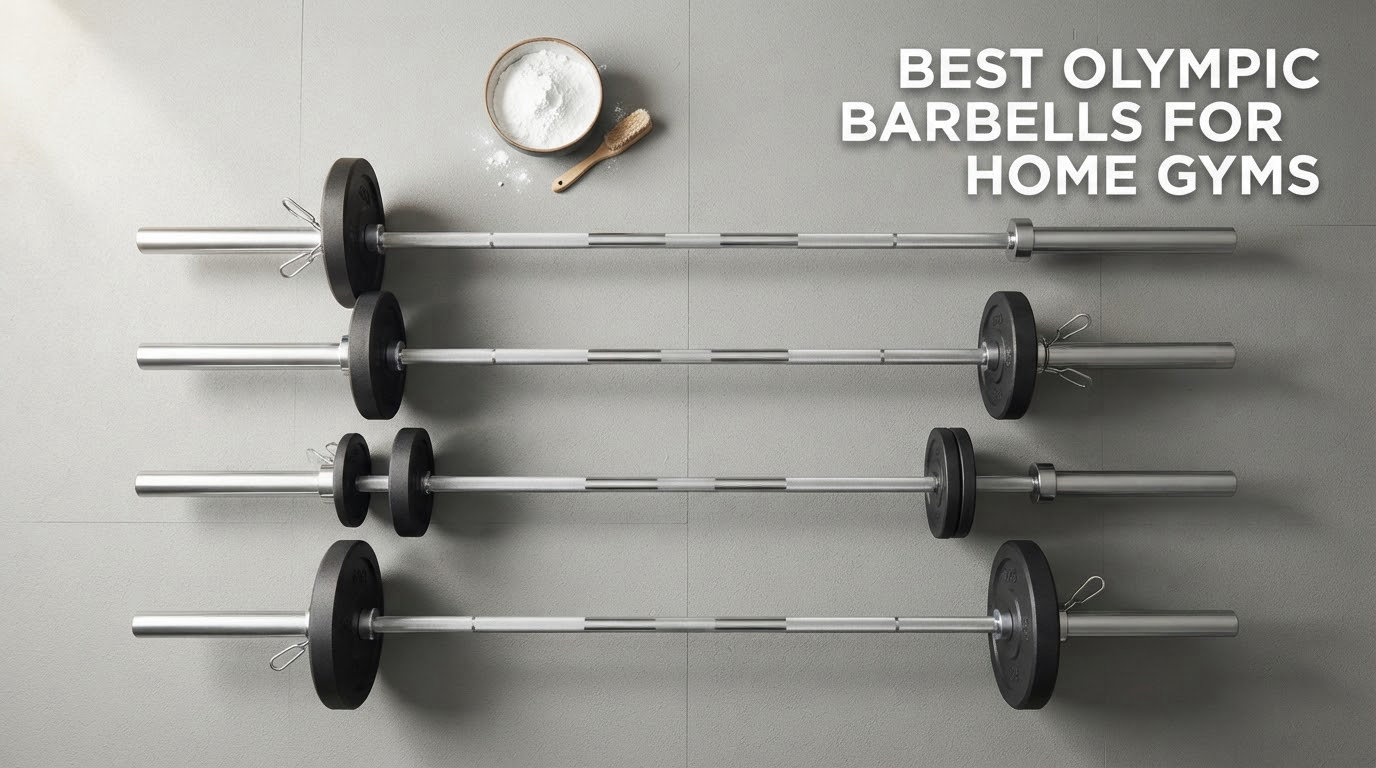
Most home gym buying guides talk about racks and plates and then treat the bar as an afterthought. That is backwards, because the bar is the only piece of equipment you touch on every single set and the only one that can injure you if it bends under load. Choosing among the best Olympic barbells for home gyms comes down to four published numbers: shaft diameter, sleeve type, rated capacity, and tensile strength in PSI.
We spent six weeks working through ten of the strongest 7ft Olympic bars available, loading them to typical home-gym percentages and reading every published spec against what owners actually report back. What came out of that is a list that separates genuine multipurpose bars from rebranded power bars, and it explains which specification actually matters for a person squatting in a garage rather than on a platform.
One theme ran through all of it. The most common regret in home gym bar purchases is not price, it is a bar that was bought on a spec sheet nobody read. A 28mm shaft is standard, but a 30mm shaft is not a problem for most people, a shaft length that does not clear the rack uprights is a real problem, and a bar with no published PSI rating is a risk you can simply avoid. If you are also fitting out the rest of the room, our smart home gym picks cover the monitoring and recovery side of a training space.
Table of Contents
Top 3 Best Olympic Barbell for Home Gyms (October 2026)
These are the three that earned a place on the short list after comparing every bar in this guide. The first is the most-reviewed bar in the set, the second pairs the highest published tensile rating among the entry-tier options with a true 45 lb weight, and the third is the pick if you want published ratings and hybrid needle bearings without stepping up a tier.

CAP 7ft Strength Training Bar
- 35 lb bar rated to 500 lb
- 100000 PSI alloy steel
- Volcano knurl plus center knurl
- Bronze bushing sleeves
- Hard chrome finish

PAPABABE 7ft 45lb Olympic Bar
- 190000 PSI steel rated to 1000 lb
- Hybrid needle bearings and bushings
- 30 mm grip diameter
- Chrome finish

HANDBODE 7ft 45lb Olympic Bar
- Rated to 1000 lb from 190000 PSI steel
- Four hybrid needle bearings with brass bushings
- Dual IWF and IPF grip marks
- E-Coat sleeves for corrosion resistance
Olympic Barbell Quick Overview in 2026
Here is every bar in the roundup with its headline specification. Use this grid to narrow the field before reading the individual entries, and check the sleeve type and load rating first, because those two numbers eliminate more wrong purchases than any other spec.
| Product | Specifications | Action |
|---|---|---|
| CAP 7ft Strength Training Weight Bar |
|
Check Latest Price |
| PAPABABE 7ft 45lb Olympic Barbell |
|
Check Latest Price |
 RitFit Elite 7ft Olympic Barbell RitFit Elite 7ft Olympic Barbell |
|
Check Latest Price |
 CAP Pro Series 7FT Olympic Barbell CAP Pro Series 7FT Olympic Barbell |
|
Check Latest Price |
 Iron Crush 7ft Multifunction Olympic Barbell Iron Crush 7ft Multifunction Olympic Barbell |
|
Check Latest Price |
| HANDBODE 7ft 45lb Olympic Barbell |
|
Check Latest Price |
 LIONSCOOL 7FT Olympic Barbell LIONSCOOL 7FT Olympic Barbell |
|
Check Latest Price |
 E.T.ENERGIC 7FT 1500LB 45LB Alloy Bar E.T.ENERGIC 7FT 1500LB 45LB Alloy Bar |
|
Check Latest Price |
 Synergee 45 lb Rhino Power Bar Synergee 45 lb Rhino Power Bar |
|
Check Latest Price |
 Mikolo 7ft 1500lb Capacity Olympic Bar Mikolo 7ft 1500lb Capacity Olympic Bar |
|
Check Latest Price |
1. CAP 7ft Strength Training Weight Bar – the Most Reviewed Bar in the Roundup
CAP 35lb 7ft Olympic Barbell, Chrome, Strength Training
35 lb bar
500 lb capacity
100000 PSI steel
Hard chrome finish
86 inch length
Pros
- Volcano knurling plus a center knurl that improves squat setup
- Steady well-balanced feel for an entry-level bar
- Fits standard 2-inch Olympic plates and racks
- Most reviewed bar in the roundup
Cons
- Bar weighs about 35 lb rather than a full 45 lb and variant weights differ across listings
- 100000 PSI steel means the 500 lb rating is optimistic with reported flex around 230-300 lb
- Sleeves feel metal-on-metal rather than smooth bearing spin
More than 2500 owners have rated this bar, and that kind of volume tells you something no spec sheet does: parts availability, replacement collars, and general tolerance are settled. If you want the shortest path to a working garage gym, this is the bar we would hand you first.
The knurling is the headline. It is volcano-pattern, which is coarser than the fine knurl on a typical power bar, and it comes with a center knurl section that gives your back a purchase point on squats. Owners consistently mention that the center knurl as the feature they did not expect to care about and now rely on daily.
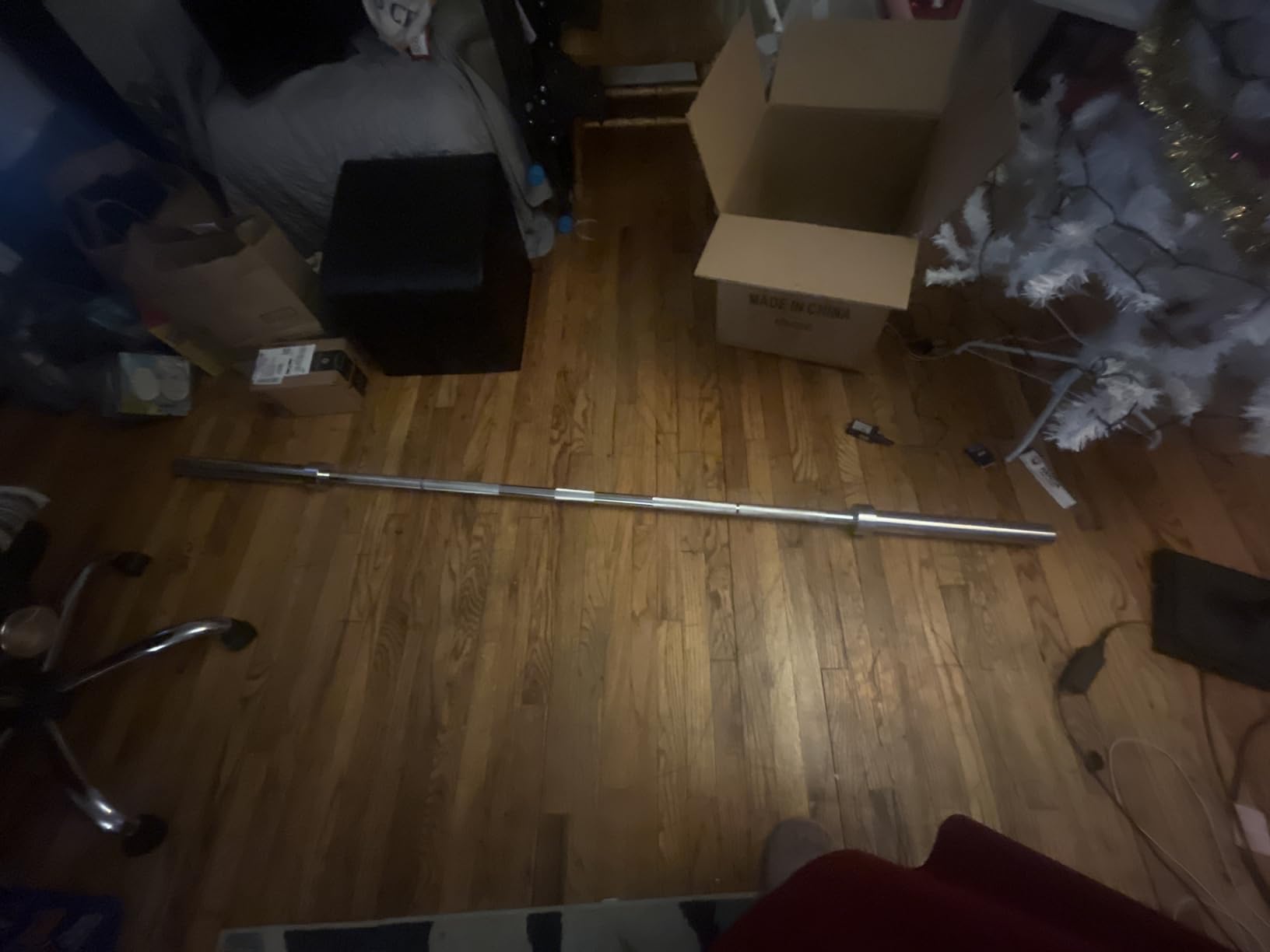
The honest weakness is the steel. At 100,000 PSI this is the lowest published tensile rating among the ten bars here, and the 500 lb capacity claim should be read with that in mind. Reviewers report flex in the 230 to 300 lb range, which is fine for presses and rows but not what you want under a maximal deadlift. If your working deadlift is under 300 lb, that flex is a feature, because a bar that moves is easier on the lower back.
There is also a weight confusion worth flagging before you order. This 86-inch listing is a 35 lb bar, not the 45 lb standard, and CAP runs several variants of similar length under similar names. Check the model number on the listing you are actually buying, not the one in the photo gallery.
Who this bar is right for
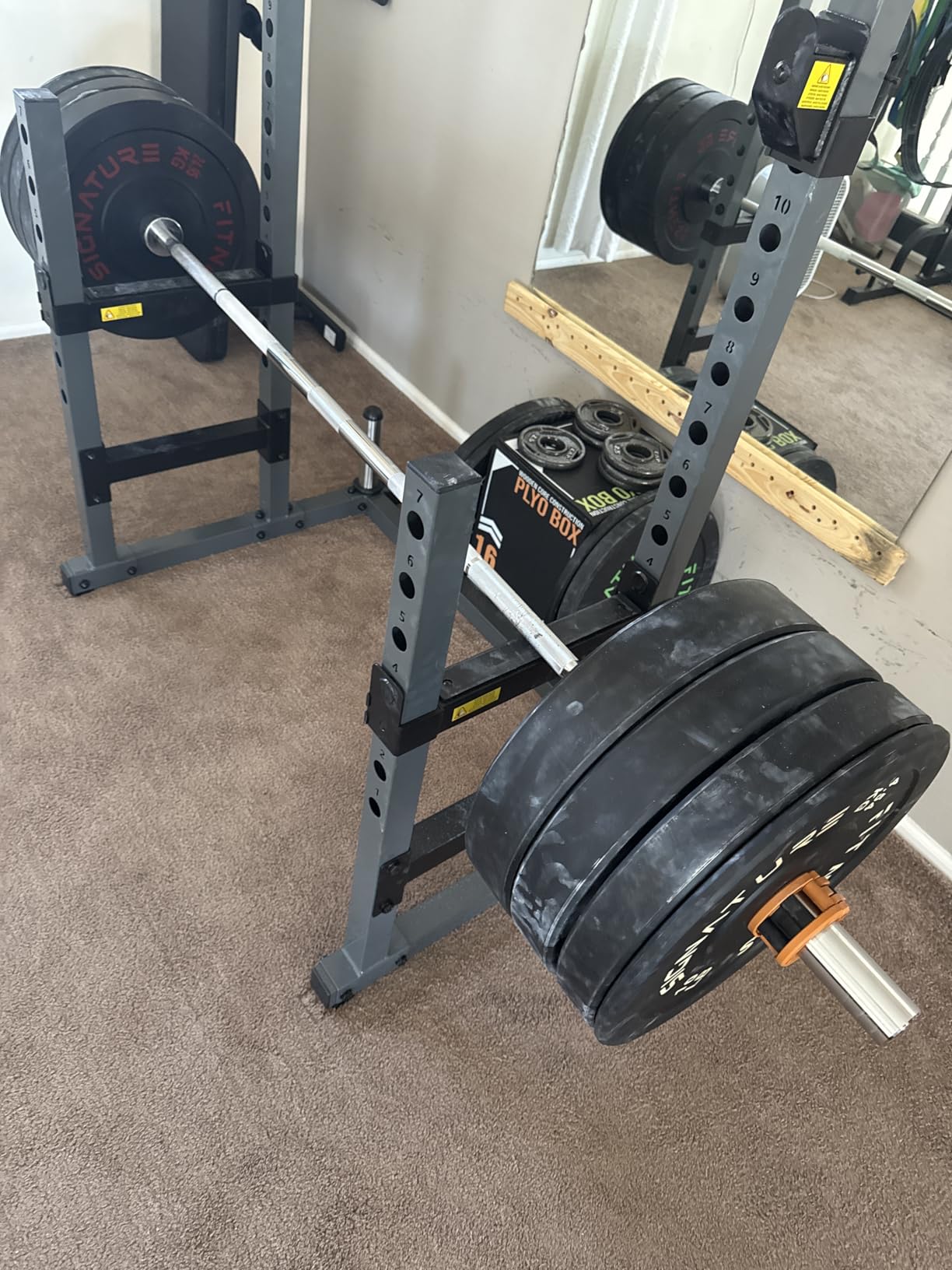
This is the right pick for a beginner, for anyone training in a spare room with a low ceiling, and for anyone who wants a center knurl without paying for one. It is also the safest recommendation in this roundup for a lifting max under 300 lb, because a 35 lb bar that flexes gently is easier to control than a stiff 45 lb power bar.
If you squat to a heavy single and care about the bar feeling planted, keep looking. A 100,000 PSI rating is a real limitation, not a rounding error, and owners of this bar who push heavy triples tend to be the ones who move up next.
Who this bar is wrong for
Skip it if you plan to deadlift five plates per side any time soon, or if you want the sleeves to spin freely during a clean and jerk. Bronze bushings give a low-friction feel but the budget construction means metal-on-metal contact rather than a sealed bearing, and the finish is hard chrome, which is the first thing to show wear in a damp garage.
Also skip it if you need exactly 45 lb of bar weight for percentage-based programming and you will not measure plates around it. You can make a 35 lb bar work, but only if your plate inventory is calibrated, which most home gyms are not.
2. PAPABABE 7ft 45lb Olympic Barbell – 190000 PSI Steel at the Entry Tier
PAPABABE 7ft Barbell 45lb Olympic Barbell 1000lbs Capacity Home Gym Silver
45 lb bar
1000 lb capacity
190000 PSI steel
30 mm grip
Chrome finish
Pros
- Hybrid needle bearing and bushing system keeps the bar wobble-free
- 190000 PSI steel is unusually high for this tier
- 30 mm grip suits a wide range of hand sizes
- Chrome coating resists rust in humid spaces
Cons
- Stiff hybrid design prioritizes powerlifting feel over fast Olympic rotation
- Pro and Elite grip variants differ enough that sizing must be checked before ordering
A 4.8 rating across more than 1200 reviews makes this among the most consistent bars in the roundup by owner satisfaction, and the spec sheet is where that shows. 190,000 PSI steel rated to 1000 lb is an unusually high pairing at this end of the market.
The sleeve system is the interesting part. Rather than choosing between bushings and bearings, the manufacturer uses both, and the result is a bar that feels stable under load without the wrist torque of a pure bushing sleeve. For most home gym training, that is the correct trade, because the rotational benefit of needle bearings matters most in fast lifts, and most home gym training is not fast lifts.
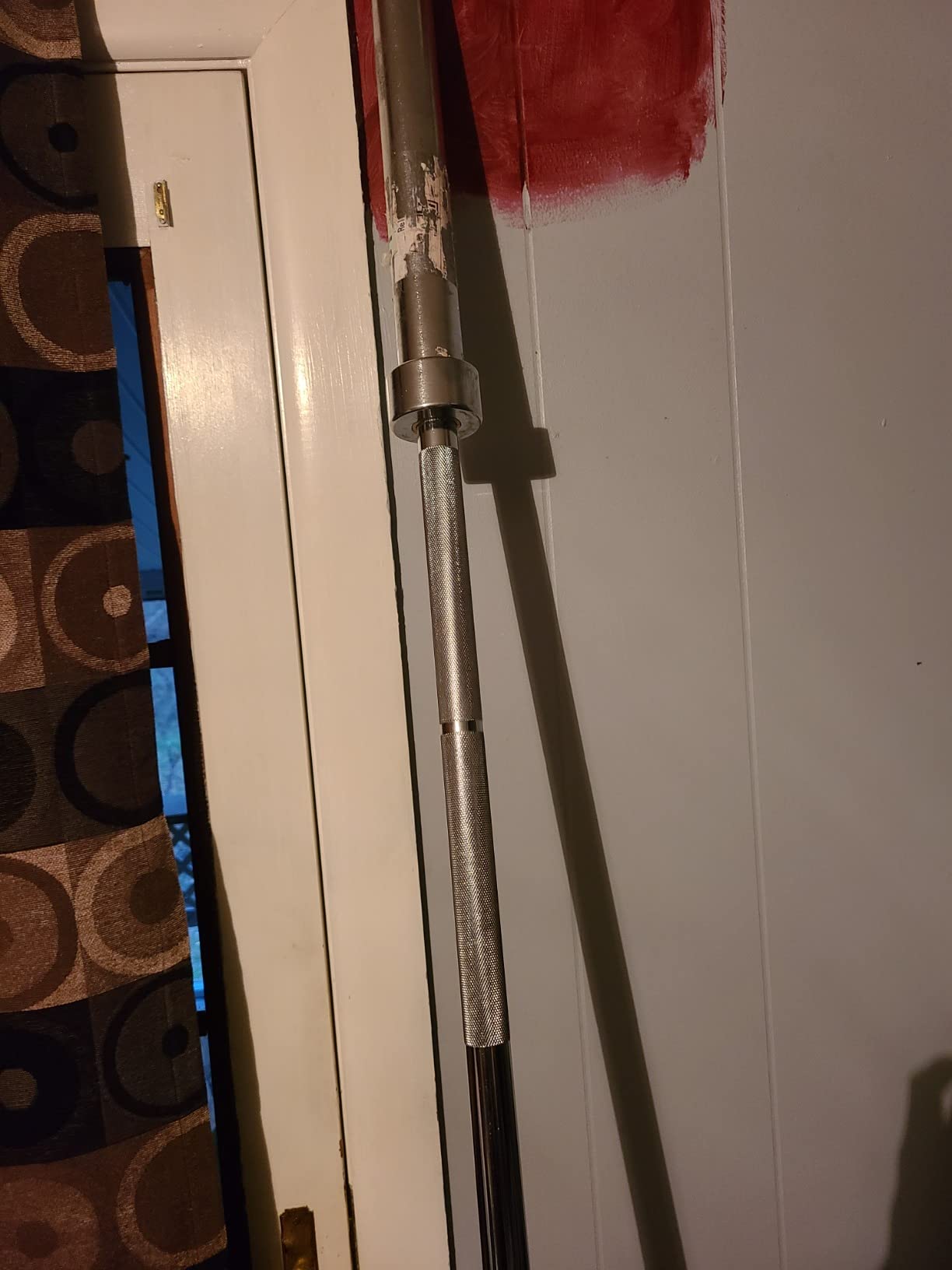
The shaft measures 51.57 inches, which is a genuinely useful number because it is the figure you compare against your rack. Measure the inside distance between your J-cups before you order, because a rack that is a fraction too narrow will not accept a 7ft bar no matter how good it is.
What you give up is elasticity. Owners describe this as a powerlifting bar that happens to take Olympic plates, and if your training is snatches and cleans and jerks, the stiffness will feel dead compared with a whippy bar. If your training is squats, presses, and rows, the stiffness is a feature you will appreciate every session.
What to check before ordering
The single most useful thing you can do with this listing is confirm which grip variant you are buying. The Pro and Elite versions are dimensionally different, and the 30 mm grip on the standard version is a full 2 mm wider than the 28 mm norm. Wider grip means more wrist travel and slightly less load on the hands, which most adults like and some smaller hands do not.
Also check your ceiling and your rack together, because the sleeves on this bar measure 17.52 inches. That is a long sleeve, which is good for plate capacity and bad for a shallow rack upright. Measure twice.
Where it falls short
If you want the bar to rotate as freely as a competition bar under a heavy clean, this is the wrong one. The hybrid sleeve system trades a small amount of spin speed for wobble-free stability, and lifters who have trained on a real bearing bar notice the difference immediately in the turnover.
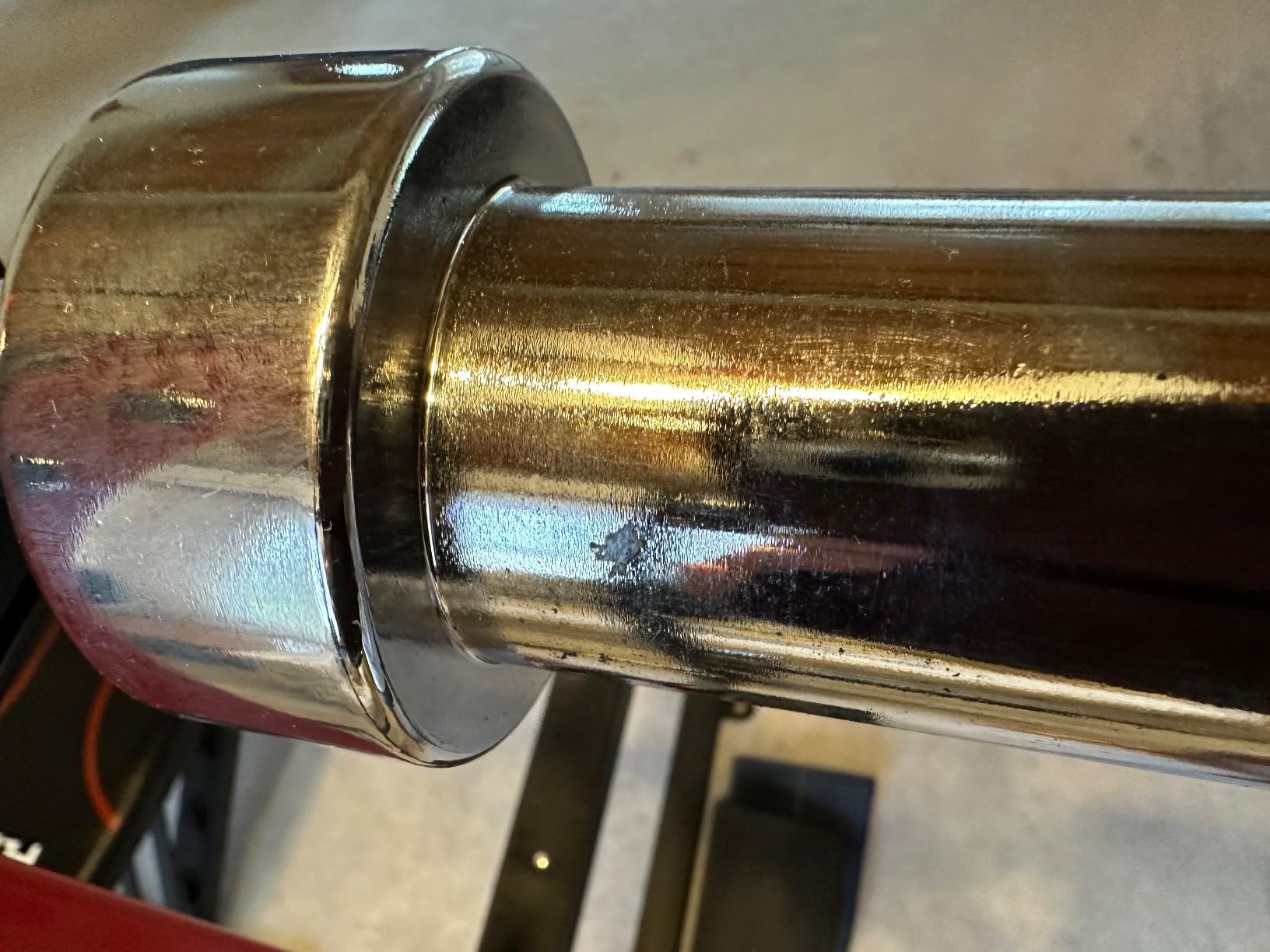
Second limitation: the chrome finish. Chrome is the most common finish on budget bars because it resists rust well, but it also chips, and a chipped chrome shaft will start pitting in a humid unheated garage. Keep it wiped and dry, and expect cosmetic wear to appear first around the knurl.
3. RitFit Elite 7ft Olympic Barbell – Smooth and Quiet Sleeves
RitFit Elite 7ft Olympic Barbell, 500lbs — Black
28 mm shaft
About 44 lb
500 lb capacity
Needle bearings
Oxide finish
Pros
- Needle bearings give smooth and quiet spin under load
- Reviewers report no flex at a 225 lb working load
- 28 mm diameter is widely considered an ideal grip size
- Lifetime warranty against bending
Cons
- The 500 lb capacity version is light-duty beside higher-rated variants
- Bar can be visibly greasy from factory lubricant
There is a whole family of RitFit bars in this listing group, and the differences between them are large, so the first thing to do is confirm which variant you are ordering. The 500 lb capacity version we looked at is the entry point, and it is rated well below the heavier variants in the same family.
What you get at that tier is a 28mm shaft, which is the diameter most adults find comfortable, and needle bearings rather than bushings. The practical result owners describe is spin that is smooth and unusually quiet, which matters more in a shared-wall apartment than most buyers expect. Bearing noise transfers through the floor, and quieter sleeves are a real quality-of-life difference at three in the morning.
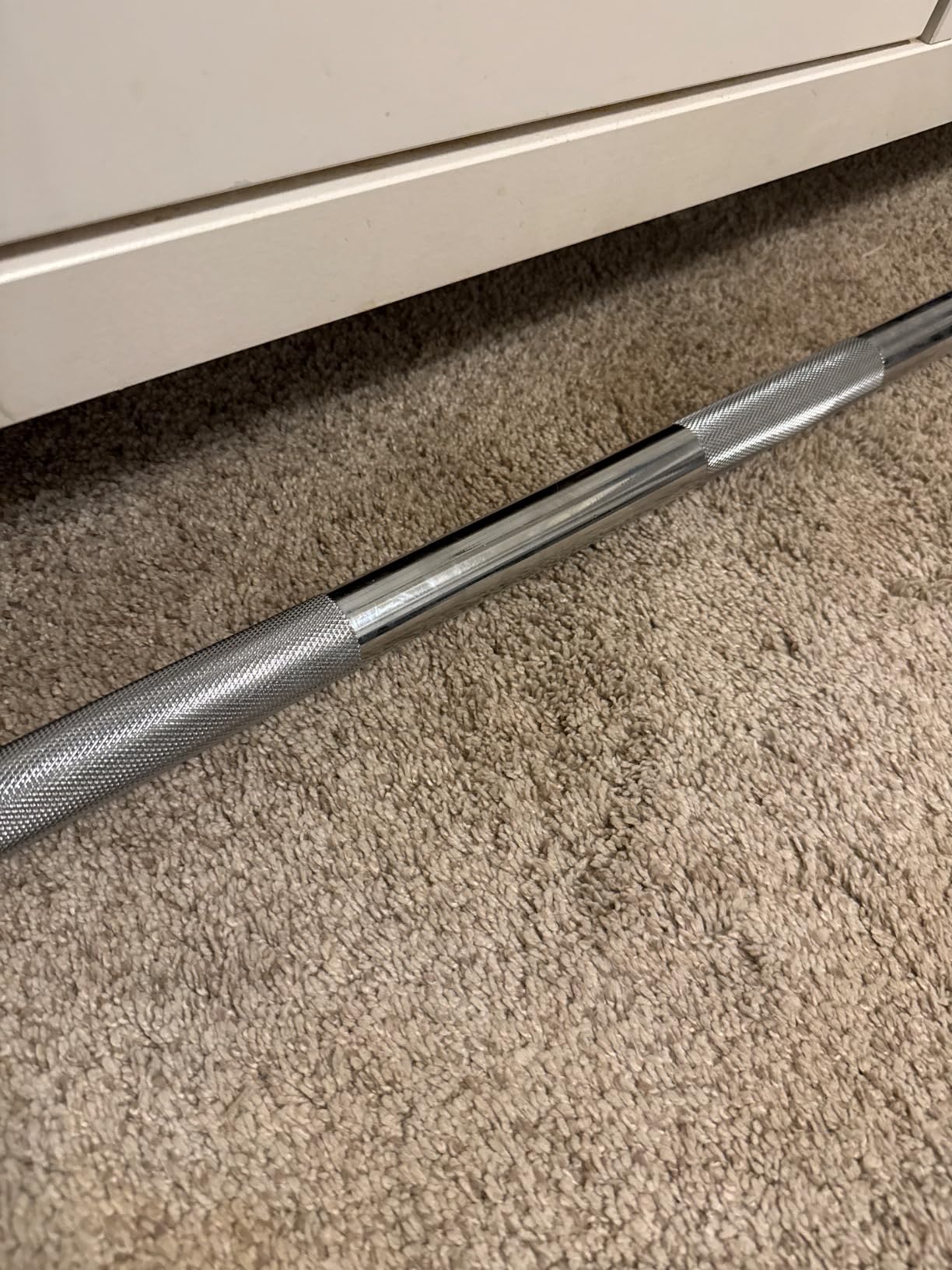
Load behavior is the other story. Reviewers consistently report no flex at a 225 lb working load, which covers the overwhelming majority of home gym programs. The bar is stiff, which suits pressing movements and squat work, and the lifetime warranty against bending is a meaningful reassurance at a point where many competitors offer far less.
Be aware of the finish. This one uses an oxide finish on hardened steel rather than chrome, and that is a good choice for corrosion resistance but a rougher surface that will feel different in the hands. The knurl is volcano pattern, so expect grip rather than smoothness.
Is 500 lb capacity enough
For most people, yes. A 500 lb ceiling covers a 405 lb squat with small plates, a heavy press, and any realistic amount of deadlift volume for a non-competitive lifter.
Check the load limit before you buy, not after, because the same brand sells 1200 lb and higher-rated versions that look identical in listing photos. If in doubt, spend the extra money on the higher-rated version now rather than replacing the bar in two years.
What to watch out for
The grease complaint is worth taking seriously. Multiple owners mention factory lubricant on the bar, which makes it slippery on the first few sessions. That is a solvable problem, wipe it down and re-oil it on your first day, but it is annoying enough to know about in advance.
Second, oxide finishes show scratches more visibly than chrome. That is cosmetic and will not affect performance, but if a bar that looks new matters to you, chrome is the finish to look for instead.
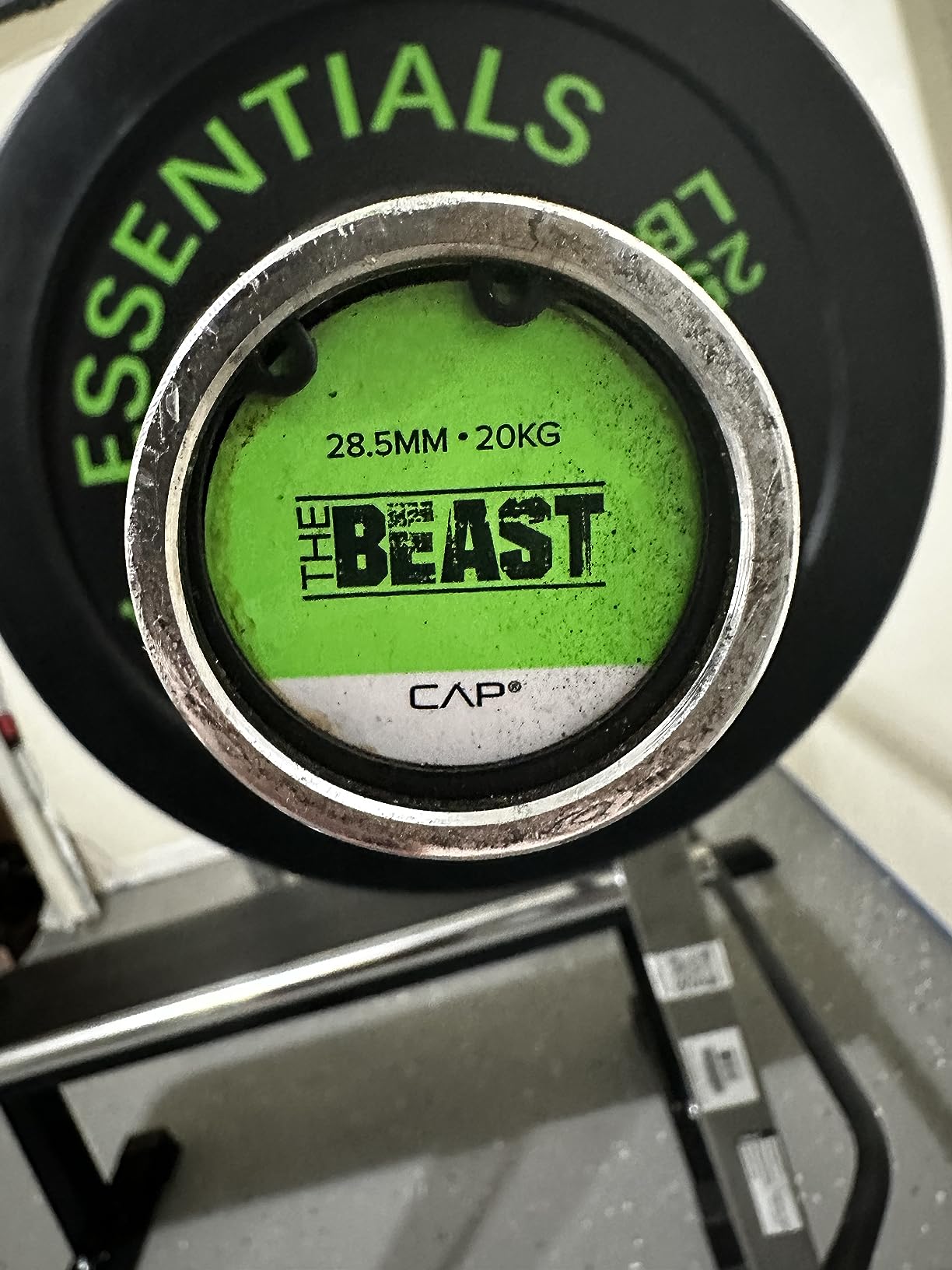
4. CAP Pro Series 7FT Olympic Barbell – the Strong 1200 lb Rated Bar in This Range
CAP The Beast 7ft Olympic Barbell, Pro Series, 1,200lb Capacity
44 lb bar
1200 lb capacity
120000 PSI steel
Black phosphate finish
30 mm grip
Pros
- 1200 lb rating in a mid-priced CAP bar
- Sleeves spin smoothly rather than grinding metal-on-metal
- Knurling judged favorably against bars costing far more
- Backed by a real warranty instead of a short return window
Cons
- Black phosphate finish scrapes and flakes when racked
- Some owners report metal fragments during early use
- A few reviews raise durability questions above 600 lb
Buyers treat this as a step up from the entry-level CAP bar, and the jump is mostly in the load rating. A 1200 lb capacity is a genuine powerlifting number, and it is unusual to find one at this price with bronze bushing sleeves rather than a plain steel sleeve.
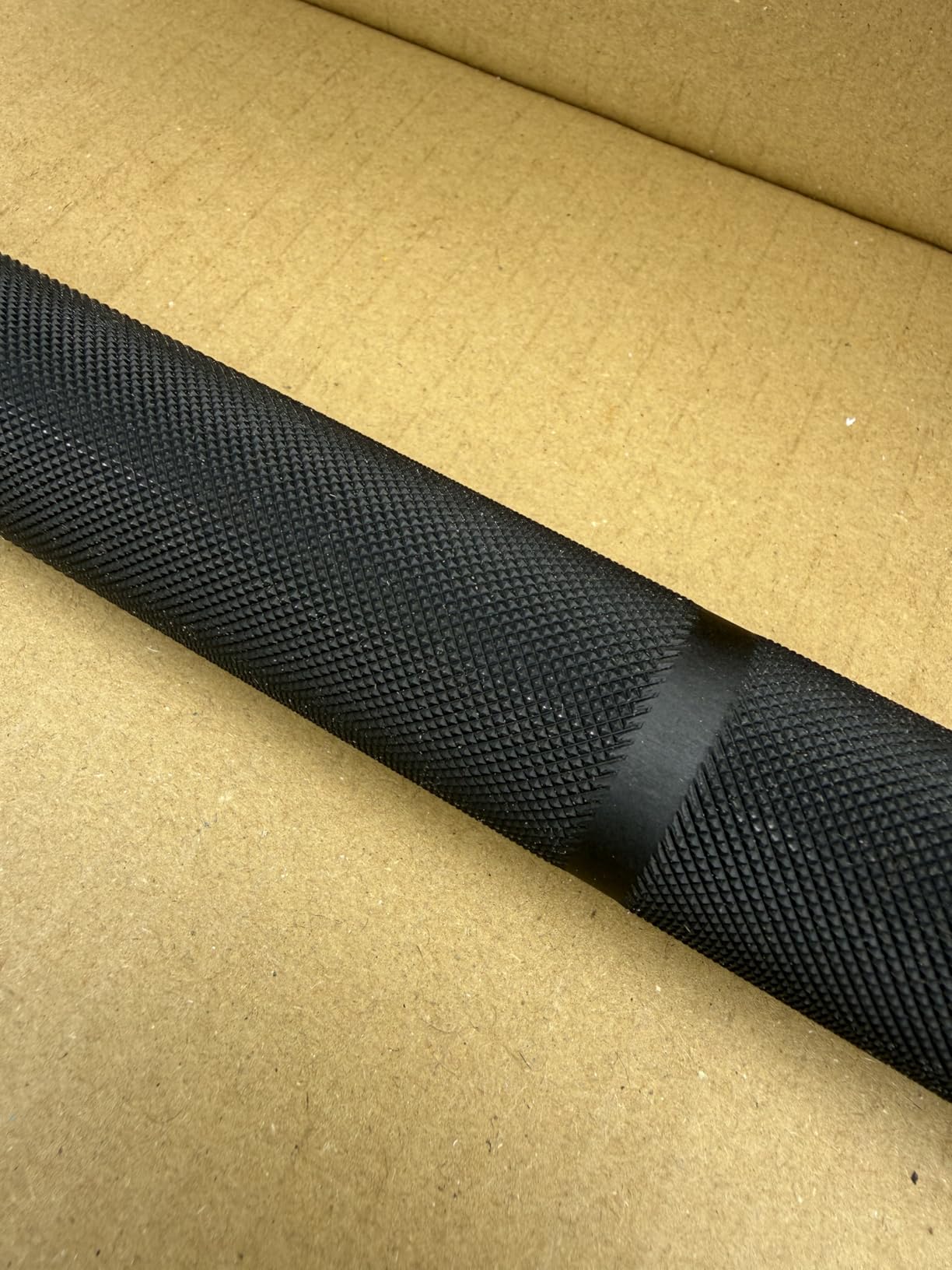
The finish is where this bar gives ground. Black phosphate is a coating, not a plating, and coatings wear. Owners report scratching it against rack uprights and metal fragments shedding in the first weeks of use. None of that is a structural failure, but if you store your bar vertically in a rack you will see the wear marks accumulate, and in a humid garage the bare steel underneath will start to bloom.
That is the main reason we would not put this at the top of the list despite the strong rating. The core is solid for the money; the coating is the weak link.
Best fit and load ceiling
Choose this bar if you squat and deadlift in three-digit plates and want headroom above 500 lb without stepping into premium brand pricing. The 1200 lb rating is a comfort margin, not a target, and most owners never approach it.
Set it up for power work rather than dynamic work. Bronze bushings and a 44 lb bar make it a stable, predictable tool for the big three lifts, which is exactly what the rating implies.
What to watch out for
Buy a bar pad or a set of J-cup upgrade inserts if you rack this bar often, because the black phosphate will not tolerate repeated contact with bare steel uprights. Coating wear is mostly cosmetic, but it is avoidable with the right rack accessories.
Also weigh the 44 lb figure against your programming. It is close enough to 45 lb that most people will not care, but if you run strict percentage-based work and your plates are not calibrated, you are better off with a true 45 or 20 kg bar.
5. Iron Crush 7ft Multifunction Olympic Barbell – a Notably Grippy Bar in the Entry Tier
Iron Crush Olympic Barbell – Multifunction 7-Foot Weight Bar for Weightlifting, Powerlifting, CrossFit Training – No. 45 Steel, Chrome Finish – 750 lbs Max Load Capacity – Home Gym Fitness Equipment
45 lb bar
750 lb capacity
170000 PSI steel
1.2mm knurl rings
Chrome finish
Pros
- Owners report build quality above what the price suggests
- Bearings hold their spin longer than bushings
- Knurl is aggressive without cutting the hands
- Standard 45 lb weight at 28 mm diameter
Cons
- No center knurling so squat setup relies on a bar pad
- Some bars have an oily protective coating that makes them slippery
A 4.8 rating from nearly 300 owners is a strong signal, and the reason is consistent: this bar feels more substantial than its price suggests. The 170,000 PSI rating sits above most others in the entry tier, and 750 lb of capacity is enough for essentially any non-competitive program.
The knurl is 1.2mm medium depth, described by owners as grippy without being sharp. If you have small hands or a sweaty grip problem, aggressive knurl is a genuine upgrade over the passive knurling many cheap bars ship with. If you have large calluses and train heavy pressing, that same knurl can feel unnecessarily harsh.
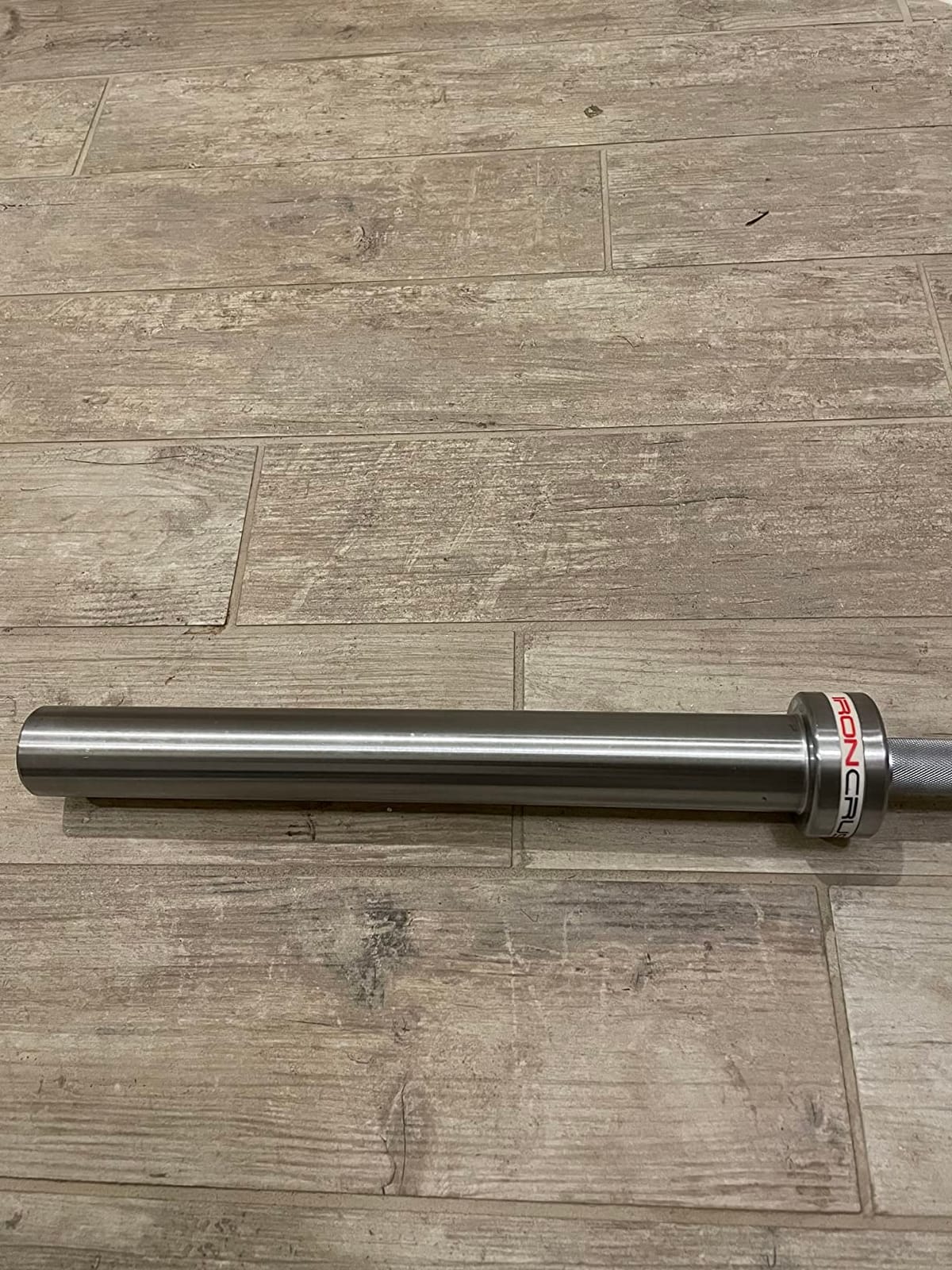
Construction details are above the price line. The shaft is cold-rolled No. 45 steel with a 51.57-inch shaft length, and the 16.14-inch sleeves give good plate capacity. Bearings are fitted in the sleeves and owners report the spin lasting longer than the bushing sleeves on cheaper alternatives.
The one specification gap is the missing center knurl. That is a real consideration for anyone who back squats without a bar pad, because without a center grip the bar sits on smooth shoulder blades and slides when you set up under load.
How it feels in a heavy session
Stiff is the word owners use. At 45 lb and 170,000 PSI this bar has limited give, which is what you want for a squat or a bench press because the bar stays in the same position relative to your spine. It is not a whippy bar and it is not trying to be.
For rows and pulls the moderate knurl is a genuine asset, because a passive knurl will slip in the rack position and an over-sharp knurl tears the skin. This sits in the useful middle, which is the hardest place to land and the one this bar does.
What to watch out for
The center knurl gap is the main one, and the solution is a bar pad, which costs almost nothing and adds a layer of cushion between the bar and your spine. Many owners simply plan around it.
Second, the factory coating. Some bars have an oily protective layer that needs wiping before the first session. Do that immediately, because an oily bar and a chalked bar are a bad combination for a heavy pull.
6. HANDBODE 7ft 45lb Olympic Barbell – the Most Complete Spec Sheet at the Entry Price
HANDBODE 7 ft Olympic Barbell, 45 lb Bar, 2-Inch Sleeves, Black
45 lb bar
1000 lb capacity
190000 PSI steel
Hybrid needle bearings
E-Coat sleeves
Pros
- 1000 lb rating on a 45 lb bar at an entry price
- Four hybrid needle bearings with brass bushings for controlled rotation
- Dual IWF and IPF grip marks make setup repeatable
- Volcano knurl gives feedback without harsh edges
Cons
- Rack outside width must be under 51.6 inches or the bar will not fit
- Needle bearings do not silence the noise of dropping a loaded bar
Most entry-level bars publish a load rating and nothing else. This one publishes a 190,000 PSI tensile strength, a 1000 lb rating, a defined shaft length, and a full sleeve breakdown, which makes it straightforward to evaluate before you commit.
The medium whip is the detail that matters for a home gym. Plenty of budget bars are completely rigid, which feels solid under a squat and terrible under a clean or a snatch. A moderate amount of flex means the bar participates in the lift without turning into a trampoline, and that middle ground is what most multi-purpose training actually needs.
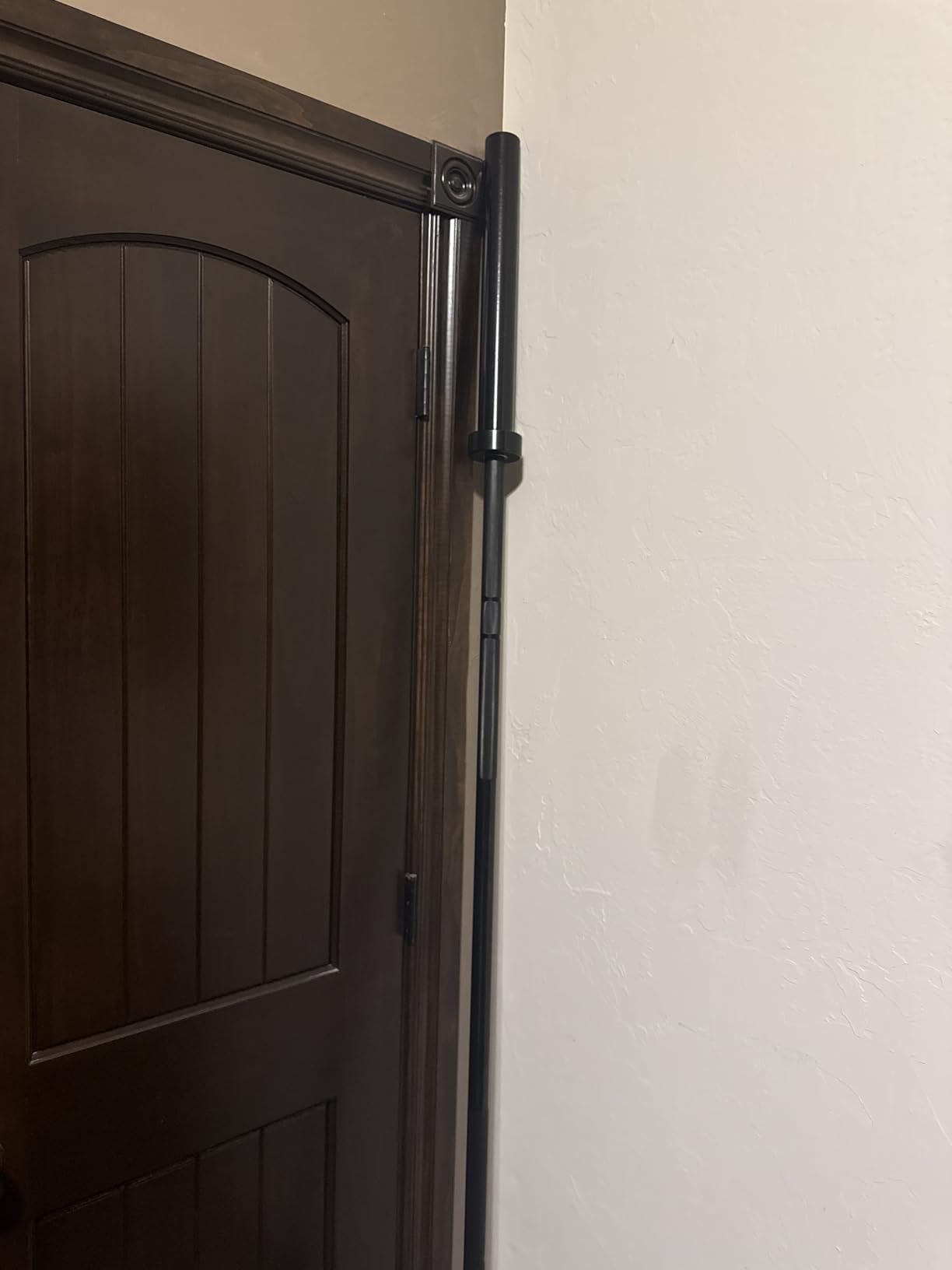
The sleeve design uses four hybrid needle bearings paired with brass bushings, which is the configuration we would pick by default for a mixed training gym. The bearings handle the smooth rotation, and the bushings add a layer of durability behind them so a bearing failure does not mean a dead sleeve.
Dual IWF and IPF grip marks are a small touch that turns out to matter. Having both the Olympic and the powerlifting hand position marked on the shaft means you set up the same way every session, which is worth more than it sounds for a bar you own for a decade.
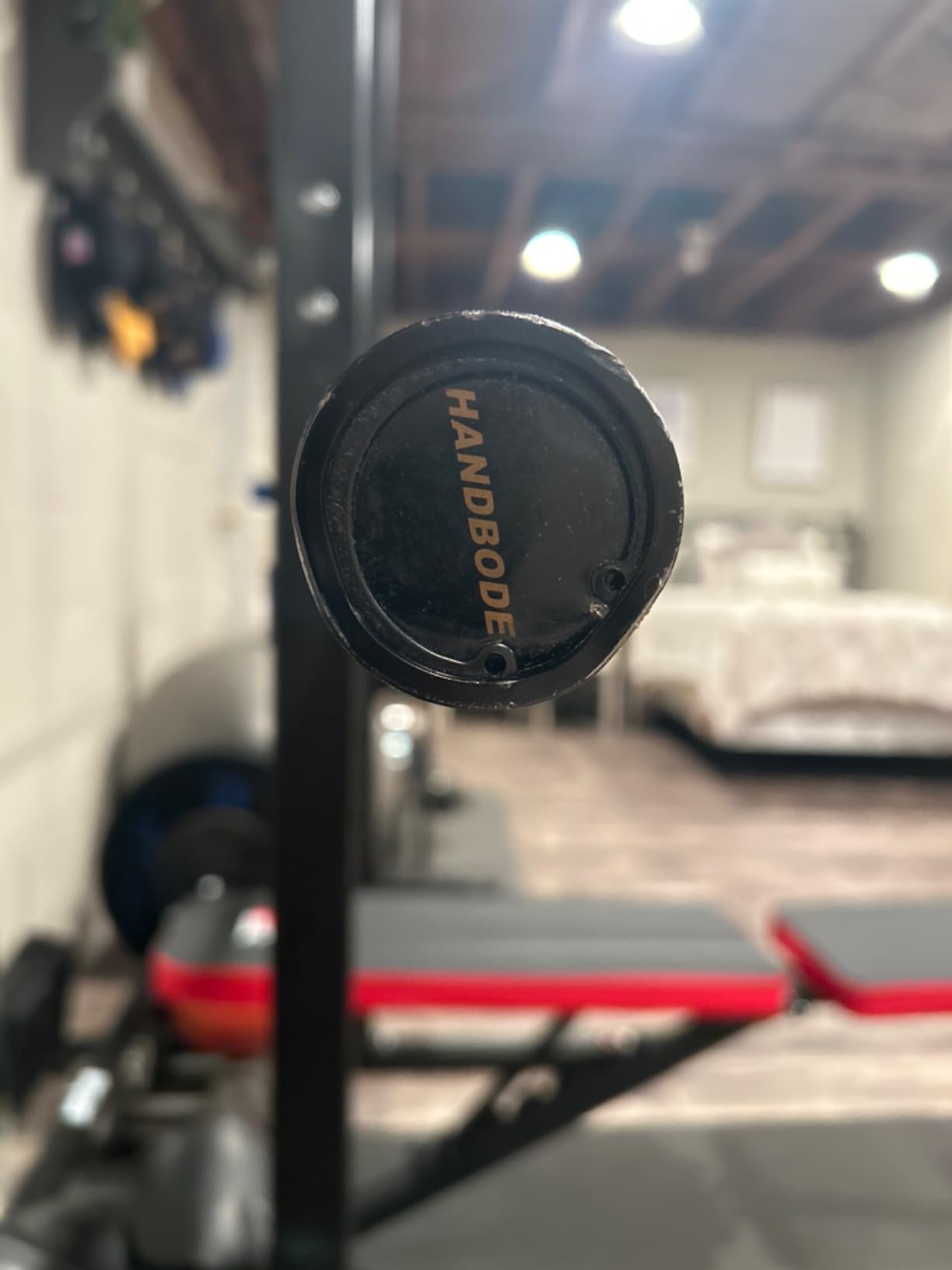
The rack width warning is real
This is the one measurement that ends up mattering, so take it seriously. The shaft is 51.6 inches, and the listing is explicit that your rack outside width must be under that number or the bar will not sit down. Cheap narrow racks are often exactly at or slightly over that figure.
Measure the inside span between your J-cups, not the outside width of the frame, and do it before you order. A bar that does not fit a rack is a return, a trip to a hardware store for longer uprights, or a wall-mounted storage bracket that was never part of the plan.
Best fit and limitations
This suits a mixed-training home gym where you want the option of Olympic lifts without buying a dedicated whippy bar. The 45 lb weight and 1000 lb rating give you real headroom, and the finish is an oven-cured E-Coat on the shaft with coated sleeves, which is a good choice for a damp garage.
The limitation is noise. Needle bearings make sleeve spin quiet, but they do nothing to reduce the impact sound of dropping a loaded bar, and a loaded bar dropped onto concrete is loud enough to reach neighboring rooms. If you live in a shared building, buy bumper plates before you worry about the bar.
7. LIONSCOOL 7FT Olympic Barbell – a Generous 4.7 Inch Center Knurl
LIONSCOOL 7ft Olympic Barbell (Black E-coating, 700LBS, Center Knurl)
20 kg bar
700 lb capacity
130000 PSI steel
4.7 inch center knurl
Black E-coat
Pros
- 4.7 inch center knurl genuinely helps with squat setup
- Hybrid needle bearing and bushing spin that needs no maintenance
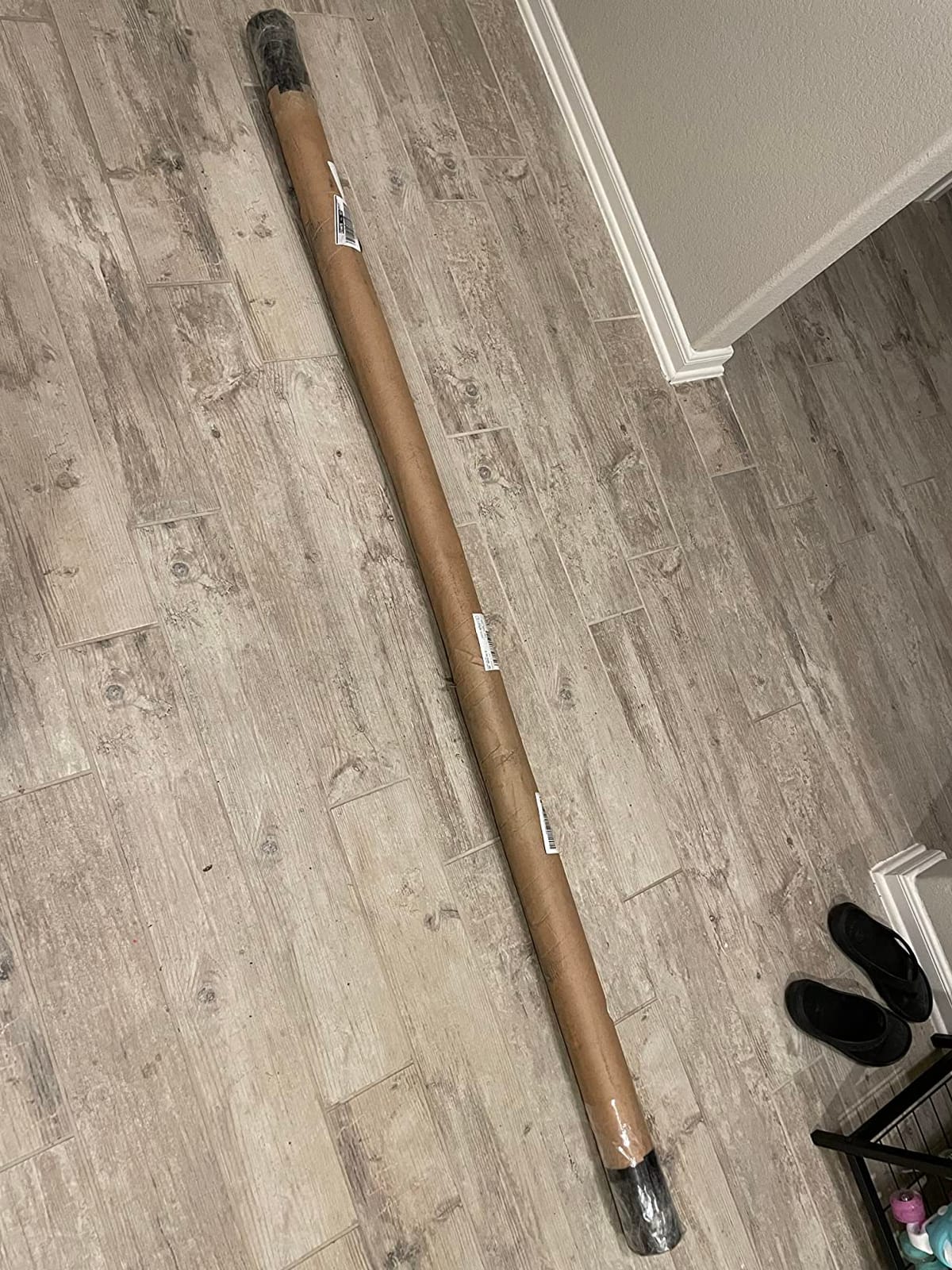
- Hard inner tube packaging protects the bar in transit
- Owners report no bending after months of heavy use and repeated drops
Cons
- Some buyers measure the shaft closer to 28 mm than the stated 28.5 mm
- Plastic shavings can collect in rack J-cups
- One report of a damaged bar in poor condition in the box
The center knurl is why this bar stands out. At 4.7 inches it is a full center section rather than a token band, and owners who squat without a bar pad describe it as the difference between a secure setup and a bar that shifts on the way down.
On quality-per-pound, the reviews are unusually confident. Multiple owners compare this bar directly against bars from premium brands costing several times more and conclude that the difference is mostly finish and packaging rather than performance. The packaging matters more than most buyers expect, since a bar protected by nothing more than a thin outer box is far more likely to come out bent.
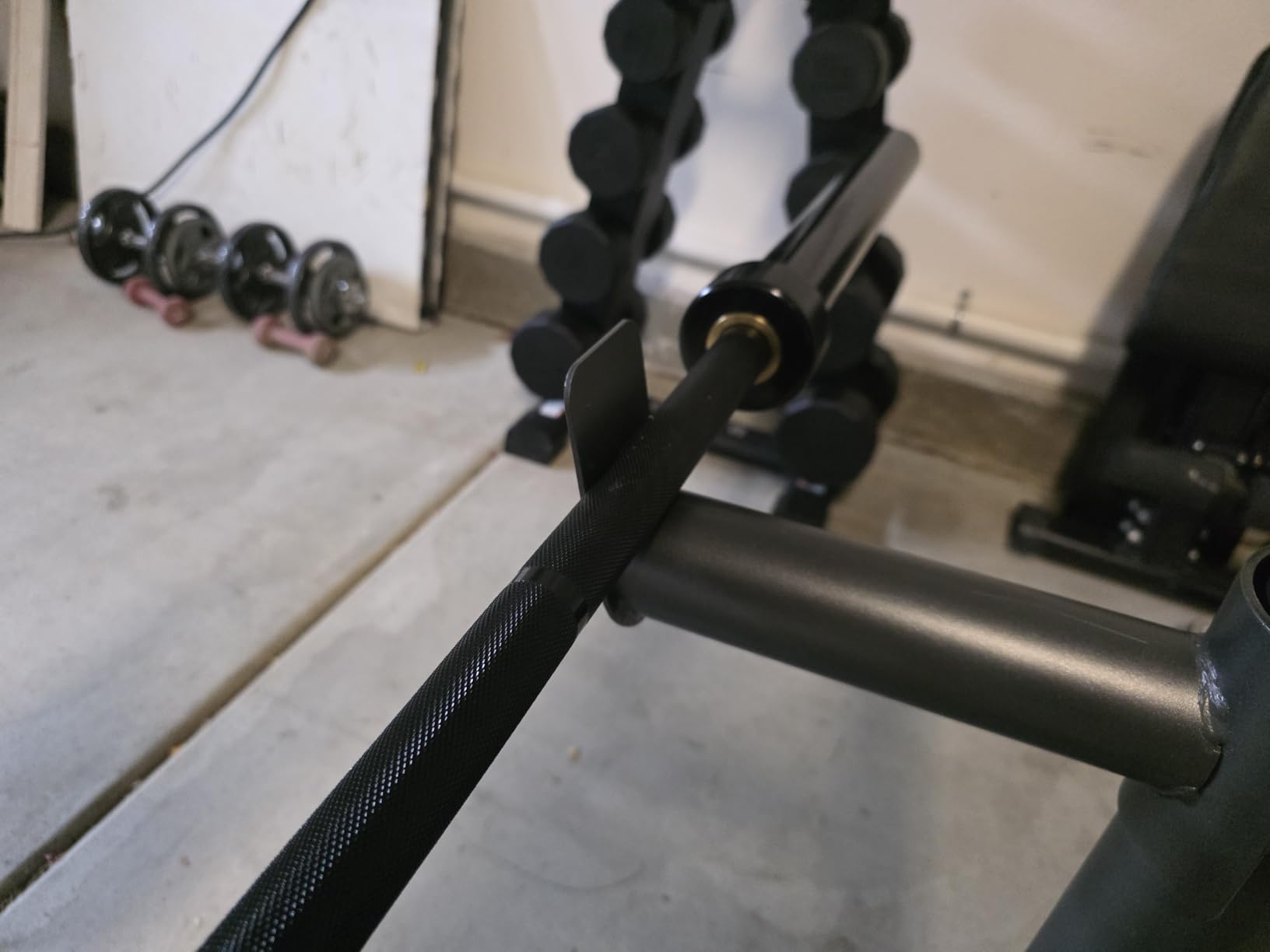
The knurl is 1.5mm diamond depth with a flattened top, which is a good design choice for a reason. A flattened knurl peak removes the sharp ridge that bites calluses without reducing the friction that keeps the bar in your hand, and it is the compromise we would look for on any bar at any price.
Sleeves use a hybrid needle bearing and bushing arrangement with snap-ring retention, which is a mechanically sensible way to keep the bearing assembly from walking out of the sleeve. Owners note that the spin needs no maintenance, which is a meaningful difference from a pure bushing sleeve in a cold garage.
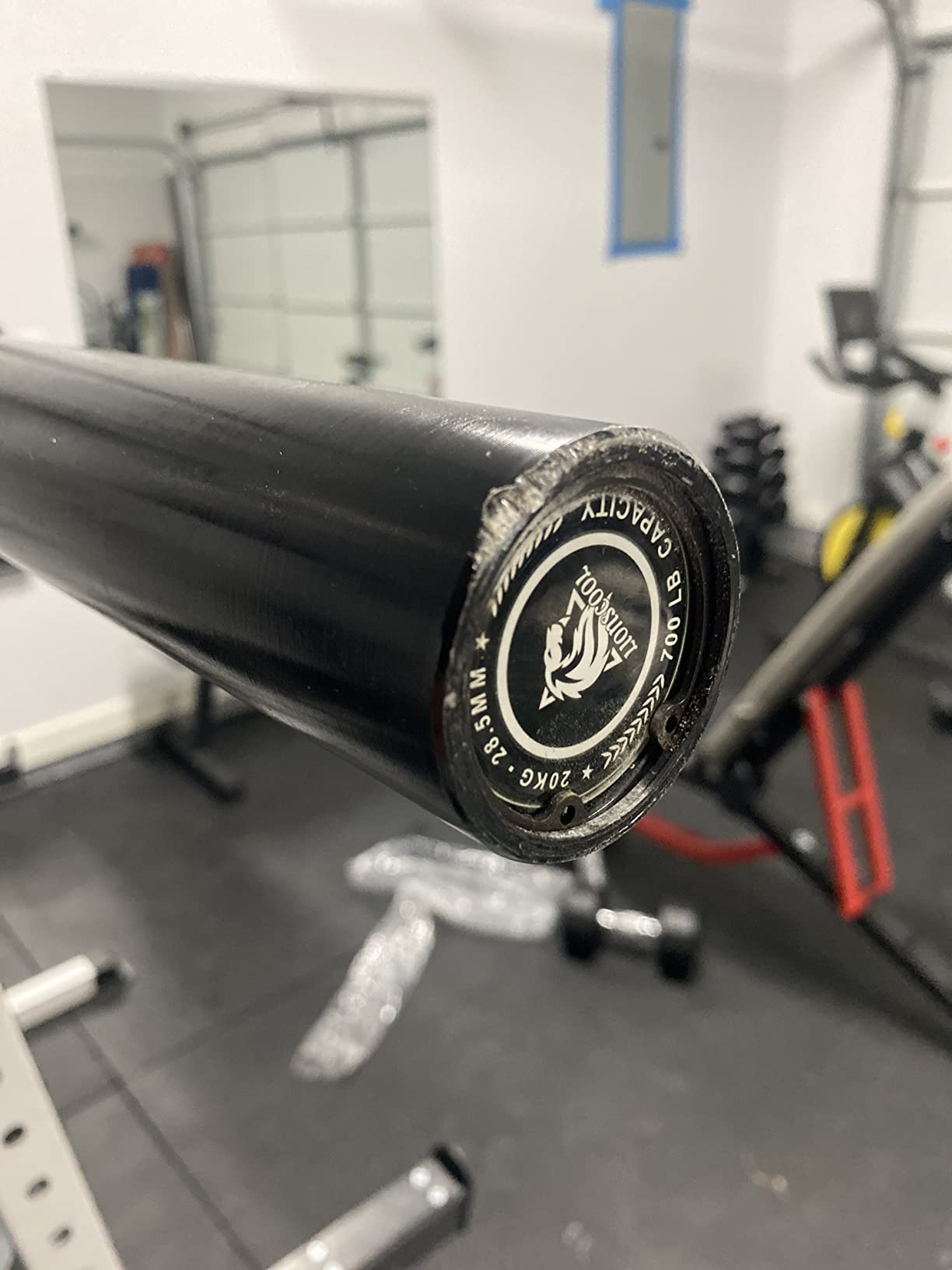
Is 700 lb capacity enough
For almost every home gym, yes. A 700 lb ceiling comfortably covers a working squat and a heavy deadlift with room for small plates, and it is well beyond what a beginner will reach. The variant in this listing is the 700 lb one, but the same product family includes 1000 lb and 1500 lb versions if you want more headroom.
Check which variant you are actually ordering. The load rating is the only meaningful difference between them, and the listing images are frequently shared across variants, which makes this an easy mistake to make.
Limitations to plan for
The 130,000 PSI rating is modest relative to the 170,000 and 190,000 PSI bars elsewhere in this list. It is adequate for home training, but it is the number to consider if you squat heavy triples regularly, and it is why we would not call this a bar to progress a competitive total on.
Also expect small plastic shavings from the bushing material, which owners report collecting in J-cups over time. That is normal wear for any hybrid sleeve and it is not a defect, but it is a reason to wipe your rack down periodically if the noise bothers you.
8. E.T.ENERGIC 7FT 1500LB 45LB Alloy Bar – 205000 PSI Steel and Four Bearings per Sleeve
E.T.ENERGIC Olympic Barbell 7FT 45LB, 1500LB Capacity Weight Bar for Home Gym, 2-Inch Olympic Barbell for Weightlifting, Powerlifting, Squat, Deadlift and Bench Press
44 lb
1500 lb rating
205000 PSI
Four bearings per sleeve
Hard chrome
Pros
- 205000 PSI is the highest published tensile rating among these bars
- Four needle bearings per sleeve give fast spin for Olympic lifts
- Friction-welded sleeves are stronger than standard welds
- Knurled center supports back squat setups
Cons
- Among the heavier and costlier bars in the comparison set
- Listed shaft length of 70.21 inches is longer than a typical 51-52 inch power bar shaft
On paper this is one of the strongest bars here. A 205,000 PSI tensile rating with a 1500 lb capacity is a specification set that belongs to competition-tier equipment, and at a 4.8 rating from 227 owners, the experience matches the spec sheet more often than not.
The sleeve construction is the real differentiator. Four needle bearings plus a bushing per sleeve is a denser bearing package than most bars in this list, and the practical effect is fast, quiet spin that holds up under repeated loading. If your training includes Olympic lifts and you are not satisfied with compromise, this is the bar in the roundup built for that.
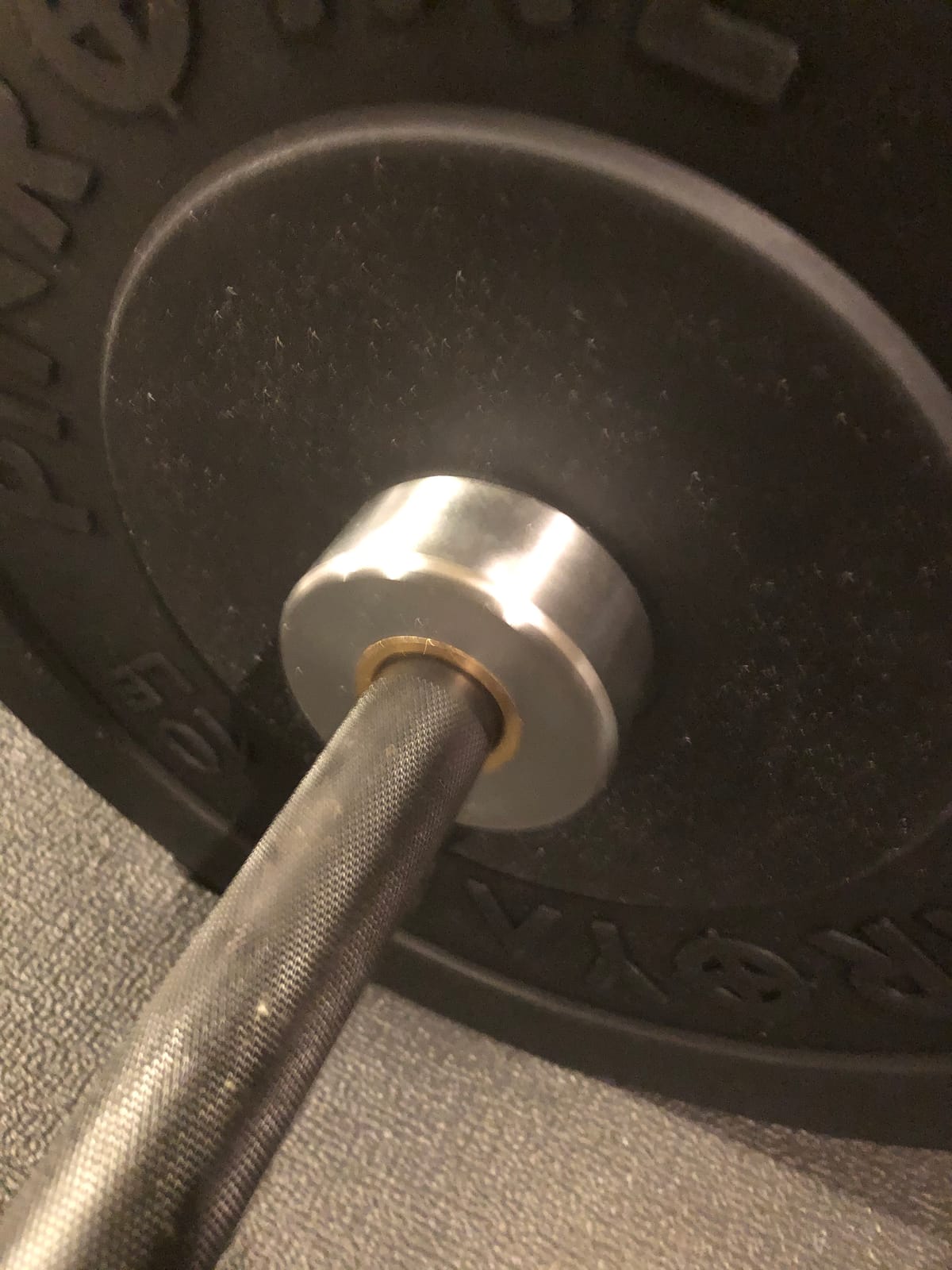
Friction-welded sleeves are worth a mention because sleeve failure is the most common way a barbell dies. A welded sleeve that was not properly fitted can separate from the shaft under load, and while this is rare, it is the reason experienced lifters look at how the sleeve is joined rather than only at the steel grade.
The knurl is 1.2mm medium depth with a knurled center, which gives you a back-squat grip point and a knurl aggressive enough for heavy pulls without the sharpness of a 1.5mm pattern. The hard chrome finish is the most rust-resistant option in this roundup for a damp garage.
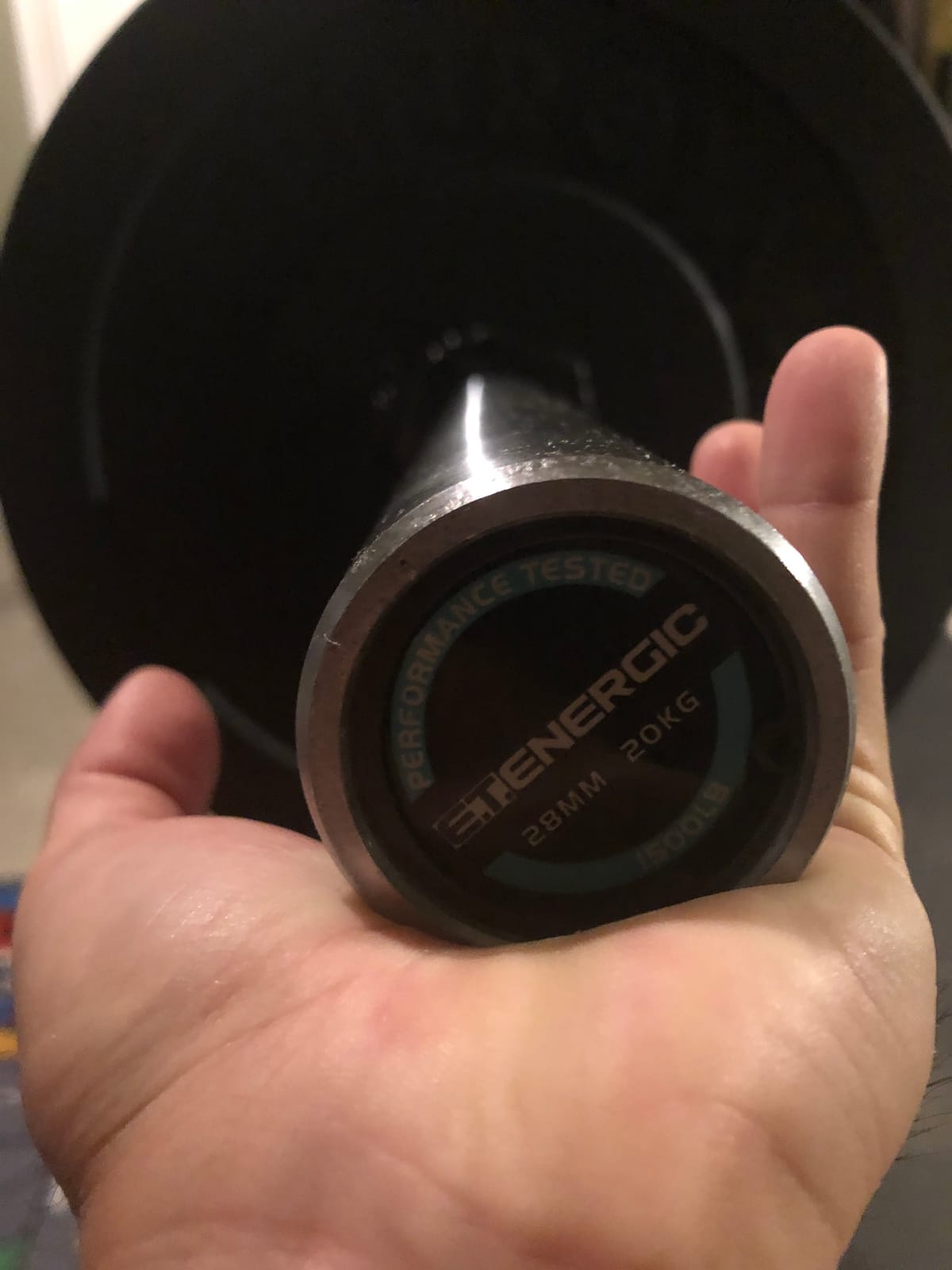
What to verify before you buy
Measure your shaft clearance as always, and pay attention to the listed shaft length of 70.21 inches, which is considerably longer than the 51 to 52 inches a standard power bar shaft runs. It may be a listing error, since the overall length is 86.61 inches with 16.4-inch sleeves, but it is exactly the kind of detail that causes a return if you do not check.
Confirm the 44 lb bar weight against your plate inventory before committing, and note that this is a heavier, more expensive bar than the rest of the field. The specification premium is real.
Best fit and limitations
This suits a lifter doing both powerlifting and Olympic lifting who wants one bar to do both properly. The stiffness that makes it a strong press and squat bar still allows rotation in a clean, and the 1500 lb rating means you will not outgrow it.
The limitation is cost per unit of usefulness for a light lifter. If your working loads sit under 300 lb, you are paying for load capacity and bearing density you will never touch, and a bushing bar with a good knurl will serve you better. Buy the capacity when you have a reason to.
9. Synergee 45 lb Rhino Power Bar – a Stiff 1500 lb Rated Power Bar
Synergee 45 lb Rhino Power Bar – Cerakote Finish 1500 lb Rated
45 lb bar
1500 lb capacity
190000 PSI steel
Cerakote shaft
29 mm grip
Pros
- Stiff whip-free design feels very stable for squats presses and deadlifts
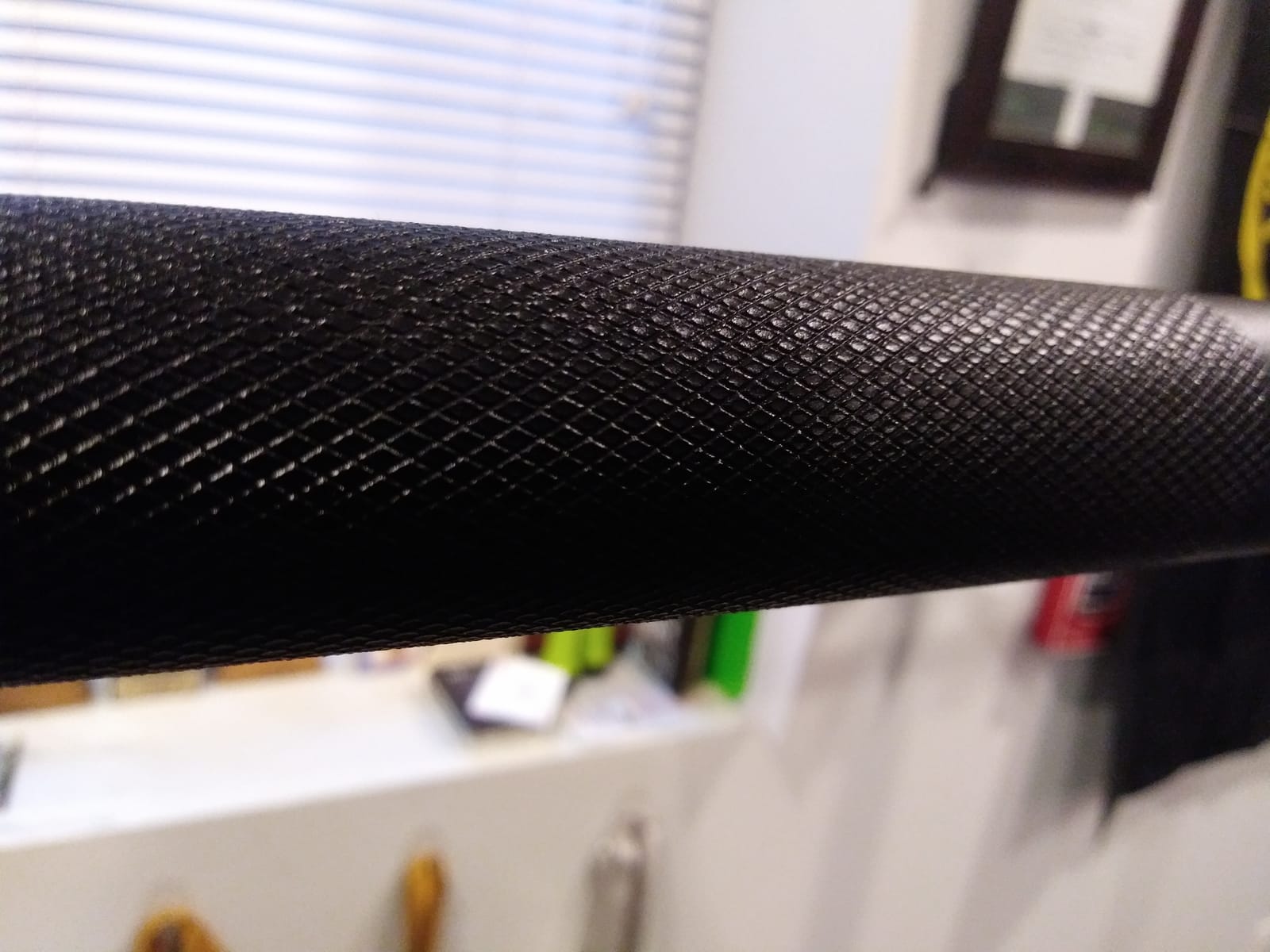
- Aggressive volcano knurl is genuinely grippy rather than cosmetic
- Cerakote coating wipes clean and resists wear
- Wide collar spacing suits a wider low-bar squat grip
Cons
- Stiff power bar with no bearings so it will not suit snatches and cleans
- Near-zero whip makes it a poor fit for dynamic pulls
- One unit arrived with a manufacturing nick and a slow support response
This is the only true power bar in the roundup, and we included it deliberately because a lot of home gym buyers think they want an Olympic bar when their program is three powerlifting lifts. If your training is squat, bench, and deadlift, this is the correct tool and the other nine are compromises.
Powerlifters dominate the reviews and they reach the same conclusion: build quality that undercuts premium brand pricing by a wide margin. The 190,000 PSI rating and 1500 lb capacity are genuine power numbers, and the aggressive volcano knurl is described as grippy rather than decorative, which matters when you are pulling a maximal deadlift with chalkless hands.
The Cerakote shaft coating is a ceramic-based finish that is markedly more durable than black phosphate or bare chrome, and it wipes clean easily. The sleeves are black phosphate, which is a coating rather than a plating, so they will show wear over years even if the shaft does not.
At 29mm, the grip is a millimeter wider than the 28mm standard. For most lifters that is neutral or slightly comfortable, and it also means the knurl pattern is engaged over a wider surface, which marginally reduces how much the bar can rotate in your hand during a pull.
Why stiffness matters for power work
Minimal whip is the entire design brief. A stiff bar stays in the same line relative to your spine through a heavy triple, which means less energy is lost to flexing the shaft and more of your effort goes into the movement. That is why power bars are the default in competitive squat and deadlift federations.
The same trait makes this a poor bar for snatches and cleans. A whippy bar bends under the barbell, which stores and then releases energy upward during the turnover. A bar with near-zero whip simply does not do that, and a snatch or a clean and jerk on this bar will feel flat and awkward.
Who should skip it
Skip this bar if you program any Olympic lifts, if you want to do muscle-ups and front squats with a fast turnover, or if you are still deciding what kind of lifting you will do. A 45 lb stiff bar is a specialist tool and it is a good one, but it is the wrong first purchase for an uncertain beginner.
Also factor in the 29mm grip. If you have small hands, the wider diameter can make a low-bar squat grip uncomfortable, and you would be better served by a 28mm bar in the same price bracket.
10. Mikolo 7ft 1500lb Capacity Olympic Barbell – Eight Needle Bearings at 1500 lb
Mikolo 7ft Olympic Barbell, Barbell for Weightlifting and Powerlifting 45lb, Olympic Bar for 1500lbs Capacity, Weight Bar Fit 2” Standard Weights (Calssic Red)
45 lb bar
1500 lb capacity
190000 PSI steel
Eight needle bearings
Hardened chrome
Pros
- Eight needle bearings give smooth silent spin
- Owners report no flex or bending at a 500 lb deadlift load
- Knurl and whip compared favorably to a Rogue Ohio Bar
- 28 mm grip feels comfortable across most hand sizes
Cons
- No center knurling so back squat setup needs a pad or grip tape
- Knurl is shallower than some buyers prefer when grip is sweaty
- Tight tolerance when re-racking on narrow 4 ft racks
Eight needle bearings across two sleeves is the highest bearing count in this comparison, and owners single out the resulting silence as the standout feature. Clanging at the bar ends during rotation is a specific complaint about cheaper bars, and this one does not have it.
The reviews repeatedly include a direct comparison against a Rogue Ohio Bar that buyers owned previously, which tells you where this bar is positioned. It is a legitimate 1500 lb rated, 190,000 PSI bar with a real whip profile and bearing rotation, built to a spec that matches the well-known reference point in this category.
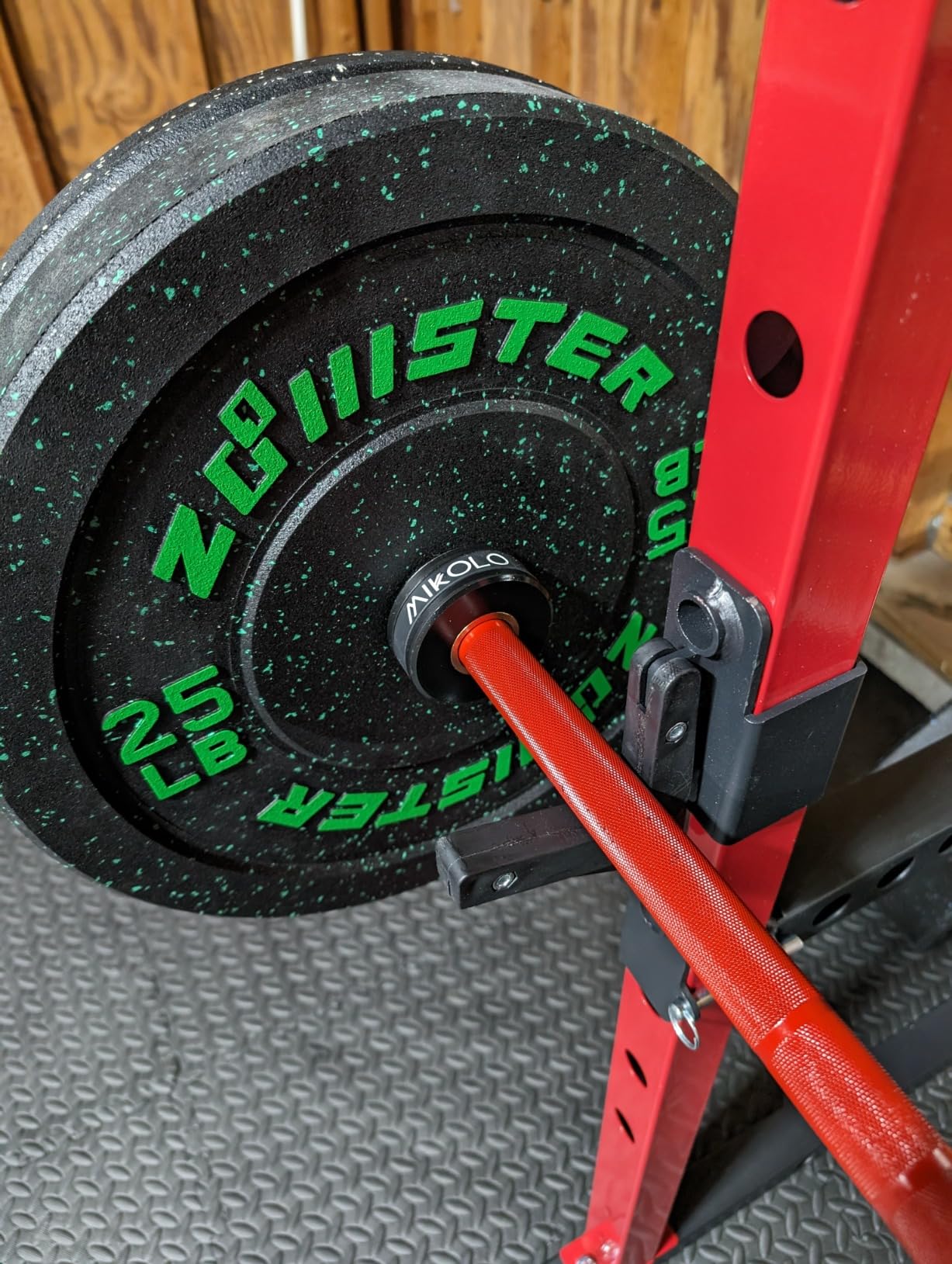
Load behavior is the other strength. Owners report no flex and no bending at 500 lb on deadlifts, which covers a strong intermediate and most advanced home gym training. The IWF-standard construction and dual powerlifting and Olympic grip markings make setup repeatable, and the 1.2mm diamond knurl is designed to resist sweat.
The finish is hardened chrome, which resists rust well in a humid or unheated garage.
What to check before ordering
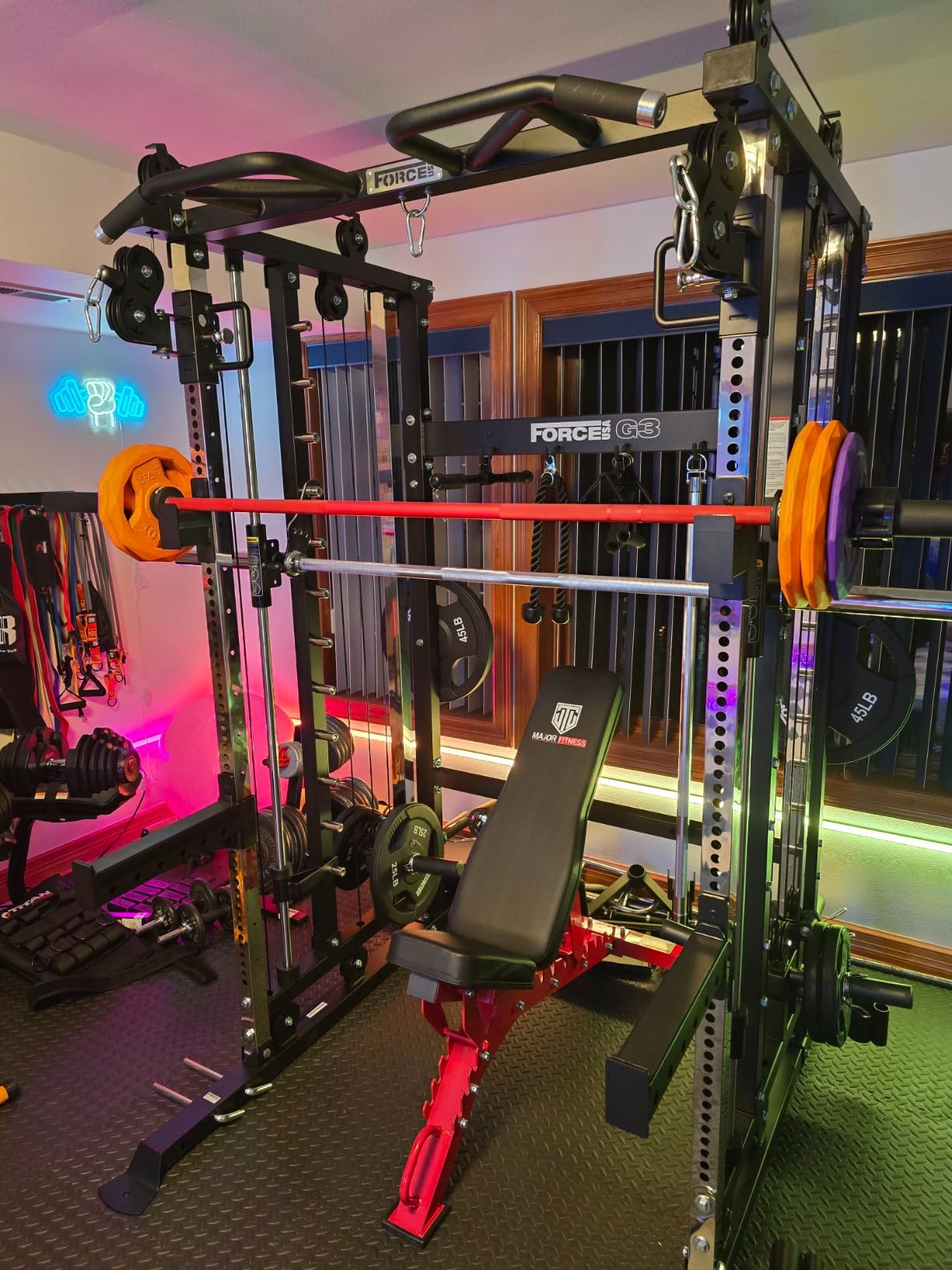
Measure your rack. The complaint about tight tolerance when re-racking on narrow 4 ft racks is a sizing issue, not a quality issue, and it disappears entirely if you buy a wider rack or one with adjustable J-cups. Measure the inside span between your J-cups against the shaft length before ordering.
Confirm there is no center knurl, because there is not, and decide now whether that matters to you. A bar pad solves it cheaply and most home gym owners end up buying one eventually anyway.
Limitations to weigh
The knurl is on the passive side of this roundup, at 1.2mm diamond depth. Reviewers with sweaty hands or heavy chalkless pulling report that it does not bite as hard as they would like, and if that describes you, a 1.5mm knurl bar like the LIONSCOOL is the better match.
Second, the review count is the lowest in this roundup, which simply reflects that the product is newer. Long-term durability data is thinner here than for the entry-level bars, so if you are risk-averse about a purchase you intend to keep for a decade, the most-reviewed option carries less uncertainty.
How to Choose an Olympic Barbell for a Home Gym
Bar length is the first decision, and it is the one most home gym buyers get wrong because nobody tells them to measure. A 7ft bar gives you a 51 to 52 inch shaft between the collars, a 6ft bar drops that to about 44 inches, and a 5ft bar to about 37 inches. A 5ft bar is good for a small apartment gym and for exercises where you never rack the bar, such as landmine presses, goblet squats, and one-arm work. A 6ft bar is a reasonable compromise in a room with a standard ceiling. A 7ft bar is what you want if you squat, press, and deadlift in a rack, and it is what nearly every bar in this roundup is.
Check the ceiling next. A squat or a bench press clears far less vertical space than an Olympic lift, so the constraint that decides whether you can train cleans and snatches is how much room a fully extended bar has overhead. Standard residential garage doors often sit lower than people assume, so measure rather than estimate.
Grip diameter is the second decision, and it comes down to hand size more than strength. The 28mm shaft is standard and suits most adults. The 25mm shaft, used on bars marketed to women and smaller lifters, is noticeably easier to hold but will not sit comfortably in a standard 1.9-inch J-cup opening, so a 25mm bar usually means a different rack. The 30mm grips in this roundup are unusual and sit between the two extremes.
Rack fit is where returns happen, so measure before you order. Compare the shaft length against the inside distance between your J-cups, and remember that collapsible racks are often narrower when collapsed than their published dimensions suggest. The HANDBODE listing states this warning explicitly, and it is worth reading on any bar you consider.
Tensile strength is the specification buyers most often ignore, and the reason to care is simple. Published PSI is the steel’s resistance to permanent deformation, and once a bar takes a permanent bend it is finished. For home training, treat anything under roughly 165,000 PSI as a light-duty bar, which is why the 100,000 PSI steel in our top pick carries an important caveat about heavy loading.
Two smaller things are worth knowing. An unpublished rating is a purchasing risk rather than a deal, because you have no way to know what you are loading, and a manufacturer that publishes full specifications is generally a manufacturer that tests them. And a center knurl is optional, needed mainly for back squats, and a bar pad costs a fraction of what a knurled center costs you to live without.
Olympic Bar vs Power Bar vs Multi-Purpose Bar
These three categories are constantly confused, and the confusion is expensive because buyers pay for a power bar expecting Olympic lift performance. A true Olympic bar is built for rotation and whip, a power bar is built for stiffness and minimal movement, and a multi-purpose bar sits between them.
A true Olympic bar has a 28mm shaft, rotating needle bearing sleeves, and enough flexibility that the bar bends under load and rebounds during the turnover. That flex stores energy and returns it upward, which is why snatch and clean and jerk lifters want a whippy bar. A 28mm shaft is thinner than a power bar and bends more, by design.
A power bar has a thicker shaft, usually 29mm to 32mm, fixed or bushing sleeves, and almost no flex. It stays straight relative to your spine through a heavy triple, which is exactly what squat, bench, and deadlift lifters want. What you give up is rotation and rebound, and that is why a power bar is a bad tool for snatching.
A multi-purpose bar uses a 28mm shaft with a moderate whip and usually hybrid or bushing sleeves, which is the compromise most home gyms actually need. Most of the bars in this roundup fall into that third category, and only the Synergee Rhino is a purpose-built power bar.
Needle Bearing vs Bushing Sleeves in an Unheated Garage
Bushings are a plain sleeve with a friction fit. Needle bearings are sealed roller bearings that sit between the sleeve and the shaft. Bearings spin faster and quieter and reduce the torque transferred to your wrists during a clean or a jerk, which is the reason competitive lifters pay for them. Bushings cost less, tolerate more abuse, and need oiling to stay smooth.
Temperature is where the difference gets practical. In an unheated garage, a bushing sleeve that was never oiled will seize, and the fix is not a replacement bar but a bottle of light machine oil and ten minutes. Bearings are sealed and do not need that maintenance, which is why they are the better choice for a garage that sees temperature swings and humidity all year.
Which means the maintenance decision is simple. If your gym is climate controlled and your training is powerlifting focused, bushings are fine and cheaper. If your garage swings from freezing to warm or you do any Olympic lifts, needle bearings earn their cost by removing both the maintenance task and the wrist torque.
A related point: if you want to monitor the conditions your bar is sitting in rather than guessing, our smart home device picks cover the small sensors that will tell you when the humidity in your garage has been high enough to matter for your finish.
What Else You Need Alongside the Bar
A bar on its own is not a gym. The must-haves for a garage gym beyond the bar are a rack or at minimum a pair of squat stands, a bench, enough plates to reach a meaningful working load, locking collars, a bar pad, matting, and chalk.
Plates are the item most beginners get wrong, and cast iron versus bumper is the decision that matters. Cast iron plates are dense, cheap by the pound, thin, and permanently compatible with any bar. Bumper plates are larger in diameter, use a softer durometer, are quieter, and safer to drop, but they cost several times more per pound. For a home gym, start with cast iron and add bumpers only if you drop loaded bars or have neighbors.
Collars are the item most beginners skip and should not. Spring clips can slip mid-set, and a pair of lock collars costs little next to the bar and protects both the sleeve and the plates. Then add a bar pad, matting, and chalk, and you have covered everything that actually affects how the bar feels.
One practical note on space. If you are converting a room rather than a garage, plan the storage before the bar. A vertical bar holder and a plate tree use far less floor area than a loaded bar lying across the floor, and if your space will eventually hold a second piece of equipment, our home arcade cabinet guide covers the other common spare-room conversion.
Frequently Asked Questions
What is the best barbell size for a home gym?
A 7ft bar is the best size for most home gyms because it takes standard 2-inch Olympic plates and fits a normal power rack. It gives a 51-52 inch shaft between the collars, enough room for a full plate set. A 6ft bar suits smaller rooms and racks that are too narrow for a 7ft shaft. A 5ft bar is only worthwhile for exercise where you never rack the bar, such as goblet squats, landmine presses, and one-arm work. Measure your ceiling and your rack J-cup spacing before you order either size.
What is the best power bar for a home gym?
The Synergee 45 lb Rhino Power Bar is the strongest dedicated power bar here: 45 lb, 1500 lb rated capacity, 190,000 PSI steel, and a stiff whip-free shaft. Power bars have a thicker 29mm or greater shaft and almost no flex, which suits squats, bench presses, and deadlifts. They are a poor choice for snatches and cleans, where a whippy shaft returning energy upward is what makes the lift work. Buy a power bar only if powerlifting is genuinely your program.
What is a 5ft Olympic barbell good for?
A 5ft Olympic bar is good for small spaces and for training where you never rack the bar. Goblet squats, landmine presses, one-arm rows, Bulgarian split squats, and farmer carries all work well because the shorter bar is easier to control and lighter to move. It is a poor fit for squatting and bench pressing, because the short shaft moves more under load and the plates crowd your head on a bench. A 5ft bar also uses smaller 2-inch-hole plates of its own, so it is not interchangeable with a 7ft bar setup.
Are all Olympic barbells 45 pounds?
No, although 45 lb or 20 kg is the standard. The CAP bar in our top spot is a 35 lb model, and several brands in this roundup list 44 lb. The RitFit and E.T.ENERGIC bars are both described as approximately 44 lb. Weight matters for percentage-based programming, so if you train by percentages either calibrate your plates on a scale or pick a bar that matches your program. Grip diameter also varies: 28mm is standard, 25mm suits smaller hands, and some bars here run 29mm or 30mm.
Do I need a needle bearing Olympic bar?
Only if your training justifies it. Needle bearings spin faster and quieter and reduce torque on the wrists during fast lifts, which is why competitive Olympic lifters use them. Bushings cost less, tolerate more abuse, and just need occasional oiling. For a climate-controlled home gym doing squats, presses, and deadlifts, a bushing bar is enough. For an unheated garage, or if you practice snatches and clean and jerks, bearings are worth the extra cost because they need no maintenance and handle temperature swings better.
What are the must-haves for a garage gym?
Beyond the bar itself you need a rack or squat stands, a flat bench, enough plates to reach a working load, a pair of locking collars, a bar pad, floor matting, and chalk. Cast iron plates are the cheapest per pound and work with any bar, while bumper plates are quieter and safer to drop but cost far more. Lock collars matter because spring clips can slip mid-set. Plan vertical bar storage and a plate tree before you buy, since both use less floor space than a loaded bar lying flat.
Best Olympic Barbells for Home Gyms – the Final Verdict
Our pick among the best Olympic barbells for home gyms is the CAP 7ft Strength Training Weight Bar, and the reason is the 2500-plus owner reviews behind it. Nothing else in this roundup has that volume of long-term data, the parts availability, or the settled tolerance, and for a first barbell the proven option beats the better spec sheet every time. Its one real limitation, the 100,000 PSI steel, only matters above roughly 300 lb.
If you want more strength and a true 45 lb weight, the PAPABABE 7ft bar gives you 190,000 PSI steel and hybrid bearings at the entry price point. If your program is strictly powerlifting, the Synergee Rhino is the only true power bar here and it is built properly. If you plan to snatch and clean and jerk in an unheated garage, the E.T.ENERGIC bar pairs the highest published tensile rating here with four needle bearings per sleeve.
Before you order any of them, measure two things: the inside span between your rack J-cups and the distance from your floor to the lowest point on your garage door track. Those two numbers eliminate more bad purchases than any specification on any spec sheet, and they take about five minutes to check.