
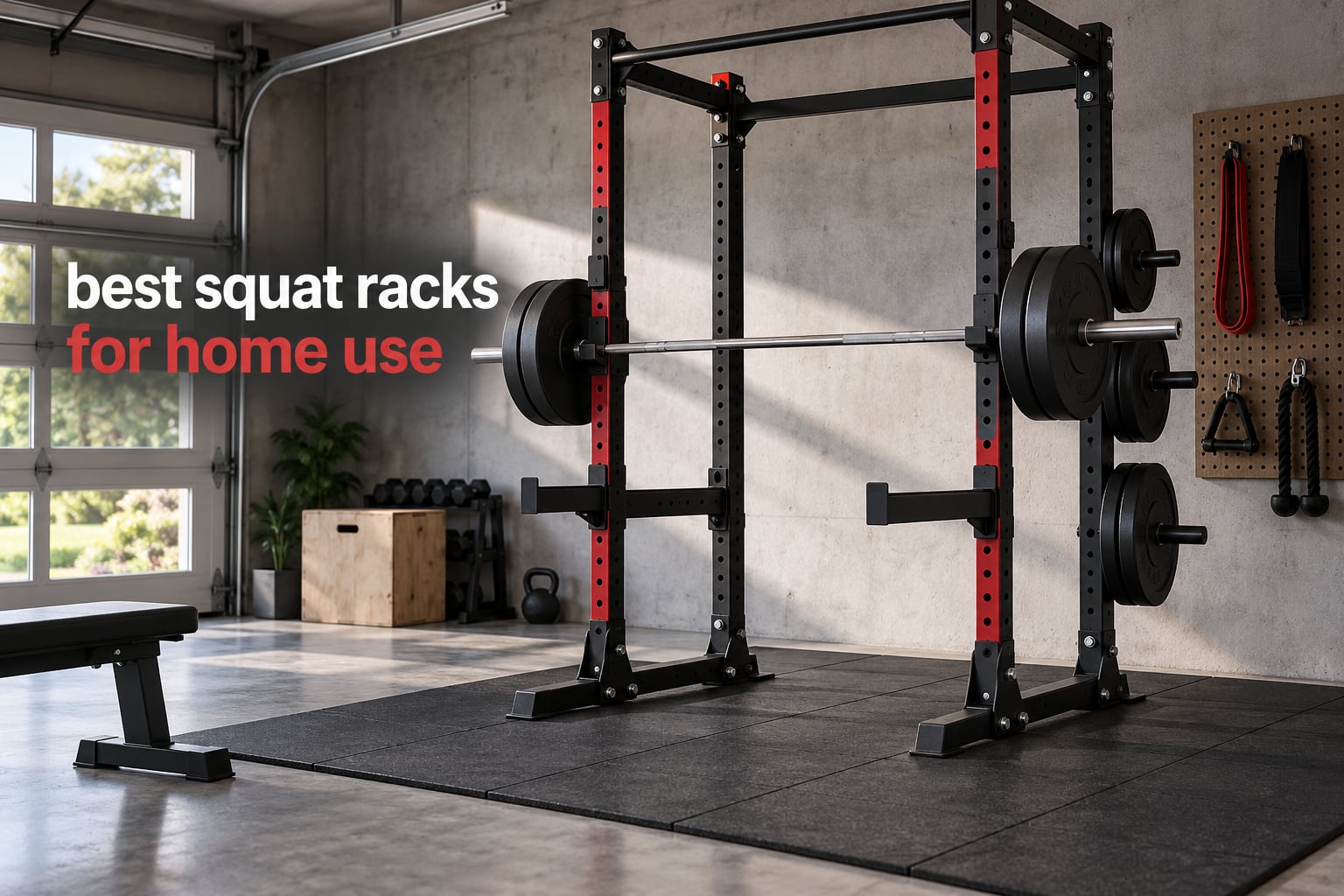
If you squat, bench or press heavy barbell weight alone at home, the rack is the piece of equipment that decides whether the session ends well. A squat rack is a steel frame with upright posts, adjustable J-cups and safety bars that holds a loaded barbell at shoulder height, so you can lift without a spotter standing behind you.
That last sentence matters more than any spec sheet. Home gym owners consistently describe the rack as the one purchase they would never give up, because a failed rep without safeties set correctly is how people get hurt. On this page we break down the best squat racks for home use, sorted by the space you actually have, the weight you actually lift, and the budget you actually have.
We spent 2026 walking through the full lineup of affordable racks and cages, reading the customer review data closely and comparing steel thickness, upright size, hole spacing, rated capacity and the accessories that come in the box. If your garage is also where you hang bikes and want the walls to earn their keep, our guide to bike racks for garage walls covers the other half of the storage problem.
Table of Contents
Top 3 Best Squat Rack Picks for Home Use in 2026

Sunny Health Power Rack
- Compact half-rack footprint
- 18-point J-hook adjustment
- Included spotter arms
- Built-in plate holders
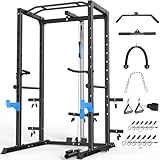
ULTRA FUEGO Power Cage
- Pulley system and lat pulldown included
- 10-level J-hook adjustment
- Landmine and dip handles
- 2-year warranty

Sportsroyals RK2 Power Cage
- 50x50mm frame rated to 1200 lb
- 150 lb rack weight
- 14 height levels
- Large accessory bundle
Best Squat Rack for Every Use Case (October 2026)
Here is the short answer before we get into the detail. The Sunny Health & Fitness full-size power rack is the best squat rack for home use overall, because it carries the highest rating and the largest review base in this group while staying inside a 38 by 53 inch footprint that fits a normal garage bay.
Best overall: Sunny Health & Fitness full-size power rack, 4.7 stars across 3890 reviews
Best on a budget: Yaheetech adjustable squat rack pair, the cheapest route into barbell training
Best for small spaces: Mikolo folding wall-mounted rack, which folds to roughly 2 inches off the wall
Best all-in-one with cables: Sportsroyals RK2, a full cage with lat pulldown, landmine and dip stations
Best for cable work on a budget: ULTRA FUEGO power cage, the best price-to-quality ratio in the set
Best half rack for solo benching: FLYBIRD SR1, with 16.7 inch extended safety arms
Best squat stand: K KiNGKANG adjustable rack, which adjusts in both height and width
Best for standard 1 inch accessories: CAP Barbell FM-8000F, which accepts Monster-style rack ecosystem arms
Best for heavy loading: JELENS S11, the highest rated capacity here at 2000 lb
Best first walk-in cage: Marcy Olympic cage SM-8117, clean finish and a two-year warranty
The Sunnys and CAP rack both hold a barbell and let you pull up, which covers the four movements most home lifters actually program. Everything above it in price buys you more attachment compatibility, a pulley system, or folding hinges.
All 12 Squat Racks Compared Side by Side in 2026
| Product | Specifications | Action |
|---|---|---|
| Sunny Health Power Rack |
|
Check Latest Price |
 Yaheetech Adjustable Squat Rack Pair Yaheetech Adjustable Squat Rack Pair |
|
Check Latest Price |
 CAP Barbell FM-8000F CAP Barbell FM-8000F |
|
Check Latest Price |
| ULTRA FUEGO Power Cage |
|
Check Latest Price |
 CANPA Multifunction Power Rack CANPA Multifunction Power Rack |
|
Check Latest Price |
| Sportsroyals RK2 Power Cage |
|
Check Latest Price |
 papababe 800 lb Squat Rack papababe 800 lb Squat Rack |
|
Check Latest Price |
 K KiNGKANG Adjustable Squat Rack K KiNGKANG Adjustable Squat Rack |
|
Check Latest Price |
 FLYBIRD SR1 Squat Rack FLYBIRD SR1 Squat Rack |
|
Check Latest Price |
 JELENS S11 Power Cage JELENS S11 Power Cage |
|
Check Latest Price |
 Mikolo Folding Wall Mount Rack Mikolo Folding Wall Mount Rack |
|
Check Latest Price |
 Marcy Olympic Cage SM-8117 Marcy Olympic Cage SM-8117 |
|
Check Latest Price |
1. Sunny Health & Fitness Full Size Power Rack Is Our Best Overall Pick
Sunny Health & Fitness Full Size Power Rack for Complete Strength Training
38 x 53 x 87 inch frame
83 lb
300 lb J-hook capacity
18-point J-hook adjustment
Pros
- Compact footprint suits apartments and small garages
- 18-point J-hook adjustment suits different users
- Included spotter arms are sturdy for solo benching
- All bolts sorted into assembly step bags
Cons
- Non-standard 0.8 inch peg holes block third-party attachments
- Spotter arms are short
- Needs weighting or anchoring to stop it shifting
This is the rack we keep coming back to after reading the full review set. At 4.7 stars across 3890 reviews it has both the highest rating and by far the largest number of reviews in the group, which means the weaknesses below show up honestly rather than being buried by a handful of owners.
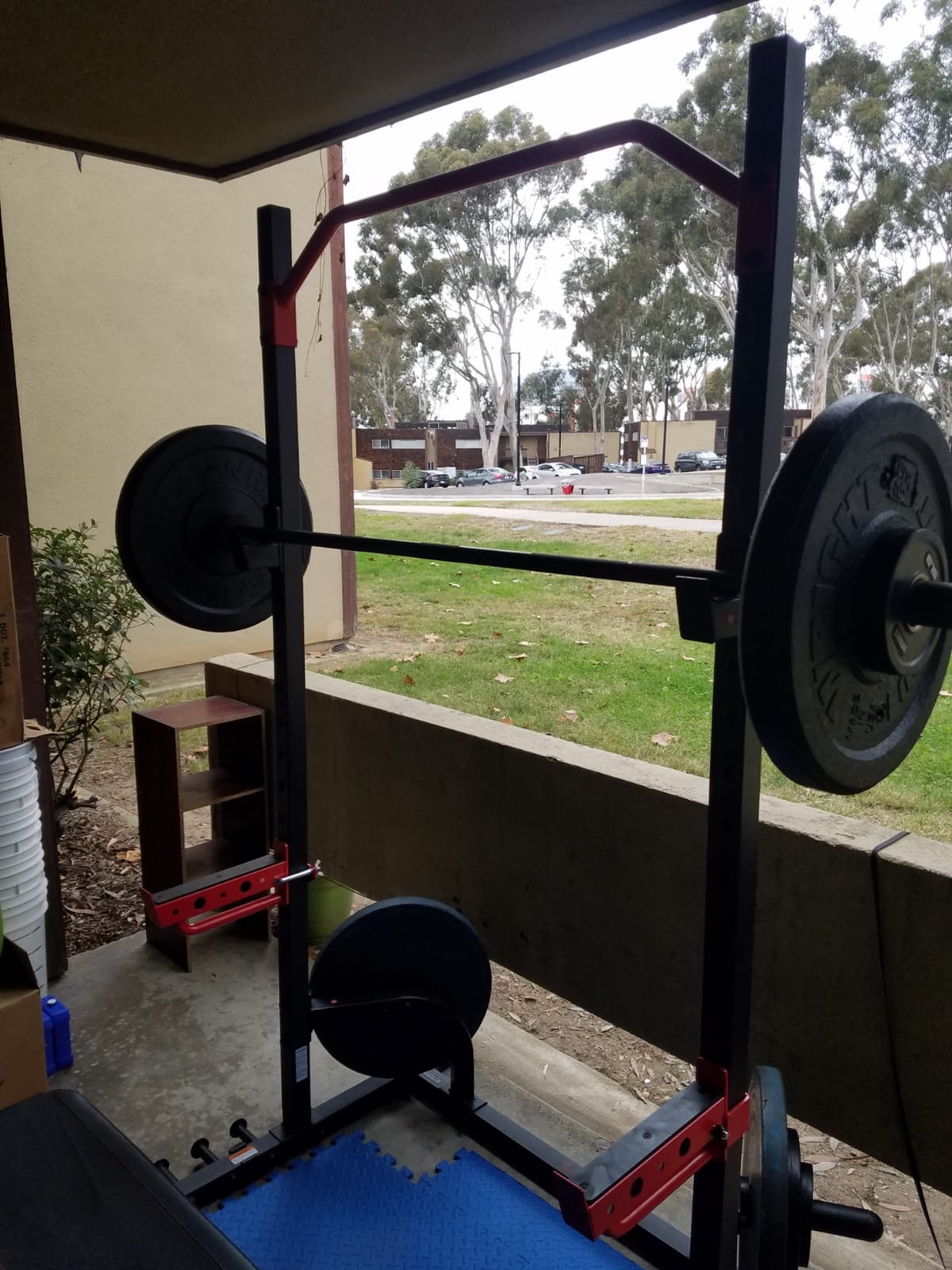
The frame measures 38 by 53 by 87 inches and weighs 83 pounds, which is genuinely small for a full-size power rack. Reviewers repeatedly single that out as the reason it works in apartments, basements and single-bay garages where a 60 inch wide full cage simply will not fit.
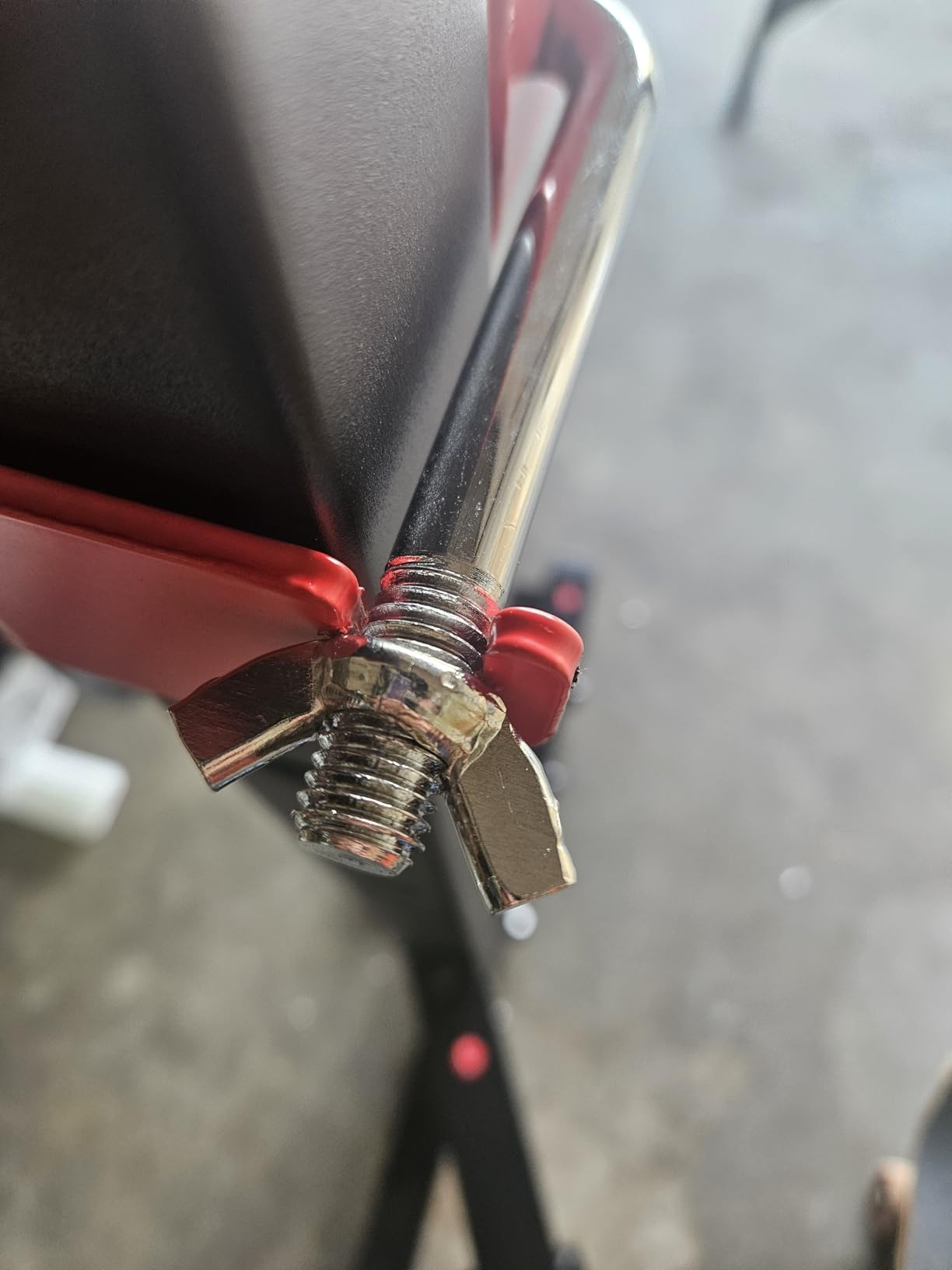
The spec sheet lists 300 lb on the pull-up bar, 300 lb on the J-hooks and 300 lb on each safety spotter arm, with 100 lb per plate holder. Reviewers describe it as very sturdy for a half rack and say it holds heavy barbell work without flex, which is the number that matters for squat and bench.
Eighteen J-hook positions mean two people of different heights can share one rack without fighting over a single pin. The angled pull-up bar has eight positions, and two built-in plate holders give the frame something to stand on.
Why it works for beginners and intermediate home lifters
Most owners bought this as a first rack and stayed with it. One of the most common notes in reviews is that the included spotter arms are solid enough to bench alone, which removes the need to buy safeties separately on day one.
Assembly runs somewhere between 30 and 90 minutes, and the hardware arrives pre-sorted into bags matched to each step. That is a small thing that saves real frustration, and reviewers mention the clear instructions alongside it.
Where the non-standard holes cause problems
The peg holes measure 0.8 inch rather than the 1 inch standard used by most rack accessories. That is the single most repeated complaint in the reviews, and it means Monster-style arms and other third-party attachments are not going to fit without an adapter.
Spotter arms are also short, which limits how far you can step back from the rack, and the pull-up bar is not knurled so sweaty hands can slip. Plan on roughly 8 feet of ceiling height for the full pull-up bar adjustment range.
2. Yaheetech Adjustable Squat Rack Pair Is the Best Budget Start
Yaheetech Adjustable Squat Rack Pair, Barbell Bench Press Stands, Home Gym
21.46 x 19.88 x 66 inch per stand
40.8 lb
550 lb listed capacity
14 pin positions per post
Pros
- Cheapest genuine barbell setup available
- Independent stands adjust to your bar width
- Compact and easy to store away
- Anti-skid foot pads protect flooring
Cons
- Wobbles noticeably when loading or unloading
- Height adjustment is slow and awkward
- Rubber foot caps fall off with use
These are not a rack in the structural sense, they are a pair of independent bench press stands, and the difference is the first thing you need to understand. Each stand is a 50mm steel tube frame that holds one end of a barbell, so there is no frame behind you to catch a failed squat.
What you get is the cheapest real route into barbell training. Buyers treat it as a sensible entry point for light to moderate home lifting, and many report it handles roughly 200-300 lb comfortably when the weight is placed rather than dropped.
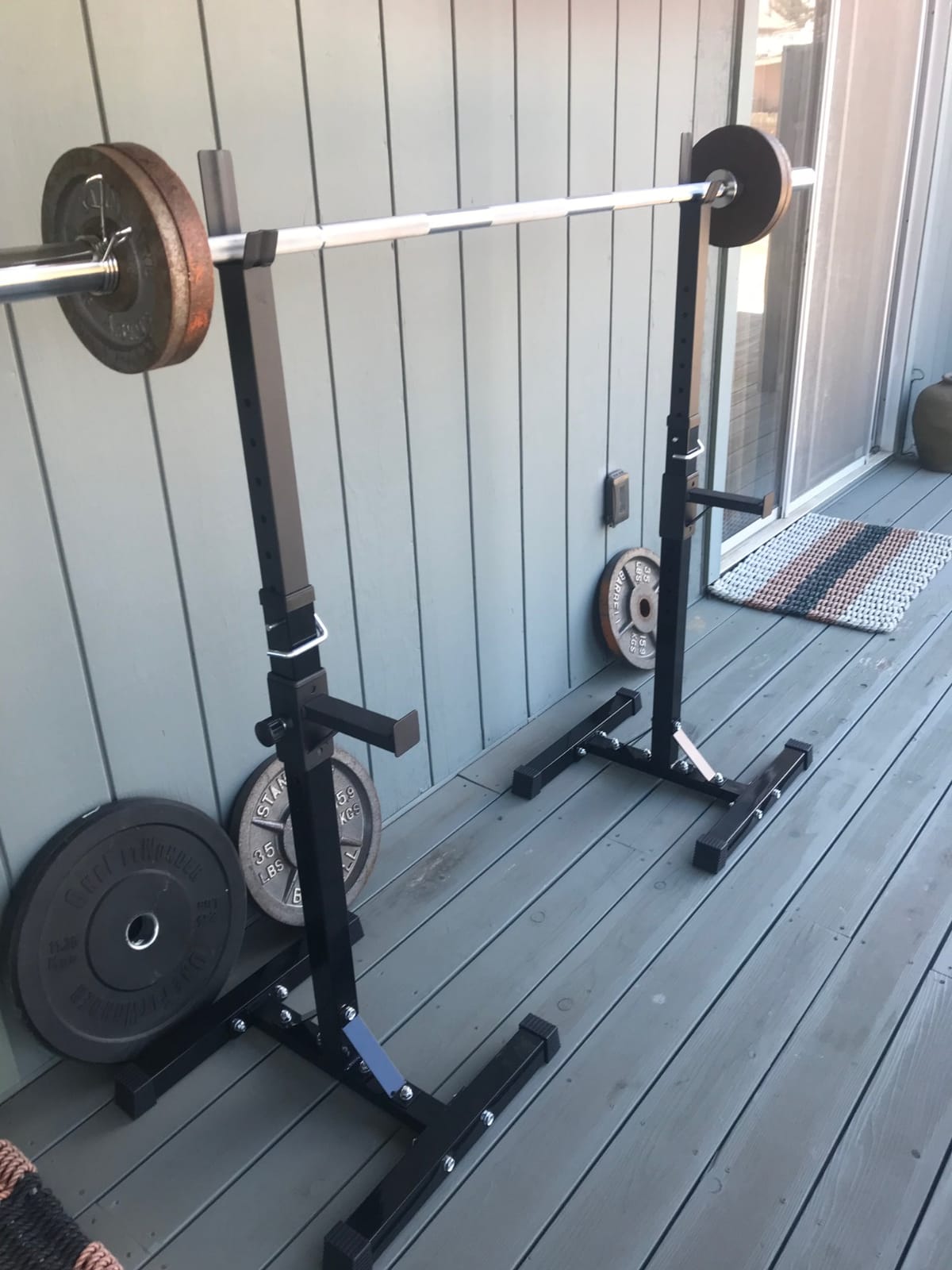
Because the two stands are independent, you can set the width to fit a standard or an Olympic bar. Fourteen adjustable safety pin positions per post with 5 cm gaps cover a height range from 44 to 70 inches, which is adjustable for most adults and most ceiling heights.
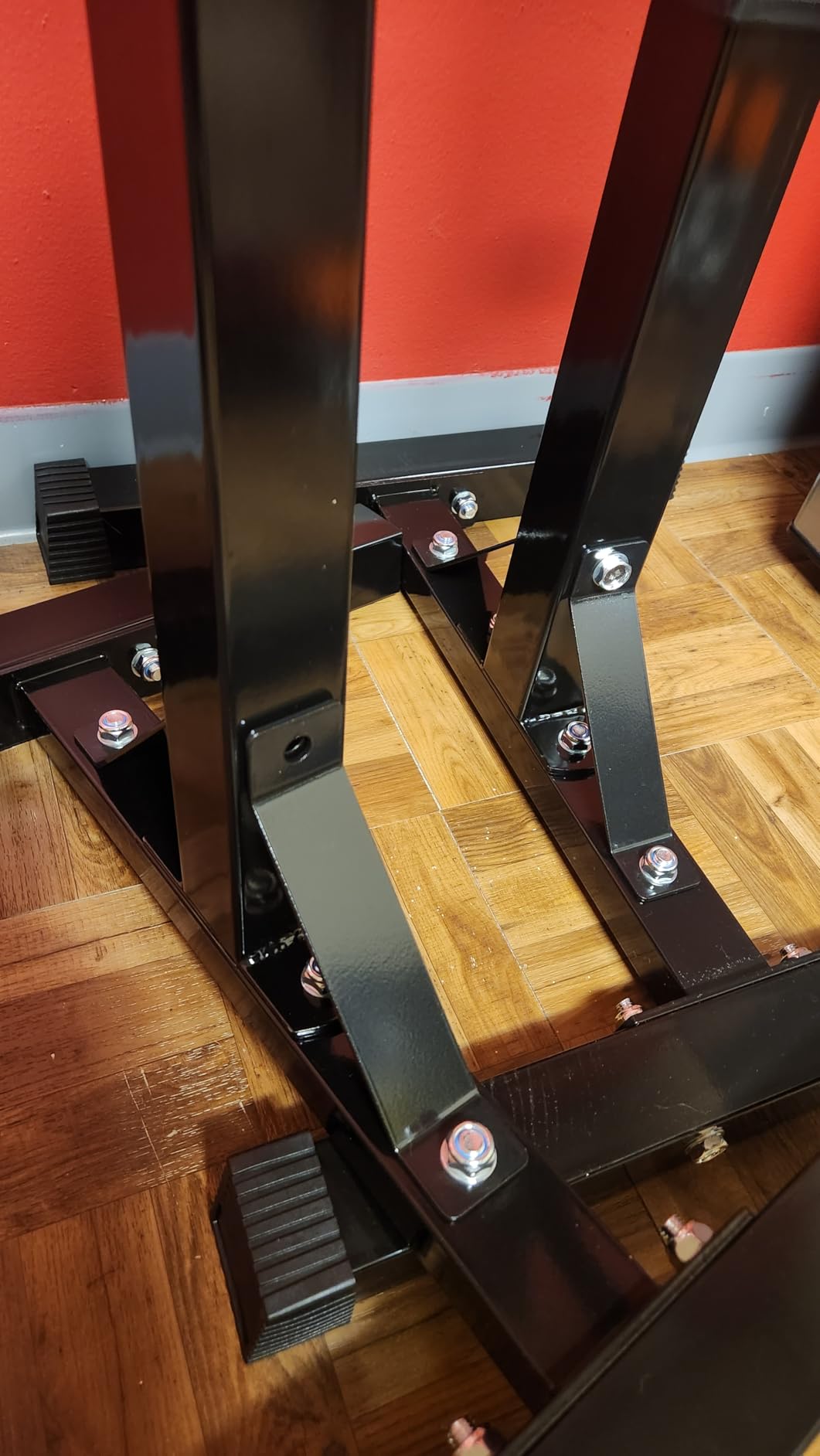
Anti-skid foot pads protect the floor and add grip during a lift, and the frame uses metal nuts paired with washers rather than plastic hardware.
When a pair of stands is genuinely enough
If your program is bench press, dumbbell work, rows and light squats, these are fine. The width adjustability means one pair covers both a 5 foot standard bar and a 7 foot Olympic bar, and folding them out of the way for other floor work takes seconds.
Owners also like that the footprint is tiny. In a spare room or a corner of a basement, two stands that store flat beat almost any cage.
Why you will not squat heavy in these
The dominant complaint is the height adjustment. It takes undoing two knobs, moving locking pins and tightening everything back up, and doing that between every warm-up set is what turns people off squat stands.
Wobble under load is the other repeat theme. Several buyers note that following the assembly sequence carefully prevents the movement others report, and the rubber foot caps and top bar cushions are known to loosen or detach. If you plan to squat heavy, add a proper rack instead.
3. CAP Barbell FM-8000F Deluxe Power Rack Is Best for Standard 1 Inch Accessories
CAP Barbell FM-8000F Deluxe Power Rack, Gray
45.6 x 61.4 x 85 inch
97 lb
300 lb bar catches,600 lb total
12 and 14 gauge steel
Pros
- Standard 1 inch holes accept Monster-style rack arms
- Plate storage weights the frame down
- Can be anchored to the floor
- ABS sleeves protect an Olympic bar
Cons
- Thin steel and safety arms reported bending at moderate loads
- J-hook rubber pads wear and detach
- Poor packaging with bent or missing parts
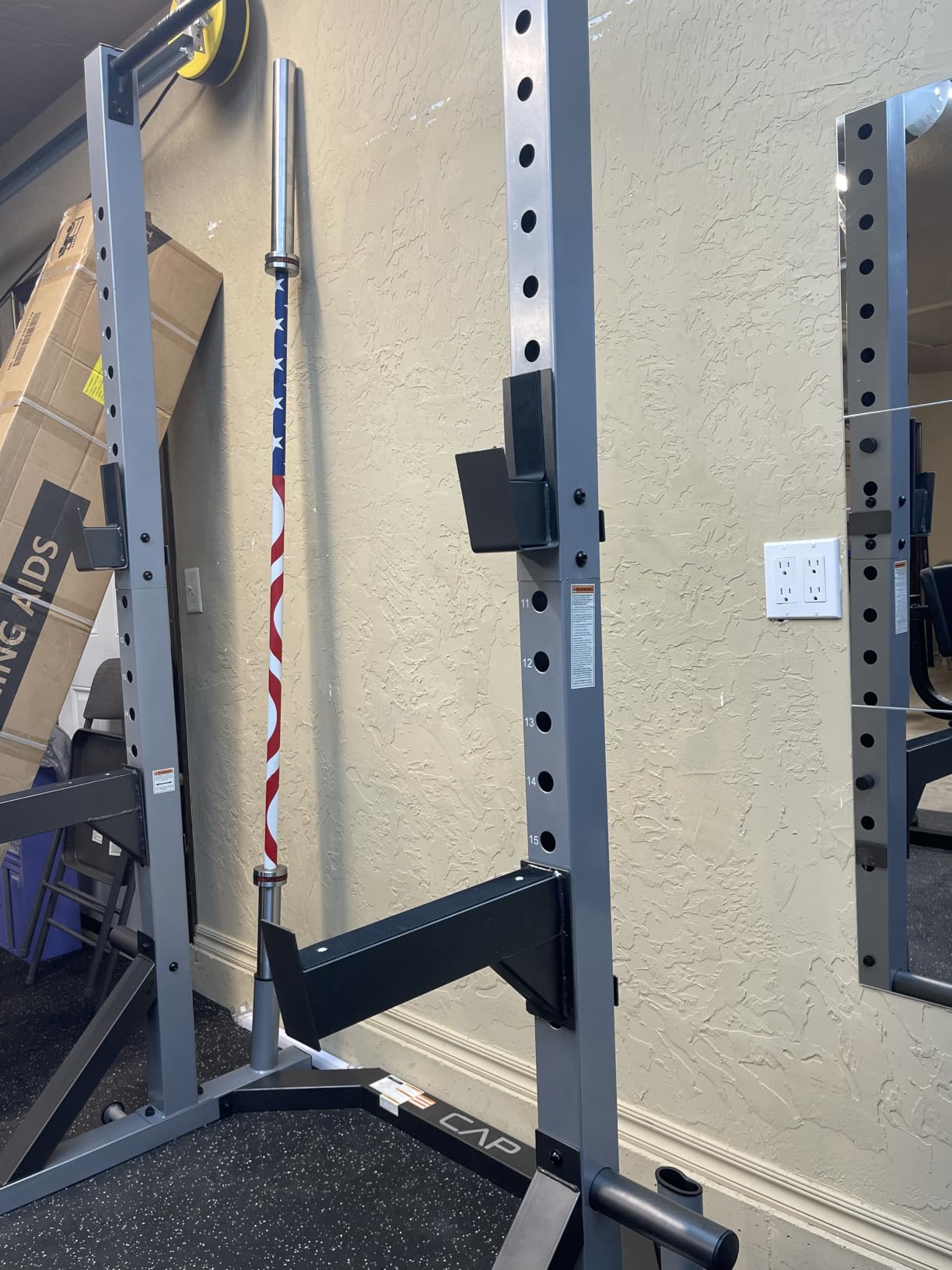
This is the rack to buy if accessory compatibility is your top priority. The 1 inch hole spacing matches the standard used by the wider rack ecosystem, so Monster-style arms, straps and attachments from other brands drop in without adapters, which is exactly the problem the Sunny rack above creates.
Capacity is listed as 300 lb on the bar catches, 600 lb total and 300 lb on the pull-up bar. That is a real ceiling worth knowing before you buy, and it is the main reason this rack sits mid-table rather than at the top.
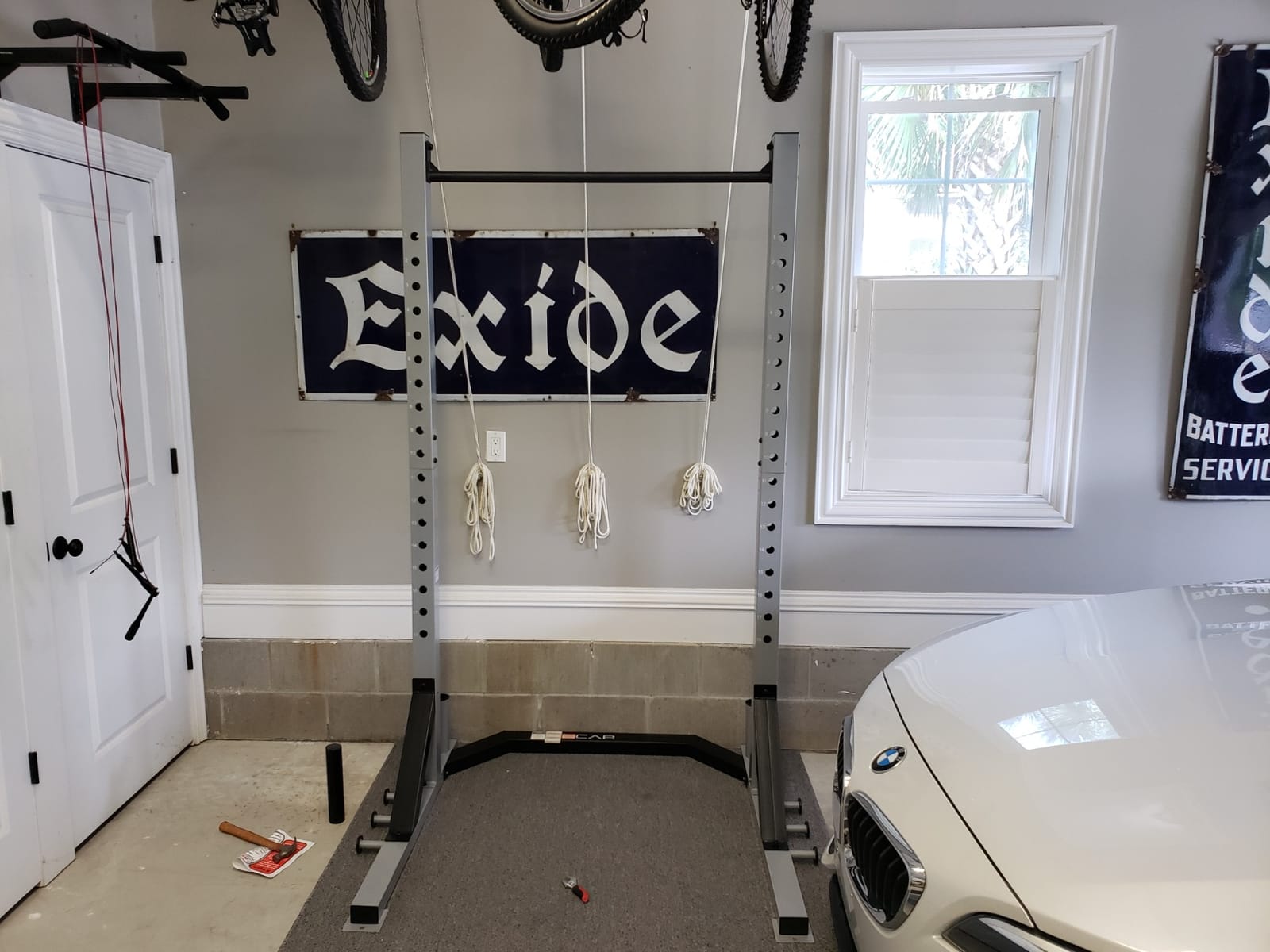
Construction is 12 and 14 gauge steel with gussets and a 3-step powder coat finish, and capped frame ends to prevent oxidation. Two plate posts and three band posts sit on each side, so you can load plates onto the frame and use it as its own deadlift storage.
Reviewers like that the weighted plate storage keeps the unit from shifting or tipping, and that it can also be anchored for extra rigidity. The ABS sleeves on the bar holders stop an Olympic bar from getting scratched.
Why the 1 inch holes matter more than the gauge
Owners regularly praise the 1 inch spacing because it accepts the same accessories as commercial racks. If you plan to add a landmine, dip station or lat pulldown later, this is the rack in the set where those purchases just work.
Several owners report the rack holding up over years and multiple movements when treated as a home rack rather than a commercial one. The plate storage and the anchor points are the two features that keep it planted.
Where the thin steel shows
Safety arm bending at moderate loads is the most serious criticism, and it lines up with the 12 and 14 gauge spec. The J-hook rubber pads are reported to wear and detach, and some buyers replaced the hooks entirely after a year or two.
Packaging quality is a recurring complaint, with bent or missing parts showing up on arrival. Replacement parts are also hard to source, and the spotter arm design means plate storage on one side may need clearing before the arms can be repositioned.
4. ULTRA FUEGO Power Cage Is Top Rated for Cable Work
ULTRA FUEGO Power Cage, Multi-Functional Power Rack with J-Hooks, Dip Handles, Landmine Attachment and Optional Cable Pulley System for Home Gym
63 x 47 x 82.7 inch with pulleys
1.5mm steel,50mm uprights
1000 lb rating
2-year warranty
Pros
- Excellent price-to-quality ratio for a cage with a pulley system
- Lat pulldown and cables run smoothly
- Stands solid once loaded with plates
- Landmine and band pegs add real variety
Cons
- Included J-hooks are weak and sit loose
- Inside depth is narrow
- Assembly takes several hours
This is the best squat rack for home use if you want cables in the same footprint as your barbell work. The 1.14 inch holes with 4 inch spacing line up with aftermarket attachments, and the box includes a pulley system, lat pulldown bar, tricep rope, T-bar, cable handles, dip handles, a 360 degree landmine and six plate storage pegs.
At 4.6 stars from 1092 reviews it holds one of the strongest ratings in the set, and reviewers consistently position it as a great value for beginners and intermediates who want a full cage with a cable station rather than a bare frame.
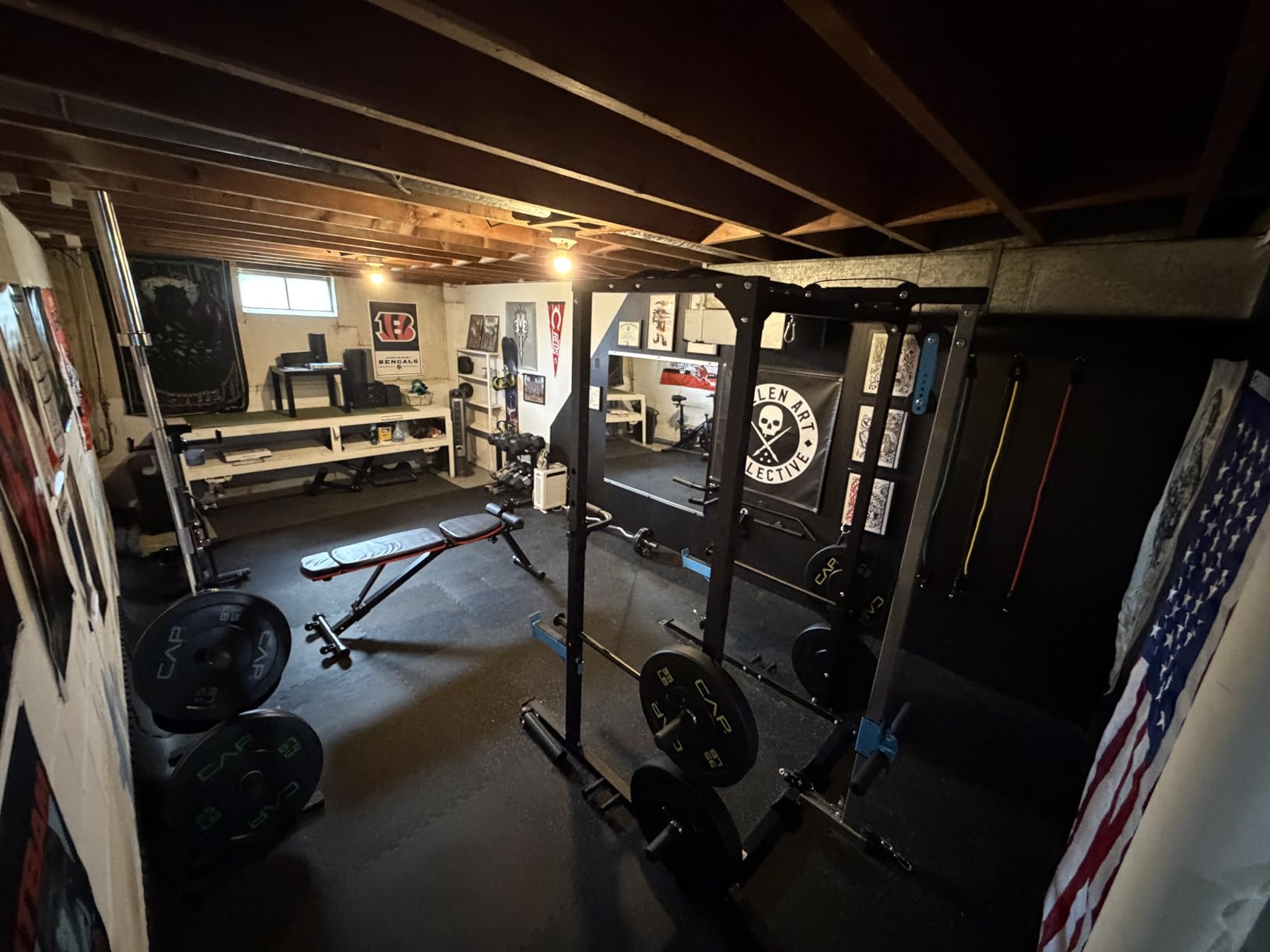
Uprights are 50 by 50mm with 1.5mm steel and an extra reinforcing tab on the base, and the manufacturer lists a 1000 lb rating. Several powerlifters report it holding a 495 lb barbell on aftermarket J-hooks with the safeties catching a failed rep, which is the real test of a home cage.
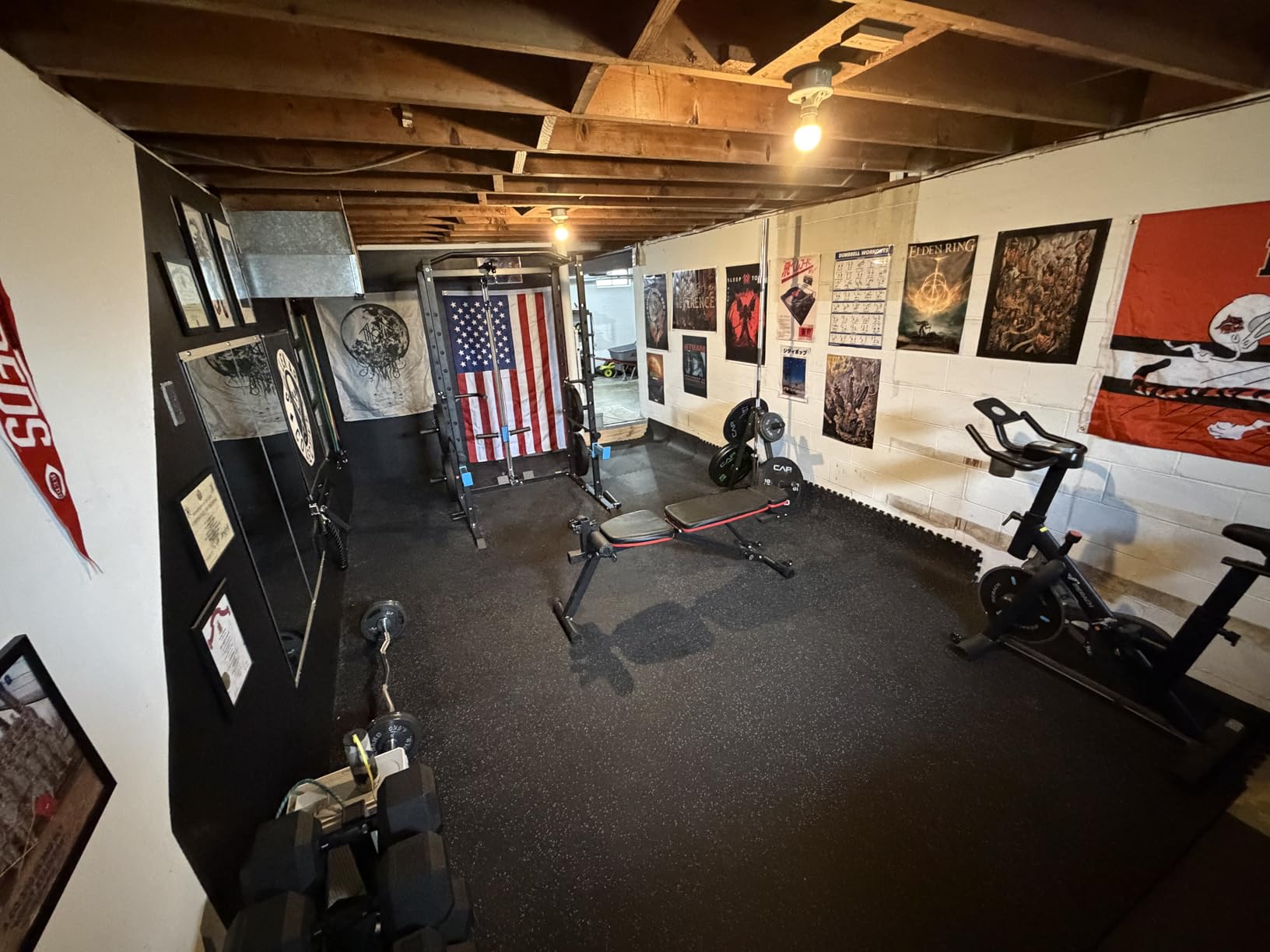
Ten height levels for the J-hooks and safety bars plus five levels for the dip handles give a wide adjustment range. The stand stays solid without being bolted down once plates are loaded onto the pegs.
Why the cable package is the deciding factor
Most home racks this size ship with nothing but a J-hook or two. This one arrives with a working lat pulldown and a rope, so rows, extensions and presses are possible from day one without a separate cable machine.
Reviewers note the lat pulldown and cable attachments operate smoothly for the price, and that the compact footprint still allows side-to-side movement inside the cage.
Plan to replace the J-hooks
The near-universal recommendation is to swap or upgrade the supplied J-hooks, which are rated around 220 lb and sit loose on the uprights. Budget for that as your first accessory purchase rather than discovering it mid-cycle.
Inside depth is narrow, which limits how far back you can sit on a bench inside the cage, and the weight plate storage pegs dip under light loads. Assembly runs several hours, and the cable routing section needs a second look. Only one carabiner is included.
5. CANPA Multifunction Power Rack Is the Best Value Pick
CANPA Multifunction Power Rack with Pull up Bar, Heavy Capacity and Adjustable Squat Stand Rack for Home Gym Equipment, Power Rack Cage (Black)
43.03 x 40.75 x 85.71 inch
800 lb rated capacity
Standard 1 inch holes
6-speed height adjustment
Pros
- Small footprint works in sunrooms
- basements and packed garages
- Standard 1 inch holes fit common accessories
- Rear Olympic plate storage bar
- Video plus paper instructions make assembly quick
Cons
- Narrow width suits a 6 foot bar better than a 7 foot bar
- Supports sit high at the lowest setting
- Not designed for heavy loading
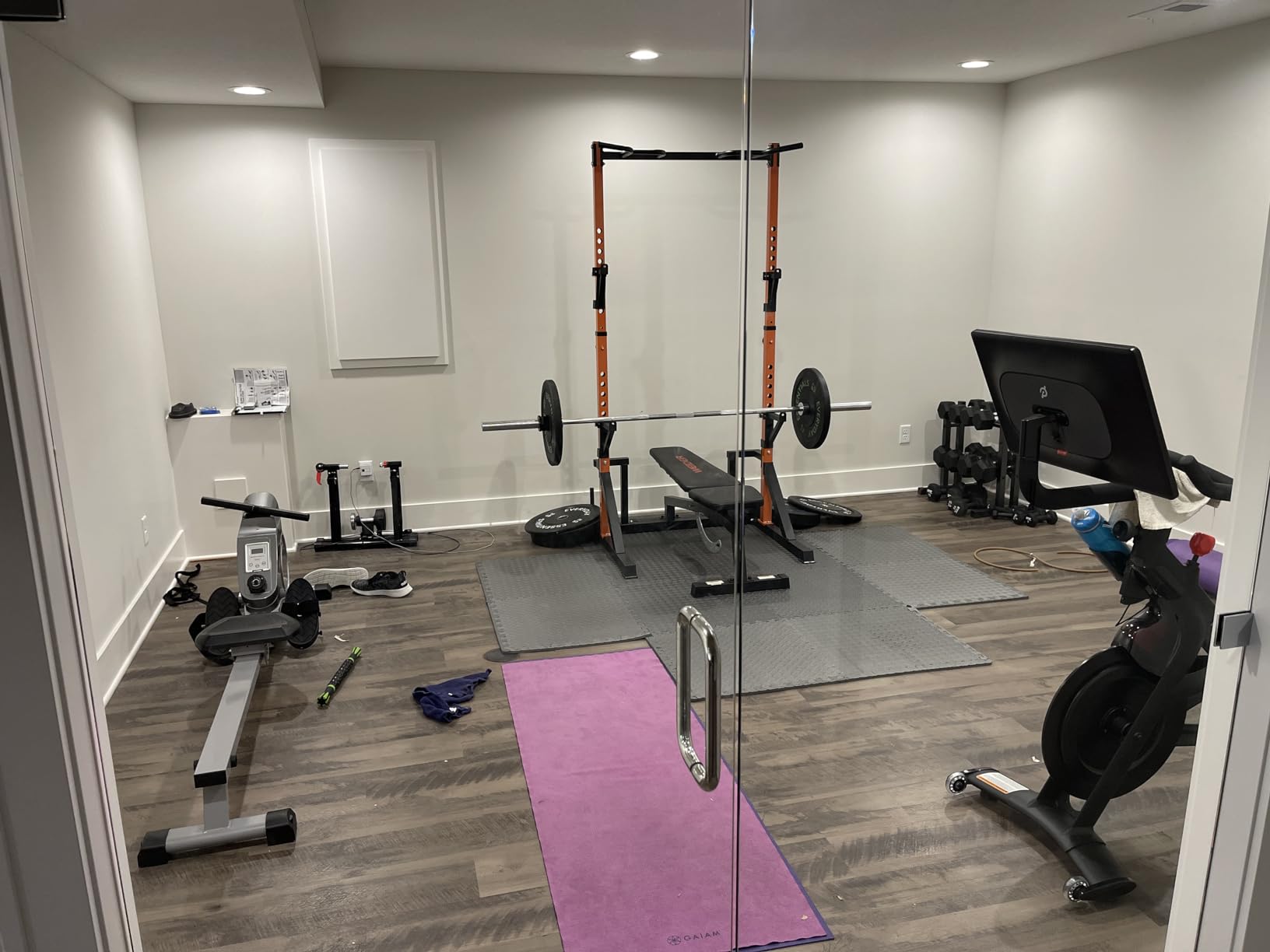
The CANPA is the pick if your available floor space is the binding constraint. At 43 by 41 inches it has one of the smaller footprints here, and reviewers specifically call it out for sunrooms, basements and packed garages where a 60 inch wide cage will not go.
It is rated to 800 lb with front and rear double support, and the single-side support arm has 17 hole positions. The main frame has 6-speed height adjustment, which is the feature low-ceiling owners value most.
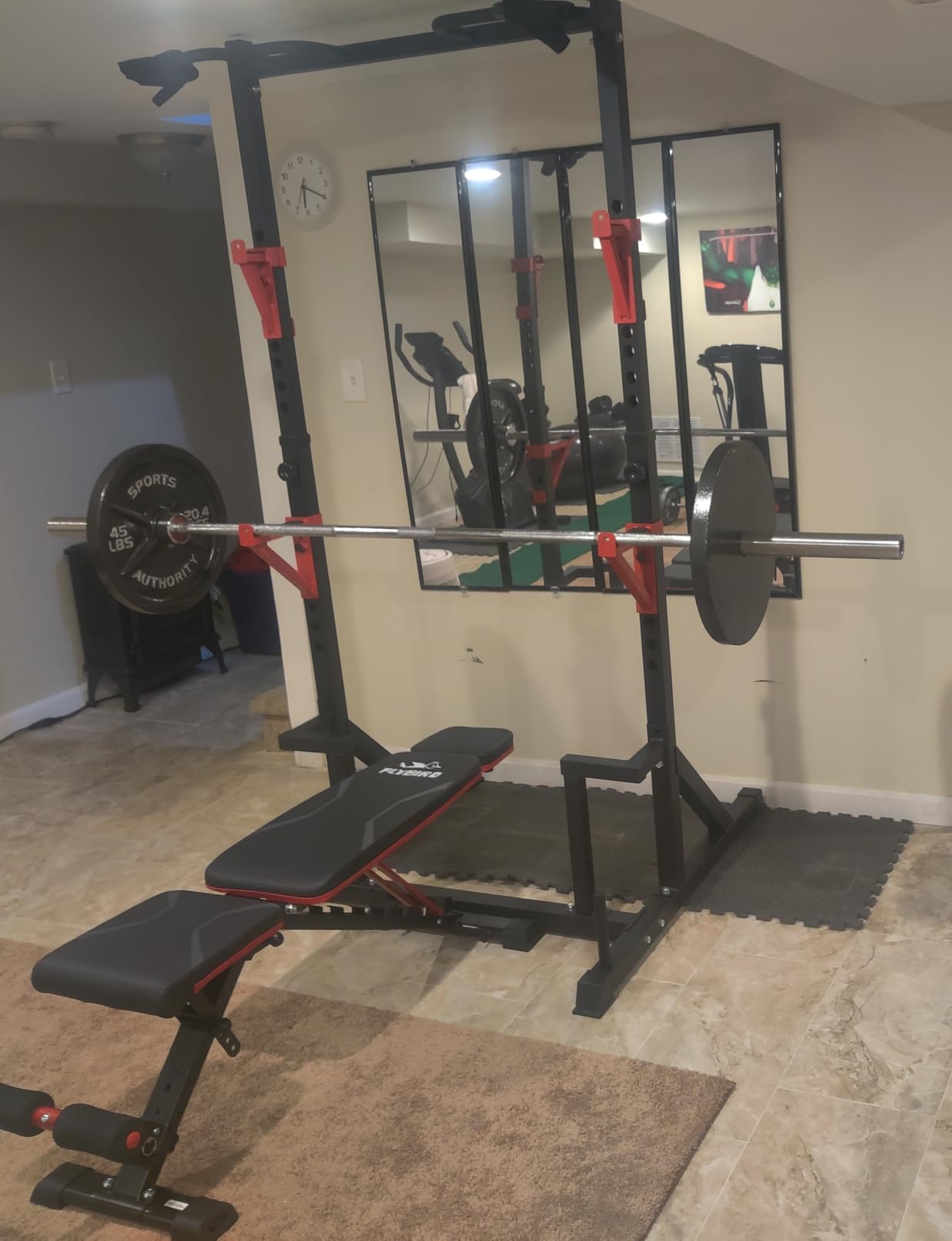
Standard 1 inch adjustment holes mean most third-party accessories fit, and the rear bar doubles as an Olympic plate storage bar. A multi-direction pull-up bar adds another grip option, and it comes in black or red.
Owners describe it as sturdy once set up and weighted down with plates, and the 800 lb rating is genuinely generous for a rack in this class.
Why low-ceiling users rate it highly
Six-speed main frame height adjustment lets you bring the supports down lower than a fixed frame allows. That matters in a basement or a single-car garage where a full-height cage would push the pull-up bar into the ceiling.
For general strength work rather than serious powerlifting, the combination of a small footprint, standard holes and plate storage is hard to argue with at this level of spend.
Where shorter lifters get frustrated
Users under roughly 5 foot 7 report the minimum support height is still too high to comfortably unrack a bar. Lifters in that range usually end up swapping the J-hooks and catches for lower ones.
The mid-width construction means a 6 foot bar is the better pairing, and long J-hooks will not fit the lower half of the frame. Treat it as a keep-fit rack rather than a heavy training one.
6. Sportsroyals RK2 Power Cage Is the Sturdiest Full Cage Here
SPORTSROYALS Squat Rack, 1200 lb Power Cage with LAT Pulldown for Home Gym
61.6 x 56 x 82.6 inch
150 lb rack weight
1200 lb rating
PU-coated cable to 500 lb
Pros
- Gym-quality 50x50mm frame rated to 1200 lb
- 150 lb frame weight gives real stability
- Precision bearing pulleys and PU-coated cable
- Very long accessory list
Cons
- Arrives in two boxes that may come on different days
- Assembly best done by two or three people
- Large footprint for a small room
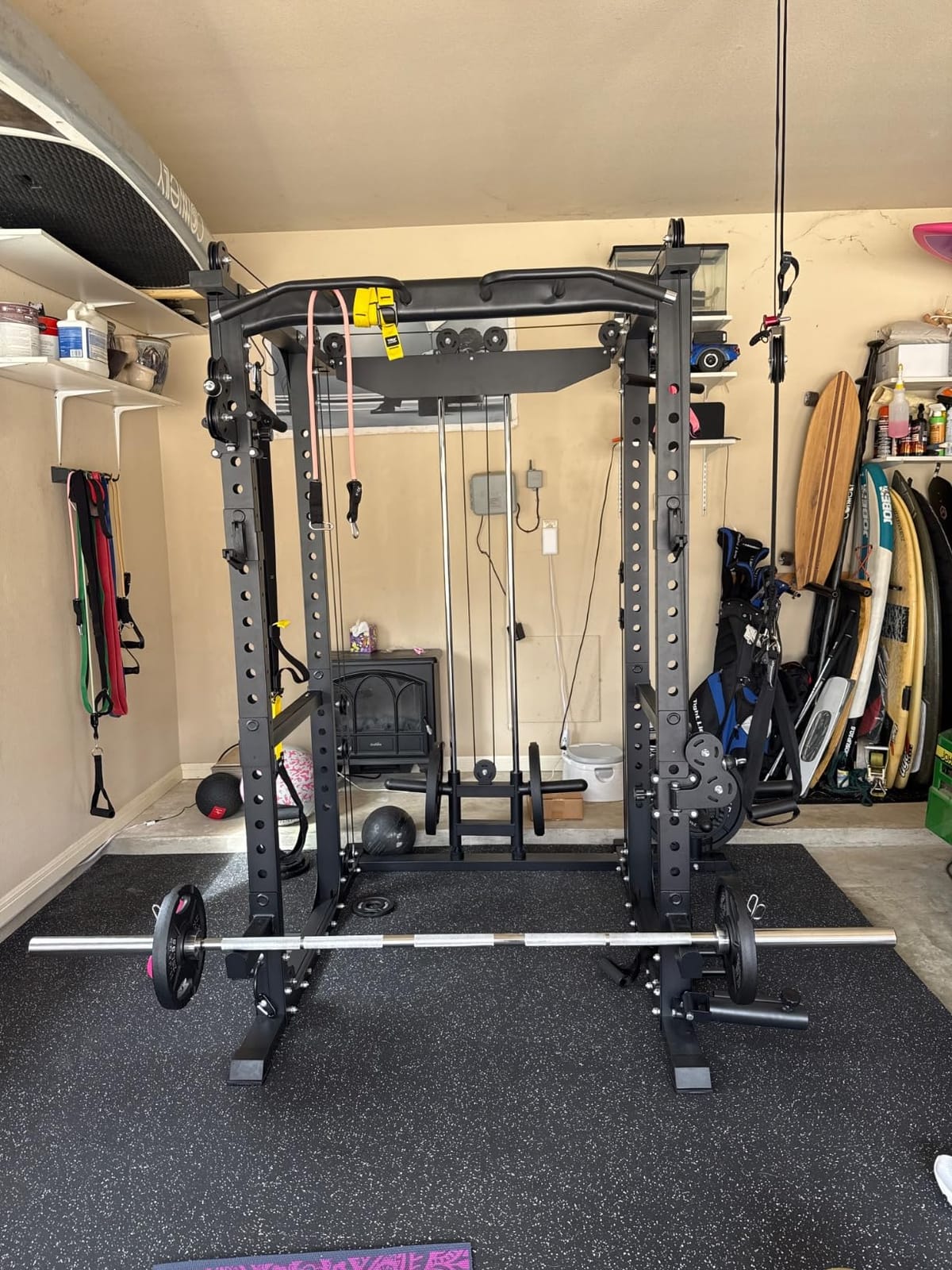
The Sportsroyals RK2 is the one to buy if you want the most physical machine in this list rather than the most features. At 150 pounds the frame is roughly twice the weight of most competitors here, and reviewers single that out as the thing that stands out against lighter builds.
It is built from 50 by 50mm steel square tube at 1.5mm thickness and rated to 1200 lb, with two reinforcing tabs at the base. Heavier is the point here: a rack that does not need to be anchored is worth more than a rack with a long parts list.
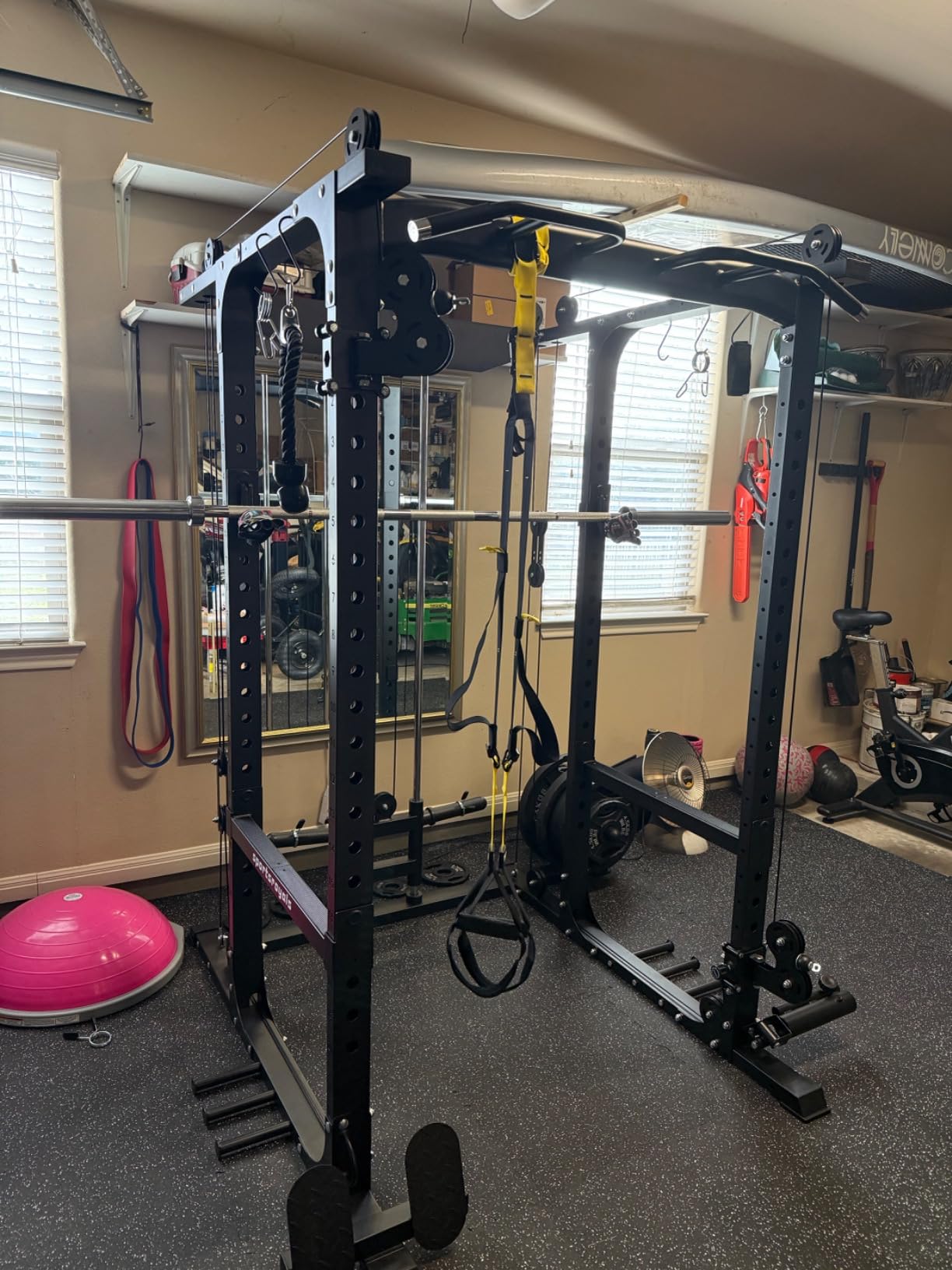
The pulley system has upper and lower lat pulldown positions using precision bearing pulleys, electroplated telescopic poles and a PU-coated steel cable rated to 500 lb, which is what makes the cable travel quiet compared with cheaper cages.
Fourteen adjustable height levels, a foot board, six band pegs, six handle hooks, a wide and narrow pull-up frame and a 360 degree landmine round out a genuinely complete package. Plate storage fits both 2 inch Olympic and 1 inch standard plates.
Why weight on the floor is a feature
A 150 lb frame is the cheapest stability upgrade available. It resists racking shock and dynamic sway far better than a 60 to 80 lb frame, which is what makes solo training alone feel different.
If you squat and bench heavy without a spotter, the mass of the rack is doing safety work that no adjustment can replicate. The 1200 lb rating is also comfortably above what any home lifter will reach.
Where the logistics get awkward
The cage arrives in two boxes, and the second one may reach you a day or more after the first. Manufacturers recommend two or three people for assembly, so plan the build before the box is open.
At 61.6 by 56 inches the footprint is one of the larger here, and bundle variants mean the bare cage and the package versions do not include the same accessory list. Check which variant you are actually buying.
7. papababe 800 lb Squat Rack Is the Best Compact First Cage
800LB Capacity Squat Rack with Pull Up Bar, Adjustable Power Cage, Home Gym
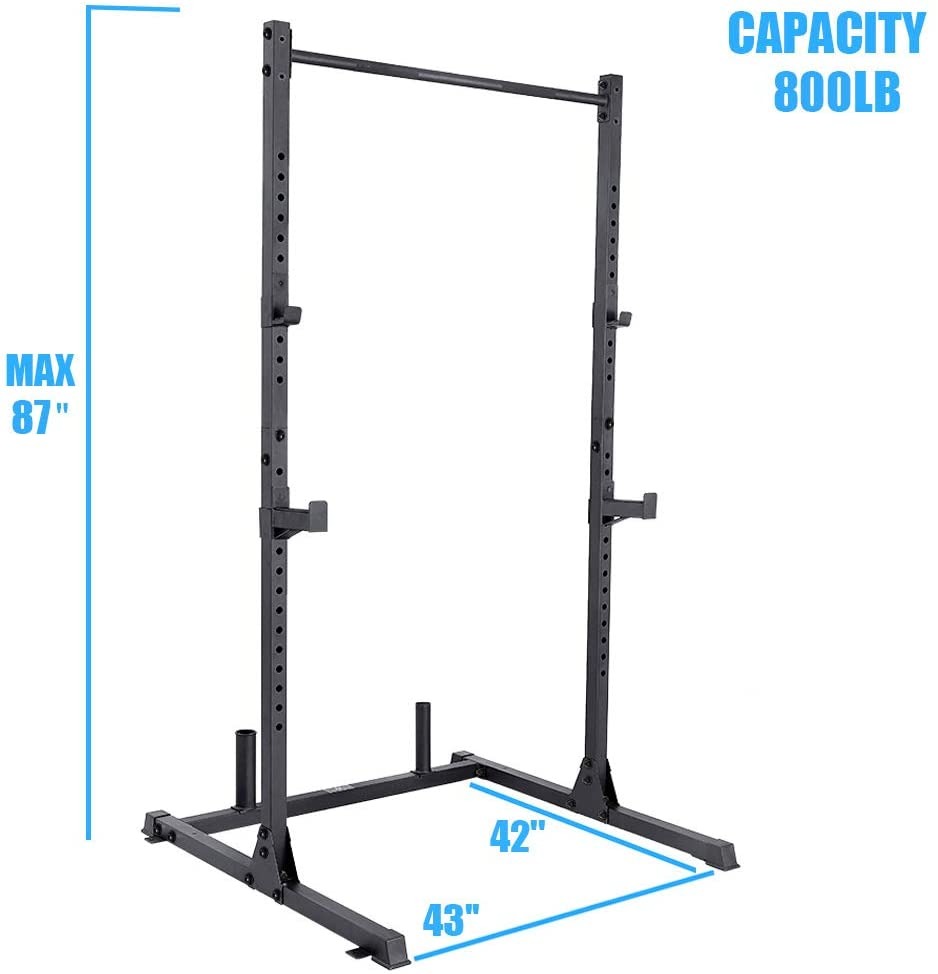
47 x 48 x 82 inch
61 lb
800 lb capacity,400 lb pull-up bar
26 J-hook positions
Pros
- Exceptionally strong for the price tier
- Knurled pull-up bar gives a secure grip
- Compact enough for a small room or garage
- Four anchor bolt holes per foot
Cons
- Pull-up bar sits directly over the barbell position
- 0.8 inch holes block most third-party attachments
- Some units arrived with a missing assembly hole
Owners of this rack are routinely surprised by the build quality at this level of spend, and several reviewers compare it favourably to racks costing two or three times more. The 2 by 2 inch 13 gauge tubular frame is a genuinely reasonable piece of steel.
It is rated to 800 lb with 400 lb on the pull-up bar, and there are 26 hole positions for the J-hooks, which covers curls, squats, shrugs, pull-ups and push-ups on the same frame.
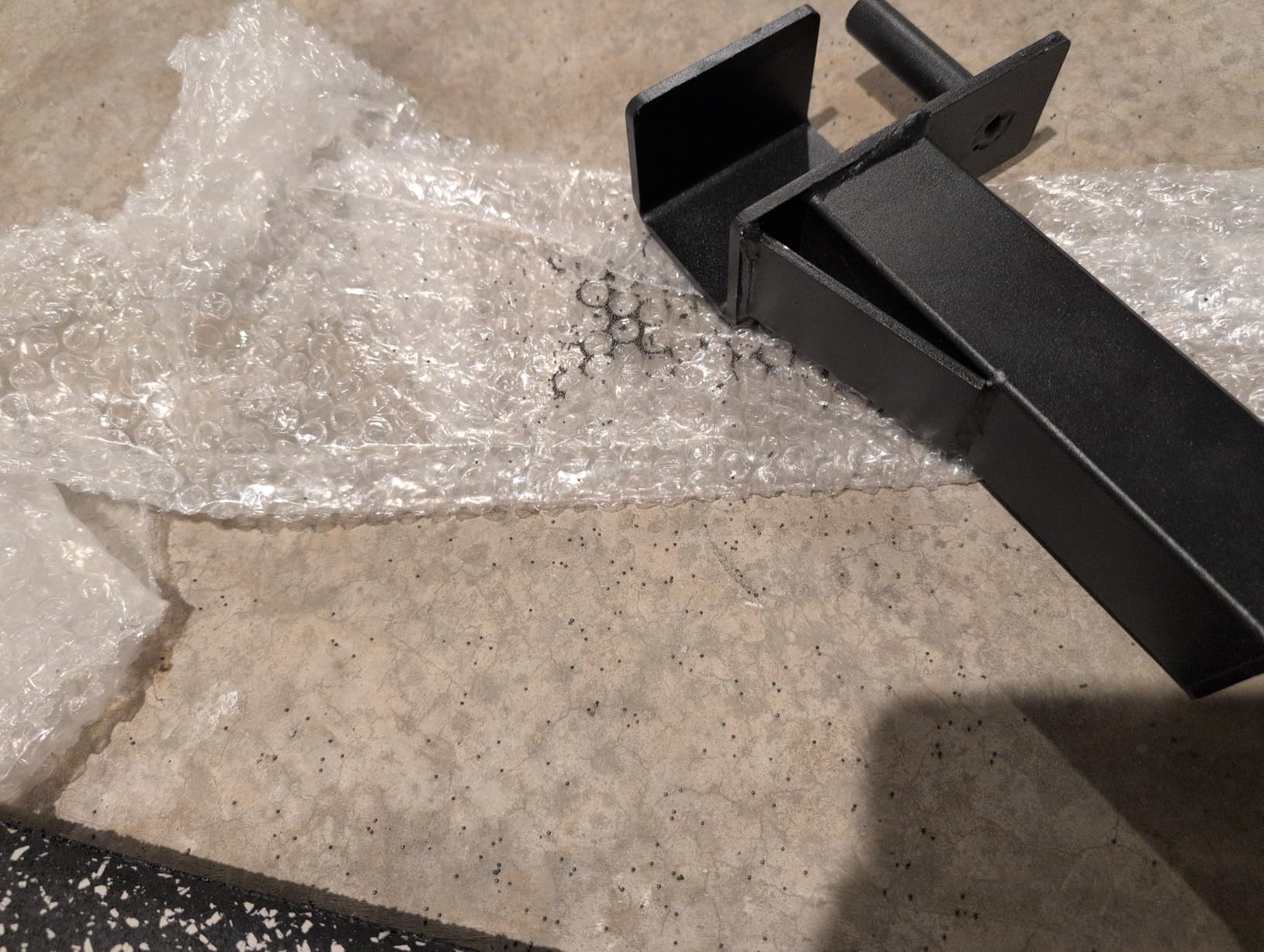
Four triangular gussets with eight anti-loosening nuts and four bolt holes at every foot give you a real choice of floor or wall anchoring, and optional floor anchor tabs are supported. The rear upright doubles as a vertical barbell holder.
Assembly takes about an hour with basic tools, and the knurled 1.25 inch pull-up bar gives a noticeably better grip than smooth bars on cheaper racks.
Why it punches above its tier
The combination of 26 adjustment positions, anchor points on all four feet and a knurled pull-up bar is unusual below this price point. Reviews mention lifting 250-300 lb without complaint and assembling in well under an afternoon.
The roughly 85 inch frame height suits a wide range of lifters, and the compact footprint works well in a small room or a garage you also use for other things.
Where the layout works against you
The most common functional complaint is that the pull-up bar sits directly above the barbell position, which interrupts superset pull-up work between squat and press sets. Plan your session order around it.
The 0.8 inch holes again block most third-party attachments, and the rear barbell post and weight post look similar but are not interchangeable. A minority of buyers received a unit with a missing assembly hole, so inspect the frame on arrival.
8. K KiNGKANG Adjustable Squat Rack Adjusts in Width and Height
K KiNGKANG Adjustable Squat Rack,Bench Press for Home Gym Load 690LBS
37 x 46.4 x 79.9 inch
2 inch square carbon steel
690 lb capacity
13 height and 10 width levels
Pros
- Adjustable in both height and width
- rare at this price
- Easy to assemble in about 30 minutes
- Rubber feet prevent sliding and floor damage
- Removable trap bar storage cylinders
Cons
- Upright hooks can hit the elbows of wider lifters
- Minimum width is still too wide for quality dips
- Max height may limit taller lifters
This is the only adjustable squat stand in the group, and the adjustability is genuine rather than nominal. Thirteen height levels cover 36.2 to 60 inches and ten width levels cover 29.9 to 46.3 inches, so the same frame can fit different bars and different lifters.
The frame is 2 inch square carbon steel with a powder coated finish and a 690 lb load capacity. The horizontal protection frame adjusts across three settings from 25.7 to 32.3 inches.
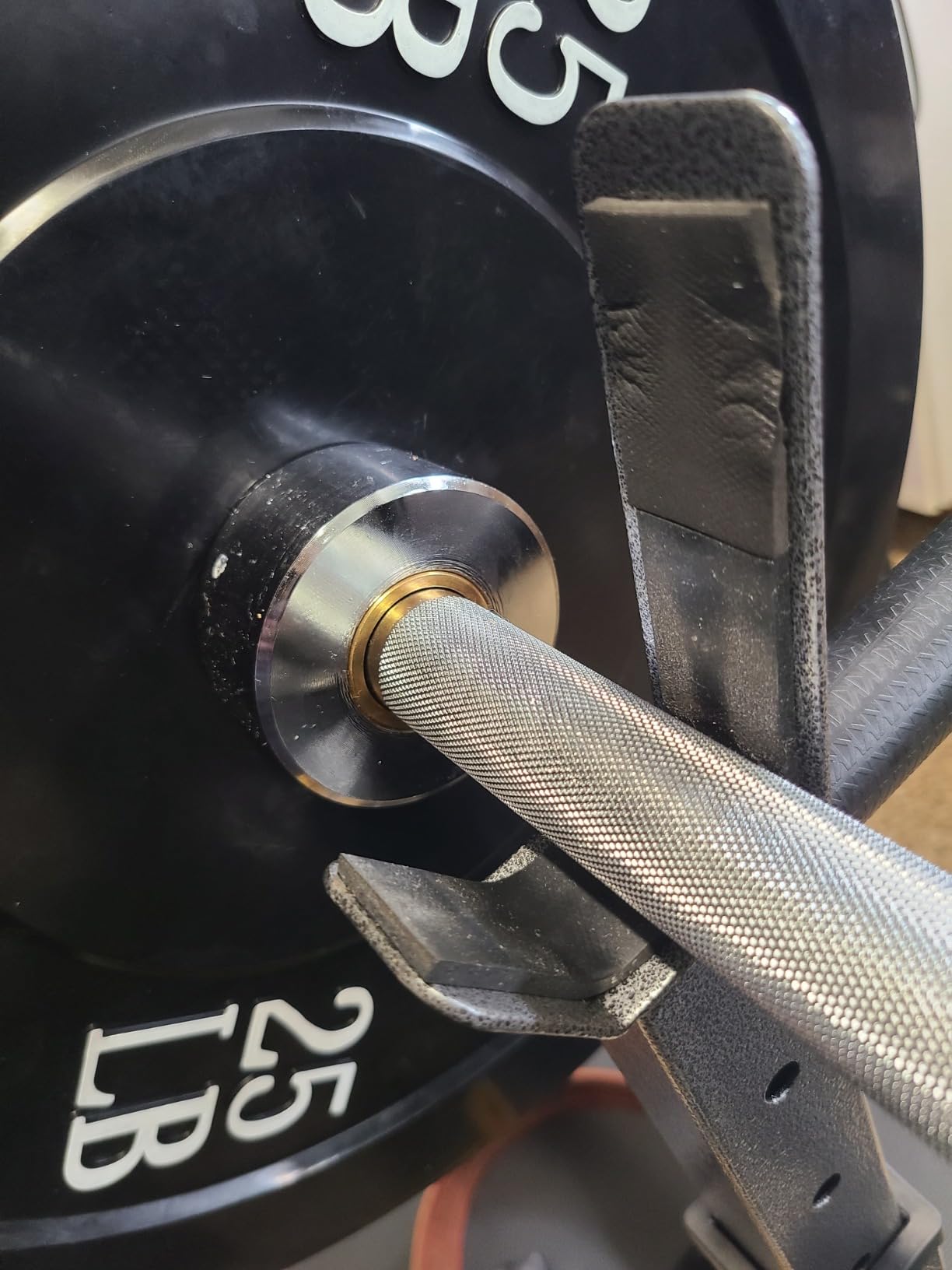
Two barbell storage racks and two removable Olympic trap bar cylinders are included, which is unusual on a stand. There is a safety locking system for both height and width, and rubber feet stop the frame sliding or scratching the floor.
Reviewers report solid performance for bench and squat work at moderate loads and like that the low unit weight makes it easy to move around the room.
Why adjustability matters for shared racks
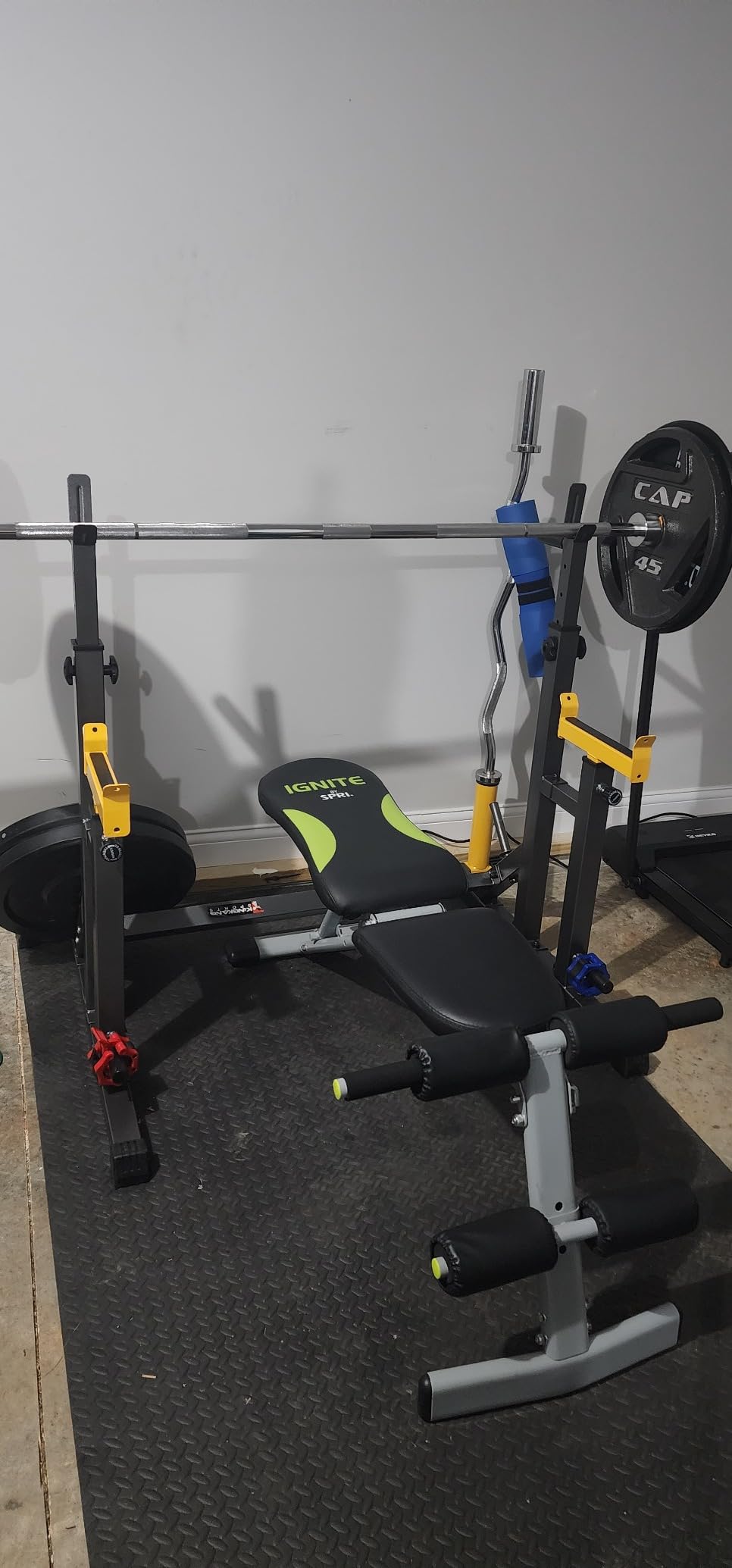
In a household where two people of different heights train, a fixed stand means one person is always bending or shrugging. Moving the supports and the width in seconds solves that without buying a second piece of equipment.
Because it folds down small and weighs about 50 pounds, it is also the pick for anyone who wants barbell work in a room they also use for something else.
The ergonomic complaints to know about
The safety hook uprights can contact the elbows of wider users during bench press, which is the most repeated complaint. Adjust the bench position before blaming your setup.
The narrowest width is still too wide for proper dips, and the maximum height may be limiting for lifters around 6 feet or taller. The supplied cushion pad under the barbell holder compresses under load and is worth replacing.
9. FLYBIRD SR1 Squat Rack Is Best for Extended Safety Arms
FLYBIRD SR1 Squat Rack with Pull-Up Bar, Multi-Functional Power Rack for Home Gym, 22 Safety Position Height & Adjustable Width for 6/7ft Barbells, Includes Extended J-Hooks & Landmine Attachment
42 x 51 x 83 inch
68 lb
950 lb capacity
16.7 inch extended safety arms
Pros
- 16.7 inch safety arms give generous catch space
- 22 height positions on standard 1 inch holes
- Adjustable width fits 6 and 7 ft barbells
- Compact footprint of roughly 1 square metre
Cons
- Half rack design gives less protection than a full cage
- Adjustable width needs repositioning between bar lengths
- Protective liners on the arms are basic
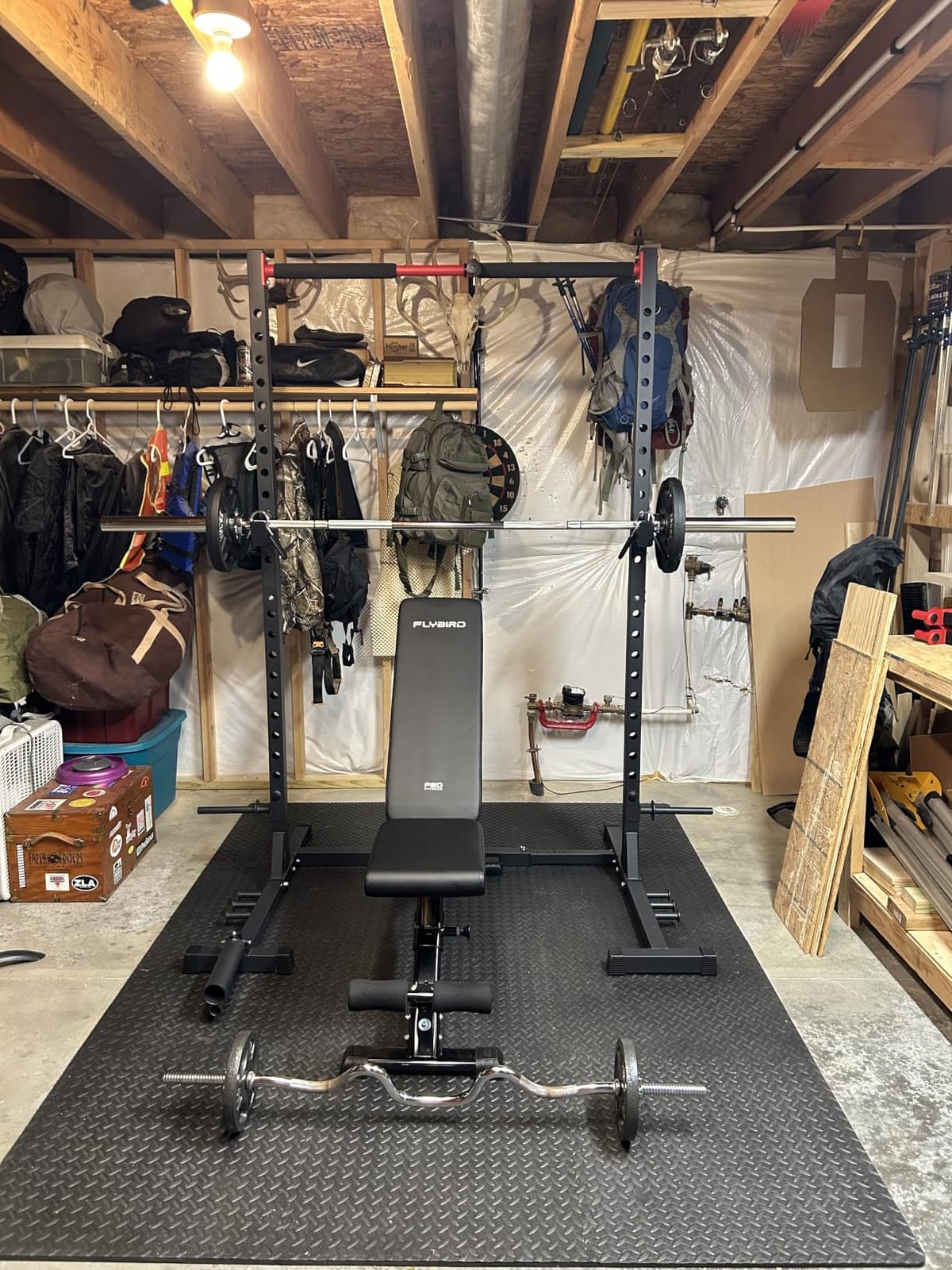
The single feature that separates this half rack from the others is the 16.7 inch extended safety arms, cut from 1.2 by 1.2 inch solid steel with protective liners. That extra catch space is what makes solo benching safer, and reviewers point to it as the reason to choose this rack over a comparable half rack.
Standard 1 inch hole spacing across 22 height positions is the second practical win. It is the same compatibility you would look for in a commercial rack, which means accessories carry over if you outgrow this frame.
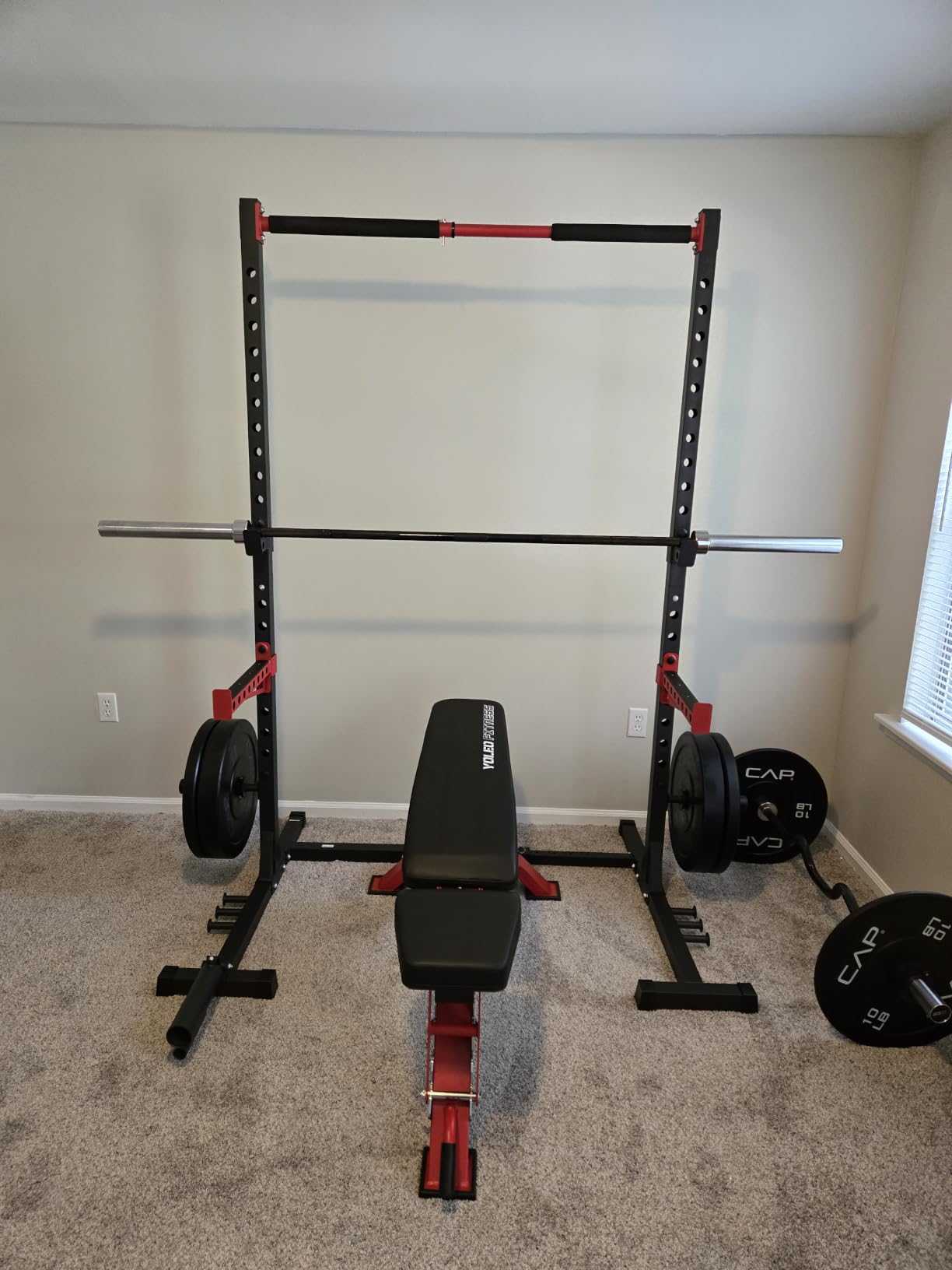
It is rated to 950 lb on a reinforced 2 by 2 inch commercial-grade steel frame, and the width adjusts to fit most 6 foot and 7 foot barbells. The footprint is about 39 by 41 inches, roughly one square metre, which is compact for what it does.
A foam-padded pull-up bar, six resistance band pegs and a 360 degree landmine attachment come as standard, and the rack weighs 68 pounds so two people can position it.
Why catch space is a safety feature
On a bench press, the length of your safety arm determines how far back you can set the bench and still have the bar land on the catches when a rep fails. A 16.7 inch arm removes almost all of that anxiety.
The adjustable width is the other quiet advantage. Swapping between a 6 foot and 7 foot bar is a matter of sliding the uprights rather than buying a second rack.
Where a half rack limits you
Because there is no rear frame, a half rack offers less protection than a full cage for failed lifts, particularly on heavy squats where you move further back. Owners frame it as a good fit for general and intermediate home lifting rather than maximal training.
Repositioning the width takes a few minutes when you switch bar lengths, and the arm liners are basic. Bench and weights are usually sold separately depending on the variant.
10. JELENS S11 Power Cage Handles the Heaviest Rated Load in the Set
JELENS S11 Power Cage, 2000LB Multi-Function Power Rack with LAT Pulldown, Squat Rack with Adjustable Pulley System and Training Attachments, Weight Rack for Home Gym
57.48 x 44.49 x 82.6 inch
50mm x 50mm steel
2000 lb rating
1-year warranty
Pros
- 2000 lb rating is the highest in this group
- Sandblasted rust-resistant steel finish
- Precision pulleys and steel wire rope run quietly
- Compact 12.5 square foot footprint
Cons
- Wide 57 inch depth takes more floor space than a half rack
- Arrives in two boxes
- Barbell and bench not included
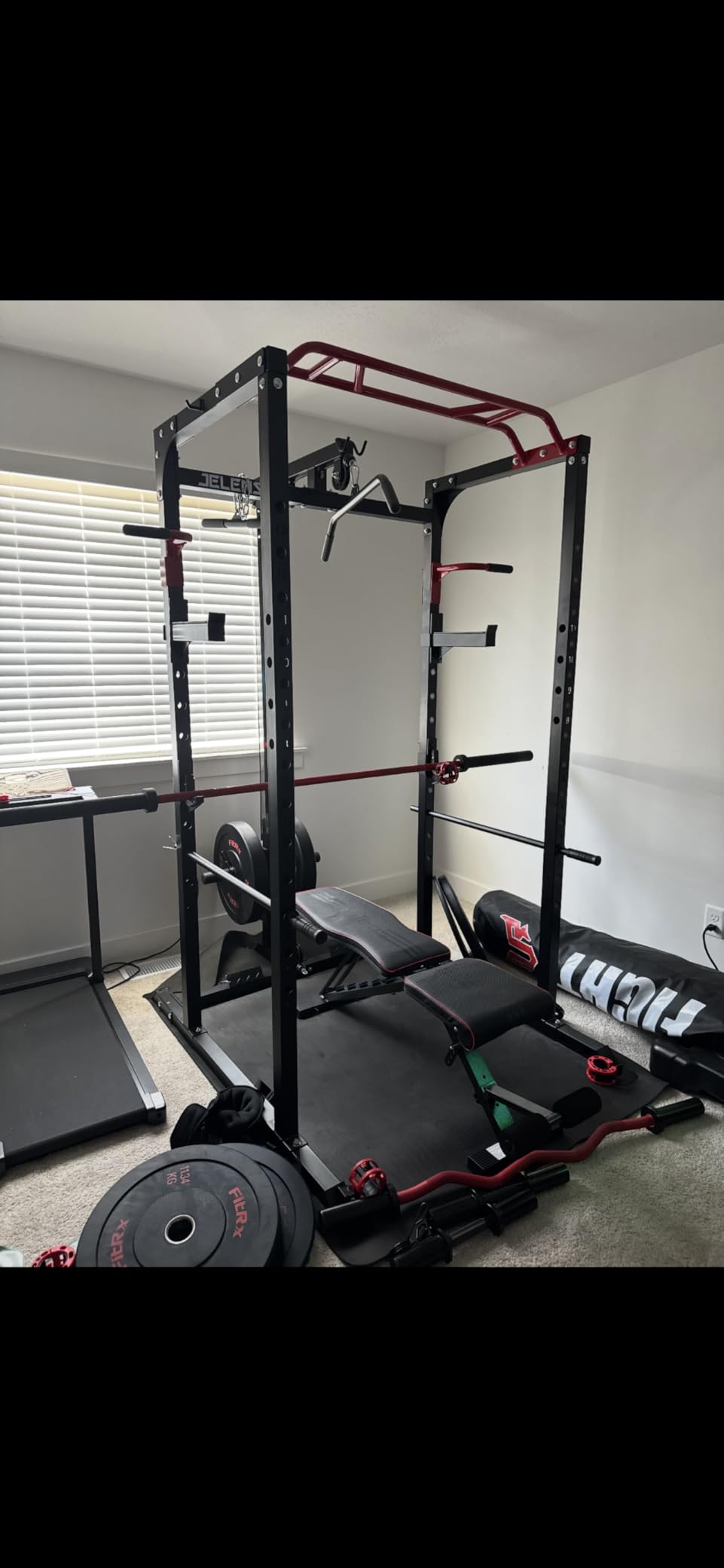
On paper the JELENS S11 has the highest rated capacity in this roundup at 2000 lb, built from 50 by 50mm heavy-duty steel pipe. Reviewers describe the frame as noticeably more robust than typical budget cages, and the sandblasted surface treatment is for rust resistance rather than appearance alone.
The pulley system is the other focus. Up and down lat pulldown positions use upgraded precision steel shaft pulleys and polished high-strength solid steel wire rope, which owners report is smooth and low noise compared with cable on cheaper racks.
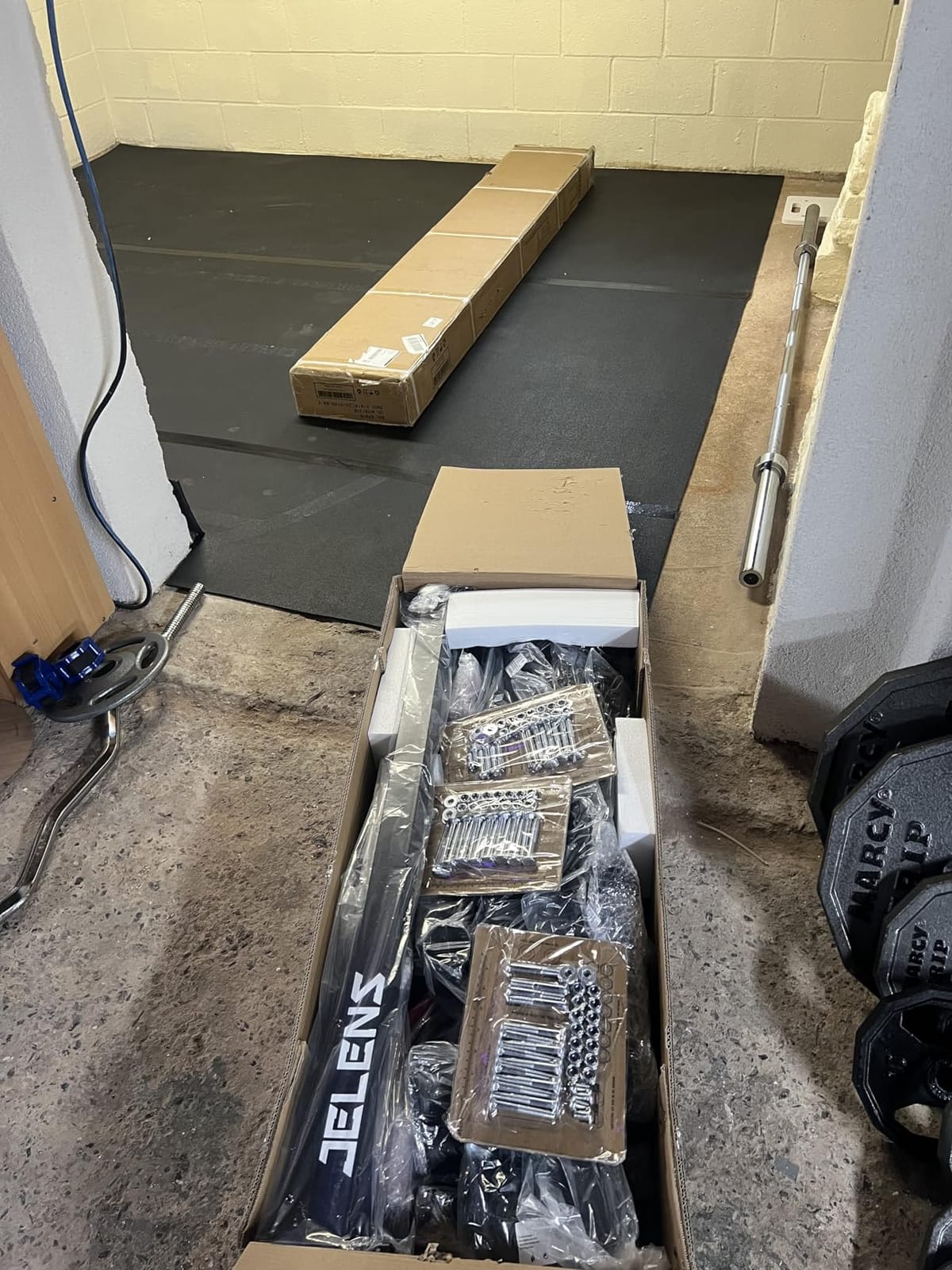
Thirteen laser-marked height positions make adjustment fast, because you can see the next hole instead of counting from the top. The accessory set includes a lat pulldown bar, cable bar, T-bar, pull-down bar, two J-hooks, two safety rods, a 360 degree landmine and four counterweight racks with clamps.
Despite the depth, the cage covers about 12.5 square feet, which is a reasonable footprint for a full cable station.
When the high rating actually matters
Few home lifters reach anything close to 2000 lb on the bar, so read this rating as build quality rather than a training target. What matters is that the steel is thick enough that the frame stays rigid under dynamic loading.
The quick-detach fitting on the cable attachments makes switching between pulldowns and rows painless, and the counterweight racks with clamps are a practical touch for a shared space.
Where the space trade-off bites
At 57.5 inches deep, this cage takes noticeably more floor space than a compact half rack. In a one-car garage you are allocating a real square to it rather than tucking it against a wall.
It arrives in two boxes, the warranty is one year rather than the two years offered by a few rivals, and the barbell and bench are not part of the base cage.
11. Mikolo Folding Wall Mounted Squat Rack Is Best for Tight Rooms
Mikolo 2″ x 2″ Folding Wall Mounted Squat Rack, 1000 Pounds Capacity Power Rack with Safety Catches, Pull Up Bar, J Hooks and Landmine Attachment, Space-Saving Home Gym(Black
47 x 19.7 x 85.8 inch open,2 inch folded
80 lb
1000 lb capacity
2-year warranty
Pros
- Folds flat in about 15 seconds and projects about 2 inches
- 2 by 2 inch steel handles 300+ lb
- 1000 lb rating is well above comparable wall racks
- Wide lag slots tolerate off-centre studs
Cons
- Mounting requires studs
- a stringer or a solid wall surface
- Rack slides up slightly to fold
- which affects height planning
- Original safety bar attachment became unavailable
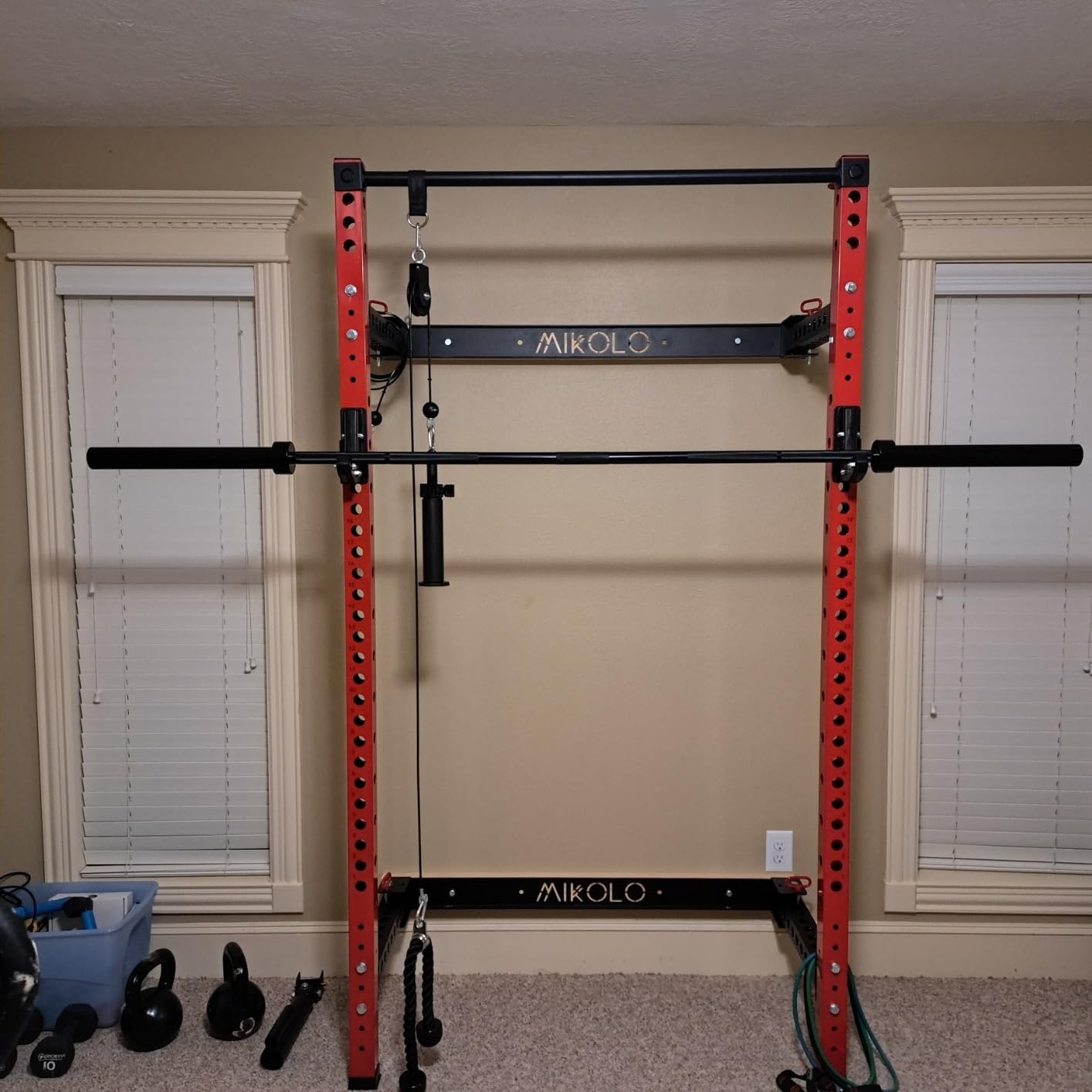
If floor space is the problem, this is the answer. The Mikolo folds in about 15 seconds from an open footprint of 47 by 19.7 by 85.8 inches down to a slab measuring 47 by 2 by 85.8 inches, which is about two inches off the wall.
Users in rooms under 100 square feet report the rack folding completely out of the way between sessions, which is the entire point. The uprights are 2 by 2 inch 13 gauge steel with a textured powder coat and a 1000 lb rating, which is well above comparable wall racks.
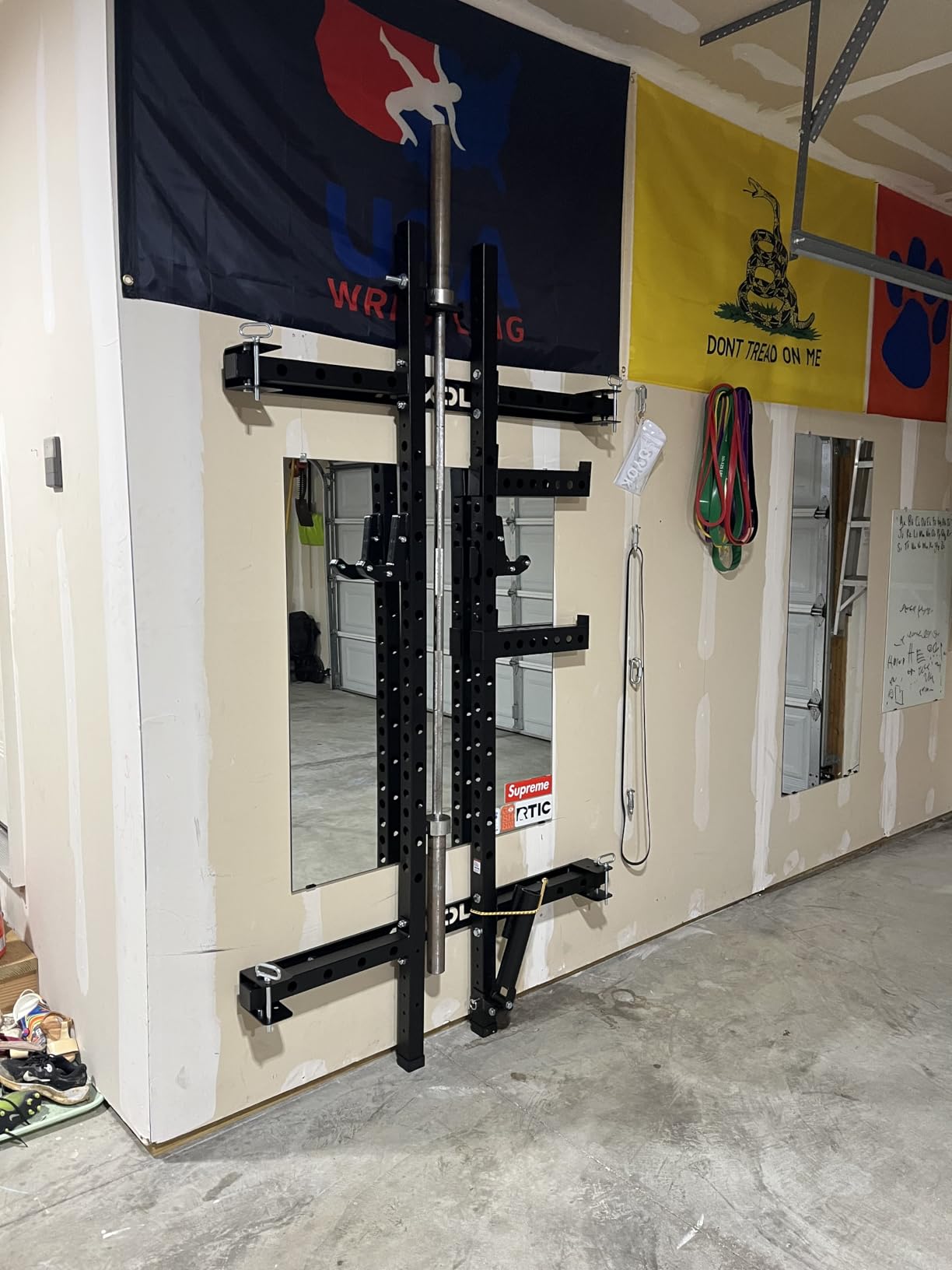
A quick-attach pull-up bar reaches 89 inches off the ground, the J-cups use UHMW plastic inserts to protect bar knurling, and a 360 degree dual size T-bar row attachment is included. The legs also adjust vertically, which compensates for uneven floors that most racks sit on regardless.
Wall mounting uses an included stringer and metal studs, with a 15 to 30 minute install, and a one-year complimentary parts replacement service is included.
Why folding beats free-standing in small rooms
A free-standing cage that permanently occupies a third of a small room changes how you use the space. A wall rack that disappears in 15 seconds lets you keep a workout area, a drying area and storage in the same footprint.
Owners also praise the wide lag bolt slots, which make installation straightforward even when stud spacing is uneven. The vertically adjustable legs are a genuine bonus on a concrete slab.
What wall mounting demands from you
You need studs, a stringer or another suitable surface. Concrete is harder than framing, and the mount has to clear doors, access panels and baseboards. Renters who cannot drill should skip this category.
Planning matters: the rack slides up slightly on the axles to fold, so a badly chosen mounting height leaves the fold-up clearance wrong. The measurement diagram is confusing for some buyers, and one owner needed a third-party replacement when the original safety bar attachment was discontinued.
12. Marcy Olympic Cage SM-8117 Is a Clean First Walk-In Cage
Marcy Olympic Cage Home Gym System – Multifunction Squat Rack, Customizable Training Station SM-8117
61.5 x 51 x 86 inch
95 lb
300 lb rated on the rack
51 inch width
2-year warranty
Pros
- Better finished than no-name racks at the same level
- Walk-in design with plate storage and anchoring points
- Assembles solo in 25-60 minutes
- Two-year manufacturer warranty
Cons
- Rubber pads detach from the catch bars within weeks
- Top bar supports can rotate when the bar is dropped in
- Sways slightly side to side
- 300 lb rating is a real ceiling
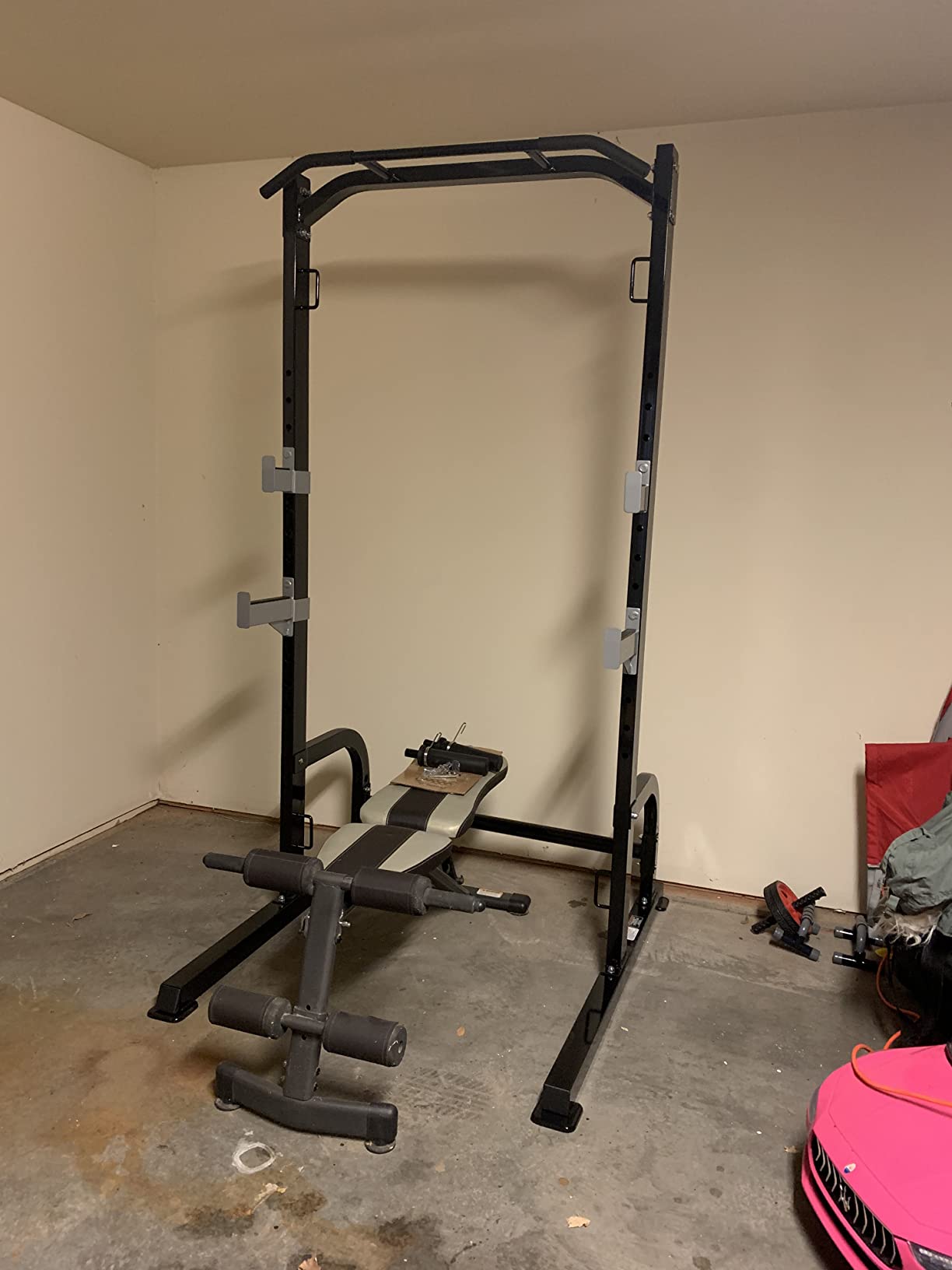
The Marcy cage is the pick if you want a walk-in full cage with a finish that looks intentional in a finished room rather than a garage. The walk-in design means you step between the uprights to get in, so a bench fits inside and you can squat in place.
At 61.5 by 51 by 86 inches and 95 pounds, it accommodates a 6 or 7 foot Olympic bar, and the multi-grip pull-up bar has foam pads. Two Olympic plate storage posts sit at the back.
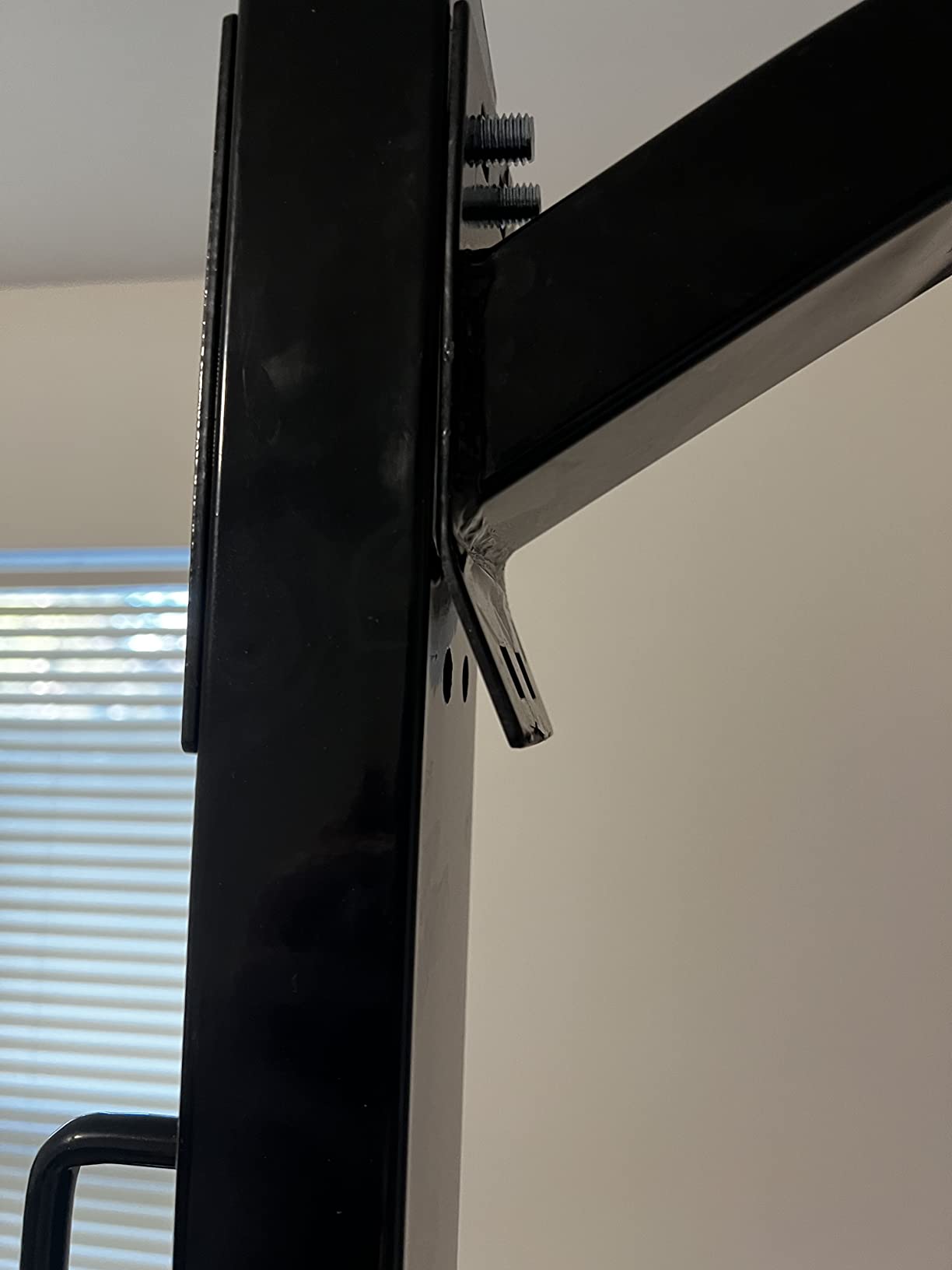
Owners rate it highly for the powder coat and chrome parts holding up with daily use, and the two-year manufacturer warranty is longer than most in this set. Assembly solo in 25 to 60 minutes is realistic, which matters if you are working alone.
At 51 inches wide it is on the narrower side, and anchoring points are provided at the base for those who want them fixed down.
Why it suits a first walk-in cage
A walk-in cage changes exercise options rather than safety. You can bench inside, use dip bars, and unrack without stepping around the frame, which a half rack does not allow.
Reviewers generally consider the build quality better than similarly priced off-brand cages, and the two-year warranty adds a little reassurance for a first major purchase.
Where the 300 lb rating becomes the limit
The stated 300 lb limit is a real ceiling for anyone progressing past that. If you are already squatting 300, this frame is telling you to plan a different one.
The most repeated criticism across reviews is the rubber padding, which detaches from the catch bars and bar rests within weeks and leaves the bar sitting on bare metal. Several owners fix it with heat-shrink tubing or glue. Minor side-to-side sway and the 51 inch width are also mentioned.
What Is a Squat Rack and Why It Matters at Home
A squat rack is a steel frame with upright posts, J-cups and adjustable safety bars that holds a loaded barbell at shoulder height so you can squat, bench press and press safely without a spotter. You set the J-cups and safety bars to the right height, unrack the bar into the J-cups, lift, then return the bar to the safeties.
Those safeties are the reason a rack exists. When a rep fails, the bar travels a few inches and lands on the safety bars rather than on you. Training heavy barbell lifts alone without that catch raises the risk of serious injury, because you have to clean and press the weight back over your head with nobody there to help.
Home gym owners consistently describe the rack as the piece that lets them train heavy alone, and most treat it as a buy-it-once purchase they would replace last, after the barbell and the bench.
Squat Rack vs Power Rack vs Half Rack vs Squat Stand
The four names describe the same basic idea with different amounts of steel and safety. A squat stand is two independent uprights with no frame behind you. A half rack adds a base and a rear upright but still has no back crossmembers. A full rack or squat cage adds the rear structure so a failed lift cannot travel backward. A power rack adds a cable carriage or pulley system on top of that frame.
In practice the differences come down to how much can go wrong behind you and how much you can attach. A squat stand is the cheapest and least safe for heavy squats. A half rack is the sweet spot for most home gyms, which is why half racks dominate this list. A full cage is what you buy when you bench inside the frame or want to use a landmine and dip station in the same footprint. A power rack is for members who want cables, because the carriage is the expensive addition.
One more term shows up constantly in the specs below: Westside hole spacing. Standard racks use 5/8 inch holes, while Westside pattern racks use 1 inch holes on a 2 inch pitch. One inch holes accept a much wider range of third-party attachments, and three of the twelve racks here use them.
How to Choose a Squat Rack for Home Use Without Overspending
Measure before you browse. Most returns in this category are not about quality, they are about a rack that is 5 inches too wide for the bay or 2 inches too tall for the pull-up bar. Note the depth, the width and the ceiling height, then check the assembled dimensions of each rack on this page against those numbers.
Ceiling height is the number most buyers ignore. A rack listed at 85 to 87 inches assembled may have a pull-up bar reaching 89 inches off the floor, which is a 7 foot 5 inch requirement before you add a centimetre of clearance. In a low-ceiling garage, prioritise racks with height adjustment on the main frame, like the CANPA, and check the fully open height of the pull-up bar rather than the frame height.
Read steel gauge as a flex test. 11 gauge and 12 gauge steel are meaningfully heavier than 14 gauge. The CAP rack in this list is 12 and 14 gauge, and its safety arms are the component reviewers report bending. The heaviest frames here, the Sportsroyals at 150 pounds and the JELENS with 50 by 50mm pipe, feel completely different under a fast unrack.
Check hole spacing before you buy any accessories. If your plan involves a landmine, a dip station or a lat pulldown attachment, 1 inch holes save you money and frustration. Two of the racks on this list use 0.8 inch holes, which blocks most third-party attachments and is the single most common regret among their owners.
Understand rackable capacity versus total capacity. Total capacity usually means every plate on the storage pegs plus the bar. Rackable capacity is what the frame holds when the bar is loaded. The Sunny rack lists 300 lb on the J-hooks, 300 lb on the spotter arms and 100 lb per plate holder, and those are separate numbers. Judge the rack on the barbell number, not the headline figure.
Budget for safeties, not just the frame. Several racks here ship without J-hooks you would want to load heavy with, and the ULTRA FUEGO in particular is recommended almost universally for a J-hook upgrade first. On a full setup you also need a flat bench, a barbell, plates and floor matting, so the rack is rarely the biggest line in the budget.
Decide whether you can anchor it. Bolting a rack to the floor is the single most effective stability upgrade, and every rack in this list except the folding wall mount has feet that accept anchor bolts. If you are renting and cannot drill, weight the frame with plates on the storage pegs instead, which is what many owners in the forums do. If you want the frame to stand on its own with no plates on it, buy a heavier one.
What to do when you cannot bolt down. Three options work well: load the plate storage pegs, put the rack on a layer of rubber matting so the feet grip instead of slide, and add a separate weight storage unit beside the rack that acts as a brace. Owners report all three turning a wobbly flat-foot rack into something stable. A second common suggestion is upgrading the feet to a wider flat foot design if your model allows it.
Use rubber matting and protect the walls. Three-quarter inch matting under the rack protects a garage slab, reduces noise for downstairs neighbours and stops the feet from creeping. If the rack is close to a wall, put a strip of wall guard on the drywall, because loaded plates thrown off a bar will find it. Storage planning for the rest of the bay is covered in our bike racks for garage walls guide.
On buying used. A used commercial rack is often a better buy than a new budget frame, because the steel is thicker and the welds were made to a commercial spec. Check the uprights for straightness, look for rust at the base plates, and count the bolt holes. Avoid welded-in attachments and racks that have been stored outside. If you cannot inspect it in person, ask for photos of the welds and the base plates.
When you do not need a rack at all. If your ceiling is under 7 feet, you are renting and cannot anchor anything, or you are only training with dumbbells and kettlebells, a rack may be the wrong purchase. A flat bench plus a set of adjustable dumbbells covers pressing, rows and squats, and a sturdy squat stand pair handles a barbell for everything except heavy squats. Many beginners get more out of a good barbell and plate set than from a better cage.
Frequently Asked Questions
Are home squat racks safe?
Yes, when they are assembled correctly and loaded within their rating. The safety bars are the critical component: set them just below the bar’s lowest position on that lift so a failed rep is caught within an inch or two of travel. Anchor the rack or weight it with plates, tighten every hardware bolt during assembly, and never exceed the rackable capacity rather than the total capacity figure.
What is the difference between a power rack and a squat rack?
A squat rack describes the function: holding a barbell at shoulder height so you can squat, bench and press safely alone. A power rack is a heavier, fully enclosed version with rear uprights, crossmembers and usually a cable carriage, so a failed lift cannot travel backward and you can add pulldowns and rows in the same footprint. A half rack is the middle option with a base and one rear upright.
What is the best power rack for a home gym?
The Sunny Health and Fitness full-size power rack is the best overall pick here, rated 4.7 stars across 3890 reviews with an 18-point J-hook adjustment and included spotter arms in a 38 by 53 inch footprint. If you want cables in the same footprint, the ULTRA FUEGO power cage is the better value, and the Sportsroyals RK2 is the heavier 1200 lb rated option.
What is the best squat rack for a garage gym?
For a standard single-bay garage, the Sunny Health power rack fits the space and holds heavy barbell work without flex. For a garage you also park in, the Mikolo folding wall-mounted rack folds to about two inches off the wall in roughly 15 seconds. For a low ceiling under 8 feet, prioritise a rack with main frame height adjustment such as the CANPA and check the fully open height of the pull-up bar.
Is a budget squat rack safe to use at home?
It depends entirely on the steel and the safety hardware, not the price alone. Racks built from 14 gauge steel with thin safety arms are the ones that fail first, and several owners of the CAP FM-8000F report arms bending at moderate loads. The safest budget option in this roundup is the papababe 800 lb rack with a 2 by 2 inch 13 gauge frame, four anchor holes per foot and 800 lb of rated capacity.
What to use instead of a squat rack?
If you train only with dumbbells and kettlebells, a flat bench plus adjustable dumbbells covers pressing, rows, lunges and goblet squats without a frame. For barbell work, a pair of independent squat stands handles bench pressing and lighter squats, though they give no rear protection. If you rent and cannot anchor anything, a squat stand pair or an adjustable rack such as the K KiNGKANG is the more practical choice.
The Best Squat Racks for Home Use in 2026
The Sunny Health & Fitness full-size power rack is the best squat rack for home use overall. It carries the highest rating and the largest review base in this group, includes spotter arms so you can bench alone from day one, and fits a footprint small enough for a normal garage bay.
If your constraints are different, the shortlist changes. Take the ULTRA FUEGO power cage if you want a lat pulldown and cables in the same frame, the Sportsroyals RK2 if you want 150 pounds of steel standing on your floor for stability, the FLYBIRD SR1 if you bench alone and want long safety arms, the Mikolo if floor space is tight, and the Yaheetech pair if you are starting out and keeping costs down.
Whatever you pick, measure the space and the ceiling first, check the hole spacing against the accessories you might want later, and treat the safeties and the barbell as part of the same purchase. Then check the latest price for your pick and start putting weight on it.