
If you want one answer before anything else: the YESWELDER LYG-L600A is the best auto darkening welding helmet for beginners in 2026, because it pairs a 1/1/1/1 true color lens with solar power and a spare battery in the box, and it carries more owner feedback than any other helmet on this list. It is not the most flexible hood here, and it is not the safest choice for low-amp TIG, but it is the one I would hand a person who has never struck an arc.
An auto darkening welding helmet is a welding hood whose lens contains photoelectric sensors and a liquid crystal display that switches from a clear state to a dark protective shade the instant it detects an arc. That means you can see the joint, the wire and the puddle before and after you strike, without lifting the helmet off your head or dragging a flip-down cover around.
For a beginner this is the single piece of equipment that most affects whether you keep welding. A clear lens lets you judge electrode angle and travel speed. A big viewing window lets you see both ends of the bead. Comfortable headgear keeps you in the chair long enough to build the muscle memory. Get those three right and your first hundred hours go fast; get them wrong and you will spend them squinting through a green window with a headache building behind your eyes.
We put ten helmets through the same filter: optical clarity, arc sensor count, shade range, viewing area, switching speed, grind mode, power source, certification and headgear. Every pick below is genuinely beginner-usable, and every pick has a clear weakness we name. Ten is a lot of helmets, so if you want the short version, jump to the steel workbenches we recommend for home welding setups first and pick up the helmet after you know where you will be working.
Table of Contents
Top 3 Best Auto Darkening Welding Helmets for Beginners (October 2026)

All 10 Helmets Compared Side by Side in 2026
| Product | Specifications | Action |
|---|---|---|
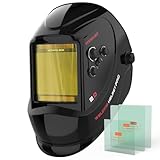
| YESWELDER LYG-L600A |
|
Check Latest Price |
 YESWELDER LYG-M800H YESWELDER LYG-M800H |
|
Check Latest Price |
 ARCCAPTAIN HSH-S800 ARCCAPTAIN HSH-S800 |
|
Check Latest Price |
 TOOLIOM Solar Powered Helmet TOOLIOM Solar Powered Helmet |
|
Check Latest Price |
 TRQWH KTS-JD03 TRQWH KTS-JD03 |
|
Check Latest Price |
 Miller Classic Series ClearLight Miller Classic Series ClearLight |
|
Check Latest Price |
 NDUUN True Color Helmet NDUUN True Color Helmet |
|
Check Latest Price |
 Sunstac SS-A800D Sunstac SS-A800D |
|
Check Latest Price |
 YESWELDER LYG-Q800D YESWELDER LYG-Q800D |
|
Check Latest Price |
 ARCCAPTAIN HSH-G999 ARCCAPTAIN HSH-G999 |
|
Check Latest Price |
1. YESWELDER LYG-L600A Review: The Best Auto Darkening Welding Helmet for Beginners Overall
YESWELDER Auto Darkening Welding Helmet 1/1/1/1 True Color, LYG-L600A
3.64 x 1.67 inch view
1/1/1/1 true color
2 sensors, 1/30000s
Solar plus CR2450
Pros
- True color lens with a clear view of the puddle
- Very fast 1/30000s switching with adjustable sensitivity and delay
- Battery and spare lenses included
- Works with a respirator and magnifying lenses
- ANSI Z87.1 and CSA Z94.3 certified
Cons
- Small viewing area compared with panoramic models
- Thin shell and light-duty headgear
- Internal lens is a tight fit inside other shells
This is the helmet I recommend without hedging. It carries 13,915 owner reviews at a 4.6 average, which is more real-world feedback than anything else in this roundup, and the pattern in those reviews is remarkably consistent: people bought it as a first helmet, it worked, and they left positive feedback about clarity rather than features they never used.
The lens is the reason. A 1/1/1/1 true color filter means you are looking at the workpiece with roughly natural color instead of the murky green cast of a basic self-darkening hood. On your first project, when you are trying to work out whether your wire is actually flowing or whether you are just making a bright blob, that difference decides how fast you learn.
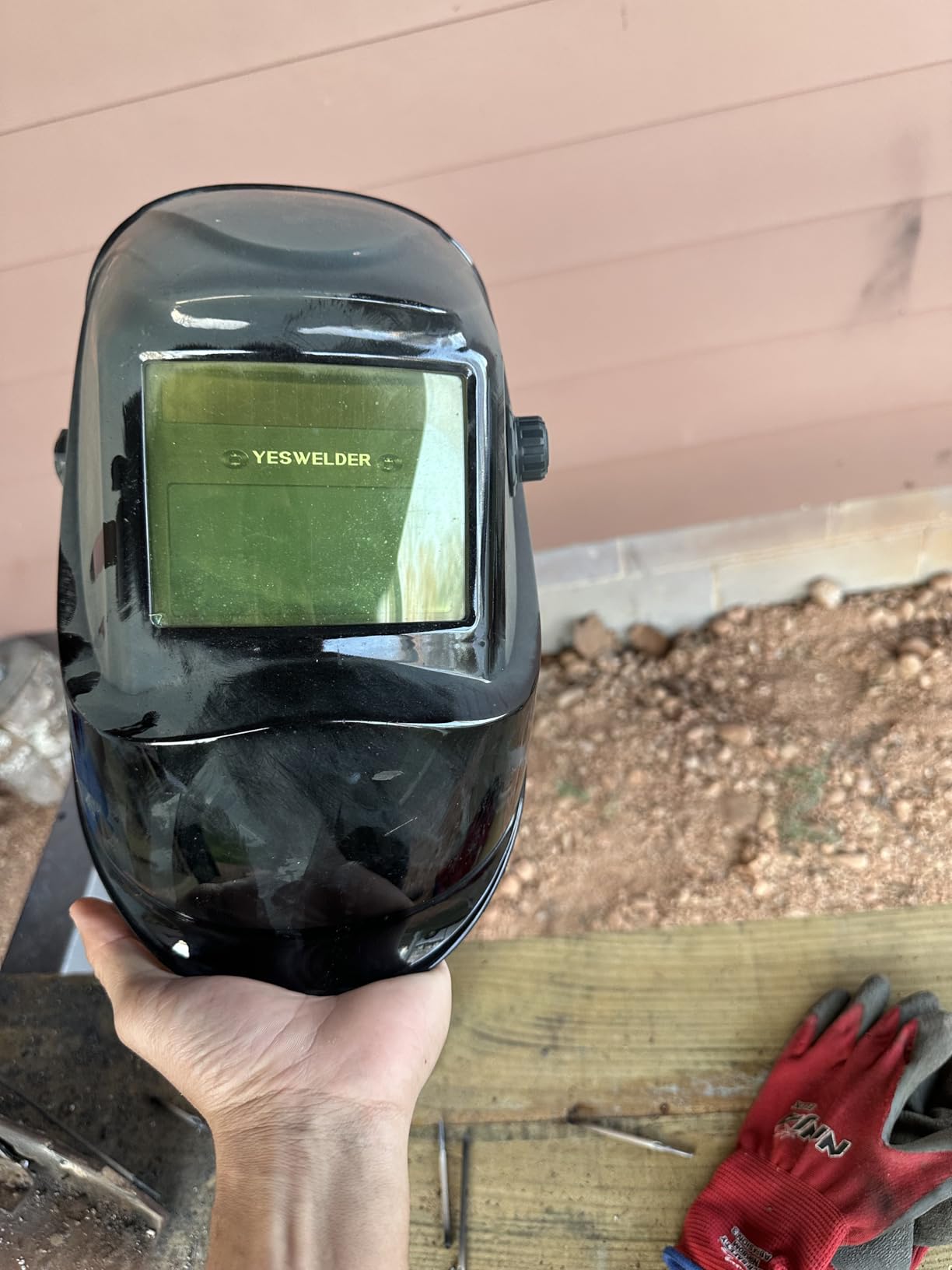
Two arc sensors is the spec that makes people hesitate, and for flat and horizontal MIG work it makes no difference at all. Two sensors find an arc that is pointed at them. They struggle when the arc is off to one side, which is what vertical-up and overhead work feel like. If you know you will be doing out-of-position welding on your first project, step up to the four-sensor models below.
The shade range of 3/7-13 covers TIG, MIG, stick and grinding, and the switch happens in 1/30000 of a second, so there is no visible lag between the strike and the darkening. Power comes from a solar panel with a replaceable CR2450 coin cell as backup, which is the arrangement that has quietly become standard on budget helmets.
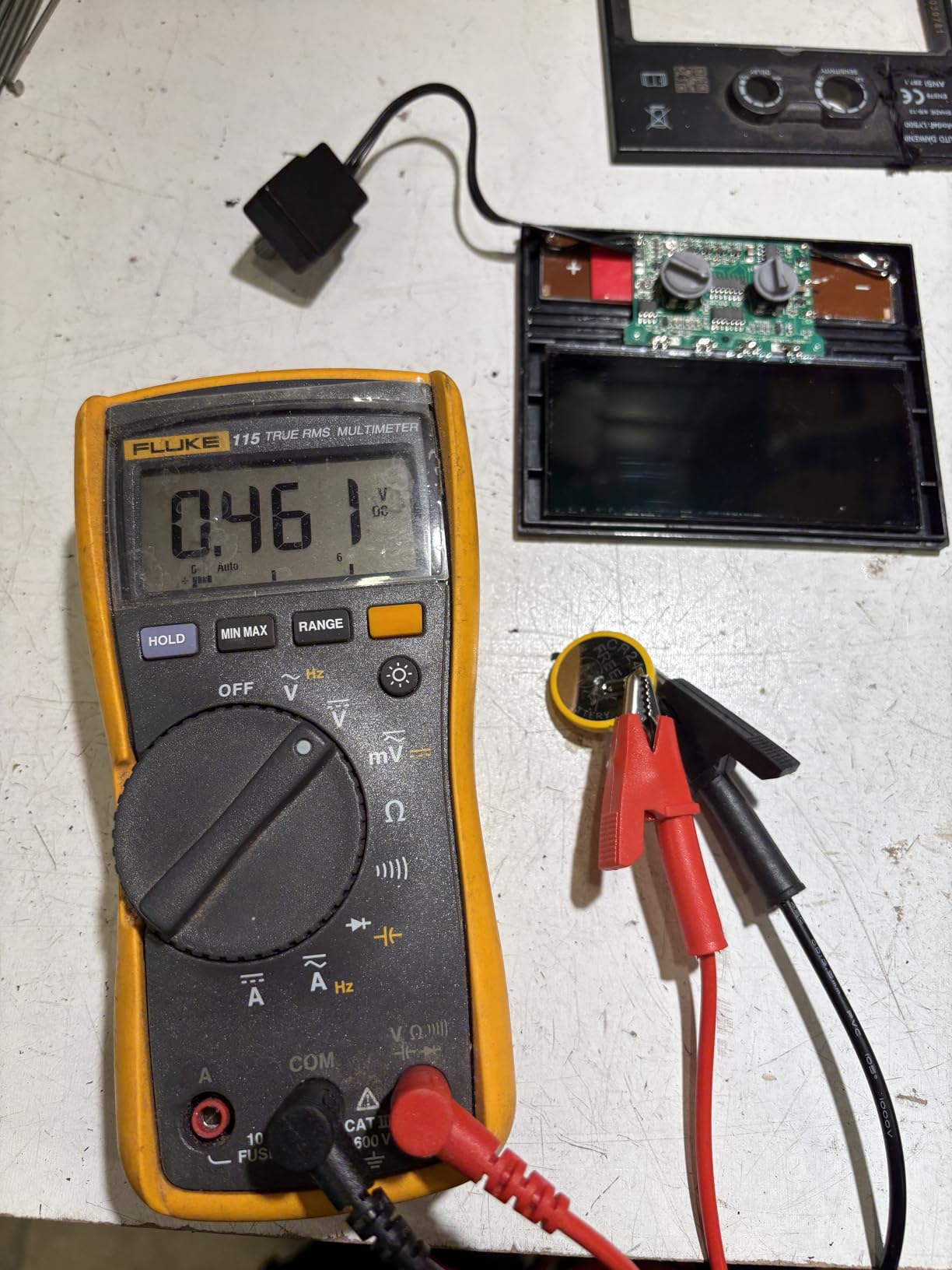
My honest complaint list is short. The viewing window is small, and if you are used to a panoramic hood the jump back feels like losing something. The shell and headband feel thin under your fingers, which makes you wonder about drop durability. One owner reported receiving a helmet with the coin cell installed incorrectly and dead on arrival, so check the battery the day it arrives.
What you get for the money you spend
The box includes the helmet, a CR2450 battery, one inner replacement lens, two outer replacement lenses and a storage bag. That matters more than it sounds. Replacement outer lenses are the consumable part of any welding helmet, they scratch during overhead work and they are the reason a cheap helmet can end up costing more over a year than a pricier one.
Because the auto-darkening cartridge here uses the same common format as a lot of mid-range hoods, you are not locked into a proprietary cartridge. Budget helmets and premium helmets often use the same replaceable lens sizing, which is the one spec where paying more genuinely buys you nothing.
Who should buy it, and who should not
Buy it if you are welding flat MIG and stick work in a garage, welding with a respirator, or wearing magnifying lenses. Owners with decades of experience use it too, but that is not who it is designed for.
Skip it if you plan to do low-amp TIG on thin stainless or aluminum. Two sensors at very low amperage on a small TIG puddle is the classic miss scenario, and the result is a flash burn behind the lens. If TIG is your main process, pick a four-sensor helmet with a light state of DIN 4 or lower.
2. YESWELDER LYG-M800H Review: Best Value for MIG and Flux-Core Beginners
YESWELDER Auto Darkening Welding Helmet, Large View, LYG-M800H
3.93 x 3.66 inch view
4 arc sensors
1/30000s response
Shade 3/5-9, 9-13
Pros
- Large true color window beginners credit with better beads
- Controls on the outside
- usable with gloves on
- Four sensors handle low-amperage TIG
- Light at about 1.32 lb
- Cheater lens compatible
Cons
- Side knobs that hold the hood up feel flimsy
- Inner lens and battery compartment are awkward to open
- Thin plastic shroud
- One report of a head strap breaking early
This is the helmet I tell people to buy when they ask what to spend. It has a 3.93 by 3.66 inch viewing area, which is a large jump up from the small rectangular windows on the cheapest hoods, and it adds a fourth arc sensor, which is the difference between a helmet that works when you are learning and a helmet that works when you are comfortable.
Multiple beginner accounts describe the wide window as the reason their welds improved. That tracks with how welding actually works. With a narrow window you are watching a slit, you lose the ends of the bead, and you compensate with weird wrist angles that become habits. With a large window you can see the puddle and the joint at the same time.
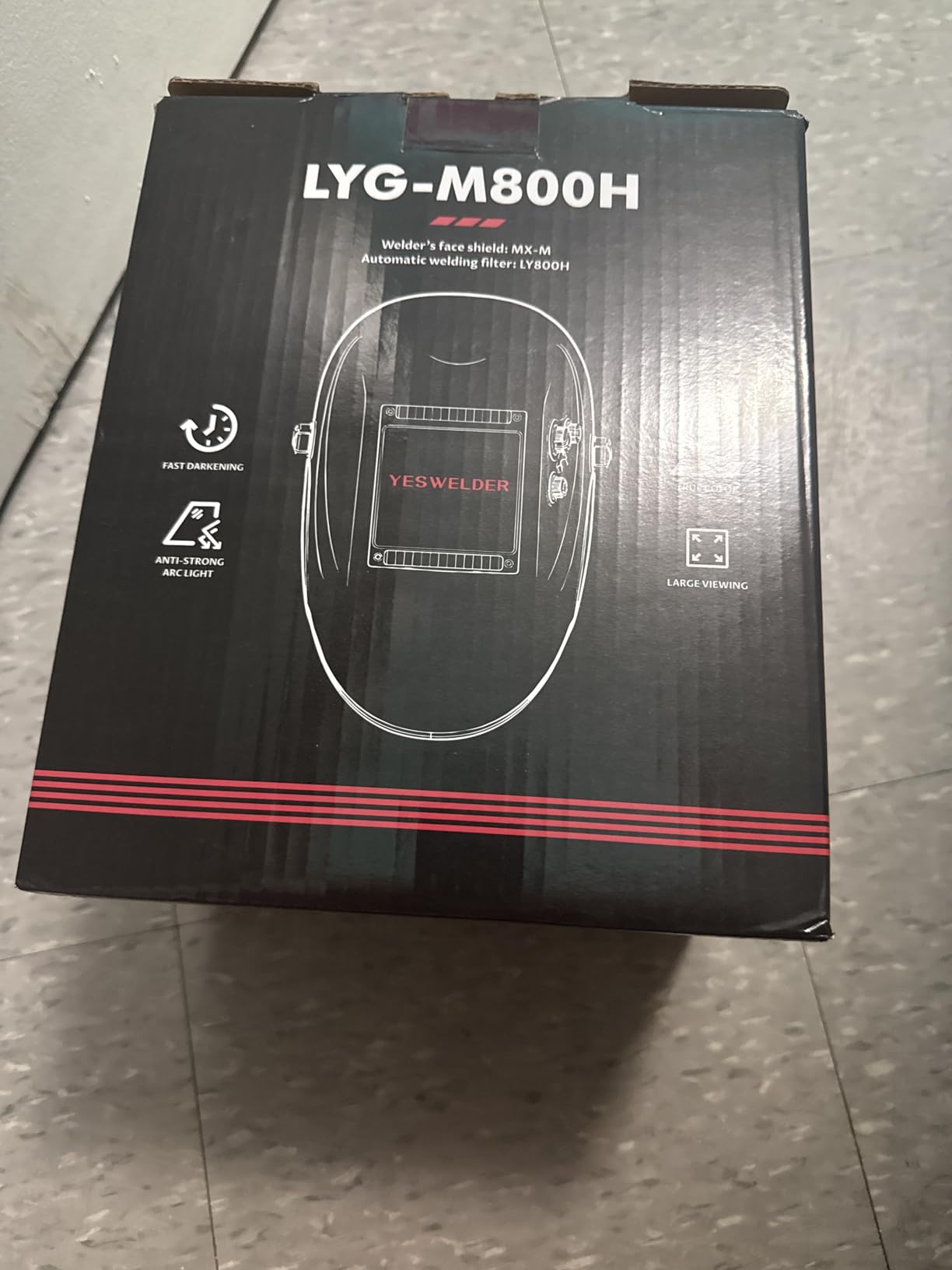
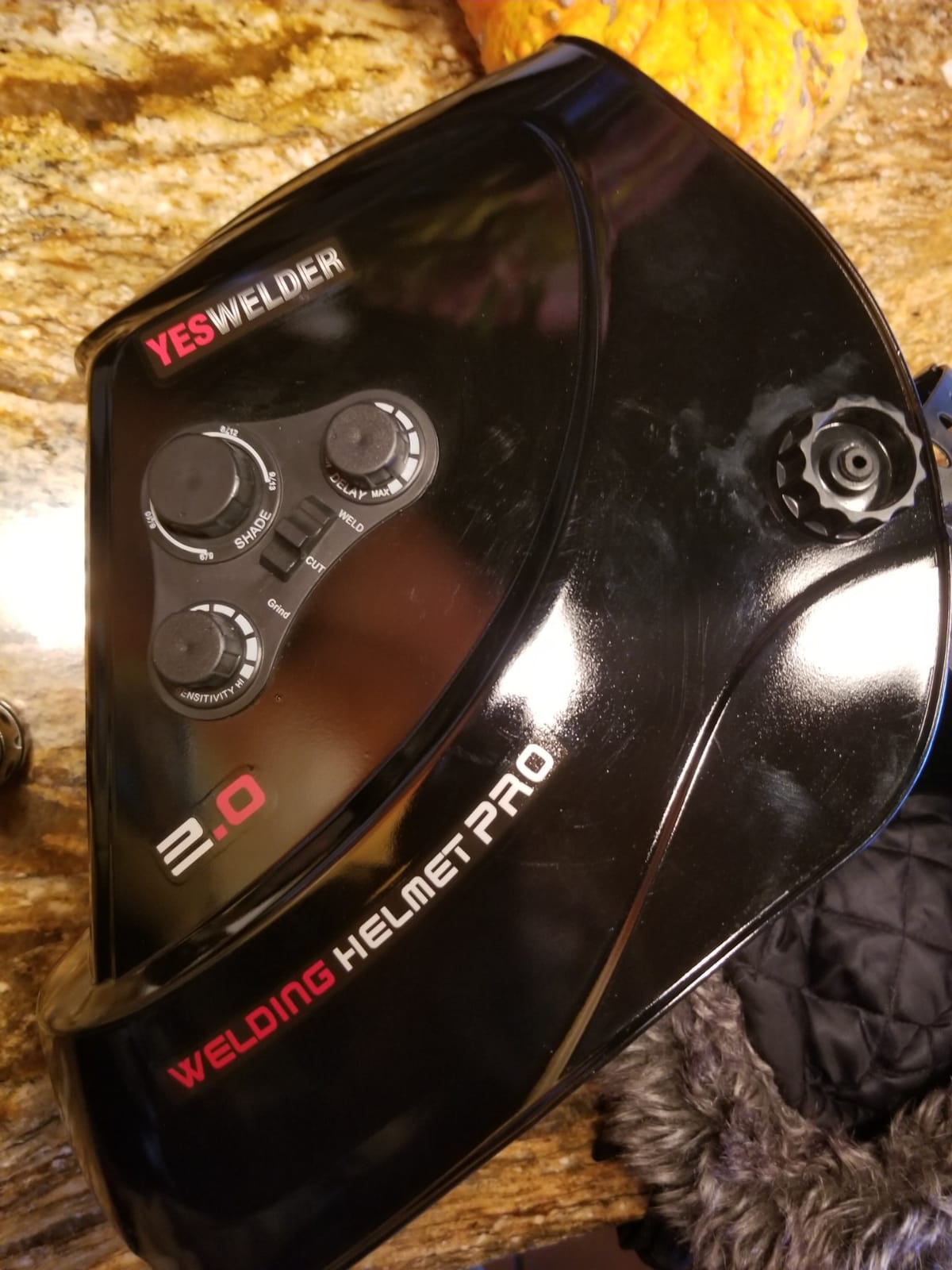
Controls on the outside of the shell are another beginner-friendly touch. Sensitivity, delay and shade sit where you can reach them with a gloved hand, so you are not flipping the helmet upside down on a hot bench to change a setting you do not understand yet.
The shade range covers weld, cut and grind positions separately, which means one helmet handles MIG, flux-core, stick, plasma cutting and cleanup. At about 1.32 lb it is light enough for long sessions, and the reinforced hinge holds the hood position without a lot of fuss.
The weak points are mechanical rather than optical. The side tension knobs that hold the hood in the up position feel flimsy and need tightening hard. The inner lens is awkward to remove and the battery compartment is hard to open, so lens swaps take longer than they should. One owner reported a head strap breaking after two days.
Why four sensors matter more than the sensor count suggests
A photoelectric sensor only detects the arc if light actually reaches it. On flat work, with the arc in front of you, two sensors see it fine. On vertical-up or overhead welds the arc is below or beside your head and sensors mounted in the front of the helmet may only catch a fraction of the light.
When a sensor misses, the lens stays light while a bright arc burns in front of your face. That is not a spec-sheet gap. It is the exact failure that burns beginners, which is why we treat sensor count as a safety spec rather than a feature.
Where this hood fits in a first shop
This works well for MIG on thin sheet metal, flux-core on thicker stock, and general garage work. It also handles TIG down to the amps where four sensors become important, though it is not a specialist low-amp TIG helmet.
Skip it if you work under a vehicle or overhead for hours at a time and the flimsy up-position knobs would annoy you. Also skip it if you plan to fill out a first welding kit on a fixed budget and you would rather spend the difference on a starter machine or gloves.
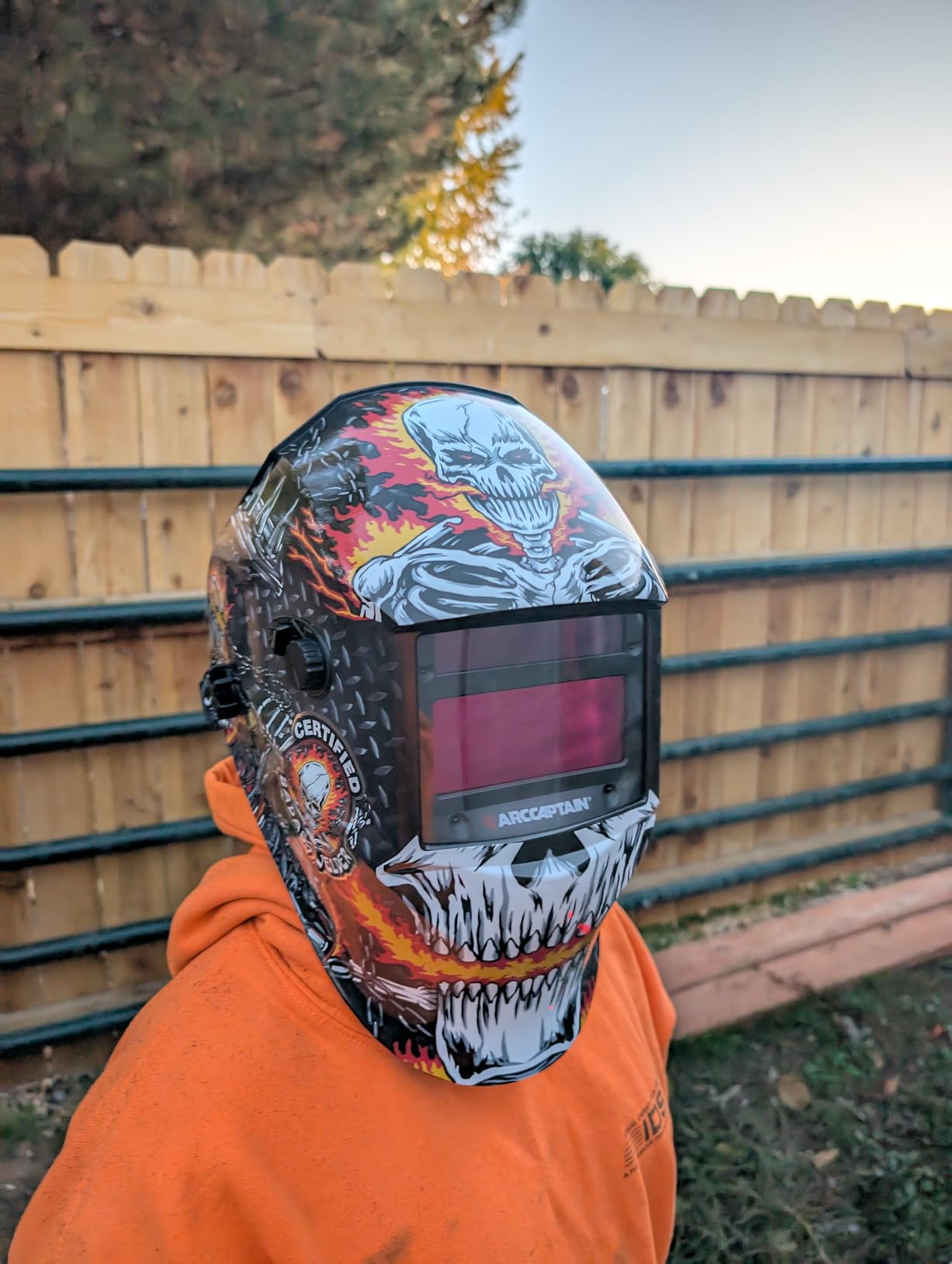
3. ARCCAPTAIN HSH-S800 Skeleton Knight Review: Best for Low-Amp TIG Beginners
ARCCAPTAIN Welding Helmet Auto Darkening, 1/25000s Response, Shade 4/9-13
4 arc sensors, 1/25000s
DIN 16 UV/IR protection
3.86 x 1.69 inch view
About 1 lb
Pros
- Four sensors give reliable detection on small TIG arcs
- Sharpest true color view in our testing notes
- Grind mode works so you rarely lift the helmet
- Light shell that stays put
- ANSI
- CSA
- EN 175 and EN 379 listed
Cons
- One review reports slow response on first strike
- One review reports filter degradation after extended use
- Plasticky feel out of the box
- Narrower screen than panoramic models
If your goal is TIG on thin stainless or aluminum, this is the helmet to look at first in this roundup. Four sensors with a 1/25000 second switch is the combination you want when the arc is small, cool and easy to miss, and it clears the DIN 4 light state that low-amp welding depends on.
The light state is worth explaining. A helmet in its clear state is not fully clear; most sit around DIN 4. During low-amp TIG the arc is dim, so the lens has to stay in its lightest possible state or it never darkens enough to protect you. Four sensors plus a fast switch give it the best chance of catching a small arc at the start.
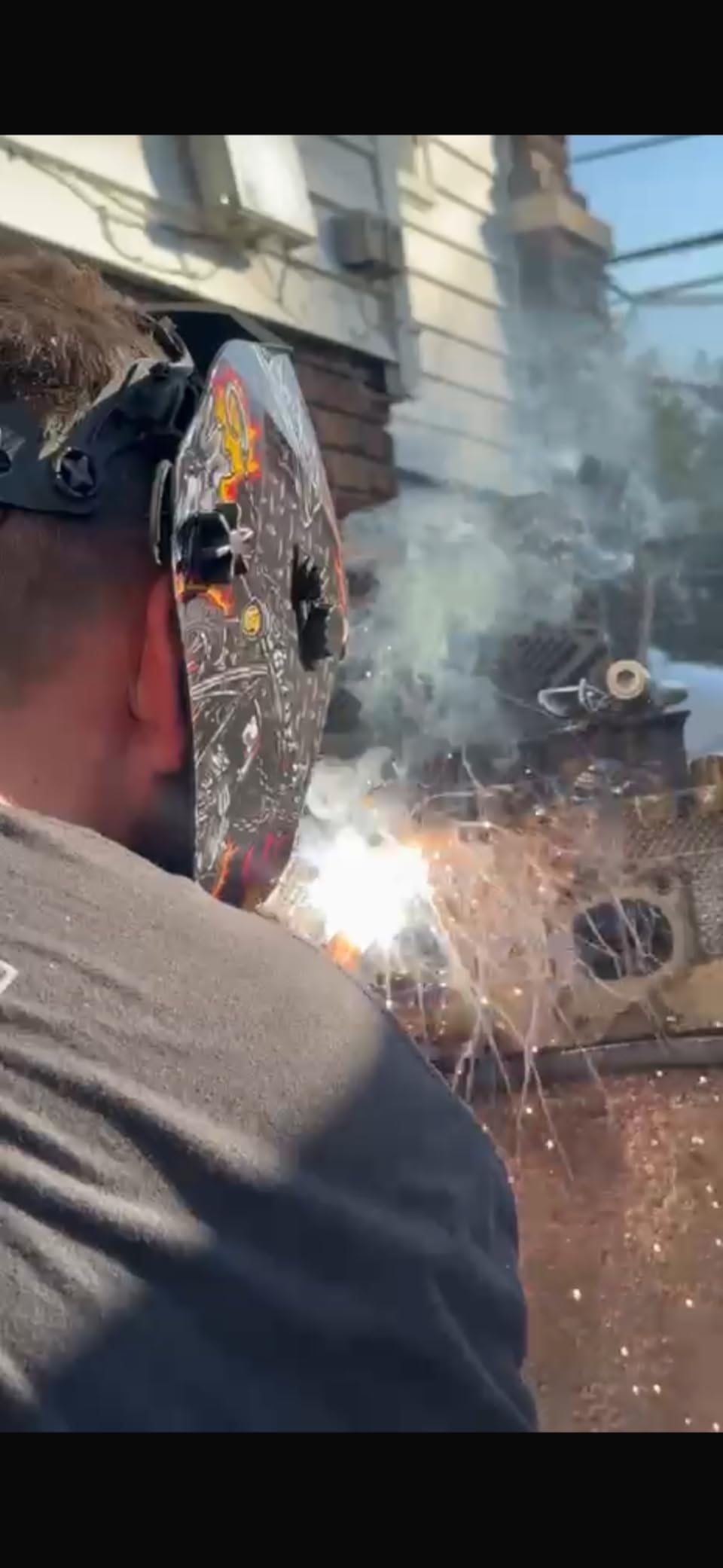
Optically this is one of the sharpest lenses here. The 1/1/1/1 rating is paired with true color technology and owners rate the clarity as the clearest they have used at this level. The 12-in-1 smart filter claims automatic protection up to DIN 16, which means the lens keeps blocking ultraviolet and infrared even when you are setting shade levels you have never tried.
The shell weighs about 1 lb and the padded adjustable headband stays put, which is nice if you are fiddling with torch angle on a small joint. Owners also report that grind mode works well enough that the helmet rarely comes off between welding and cleanup, and that is a real comfort win in a small shop.
There are two failure reports worth knowing about. One owner reported slow response exposing the eyes to initial arc light, and another reported the filter degrading after a period of use with return issues. Both are isolated among a small share of critical reviews, but the first one is exactly the failure mode you are buying a four-sensor helmet to avoid, so test it on scrap before you rely on it for a real TIG joint.
What the certification markings tell you
This helmet is listed to ANSI/ISEA Z87.1-2010, CSA Z94.3, DIN EN 175 and DIN EN 379. The European markings matter even in a US garage because they cover optical class testing that the ANSI mark does not cover in the same way, which is a reasonable signal on a helmet you will wear for years.
The 180-day warranty is short compared with what the major manufacturers offer, so keep the packaging and check the helmet carefully when it arrives.
Should a beginner buy this one
Yes, if TIG is on your list at all, and you are working on thin material where the arc runs at the low end. Four sensors, a fast switch and true color optics cover the three things that make low-amp work safe and learnable.
Pass if you only weld flat MIG and stick with a machine that pushes serious amperage, because then the narrow viewing window is the only thing you give up, and the LYG-M800H gives you a much bigger one for a similar outlay.
4. TOOLIOM Auto Darkening Solar Powered Helmet Review: Best Lightweight Helmet for Long Sessions
TOOLIOM Auto Darkening Solar Powered Welding Helmet for TIG MIG ARC
1.14 lb shell
1/25000s auto darkening
External grind control
3.64 x 1.67 inch view
Pros
- Very light at 1.14 lb to reduce neck strain
- Reported to hold up over years of home-shop use
- External grind switch saves taking the helmet off
- True color 1/1/1/1 lens
- Blue light blocking outer lens
Cons
- Arc reaction reported as slightly slow by some
- Thin plastic shell
- Solar cell supplements rather than recharges
- Weak in tight spaces where arc light is blocked
Weight is the unglamorous spec that decides whether you still enjoy welding after a month. Neck fatigue sets in around the third hour, and a helmet that feels heavy at the end of a session is the first thing people replace. At 1.14 lb with a breathable sweatband, this is one of the lighter shells in the group.
Reviewers describe it as an ideal starter or classroom mask, and the strongest recurring comment is durability: several owners report five years of home-shop use on the same unit. Auto-darkening reliability over years is a bigger deal than most spec sheets admit, because a battery that stops holding charge ends a project.
The optical spec is 1/1/1/1 true color across a 3.64 by 1.67 inch window, with a 1/25000 second switch and a shade range of DIN 3.5 and 9-13. The grind mode is controlled externally, so you can drop from welding to grinding without removing the hood, and the blue light blocking outer lens is a genuine plus for all-day shop work.
There is a low-battery indicator and a user-replaceable battery compartment, which sounds small until you are standing in a garage at 9pm wondering why the lens stopped darkening.
The complaints cluster around three things. Some users report the arc reaction as slightly slow. The plastic shell feels thin. And the solar cell supplements the battery rather than recharging it, so you still need to keep a spare on hand. It is also a poor choice for tight, obstructed spaces where the arc light is partially blocked from the sensors.
Comfort versus viewing area
This helmet makes an interesting trade: it prioritizes the weight on your head and the price in your pocket over the size of the window. If you are welding for three hours on car repair or farm work, low weight wins. If you are learning bead placement on small parts, the bigger windows on the M800H or the ARCCAPTAIN HSH-G999 serve you better.
Who it fits and who it does not
Buy it if you are welding overhead or under equipment, if you wear glasses and want minimal helmet pressure, or if you are buying a first helmet for a teenager or trade student who will drop it.
Skip it if you do fine TIG where a slow first response is unacceptable, or if you work in enclosed spaces where the arc is partly shielded from the sensor. In those conditions, more sensors beat fewer sensors every time.
5. TRQWH KTS-JD03 Review: Best for Dim Garages and Low-Light Work
TRQWH Welding Hood Auto Darkening Welding Helmet with Light True Color
Rechargeable top LED light
1/1/1/2 clarity
1/20000s switching
Solar plus lithium battery
Pros
- Integrated rechargeable LED work light for dark shops
- Fast 1/20000s switching with a true color lens
- External delay and sensitivity knobs
- Easy to assemble and comfortable over daily use
- Handles TIG
- MIG
- stick
- plasma and grinding
Cons
- Head strap loosens during use
- Brittle plastic shell that can crack if dropped
- LED brightness and battery endurance are only adequate
- Plain appearance
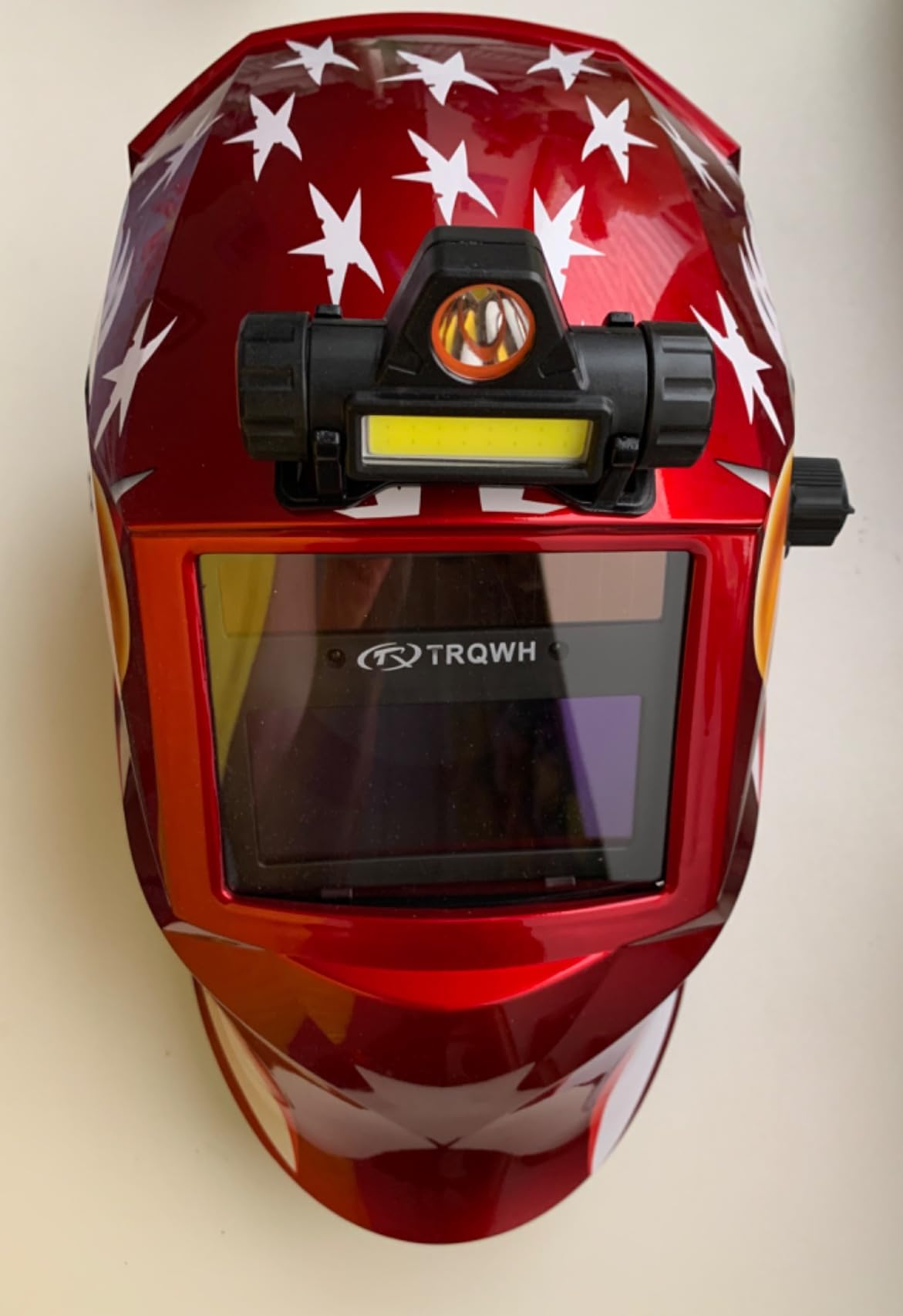
This is the pick for anyone welding in a garage after dark, in a basement shop, or outdoors where the only light comes from the work light on your truck. The USB rechargeable LED mounted on the top of the hood lights the workpiece from behind your head, which is roughly where you would put your own lamp if you had one.
Optically it is 1/1/1/2 rather than 1/1/1/1. That fourth number is angular dependence, meaning how consistent the view is when you look at an angle instead of straight on. A 2 there is still very good, it just tells you the edges of the window are slightly less even than the center.
The switching spec is 1/20000 of a second using double liquid crystal layers and an optical coating filter, and the delay control runs from 0.2 to 1.0 seconds. Shorter delay is right for stick and short tacks; longer delay keeps the lens dark between beads on MIG so you are not strobing yourself.
Power is dual: a solar panel with a replaceable lithium battery as backup. The external grind button, side angle knob and rear tightness knob all live on the shell, and the forehead has a thickened sponge pad, which is what keeps the helmet from pressing on your brow through a long day.
The build is the weak point. Owners report the head strap loosening during use and a plastic shell that can crack if dropped or knocked, which is a real concern for anyone working around a vehicle. The LED is also described as adequate rather than impressive, with battery endurance to match.
Is a work light worth paying for
It depends on where you weld. In a lit shop, a top LED adds little. In a dim garage or a night repair job, being able to see the joint before you strike is worth a lot, because you can set your gas, your stickout and your cleanup pass without dragging a separate lamp into the arc flash zone.
Who should pick this helmet
Buy it for night work, basement shops, mobile repair, and for anyone who wants a helmet with a generous shade range covering DC and AC TIG, MIG, stick, plasma cutting and grinding in one unit.
Skip it if you work where helmets get knocked around, since the shell is brittle, or if you want the sharpest optical clarity available at this level. The 30-day warranty is also the shortest here, which matters if you are unsure.
6. Miller Classic Series ClearLight Review: Best Warranty Coverage for the Long Game
Miller Classic Series Welding Helmet, ClearLight™, Shade 8-13, Black
6 square inch ClearLight view
Weld 8-13, cut 5-8, grind 3
Three-year warranty
Ratchet headgear
Pros
- Highest average rating in this roundup at 4.7
- ClearLight optics give a natural high-definition view
- Ratchet headgear is secure and comfortable
- Digital shade
- delay and sensitivity controls
- Three-year warranty with long spare-part availability
Cons
- Highest price point in this roundup
- Weld shades start at 8
- which is less flexible for light work
- Two arc sensors and a slower 1/23000s switch
- 6 square inch view is smaller than panoramic budget models
The Miller Classic Series carries the highest average rating in this group at 4.7, with 86 percent of its reviews at five stars. It is also the only helmet here from a manufacturer that has published spare-part availability for three years, and it is backed by a three-year warranty instead of the 30 or 180 days common on budget models.
That matters if you see yourself welding for a decade. Warranty length is not an optical spec, but it is a signal about how a company expects its product to hold up, and it is the difference between a replacement part existing in five years and not existing at all.
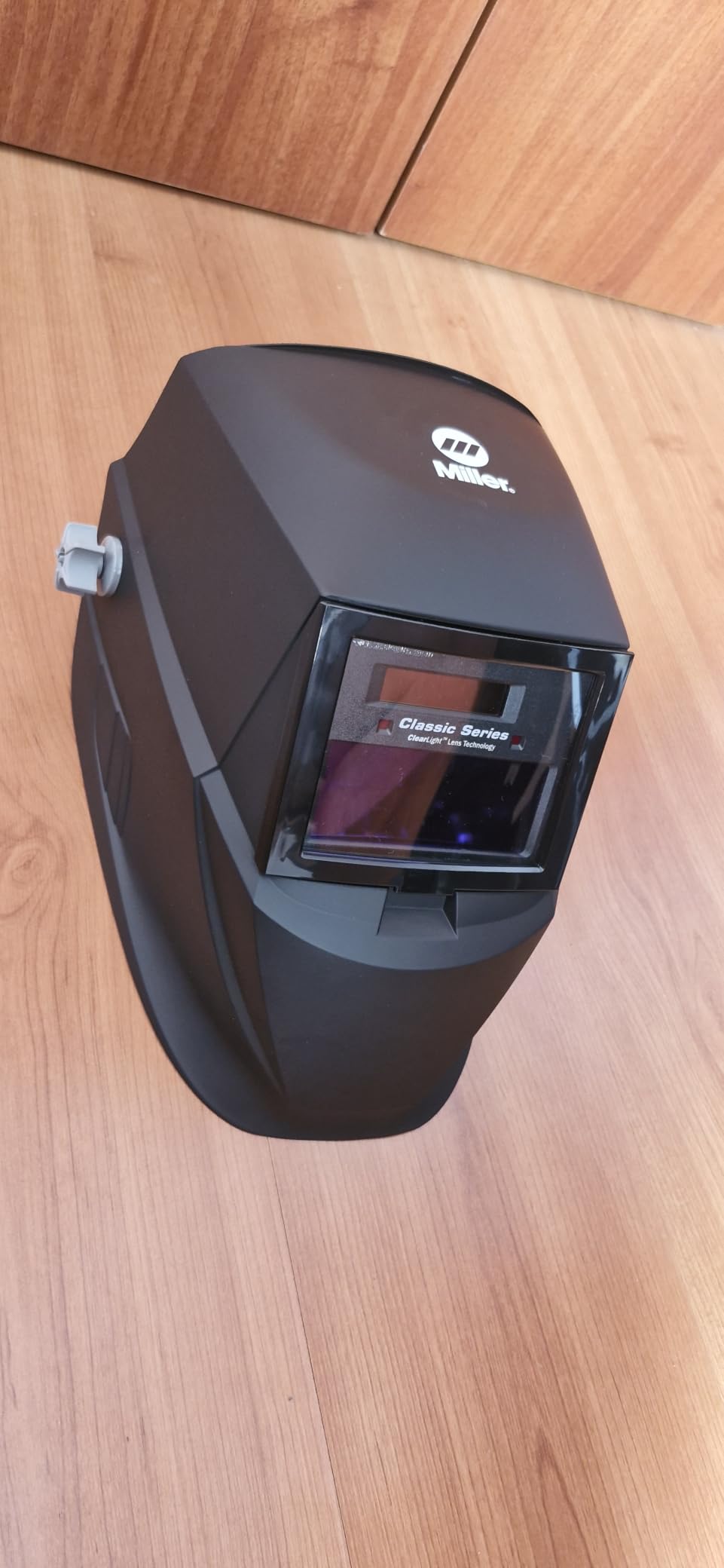
The ClearLight lens gives a natural, high-definition view of the puddle and plate that owners consistently rate above green-tint alternatives. The light state of 3.0 is the lowest we see listed here, which means the helmet stays comfortably transparent between welds, and the auto-on power control activates at the strike.
Ratchet headgear is the other quiet luxury. You set the tension once and it holds, which removes the small annoyance of a headband creeping forward mid-bead. Digital controls for shade, delay and sensitivity are straightforward to set once and forget.
Now the compromises. This is the highest price point in this roundup, by a wide margin. Weld shades run 8-13, so it is less flexible for thin-gauge and low-amp work than the helmets that start at shade 5. Two arc sensors with a 1/23000 second switch are the slowest reaction time listed here, and the 6 square inch view is smaller than the panoramic budget models despite the higher price.
When the extra cost is justified
The price gap makes sense if you are buying one helmet for the next five years, if you value having real parts available when the headband cracks, or if you mostly weld at higher amperage where a two-sensor helmet is perfectly adequate.
It does not make sense if you are not sure you will stick with welding, or if your plan involves a lot of light-gauge TIG where the shade 8 minimum is a genuine limit. In both of those cases, a four-sensor budget hood serves you better today.
What you give up versus the budget picks
You give up viewing area and low-amp flexibility, and you get better optics, better headgear and real warranty support. That is a fair trade for a committed beginner and an expensive lesson for an uncertain one, which is why this is not our top pick even though it scores highest on stars.
7. NDUUN True Color Helmet Review: Budget Pick for Occasional Welding
NDUUN Welding True Color Helmet Auto Darkening Hood with Adjustable Shade Range 4/9-13 for TIG MIG ARC Welder Mask
3.62 x 1.65 inch view
2 arc sensors
3/10000s switching
Solar panel charging
Pros
- Lowest outlay of the helmets here
- Lightweight plastic keeps it comfortable for occasional work
- Solar charging means fewer battery worries
- Wide range of graphic and colour options
- Easy to set up and does what it says
Cons
- Flimsy plastic construction
- Only 2 arc sensors and a slow 3/10000s switch
- Small viewing area
- Inner lens pits from flux and may need frequent replacement
This is the cheapest helmet on the list and the one that makes the least sense to buy twice. If you are trying welding to see whether you like it, or you weld once a month in the garage, this gets you a working auto darkening filter without a big commitment.
The filter uses two premium sensors and darkens from light to dark in 3/10000 of a second, which is slower than everything else here. The DIN4 light level and a 0.1 to 0.8 second dark-to-bright transition are fine for short tacks and simple flat work. Solar panel technology charges the filter when the helmet sits in light, so battery management is mostly hands-off.
Owners describe it accurately as a solid value for occasional and hobby work. It is light, it fits with an adjustable headband, and the true color visor is a pleasant surprise at this end of the market. A wide range of graphic and colour options means it can also double as a gift for someone starting out.
Two things limit it. The shell is flimsy plastic, and the inner lens is cheaper than the others here and shows pitting from flux relatively quickly. On stick work with a lot of spatter, you will likely replace the inner lens sooner than you would on a hood with a better cartridge.
Two arc sensors plus the slowest switch time here means this is not a helmet for out-of-position work or low-amp TIG. Take it as a flat-work, short-arc helmet and it is fine. Ask it to catch a dim TIG arc or an overhead vertical-up strike and it may not.
When spending the extra money is worth it
The jump from this to the LYG-L600A buys you a faster switch, a better inner lens and blue light blocking, and it buys a spare battery and lenses in the box. If you know you will weld regularly, that upgrade is worth making immediately rather than after the inner lens pits out.
Who should buy this and who should not
Buy it if you are experimenting, welding occasionally, or buying for a kid who might not stick with it. Also sensible as a shop spare for a helmet that gets thrown in a truck.
Skip it if you intend to make welding a regular habit, if you work stick with heavy spatter, or if you plan any overhead or vertical-up work. Those are the exact conditions where the two-sensor, slow-switch design bites.
8. Sunstac SS-A800D Review: Best for Stick, Flux-Core and Big Screens
Sunstac Auto-Darkening Welding Helmet 3.94 x 3.27″ View with Light
3.94 x 3.27 inch view
4 arc sensors, 1/30000s
Shade 4/5-9/9-13
Solar plus lithium battery
Pros
- Large viewing screen with no darkening lag reported
- 1/1/1/1 true color at 1/30000s
- Four sensors handle out-of-position strikes
- Rechargeable swivel work light with two modes
- Padded interior with multiple fit adjustments
Cons
- Filter can take a moment on the first strike
- Battery compartment is hard to access
- Solar supplements rather than recharges
- Side tension buttons feel delicate
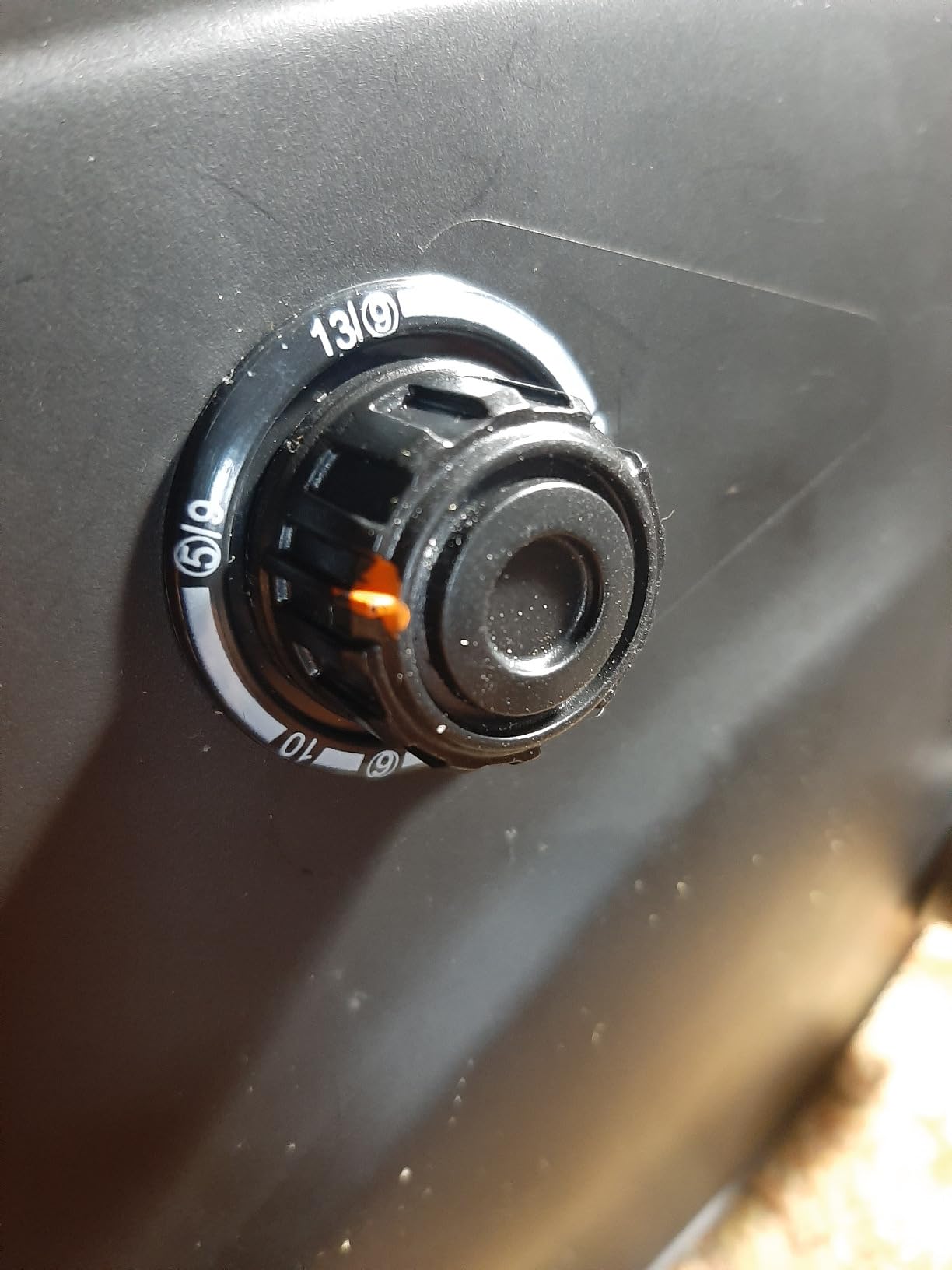
A wide shade range of 4, 5-9 and 9-13 across weld, cut and grind positions is what makes this useful for stick and flux-core beginners, because those processes put you across a much broader amperage range than MIG on thin sheet. The same helmet handles TIG, MIG, cut, MMA and plasma without a swap.
The 3.94 by 3.27 inch screen with four arc sensors and a 1/30000 second switch is a genuinely strong sensor-and-window pairing at this level. Owners report no darkening lag and no over-darkening once the arc is running, and the jump in visibility from older self-darkening hoods is the most common comment in the reviews.
There is a rechargeable high-brightness auxiliary work light on a swivel with two modes, which means you can aim it at the joint rather than wearing it straight ahead. Power is dual, lithium battery or solar. The interior is padded with multiple fit adjustments, and no eye strain is reported even across extended sessions.
The reported weaknesses are small but worth listing. The filter can take a moment to activate on the very first strike, which looks like a fault until you learn it is normal. The battery compartment is difficult to access, the solar panel supplements rather than recharges, and the side tension buttons feel delicate.
One owner also notes the deep headpiece can hit glasses on smaller heads. If you wear glasses, order it knowing the headgear may need more adjustment than a slim shell allows.
Why the shade range matters for stick work
Stick welding runs hot on thick plate and cool on thin plate with the same machine, and the correct shade shifts with it. A helmet limited to one narrow weld range forces you to accept either a too-light filter that strains your eyes or a too-dark filter that hides the puddle. Separate weld, cut and grind shade settings remove that compromise.
Who this helmet suits
Buy it for structural repair, farm and trailer work, plate welding, and any beginner who will do more than one process with one machine. Four sensors make out-of-position work far less of a gamble.
Skip it if you wear small glasses and cannot adjust the headband to your comfort, or if you need a helmet with a real warranty, because this one does not list one.
9. YESWELDER LYG-Q800D Review: Best 180-Degree Panoramic Helmet
YESWELDER Auto Darkening Welding Helmet with LED, 180° View, LYG-Q800D
3.94 x 3.23 inch view with side panel
4 arc sensors, 1/30000s
Built-in LED
Blue light blocking lens
Pros
- Side window gives real situational awareness
- 1/1/1/1 true color across a large window
- Four sensors with adjustable sensitivity and delay
- Built-in LED for dim work
- Reinforced PP shell for regular use
Cons
- Heavier and bulkier than slim budget models at 2.2 lb
- Costs more than most true color helmets here
- Side panel is fixed DIN5 and does not auto darken
- Mixed durability reports in reviews
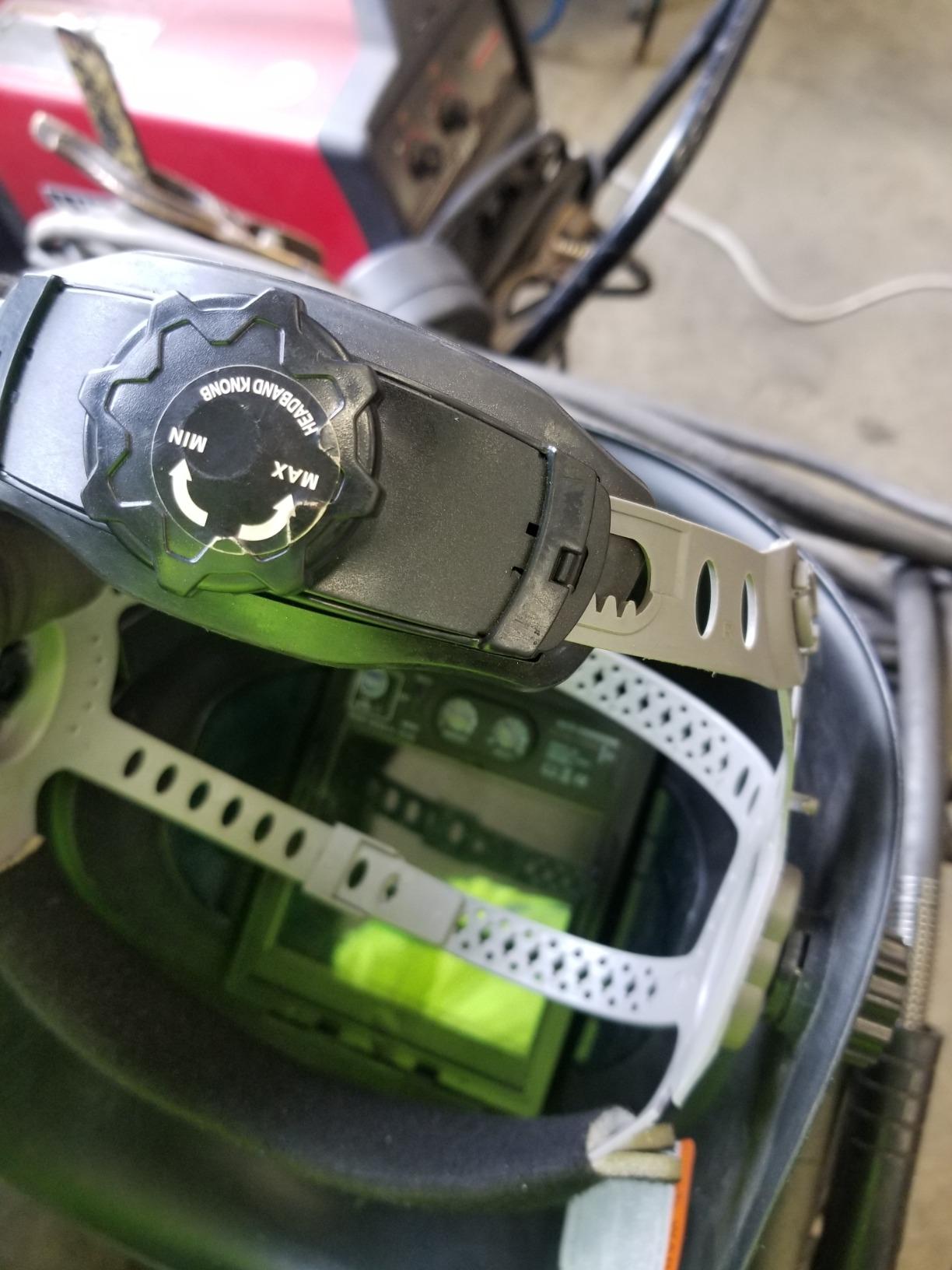
Side windows are the feature people react to most when they see this hood in person. Instead of a flat front plate, the shell carries a non-auto-darkening DIN5 panel on each side, giving roughly 180 degree coverage so you can see the person holding the plate, the truck you are under, or the second arc running in the same shop.
For a beginner, situational awareness is not a luxury. A lot of early frustration comes from not being able to see where your hands are, where the material is going, or whether someone is about to walk behind you with a grinder. The side panels fix a specific kind of blindness.

The main window is 3.94 by 3.23 inches at 1/1/1/1 true color, with four arc sensors, a 1/30000 second switch and adjustable sensitivity and delay. The shade range of 3, 5-9 and 9-13 covers TIG, MIG, MMA, cut and grind, and the lens is blue light blocking. There is a built-in LED work light and magnifying lens compatibility.
Power is solar plus a replaceable CR2450 lithium battery, and the shell is reinforced thicker PP with pivot style headgear.
The trade-offs are weight and money. At 2.2 lb it is one of the heavier shells here, and it costs more than most of the true color models in this roundup. The side panel is fixed at DIN5 rather than auto-darkening, so it does not adapt to shade changes and gives you a permanently mid-tone peripheral view.
Is the panoramic view worth the extra weight
If you weld in a shared shop, under vehicles, or on work where someone else is moving around you, the side windows are genuinely useful and the weight is manageable. If you weld alone on a bench all afternoon, the extra mass mostly adds neck load and you would be better served by a larger single window.
Who should choose this, and who should not
Buy it for multi-bay shops, school programs with more than one student, and anyone who wants the widest field of view available without stepping up to a premium panoramic hood.
Skip it if neck comfort is already your main problem, or if you are building a first kit on a tight budget, since there are lighter and cheaper options that give you a bigger main window even without side panels.
10. ARCCAPTAIN HSH-G999 Review: Best Full-Size Screen for Bead Placement
ARCCAPTAIN Auto Darkening Welding Helmet, 3.94″X3.66″ Large Viewing Screen
3.94 x 3.66 inch view
4 arc sensors
DIN 16 auto protection
About 2 lb
Pros
- Very large 3.94 by 3.66 inch true color screen
- Four sensors with fast auto-darkening
- Single locking point at the base of the skull stays put
- Grind mode works reliably
- Some experienced welders prefer it to premium hoods
Cons
- Headgear suspension feels flimsy under a welding cap
- Inner lens coating peeled after two weeks of intensive use
- One report of headgear failure after seven months
- Not intended for full-time professional work
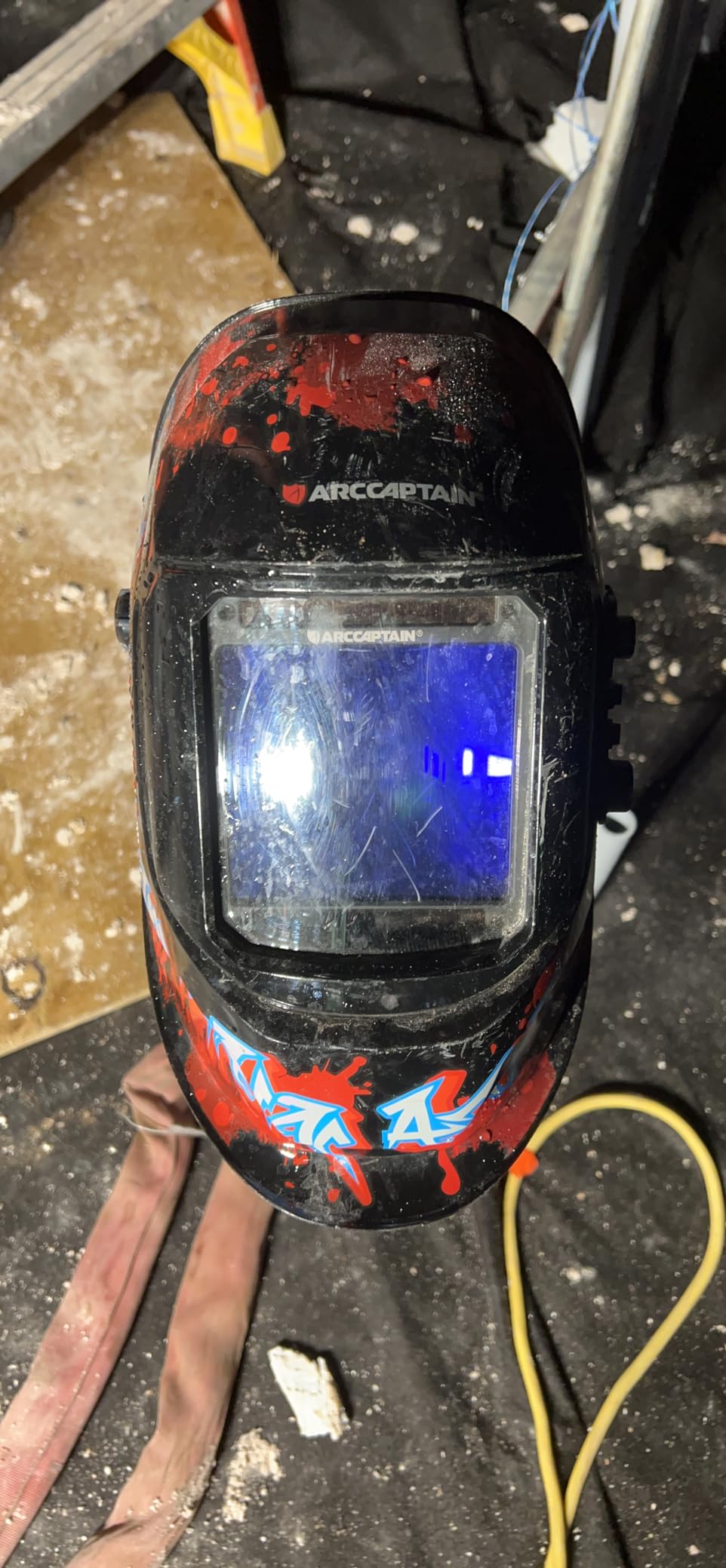
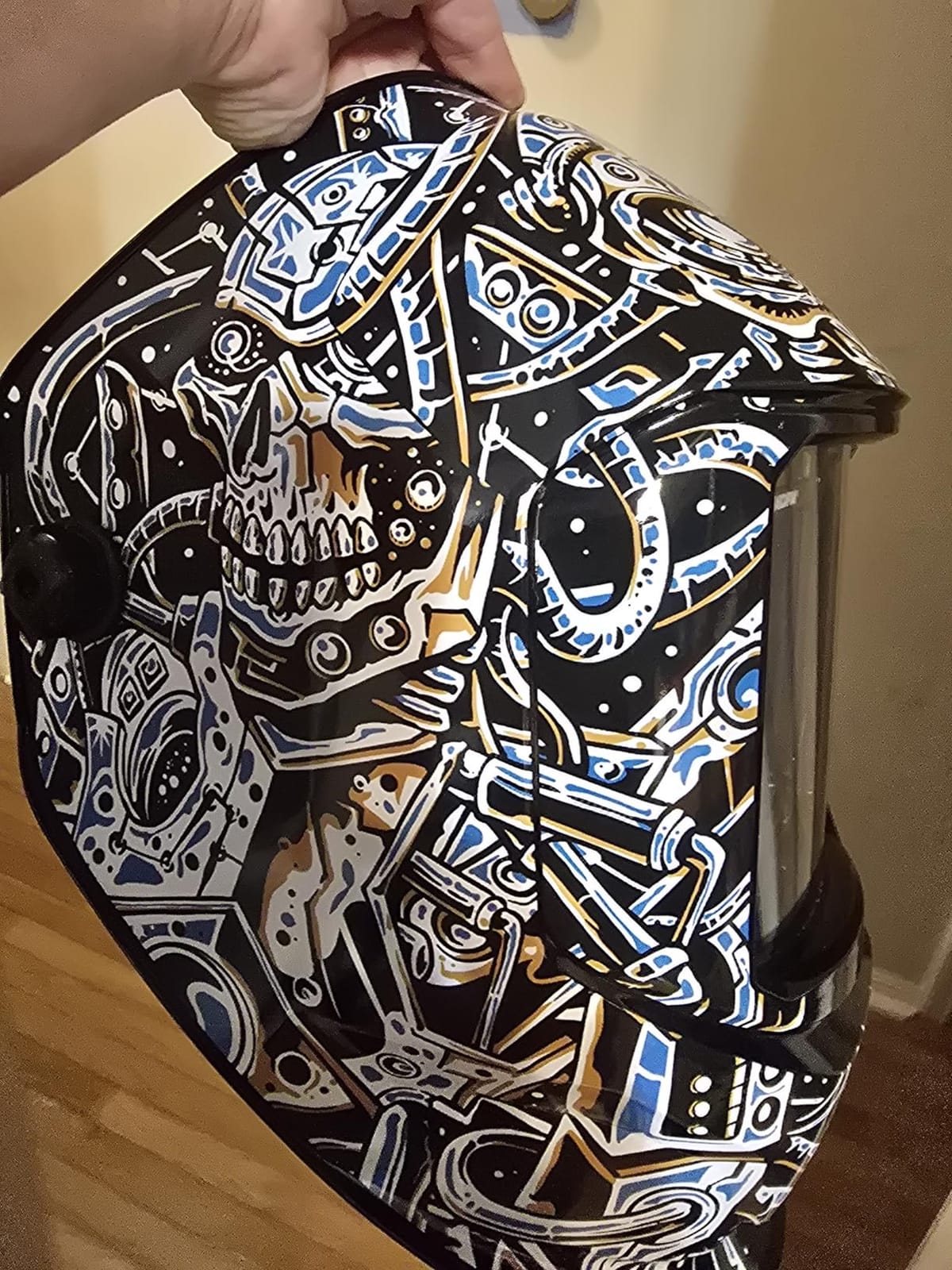
The main window here is 3.94 by 3.66 inches, which is as large as anything in this roundup, and it is paired with a 1/1/1/1 true color lens and four premium arc sensors. The light state is DIN4 with a DIN5-9 and 9-13 dark state, and the smart filter claims automatic protection up to DIN 16 with continuous ultraviolet and infrared filtering.
That combination is aimed at the thing beginners struggle with most: seeing the whole bead at once. With a window this wide you can watch the puddle from the start of the bead to the crater fill, which is how you learn to keep a consistent travel speed.
Headgear adjusts dynamically with breathable padding, and the single locking point at the base of the skull is a design several owners praise for staying in place. Grind mode works reliably, so cleanup does not mean removing the helmet, and a handful of welders with decades of experience report using this as their go-to hood instead of premium brands.
The honest weaknesses are durability under heavy use. The headgear suspension feels flimsy, especially under a welding cap. One owner reported the inner lens coating peeling after about two weeks of intensive use, and another reported headgear failure after roughly seven months. A long-term user is blunt that it is not intended for full-time professional work.
The 180-day warranty is short, but the manufacturer does offer one, which is more than several models in this price bracket manage.
Beginner versus professional expectations
For someone welding a few hours a week, this hood is comfortably good. Big window, fast sensors, reliable grind mode and a shell most beginners will never abuse. If you are welding eight hours a day, the headgear and lens coating reports should steer you to a model with a longer warranty and better optics.
Where it sits against the other ARCCAPTAIN
The Skeleton Knight earlier in this list optimizes for light weight, low-amp TIG and sensor-driven safety. This one optimizes for screen area and everyday handling. Choose the Skeleton Knight if TIG is your process, and this one if you spend your time watching beads and cleaning up welds.
Final read on the tenth pick
It is a strong second or third helmet for a busy home shop, where the wide screen and reliable grind mode get used every session. It is also a good gift for a beginner, because the large window makes the first month of learning noticeably less frustrating.
How We Picked the Helmets on This List
Every helmet here was judged on the same eight criteria, weighted toward what actually affects a beginner’s first hundred hours. Sensor count and optical clarity came first, because those determine whether you can see and whether the lens protects you. Viewing area and comfort followed, because those determine whether you stay at the bench. Shade range, switching speed, grind mode, power source and certification filled out the ranking.
We read the full review sets on each product rather than the top reviews alone, which is why the same flaws keep surfacing: thin plastic, awkward battery compartments, head straps that loosen, inner lenses that pit from flux. We also weighted warranty length and parts availability as value signals, because a helmet that cannot be repaired is a hidden recurring cost.
Where owner feedback and the manufacturer spec sheet disagreed, we went with the owner feedback. That is why the LYG-L600A takes the top spot despite two arc sensors, and why the highest-rated helmet in the group is not our pick.
Auto Darkening Welding Helmet Buying Guide for Beginners
Passive vs Auto-Darkening: Is the Upgrade Worth It?
A passive helmet is a fixed dark window. You flip the hood down to weld and lift it to see. Auto-darkening uses photoelectric sensors and a liquid crystal display to switch from clear to a chosen shade in a fraction of a second, so the helmet can stay down all the time.
For a beginner, auto-darkening is worth it as soon as you plan to strike an arc more than a few times. With a passive hood you spend a surprising share of your time lifting and dropping a heavy shell, and new welders often prop the hood up with a glove, which blocks the sensor on auto-darkening models. The practical argument is hands-free work and consistent exposure; the safety argument is that a lens stuck in the wrong shade cannot happen.
A passive hood still has a place if you want the cheapest possible way to try welding once. It is not a place if you expect to weld regularly.
Arc sensors and welding position
Arc sensors detect the light of the arc. How many you need depends entirely on where the arc is relative to your face.
Two sensors are enough for flat and horizontal work where the arc is in front of you and the light lands on them directly. Four sensors give you coverage when the arc is off-axis, which is what vertical-up and overhead work feels like. Six or seven sensors exist for multi-bay shops where several arcs can light up one helmet at once, or where a neighbouring welder is running a hot pass near your station.
The failure to fear is not a dim view. It is a lens that stays light while a full arc burns in front of your face. That is a flash burn, and it is the single most-cited fear among first-time welders. Four sensors is the practical minimum for a beginner who might do out-of-position work; two sensors is fine only if you will stay flat.
Shade range and the DIN scale
DIN numbers describe how much light gets through. Lower numbers are brighter. A helmet usually has a light state around DIN 4 and a dark state covering something like DIN 9 to 13.
MIG on thin material sits in the lighter end of the weld range, typically around shade 9-10. Stick on plate wants darker protection, often 11-13. Low-amp TIG wants the lightest usable setting so the lens can still detect a dim arc. Grinders want very light shades near 3 to 5.
If you plan more than one process, look for separate weld, cut and grind shade settings rather than one continuous block. That lets one helmet cover MIG, stick, plasma cutting and cleanup without guesswork.
Optical clarity and what 1/1/1/1 means
The optical clarity rating is written as four numbers from the EN 379 scale. The first is optical class, where 1 is best and means a perfectly uniform view. The second is light diffusion, where 1 means neighbouring objects stay distinct. The third is homogeneity, where 1 means no bright or dark spots across the filter. The fourth is angular dependence, where 1 means the view stays consistent even when you look at an angle.
1/1/1/1 is the best possible score and it is what most modern helmets claim. 1/1/1/2 is very close, with slightly less consistency near the edges. A 1/1/1/2 helmet is perfectly fine, but do not accept a 1/2 rating on light diffusion, because that is what makes a view look smeared.
True color lenses also reduce the green cast of standard filters. That matters for beginners in a subtle way: a green view makes a decent weld look bad, and beginners frequently blame their own technique for what is really just the filter.
Viewing area and switching speed
Viewing area is stated as width by height, or as square inches. Small windows cluster around 3.6 by 1.7 inches. Large windows reach 3.94 by 3.66 inches, and panoramic models add side panels for something closer to a 180 degree field.
For a beginner, more is better, up to the point where the helmet gets heavy. A 3.9 by 3.6 inch window lets you see the full width of a bead and both ends of it, which is exactly what you need to learn travel speed and crater control.
Switching speed is quoted as a fraction of a second, ranging here from 1/20000 to 1/30000. All of these are effectively instant to the human eye. Treat any differences here as a tiebreaker, not a decision, and judge a helmet instead on whether its first strike darkens reliably.
Grind mode, power source and certification
Grind mode switches the helmet to a light shade for grinding and cutting, ideally from a button outside the hood. Internal controls are worse for beginners because you have to flip the helmet around, often with hot gloves on.
Solar panels with a replaceable coin cell or lithium battery are the norm now. Solar alone is not enough, because a shop with no windows means no charging. Look for a low-battery indicator, and keep a spare on hand regardless.
On certification, ANSI Z87.1 is the US minimum and EN 379 and EN 175 are the European standards. Some helmets here list all of them. No ANSI Z87.1 marking is a reason to skip a helmet outright.
Fit, glasses and neck fatigue
Fit is a genuine purchase blocker and almost no roundup covers it. If you wear glasses, check whether the helmet is deep enough at the back to clear the arms, and whether the headband adjustment range actually fits your head. Deep shells can hit glasses on smaller heads.
For neck fatigue, the things that help are low weight, a padded sweatband, a balanced shell, and ratchet or pivot headgear that holds position without a tight strap. If you already get headaches from wearing a hood, buy the lightest well-fitting model you can find rather than the biggest screen.
Cover lens replacement and total cost
The outer cover lens is a sacrificial plastic window that takes spatter and scratches. It is the main consumable on any welding helmet, and the hidden cost of a budget helmet is replacing its lenses more often.
Two things lower that cost. First, budget and premium helmets very often use the same common cartridge format, so a cheap helmet is not stuck with expensive replacement parts. Second, a headgear strip you can replace independently of the shell extends the life of an otherwise good hood.
Budget accordingly: treat the outer lens as a yearly consumable, keep a spare inner lens if you do a lot of stick work, and expect to replace the headgear on the lightest plastic models sooner than you expect.
Frequently Asked Questions
What is the best auto-darkening welding helmet for beginners?
The YESWELDER LYG-L600A is our top pick for beginners. It combines a 1/1/1/1 true color lens, solar power with a replaceable CR2450 battery, 1/30000-second switching and a shade range of 3/7-13. It also carries the largest volume of owner feedback in this roundup. If you plan to do low-amp TIG or overhead work, choose a four-sensor model such as the YESWELDER LYG-M800H or ARCCAPTAIN HSH-S800 instead.
What is the best welding helmet for value for money?
The YESWELDER LYG-M800H is the strongest value in this roundup. You get a 3.93 by 3.66 inch true color viewing window, four arc sensors that detect arcs more reliably than two-sensor designs, external shade and delay controls you can adjust with gloves on, and a weight of about 1.32 lb. That combination of screen size and sensor count is usually found in more expensive hoods.
Are auto darkening welding helmets any good?
Yes. Auto-darkening helmets use photoelectric sensors and a liquid crystal filter to switch from clear to a chosen shade in a fraction of a second, blocking ultraviolet and infrared light while leaving enough visible light to see the puddle. Modern budget models reach 1/1/1/1 optical clarity with switching around 1/25000 to 1/30000 of a second. The main limitation is sensor count on out-of-position work.
How many arc sensors do I need in a welding helmet?
Two sensors are enough for flat and horizontal work where the arc sits directly in front of you. Four sensors are the practical minimum for a beginner, because they detect the arc when it is off to the side during vertical-up and overhead welds. Six or more sensors help in multi-bay shops where a nearby arc can false-trigger your lens. A missed sensor means a flash burn, so sensor count is a safety spec rather than a feature.
Is shade 10 or 11 better?
Neither is universally better. It depends on the process and the amperage. MIG on thin material usually sits around shade 9 or 10, stick welding on thicker plate often wants 11 through 13, and low-amp TIG wants the lightest shade that still protects you. A helmet with separate weld, cut and grind shade settings makes this much easier to manage than a single continuous range.
What welding helmet has the clearest view?
Viewing clarity is described by the EN 379 rating, written as four numbers covering optical class, light diffusion, homogeneity and angular dependence. A score of 1/1/1/1 is the best available, and 1/1/1/2 is very close. In this roundup the Miller Classic Series ClearLight, the YESWELDER LYG-L600A, the ARCCAPTAIN HSH-S800 and the ARCCAPTAIN HSH-G999 all carry 1/1/1/1 ratings.
Final Verdict: The Best Auto Darkening Welding Helmet for Beginners in 2026
The YESWELDER LYG-L600A is the best auto darkening welding helmet for beginners in 2026. A true color lens, a fast switch, solar power with a battery backup and the widest owner feedback base on the market make it the lowest-risk first purchase. Spend a little more and the YESWELDER LYG-M800H adds four arc sensors and a much larger window, which is the smarter buy if you will ever weld overhead or out of position.
If TIG on thin material is part of your plan, go straight to the ARCCAPTAIN HSH-S800. If you mostly grind and clean up after welding, the ARCCAPTAIN HSH-G999 gives you the biggest window in this roundup. If you are buying one helmet for the next decade and mostly weld at higher amperage, the Miller Classic Series is worth the jump for its optics, ratchet headgear and three-year warranty.
Whichever one you choose, set it up on a scrap piece before a real project, learn the sensitivity and delay controls, and check the shade against the process you actually use. That ten minutes of setup will save you more practice time than any spec on any of these helmets.