

A cold-climate hot tub cover is a custom-fit, tapered foam-insulated spa cover built around a high-density virgin EPS foam core, wrapped in marine-grade vinyl, and closed with a heat-sealed vapor barrier and a full-length steam stopper along the hinge. That combination is what separates a cover that survives a northern winter from one that sags into a puddle by February.
We spent the last few months reading through spec sheets, warranty terms, and owner reviews on cold-weather covers, and compared all ten products below side by side on foam density, taper, skin weight, warranty length, and how they behave under snow load. What follows is the best hot tub covers for cold climates shortlist, ordered by how well each one handles freeze-thaw cycles, snow, and heat loss.
Table of Contents
Key Specifications to Look For
Foam core density near 2 lb per cubic foot; prevents sagging under snow load.
Taper of roughly 6 inches at center down to 4 inches at the edge; sheds rain and ice instead of pooling.
Marine-grade vinyl skin, 28 to 30 oz; resists UV cracking and split seams.
Heat-sealed multi-ply vapor barrier; blocks condensation that causes waterlogging.
Full-length steam stopper at the hinge seam; closes the biggest heat leak on the cover.
Foam thickness of 4 to 6 inches; each extra inch adds meaningful R-value in a freeze.
Two other things decide a cold-weather purchase before specs even come up. First, cover architecture: a custom foam cover is the all-round answer, a hard top shell carries the heaviest snow loads, and an attached automatic system is the premium option for owners who use the tub in winter. Second, fit. A custom cover made to your tub’s exact dimensions and corner radius will hold a seal that a universal-fit cover never will.
If your existing cover is already soft, heavy, or pooling meltwater, our guide to getting non-generic results out of AI research tools covers the workflow we use when we dig through thousands of reviews on a single product.
Top 3 Picks for Cold-Climate Hot Tub Covers

The Cover Guy Premium Custom Cover
- R19 insulation
- zero water absorption wrap
- 6/5/4 inch taper
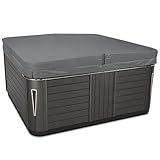

BeyondNice Ultra 6-Inch Custom Cover
- 6 inch maximum foam
- stand-on sturdy
- Surefit guarantee
Best Hot Tub Covers for Cold Climates at a Glance (October 2026)
| Product | Specifications | Action |
|---|---|---|
| The Cover Guy Premium Custom Hot Tub Cover |
|
Check Latest Price |
| MySpaCover Custom-Made Hot Tub Cover |
|
Check Latest Price |
| BeyondNice Ultra 6 Inch Custom Hot Tub Cover |
|
Check Latest Price |
 ULTCOVER Waterproof Square Spa Cover 85 inch ULTCOVER Waterproof Square Spa Cover 85 inch |
|
Check Latest Price |
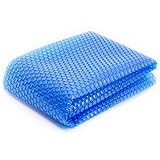 Spa Depot Thermo-Float 16 Mil Bubble Blanket Spa Depot Thermo-Float 16 Mil Bubble Blanket |
|
Check Latest Price |
 Gekufa Winter Bubble Blanket 7×7 ft Gekufa Winter Bubble Blanket 7×7 ft |
|
Check Latest Price |
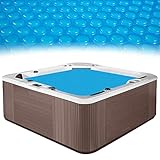 MADHOLLY 16 Mil Spa Hot Tub Cover MADHOLLY 16 Mil Spa Hot Tub Cover |
|
Check Latest Price |
 BeyondNice Durable Replacement Hot Tub Cover BeyondNice Durable Replacement Hot Tub Cover |
|
Check Latest Price |
 Redeo Hot Tub Thermal Cover 6×6 ft Redeo Hot Tub Thermal Cover 6×6 ft |
|
Check Latest Price |
 Frienda Winter 6 x 6 Bubble Blanket Frienda Winter 6 x 6 Bubble Blanket |
|
Check Latest Price |
1. The Cover Guy Premium Custom Hot Tub Cover – Best All-Round Cold-Climate Cover
The Cover Guy Premium Hot Tub Cover | Custom Made Replacement Spa Cover | Energy-Saving Hot Tub Covers Built for All Climates | 6, 5, or 4 inch Taper
Custom made foam
R19 insulation value
6, 5 or 4 inch taper
3-year warranty
Pros
- Custom built to your dimensions with a tight seal
- R19 insulation value with zero water absorption wrap
- Tapered foam sheds rain ice and snow
- Light enough for one person to lift and close
Cons
- 11 percent of ratings are 1-star
- Off-Amazon confirmation step before the build starts
- Baseline build is basic and stiffer foam is a paid upgrade
This is the cover we come back to most often when someone asks us to recommend the best hot tub covers for cold climates without naming a budget. The foam is built to a 6, 5, or 4 inch taper, and owners consistently describe the fit as landing inside the stated plus or minus half-inch tolerance. That precision is what keeps the seal tight enough to matter in January.
The zero water absorption wrap is the detail that separates this from a generic foam slab. Instead of leaving the EPS exposed, the foam gets wrapped so moisture has nowhere to sit and condense. Owners in the review set mention this in connection with heat retention more than any other spec on the listing.
Reviewers also single out the reinforced straps, which are rated above industry load thresholds, plus the locking safety straps and handles. For a family tub, that strap rating is not a minor detail. It is the difference between a cover that stays put through a January storm and one that ends up across the yard.
What you should know before you order
Buying is not a straight checkout. The seller runs an off-Amazon follow-up with a company rep to confirm size, shape, color, and any upgrades before the build is released. Most owners treat that call as a benefit since it catches measurement errors, but it does add a step and a few days of waiting.
The baseline configuration is a basic build. Stiffer 2 lb foam, double-wrapped foam, and side straps are all available, and they are what move this cover from good to genuinely cold-climate rated. If your winters are harsh, budget for those upgrades at the ordering call rather than after delivery.
Who this cover suits best
This suits owners in a cold-but-moderate winter zone who want a custom foam cover without a hard shell, and who can measure their tub carefully. It is also the pick for anyone who wants a cover light enough that one person can open it daily without wrestling with it.
Skip it if your priority is the thickest possible insulation or the longest warranty on the list, or if you want same-day delivery. It is a build-to-order product, and its 3-year warranty is shorter than the 5-year terms offered by several of the picks below.
2. MySpaCover Custom-Made Cover – Best Rated Custom Build with the Longest Warranty
MySpaCover Custom-Made Hot Tub and Spa Cover Replacement | High-Density EPS Foam Insulation | HydroTex 600D or Marine Vinyl | Any Shape and Size up to 96 x 96 in. | 5-Year Warranty
Virgin EPS foam core
Custom to any shape
30 oz marine vinyl or 600D fabric
5-year warranty option
Pros
- 4.4 stars with 78 percent of ratings at five stars
- High-density virgin EPS core with sealed core construction
- Precision fit within half an inch in specialty shapes
- Choice of 600D fabric at 5 years or 30 oz marine vinyl
Cons
- Listed at 60 pounds so often a two-person lift
- 9 percent of ratings are 1-star
- Made to order and not Prime
Where the Cover Guy wins on brand history, MySpaCover wins on the rating spread. It carries a 4.4-star average with 78 percent of ratings at five stars. Buyers tend to credit two things: the choice of skin material and the fact that the sealed foam-core construction resists moisture absorption.
The shape flexibility here is unusually good. The listing covers square, rectangular, circle, octagon, and rounded-corner builds, and it handles sizes up to 96 by 96 inches. If your tub is anything other than a plain square, this is the listing that is least likely to force you into a compromise.
You can order HydroTex 600D fabric with a 5-year warranty or standard marine vinyl with a 3-year warranty. In a cold climate that sees a lot of sun through the winter, the fabric option carries the longer term, and owners report that the high-density EPS core is the feature behind their energy savings.
What you should know before you order
The listed item weight is 60 pounds, and that number matters more than it looks. On larger covers that is a two-person lift every time you want a soak. If you are the only person who will open it, factor in a lift aid before you commit.
The 9 percent of ratings that sit at one star concentrate on customer service and fit disappointments rather than on the cover failing in the cold. As with any made-to-order product, the accuracy of your submitted dimensions drives almost all of that outcome.
Who this cover suits best
This is the pick for anyone with a non-standard tub shape who wants one of the longest warranties available on a custom foam cover. It also suits owners who plan to keep the tub outdoors through several seasons and want the 5-year fabric option rather than a 3-year vinyl one.
It is not the right choice if buying in a hurry matters to you, since it is made to order rather than held in inventory. For an off-the-shelf product you can have quickly, look at the floating blankets further down.
3. BeyondNice Ultra 6 Inch Custom Cover – Best for the Heaviest Snow Load
BeyondNice Ultra Hot Tub Cover, Custom Made 6″ Thick Maximum Insulating Replacement Spa Cover – World’s Only Design Your Own Ordering Wizard Insures every cover is made perfectly for every customer! FedEx shipping now available!
6 inch maximum foam thickness
Builds to your dimensions
5-year Surefit guarantee
14 color options
Pros
- One of the deepest foam builds available at 6 inches
- Sturdy enough that an adult can stand on it
- Surefit guarantee backed by 5 years
- Ordering wizard confirms every build step
Cons
- Commonly needs two people to move
- Longest build time in this roundup
- 20 percent of ratings sit at 3 stars or lower
When we ask how much snow a cover can take, the honest answer is that thickness buys you time. This is one of the thickest builds available in our roundup at 6 inches, and one Ohio owner reported water staying at 104 degrees under a 3-day snow load, dropping only 2 degrees over 24 hours with the heat switched off. That is the closest thing to a real load test we found in the reviews.
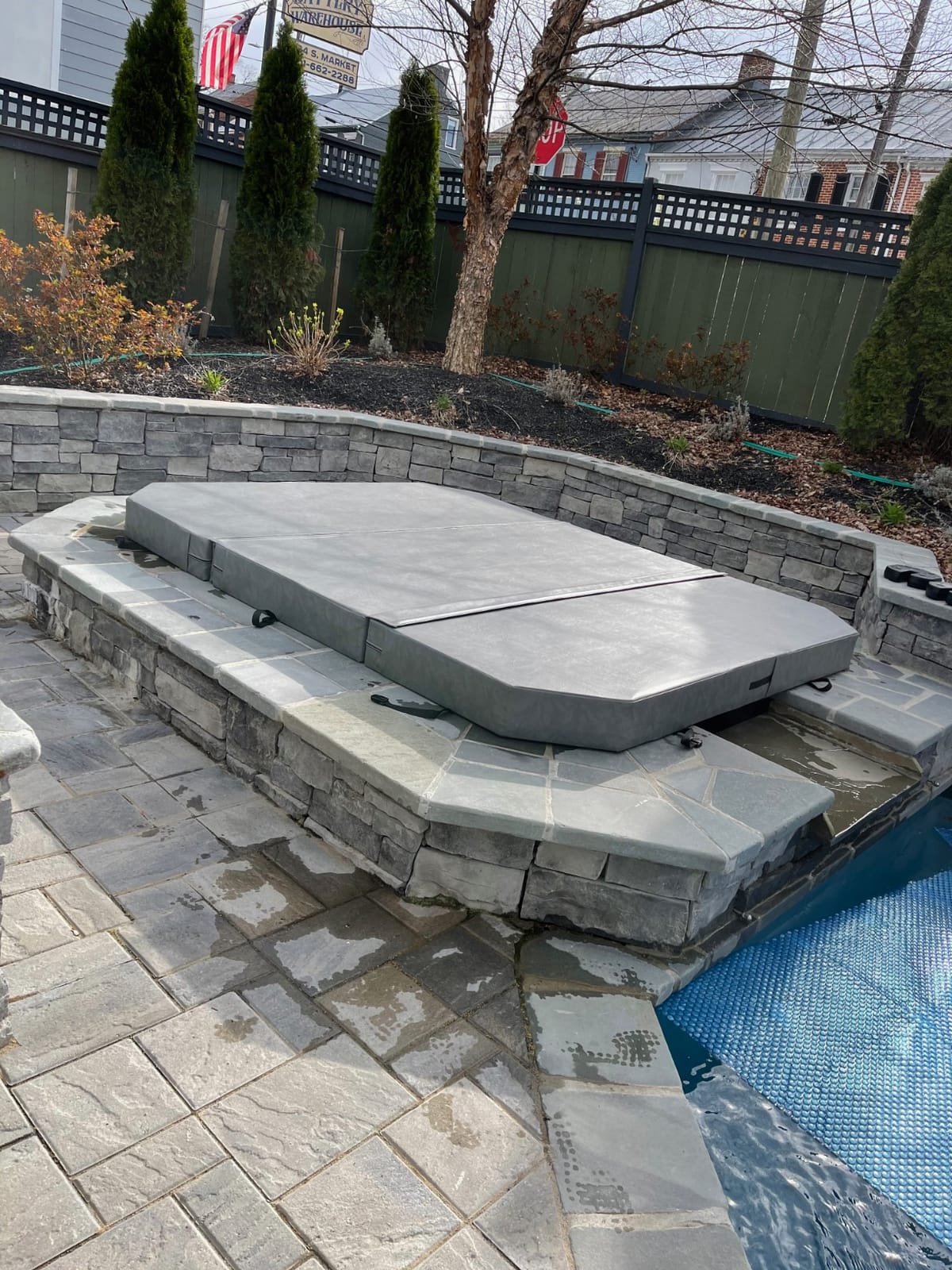
The structural rigidity is a genuine difference here. Multiple owners note they can stand on the surface during snow removal, which matters when you are dealing with a heavy wet snowfall and a full shovel. Lighter foam covers dent under a boot and take a permanent crease.
Warranty terms are also strong for this class. The Surefit guarantee runs 5 years, and one owner reports a previous cover from the same manufacturer lasting nine years. The ordering wizard sends a company rep through each build step, which catches dimension errors before the foam is cut.
What you should know before you order
This is the thickest and slowest-moving cover in the group. Owners commonly build a pulley or track system to move it, and the listed item weight is 55 pounds before you account for a larger custom size. Plan the opening mechanism at the same time as the cover.
The weak point is fulfillment rather than the product. Negative reviews cluster around a wrong-size build, shipping damage, and slow resolution. The build itself takes considerably longer than a standard order, so a problem discovered late eats into the very season you bought the cover for.
Who this cover suits best
This suits owners in northern regions who get repeated heavy snow and who would rather remove snow less often. It is also the sensible choice if the tub sits on a deck where standing on the cover during clearing is something you will actually do.
It is a poor fit for small patios with no room for a lifting rig, or for anyone who needs the tub open daily with a single-person lift. If you use the tub through winter, the weight will be felt every single time.
4. ULTCOVER Waterproof Square Spa Cover 85 Inch – Best Value Weather Shield
ULTCOVER Waterproof Square Hot Tub SPA Cover 85 inch
600D polyester canvas
85 by 85 inch fit
Waterproof backing
3-year warranty
Pros
- Waterproof backing blocks rain hail snow and debris
- Structured air vents reduce wind lift
- Heavy duty elastic cords adjust for a tight fit
- 8000 plus ratings averaging 4.5 stars
Cons
- Cannot work alone as an insulating hard cover
- Offers no meaningful insulation on its own
- Debris protection only rather than heat retention
Be clear about what this is. The ULTCOVER is a waterproof outer shell that sits over an insulated cover, not a replacement for one. Its job is keeping snow, hail, leaves, dust, and bird droppings off the tub and off the cover underneath, and at 8000-plus ratings it does that job extremely well.
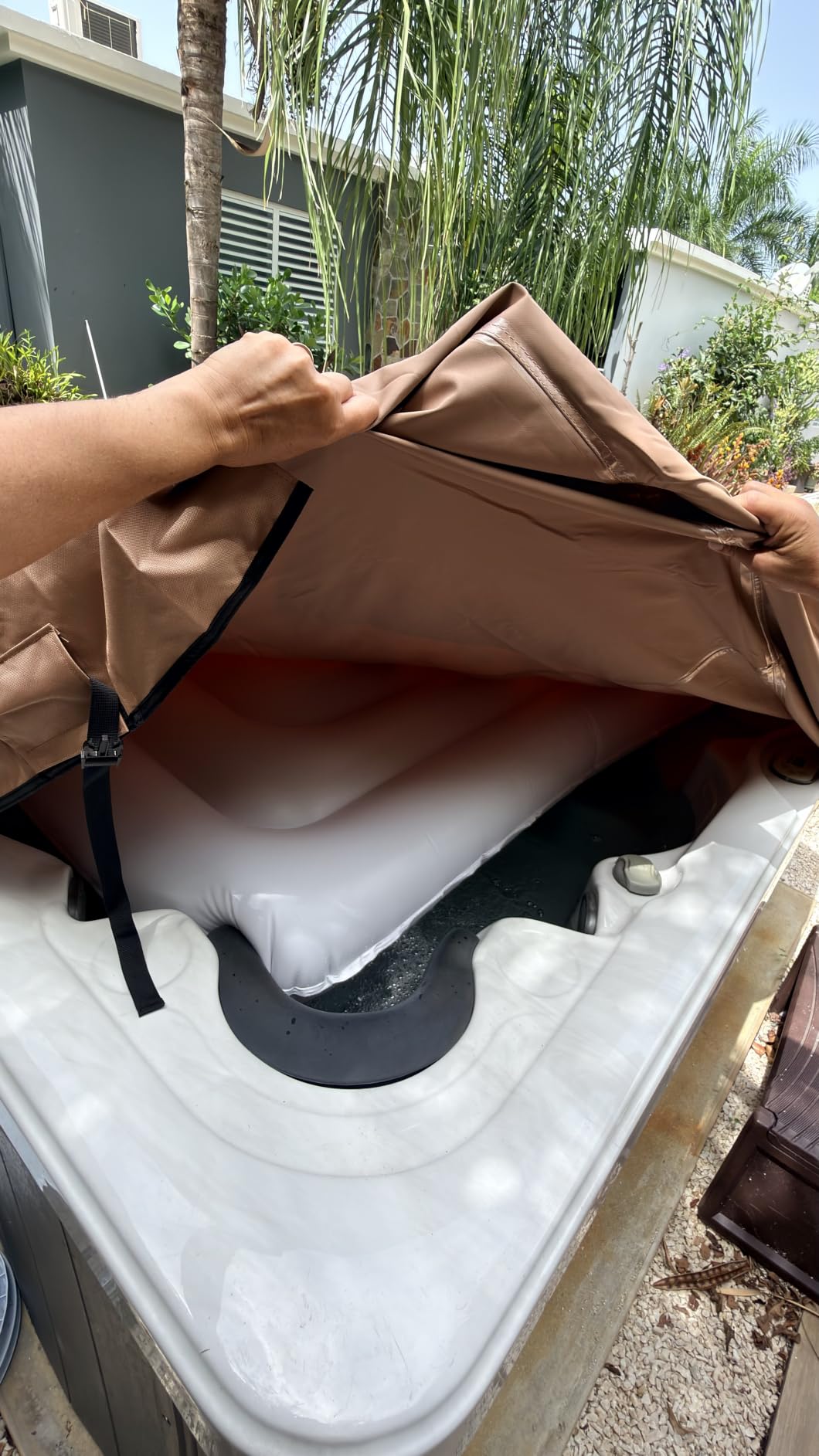
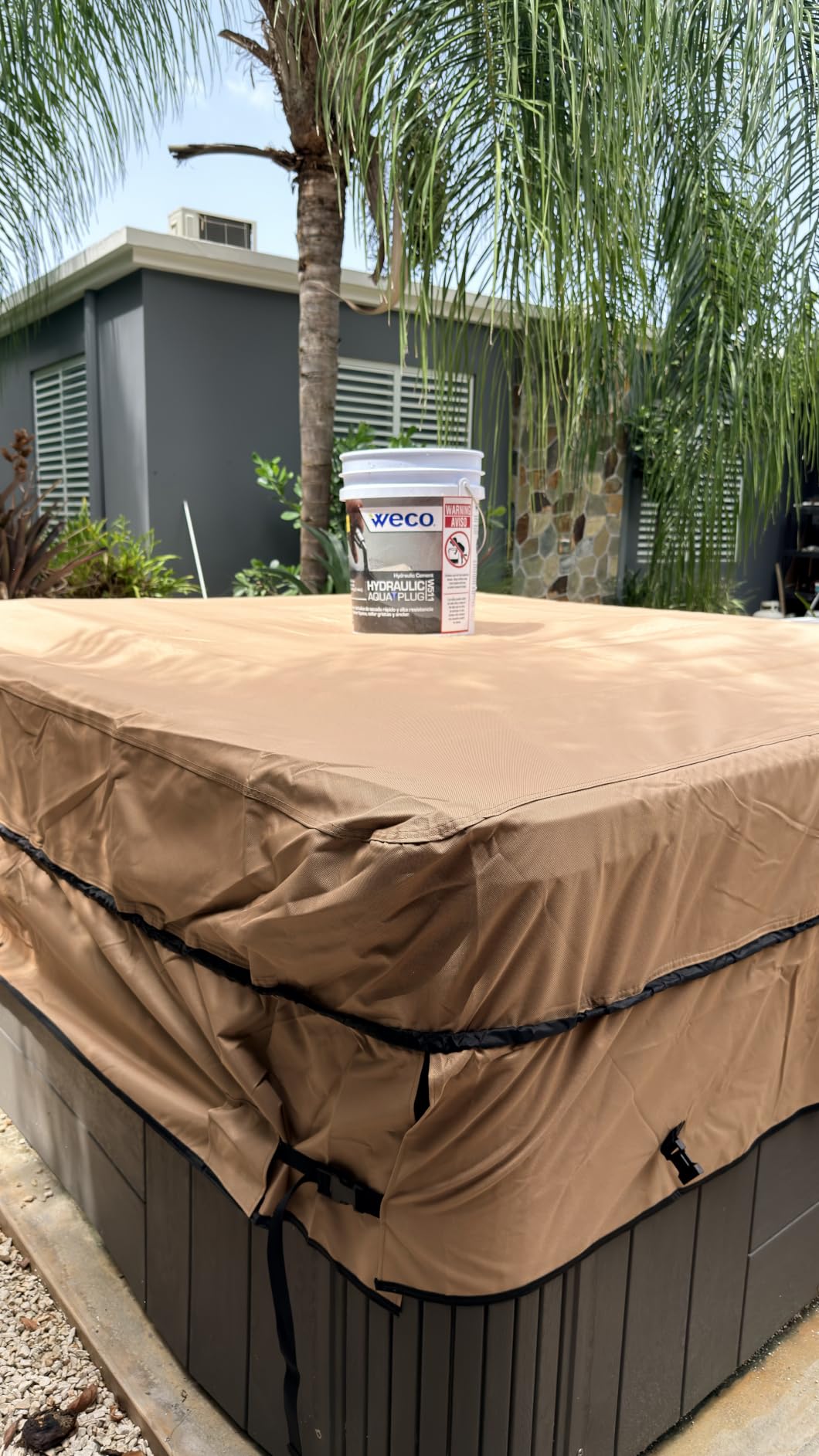
The material is 600D polyester canvas complex with a waterproof backing, in a brown 85 by 85 inch size with a manual fit. Two structured air vents on the sides matter more than they sound, because trapped air under a flat sheet is what turns wind into lift.
What reviewers like most is the elastic cord system. Owners in windy neighborhoods describe tightening the cords until the fit is snug enough to survive a storm, which is exactly the failure mode people report with flat tarps and generic fitted sheets.
What you should know before you order
The size is fixed at 85 by 85 inches, so this suits square tubs up to that footprint and nothing wider. Measure across the widest point of the tub and across the coping before you assume it will fit, since the cover needs to hang down over the sides.
Because it is an outer layer, you still need a foam or hard cover beneath it. In a freeze-belt climate that means two purchases, so factor the layering into your total cost rather than treating this as a cold-weather solution on its own.
Who this cover suits best
This suits owners who already have a serviceable insulated cover and want a weather shield to protect it through the season. It is also the sensible pick for anyone dealing with debris, birds, or a wooded lot where the tub collects leaves faster than anyone wants to clean them.
It does not help anyone trying to cut a winter heating bill, since it adds no insulation. If heat retention is the goal, start with one of the custom foam covers above.
5. Spa Depot Thermo-Float 16 Mil Bubble Blanket – Best for Evaporation Control
Spa Depot Thermo-Float 16-mil 7ft x 7ft Hot Tub Bubble Cover Floating Spa Blanket – trimmable Heavy-Duty Insulating Solar Heating
16 mil PE and PP film
84 by 84 inch coverage
Floating install
4.4 pound weight
Pros
- 4.6 star average with 76 percent five-star ratings
- 16 mil film outlasts typical 8 to 12 mil blankets
- Cuts evaporation heat loss by up to 95 percent
- Keeps the underside of a hard cover dry
Cons
- Bunches into a corner and can block the skimmer
- Film can discolor brown over time
- Floats on the water so it does not carry snow load
The biggest heat loss from an uncovered or lightly covered hot tub is evaporation, and this blanket attacks that directly. Owners report cutting evaporation by up to 95 percent, with a matching drop in heater runtime. One long-term owner noted roughly 95 percent less evaporation and a markedly drier hard-cover underside.
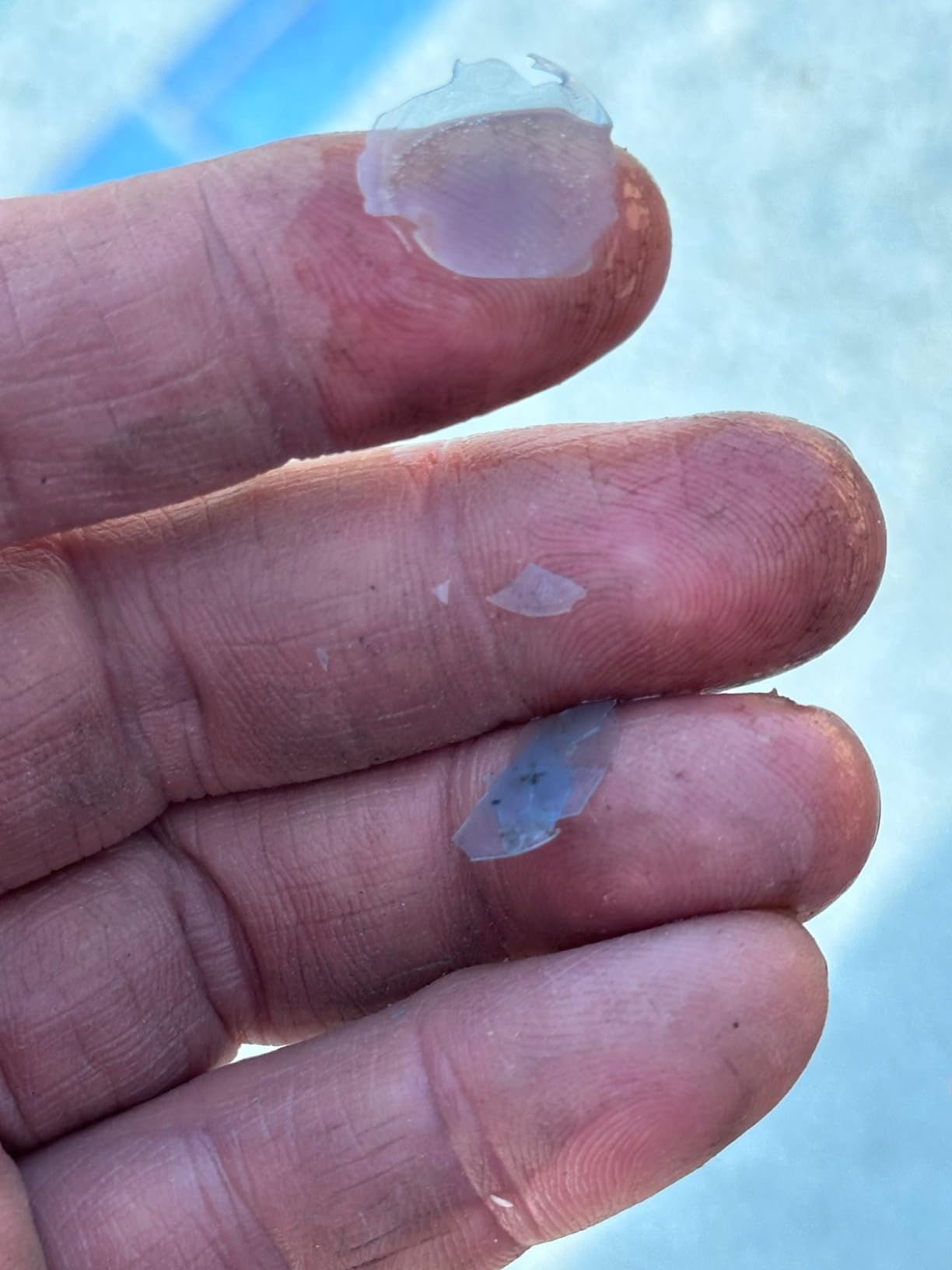
The 16 mil film is the reason we prefer this over cheaper bubble blankets. Most spa blankets on the market sit at 8 to 12 mil, and the extra thickness shows up as resistance to cracking and to detaching bubbles across a full freeze-thaw season.
At 84 by 84 inches it covers most square 7 foot tubs without trimming, and at 4.4 pounds one person can drop it in place with no tools or anchors. It also doubles as a protective layer that keeps steam off the underside of a hard cover, which slows the waterlogging cycle.
What you should know before you order
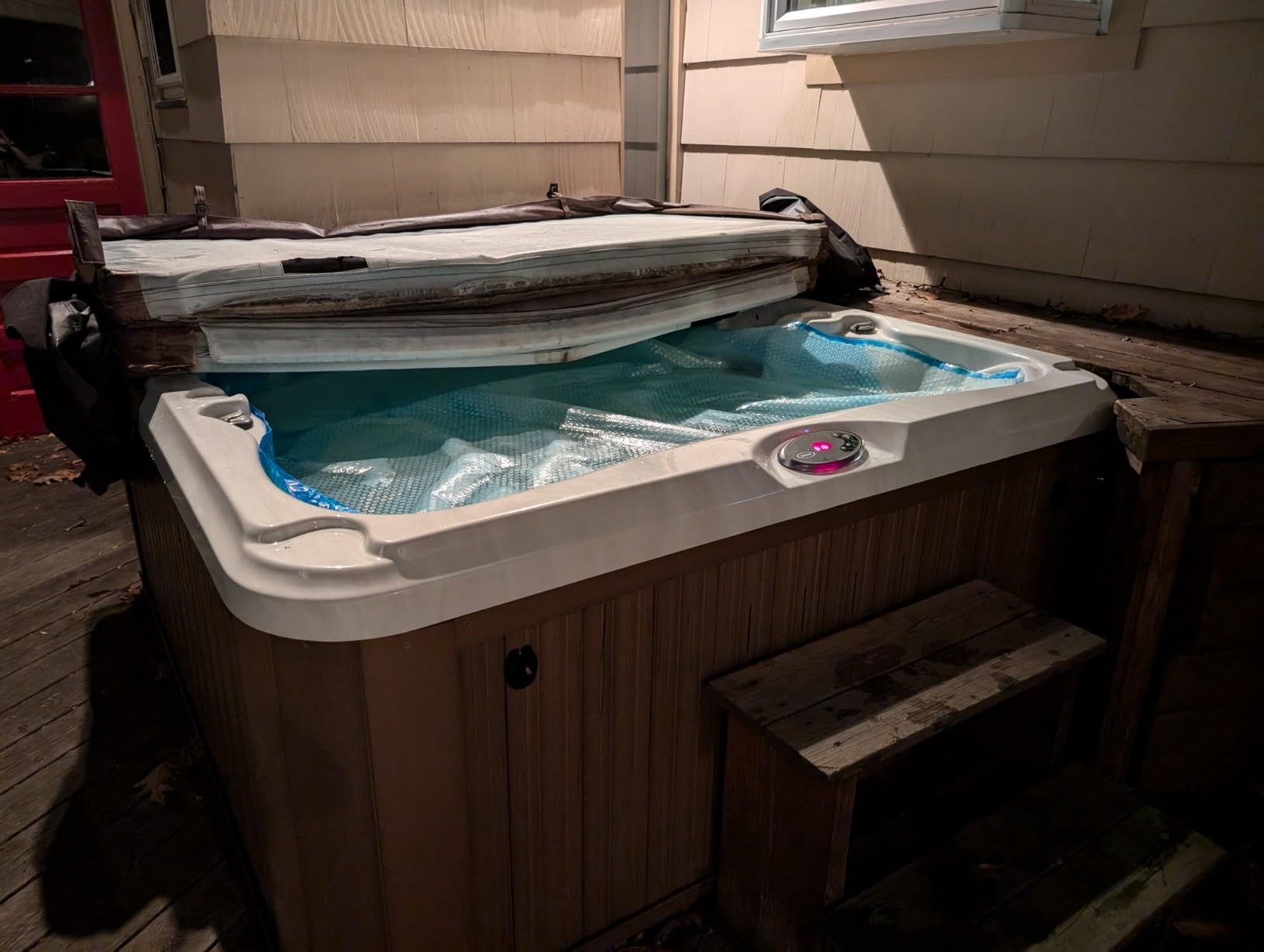
It floats on the water, so it sits inside the tub rather than on top of it. That means it interacts with the water and with the jets. Owners report that it can bunch into a corner and partly block the skimmer when automatic spa jets cycle underneath a hard cover.
There is also a cosmetic issue worth knowing about. Iron in spa water can turn the film brown over time. It does not affect performance, but it does affect how the blanket looks after a couple of seasons.
Who this cover suits best
This suits owners who want to cut heating cost during shoulder seasons and who already have a proper insulated cover in place. It is a strong second layer for anyone whose hard cover underside shows early condensation staining.
It is not a snow-load solution on its own, and it will not keep a tub from freezing. Treat it as a layer inside a cover, not as a replacement for one.
6. Gekufa Winter Bubble Blanket 7×7 ft – Best for Cold-Snap Heat Retention
Winter Hot Tub Bubble Blanket – 7×7 FT 16-Mil Square Pool Spa Solar Cover
16 mil polyethylene film
84 by 84 inch cut to fit
Floating tool-free install
Cold-weather design
Pros
- Built specifically for cold-weather heat retention
- 16 mil film resists cracking fading and deformation
- Cuts evaporation by up to 95 percent
- Cuts to fit in-ground or above-ground tubs
Cons
- Must be cut by the buyer and careless cuts leave gaps
- Supplement to a hard cover rather than a replacement
- 7 percent of ratings are 1-star on bubble degradation
Owners in colder regions describe the effect in plain terms: overnight temperature drop slows noticeably once the blanket is cut to fit and floated bubble-side down. That is the least effort any heat retention gain in this roundup requires, since nothing here is easier to add than a floating sheet.
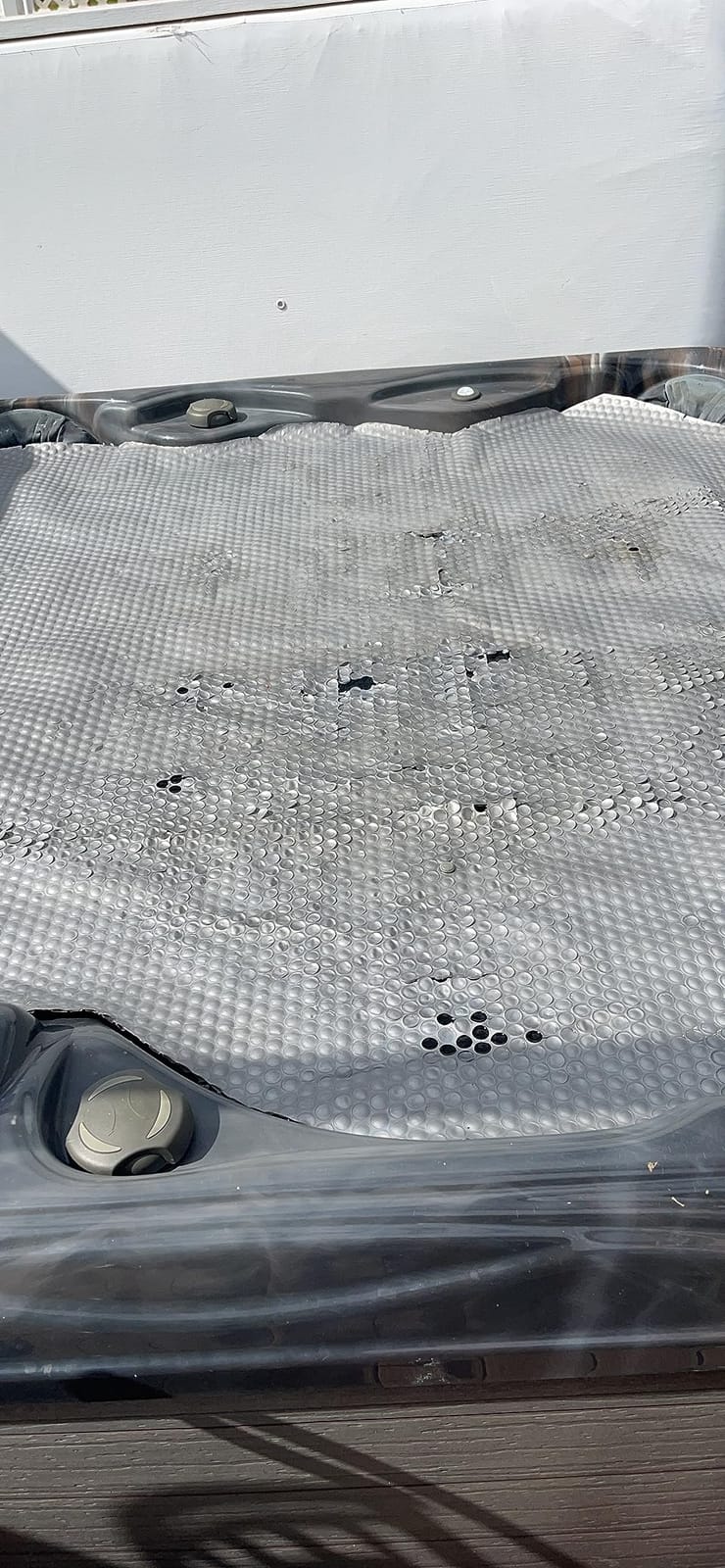
The material choice is 16 mil polyethylene, chosen for cold use because it resists cracking, fading, and deformation through temperature swings. Standard 8 mil film turns brittle and splits after a hard winter, and the annual replacement cycle is the real cost of a thin blanket.
It can be cut to any size and shape, which suits odd tubs where a rectangular sheet needs trimming to follow a curved or octagonal edge. Sizes run from 6 by 6 feet up to 9 by 9 feet, so it covers a wider range than the smaller budget blankets.
What you should know before you order
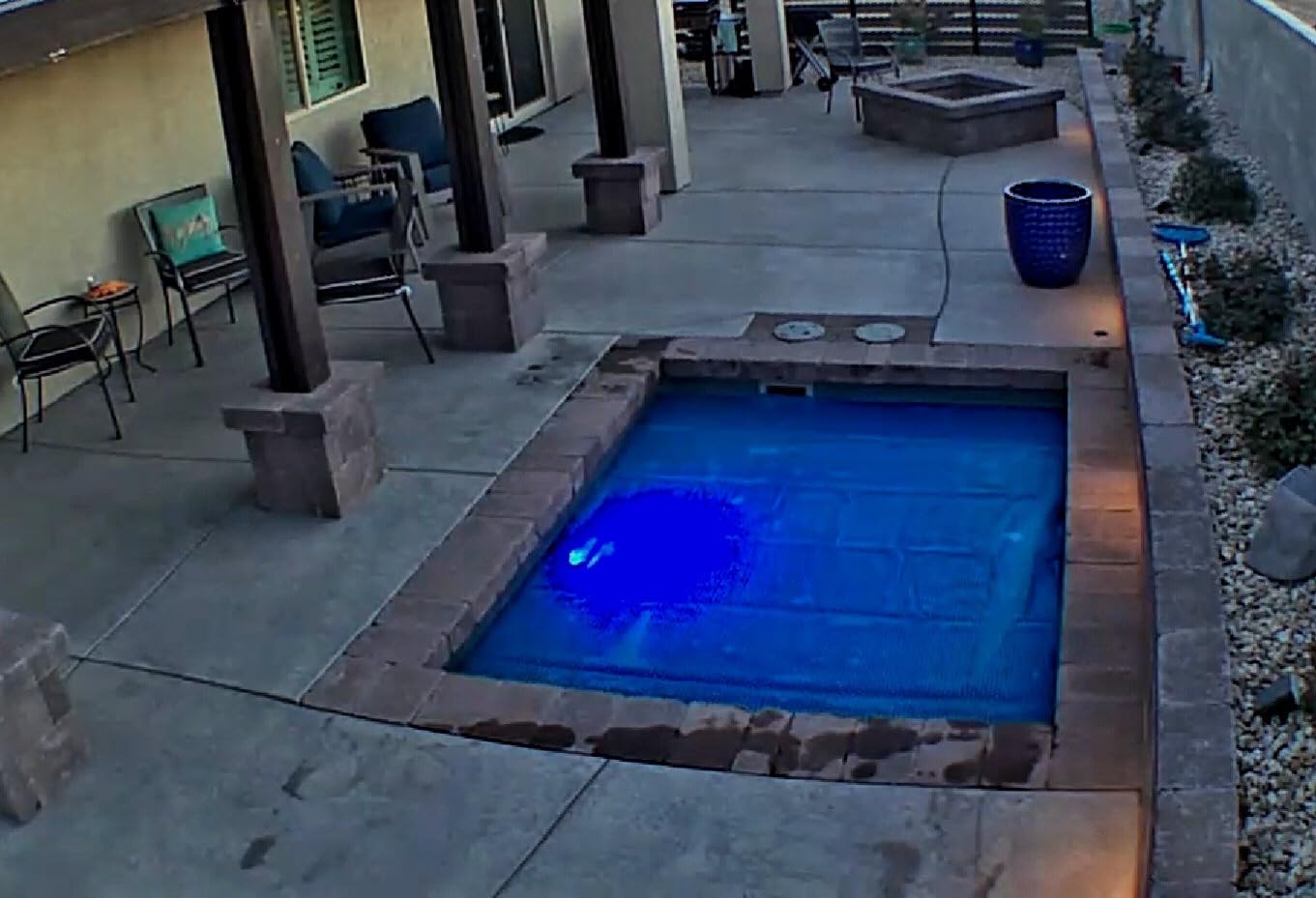
You cut it yourself. The film is forgiving, but a rushed cut leaves gaps at the edge and evaporation walks straight through those gaps. Lay the sheet out flat first, mark the line, and take your time with it.
It is also a seasonal consumable. Seven percent of ratings are 1-star, and the complaints concentrate on bubbles eventually degrading after several seasons of use. Treat it as something you replace rather than something you restore.
Who this cover suits best
This suits owners who keep the tub outdoors through winter but are not in a heavy snow belt, and who want to slow overnight heat loss between uses. It works well as an inner layer beneath a hard cover in a freeze-thaw region.
If you get significant snowfall, it does nothing for load. Snow sits on the hard cover above it, not on this blanket, so you still need a cover rated for the weight.
7. MADHOLLY 16 Mil Spa Hot Tub Cover – Best for Keeping a Hard Cover Dry
MADHOLLY 7×7FT Square 16Mil Heavy-Duty Spa Hot Tub Cover for Heat Retention
16 mil polyethylene
82.68 inch square
Bubble-side-down float
Trims with scissors
Pros
- 4.5 star average with 76 percent five-star ratings
- Trims in minutes with household scissors
- Cuts evaporation by up to 95 percent
- Reduces condensation on a hard spa cover
Cons
- Bubbles can go brittle after a year or two
- Arrives folded so creases need flattening
- No storage bag or strap included
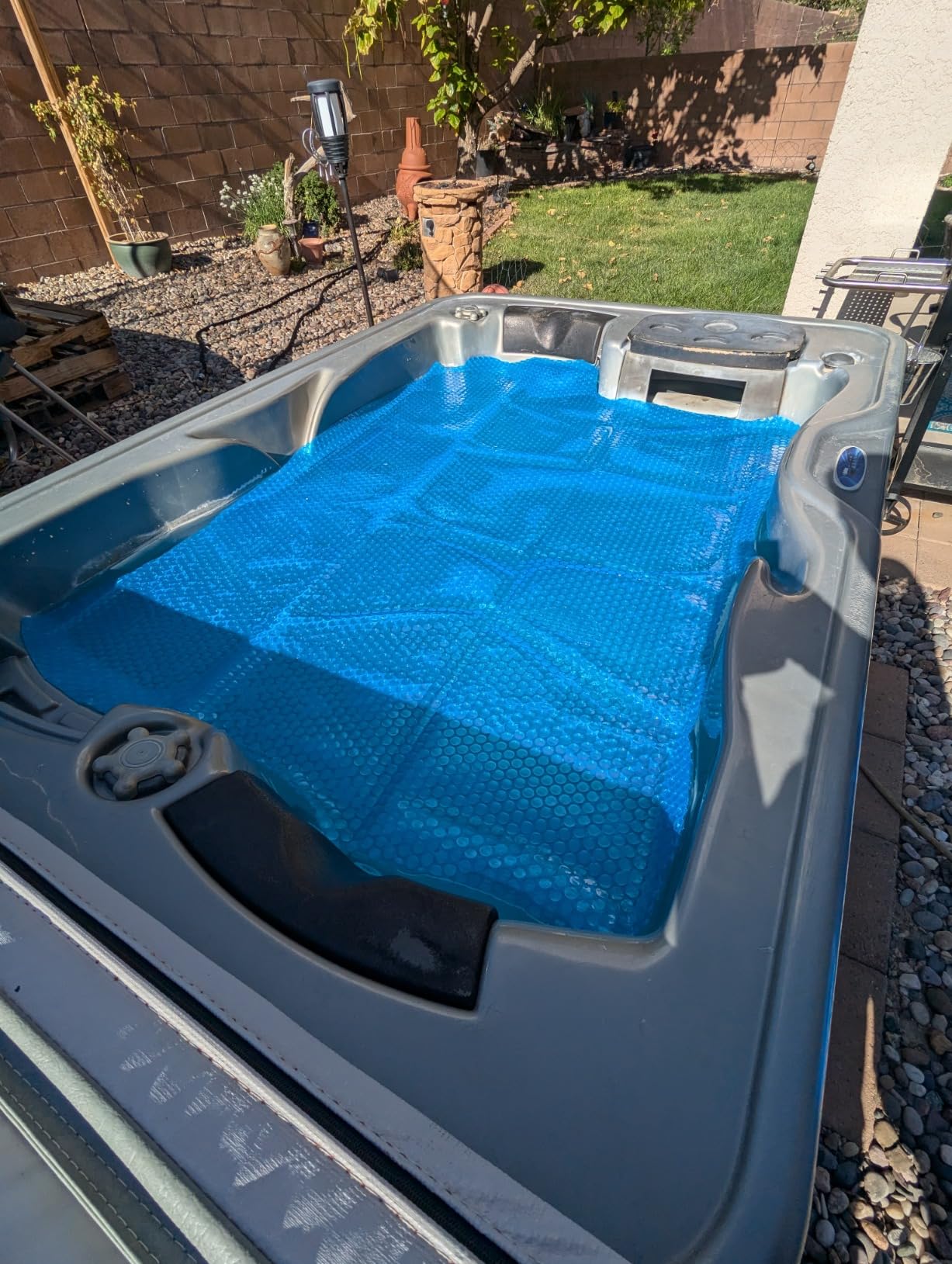
Our angle on this one is waterlogging prevention rather than raw heat retention. The blue bubble design passes sunlight for solar gain, but the more useful effect reported by owners is how much less condensation forms on the underside of a foam or hard cover above it. Less trapped moisture means a slower path to a heavy, sagging lid.
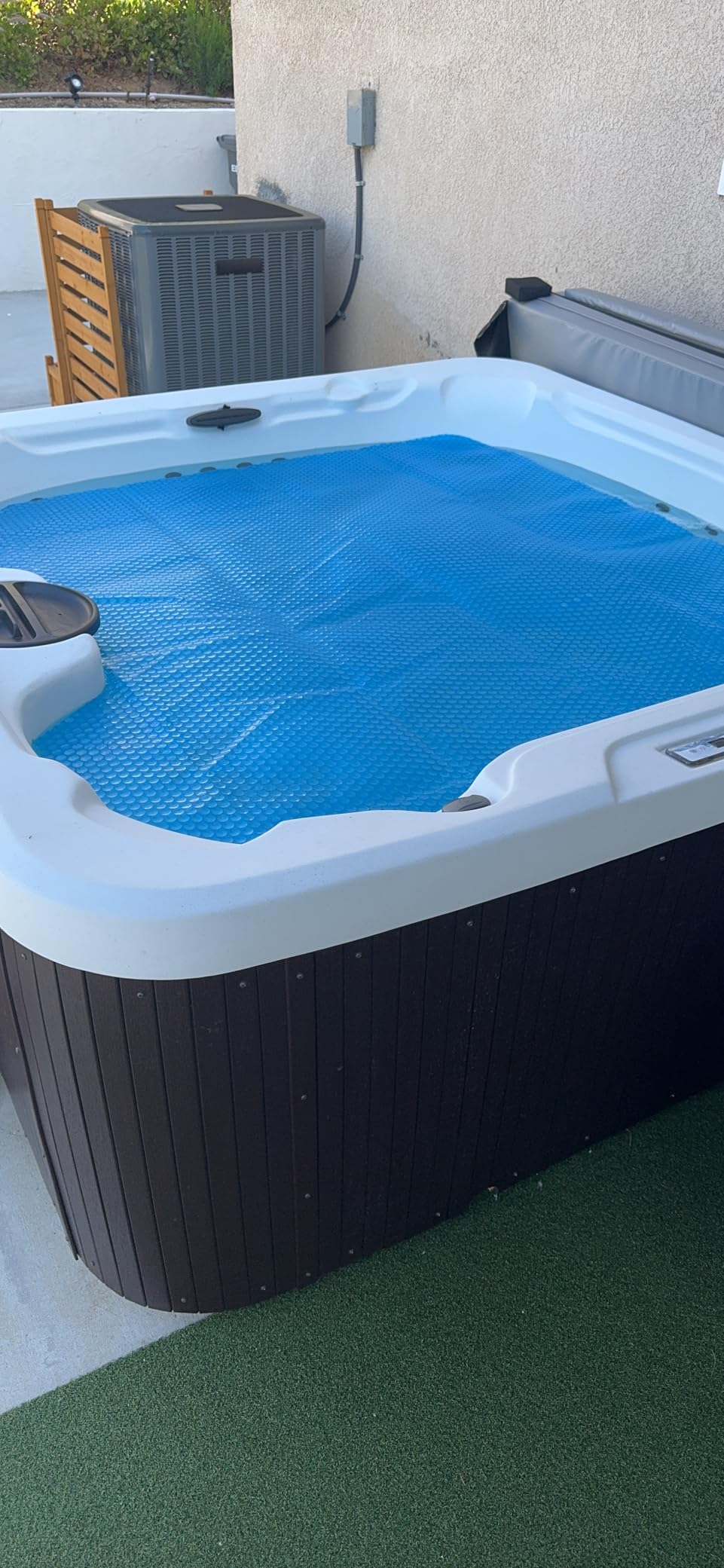
Owners in the Midwest and northern US describe using it beneath a foam and vinyl cover during freezing conditions, where it holds temperature and pushes evaporation close to zero. The 16 mil thickness is heavier than the 8 to 12 mil blankets, and bubbles are reported not to crack or detach easily.
Handling is straightforward. It trims with household scissors in minutes without fraying, so you can fit an irregular tub without a special tool, and the sheet lays bubble-side down where it stays put on the water.
What you should know before you order
It arrives folded, so you will get creases. Owners report needing to lay it flat under some weight to smooth it out before first use, which takes a few hours of doing nothing, so plan it around a warm day.
Longevity is the trade-off. Bubbles can turn brittle and crack after roughly a year or two of heavy use, and there is no storage bag or strap in the box, so you will need to figure out folding storage yourself in a cold shed.
Who this cover suits best
This suits owners who already have a hard cover and are seeing early signs of moisture getting into it. It is also a good fit for anyone whose foam cover has started feeling heavier year over year and wants to slow the next replacement.
It is not a standalone cold-climate answer. Alone it will not hold heat through a hard freeze, and it carries no snow load rating at all.
8. BeyondNice Durable Replacement Cover – Best for Choosing Your Own Foam Thickness
BeyondNice Durable, Replacement Hot Tub Cover | Custom Made Spa Cover | 5 Year Warranty | Insulating Foam Cores 4, 5 or 6 inches Thick | Hot Tub Cover Sizes up to 96 x 96 inches
4, 5 or 6 inch foam cores
Custom made to order
5-year warranty
Made in the USA since 1985
Pros
- Foam thickness chosen to match your snow load
- 5-year warranty
- Built in the USA since 1985
- Ordering wizard covers shape color and fold direction
Cons
- Heaviest listed build at 70 pounds
- 11 percent of ratings are 1-star
- Requires completing a measurement wizard
This is the most flexible cold-climate build in the group because foam thickness is a choice rather than a fixed spec. You pick 4, 5, or 6 inches depending on how much snow your site actually receives, and for owners who want to spend the money only where it is needed, that is the deciding feature.
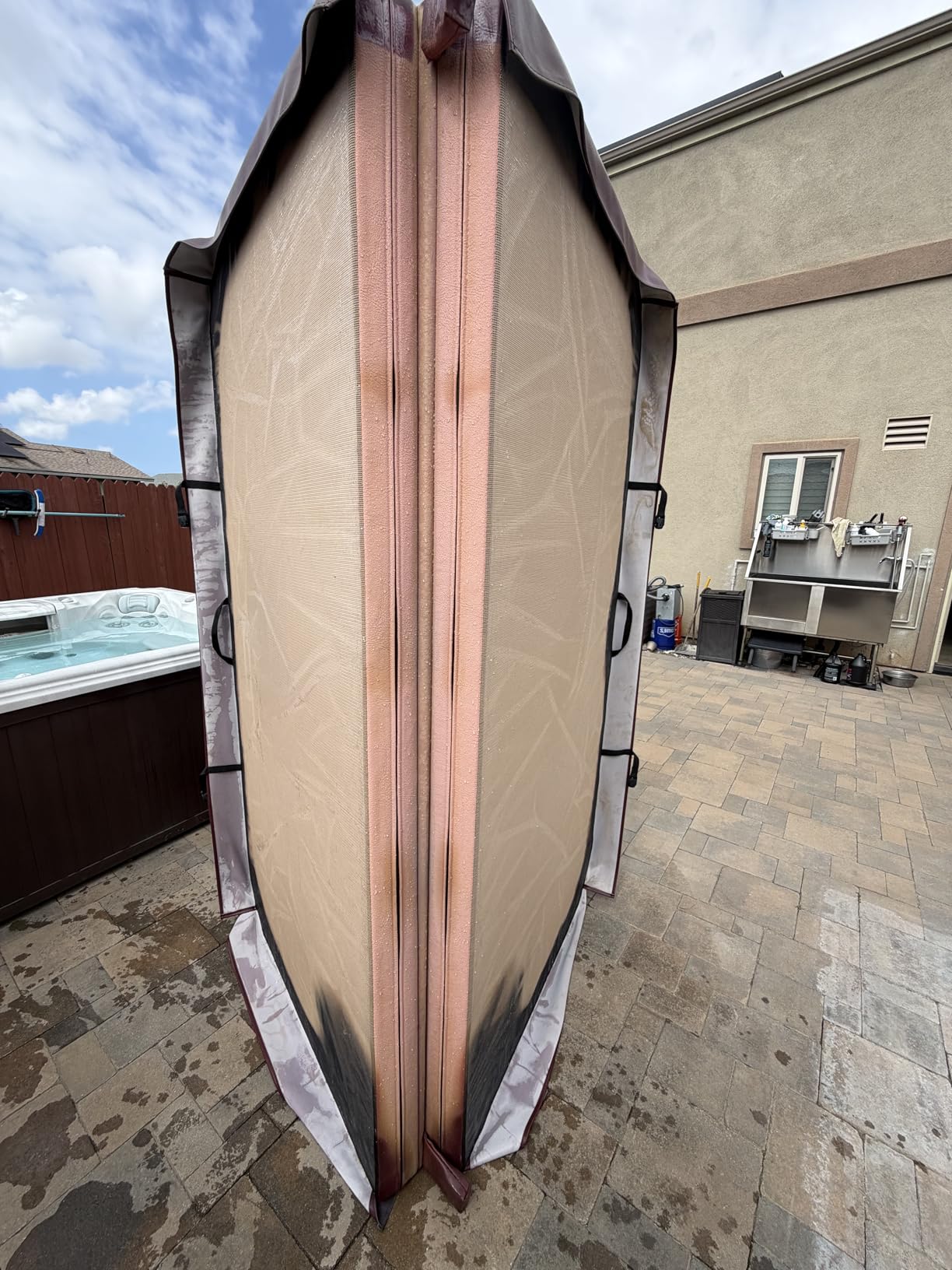
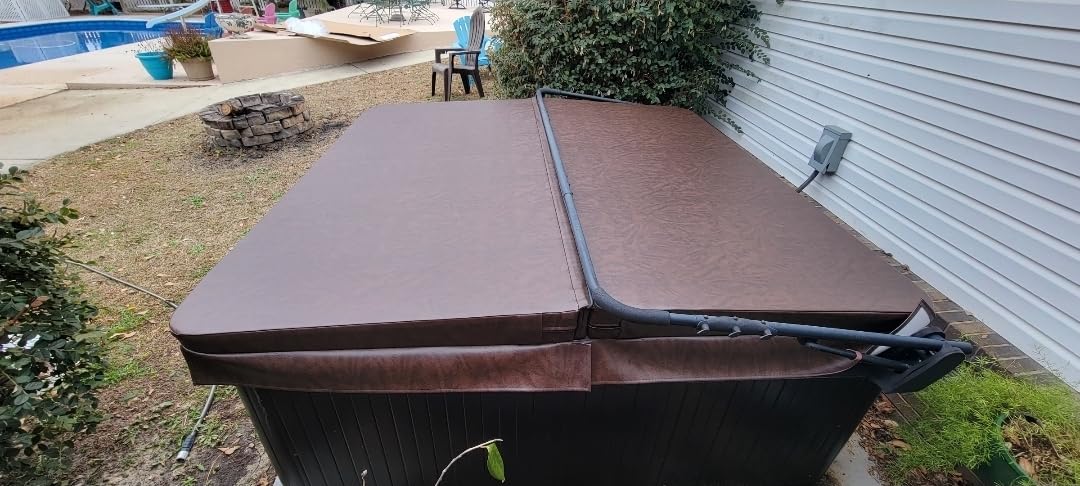
The fold direction and shape options are genuinely useful. You can specify four cut corners, an octagon, one cut corner, round, or square, which matters when you want the folded half to face the side you stand on while opening the tub. These are the details that separate a cover that is convenient from one that is merely functional.
The manufacturer has built covers since 1985 in the USA, and the 5-year warranty is among the longest offered in this roundup. It also meets or exceeds industry safety standards for foam density, handles, and locking straps.
What you should know before you order
The listed weight is 70 pounds, the heaviest build here, so this is typically a two-person lift. If you plan to use the tub daily through winter, weigh that against the appeal of a deeper foam core before you commit.
Eleven percent of ratings sit at one star, focused on specification errors and slow remedial service. That points at the ordering process rather than the cover, so complete the measurement wizard carefully and double-check every dimension before you submit it.
Who this cover suits best
This suits owners in variable winter climates who want to set insulation depth to their own snow load, and anyone who wants a 5-year warranty on a custom foam cover. The fold-direction choice makes it a good fit for tubs installed in tight side yards.
It is not the lightest option to open and close, and it requires the most care during ordering. If you would rather not supply measurements yourself, pick a builder with a simpler confirmation call.
9. Redeo 3/8 Inch Closed-Cell Thermal Cover – Best Closed-Cell Foam Layer
Redeo Hot Tub Thermal Cover 6’x6′ x3/8″
3/8 inch closed-cell foam
Cut to fit 6 by 6 foot tubs
Floating thermal layer
Beige or black
Pros
- Closed-cell foam resists soaking through
- Owner reports only 9 degrees of loss in a 12 hour outage
- Keeps a hard cover underside dry
- Cuts easily with heavy-duty scissors
Cons
- Can restrict circulation and cause stagnant water and slime
- Stiff foam is awkward to shape
- Beige yellows with weather exposure
Every other foam build in this list uses expanded polystyrene, which is open at the cell level. Closed-cell foam behaves differently, and that is the entire argument for this pick. Water sits on the surface instead of migrating into the material, so it does not accumulate the way a saturated EPS core does.
The owner report that gives us pause is also the most useful data point here. Someone in severe cold weather reported a water temperature drop of only 9 degrees across a 12-hour power outage with this cover in place. That is the kind of margin that matters when a heater fails in a freeze.
It also cuts easily with heavy-duty scissors and floats light enough for one person to handle, and it is stiff enough not to flop around in handling. Owners report that it substantially reduces evaporation in high-altitude dry conditions.
What you should know before you order
The most serious complaint in the reviews is water quality. Owners report that floated over the water, this blanket restricts circulation, which leads to stagnant water, a musty smell, and slime that requires shocking after each use. Check your circulation before leaving it in place permanently.
The 3/8 inch closed-cell foam is also stiff, which makes it awkward to shape around an irregular tub. And the beige option yellows with weather exposure, so pick the black if appearance over time matters to you.
Who this cover suits best
This suits owners in dry, cold climates who need an extra insulating layer and who will remove the sheet after each soak to keep circulation moving. It also works well beneath a hard cover, where the closed cell keeps moisture off the underside.
It is not a snow-load cover and it is not a substitute for a custom insulated lid. Think of it as a layer inside the system rather than the system itself.
10. Frienda Winter 6 x 6 Bubble Blanket – Best for Small Tubs
Frienda Winter 6 x 6 ft Hot Tub Bubble Blanket 16 Mil Square Pool Spa Solar Cover Heavy Duty Floating Spa Blanket for Above Ground Inground Swimming Pools Insulating Solar Heating
6 by 6 foot 16 mil PE sheet
Cut to any size or shape
Floating install
1.25 kg weight
Pros
- Entry-level outlay with a 16 mil film for a seasonal add-on
- Reliable PE that resists breaking and fading
- Floats with no tools or anchors
- Traps solar heat and blocks leaves and debris
Cons
- Smallest coverage here at 6 by 6 feet
- Buyer must trim it to fit
- Thin-film blankets are a seasonal consumable
We include this one because small tubs are common and the math works differently for them. At 6 by 6 feet this covers a compact spa without overlap, and at 16 mil the film is thicker than most blankets at this cost. It traps solar heat by day and cuts evaporation overnight with no hardware at all.
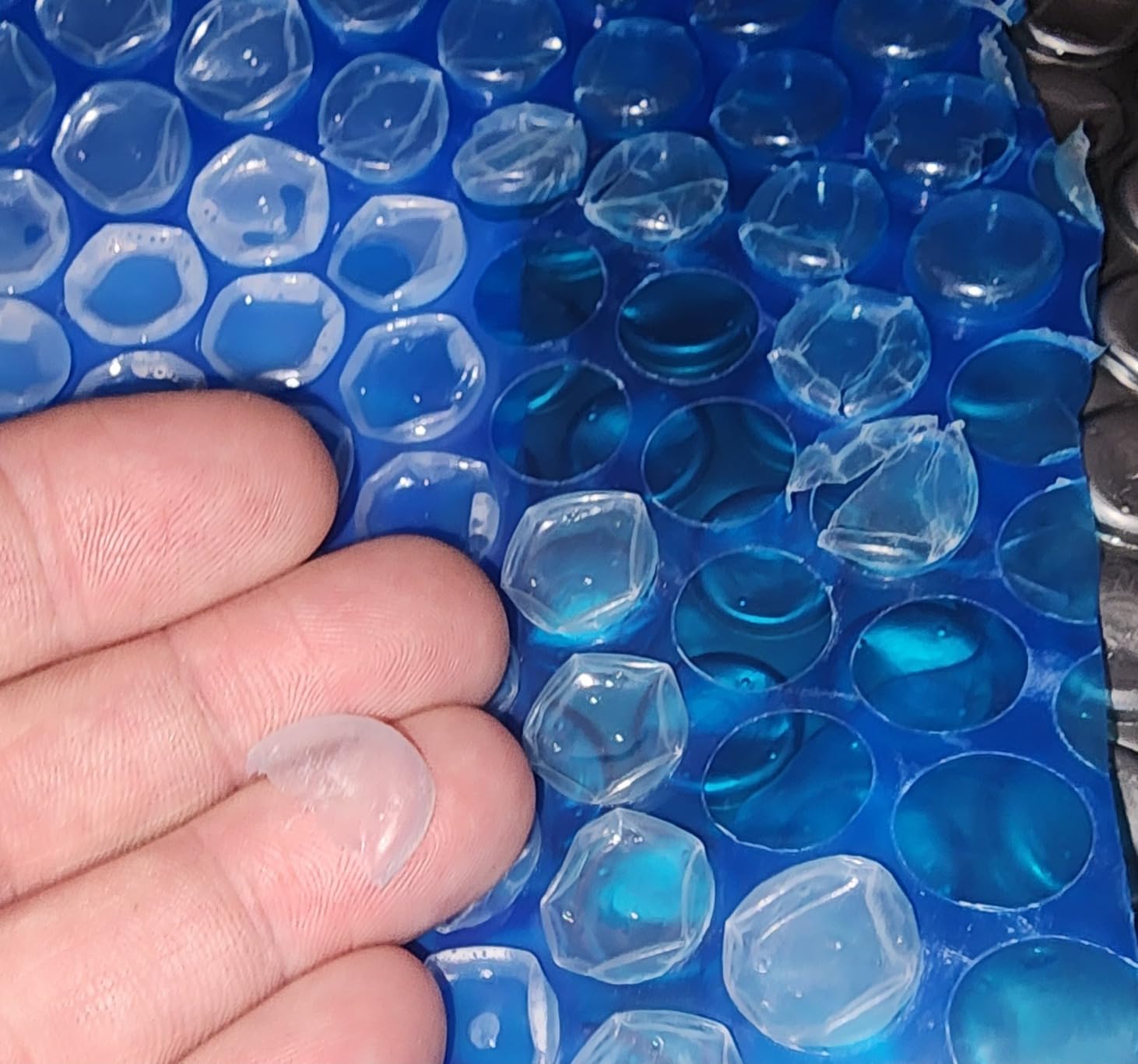
Reviewers confirm it does exactly what it claims, with 71 percent of ratings at five stars. The PE material is reusable and resists breaking and fading, and it floats over hot tubs, spas, pools, and ponds with no installation work.
One thing to know before you look at the listing dimensions: the stated 15.55 by 12.2 inch figure describes the folded package, not the sheet itself. The flat sheet measures 6 by 6 feet, and it needs trimming for anything larger.
What you should know before you order
The coverage is the smallest in our list, so if your tub is larger than 6 by 6 feet you are cutting and joining. Buyers trimming it report that a rushed cut leaves edges that leak evaporation straight back out.
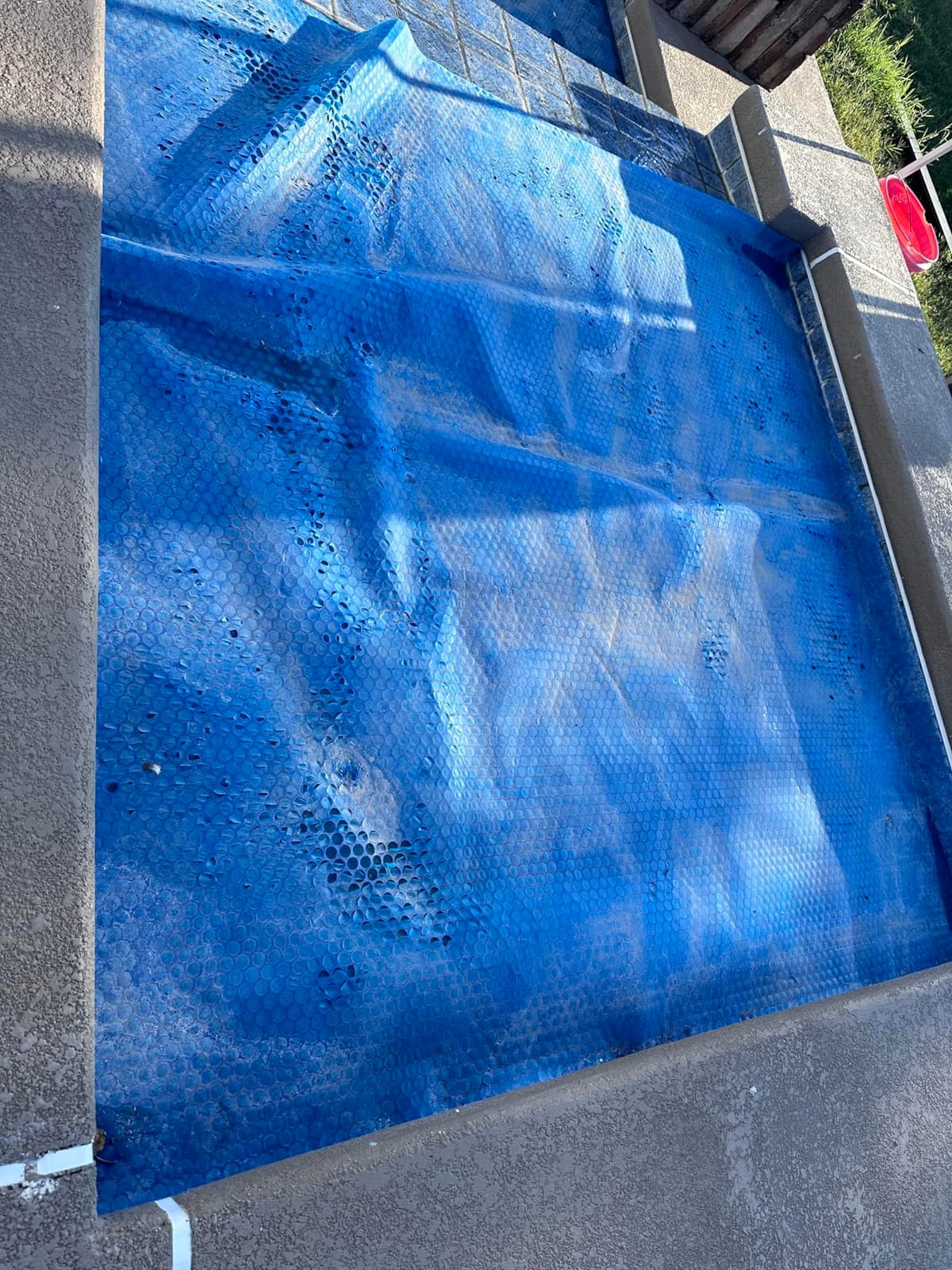
It is a seasonal item. Ten percent of ratings are 1-star, and the complaints concentrate on the film losing usefulness after a season or two rather than on any defect at delivery. Value is the selling point here, not longevity.
Who this cover suits best
This suits owners of a small square tub who want to cut evaporation and block leaf debris for one season at a low outlay. It also suits anyone with a pond or small pool who wants a second piece of film on hand.
It offers nothing to owners in heavy snow regions, since a floating sheet carries no load at all. If snow load is your concern, this is not the product category to buy in.
What Makes a Cover Cold-Climate Rated
Foam density is the number most listings bury and the one that matters most. A 2 lb per cubic foot EPS core holds its shape under snow load; a 1 lb core compresses and takes a permanent set after one bad January. If a listing does not state density, ask before you order.
Thickness comes next, and cold regions should read 4 to 6 inches. Each inch adds measurable R-value, which is why the deeper builds in our list also tend to be the ones weighing 55 pounds and up. Taper runs alongside thickness: a 6 inch to 4 inch profile means the center is deepest and the edge is shallow, which is what pushes meltwater off the cover instead of pooling in the middle where it freezes.
The vapor barrier is the anti-waterlogging layer. A heat-sealed multi-ply barrier stops spa steam condensing inside the foam, and that condensation is the single leading cause of a cover that gets heavy and sags after four to six years of service. Check whether the foam is fully wrapped, not just topped.
Finally, the steam stopper at the hinge. The hinge seam is the largest opening in any cover, and it is where heat escapes fastest and where wind finds a lip to grab. A full-length steam stopper closes that gap and is a worthwhile upgrade on any cold-region build.
How to Measure Your Tub for a Custom Cover
Get these four measurements right and a custom cover will seal properly. Get them wrong and you will be replacing it in a season, which erases any saving from buying a cheaper build.
1. Identify the shape. Square, rectangular, round, octagon, and rounded-corner tubs all need a different pattern, and square tubs with a radius are the most commonly mis-ordered.
2. Measure full width and length across the widest points, including the coping. Measure where the cover needs to hang, not just the shell of the tub.
3. Determine the corner radius. This is the measurement most people get wrong. Measure the straight run along one edge from the corner to where the curve begins, and compare it against the radius options offered by the builder.
4. Choose thickness and taper based on your snow load rather than on price. If your site gets wet heavy snow, step up one thickness level. Most builders offer 4, 5, and 6 inch cores, and the custom builders in our list all let you pick.
Submit the dimensions twice. A second pass takes two minutes and catches the transposition errors that account for most of the one-star reviews we read.
How Much Snow Can a Hot Tub Cover Hold?
Most standard soft covers handle roughly 1 to 2 feet of light, fluffy snow before the core starts to suffer. Past that depth, or after just a few inches of wet heavy snow, the load exceeds what an open-cell foam core can carry and the cover begins to sag.
Sagging is the failure point that matters, because a sagging cover breaks the seal at the edges and water pools where the crown used to be. That pooled water refreezes, adds weight, and accelerates the collapse. In our read of the reviews, this is how most covers are lost in heavy-snow regions rather than by a single catastrophic event.
Two habits prevent it. Clear snow in stages rather than in one pass, so you never put the full load on at once. And if you find yourself shovelling more than a foot of powder in a single storm, that is a signal your cover is undersized for your climate, not a maintenance failure.
A hard top shell is the answer when you clear snow more than a few times a winter. It carries the load on a rigid structure and never pools, which is why it is the standard recommendation in the snowiest northern areas and Canadian provinces.
Is Your Cover Waterlogged? Five Signs and the Fix
A waterlogged cover is heavier than it used to be, sags toward the water, and slowly stops insulating. These are the five signs we check, in order of how reliably they show up.
1. It is noticeably heavier than when it was new. Not heavier from snow, heavier from the cover alone.
2. The middle dips toward the water when nobody is standing on it.
3. You can hear sloshing or see water movement if you press the panels.
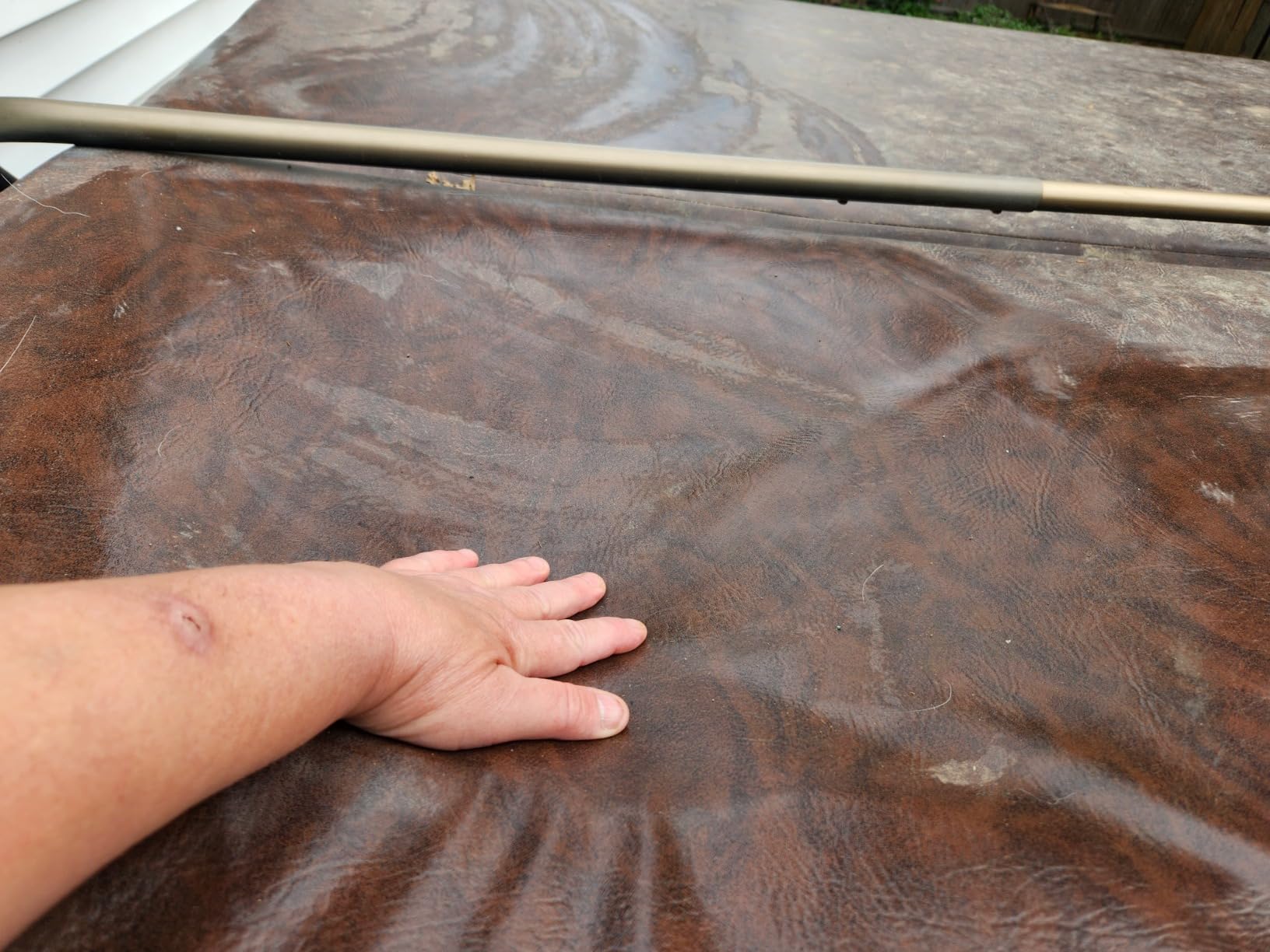
4. The vinyl skin feels cool and damp rather than firm and dry to the touch.
5. The cover no longer sits flat at the edges, so the seal breaks and heat escapes.
The fix depends on severity. For a cover that is heavy but not broken, pull the core panels out and dry them, flip the panels so the crown faces upward, and leave them spread out in sun and air for a few days. Owners on sagging-cover threads report that flipping the panels reverses the downward sag, because the foam deforms toward the crown over time.
Several owners also swap a new closed-cell core into an old cover whose vinyl skin is still in good shape, which costs far less than a full replacement. If the core itself is cracked or crumbling, that repair stops working, and a broken core from heavy snow load is the most serious form of this damage. Replace it.
Preventing the problem takes three things: a heat-sealed vapor barrier, a cover that actually fits so warm steam cannot get in, and a floating blanket or thermal layer that keeps the underside of the foam from sitting in damp air all season.
Winter Maintenance and Wind Lift
Wind lift is the problem owners in Ontario and the upper Midwest mention most, and it is not about cover strength. It is about how the cover is anchored, so start with the straps and work outward from there.
Use every strap the cover came with, tightened evenly, and add a wind bar or extra anchors if your site is exposed. A cover lying flat with slack around the edge gives wind a lip to get under, and once air gets underneath, the cover acts like a sail. Rounded corners shed wind better than square ones.
Clear snow before it settles rather than after. Fresh powder at six inches is manageable; the same snowfall compressed into a wet half-foot is not. Keep a plastic shovel nearby and never use a metal blade on the vinyl, since a single gouge becomes a tear under the next load.
Clean the vinyl a couple of times a season with mild soap and water and let it dry completely. Then apply a UV protectant. Cold regions get low-angle sun through the whole winter, and UV damage is what turns a good vinyl skin brittle and crack-prone after a few seasons.
One safety habit closes this section. If your cover doubles as a safety lock, remember that it has to come off before you add chemicals, and chemicals should never go into the water with the cover on. A lock that releases in freezing weather is worth less than the bubble it was meant to prevent.
Running Your Tub in Winter vs Winterizing It
There is no fixed temperature where a hot tub stops working, but there is a practical answer to how cold is too cold. Water left in a tub in a region with deep freeze is what causes catastrophic damage when a pump fails, a heater quits, or power goes out, because the ice expands against the shell and plumbing.
If you run the tub through winter, protect it in order. A floating bubble blanket sits on the water to cut evaporation, a properly fitted custom cover seals the top, and a thermal blanket between them adds a final layer. Owners running tubs through a Canadian winter report this stack holding heat well enough that the heater cycles far less often.
If you are closing the tub for the season, drain it fully, blow out the lines, leave the jets open, and leave the cover on loose rather than strapped down so any residual ice has somewhere to go. A cover strapped over a draining tub can trap expansion pressure.
Can you soak while it snows? Yes, if the cover is off and the tub is running, but stay out of the water if a load-bearing cover is overhead, and never stand on a foam cover that is not rated for it.
Shelters and Enclosures That Pair With a Cover
A cover and a shelter solve different problems, and pairing them works. The cover handles heat loss, moisture, and debris. The shelter handles snow load and wind lift, which is the pair of problems a cover alone can never fully solve.
A gazebo or pergola over the tub takes the weight of accumulating snow before it reaches the cover, and blocks the wind that causes lift. Owners on r/hottub threads recommend a two-sided shelter with curtains if you want to keep using the tub through the winter, since it turns wind chill into a non-issue.
The simplest version is a hard top shell. It is not an enclosure, but it moves the snow load onto a rigid structure, which is the single biggest upgrade a heavy-snow owner can make.
Whatever you build, keep airflow in mind. A fully enclosed structure traps moisture, and a cover in a damp enclosure will waterlog faster than one in open air.
Frequently Asked Questions
What are the best hot tub covers for winter?
The best hot tub covers for winter combine a high-density virgin EPS foam core around 2 lb per cubic foot, a 6 inch to 4 inch taper that sheds snow, marine-grade vinyl skin, and a heat-sealed vapor barrier with a full-length steam stopper. Custom foam builds of 4 to 6 inches are the best all-round answer, while hard top shells are worth the extra cost in heavy snow regions.
What is the best hot tub cover for snowy conditions?
For snowy conditions, prioritize foam thickness and a strong taper over anything else. A 5 or 6 inch custom foam core holds its shape under load, while a shallower cover sags and begins pooling meltwater. In regions with repeated heavy snowfall, a hard top shell that carries the load on a rigid frame removes the problem entirely.
How thick should a hot tub cover be for winter?
For winter, aim for 4 to 6 inches of foam thickness. Most builders offer 4, 5, and 6 inch cores, and each additional inch adds measurable R-value. The taper matters as much as the depth, so look for a profile around 6 inches at center down to 4 inches at the edge so meltwater runs off rather than pooling and refreezing in the middle.
My hot tub cover is waterlogged. What should I do?
Pull the core panels out, flip them so the crown faces upward, and spread them in sun and air for a few days. Flipping reverses the downward sag that develops over time. If the foam is cracked or crumbling rather than merely heavy, no drying will help and the core should be replaced, either as a new panel or as a closed-cell swap into the existing vinyl skin.
What can I use instead of a hot tub cover?
A floating bubble blanket or a closed-cell thermal sheet is the practical alternative, and it works best as a layer inside a system rather than as a replacement for one. Bubble blankets cut evaporation substantially and keep the underside of a hard cover dry, but they carry no snow load and no seal. A hard top shell or a shelter is the alternative when the real problem is weight rather than heat loss.
What is the best way to enclose my hot tub for winter?
A gazebo or pergola over the tub handles snow load and wind lift, which a cover alone cannot. Owners running tubs through winter often add curtains to a two-sided shelter to block wind chill. Keep some airflow in any enclosure, since trapped moisture makes a cover waterlog faster rather than slower.
Final Verdict for Cold-Climate Owners
If you take one thing from this roundup of the best hot tub covers for cold climates, make it the spec list rather than the brand. Foam density, taper profile, vapor barrier, and steam stopper decide whether a cover survives your winter, and those four numbers are published on every reputable listing.
Our pick for most owners is the Cover Guy Premium custom build, with the stiffer foam and full wrap worth paying for at the ordering call. Go deeper on foam at the BeyondNice Ultra 6 inch cover if you get heavy snow, or choose MySpaCover if your tub has an unusual shape and you want the 5-year option. Add a floating bubble blanket underneath whichever cover you pick, and check your core panels every spring.