
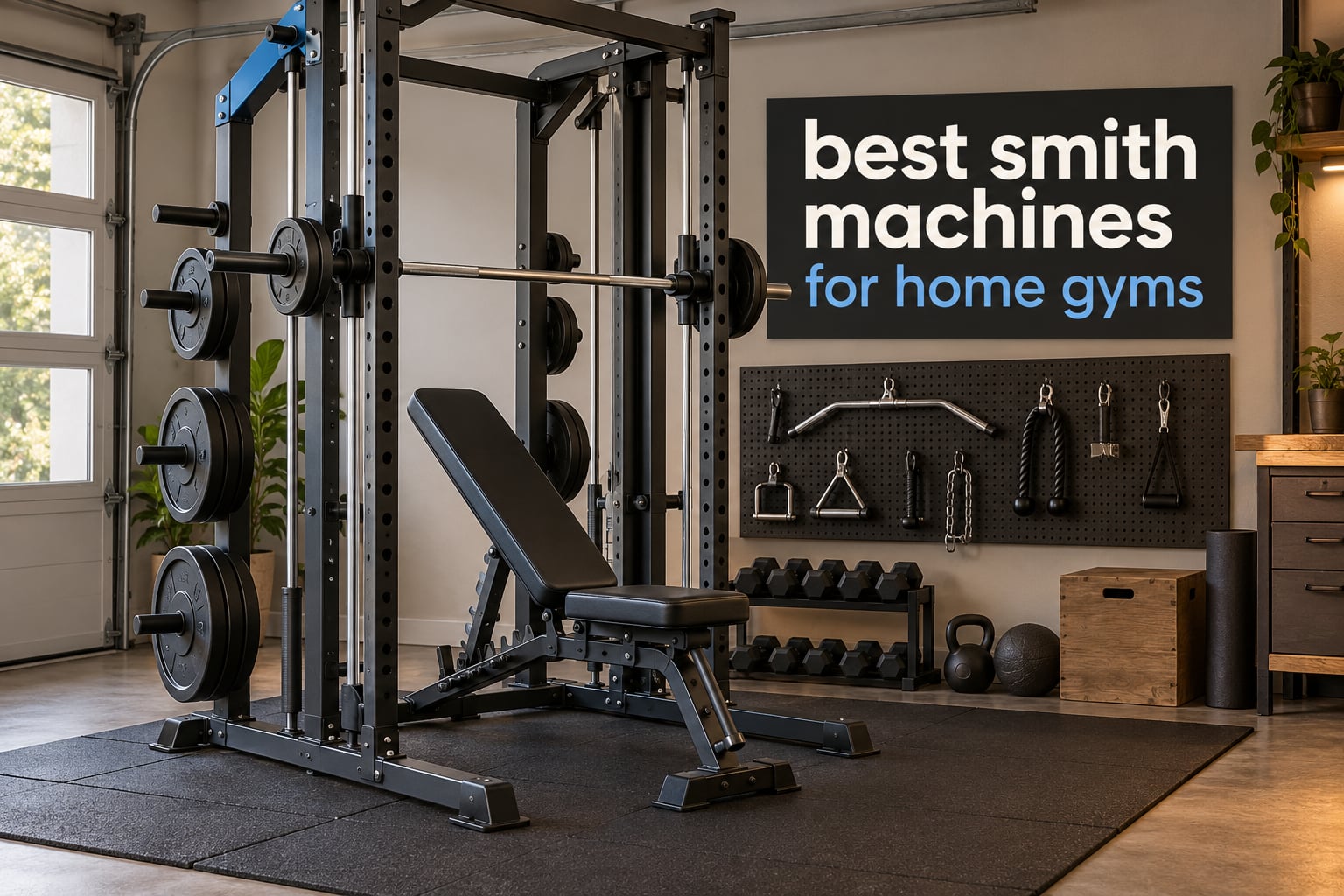
Yes, a Smith machine is worth it for a home gym if you train alone. The bar rides on fixed vertical rails with hooks at several heights, so you can squat, incline press and shoulder press to failure without a spotter standing behind you, and you can rack the bar with a wrist twist at the end of a set. That single feature is why a guided bar keeps showing up in home setups, and it is why this guide to the best Smith machines for home gyms in 2026 is built around that question rather than around brand names.
A Smith machine is a barbell mounted on welded guide rods. The bar can only travel in one straight vertical path, and it drops into a catch or lockout point when you twist your wrist. Underneath that simple idea sit two decisions that decide whether the machine feels like a commercial rig or a frustrating compromise: linear bearings versus bushings on the guide rods, and a counterbalanced bar versus a standard bar. Get those right and the machine becomes a fixture you will keep for years. Get them wrong and the bar sticks halfway up.
We compared 10 Smith machines and cable cages across frame steel, bar travel system, rated capacity, pulley ratio, weight stack design, footprint and warranty length. We do not physically test heavy equipment in a spare room, so everything here comes from published specifications and from what owners report after living with the machine, and we say which is which. Use the smart home gym picks if you want guided motion without owning steel at all, and come back here once you decide a real bar path is worth the floor space.
Table of Contents
Top 3 Best Smith Machines for Home Gyms in 2026


The Marcy wins the top slot because it is the only machine here with a large, long-lived owner base, which means the failure modes are well documented rather than theoretical. The DONOW pairs a high rating with meaningful review volume and is the only one that hides both weight stacks inside steel shrouds. The SunHome is the pick if you want a full cage, Smith bar and cable station on the smallest outlay of anything in this list.
All 10 Smith Machines Compared for Home Gyms (October 2026)
| Product | Specifications | Action |
|---|---|---|
| Marcy Smith Cage MD-9010G |
|
Check Latest Price |
 SunHome SH-999 Smith Machine Power Cage SunHome SH-999 Smith Machine Power Cage |
|
Check Latest Price |
| DONOW Smith Machine with Weight Stacks |
|
Check Latest Price |
 Mikolo Smith Machine with Dual Weight Stack Mikolo Smith Machine with Dual Weight Stack |
|
Check Latest Price |
 Mikolo M4 2.0 Lite Smith Machine Mikolo M4 2.0 Lite Smith Machine |
|
Check Latest Price |
 RitFit M1 Pro Smith Cable Crossover RitFit M1 Pro Smith Cable Crossover |
|
Check Latest Price |
 pooboo P43 Power Cage Smith Machine pooboo P43 Power Cage Smith Machine |
|
Check Latest Price |
 Major Fitness Drone2 Advanced Smith Major Fitness Drone2 Advanced Smith |
|
Check Latest Price |
 SNODE ALL10 All-in-One Smith Machine SNODE ALL10 All-in-One Smith Machine |
|
Check Latest Price |
 JELENS M21 Multi-Function Smith Cage JELENS M21 Multi-Function Smith Cage |
|
Check Latest Price |
The 10 Best Smith Machines for Home Gyms Reviewed
1. Marcy Smith Cage MD-9010G, Best Overall Smith Machine for a Home Gym
Marcy Smith Machine Home Gym Cage with Weight Bench & Pulley System MD-9010G
Linear bearing carriage
Alloy steel frame
373 lb machine weight
300 lb max user
Pros
- Linear bearing Smith carriage glides smoothly once greased
- Alloy steel frame with safety catches and adjustable positions
- Leg developer and pec deck cover full-body work
- 1438 owners have documented long-term behaviour
Cons
- Assembly commonly takes 7 to 10 hours and two people
- Instructions do not number or label parts
- Smith bar and rear carriage need regular lubrication
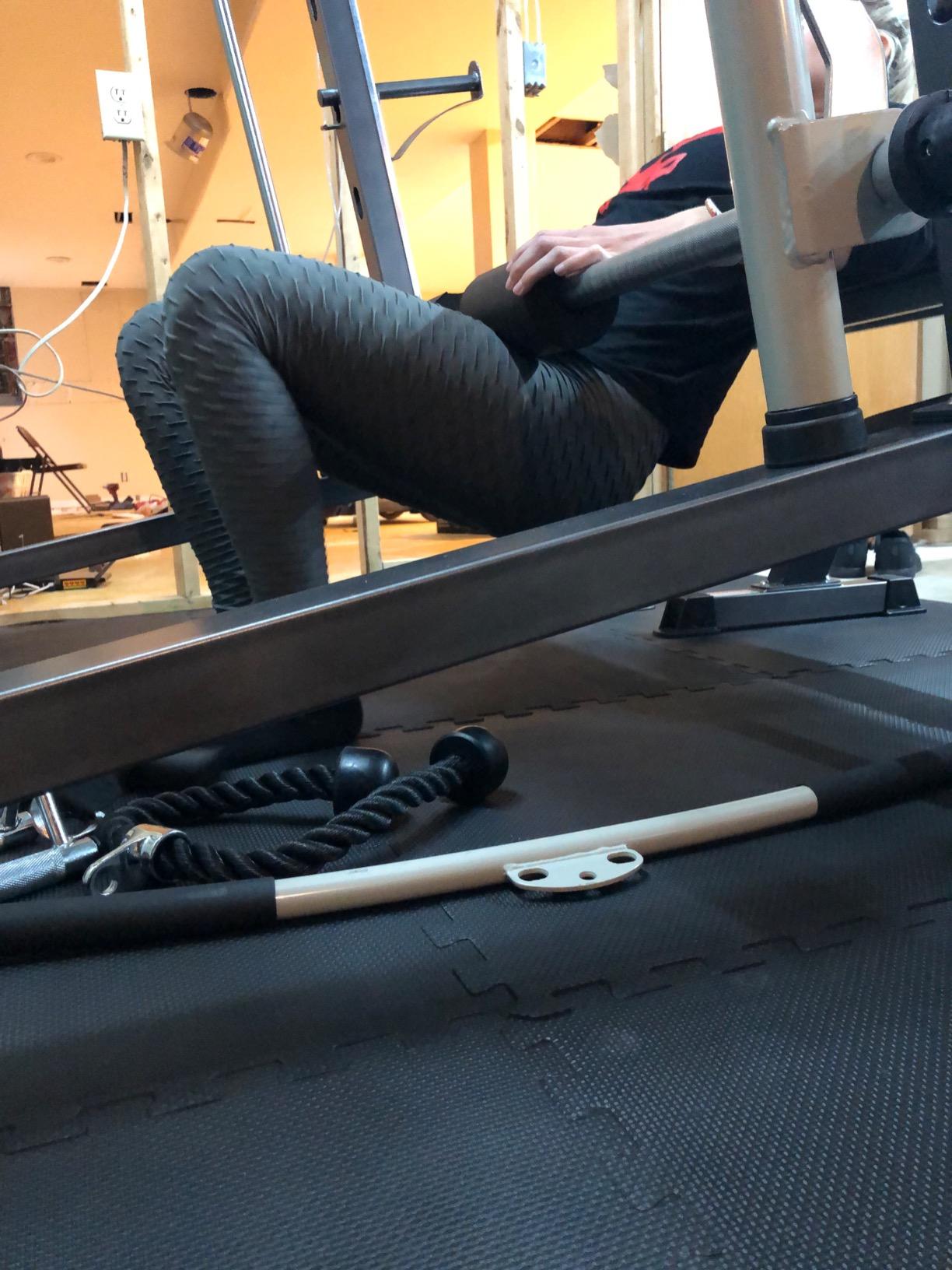
The Marcy MD-9010G is the machine we keep coming back to, and the reason is the size of its owner base rather than any single headline spec. At 1438 reviews it is the most thoroughly documented Smith cage here, which means the complaints you are about to read are the complaints real people actually hit rather than the ones a reviewer predicts. The frame is alloy steel, the Smith carriage runs on linear bearings, and the whole thing weighs 373 lb across a 70 by 79 by 85 inch footprint, which is the part people underestimate because the attached bench is long and the leg developer folds out from it.
What sold us on the bar travel is how the linear bearing carriage behaves once it is lubricated. Owners report a glide that is smooth and quiet rather than merely functional, and the rack of catch points along the uprights lets you squat heavy without a spotter. The rear weight carriage and the pec deck are what turn this from a rack into a full-body station, and the safety catches adjust to several positions as standard.

The honest drawback is assembly. Owners consistently report 7 to 10 hours and a second pair of hands, and the instructions do not number or label individual parts, so matching hardware is a slow job. Cable routing is the other weak point in the manual, and it is the step where wires most often end up threaded incorrectly. Budget a full weekend rather than an evening.
There is a maintenance habit worth building in from day one. The chrome Smith bar and the rear weight carriage both need silicone or lithium grease before they will run properly, and owners who skipped that step are the ones who describe a grinding, sticking bar. Two more practical notes: Olympic plates and an Olympic bar are not included, so budget for those separately, and the bench seat and curl pad latches have to be unscrewed to adjust rather than popped.
Who the Marcy MD-9010G suits best
This is the machine for the lifter who wants a squat rack, a bench and a cable station in one footprint and is willing to spend a weekend on assembly. It also suits anyone who plans to progress past beginner loads, because the rated user limit of 300 lb and the heavy frame leave room to grow. If you already own a rack and a cable column, this is redundant and you should buy something else.
It is a poor fit for a rented space where bolting a 373 lb frame to the floor is not an option, and for anyone in a hurry. It is also the wrong first machine for a small apartment, where the footprint plus bench plus leg developer eats a whole wall of a room.
Where the Marcy falls short
The bench and leg developer need more floor space than most buyers plan for, and owners report the rear loading-pin carriage can bind and snag. Instructions that skip part labels turn a 7 to 10 hour build into a frustrating one, so if you are not comfortable with a spanner and a diagram, budget for help.
At 4.4 average it is not the highest-rated machine on this list, which tells you something useful: the design is proven rather than exciting. That is exactly what we want from a primary piece of home equipment, and it is why this is the first stop for most people building a home gym.
2. SunHome SH-999, Best Value Smith Machine for a Home Gym
SunHome Smith Machine, 2000LBS Power Cage Squat Rack with Smith Bar, LAT Pull-Down Systems, Cable Crossover Machine for Home Gym (Black, S4)
2mm steel square frame
410 lb frame weight
440 lb total weight
Auto-lock safety hooks
Pros
- Rolling bearing pulleys run smooth and noticeably quiet
- Auto-lock safety hooks rack the bar at any angle
- 6 plate posts plus barbell post and accessory hooks
- 410 lb frame resists rocking under load
Cons
- Diagram-only instructions with unnumbered pieces
- No tools included for assembly
- Excess cable slack on the seated row and upper lines
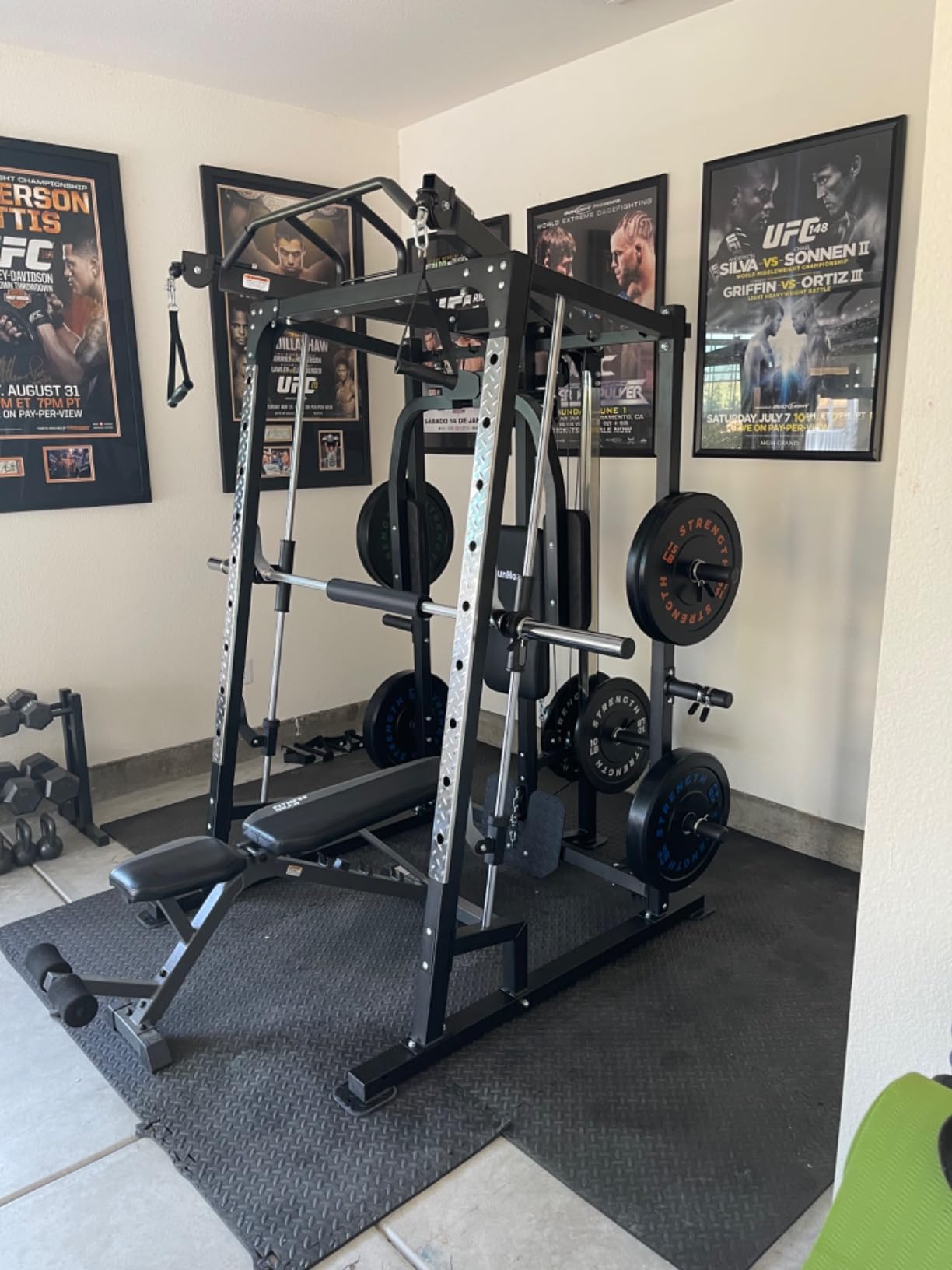
The SunHome SH-999 is the reason we do not treat a modest budget as a compromise. It packs a 2mm thickened commercial steel square frame with a 410 lb frame weight into a 87 by 65.7 by 60.3 inch footprint, and owners report it does not rock when loaded. The rolling-bearing pulley system is the detail we would have expected only on a pricier machine, and it runs smooth and noticeably quieter than sliding pulleys.
The auto-lock safety hooks are the reason this cage appeals to solo lifters. You can lock the bar at any angle, which means a failed bench press ends with the bar parked rather than on the floor. Add 6 weight plate posts, a barbell storage post and accessory hooks, and this is a full station rather than a bar in a frame.
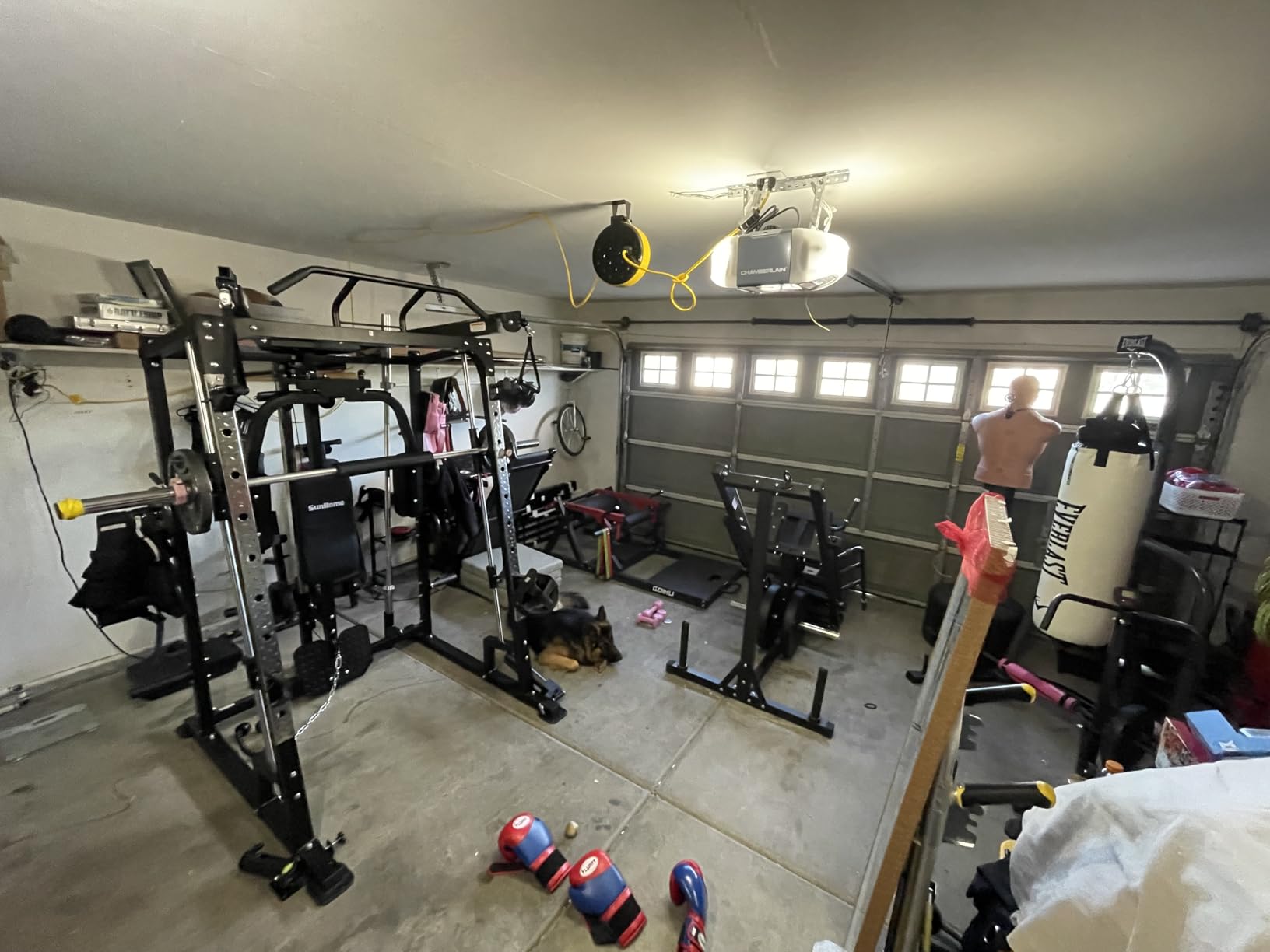
Documentation is the weak point. Assembly instructions are diagram-only with unnumbered pieces, which owners report as genuinely frustrating, and no tools are included at all. It also arrives in three large, heavy boxes, so moving them indoors is a two-person job before the build even starts. Set aside the better part of a day.
Two functional issues are worth weighing. Cable slack is excessive on the seated row and the upper cables with no adjustment, so you will spend a little time dialling that in before it feels right. The Smith bar is guided but not hooked to a cable, which means it can sit slightly uneven, and the butterfly chest station is awkward enough that some owners move it out of the way of the squat path.
Who the SunHome SH-999 suits best
This is the pick for a first home gym where you want a cage, a Smith bar and a cable station without assembling three separate pieces of equipment. It suits beginners who will grow into the loads, and it suits anyone who values quiet running cables in a shared house. The 440 lb total weight means you will want a second person on moving day.
It is a weak fit for anyone who plans to squat seriously heavy for years, because the guided bar and modest frame are tuned more for general fitness and hypertrophy than for maximal attempts. It is also a poor choice for a shared garage, because the butterfly chest station sits in the squat path and has to be moved around.
Where the SunHome falls short
Unnumbered, diagram-only instructions are the recurring theme, and they cost real time on a machine this size. The butterfly station sitting in the squat path is the second most common irritation, and the unadjustable cable slack on the row is the third.
One-year warranty coverage is also the shortest we would ideally see, so treat it as a machine to service carefully rather than one to neglect. Set that against the rolling-bearing pulleys and 410 lb frame and it is still a strong starting point.
3. DONOW Smith Machine with Weight Stacks, Best Rated Cable Setup
DONOW Smith Machine with Weight Stacks Home Gym System Cable Crossover
Dual 352 lb weight stacks
2:1 cable crossover
Linear bearing Smith bar
2240 lb max
Pros
- Enclosed dual weight stacks remove plate loading for cable work
- True independent dual crossover with a 2:1 ratio
- Steel shrouds keep cables and weights contained
- 4.6 average across 247 owners
Cons
- One of the widest footprints in the roundup at 78.58 inch
- Arrives in 8 separate boxes
- Aluminum pulleys are an option rather than standard
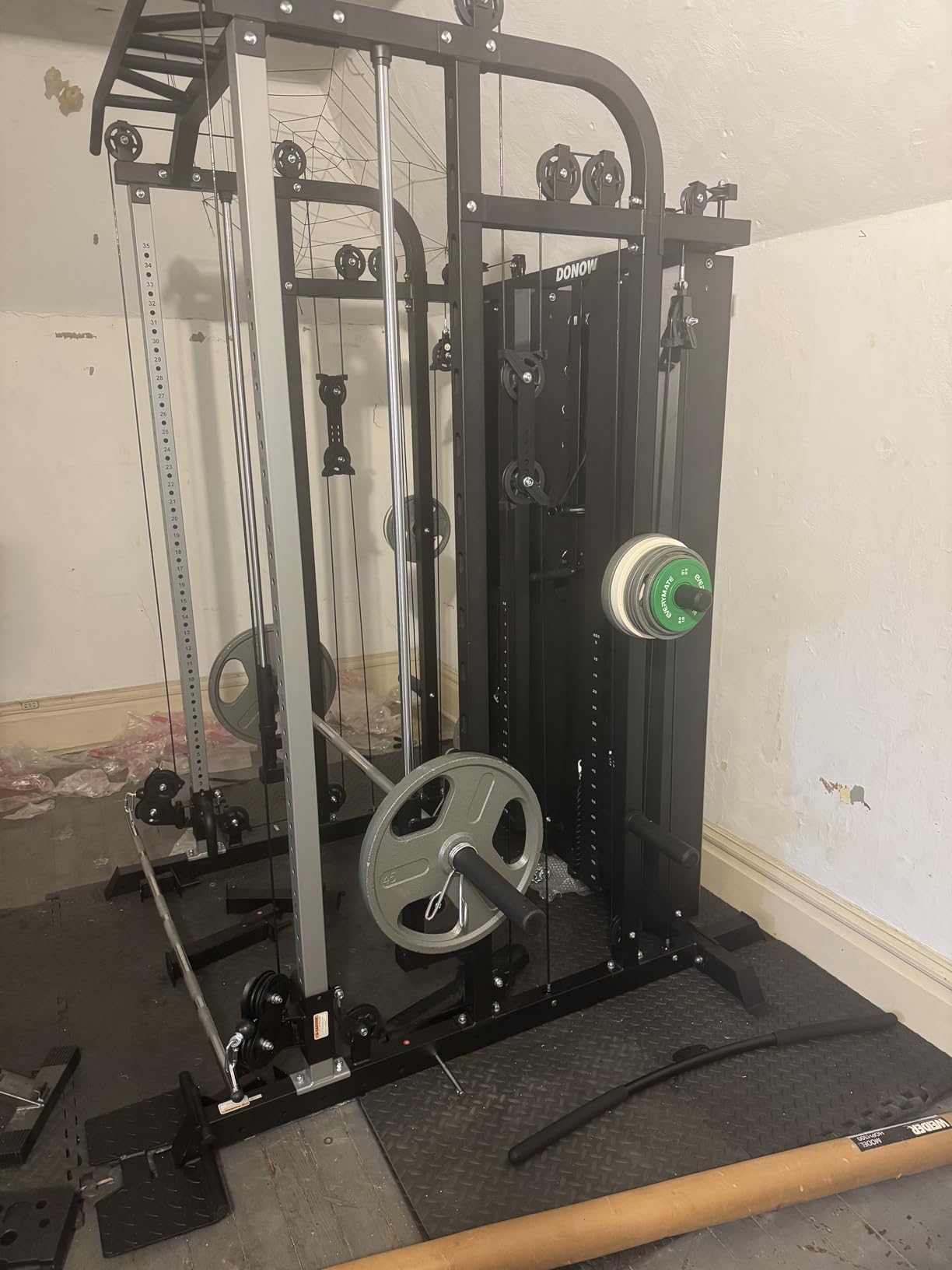
The DONOW is the machine we would buy if cable work mattered more than barbell work. It carries two enclosed weight stacks totalling 352 lb, so you get selectorized resistance without loading a single plate, and a true independent dual cable crossover with a 2:1 ratio. That combination is what separates it from the plate-loaded cages in this roundup, and it is why the machine holds a 4.6 average across 247 reviews with about 75 percent five-star ratings.
The enclosed stacks are the sleeper feature. Steel shrouds keep the cables and weights contained, which tidies the footprint and stops loose hardware from wandering into the bar path, and the dual stacks can be used by two people at once. The Smith side runs on a linear bearing bar mounted to solid poles, on a 2 by 2 inch steel frame rated to 2240 lb.
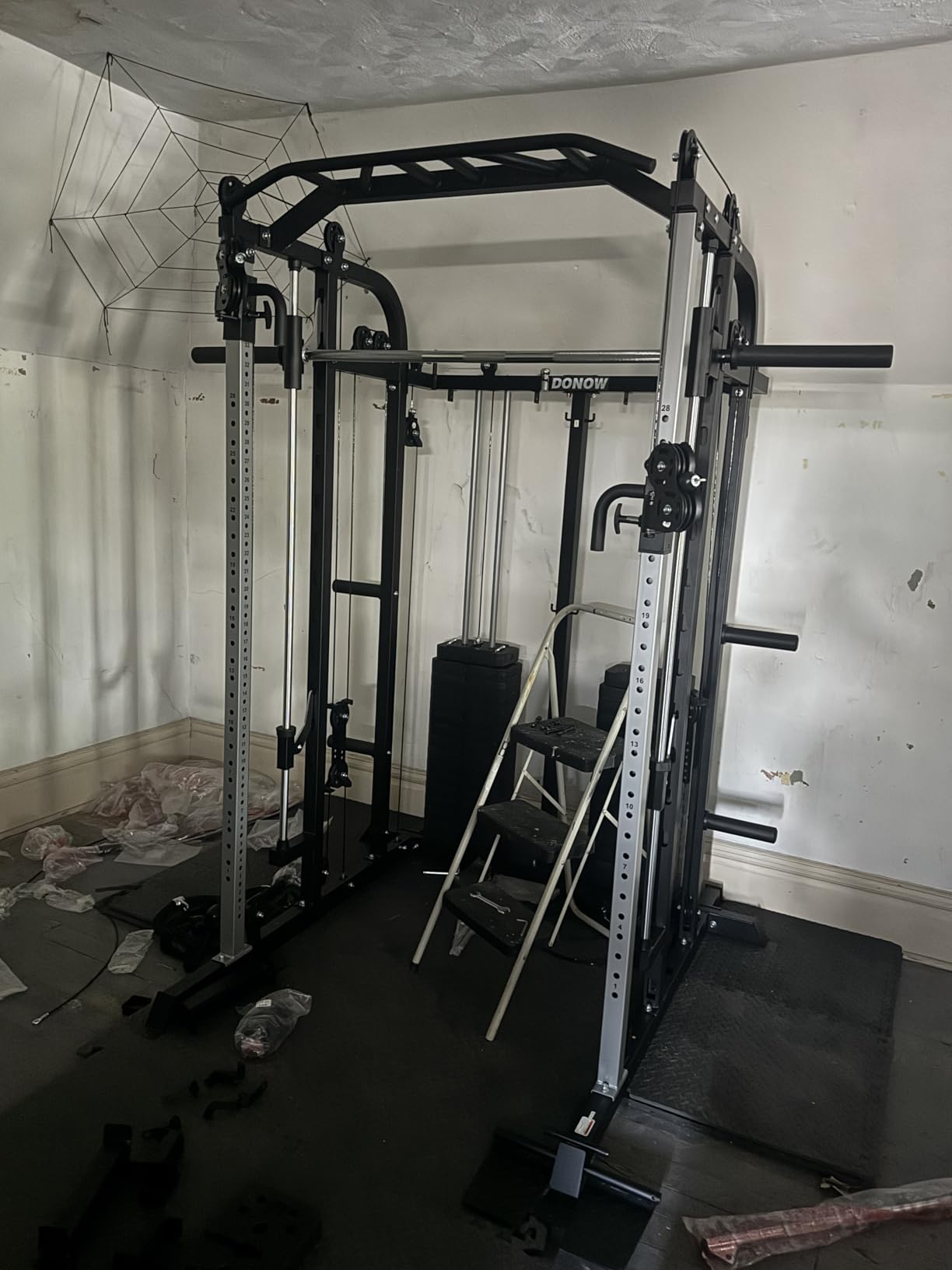
Size is the real cost here. At 54.7 inches deep by 78.58 inches wide by 88 inches tall, this is one of the largest frames in the roundup, and you need genuine floor space plus room to swing the arms. Logistics are heavier too, because the weight-stack configuration arrives in 8 boxes rather than one pallet.
One spec detail catches us out: the aluminum pulleys that the highlight copy mentions are listed as an available option rather than standard equipment. If smooth quiet cable travel is the reason you are looking at this machine, check what is actually in the box before you commit. Everything else about the build reads as solid, and the linear bearing Smith bar holds stable under load according to owners.
Who the DONOW suits best
This is the pick for someone whose training is split between the barbell and cables, especially anyone who wants two people to work at the same time without a second machine. The 2:1 ratio makes cable work feel manageable for beginners who would otherwise be underloading plates. It also suits tidy, organised garages, because the shrouded stacks keep the machine visually contained.
It is a poor fit for a small room or a low-ceiling basement, where 78.58 inches of width is hard to justify. Anyone who will never touch the cables should look at a cage with a plate-loaded setup instead, because the stacks are where the value sits.
Where the DONOW falls short
The footprint and the 8-box packaging are the two practical drawbacks owners repeat. The optional aluminum pulleys are the third, because they are the difference between ordinary cable feel and very smooth cable feel, and the standard spec sheet does not include them.
At 4.6 with 247 reviews this has one of the strongest rating-to-volume combinations in the roundup, which is why it sits this high despite the size. If your garage can take the footprint, this is the most complete single machine you can put against a back wall.
4. Mikolo Smith Machine with Dual Weight Stacks, Best for Two-Person Training
Mikolo Smith Machine with Weight Stack, Power Cage Home Gym System with LAT Pulldown & Cable Crossover, Multi-Functional Trainer with Dual Pulley System, Includes 12+ Free Attachments
256 lb dual weight stacks
15 degree elevated pivot
2200 lb capacity
87 inch tall
Pros
- Two independent stacks let two people train at once
- Patented 15 degree elevated pivot for pulldown and row
- 264 lb combined capacity for pulldown and low row
- 10 stations and 10+ attachments in one footprint
Cons
- 2:1 ratio means loading about double the felt resistance
- Stock leg hold-down arm pushes you away during pulldowns
- Higher price than comparable cable cages
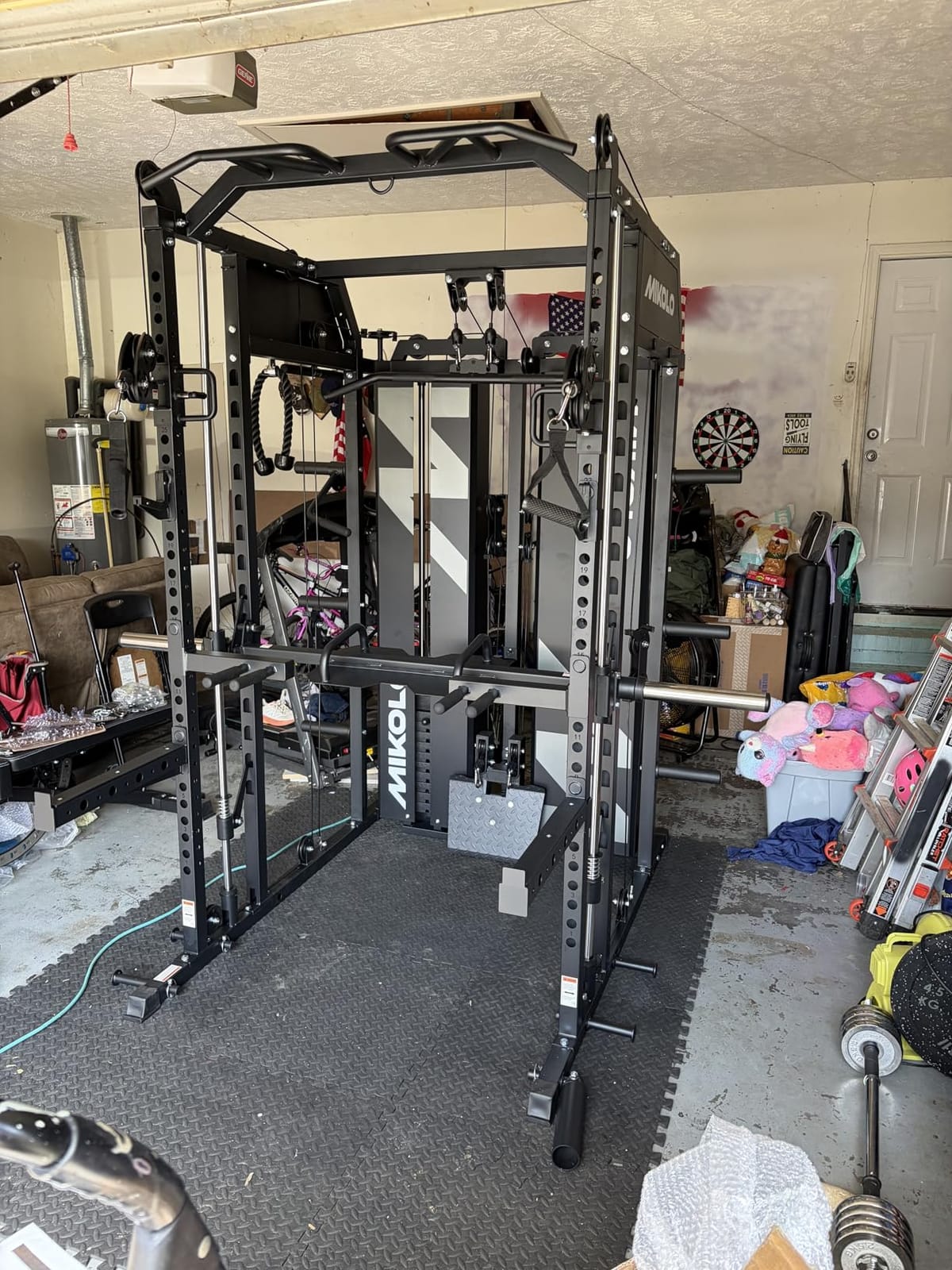
Mikolo built this machine around a single idea: two people should be able to train on it at the same time. The dual weight stack system delivers 256 lb total, 128 lb per side, and the pulley configuration combines two 2:1 stacks for 264 lb of lat pulldown and low row capacity. For a shared garage gym or a household where two people train on the same schedule, that is a genuine structural advantage rather than a spec-sheet trick.
The patented 15 degree elevated cable pivot is the other idea worth understanding. Instead of routing the pulldown line straight down, it lifts the pivot so the cable path comes in from above, which reviewers say improves back engagement and reduces spinal stress. The frame is 50x50mm industrial steel with reinforced joints and a 2200 lb capacity, finished in a military-grade anti-corrosion coating, measuring 87 by 56 by 68 inches.
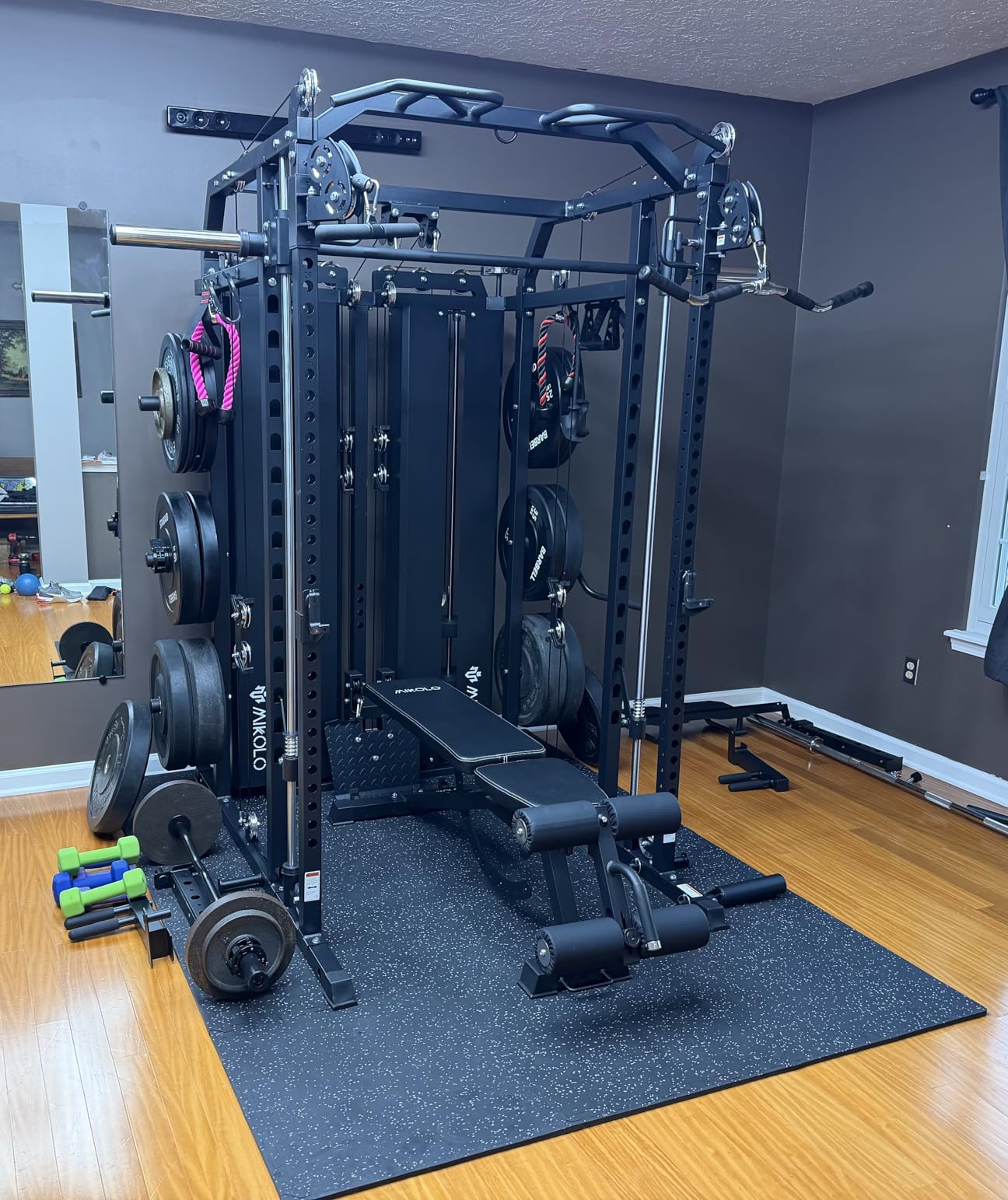
The 2:1 ratio is the catch. Because the system combines two stacks to produce its output, you load roughly twice the weight you actually feel, which makes small loading increments harder and means the machine never feels as heavy as the numbers suggest. If your training depends on precise cable loading, that is a real drawback rather than a technicality.
The included leg hold-down attachment is the other recurring irritation. It mounts to a long spotter arm that physically pushes you away from the machine during lat pulldowns, and Mikolo sells a better version separately. The upside is the accessory list: 10 integrated training positions, more than 10 attachments, 6 weight storage pins and 4 attachment hooks, all inside a cage footprint.
Who the Mikolo SM02 suits best
This is the machine for a two-person household gym, and for anyone who wants a full range of cable positions in one frame rather than a separate functional trainer. The aluminum pulley system delivers smooth, quiet cable travel, and the seamless transitions between pulldown, row and trolley work mean no carabiner swapping mid-session. It suits a garage with roughly 68 by 56 inches of floor to spare.
It is a poor fit for a solo lifter who trains mostly free weights, since much of the value here is in the cable system. It is also a poor fit for anyone who needs to load small cable increments for shoulder or arm isolation work.
Where the Mikolo SM02 falls short
The 2:1 ratio and the stock leg hold-down arm are the two most repeated caveats in the reviews, and both are avoidable only by buying an extra attachment or choosing a different machine. It also sits in a higher specification tier than comparable all-in-one cable cages, which is hard to argue with when you want two-user capability but easy to argue with when you do not.
At 4.4 across 128 reviews it is well regarded, and the build quality is the part owners praise most. This is a premium machine aimed at a specific household, and outside that household the premium buys you features you will not use.
5. Mikolo M4 2.0 Lite, Best for Precise Selectorized Loading
Mikolo M4 2.0 Lite Smith Machine, 2200LBS Power Cage with LAT Pulldown & Cable Crossover, All-in-One Home Gym Squat Rack with Aluminum Pulley System for Full-Body Workouts
117 lb stack per side
9 lb increments
34 rack positions
2200 lb capacity
Pros
- Selectorized stacks step in 9 lb increments for fine control
- 34 height positions at 2 inch spacing
- Top horn pins add 250 lb for 380 lb total
- Built-in Smith bar storage clears the rack interior
Cons
- 2:1 ratio means loading more than the felt resistance
- Stock leg hold-down arm feels awkward on pulldowns
- Deep 70.86 inch footprint makes it a large layout
The M4 2.0 Lite is the version of the Mikolo cage for people who hate loading plates. Each side carries a selectorized stack of 117 lb in 9 lb increments, and the top horn pins accept up to 250 lb more, giving 380 lb of available resistance per side. For hypertrophy work where you care about the difference between 60 lb and 69 lb of cable pull, that is the whole argument.
The rack position count is the quiet hero. Thirty-four height settings at 2 inch hole spacing, plus 2 upper positions dedicated to storing the Smith bar when it is not in use, means you can place the bar or the J-hooks almost exactly where you want them. The redesigned high pulley also gives a fuller lat pulldown range than earlier versions, and the storage system covers J-hooks, safety arms, dip bars, plates, barbell and handles.
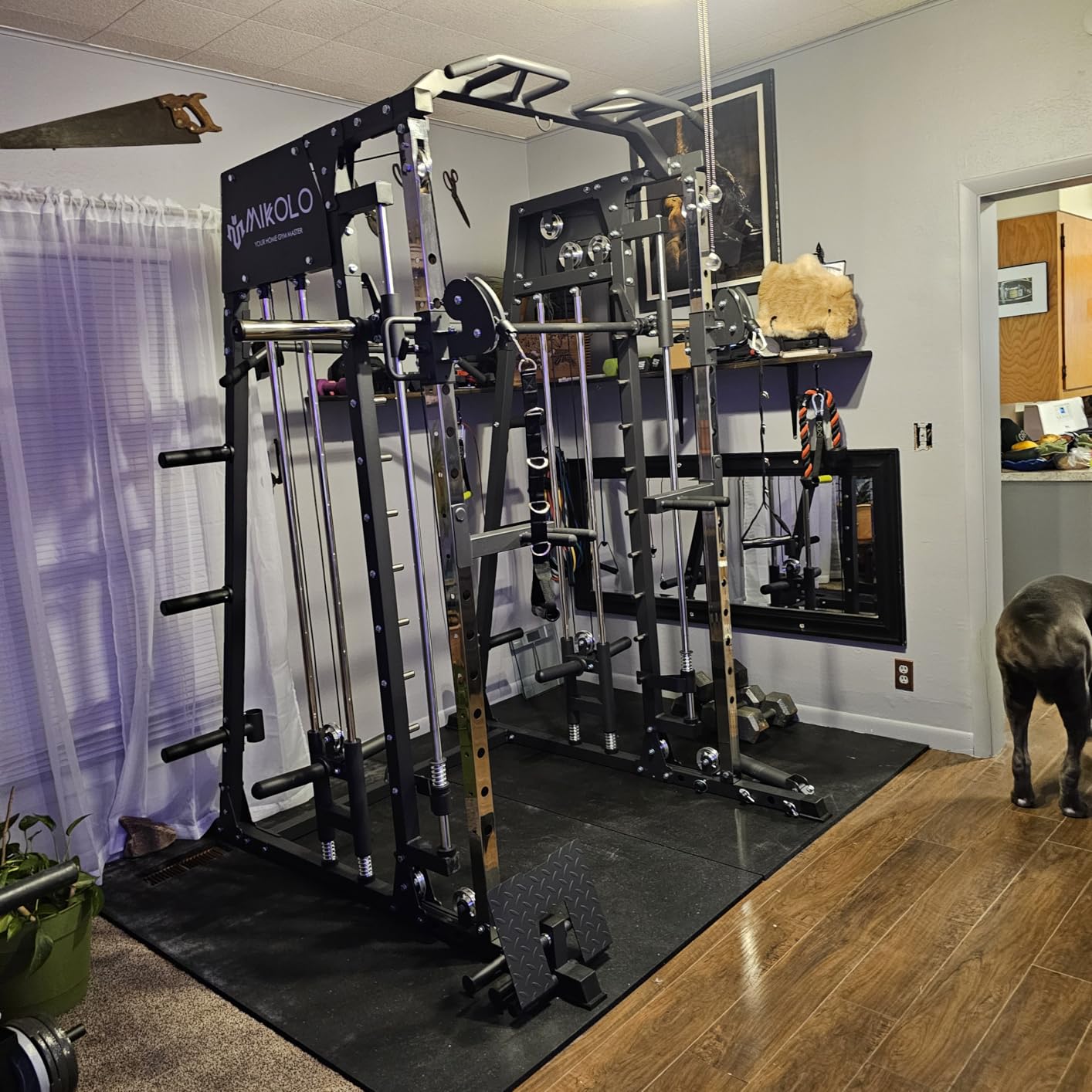
The 2:1 ratio applies here too, so the resistance you feel is roughly half what you have loaded. That is the trade for selectorized loading and most owners accept it, but it does mean the machine tops out sooner than the 2200 lb rated capacity suggests for cable work. The included leg hold-down attachment sits on a long spotter arm and feels awkward, the same complaint that appears on the other Mikolo machine in this list.
Size is the other factor. At 70.86 by 47.3 by 87 inches, the depth makes this one of the larger footprints here, which is a real consideration in a garage already shared with a car. A few buyers also reported damage in transit to pulleys and frame members, and not all pieces are labelled while the included tools are inadequate.
Who the M4 2.0 Lite suits best
This suits anyone who trains two people, or one person twice a day, and who wants to skip plate changes entirely on cable work. The 34-position rack also makes it a good fit for a household with different heights, because each person can set the bar independently. Reviewers call it one of the strongest value combinations of Smith bar and cable station available.
It is a poor fit for a small space, and a poor fit for anyone who wants to load heavy cable for heavy pulling, because the 2:1 ratio caps how much resistance you can generate. Anyone who already owns a good set of plates and is happy to load them will not gain much from the stacks.
Where the M4 2.0 Lite falls short
The 2:1 ratio, the awkward stock leg hold-down arm and the deep footprint are the three repeated caveats, and shipping damage plus unlabelled parts are the practical ones. The 4.3 average across 114 reviews sits mid-pack, which is consistent with a machine that does a lot well and nothing exceptionally.
What it does do is make fine-grained cable loading genuinely easy in a home setting, and that is a niche the plate-loaded cages do not serve. If that is your bottleneck, this is the machine to shortlist.
6. RitFit M1 Pro, Best Smith Machine for Small Spaces
RitFit M1 Pro Smith Machine Cable Crossover Power Cage Home Gym
Linear bearing carriage
2 x 2 inch uprights
1850 lb capacity
11 Smith heights
Pros
- Stable in the pull-up position with no wobble under load
- Dual slide rail crossover with aluminum pulleys
- Landmine attachment locks the bar securely
- Parts support sends replacements quickly
Cons
- Lighter 14 gauge steel torques during assembly
- Arrives scratched from heavy freight handling
- Smith springs can block hip thrusts for shorter users
The RitFit M1 Pro is among the most compact machines in this roundup at 63 by 47.8 by 85.2 inches and 360 lb, and unlike many compact cages it does not feel like one. The 2 by 2 inch steel uprights carry an 1850 lb rating, and the Smith carriage runs on linear bearings with bottom spring shock absorption and 11 selectable heights. Owners single out stability in the pull-up position under load as the standout trait.
The cable side uses a dual slide rail crossover structure with aluminum pulleys and rubber cable balls, which reviewers describe as smooth through the full range and quick to adjust. The accessory list is unusually complete for the size, including a landmine that actually locks the bar rather than letting it slide out, plus a T-bar, dip handles, J-hooks, safety spotter arms, band pegs and handles.
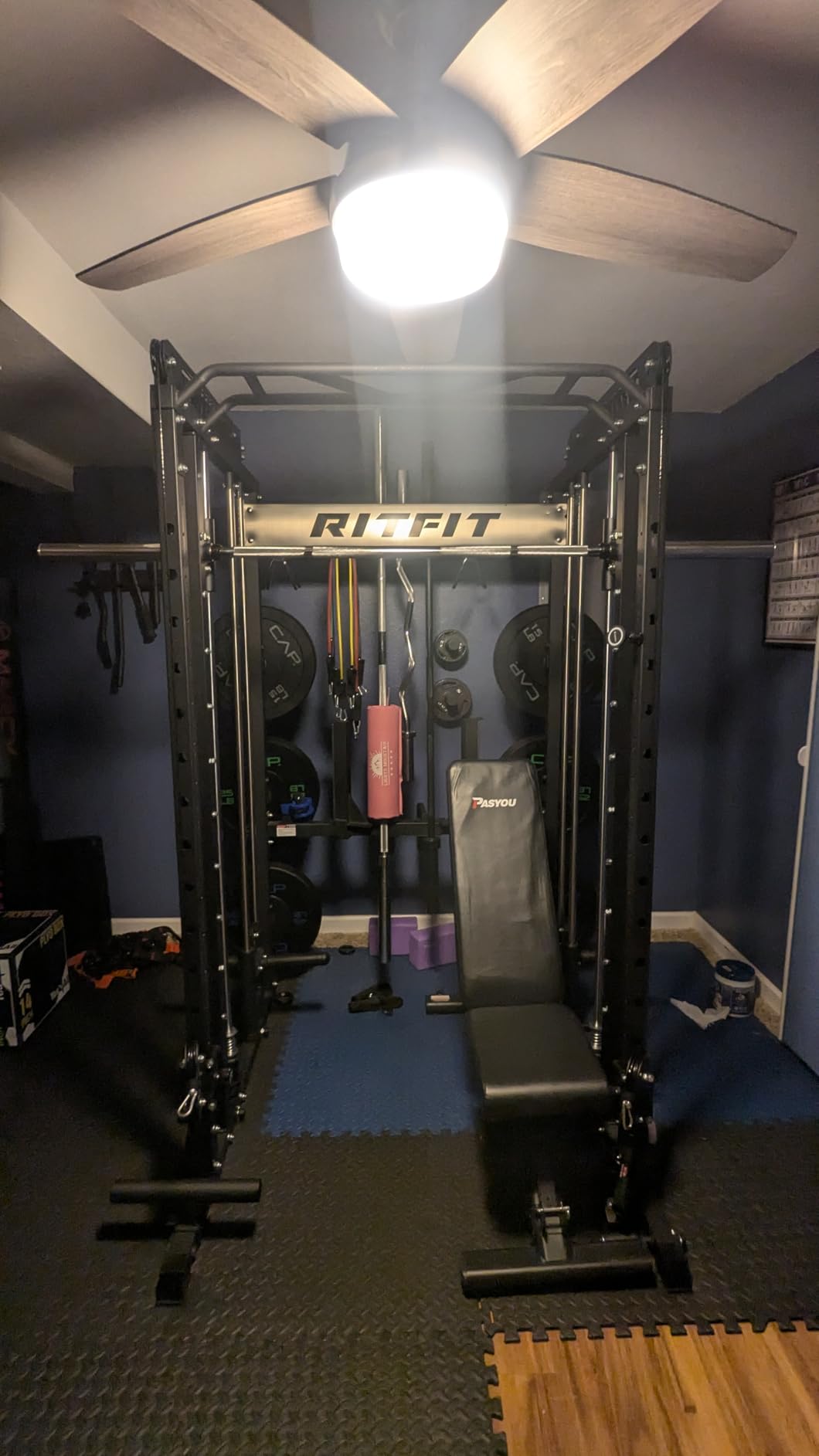
Build quality is mixed. Owners report the 14-gauge steel is lighter than expected, which means the frame torques slightly during assembly and the final bolts are hard to line up. Cosmetic damage on arrival is the other repeat complaint, with some units arriving heavily scratched enough to look returned or forklift-damaged. Neither affects function, but both sour the first impression.
There is one specific clearance problem worth knowing about. The permanently attached Smith springs at the base of the carriage can block hip thrusts and glute bridges for shorter users, because there is nowhere to move the bar out of the way. Only one foot holder ships, so two people cannot both do ankle-attachment leg work at the same time, and one of the two cables can run less smoothly than the other.
Who the RitFit M1 Pro suits best
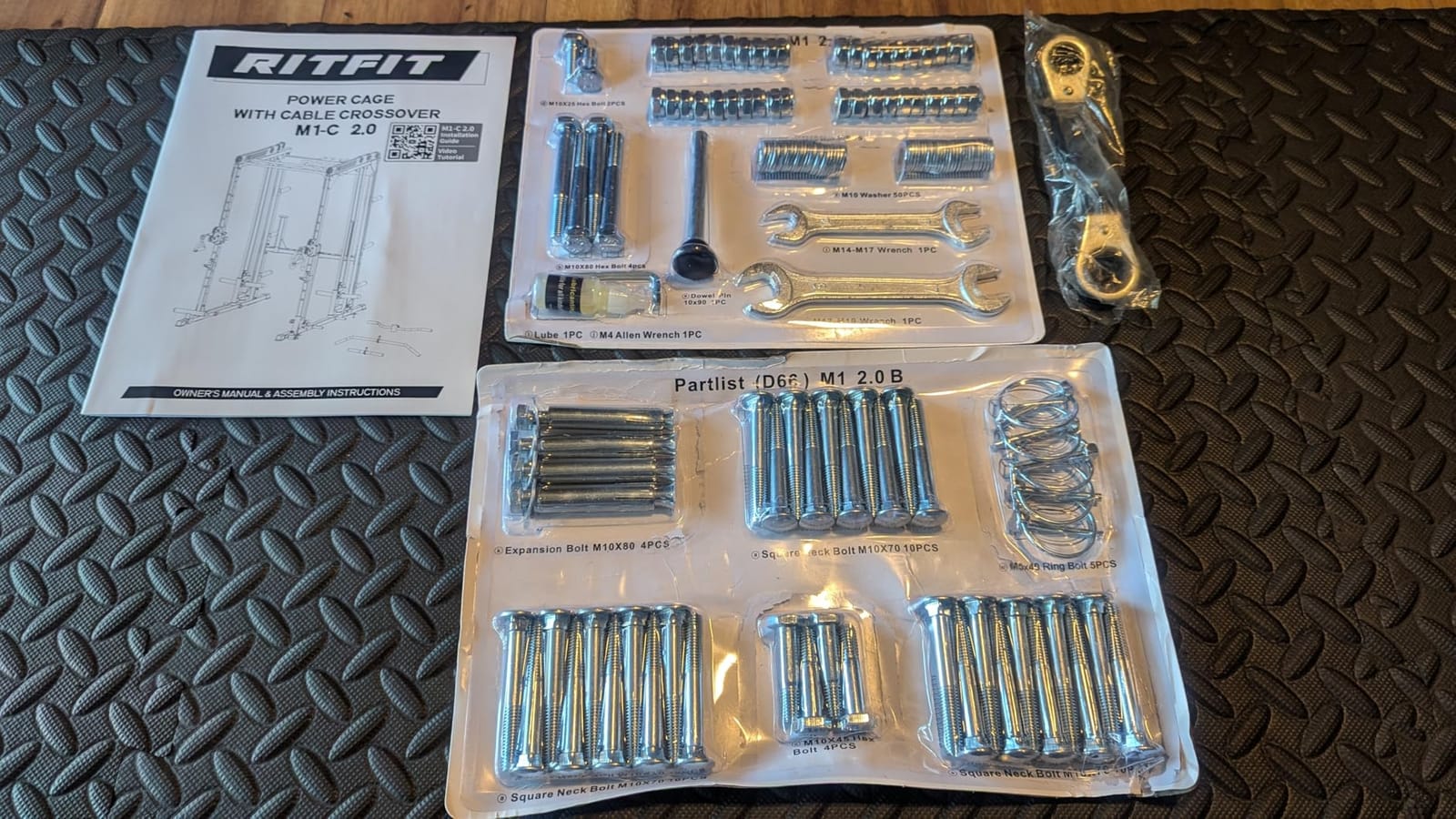
This is the pick for a small garage gym or a basement where 47.8 inches of width is the difference between fitting the machine and not fitting it. It suits anyone who wants a landmine attachment, since few machines this size include one that locks properly. Support is also a genuine strength, with owners reporting fast free replacements for damaged or missing parts and an installation video included.
It suits shorter lifters training pull-ups and squats, and it works well for a household with one main trainee. The 36-month frame warranty and 12-month accessory warranty are also the longest terms in this roundup, which matters for a machine that will be loaded daily.
Where the RitFit falls short
Cosmetically it is a coin flip what arrives at your door, and structurally the 14-gauge steel is thinner than the rest of the list. The attached springs ruling out hip thrusts is the most functional limitation, and the single foot holder limits genuine two-person use to pull-ups rather than cable leg work.
At 4.5 across 110 reviews the ratings are strong, but this is a machine built to a compromise, and the compromises are in the steel and in the small details. If the footprint is your binding constraint rather than your preference, it is the right answer.
7. pooboo P43, Best Smith Machine for a First Home Gym
pooboo Power Cage Smith Machine with 2000LB Squat Rack Cable System
2000 lb rack capacity
1000 lb cable capacity
Bearing pulleys with PU rope
Pros
- 4.9 average rating across 78 owners with 95 percent five-star
- 2000 lb rack capacity in a 62.9 by 43.3 inch footprint
- Bearing pulleys and PU wire rope run smooth and silent
- More than 20 attachments including a 360 degree landmine
Cons
- Thinnest review base in the roundup at 78
- Warranty term is listed as 1 year in the copy and 2 years in the spec
The pooboo P43 carries the highest average rating of anything in this roundup at 4.9, with 95 percent of its 78 reviews at five stars. That number deserves context rather than celebration. A base of 78 owners is thin against the Marcy at 1438 reviews, so there is less long-term durability data behind the score here. What the reviews do show is that owners consistently like what they got.
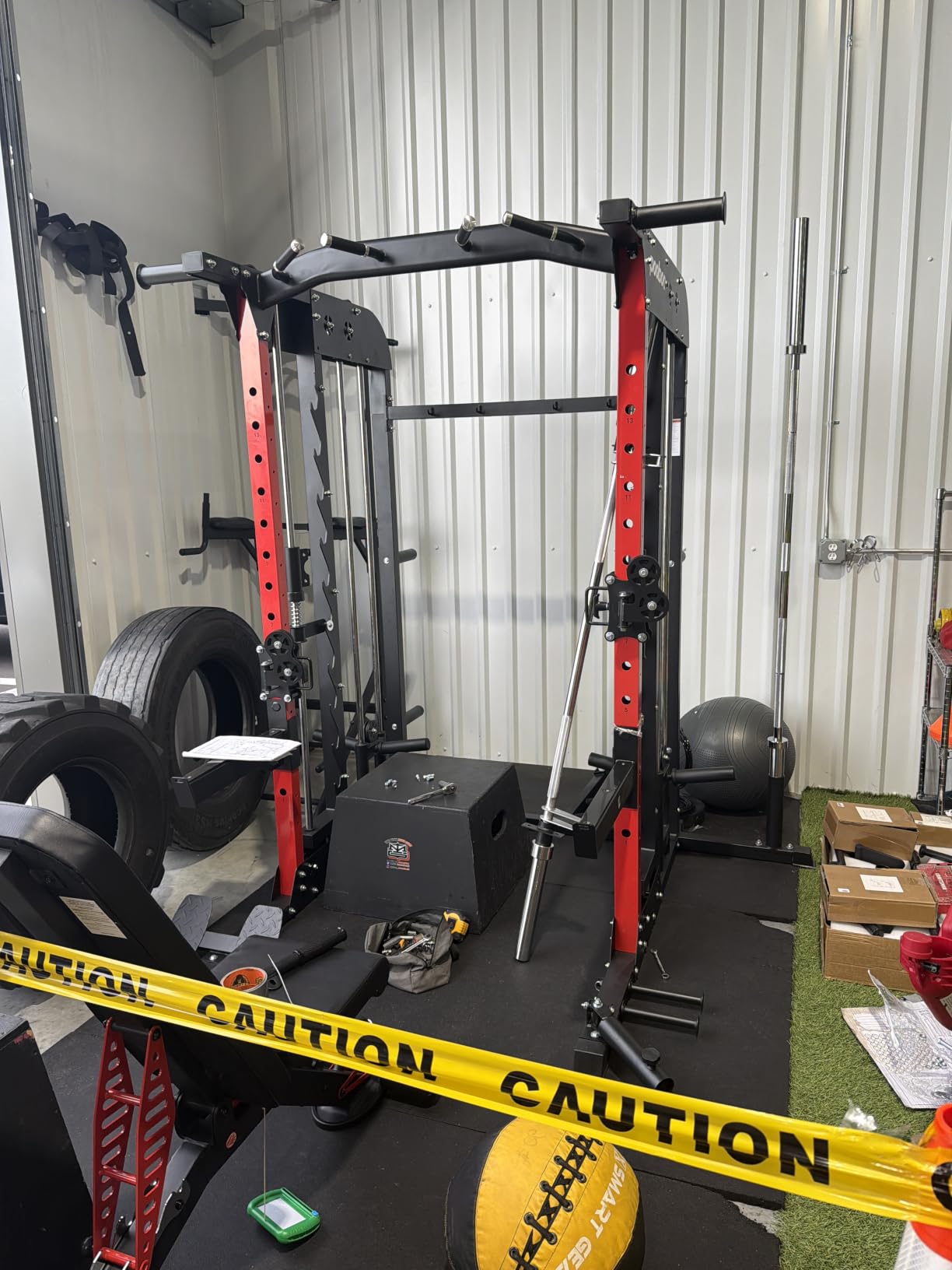
The specification is confident for the class. A 2000 lb squat rack capacity, 1000 lb through the cable system, bearing pulleys with durable PU wire rope, and a 62.9 by 43.3 by 82.6 inch footprint at 417 lb. The accessory count is the headline number, with more than 20 pieces including J-hooks, safety spotter arms, dip bars, cable grips, a lat pulldown bar, a row bar, a low row foot board and a 360 degree landmine.
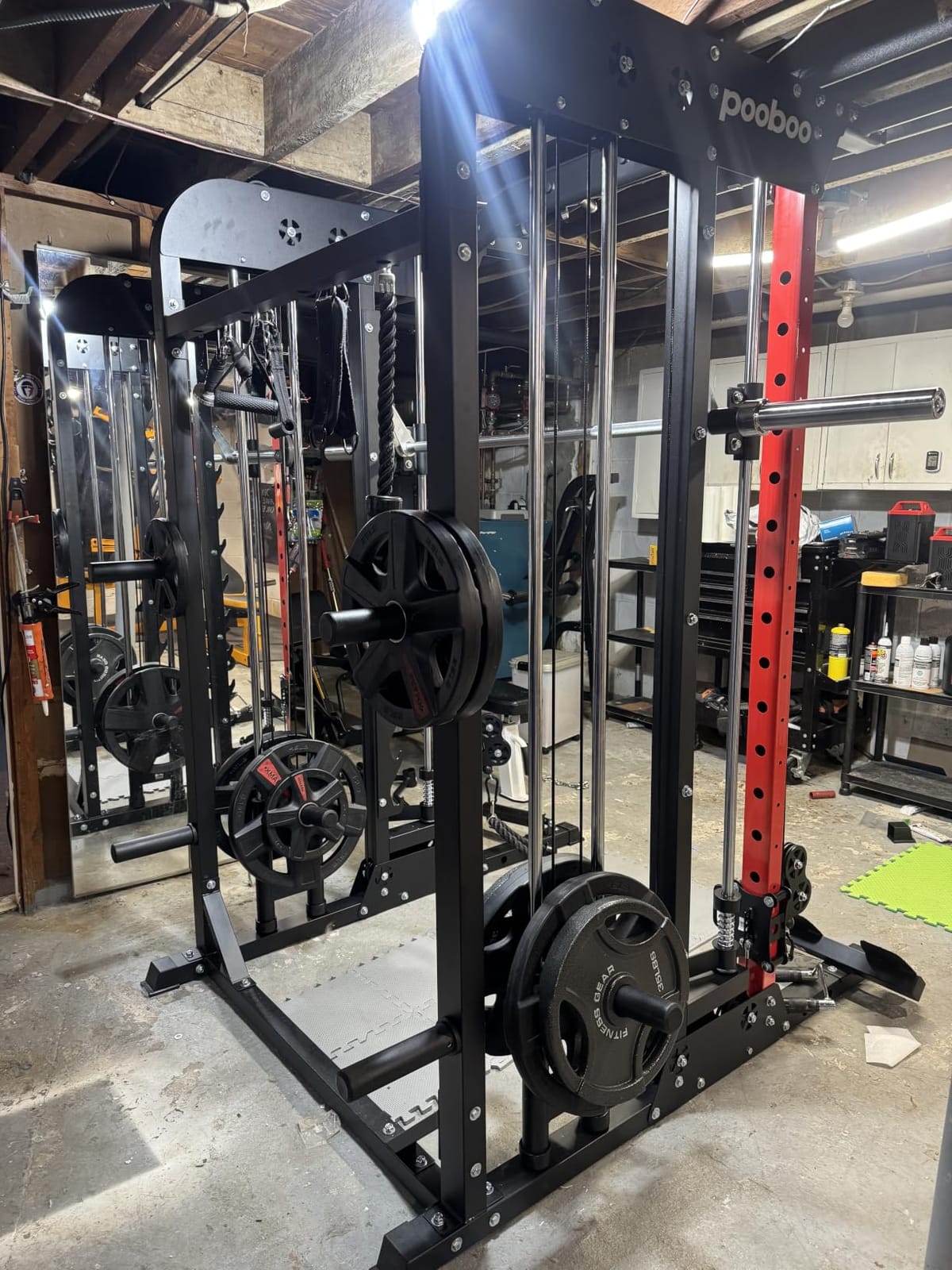
Sandblasted metal components with a burr-free finish and rust-proof paint are the details that separate this from the cheapest cages, and the P43-Pro version adds a free Olympic bar, a barbell pad, extra handles and an ankle strap. It is packed in two packages specifically to reduce transit damage, which owners appreciate after seeing what heavy steel can do to a single carton.
The warranty term is genuinely inconsistent. The product copy states one year while the specification sheet lists two, and we would not treat the longer figure as settled until you have confirmed it with the seller before you buy. That is a documentation problem rather than a build problem, but documentation is what you rely on when something arrives damaged.
Who the pooboo P43 suits best
This suits a first home gym where you want one machine to cover squats, presses, pull-ups, rows, cable flyes and landmine work without a second purchase. The 43.3 inch width is one of the narrower frames in the list, and the 82.6 inch height works in most basements. It also suits anyone who wants smooth, silent cable travel and would rather not chase a cheaper pulley set.
It suits buyers who are willing to be the early owner. The rating is excellent and the specification list is complete, but you are buying on published data rather than on a decade of field reports, and that is a fair trade at this price point.
Where the pooboo falls short
The 78-review base is the honest limitation. A 4.9 from 78 owners says the machine arrived intact and worked as described for those buyers, which is a good signal, but it says less about year-three wear than a 1438-review base does.
The conflicting warranty term is the practical thing to resolve before purchase, and the machine is heavy enough at 417 lb that assembly is a two-person job. Confirm the warranty, plan the move, and this is a strong first home gym.
8. Major Fitness Drone2 Advanced, Best for Heavy Cable Work
Major Fitness Drone2 Premium Training Smith Machines– All-in-One Home Gym Squat Rack with Aluminum Pulley Set , Weight Bar, Dual LAT Pull-Down Systems (SL D2AW ONLY)
1:1 cable ratio
Aluminum pulley set
2 x 2 inch uprights
2000 lb capacity
Pros
- 1:1 cable ratio gives real resistance for heavy rows and presses
- Aluminum pulley set ships standard rather than as an upgrade
- 535.6 lb build on commercial grade 2 x 2 inch uprights
- Adapts to most third-party accessories
Cons
- Thinnest feedback base in the roundup at 35 reviews
- Heaviest machine here at 535.6 lb so a two-person move
- Only a 1-year warranty
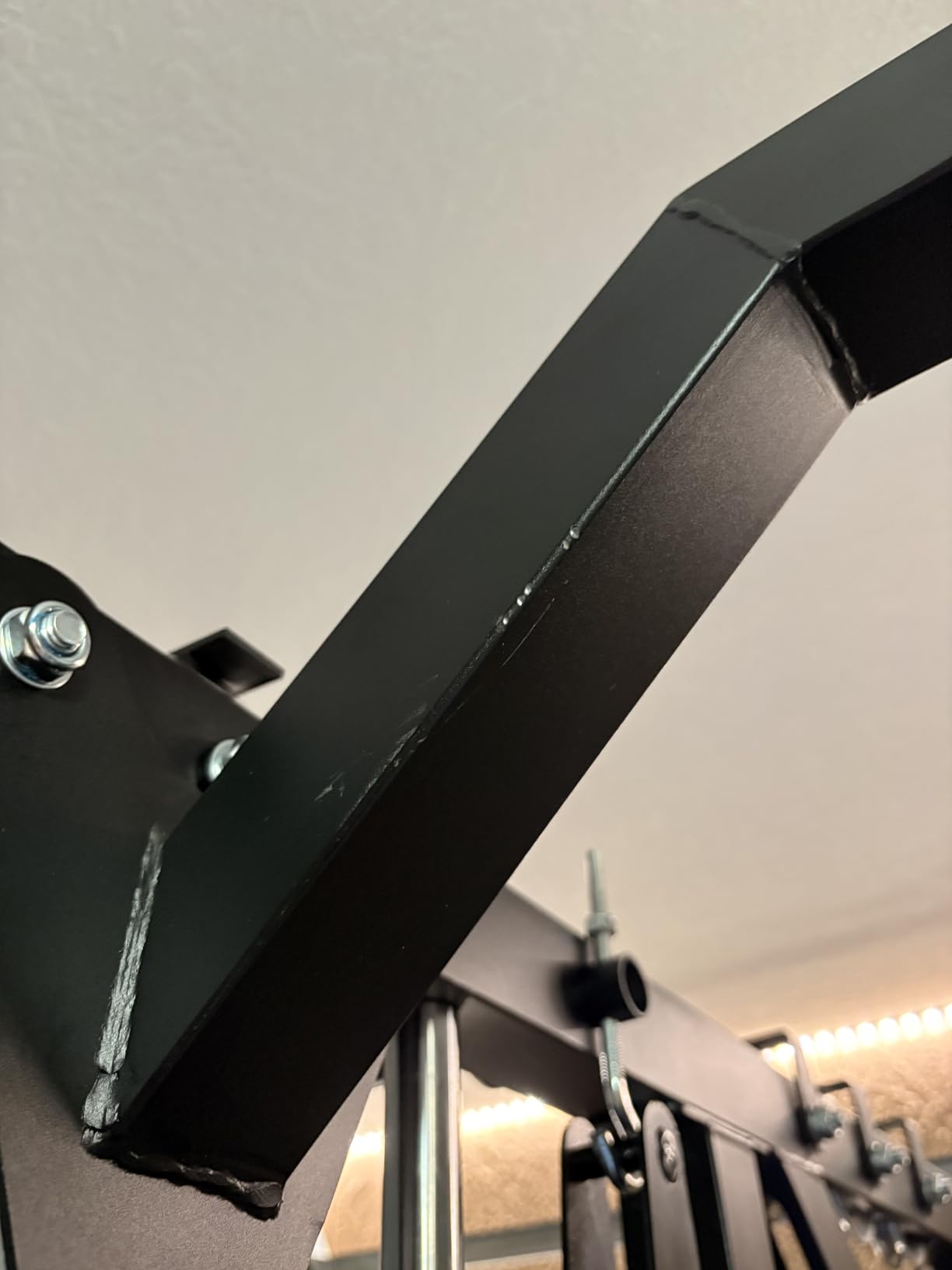
The Drone2 Advanced exists to solve one problem that most 2:1 all-in-ones create, and it solves it well. Its 1:1 cable ratio means the resistance you pull against is the resistance you loaded, so a heavy lat pulldown or low row behaves like a real weighted movement instead of feeling feathered. For anyone doing serious pulling volume, that single spec is worth more than any attachment in the box.
The aluminum pulley set also ships standard here, where several competing machines sell it as an upgrade, and the frame is 2 by 2 inch commercial grade steel rated to 2000 lb across a build weighing 535.6 lb. Lifetime after-sales support comes with a detailed manual, an installation video and 24/7 contact, and the frame accepts most third-party accessories so expanding later is straightforward.
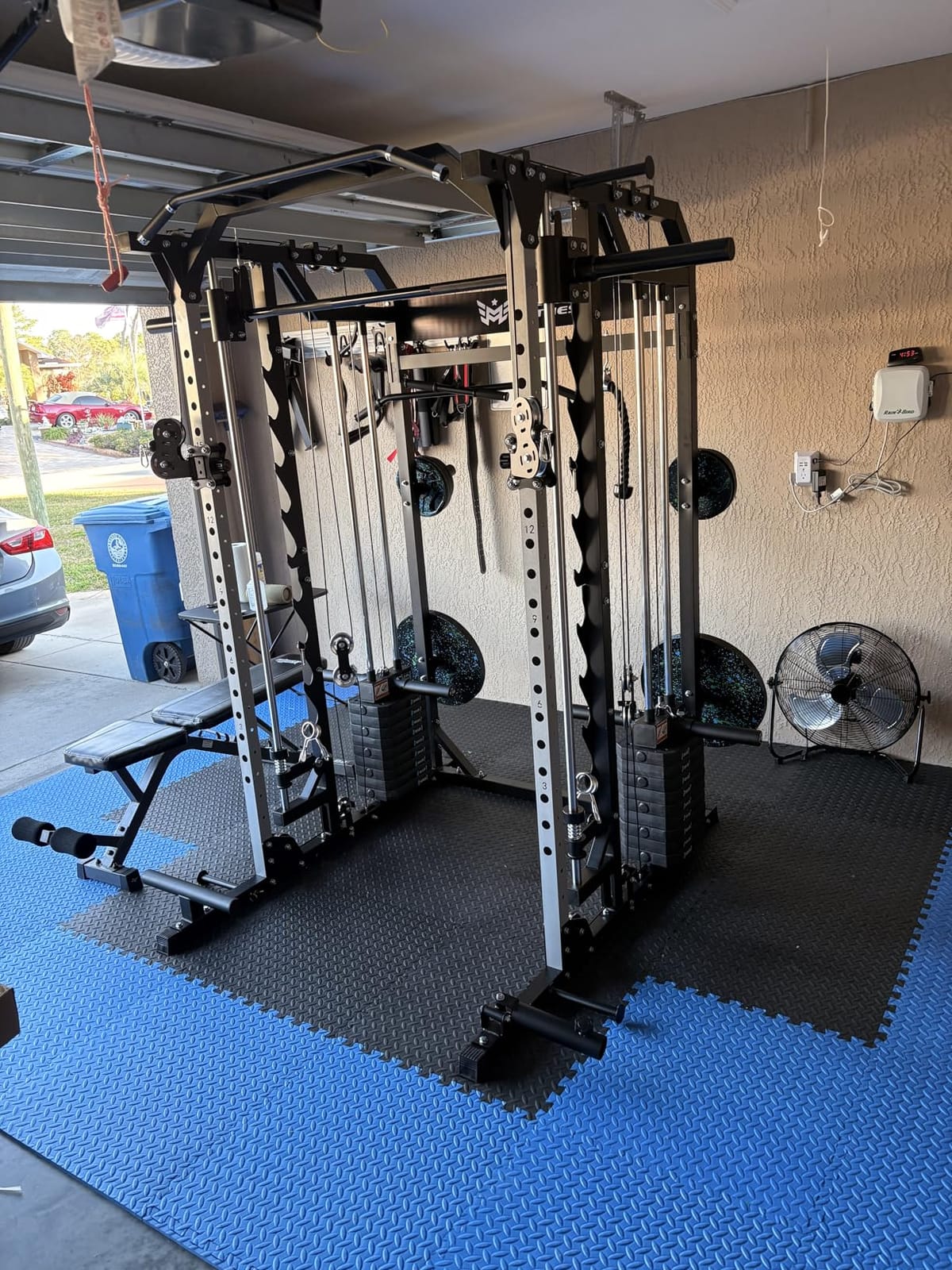
Weight is the fact that shapes your entire experience of this machine. At 535.6 lb it is the heaviest unit in the roundup by a wide margin, which makes moving it and assembling it a genuine two-person job with more than two people for some steps. If you are furnishing a basement or a room you have to get it down stairs into, that is a serious logistics problem before you have bolted a single plate.
Only 35 reviews is the other limitation, the thinnest feedback base here, so the 4.7 average is encouraging but rests on very few owners. The 1-year warranty is also among the shortest here, and with a machine this heavy you would want longer cover on the welds and the pulley carriage.
Who the Drone2 suits best
This is the machine for a lifter whose cable work is serious, who wants a 1:1 ratio rather than a 2:1, and who plans to load heavy on pulldowns, rows and leg press movements. It suits anyone already collecting attachments, because the frame accepts most market-standard add-ons, and the accessory bundle that ships with it covers dip handles, a T-bar, a barbell pad, tricep rope, ankle straps, wrist wraps, a lifting belt and a lat bar.
It suits buyers with a garage and a second strong person on moving day. If you have clear floor space, a vehicle rated for the load, and no stairs in the way, the ratio and the standard aluminum pulleys make this the cable system to beat for heavy pulling in the roundup.
Where the Drone2 falls short
The 535.6 lb build is the dominant drawback, and it is not a small one, because it affects where you can put the machine as much as how it performs. The 35-review base and 1-year warranty are the other two, and together they mean less documented long-term behaviour than the lighter machines in this list.
At 4.7 this is the second-highest rated product here, and the ratio advantage is real rather than marketing. If your training justifies the logistics, the capability is there and the after-sales support is better than most.
9. SNODE ALL10, Best Smith Machine for Low Ceilings
SNODE ALL10 All-in-One Smith Machine Home Gym, Multi-Functional Power Rack
Two 175 lb stacks
Selectable 1:1 and 2:1
Leg press included
Flat-top bar
Pros
- Leg press attachment performs like a commercial leg press
- Flat-top pull-up bar suits low-ceiling basements
- Cables stay smooth and quiet with no loosening over time
- Hardware is labelled by assembly step
Cons
- Only a 1-year warranty
- Weight stack configuration arrives in 9 boxes
- Lat pull-down seat is small for taller users
The SNODE ALL10 solves two problems at once that most machines pick between. It gives you two 175 lb weight stacks for 350 lb of built-in resistance, and it lets you switch the pulley ratio between 2:1 and 1:1 depending on whether you are doing hypertrophy or heavy pulling. That flexibility is the feature owners notice first, because most competitors lock you into one ratio.
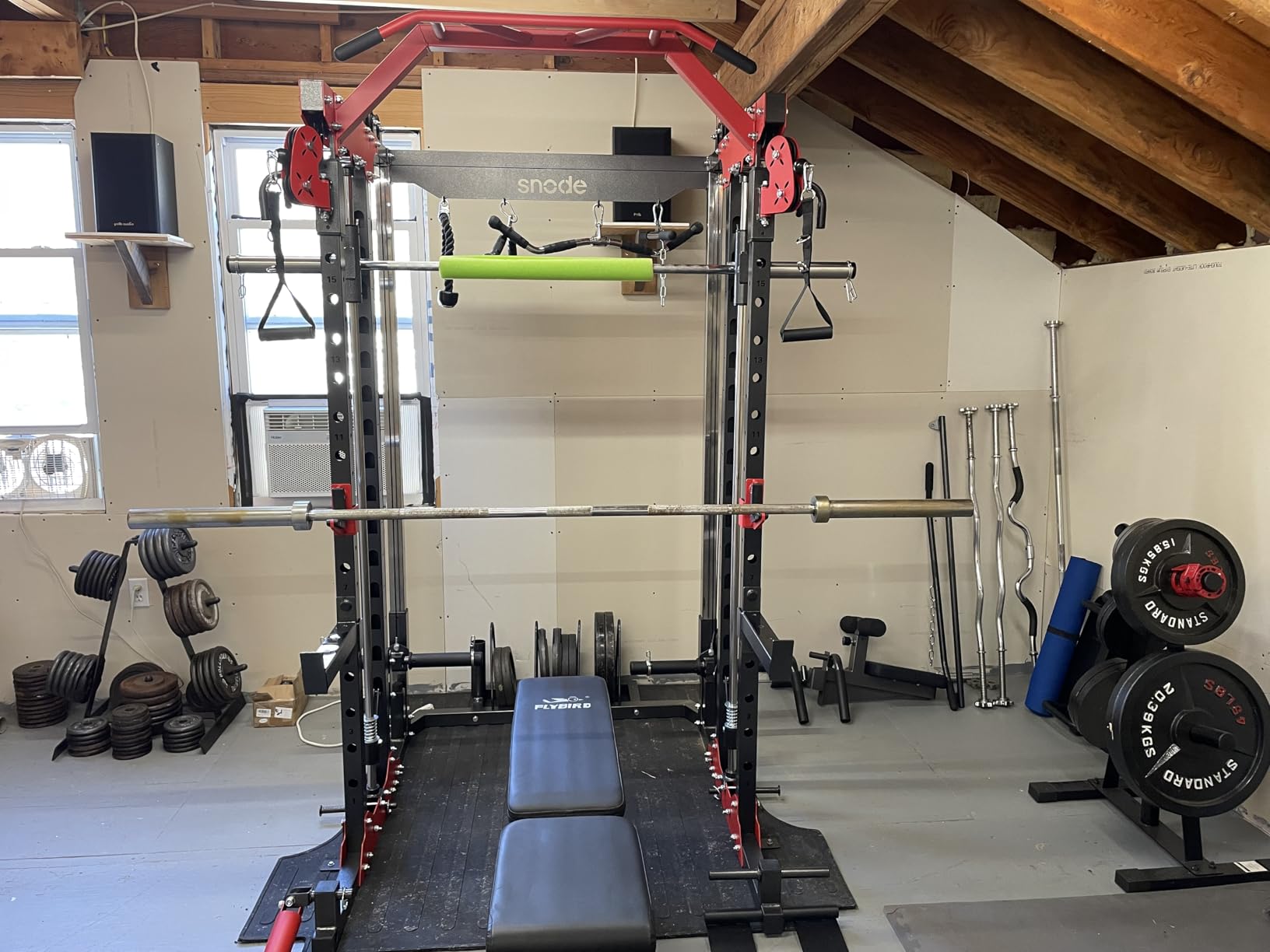
The second is the flat-top pull-up bar. It sits unusually low against the frame, and one owner reports it was the only full setup that fit their low-ceiling basement. For anyone training below about 7.5 feet of ceiling, that single design decision can be the difference between owning a machine and not. The leg press attachment also performs like a commercial leg press, and the compact centred bar lets the bench tuck in rather than stick out.
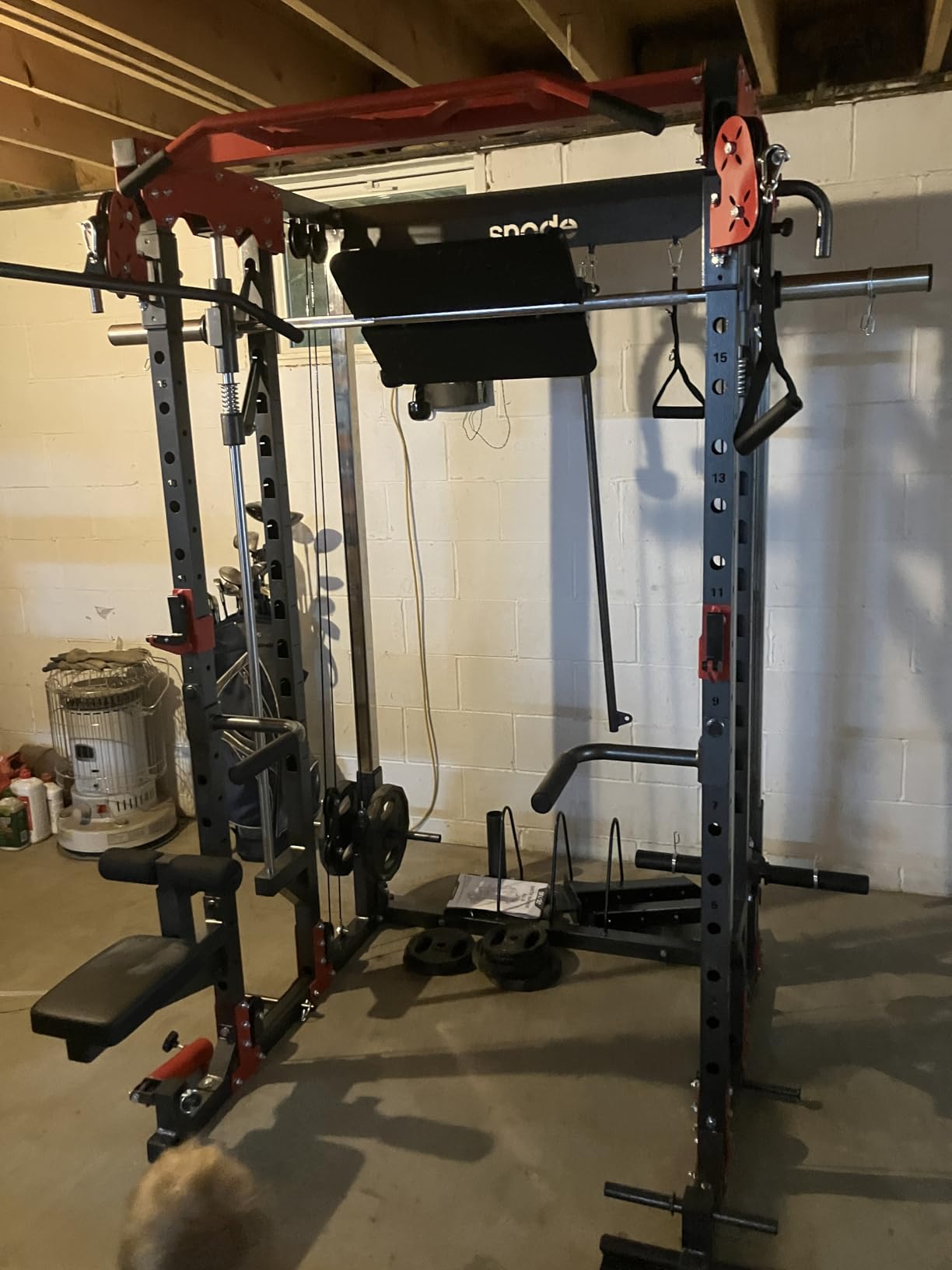
Build feedback is consistently good. Cables and pulleys stay smooth and quiet with no squeaks and no loosening after months of heavy use, hardware arrives neatly packaged and labelled by assembly step, and customer service resolved missing and damaged parts within hours while paying the return postage. The 50x50mm frame carries a 2000 lb rating across a 68.7 by 57 by 80.7 inch footprint.
There are three real drawbacks. The warranty is one year. The weight-stack version arrives as 9 separate boxes, which is a lot of cardboard to move into a basement. And the lat pull-down seat is small for taller users, which is a bit ironic on a machine whose selling point is fitting into a low-ceiling room.
Who the SNODE ALL10 suits best
This is the pick for a low-ceiling basement, and it is the clearest answer in the roundup to that specific problem. It also suits anyone who wants both a hypertrophy ratio and a heavy-lifting ratio in one machine, and anyone training legs who would rather use a proper leg press than a hack squat or a free-weight setup. The mesh dust covers over the stacks also let you see stack movement, which is useful for gauging rest.
It suits buyers who will read the manual before building, because the cable routing section is reported as unclear even though the hardware labelling is good. Anyone under about 5 foot 9 will want to check the lat seat clearance before committing.
Where the SNODE falls short
A 1-year warranty on a machine with 350 lb of built-in weight is the biggest gap, and the 9-box packaging is the biggest chore. The small lat pull-down seat and a fixed plate holder are the smaller annoyances, and bar latching takes practice while the guide bars need greasing.
At 4.6 across 51 reviews the rating is strong for a small sample, and owners consistently rate it above what they expected from the specification sheet. The flat-top bar is the reason to buy it; everything else is a well-built machine with a thin warranty.
10. JELENS M21, Best Smith Machine for Two-Person Cable Work
JELENS M21 Smith Machine, Multi-Function Power Cage with Dual Pulley Cable Crossover System, 2000LBS All-in-One Squat Rack with Smith Bar and Attachments for Home Gym(Red, M21 Smith Machine)
50mm by 50mm steel frame
2000 lb safe working load
Independent dual pulleys
Pros
- Independent pulley systems on both sides allow two people to train
- All bolts share one socket size for straightforward assembly
- 20 laser-marked height positions on 9 welded columns
- Responsive service replaced a damaged cable coating
Cons
- Frame can wobble under load
- Thinner steel gauge than the specification suggests
- Cable coating can separate at the hook after a few months
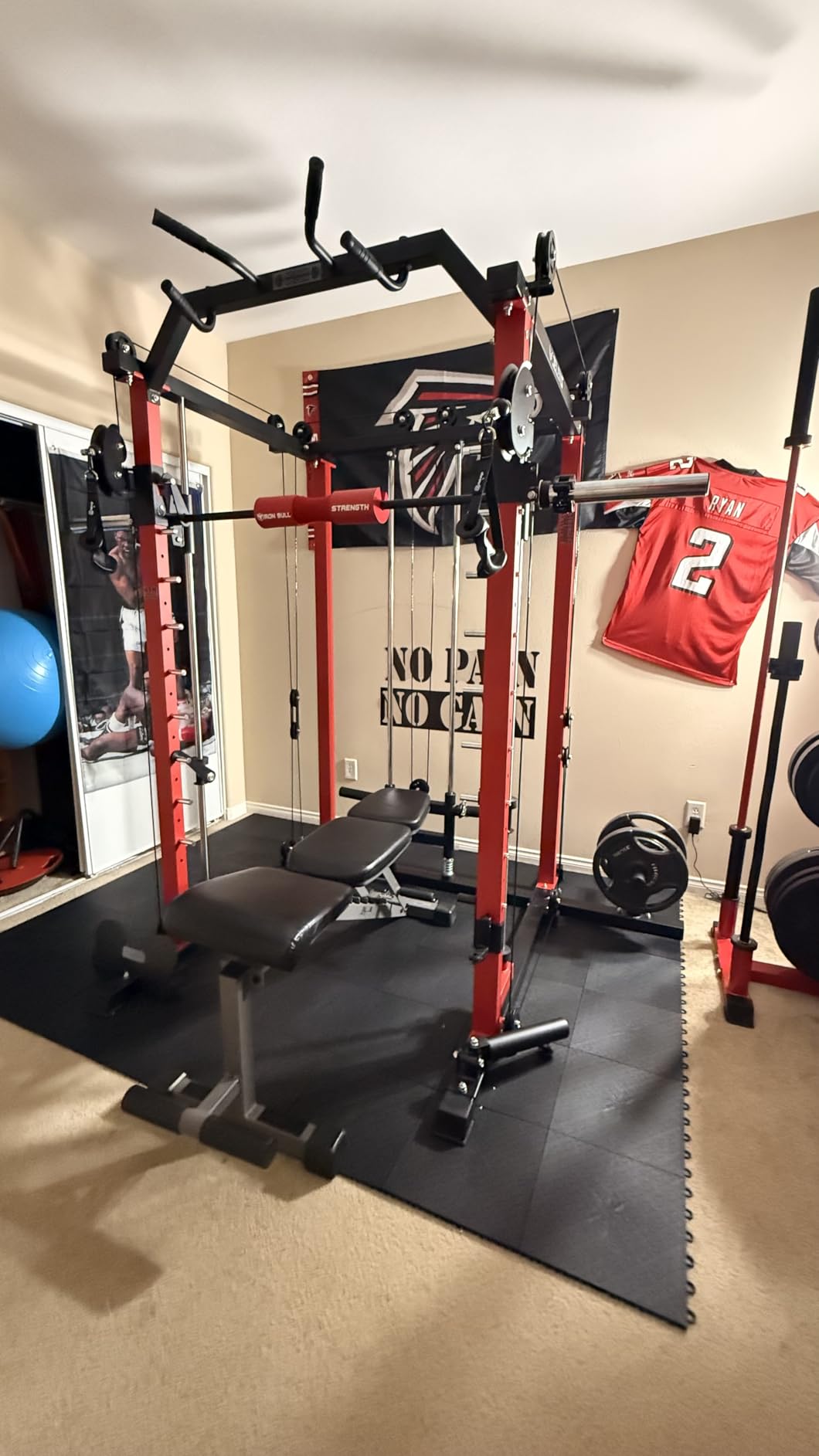
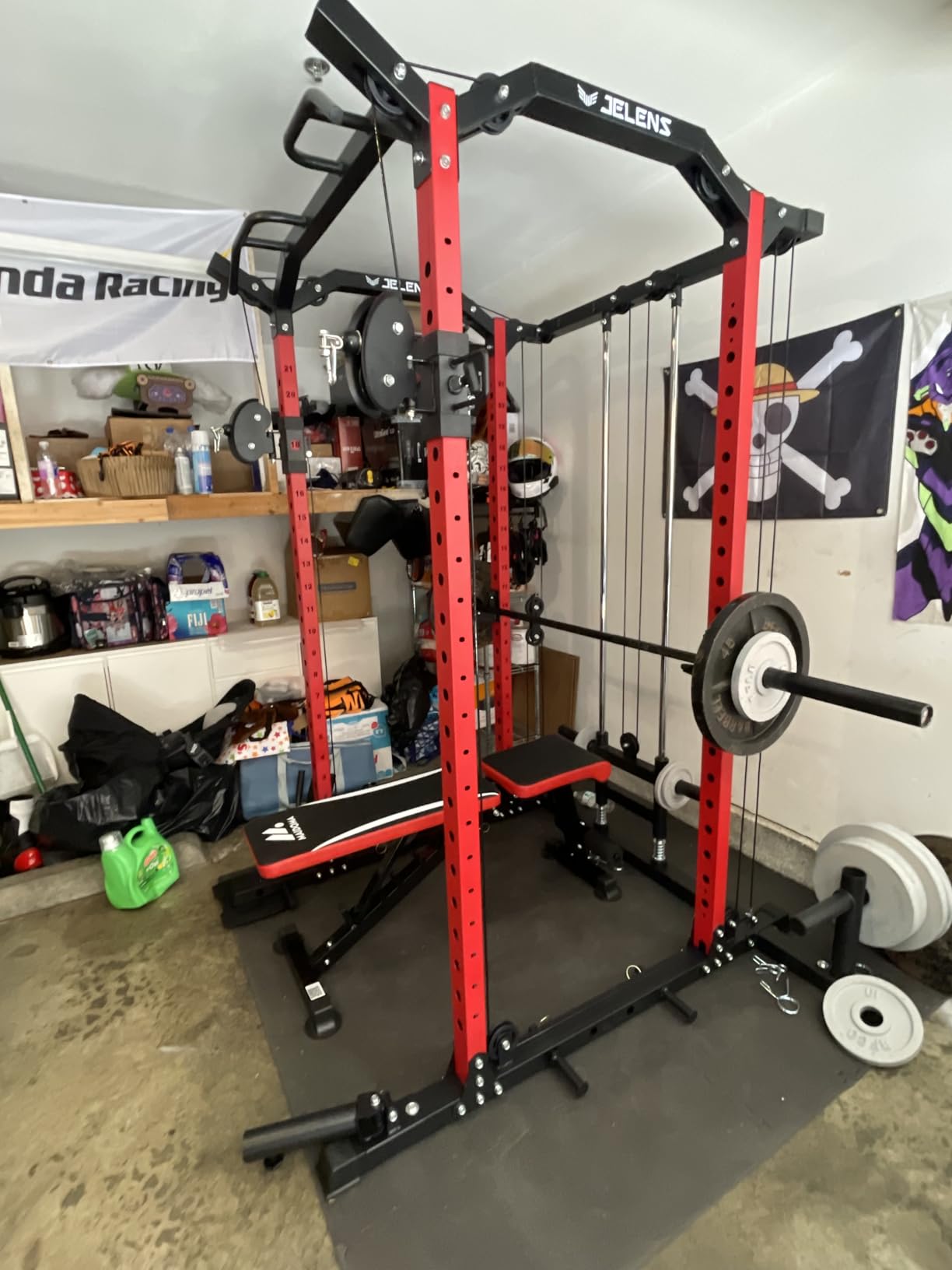
The JELENS M21 does something several pricier cages do not, which is give you two genuinely independent cable systems. Each side runs its own pulleys, so two people can work at once without one interfering with the other, and the Smith module uses linear bearings with bottom spring shock absorption to keep the bar smooth. The 50mm by 50mm frame carries a 2000 lb safe working load, and the height adjustment runs through 20 laser-marked positions across 9 screw-welded columns.
The assembly detail nobody else mentions is the bolt sizing. All bolts are the same size, so one socket covers the entire build, which owners with a single set of tools really appreciate on a machine this large. The accessory set is also thorough, with a lat pull-down bar, T-bar, tricep rope, two J-hooks, two cable handles, four weight storage pins, a 360 degree landmine, a foot board and counterweight racks with clamps.
Now the problems, and they are structural rather than cosmetic. The frame can wobble under load, and owners report the metal gauge is thinner than expected at this price, with a warning not to overtighten the bolts or they dent the tubing. That combination tells you how the steel is being specified, and it is the reason we would not load this machine near its 2000 lb rating for heavy barbell work.
Cable quality is the second weak point. The rubber coating on the cables can separate at the attachment hook after a few months of use, and the cable handles and bars are described as feeling cheap. Storage is also limited, with no dedicated plate or dumbbell storage posts, and a few owners report quality control issues including a major set of parts missing from the box and confusing instructions at several pages.
Who the JELENS M21 suits best
This suits a two-person household that genuinely trains at the same time, since independent dual pulleys are rare in this class and the 360 degree landmine plus full lat station cover a lot of ground. It also suits buyers who enjoy building equipment, because uniform bolt sizes and a 9-column welded frame make a straightforward weekend project with one socket set.
It suits owners who will maintain it. Greasing the guide bars and watching the cable coating is manageable if you are the type to do it, and customer service is responsive, replacing a damaged cable coating quickly. If two-person cable training is your priority and your budget is firm, this is a defensible pick.
Where the JELENS falls short
Wobble under load, thinner-than-expected gauge and the overtightening warning are the three that would stop us recommending this for heavy barbell training. Cable coating separation and cheap-feeling handles are the wear concerns, and limited plate storage is a daily-use annoyance rather than a fault.
At 4.3 across 55 reviews it sits mid-pack, and the two-year free replacement warranty on accessories is the best parts cover here, though it does not extend to the frame itself the way a longer frame warranty would. It is a capable two-user cable option built on a thinner frame, and that is the trade.
How to Choose a Smith Machine for a Home Gym in 2026
Every machine above is a good machine within its class, and the differences between them are smaller than the differences between classes. Decide the class first and the model almost picks itself. The seven criteria below are the ones that actually change your day-to-day experience, in the order we would weigh them.
1. Linear bearings versus bushings
This is the single most important spec on the page. A linear bearing is a sealed, rolling carriage that the bar hooks ride on, and it keeps gliding smoothly for years with a grease point. A bushing is a simple sleeve, usually bronze or polymer, and it is cheaper and lighter but it wears, catches and produces the sticking, grinding bar travel that owners complain about most often. Most of the frames here specify a linear bearing carriage, and that is why we would not buy one that does not.
The maintenance note matters as much as the component. Linear bearings still need lubrication, and on the Marcy specifically owners report that the chrome Smith bar and the rear weight carriage need silicone or lithium grease out of the box before they run properly. A machine with no accessible grease points will bind within a year.
2. Counterbalanced versus a standard bar
A counterbalanced bar is hooked to a weight stack or spring system so the bar feels light at the bottom of the travel and requires effort only to lift. A standard bar is dead weight, so the first 20 lb of every rep is spent fighting the bar rather than the load. Counterbalancing makes a Smith bar usable by beginners, older lifters and anyone returning from injury. It is worth paying for, and it is the reason the Mikolo and SNODE machines with built-in stacks are so appealing for two-person households.
None of the ten machines here includes a counterbalance retrofit, and on cage-style Smiths the counterbalance is usually an add-on sold by the manufacturer. If counterbalancing matters to you, choose a machine with built-in stacks rather than planning to retrofit later.
3. Weight capacity tiers and steel gauge
Think in three tiers. Budget cages sit between 1850 and 2000 lb of static capacity and suit beginners and general fitness. Mid-tier machines push the same 2000 lb rating with heavier steel and better hardware, which is what you want if you will progress. Premium machines reach 2200 to 2240 lb and add commercial uprights, which is where the DONOW and the two Mikolo cages sit.
Steel gauge is the harder number to read and the more revealing one. 50x50mm, or 2 by 2 inch, uprights appear on the DONOW, the Mikolo SM02, the SNODE and the Major Fitness Drone2. The RitFit M1 Pro uses 2 by 2 inch uprights but is described by owners as lighter 14-gauge steel, and the JELENS carries a similar warning. If a listing does not state the gauge, treat the weight of the machine as the proxy, because steel mass is the hardest thing to fake.
4. Selectorized weight stacks versus plate-loaded cables
Selectorized stacks are a fixed column of weights you move with a pin, so you can change resistance in seconds and never touch a plate. Plate-loaded cables use the same bar and plates you already own, which is cheaper and lets you load anything. Stacks suit shared gyms, apartments with downstairs neighbours, and anyone doing high-rep isolation work where frequent loading is the bottleneck. They also add weight and width to the machine.
The machine weight is the quiet drawback of stacks. Built-in stacks push machines past 350 lb before any frame steel, and the 535.6 lb Major Fitness Drone2 is the extreme case. If you are getting the machine into a basement, factor stair width and turning radius into your decision before you fall in love with the ratio.
5. Cable ratio, 1:1 versus 2:1
The pulley ratio tells you how much resistance you feel per unit of weight. A 2:1 system feels half what you loaded, which makes it easy to get a workable starting weight but makes fine increments hard. A 1:1 system feels exactly what you loaded, which is what serious pulling requires. The DONOW, both Mikolo machines and the JELENS run 2:1. The Major Fitness Drone2 runs 1:1, and the SNODE lets you switch between both.
This is the spec most often ignored and most often regretted. If your cable work is back and biceps work at moderate loads, 2:1 is fine. If you are pulling heavy, buy the 1:1 machine or the switchable one.
6. Footprint, ceiling height and the tall-lifter check
Footprints in this roundup run from 43.3 inches wide on the pooboo P43 to 78.58 inches on the DONOW, and depths run from about 55 to 71 inches. Add bench space in front and you need half again that. Measure the room and the route to it before you choose, and check ceiling height against the tallest attachment rather than the frame.
For lifters over 6 foot 2 inches, do a specific measurement. Stand under the high pulley with your arms fully overhead and note where your hands sit relative to the top of the machine. If the cable exit is at or below your head height when you are standing tall, lat pulldown travel will be cramped no matter what the spec sheet says. The same check applies to the pec deck, which owners of tall frames report is genuinely uncomfortable, and the fix is usually to use the high pulleys instead.
7. Assembly, total cost of ownership and warranty
None of these machines come with a meaningful set of plates or an Olympic bar, and the Marcy makes that explicit in its own documentation. Budget separately for a full set of plates, a bar, and floor bolts if you are anchoring to concrete. Heavy units also arrive in multiple cartons, and the DONOW comes in 8 boxes while the SNODE weight-stack version comes in 9.
Assembly is rarely a one-person job. The Marcy commonly takes 7 to 10 hours with two people, and the SunHome arrives in three heavy boxes with no tools included. Warranty terms here range from 1 to 3 years, with the RitFit offering the longest frame cover at 36 months, and the pooboo listing inconsistent terms that you should confirm in writing before buying.
For the wider picture of a small-space gym, our rowing machine comparison covers the cardio side that no cable cage can replace.
Who Should Skip a Smith Machine Entirely
Skip it if your goal is barbell skill. A guided bar teaches you a fixed path, and the ability to squat and press a free bar without a spotter is the actual skill most people are buying a rack for. If you are training for powerlifting or learning to compete, spend the money on a power rack with proper safeties and save the Smith for accessories.
Skip it if you are in a rented space. Every machine in this roundup is between 350 and 535 lb, and the research on these products is consistent that they want to be anchored to a floor. Bolting a half-ton frame into a rental is a conversation with your landlord rather than a purchase decision.
Skip it if you already own a power rack and a cable column, because an all-in-one will not outperform either of them and you will be replacing working equipment. In that case a rack-mounted Smith attachment is a fraction of the cost and a fraction of the floor space. And if you want guided motion with no steel at all, our elliptical machine reviews cover the other end of the spectrum.
Frequently Asked Questions
Is a Smith machine worth it for a home gym?
Yes, if you train alone. A Smith machine lets you squat, incline press and shoulder press without a spotter because the bar can only travel in one path and ratchets into a catch point with a wrist twist. It is less useful if your goal is developing barbell technique, since the fixed path removes the balance and stability demands of a free bar.
Is there an all-in-one Smith machine for home use?
Yes. Every machine in this roundup combines a Smith bar with a cage, and most add a cable crossover with either weight stacks or plate-loaded lines. The two-person-friendly options are the Mikolo SM02, the Mikolo M4 2.0 Lite, the SNODE ALL10 and the JELENS M21, all of which have independent dual cable stacks.
Is a Marcy Smith machine good?
The Marcy MD-9010G is the best overall pick here, holding 4.4 across 1438 reviews, the largest owner base in the roundup. Owners praise the linear bearing Smith carriage and the alloy steel frame. The recurring complaints are assembly time of 7 to 10 hours, unlabelled parts in the instructions, and the need to lubricate the Smith bar and rear carriage.
What are the downsides of using a Smith machine?
The bar path is fixed, so you do not develop free-bar stability. The bar itself is dead weight unless the machine is counterbalanced, so a standard bar feels heavy at the bottom of every rep. Attachment-heavy machines can have built-in pads that do not fit your body, which makes them poor for supersets. Several machines here also list a maximum user weight of 300 lb.
Why does the Smith machine get so much hate?
Because it looks like a shortcut. Critics argue the fixed bar path removes the core stability skill of squatting and pressing a free barbell, and that counterbalanced bars make the movement too easy to progress on. The defensible counter-argument is that it removes the spotter problem rather than the effort problem, which is exactly what a solo home lifter lacks.
How much ceiling height and floor space do I need?
Frames in this roundup are between about 80.7 and 90 inches tall, with footprints from 43.3 inches wide on the pooboo P43 to 78.58 inches on the DONOW, and depths from roughly 55 to 71 inches. Allow bench space in front of that. For lifters over 6 foot 2 inches, stand under the high pulley and check the cable exit is above your head when you are standing tall.
The Verdict on the Best Smith Machines for Home Gyms in 2026
The Marcy Smith Cage MD-9010G is the best Smith machine for a home gym in 2026 because it combines linear bearings, an alloy steel frame and the largest documented owner base of anything we reviewed. If your budget is firmer, the SunHome SH-999 gives you a full cage, a guided bar and rolling-bearing pulleys for the least outlay, and the DONOW is the pick when cable work is half your training and you want the highest rating at meaningful review volume.
Match the machine to your constraint rather than to the spec sheet. Low ceiling means the SNODE. Small floor space means the pooboo or the RitFit. Serious cable loading means the Major Fitness Drone2 and its 1:1 ratio. Two people training at once means either Mikolo cage. And buy plates, a bar and floor bolts separately, because none of them come in the box.
Whichever you choose, grease the guide bars in month one. That single habit is the difference between a machine that still feels smooth in year three and one that does not.