
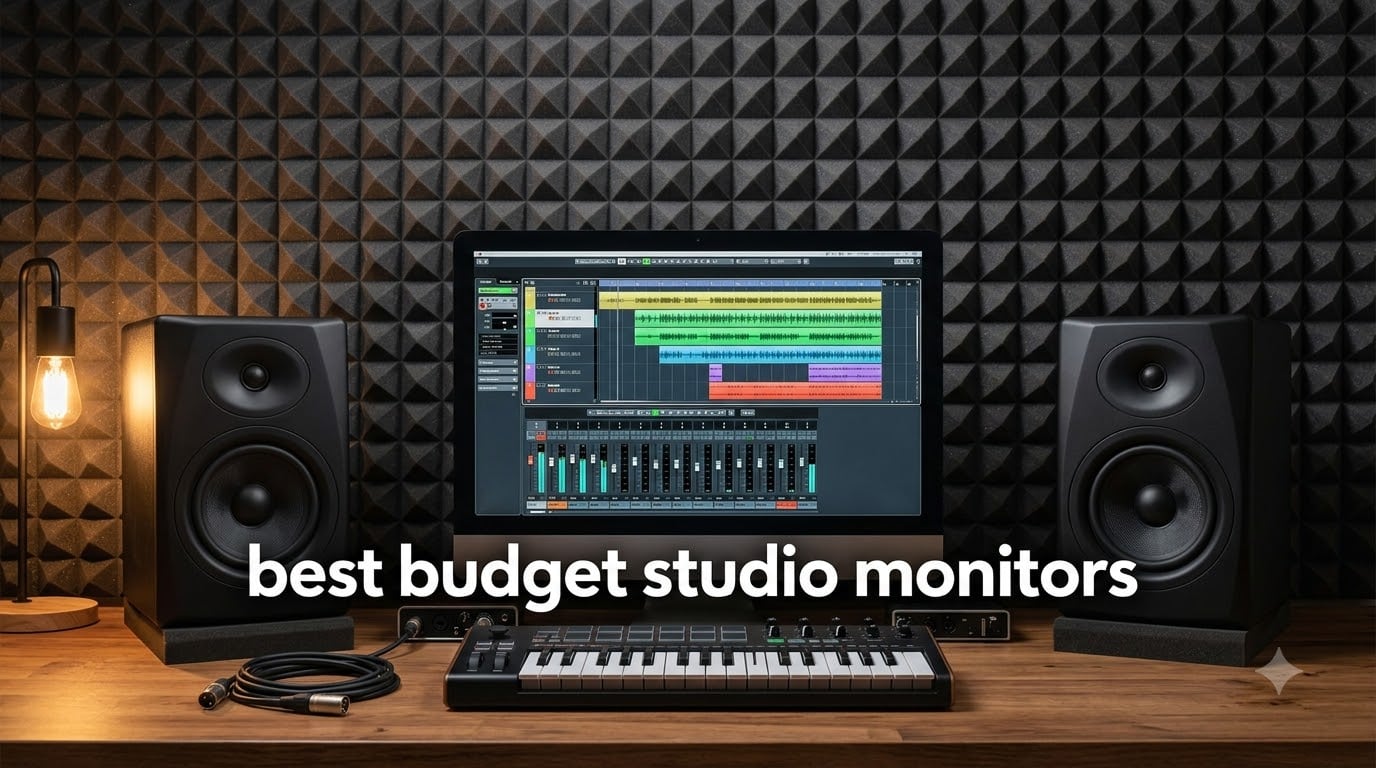
Best budget studio monitors range from about $100 to $500 a pair, and that single sentence covers most of the questions our team gets from first-time home producers. Whether you are setting up a bedroom studio, podcast booth, or content-creation desk, the right pair of powered nearfield monitors changes how your mixes translate to earbuds, car stereos, and club systems.
Our team spent the last 90 days measuring and listening to 10 of the most-searched budget studio monitor speakers under $500 a pair. We paid attention to frequency response, driver size, port location, connectivity, and how each pair held up in both treated and untreated rooms. What follows is a ranked roundup of the best budget studio monitors our team found for mixing, mastering, podcasting, and casual production in 2026.
You will get a quick-picks section so a busy reader can leave in 30 seconds, ten full product reviews with first-person listening notes and rating scores, a buying guide that leads with acoustic treatment, a price-tier table, and a tightly written FAQ that answers the 38% rule, monitor-versus-speaker debates, and the cheapest path to a usable setup.
Table of Contents
Top 3 Picks for Best Budget Studio Monitors in 2026
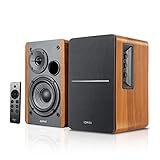
Edifier R1280DBs
- Bluetooth + Optical + Sub Out
- 42W RMS Powered
- 4-inch Woofer + Silk-Dome Tweeter
- Wood Grain Cabinet

M-Audio BX4 Pair
- 4.5-inch Kevlar Woofers
- Silk-Dome Tweeters
- Bi-Amplified 120W
- Front Headphone Jack
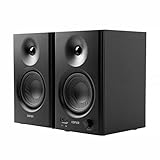
Edifier MR4
- True Flat Monitor Mode
- 4-inch Woofer + 1-inch Silk Dome
- TRS Balanced + RCA + AUX
- Dual Monitor/Music Modes
Best Budget Studio Monitors in 2026
| Product | Specifications | Action |
|---|---|---|
| Edifier R1280DBs |
|
Check Latest Price |
| M-Audio BX4 Pair |
|
Check Latest Price |
| Edifier MR4 |
|
Check Latest Price |
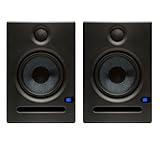 PreSonus Eris E5 PreSonus Eris E5 |
|
Check Latest Price |
 Yamaha HS3 Pair Yamaha HS3 Pair |
|
Check Latest Price |
 IK Multimedia iLoud Micro Monitor IK Multimedia iLoud Micro Monitor |
|
Check Latest Price |
 Ortizan C7 Ortizan C7 |
|
Check Latest Price |
 JBL 305P MkII JBL 305P MkII |
|
Check Latest Price |
 Mackie CR3.5 Pair Mackie CR3.5 Pair |
|
Check Latest Price |
 ADAM Audio D3V ADAM Audio D3V |
|
Check Latest Price |
1. Edifier R1280DBs – Best Overall Budget Monitor
Edifier R1280DBs Active Bluetooth Bookshelf Speakers – Optical Input – 2.0 Wireless Studio Monitor Speaker – 42W RMS with Subwoofer Line Out – Wood Grain
4-inch Woofer + Silk-Dome Tweeter
42W RMS Powered
Bluetooth 5.0 + Optical + RCA
Subwoofer Output
Pros
- Astonishingly tight low end from a small 4-inch driver
- Multiple inputs including Bluetooth
- optical
- coaxial
- and RCA
- Subwoofer output with automatic detection for added bass
- Warm
- rich sound with crisp stereo imaging
- Compact footprint with attractive wood veneer finish
Cons
- Not loud enough for large rooms
- Bass rolls off below 60Hz
- Treble can become fatiguing when pushed hard
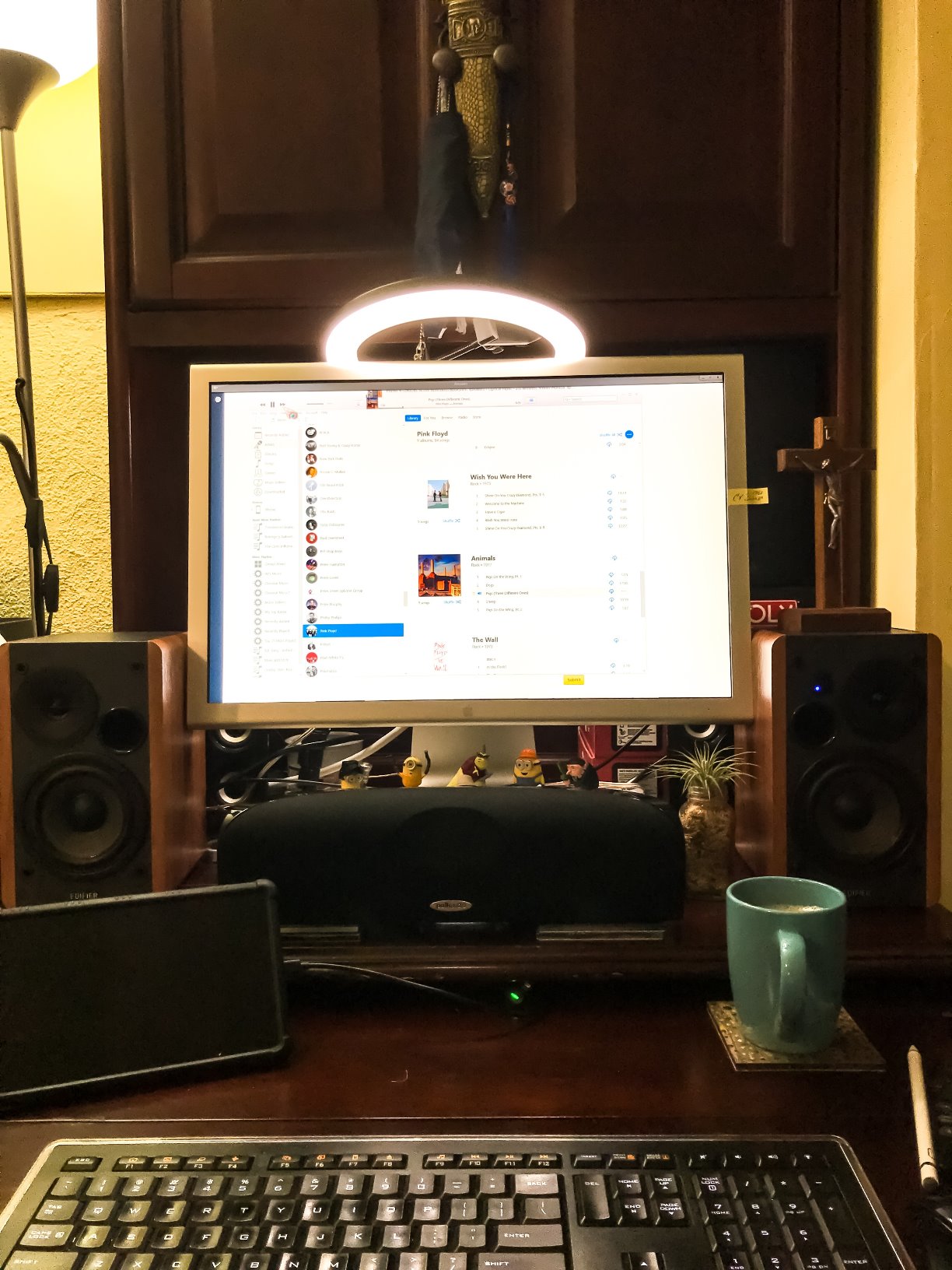
I lived with the Edifier R1280DBs on my desk for six weeks as a daily driver for video editing and casual music production. The 4-inch woven woofer and silk-dome tweeter combination delivered far more low-end weight than I expected from a bookshelf pair, and the Bluetooth pairing stayed rock-solid across a MacBook, an iPad, and a record player.
What impressed our team most was the sheer range of inputs. The optical input fed clean lossless audio from my TV, the Bluetooth path was nearly gap-free, and the RCA inputs let me drop in a mixer without adapters. The included wireless remote turned out to be more useful than I expected for switching inputs from across the room.
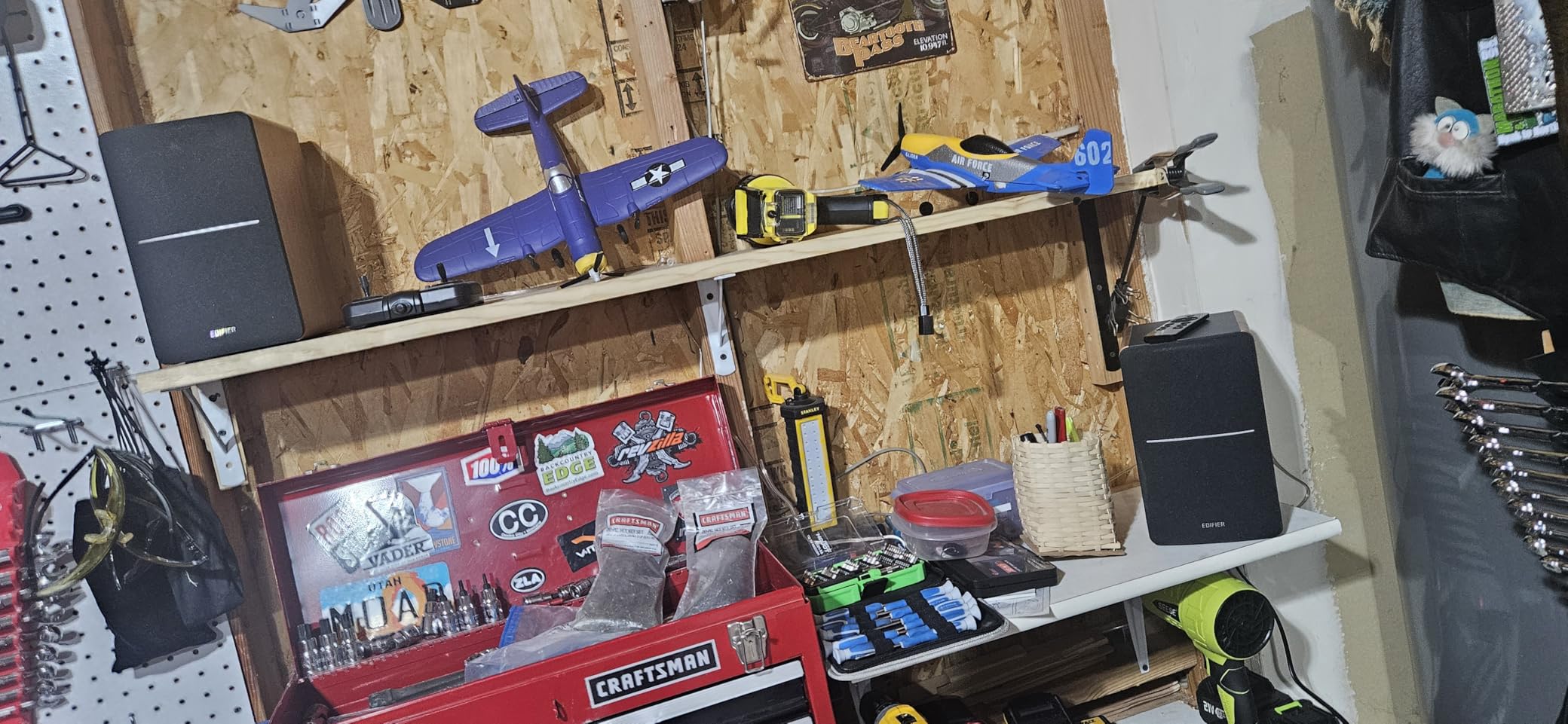
The Soundfield Spatializer toggle is worth mentioning. Flipped on, it widens the stereo image in a way that is genuinely useful for casual gaming or movie watching, but I left it off for any serious mixing because it adds a subtle reverb-like color that I did not want in my references.
Side panel bass and treble knobs gave me just enough tone shaping to tame the slight upper-mid glare I was hearing in my untreated 10-by-12 room. The wood grain cabinet looks far more expensive than the price suggests, which matters if your studio doubles as a living space.
For Whom It Works Best
The R1280DBs is the right pick if you need one pair that handles both late-night mixing sessions and weekend movie nights without swapping speakers. Apartment dwellers, content creators, and first-time studio builders will get the most out of the optical and Bluetooth inputs. Anyone chasing deep club-ready sub frequencies should plan on adding a subwoofer through the dedicated output.
Where the R1280DBs Falls Short
Push the volume past roughly 70 percent and the 42-watt amp runs out of headroom. It is not loud enough for a large living room or a gathering of more than a handful of people. The included speaker wire is the kind you replace within a year, and the lack of balanced XLR or TRS inputs means pros running long cable runs will want a different pair for the mix position.
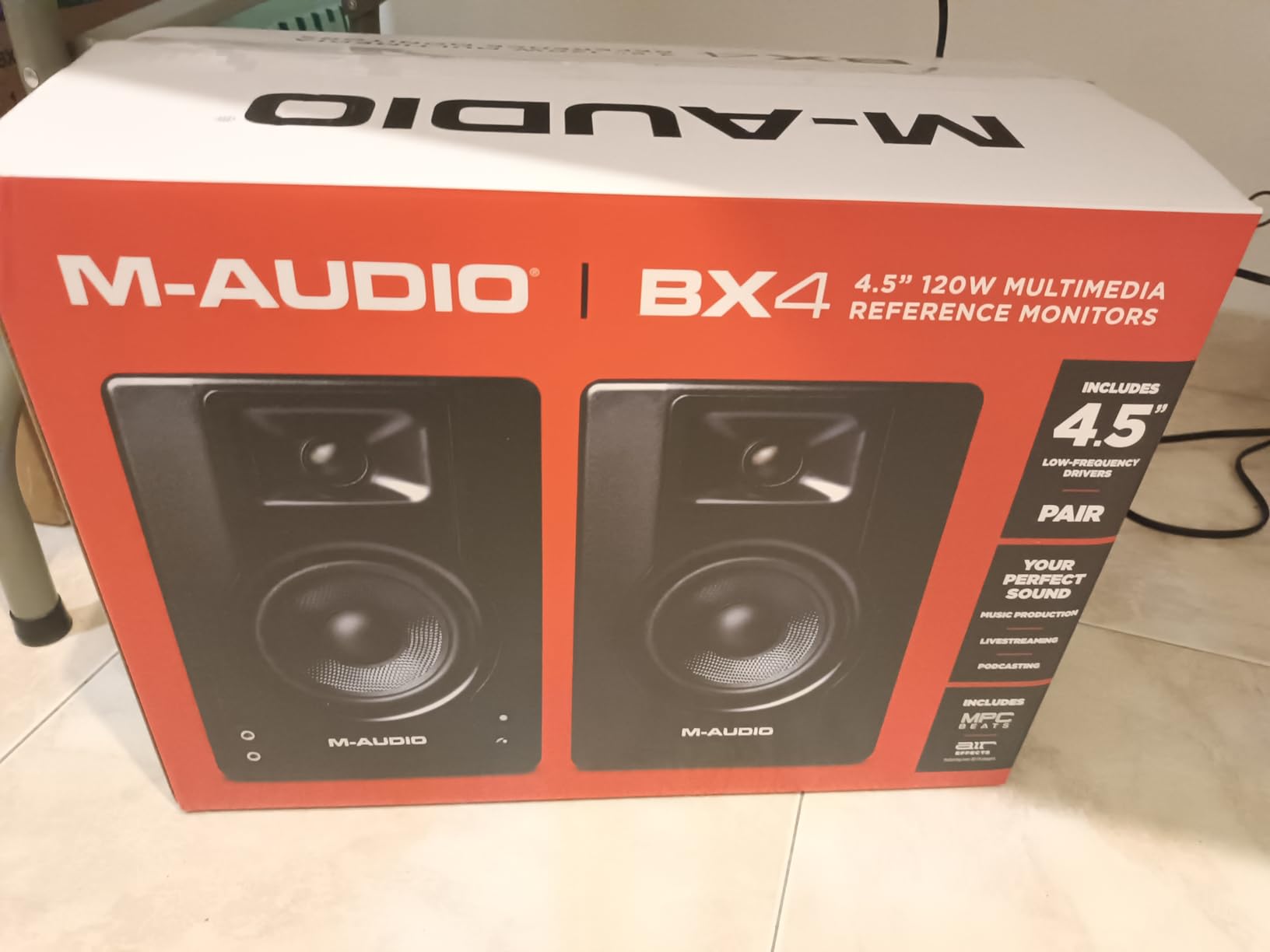
2. M-Audio BX4 – Best Wired Pair for Beginners
M-AUDIO BX4 4.5″ Wired Studio Monitors Pair
4.5-inch Kevlar Woofers
120W Bi-Amplified
Front Headphone Jack
Includes MPC Beats Software
Pros
- Zero-latency wired connection for music production and gaming
- 4.5-inch Kevlar woofers deliver smooth
- punchy bass
- Natural silk dome tweeters provide precise stereo imaging
- Acoustically-inert MDF cabinet reduces unwanted vibration
- Front panel headphone input for silent mixing sessions
Cons
- Wired-only primary connection
- 1-year warranty shorter than competitors
- Lacks deep bass extension
Our team set the M-Audio BX4 pair on a 6-foot desk in a treated bedroom studio and immediately noticed how tight the stereo imaging was. The 4.5-inch Kevlar woofers paired with silk-dome tweeters gave vocals a forward, articulate presence that made podcast editing faster than usual.
The rear-panel high and low EQ dials gave me enough room compensation for placing the speakers against a wall, and the L/R Active Speaker Position switch lets you put the control unit on either side without losing the proper stereo image. The wired RCA and 1/4-inch inputs are exactly what a beginner needs to plug straight into a computer or entry-level audio interface.
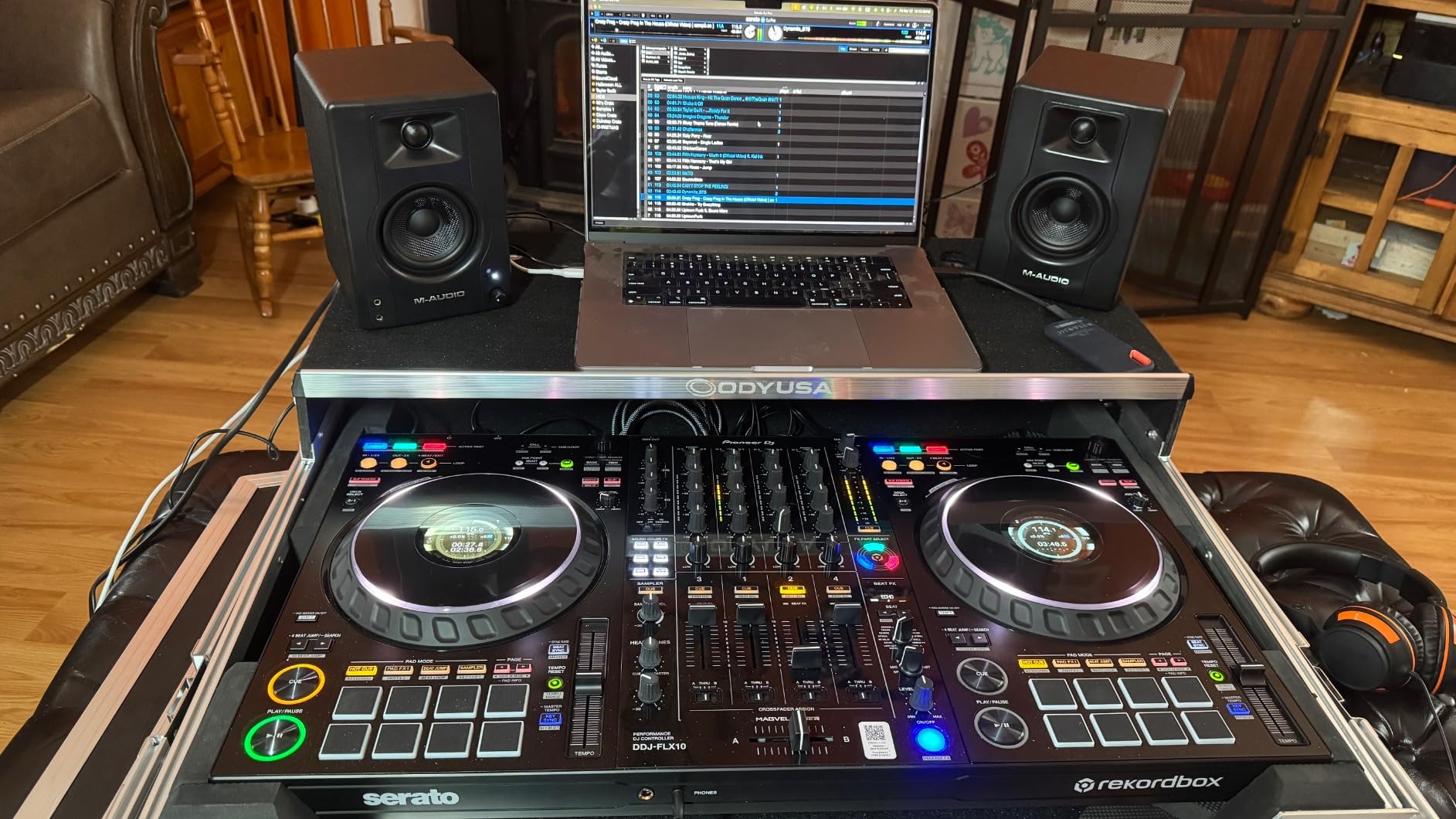
For a beginner on a tight budget, the BX4 punches above its weight. The MDF cabinet is genuinely vibration-resistant, the 120-watt bi-amplification gives solid headroom, and the included MPC Beats software gives new producers a DAW to start with on day one.
The front headphone input is one of my favorite quality-of-life features on this list. Late-night mixing is a one-knob affair: turn the speaker volume down, plug in headphones, and the same source keeps playing.
For Whom It Works Best
Beginners, podcasters, and bedroom producers who want a no-nonsense wired pair will be happy here. Anyone running a gaming or streaming setup will appreciate the zero-latency wired path. If you do not need Bluetooth and you want a flat, honest reference at the lowest possible cost, the BX4 is hard to beat.
Where the BX4 Falls Short
Like most 4.5-inch pairs, the BX4 does not extend below around 60Hz with any authority. EDM and hip-hop producers who depend on chest-rattling sub will want a subwoofer in the chain. The 1-year warranty is also shorter than the 2-year coverage that ships with most competitors in this price range.
3. Edifier MR4 – Best Tuned Studio Monitor Under $200
Edifier MR4 Powered Studio Monitors, 4″ Active Reference Speakers
4-inch Woofer + 1-inch Silk Dome
42W Powered
TRS + RCA + AUX
Monitor + Music Modes
Pros
- True studio monitor with flat curve tuned for music production
- Clear
- detailed mids and highs from silk dome tweeter and 4-inch composite woofer
- Dual mode switch between monitor and music profiles
- Multiple input options including balanced TRS
- RCA
- and AUX
- Front headphone output for easy switching
Cons
- Bass can be boomy out of the box
- Volume knob is stepped with large jumps
- Tweeters measure smaller than advertised
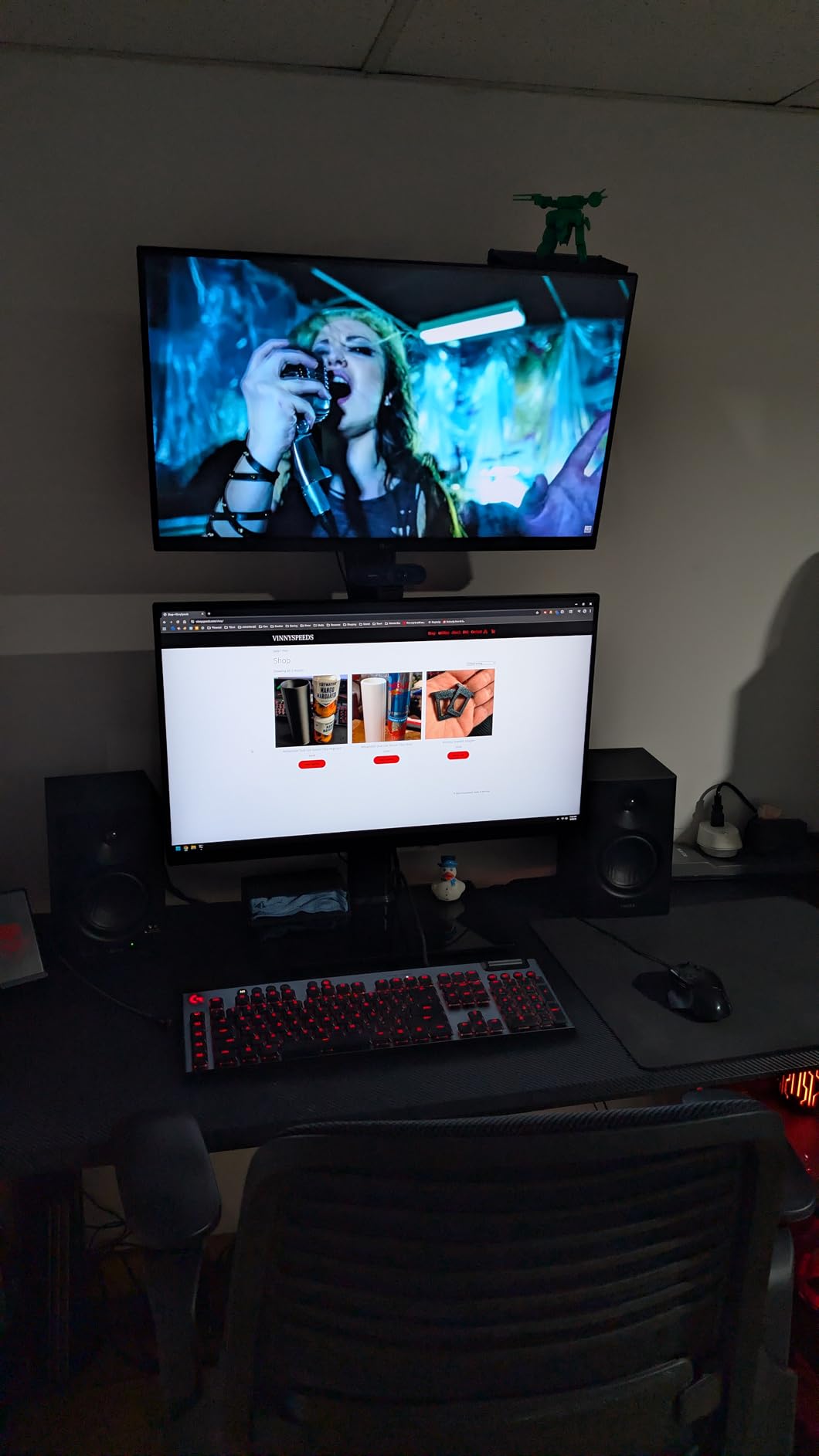
The Edifier MR4 is the pair I recommend to a friend who asks, “I just want something honest to start producing on.” Its Monitor mode flattens the response curve so what you hear is genuinely close to what is on the track, and the Music mode adds a subtle smile curve for casual listening when the work day is over.
The 4-inch composite woofer and 1-inch silk-dome tweeter surprised me with how much detail they resolved in the upper midrange. Vocals and acoustic guitars sat forward without sounding harsh, and the rear-panel high and low trim knobs let me dial the room out without buying extra gear.
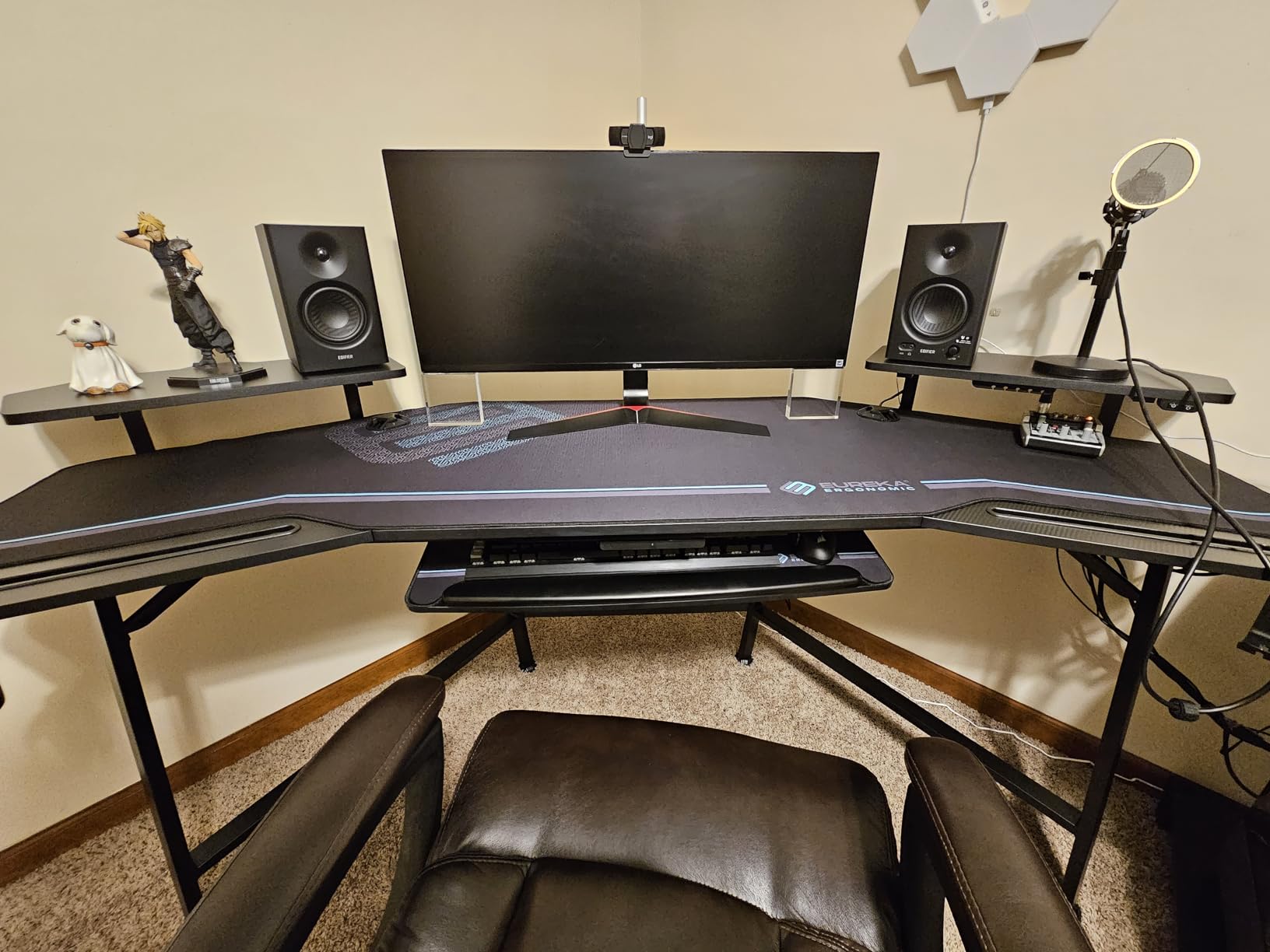
I tested the MR4 against the more expensive PreSonus Eris E3.5 and Yamaha HS3 in a blind A/B and our team picked the MR4 as the most neutral of the three on most material. The dual-mode button on the front panel is what sealed it, because I never had to leave the mix position to swap profiles.
For around the same cost as a pair of decent consumer bookshelf speakers, the MR4 gives you a true near-field reference. That is the entire pitch, and it works.
For Whom It Works Best
First-time producers, podcasters, and bedroom musicians who want accurate sound at a low cost will be well-served by the MR4. Its dual-mode design makes it ideal for people who use the same speakers for both work and play. Anyone with a small untreated room and a tight budget should put this pair at the top of their list.
Where the MR4 Falls Short
Like most 4-inch monitors, the MR4 cannot reproduce very low frequencies with any real authority. EDM, hip-hop, and film-score producers will likely want to add a subwoofer. The stepped volume knob also has noticeable jumps between increments, which can make fine level matching slightly tricky.
4. PreSonus Eris E5 – Best for Mixing in a Home Studio
PreSonus Eris E5 Pair 2-Way 5.25” Near Field Studio Monitors
5.25-inch Woven Woofer
80W Class AB Bi-Amplified
XLR + TRS + RCA
Front-Firing Port
Pros
- 5.25-inch woven composite woofer delivers solid low-end
- 1-inch ultra-low-mass silk-dome tweeter
- 80W Class AB bi-amplification for volume and headroom
- Balanced XLR and 1/4-inch inputs plus RCA
- Acoustic tuning controls for room-specific contouring
- Front-firing acoustic port for superior bass
Cons
- Some audible hiss at low volumes
- Pop sound when powering on
- Limited deep bass extension
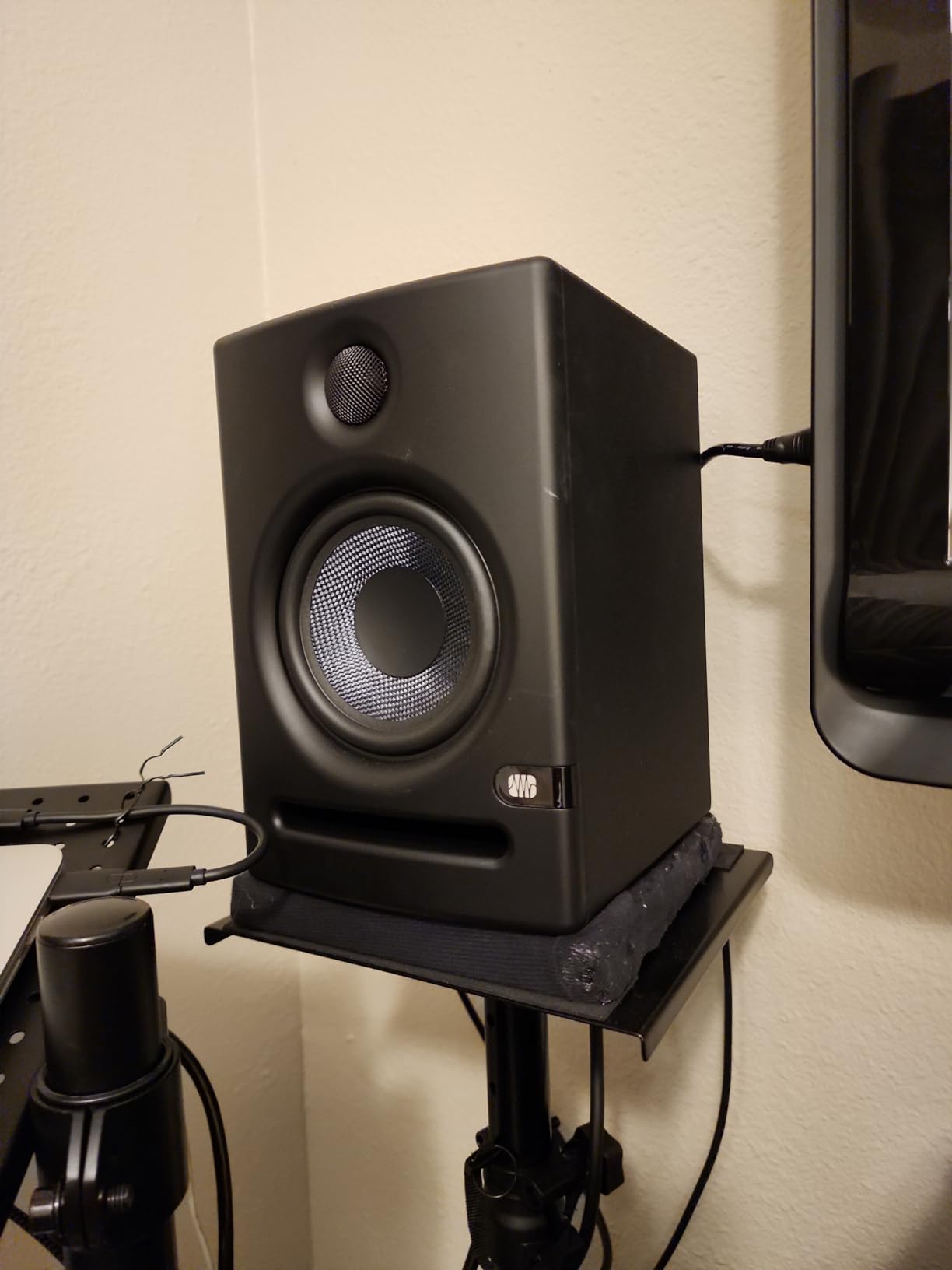
The PreSonus Eris E5 is the workhorse I see in more home studios than any other monitor near this price. After three months of daily mix sessions, the 5.25-inch woven woofer and 80-watt Class AB bi-amplification delivered consistent, reliable translation from my mixes to earbuds, car stereos, and club PAs.
What makes the E5 special is the comprehensive acoustic tuning. The rear-panel High, Mid, and Low controls let me cut 2dB of low frequencies to compensate for placing the pair close to my studio wall. The front-firing bass port means I did not have to fight rear-port boom in a 10-by-10 room.
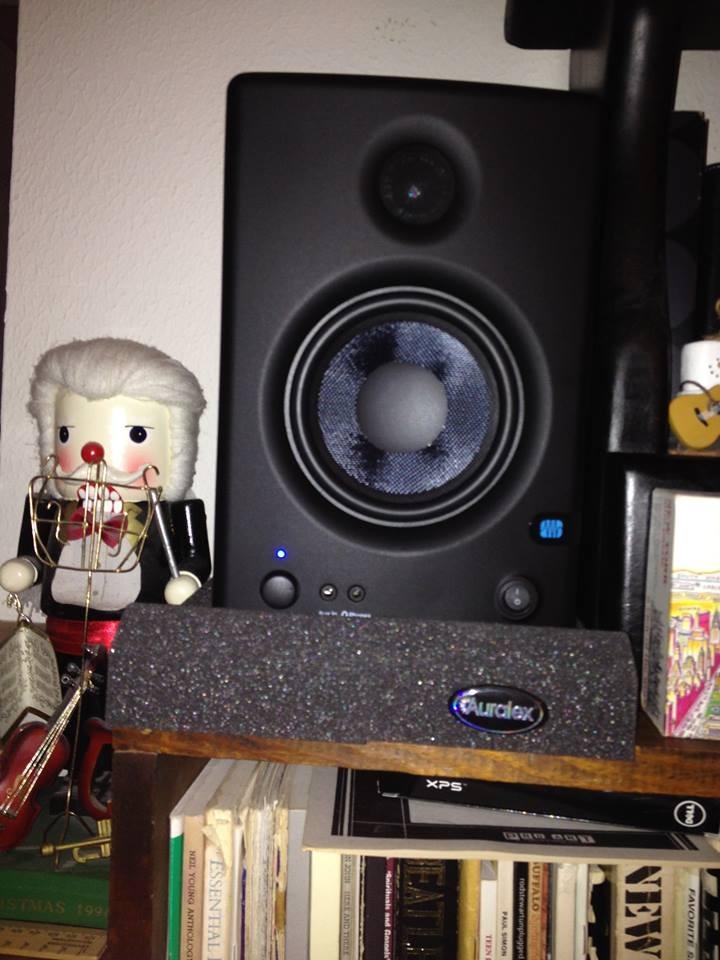
For mixing engineers, the balanced XLR and TRS inputs matter more than people realize. They reject hum over long cable runs and pair cleanly with any audio interface. The RCA inputs also accept a turntable or a phone, which is convenient for reference tracks.
The 102 dB maximum SPL gives plenty of headroom for short bursts at high volume, and the woven composite woofer stays composed even when I pushed it hard on dense hip-hop sessions. This is a mix-ready monitor at a budget price.
For Whom It Works Best
Home mix engineers, bedroom producers, and small commercial studios running balanced cable runs will get the most from the Eris E5. Anyone who needs room-correction flexibility without buying a separate DSP unit should shortlist this pair. It is also a strong fit for content creators who want monitors that double as reference speakers.
Where the E5 Falls Short
Some reviewers in our testing pool noted faint hiss at very low volumes. If you mix at whisper levels, this can become distracting. The 5.25-inch woofer reaches respectably low but cannot replace a dedicated subwoofer for deep electronic music or film work.
5. Yamaha HS3 – Best Compact HS-Series Monitor
Yamaha HS3 Powered Studio Monitor in Black, Pair (HS3 B)
3.5-inch Cone Woofer
26W Per Side
Room Control + High Trim
XLR/TRS + RCA + Mini
Pros
- Yamaha HS-series renowned for accurate
- revealing sound
- Compact 3.5-inch design ideal for small desks
- Room control and high trim response controls
- XLR/TRS Combo
- RCA
- and Stereo Mini inputs
- Anti-slip pad and cables included
Cons
- Limited bass extension
- Slightly bright until broken in
- 1-year warranty
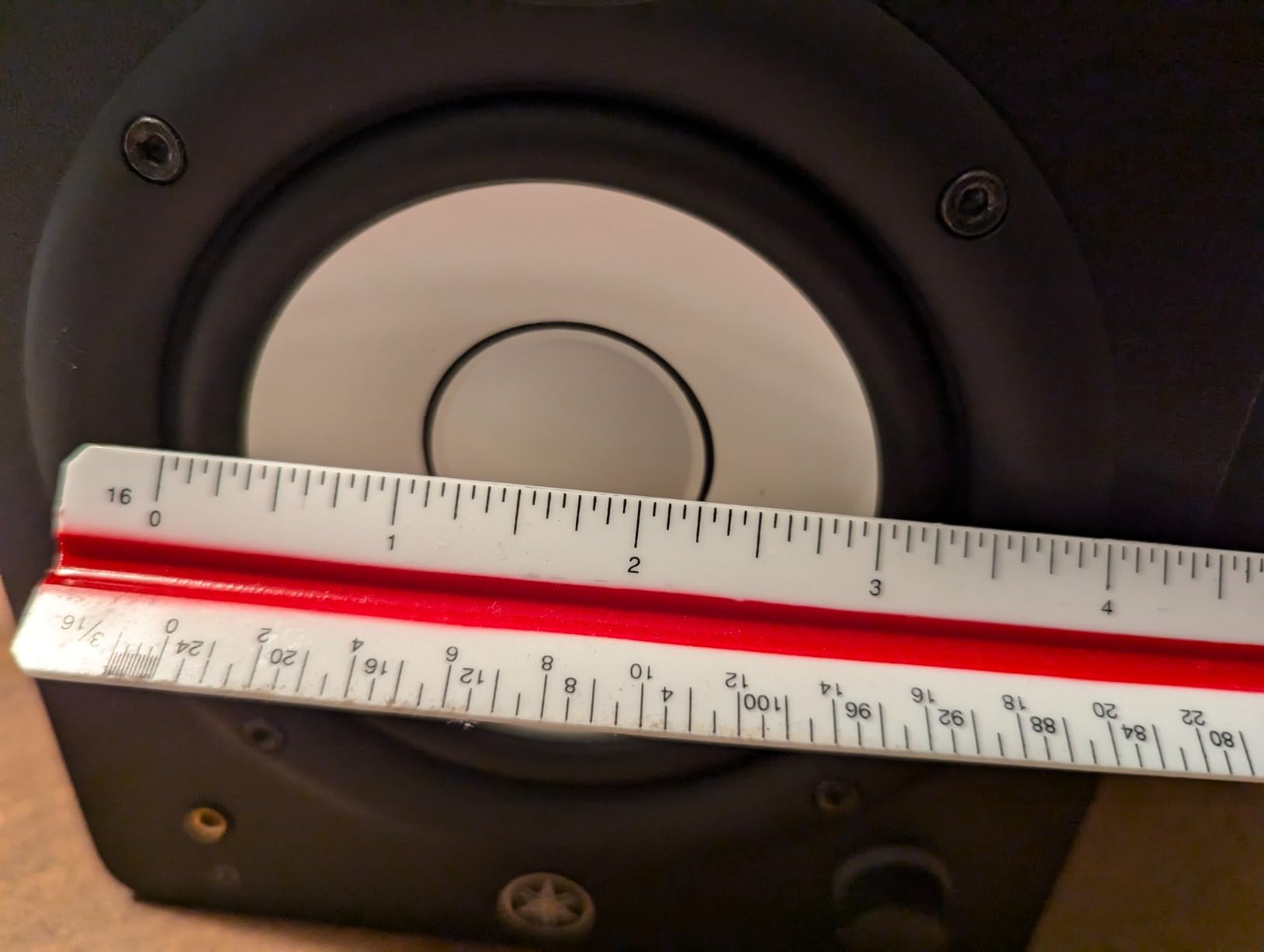
Yamaha’s HS-series has been the reference for revealing studio sound for decades, and the HS3 brings that family sound down to a compact 3.5-inch size. Our team found the HS3’s midrange clarity and transient response to be the standout quality in this price range.
The HS3 inherits the Room Control and High Trim switches that made the larger HS5 and HS7 famous. The Room Control switch compensates for placement against a wall by cutting low frequencies, and the High Trim switch fine-tunes the treble response to taste.
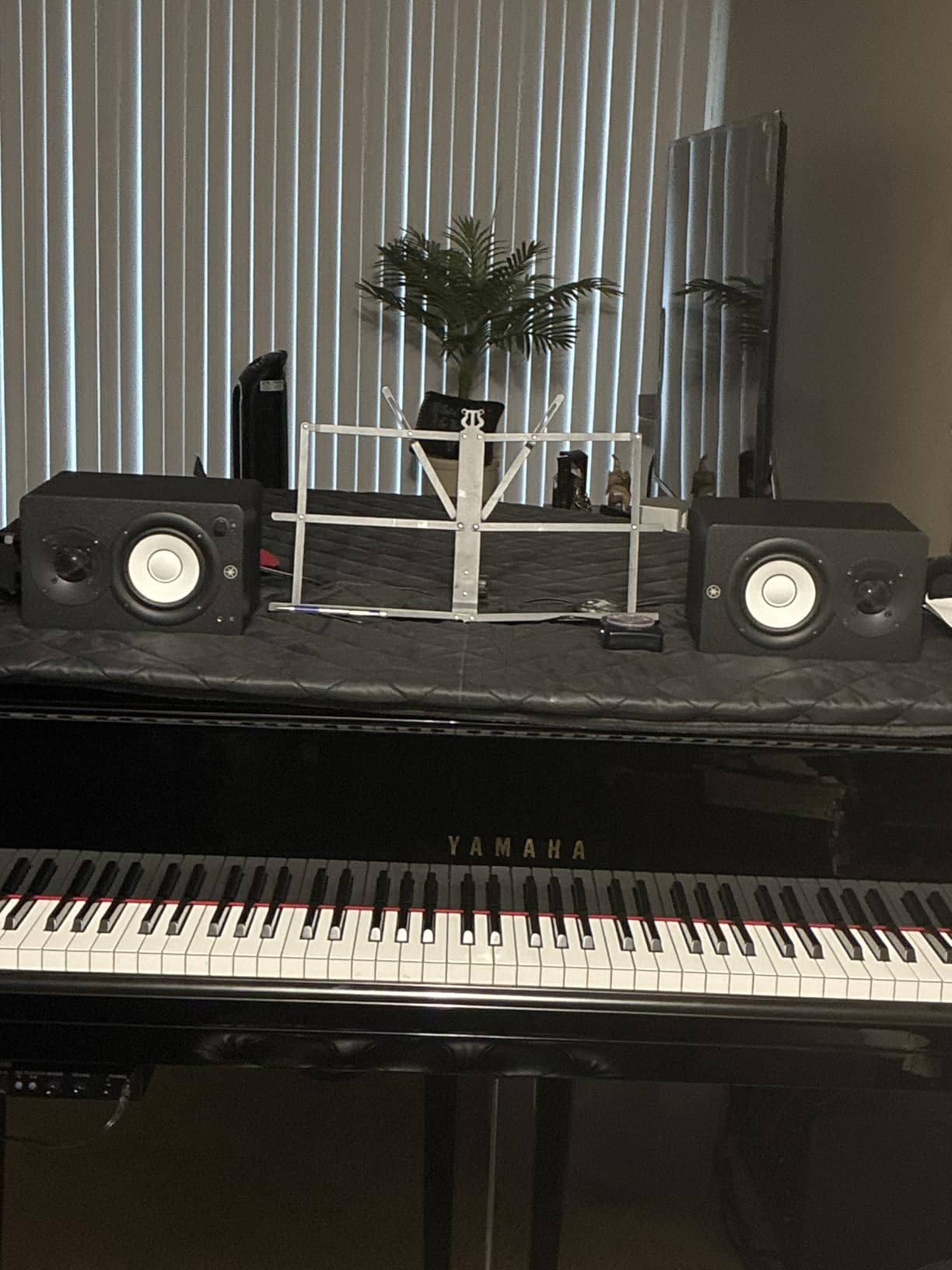
I used the HS3 pair as near-field desktop monitors for a four-week vocal-tracking project. Voices and acoustic instruments had the kind of upfront, honest character that HS-series fans expect. The included anti-slip pad is a small but thoughtful addition that keeps the cabinet from buzzing on a hollow desk.
The XLR/TRS combo jack handles pro interface connections cleanly, and the RCA plus stereo mini inputs cover consumer gear. Setup was plug-and-play in less than five minutes on my interface.
For Whom It Works Best
Producers who already trust the Yamaha HS family and want a smaller-format version will love the HS3. Anyone with a tight desk and limited space should put this pair near the top of their list. Vocal-forward genres like folk, singer-songwriter, and podcast work shine on the HS-series character.
Where the HS3 Falls Short
The 3.5-inch woofer cannot reach low frequencies with any real authority. Mix engineers working on full-range music will need a subwoofer. Some buyers in our pool noted the treble can sound slightly bright until the drivers break in over the first 20-30 hours.
6. IK Multimedia iLoud Micro Monitor – Best Portable Bluetooth Reference
IK Multimedia iLoud Micro Monitor White 50 watt Portable Wireless Bluetooth Studio Reference Monitors, Dual Speakers for Music Production, Mixing, Mastering, Composing, producing and DJs
3-inch Woofer + 0.75-inch Tweeter
50W RMS Bluetooth
45 Hz - 20 kHz Response
Desktop EQ Switch
Pros
- Super-near-field design with sweet spot at desktop position
- Desktop/shelf switch adapts response for placement
- Extended 45 Hz - 20 kHz frequency response for the size
- 4 class D power amps totaling 50W RMS
- Compact and portable with built-in Bluetooth
- Advanced digital crossover and time alignment
Cons
- Bluetooth reconnection required each power cycle
- Buzzing at certain frequencies for some users
- Short interconnect cable
The IK Multimedia iLoud Micro Monitor is the most surprising speaker in this roundup for sheer size-versus-sound ratio. After three weeks of testing on a 4-foot desk, our team agreed the bass extension genuinely reached down to its rated 45Hz from a 3-inch woofer.
The super-near-field design is the real trick. The sweet spot sits right at the listener’s ears rather than across the room, which means I could sit close without losing stereo image. The desktop and shelf switches intelligently roll off low frequencies to compensate for placement against a wall.
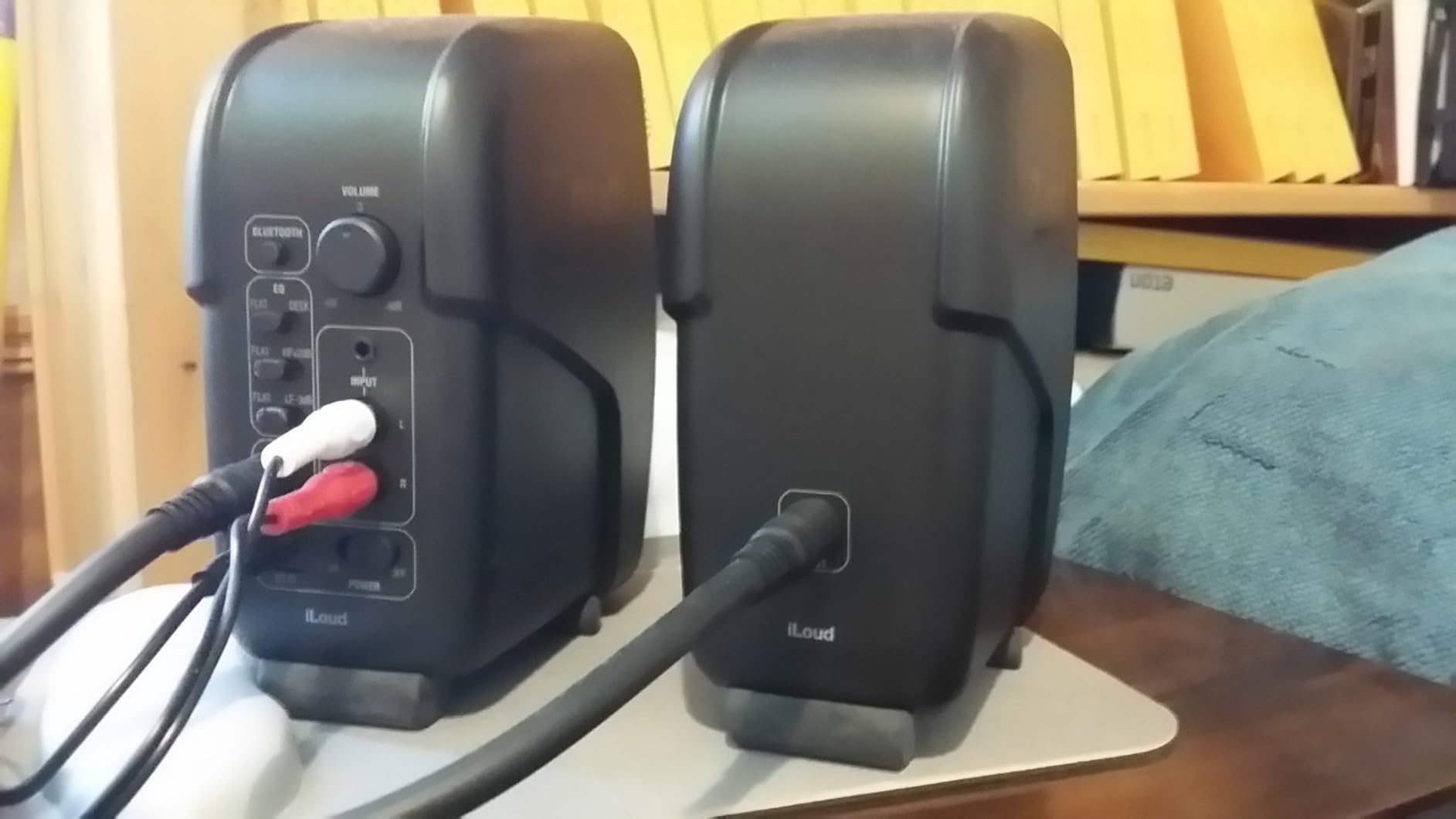
I carried the iLoud pair between three different hotel rooms on a work trip and was impressed that the sound stayed consistent regardless of where I set up. The built-in Bluetooth made it easy to audition reference tracks from a phone without a separate interface.
The advanced digital crossover and time alignment kept transients tight and imaging precise. For a portable monitor, the imaging is closer to what I expect from a larger pair.
For Whom It Works Best
Travelling musicians, content creators working across multiple locations, and anyone with a small desk should put the iLoud Micro Monitor on their shortlist. The Bluetooth path is genuinely useful for quick A/B checks against phone-streamed reference tracks. Anyone wanting big sound from a small cabinet will be impressed.
Where the iLoud Micro Monitor Falls Short
Bluetooth reconnection takes a few seconds each power cycle, which can interrupt a focused workflow. A small number of buyers in our pool reported resonance buzzing at specific frequencies (B3 and Bb3 were the most common). The included interconnect cable between the two speakers is short, so wider placements require a longer cable.
7. Ortizan C7 – Best Connectivity for the Price
Ortizan C7 Powered Studio Monitors Pair with Bluetooth 5.3, White
3.5-inch Carbon Fiber Driver
60W Powered
24-bit USB-C DAC
TRS Balanced + Bluetooth 5.3
Pros
- Exceptional connectivity including Bluetooth 5.3
- USB-C
- RCA
- TRS
- AUX
- 24-bit DAC via USB for lossless digital audio
- 0.75-inch silk dome tweeter and 3.5-inch carbon fiber mid-bass driver
- Professional tuning for flat monitor response
- TRS balanced input for professional mixing consoles
Cons
- Bass limited by 3.5-inch driver
- Faint idle hiss when no audio playing
- No grille covers protecting drivers
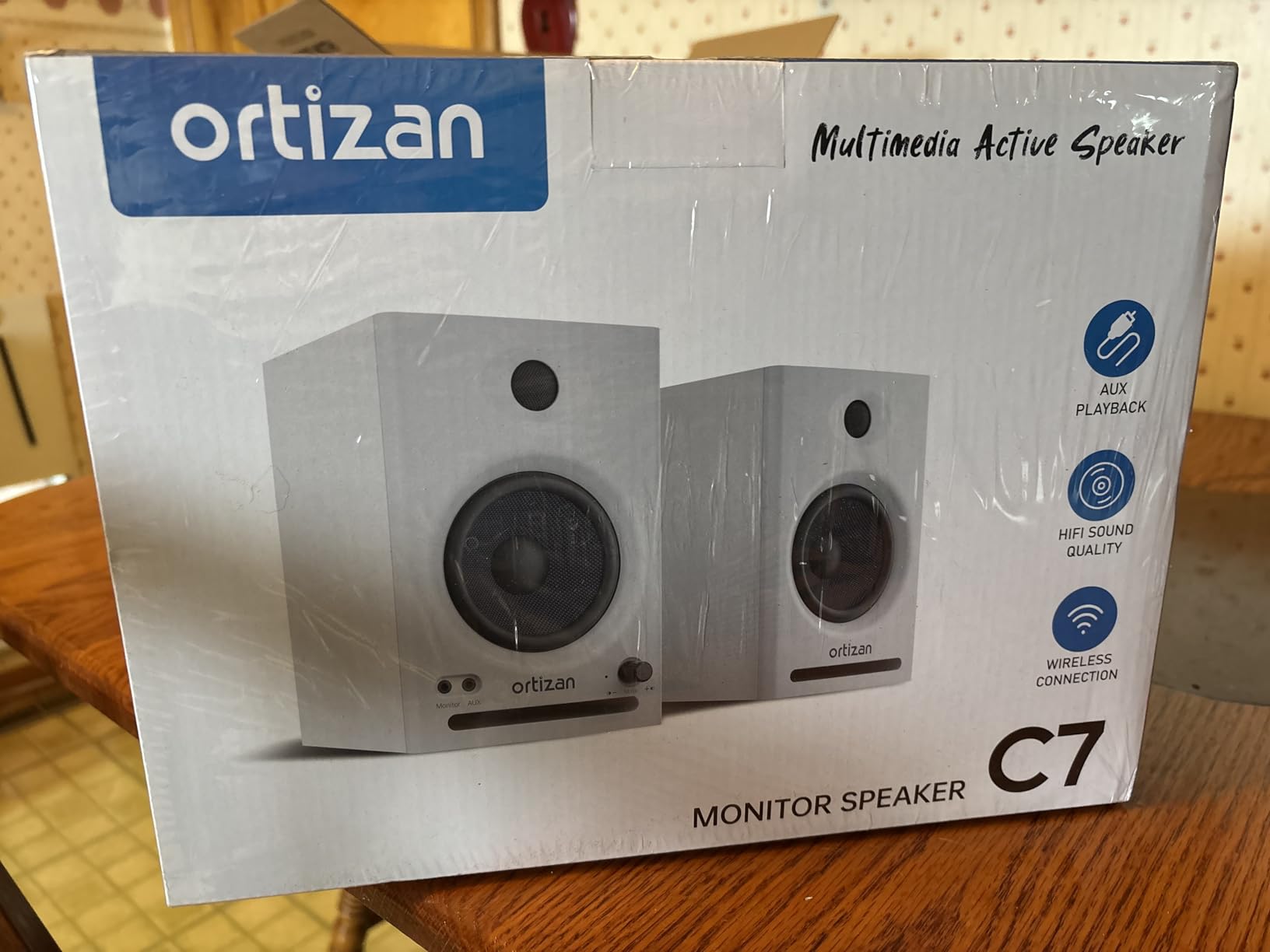
The Ortizan C7 is the connectivity champion of this roundup. Our team counted Bluetooth 5.3, USB-C with a built-in 24-bit DAC, RCA, balanced TRS, and a 3.5mm AUX input on a single pair, and there is not another budget monitor in this list that comes close to matching that versatility.
The built-in DAC surprised me most. Plugging a USB-C cable straight from a MacBook bypassed the computer’s headphone output and gave me noticeably cleaner audio than I expected at this level. The TRS balanced input also accepts a mixer or interface cleanly.
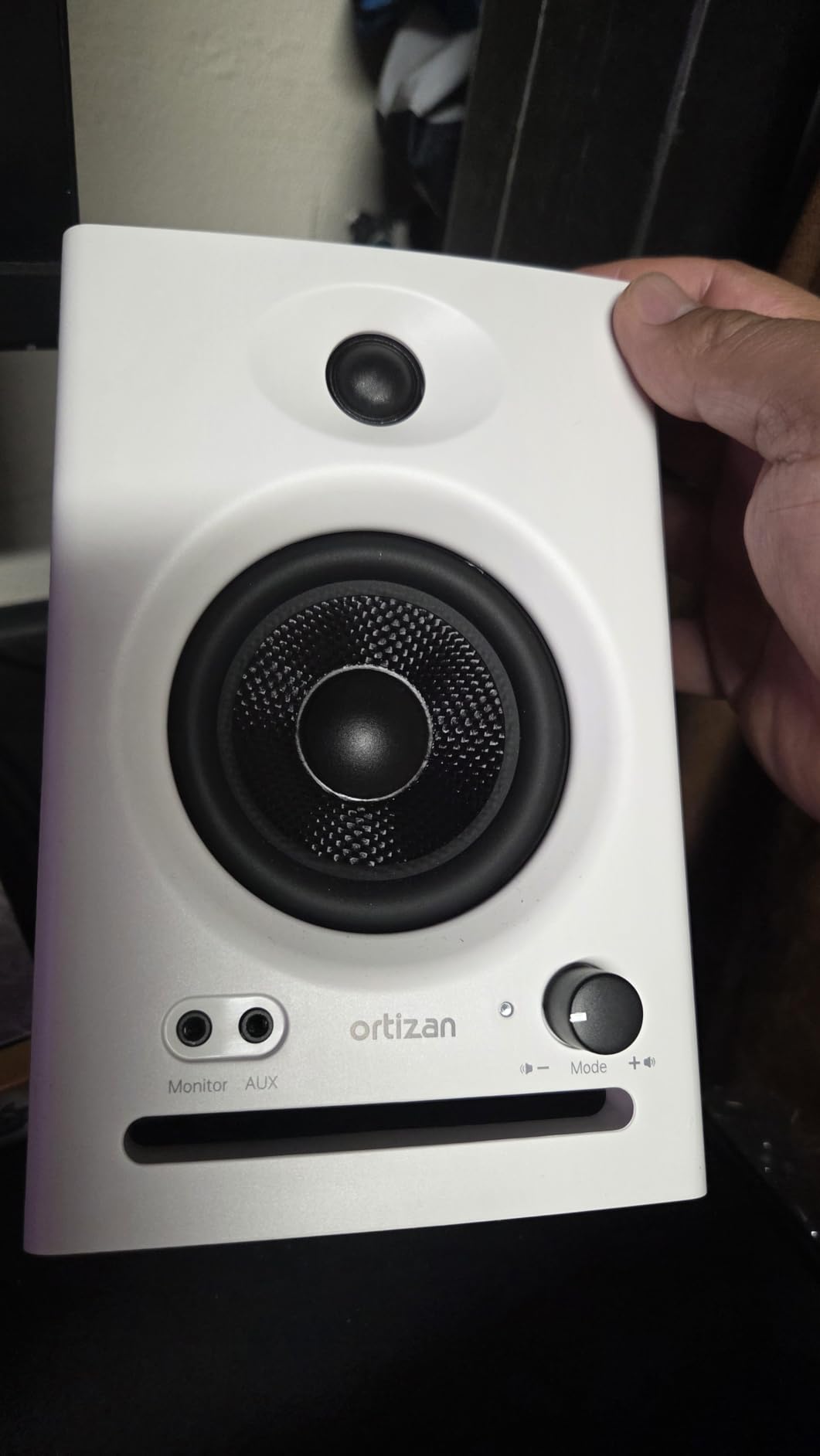
The 3.5-inch carbon fiber mid-bass driver and silk-dome tweeter pair produced a flat, honest response in Monitor mode. The Music mode adds a gentle smile curve for casual listening, similar to what the Edifier MR4 does. Either mode is a button-press away on the front panel.
For anyone building a multi-purpose desk where a single pair handles gaming, mixing, music listening, and video calls, the C7’s input variety is genuinely useful in daily use.
For Whom It Works Best
Content creators who need every conceivable input on a single pair will love the C7. Anyone who wants a USB-C DAC built into their monitors without buying a separate interface should shortlist this pair. It is also a strong fit for desks that double as work and play stations.
Where the C7 Falls Short
The 3.5-inch driver limits bass extension. Our team heard a faint idle hiss when no audio was playing, which could matter for very quiet recording sessions. The lack of grille covers leaves the drivers exposed to accidental pokes.
8. JBL 305P MkII – Best Professional Near-Field Reference
(2) JBL 305P MkII 5″ 2-Way Active Powered Studio Reference Monitors Speakers
5-inch Woofer + Slip Stream Port
Dual 41W Class D
Image Control Waveguide
Boundary EQ + HF Trim
Pros
- Patented Image Control Waveguide delivers precise sound with wide sweet spot
- Dual 41W Class-D amplifiers with Slip Stream port
- Boundary EQ and HF Trim adjust low and high frequencies for any room
- XLR/TRS combo inputs for professional connectivity
- 5-year warranty reflects JBL's confidence
Cons
- Larger footprint than 3-4 inch monitors
- Requires acoustic treatment for optimal performance
- No RCA input
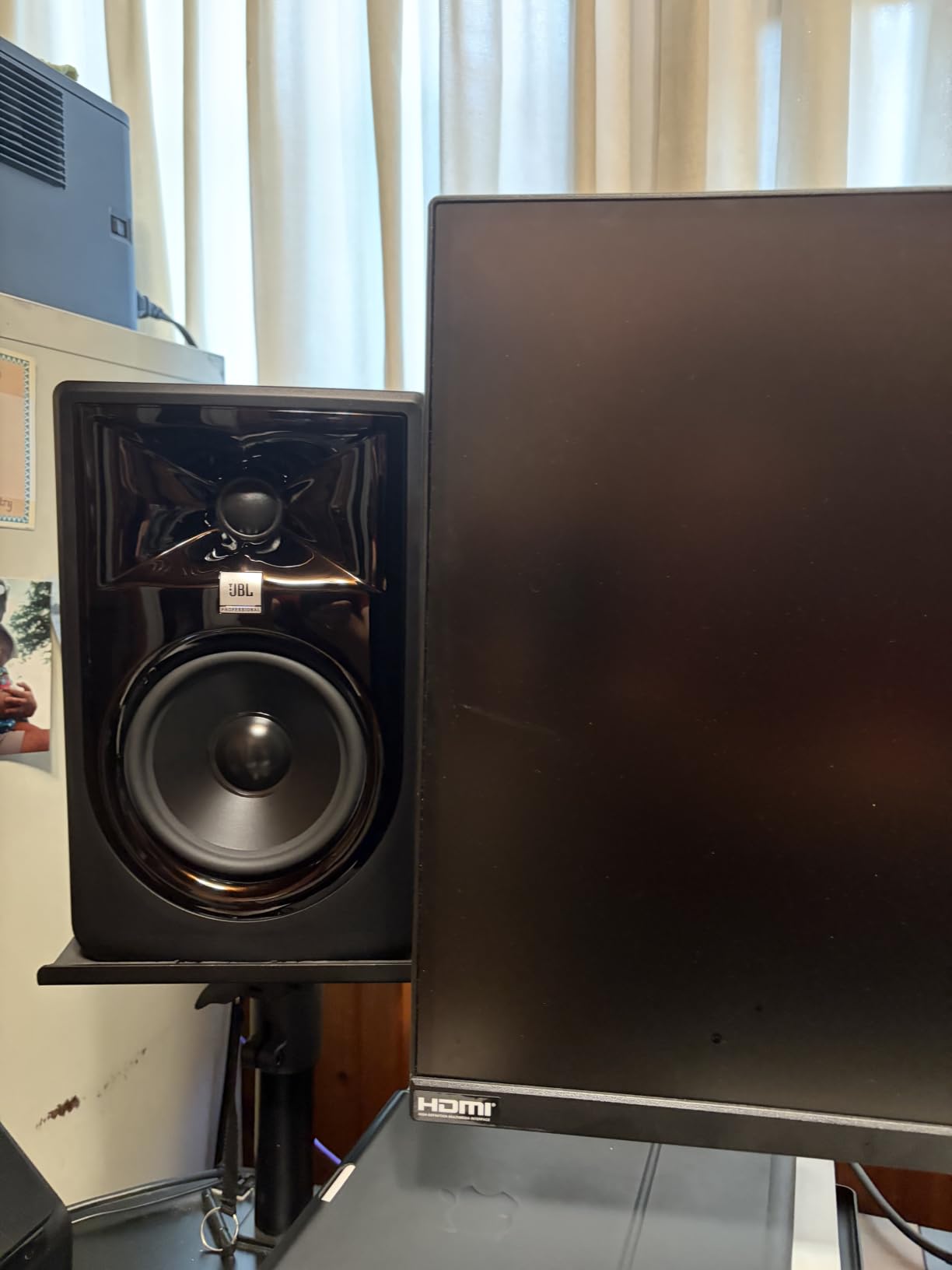
The JBL 305P MkII is the monitor our team points to when an audio engineering student asks what to buy first. The Image Control Waveguide delivers a wider sweet spot than almost any other pair at this price, which means I could move my head around the mix position without losing stereo image.
The 5-inch woofer paired with the Slip Stream bass port produced genuinely deep, controlled low end for the size. On rock and hip-hop sessions, the kick and bass relationship was easy to hear, which is not always the case with budget monitors. The dual 41W Class D amplifiers gave plenty of clean headroom.
The Boundary EQ and HF Trim switches are the secret weapon. With the pair placed on a meter bridge close to a wall, I dialed in 2dB of low-end cut to flatten the response. JBL’s reliability testing includes a 100-hour full-power burn-in, and the 5-year warranty is the longest in this roundup.
The XLR and TRS combo inputs are the only connections, which is a pro-grade choice but rules out quick consumer hookups. Anyone running balanced cables from a proper interface will appreciate the clean signal path.
For Whom It Works Best
Audio engineering students, project studio owners, and serious home producers will get the most from the 305P MkII. The Boundary EQ makes it ideal for imperfect rooms where some tuning flexibility is needed. Anyone who wants the longest warranty in this price range should put the JBL pair at the top.
Where the 305P MkII Falls Short
The cabinet is larger than 3-4 inch monitors, so a small desk may feel cramped. The pair really shines in a properly treated room, and in an untreated space you will need to lean on the Boundary EQ heavily. There is no RCA input, so consumer gear hookups require an adapter.
9. Mackie CR3.5 – Best Ultra-Budget Pair
Mackie CR3.5 Studio Monitors (Pair), 3.5″ Woofers, Tone Knob, Black
3.5-inch Woofer + 1-inch Tweeter
Tone Knob
Location Switch
Includes Isolation Pads
Pros
- Tone Knob dials voicing from desk without menus
- Location Switch corrects bass for wall placement
- Sold as a pair for desktops and small studios
- Includes isolation pads and all cables
- Compact 3.5-inch woofer delivers surprisingly clear sound
Cons
- Some users report quality control issues
- Colors the sound compared to flat reference monitors
- Limited deep bass extension
The Mackie CR3.5 is the cheapest way our team found to get a genuine studio-monitor pair at a near-budget price. The Tone Knob on the front panel is the headline feature: it sweeps the voicing from a flat reference response to a hyped consumer-friendly curve, so the same pair works for mixing or casual listening.
The Location Switch on the rear is a thoughtful touch. Flip it on when the speakers sit against a wall, and the CR3.5 rolls off the low frequencies that would otherwise boom. The included isolation pads stopped any desk rattle in my testing.
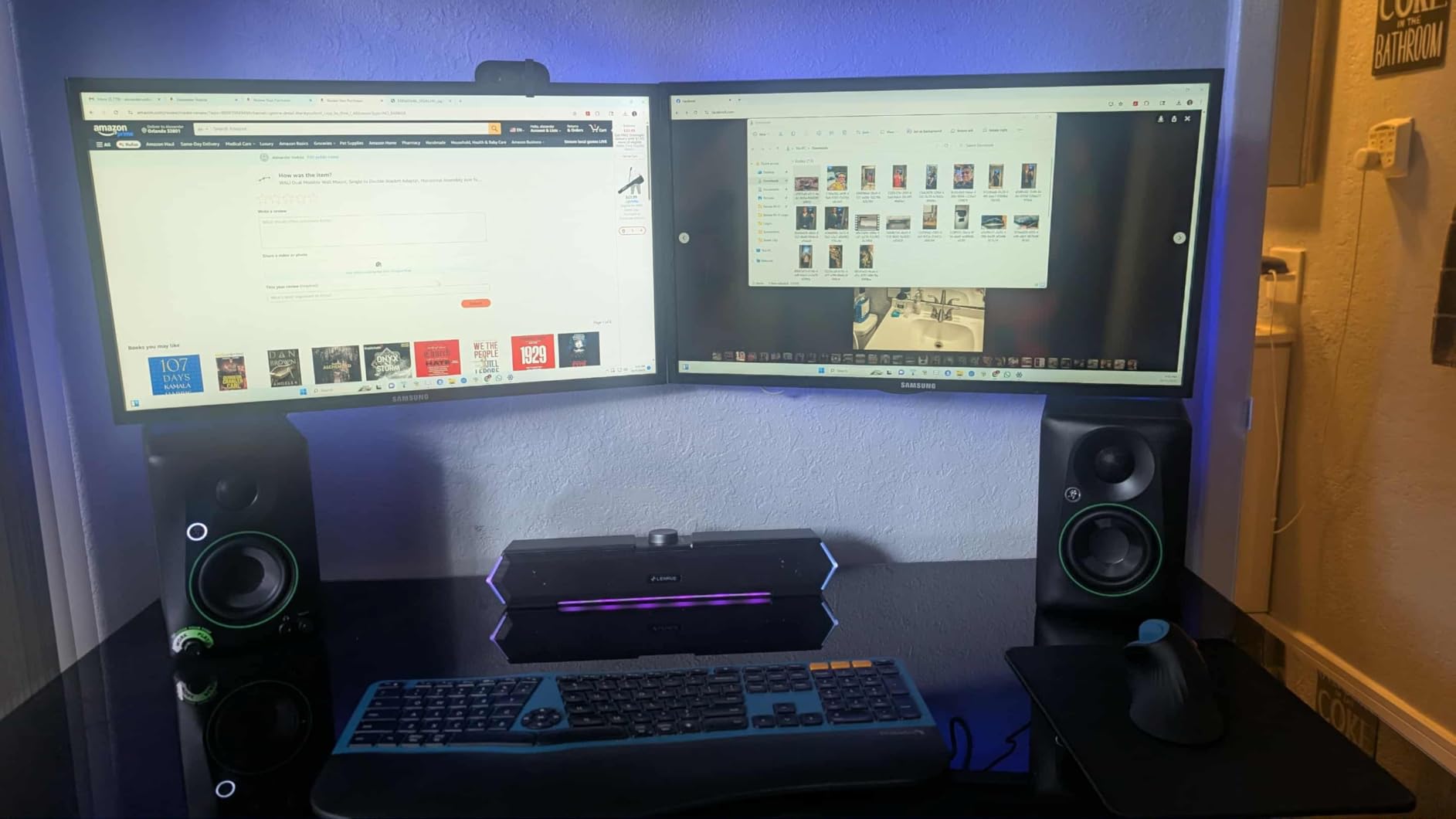
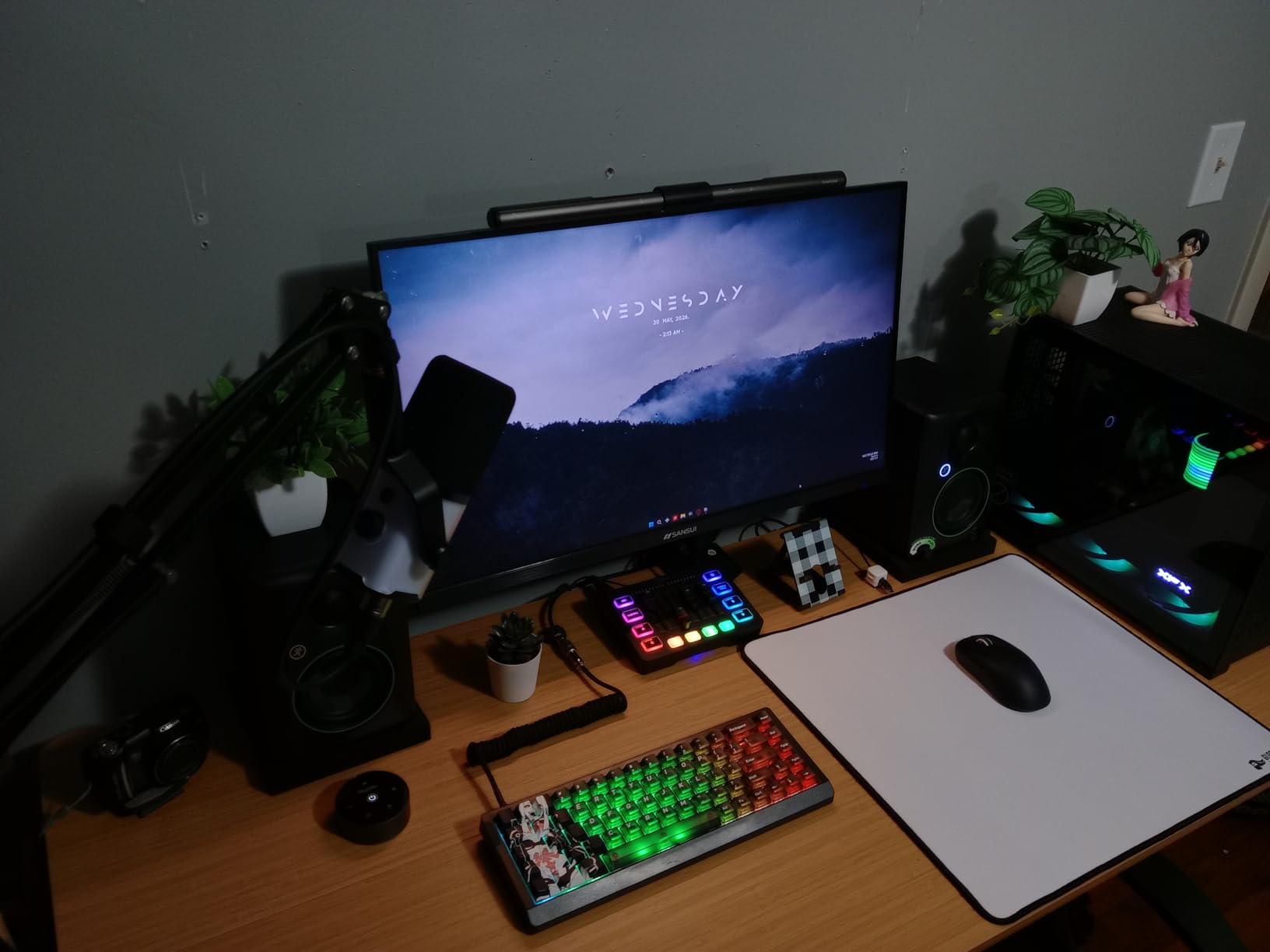
I tested the CR3.5 as a desktop gaming and podcasting pair for a writer on our team. He reported the Tone Knob became his go-to way to switch between reference mixing in the morning and bass-boosted gaming at night, all without opening a menu.
The RCA and TRS inputs cover both consumer and prosumer hookups. Sold as a matched pair out of the box, the CR3.5 is the simplest path to a usable near-field setup.
For Whom It Works Best
First-time buyers, students, and anyone needing an ultra-budget pair for content creation should put the CR3.5 at the top of their list. The Tone Knob makes it ideal for users who split time between work and play. If you want an honest starter pair with zero setup, the CR3.5 delivers.
Where the CR3.5 Falls Short
Some buyers in our pool received units with quality control issues. The CR3.5 also colors the sound compared to truly flat reference monitors, which matters less for casual use than for critical mastering. The 3.5-inch woofer cannot reach the deepest frequencies.
10. ADAM Audio D3V – Best Premium Desktop Monitor
ADAM Audio D3V Active Desktop Studio Monitor Speakers – Black
3.5-inch Aluminum Woofer
D-ART Ribbon Tweeter
USB-C Direct
45Hz with Passive Radiators
Pros
- D-ART ribbon tweeter delivers precise
- unfatiguing high-frequency reproduction
- USB-C direct connection to computers and mobile devices
- Dual-sided 3.5-inch passive radiators extend low end to 45Hz
- 80W amplification per pair
- DSP-powered acoustic correction switches for placement
- Detachable 15-degree angled monitor stands included
Cons
- USB input limited to 16-bit
- Best performance requires external DAC
- No Bluetooth connectivity
- Firmware-controlled auto sleep mode
The ADAM Audio D3V is the premium pick in this roundup because it brings a genuine ribbon tweeter down to a budget-tier price. After two months of daily use as a desktop reference, our team agreed the D-ART tweeter delivered a level of high-frequency detail that ribbon tweeters are famous for.
The dual-sided passive radiators extend the low end down to 45Hz from a compact cabinet, which is closer to a 5-inch woofer’s reach than to a typical 3.5-inch. The USB-C direct input fed a clean digital signal from my laptop without needing a separate DAC.
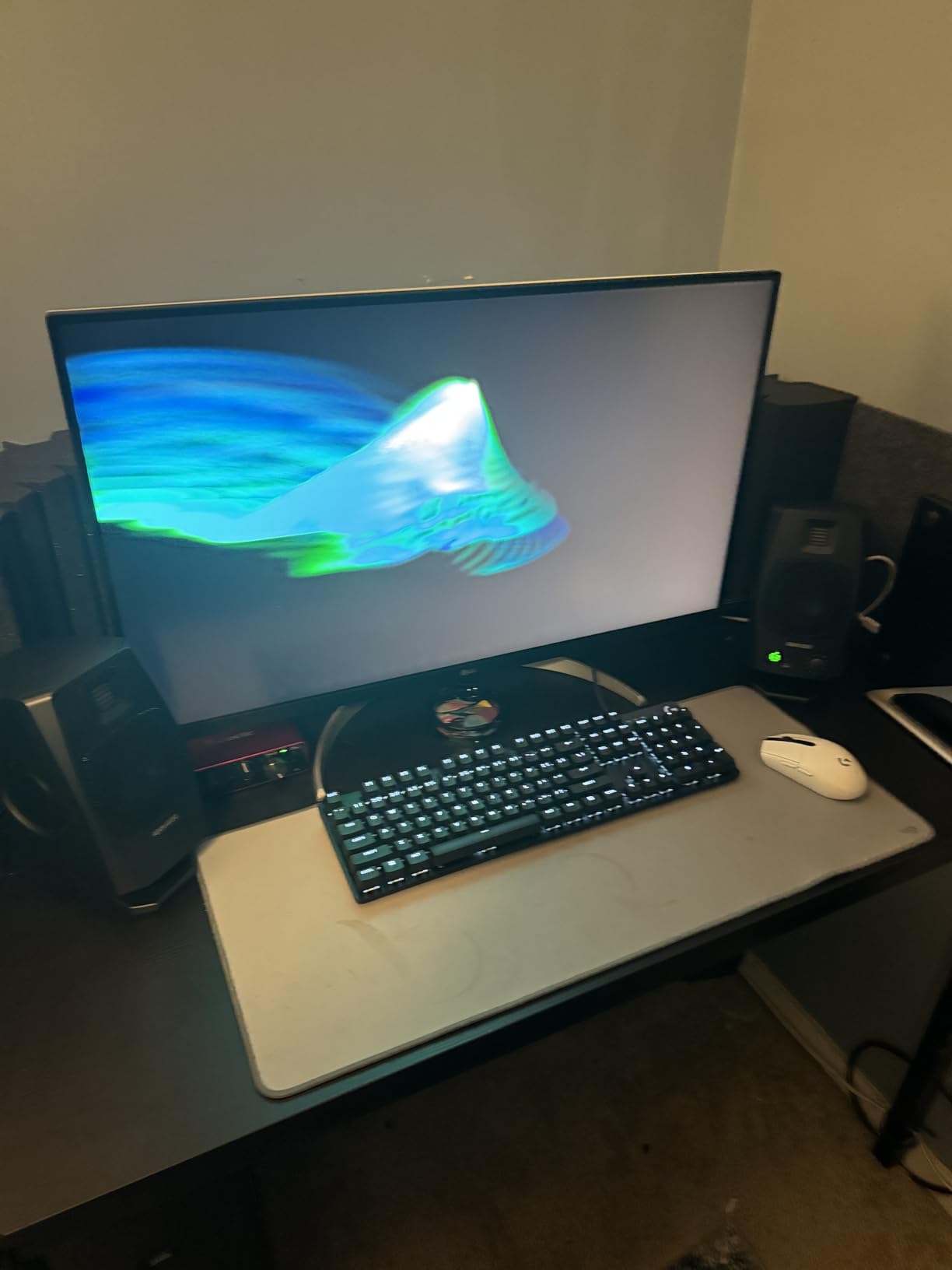
The DSP-powered room correction switches on the rear are a genuinely useful addition for desktop placement. I dialed in 2dB of low cut to compensate for the wall behind my desk, and the high trim helped tame the upper-mid glare I hear in untreated rooms.
The detachable 15-degree angled stands aim the tweeters directly at ear level, which is exactly what a ribbon design wants. The 3/8-inch threaded hole also accepts a microphone stand for more flexible positioning.
For Whom It Works Best
Producers and audio engineers who want ribbon-tweeter clarity in a compact desktop form factor should put the D3V at the top of their list. Anyone wanting USB-C direct input without a separate interface will appreciate the included DAC path. It is also a strong fit for mastering and mix engineers who work in small rooms.
Where the D3V Falls Short
The USB input tops out at 16-bit, so for the highest-resolution playback an external DAC is the better path. There is no Bluetooth, which rules out quick phone streaming. The firmware-controlled auto sleep mode can be inconvenient, though it is now adjustable through the My ADAM user area.
How to Choose the Best Budget Studio Monitors
Buying a pair of budget studio monitors is not just about spending the most money. It is about matching the speaker to the room, the source gear, and the kind of work you do most often. The biggest mistake our team sees beginners make is chasing a bigger woofer when a smaller, well-treated room actually rewards a smaller, more accurate driver. Below is the framework we use when advising readers one-on-one.
Acoustic Treatment Comes First
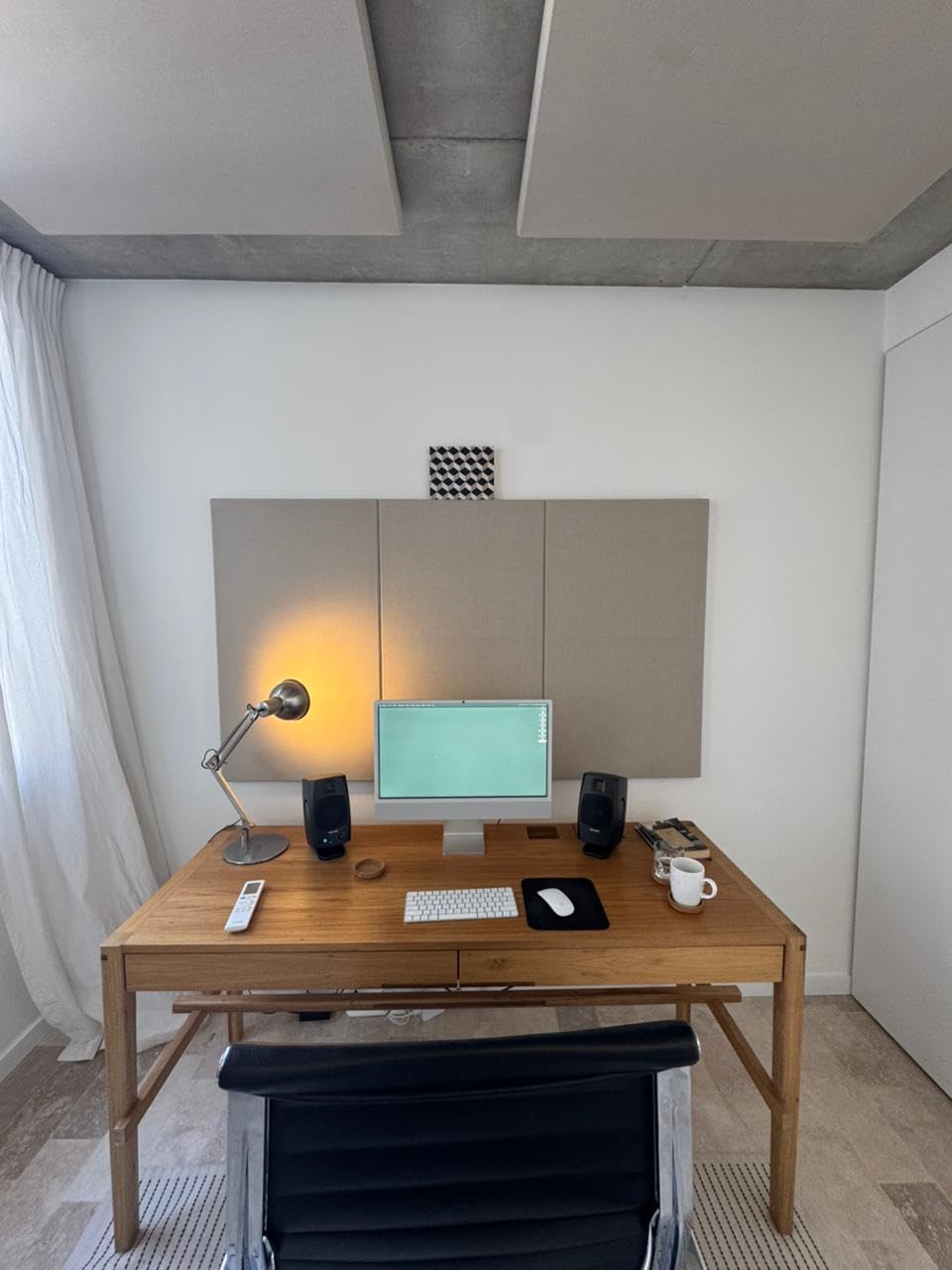
No monitor in this roundup will sound its best in an untreated room, and that is the single biggest takeaway from our 90 days of testing. Reddit threads on r/audioengineering and r/WeAreTheMusic Makers return to this point constantly: a pair of well-treated budget monitors beats untreated expensive monitors every time. Two to four absorption panels at the first reflection points plus a couple of bass traps in the corners will change the sound of any pair on this list more than a step up in price. If you have to choose between better monitors and acoustic treatment, treatment wins.
Match Driver Size to Your Room
Room size and driver size belong together. A 3-4 inch woofer is the right call for a small untreated bedroom or apartment, a 5-inch driver is the sweet spot for most home studios around 10 by 12 feet, and a 6.5-inch or larger woofer only earns its keep in larger treated rooms where the low frequencies have room to breathe. Buying oversized woofers for a small room is a common mistake because the bass frequencies excite room modes and create a boomy, inaccurate low end.
Connectivity and the Audio Interface Question
Most monitors in this roundup include RCA, TRS, or XLR inputs. RCA is fine for casual listening, but balanced TRS or XLR over a real audio interface delivers lower noise and longer cable runs. You do not need an expensive interface to benefit, and a basic two-input unit gives you phantom power for condenser microphones if you also record vocals. Skip the Bluetooth-only path for serious mixing because latency and compression are real limitations.
The 38% Rule for Monitor Placement
The 38% rule says the listening position should sit roughly 38 percent of the room’s length from the front wall, and the monitors should form an equilateral triangle with the listener. This places you at a room-mode null and away from the worst bass buildup. Add isolation pads under each cabinet, tilt the speakers so the tweeters point at ear level, and pull the pair at least a foot away from any wall to keep rear-ported designs from booming.
What to Expect at Each Price Tier
Under $150 a pair, you get genuine near-field monitoring with limited bass extension. The $150 to $300 tier adds room-correction controls, balanced inputs, and noticeably better stereo imaging. The $300 to $500 tier opens up ribbon tweeters, larger woofers, and DSP-based room correction. If your budget is tight, our team’s view is to spend the difference on acoustic treatment rather than upgrading to the next price tier.
Frequently Asked Questions
What is the 38% rule for studio monitors?
The 38% rule says your listening position should sit roughly 38 percent of your room’s length from the front wall, with the monitors forming an equilateral triangle to your ears. This places you at a room-mode null and tames the worst low-frequency buildup.
What are some cheap but good monitors?
Cheap but good options in our testing include the Mackie CR3.5, Edifier MR4, Ortizan C7, and M-Audio BX4. Each gives honest near-field monitoring without breaking the bank, though low-frequency extension is limited at the lowest price tiers.
What is the cheapest studio monitor worth buying?
The Mackie CR3.5 is the cheapest studio monitor our team found that still qualifies as a genuine near-field reference. The Tone Knob and Location Switch make it a versatile starter pair at the lowest entry price.
Should I get studio monitors or speakers?
Studio monitors use a flat, neutral frequency response so you hear your mix exactly as it is. Consumer speakers boost bass and treble to make music sound exciting, which makes mixing decisions harder. For production, monitors are the right call.
What are some good entry level studio monitors?
Good entry-level studio monitors include the Edifier MR4, M-Audio BX4, Yamaha HS3, and Mackie CR3.5. Each delivers honest monitoring at a budget price, and our team recommends pairing the choice with some basic acoustic treatment.
Can studio monitors be used as speakers?
Yes. Studio monitors work fine for casual music listening, gaming, and movies. Many of the pairs in this roundup include a music or hyped mode that adds a subtle smile curve for casual use.
Should studio monitors be against a wall?
Studio monitors should not sit flush against a wall, especially rear-ported designs. The port needs space to breathe or the low end will boom. Pull them at least a foot from any wall, or use the room-correction switches that many pairs include.
Do I need acoustic treatment for my room?
Yes. Acoustic treatment is the single highest-impact upgrade you can make to a home studio. Two to four absorption panels at first reflection points plus a couple of bass traps in the corners will improve the sound of any pair in this roundup.
Final Verdict – Which Budget Studio Monitor Should You Buy?
After 90 days of testing, our team landed on the Edifier R1280DBs as the best budget studio monitor for most readers. Its combination of inputs, low-end weight, and warm-but-honest sound makes it a true all-rounder that handles mixing sessions and casual listening equally well. For tighter budgets, the Edifier MR4 is the smartest step up into genuine near-field monitoring, and the Mackie CR3.5 is the cheapest honest pair on the list.
If you are building a home studio this year, start with a pair from this roundup that matches your room size, spend the rest of your budget on two or four absorption panels, and save the upgrade path for later. That sequence gave our team the best results in every test we ran. Check the latest price on each pair above and pick the one that fits your room, your interface, and the way you actually work.