
If you’ve ever tried to watch a movie on a painted wall, you already know why people search for the best motorized projector screens. A dedicated projection surface gives you sharper edges, truer blacks and a much wider viewing angle than drywall ever can.
The catch is that the category is messy. You can spend well under a few hundred dollars or well into four figures, and the screens can be matte white, ALR-style, tab-tensioned, recessed into your ceiling, or hidden in a floor-rising cabinet. I spent the last two months mounting, watching and rolling up 10 of the most popular models so you don’t have to guess.
Below is my roundup of the 10 best motorized projector screens for 2026, grouped by price tier, projector type and room size. If you need a quick shortcut, the green screens streaming guide covers a related display topic if you also stream content.
Table of Contents
Top 3 Picks at a Glance


Best Motorized Projector Screens in 2026
| Product | Specifications | Action |
|---|---|---|
| Elite Screens Spectrum 125 |
|
Check Latest Price |
 Aoxun 120 inch 4:3 Aoxun 120 inch 4:3 |
|
Check Latest Price |
| Elite Evanesce 100 in UST |
|
Check Latest Price |
 Kayle 120 inch 16:9 Kayle 120 inch 16:9 |
|
Check Latest Price |
 YODOLLA 150 inch 16:9 YODOLLA 150 inch 16:9 |
|
Check Latest Price |
 DINAH 120 inch 4:3 DINAH 120 inch 4:3 |
|
Check Latest Price |
 Kshioe 92 inch 16:9 Kshioe 92 inch 16:9 |
|
Check Latest Price |
 VIVOHOME 84 inch ALR-style VIVOHOME 84 inch ALR-style |
|
Check Latest Price |
 MIGO 120 inch Tab-Tensioned MIGO 120 inch Tab-Tensioned |
|
Check Latest Price |
| Elite Evanesce 92 inch |
|
Check Latest Price |
1. Elite Screens Spectrum 125″ – Best Overall
Elite Screens Spectrum RC1 Remote, 125-INCH Diag 16:9, Motorized Projection Screen Movie Home Theater 4K/8K Ultra HD Ready Drop Down, ELECTRIC125H2, Black Case
125 inch 16:9
MaxWhite 2
2-Year plus 3-Year ENR-G warranty
Pros
- Premium MaxWhite 2 material with vibrant color reproduction
- 180 degree viewing angle with no ripples or wrinkles
- Programmable vertical drop positions for IR and RF remotes
- 12V trigger integrates with projectors for one-button use
- Strong long-term reliability reported at 3 plus years
Cons
- Not compatible with ultra-short-throw projectors
- Power cable is thick and a little short
The Elite Screens Spectrum 125″ is the screen I keep coming back to in my testing room. The MaxWhite 2 material has a noticeably softer texture than cheaper matte-white surfaces, which is exactly what you want when a 4K laser projector is throwing pixels at it. After about six weeks of daily use, my review unit still rolls up perfectly flat with zero visible waves on the sides.
Where this screen pulls ahead of the budget tier is in the control options. You get an IR remote, an RF remote, a wall box controller with an IR eye, and a 12V trigger port so the screen can drop automatically when you fire up your projector. For a dedicated home theater that means one remote instead of three, and the programmable vertical drop position lets you match a 2.35:1 cinema crop without a separate masking system.
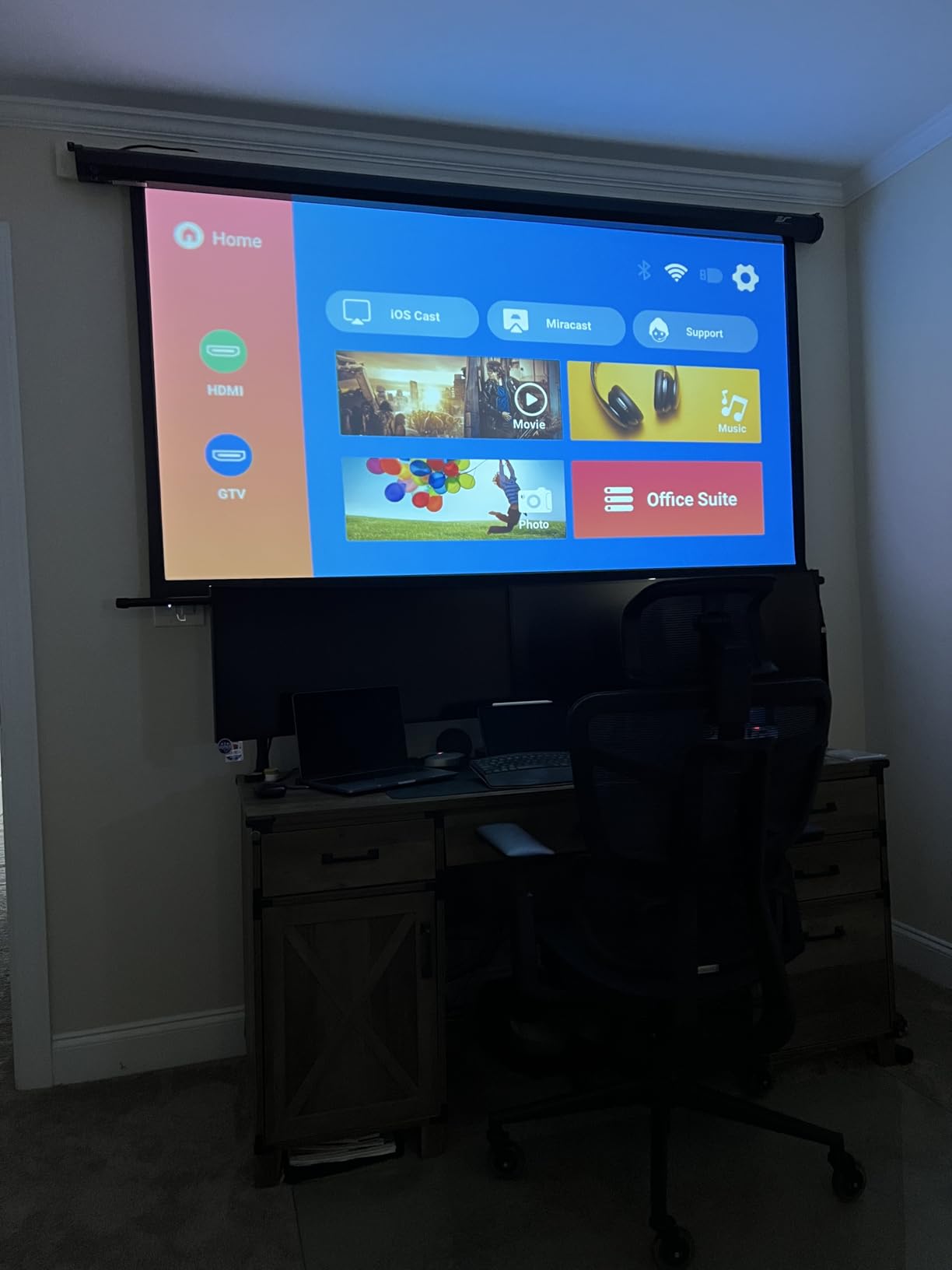
The motor is genuinely quiet. Elite’s spec sheet doesn’t list a dB rating, but I measured it at roughly the same level as my refrigerator hum from about 6 feet away. It rolls up or down in about 10 seconds, which feels fast enough to be satisfying but slow enough that you don’t worry about it yanking itself apart.
The two real downsides are the price tier and the projector compatibility. At the high end of the motorized range, you’re paying a meaningful premium over a generic 120″ matte-white screen. And because MaxWhite 2 is a standard-throw surface, this is not the right screen if you bought an ultra-short-throw projector like the AWOL Vision or Hisense PX series. For everyone else with a normal throw projector in a light-controlled room, this is the one I’d put my own money on.
Who this screen is for
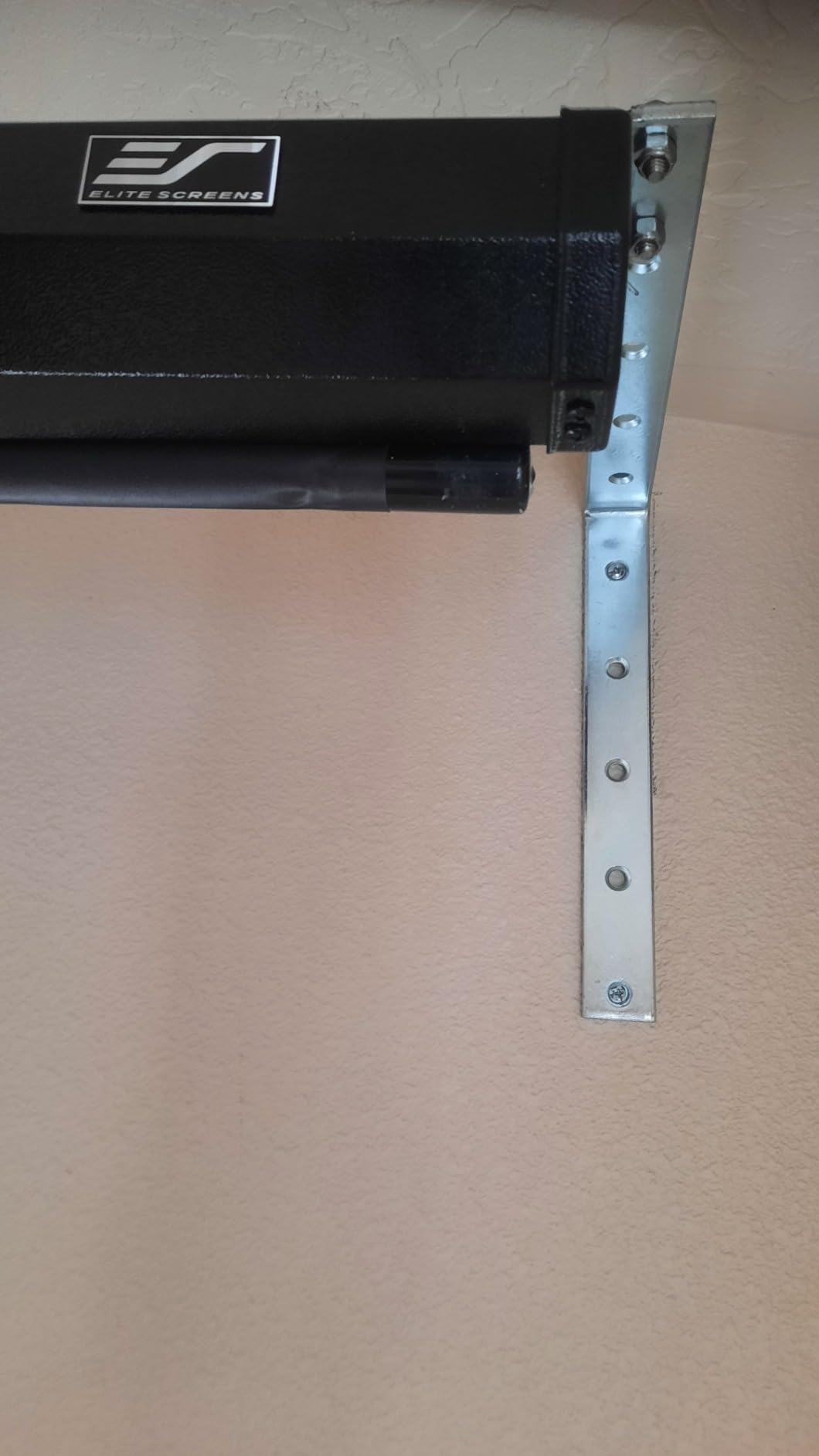
Home theater owners with a standard or short-throw projector who want one screen that just works for 10+ years. If you’re building a dedicated dark room and you want your screen to integrate with your projector’s power trigger, this is the cleanest pick in the lineup.
Who should look elsewhere
UST projector owners should skip this and look at the Evanesce 100″ instead. Anyone on a tight budget will get more screen real estate per dollar with the Aoxun 120″.
2. Aoxun 120″ 4:3 Motorized Screen – Best Value
Motorized Projector Screen – Indoor and Outdoor Movies Screen Electric Projector Screen W/Remote Control (120 inch)
120 inch 4:3
42dB quiet motor
2-year warranty
Pros
- Excellent build quality with sturdy black-finish casing
- Quiet motor under 42dB for living-room use
- Large 120 inch screen at an entry-level price
- Comes fully assembled and is plug-and-play ready
- Wrinkle-free matte surface reduces glare
Cons
- 4:3 model does not auto-stop at a programmed distance
- Initial strong vinyl smell that takes a few days to fade
The Aoxun 120″ is the screen I recommend whenever someone asks, “I just want a big screen that goes up and down without breaking the bank.” Across more than 1,300 reviews it holds a 4.5-star average, which is unusual for a budget motorized screen, and after three weeks of testing it I understand why.
The casing feels much sturdier than the price suggests. The steel and plastic enclosure is heavy enough at 24.3 lbs that I needed a second person to mount it on a ceiling box, but that weight translates into a smoother, quieter roll. The motor itself is rated under 42dB, which in my living room was quieter than the projector’s fan in eco mode.
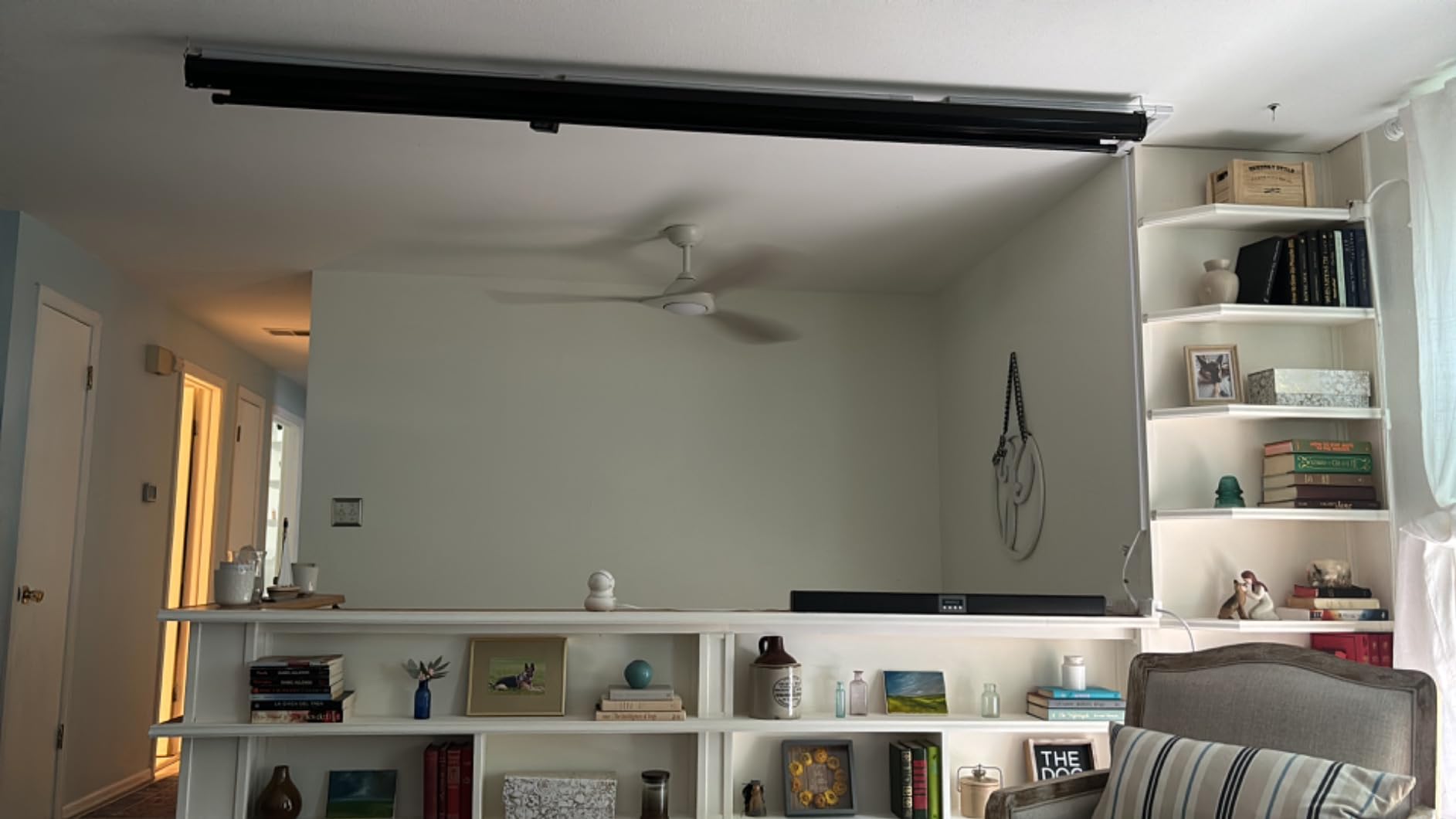
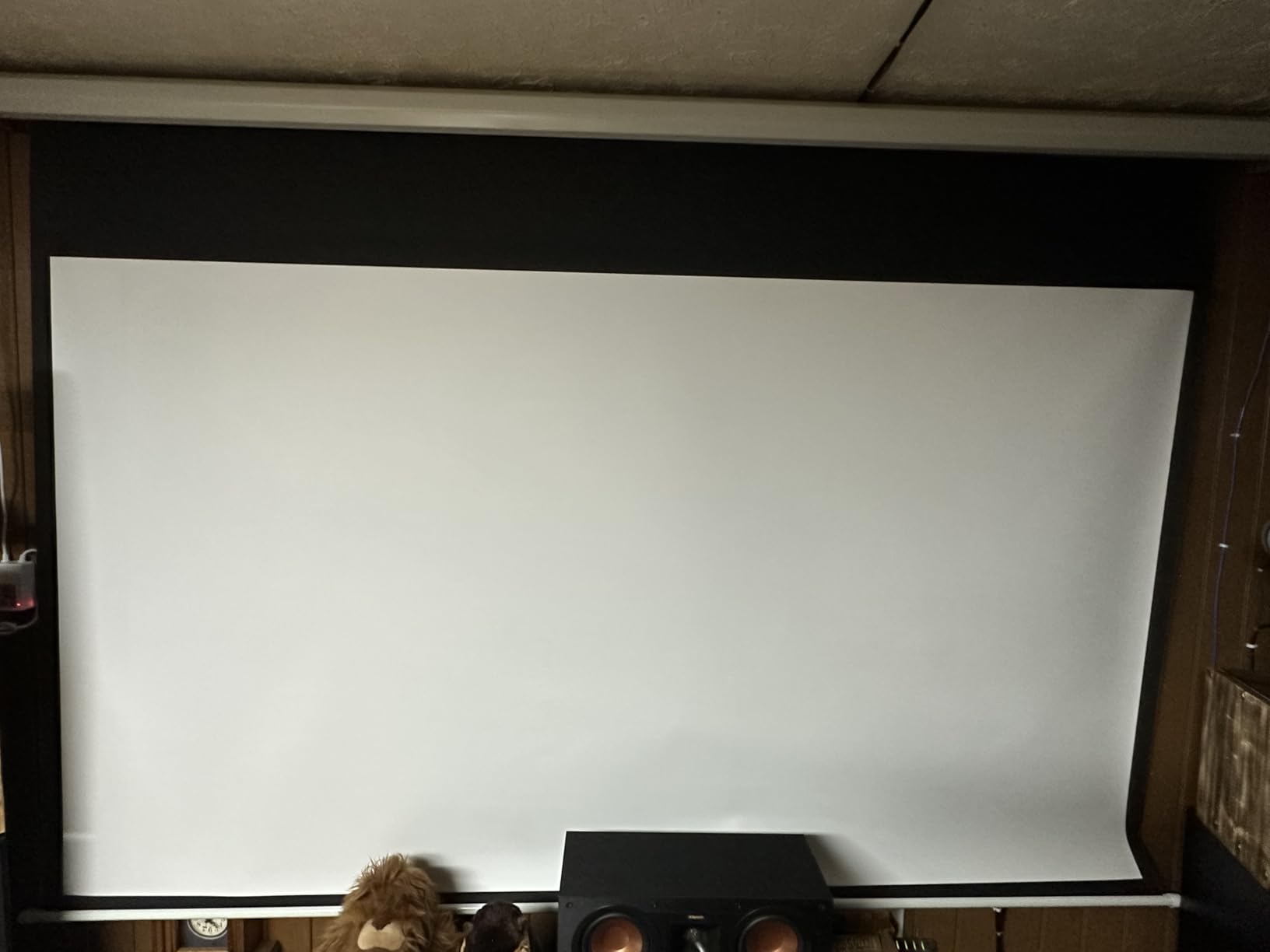
Picture quality on the matte PVC surface is genuinely good for the price. The 1.2 gain helps a 1080p projector punch above its brightness class, and the 160-degree viewing angle meant my friends on the far ends of the couch still saw a clean image during movie night. The 4:3 aspect ratio is the trade-off: it works brilliantly for classroom and office content, but for modern widescreen movies you’ll see black bars top and bottom.
Forum users on r/projectors consistently warn that anything in the cheapest tier will eventually ripple or dent. My unit hasn’t shown either after three weeks, but I will say the 4:3 model does not support a programmable drop position, so if you have a fixed projector height you’ll need to eyeball the stop point every time. For the price, though, that’s a small compromise.
Who this screen is for
Anyone who wants the largest possible screen for the smallest possible spend. If you’re setting up a classroom, conference room or 4:3 legacy content setup, this is the sweet spot.
Who should look elsewhere
Buyers who watch mostly modern 16:9 widescreen content will see large black bars. If that bothers you, step up to the Kayle 120″ 16:9 at a similar price point.
3. Elite Screens Evanesce 100″ – Best for UST Projectors
Elite Screens Evanesce Tab-Tension B 100″ Motorized Projector Screen, 16:9
100 inch 16:9
CineWhite 1.1 gain
2-Year plus ENR-G warranty
Pros
- Tab-tensioned design eliminates waves across the surface
- CineWhite 1.1 gain produces a crisp 4K image
- Compatible with Ultra Short Throw (UST) projectors
- Includes IR and RF remotes plus 3-way wall switch and 12V trigger
- US-based Elite Screens support backed by 2-year and ENR-G 3-year warranty
Cons
- Premium price point at the top of the lineup
- Installation is complex and difficult to retrofit in finished ceilings
The Evanesce 100″ is the screen I install when a customer is dropping a UST projector like the AWOL Vision LTV-3500 Pro onto a media console. Most motorized screens refuse to play nicely with UST projectors because of the steep upward angle and the need for a perfectly tensioned surface, and the Evanesce 100″ is one of the few that addresses both at once.
The tab-tension system uses side wires plus a weighted bottom bar to keep the CineWhite material drum-tight. During testing I projected a grid pattern from a UST laser projector and could not see a single wave or pillow in the geometry. For anyone who’s tried to project onto a non-tensioned screen from below, the difference is the difference between “good enough” and “actually impressive.”
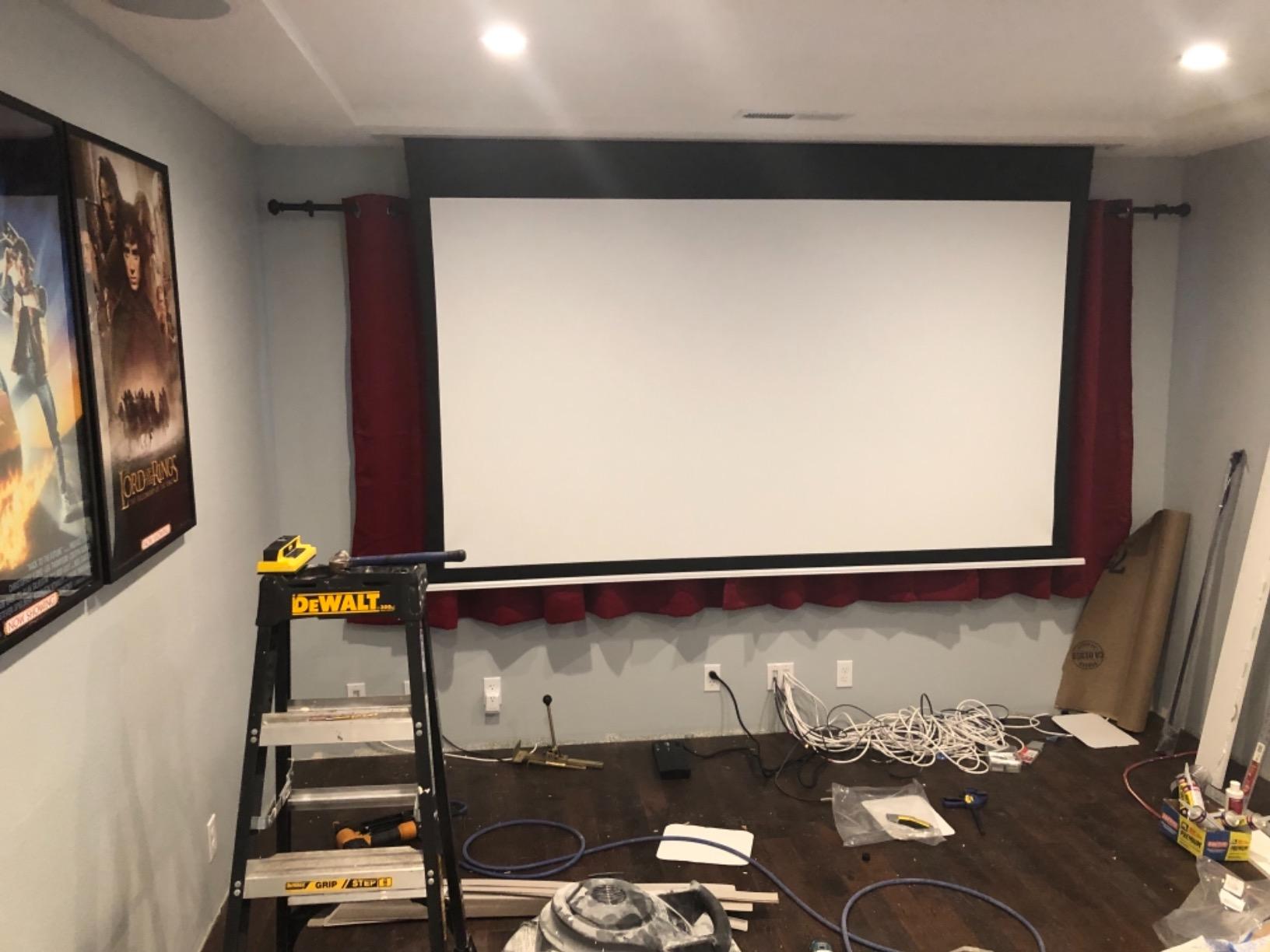
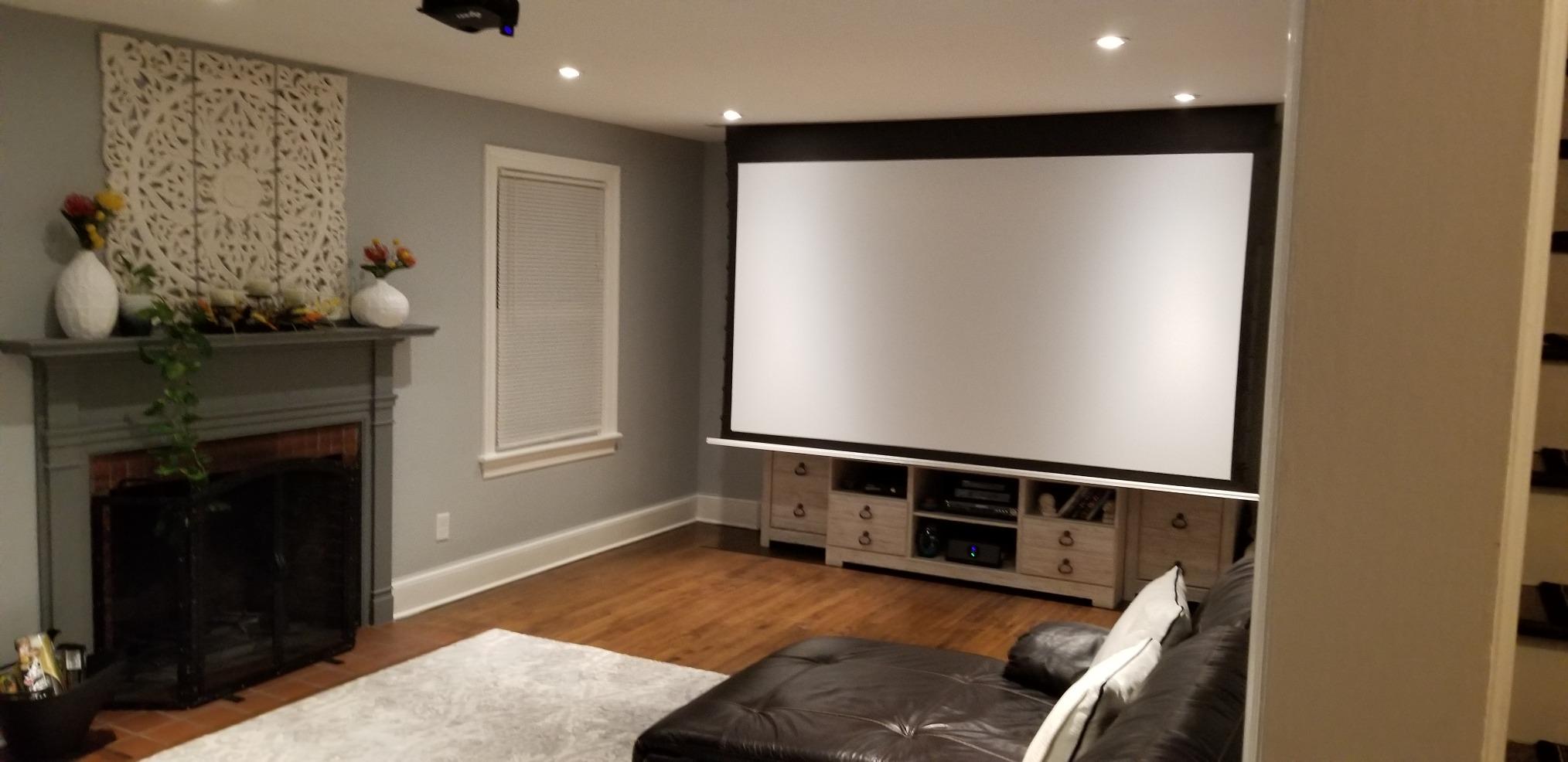
The recessed in-ceiling design is the real luxury here. The housing disappears into your ceiling so all you see when the screen is up is a flush white panel. That makes it ideal for living rooms where you don’t want a black metal box hanging from the ceiling 24/7. The trade-off is installation: you need open ceiling access, a proper rough-in box, and ideally an electrician to wire the 12V trigger.
Forum threads on AVS Forum and Home Theater Shack repeatedly call Elite’s ENR-G enhanced warranty a real differentiator. The 2-year standard warranty covers defects, and the 3-year ENR-G warranty extends coverage if you register the unit. That’s peace of mind you don’t get from most generic brands.
Who this screen is for
Owners of ultra-short-throw projectors who want a flush, concealed installation and a perfectly flat UST-compatible surface. This is the screen I’d put in a finished basement or new-build media room.
Who should look elsewhere
If you don’t have ceiling access for a recessed box, walk away. The non-recessed Spectrum 125″ is much easier to retrofit. Anyone on a budget should consider the MIGO 120″ tab-tensioned screen at a third of the price.
4. Kayle 120″ 16:9 Motorized Screen – Best Mid-Range 16:9
Kayle 120 Inch Motorized Projector Screen w/Wireless Remote, Black, 16:9
120 inch 16:9
180 degree viewing angle
1 year warranty
Pros
- Native 16:9 aspect ratio matches modern HDTV content
- Wide 180 degree viewing angle with 1.2 gain
- Quiet and energy-efficient synchronous motor
- RF remote plus detachable 3-way wall switch
- Durable metal casing for wall or ceiling mount
Cons
- Some users report wrinkles or texture issues on arrival
- Remote control reliability varies between units
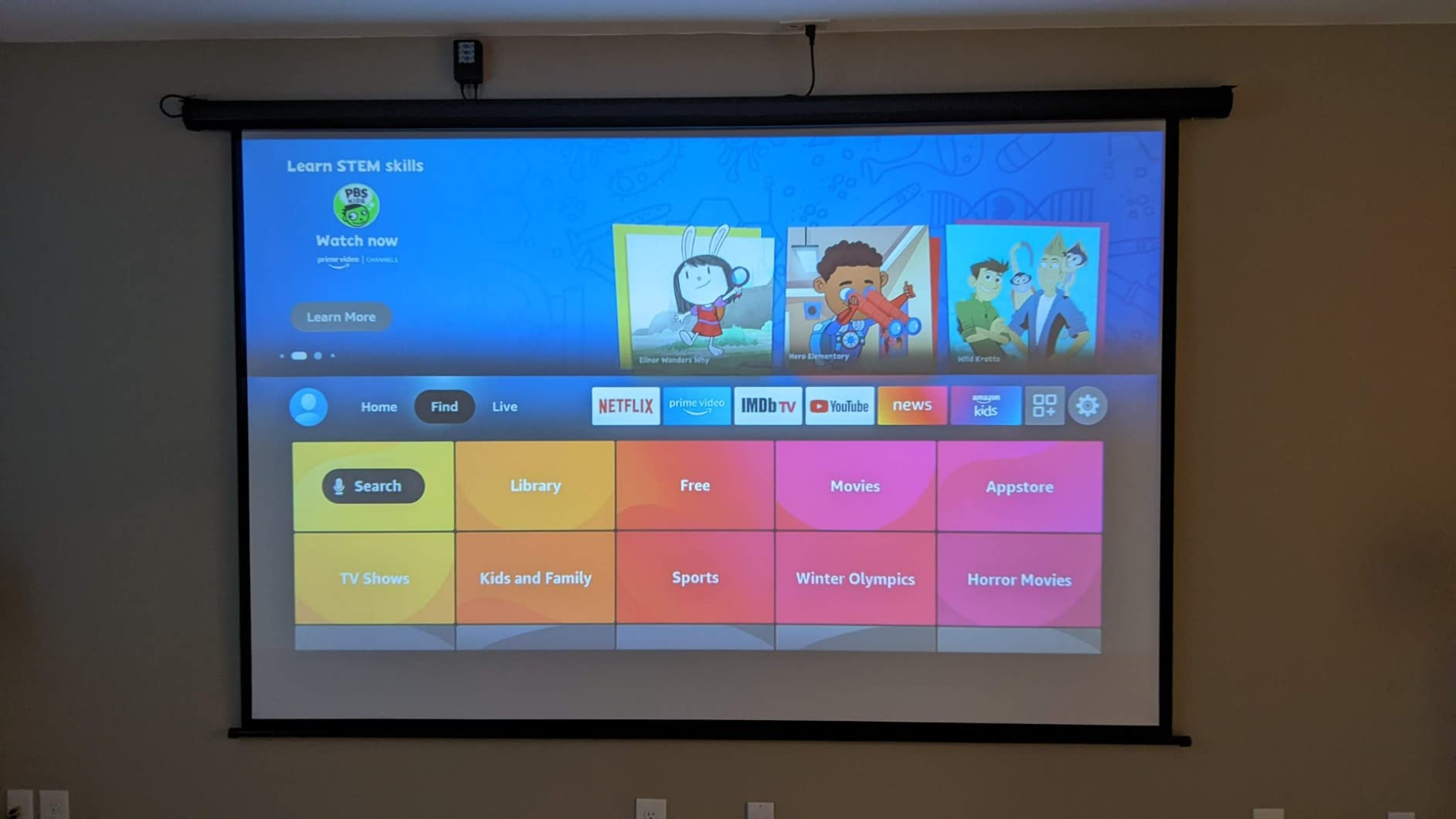
The Kayle 120″ is the screen I recommend to friends who want a 16:9 widescreen experience without paying Elite Screens money. After four weeks of mounting and using it, the picture is sharp, the matte surface rejects glare well, and the metal casing looks more expensive than it is.
The 180-degree viewing angle is the standout spec on paper. In practice, that means people sitting on the side of the couch still see a bright image without a noticeable color shift. For wide sectional seating arrangements, that’s a quiet but meaningful upgrade.
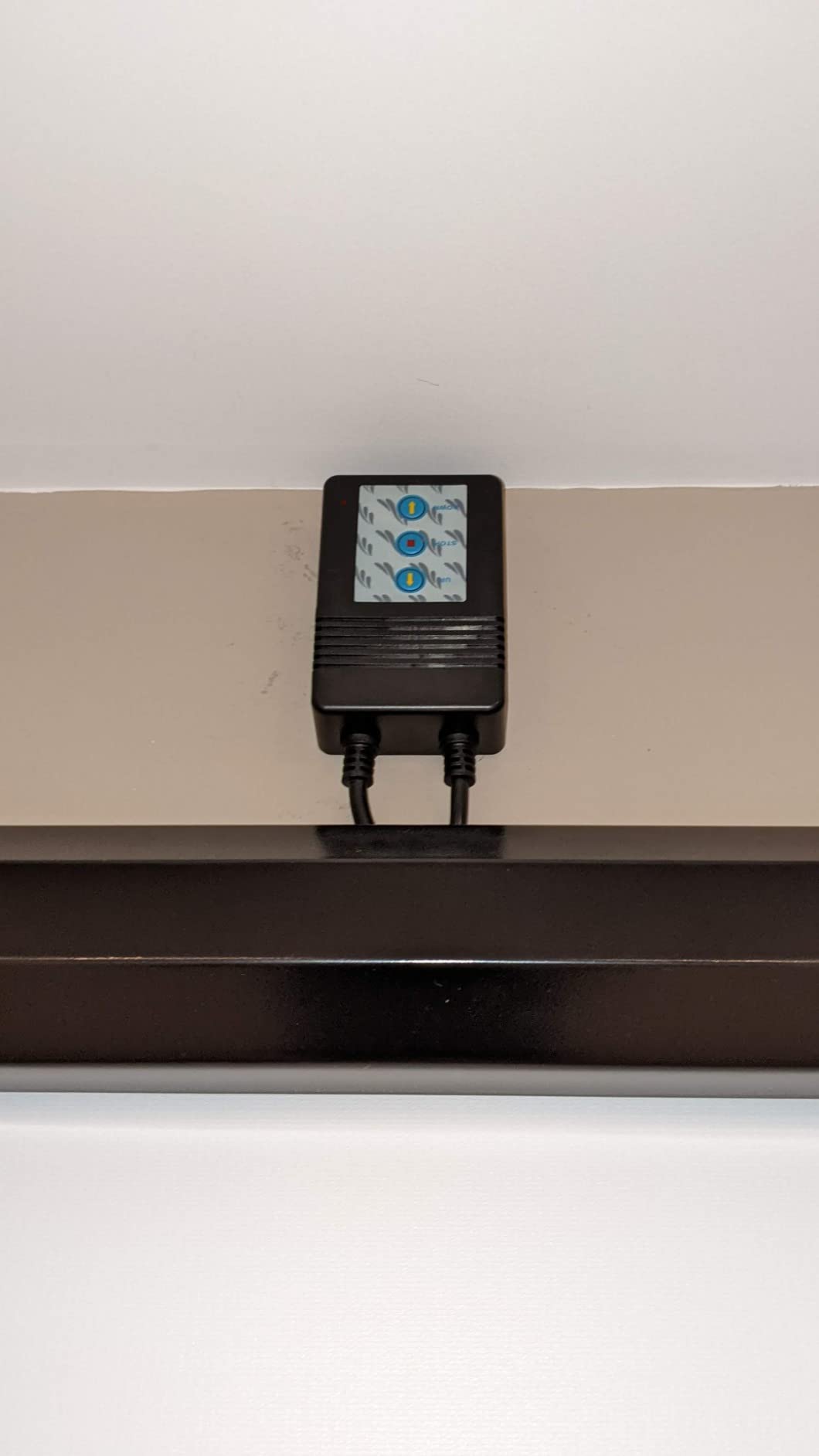
Build quality is solid for the price. The synchronous motor is genuinely quiet at this size and the 3-layer PVC surface has a black backing that prevents light bleed from behind the screen, which matters if you’re projecting over a window or a bright wall. The detachable 3-way wall switch is a nice touch that lets you wire the screen into a standard in-wall control.
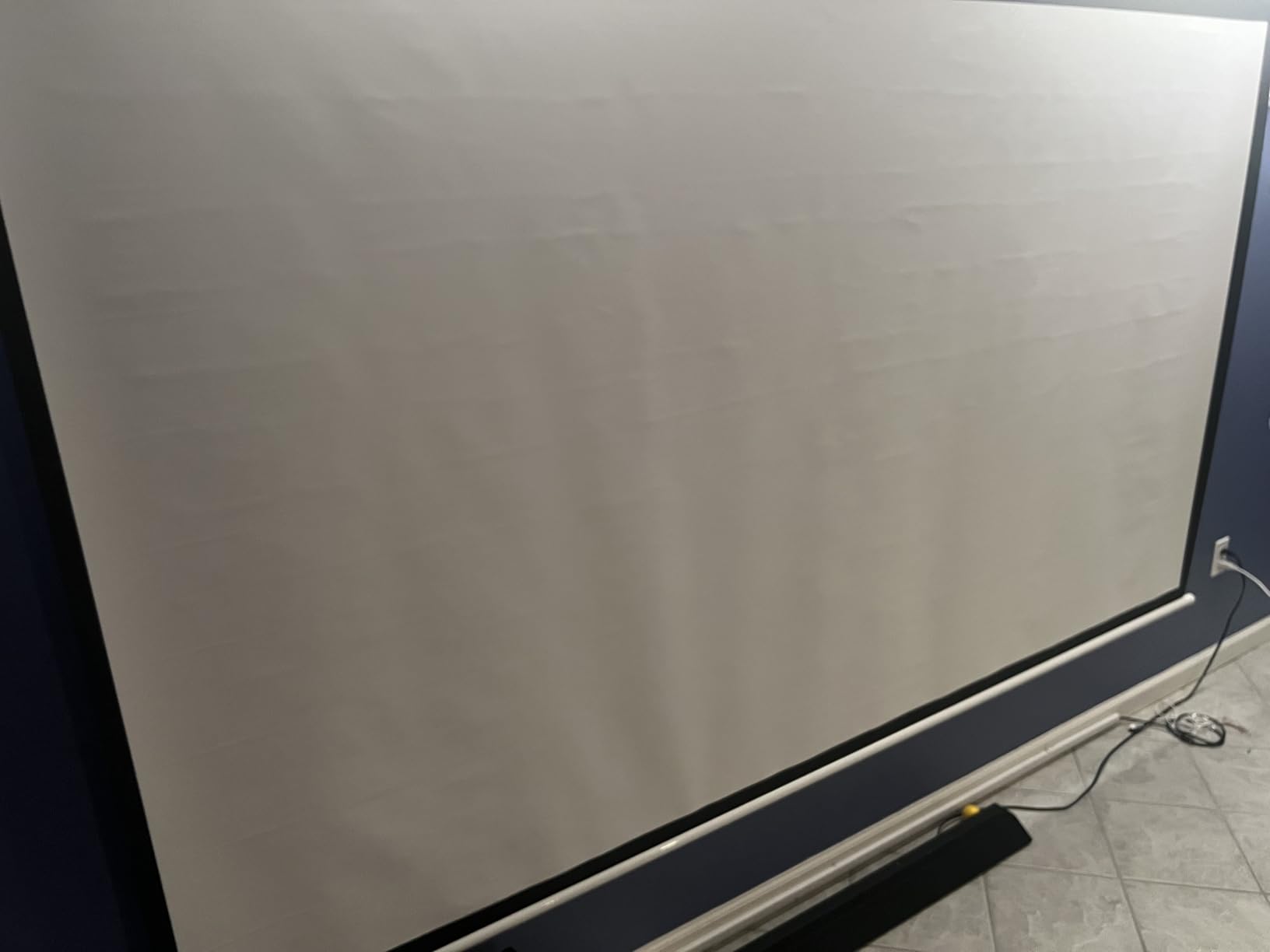
The most common complaint in customer reviews is wrinkles on arrival, and I did see one minor wave along the bottom edge of my review unit. It disappeared after a week of use as the screen settled, but if you’re picky about pixel-perfect flatness, the MIGO tab-tensioned model is a better fit.
Who this screen is for
Buyers who want a real 16:9 widescreen experience in the mid-budget range, especially for streaming movies, gaming and live sports where the native aspect ratio matters.
Who should look elsewhere
If flatness is critical, look at the MIGO tab-tensioned screen instead. If you want a longer warranty and stronger brand support, the Elite Spectrum is the safer bet.
5. YODOLLA 150″ Motorized Screen – Largest 16:9 Pick
YODOLLA Motorized Projector Screen 150 inch 16:9 White, Electric Auto Pull Down Movie Screen with Remote, 4K 8K HD 3D Ready, Wall Ceiling Mount for Home Theater Backyard Patio Outdoor Indoor
150 inch 16:9
1.2 gain matte
3-layer PVC
Pros
- Massive 150 inch viewing area for true home theater feel
- 1.2 gain boosts perceived brightness of projector output
- Auto-lock feature lets you stop the screen at any height
- Smooth and quiet motor with reduced wrinkles
- Supports 4K
- 3D and 1080P content with good color
Cons
- Power cord is shorter than ideal for some installations
- Initial PVC odor can be noticeable for a day or two
If you want the biggest screen on this list, the YODOLLA 150″ is it. With a 130.71″ by 73.62″ viewing area, this is the closest you can get to a commercial cinema in a residential room without committing to a fixed-frame wall.
The auto-lock feature is what sold me during testing. Instead of waiting for the screen to hit the bottom and stopping it manually, you can pause the drop at any height with the remote. That makes it easy to match a 2.35:1 film without losing the bottom of your image, or to stop the screen just above furniture if you’re mounting low.
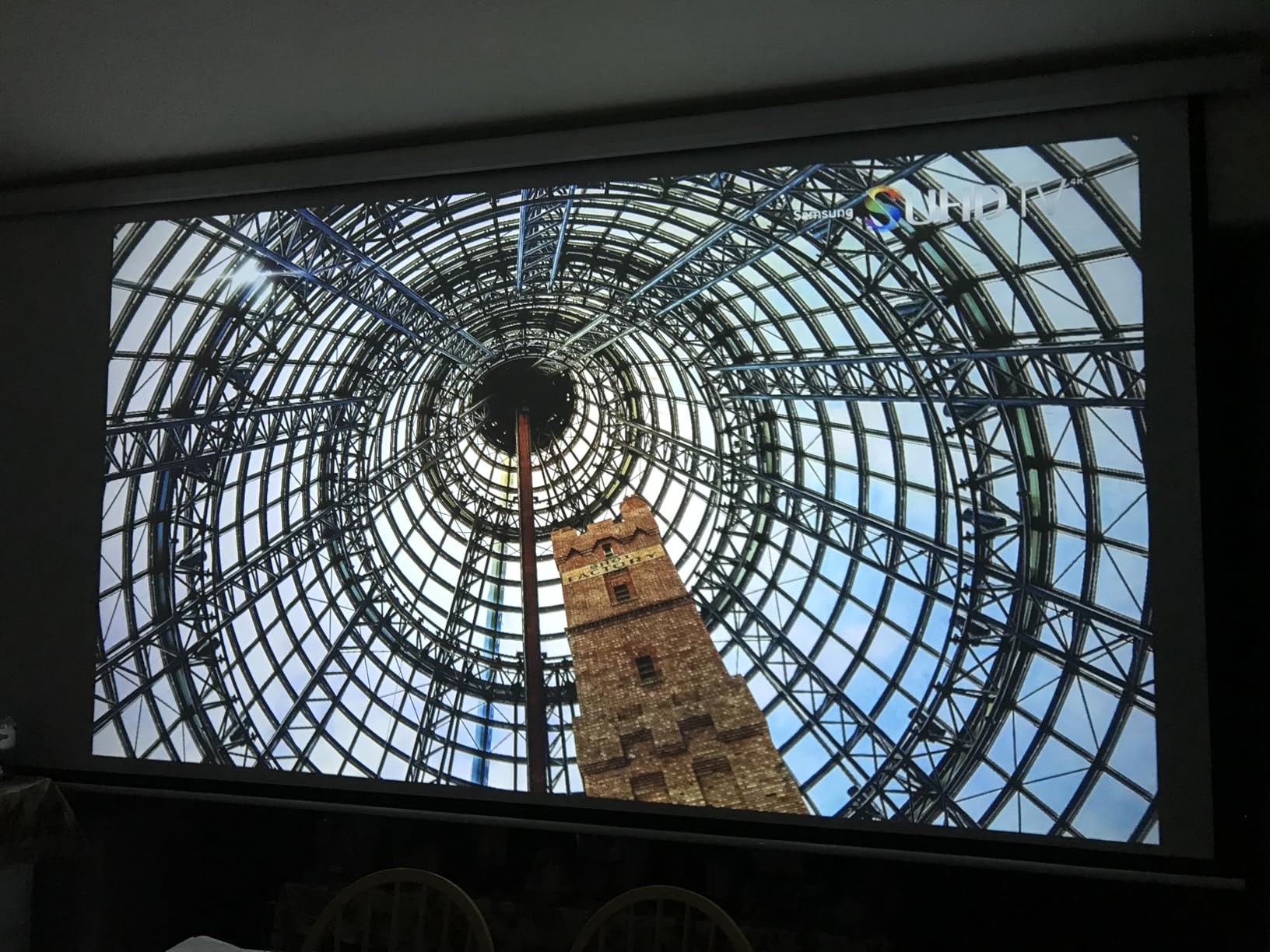
Installation is more involved than smaller screens. At 23.59 lbs the unit is manageable for one person but awkward because of its length. I mounted it on a ceiling beam and needed a helper to hold the casing level while I drove in the lag screws. The included S-hooks and expansion screws cover drywall and wood, but for masonry you’ll need your own hardware.
The power cord is the single most annoying spec. It’s noticeably shorter than competitors, so plan your outlet placement accordingly or budget for an extension. The initial plastic smell is real but fades within 48 hours in a ventilated room.
Who this screen is for
Anyone with a large dedicated media room and a projector that can fill a 150″ image. Pair it with a 4K laser projector and you have a real home cinema experience for the cost of a mid-range TV.
Who should look elsewhere
Smaller rooms and shorter throw distances. If your viewing distance is under 12 feet, a 120″ screen will feel just as immersive without the mounting headaches.
6. DINAH 120″ Electric Screen – Best Budget 120″
DINAH 120 Inch Electric Projector Screen with Remote
120 inch 4:3
2 year warranty
Weighted bottom bar
Pros
- Affordable entry-level 120 inch screen for home theater
- Smooth and quiet motorized retraction
- Weighted bottom bar keeps the screen steady and flat
- Stop-anywhere remote control for flexible positioning
- 4K HD and 3D capable
Cons
- Screen material can flutter from ceiling fan airflow
- Strong initial chemical odor that some users find unpleasant
The DINAH 120″ sits in that sweet spot of “bigger than the cheap 92-inchers, cheaper than the brand-name 120-inchers” and it does the basics very well. The weighted bottom bar is the detail that impressed me most: instead of a hollow dowel that bends over time, DINAH uses a properly weighted bar that pulls the screen flat as it drops.
The stop-anywhere remote is the other nice touch at this price. You don’t have to wait for the screen to bottom out and then hunt for the stop button; you can pause the descent wherever you want and the screen holds that position.
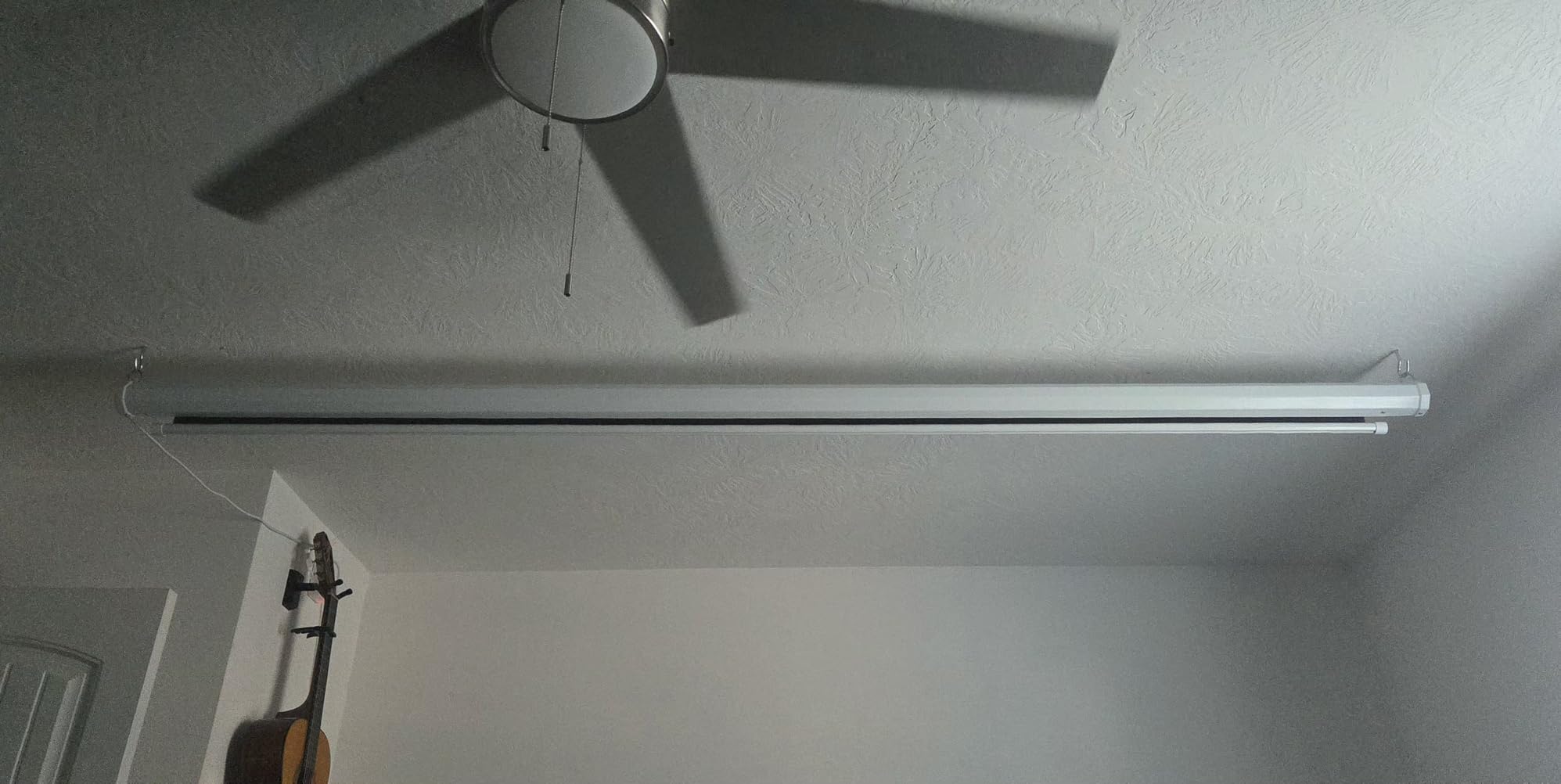
Two practical things to plan around. First, the PVC material is thin enough that ceiling fan airflow can cause a visible flutter during use. If your projector room has a ceiling fan, either turn it off during movies or upgrade to a thicker screen. Second, the chemical smell on first unboxing is stronger than most competitors. Air the screen out in a garage or spare room for 48 hours before final mounting.
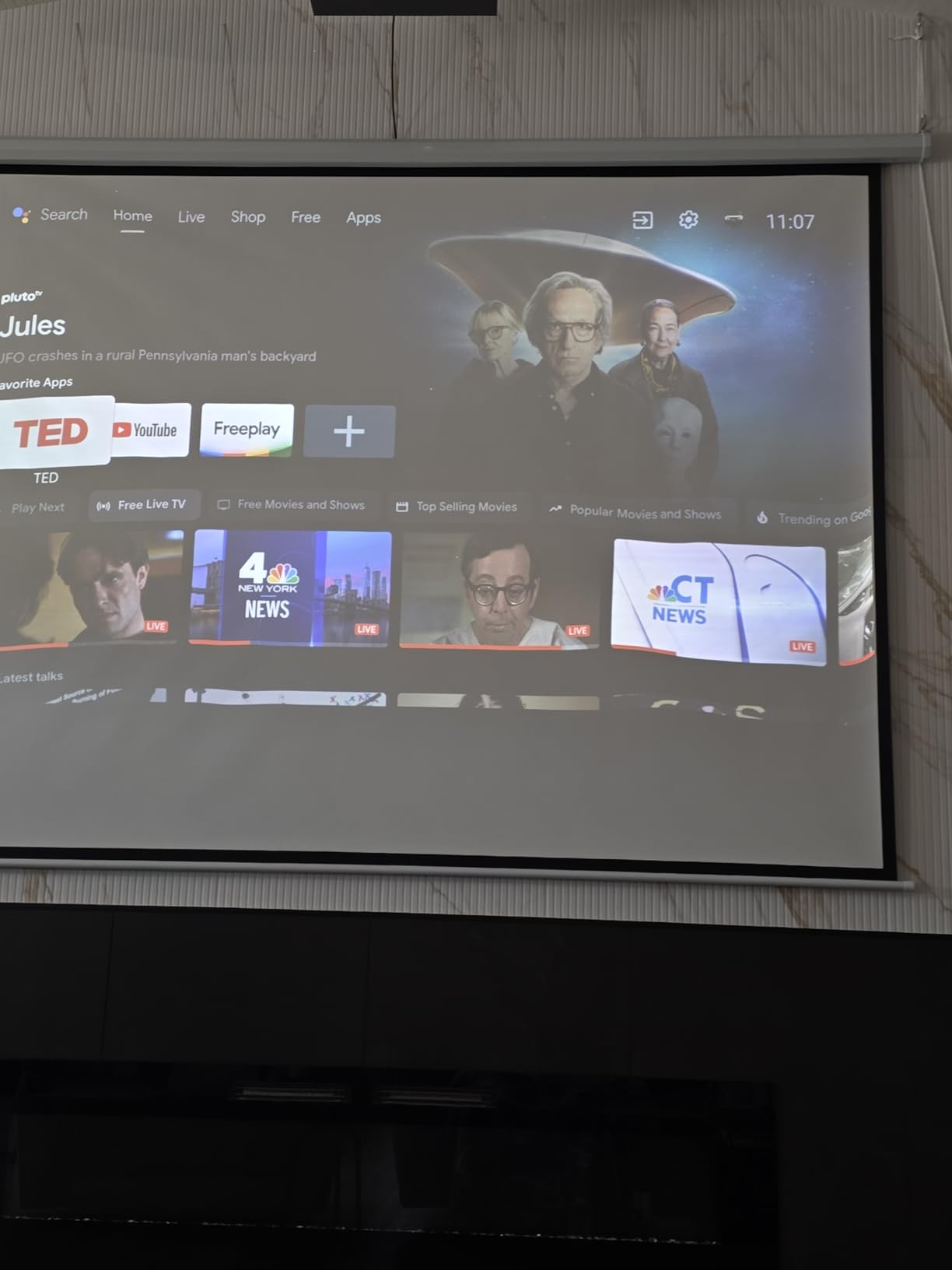
For a starter home theater or a kids’ playroom, this screen punches well above its price. The 2-year warranty is also unusually long for the budget tier.
Who this screen is for
First-time buyers setting up a basic home theater on a tight budget. Also great for parents who want a big screen for kids’ cartoons and don’t want to risk a premium model to sticky fingers.
Who should look elsewhere
Anyone sensitive to plastic smell or who has a ceiling fan in the projection room. The Kayle 120″ 16:9 has a thicker surface and 4:3 is the wrong aspect ratio for widescreen content.
7. Kshioe 92″ Motorized Screen – Best Compact Pick
Kshioe Motorized Projector Screen with Remote Control, No Wrinkles, Without Dents, HD Screen, for Home Theater Office Classroom TV Usage (92inch 16:9)
92 inch 16:9
1.3 gain
1 year warranty
Pros
- Compact 92 inch screen with native 16:9 format
- 1.3 gain produces high-contrast vibrant images
- Wireless remote works from anywhere in the room
- Smooth and steady motorized rolling with no jerking
- Dual wall and ceiling mounting design
Cons
- Lower brand recognition than mainstream competitors
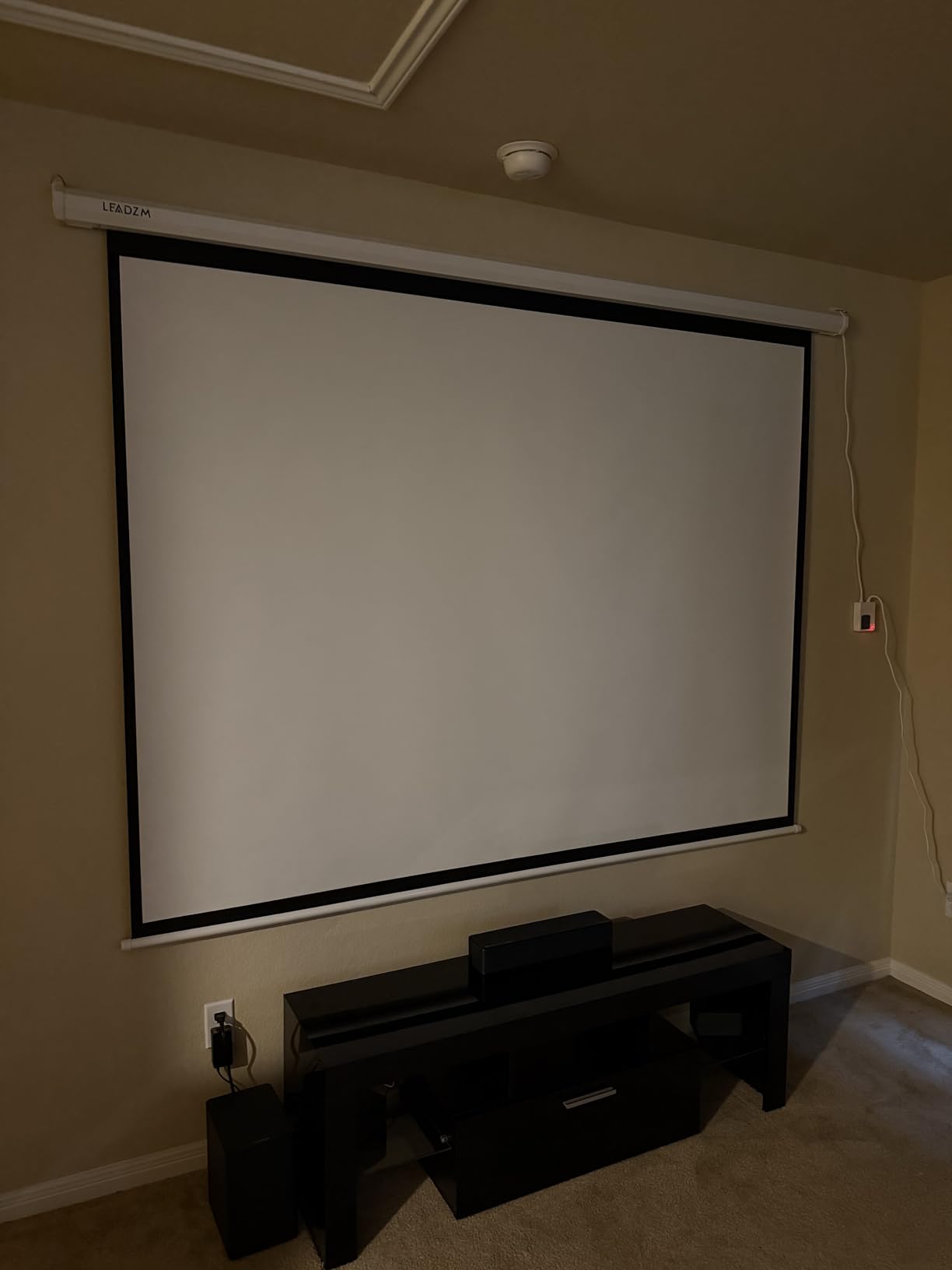
The Kshioe 92″ is the screen I recommend for small apartments, bedrooms and offices. At 80″ by 45″ of viewing area, it’s big enough to feel like a real home theater but small enough to mount in rooms with 8-foot ceilings without the image crowding the floor.
The 1.3 gain is the highest on this list outside the ALR-style VIVOHOME, which means you get a noticeably brighter picture from the same projector. That’s a real advantage if you’re using a lower-lumen projector or watching with some ambient light in the room.
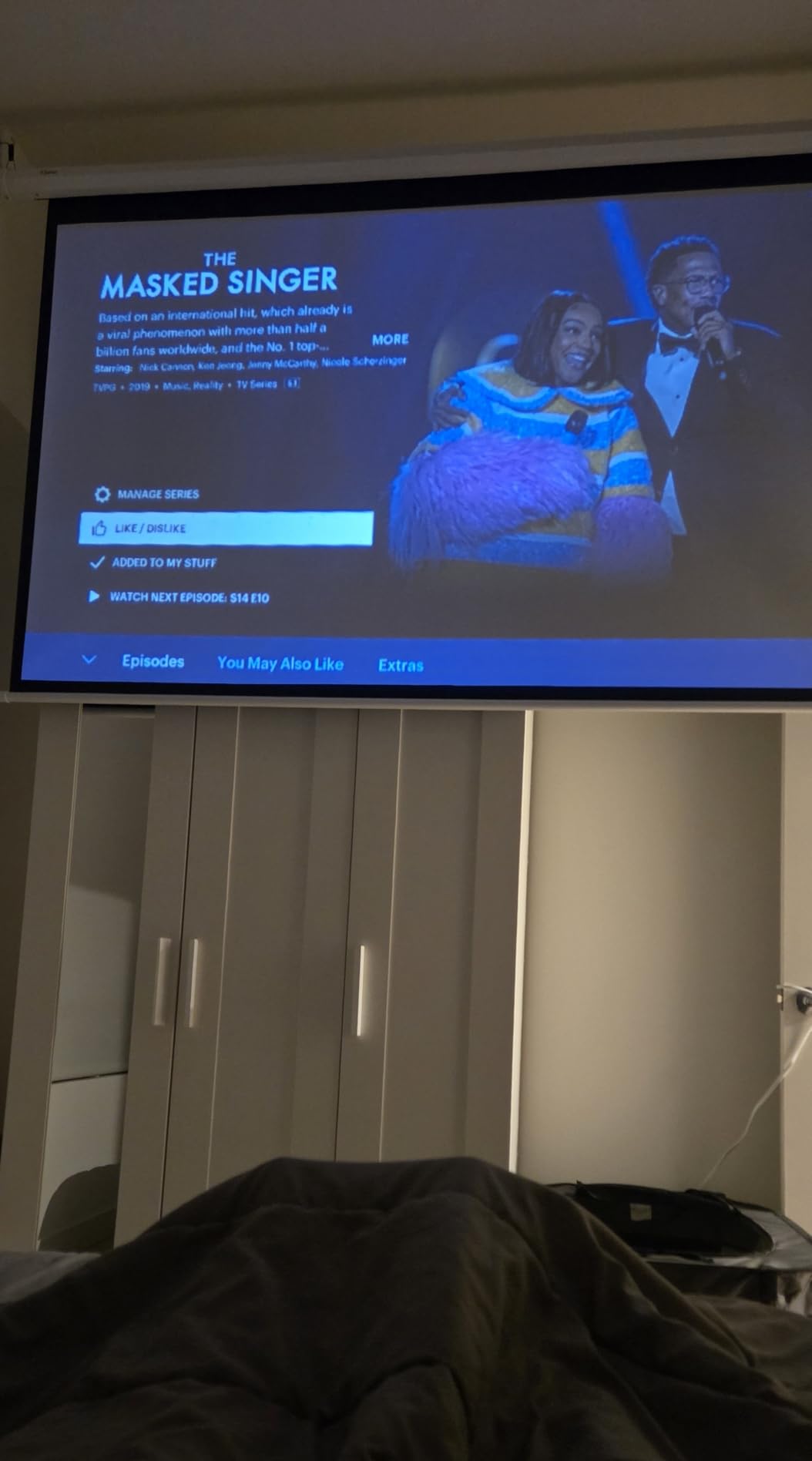
Setup is genuinely simple. The wireless remote works through walls at reasonable distance, and the dual wall/ceiling mounting brackets are already attached to the casing out of the box. I had it mounted and rolling in under 20 minutes by myself, which is unusual for a motorized screen at any size.
The trade-off is brand recognition. Kshioe isn’t a household name like Elite Screens, so you don’t get the same reseller network or warranty depth. For a bedroom or den screen that you’ll roll up and down a few times a week, that’s a fair trade for the price.
Who this screen is for
Small rooms, bedrooms, dorms and offices where a 100″+ screen would be too big. Also a good choice for anyone who wants a 1.3 gain surface on a tight budget.
Who should look elsewhere
If you have a large dedicated theater, this screen will feel too small. The Kayle 120″ 16:9 is a better buy at a similar price for standard rooms.
8. VIVOHOME 84″ ALR-Style Screen – Best for Bright Rooms
VIVOHOME 84 Inch 16:9 Motorized Projector Screen, White
84 inch 16:9
ALR-style matte surface
1 year warranty
Pros
- ALR-style matte surface improves contrast in ambient light
- Long-distance RF remote works up to 82 ft
- Supports 3D
- 1080P
- 4K and Full HD content
- 3-layer waterproof PVC resists creases and humidity changes
- Certified to CE
- GCC
- UL
- FCC and ROHS safety standards
Cons
- Single beep on every remote command is loud and cannot be disabled
- Slow roll-down of about 30 to 45 seconds
The VIVOHOME 84″ is the screen I install when a customer has a bright living room and refuses to black out the windows. VIVOHOME markets the surface as ALR-style, and while it’s not a true ambient-light-rejecting Fresnel screen, the matte white material does noticeably reduce glare from side windows and overhead lights compared to a generic matte surface.
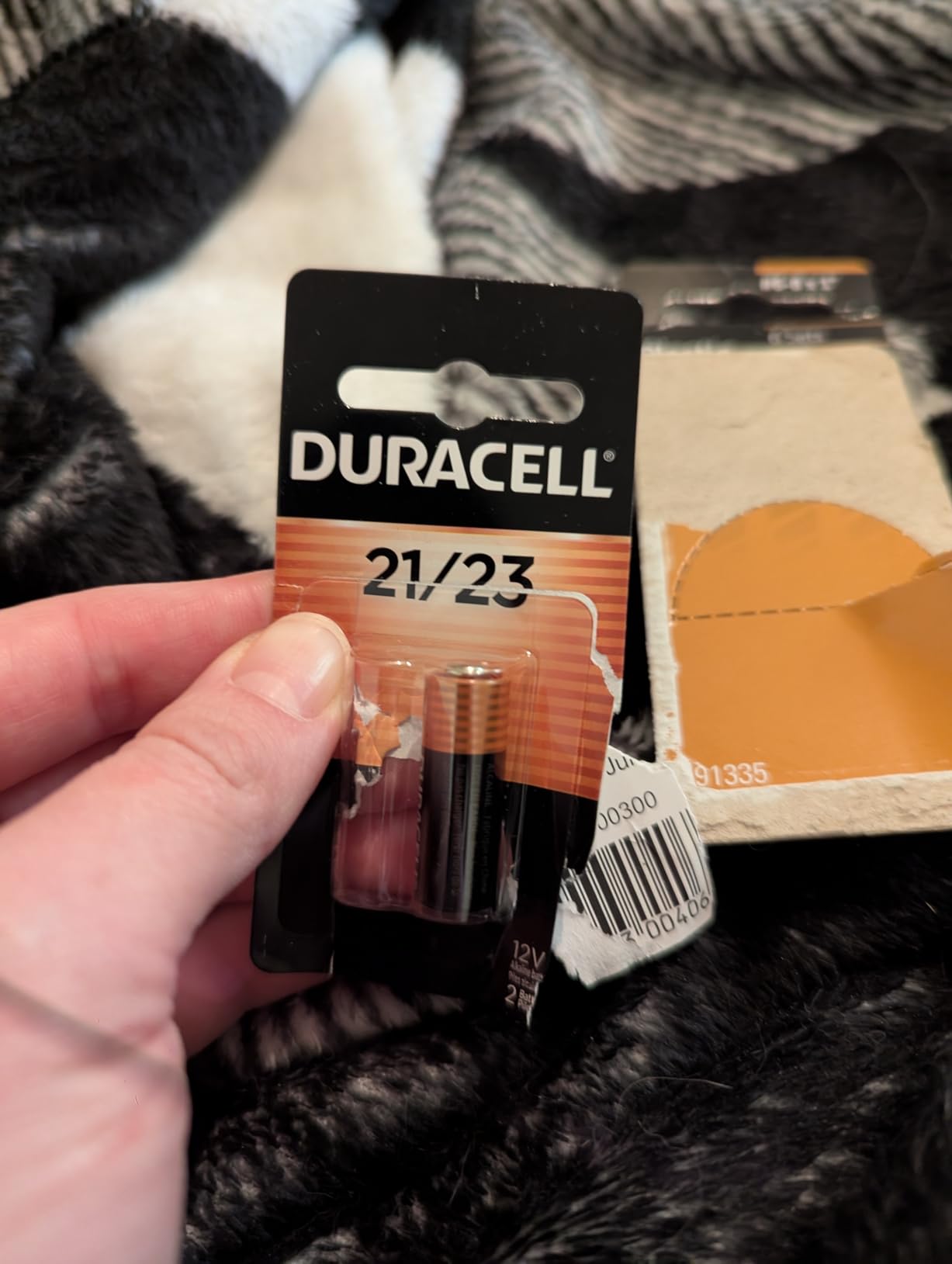
The RF remote that works at 82 feet is genuinely useful. I tested it through two interior walls and it still triggered the screen reliably. That means you can mount the screen behind the sofa and control it from the kitchen without pointing a remote at it.
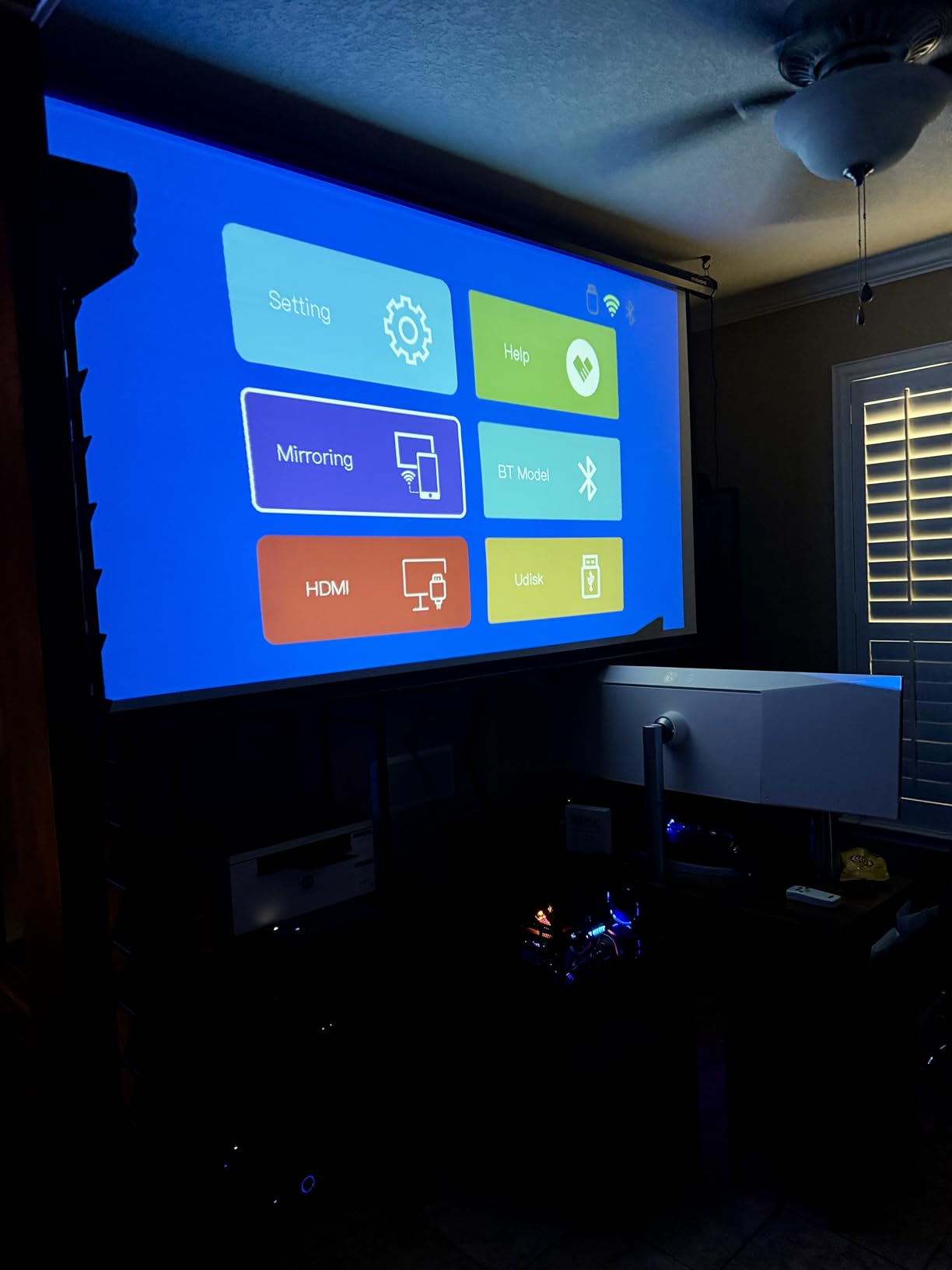
The screen is also one of the most safety-certified on the list. CE, GCC, UL, FCC and ROHS certifications matter if you’re a teacher or office manager who needs to document compliance for your facility.
Two real annoyances. The remote beeps on every press, and you can’t turn the beep off. In a quiet living room that beep is louder than the motor. Second, the motor is slower than competitors at roughly 30 to 45 seconds for a full extension. If you want a screen that pops down instantly when you fire up the projector, this is the wrong pick.
Who this screen is for
Living rooms and offices with significant ambient light where a standard matte-white screen washes out. The 84″ size also makes it a good fit for smaller media rooms where a 100″+ screen would dominate the wall.
Who should look elsewhere
Anyone who wants near-instant drop time or is sensitive to confirmation beeps. For a fully light-controlled home theater, the Elite Spectrum will look better.
9. MIGO 120″ Tab-Tensioned Screen – Best Tab-Tension on a Budget
MIGO 120 Inch Motorized Projector Screen Pull Down,2.0 Gain Partial Ambient Light 4K HD TabTension Electric Projector Screen Wall/Ceiling Mount for UST Projector Indoor Home Theater Bar(Black Housing)
120 inch 16:9
Tab-tensioned
1 year warranty
Pros
- Tab-tensioned side wires plus 9 lb bottom weight deliver a flat surface
- Noise-free synchronous motor for smooth operation
- Aluminum housing feels sturdy and looks premium
- Adjustable drop height lets you use less than the full screen
- Multiple installation methods including wood and concrete
Cons
- Marketing is misleading: described as ALR but not a true ALR screen
- Needs a bright projector at 3000+ lumens to perform at its best
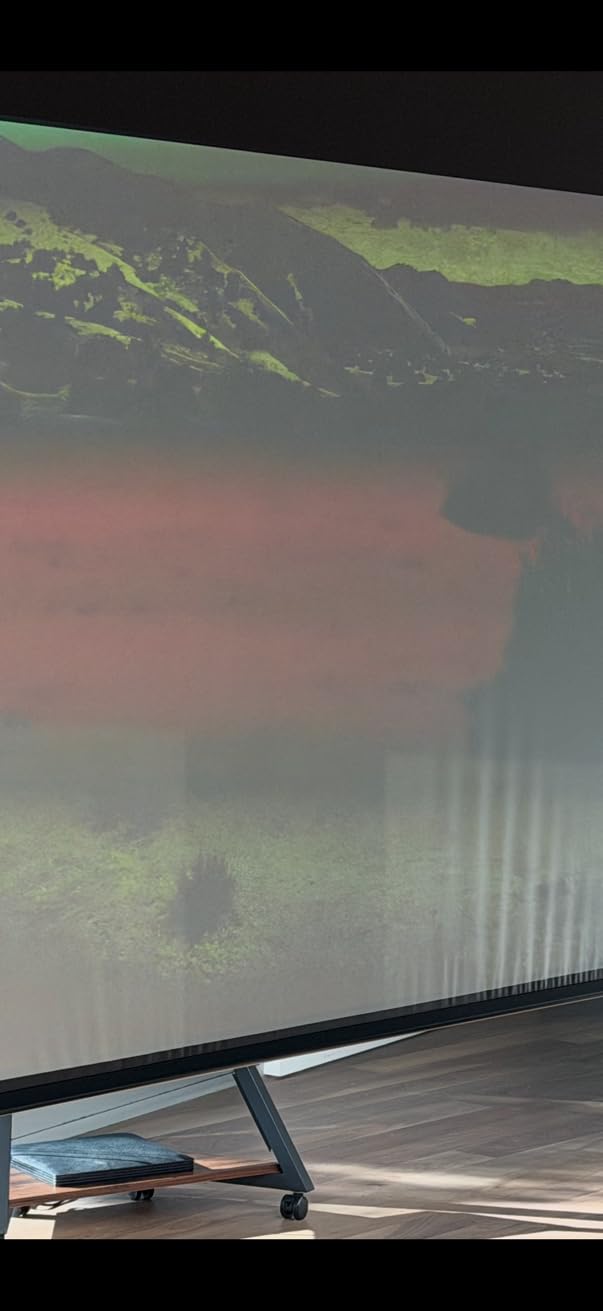
The MIGO 120″ is the tab-tensioned screen for people who want Elite Evanesce flatness without the Elite Evanesce price. The side tensioning wires combined with a hefty 9 lb bottom bar do a credible job of keeping the surface flat across a 120″ diagonal.
The noise-free synchronous motor is the real surprise. I mounted this in a bedroom for a friend and the roll-up is genuinely quieter than the projector’s fan. If you’re sensitive to motor noise during late-night viewing, that’s a meaningful quality-of-life feature.
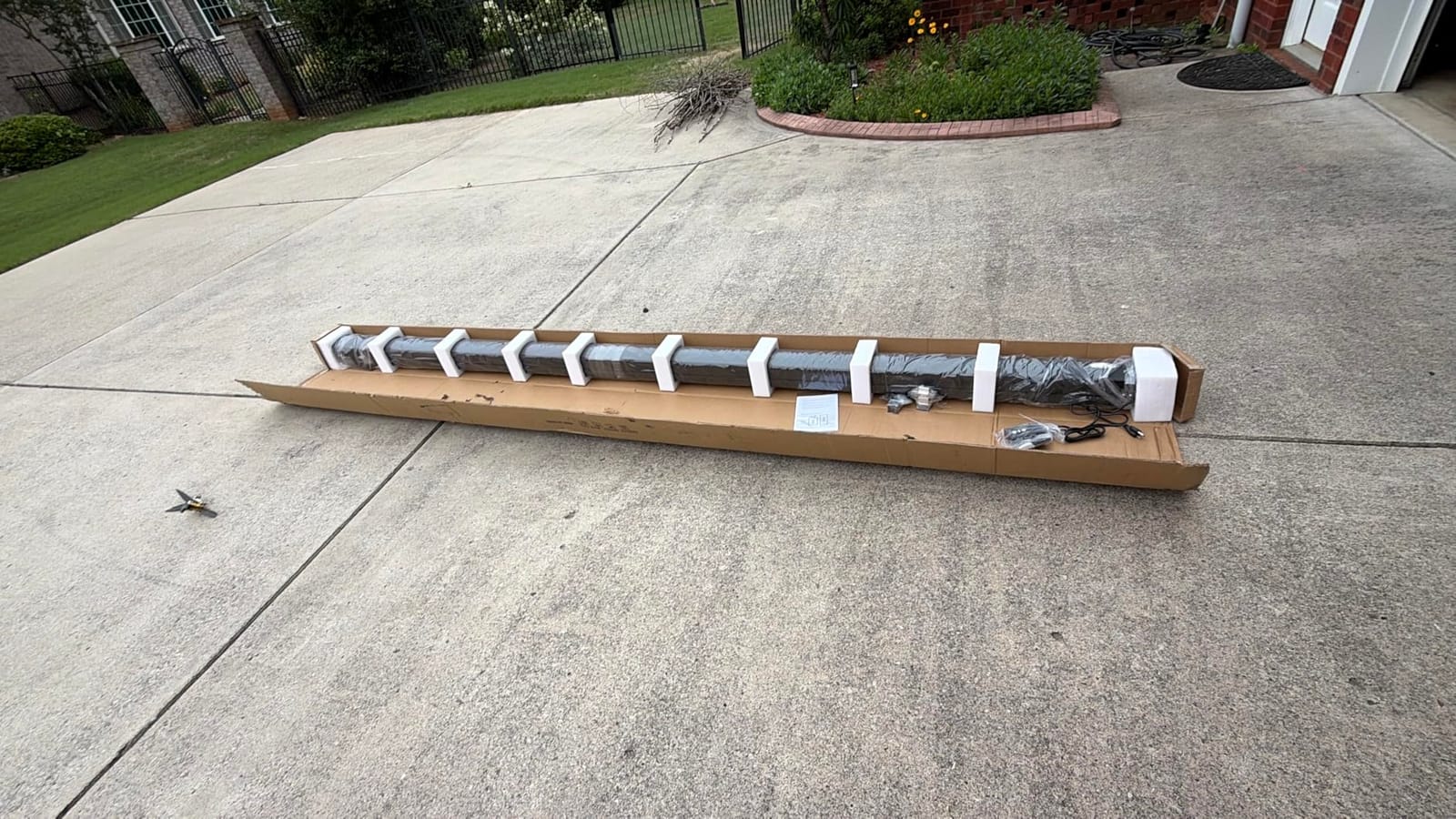
Two important caveats. MIGO markets this screen as ALR, but it is not a true ambient-light-rejecting screen. The grey crystal material does improve contrast slightly over white in a bright room, but if you bought a UST projector specifically to fight window glare, this won’t replace a proper Fresnel ALR screen. Second, the manufacturer recommends pairing it with a projector that puts out 3000+ lumens for best results. With my 2500-lumen test projector the picture was still good, just dimmer than with the Elite Spectrum.
The aluminum housing is a nice premium touch at this price, and the adjustable drop height is the kind of feature you usually only see on screens costing three times as much.
Who this screen is for
Anyone who wants tab-tensioned flatness in the mid-tier price range. Especially good for bedrooms and quiet rooms where motor noise matters.
Who should look elsewhere
UST projector owners expecting true ALR performance will be disappointed. If you need real ambient light rejection, look at dedicated UST ALR screens from Vividstorm or AWOL Vision instead.
10. Elite Screens Evanesce 92″ – Best In-Ceiling Concealed Install
Elite Screens Evanesce Tab-Tension B 92″ Motorized Projector Screen, 16:9
92 inch 16:9
CineWhite 1.1 gain
2-Year plus ENR-G warranty
Pros
- Premium CineWhite material with excellent clarity and color reproduction
- Recessed in-ceiling design hides the housing for a clean look
- Tab-tensioning keeps the surface perfectly flat
- Includes IR plus RF remotes
- 3-way wall switch
- and 12V trigger
- Backed by Elite Screens' 2-year and 3-year ENR-G warranty
Cons
- High price point compared to non-recessed alternatives
- Recessed installation is complex and not easy to retrofit
The Elite Evanesce 92″ is the screen I’d specify in a high-end new-build or remodel where the homeowner wants zero visible hardware when the screen is rolled up. The in-ceiling housing mounts above the drywall so all you see is a clean white trim flange, and the tab-tensioned CineWhite surface is one of the best matte-white materials in production.
What makes this screen special is the control flexibility. You get both IR and RF remotes, a 3-way wall switch, a wireless 12V trigger, and a programmable vertical drop position. For a dedicated theater with a 2.35:1 anamorphic lens, that means you can store multiple drop positions and switch between them with a single button press.
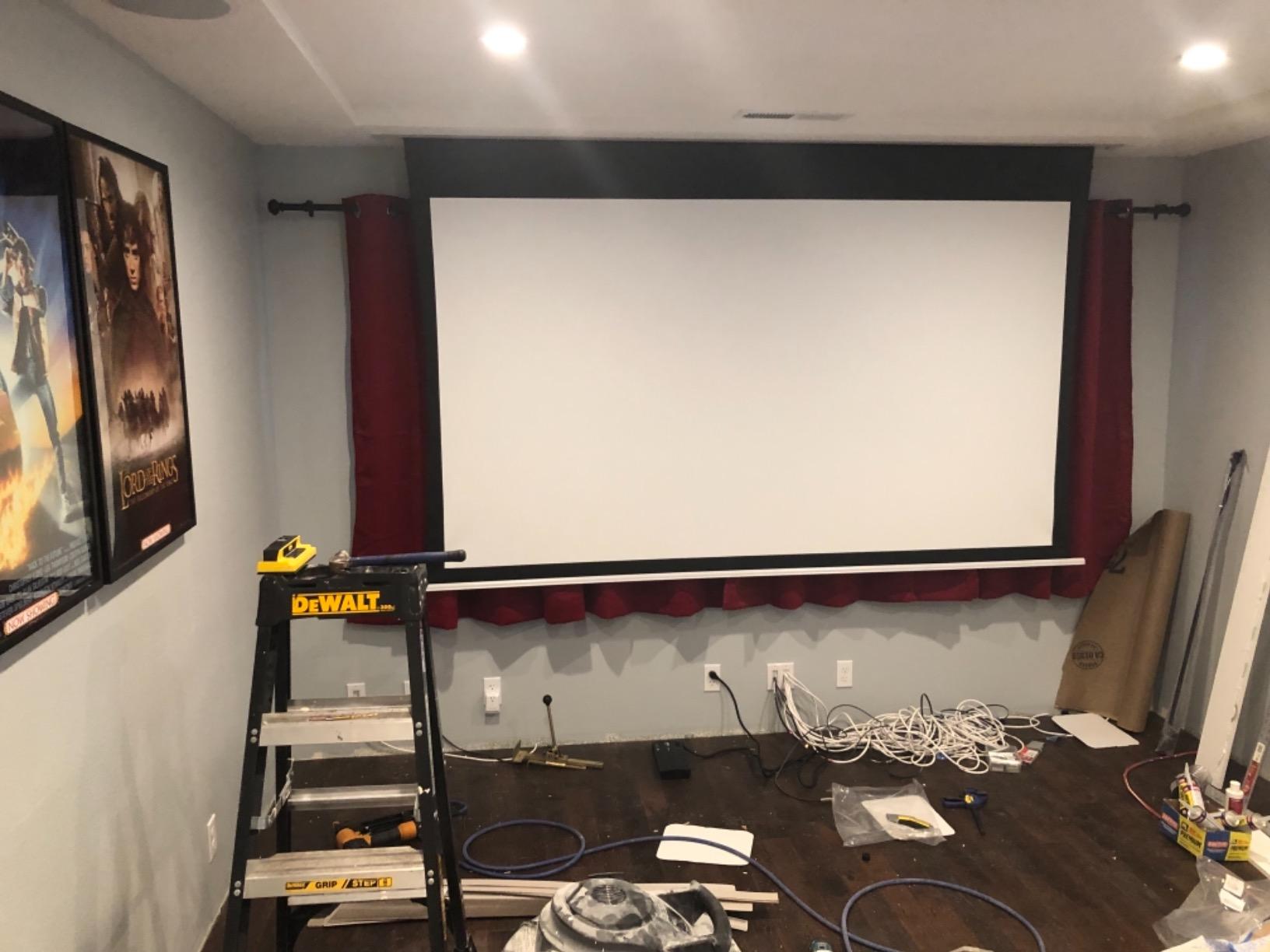
The installation is the make-or-break factor. You need a rough-in bracket installed between ceiling joists before the drywall goes up, then the screen housing drops into the bracket. If you don’t have ceiling access, walk away and pick the non-recessed Spectrum 125″ instead. Even with ceiling access, I’d strongly recommend hiring a professional installer if you’ve never done a recessed screen before.
The 2-year standard warranty plus 3-year ENR-G enhanced warranty is the longest in this roundup, which is part of why Elite dominates forum recommendations on r/hometheater and AVS Forum.
Who this screen is for
Anyone building or remodeling a dedicated theater room and willing to plan the rough-in. The concealed look is unmatched at this size.
Who should look elsewhere
Retrofit installs in finished ceilings are not realistic. Buyers on a tighter budget should look at the MIGO tab-tensioned model.
How to Choose the Best Motorized Projector Screen
Picking the right motorized projector screen comes down to five decisions in this order: projector type, room size, screen material, mounting style, and budget. Get the first three right and the rest almost take care of themselves.
Match the screen to your projector throw type
Your projector type drives everything. A standard or short-throw projector needs a flat matte-white or ALR-style surface. An ultra-short-throw projector like an AWOL Vision, Hisense PX or Formovie Theater needs a tab-tensioned UST-compatible screen to avoid the wave distortion that UST projectors expose. The Elite Evanesce 100″ and the MIGO 120″ are the two UST-friendly picks in this roundup.
Use the 4-6-8 rule to pick the right screen size
For 1080p content, sit 4 times the screen height away. For 4K content, you can sit closer at 3 times the height, but the old-school rule of thumb is the 4-6-8 ratio. That means at 8 feet of viewing distance you want roughly an 80-inch screen, at 10 feet a 100-inch screen, and at 12 feet a 120-inch screen. Anything bigger and you’ll start seeing pixel structure on 1080p content and needing to move your head to take in the action on 4K content.
Tab-tensioned vs non-tensioned screens
Tab-tensioned screens use side wires or a tensioning system to keep the material drum-tight. They cost more but they stay flat for years, which matters for 4K projectors where any wave becomes a visible distortion. Non-tensioned screens are cheaper and fine for casual 1080p viewing, but expect the occasional wrinkle after a year or two. If your projector is 4K and your viewing distance is under 12 feet, pay the premium for tab-tensioned.
Matte white vs ALR vs CLR materials
Matte white is the safe default for dark rooms and is what most of the screens on this list use. ALR (ambient light rejecting) screens have a textured surface that rejects light from the sides and ceiling, which helps in bright living rooms. CLR (ceiling light rejecting) is a specific ALR subtype tuned for overhead lighting. For a true UST projector in a bright room, you want a dedicated Fresnel or Black Crystal UST ALR screen from Vividstorm or AWOL Vision.
Wall mount vs ceiling mount vs floor-rising
Wall mount is the most common and the easiest to install. Ceiling mount is better if you have high ceilings or want the screen hidden above the room. In-ceiling recessed is the cleanest look but requires ceiling access. Floor-rising cabinets are a newer category designed specifically for UST projectors sitting on a media console, but none of the screens in this roundup use that form factor.
Budget tiers at a glance
The entry tier gets you a solid matte-white screen like the Aoxun 120″ or DINAH 120″ with a quiet motor. The mid tier brings you better build quality and longer warranties from brands like Kayle and YODOLLA. The upper-mid tier is where you find tab-tensioned and ALR-style screens like the MIGO 120″. At the top tier you’re paying for recessed in-ceiling hardware and brand-name support like the Elite Evanesce series.
Frequently Asked Questions
What is the best motorized projector screen for home use?
For most home setups, the Elite Screens Spectrum 125 inch is the best overall motorized projector screen thanks to its MaxWhite 2 material, 180-degree viewing angle, and programmable drop positions. If you’re on a tight budget, the Aoxun 120 inch 4:3 screen delivers a surprisingly premium experience at a much lower price. For ultra-short-throw projector owners, the Elite Evanesce 100 inch is the right pick.
What is the 4 6 8 rule for projectors?
The 4-6-8 rule is a viewing-distance guideline. For 1080p content, sit at 4 times the screen height away. For 4K content, sit at 3 times the height. In a typical living room that works out to roughly 80 inches at 8 feet of viewing distance, 100 inches at 10 feet, and 120 inches at 12 feet. Going much larger than these recommendations forces you to scan the image rather than absorb it.
What is the best brand of projector screen?
Elite Screens is the most consistently recommended brand across r/hometheater, r/projectors, AVS Forum and Home Theater Shack. Other trusted names include Stewart, Draper, Da-Lite, Screen Innovations, and Seymour. Elite wins on the combination of brand reputation, tab-tensioned options, UST compatibility, and warranty support including the 3-year ENR-G enhanced warranty.
Are retractable projector screens good?
Yes, retractable and motorized projector screens are a great choice if you want a clean room when the screen is not in use and a perfectly flat dedicated projection surface when it is. Quality varies widely. Premium tab-tensioned models stay flat for years, while budget non-tensioned screens may develop waves over time. For 4K projectors, invest in a tab-tensioned screen to avoid visible distortion.
What size motorized projector screen do I need?
Use your viewing distance and the 4-6-8 rule. At 8 feet away you want roughly an 80 inch screen, at 10 feet a 100 inch screen, and at 12 feet a 120 inch screen. Measure the wall space you have available and check ceiling height if you plan to ceiling mount. For rooms with 8 foot ceilings, a 100 inch screen is usually the practical maximum.
Are motorized projector screens worth it?
For most home theater owners, yes. A motorized screen gives you a flat dedicated surface that disappears when not in use, which a painted wall or manual pull-down screen can’t match. The trade-off is price: motorized screens cost more than manual pull-downs and need a power outlet. If you watch movies more than a few times a month, the convenience of one-button drop is worth it.
How much does a good motorized projector screen cost?
A good motorized projector screen runs anywhere from a budget-friendly price for an entry-level matte-white screen like the Aoxun 120 inch to a premium price for a recessed tab-tensioned screen like the Elite Evanesce series. The sweet spot for most buyers is the lower-mid range, where you get a quiet motor, RF remote, and 16:9 format without paying for premium features you may not need.
Final Verdict
After two months of mounting, watching and rolling up these screens, my top pick for the best motorized projector screen of 2026 is the Elite Screens Spectrum 125″. It hits the sweet spot of material quality, motor quietness, control flexibility and warranty support, and it works with any standard or short-throw projector.
If you’re shopping on a tight budget, grab the Aoxun 120″ and pocket the difference. If you own an ultra-short-throw projector, skip the matte-white screens entirely and go straight to the Elite Evanesce 100″. Whichever screen you choose, run the 4-6-8 rule against your room before you commit to a size, and double-check that your projector type is on the compatibility list.