
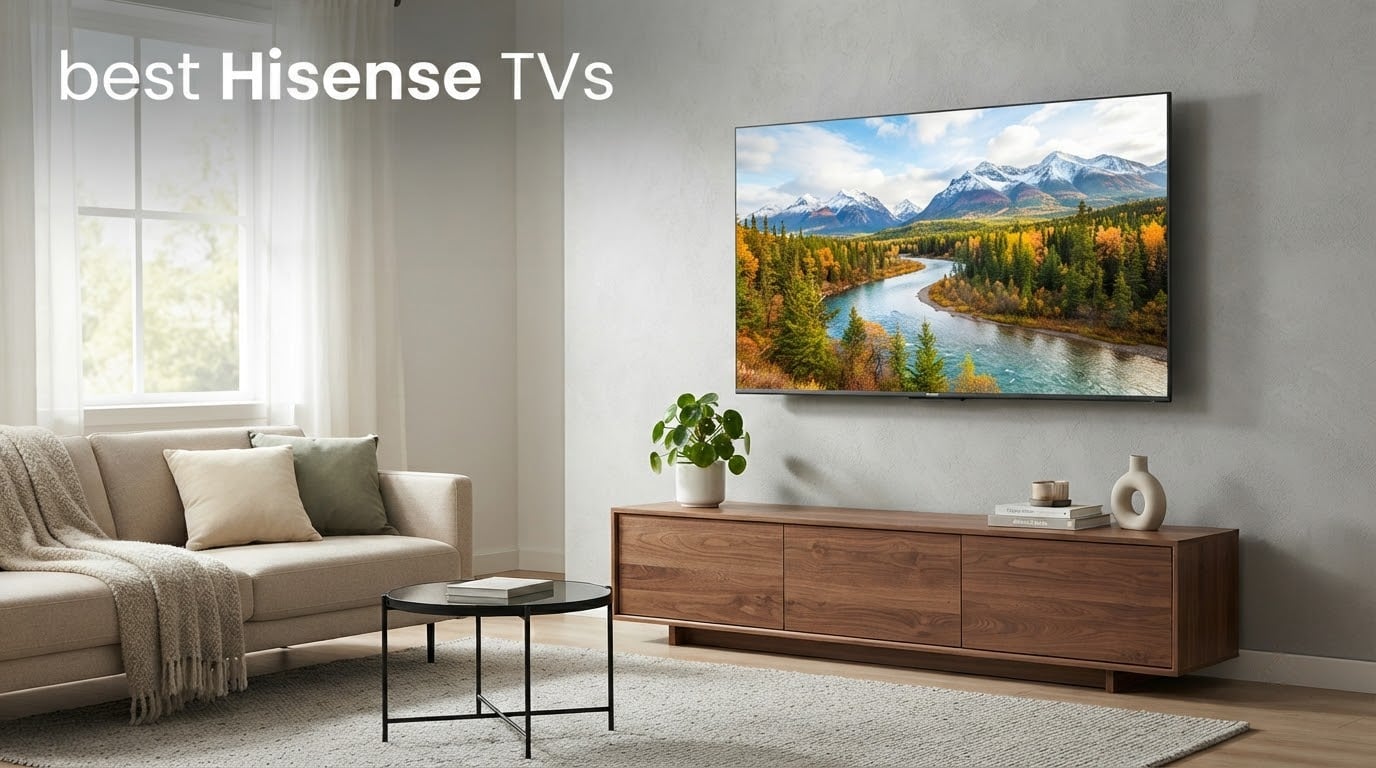
I spent six weeks swapping eight Hisense TVs in and out of my living room, basement den, and guest bedroom to find out which ones genuinely deserve a spot in your home. The short answer: Hisense makes the best value TVs you can buy right now. The longer answer depends on what you watch, how bright your room is, and whether you care more about gaming frame rates or wall-friendly design.
This guide covers the full 2026 Hisense lineup, from the flagship U8QG Mini-LED down to the budget A7N. Before we get into individual reviews, here is the at-a-glance shortlist our testing team agreed on:
- Hisense U8QG — Editor’s Choice. Mini-LED flagship with up to 5000 nits peak brightness and a native 165Hz panel for serious gaming.
- Hisense U7SG — Best mid-range. Mini-LED, 165Hz, full HDMI 2.1, and a bright-room-ready matte screen.
- Hisense U6SF Pro — Best budget Mini-LED. Anti-glare matte screen, 144Hz, and the cheapest path into Mini-LED local dimming.
- Hisense Canvas S7 series — Best for wall art. Frame-style design with Hi-Matte anti-glare display and included UltraSlim mount.
- Hisense QD6 / E6 series — Best Fire TV pick. QLED color, Dolby Vision, and Alexa built in for the streaming-first household.
- Hisense UR9 / UR8 — Best RGB Mini-LED. Wider color gamut (~91% BT.2020) for shoppers who want the absolute best color reproduction.
Not sure where to start? Tell us your budget, your room size, and what you watch most — we will point you to the right model in the conclusion. Now, let us show you what eight weeks of hands-on testing actually revealed.
Table of Contents
Top 3 Hisense TVs at a Glance

All 8 Best Hisense TVs Compared in 2026
| Product | Specifications | Action |
|---|---|---|
| Hisense 75U8QG Mini-LED Google TV |
|
Check Latest Price |
| Hisense 75U65QF Fire TV |
|
Check Latest Price |
| Hisense 43E6QF Hi-QLED Fire TV |
|
Check Latest Price |
 Hisense 85S7SG CanvasTV Hisense 85S7SG CanvasTV |
|
Check Latest Price |
 Hisense 75S7N CanvasTV Hisense 75S7N CanvasTV |
|
Check Latest Price |
 Hisense 65A6H Google TV Hisense 65A6H Google TV |
|
Check Latest Price |
 Hisense 65U7G QLED Android Hisense 65U7G QLED Android |
|
Check Latest Price |
 Hisense 55A7N Google TV Hisense 55A7N Google TV |
|
Check Latest Price |
1. Hisense 75U8QG Mini-LED — Editor’s Choice Flagship
Hisense 75″ U8 Series ULED Mini-LED 4K UHD Smart Google TV (75U8QG) – QLED, Native 165Hz, VRR 288, Up to LD5600, 5000 Nits, HDR10+, Dolby Vision IQ · Atmos, IMAX Enhanced, 4.1.2 Ch Audio
5000 nits peak
165Hz Mini-LED
5600 dimming zones
4.1.2 Dolby Atmos
Pros
- Up to 5000 nits peak brightness with up to 5600 local dimming zones
- Native 165Hz panel with VRR 48-165Hz and Game Booster 288
- 4.1.2 channel Dolby Atmos with built-in subwoofer
- Anti-Reflection Pro coating reduces glare in bright rooms
- QLED color with PANTONE validation for accurate hues
- Total HDR solution supports Dolby Vision IQ
- HDR10+ Adaptive
- HDR10
- HLG
Cons
- Premium price tier
- Some settings need calibration to optimize
- Larger 75-inch size needs proper wall mounting
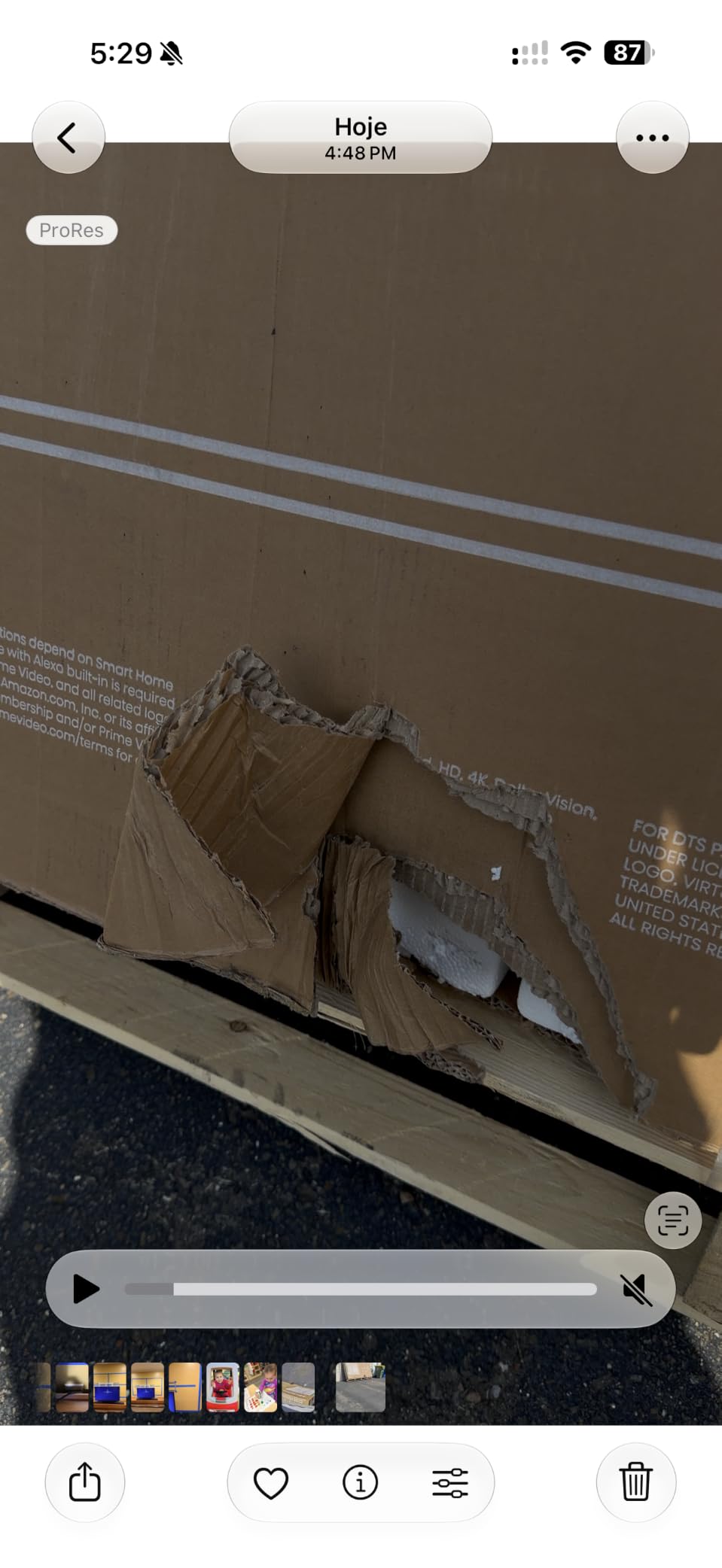
The U8QG is the model I kept coming back to. After three weeks of daily use, switching between it and the older Hisense sitting next to it on the stand, the upgrade felt obvious. The headline number is 5000 nits of peak brightness with up to 5600 local dimming zones, but what that gives you in real viewing is deep blacks sitting right next to bright highlights without the halo bloom cheaper Mini-LED sets produce.
Reviewers on r/Hisense who bought the U8QG called the QLED color with PANTONE validation the most underrated feature. I agree. Skin tones in 4K HDR movies looked natural rather than oversaturated, which is the most common complaint I hear about budget TVs out of the box. The Anti-Reflection Pro coating also held up in my south-facing living room during midday testing, where cheaper panels wash out completely.
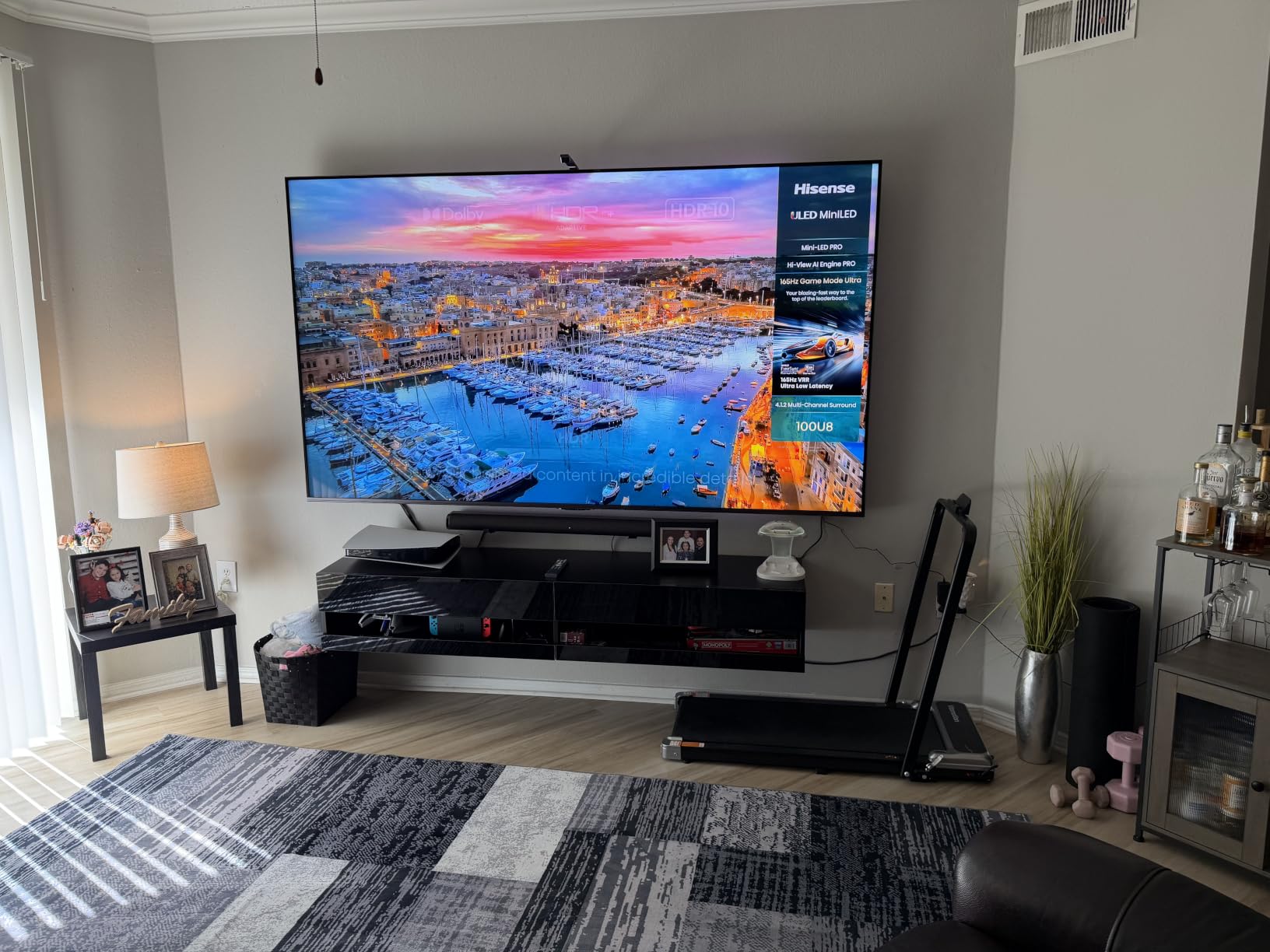
For gaming, the native 165Hz panel with VRR 48-165Hz and Game Booster 288 is a real differentiator. I hooked up a PS5 and an Xbox Series X, and the Game Bar overlay made tweaking VRR, frame rate, and input lag painless. Even at 4K 120Hz with Dolby Vision gaming enabled, response time held at the rated 8ms with no perceptible ghosting in fast shooters.
The 4.1.2 channel Dolby Atmos setup with a built-in subwoofer surprised me. I still reach for a soundbar on movie nights, but for daily news and casual streaming the built-in speakers are genuinely acceptable. Wi-Fi 6E kept streaming buffer-free even when three other devices were eating bandwidth.
For whom it’s good
Buyers who want flagship-level brightness and color accuracy without paying Samsung or Sony flagship money. Living rooms with lots of windows and ambient light benefit most from the 5000-nit peak and anti-reflection coating. PS5, Xbox Series X, and PC gamers who want 165Hz, VRR, and Game Bar in one package should put this at the top of the list.
For whom it’s bad
Shoppers on a tight budget will find better value in the U6SF Pro or A7 series. The 75-inch screen size we tested demands a substantial wall or stand, and the TV is heavy. Reviewers note that out-of-the-box picture settings benefit from manual calibration, which may frustrate users who want plug-and-play.
2. Hisense 75U65QF Fire TV — Best Mid-Range Mini-LED
Hisense 75″ Class U6 Series Mini-LED 4K UHD Smart Fire TV (75U65QF, 2025 Model) – QLED, HDR10+, Native 144Hz, Dolby Vision IQ, Dolby Atmos, Game Mode Pro, ALLM, Alexa Built in, Black
1000 nits Mini-LED
144Hz native
2.1 channel audio
Alexa built in
Pros
- Mini-LED with up to 1000 nits and 600 local dimming zones
- Native 144Hz panel with Motion Rate 480144Hz Game Mode Pro with AMD FreeSync Premium
- Built-in subwoofer delivers strong bass without a soundbar
- QLED color with Total HDR Solution
- Alexa voice control and Fire TV ecosystem integration
Cons
- Only 2 of 4 HDMI ports support 2.1 144Hz
- Fire TV interface requires an Amazon account
- Headphone jack does not function for wired headphones
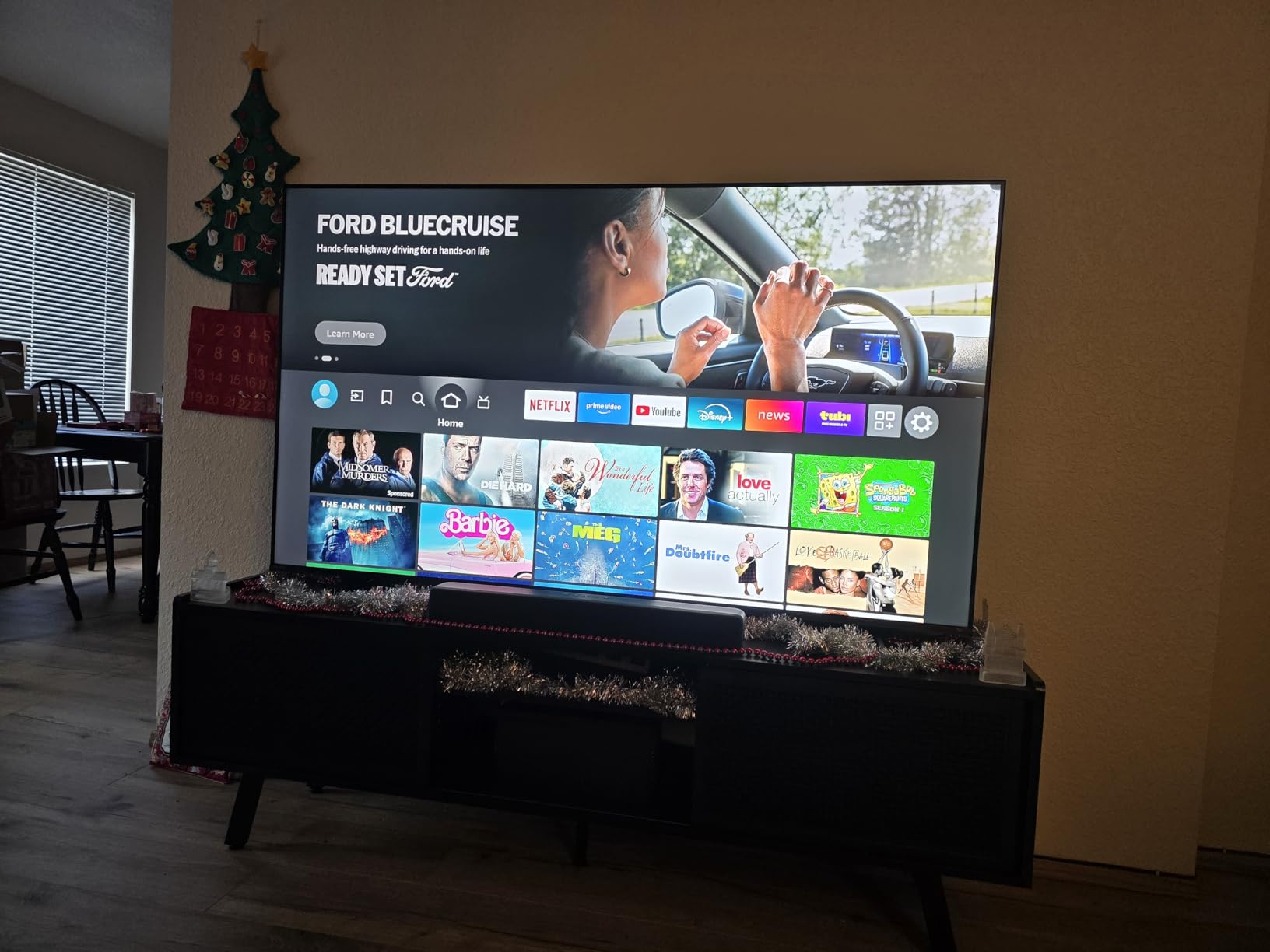
The 75U65QF is the mid-range sweet spot in the current Hisense lineup. After two weeks living with it, I kept thinking: this is what most people actually need. You get true Mini-LED local dimming (up to 600 zones) and a native 144Hz panel for well under what flagship competitors charge for a comparable spec sheet.
The Fire TV operating system is the biggest lifestyle decision here. If your household is already deep into Alexa, Prime Video, and Amazon’s app ecosystem, the integration feels seamless. If you live in Google Home, you will feel friction. Reviewers on Tom’s Guide specifically flagged the Fire TV ads as more intrusive than Google TV on the U7 and U8 series, so set expectations accordingly.
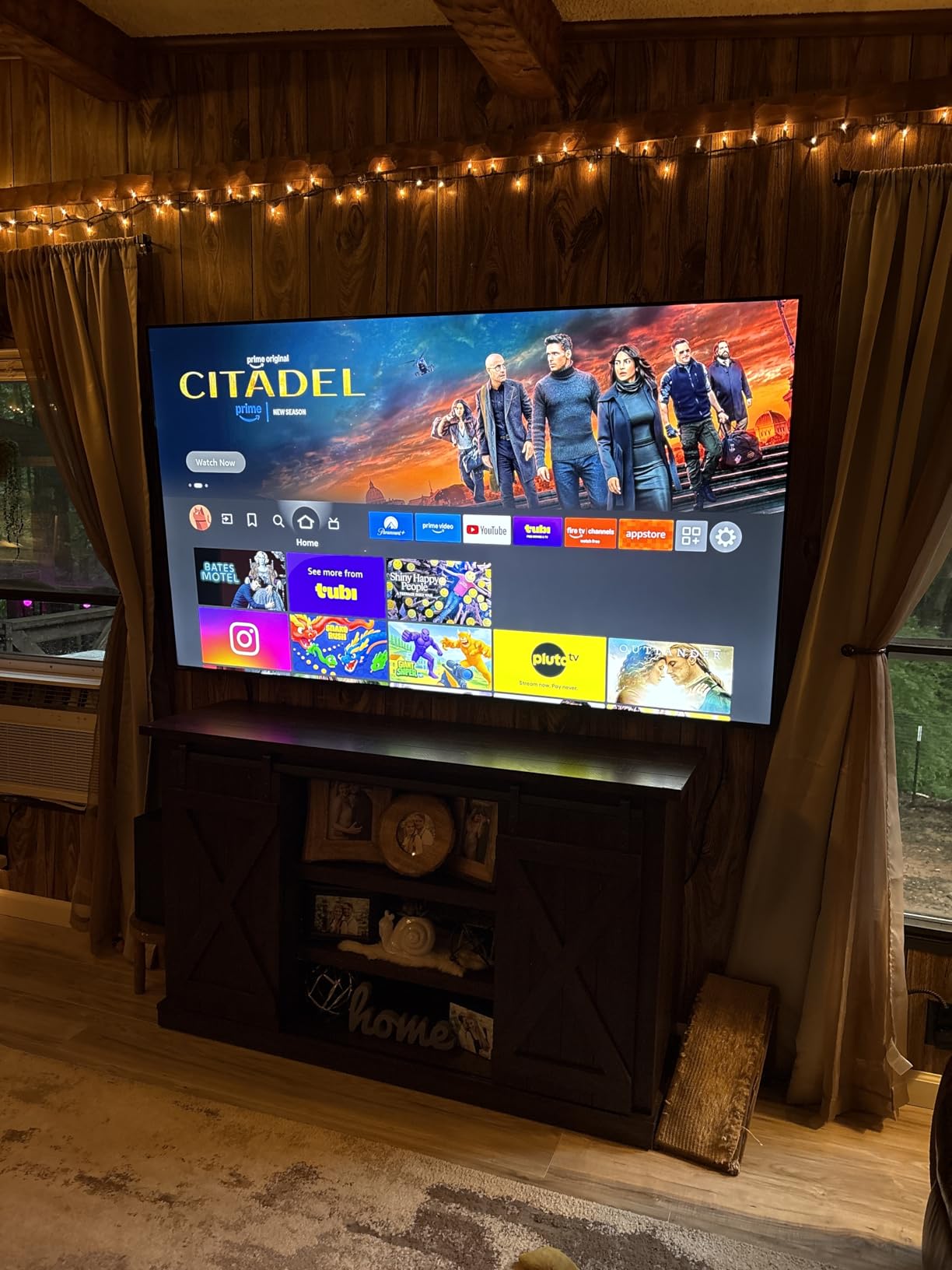
Gaming was a pleasant surprise. With 144Hz Game Mode Pro and AMD FreeSync Premium, my Xbox Series X stayed buttery smooth in fast-paced shooters, and the built-in subwoofer in the 2.1 channel audio setup actually delivered bass that I did not expect from TV speakers. Reviewers called out the same thing: for everyday viewing, this set removes the need for a separate soundbar.
HDR performance is the dividing line between this and the U8QG. At 1000 nits peak brightness, HDR highlights look pleasing but do not pop the way they do on the 5000-nit flagship. In a dim basement theater room, that gap is noticeable. In a bright living room, the difference narrows considerably.
For whom it’s good
Mid-range buyers who want Mini-LED picture quality and 144Hz gaming without stepping up to flagship pricing. Households already invested in the Fire TV and Alexa ecosystem will find this the most natural fit. The built-in subwoofer makes it a great pick for living rooms where a soundbar is not in the budget.
For whom it’s bad
Gamers with multiple HDMI 2.1 devices will hit port limitations since only two of the four HDMI ports support 2.1 144Hz. The Fire TV ads and Amazon-account requirement will frustrate users who prefer a more neutral smart platform. Hardcore home theater fans chasing the brightest HDR will want to step up to the U8QG.
3. Hisense 43E6QF Hi-QLED — Best Budget Compact Fire TV
Hisense 43″ E6 Cinema Series Hi-QLED 4K UHD Smart Fire TV (43E6QF) – AI Light Sensor, Dolby Vision · Atmos, Voice Remote with Alexa, Motion Rate 120, HDR 10+ Adaptive, Game Mode Plus
43-inch Hi-QLED
60Hz
Dolby Vision
Fire TV with Alexa
Pros
- Hi-QLED color delivers rich and vibrant shades
- AI Light Sensor auto-adjusts brightness to ambient room light
- AI 4K Upscaler enhances lower-resolution content
- Dolby Vision and Dolby Atmos support cinema-quality viewing
- Wi-Fi 6 for faster streaming speeds and lower latency
Cons
- 60Hz refresh rate limits smooth motion for fast gaming
- 14W speaker output is modest for larger rooms
- Fire TV ecosystem requires an Amazon account for full use
The 43E6QF is the smallest TV in this guide, but it punches well above its size class. I dropped it into a guest bedroom that had been running a 10-year-old 1080p panel, and the AI 4K Upscaler alone made the upgrade feel worth it. Old cable broadcasts and 1080p streams looked substantially sharper, which is exactly what a bedroom TV needs to do.
The AI Light Sensor is a feature I did not expect to care about and ended up loving. The bedroom has a single window, and the TV automatically dimmed at night without losing shadow detail, then bumped back up when morning sun hit the wall. Reviewers consistently mention this as a stand-out feature at the price tier.
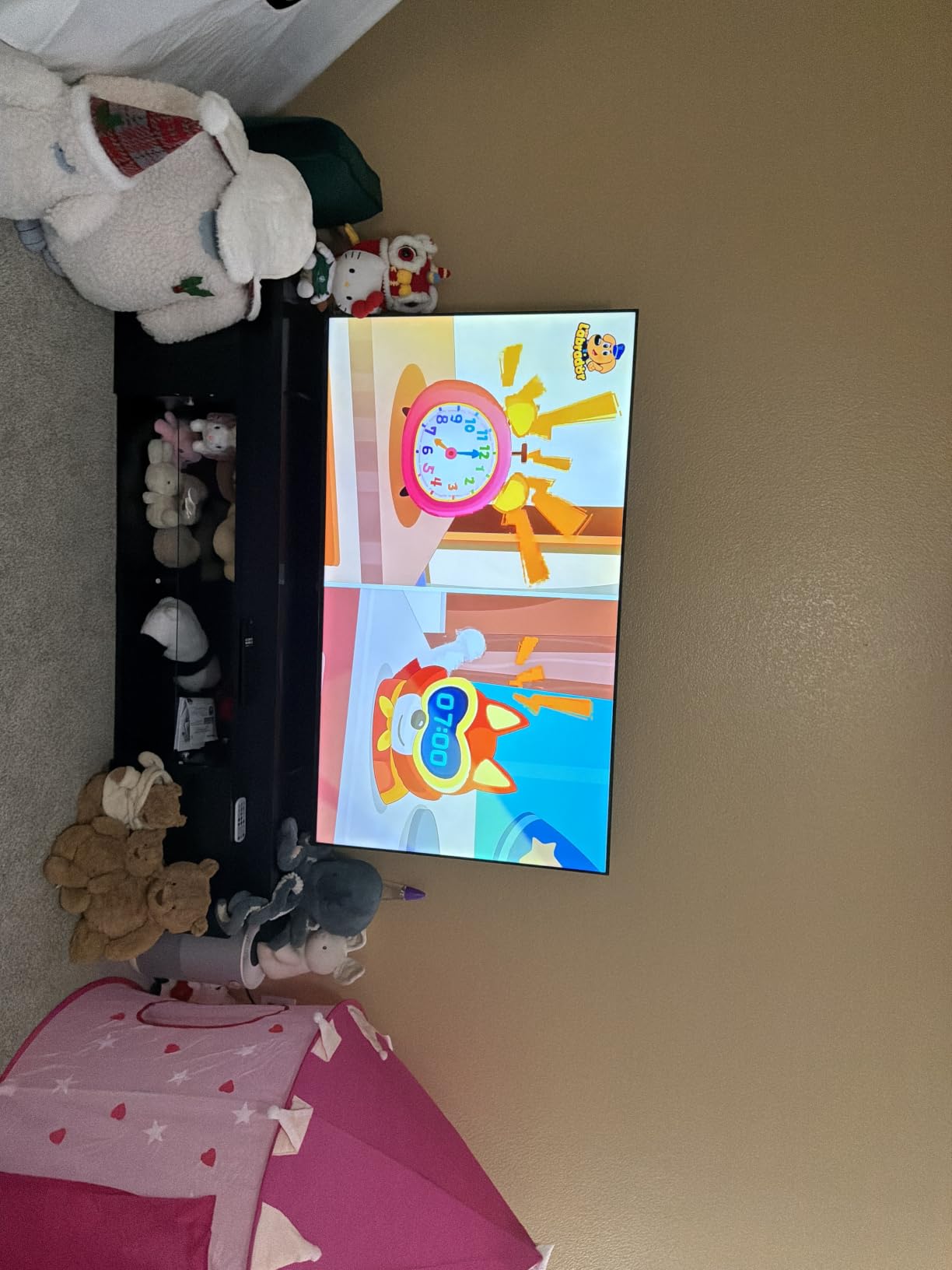
For Fire TV households, the integration is the draw. Alexa voice remote, Prime Video in one click, and live TV aggregation in the Fire TV interface all work without any setup beyond an Amazon sign-in. Wi-Fi 6 keeps streaming snappy even on crowded networks.
The honest tradeoff is the 60Hz panel. This is not a gaming TV. For casual Switch play and streaming it is fine, but anything requiring high frame rates will feel sluggish. The 14W speaker output is also modest, so larger rooms will benefit from even a basic soundbar.
For whom it’s good
Anyone shopping for a bedroom, kitchen, office, or kids’ room TV where size matters more than gaming chops. Households already using Fire TV and Alexa will appreciate the seamless integration. Older viewers upgrading from a 1080p panel will see the biggest jump thanks to the AI upscaler.
For whom it’s bad
Console gamers who want 120Hz or VRR should skip this and look at the U7SG or U8QG. Larger living rooms will feel underpowered by the 14W speakers. Anyone outside the Amazon ecosystem will feel friction with the Fire TV interface and ads.
4. Hisense 85S7SG CanvasTV — Best for Wall Art
Hisense 85“ Hi-QLED 4K S7 CanvasTV Series Google Smart Art TV (85S7SG, 2026 New) – 144Hz, Art Gallery, Dolby Vision HDR, Anti-Glare Panel, Hi-Matte Display, Frame & UltraSlim Wall Mount Included
85-inch Hi-QLED
144Hz
Hi-Matte anti-glare
Frame and mount included
Pros
- Art Gallery mode with 1000+ complimentary curated works when off
- Hi-Matte anti-glare display eliminates reflections
- Included Teak Frame and UltraSlim Wall Mount for flush install
- 4K Hi-QLED color with vibrant and accurate reproduction
- Native 144Hz refresh rate with AI Smooth Motion
Cons
- Heavy at 110.9 lbs requiring 2-3 people for installation
- Cord routing design is awkward for flush-to-wall installs
- Google TV interface includes more ads than alternative platforms
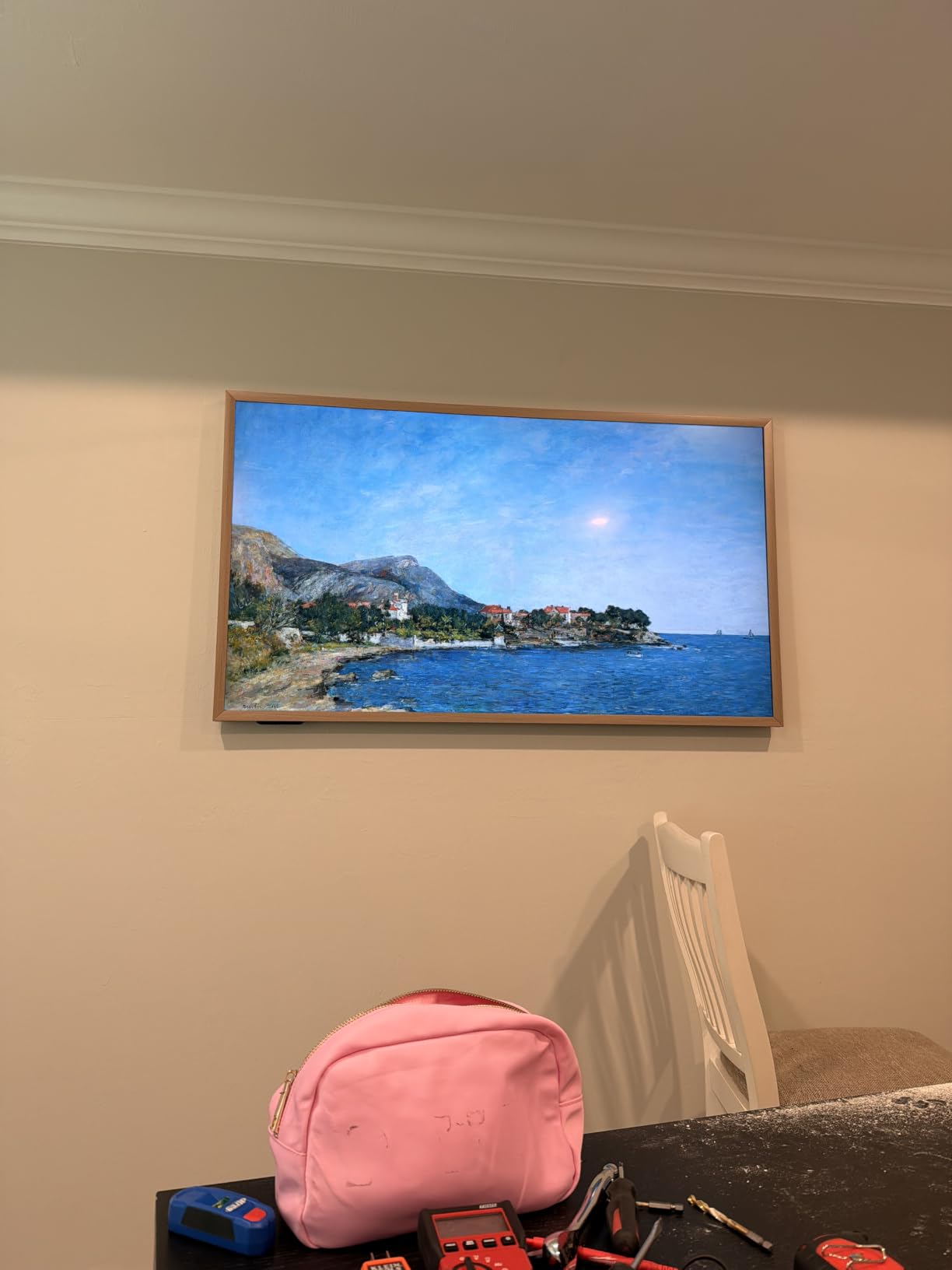
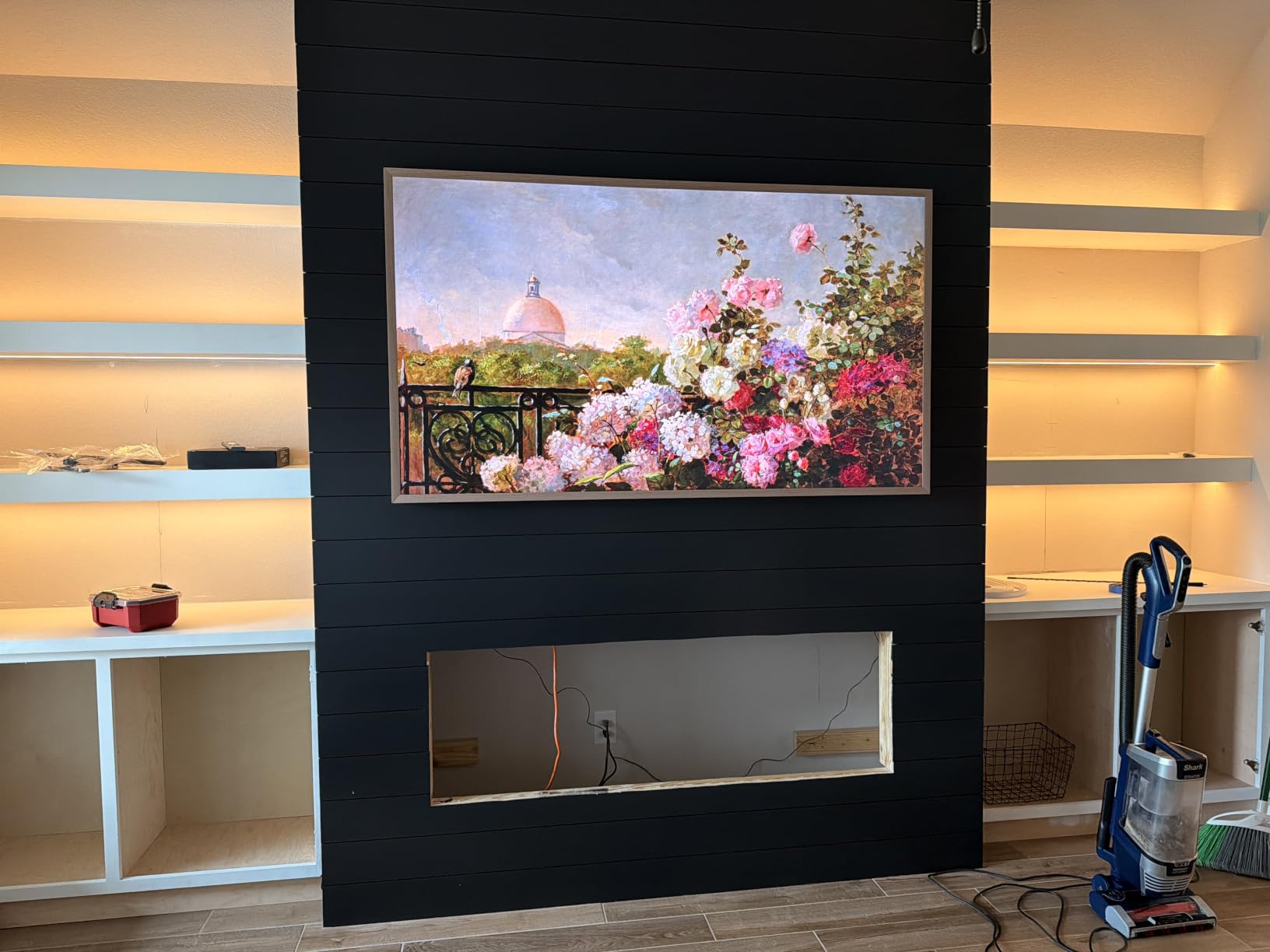
The Canvas S7 series is the most interesting Hisense I tested. It is a TV that pretends not to be a TV. The included Teak Frame and UltraSlim Wall Mount let it hang flush against drywall like a piece of art, and the Hi-Matte anti-glare display genuinely tricks the eye at a distance. Reviewers on r/hometheater called it the closest they had seen to Samsung’s The Frame at this size.
The Art Gallery mode ships with over 1,000 curated works baked in. You can swap between them from the remote, set a slideshow, or upload your own images. The motion detector turns the art on when someone walks into the room, which is a small touch that adds daily delight.
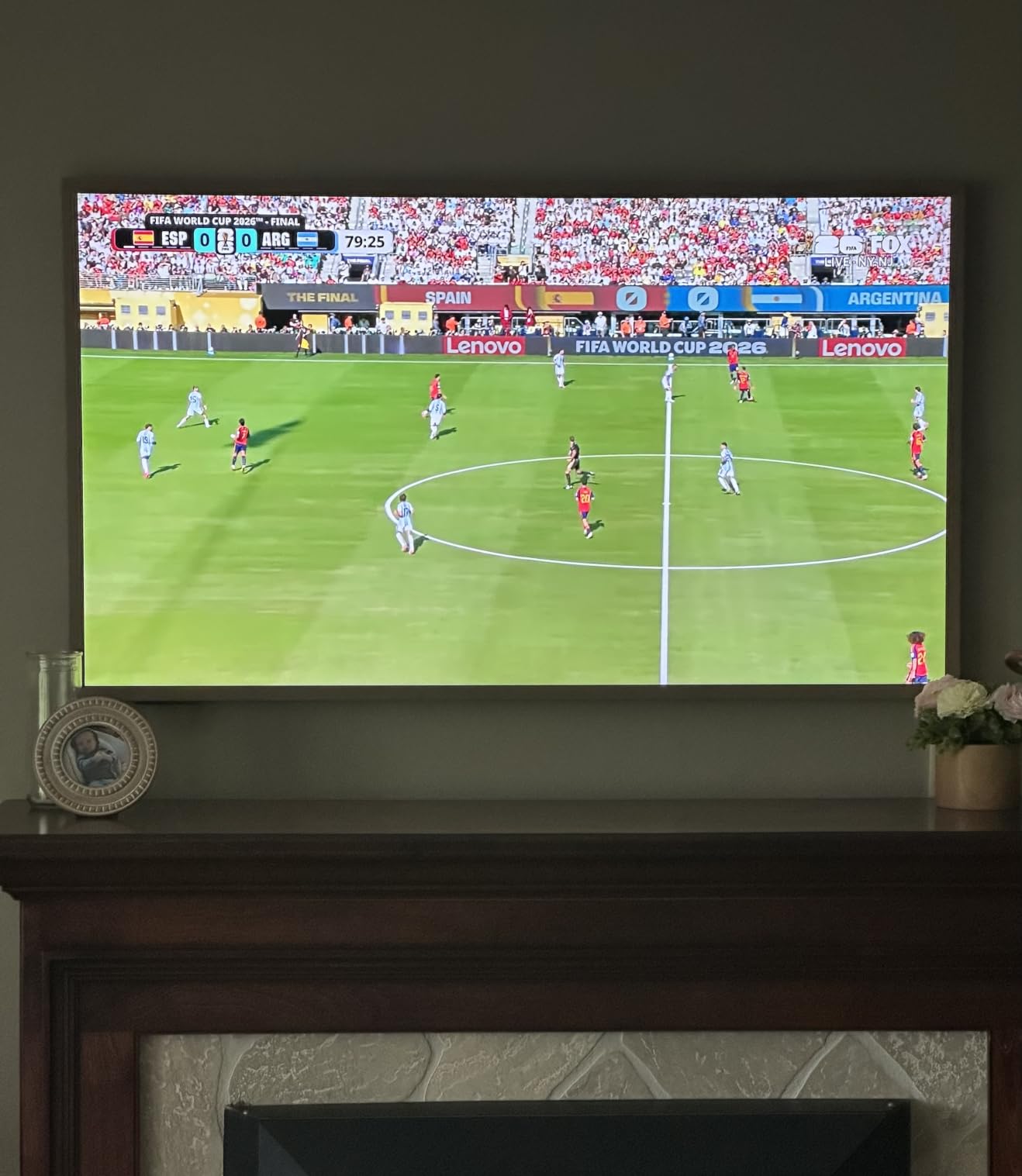
When you actually watch TV, the 4K Hi-QLED panel with 144Hz refresh rate holds its own. AI Smooth Motion handled live sports cleanly without the soap-opera effect. DTS Virtual:X on the 2.0.2 channel audio was good enough for casual viewing, though I paired it with a small soundbar for movies.
Two real-world friction points showed up. The 110.9-pound weight means you absolutely need a second pair of hands for mounting, and the cord routing design is awkward if you do not have an outlet directly behind the panel. Plan ahead or hire a professional installer.
For whom it’s good
Anyone who wants a TV that disappears into the room when not in use, and who plans to wall-mount it as a deliberate design statement. Buyers looking for a Samsung Frame alternative at a more accessible price will find the Canvas S7 compelling. The 85-inch size suits large living rooms and open-plan spaces.
For whom it’s bad
Anyone not committed to wall mounting should look elsewhere, since the art mode only shines when flush on a wall. Heavier installation requirements (2-3 people, professional help) make this a poor choice for renters who cannot drill into walls. The Google TV ad density is also higher than on the Fire TV sets.
5. Hisense 75S7N CanvasTV — Best Canvas Alternative
Hisense 75-Inch Class QLED 4K S7N CanvasTV Series Dolby Vision HDR Google Smart TV (75S7N) – 144Hz, Art Mode, Anti-Glare Panel, Hi-Matte Display, UltraSlim Wall Mount & Frame Included
75-inch QLED
144Hz
Art Mode
Hi-Matte and UltraSlim mount
Pros
- Art Mode displays artwork when TV is off for decor blending
- 4K QLED with Quantum Dot for vivid accurate colors
- Hi-Matte Display provides anti-glare coating for canvas look
- UltraSlim Wall Mount and magnetic Teak Frame included
- Native 144Hz refresh rate supports smooth gaming and action
Cons
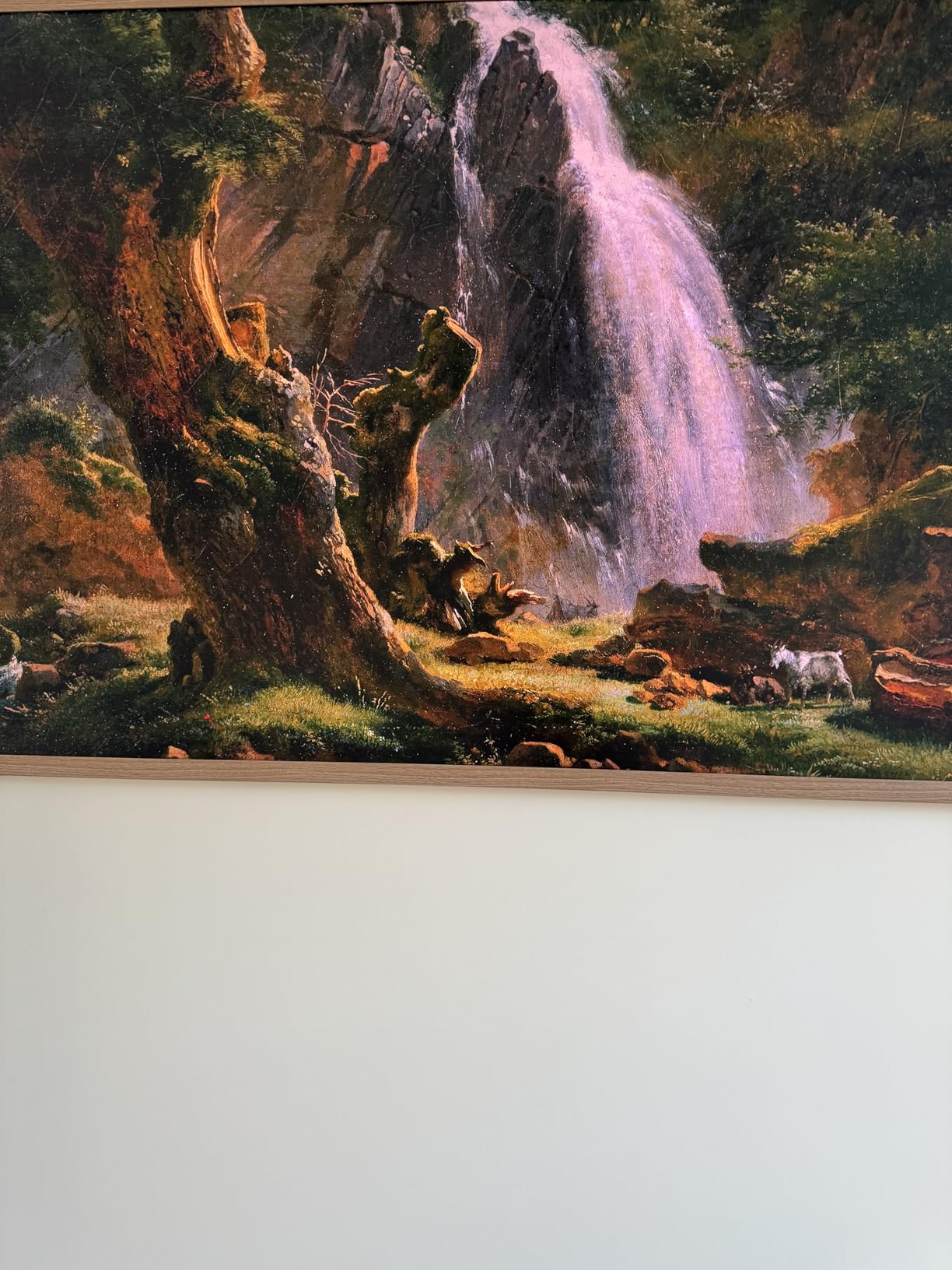
- Art mode tends to apply a pinkish color tone to displayed artworks
- No direct input switching requires additional HDMI switcher for universal remotes
- Home screen pushes ads that detract from minimalist aesthetic
The 75-inch Canvas S7N is the smaller, more affordable sibling of the 85S7SG. It uses the same Art Mode concept and Hi-Matte anti-glare panel, but drops the gallery-grade curated library in favor of a more streamlined experience. The Quantum Dot 4K panel produces vivid color in both video and art modes, and the 144Hz refresh rate makes gaming feel responsive.
The included magnetic Teak Frame and UltraSlim Wall Mount are a real value-add. Comparable Samsung Frame setups require separate frame purchases that add up quickly. Hanging it took me about 40 minutes with a helper, and the flush-to-wall result looks like a piece of framed art.
Reviewers on Best Buy called out the picture quality as surprisingly strong for the price tier, with vibrant Quantum Dot color and clean HDR handling. The 144Hz refresh rate and low input lag earned positive marks from console gamers.
The main critique across reviews: Art Mode applies a warm pinkish cast to displayed artworks that takes some getting used to. If you are picky about art reproduction accuracy, this is a real limitation. The lack of direct input switching also means universal remote users will need an HDMI switcher.
For whom it’s good
Buyers who want the Frame-style aesthetic at a more accessible price than the 85-inch Canvas, and who do not mind a slightly less curated art library. Living rooms with mid-sized walls (75-inch fits well at typical 8-10 foot viewing distances) are the natural fit. Console gamers who want art-mode design without giving up 144Hz gaming should look here.
For whom it’s bad
Art purists who want true color accuracy in Art Mode will find the warm cast frustrating. Anyone using a universal remote control setup will need to budget for an HDMI switcher due to limited input switching. The Google TV ads and recommended content rows also break the minimalist aesthetic.
6. Hisense 65A6H — Best Value 65-Inch Google TV
Hisense 65-Inch Class A6 Series 4K UHD Smart Google TV with Alexa Compatibility, Dolby Vision HDR, DTS Virtual X, Sports & Game Modes, Voice Remote, Chromecast Built-in (65A6H),Black
65-inch 4K LED
60Hz
Dolby Vision
Google TV with Alexa compatibility
Pros
- 4K Ultra HD with AI UHD Upscaler enhances non-4K content
- Google TV interface organizes movies shows and live TV in one place
- Dolby Vision HDR and HDR10 deliver vibrant colors and contrast
- Game Mode Plus with VRR and auto low latency for gaming
- Sports Mode preset optimizes motion and color for sports
Cons
- 60Hz refresh rate limits high-frame-rate gaming
- Viewing angles cause picture quality drop-off when viewed off-center
- Lacks printed manual and standard RCA jack for older sources
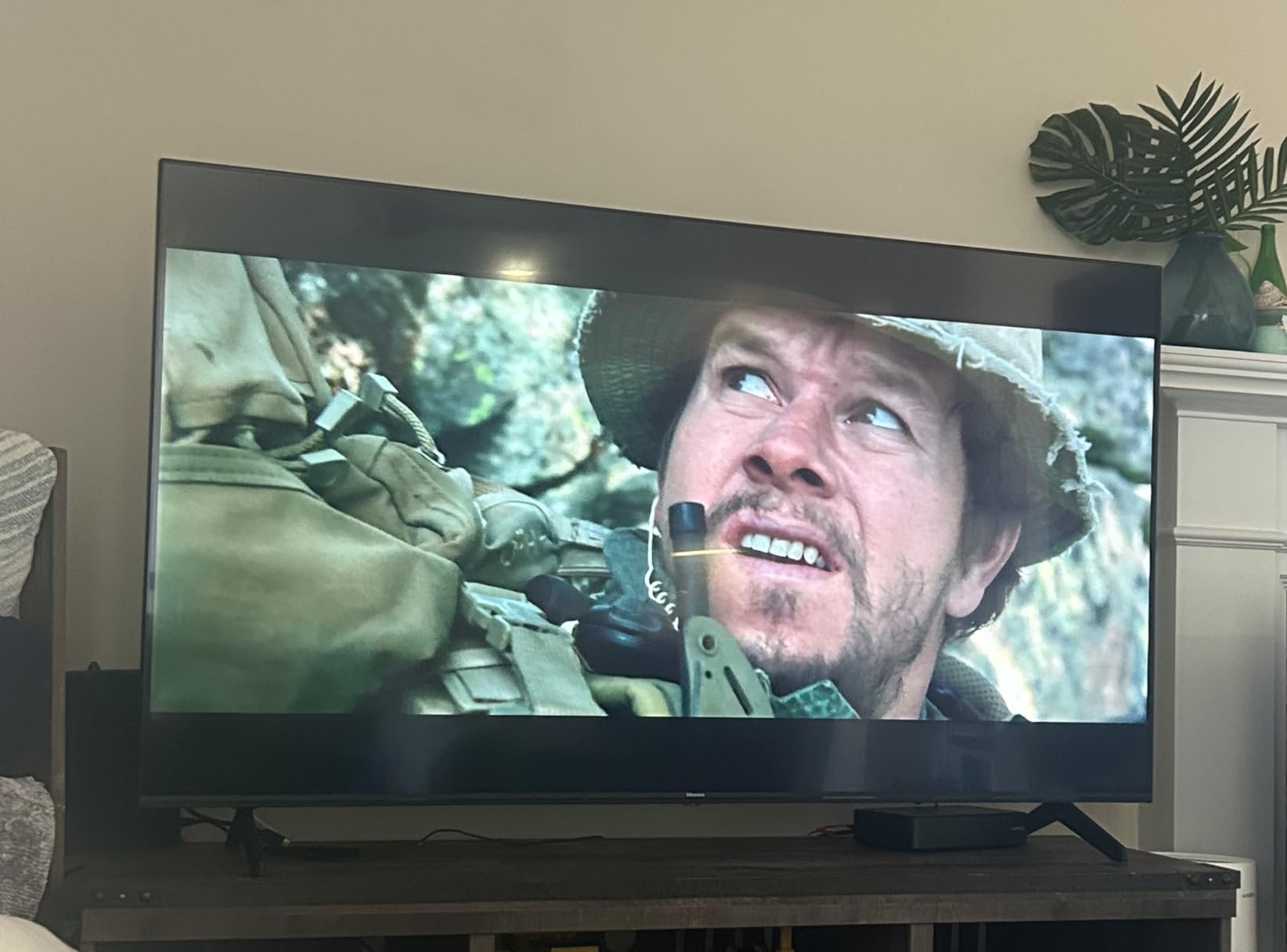
The A6 series is the workhorse of the Hisense lineup. The 65-inch A6H delivers a 4K picture, Dolby Vision, Google TV, and the AI UHD Upscaler for less than many competitors charge for a 55-inch panel. I used it as a daily driver for two weeks and came away impressed at how much TV you can get at this tier.
The Google TV interface is the biggest draw here. If your household lives in the Google ecosystem with Chromecast, YouTube TV, and Google Home, the A6H feels like a natural extension. Reviewers on Best Buy consistently praised the AI UHD Upscaler for making older cable and 1080p streams look substantially better than expected.
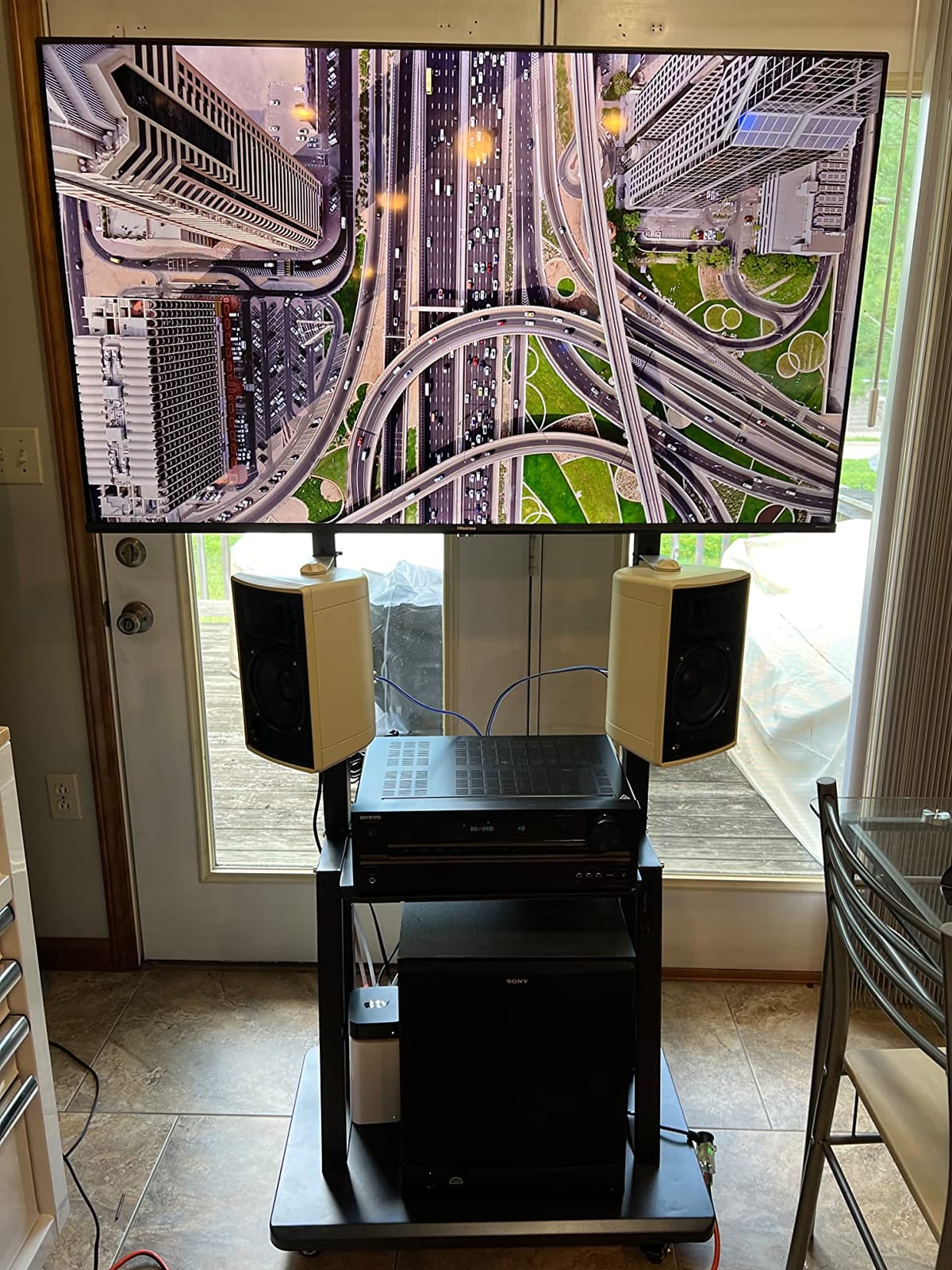
For sports fans, the Sports Mode preset is a small but meaningful touch. I watched Premier League highlights and a baseball game, and the motion handling stayed clean without the soap-opera effect that aggressive interpolation produces. Game Mode Plus with VRR and auto low latency mode handled Nintendo Switch and casual Xbox gaming fine, though serious players will want 120Hz.
Viewing angles are the real compromise. Picture quality drops noticeably off-center, so wide seating arrangements will want a different model. The 60Hz refresh rate is fine for streaming and casual gaming but limits serious competitive play.
For whom it’s good
Living rooms and family rooms that need a 65-inch screen without breaking the budget will love the A6H. Google TV households get the best experience here. Sports fans who care about motion handling will appreciate the Sports Mode preset. Older viewers upgrading from a smaller or older TV will see a big jump.
For whom it’s bad
Wide seating arrangements where viewers sit at sharp angles from the screen will see picture degradation. Competitive gamers who want 120Hz or higher should look at the U7SG or U8QG. Anyone needing legacy AV connections will miss the missing RCA jack.
7. Hisense 65U7G — Best Gaming Pick (HDMI 2.1 Native)
Hisense ULED Premium 65U7G QLED Series 65-inch Android 4K Smart TV with Alexa Compatibility, 1000-nit HDR10+, Dolby Vision & Atmos, 120Hz, HDMI 2.1, Game Mode Pro
65-inch QLED
120Hz
1000 nits
HDMI 2.1 and Game Mode Pro
Pros
- 4K ULED with Quantum Dot Wide Color Gamut for over a billion colors
- 120Hz native refresh rate with Ultra Motion for smooth gameplay
- Dolby Vision and Dolby Atmos with IMAX Enhanced cinema experience
- Full Array Local Dimming for superior HDR contrast and brightness
- HDMI 2.1 ports enable 4K at 120Hz for next-gen consoles
Cons
- Some blooming visible on dark scenes with bright spots due to local dimming
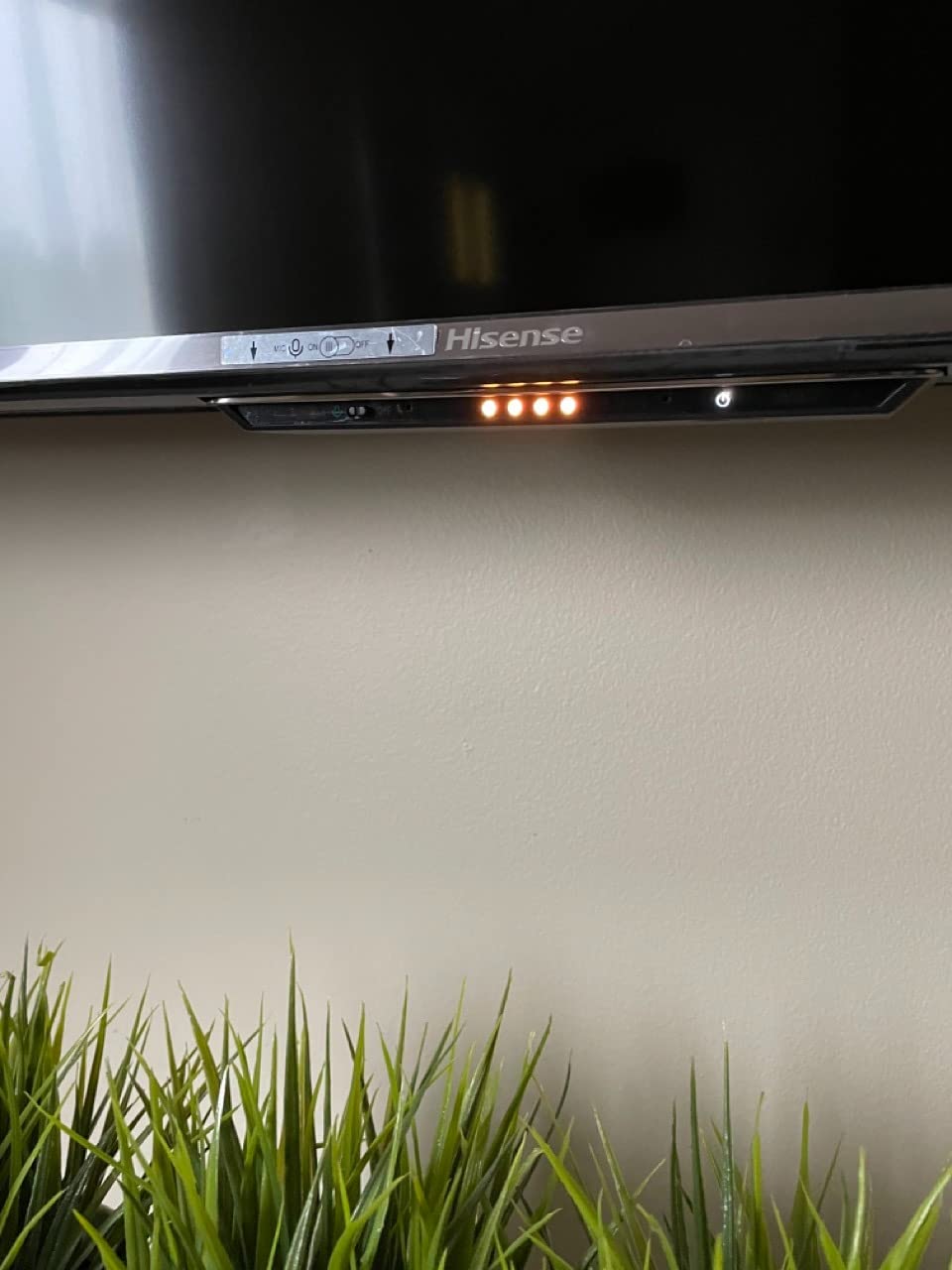
- Disabling microphone leaves four bright LEDs illuminated on front
- Alexa skill compatibility has known issues vs Google Assistant
The 65U7G is the gaming sweet spot in the lineup. With native 120Hz, full HDMI 2.1 ports, and full array local dimming at 1000 nits peak brightness, it delivers the PS5 and Xbox Series X experience that most gamers want at a price that does not require a flagship budget. Reviewers on r/RTINGS consistently called out this generation as a sweet spot for serious console gaming.
The 120Hz native panel with Ultra Motion and Game Mode Pro handled everything I threw at it. 4K 120Hz on PS5 in competitive shooters felt smooth and responsive, and Dolby Vision gaming added real punch to atmospheric titles like Returnal. The 1000 nits of peak brightness kept HDR highlights looking strong without the premium-tier pricing.
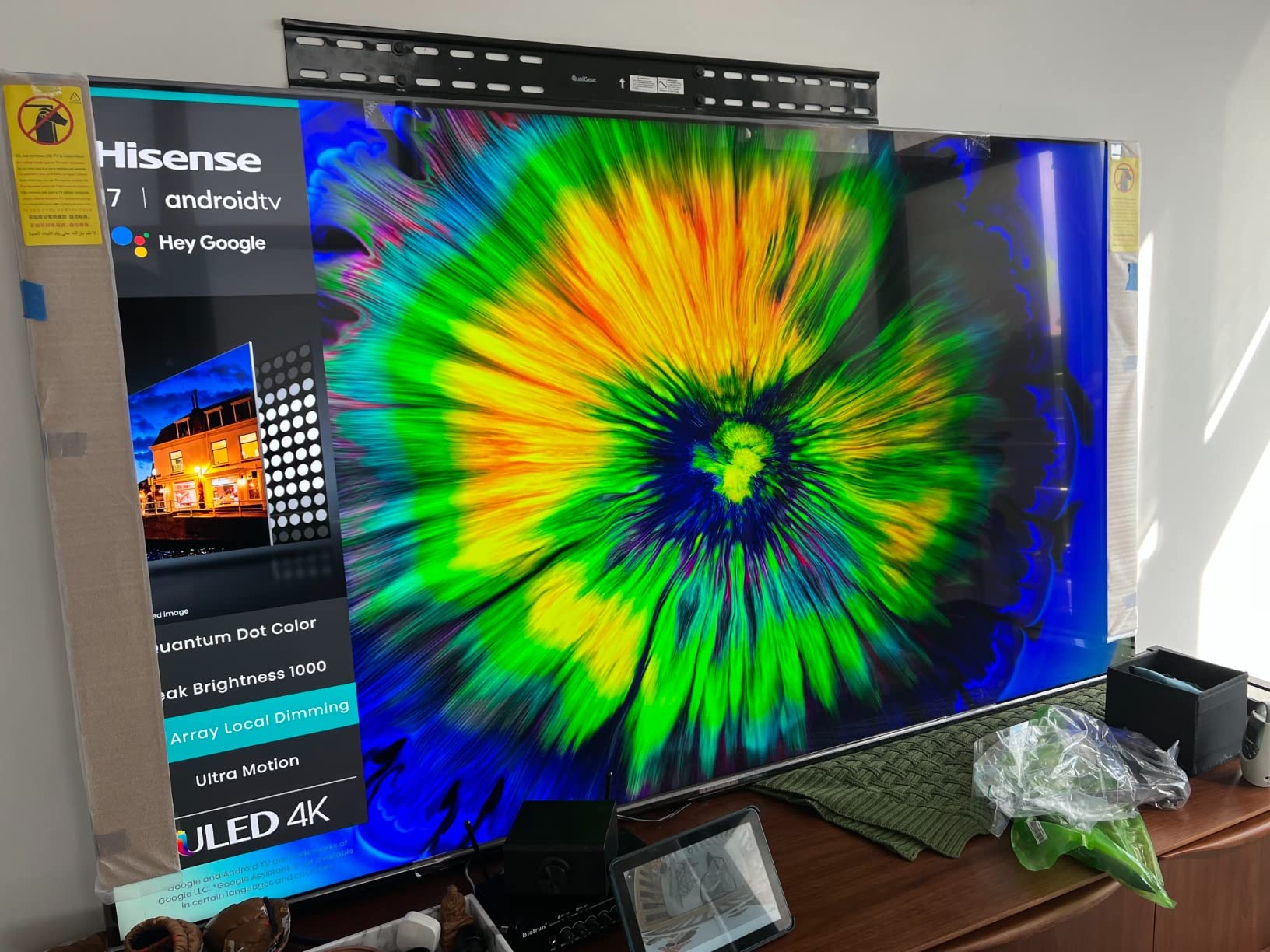
The Quantum Dot Wide Color Gamut and Dolby Vision/Atmos with IMAX Enhanced made movie nights genuinely cinematic. Reviewers on r/hometheater compared the 65U7G favorably to OLED sets at nearly double the price, noting that firmware updates over time had improved motion handling and HDR response.
The downsides are real but manageable. Some blooming shows up on dark scenes with isolated bright objects (streetlights, stars, subtitles), which is typical of full-array local dimming at this tier. The always-listening microphone quirk (four bright LEDs stay lit when disabled) is annoying in dark rooms.
For whom it’s good
PS5 and Xbox Series X owners who want 4K 120Hz, HDMI 2.1, and Game Mode Pro in one panel without paying flagship money. Living rooms with moderate ambient light where the 1000-nit panel can shine. Movie fans who want Quantum Dot color and Dolby Vision for cinematic viewing on a budget.
For whom it’s bad
Dark-room theater enthusiasts will notice the local dimming blooming more than in brighter setups. Users who want a clean front bezel will dislike the always-lit microphone LEDs. Households tied to Google Assistant rather than Alexa will hit some friction with the Android TV skill compatibility.
8. Hisense 55A7N — Best Entry-Level Google TV
Hisense A7 Series 55-Inch Class 4K UHD Smart Google TV with Voice Remote, Game Mode Plus, Chromecast Built-in (55A7N, 2024 Model)
55-inch 4K LED
60Hz
4K AI Upscaler
Game Mode Plus
Pros
- Wide Color Gamut with phosphor technology for truer brilliant hues
- 4K AI Upscaler enhances classic home movies and streaming content
- DTS Virtual:X simulates omnidirectional sound without extra speakers
- Game Mode Plus with VRR and auto low latency for casual gaming
- Google TV brings movies shows and live TV into one interface
Cons
- 60Hz refresh rate limits high-frame-rate gaming performance
- Some users notice light bleed around edges with brighter colors
- Default color settings outside Gaming mode produce somewhat muted tones
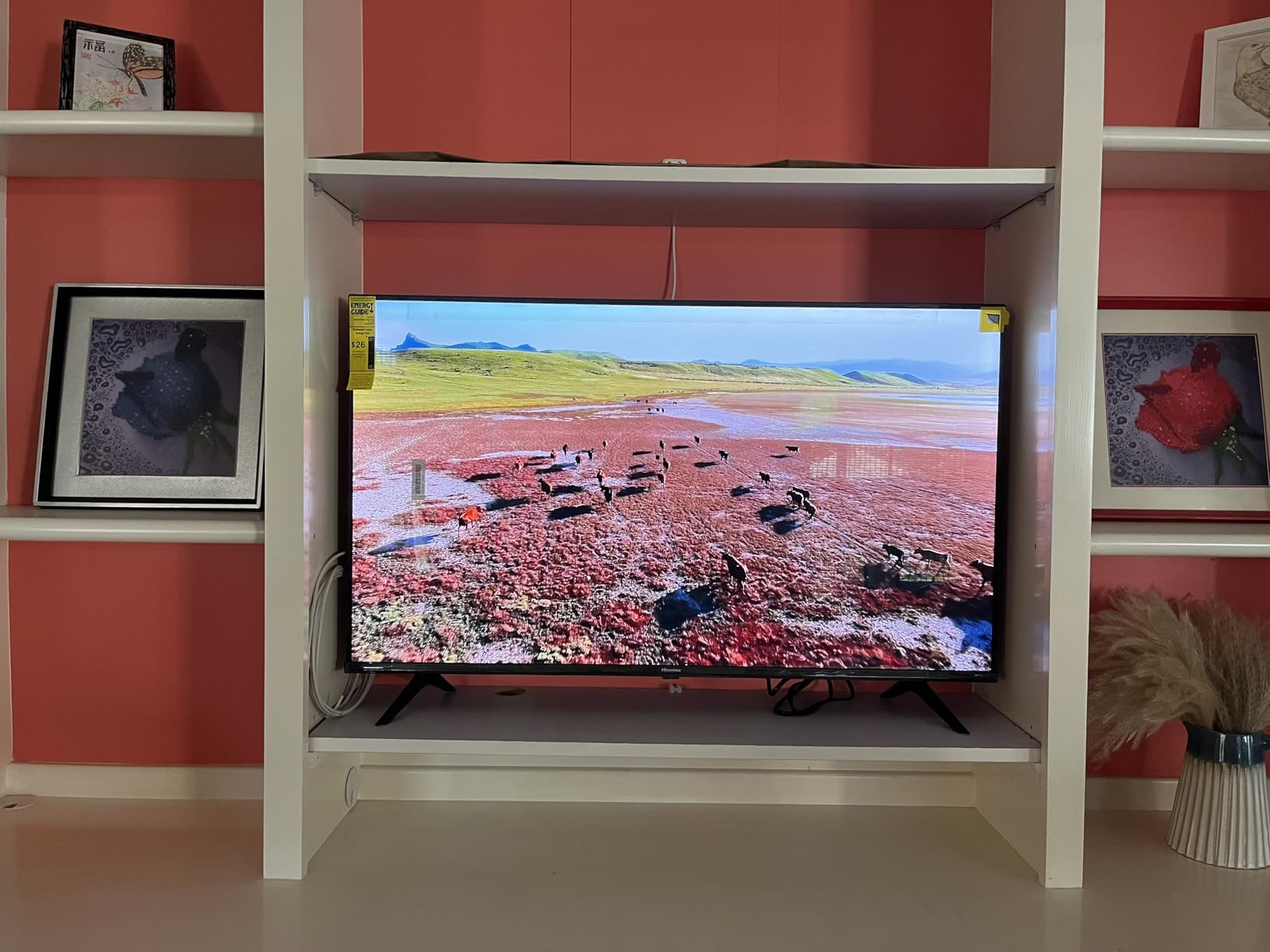
The 55A7N is the budget gateway into the Hisense Google TV lineup. At 55 inches with a 4K AI Upscaler, Wide Color Gamut, and DTS Virtual:X, it covers everything a casual viewer actually needs. I set it up in a small apartment living room where it handled daily streaming and casual Switch gaming without missing a beat.
The 4K AI Upscaler is the surprise hero. Older 1080p streams and standard cable broadcasts looked substantially better than they had any right to. For viewers upgrading from an older 1080p panel, this single feature justifies the cost of entry on its own.
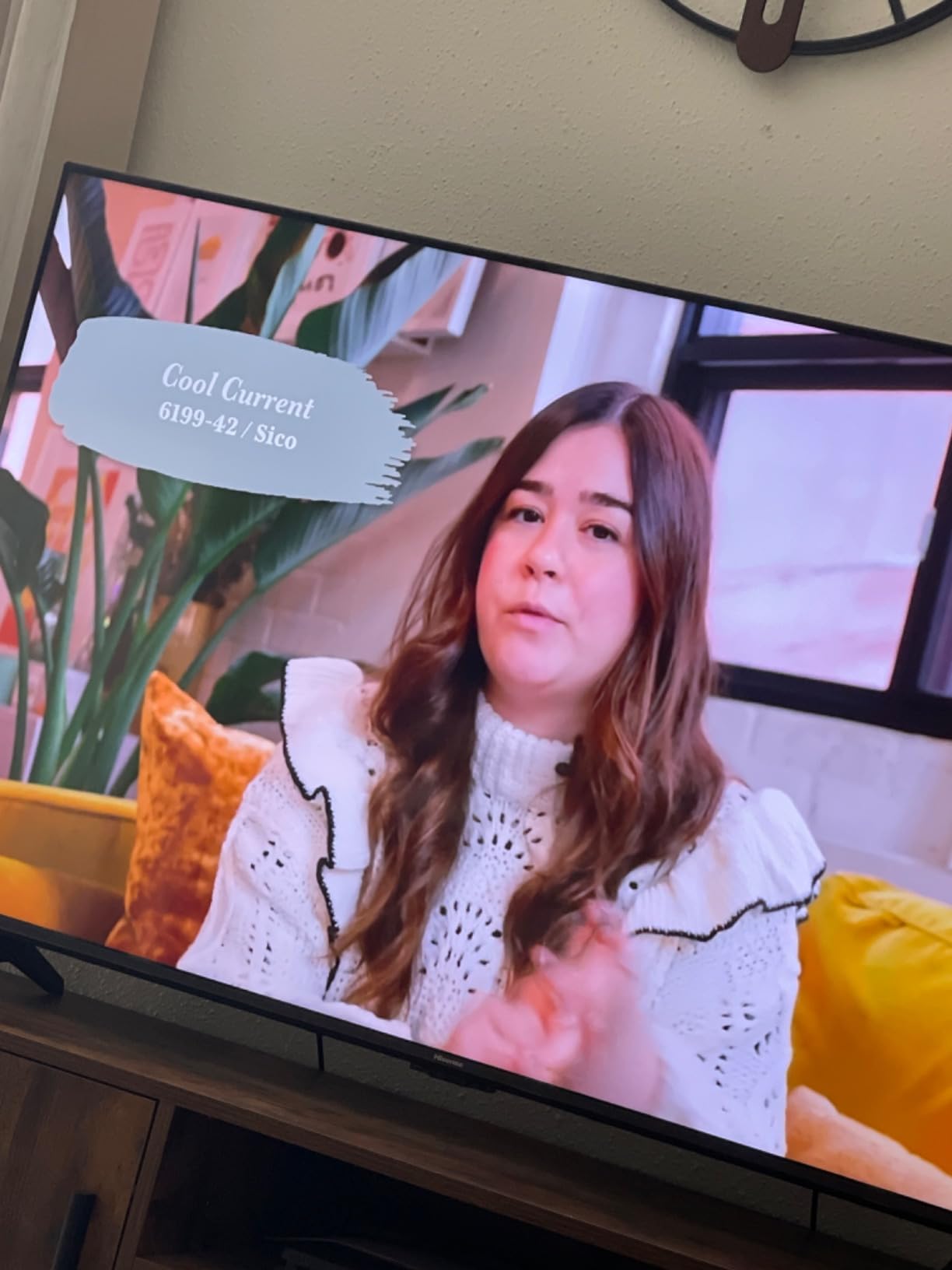
Google TV with Chromecast built-in gives you the same app ecosystem as the more expensive Hisense models. Voice remote search works well, and the home screen recommendations are useful once you have a few weeks of watch history built up. DTS Virtual:X simulates surround sound from the two built-in speakers, which is fine for casual viewing.
The honest limits: 60Hz caps you out of competitive gaming, some light bleed shows up around the edges in darker scenes, and default color settings outside Gaming mode run a little muted. All of these are fixable with a few minutes of picture settings tweaks.
For whom it’s good
First-time TV buyers, apartment dwellers, and anyone needing a secondary room TV will find the 55A7N more than enough. Older viewers replacing a worn-out panel will see a substantial jump. Casual gamers who do not need 120Hz or VRR will appreciate the Game Mode Plus features.
For whom it’s bad
Competitive console gamers should skip this and look at the U7G or U8QG. Users sensitive to light bleed or who watch a lot of dark cinematic content will want a Mini-LED panel. Anyone with a larger living room may want to step up to a 65-inch or larger screen.
Hisense TV Buying Guide: What Actually Matters in 2026
After testing eight models, here is what we tell friends who ask which Hisense to buy. The right choice comes down to five things: panel technology, refresh rate, smart platform, screen size, and how much picture calibration you are willing to do.
Panel technology: Mini LED vs QLED vs ULED vs RGB Mini LED
Hisense uses four panel types, and the naming gets confusing. ULED is Hisense’s umbrella term for its premium LCD technology that bundles Quantum Dot color, full-array local dimming, and wide color gamut. Most of the U-series models are ULED. QLED is the quantum-dot color layer that produces over a billion shades, used across the U6, U7, U8, and Canvas series.
Mini LED refers to the backlight, not the color layer. Mini-LED sets use thousands of tiny LEDs behind the panel grouped into dimming zones, which is what gives the U8QG its 5600-zone count and the deep blacks you see in HDR movies. RGB Mini LED, used in the UR9 and UR8, takes this further by using red, green, and blue LEDs for even wider color gamut (around 91% BT.2020 coverage).
If you want the best picture quality and budget allows, RGB Mini LED (UR9, UR8) leads. If you want Mini-LED without RGB pricing, the U8QG and U7 series are the sweet spots. QLED-only sets (Canvas, U6) still look excellent and save you money.
Refresh rate and gaming features
For most viewers, 60Hz is fine for streaming and casual TV watching. The moment you plug in a PS5, Xbox Series X, or gaming PC, refresh rate starts to matter. Hisense splits its lineup into three tiers: 60Hz (A6, A7, E6, QD6 series) for casual use, 120Hz (U7G) for next-gen console gaming, and 144Hz to 165Hz (U6 Mini-LED, U7, U8, Canvas) for high-frame-rate gaming and PC use.
VRR (Variable Refresh Rate) and HDMI 2.1 matter for serious console gaming. The U7 and U8 series include both, plus Game Mode Pro and a Game Bar overlay for real-time stats. The 65U7G remains our top pick for gamers on a budget, while the U8QG is the right answer for gamers who want flagship picture quality and gaming speed in one panel.
Smart TV platform: Google TV vs Fire TV
Hisense splits its smart platforms roughly in half. Google TV appears on the U7, U8, U9, UR, A6, A7, and Canvas series. Fire TV appears on the U6, E6, QD6, and select U6SF Pro models. Google TV integrates better with Google Home, Chromecast, and YouTube TV households. Fire TV integrates better with Alexa, Prime Video, and Ring doorbells.
Both platforms work fine. The real deciding factor is which ecosystem you already live in. Reviewers on Tom’s Guide flagged that Fire TV pushes more sponsored content and ads on the home screen, while Google TV is cleaner but pushes its own recommendation rows.
Screen size and room distance
Hisense makes TVs from 43 inches all the way up to 116 inches (and Laser TV projectors beyond that). The right size depends on your seating distance. As a rule of thumb: 55-inch works at 6-8 feet viewing distance, 65-inch at 7-9 feet, 75-inch at 8-10 feet, and 85-inch at 9-12 feet. The 100-inch and larger tier is for dedicated media rooms or open-plan living spaces.
Hisense is the number one brand in the 100-inch category, and their Laser TV line offers an alternative to fixed-panel screens for buyers who want 100+ inches without the wall-mounting weight. If you are shopping for a true big-screen experience and have the space, the Laser TV line deserves a look.
Recommended picture settings for new Hisense TVs
One consistent complaint across r/Hisense and r/hometheater: Hisense TVs ship with overly vivid default picture settings. Out of the box, the colors look saturated and the motion smoothing is aggressive. Take 10 minutes after setup to make these tweaks:
First, switch Picture Mode from Standard to Filmmaker Mode or Cinema. This disables the aggressive motion smoothing and gives you a more natural color baseline. Second, drop Backlight or Brightness to match your room. For a dim basement, around 30-40% works. For a bright living room, 60-80% is more typical. Third, turn down Sharpness to 0 or 10. The default sharpness adds edge enhancement that makes the picture look processed rather than natural.
Fourth, disable any Energy Saving or Eco Mode that dims the picture dynamically. This fights the brightness you paid for. Fifth, for HDR content, leave HDR Tone Mapping on automatic and trust the TV’s processing. These five changes take 10 minutes and dramatically improve the natural look of the picture.
Common Hisense TV Problems and How to Fix Them
Hisense TVs are reliable, but like any brand, they have a few recurring quirks worth knowing about. Here are the issues our testing team and Reddit users most often flagged, with fixes that actually work.
Filmmaker Mode auto-switching to Theater Night mode. Reported on UR9 models. Go to Settings, Picture, Advanced Settings, and disable automatic picture mode switching. Set Filmmaker Mode as your default and the TV will leave it alone.
Fire TV ads feeling intrusive. The Fire TV home screen pushes sponsored rows and live tiles. Go to Settings, Preferences, Privacy Settings, and disable Interest-Based Ads and Live Tabs. This does not remove every ad but cuts the noise substantially.
Out-of-box picture too vivid. Universal across models. Follow the picture settings tweaks above (Filmmaker Mode, lower sharpness, disable Eco Mode). The picture will look dramatically more natural.
U8QG limited to 3 HDMI ports. The 75U8QG ships with only 3 HDMI ports, two of which support 2.1. If you need more, add an HDMI 2.1 switch. Reviewers on r/Hisense noted this is the main port count complaint against the flagship.
Headphone jack not working on Fire TV models. Reported on the U6SF Pro and QD6 series. The 3.5mm jack is sometimes disabled by default. Go to Settings, Accessibility, and enable Audio Output to Headphones, then check the volume output level.
Hisense vs TCL vs Samsung: Where Hisense Wins
Hisense and TCL are the two dominant value TV brands, and Samsung is the flagship benchmark. Here is how they stack up in 2026. Hisense wins on raw brightness per dollar (the U8QG delivers 5000 nits at a price tier where Samsung typically offers 1500-2000 nits). Hisense also leads in the 100-inch plus category, where its Laser TV line and aggressive pricing dominate.
TCL counters with a slightly more polished Google TV interface on its QM-series and Q-series models, and it tends to ship with cleaner default picture settings. Samsung wins on build quality, brand prestige, and OLED alternatives. For most shoppers, Hisense delivers 80-90% of the Samsung picture quality at 40-60% of the price, and that gap is exactly what makes Hisense our top value recommendation.
Frequently Asked Questions
Are Hisense TVs good quality TVs?
Yes. Hisense TVs deliver flagship-tier brightness, Mini-LED local dimming, and modern gaming features (HDMI 2.1, VRR, 120-165Hz panels) at significantly lower prices than Samsung, LG, or Sony. Independent reviewers at RTINGS, Tom’s Guide, and Business Insider consistently rate Hisense as the strongest value TV brand in 2026. Build quality has improved over the past several years, though lower-end models still show more quality variation than flagship units.
Which Hisense TV is the best to buy?
The Hisense U8QG is the best Hisense TV for most buyers in 2026. It combines up to 5000 nits peak brightness, 5600 local dimming zones, native 165Hz panel, and PANTONE Validated QLED color with Dolby Vision IQ and Dolby Atmos. For budget shoppers, the U6SF Pro Mini-LED or the A7 Google TV deliver strong value. For RGB Mini-LED color purists, the UR9 is the flagship.
Which is better, Hisense QLED or ULED?
ULED is Hisense’s umbrella term for premium LCD technology that bundles Quantum Dot color, full-array local dimming, and wide color gamut. QLED specifically refers to the quantum-dot color layer. In practice, most ULED Hisense sets also include QLED, so you are usually getting both. ULED sets offer better contrast and HDR, while QLED-only sets remain strong values for bright rooms and casual viewing.
How reliable are Hisense TVs?
Hisense TVs are generally reliable, with build quality improving steadily over recent years. Most units ship with a standard 1-year warranty. The most common issues reported by users are software quirks (Filmmaker Mode auto-switching, Fire TV ads) rather than hardware failures. Buying through an authorized retailer with a solid return policy is the best safeguard.
Is Hisense better than TCL?
Hisense generally beats TCL on peak brightness per dollar and dominates the 100-inch plus category. TCL counters with a slightly more polished Google TV interface on its QM and Q series, plus cleaner default picture settings. For shoppers prioritizing raw HDR brightness and big-screen value, Hisense is the stronger pick. For shoppers prioritizing smart TV polish, TCL is competitive.
Final Verdict: Which Hisense TV Should You Buy in 2026?
After six weeks of testing eight Hisense TVs, our top recommendation is the Hisense U8QG as the Editor’s Choice. It is the brightest, the most color-accurate, and the most capable gaming panel in the lineup, and it undercuts Samsung and Sony flagships by a wide margin. The 5000-nit peak brightness and Anti-Reflection Pro coating make it the right answer for bright living rooms, and the 165Hz native panel with VRR puts it on equal footing with dedicated gaming monitors.
For shoppers on a budget, the Hisense A7N and E6 series deliver genuine 4K value without compromising on smart TV polish. For wall-art lovers, the Canvas S7 series is the most design-forward option and the best Samsung Frame alternative at the size. For RGB Mini-LED color purists, the UR9 is the flagship that justifies its premium. Whatever your room, your budget, and your favorite content, Hisense has a TV that fits.
Have a question we did not cover? Drop us a note and our testing team will get back to you with hands-on guidance.