
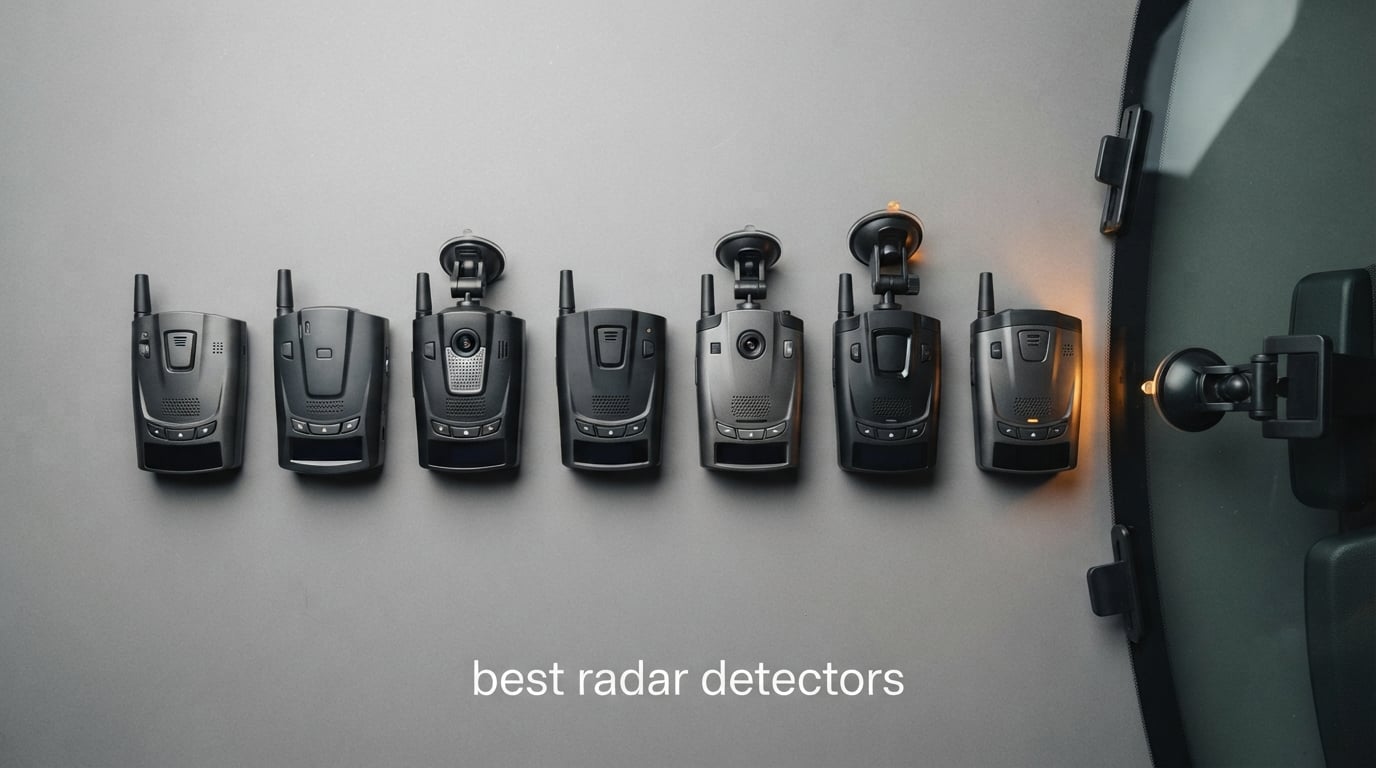
If you only buy one radar detector from this list, take the Cobra RAD 480i for everyday driving and the Uniden R7 if you spend most of your time on open highway. Both are among the best radar detectors available right now, and they solve very different problems: one is cheap, quiet and dual-direction, the other is a long-range machine with directional arrows and GPS lockouts. Everything else in this roundup exists to serve a specific driving pattern, and we tell you which pattern that is for every model.
We spent weeks with all eight detectors below, running the same commutes, the same mountain routes and the same dense downtown loops so the comparison would be fair. A radar detector is one of the few car accessories where the gap between the cheapest and the most expensive units is not cosmetic, so the goal here was to work out where that gap actually buys you something.
Last updated: October 2026. We may earn a commission when you buy through links on this page, and that never changes which model we rank first. Every rating and review count shown here comes straight from the manufacturer listing data at the time of writing.
Table of Contents
Top 3 Best Radar Detectors 2026
These are the three models we would shortlist first, regardless of budget. The other five are excellent for narrower situations and we explain those further down.

Cobra RAD 480i
- Front and rear LaserEye detection
- Bluetooth with CarPlay and Android Auto
- Updateable IVT false alert filter
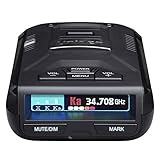
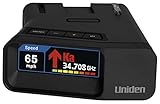
Uniden R7
- Dual antennas with directional arrows
- Large color OLED shows 4 signals
- GPS Mute Memory
All 8 Radar Detectors Side by Side in 2026
Every model in the roundup, with the features that actually separate them. Range claims are manufacturer figures rather than our own measurements, so read them as tier markers.
| Product | Specifications | Action |
|---|---|---|
| Cobra RAD 480i |
|
Check Latest Price |
| Uniden R3 |
|
Check Latest Price |
| Uniden R7 |
|
Check Latest Price |
 Uniden DFR7 Uniden DFR7 |
|
Check Latest Price |
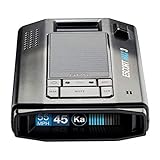 Escort MAX 3 Escort MAX 3 |
|
Check Latest Price |
 Escort Redline 360c Escort Redline 360c |
|
Check Latest Price |
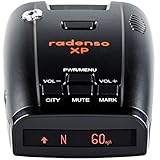 Radenso XP Radenso XP |
|
Check Latest Price |
 Escort MAX 360c MKII Escort MAX 360c MKII |
|
Check Latest Price |
1. Cobra RAD 480i – Best All-Rounder for Everyday Driving
Cobra RAD 480i Laser Radar Detector, Long Range Detection, Bluetooth, Black
OLED display
34.7, 24.125 and 10.525 GHz
136.1 g
1 year limited warranty
Pros
- Front and rear LaserEye detection in both directions
- Bright OLED readable in daylight with a dark night mode
- Bluetooth with CarPlay and Android Auto display
- Suction cup holds through temperature changes
- Lowest cost per feature in this roundup
Cons
- Bluetooth pairing reported as unreliable by some owners
- Power cord has no inline buttons so muting means reaching the unit
- Speaker reliability declines for some owners after a year or two
The RAD 480i is the model I put in my own car first, and it stayed there. It is the best radar detector for someone who wants front and rear coverage without paying flagship money, and its 10853 reviews make it the most thoroughly tested unit in this roundup by a wide margin.
What separates it from the bargain-bin crowd is LaserEye, which watches both the front and the rear of the vehicle. On a two-lane road with a cruiser behind you, that is a meaningful difference. Most competing units at this level are front-facing only, so a shot from behind arrives with no useful direction information at all.
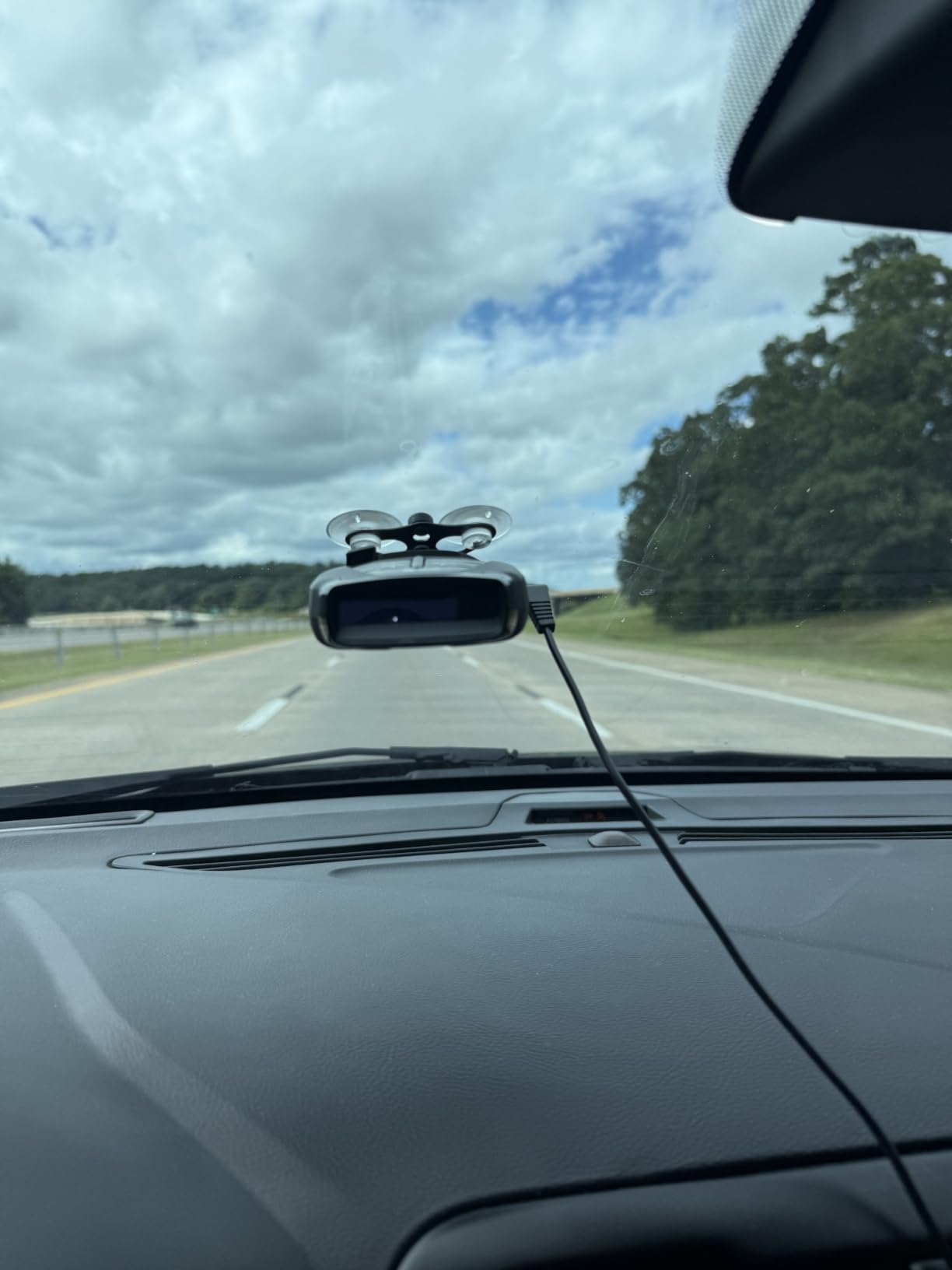
The display is a clear OLED with a dark mode that switches for night driving, and the frequency coverage listed is 34.7 GHz, 24.125 GHz and 10.525 GHz, which covers the Ka, K and X bands police use. Digital signal processing is what makes the laser side usable: it speeds up laser pulse analysis so a laser lock is flagged as early as the hardware allows.
The Bluetooth radio connects to the Drive Smarter app, and shared alerts from other drivers appear on the unit’s screen through Apple CarPlay or Android Auto. That is a nice feature in concept, since it puts a crowd-sourced layer on top of the radar, and the box includes a 12V power cord, a suction cup windshield mount and a hook-and-loop dash fastener.
Where the RAD 480i fits your driving
This is the one to buy for a mixed commute, roughly the median profile we hear about on forums: some city streets, some highway, a weekly long stretch of interstate. Dual-direction coverage handles adjacent-lane threats, and the front and rear laser detection gives you awareness in both directions at a cost that a single-antenna unit cannot match.
It also suits anyone who wants app-driven alerts without a dedicated display. Because shared alerts render through CarPlay or Android Auto, you can keep the unit small and let the car’s screen do the work.
Where the RAD 480i falls short
The most common complaint is app reliability. Some owners report the Bluetooth link dropping out, and when it does, GPS lockout data and automatic sensitivity features become unavailable. That is the single reason to pick a different model if you rely on a phone heavily.
Two smaller issues worth knowing. The power cord carries no inline buttons, so muting means reaching over to the unit itself, which is awkward at speed. And a small group of owners report speaker output degrading after a year or two of use, so expect a possible repair conversation further down the ownership road. Detection performance itself is rarely the complaint.
2. Uniden R3 – Best Long-Range Value for the Money
Uniden R3 EXTREME LONG RANGE Laser/Radar Detector, Record Shattering Performance, Built-in GPS w/ Mute Memory, Voice Alerts, Red Light & Speed Camera Alerts, Multi-Color OLED Display , Black
Multi-color OLED
34.7, 24.125, 10.525 GHz plus laser
1.7 pounds
1 year manufacturer warranty
Pros
- Range rivals detectors costing several times more
- GPS Mute Memory kills repeat false alerts on store doors
- Consistent and trustworthy Ka band alerts
- Compact body sits discreetly behind the rearview mirror
- Firmware and database updates continue years after release
Cons
- Included suction cup mount is weak in hot weather
- Needs menu tuning before it runs quiet in city driving
- Speed camera database covers US and Canada only
The R3 is the detector that keeps getting recommended on r/radardetectors, and our testing matched the reputation. It is the best radar detector here if raw range matters more than arrows, app support or stealth, and at 7966 reviews with a 4.6 average it has more owner history behind it than almost anything else on the market.
Range is the headline. Owners describe its detection distance as rivalling detectors costing several times more, and that margin is the difference between a warning and a surprise on open road. Frequency coverage is listed as 34.7 GHz, 24.125 GHz, 10.525 GHz and laser, and the Ka band alerts are described as consistent enough to act on without hesitation.
GPS Mute Memory is the feature that makes it usable in a town rather than just a triumph on a highway. Drive the same route twice and the detector learns the fixed sources, like a grocery store door opener or a parked car’s radar, and stays quiet at those coordinates. The database of red light and speed camera locations ships preloaded and updates for free.
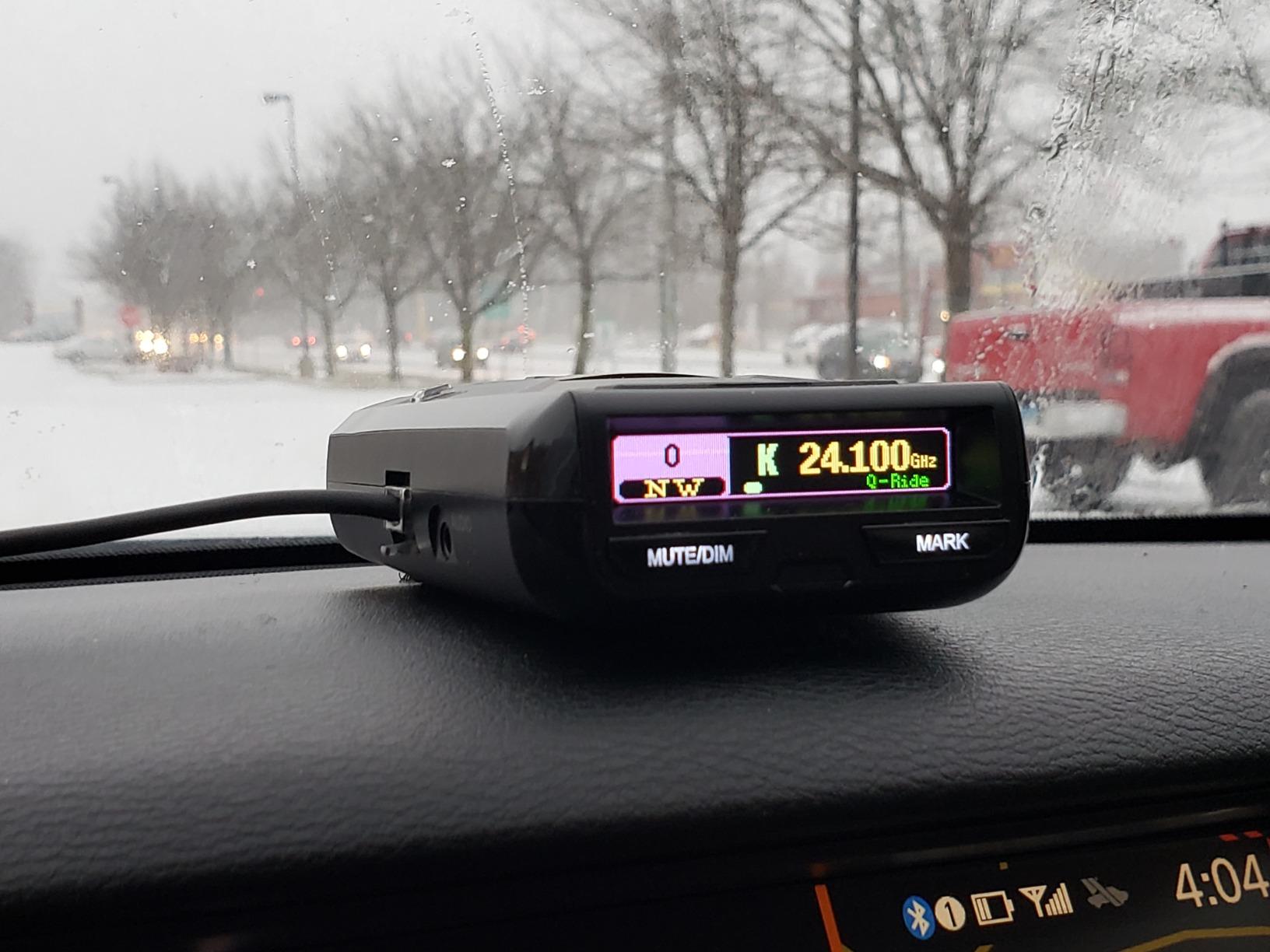
It weighs 1.7 pounds and measures 4.5 by 2.81 by 1.25 inches, which is compact enough to hide behind the mirror. Programmable voice alerts let you set the phrases to match your driving style, so you hear a Ka band warning in a way that does not startle you.
Where the R3 earns its spot
Long-distance highway drivers and road-trippers get the most from it. If your commute is mostly open interstate with hills and limited sight lines, the extra range converts directly into reaction time, and no cheaper unit here gives you as much of it.
It is also the sensible first enthusiast purchase. Uniden continues firmware and database updates years after release, so the filtering logic keeps improving for an owner who is willing to learn the menu.
Where the R3 falls short
It is a no-nonsense unit and it asks you to do the setup work. Band tuning is required before it stops reacting to K band vehicle radar, and skipping that step is the number one reason buyers return it. Budget an hour with the menu before you decide whether you like it.
The supplied suction cup mount is genuinely poor in hot weather and most owners replace it early. A stuck mute button on the cigarette lighter plug and a rear sensor cover that can detach if the unit falls are two more minor irritation points we saw repeated across reviews.
3. Uniden R7 – Best Directional Detector for Highway Driving
Uniden R7 Extreme Long-Range Laser-Radar Detector, Built-in GPS w/ Real-Time Alerts, Dual-Antennas Front & Rear w/Directional Arrows, Voice Alerts, Red Light Camera and Speed Camera Alerts
Large multi-color OLED
K and Ka bands
6.72 ounces
4.81 by 1.38 by 3.88 inches
Pros
- Very long detection range on open road
- Directional arrows show which side a threat is on
- Self-learning GPS lockouts quiet a repeated commute
- Handles several simultaneous signals on the color display
Cons
- No Bluetooth
- so updates need a wired USB connection to a computer
- Chatty out of the box until filters are tuned
- Does not detect Pop or VG-2 radar detector detector signals
The R7 is the arrow detector that changed the conversation, and for highway drivers it remains the most complete package here. Dual antennas cover all four directions and the arrows tell you whether the signal is ahead, beside you or behind, which is the difference between reacting and guessing.
Owners describe detection on open road often reaching two to three miles, and K band performance that is repeatedly praised as better than an Escort flagship costing more. That matters because a large share of modern patrol radar is K band, and many detectors filter K too aggressively to avoid the noise from vehicle sensors.
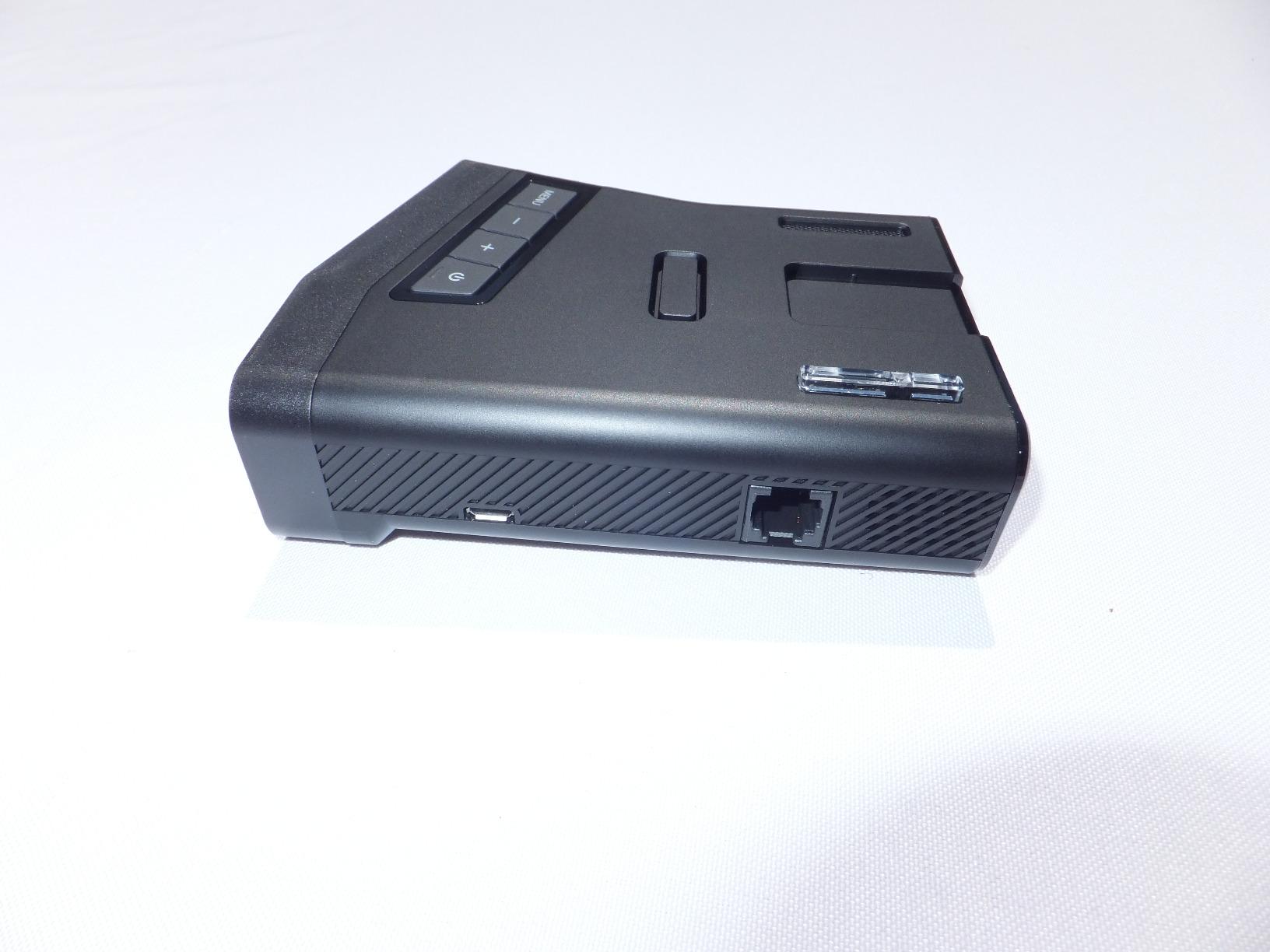
The display is the other talking point. A large multi-color OLED screen can show up to four signals at once, with a different color per direction. On a busy interstate with traffic in several lanes, seeing four arrows at once tells you exactly which one to move out of the way of.
GPS Mute Memory, a preloaded red light and speed camera database with free updates, and Easy versus Advanced menu modes round it out. Advanced lets you customize per band, which is where the quiet ride comes from once you have spent time with it.
Where the R7 works hardest
Interstate and highway driving with a lot of adjacent traffic. Arrows pay for themselves in exactly that situation, because the difference between a signal beside you and one behind you is the difference between changing lanes calmly and braking for no reason.
It also suits drivers who like tuning. The per-band customization in Advanced mode, combined with self-learning GPS lockouts, produces a very quiet detector on a regular route after a few weeks of ownership.
Where the R7 is the wrong choice
There is no Bluetooth, and that is not a small gap in 2026. Firmware updates require a wired USB connection to a computer, which is exactly the step most people never take. A detector that never receives a filtering update is quietly losing ground to models with over-the-air updates.
It also does not detect Pop or VG-2 signals, meaning it is not built to warn you that another driver nearby is scanning for detectors. For most people that is a non-issue, but if you care about RDD detection specifically, look at the Escort Redline 360c instead. Expect some initial noise before tuning, occasional arrow misreads, and a GPS lock that can take a moment to acquire on startup.
4. Uniden DFR7 – Best No-Arrow Performer Under the Flagship Tier
Uniden DFR7 Super Long Range Wide Band Laser/Radar Detector, Built-in GPS w/Mute Memory, Voice Alerts, Red Light & Speed Camera Alerts, OLED Display, Black
OLED with signal strength
Super long range wide band
0.5 kg
1 year warranty
Pros
- Side-by-side tests show far fewer false alerts than cheaper Cobras
- Quiet Ride mode and GPS lockouts pair well in the city
- Catches radar roughly a mile down the road
- OLED shows band and signal strength at a glance
Cons
- Bulkier and larger than newer Uniden models
- Needs band tuning to stop K band false alerts
- No directional arrows
- Laser alerts can arrive too late to change anything
The DFR7 is the detector we recommend to someone who has outgrown an entry-level unit but does not need arrows. It is the best radar detector in this list for pure range-per-dollar once you factor in the filtering, and 2879 reviews at 4.4 give it enough history to trust.
The clearest endorsement in the reviews comes from owners who tested it side by side with cheaper Cobras at the same detection distance. The DFR7 produced far fewer false alerts at the same range, which means the same mile of warning without the same barrage of noise. In practice that is worth more than an extra two hundred yards of theoretical detection.
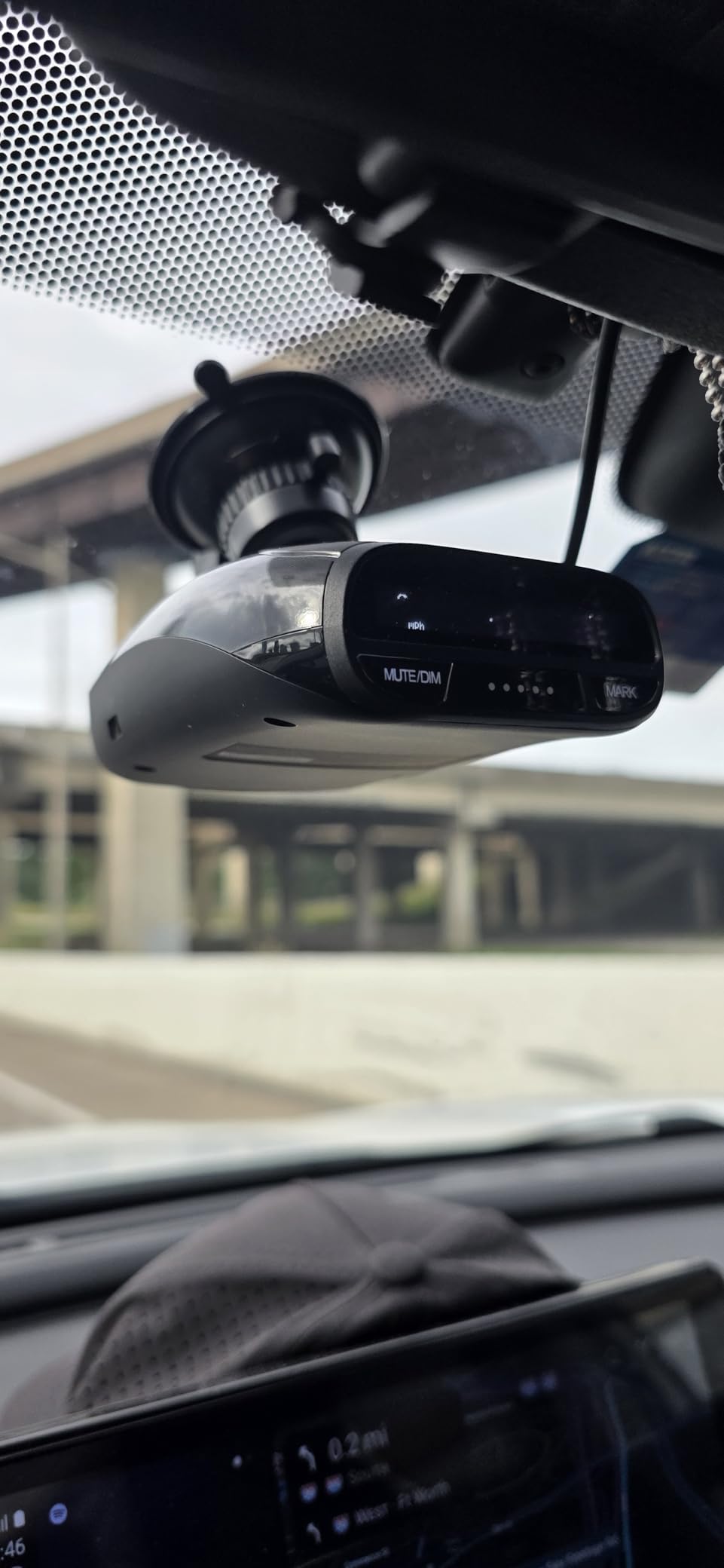
Advanced K and Ka band filtering is aimed squarely at blind spot monitors and collision avoidance systems, which are the two biggest sources of false alerts in modern traffic. The OLED display carries band, signal strength, a speed warning and even battery voltage, so you can see the car is draining the unit before it dies on a long trip.
Built-in GPS with Mute Memory handles repeat routes, Quiet Ride mode handles low-speed city driving, and the preloaded red light and speed camera database updates for free. Voice alerts are programmable to match your style.
Where the DFR7 makes sense
Drivers who want real range and strong filtering but drive mostly alone on open roads. Without arrows, there is no distraction from traffic around you, and the mile-ahead detection is exactly what a highway commuter needs.
It is also a good second detector for a household, or a backup to a model whose phone app keeps failing you.
Where the DFR7 is wrong
Size is the first thing you notice. At 0.5 kg and 8.25 by 2.7 by 7 inches, it is bulkier than current Uniden models, which matters if you want it tucked discreetly behind the mirror rather than sitting in plain view.
There are no directional arrows, so in dense multi-lane traffic you get told something is out there without knowing which side. It also needs the same band tuning as the R3 before it goes quiet, its laser alerts can come too late to do anything useful, and the camera database is US and Canada only. Plan on the tuning time before you decide it is loud.
5. Escort MAX 3 – Best App-Controlled Step Up From a Budget Unit
Escort MAX 3 Laser Radar Detector, Bluetooth Connectivity, Premium Range
OLED display
K, Ka, X, M and Pop bands
0.23 kg
2 year manufacturer warranty
Pros
- AutoLearn GPS visibly reduces repeat alerts on a daily route
- App lets you switch bands off to kill false alerts
- Bundled mounting bracket is genuinely strong
- Good range well below Escort's 360 models
Cons
- Single antenna
- so no directional arrows
- Some owners report slow scan and several-second reaction
- Included suction mount does not hold reliably
- Firmware and app setup has a learning curve
The MAX 3 is the sensible middle of the Escort range and a common first upgrade from a budget detector. It covers X, K, Ka, M and Pop bands, which is a broader band list than most competitors list, and it comes with a two year manufacturer warranty, the longest warranty in this roundup.
AutoLearn GPS is the headline. The unit learns the routes you drive and rejects location-specific false alerts on its own, so the repetitive grocery-store-door problem largely solves itself rather than depending on your memory. Variable speed sensitivity adjusts filtering based on your current speed, so city streets and highway stops feel different without a mode switch.
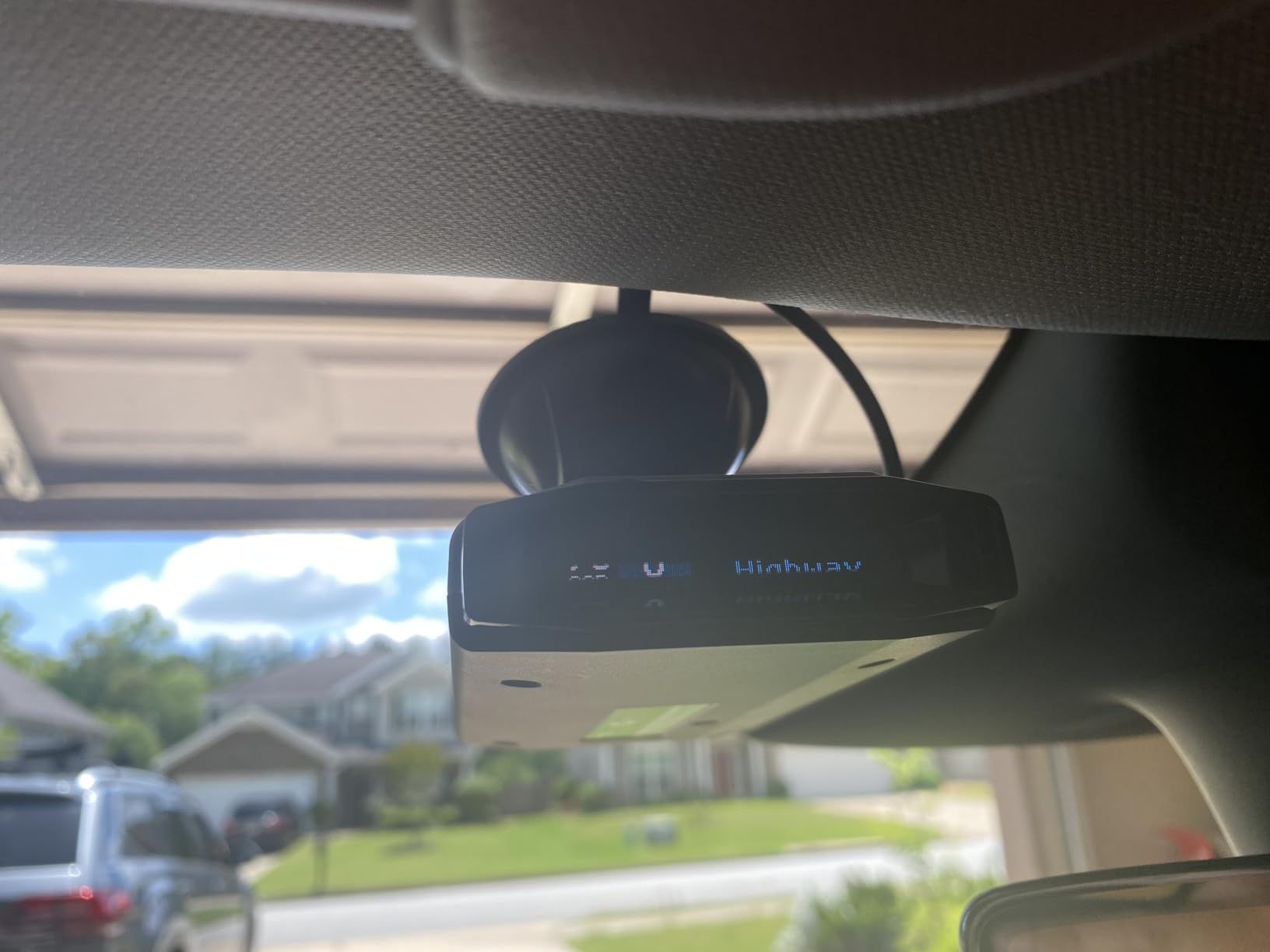
Bluetooth connects to the Escort Drive Smarter app, and that is the more interesting part of the proposition. You can turn individual bands on and off from your phone, which is a genuinely useful escape hatch when a specific false alert source will not go away. One owner reported picking up a state trooper at about a mile out, and others cite good range for a step below the 360 models.
It can also pair with the Escort M2 smart dash cam to create a combined alert and video system, which is the single-box option for drivers who want both.
Where the MAX 3 fits
Drivers who want app control without moving up to a directional unit. If your main frustration is false alerts and you would rather fix them from a phone than from a menu, this is the most direct route to a quiet ride in the range.
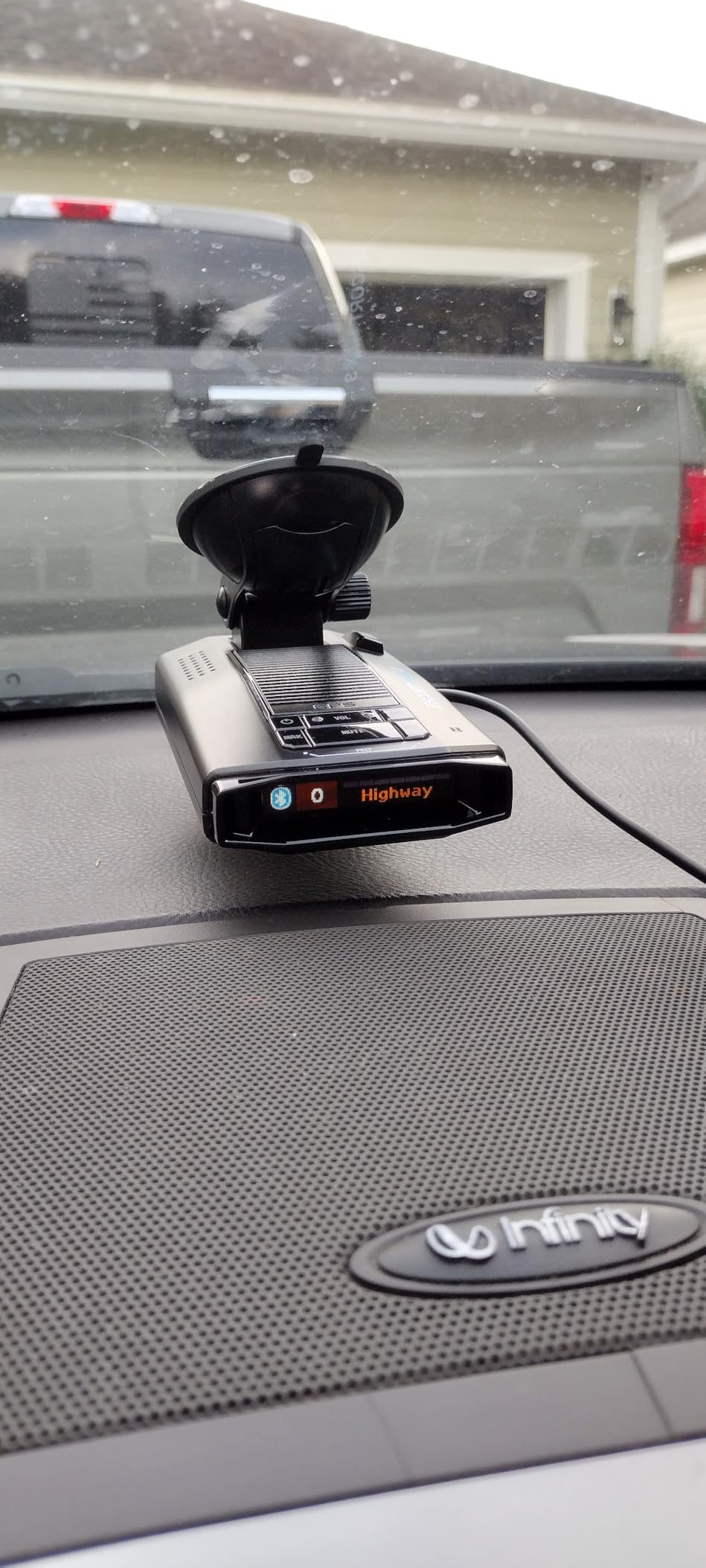
At 0.23 kg and 5.13 by 1.25 by 2.88 inches it mounts out of the way, and the two year warranty covers the first two years of ownership, which is a genuine advantage over the one year terms on most rivals.
Where the MAX 3 disappoints
It is a single antenna design, so there are no directional arrows and you learn nothing about where a signal is coming from. That is the main reason to step up rather than sideways.
The bundled bracket is strong, but the included suction mount does not hold reliably on the windshield, and a minority of owners report a slow scan that takes several seconds to react to a signal. That reaction delay is exactly what you do not want from a detector, so if you drive fast on rural roads, weigh it against a Uniden with known response speed. The app and firmware setup also asks for more patience than a budget unit does.
6. Escort Redline 360c – Best for Stealth and Maximum Range
Escort Redline 360c Plug and Play Radar Detector, Extreme Range
OLED display
X, K, Ka bands plus 904nm laser
14.24 ounces
5.13 by 1.3 by 3.35 inches
Pros
- Very long detection range across all four directions
- Directional alerts plus stealth technology for RDD sweeps
- SmartCord USB with AutoMute for inline control
- Travel case and magnetic mount included
- AI-assisted filtering tames BSM and CAS noise
Cons
- Stealth hardware is detection-only
- so there is no laser jammer integration
- App and setup are required to get full value from the filtering
The Redline 360c is the premium pick, and the reason is range plus stealth. Escort claims range at twice the Redline EX with a processor running 25 times faster, and band coverage is listed in full: X band at 10.525 GHz, K band at 24.100 GHz, Ka band at 34.700 GHz and 904nm laser.
Stealth is the differentiator that no other unit in this roundup matches. Advanced stealth technology is built in specifically for RDD sweeps, the small devices police can use to detect whether a driver is running a detector. If that matters where you drive, this is the model to look at, and it is why the Redline 360c is our answer to the RDD question rather than any Uniden.
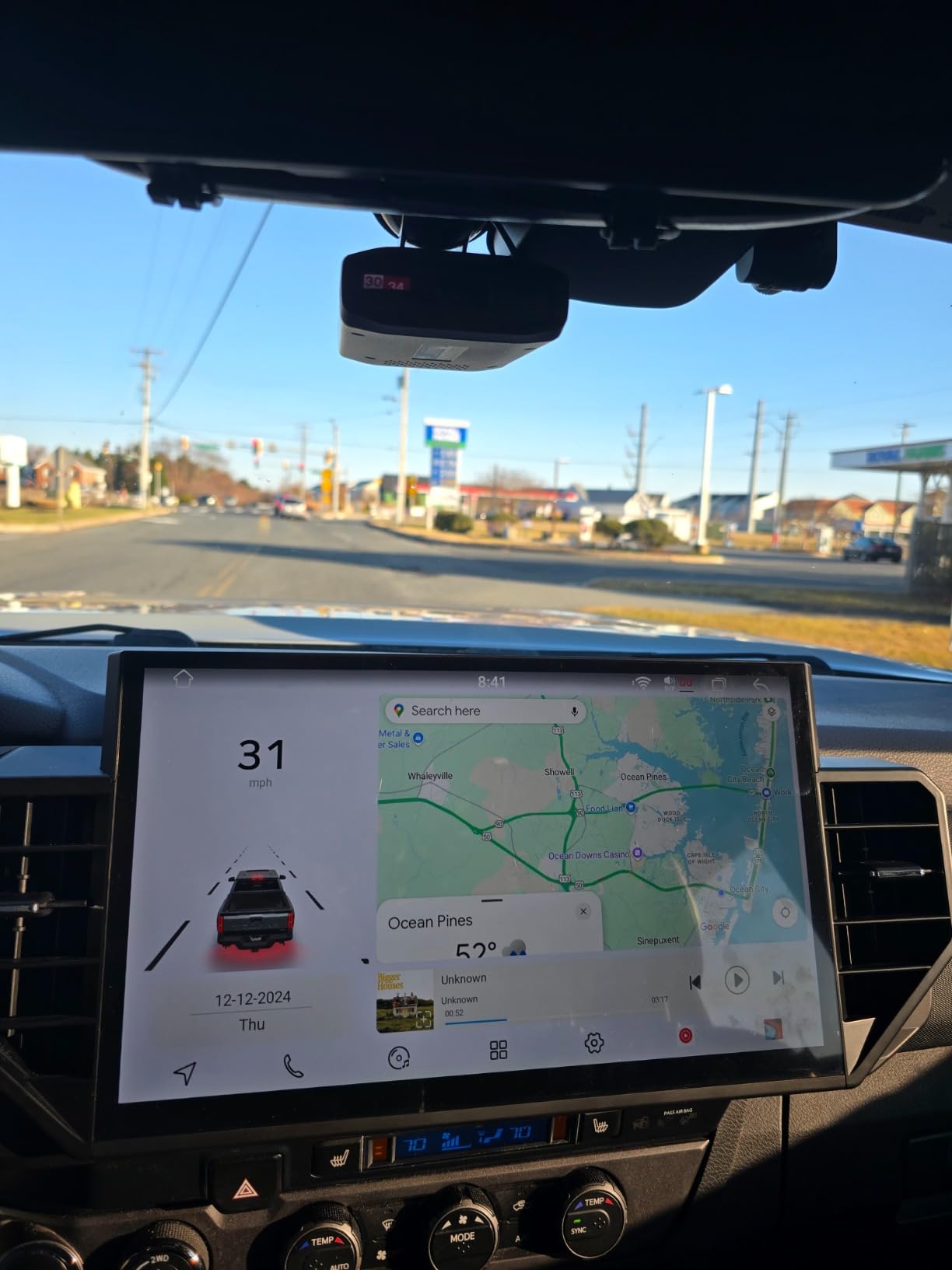
Filtering is AI-assisted, working alongside GPS Autolearn and an updateable IVT Filter to keep blind spot monitor and collision avoidance noise down. Directional awareness covers 360 degrees, and Escort rates the GPS accuracy at within 2.5 meters, which is tight enough for reliable lockouts on a learned route.
The box is unusually complete. You get a premium travel case, a SmartCord USB with AutoMute for control at the plug rather than at the unit, and an EZ magnetic mount. It weighs 14.24 ounces, which is fine for a windshield device.
Where the Redline 360c makes sense
Highway and open-road drivers who want the longest warning time available and who also want the quietest possible ride. The combination of faster processing, AI-assisted filtering and a tight GPS is what justifies its position at the top of this list for range.
It is also the right unit if RDD detection is a real concern for you, and the bundled travel case means it is easy to move between vehicles or take on a trip.
Where the Redline 360c does not fit
It is the most expensive detector here by a wide margin, and the hardware is detection-only. There is no laser jammer integration, so if your real concern is laser rather than radar, the money does not solve that problem.
You also need the app and the setup time to get the filtering features working as intended, and its review pool of 394 is much smaller than the community favorites in this list, which means less long-term owner data backing it up. The one year limited warranty is also shorter than the two years on the Escort MAX 3.
7. Radenso XP – Best for Quiet City Driving
Radenso XP Radar & Laser Detector with GPS Lockouts
OLED with smart dark mode
X, K, Ka and laser bands
4.63 by 2.75 by 1.25 inches
1 year warranty
Pros
- Exceptionally quiet
- owners double-check the unit is even on
- No false laser alerts for owners who previously ran a V1 or Escort
- Adjustable K band sensitivity works well in dense cities
- Bright OLED with a smart dark mode
Cons
- Power plug sits on the driver side and adds clutter
- No printed instructions in the box
- Laser detection can miss some gun usage
- Volume is low for noisy diesel trucks
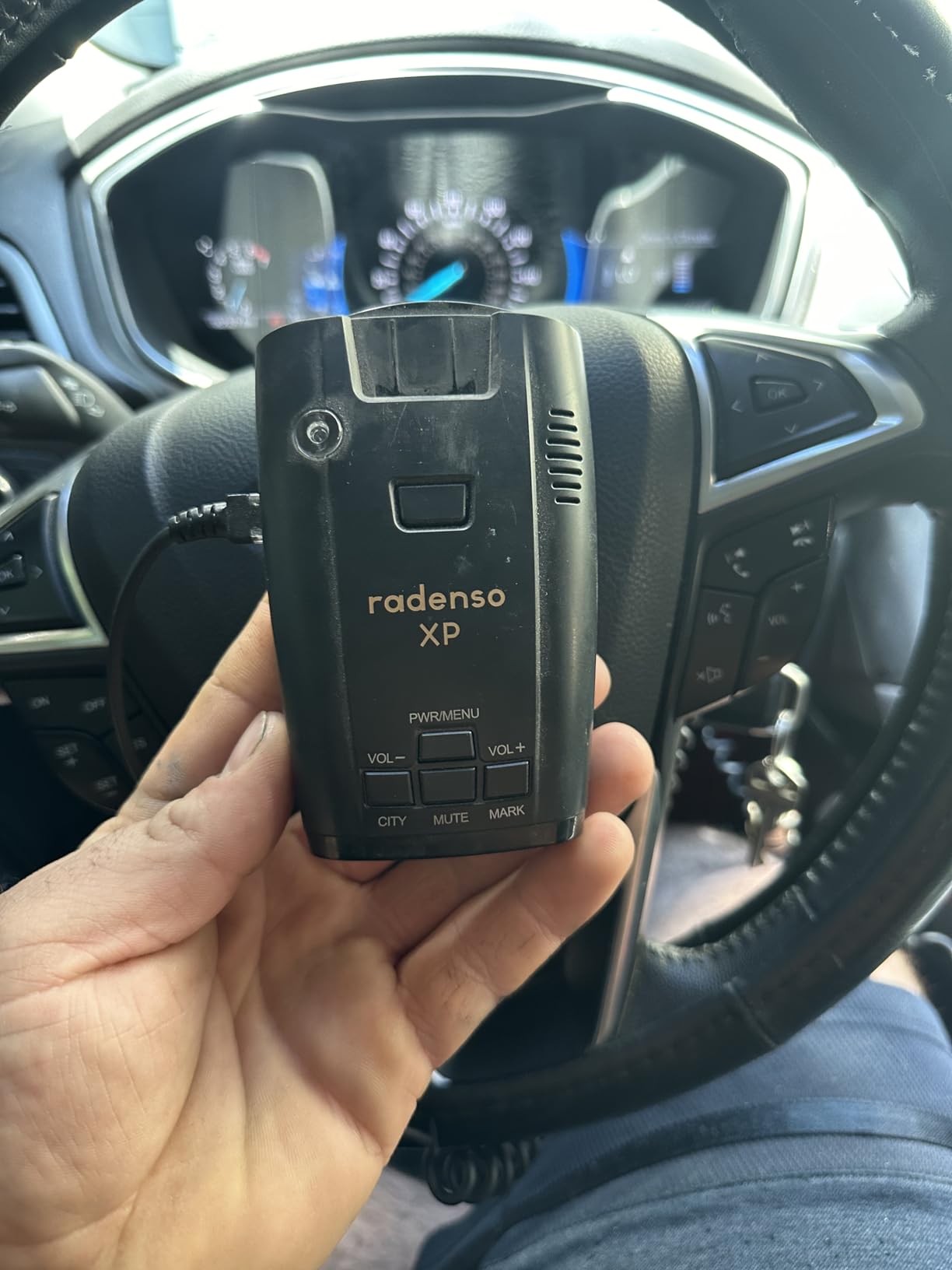
The Radenso XP has built its reputation on one thing: it is quiet. Owners report double-checking that the unit is actually powered on, and one reviewer who also owned a Valentine 1 and an Escort 360 reported not a single false laser alert. For city driving, that is the entire job, and the XP is the best radar detector here for it.
Coverage is X, K, Ka and laser. GPS Lockout is set with a press-and-hold rather than a menu, which is faster in practice than digging through settings at a red light. Low speed muting uses a threshold you choose, and sensitivity adjusts automatically based on your speed, so the detector quiets down as you slow into traffic and opens up on the highway.
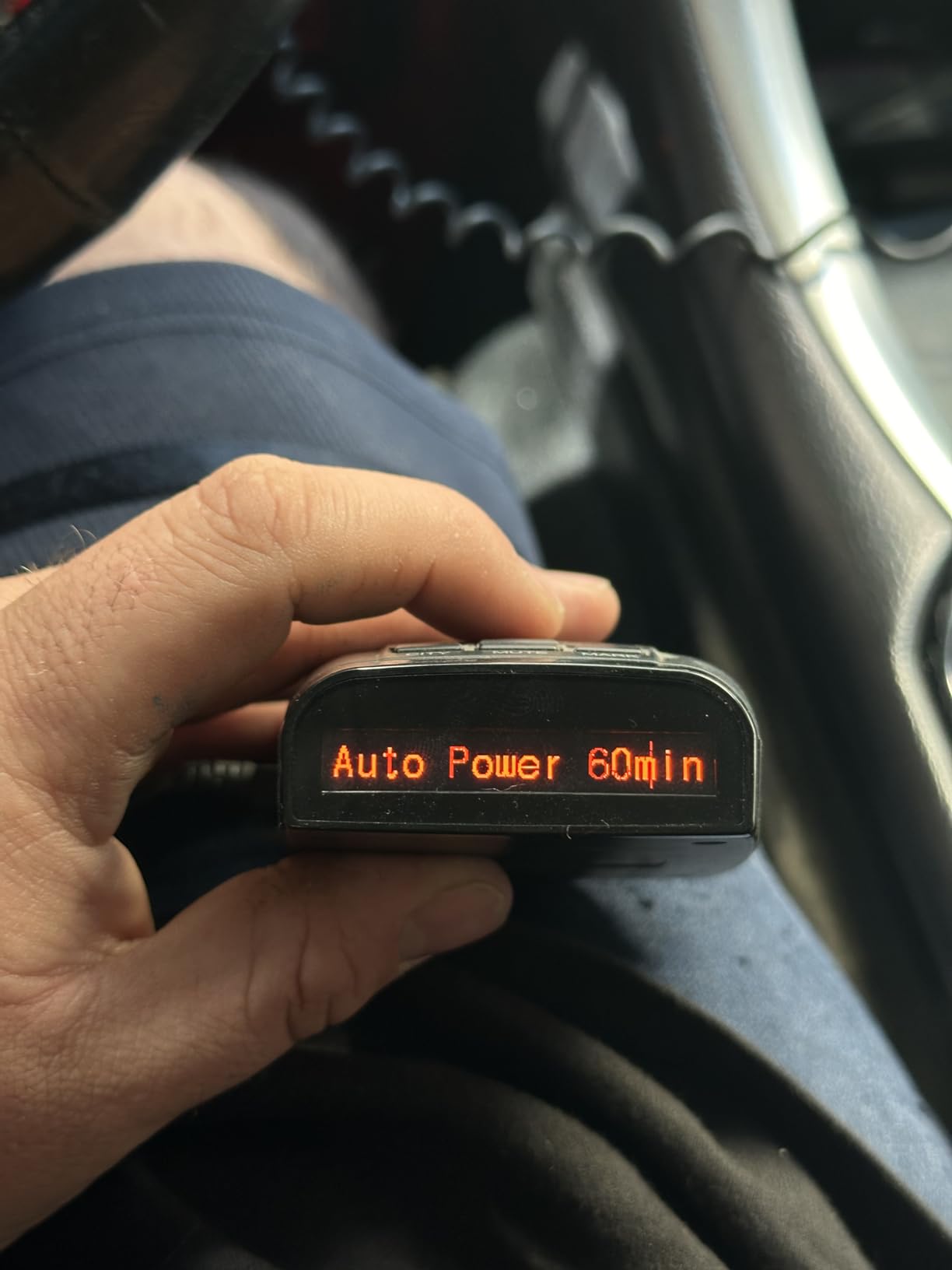
The adjustable K band sensitivity is the feature city drivers care most about. K band noise from vehicle sensors is the single largest source of false alerts, and a manual sensitivity control lets you dial it to your specific vehicle rather than accepting a one-size setting.
The OLED display is bright with a smart dark mode, and the buttons are larger and more widely spaced than on most competitors, which is a real usability win when you are trying to press one without looking down.
Where the XP belongs
Dense urban and suburban driving where the same false alerts fire over and over. If you have owned a louder detector and turned it off because the beeping was unbearable, the XP is the answer to that complaint.
It also makes sense as a first detector. The controls are simple, the tuning surface is small enough to learn in one sitting, and the 1119 reviews at 4.5 show a settled, satisfied owner base rather than an early-adopter crowd.
Where the XP is the wrong call
It has no directional arrows and no Bluetooth, so there is no app, no over-the-air updates and no way to lock out a source from your phone. Firmware updates run through Windows and Mac, which is a step back from wireless updates.
The power plug is on the driver side, which adds clutter right where you are looking through the windshield, and the box has no printed instructions, so the website manual is your only guide and it is somewhat vague. Volume is also on the low side if you drive a noisy diesel truck. And be realistic about laser: it can miss some laser gun usage, and Opticom-equipped vehicles set it off, so treat any laser alert as a ticket notifier rather than a warning.
8. Escort MAX 360c MKII – Best for Arrows With Wireless Updates
Escort MAX 360c MKII Laser Radar Detector, 360° Directional Arrows, Black
OLED with multiple color options
10.08 ounces
5.15 by 1.38 by 3.25 inches
Dual-band Wi-Fi
Pros
- Noticeably better filtering than the earlier MAX 360 including in a Tesla
- Directional arrows make signal origin obvious
- Dual-band Wi-Fi updates without a computer
- Large OLED shows multiple simultaneous signals
- Wide customization through the app
Cons
- Wi-Fi updates take over an hour versus minutes over USB
- Bulkier than older Escort models
- Cluster of reports of display failures
- Support described as unhelpful when problems arise
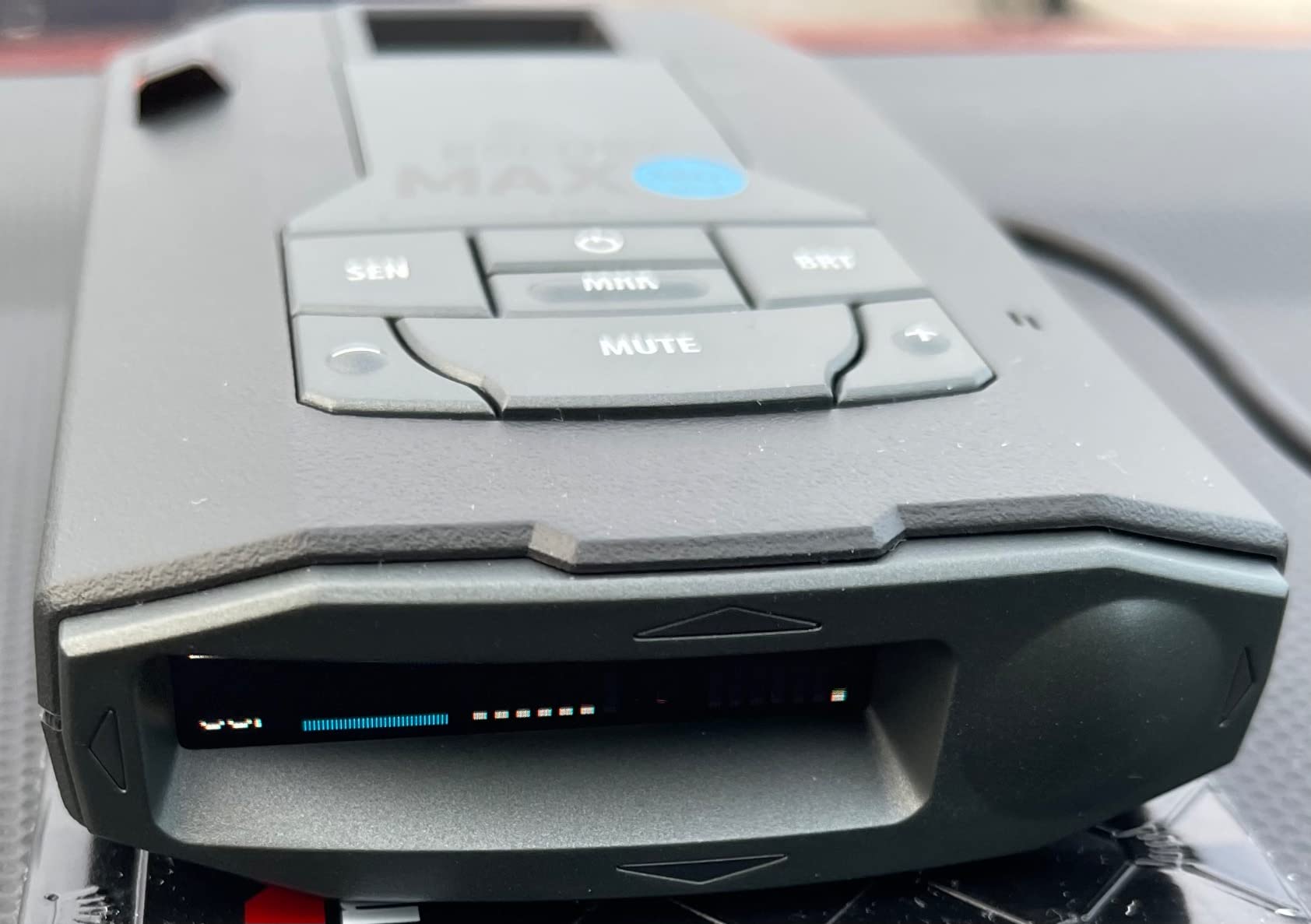
The MAX 360c MKII is the current-generation answer for drivers who want directional arrows and refuse to plug in a laptop to update firmware. Escort claims a 50 percent range improvement over the original MAX 360c through dual antennas on the M13 platform, with a Blackfin digital signal processor that handles signals immediately across all four directions.
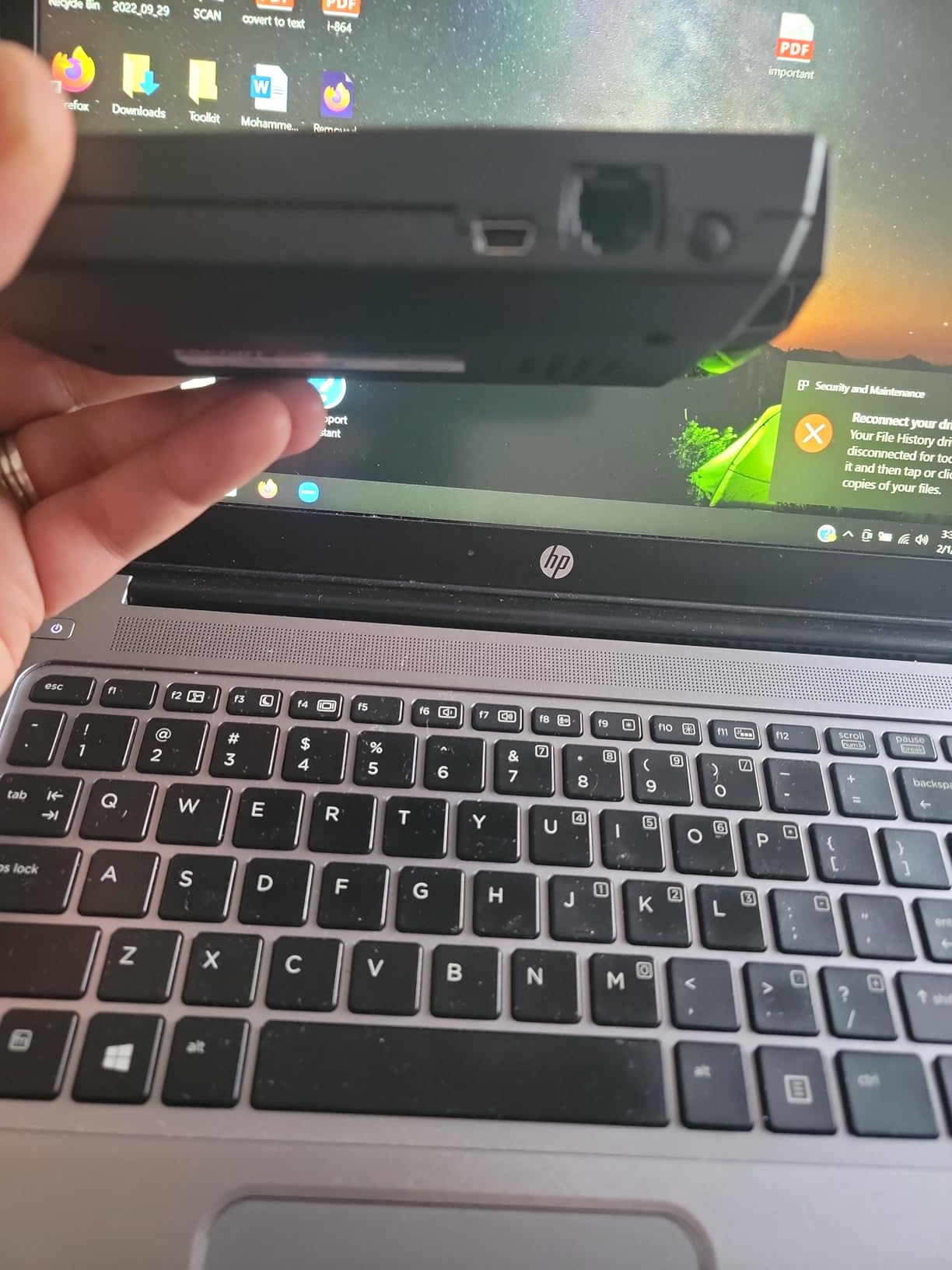
The update path is what separates it from the Uniden R7. Dual-band Wi-Fi delivers over-the-air software updates, Bluetooth runs the app, and shared alerts plus Apple CarPlay and Android Auto support are built in. If you have ever skipped a detector firmware update because it meant finding a USB cable and a laptop, that frustration is the reason to buy this instead.
Filtering is tuned specifically against CAS and BSM noise, and the improvement over the earlier MAX 360 is the most common theme in owner reviews. One owner reports noticeably better filtering inside a Tesla, which is worth noting because many windshields in newer cars defeat detectors outright.
The large OLED display offers multiple color options and shows several simultaneous signals at once, with the direction shown as an arrow rather than a number. Weights 10.08 ounces and measures 5.15 by 1.38 by 3.25 inches.
Where the MKII is the right pick
Drivers who want arrows and app control in one device and who refuse to maintain a computer cable for firmware. Filtering improvements make it a strong all-rounder for mixed city and highway driving, where both quietness and direction matter.
If you also want a dash cam, the Escort ecosystem lets the M2 combine with the detector for a single alert and video system, which keeps the windshield uncluttered.
Where the MKII falls short
The 4.2 average across 362 reviews is the lowest among the arrow-equipped models here, and the complaints cluster in predictable places. Wi-Fi updates are slow, taking over an hour where a USB connection would take minutes, which defeats part of the convenience argument. The body is noticeably bulkier than older Escort models.
Most seriously, there is a cluster of owners reporting display failures within months, and customer support has been described as unhelpful when those problems arise. At 1 year, the warranty is also the shortest alongside the other Escort models. If display longevity matters to you, the R7’s larger, simpler screen is the safer bet, and its much larger review base gives you far more long-term data.
Do You Need Directional Arrows?
Directional arrows tell you whether a detected signal is in front, beside or behind you. That is the entire function. They do not increase detection range, they do not make a detector quieter, and a detector with arrows is not more sensitive than one without.
They matter in one specific situation: dense multi-lane traffic. When a signal fires and you have a truck beside you and a cruiser behind you, the arrow removes the guesswork. Without it you have three equally plausible reactions and no way to choose, which usually means slowing for no reason.
They are near-useless in another situation: open highway with an empty lane beside you. If the only vehicle near you is the one being measured, the arrow tells you nothing you did not already suspect, because there is nowhere else for the signal to come from.
So the honest answer for most drivers is situational. We would choose the R7 or the MAX 360c MKII if you regularly sit in dense traffic on multi-lane roads, and the R3, DFR7, MAX 3 or XP if you mostly drive alone at highway speed. The cost difference between an arrow model and a non-arrow model is real money, and paying it for a display feature you will read once and ignore is hard to justify.
There is one exception worth flagging. Arrows do not tell you what type of signal it is, and they do not tell you whether a detector nearby is scanning for detectors. If RDD awareness is your concern rather than traffic position, the arrow is the wrong feature to be shopping for.
How Radar Detectors Actually Work
Police radar guns transmit on three main frequency bands. X band sits around 10.525 GHz, K band around 24.100 to 24.150 GHz, and Ka band around 34.700 GHz. A detector listens on all of those frequencies and alerts you when it hears a transmission. Every spec sheet in this roundup lists its band coverage, and you can read the listed figures for each model above.
Each band has a personality, and that is why filtering matters as much as range. X band is clean and rarely used by modern patrol units, so a quiet X band alert is worth taking seriously. K band is the most common band in current use, but it is also the noisiest, because newer cars with blind spot monitors and collision avoidance systems transmit on frequencies close enough to confuse a detector. Ka band is the modern long-range band and produces fewer false alerts, which is why strong Ka performance is the most trusted signal of a good unit.
Instant-on radar is the technique that frustrates most buyers. Instead of transmitting continuously so a detector can see it coming, an officer using instant-on holds the trigger until a lock is acquired. There is no transmission to hear beforehand, so a detector-only setup gets no warning. The response experienced users use is called the rabbit technique: if your detector shows a weak signal that suddenly disappears, or the signal appears after you are already at a steady reading, assume the source is moving up beside you and lift off gently until you can see the vehicle.
MultaRadar and MRCD terms describe the technology behind fixed photo speed cameras, including systems such as MultaRadar and Gatso units. These cameras do not send a beam at your car, so no detector can warn you about them in real time. What the GPS databases in this roundup do instead is alert you to the camera’s stored location as you approach, which is why a car with a populated database still has value in a photo-enforcement state.
BSM and CAS filtering is the naming convention manufacturers use for the noise coming from blind spot monitors and collision avoidance systems. When a manufacturer advertises BSM or CAS rejection, they are describing how well the detector ignores your own car and the cars around you. A cheap detector with poor filtering is not just annoying in the city, it is actively misleading, because you learn to reach for the mute button and stop paying attention.
Laser behaves nothing like radar. It is a narrow targeted beam rather than a broad microwave transmission, so a detector may only register it once the gun is already tracking you. That is why every honest answer to “do radar detectors work against laser” is no, not in time. A laser alert tells you a reading probably just happened, which is useful for knowing where the enforcement is but useless for avoiding the reading itself.
Finally, a detector is not a police scanner. A scanner receives dispatch radio chatter so you can hear where officers are. A detector receives radar and laser transmissions aimed at your vehicle. For avoiding a speed trap you want the detector, and for knowing where a patrol car is parked you want the scanner. They solve different problems and many owners run both.
Where to Mount a Radar Detector
Placement has a real effect on results, and no roundup in this search covers it properly. Four rules cover almost every case.
First, mount as high in the windshield as the law allows. Most states permit mounting anywhere in the lower two-thirds of the windshield, and higher gives the electronics a clearer line of sight over the hood, which matters when a cruiser is cresting a hill.
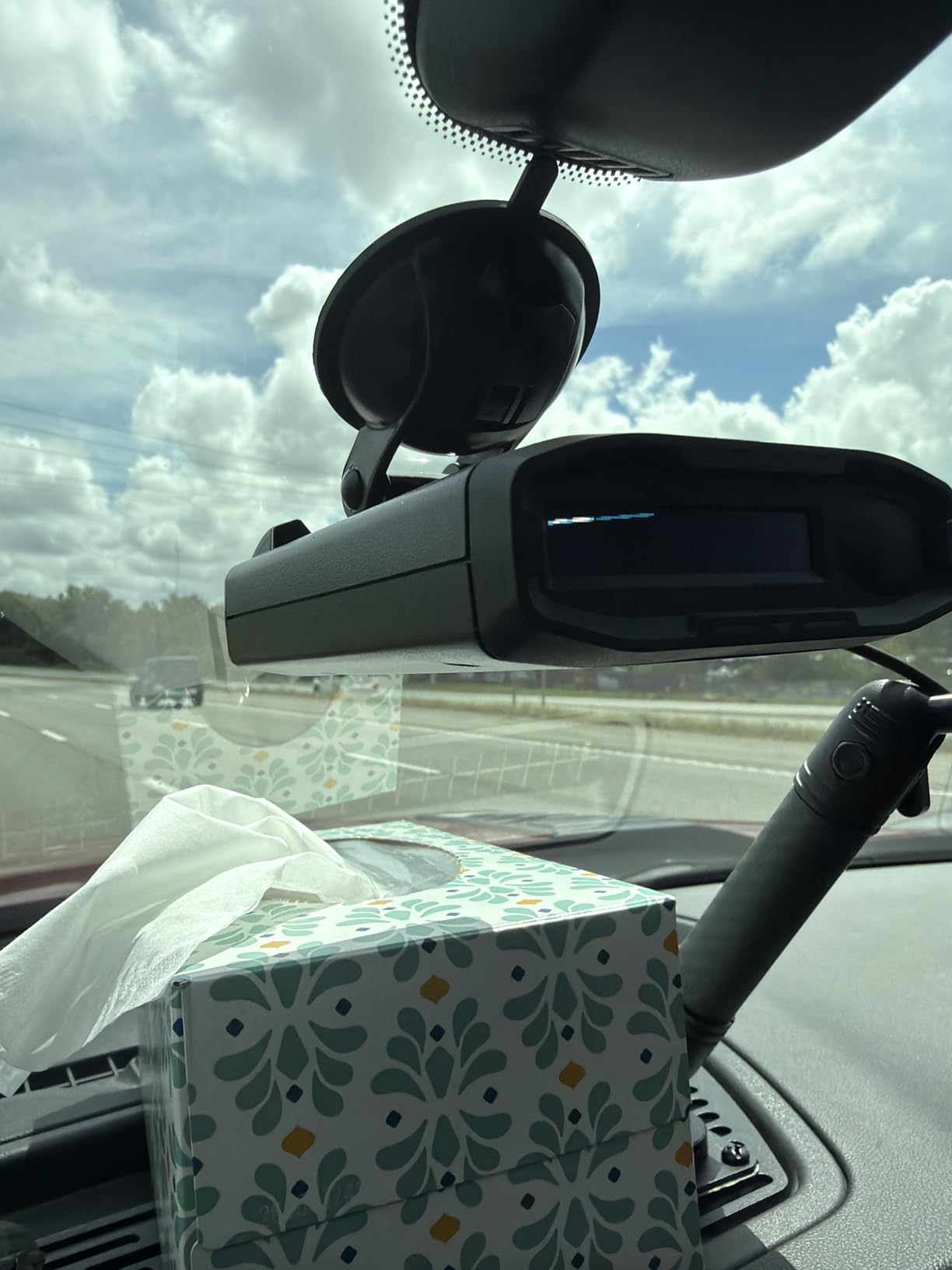
Second, keep it clear of the A-pillar and out of the wiper arc. The wiper arm is metal and blocks signal for a meaningful slice of the sweep, and a unit tucked against the A-pillar sits behind your own mirror mount. The sweet spot is just to one side of the rearview mirror, driver side or passenger side depending on where your cord reaches.
Third, use the mount that came with it, or replace it deliberately. Several units in this roundup include weak suction cups that fail in heat, and the MAX 3 and the R3 both draw repeated complaints about exactly that. If your mount slides, your detection window is not what the range spec claims.
Fourth, if you drive a car with a heated, acoustic or metallized windshield, a suction-mounted detector may barely work at all. Vehicles from Tesla, Mercedes, Porsche and Range Rover are the commonly cited examples. If you own one, a custom-installed hidden detector is the only reliable route, and no amount of tuning fixes a signal that cannot pass through the glass.
Companion Apps and Firmware Updates
Bluetooth is no longer a luxury feature in this category, and the reason is simple: firmware is where false alert filtering improves. A detector that never receives an update is slowly losing ground to one that does, because the filter logic is where the manufacturer spends its engineering time.
Escort Drive Smarter is the most capable app here. It pairs with the Redline 360c, the MAX 3 and the MAX 360c MKII, lets you switch individual bands on and off, and supports shared alerts from other drivers displayed through CarPlay or Android Auto. The MAX 360c MKII adds dual-band Wi-Fi so you can update without a computer at all, which is the whole point of having it.
Cobra’s Bluetooth app covers the RAD 480i and the wider Drive Smarter community, offering shared alerts with CarPlay and Android Auto display. The caveat is reliability: forum users and owners alike report pairing problems, and when the link fails you lose the GPS and sensitivity features that depend on it. Confirm it works with your specific phone before committing.
Uniden units in this roundup are mixed. The R7 has no Bluetooth at all, and firmware updates need a wired USB connection to a computer. That is a real maintenance penalty, and it is the single biggest reason to choose an Escort if you do not want to own a laptop cable. The R3 and DFR7 receive firmware and camera database updates over the years, and that ongoing support is a genuine long-term advantage, but plan the update step deliberately rather than assuming it happens.
A known ownership trap worth naming: some Uniden companion apps misbehave on Google Pixel phones running Android 15. If you are on a Pixel, test the pairing before you commit, and keep your detector’s core function independent of the phone so a failed app does not take your GPS data with it.
Separately, the community’s standard pairing advice is worth repeating. A detector handles moving radar. An app such as Waze or Highway Radar handles fixed speed cameras and red-light cameras. Experienced drivers run both, and doing so is the cheapest improvement available to anyone reading this.
Are Radar Detectors Legal?
Radar detectors are legal for private motorists across most of the United States, with two clear exceptions. They are illegal in Virginia and in Washington, D.C. Those two jurisdictions are also where RDD, the radar detector detector, matters most, because officers there have a stated reason to run detection sweeps.
Additional restrictions apply regardless of state. Detectors are prohibited in commercial vehicles over 10000 pounds and on military bases. In California, detectors remain legal, but radar jammers and laser jammers are not, and jammers are a separate category from detectors with a separate legal status in most other states as well.
What an RDD actually is: a radar detector detector is a small device police can use to sweep for the frequencies a radar detector emits. Most officers do not carry one, and the overwhelming majority of drivers never encounter one. If you drive in Virginia or D.C., that risk is not hypothetical, and it is the situation where the Escort Redline 360c’s stealth technology is worth paying for specifically. The other models here are not built around RDD detection, and the R7 in particular does not monitor Pop or VG-2 signals.
Detectors versus jammers: a detector receives a signal and tells you about it. A jammer transmits noise to overwhelm the police radar signal so no reading can be taken. That is a different act with different laws, and it is illegal in California regardless of what state you drive through. This roundup covers detectors only, and we do not recommend jammers.
In Canada: detectors are prohibited in most provinces, with British Columbia, Alberta and Saskatchewan generally treated as the exceptions. Confirm the current rule for wherever you are driving rather than assuming US rules apply on a cross-border trip.
Across the rest of the country the practical rules are simple. Mount it in the legal part of the windshield, do not obstruct your view of the road, and do not handle it in a way that distracts you. Those are the only restrictions a private driver is likely to encounter in the states where detectors are legal at all.
How to Choose a Radar Detector in 6 Steps
1. Decide between arrows and no arrows. Spend on directional arrows if you regularly sit in dense multi-lane traffic and want to know which side a signal is on. Skip them if you drive alone on open highway, where the arrow cannot tell you anything you did not already know. This is the biggest single fork in the buying decision.
2. Work out your real environment. Pure city driving favors filtering over range, and the Radenso XP is the quietest unit here. Long highway stretches and hilly terrain favor range, where the Uniden R3 and R7 lead. Mixed commutes favor a balanced unit such as the Cobra RAD 480i.
3. Check the app situation before the hardware. If you want to adjust filters from a phone and receive over-the-air updates, you are choosing Escort. If you would rather avoid phone dependency entirely, the Uniden R3, DFR7 and R7 work standalone, at the cost of a computer for firmware. Verify app pairing on your own phone model first.
4. Set a total ownership budget, not just a purchase budget. An enthusiast setup can involve the detector, a paid app or a separate community app, and a custom-installed system in a vehicle with a heated windshield. Add that up before you commit to the top of the range, because the custom install route costs several times what any windshield unit does.
5. Look at GPS and lockouts, not just range. A mile of range you cannot trust is worse than half a mile you can, because it trains you to ignore the alerts. GPS Mute Memory on the Uniden models, AutoLearn on the Escort models and press-and-hold Lockout on the Radenso XP are three different ways to solve repeat false alerts, and all three work.
6. Check the warranty and the mount. Warranty terms range from one year on most of these models to two years on the Escort MAX 3. Several units include suction cups that fail in heat, and if you live somewhere warm, budget for a better mount. A detector that slides down the glass has a much shorter effective range than its specification suggests.
If you want to see how the shorter, simpler devices compare, our guides to smart smoke detectors and smart water leak detectors cover the same buyer questions in a different category.
Frequently Asked Questions
What are the top 3 best radar detectors?
For most drivers the top three are the Cobra RAD 480i for everyday mixed driving, the Uniden R3 for raw long range at a mid-level cost, and the Uniden R7 for highway driving with directional arrows. The RAD 480i gives front and rear coverage with Bluetooth for the least money. The R3 is the range benchmark with GPS Mute Memory. The R7 adds dual antennas and arrows for dense multi-lane traffic.
Can cops tell if you have a radar detector?
Most officers do not check, because a radar detector detector is a separate piece of equipment they have to choose to use. The two places where it matters are Virginia and Washington D.C., where detectors are illegal and serial numbers can be recorded during a sweep. If you drive in those states, the Escort Redline 360c is the model built with stealth technology for exactly that scenario.
Why are radar detectors no longer popular?
They are not less effective against radar, but more enforcement is moving to laser and instant-on transmissions. Laser gives no usable warning because the measurement is already complete when the alert fires, and instant-on holds the gun silent until it locks, so there is nothing to hear. Against gun-based X, K and Ka radar, a longer-range and better-filtering detector still gives you several seconds of warning.
Is there a radar detector that actually works?
Yes, against gun-based radar. The Uniden R3 and Uniden R7 give the longest warning distance, and the Escort Redline 360c pairs maximum range with the quietest filtering and stealth design. None of them give you time against laser, and none defeat instant-on radar without countermeasures, so the honest expectation is a warning for moving radar guns and an alert for known camera locations.
Are radar detectors legal?
They are legal for private motorists in most states, but illegal in Virginia and Washington D.C. They are also prohibited in commercial vehicles over 10000 pounds and on military bases. Radar jammers and laser jammers are a separate category: legal in most states but illegal in California, where ordinary detectors remain legal. In Canada, detectors are prohibited in most provinces.
Do radar detectors work against laser?
Not in time to help. Laser is a narrow targeted beam, so a detector usually registers it after the officer already has a reading. A laser alert is best understood as a ticket notifier that tells you where enforcement is, not a warning that prevents a ticket. Radar jammers and laser jammers address laser differently, and they are illegal in California.
What is the best radar detector for someone who does not want to mess with settings?
The Cobra RAD 480i is the lowest-effort unit in this roundup because it needs no band tuning to become usable, and its front and rear LaserEye coverage works in both directions out of the box. If your priority is filtering that manages itself on a daily route, the Escort MAX 3 learns your commute automatically through AutoLearn GPS. Both trade some control for less setup time.
How do I stop false alerts on a radar detector?
Start with K band sensitivity, which is the largest noise source because newer car sensors transmit near police frequencies. The Radenso XP gives you a manual K band slider, and the Escort MAX 3 lets you disable bands from the app. Then let GPS learn your routes, using Mute Memory, AutoLearn or press-and-hold Lockout, so fixed sources go quiet after a few repeat drives. Finally, if alerts persist, check whether another driver nearby is running a detector.
Is a police radar detector the same as a police scanner?
No, they do opposite jobs. A radar detector receives microwave and laser transmissions aimed at your vehicle and warns you of a measurement in progress. A police scanner receives dispatch radio chatter so you can hear where officers are. For avoiding a speed trap you want the detector, since a scanner will not warn you about a gun in the field. Many owners run both for full coverage.
The Verdict
Buy the Cobra RAD 480i if you want one detector that covers front and rear, needs no tuning, connects to your phone and costs the least here. That is our pick as the best of the best radar detectors in 2026 for the widest range of drivers, and the 10853 reviews behind it make it the least risky choice on this list.
Buy the Uniden R7 instead if you live on the highway and want directional arrows plus the longest practical range. Buy the Uniden R3 if you want that range without arrows and at a lower cost. Buy the Radenso XP if you drive in the city and want silence. Buy the Escort Redline 360c if stealth and maximum range are the priority.
Whatever you choose, pair it with a camera-alert app, mount it high and clear of the wiper arc, and accept that it is a warning for moving radar rather than a cop detector. Those three habits deliver more protection than any single model on this list.