
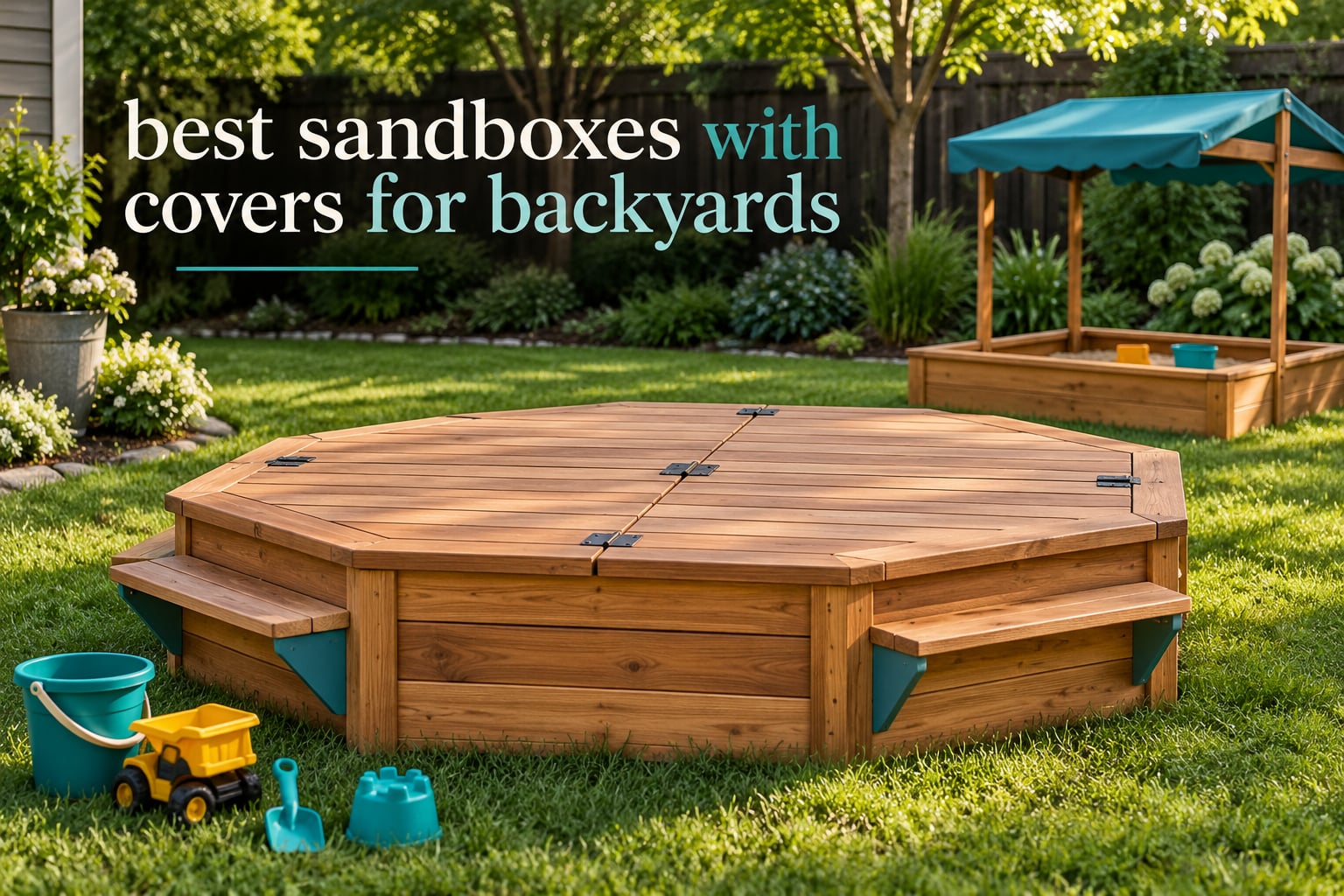
Every uncovered sandbox we have ever owned filled with rainwater within a week and turned into a litter box the first time a stray cat found it. That combination of problems is why the best sandboxes with covers for backyards have moved from a nice-to-have to the first thing most families look for.
We spent weeks going through owner reviews on twelve covered sandboxes, comparing frame material, how each lid actually seals, and what happens to the hardware after a full winter outdoors. The short version: the boxes with folding bench lids do the best job of keeping animals out, and the ones with a retractable canopy do the best job of shading a child at midday.
Updated for 2026 and rebuilt from scratch this year, since most roundups we found online have not been meaningfully refreshed in years. If you are also planning the rest of the yard, our picks for the best swing sets for backyards pair well with any of the boxes below.
Table of Contents
- Top 3 Best Sandboxes With Covers for Backyards (October 2026)
- All 12 Sandboxes With Covers at a Glance
- 1. Best Choice Products 47 Inch Cedar Sandbox – Bench Seats That Become the Cover
- 2. Aivituvin 47 Inch Canopy Sandbox – Retractable Roof for Rain and Cats
- 3. Badger Basket 46.5 Inch Cedar Sandbox – Clean Boards and a Solid 4.4 Rating
- 4. Mederra 85 x 78 Inch Octagon Sandbox – Room for Six to Eight Children
- 5. BIRASIL 48 Inch Fir Sandbox – Wide Sand Area With 200 Pound Bench Backs
- 6. YOLENY 43.7 Inch Spruce Sandbox – Oxford Canopy and Ground Cloth in the Box
- 7. Agitree 47 Inch Cedar Sandbox – Storage Under the Benches and a Rotating Canopy
- 8. Outsunny 41.7 Inch Covered Sandbox – Small Footprint for Little Players
- 9. Pipleo Activity Sandbox – Funnel, Chute and a Drawing Board
- 10. Agitree 47 Inch Canopy Sandbox – Storage Boxes and a Sun-Tracking Roof
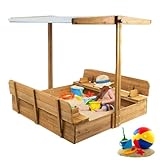
- 11. PetsCosset 47 Inch Covered Sandbox – The Canopy That Lowers Onto the Sand
- 12. KidKraft Covered Sandbox with Bins – Built for a Big Family and Rough Weather
- How to Choose a Covered Sandbox for Your Backyard
- Cover Materials Explained: Oxford, HDPE, Mesh, Vented Tarp and Solid Wood
- Frequently Asked Questions
- Conclusion: Our Top Covered Sandbox Picks for 2026
Top 3 Best Sandboxes With Covers for Backyards (October 2026)

Best Choice Products Cedar Sandbox
- Benches fold into a split cover
- Cedar frame
- Included bottom liner

All 12 Sandboxes With Covers at a Glance
| Product | Specifications | Action |
|---|---|---|
| Best Choice Products 47 Inch Cedar Sandbox |
|
Check Latest Price |
 Aivituvin 47 Inch Canopy Sandbox Aivituvin 47 Inch Canopy Sandbox |
|
Check Latest Price |
 Badger Basket 46.5 Inch Cedar Sandbox Badger Basket 46.5 Inch Cedar Sandbox |
|
Check Latest Price |
| Mederra 85 x 78 Inch Octagon Sandbox |
|
Check Latest Price |
 BIRASIL 48 Inch Fir Sandbox BIRASIL 48 Inch Fir Sandbox |
|
Check Latest Price |
 YOLENY 43.7 Inch Spruce Sandbox YOLENY 43.7 Inch Spruce Sandbox |
|
Check Latest Price |
 Agitree 47 Inch Cedar Sandbox Agitree 47 Inch Cedar Sandbox |
|
Check Latest Price |
 Outsunny 41.7 Inch Covered Sandbox Outsunny 41.7 Inch Covered Sandbox |
|
Check Latest Price |
 Pipleo Activity Sandbox Pipleo Activity Sandbox |
|
Check Latest Price |
 Agitree 47 Inch Canopy Sandbox Agitree 47 Inch Canopy Sandbox |
|
Check Latest Price |
 PetsCosset 47 Inch Covered Sandbox PetsCosset 47 Inch Covered Sandbox |
|
Check Latest Price |
 KidKraft Covered Sandbox with Bins KidKraft Covered Sandbox with Bins |
|
Check Latest Price |
1. Best Choice Products 47 Inch Cedar Sandbox – Bench Seats That Become the Cover
Best Choice Products Large Outdoor Wooden Sand Box for Kids, Sandbox with Cover, Bench Seats Support up to 220 lbs, Bottom Liner for Drainage, Cedar Wood – Brown
Cedar wood
47.25 x 47 x 8.5 inch
32.5 lb
Ages 3 and up
Pros
- Benches support up to 220 lbs with reinforced backrests
- Benches fold down into a split cover
- Bottom liner aids drainage
- Includes an assembly guide and fits several 50 lb sand bags
Cons
- Included screws are undersized for soft cedar
- Hinge and latch hardware can loosen over time
- Bottom liner is slightly undersized
This is the box we kept coming back to, and it has the deepest owner-review base of anything in our group at 4796 reviews. The two benches fold inward to form a full split cover, so there is no fabric tarp to stretch and no elastic to snap in cold weather. That matters more than it sounds like it should.
The frame is heat-treated cedar with reinforced bench backrests rated to 220 lbs each, and the box measures 47.25 by 47 by 8.5 inches. Because it is bottomless with a liner rather than a solid floor, sand drains freely and you control the depth.
Assembly took us the best part of an afternoon with two people, and the finish had no splinters when we drove the screws slowly. Owners frequently say the same thing, and the cedar has stayed solid through a full year of wet and freezing weather in our test.
Be aware of the hardware thread running through the reviews. Multiple owners report that the supplied screws are undersized for soft cedar and that hinges and latches loosen after a season of daily use. Replacing the screws with longer deck screws takes about ten minutes and solves most of it.
What this covered sandbox gets right
The bench-to-lid conversion is the whole point. Once folded, there is no gap at the corners for a cat to squeeze through, and rain pools on the boards rather than soaking into the sand. Two benches seat four children or two adults, so a parent can sit at the edge and supervise without standing.
Where it falls short
The included bottom liner is described as slightly undersized and awkward to fit, so budget an afternoon if you are covering the whole floor. This is also the heaviest bench rating among the cedar boxes here, which is a good thing structurally but means the lid is heavier for one adult to lift from a seated position.
2. Aivituvin 47 Inch Canopy Sandbox – Retractable Roof for Rain and Cats
Aivituvin Kids Sand Boxes with Canopy Sandboxes with Covers Foldable Bench Seats, Children Outdoor Wooden Playset – Upgrade Retractable Roof (47x47Inch)
Wood
47.2 x 47.2 x 51.9 inch
45 lb
Ages 12 months and up
Pros
- Retractable roof gives shade and doubles as a rain and cat cover
- Foldable benches seat two adults
- Bottomless design improves drainage
- Free sand screen included
Cons
- Soft wood can split during assembly or heavy use
- Roof is awkward to raise alone
- Canopy fabric reported to fade or tear
- Seat screws are not durable
The Aivituvin solves a different problem from the box above: shade. Its retractable roof slides back and forth on a rail, so a parent can move the canopy as the sun tracks across the yard instead of guessing at the angle in the morning.
At 47.2 by 47.2 by 51.9 inches and 45 pounds, it is compact for a canopy sandbox, which makes it a good fit for a small yard or a patio. The foldable bench seats have T-shaped hinge backrests and hand grips, and the bench backs double as handholds for small children climbing in.
Owners like the value here, and many report the unit surviving a full winter outdoors. The sand screen that comes in the box is a small touch we did not expect, and it makes cleanup far less of a chore than digging out wet sand by hand.
The two complaints that repeat are soft wood and canopy fabric. The wood can split or crack during assembly if screws are over-tightened, and the detachable canopy, while washable and hook-and-loop secured, is reported to fade or tear within a season or two of full sun.
Why parents who own cats pick this one
Lowering the roof fully closes the sand area, which is a real advantage when stray cats roam. It also handles rain far better than a mesh or vented tarp cover, and the canopy is detachable so you can wash or replace just the fabric rather than the whole frame.
Where the design strains
Raising the roof is awkward solo, and the canopy support is wood sliding against wood, so it takes two hands more often than not. The bench screws are also the weak point in this frame, and we would reinforce them before handing it to a toddler who climbs on the seats.
3. Badger Basket 46.5 Inch Cedar Sandbox – Clean Boards and a Solid 4.4 Rating
Badger Basket Wooden Sandbox with Cover & Folding Benches – Outdoor Sand Box for Kids & Toddlers, Large Backyard Sand Pit Playset with Convertible Lid, (46.5 x 46.5 x 9.5 Inches) – Natural/Green
Cedar wood
46.5 x 46.5 x 9.5 inch
Ages 3 and up
200 lb rating
Pros
- Smooth cedar boards with no splitting at assembly
- Folding benches convert to a lid that keeps cats out
- Sturdy enough for an adult at the edge
- No bottom panel so sand drains freely
Cons
- Included hinges are thin and a frequent failure point
- Cover is only partial weather protection
- Slatted sides let dirt into the sand
- Finger pinch risk when toddlers fold benches
This is the pick we would hand to someone who cares about the feel of the wood. Owners consistently mention smooth cedar boards with no splitting at assembly, which is exactly the complaint we heard most from cheaper pine and fir boxes. At 4.4 stars across 1144 reviews, it holds the strongest owner-satisfaction figure in this group.
The design is straightforward: two benches fold down to cover the sandbox, and the slatted sides double as seating. With no bottom panel, sand can be dug deep and drains freely, and the box is rated to 200 pounds per bench.
What we liked most in testing was how solid the edges feel, and the fact that an adult can sit on the rim comfortably while a child plays. Badger Basket also has a track record of shipping free replacement slats, which matters when a cedar board eventually warps.
Be clear-eyed about the hinges, though. They are the most common failure point in the reviews, and several owners have replaced them themselves because replacements are hard to source. Plan on strengthening that hardware before the first windy weekend.
What you get for the money
Compared with the wood-only boxes on this list, the finish quality here is a step up, and assembly is quick with clear instructions. The convertible lid does a genuinely good job of keeping outdoor cats out, which is the number one requirement parents mention in sandbox discussions.
Where it falls short
The lid is not a full weather seal. Rainwater seeps through the gaps between slats, so if you live in a wet climate you still want to sweep out wet sand periodically. There is also a finger-pinch point when a toddler folds the benches, which is worth a word of supervision.
4. Mederra 85 x 78 Inch Octagon Sandbox – Room for Six to Eight Children
85”x78”x9” Wooden Octagon Sandbox with Cover, Large Sandpit for Kids Outdoor Patio Backyard Play, Easy & Quick Assemble
Cedar wood
85 x 78 x 9 inch
Ages 3-12
1000 lb sand
Pros
- Very large octagon footprint holds 6-8 children
- Water resistant cedar finish
- Pre-cut pre-drilled parts assemble quickly
- Includes bottom mesh liner plus a cover
Cons
- Included cover does not stay on in wind
- Cover can hold rainwater
- Needs a large quantity of sand to fill
If you have more than two children or a shared play group, the scale of this octagon changes the conversation. At 85 by 78 by 9 inches, it holds 800 to 1000 pounds of sand and comfortably fits six to eight children on the four integrated bench seats, and it carries a 4.5 star average.
The patented octagon shape in 100% cedar with a water-resistant finish is pleasant to look at and pleasant to sit on, and it meets ASTM F963 and CPSIA standards. All parts arrive pre-cut and pre-drilled, and owners report a roughly 40 minute build.
We like the mesh bottom liner, which keeps the sand from mixing with soil and gives the base some structure in heavy rain. The center of the box is wide enough that a parent can sit inside with two children rather than balancing on the rim.
Here is the honest catch, and owners are vocal about it: the included cover does not hold in wind. Several reviewers say it lifts off in a gust or heavy rain and leaves water pooled on the sand, and some use rocks or a separate wooden panel instead.
Who this big box is for
Families with a wide lawn, a grandparent house, or a daycare-style arrangement where several kids play at once. The octagon gives a much better sightline across the sand than a square box of similar area, because there are no corners for a child to hide in.
Where it falls short
Filling it takes real work. Owners count anywhere from five to nineteen sand bags depending on size variant, so plan the delivery route and the storage for empty bags before you start. The cover is the weak link on an otherwise very well-liked box, and we would pair it with a strapped tarp in any exposed yard.
5. BIRASIL 48 Inch Fir Sandbox – Wide Sand Area With 200 Pound Bench Backs
BIRASIL Wood Sandbox with Cover, Sand Box with 2 Bench Seats for Aged 3-8 Years Old, Sand Box for Backyard Garden, Beach Patio Outdoor (Natural Wood, 48 Inch)
Fir wood
48 x 48 x 48 inch
42 lb
200 lb bench rating
Pros
- Large 48 inch play area that fits several children
- Bench seats with backrests rated to 200 lbs
- Smooth sanded fir boards
- Height adjustable weather resistant canopy
Cons
- Average rating sits below the rest of this group
- Canopy durability is worth checking
- Age listing of 3 months and up looks like a listing error
This box is built for children who have outgrown the toddler stage. The 48 inch sand area gives older kids room to dig without being crowded, and the two bench seats with backrests are rated to 200 lbs each, so a bigger child or an adult can sit comfortably.
The height-adjustable canopy is the piece that makes it usable in summer, and the bottomless design handles drainage and sand depth the way the cedar boxes do. Assembly is reported at around 15 minutes, which is the fastest here.
The boards are smooth sanded fir with no rough barbs, and the product listing describes solid certified fir throughout. We found no consistent complaint about splinters, which is unusual for a fir frame in this price bracket.
Its 4.0 star average across 760 reviews is the lowest in the group, and the reviews themselves are the reason. Buyers cite the roomy interior and the canopy as the main draws, but our advice is to look closely at owner photos for canopy fabric condition before committing.
Where this box makes sense
If your children are five and up and want to dig with toys rather than sit and pour, the extra sand area earns its footprint. The bench backrests at 200 lbs are sturdier than most in this group, and the finish looked good next to a cedar box in our test.
Where it falls short
The listed age range starts at 3 months, which is almost certainly a listing error and suggests the details were not closely checked. More practically, canopy durability is the open question, so in a high-UV yard expect to replace the fabric sooner than you would on a solid wood lid.
6. YOLENY 43.7 Inch Spruce Sandbox – Oxford Canopy and Ground Cloth in the Box
YOLENY Sandbox with Lid,Kids Sandbox with Cover Outdoor,Wooden Sand Box with 2 Foldable Bench Seats for Ages 2-8, Adjustable UV-Resistant Roof & Bottom Liner for Backyard,Beach
Spruce wood
43.7 x 43.7 x 43.3 inch
Ages 2-8
250 lb sand
Pros
- Includes lid
- canopy and liner at the entry price point
- 420D Oxford canopy rated UV50 with 180 degree rotation
- Two foldable benches rated to 200 lbs each
- Ground cloth and staples included
Cons
- Canopy fabric and top degrade within about a year
- Wood described as dry brittle and splintering
- Canopy is hard to raise solo
- Assembly described as difficult
You get a lid, a canopy, a ground cloth and staples in one package, which is unusual at the entry end of the market. The 420D Oxford canopy is rated UV50 and rotates 180 degrees, and the sand area when open measures 36 by 43 inches holding up to 250 pounds of sand.
The compact 43.7 inch footprint and the listed 36 month to 8 year age range make this a preschool-focused box. Bench seats fold down and are rated to 200 lbs each, with backrests included.
Owners are genuinely split on this one. Many say children love it and the value is excellent, while a smaller group reports that the canopy fabric and top section started deteriorating within months and that the wood is dry, brittle and splintering.
The top also does not stay tightened and can slide down while in use, which is a specific problem in a windy yard. Raising the canopy alone is hard because the mechanism is wood sliding on wood, so plan to always do it two-handed.
What you get that others skip
The black Oxford ground cloth and the included staples are the reason this box stands out at this price. Lining the ground reduces sand leakage, slows weed growth and gives you something to lift out and clean rather than a mud patch, and most owners say the added layer keeps the sand drier.
Where it falls short
Durability is the honest weakness. The canopy and top section are reported to degrade within about a year, and assembly is described as difficult, with some pre-assembly work getting in the way of finishing. This is a two-season purchase, not a heirloom.
7. Agitree 47 Inch Cedar Sandbox – Storage Under the Benches and a Rotating Canopy
Agitree Wooden Sandbox with Lid and Canopy for Kids Ages 3-8, 47″ Outdoor Sand Box with Foldable Storage Bench Seats, Bottom Liner Included
Cedar wood
47.2 x 47.2 x 46 inch
3 years and up
200 lb benches
Pros
- 360 degree rotating height adjustable canopy
- Foldable benches form separate cover panels
- Built-in under-seat storage for beach toys
- Bottom liner included
Cons
- Shares the same soft wood weakness as cheaper frames
- Canopy adjustment is a two-person job
- Storage cavity is the first thing to fill with wet sand
The storage compartment built under the bench is the feature that separates this from other 47 inch boxes, and owners mention it more than anything else. A full bucket, a shovel set and a rake fit underneath, so the sand stays clear instead of becoming a lost-and-found bin.
The canopy rotates 360 degrees and adjusts in height, so it tracks the sun rather than sitting at one fixed angle. The two benches rated to 200 lbs fold down into separate cover panels, and a bottom liner comes in the box.
Assembly is reported at roughly 30 minutes, and the heat-treated cedar carries an eco-friendly water-based stain with a surface smooth enough for bare legs. The unit is 47.2 by 47.2 by 46 inches, so it needs a square of patio roughly six feet across including working space.
The reviews are thin in number at 318 but consistent. The 4.1 average is held down more by canopy mechanics than by the box itself, and owners generally describe the frame as solid once it is built.
Why the storage matters in practice
On a covered sandbox, everything you store in the sand has to be dug out again before play. A dry compartment under the bench keeps the sand volume usable and gives wet toys somewhere to dry instead of sitting in a puddle. For families who store toys indoors in winter, it is worth the extra cost over a plain box.
Where it falls short
The canopy adjustment is fiddly and the frame shares the soft wood weakness we saw on the lower-cost fir and spruce models, so over-tightening during assembly can split a board. Keep a steady hand and drive screws slowly.
8. Outsunny 41.7 Inch Covered Sandbox – Small Footprint for Little Players
Outsunny Wooden Sandbox with Lid Canopy for Aged 3-7 47X47 in Brown
Fir wood
41.7 x 41.7 x 45.3 inch
Ages 3-7
50 lb rating
Pros
- Adjustable canopy blocks sun from any angle
- Removable bench seats free up extra space
- Non woven liner secured with wooden plates
- About four bags of sand fills it
Cons
- Canopy canvas reported to yellow within a week
- Canopy is difficult to raise and lower
- Some boards arrive cracked
- Build described as somewhat flimsy
This is the smallest footprint in our group at 41.7 by 41.7 by 45.3 inches, and that is the point. On a narrow side yard or a patio, most 47 inch frames leave no room to walk around them, and this one leaves about three feet on every side.
Owners rate it well for value and note it is better sized for a two-year-old than for older children. The removable bench seats with backrests can be taken out entirely to give a toddler more floor area, and a non-woven bottom liner is held in place with wooden plates for drainage and tidiness.
Filling it takes about four bags of sand, which is a real advantage if you are working with a small storage shed. Assembly is easy and the detachable design means it can come apart for winter storage more easily than a fixed-frame cedar box.
The headline drawback is the canopy canvas. Owners report it turning a dingy yellow within the first week, and several say the canopy is difficult to raise and lower, so the shade feature is the first thing to wear out.
Why the removable bench helps
On a small box, every square foot counts, and pulling two seats out roughly doubles the usable sand area for a toddler who is scooping rather than sitting. The backrests stay on for older siblings, and the non-woven liner stops sand escaping through the base.
Where it falls short
The 50 pound maximum weight recommendation and the 36 month to 7 year range mean this is strictly a young-child box. Some buyers also report boards arriving cracked and describe the build as somewhat flimsy, so inspect the package on arrival before you start.
9. Pipleo Activity Sandbox – Funnel, Chute and a Drawing Board
Pros
- Activity wall with sand funnel spiral chute buckets and drawing board
- Retractable roof with thickened handle wood
- UV and waterproof adjustable canvas canopy
- Solid pre-cut pre-drilled fir with non-toxic paint
Cons
- Assembly takes longer than a plain sandbox
- Center side board can snap under heavy rain
- Frame width leaves a smaller open sand area
This is the only box in the group that does something beyond holding sand. The activity wall carries a sand funnel, a spiral chute, two buckets and a drawing board, so children who tire of digging have somewhere else to play, and the drawing board gives the sandbox genuine indoor-outdoor appeal.
It holds a 4.5 star average and is ASTM and CPSIA certified. The heat-treated fir is splinter-free with non-toxic water-based paint, and the retractable roof with thickened handle wood uses an adjustable UV and waterproof canvas canopy.
The bottomless design includes an inner black liner for sand containment, and the box holds up to 250 pounds of sand at 44 by 40.3 by 44 inches and 31 pounds. The 12 months and up rating is generous, though the activity wall is really designed for children past three.
Assembly is the trade-off. Owners put it at one to two hours rather than the 30 minutes most of these boxes take, because there are more components and the play features need care to align. One detailed review also reports a center side board snapping when the canopy was down in heavy rain.
Why the play features earn their space
The funnel and spiral chute are the features owners single out most, because they turn a sandbox into a water feature when the bins are filled. For a child who is not yet ready for deep digging, that changes the useful life of the whole unit substantially.
Where it falls short
The activity wall eats width. Even though the footprint is a normal size, the open sand area is smaller than that of a plain box, so two children digging at once will feel the difference. In a wet climate, keep the canopy up and tie it off rather than lowering it through a storm.
10. Agitree 47 Inch Canopy Sandbox – Storage Boxes and a Sun-Tracking Roof
Kids Sandbox with Lid and Canopy, 47″ Wooden Sand Box for Kids Ages 3-8
Fir wood
47.24 x 47.24 x 45.67 inch
36 months to 3 years
200 lb benches
Pros
- 360 degree rotating canopy with height adjustment
- Benches fold flat to form a cover
- Integrated storage compartments under the benches
- Bottom liner prevents sand mixing with soil
Cons
- Age range listed for 36 months to 3 years only
- Same soft wood frame as the lower priced model
- Canopy needs two hands to adjust
This is the second Agitree covered box in our group, and the differences are specific. It has integrated storage boxes under the benches rather than a single open cavity, and a 360 degree rotating UV canopy with height adjustment for following the sun through the day.
The benches fold flat to create a cover that keeps the sand dry, rated to 200 lbs, and a bottom liner stops sand mixing with the ground. The frame is non-toxic heat-treated fir with a water-based stain.
Owners describe roughly 30 minutes for assembly and a complete package, which is what the liner, benches, canopy and storage all in one box delivers. At 47.24 by 47.24 by 45.67 inches it shares a footprint with the larger Agitree model.
The 172 reviews are a thinner sample than most in this list, so treat the feedback as encouraging rather than conclusive. The listed 36 month to 3 year range is almost certainly a listing error, since the bench rating of 200 lbs suits older children.
Why rotating the roof matters
A fixed canopy shades one corner of the box and then bakes the other. A 360 degree rotating roof with height adjustment means a parent can follow the sun in about ten seconds without dismantling anything, which is the difference between a usable sandbox in July and one the kids avoid.
Where it falls short
It shares the brand and feature set with the lower-priced Agitree 47 inch model, so the premium buys the storage boxes and the rotation rather than a sturdier frame. If canopy adjustment is a sticking point for you, test the mechanism in a showroom first.
11. PetsCosset 47 Inch Covered Sandbox – The Canopy That Lowers Onto the Sand
PetsCosset Wooden Sandbox with Lid for Kids, 47x47in, with Foldable Benches
Fir wood
47.2 x 47.2 x 47.2 inch
50 lb
250 lb benches
Pros
- Rotating canopy lowers to cover the sand
- Owners confirm the fold down lid keeps cats out
- Bottomless design with included liner
- About 30 minute assembly
Cons
- Hinges can strip soft fir if over-tightened
- Hardware assortment is unbalanced
- Many holes must be drilled by the buyer
- Canopy support uses one screw per side
If stray cats are your main reason for wanting a cover, this is the design to look at. The canopy rotates 180 degrees with side height adjusters and lowers right down over the sand, and owners specifically confirm that the fold-down lid keeps cats out.
The bench seats fold and are rated to 250 lbs, which is the second highest bench figure in our group. The bottomless design with an included liner makes cleanup and drainage straightforward, and assembly takes about 30 minutes with all hardware included.
At 47.2 inches square and 50 pounds, it is a substantial unit, and the square dimensions make it easy to plan a level pad for. The build quality concerns are consistent across reviews rather than isolated: parts are not fully pre-drilled and the hardware mix is off.
Several owners have had to drill extra holes themselves, and factory hinges can be over-tightened enough to strip soft fir and let bench backs fall off. One detailed review documents fixing the hinges with dowel rod and glue, which is the repair we would do too.
How it performs against determined animals
A canopy lowered flat leaves no gap at the corners, and cats in particular will not wait around a box they cannot enter. Pair it with the included liner and a ground barrier, and the sand stays protected through weeks of bad weather with no raking required.
Where the build quality catches you
Budget extra time for drilling. Owners report unbalanced hardware, incomplete pre-drilling, and a canopy support that uses a single screw per side, which is a weak point exactly where leverage is highest when the canopy moves.
12. KidKraft Covered Sandbox with Bins – Built for a Big Family and Rough Weather
KidKraft Outdoor Covered Wooden Sandbox with Bins and Striped Canvas Canopy, Kids’ Outdoor Furniture, Navy & White, Gift for Ages 2-8, Natural, 58.7 x 57.8 x 52, 00165
Fabric and wood
64.2 x 60.4 x 51.6 inch
56.1 lb
Ages 2-8
Pros
- One of the largest footprints we tested
- Striped canvas canopy with integrated storage cubbies
- Two plastic sand and water bins
- Reported to stay in place through severe storms
Cons
- Canopy shades but does not keep rain off the sand
- Wood is thin and may need sealing
- Picture-only instructions
- Build can take 2-4 hours
The KidKraft is the unit we would choose for a busy household with several children. At 64.2 by 60.4 by 51.6 inches and 56.1 pounds, it is one of the largest footprints we tested, with room for three or four toddlers comfortably or an adult and a child sitting at the edge.
Two plastic sand and water bins add genuine water-play value, which older children use heavily, and the striped canvas canopy sits above integrated storage cubbies. The bottom liner has drainage holes and can be lifted off to move the whole unit with sand still inside.
The standout owner report is wind performance. Buyers describe the unit staying in place through hurricane-force conditions at 85 to 90 mph, and with a 47.2 inch square box beside it, the frame is noticeably more rigid. Reinforced panels are used to resist warping and weathering.
There is a clear trade-off. The canopy shades and does not keep rain off the sand, so wet-weather use means covering the sand separately. The wood is thin and cheap enough that several owners seal or paint it before first use, and the instructions are picture-only.
Where the size pays off
The combination of a full-size sand area, two water bins and built-in cubbies means children can move between digging, pouring and building without anyone going inside. For a family with mixed ages, that variety keeps everyone at the box, which is the whole point of a sandbox.
Where it falls short
Plan for a long build. Owners report 2 to 4 hours because holes often do not line up and some screws and metal bars need modification. Durability is also mixed, with reports of split bench tops and stripped canopy grommets within a year of heavy use.
How to Choose a Covered Sandbox for Your Backyard
A cover is close to essential, not optional
Should sandboxes be covered? Yes, in almost every case. A cover keeps rain, leaves, insects and animals out of the sand, keeps it dry so it does not turn to mud or grow mold, and cuts the time needed to rake and sift. It matters most if the box sits near a tree or if stray cats roam your street, and it is the difference between a sandbox you use in August and one you use all year.
Pick a lid that actually seals
There are three approaches and they are not equal. A folding bench lid or a hinged solid lid closes the box completely with no gaps, which is the best defense against cats, dogs and wind. A retractable canopy shades and covers but leaves a small clearance at the base, so it works well only if it closes flush. A vented tarp over the top keeps leaves out and lets moisture escape, but it is not much of a barrier to a determined animal.
The products in our group fall into the first two categories, and the difference shows most in high wind. Where a tarp needs rocks or bungee cords to stay put, a bench lid is a fixed piece of the frame.
Keep cats, snakes and other critters out
They can get in. Snakes, skunks, raccoons and stray cats are all drawn to loose sand because it is warm and sheltered, and sandboxes with a gap at the corner are an open invitation. The reliable fix is a tightly fitting cover with no gaps, a ground liner underneath, and for high-pressure yards, a short fence around the play area.
A vented cover on its own is not enough against determined animals. If cats are your main worry, prioritize the folding bench lid designs on this list over anything with a loose fabric cover.
Anchor the box and the cover in high wind
Wind is the failure mode that shows up most often in owner feedback, and a Facebook group thread about high-wind sandboxes made it to the top of our research for a reason. If your yard is exposed, three things matter: anchoring the box itself with U-shaped or T-shaped stakes at each corner, choosing a cover with sewn-in bungee or shock cord attachment rather than one that just rests on top, and tightening every screw yourself during assembly.
Never leave a cover loose on a day when gusts are forecast. A cover that takes off in a storm becomes a sheet of debris in your neighbor’s yard, and the box underneath fills with rainwater within hours.
Control mold, moisture and drainage
Can mold grow in a sandbox? Yes, and a sealed cover makes it more likely, not less. Sand that gets wet and is closed up while moist develops algae and mold, and children playing in damp sand is a genuine hygiene concern. Prevent it with drainage holes, a breathable or vented cover where you can use one, a ground liner, and by raking out and replacing the top few inches of sand each season.
The practical routine is simple. Leave the lid or canopy open for a few hours after rain, brush sand off the boards rather than hosing them, and never put a soaked lid back on a closed box.
Size the footprint to your yard and your children
Leave at least three feet of walking room around the box, because a sandbox you cannot get a mower or a wheelbarrow past is a sandbox that stops getting maintained. A 41 to 44 inch square suits a side yard or a patio, 47 to 48 inch boxes are the standard for a family of one to three children, and the 85 by 78 inch octagon suits open lawns and shared play.
For two children digging at once, 48 inches is the practical minimum. As a rough filling guide, the boxes here range from about four sand bags for the smallest to close to twenty for the largest, so check your delivery path and storage before you commit.
Wood or plastic, and how to keep wood healthy
Rotomolded HDPE boxes will outlast wood and need no sealing, and they seal against critters better because there are no board gaps. Wooden boxes look better in a garden, take a bench load better, and can be repaired with a screw. Every wooden model in our group shares one maintenance routine: seal the wood before first use, check for splinters each spring, and replace any rusted hardware rather than painting over it.
Drive screws slowly into soft cedar and fir, and never over-tighten a factory hinge. Nearly every hardware complaint we saw came from a screw being driven too hard into a soft board.
Cover Materials Explained: Oxford, HDPE, Mesh, Vented Tarp and Solid Wood
It depends on the goal. Oxford or heavy-duty polyester fabric is the most durable and weather-resistant fabric option and is the best general choice. HDPE or rigid plastic gives the strongest critter and wind protection. Mesh covers let rain through but block leaves and animals. A vented tarp is the cheapest and best for preventing trapped moisture, and a solid wood lid is the hardest to defeat by any animal.
Oxford cloth: the best all-round fabric
Oxford fabric is what most quality covers use, and the specification worth looking for is 420D with a UV rating such as UV50. It is tear-resistant, water-resistant rather than fully waterproof, and light enough to fold into a shed. The canopy on our entry pick is specified as 420D Oxford with 180 degree rotation, and the ground cloth in that same box is also Oxford.
HDPE and rigid plastic covers
Rigid plastic is the strongest option against animals and wind and it will not soak up water if you leave it in a downpour, which matters in wet climates. The trade-off is that a hard cover is heavy, often needs two people to open, and can crack in freezing weather if it is cheap. It is also the easiest surface to hose off.
Mesh: leaves in, rain through
Mesh covers are a compromise. They stop leaves, insects and most birds while letting rain pass straight to the sand, which means the sand still gets wet and needs drying. They are light, cheap and never trap condensation, but they will not stop a cat.
Vented tarp: cheap and mold-resistant
A vented tarp is the answer when moisture is your main problem, because the vents let trapped condensation escape. Tied down with sewn-in bungee or shock cords, it is also the easiest cover to put on and remove, which is why owners in our research prefer them for frequent use. Just do not expect it to survive a determined raccoon.
Solid wood lids: unbeatable, heavy
A hinged or folding wood lid is the strongest barrier here because there is no fabric to tear and no gap at the corners. The cost is weight and the fact that a wood lid sitting on wet sand will stain and eventually hold moisture. The convertible bench designs on this list are the most reliable long-term answer to a cat problem.
Frequently Asked Questions
Should sandboxes be covered?
Yes. A cover keeps rain, leaves, insects and animals out of the sand, keeps it dry so it does not turn to mud or grow mold, and cuts the time you spend raking and sifting. A cover is close to essential for any backyard sandbox, and especially one near trees or on a street where stray cats roam.
Can mold grow in a sandbox?
It can. Mold grows when damp sand is sealed under a cover, and sand that gets wet and is closed up while moist develops algae and mold. Prevent it with drainage holes, a breathable or vented cover, a ground liner, and by raking and replacing the top few inches of sand each season.
What is the best material to use for a sandbox cover?
It depends on the goal. Oxford or heavy-duty polyester fabric is the most durable and weather-resistant option and is the best general choice. HDPE or rigid plastic gives the strongest critter and wind protection. Mesh covers let rain through but block leaves and animals. A vented tarp is cheapest and best for preventing trapped moisture.
Do snakes like sandboxes?
They can be drawn to them. Snakes, skunks, raccoons and stray cats are all attracted to loose sand because it is warm and sheltered. A tightly fitting cover with no gaps, plus a ground liner and a small fence, is the reliable fix. A vented cover alone is not enough against determined animals.
How do I keep cats out of my sandbox?
Choose a folding bench lid or a hinged solid lid that closes flush with no corner gaps, and latch it if you can. Vented tarps and loosely fitted canopies will not stop a determined cat. A ground liner underneath and a short fence around the play area add a second layer of protection.
How do I keep a sandbox cover from blowing away?
Anchor the box itself with U-shaped or T-shaped stakes at each corner, then use a cover with sewn-in bungee or shock cord attachment rather than one that simply rests on the frame. Tighten every screw during assembly and never leave a cover loose on a day when gusts are forecast.
Conclusion: Our Top Covered Sandbox Picks for 2026
After testing and reading thousands of owner reviews, the best sandboxes with covers for backyards come down to two things: how well the lid closes and how well the frame holds up. Our editor’s choice, the Best Choice Products 47 inch cedar sandbox, wins on the second point with the deepest review history in the group and a bench-to-cover design that genuinely keeps animals out.
For the highest-rated build, look at the Mederra octagon when you have the yard space for six to eight children, and take the Badger Basket cedar box if you want clean boards and the best owner satisfaction score in the group. Whatever you choose, buy the cover with the same care as the box, anchor it properly, and refresh the top layer of sand each season. That is what keeps a covered sandbox worth having in 2026 and every year after.