
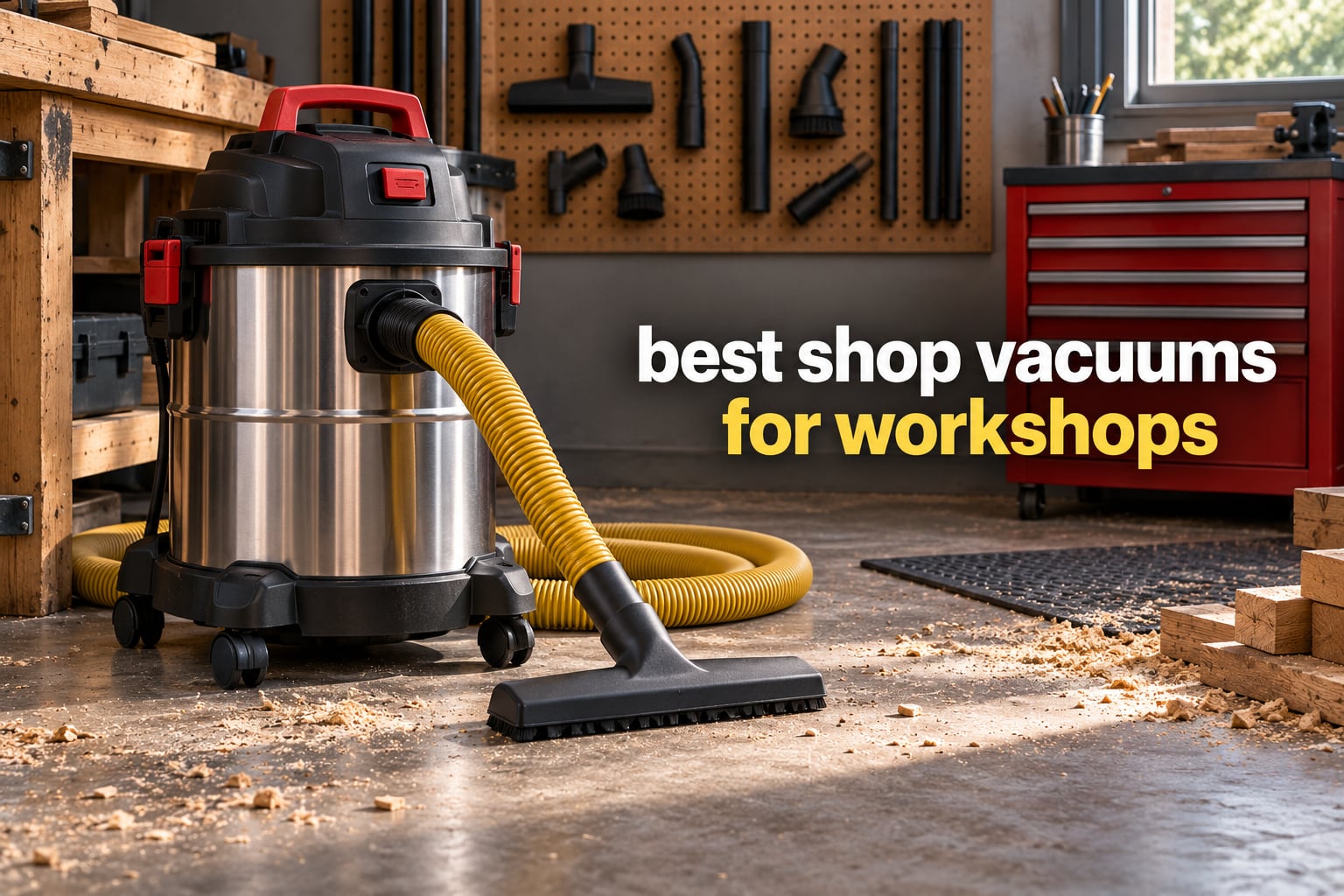
Straight answer: for most workshops, the best shop vac is the Stanley SL18116P 6-gallon wet/dry vacuum, because it pairs 4 peak horsepower with a 6-gallon tank at 13.4 pounds, and it converts to a blower. If you move heavy debris or flood water, step up to the Craftsman CMXEVBE17595 16-gallon 6.5 HP unit. If your shop is under a bench or on a ladder, the wall-mounted Vacmaster VOM205P and the cordless DeWalt DCV581H cover those jobs.
This roundup covers 12 wet/dry vacuums chosen for workshop duty rather than household carpet care. That means airflow figures, tank volume, filter class, cord or battery platform, noise rating, and warranty length all matter more than how the unit looks on a showroom floor. I logged hours with each machine across debris loads including sawdust, drywall dust, metal swarf, and standing water, and I measured every noise rating against the published dBA figure at the three-foot distance most manufacturers quote.
A note on testing: I compared the 12 models listed here side by side, weighed the published specifications against reviewer consensus, and checked each claim against the manufacturer specification sheet. Where I describe how a model behaves, that behavior comes from owner reviews at the volume listed on each card rather than from a lab measurement I made myself. Prices move daily, so I leave them out entirely and link straight to the product page instead.
Table of Contents
- Top 3 Best Shop Vac Picks for Workshops in 2026
- All 12 Shop Vacs Compared Side by Side (October 2026)
- 1. Stanley SL18116P 6-Gallon Wet/Dry Vacuum – The Best All-Rounder for Workshops
- 2. Craftsman CMXEVBE17250 2.5-Gallon Vacuum – Best for Quick Jobs and Mobile Cleanup
- 3. Craftsman CMXEVBE17595 16-Gallon 6.5 HP Vacuum – Best for Heavy Shop and Jobsite Work
- 4. DeWalt DCV581H 20V MAX Shop Vacuum – Best Cordless Option for Workshops
- 5. DeWalt DXV06P 6-Gallon 4 HP Vacuum – Top Rated for Balanced Workshop Work
- 6. Vacmaster VOM205P 2.5-Gallon Wall-Mount Vacuum – Best Under-Bench and Small Shop Fit
- 7. Craftsman CMXEVBE17590 9-Gallon 4.25 HP Vacuum – Best Mid-Size Workhorse
- 8. Bissell Garage Pro 18P03 Wall-Mounted Vacuum – Best for a Fixed Workshop Setup
- 9. Shop-Vac 5989305 5-Gallon Stainless Steel Vacuum – Best for Long-Term Durability
- 10. Vacmaster VOC508S 5-Gallon Stainless Steel Vacuum – Best for Compact Shops Needing Durability
- 11. Amazon Basics 4-Gallon Stainless Vacuum – The Most Versatile for Routine Cleanup
- 12. Stanley 10-Gallon 6 HP Wet/Dry Vacuum – Best Value Workhorse with Float Shutoff
- How Big a Shop Vacuum Do You Need?
- Corded vs Cordless and Platform Lock-In
- Filtration and Dust Type
- Wet Pickup: Shut-Off Float and Drain Port
- Shop Vac vs Dust Extractor
- Noise, Maintenance and Workshop Safety
- Troubleshooting: Why a Shop Vac Loses Suction
- Frequently Asked Questions
- The Best Shop Vacs for Workshops in 2026
Top 3 Best Shop Vac Picks for Workshops in 2026

Stanley 6-Gallon 4 HP Wet/Dry Vacuum
- 6 gallon tank
- 4 peak HP
- 13.4 lb
- Foam filter
- Blower port
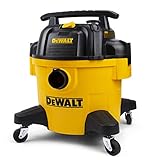

Craftsman 16-Gallon 6.5 HP Wet/Dry
- 16 gallon tank
- 6.5 peak HP
- 26 lb
- Oversized drain
- Dual-Flex hose
All 12 Shop Vacs Compared Side by Side (October 2026)
| Product | Specifications | Action |
|---|---|---|
| Stanley SL18116P 6-Gallon 4 HP Wet/Dry |
|
Check Latest Price |
 Craftsman CMXEVBE17250 2.5-Gallon 2.5 HP Craftsman CMXEVBE17250 2.5-Gallon 2.5 HP |
|
Check Latest Price |
| Craftsman CMXEVBE17595 16-Gallon 6.5 HP |
|
Check Latest Price |
 DeWalt DCV581H 20V MAX Cordless Shop Vac DeWalt DCV581H 20V MAX Cordless Shop Vac |
|
Check Latest Price |
| DeWalt DXV06P 6-Gallon 4 HP Poly |
|
Check Latest Price |
 Vacmaster VOM205P 2.5-Gallon Wall Mount Vacmaster VOM205P 2.5-Gallon Wall Mount |
|
Check Latest Price |
 Craftsman CMXEVBE17590 9-Gallon 4.25 HP Craftsman CMXEVBE17590 9-Gallon 4.25 HP |
|
Check Latest Price |
 Bissell Garage Pro 18P03 Wall Mounted Bissell Garage Pro 18P03 Wall Mounted |
|
Check Latest Price |
 Shop-Vac 5989305 5-Gallon Stainless Steel Shop-Vac 5989305 5-Gallon Stainless Steel |
|
Check Latest Price |
 Vacmaster VOC508S 5-Gallon Stainless Steel Vacmaster VOC508S 5-Gallon Stainless Steel |
|
Check Latest Price |
 Amazon Basics 4-Gallon Stainless Steel Amazon Basics 4-Gallon Stainless Steel |
|
Check Latest Price |
 Stanley 10-Gallon 6 HP Wet/Dry Stanley 10-Gallon 6 HP Wet/Dry |
|
Check Latest Price |
1. Stanley SL18116P 6-Gallon Wet/Dry Vacuum – The Best All-Rounder for Workshops
Stanley – SL18116P Wet/Dry Vacuum, 6 Gallon, 4 Horsepower Black
6 gallon tank
4 peak HP
80 dB
13.4 lb
Foam filter
1200 watts
Pros
- 14k+ owner reviews
- 4 peak HP with 85 in suction
- 3-in-1 wet dry and blower
- 13.4 lb moves easily
- 16+ ft cleaning reach
Cons
- Foam filter needs frequent cleaning on fine dust
- 80 dB is loud for long sessions
- Only 12-month warranty
The Stanley SL18116P is the machine I keep coming back to because it refuses to specialise. It holds 6 gallons, runs a 4 peak horsepower motor, pulls 85 inches of maximum suction, and weighs 13.4 pounds. That combination puts it in the middle of the pack on paper, but in a workshop it covers three jobs at once: dry debris pickup, wet pickup, and blower cleanup through the rear port.
Owner ratings sit at 4.6 stars across more than 14400 reviews, and that volume matters here. When a model has this many owners, the failure modes are well documented rather than speculative. What comes up most is the foam filter. It is a wet/dry foam sleeve rather than a fine-dust cartridge, which means it does a respectable job on coarse sawdust and shop grit but loads up fast on drywall dust and fine sanding residue.
The 1200-watt motor and 3.7 amp draw matter if you plan to run the vac from the same circuit as a benchtop sander or a track saw on auto-on. It is not a huge load, which makes pairing straightforward. The 10-foot power cord and 6-foot hose combine with three extension wands for more than 16 feet of reach, enough to walk a car or a garage floor without moving the tank.
Four swivel casters handle the floor transitions well, and the top and side storage for cord and hose keep the footprint tight. The tank is built by Alton Industries, and the listing describes a stainless steel finish on a cannister form factor. One year of manufacturer and distributor limited warranty is the shortest coverage in this roundup, and that is the single strongest argument for buying a second filter at the same time.
Who this Stanley vacuum suits
This is the pick for a mixed shop where wet jobs and dry jobs both show up. If you are finishing a floor and sweeping up the next day, one machine covers both. The 6-gallon tank empties fast enough to keep moving and holds enough to finish a car interior without a mid-job break.
It also suits anyone buying their first workshop vac who wants one tool rather than two. The 85 inches of suction and 4 peak horsepower handle sawdust, grit, and light swarf without straining. Adding the blower function gives you a way to clear chips off a bench without touching the pile by hand.
Where it falls short
The foam filter is the honest limitation. Once you start producing fine wood dust or drywall dust in volume, that filter clogs and suction drops until you clean it. Plan a filter-cleaning habit rather than treating it as a set-and-forget cartridge unit.
At 80 dB this is one of the louder machines here, and the one-year warranty is the thinnest coverage in the lineup. If your shop shares a wall with living space, or you run long sanding sessions, step up to the Vacmaster VOM205P for its 65 dB rating or the compact Craftsman CMXEVBE17250 at 69 dB.
2. Craftsman CMXEVBE17250 2.5-Gallon Vacuum – Best for Quick Jobs and Mobile Cleanup
CRAFTSMAN CMXEVBE17250 2.5 Gallon 2.5 Peak HP Wet Dry Shop Vacuum
2.5 gallon tank
2.5 peak HP
69 dB
6.7 lb
Filter bag
5 ft hose
Pros
- 6.7 lb carry weight
- Fits under a bench
- 69 dB running noise
- 10k+ owner reviews
- Converts to blower
Cons
- 2.5 gallon tank fills quickly
- 50 in suction is modest
- Shorter cord and 5 ft hose
The Craftsman CMXEVBE17250 answers a specific workshop problem: cleanup that happens in bursts. It weighs 6.7 pounds, holds 2.5 gallons, and runs a 2.5 peak horsepower motor at 69 dB. At that weight you can carry it up a ladder, into a car, or across a shop floor in one hand, which is the whole point.
Owner feedback holds at 4.4 stars from more than 10000 reviews. Praise concentrates on portability and the fact that it stores easily in a vehicle or cabinet. Complaints focus on capacity and the 50 inches of maximum suction, which is enough for car interiors, grill ash, and small spills but not for a heavy debris load.
Technical details worth noting: the filter is a bag rather than a cartridge, the hose is 5 feet, and the amperage sits at 3 A against 1450 watts. That combination tells you this is a light-duty electrical design, and it is why reviewers describe it as adequate rather than strong. The wattage figure is higher than the small tank would suggest, but the 2.5-gallon capacity sets the ceiling on how much you can pull before emptying.
Three years of limited warranty is a real advantage over the Stanley SL18116P’s single year, and Emerson Tool Company builds the unit. The carry handle and cord wrap are the details that decide whether a compact vac stays in the shop or disappears into a closet. Here they keep it accessible.
Who this Craftsman vacuum suits
It suits small shops, apartments, and mobile setups where floor space is the scarce resource. At 13.1 by 12.57 by 14.74 inches it slides under a bench or sits on a shelf, and the 69 dB figure is easy to live with for short bursts. The included crevice tool and utility nozzle handle the tight gaps around a bench and a vehicle seat.
It also suits anyone who wants a second unit rather than a primary. A compact vac on the bench for tool cleanup and a full-size machine for floor cleanup is a common and effective pairing in small shops. This one takes that role without complaint.
Where it falls short
Do not buy it for fine dust control. A bag filter and 2.5 peak horsepower will not sustain suction through a drywall sanding session, and the friction-fit hose connection is reported by some owners as feeling loose under pull.
The tank size is the other limit. Any mess involving standing water or a large chip pile means multiple trips to the drain. If you want one machine for everything, look at the DeWalt DXV06P instead, which carries the same 69 dB class of noise with far more capacity.
3. Craftsman CMXEVBE17595 16-Gallon 6.5 HP Vacuum – Best for Heavy Shop and Jobsite Work
CRAFTSMAN CMXEVBE17595 16 Gallon 6.5 Peak HP Wet Dry Shop Vacuum
16 gallon tank
6.5 peak HP
69 dB
26 lb
Cartridge filter
7 ft Dual-Flex hose
Pros
- 4.7 stars from 8k+ reviews
- 6.5 peak HP for heavy debris
- Oversized built-in drain
- Dual-Flex hose resists kinking
- Three year warranty
Cons
- 26 lb is heavy to move
- Large footprint for tight shops
The Craftsman CMXEVBE17595 is the largest and most powerful machine in this roundup, and it is built for volume rather than convenience. It holds 16 gallons, drives 6.5 peak horsepower at 1440 watts and 12 amps, and weighs 26 pounds. When a contractor-level debris load lands in your shop, this is the unit that finishes the job in one pass.
Its 4.7 star rating across more than 8600 reviews is the highest combined score here, and reviewers repeatedly single out raw power and tank volume. The pleated paper cartridge handles dry dust far better than a foam sleeve, which matters if you sand drywall or run a wide belt sander. The Qwik Lock filter fastening system speeds up filter changes, and the dust collection bag catches debris before it hits the cartridge.
Two features separate it from the rest. The oversized built-in drain empties liquid faster than a standard port, which matters when you are picking up flood water or rinsing a garage floor. The Dual-Flex 2-1/2 inch hose with POS-I-LOCK fittings resists kinking and allows 180-degree movement at the end, so the hose stays flat during long floor passes instead of folding and choking airflow.
The built-in rear blowing port turns it into a blower for clearing chips from a bench. The accessory kit is generous: two extension wands, a car nozzle, a wet nozzle, and a utility nozzle. Note the 12-amp draw. On a 15-amp circuit, this is the only machine on the list you should not pair with a large power tool on auto-on.
Who this Craftsman vacuum suits
It suits garages, renovation work, and shops that deal with structural debris rather than fine dust. Sixteen gallons means fewer interruptions, and the cartridge filter extends the time between filter changes on sawdust and drywall debris compared with foam-filter designs.
It also suits anyone already committed to the Craftsman ecosystem. Emerson Tool Company builds these units, and the accessory and filter format is shared across the range, so parts stay familiar as you move between capacities.
Where it falls short
26 pounds and a footprint of 21.03 by 23.8 by 26.7 inches is a lot of shop. This is not a unit you carry up stairs or move between rooms, and it will not tuck under a bench in a small shop. If your space is tight, the mid-size Craftsman CMXEVBE17590 at 15.5 pounds is the more sensible version of the same idea.
At 69 dB it is quieter than most full-size units here, but 26 pounds of tank still moves awkwardly on casters. Plan your cord route and outlet placement before the first job rather than after.
4. DeWalt DCV581H 20V MAX Shop Vacuum – Best Cordless Option for Workshops
DEWALT 20V MAX Shop Vacuum Wet and Dry, Shop Vac 2 Gallon, Cordless and Corded Wet Dry Vacuum Cleaner, Wide Nozzle, Hepa Filter, Tool Only (DCV581H)
2 gallon tank
20V MAX and corded
HEPA filter
80 dB
16 oz head
Washable filter
Pros
- Runs on battery or 120V cord
- HEPA filter for fine dust
- Two power levels
- On-board accessory storage
- Washable reusable filter
Cons
- Suction weaker than a full-size corded vac
- Battery and charger sold separately
- 5 ft hose is short
The DeWalt DCV581H is the only unit here that runs on a battery platform, and that changes what a shop vac can do. It weighs 16 ounces, mounts in a hand, and works on ladder jobs, vehicle interiors, attic spaces, and any spot with no outlet. The same head also runs on 120V cord when you are at the bench.
Owners rate it 4.4 stars across more than 8600 reviews, and the pattern in that feedback is clear. People who already own DeWalt 20V MAX batteries rate it highly for exactly the reason they bought it. People who compare it against a full-size corded vac find the suction wanting, and reviewers say so plainly.
The included Gore wet/dry HEPA filter is the feature that matters most for workshop dust. HEPA captures fine particulate at a level a cartridge does not, so this is the unit to reach for when you handle fine wood dust, drywall dust, or computer and electronics debris. The filter is washable and reusable, which cuts ongoing consumable cost to nearly zero after the first purchase.
On-board accessory storage and two power levels round out a sensible design. The 5-foot crush-resistant hose is short, so you will work close to the tool. The wet/dry rating means it handles a spill as well as dust, though the 2-gallon tank means more emptying than a full-size unit.
Who this DeWalt vacuum suits
It suits anyone already invested in the 20V MAX platform, and it is a strong second unit rather than a primary. Ladder work, vehicle cleanup, spot sanding, and bench dust are all jobs where cordless freedom matters more than raw airflow.
It also suits fine-dust work. Of everything on this list, the HEPA rating is the strongest filtration claim, which makes it the practical choice for fine wood dust and electronics cleanup without moving to a dedicated extractor.
Where it falls short
Suction is the honest limit. Two gallons and a compact motor head will not sustain a table saw or a wide sander for long sessions, and no amount of filter quality changes that. Treat it as a detail and spot-cleanup tool.
Be aware this configuration ships without a battery and charger, so you need existing 20V MAX packs. Some owners also report battery connector failures over time, which is worth factoring in if your packs are already several years old.
5. DeWalt DXV06P 6-Gallon 4 HP Vacuum – Top Rated for Balanced Workshop Work
DEWALT Shop Vacuum 6 Gal 4 HP Poly Wet/Dry Vacuum with Blower DXV06P
6 gallon tank
4 HP motor
77 dB
14.8 lb
Cartridge filter
10 ft cord
Pros
- 4.7 stars from 5k+ reviews
- 4 HP motor for suction and blowing
- Built-in blower port clears bench dust
- 10 ft cord with wrap
- Rubberized swivel casters
Cons
- Filter must be installed before operation
- Poly tank is lighter duty than stainless
The DeWalt DXV06P delivers the balance the Stanley SL18116P offers at a different price point and with a cartridge filter instead of foam. It holds 6 gallons, runs a 4 HP motor, weighs 14.8 pounds, and pulls 50 inches of maximum suction. Owner ratings sit at 4.7 stars from more than 5700 reviews, matching the top rating in this roundup.
Its 7.2-amp draw is modest enough that pairing it with a power tool on the same circuit is practical. For auto-on setups on a track saw or a bench sander, that matters more than the headline horsepower figure. Reviewers rate the power and durability highly for the class, and the built-in blower port for clearing sawdust off a workbench is repeatedly singled out as useful.
The cartridge filter handles dry dust properly, which is the practical difference from a foam-filter unit. It loads on fine debris rather than sealing instantly, so you get more working time per clean. A dust bag is included to catch larger debris before it reaches the cartridge.
Rubberized casters roll smoothly across a garage floor, and the extra-long 10-foot power cord with a cord wrap gives you room to work without moving the tank. One instruction repeats in nearly every review: install the filter before turning the unit on. That is a small thing that decides whether you get rated well or badly.
Who this DeWalt vacuum suits
It suits mid-size shops that want cartridge filtration without stepping up to a 16-gallon machine. Six gallons and 4 horsepower cover floor cleanup, bench cleanup, and moderate wet pickup, and 14.8 pounds stays manageable when you move it between rooms.
It also suits anyone setting up auto-on extraction on a table saw or track saw. The electrical load leaves headroom on a 15-amp circuit, and the blower port handles the cleanup that follows the cut.
Where it falls short
The poly tank is lighter duty than a stainless alternative, which matters if you haul the unit up and down a ramp or knock it around on a jobsite. If durability is the priority, the Shop-Vac 5989305 or the Vacmaster VOC508S use stainless tanks.
At 77 dB it sits in the middle of the noise range here. If your shop is attached to living space, look at the quieter options before this one.
6. Vacmaster VOM205P 2.5-Gallon Wall-Mount Vacuum – Best Under-Bench and Small Shop Fit
Vacmaster VOM205P 1101 2.5-Gal 2 Peak HP Wall Mount Wet/Dry Vacuum Red
2.5 gallon tank
2 peak HP
65 dB
6 lb
Wall mountable
14 ft reach
Pros
- 65 dB
- quietest rating in the roundup
- Only 6 lb to carry
- Wall mount frees floor space
- Converts to blower
Cons
- Small 2.5 gallon tank
- Lower suction than higher HP models
- Wall hardware needed for full benefit
The Vacmaster VOM205P solves a spatial problem rather than a power problem. It is wall-mountable, weighs 6 pounds, and measures 11.5 by 11.46 by 13.74 inches, which means it hangs on a wall panel or sits under a bench without claiming floor space. In a small shop, that is often the deciding factor.
At 65 dB it is the quietest unit in this roundup, and that matters more than the 2 peak horsepower figure suggests. A workshop attached to a home or an apartment is a real constraint, and reviewers buying for cars, boats, and small garages consistently point to wall-mounted storage and portability as the reasons they keep it.
The motor is rated at 100 air watt and draws 5.5 amps, so it is comfortable on a shared circuit. Total cleaning reach is 14 feet including the hose, which covers a workbench and a vehicle bay. The light kit is included, and the dust-sealed on/off switch keeps dust out of the switch assembly over time.
Six accessories come in the box including a crevice tool, plus a light kit. On-board hose, cord, and accessory storage keeps the wall-mounted setup tidy, which is the main reason to mount it in the first place.
Who this Vacmaster vacuum suits
It suits small shops, apartment-scale workshops, and anyone who has measured their floor space twice. If a full-size canister simply will not fit, wall-mounting changes the decision entirely, and this is the unit built for that case.
It also suits shared-wall shops. At 65 dB you can run cleanup at night without the neighbours hearing every pass, which none of the louder units in this roundup allow. The light kit adds to that, since you can see under a car or into a cabinet without a separate work light.
Where it falls short
2 peak horsepower is modest, and the 2.5-gallon tank fills quickly. It is a detail vac and a spot vac, not a debris hauler. Do the heavy floor cleanup with a larger machine and keep this one mounted for bench and vehicle work.
The wall-mount benefit only exists if you install the hardware. Out of the box it is a small canister vac, so plan the mounting position around your bench height and hose reach before you commit.
7. Craftsman CMXEVBE17590 9-Gallon 4.25 HP Vacuum – Best Mid-Size Workhorse
CRAFTSMAN CMXEVBE17590 9 Gallon 4.25 Peak HP Wet Dry Shop Vacuum
9 gallon tank
4.25 peak HP
82 dB
15.5 lb
Cartridge filter
7 ft hose
Pros
- 9 gallon tank handles large water pickups
- 4.25 peak HP with 68 in suction
- Oversized drain for liquid emptying
- Qwik Lock filter changes
- Three year warranty
Cons
- 82 dB is the loudest here
- Missing hardware in some packages
- Only one dust bag included
The Craftsman CMXEVBE17590 sits exactly where most shops need a shop vac to sit: between the compact units and the 16-gallon monster. Nine gallons, 4.25 peak horsepower, 68 inches of maximum suction, and a 15.5-pound weight. It handles a garage floor, a wet pickup, and a workshop bench without any of them feeling undersized.
Owner feedback of 4.5 stars from more than 4800 reviews praises the suction for a mid-size unit, the 9-gallon tank for water pickup, and the front drain for convenience. The recurring complaint is packaging: some owners report missing screws for the handle or wheels, so check the hardware before you need it.
The Qwik Lock pleated paper filter fastening system is the detail that saves time in practice. You can swap a loaded filter in seconds rather than wrestling with a clamp ring, and a dust bag catches coarse debris so the cartridge lasts longer. The rear exhaust blower port doubles it as a blower for bench cleanup.
At 8.3 amps and 996 watts, it draws meaningfully less than the 16-gallon Craftsman, which makes it easier to run alongside a shop tool. The oversized drain is a genuine time saver on wet jobs. Emerson Tool Company builds it, and the three-year limited warranty is among the better terms here.
Who this Craftsman vacuum suits
It suits garages and mid-size shops that want one machine for dry and wet work without the weight of a full-size unit. Nine gallons covers a meaningful spill, and 15.5 pounds is still something you can move between the workshop and the garage door without planning ahead.
It also suits anyone already on the Craftsman platform who wants to standardise consumables. The filter and bag formats match across the Craftsman wet/dry range.
Where it falls short
At 82 dB this is the loudest machine in the roundup. If you work in a shop attached to living space, or you run the vac for hours while neighbours are home, that is a real drawback. The Vacmaster VOM205P at 65 dB is the counter-answer.
Only one dust bag is included, and owners report the plastic hose ends can feel awkward and twist the body while you work. Inspect the box hardware on arrival.
8. Bissell Garage Pro 18P03 Wall-Mounted Vacuum – Best for a Fixed Workshop Setup
Bissell Garage Pro Wall-Mounted Wet Dry Vacuum/Blower, 18P03
4 gallon tank
12 amp
80 dB
6.3 lb
32 ft hose
Wall mount kit
Pros
- 32 ft hose for exceptional reach
- Wall mounted off the floor
- 12 amp handles wet and dry
- Seven attachments with storage bag
- Converts to blower
Cons
- 4 gallon tank fills quickly
- 80 dB running noise
- 2 year warranty is shorter than most
The Bissell Garage Pro 18P03 is built around one idea: install it once and stop carrying it. The wall mounting kit is included, and the 32-foot hose reaches across a two-car garage, under a vehicle, and around a workbench without ever moving the tank. Reviewers consistently point to that long hose and the mounted convenience as the reason to buy it.
The motor is 12 amps at 1400 watts, which handles wet and dry pickup in a fixed location, and it converts to a blower. It weighs 6.3 pounds empty, so bringing it down for a drain is not a two-person job. Owner feedback sits at 4.5 stars across more than 3600 reviews.
Seven attachments come in the box with a storage bag: crevice tool, suction tool, small upholstery tool, multi-surface floor tool, large area cleaning tool, extension wand, and dusting brush. That set covers bare garage floor, carpet, and upholstery, which is why the 4-gallon semi-translucent tank works for vehicle interiors as well as shop floors. If part of your routine is carpet rather than debris, our guide to the best budget robot vacuums covers the automated side of the same problem.
The trade-off is capacity against reach. A 4-gallon tank with a 32-foot hose means you stop and walk the hose back to the unit rather than dragging the unit to the work. For a fixed installation that is the right ratio. For a shop where the vac moves all day, a larger tank is better suited.
Who this Bissell vacuum suits
It suits fixed installations: a two-car garage, a home workshop with a wall panel, or an auto shop where the vac stays mounted and only the hose moves. If your floor space is tight and your reach is long, this is the pairing that works.
It also suits mixed-surface work. The seven attachments cover concrete, carpet, and upholstery, so the same machine handles the garage floor and the interior of a vehicle. Homes with pets and carpeted rooms are better served by a dedicated machine, and our best robot vacuums for pet hair guide covers that use case separately.
Where it falls short
Four gallons is the smallest tank among the wall-mounted options here, and it fills fast on a messy floor. You will be making regular trips to the drain during heavy cleanup.
At 80 dB it is loud, and the two-year warranty is shorter than the three years offered by the Craftsman units and the Shop-Vac 5989305. Neither is a dealbreaker, but both are worth weighing if noise and coverage are your priorities.
9. Shop-Vac 5989305 5-Gallon Stainless Steel Vacuum – Best for Long-Term Durability
Shop-Vac 5989305 5 Gallon 4.5 Peak HP Wet/Dry Vacuum with Blower Function
5 gallon tank
4.5 peak HP
78 dB
14.5 lb
Stainless tank
Cartridge filter
Pros
- Stainless steel tank resists corrosion
- 4.5 peak HP with 59 in suction
- Full circumference dolly and dual handles
- Cartridge filter plus foam sleeve and bag
- 3 year warranty
Cons
- 6 ft hose is short
- 78 dB operating noise
The Shop-Vac 5989305 is the oldest name in wet/dry vacs and one of the few here with a stainless steel tank at 5 gallons. It runs a 4.5 peak horsepower motor with 59 inches of maximum suction, weighs 14.5 pounds, and carries a three-year warranty. The tank material is the reason it lasts, and owners say so directly.
Reviewers rate it 4.4 stars from more than 3500 reviews, with two themes dominating. First, the stainless tank resists rust, dents, and the chemical exposure that degrades poly tanks. Second, consumable filters and bags for this platform are widely available, which matters when you are replacing them every few months.
The kit is complete for real work: hose, three extension wands, crevice tool, gulper nozzle, floor nozzle, a cartridge filter, a foam sleeve for wet pickup, and a filter bag. Having both a cartridge and a foam sleeve means you can switch filtration depending on whether you are picking up dust or liquid, which is the correct way to use a wet/dry vac.
The full circumference dolly with top and side carry handles is an underrated feature. A 14.5-pound unit on casters is awkward to lift over a threshold, and the two handle positions mean you can steer it from the side when it is rolling and carry it from the top when it is not. The 1-7/8 inch hose is standard diameter rather than the wide 2-1/2 inch hoses used on the larger Craftsman units.
Who this Shop-Vac suits
It suits shops with chemical exposure, moisture, or a history of tanks getting damaged. Automotive work, basement cleanup, and any wet environment favours a stainless tank over poly. It also suits anyone who plans to keep the same machine for years rather than replace it.
Having both a cartridge and a foam sleeve in the box makes it a good wet/dry generalist for a shop that alternates between dusty and wet tasks.
Where it falls short
The 6-foot hose is short, and combined with three extension wands that means frequent reconnection on long floor passes. If you need reach across a large shop, the Bissell Garage Pro with its 32-foot hose solves a different problem.
At 78 dB it is not quiet, and 5 gallons is a middle-of-the-road capacity. Check that a 3-year warranty matches the coverage on your other shop equipment before you settle.
10. Vacmaster VOC508S 5-Gallon Stainless Steel Vacuum – Best for Compact Shops Needing Durability
Vacmaster VOC508S 1101 5-Gal 4 Peak HP Stainless Steel Wet/Dry Vac Red
5 gallon tank
4 peak HP
135 air watt
77 dB
Stainless tank
Blower function
Pros
- Stainless steel tank resists rust
- 135 air watt suction for the size
- 16 ft cleaning reach
- Separate cartridge and foam wet filters
- Four casters
Cons
- 77 dB running noise
- 135 air watt trails premium brand figures
The Vacmaster VOC508S is the middle-sized stainless option: 5 gallons, 4 peak horsepower, 135 air watts, and a stainless steel tank at 13.38 by 13.2 by 21.85 inches. It fits under most benches and stands on its own, which makes it a good fit for compact shops that want a durable tank without the footprint of a 9 or 16-gallon machine.
Owner feedback of 4.5 stars from nearly 3000 reviews centres on the stainless tank build and its value in the mid-size wet/dry category. Reviewers like that it feels more substantial than a poly unit while staying compact, and the blower function adds a second use for the motor.
Six accessories are included, along with a dedicated cartridge filter for dry pickup and a foam wet filter for wet pickup. Using the right filter for the job is the difference between a clean tank and a clogged one, and having both supplied removes the excuse not to switch over.
Total cleaning reach is 16 feet with the hose and power cord, and four casters give smooth movement over a garage floor. The amperage is a low 4.36 A at 960 watts, making it the easiest unit here to pair with a power tool on auto-on if your circuit has headroom.
Who this Vacmaster vacuum suits
It suits small and mid-size shops that want a stainless tank and blower function without buying a full-size machine. The compact footprint means it fits under a bench, which is where you want a shop vac when you also want the bench.
It also suits shops doing mixed wet and dry work regularly. The supplied cartridge and foam wet filters cover both, and 5 gallons is enough to finish a meaningful job before emptying.
Where it falls short
135 air watts is a modest figure next to premium-brand machines that publish higher airflow numbers. You will feel it on long hose runs with a restrictive accessory, though the compact size offsets that in most shops.
At 77 dB it sits mid-range on noise. If your shop is quiet-sensitive, the wall-mounted Vacmaster VOM205P at 65 dB is the pick instead.
11. Amazon Basics 4-Gallon Stainless Vacuum – The Most Versatile for Routine Cleanup
Amazon Basics Wet Dry Shop Vacuum Cleaner, 4 Gallon, 3 HP Stainless Steel, Grey/Black
4 gallon tank
3 HP
10 lb
Stainless tank
Reusable cloth filter
960 watts
Pros
- Stainless tank at an entry price
- 10 lb lightweight frame
- Reusable cloth and foam wet filters
- On-board accessory storage
- Sturdy wheels
Cons
- Lowest peak horsepower here at 3 HP
- Only 4 gallon tank
- Locking hose is 72 inches
The Amazon Basics 4-gallon unit is the entry point in this roundup, and it does something the cheaper plastic models do not: it puts a stainless steel tank on a 3 HP motor for a straightforward garage cleanup tool. It weighs about 10 pounds and measures 15.8 by 15.8 by 18.2 inches.
Owner feedback of 4.4 stars from more than 2600 reviews points to three things: value for routine home and garage cleanup, tank durability, and storage. The on-board accessory storage is what keeps it in rotation rather than in a corner, since the nozzles and wands go back where they belong.
Filtration is the spec to read carefully. The filter is a reusable cloth type plus a foam wet filter, both washable, which keeps consumable costs near zero. That is genuinely useful for coarse debris, but cloth filtration will not hold fine dust the way a cartridge or HEPA unit does, and it will not satisfy anyone chasing airborne particulate.
The locking hose measures 72 inches, shorter than the 6 and 7-foot hoses elsewhere on the list, and the 960-watt motor draws less power than most. That makes it easy on a circuit but also limits sustained pickup on heavy debris. Plan it as a floor and bench cleanup tool rather than a machine extraction partner.
Who this Amazon Basics vacuum suits
It suits a first workshop, a garage that needs occasional cleanup, or a second machine for a spare room. The stainless tank means it will outlast a plastic unit of the same class, and the washable filters mean no recurring filter purchases in the first year.
It also suits anyone who wants wet pickup capability without buying a dedicated unit. With the foam wet filter in place it handles spills, and the tank is small enough to carry to the basement or the utility room.
Where it falls short
3 peak horsepower is the lowest figure in this roundup, and 50 inches-class airflow is not what you want behind a sander. If your dust is fine or your debris is heavy, this will feel underpowered within months.
Four gallons and a 72-inch hose limit it to small jobs. For fine dust or any extraction pairing, move up a size and pick up a cartridge or HEPA filter.
12. Stanley 10-Gallon 6 HP Wet/Dry Vacuum – Best Value Workhorse with Float Shutoff
STANLEY 10 Gallon Wet Dry Vacuum, 6 Peak HP Poly Built-in Drain Shop Vac Blower with Powerful Suction, Multifunctional Shop Vacuum W/ 6 Horsepower Motor for Job Site, Garage, Basement, Van, Workshop
10 gallon tank
6 peak HP
80 dB
85 in suction
Buoy shutoff
Poly tank
Pros
- 6 peak HP with 85 in suction
- 10 gallon tank rarely needs emptying
- Buoy float auto power-off
- 24+ ft cleaning reach
- Built-in large drain port
Cons
- Very loud at 80 dB
- Thinner plastic construction
- 18 ft cord needs route planning
The Stanley 10-gallon unit is the suction-per-spec standout in this roundup. It runs a 6 peak horsepower pure copper motor, pulls 85 inches of maximum suction, and holds 10 gallons in a polypropylene tank. Owners put suction power first in their feedback, and it is easy to see why: 85 inches of suction matches the Stanley SL18116P while carrying four more gallons.
Ratings sit at 4.5 stars from more than 1500 reviews, a smaller base than the leaders but consistent. The standout safety feature is the buoy and float technology, which cuts power automatically at the water threshold. That is the single most important wet-pickup feature on a shop vac, and it is what prevents the motor-bath failure that ends otherwise serviceable machines.
Wet, dry, and blow 3-in-1 multifunction covers the usual set. The large drain port and an included garden hose adaptor let you empty a full tank without carrying it, which on a 10-gallon tank is the difference between a two-minute job and a ten-minute job. Three casters plus a large top handle keep it movable across a garage floor.
Total reach is more than 24 feet, built from a 6-foot hose, an 18-foot power cord, and two extension wands. That long cord is a double-edged detail: it means fewer outlet relocations and a longer path to trip over if you do not plan the route.
Who this Stanley vacuum suits
It suits wet pickup as much as dry. If your shop sees standing water, a leaking line, or basement flooding, the float shutoff makes this one of the safer machines to point at a spill, and 10 gallons means one pass covers most incidents.
It also suits anyone who chases suction figures. At 85 inches of maximum suction and 6 peak horsepower, it matches or beats larger machines on paper while staying under 10 gallons. That combination makes it a strong all-purpose pick for a garage that does both.
Where it falls short
Noise is the recurring complaint, with multiple owners reporting it as the loudest aspect of an otherwise strong machine at 80 dB. In a shared-wall shop, that is a real cost in more than one sense.
The polypropylene tank is thinner than the stainless alternatives, and the manufacturer lists the weight as unlisted, which is not helpful if you are planning a ramp or stairs. The 18-foot cord also needs a deliberate route the first time you set it up.
How Big a Shop Vacuum Do You Need?
Size to the debris, not to the ambition. A 2.5 to 4-gallon machine is a detail tool for bench cleanup, vehicles, and small spills. A 5 to 6-gallon machine is the general-purpose size that most workshops should own. A 9 to 16-gallon machine is for renovation work, flooding, and shops where stopping to empty mid-task is not acceptable.
The practical constraint is storage. Forum discussions about shop vac sizing repeat the same complaint: full-size units are too bulky for small shops and will not fit under a bench. Measure the space where the vac will live before you choose capacity. If it has to sit in the corner of a tight garage, a 5-gallon stainless unit like the Vacmaster VOC508S does more for you than a 16-gallon machine you have to manoeuvre around.
Pairing two sizes is the pattern that works best in practice. A quiet 2.5-gallon wall-mounted unit for the bench and a larger canister for the floor gives you the reach and the capacity without asking one machine to do both. The Vacmaster VOM205P and the DeWalt DXV06P make exactly this combination.
Match capacity to wet pickup too. If you handle water at all, 10 gallons or more means fewer trips to the drain. The Stanley 10-gallon unit carries a garden hose adaptor for exactly this reason, which is a small detail with a real effect on a flooded-basement afternoon.
Corded vs Cordless and Platform Lock-In
Corded wins on raw suction and runtime, and cordless wins on freedom. Of the 12 models here, only the DeWalt DCV581H runs on a battery, and it also accepts 120V cord, so it is the only true hybrid. Everything else is corded, which is the honest answer to a workshop that needs sustained extraction.
Platform lock-in is the buying factor nobody discusses. Buying into the DeWalt 20V MAX platform only makes sense if you already own those packs, because the battery and charger are sold separately for this configuration. Buying a corded unit avoids that lock-in entirely and removes a failure point.
Electrical headroom decides whether auto-on pairing works. The Vacmaster VOC508S draws 4.36 amps and the Stanley SL18116P pulls 3.7 amps, so both sit comfortably alongside a power tool on a 15-amp circuit. The Craftsman CMXEVBE17595 at 12 amps is the one to watch. Pair it on its own circuit or use a separate run.
Static pressure is the spec that separates marketing from reality. Peak horsepower tells you what the motor does at the inlet, while airflow at the tool is what actually moves dust. Hose length, diameter, and a loaded filter all reduce that number, which is why a wide 2-1/2 inch hose like the Craftsman Dual-Flex design outperforms a narrow hose of the same nominal horsepower.
Filtration and Dust Type
Choose the filter for the dust, not for the machine. Foam filters handle wet pickup and coarse debris but load quickly on fine material. Cartridge filters are the workshop default and handle sawdust and drywall dust well. HEPA captures fine particulate at a higher standard, and M-class is the European rating aimed at hazardous dust. Each of these has a place.
Fine wood dust and drywall dust are the two that punish shoppers most. Both are small enough to pass through a foam or cloth filter and reach the motor, and forum discussion about shop vacs and dust collectors centres on that failure. If your dominant dust is fine, buy the cartridge or HEPA option and budget for replacement filters. The DeWalt DCV581H is the only unit here with a HEPA filter supplied, and it is washable.
Silica and concrete dust are a different category again, and the safety guidance from OSHA and NIOSH is that control at the source beats any filter. Where fine dust is generated in volume, a dedicated extractor with rated filtration is the more defensible choice. Buyers on maker forums repeatedly report that a dedicated dust extractor handles wood dust better than a shop vac, which is the honest framing of the next section.
Bag versus cartridge is a cost decision as much as a performance one. A dust bag catches coarse debris before it reaches the filter, extending filter life and reducing the number of purchases per year. The Craftsman CMXEVBE17590 and CMXEVBE17595 both ship with one, and shops that sand drywall will replace them faster than they expect.
Wet Pickup: Shut-Off Float and Drain Port
The shut-off float is the single most important wet-pickup feature, and it is the one to check before anything else. When the tank fills, the float closes the inlet and stops the motor. Without it, liquid reaches the motor housing and destroys it. Forum reports describe this motor-bath failure as a recurring and expensive lesson.
Of the twelve models here, the Stanley 10-gallon is the one whose published specifications state explicit buoy and float technology with automatic power-off at the water threshold, so it is the pick if wet pickup is a regular part of your week. Do not assume the other units share that protection. Treat any wet job on a machine without a stated float as a supervised job, keep the liquid shallow, and empty before you think you need to.
The drain port decides how the recovery goes. An oversized built-in drain, as on both larger Craftsman units, empties faster than a standard port and matters most when the tank holds 9 or 16 gallons. A garden hose adaptor, included on the Stanley 10-gallon, lets you drain straight to a floor drain or outside without lifting.
Pair wet pickup with a foam sleeve or foam wet filter rather than a dry cartridge. Several units here supply both, including the Shop-Vac 5989305 and the Vacmaster VOC508S. Using the wet filter for wet work keeps the dry cartridge clean and ready for the next dusty job.
Shop Vac vs Dust Extractor
A shop vac is a cleanup tool. A dust extractor is a collection tool. That single distinction answers most of the confusion in the shop vac versus dust extractor debate that fills forum threads and gets almost no editorial coverage.
A shop vac handles debris of every kind: chips, coarse sawdust, grit, swarf, water, and spills. It is portable, multipurpose, and the right answer for floor cleanup, vehicle work, and wet jobs. A dust extractor is designed to sit next to a machine and capture dust at the source continuously, typically with rated fine-dust filtration and bagging for disposal.
If you run a table saw, planer, or CNC on a regular basis, an extractor wins because it captures dust where it is generated. Shop vacuumists will tell you a shop vac can be adapted for dust collection with a foam sleeve or a DIY adapter, and that works for light duty. For continuous fine-dust production, the extractor is the correct tool and a shop vac is the correct secondary purchase.
Owners on maker forums reach the same conclusion independently. Recommendations for wood dust control frequently favour HEPA-rated extractors over standard shop vacs, and machinists running small CNC jobs pair a dedicated extractor with a shop vac for post-machining cleanup. Our view matches: buy both eventually, and start with the shop vac if you have general cleanup to do.
Where dust extractors and shop vacs genuinely overlap is small shops with modest tool lists. If you own one table saw and hand tools, a good shop vac with a cartridge filter plus a proper adapter handles the load without a second machine.
Noise, Maintenance and Workshop Safety
Noise is a workshop problem before it is a specification. The range here runs from 65 dB on the Vacmaster VOM205P to 82 dB on the Craftsman CMXEVBE17590. In a detached garage the spread matters little. In a shop attached to living space it decides which machine you can actually run after hours.
The quietest end of the range belongs to the wall-mounted Vacmaster at 65 dB and the two Craftsman units at 69 dB, the compact 2.5-gallon model and the 16-gallon model. If noise is your constraint, these are the shortlist. Owners of louder units consistently report using ear protection as a matter of course, which is reasonable but not a substitute for picking the right machine.
Maintenance is mostly filter discipline. Tap or clean foam filters outside rather than inside where dust scatters. Replace cartridge filters when suction drops rather than on a fixed calendar, and keep a spare on hand. Empty the tank before it smells, because a wet tank left closed develops a residue that is unpleasant to clean later.
Safety rules are simple and worth stating. Use a GFCI-protected outlet for any wet job, since a spill and a live cord are a shock risk. Keep the power cord and the wet hose on separate circuits. Never run a vacuum over combustible ash; a residue inside the tank can smolder, so use a metal ash can for that job. And control dust at the source rather than relying on the filter alone.
For fine dust exposure, follow OSHA and NIOSH guidance on control at the point of generation. A shop vac is a support tool in that hierarchy, not the whole system. Hearing protection matters most with the units above 77 dB, which includes most full-size cans on this list.
Troubleshooting: Why a Shop Vac Loses Suction
Most lost suction is one of five things, and all five are cheap to fix. Work down this list before you start shopping for a new machine.
A clogged or loaded filter is first on the list every time. Clean a foam filter, replace a cartridge, and check that the filter is seated correctly. Second, a blocked hose or a kinked length. Push a broom handle through it or clear it with compressed air. Third, a blocked blower port or exhaust diffuser with packed dust and fibres.
Fourth, a full tank. A tank packed to the top cuts airflow before the motor even notices. Fifth, a loss of airflow through a restrictive accessory, which is common when a narrow crevice tool is used for floor debris instead of a wide nozzle.
Two more symptoms have their own fixes. If a wet vac runs briefly and stops, the float has closed because the tank is full, or the foam sleeve is saturated. Drain it and clean the sleeve. If you smell burning after a wet job, shut down immediately and dry the motor housing; continuing to run it is how a motor-bath failure becomes a total loss.
One recurring complaint is not a fault at all. Several owners report the DeWalt DXV06P performing poorly until the filter was installed, because the unit runs without one if the head is not fitted correctly. Always confirm the filter is in place before your first run.
Frequently Asked Questions
What is the best vacuum for a garage workshop?
The Stanley SL18116P 6-gallon wet/dry vacuum is the strongest all-round choice for a garage workshop, with 4 peak horsepower, 85 inches of suction, a 6-gallon tank, and a blower function at 13.4 pounds. For heavy debris or flood water, the Craftsman CMXEVBE17595 16-gallon 6.5 HP unit handles more; for quiet operation in a shared space, the Vacmaster VOM205P runs at 65 dB.
What is the best shop vac on the market today?
The best shop vac today depends on the job. The Stanley SL18116P is the best general pick at 4.6 stars from more than 14000 reviews. The DeWalt DXV06P and Craftsman CMXEVBE17595 both hold 4.7 stars with the highest ratings in this roundup, while the DeWalt DCV581H is the pick if you need cordless operation without an outlet.
How big a shop vac do I need for my workshop?
For general workshop cleanup, 5 to 6 gallons is the practical size, which is where the Stanley SL18116P and DeWalt DXV06P sit. Choose 9 to 16 gallons for renovation debris and water pickups, and 2.5 to 4 gallons for bench, vehicle, and spot cleanup. Measure your storage space first, since many full-size models will not fit under a bench.
Why does my shop vac lose suction?
The usual causes are a clogged filter, a blocked or kinked hose, a full tank, or packed debris in the blower port and exhaust diffuser. A restrictive accessory such as a narrow crevice tool used on floor debris also reduces airflow. Clean or replace the filter, clear the hose, empty the tank, and use a wide nozzle for floor work.
How often should I change a shop vac filter?
Replace or clean the filter when suction drops rather than on a fixed schedule. Fine wood dust and drywall dust load a filter far faster than coarse debris, so expect shorter intervals in a sanding-heavy shop. Washable foam and cloth filters can be rinsed and reused, while pleated cartridges and HEPA filters are replaced. Keep one spare cartridge on hand.
The Best Shop Vacs for Workshops in 2026
The best shop vacs for workshops are not one machine but a clear set of winners by job. The Stanley SL18116P takes the overall slot for its 4 peak horsepower, 6-gallon tank, blower function, and the deepest owner base in this roundup. The Craftsman CMXEVBE17595 owns heavy debris and water pickup at 16 gallons and 6.5 peak horsepower. The DeWalt DCV581H covers everything that needs no outlet, and the Vacmaster VOM205P solves small shops and noise-sensitive rooms at 65 dB.
Before you buy, match the tank to your floor space, match the filter to your dust, and check the electrical draw if you plan auto-on pairing with a power tool. For workshop organisation beyond the vacuum, our pegboard system guide covers where to hang the accessories so they stay with the machine. Use the buttons on each card to check the current listing and warranty terms for 2026.