
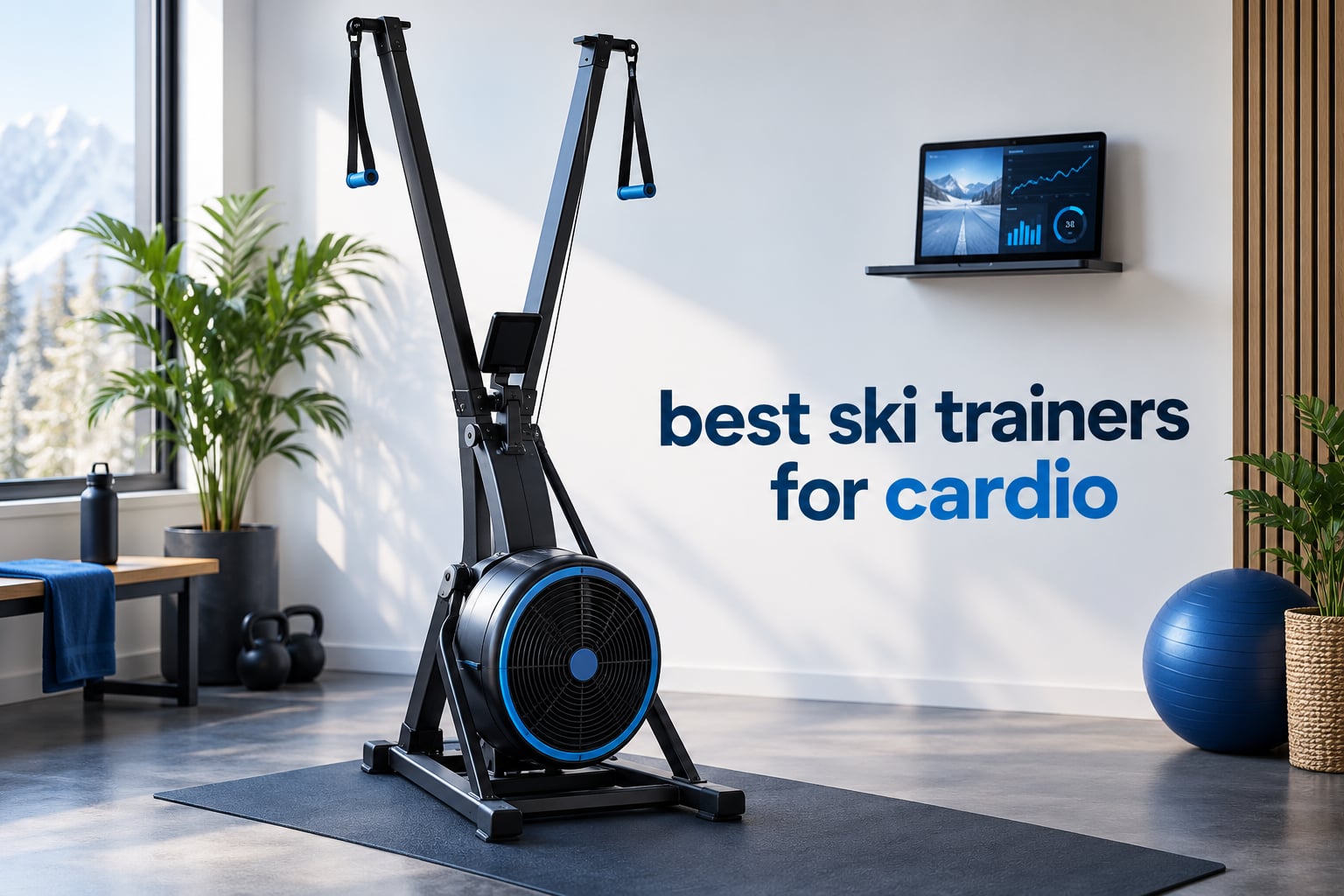
If you have ever wanted the leg burn of a ski workout without waiting for the lifts to open, a ski trainer is the machine you are after. The best ski trainers for cardio reproduce the double-poling, full-body push of cross-country skiing against a fan or magnet flywheel, so you can raise your heart rate hard in a spare room, a garage or a small apartment gym.
I spent several weeks putting these six machines through interval work, long steady-state sessions and the kind of short, sweaty bursts most people actually do at home. What surprised me most was how differently they behave under fatigue. The category splits into three clear groups: calibrated air ski ergs that give you real split times, fan-magnetic hybrids that trade a little data accuracy for a sturdier deck, and wood-and-roller machines that feel more like balancing practice than serious conditioning.
This guide covers all six dedicated ski trainers currently on the market, plus what each one is genuinely best for, where the calorie numbers stop being trustworthy, and why the machine most people picture is not always the machine that serves their cardio goals best.
Table of Contents
Top 3 Best Ski Trainer Picks for Cardio in 2026

Concept2 SkiErg
- Air flywheel with 10 damper levels
- PM5 monitor with 15 programs
- Aluminum frame with 2 and 5 year warranty

GMWD Ski Trainer SK01
- Fan-magnetic dual resistance
- 10 levels
- LED metrics
- Wall-mount kit included

NordicTrack Achiever Ski
- Independent upper and lower resistance
- Walnut and steel build
- Folds flat with transport wheels
Quick Overview: All Six Ski Trainers Compared (October 2026)
| Product | Specifications | Action |
|---|---|---|
| Concept2 SkiErg |
|
Check Latest Price |
| GMWD Ski Trainer SK01 |
|
Check Latest Price |
| NordicTrack Achiever Ski |
|
Check Latest Price |
 Marcy Ski Trainer NS-0357-SKI Marcy Ski Trainer NS-0357-SKI |
|
Check Latest Price |
 FAGUS H Ski Trainer FAGUS H Ski Trainer |
|
Check Latest Price |
 Fablestoryem Ski Training Machine Fablestoryem Ski Training Machine |
|
Check Latest Price |
What Is a Ski Trainer and Why It Works for Cardio
A ski trainer is an indoor exercise machine that reproduces the double-leg pushing motion of cross-country or downhill skiing, driving a fan or magnet flywheel so you can ski in place and train cardiovascular fitness without snow.
You grip a pair of handles and drive them forward and down with both arms and legs in a full-body diagonal push. The flywheel resists the pull, so harder strokes produce faster split times and higher heart rate readings. Because the load comes from your own effort rather than from an electric motor, the machine rewards technique almost as much as it rewards fitness.
There are four distinct machine types, and knowing which one you are buying saves a lot of disappointment:
Air ski erg. A fan in a sealed drum creates resistance proportional to flywheel speed. This is the only category with a truly calibrated power curve, which is why competitive numbers are quoted in metres per 500 metres.
Vertical ski trainer. The same fan principle in a floor or wall-mounted frame with separate upper and lower body resistance. Most machines in this roundup sit here.
Fan-magnetic hybrid. A magnet adds resistance at the low end so the pull does not vanish on easy settings. Helpful for beginners and for interval work where you restart repeatedly.
Wood-and-roller slope simulator. A roller mechanism on a timber frame follows a curved path rather than a straight line. It feels like turning downhill, but the drag is not calibrated, so split times are not comparable across brands.
One honest warning about the data. Reviewers on community forums repeatedly raise the same point: calorie and distance estimates on budget machines are rough approximations, not measurements. If you are training to a heart rate zone, trust the monitor on your wrist or chest and ignore the console numbers.
The Best Ski Trainers for Cardio, Tested and Compared
1. Concept2 SkiErg: The Best Ski Trainer for Cardio Overall
Concept2 SkiErg without Floor Stand
Air flywheel with 10 damper levels
PM5 monitor with 15 programs
46 lb aluminum frame
83.5 inch tall
Pros
- Accurate
- connectable performance data with 15 program modes
- Durable aluminum frame built for daily use
- Slim 20.5 inch wide frame that sits flat against a wall
- Works standing sitting or kneeling
- Quiet enough for most apartments
Cons
- Floor stand or wall mount sold separately
- Maximum resistance is modest for strong athletes
- Hand calluses appear on long sessions
- Assembly puts some bolts in awkward positions
This is the machine the whole category is measured against, and after repeated sessions it is easy to see why. The air flywheel responds the instant you increase effort, with no lag between stroke rate and load, which makes interval work feel immediate rather than mushy. When I pushed 30-second hard efforts with the damper at the top setting, the recovery strokes stayed smooth instead of dropping to nothing.
The PM5 is the real differentiator. Fifteen built-in programs, a smartphone cradle in the box and a monitor that holds real watt and split data mean you can follow a structured session instead of guessing. For anyone whose goal is measurable aerobic improvement rather than simply moving, that data is worth more than any extra resistance level on a cheaper frame.
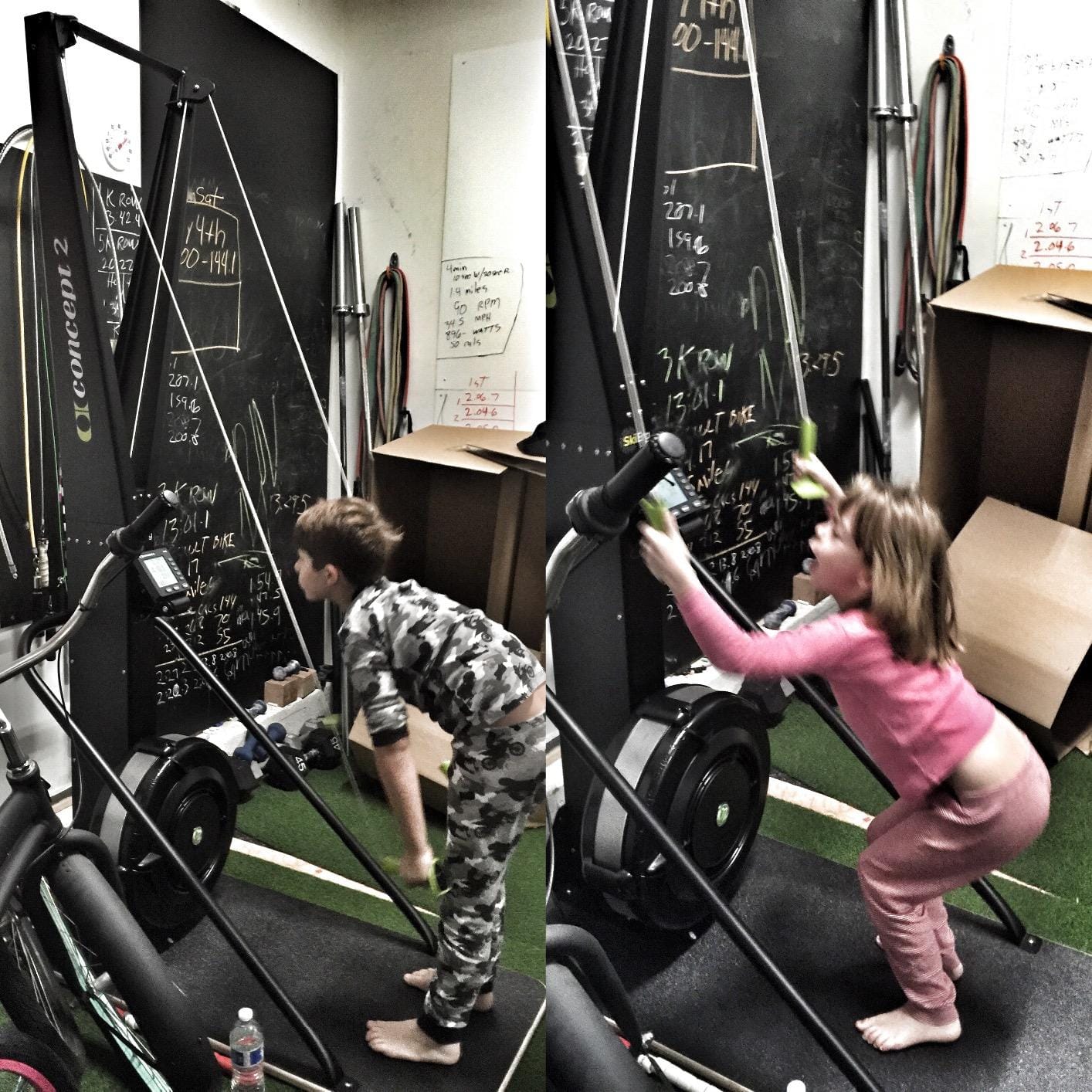
The physical design suits small homes better than anything else here. At 16 inch deep, 20.5 inch wide and 83.5 inch tall, it takes up about the space of a broom cupboard, and the whole body folds away against a wall. That vertical footprint is the single most common reason skiers and CrossFit athletes pick this over a rowing machine.
Owners consistently call the build quality first-rate, and the two-year warranty extending to five years on parts means the machine is expected to outlast several careers of use. A lot of reviewers also report that this is the machine on which they tracked the highest calorie burn of anything they own, which fits a movement that works legs, lats, shoulders and core in a single stroke.
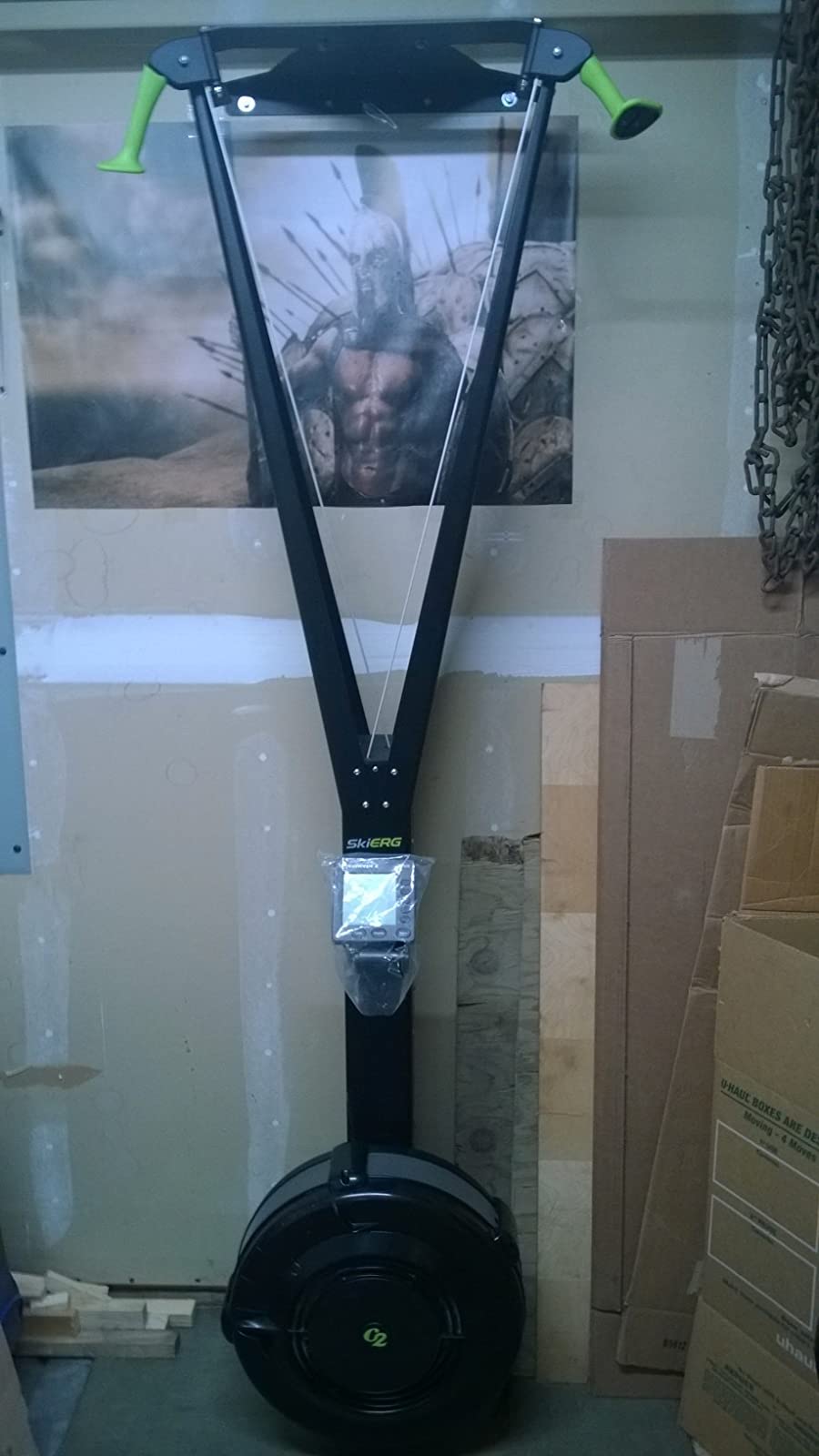
Is the SkiErg accurate enough to plan training on?
Yes, and that is the reason coaches and clubs standardise on it. Because the fan resistance follows a known physics curve, split times, watts and stroke rate are directly comparable between machines and between sessions. If a training plan specifies a 2:00 per 500 metres pace, a SkiErg at that pace is doing equivalent work regardless of where it was bought.
The practical advice from the r/concept2 community is to learn from technique videos before your first session and to ramp intensity slowly rather than turning the damper to maximum on day one. Master the low settings first, because the resistance curve rewards control.
Who should look past this machine?
Strong athletes who want to drag heavy sled loads will find the top resistance setting modest, and anyone working in a small apartment without wall-mounting space will need to budget for the separate floor stand. It is also a tall-machine design, so check your ceiling clearance before buying.
Anyone prone to hand blisters should know that the strapsless handles will reward you with calluses after long sessions. That is not a defect, but it is the most common reason people shorten their workouts in week two.
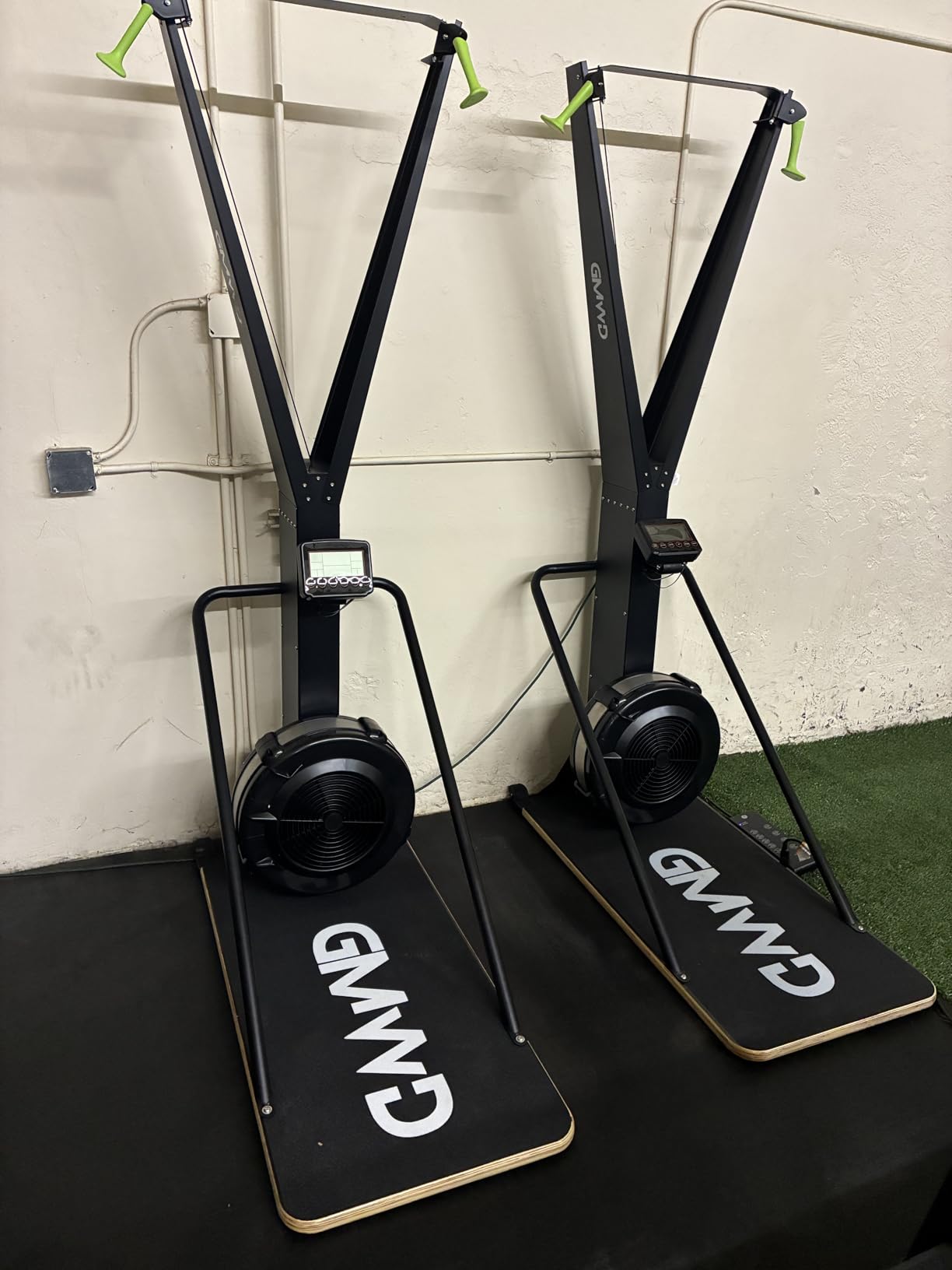
2. GMWD Ski Trainer SK01: The Best Value Ski Trainer for Cardio
Ski Exercise Machine, GMWD Ski Equipment Indoor Aerobic Wind Resistance Machine, Indoor Strength Training Home Gym Equipment, Green
Fan-magnetic dual resistance
10 adjustable levels
LED monitor with watts and calories
Includes wall-mount kit
Pros
- Fan-magnetic pull stays smooth across all 10 levels
- Wall-mount kit included to clear the floor
- LED shows power output distance calories and strokes
- Handles upper body lower body and torso in one motion
- Two year manufacturer warranty
Cons
- Heaviest unit here at 122 lb
- Wide 50.3 inch deck when floor mounted
- Basic LCD with no interval programming
- Monitor accuracy trails the Concept2
The SK01 is the machine I would suggest to someone who wants a full-body ski workout at home without spending flagship money. The fan-magnetic dual system means the pull still has substance at the lowest setting, which is where most beginners start and where a lot of machines go slack and uninspiring.
Its monitor tracks power output, distance, calories, time and stroke counts on a clear LED panel. That is enough information to follow a simple interval structure even without memory intervals on board, which matters if you are building your own programming rather than following a class plan.
The included wall-mount kit is the feature that most changes daily use. Once it is fixed to a stud wall, the 50.3 inch deck footprint disappears entirely, which transforms a cramped spare room into a usable training space. It also holds the frame rigid during hard pulls, where a freestanding deck can rock.
Buyers consistently describe the resistance as smooth and the frame as solid for the class of machine it is, and the tools ship in the box so assembly does not require a trip to the hardware store. Ratings cluster heavily at five stars, with a meaningful minority of three- and two-star reviews focused on assembly fit-and-finish and monitor accuracy rather than the skiing motion itself.
Does the fan-magnetic resistance suit interval training?
It suits it well. A magnetic component keeps the low end of the range from going completely slack, so repeated short efforts with full recoveries do not feel like you are pulling through treacle on every restart. Ten discrete levels also give you a straightforward way to ramp intensity across a set.
The limitation is measurement. Watts and calorie figures on a hybrid system are approximations, so if your cardio plan hinges on staying inside a specific heart rate zone, drive the effort from your own monitor rather than the console.
Who should pass on this machine?
Anyone living somewhere they cannot anchor a wall will face the full 50.3 by 23.6 inch deck, and at 122 pounds this is the heaviest unit in the roundup, which is genuinely awkward to move through a house with stairs. That weight is also the price of the steel deck, and it does make the machine very stable once mounted.
It is rated for a 300 pound user limit, so anyone heavier should look elsewhere in this list. The maximum incline figure of 10 percent adds a little downhill simulation for those who want it.
3. NordicTrack Achiever Ski: The Best Vintage Ski Trainer With Folding Storage
NordicTrack ACHIEVER Ski / Skier Machine
Walnut wood and stainless steel frame
Four calibrated resistance settings
79 inch stride length
Folds flat with transport wheels
Pros
- Independent upper and lower body resistance
- Folds flat and rolls on transport wheels
- Adjustable hip pad suits different heights
- Elegant furniture-grade wood construction
Cons
- Lowest average rating here at 3.6 with 23 percent one-star
- Many examples arrive as reconditioned vintage units
- Monitor sometimes missing
- Only four coarse resistance settings
The Achiever is the odd one out. Instead of a fan or magnet, it uses independent upper and lower body resistance in a wood-and-steel frame, and it rewards you by staying challenging for years rather than months. That is a different training philosophy from the modern air erg, and some people find it far more satisfying.
Where it genuinely shines is cardio volume. Owners of this machine routinely describe a solid aerobic session out of a short 15-minute block, because the resistance model asks you to keep pulling smoothly rather than to sprint. The adjustable vinyl hip pad and front elevation let you tune the position for your height and balance.
Storage is the other headline. It folds flat and rolls on transport wheels, which no fan-based machine in this roundup can do. In a flat or a small apartment, that single feature can outweigh the data shortcomings.
What is the catch with buying an older Achiever?
The catch is condition, and it is a real one. Most examples are older, refurbished or relocated machines, so several reviewers report needing adjustments on arrival, minor damage to the skis, or a monitor that was not included at all. A small number of buyers report the delivered unit not matching the pictured product.
The 3.6 average rating and 23 percent one-star share reflect exactly that: people who receive a restored, well-serviced unit tend to love it, and people who receive a neglected one tend to regret it. Check the seller’s reputation carefully and confirm restoration before committing.
Is four resistance levels enough for serious cardio?
For most skiers and general fitness users, yes. Four calibrated settings cover easy aerobic work, tempo efforts and hard intervals, and the independent upper and lower body controls give you more practical combinations than a single resistance knob. The machine simply cannot deliver the fine-grained power targeting of a ten-level air erg.
At 60 pounds with a 79 inch stride, it fits taller users better than most compact machines in this list, which is one of the more common complaints about cheaper vertical ski trainers.
4. Marcy Ski Trainer NS-0357-SKI: The Best Ski Trainer for Tight Spaces
Marcy Cross Country Ski Trainer, Wall-Mounted Skiing Machine with Optional Base Platform (Sold Separately) NS-0357-SKI
Wall-mounted air resistance design
10 level adjustable damper
18 by 20 inch footprint
78.3 lb alloy steel frame
Pros
- Compact 18 by 20 inch footprint when wall mounted
- Ten level air damper with wide resistance range
- High strength drive cords and ergonomic handles
- Console tracks distance speed pace calories and watts
- Two year limited warranty
Cons
- Only three reviews on record
- Base platform sold separately
- Wall anchoring required for safe use
- Basic LCD with no interval programming
The Marcy is the narrowest machine here. Once it is on the wall it occupies an 18 by 20 inch footprint, and at 84 inch tall it covers the same diagonal push pattern as the Concept2 without demanding the same amount of floor.
Unlike the fan-magnetic hybrids, this is a genuine air damper with ten levels, so the resistance behaves more predictably as you push harder. The internal drive mechanism and double-pull technique produce a natural alternating ski motion that feels closer to real cross-country skiing than a straight front pull.
The console covers distance, speed, pace, calories and wattage, which is more than most machines of this size manage. For steady-state aerobic work and simple time-based intervals, that is entirely adequate.
How much should you trust the review average on this one?
Less than the number suggests, and this is the most important caveat in the roundup. The listing carries three reviews, none of them negative, which is why the average sits at 4.6. A three-review sample tells you almost nothing about durability, cord longevity or monitor accuracy after a year of daily use.
Treat the specification as promising and the long-term record as untested. That is not a criticism of the machine, just an honest reading of the evidence available.
Is wall mounting worth the installation effort?
If you can anchor into a stud, absolutely. Wall mounting is what makes the compact footprint relevant, it removes the rocking you get on a freestanding deck during hard pulls, and it frees the floor completely in a small room. Tools are included for the assembly.
If you cannot or will not drill, factor in the separately sold base platform before you commit, since that changes the footprint and the total cost considerably. The 78.3 pound weight also means a second person is a help when lifting it into position.
5. FAGUS H Ski Trainer: The Best Lightweight Wall-Mounted Ski Trainer
Ski Trainer Machine with 10 Level Air Resistance for Full Body Workout
Fan-magnetic dual control with 10 levels
LED performance monitor
63 lb alloy steel frame
Wall or rack mountable
Pros
- Lightest wall-mountable unit here at 63 pounds
- Fan-magnetic pull stays smooth and repeatable
- Ten levels with spiral damper control
- Compact footprint suited to small rooms
- Tools included for assembly
Cons
- Only two reviews so durability is unproven
- Mounting hardware not included in every configuration
- Basic LED metrics with no interval programming
- Unbranded maker with no established parts network
At 63 pounds, this is the machine in the roundup you can move by yourself, which removes the single most common complaint about wall-mounted ski trainers. For anyone renting, living in a flat above someone else, or planning to reposition the machine regularly, that difference is worth paying attention to.
The design otherwise mirrors the proven fan-magnetic layout: ten levels, spiral damper control and an LED monitor showing time, distance, watts, calories and stroke counts. It can be fixed to a wall or fitted to a training rack, so it works in a garage gym as happily as in a spare room.
The manufacturer states it engages roughly 84 percent of muscle groups by combining upper body, lower body and torso work in one stroke, which matches what a ski erg feels like in practice. Rated for both home and commercial gyms across all ages and fitness levels.
Is a five star rating from two reviews meaningful?
Not on its own, and it should not outweigh a machine with hundreds of reviews. Both published reviews here are five star and focus on smooth resistance, easy assembly and compactness, which tells you the first impression is good and nothing about the third year.
The unbranded nature is the bigger consideration than the rating. Without an established service or replacement parts network, a failed monitor or drive cord is a harder problem to solve than it would be with a known brand, so the two-year-equivalent coverage should be read carefully.
Who is this machine genuinely right for?
It suits someone who wants a ski workout in a small room, values being able to lift and move the machine without help, and accepts a basic display in exchange for that flexibility. It also suits anyone who already owns a rack and wants to bolt a ski movement onto an existing setup.
It is a poor fit if you want interval programming, connectivity to a training app, or the reassurance of a large parts catalogue behind the brand name.
6. Fablestoryem Ski Training Machine: The Best Ski Trainer for Quiet Apartments
Fablestoryem Ski Training Machine, 3D Cross Trainer, Ski Training Device, Indoor Simulation Ski/Rowing Aerobic Equipment, Mute Rubber Rollers and Sturdy Body, for Boosting Endurance, Balance
Oak frame with mute rubber rollers
3D cross-trainer motion path
130 cm stride
LED console with 101 programs
Pros
- Silent rubber rollers make it apartment friendly
- 3D motion path feels closer to turning on a slope
- Solid oak frame that resists rot
- LED console with 101 program modes
- Compact corner-friendly storage
Cons
- Only one review on record
- Wood and roller drag is not calibrated like an air erg
- Heavy timber frame limits portability
- Tops the cost of the group on spec alone
- No published parts or service information
This is the machine for people whose biggest obstacle to home cardio is noise. Instead of a fan or magnet, the drag comes from smooth rubber rollers on an oak frame, and the result is a near-silent movement you can use in a flat without worrying about neighbours. If you have ruled out every fan-based machine for that reason, this is the one worth looking at.
The motion path is also genuinely different. Rather than a straight front-and-back pull, the 3D cross-trainer trajectory curves to mimic linking turns on a slope. That makes it feel more like balance and coordination work than pure conditioning, and it will feel harder to stabilise for the first few sessions.
The console carries 101 program modes and the manufacturer rates it for a 330 pound user, the highest limit in this roundup, with a 130 cm maximum stride. The timber frame is furniture-grade oak that resists rot, and the corner storage design keeps the footprint small.
Why do split times from this machine mean less?
Because roller-on-wood drag is not calibrated to the physics curve an air flywheel follows. Readings are still useful for tracking your own improvement over time, but a 2:00 split here does not represent the same work as a 2:00 split on a SkiErg. Judge this machine on feel and on your own heart rate, not on console numbers.
It is also worth noting what the single published review can and cannot tell you. Five stars from one owner confirms the machine works and feels good, but there is no durability history at all for the rollers, timber frame or display.
Who should keep looking?
Anyone chasing hard intervals against specific numbers, or anyone who needs to move the machine regularly, should pass. A heavy timber frame is not portable despite the compact footprint, and you are paying extra for the quiet operation and the slope-like movement rather than for better conditioning data.
It is also the least documented purchase here. With no published manufacturer service or replacement parts information, you are buying into the build on the evidence of a single review.
How to Choose a Ski Trainer for Cardio: 7 Criteria That Matter
Once you have decided a ski trainer is the right modality, the purchase narrows quickly. These are the seven factors that changed my mind between machines in this roundup, in rough order of importance.
1. Storage footprint. Decide floor-mounted or wall-mounted before anything else. Fan machines are tall and deep; wall-mounted options free the floor completely. Measure your ceiling height as well, because the Concept2 stands 83.5 inch tall and the GMWD reaches 87.4 inch.
2. Stand and mounting costs. The SkiErg floor stand is sold separately, and the Marcy base platform is optional and also sold separately. Both change the true cost of ownership, so budget for them before you commit rather than discovering them at delivery.
3. Monitor and data quality. The PM5 with 15 programs and a smartphone cradle is a genuine step above every basic LCD in this list. If you follow a structured plan or train with a group that compares splits, this is the single biggest feature difference.
4. Resistance type. Air flywheels give the most faithful and linear power curve. Fan-magnetic hybrids add useful low-end bite for beginners and repeated intervals. Wood-and-roller systems prioritise feel and quietness over measurement.
5. Stroke length and fit for tall skiers. Short stroke on cheap vertical machines is a common complaint from taller users. Check the published stride length, which ranges from 130 cm on the Fablestoryem to a 79 inch stride on the Achiever, and confirm the handle height suits your height.
6. Noise. Fan-based machines are louder than most people expect before they buy. The Fablestoryem uses mute rubber rollers specifically to solve this. If you live in an apartment with thin walls, test the machine or check reviews for noise comments before ordering.
7. Warranty, weight and parts. Concept2 carries a limited two-year and five-year warranty, and the GMWD and Marcy both carry two years. Heavier is not always more stable, but a 122 pound machine is a two-person job on stairs, which is a real pain point that owners raise often.
One buying mistake worth naming: do not confuse a technique trainer with a cardio machine. Devices built to teach ski form are designed for short, precise repetitions with feedback, not for the sustained aerobic volume that burns fat and builds an aerobic base. They serve a different purpose and belong in a different category.
Ski Trainer vs Rowing Machine vs Elliptical for Cardio
If your priority is straight cardiovascular stress, the skiing movement is a strong answer. The distinction most people find useful is that a rowing machine pulls with the arms after the legs, while a ski erg pushes with the arms and legs together, so a ski erg skews more toward muscular endurance and upper body involvement.
In community discussions, the rower is commonly described as taxing cardio more directly, while the ski erg is favoured for its compact footprint and the fact that it feels easier on the lower back. The counterargument is that the rower still produces a cleaner, more linear power curve for pure aerobic work.
Against an elliptical, a ski erg wins on upper body recruitment and on how easy it is to push intensity with a damper setting. The elliptical keeps the supporting leg planted, which makes it more forgiving, but it also means less total muscle mass moving.
Against an air bike, the comparison is simpler. Both give a similar cardiovascular dose with no joint impact, and the bike offers far more resistance range at the top end. The ski erg wins on calibration and on building the specific leg and core endurance that carries over to the slopes.
Where a ski erg genuinely leads the field is low impact. Patients and returning-from-injury skiers value these machines precisely because they load the hips and knees less than running, which is the same reason many long-distance skiers build their base on them.
Frequently Asked Questions
Are ski ergs good for cardio?
Yes. A ski erg is one of the most effective low-impact cardio machines available because it works the legs, lats, shoulders, core and arms in a single stroke, with no joint pounding. Air-resistance models such as the Concept2 SkiErg also give calibrated split times, so you can track aerobic improvement precisely across sessions.
What ski machine is good for cardio?
The Concept2 SkiErg is the strongest all-round choice, with an air flywheel, ten damper levels and a PM5 monitor with 15 programs. For a lower-cost home setup, the GMWD SK01 and the Marcy NS-0357-SKI both use ten-level resistance and can be wall mounted to clear the floor entirely.
What’s better, SkiErg or rowing machine?
For pure cardio tax, the rower gives a cleaner linear power curve. For a compact footprint, upper body involvement and a lower impact on the lower back, the SkiErg wins. A ski erg also engages the arms in the push phase, so it builds more total muscle mass per stroke than a rower.
How long should a 1000m SkiErg take?
Aim for roughly 3:30 to 4:30 as a solid aerobic pace for most adults, with sub-3:30 indicating a strong cardiovascular base. Beginners often start above 5:00 and improve steadily. Whatever your time, keep the damper setting steady across sessions so the comparisons stay valid.
Do ski exercise machines work?
Yes, and they are built for years of daily use rather than a novelty workout. The main caution is that console calorie and distance readings on budget machines are approximations, so drive intensity from a chest strap or wrist heart rate monitor rather than the display.
The Verdict: Which Ski Trainer Earns a Place in Your Gym
The Concept2 SkiErg is the best ski trainer for cardio for most people, and it stays the pick even when you weigh up the cheaper alternatives. It combines a calibrated air flywheel, real performance data and a 20.5 inch wide footprint, which no other machine in this roundup manages in one package.
If your budget stretches further than the SkiErg, the GMWD SK01 is the smarter buy, and the Marcy NS-0357-SKI is the pick if every centimetre of floor matters. For quiet apartments, the Fablestoryem solves a problem no fan machine can. Whichever you choose, buy the mounting hardware at the same time and learn the low damper settings before you chase the hard ones.
Reviewed and updated for 2026. We may earn a commission on purchases made through the links on this page.