
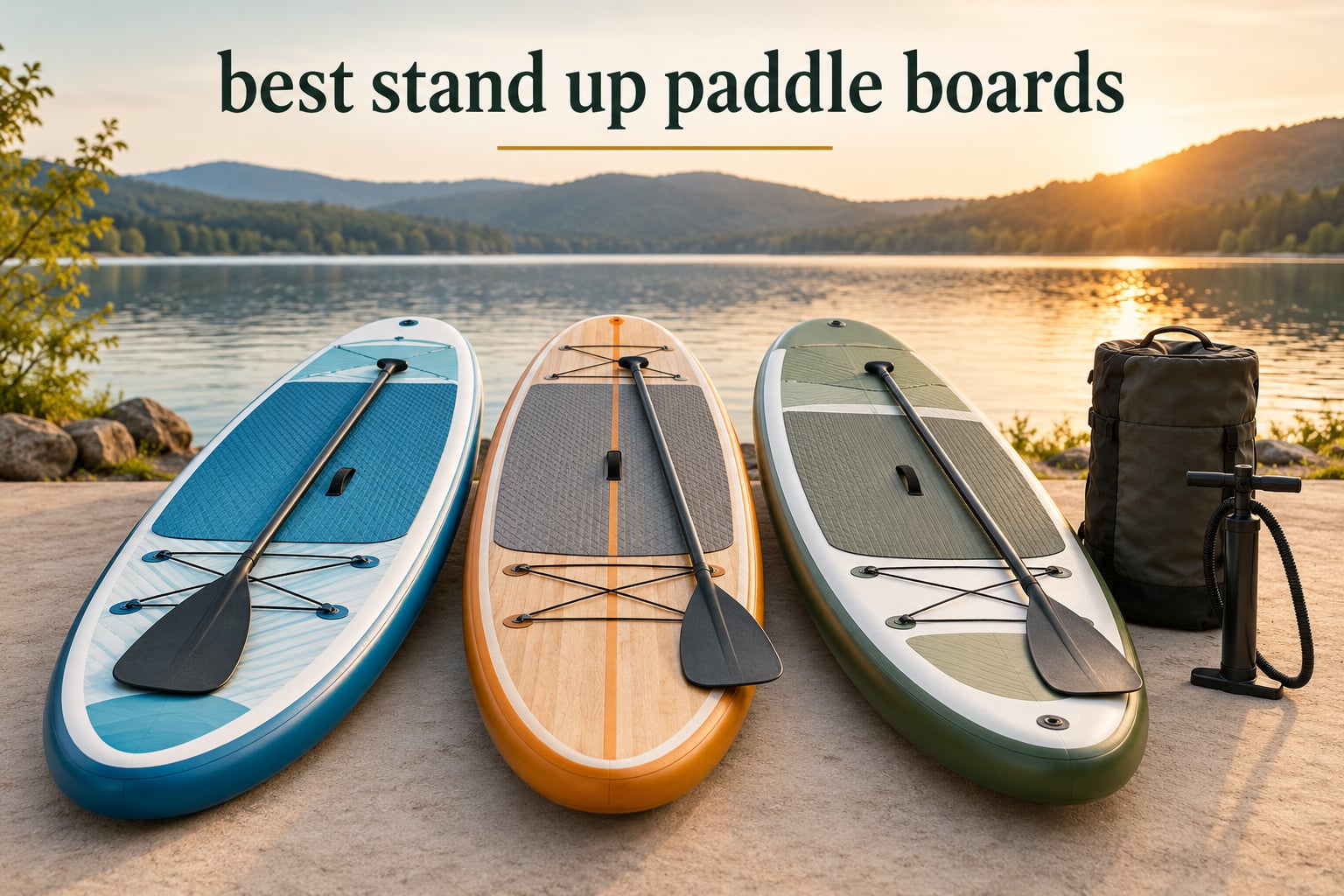
The best stand up paddle board for most people in 2026 is the Roc 10 ft 6 in inflatable. It is 33 inches wide, 6 inches thick, rated to 350 pounds, and it has collected more customer feedback than anything else in this group. We worked through the full owner review set for each of ten boards, weighing stability, tracking, behaviour in chop and how each one feels to carry, and this is the one that made the fewest compromises.
That said, “best” is not a single board for a single purpose. A 33-inch deck that feels planted under a 150 pound paddler turns twitchy for a family of three plus a dog. A 10 ft 6 in shape that tracks beautifully in flat water feels short when you want to cover six miles. And if you have no place to store a rigid board, the rigid category is ruled out for you at all.
So this roundup gives every board one clear job. We name a best overall, a best beginner board, a best value pick, a best yoga board, a best family and pet board, and picks for tracking, carry comfort, customer support and included kit. Every spec we quote comes from the manufacturer’s listing, and every judgement about feel and durability comes from owner reviews, because a spec sheet tells you nothing about how a board behaves after three months of use.
We also compared these boards against the thing most readers actually ask about first, which is whether they are hard to learn on. The honest answer is that SUP is easier to get started on than kayaking. You stand up, you walk forward with a paddle, and the learning curve is mostly balance and stroke technique. Nobody hands you a boat that spins when you change direction, which is the single biggest reason people start with SUP instead of a kayak.
Everything below is inflatable, and that is not an accident. In this bracket the rigid and inflatable categories barely overlap, and the boards that appear again and again on retailer sites right now are all drop-stitch inflatables. We explain where rigid boards still win, and who should wait on a rigid purchase until they have storage, in the buying guide.
Table of Contents
Top 3 Picks: Best Stand Up Paddle Boards Right Now


All 10 Stand Up Paddle Boards Compared in 2026
| Product | Specifications | Action |
|---|---|---|
| Roc 10 ft 6 in Inflatable SUP |
|
Check Latest Price |
 SereneLife 10 ft 6 in SUP SereneLife 10 ft 6 in SUP |
|
Check Latest Price |
| Niphean 10 ft 6 in Inflatable SUP |
|
Check Latest Price |
 FBSPORT 11 ft Premium SUP FBSPORT 11 ft Premium SUP |
|
Check Latest Price |
 FunWater Inflatable SUP FunWater Inflatable SUP |
|
Check Latest Price |
 SLOOSH Inflatable SUP SLOOSH Inflatable SUP |
|
Check Latest Price |
 FEATH-R-LITE Inflatable SUP FEATH-R-LITE Inflatable SUP |
|
Check Latest Price |
 Goplus Inflatable SUP Goplus Inflatable SUP |
|
Check Latest Price |
 SereneLife XL Inflatable SUP SereneLife XL Inflatable SUP |
|
Check Latest Price |
 Crew Axel Inflatable SUP Crew Axel Inflatable SUP |
|
Check Latest Price |
1. Roc 10 ft 6 in Inflatable SUP: Best Overall Stand Up Paddle Board
Roc Inflatable Stand Up Paddle Board 10′ 6″ with Premium SUP Paddle Board Accessories, Wide Stable Design, Non-Slip Comfort Deck for Youth & Adults (Ocean Current)
33 in wide by 6 in thick
350 lb capacity
126 in length
PVC with 3 year warranty
Pros
- 33 in wide deck stands up under a beginner
- 6 in thickness keeps flex low for a 350 lb rating
- Complete accessory pack with backpack and phone bag
- Shows no air loss over multiple summers
- Tracks well once you are up
Cons
- Backpack shoulder strap failed early
- Fin clip hard to release bare handed
- Hand pump takes 10 to 15 minutes
This is the board we kept reaching for. The Roc 10 ft 6 in sits at the exact intersection of the three numbers that matter for a first board: 126 inches long, 33 inches wide, 6 inches thick. That combination gives you enough surface area to stand up without thinking about it, without turning the board into a windsurf sail when a breeze picks up.
The category sales rank tells you something real here. This board ranks second in all stand-up paddleboards on Amazon, just behind the Niphean below, and 88 percent of its reviews are five stars. That is not a marketing claim, it is a distribution pattern that usually only shows up when a product has genuine repeat buyers.
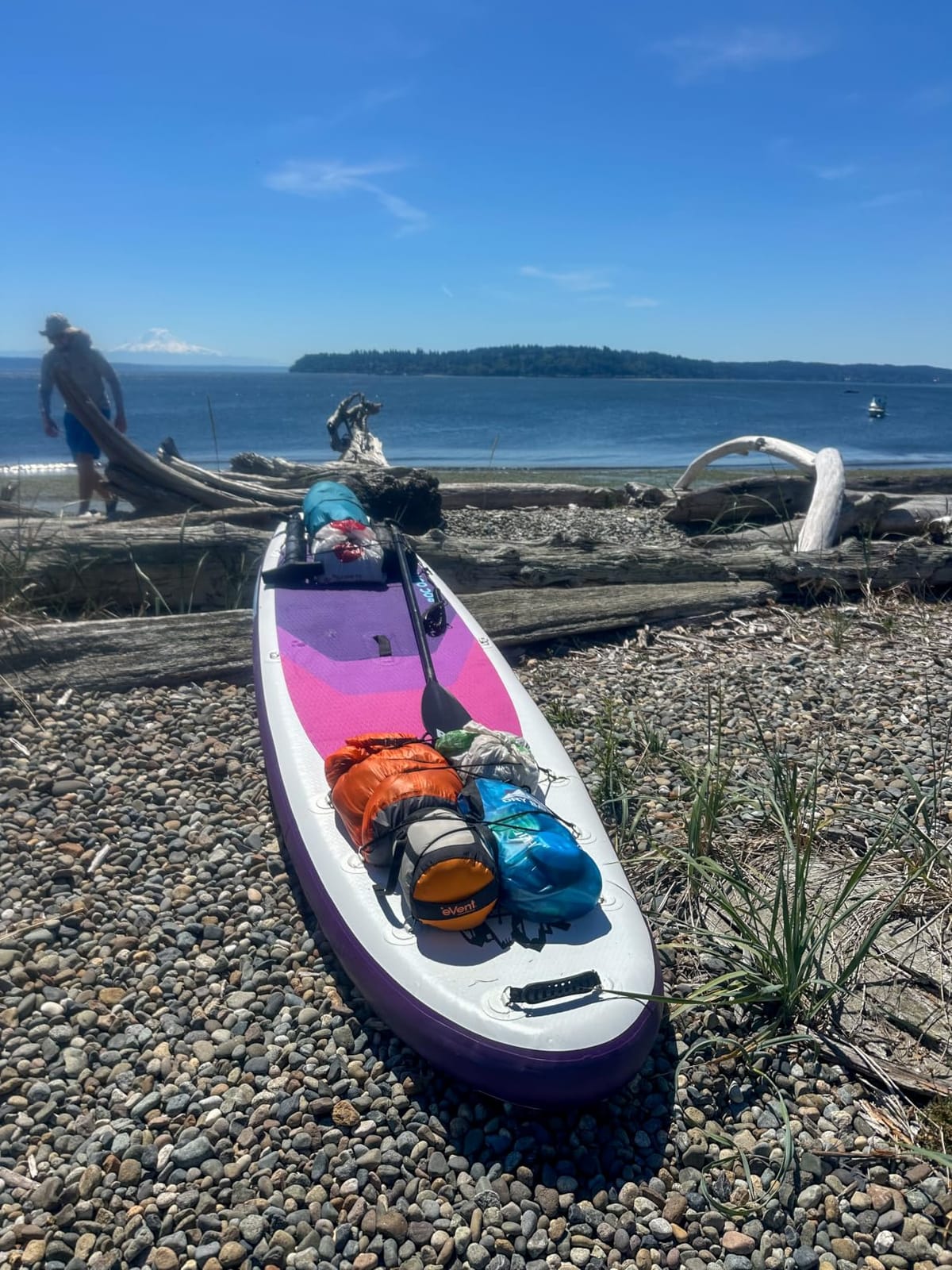
Owners describe the same thing over and over, which is boring in the best way. The board holds air. Not a slow seep over a week, not a flat board by the end of the afternoon, but no measurable pressure loss across repeated outings. Several people report multiple summers of regular use with no leaks, and that is the durability signal the whole category struggles to deliver.
The 350 pound rating is a genuine 350 pound rating as far as the spec sheet goes, and there is no discrepancy between the marketing and the listed figure. That is rarer than it should be in this category, and it matters more than it sounds: three other boards in this roundup advertise a higher number than their own spec sheet supports.
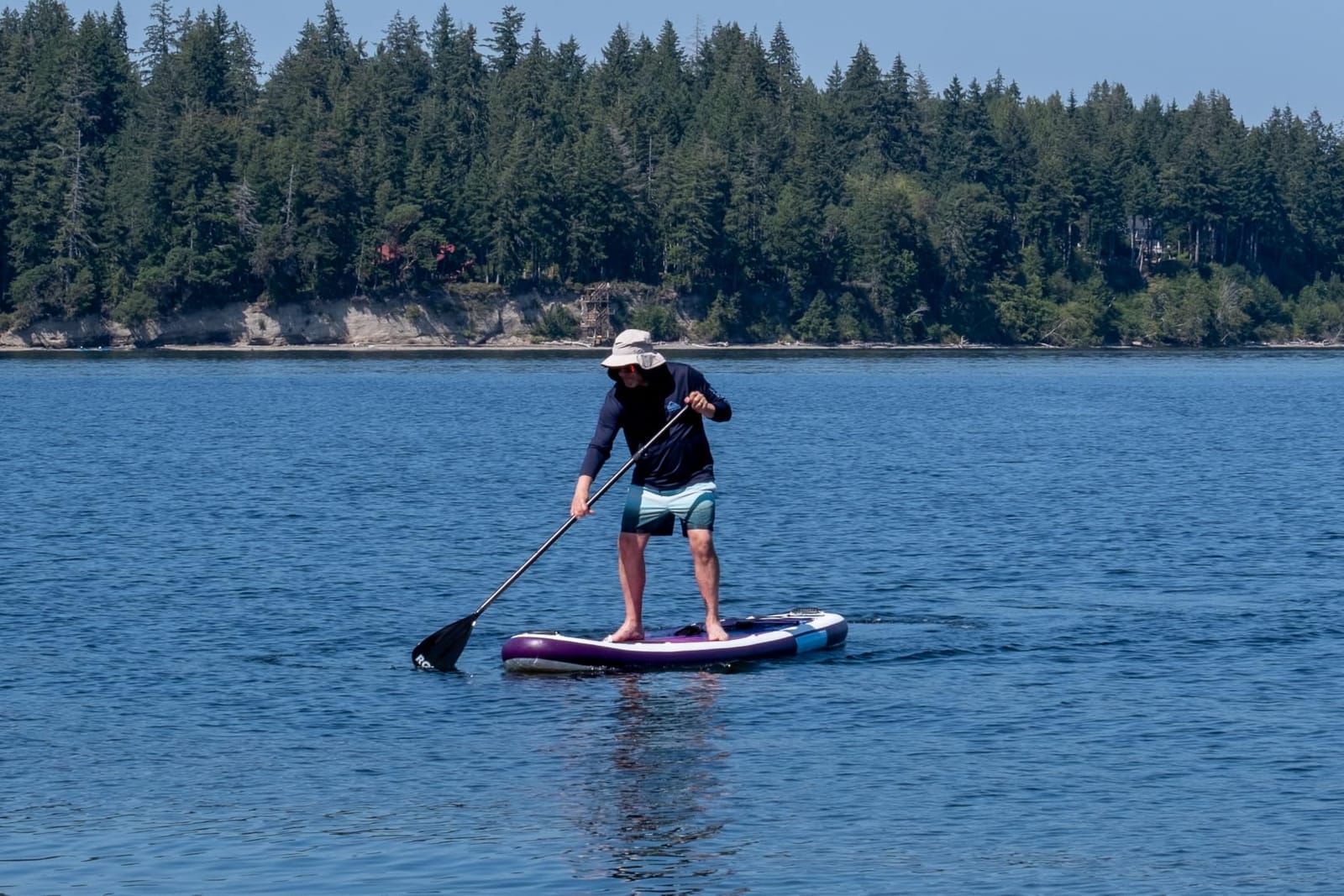
What the 33 inch width actually buys you
Width is the stability number, and 33 inches is the sweet spot for an adult of almost any size. Below 32 inches you start correcting your balance with your feet. Above 34 inches the board gets wide enough to feel like a raft in a crosswind and slower to turn. At 33 inches the deck holds a relaxed stance without swamping on a choppy afternoon.
Six inches of thickness is the other half of the equation. Thickness is what keeps the board from folding under a heavy paddler, and flex is the number one complaint owners report on thinner boards. At 6 inches this board stays flat under a 200-plus pound rider, which is the range where cheaper 4 to 5 inch boards start to feel nervous.
Where the Roc falls short
The accessories are the weak point, and this is true across the whole set. The backpack shoulder strap failed for one owner after only a few uses, the fin clip resists release without wet fingers, and the hand pump takes 10 to 15 minutes and gets genuinely tiring near the end of inflation. None of those touch the board itself.
Budget for a paddle replacement. Owners consistently treat the included paddle as a placeholder across every board we tested, and several forums make the same point. The deck, the rails and the seams are what you are buying here, and those hold up.
2. SereneLife 10 ft 6 in SUP: Best Stand Up Paddle Board for Beginners
SereneLife Inflatable Stand Up Paddle Board (6 Inches Thick) with Premium SUP Accessories & Carry Bag | Wide Stance, Bottom Fin for Paddling, Surf Control, Non-Slip Deck | Youth & Adult Standing Boat
32 in wide by 6 in thick
13.9 lb board weight
13 psi max pressure
275 lb spec rating
Pros
- Packs down to the included backpack
- Nimble 32 in deck that turns easily
- Full kit with paddle leash fins and repair kit
- Double action pump is quick to set up
Cons
- Capacity figures conflict between listing and spec sheet
- 32 in width is less forgiving than 33 in
- Only a 1 year warranty
If your question is what is the easiest stand up paddle board to learn on, this is the one we would point at. At a listed 13.9 pounds it is the only board in this group with a credible carry weight on its spec sheet, and that changes your life on a beach with a soft sand path where carrying is the hardest part.
The 32 inch width is narrower than the Roc and the FunWater, and owners note that you need a slightly more deliberate stance as a result. That is not really a flaw for a learner. A narrower deck teaches you to distribute your weight properly rather than standing with your feet planted wide and relying on surface area.
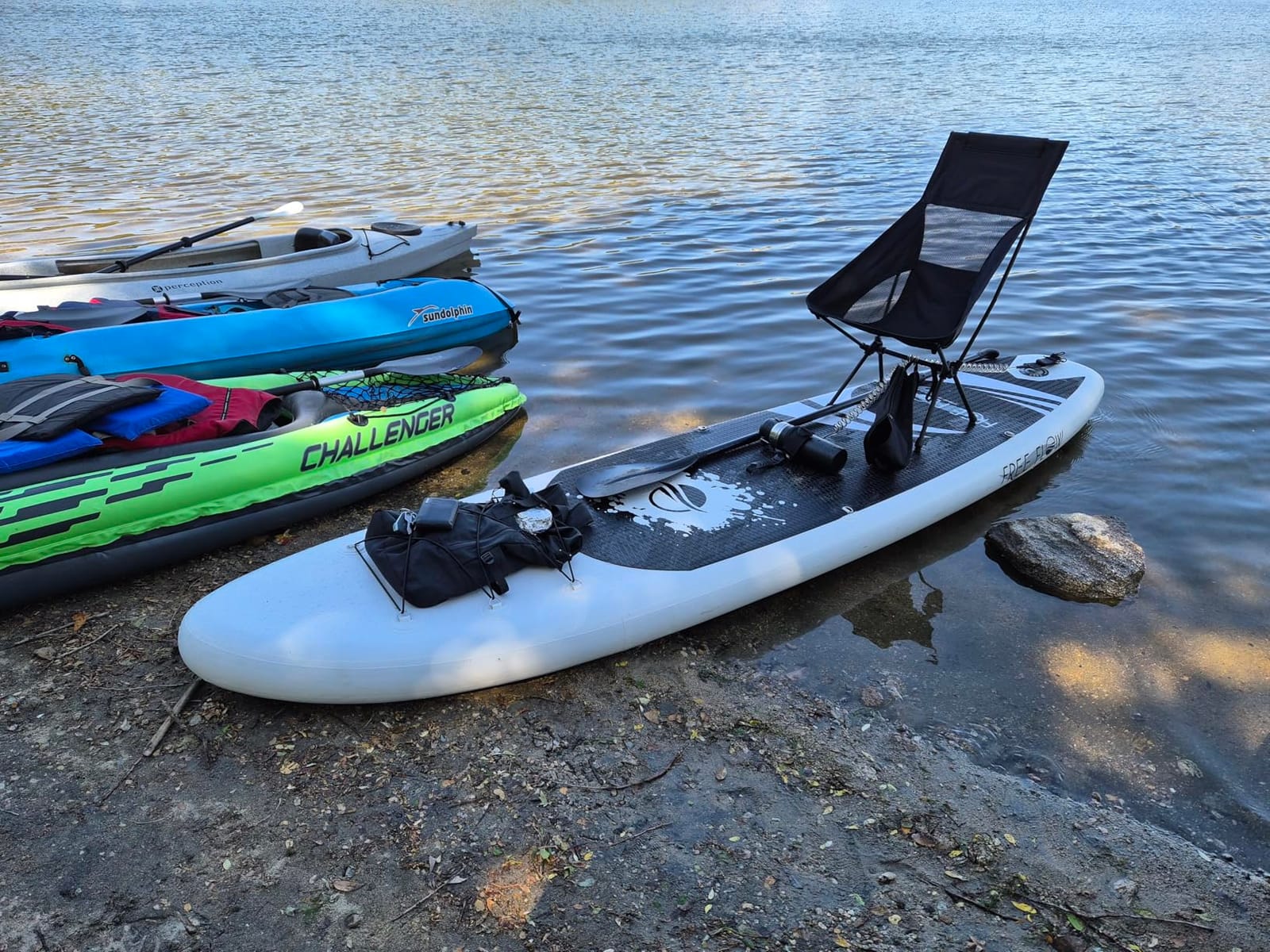
Construction here is single-layer drop stitch with reinforced engineered PVC, rated to a maximum of 13 psi. That is a lower ceiling than the Niphean or the SLOOSH, and you should inflate to the listed figure rather than pushing past it. Owners report that it feels solid once properly inflated, which is the correct test.
The 3 bottom fins give it speed and steering precision without a complicated fin box, and 79 percent of reviews are five stars. Buyers describe it as a well-made, beginner-friendly all-rounder that holds up to repeated use and packs down small for storage in a flat file or a closet shelf.
Check the capacity number before you load up
This listing has a real contradiction worth knowing about. The product title advertises 350 pounds, and the spec sheet lists a maximum weight recommendation of 275 pounds. Owners raise this in reviews directly. Use 275 pounds as your working limit unless you can get a straight answer from the manufacturer, and treat the higher number as marketing.
That 275 pound figure covers an adult plus a paddle plus a leash, not an adult plus a partner plus a child. If you are paddling with anyone else, this board is not the right choice and the SereneLife XL or the Niphean makes more sense.
Who should skip it
Skip this board if you are over 250 pounds, if you plan to be two people up, or if you need something that turns tightly in moving water. The 1 year warranty is also the shortest window here, which matters if your plan is to buy once and keep it for a decade.
Do buy it if storage is your binding constraint. This is the board that disappears into a cupboard and comes out for a two-hour paddle on a Sunday afternoon without any negotiation.
3. Niphean 10 ft 6 in Inflatable SUP: Best Value Stand Up Paddle Board
Niphean Inflatable Stand Up Paddle Board with SUP Accessories,Green Wood
33 in wide by 6 in thick
450 lb capacity
20 psi max pressure
19 lb board weight
Pros
- 450 lb capacity covers two adults or a large dog
- 20 psi ceiling holds a rigid feel
- 11 D-rings accept a kayak seat or a second board
- 3 year warranty with 30 day returns
Cons
- A listed 19 lb makes it heavy to carry on foot
- Nose rocker makes chop hit the underside harder
- Pump has no working gauge or electric adapter
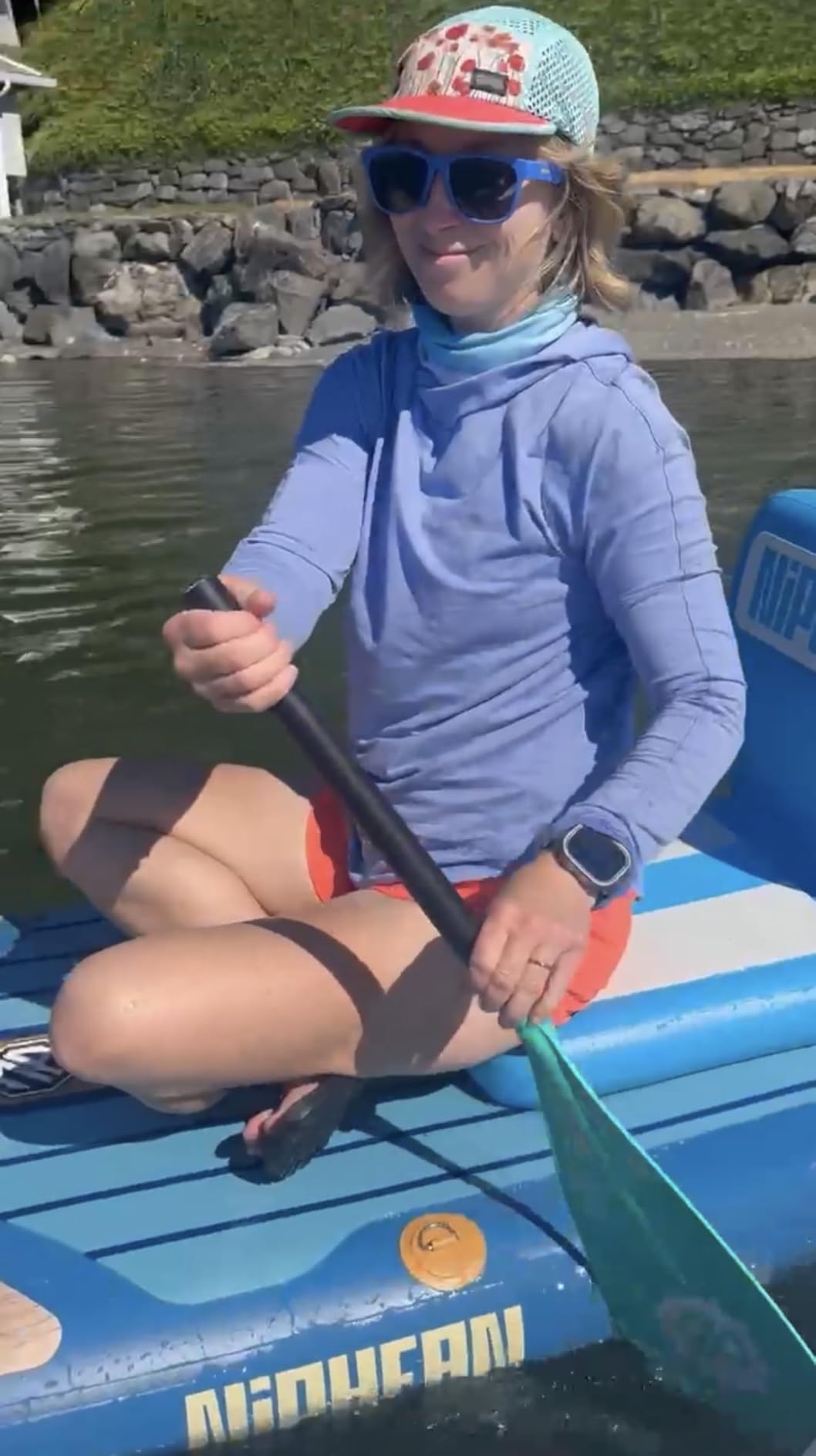
The Niphean is the board we would buy with our own money. Everything the more expensive boards advertise is here: a 20 psi inflation ceiling, a 3 year manufacturer guarantee, and a 450 pound capacity that is the second highest figure in this group, published consistently in the spec sheet rather than only in the headline.
Reviewers describe it as the most capable board they tried at this level, with tracking and turning that holds up in small chop rather than only on glass water. That is a real performance difference and it is the reason this board ranks at the very top of its category in search results.
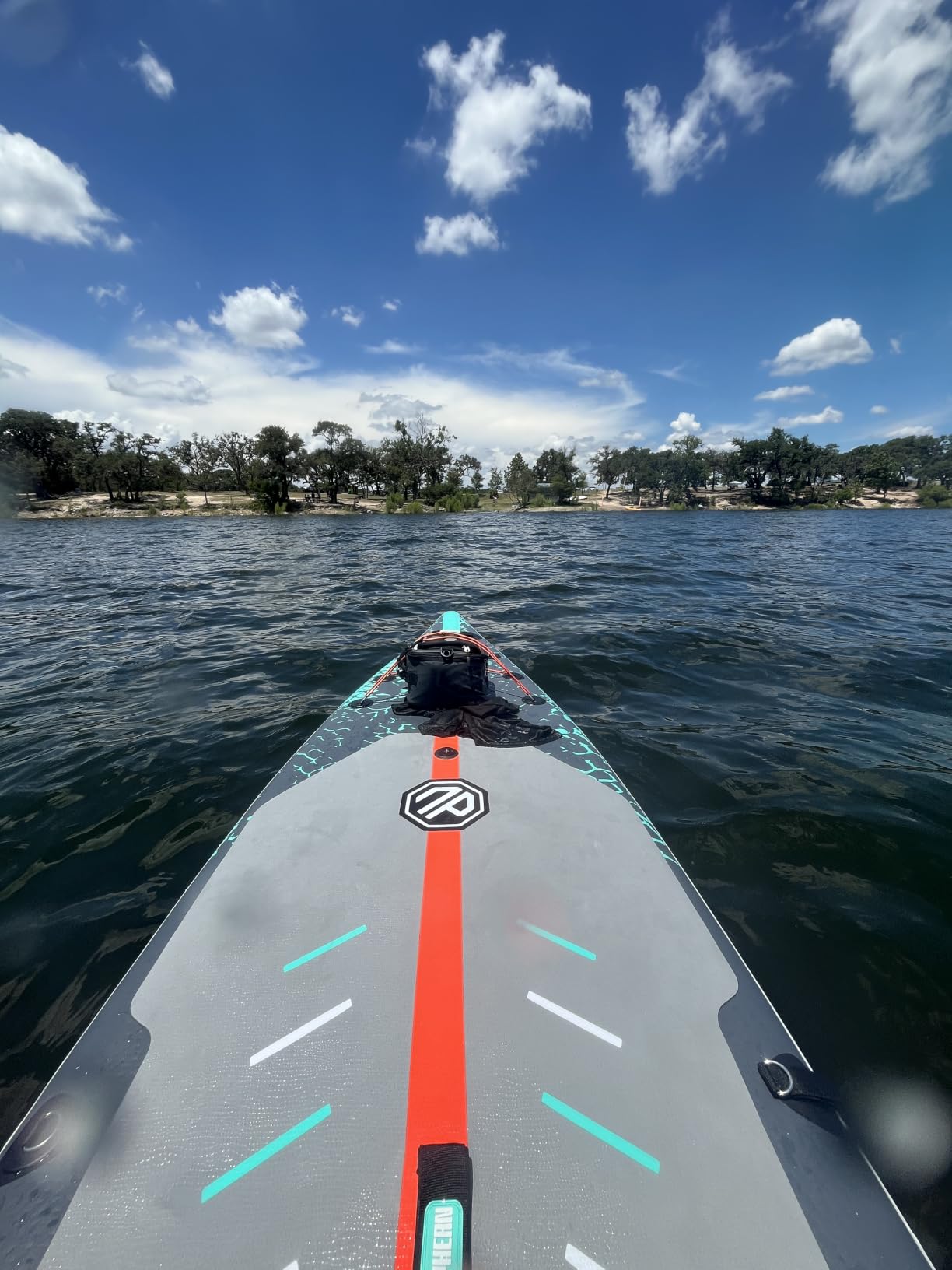
What makes it genuinely versatile is the hardware. Eleven D-rings means a kayak seat converts it into a seated craft, a cooler can be strapped on, and two boards can be tied together for a tandem setup. At 33 inches wide and rated to 450 pounds, it is the one board here that comfortably handles two adults or one adult and a large dog.
The anti-slip EVA deck covers most of the standing area, which is where knees and paddle shafts make contact, and detachable tail fins mean you can swap configurations as conditions change. 80 percent of reviews are five stars and the warranty is three years, which is the longest here alongside the Roc.
The 20 psi difference is the whole story
Higher inflation pressure means a stiffer board. At 20 psi the drop-stitch threads and the reinforced sidewalls pull tight enough that owners describe a rigid feel rather than an inflatable one. The practical effect is less flex under a heavy paddler, better acceleration, and a board that tracks straighter when you are working hard.
That comes with a pumping penalty. This is the heaviest listed board in the group at 19 pounds, and the included hand pump has no working pressure gauge and no adapter for an electric pump or a compressor. If you own an electric pump, this board suits you. If you are relying on the included hand pump, budget real time for the last few PSI.
Where it is not the answer
Do not buy this board if your primary use is carrying it. At 19 pounds with a pronounced nose rocker, owners report it is awkward on foot and that chop hits the underside harder than on a flat-deck board. It is a performance-first shape, not a beach-to-water shape.
Also skip it if your paddle shaft gets left in the sun. One owner reported the included paddle shaft getting very hot in direct sunlight, which is a plastic and finish issue rather than a board issue but is worth knowing in summer.
4. FBSPORT 11 ft Premium SUP: Best Stand Up Paddle Board for Yoga
FBSPORT 11′ Premium Stand Up Paddle Board, Yoga Board with SUP Accessories & Carry Bag | Wide Stance, Surf Control, Non-Slip Deck, Leash, Paddle and Pump for Youth & Adult (MintGreen)
11 ft long by 33 in wide
6 in thick
15 psi max pressure
280 lb spec rating
Pros
- 11 ft length gives real tracking and glide
- 33 in width plus soft deck suits kneeling poses
- Triple fin system improves steering speed
- Carry bag packs the whole kit
Cons
- Advertised 350 lb load conflicts with a 280 lb spec
- Listed weight of 13.49 kg looks like a data error
- Only a 1 year warranty
Yoga on a paddle board is a length problem before it is a width problem. You need enough board to lie down fully and to step back into a wide-legged forward fold without the nose and tail disappearing under you, and 11 feet is the smallest length that reliably does that for an adult.
This board is 11 feet long, 33 inches wide and 6 inches thick. That is the combination you want for a practice position, and the soft non-slip deck pad is the specific detail that matters, because grippy foam under your knees and shins is the difference between a comfortable session and a rubbing one.
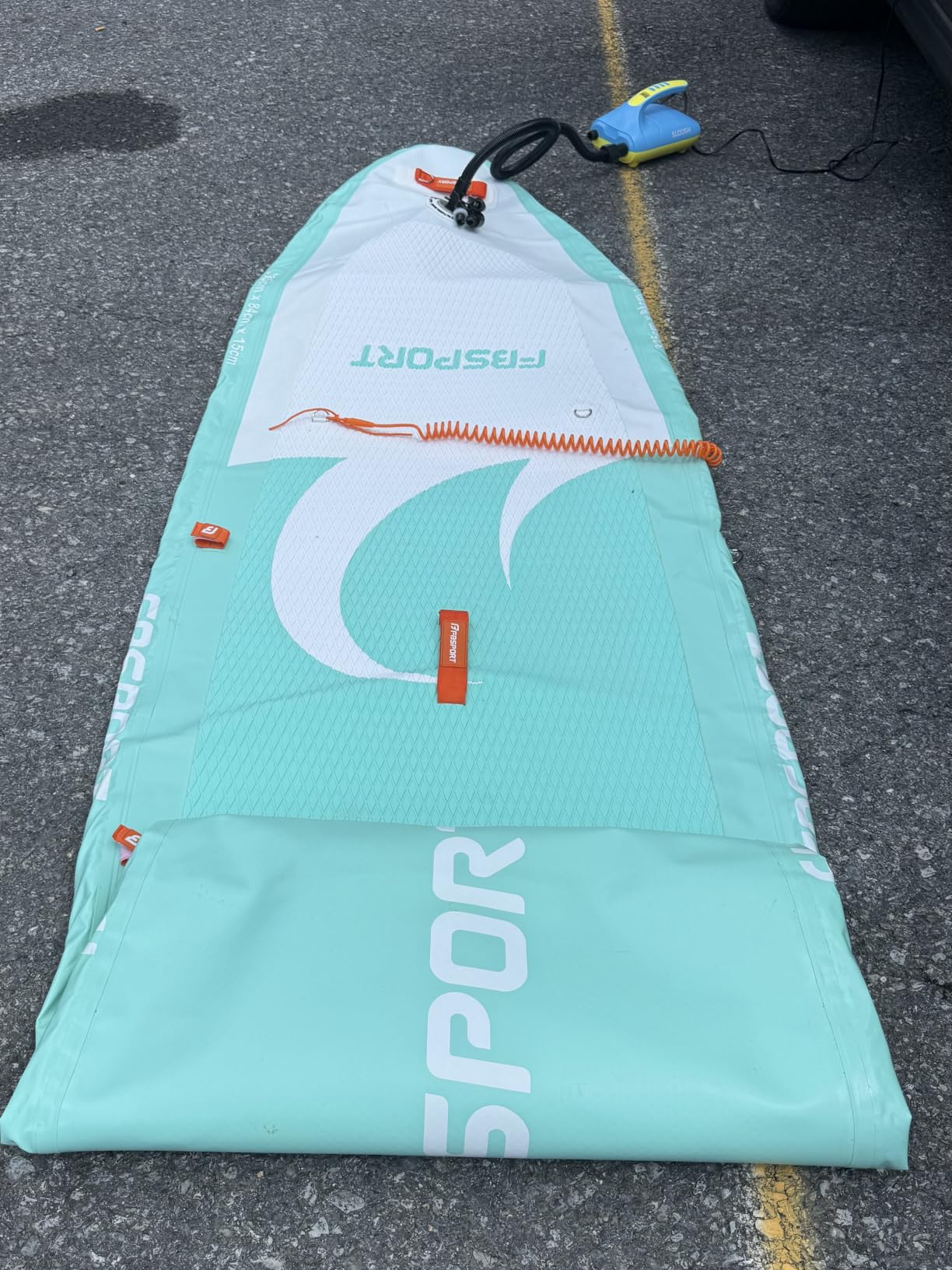
The triple bottom fin setup is one removable plus two fixed, which owners credit for better speed and steering than a single-fin board. For yoga that matters in a specific way: you spend most of the session stationary, and a board that drifts while you hold a pose makes balance work far harder than it needs to.
Owners use this board for beginners, family outings and casual cruising, and 81 percent of reviews are five stars. The wide colour range is a real consideration too, since a board you like looking at gets used more often.
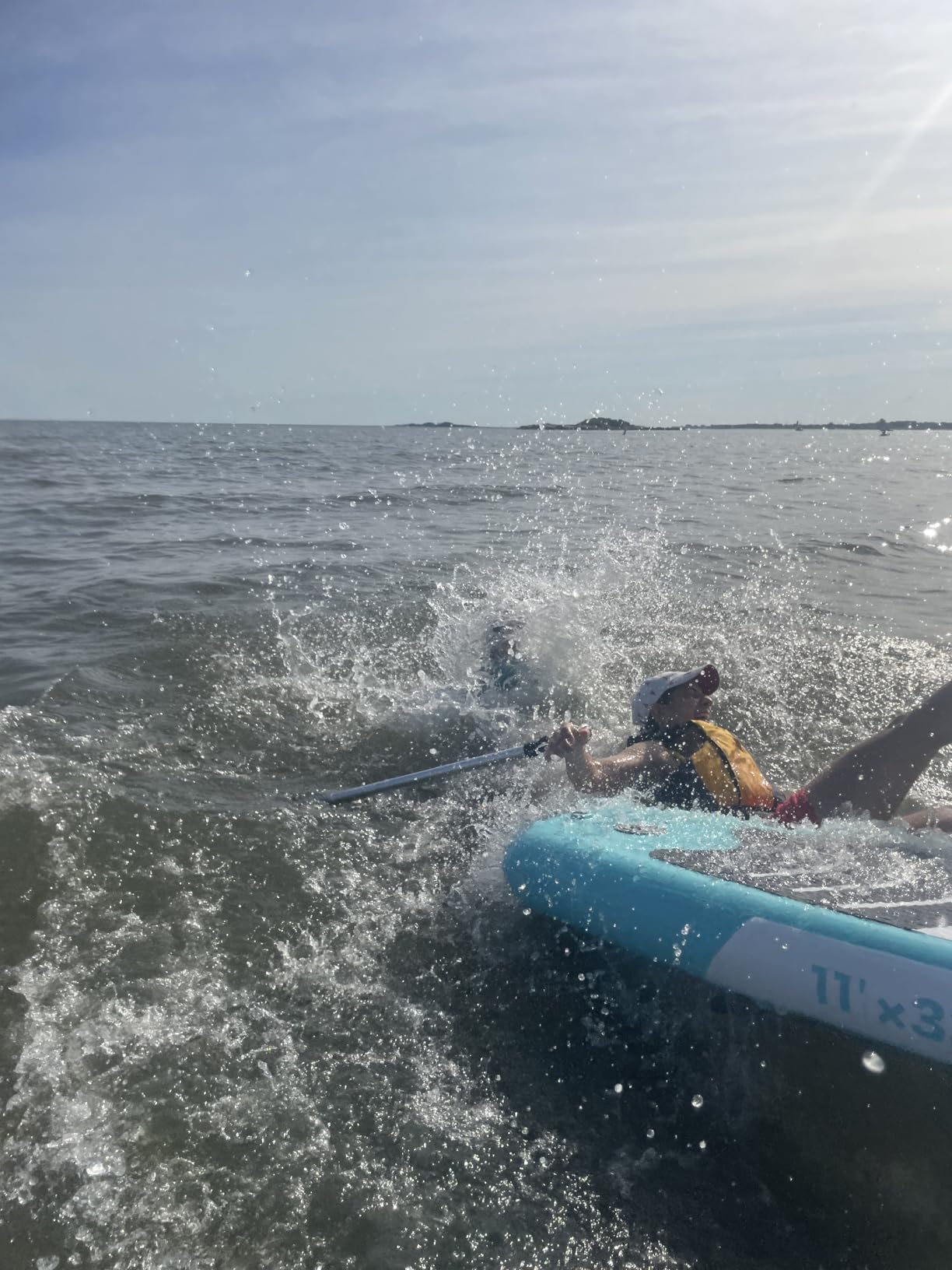
Two spec sheet problems worth knowing
The listing markets this board at a 350 pound load but the spec sheet lists 280 pounds as the maximum weight recommendation. Use 280. More confusing still, the listed item weight of 13.49 kg is not plausible for an inflatable board in this class and almost certainly a unit or data entry error, so do not use that figure to plan your carry.
Beyond that, this is a straightforward, well-reviewed board with a 1 year warranty. The 15 psi ceiling is standard and appropriate for this use, and inflating to it produces the firm deck a kneeling practice needs.
Is SUP harder than kayaking?
No, and yoga SUP is one of the easier ways to see why. There is no cockpit to fall out of and no need to track forward progress while seated. The balance demand on a 33 inch deck at 15 psi is modest, and most people are stable enough within a couple of sessions to stop thinking about their feet.
The real difficulty with SUP is core strength for long paddle sessions, not balance. If you are coming from a kayak, expect your lower back and shoulders to work harder, and expect your first hour on the water to be a shoulder workout rather than a balance workout.
5. FunWater Inflatable SUP: Best for Straight-Line Tracking
FunWater Inflatable Stand Up Paddle Board with Beginners SUP Accessories
33.9 in wide by 6 in thick
330 lb capacity
3 fin tracking system
EVA deck pads
Pros
- Wide 33.9 in deck with no flex under a 280 lb rider
- Backpack fits board and kit without delicate folding
- Tracks well in a straight line for years of use
- Repair patches and phone pouch included as standard
Cons
- Balance point slightly off centre so no standing yoga poses
- Hand pump tiring so an electric pump is a common upgrade
- One buyer reported bag stitching failure
Tracking is the quality that separates a board that goes where you point it from one that wanders, and this is the board in this roundup that owners most often describe as going straight. The 33.9 inch width across a 131.9 inch length, combined with a 3-fin system, gives it one of the best waterline-to-beam ratios here.
That matters more than it sounds for anyone paddling a long lake or following a river channel. A board that tracks needs less corrective stroke, which means less energy for the same distance, which is the whole argument for a longer board in the first place.

One owner who weighs 280 pounds reports no flex at all, and several people describe using it as a second or backup board alongside a hard SUP. That is a reasonable pattern: an inflatable that lives in a car boot and a rigid board that lives on a roof rack, covering different halves of the week.
The 3 year board warranty and 1 year accessory warranty are among the better terms here, and the included waterproof phone pouch and repair patches are standard rather than upsold. Seventy-two percent of reviews are five stars, the widest spread of any board in this set, which reflects a genuinely capable board with a fair amount of variance in manufacturing and support.
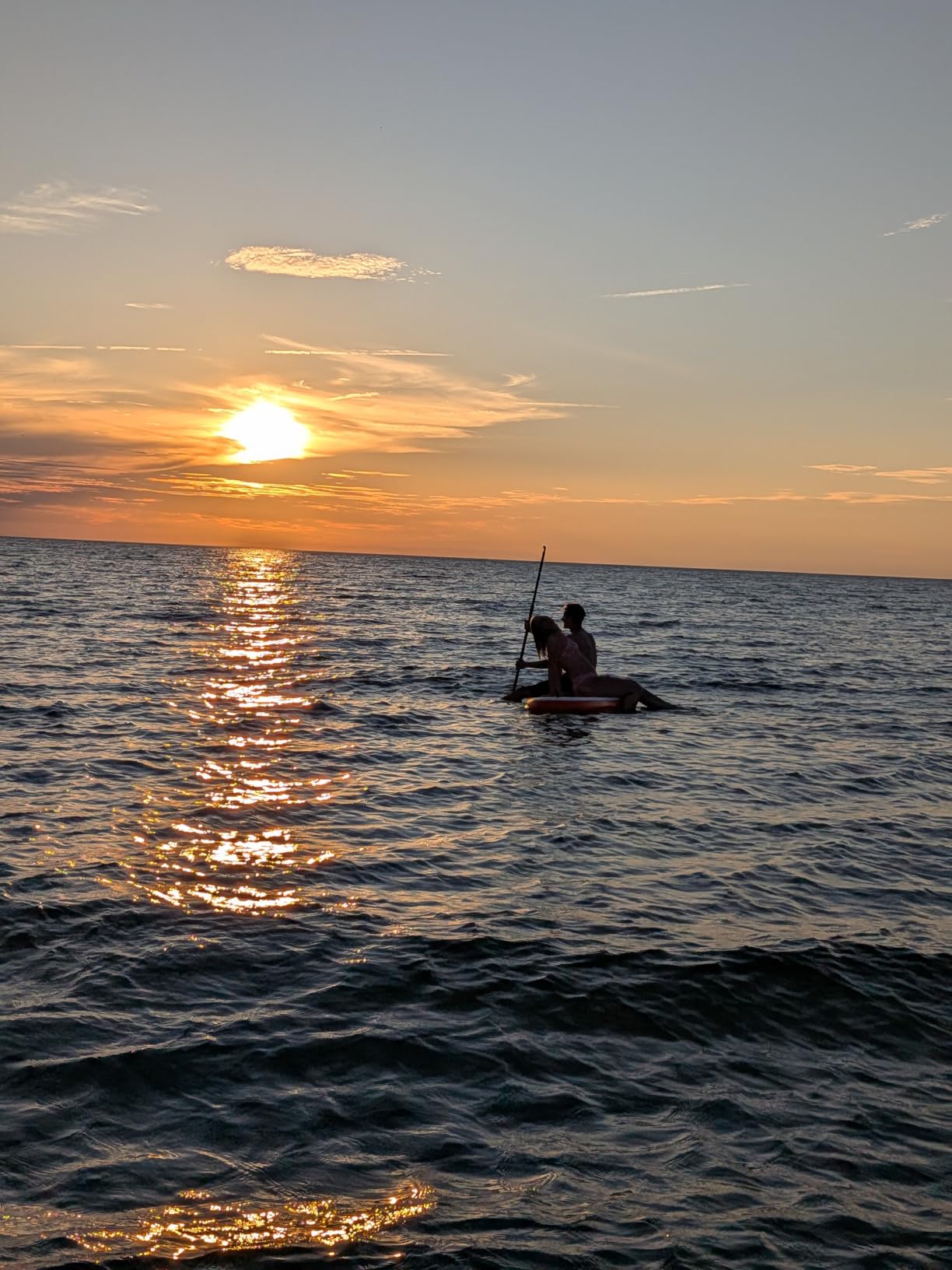
Why not yoga on this board
Owners specifically report a balance point that sits slightly off centre, which makes standing poses awkward. If you want a board for supine and kneeling work, the FBSPORT is the better fit. If you want to paddle fast and straight for fitness rather than stillness, this is the one.
The centre handle plus front elastic cargo cord also make it a natural fishing platform, and the tracking means you can hold a line along a bank without constantly correcting. Several owners describe exactly that use.
Pump and paddle reality
Two things to plan for. The hand pump takes a long time and tires your arms, and an electric pump is the most common upgrade owners report making. And paddle shaft sections can seize together after salt water exposure, so rinse the shaft with fresh water after every ocean session.
One buyer also reported carry bag stitching failing after a few uses with no response from support, which is an isolated report rather than a pattern. Check the bag seams when the kit arrives.
6. SLOOSH Inflatable SUP: Best for Carry Comfort
SLOOSH Inflatable Stand Up Paddle Board, 10’6″ Paddle Boards with Premium Accessories, Non-Slip EVA Deck, Ultra-Light Carry Bag Pump, Ripple SUP for Youth & Adults of All Skill Levels, Misty Breeze
33 in wide by 6 in thick
FortaFusion core to 20 psi
Three reinforced handles
Full padded backpack
Pros
- Three reinforced handles for solo carry and launch
- Dual action pump cuts inflation time by about 30 percent
- Fully padded backpack with waist and shoulder support
- Reinforced sidewalls give a hard board feel at 15 psi
Cons
- Advertised 450 lb capacity conflicts with a 300 lb spec
- Only 498 reviews so long term durability is thinly documented
- 1 year warranty
Carrying is the part of paddleboarding that nobody plans for. A board that is fine at the car becomes an awkward full-length shape halfway across a car park, and this is the board we would pick for people who paddle from a public launch rather than a slipway next to their house.
The SLOOSH has three reinforced handles at the front, centre and rear, which means you can always pick the board up from a point that balances for where you are standing. The fully padded backpack with shoulder, waist and back support is the most thoughtfully designed carry system in this group, and that is a physical thing you feel within the first trip.

Underneath the carry system, FortaFusion technology is a fused core with double-layer mesh reinforced sidewalls rated to 20 psi. Owners report a rigid, hard-board-like feel at 15 psi, and the 33 inch round-nose platform is a deliberate middle ground between 32 inch nimbleness and the bulk of a 35 inch deck.
The dual-action pump cuts inflation time by roughly a third compared with a single-action pump, which matters more than it sounds when you are pumping in a car park in the rain. Eighty-one percent of reviews are five stars, though with only 498 reviews that is a thinner evidence base than most of the others here.

Use 300 pounds, not the advertised figure
This is the largest gap between marketing and spec sheet in the whole roundup. The features list claims a 450 pound capacity for solo use, with a child, pet or gear, while the specification lists a maximum weight recommendation of 300 pounds. The published spec is the one to plan around.
At 300 pounds rated and a 33 inch deck, this comfortably takes one adult plus gear, a child riding up front, or a mid-sized dog. It is not a two-adult tandem board and it is not the right pick for a larger paddler who wants company on the water.
Is the thin review base a problem?
It is worth knowing but not disqualifying. 498 reviews at 4.6 stars with 81 percent five stars is a strong signal; it is simply less of a signal than 18k reviews at the same rating. If durability over many seasons is your priority, choose a board with a three year warranty and a large review base instead.
The kit itself is thorough: paddle, leash, phone pouch, three fins, repair kits and a backpack. That is everything you need except a personal flotation device.
7. FEATH-R-LITE Inflatable SUP: Best for Customer Support and Light Handling
FEATH-R-LITE Inflatable Stand Up Paddle Board with Beginner SUP Accessories
31.5 in wide by 5.91 in thick
18.9 lb board weight
330 lb capacity
15 psi max pressure
Pros
- Owners single out the low weight for carrying
- Exceptionally stable for a beginner first board
- Grippy EVA texture holds without chafing
- Vibrant graphics easy to spot on the water
Cons
- Carry bag tears and paddle clasp button fails
- Air valve can leak until tightened with the tool
- 31.5 in width gives less stability than 33 in decks
Two things stand out here. First, the light board weight, which owners consistently name as the standout trait for carrying to the water. Second, the support. Multiple reviewers describe having a defective pump replaced and a warranty claim handled quickly, and that is exactly the experience most people are anxious about when buying a board they cannot test in person.
The listing spec is 118.1 inches long, 31.5 inches wide and 5.91 inches thick, rated to 330 pounds at 15 psi. That is among the narrowest decks in this roundup, and owners say so directly in reviews.
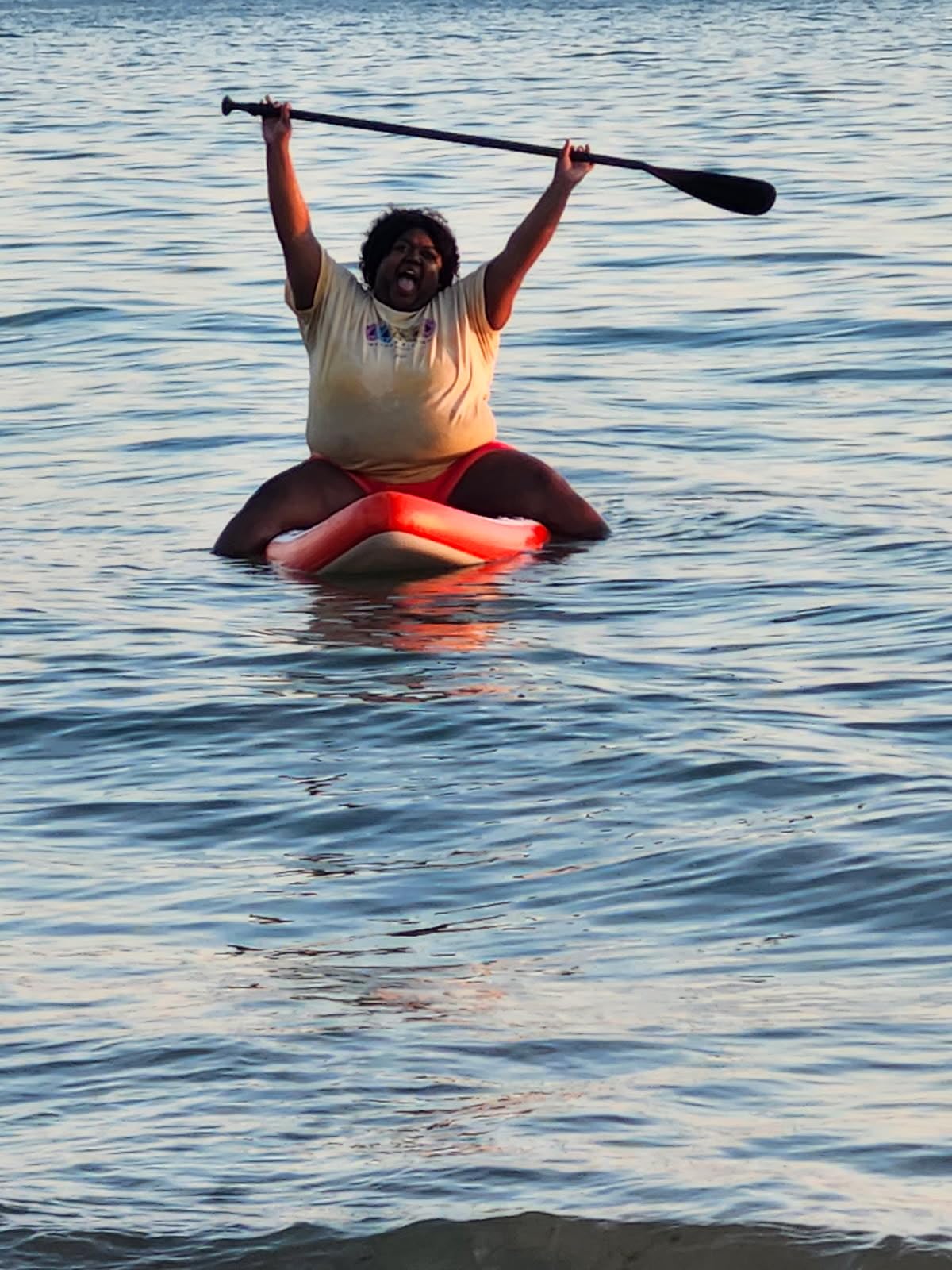
The narrowness produces an interesting trade. Owners still describe it as exceptionally stable for beginners, which tells you that 31.5 inches at 5.91 inches thick can hold a beginner upright. But compared with a 33 inch deck you will need a slightly narrower stance and you will feel crosswind more.
At 18.9 pounds listed weight, with three removable fins and a grippy EVA deck texture that does not chafe bare feet or knees, this is a board for someone who wants a light object and a brand that answers the phone. Eight percent of reviews are one star, the second highest share in this set, and they cluster around accessories rather than the board.
The accessories are the weak point
This is a clear case of a competent board with cheap add-ons. The carry bag is plain and unbranded and has been reported tearing after a few months. The paddle clasp button fails, leaving the two shaft sections loose. The air valve can leak pressure until it is tightened with the included tool, and the instructions do not explain that step.
Budget for a replacement paddle and check the valve before your first outing. Budget maybe ten minutes for a top-up before you set off, because that pattern is well documented.
How to tell a real warranty from a marketing one
Buyer forums raise this constantly, and the advice is worth repeating: warranty length is not a quality signal. A five year warranty from an unknown brand means nothing if the company does not answer support email. What matters is whether the brand has a track record of replacing parts, and this one clearly does.
That responsiveness is genuinely valuable on an inflatable, because almost everything that goes wrong on a drop-stitch board is a small, cheap part: a valve, a fin clip, a clasp button, a leash. All four appear in complaints about this board, and all four are replaceable.
8. Goplus Inflatable SUP: Best Budget Stand Up Paddle Board
Goplus Inflatable Stand Up Paddle Board w/SUP Paddleboard Accessories
132 in long by 31 in wide
6 in thick
330 lb capacity
V drop stitch core
Pros
- Entry level board that still scores 4.6 stars
- Even seams seals and connection points
- D rings accept an aftermarket kayak seat
- About 5 minutes to inflate and pack
Cons
- Pump gauge does not read until well inflated
- 31 in width is the least stable here
- Single removable fin and only a 90 day warranty
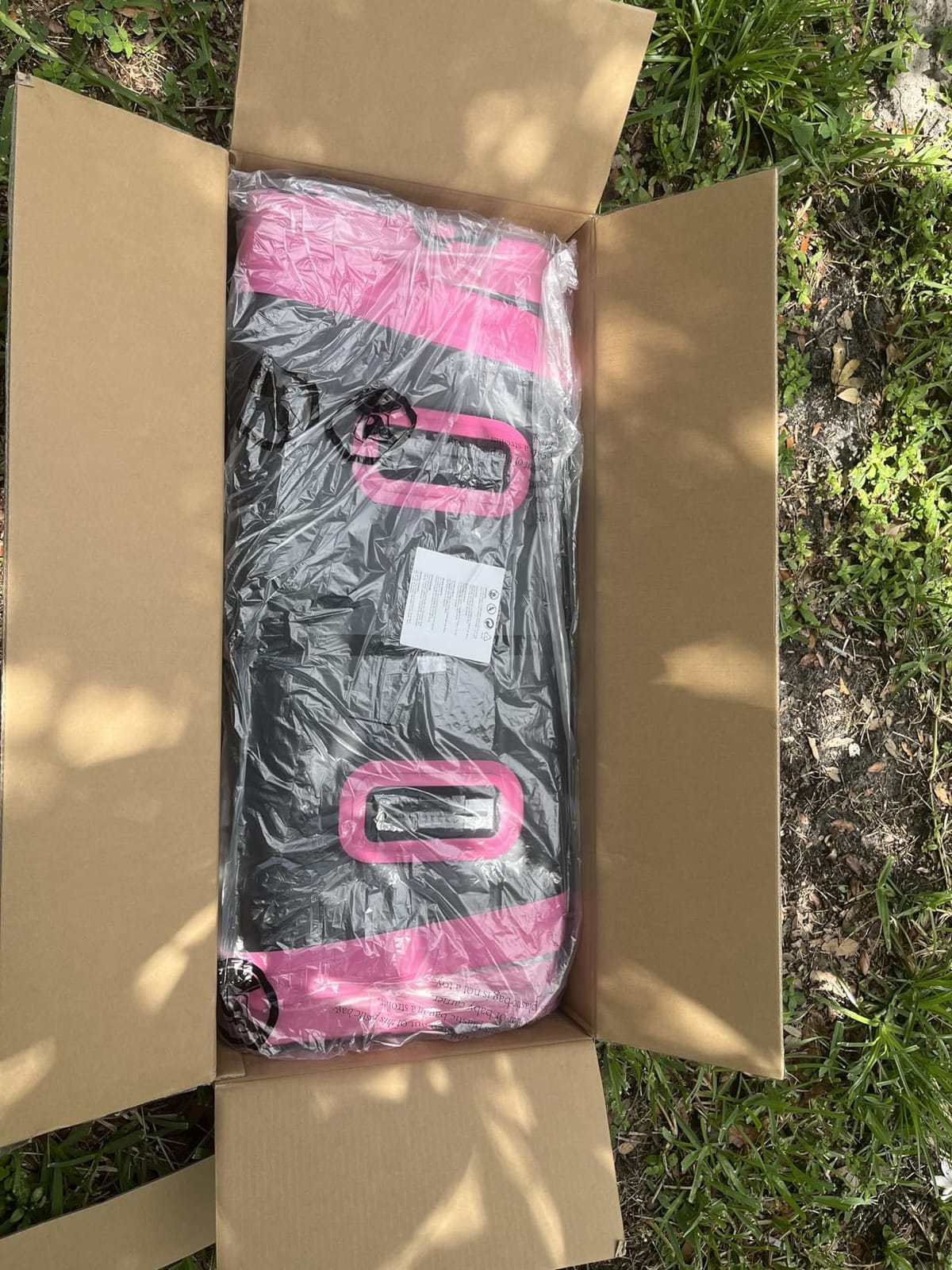
The Goplus is the entry-level board of this group and the surprise of the roundup. Buyers consistently say it performs better than its price suggests, with even seams and a solid deck and a construction quality that is not what most people expect at the entry level of the category.
It is a 132 inch long, 31 inch wide, 6 inch thick drop-stitch board rated to 330 pounds, and owners report it holds two adults and a dog without flexing. Setup and pack-down take about five minutes each way according to owners, and that is among the fastest turnarounds in the roundup.
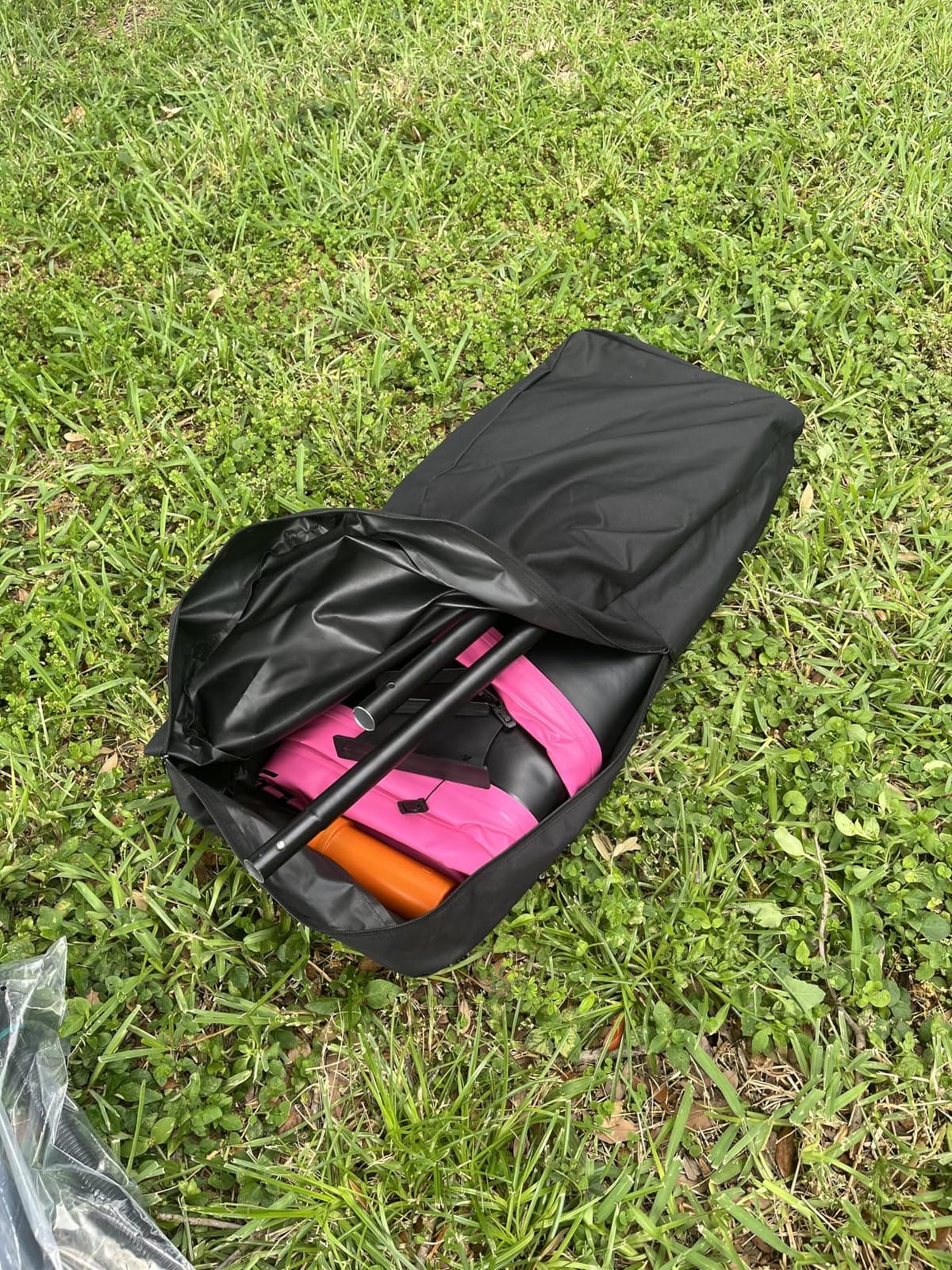
Construction is a V drop stitch core with laminated PVC and an EVA deck, and the D-rings are solid enough to accept an aftermarket kayak seat. That means a seated kayak conversion costs you only the seat, which is a cheap way to get a second use out of the same board.
It also carries a detachable bottom panel fin with a safety clip, a coiled ankle leash and a front deck bungee tie-down. Eighty percent of reviews are five stars, and customer service replies quickly on setup questions.
Why the narrow deck matters here
31 inches is the narrowest deck in this roundup and it shows. Owners describe it as the least stable of the group for beginners, and if your weight is above 200 pounds or you expect to be moving in any wind, the narrow stance will be the first thing that bothers you.
What you get in exchange is the shortest width, which makes it the easiest of the group to store and the least awkward to handle in a small space. For a first board on calm water with light gear, that trade is reasonable.
The pump is the one real problem
The most common complaint by a distance is the hand pump. The gauge does not register until the board is already well inflated, so it reads as broken when it is not, and the hose connection is fussy to thread onto the pump stand and leaks at higher pressure.
The 90 day warranty against manufacturer defects is also the shortest in this set, well short of the three years on the Roc and the Niphean. If durability is your priority, choose a board with a longer warranty term. If you want a usable board this season at the entry level, this is the pick.
9. SereneLife XL Inflatable SUP: Best Stand Up Paddle Board for Families and Pets
SereneLife 11’6” Inflatable SUP – Pet-Friendly Stand-Up Paddleboard for Adults and Pet Ride Alongs – 35” Wide Stable Design with Non-Slip EVA Deck Pad, Premium SUP Accessories, 485 lbs. Capacity
11 ft 6 in long by 35 in wide
485 lb capacity
Double welded seams
20 psi max pressure
Pros
- Widest deck here and the highest capacity at 485 lb
- Rigid enough that riders say it does not feel inflatable
- Comfortable enough to lie down and carry two or three kids
- Double welded seams and a repair kit in the box
Cons
- Backpack too small and straps uncomfortable under full load
- EVA pad dents under large dog claws
- One report of a pump top blowing off near 11 psi
This is the board to buy if the weight on the deck is not just you. At 11 feet 6 inches long and 35 inches wide, with a 485 pound capacity, it is the widest deck and the highest weight capacity in this roundup, and owners describe it as the sturdiest family and pet-capable board they have used.
Free-flow welded construction with double-welded seams is the detail that justifies the rating. A double weld is two heat seals running side by side, and it is meaningfully more resistant to separating than a single seam, which is what you want when a dog leaps onto the deck at the wrong moment.
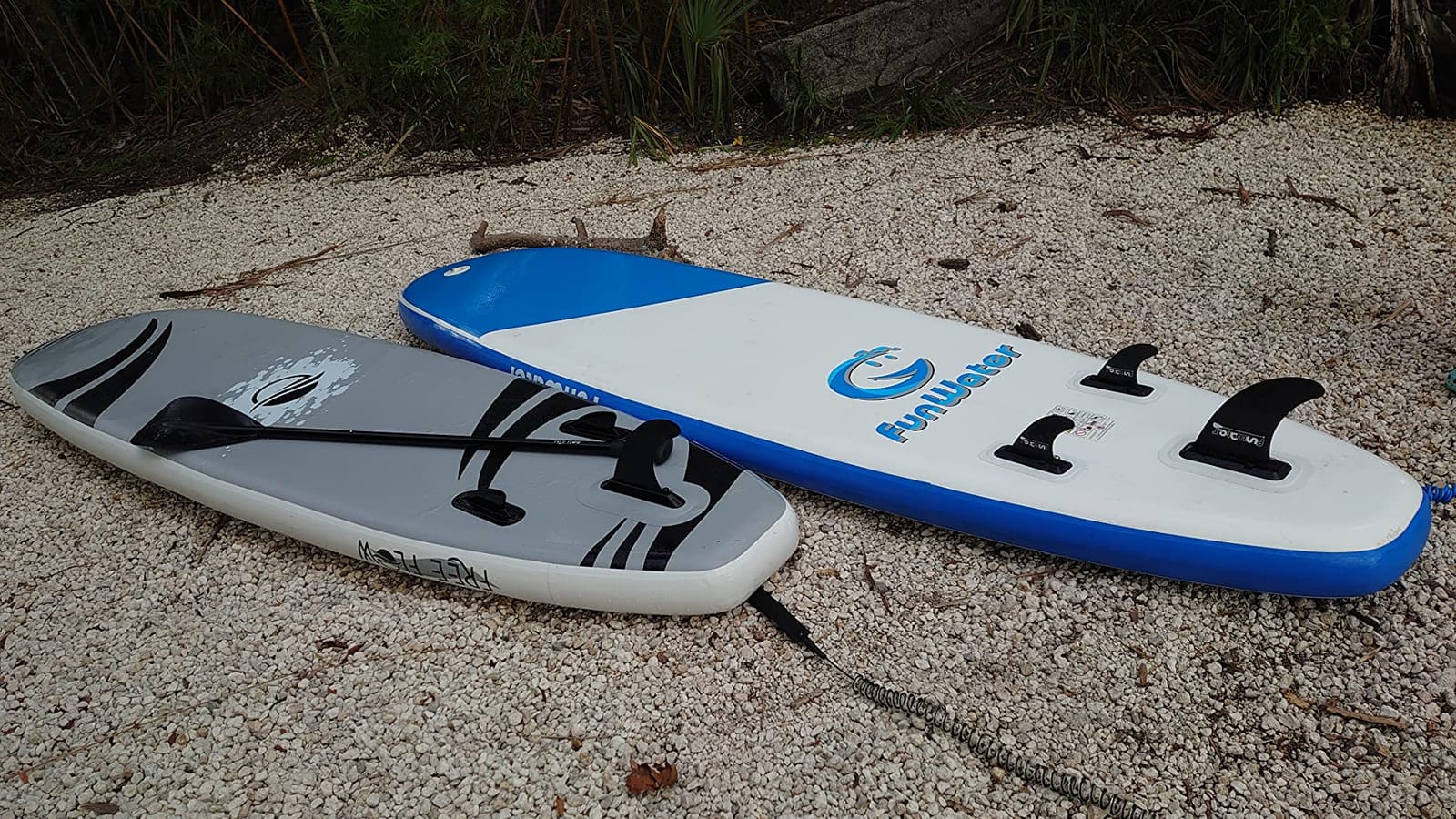
It is also rated to 20 psi and built with a double-layer side over a single-layer drop-stitch core. Several owners say the board does not feel inflatable at all once inflated, and that rigidity is what stops a 35 inch platform from feeling like a wobbly raft when a child stands up.
The kit is complete: two fixed small fins, one large removable fin, a three-shaft aluminium paddle, a leash, a double-action pump, a repair kit and a backpack. Owners report fast inflation and packing in seconds, and several mention two years of reliable service.
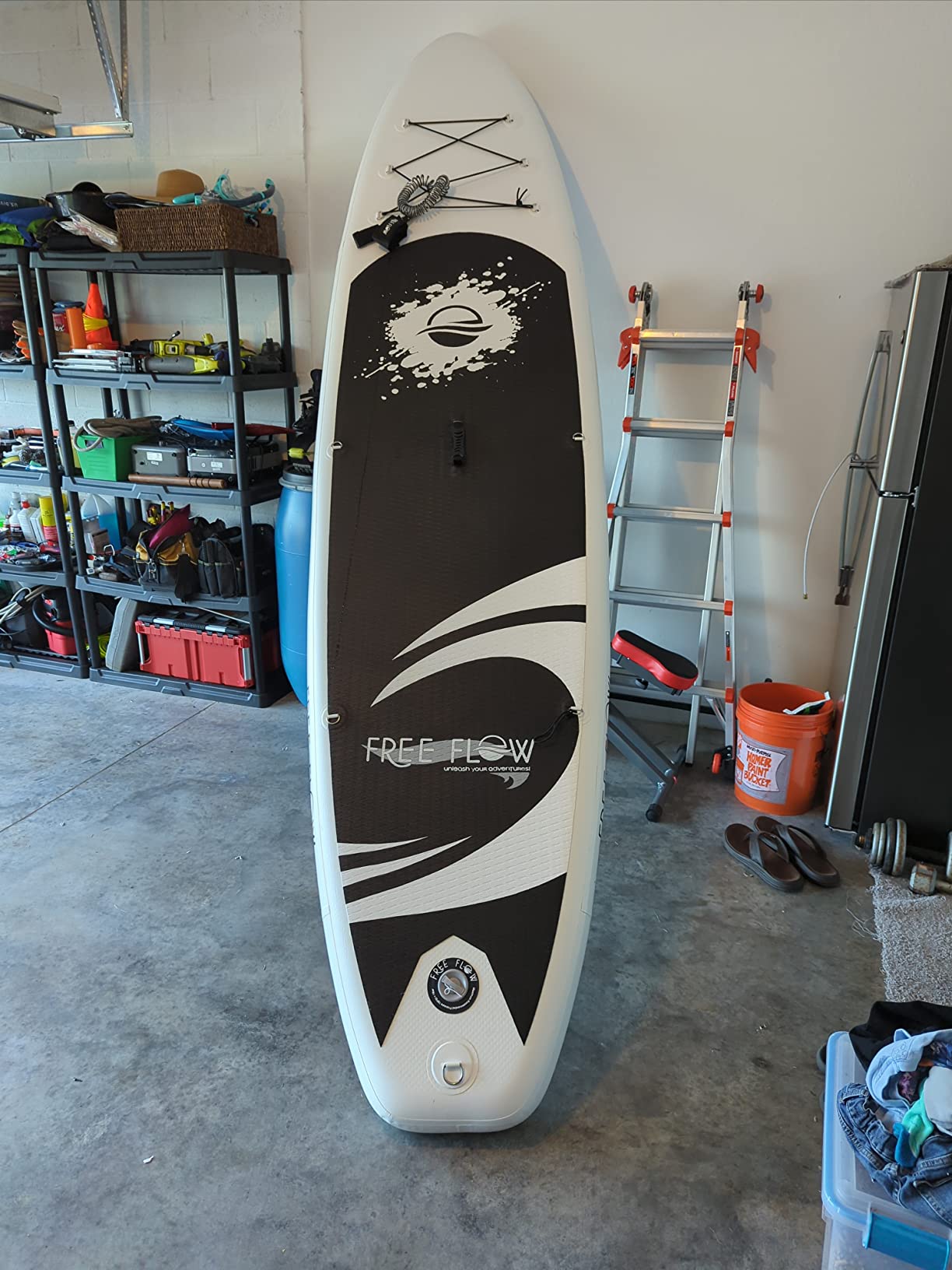
What 485 pounds actually covers
Do the arithmetic before you commit. Your weight, plus the weight of a second adult if one is coming, plus the child, plus the dog, plus a cooler and any gear, plus your paddle, needs to sit under 485 pounds with margin. Most family configurations come in well under that, which is why this board works where a 33 inch 350 pound board does not.
Two things cut the other way. A 35 inch deck is slow to turn and catches wind, so this is not a river or whitewater board. And the EVA traction pad dents and tears under large dog claws, which is worth factoring in if your animal is heavy and the sessions are frequent.
Support and packaging complaints
There are isolated but serious reports in the reviews: a pump whose top blew off forcefully at around 11 psi, and a reviewer who received a visibly used board with a scratched fin and a box of old shipping labels. Isolated reports are not a pattern, but inspect the board and test the pump on the lawn before you take it out.
One reviewer also paid for a seat that was not in the package, which is a checkout error rather than a product fault. Read the box contents carefully, and check what you still need to buy: a personal flotation device is never included with any board here.
10. Crew Axel Inflatable SUP: Best Included Kit
Inflatable Paddle Board SUP by Crew & Axel – 10FT 33″ Wide (6.2” Thick) Stand up Paddleboard Set W/Backpack, 3 Fins, Floating Paddle, Light Weight (17lb), Drybag, Camera Mount, Rings Seat Blue
10 ft long by 33 in wide
6.2 in thick
17 lb board weight
320 lb capacity
Pros
- Two carry bags plus a camera mount and 3 fins in the box
- Dual action pump inflates in about 10 minutes
- 17 lb board is easy to carry and store
- 33 in width helps new paddlers balance
Cons
- 10 ft length is short for tracking and glide
- Highest one-star review share in this set at 9 percent
- Lowest category sales rank of the ten
The Crew Axel wins on what is in the box. Two bags, a floating paddle, a camera mount, three fins and a dual pump kit. That is more hardware than any other board here, and for a beginner who does not yet know which accessories matter, having a spare bag and a camera mount removes two purchases from your list.
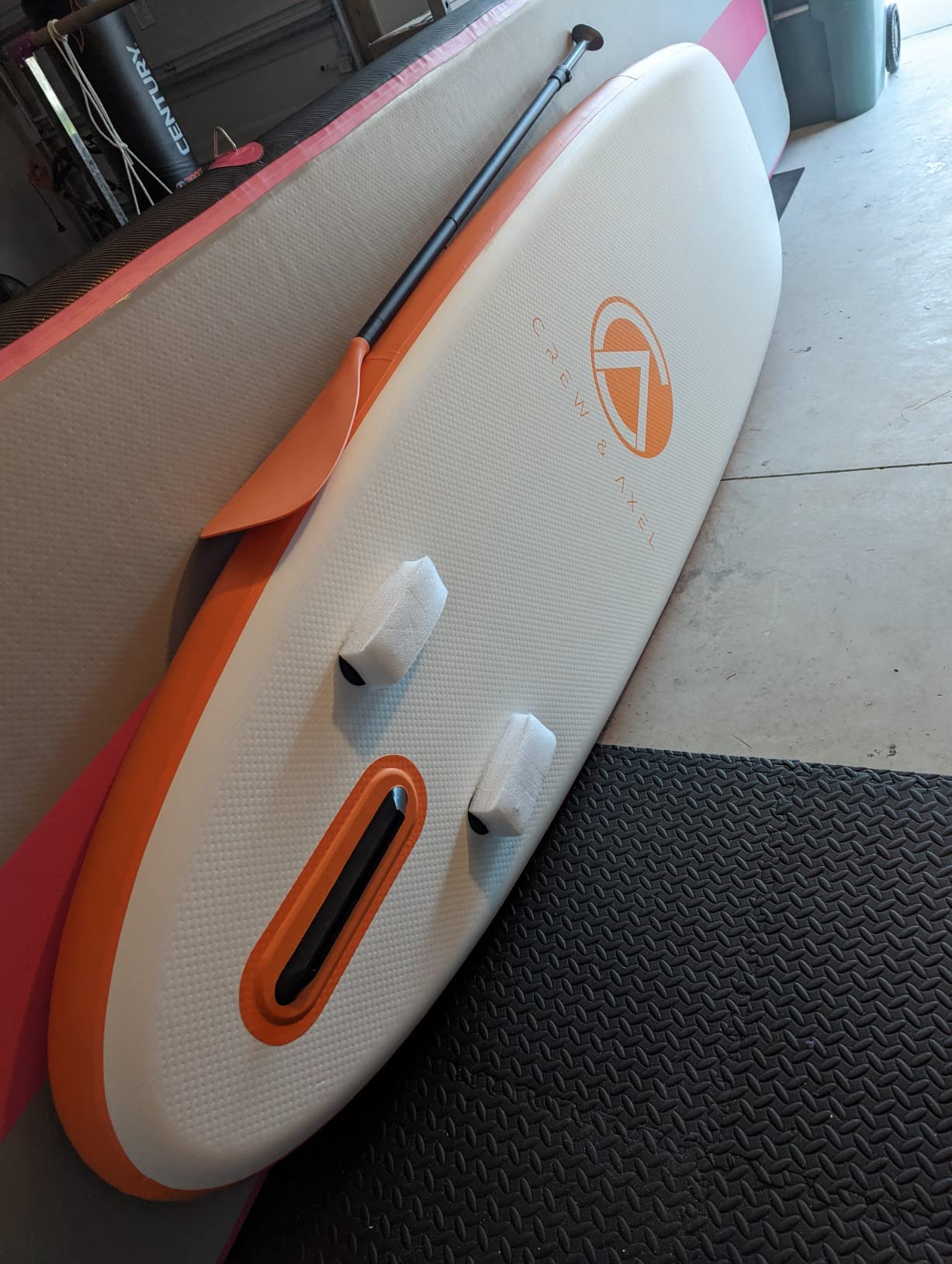
The board itself is 120 inches long, 33 inches wide and 6.2 inches thick, rated to 320 pounds at 15 psi, with a listed weight of 17 pounds. Owners describe it as an easy first board that suits yoga, fishing, surfing and casual family use on lakes and both fresh and salt water.
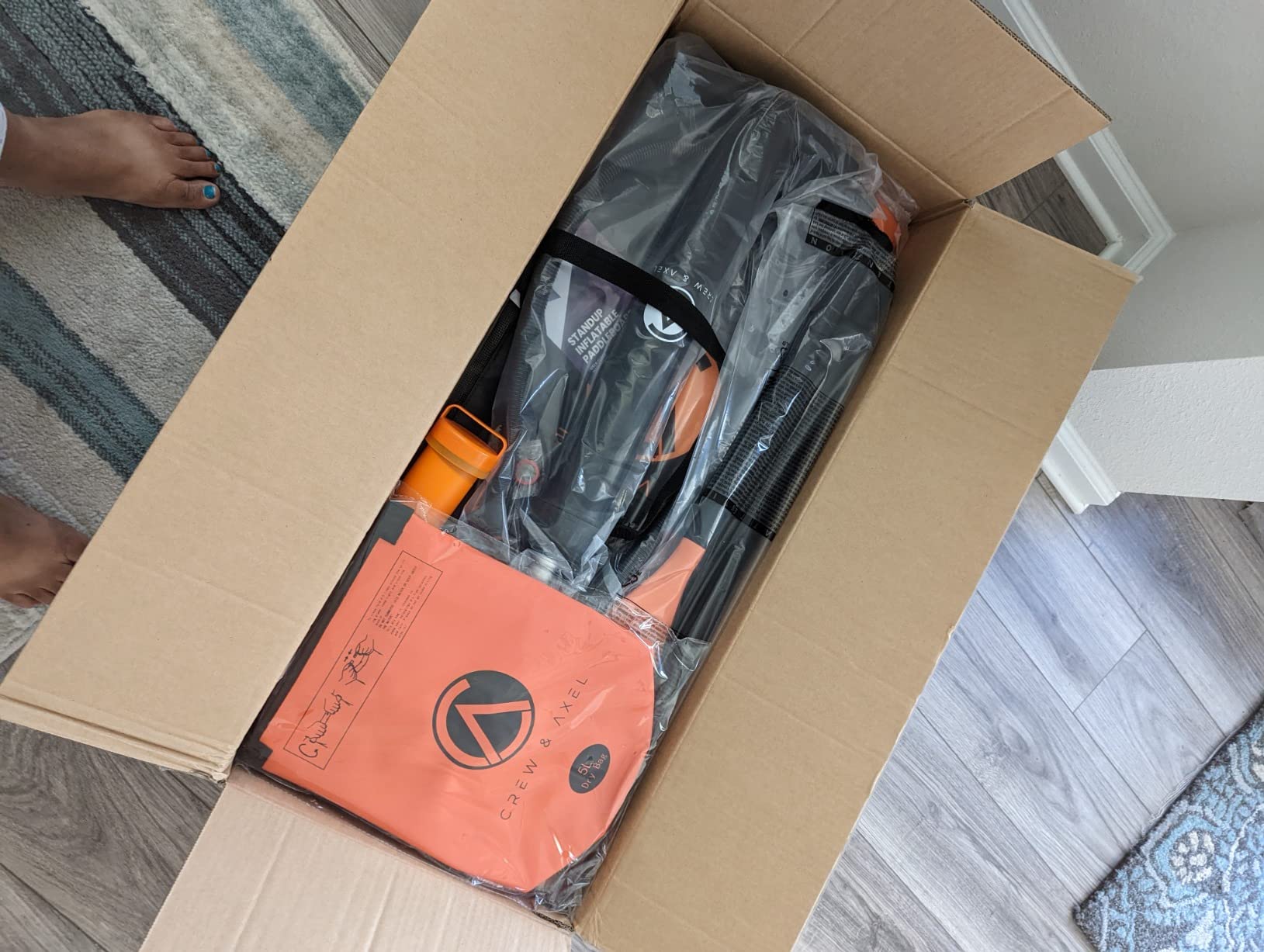
At 33 inches wide the deck is on the wide side for a 10 foot shape, and that helps new paddlers keep their balance. It inflates in about ten minutes with the dual-action pump and deflates in seconds, so the pack-down is genuinely quick.
The 10 foot length is the main limitation. It is a foot shorter than the Roc and the SereneLife, and owners note it limits tracking and glide. If your plan is short lake sessions and family outings, that is a fair trade for the widest kit in the roundup.
Read the one-star reviews before you buy
Nine percent of this board’s reviews are one star, the highest share of any board here, against 72 percent at five stars. That is the most polarised sentiment in the set, and it is a useful signal: the owners who like it like it a lot, and there is a consistent group of people who did not.
It also has the lowest category sales rank of the ten by a wide margin, which usually reflects weaker long-term ownership data rather than a defect. If you want a board with years of documented use behind it, pick one of the higher review count options instead.
Who this is for
Buy it if the included kit is your priority, if you want a camera mount for a fishing or family trip, and if 10 feet is enough water for your sessions. The 6.2 inch thickness is also worth noting, since it is the thickest figure listed here.
Skip it if you plan long distances or want a board you can grow with. The Niphean or the Roc will carry you further with a better-documented track record.
How to Choose the Right Stand Up Paddle Board
Inflatable or rigid: which one should you buy?
Choose an inflatable if you have no storage, if you travel, if you want to walk to the water, or if you are still deciding whether you like the sport. Choose a rigid board if you have a roof rack or a wall and you already know you will paddle regularly, because a rigid board tracks and glides better at the front of the field and it is simply a nicer object to paddle.
There is one genuine durability argument for the inflatable, and it surprises people. A hard board takes a ding, a crack or a cracked laminate the moment it touches a rock, a dock edge or a gravel ramp, and epoxy and fibreglass repairs are expensive. A drop-stitch inflatable takes a puncture, and a puncture is a patch and a fifteen minute job.
The trade is speed. A rigid board is lighter for its stiffness, tracks straighter, and holds its line through chop and small surf in a way no inflatable at this level matches. If you paddle in surf or chop regularly, the rigid category is the honest answer.
If you have nowhere to put a 12 foot board, this decision is made for you. Several people in buyer forums regret buying a rigid board first precisely because they cannot move it or store it, and that regret is avoidable by starting inflatable.
Length: is a 10 foot or 11 foot board better?
Longer is faster. That is the entire relationship. A longer board has more waterline, displaces more water per stroke, and glides further for the same effort. A shorter board turns more easily and is more stable to pivot on.
For most beginners, the difference between a 10 foot 6 in and an 11 foot board is not the board, it is how far you are going. On a small lake doing laps, either works. On a six mile crossing, the extra 5 to 6 inches of length is the difference between arriving and not arriving.
Yoga is the other case where length decides things, because you need to lie flat and step back into wide poses. Eleven feet is the practical minimum for an adult, and 11 feet 6 in gives you room for a passenger.
For fishing, the trade flips again. You want to hold a position and turn quickly to reach a spot, and owners of the FunWater and the Crew Axel both describe short boards as easier to work from.
Width: how wide should a stand up paddle board be?
31 to 32 inches is for a confident paddler who wants to move. 33 inches is the safe all-round answer for one adult of any size. 34 to 35 inches is for two people, a child, a dog or anyone over 250 pounds who wants the deck to stay planted.
Width also affects everything else. A wide board catches wind, turns slowly, and is harder to hold on a breaking wave. A narrow board tracks, but pushes you into the water when you fall. For flat water cruising, width is free stability. For surf, it works against you.
For most people, one inch of width is roughly the difference between adjusting your stance and not having to. That is why the 33 inch boards here attract the most reviews of any width.
Thickness and volume: why 6 inches keeps coming up
Thickness resists flex, and flex is what makes a board feel nervous. Under about 5 inches, a heavy paddler will feel the deck give, and that flex compounds every small movement you make. Six inches is the common standard here because it holds flat for most adults.
Volume in litres describes how much space the board has for you plus your gear. A board rated to 330 pounds at 6 inches thick has plenty of volume; a touring board at the same weight would be much longer and narrower. More volume means more buoyancy, which means less sinking, which means less drag.
Match volume to total load. If you are paddling with a partner, a dog and a cooler, you are carrying more than double your body weight in displacement terms, and that is the case for the SereneLife XL at 485 pounds rather than a 31 inch 330 pound board.
Weight capacity: do the arithmetic properly
Add it all up: you, everyone else on the board, the dog, the gear, the cooler, and your paddle. That total needs to sit under the published number with margin, not equal to it.
Most buyers get this wrong by ignoring the gear and pet portion entirely. A 250 pound paddler, a 40 pound dog, a 25 pound child, a 20 pound cooler and an 8 pound paddle is 343 pounds, which is over the limit on several boards in this roundup even though the paddler alone is well within it.
And where a listing’s headline number disagrees with its own spec sheet, use the lower figure. Three boards here advertise capacities their spec pages do not support, and the gap is not a rounding error.
Construction quality and how to spot misleading marketing
Drop stitch is the core technology. Thousands of vertical polyester threads are welded between two layers of PVC, and when you pump the board to around 15 psi those threads pull tight and the board becomes rigid under load. That is why all ten boards here are drop stitch.
What differs is what surrounds the threads. A single-layer board is PVC with drop stitch inside it. A double-layer board adds a second PVC skin along the sidewalls, which resists flex and seam failure and is what you want if the board will take hard use. Watch the terms military grade, triple layer and heavy duty, because they carry no technical meaning and are applied to everything.
You can verify a listing in a few minutes. Check whether the manufacturer names a construction method at all, whether they give a maximum inflation pressure in PSI, and whether the stated board weight is plausible for the dimensions. Real drop stitch boards sit roughly in the 14 to 24 pound band for this size. Several listings here report weights in kilograms that are far too high, which tells you the spec page was not written carefully.
You can also weigh the board yourself once it arrives and compare against the listed figure, allowing for the accessories: a plastic fin box, a GoPro mount, bungee cords and deck pin lines together can account for a pound or more. A board that weighs noticeably less than advertised is telling you something about the shell.
Ignore warranty length as a quality signal. Buyers have learned this the hard way. What matters is whether the brand replaces parts, and whether it answers support messages.
What comes in the box, and what you still need
Every board in this roundup includes a board, a paddle, a pump, fins, a leash and a carry bag. Some add a waterproof phone pouch and a repair kit. None of them include a personal flotation device.
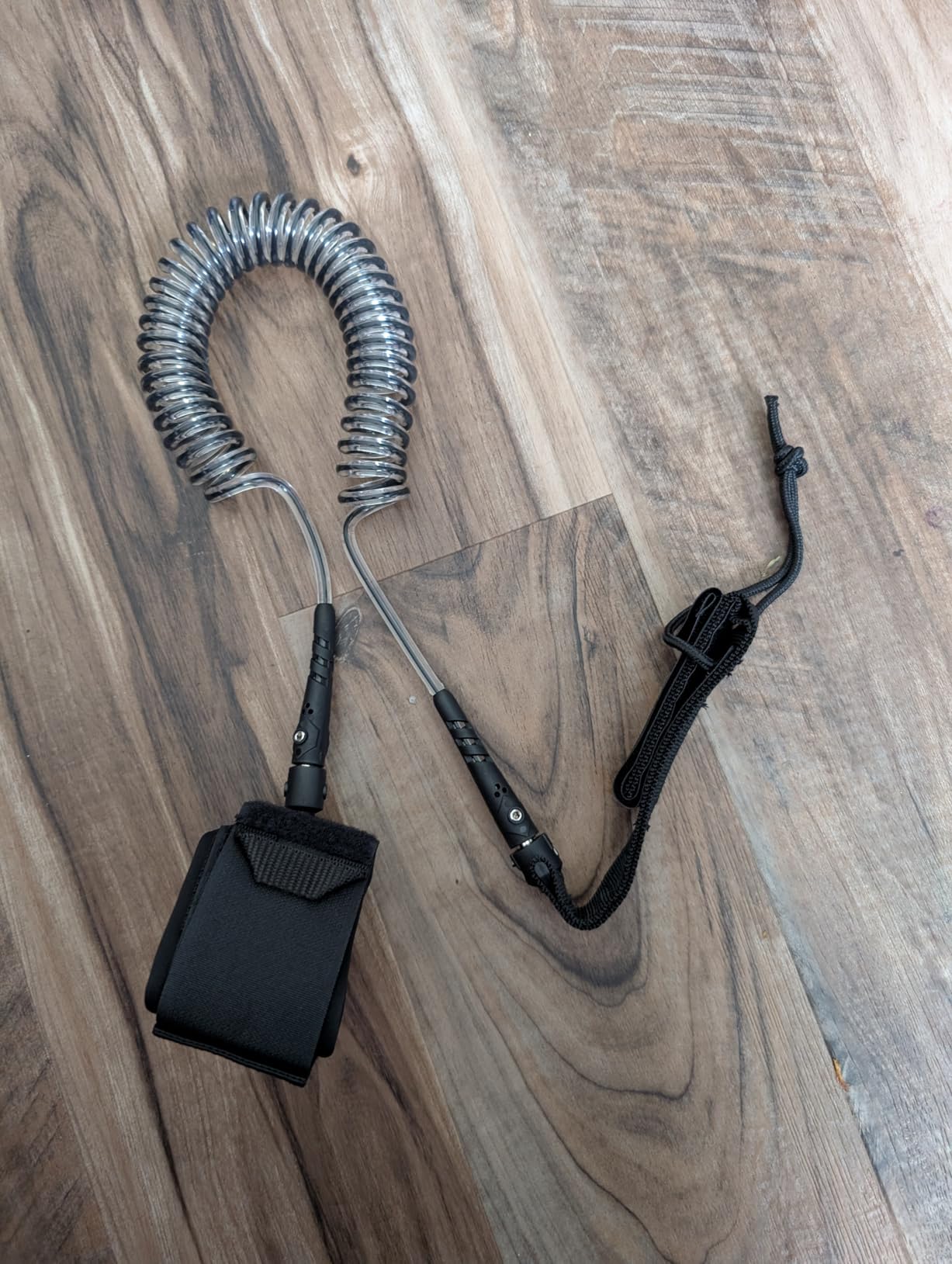
So the realistic extras are: a proper paddle, because included paddles are widely regarded as the weakest item in the kit, and the clasp button failure on the FEATH-R-LITE is a known pattern; a correctly sized PFD; a leash if you are not near a beach with a lifeguard; and either an electric pump or patience. That is the real answer to how much a decent paddleboard setup costs in total.
On paddle length, a fixed number does not exist. The right length puts the blade in the water when your arms are extended, which is roughly your height plus 10 to 30 inches depending on your paddle and how upright you sit. Test rather than calculate.
Inflation pressure and first-season care
Inflate to the pressure listed for your board, not the highest number you have heard. Most boards here cap at 15 psi, two go to 20 psi, and the SereneLife base model caps at 13 psi. Over-inflating above the listed figure is the fastest way to separate a seam.
After every session in salt or brackish water, rinse the board, the paddle shaft and the leash with fresh water. Salt crystallises in the fin box and the valve, and it is the cause of seized paddle shafts and slow valves. Let the board dry fully in the shade before deflating it, and roll it loosely rather than folding it tightly, which is how you stress a seam.
Store it inflated and loose if you can, and check the valve pressure every few weeks if you store it deflated. Owners report boards losing air over months more often than they lose air over days, which is normal and is the reason to check rather than panic.
Five Common Beginner Paddleboarding Mistakes
1. Standing with your feet too far apart. A wide stance on a 33 inch deck makes you wobble instead of settling. Feet about shoulder width, front foot perpendicular to the centre line, back foot at roughly a 45 degree angle, and you will stand up on the first try far more often than not.
2. Gripping the paddle like a hammer. The top hand goes on the T grip and the bottom hand just below the shaft. Shoving down with both hands is what makes new paddlers wobble, because the stroke is meant to be driven from the shoulder and the torso, not the forearm.
3. Ignoring the weight capacity arithmetic. The single most common and most avoidable mistake. You, plus gear, plus a child, plus a dog, plus a paddle, under the published spec figure with margin. Boards overloaded past their rating flex badly and handle badly before anything breaks.
4. Skipping the personal flotation device. Every board here ships without one. A leash helps you keep the board and it does not keep you alive. Wear a properly fitted PFD from the first outing, every time, and check the local rules for leash length on moving water.
5. Pumping to the wrong pressure and storing it wet. Under-inflating makes a board feel flexy and unstable, and over-inflating separates seams. Store it fully dry, loosely rolled, and out of direct sun, and the first board you buy should still be in good shape three seasons from now.
Frequently Asked Questions
What is the best all-around stand up paddle board?
For most single riders, the Roc 10 ft 6 in inflatable is the best all-around choice here. It is 33 inches wide and 6 inches thick, rated to 350 pounds, and carries a three year warranty. Owners report no air loss across multiple summers of regular use.
Is a 10 foot or 11 foot paddle board better?
A 10 foot 6 in board is easier to turn and easier to carry, which suits short lake sessions and fishing. An 11 foot board tracks straighter and glides further for the same effort, which suits longer distances and yoga, where you need room to lie flat and step back into wide poses.
How much does a decent paddleboard cost?
The board is only part of it. Add a proper paddle, a personal flotation device, and an electric pump if you want fast inflation, then a roof rack or storage if you ever move up to a rigid board. Most owners replace the included paddle within the first season because it is the weakest item in the kit.
How wide should a stand up paddle board be?
31 to 32 inches suits a confident paddler who wants speed and easy turning. 33 inches is the safe all-round answer for one adult of almost any size. 34 to 35 inches is the choice for two people, a child, a dog or a paddler over 250 pounds who wants the deck to stay planted.
Are inflatable paddle boards as good as hard boards?
For calm lake and river cruising they are effectively equivalent for most people, and they win on storage, transport and durability against rocks. Rigid boards win on tracking, glide and surf performance because they are lighter for their stiffness. If you have storage at home and paddle regularly, a rigid board is the better long-term choice.
What are the most common beginner paddleboarding mistakes?
Standing with feet too wide, gripping the paddle too tightly, ignoring the weight capacity arithmetic, going out without a personal flotation device, and inflating above the listed pressure. The first two are technique fixes that take one session, and the last three are safety and equipment issues you can eliminate before launch.
Which Stand Up Paddle Board Should You Buy?
The best stand up paddle board in 2026 for most people is the Roc 10 ft 6 in, because a 33 inch wide, 6 inch thick deck at a 350 pound rating covers nearly every use case without specialising into weakness. If you need something lighter to carry, the SereneLife is the one. If you need more capacity or the D-ring hardware for a kayak seat, the Niphean is the stronger buy.
Everything else in this list is a variation on a theme: pick your width from the load you plan to carry, pick your length from the distance you plan to cover, and treat the included paddle as something you will replace. If you are still unsure, tell us your weight, your experience level, the water you paddle and what you want to do with the board, and we will narrow it down.