
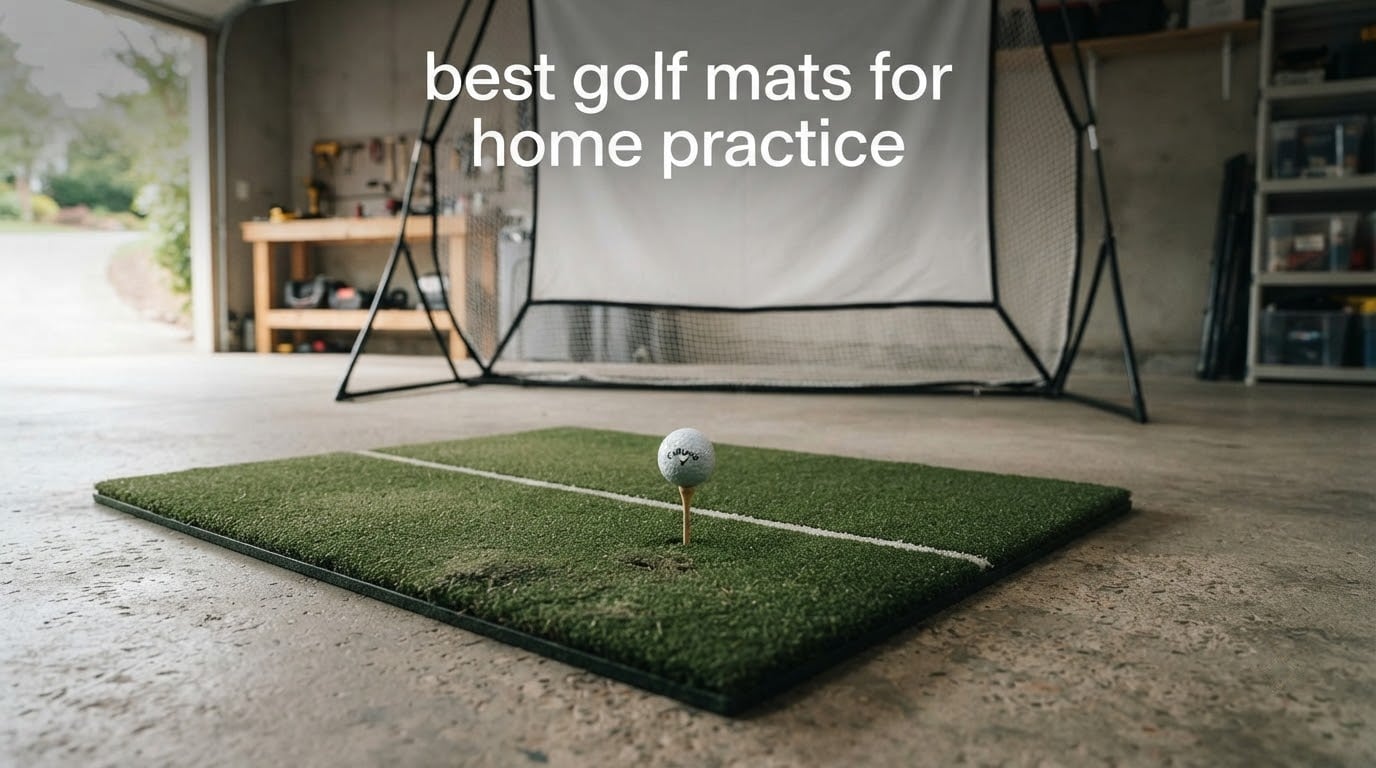
Most people searching for the best golf mats for home practice are trying to solve two very different problems with one search. Some need a full-size hitting surface they can swing a driver into, in a garage with a concrete floor. Others just want somewhere to roll putts at after dinner. Those two jobs need completely different products, and picking the wrong one is how you end up with a driver mat you can only chip from, or a putting strip you wish had more feedback on contact.
A golf hitting mat is a raised surface with synthetic turf over a foam or rubber base. It lets you take full swings indoors or on hard ground when the driving range is closed. The turf gives the clubface a grass-like feel and accepts either real tees or built-in tee holes, while the base absorbs impact so the shock does not travel up your wrists, elbows and shoulders.
That last part is the one most roundups skip. A user on forums.golfwrx.com described the real problem plainly: first mats are often placed on very hard surfaces, and the jarring effect from concrete or macadam is transmitted straight up the wrists and elbows. A thin mat laid directly on concrete does not solve that problem so much as move it.
We put twelve of the most-reviewed mats in this category through the same checklist: turf pile height, base thickness and density, shock absorption, stability on a hard floor, tee options, warranty length, and how much owner feedback sits behind each listing. We also read what buyers actually say after months of use rather than after one session. We earn a commission if you buy through the links on this page, which does not change the order below.
Table of Contents
Top 3 Best Golf Mats for Home Practice

PUTT-A-BOUT Par Three Putting Green
- 108 inch by 36 inch kidney layout
- Five holes plus sand-trap cutouts
- Rubber-backed PET resin surface
- 3.5 pounds

GoSports Elite Golf Hitting Mat
- 5 by 4 foot hitting area
- 15mm commercial-grade turf
- EVA foam base with non-slip backing
- Six tee holes plus three rubber tees
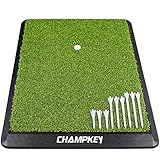
CHAMPKEY Synthetic Turf Hitting Mat
- 16mm turf over a rubber base
- 13 by 17 inch portable footprint
- Nine plastic tees included
- 90 day warranty
Best Golf Mats for Home Practice in 2026
| Product | Specifications | Action |
|---|---|---|
| PUTT-A-BOUT Par Three Putting Green |
|
Check Latest Price |
 SKLZ Accelerator Pro Putting Green SKLZ Accelerator Pro Putting Green |
|
Check Latest Price |
| GoSports Elite Golf Hitting Mat |
|
Check Latest Price |
| CHAMPKEY Synthetic Turf Hitting Mat |
|
Check Latest Price |
 COSPOPTIC Golf Hitting Mat with Feedback COSPOPTIC Golf Hitting Mat with Feedback |
|
Check Latest Price |
 Perfect Practice Standard 9 Foot Putting Mat Perfect Practice Standard 9 Foot Putting Mat |
|
Check Latest Price |
 GoSports Tri-Turf XL Golf Mat GoSports Tri-Turf XL Golf Mat |
|
Check Latest Price |
 SAPLIZE Foldable Golf Hitting Mat SAPLIZE Foldable Golf Hitting Mat |
|
Check Latest Price |
 Bltend 36mm Golf Hitting Mat Bltend 36mm Golf Hitting Mat |
|
Check Latest Price |
 Ywitio Premium Dual-Turf Golf Mat Ywitio Premium Dual-Turf Golf Mat |
|
Check Latest Price |
 Ponsonbay Golf Mat with Ball Tray Ponsonbay Golf Mat with Ball Tray |
|
Check Latest Price |
 Golfguru 5×4 Golf Hitting Mat Golfguru 5×4 Golf Hitting Mat |
|
Check Latest Price |
1. PUTT-A-BOUT Par Three Putting Green – Best Overall Putting Mat
PUTT-A-BOUT Grassroots Par Three Putting Green (9-feet x 3-feet)
108 x 36 inch kidney layout
Five holes with sand traps
Rubber back and PET resin surface
3.5 pounds
Pros
- Rolls out flat in seconds with no assembly or curled edges
- Kidney shape with five holes and sand-trap cutouts
- True roll fast enough for real putting technique
- Rolls up easily for storage in hallways
- Doubles as a game-room surface for kids
Cons
- Relatively thin mat that demands precise putting
- Holes and cutouts have no backing so the floor shows through
- Missed putts can roll off the back edge
This is the mat we keep coming back to, and the reason is unglamorous: after several months of use it still rolls out flat every time. There is no assembly, no snapping back into shape and no curled corners to fight with at the start of a putting session.
At 108 inches long by 36 inches wide and 3.5 pounds, it is a genuinely portable putting surface. It lives folded against a wall and gets rolled out in the time it takes to grab a putter. That matters more than it sounds, because a putting mat you have to set up carefully never gets used.
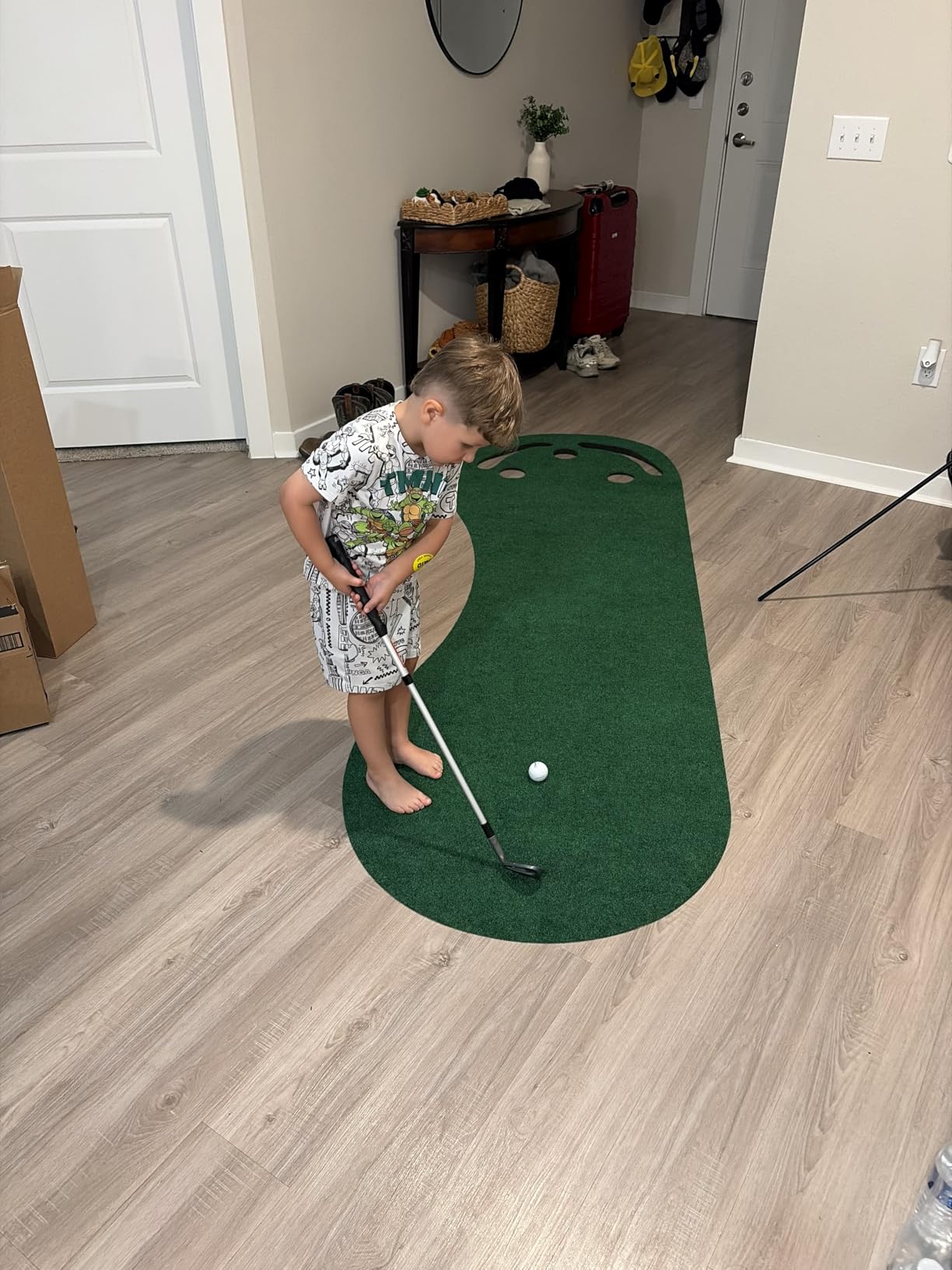
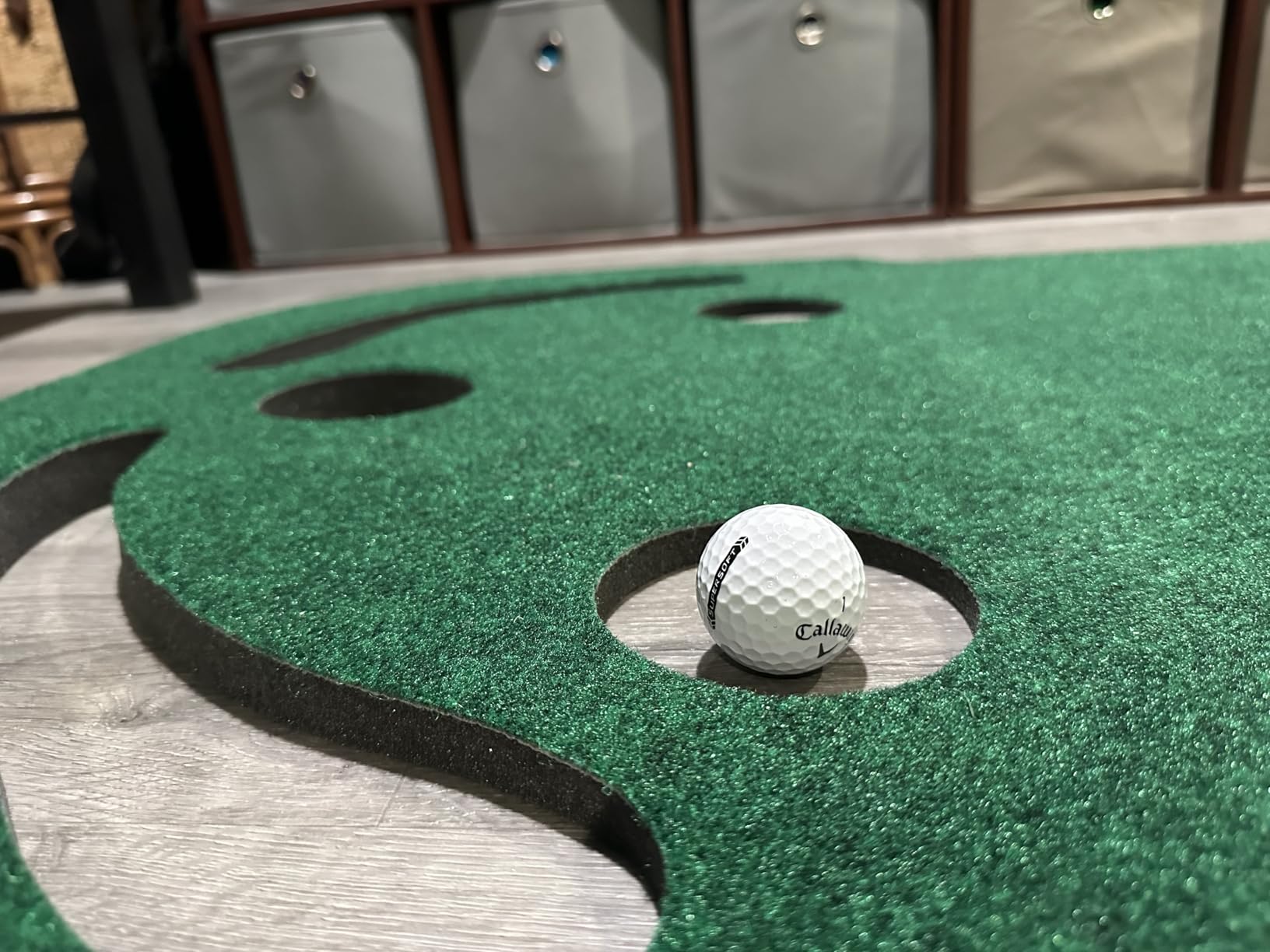
The kidney shape is smarter than it looks. Five holes spread across the surface give you different distances and angles, and the sand-trap cutouts add a failure mode to think about. Reviewers describe the roll as true and fast enough to work on genuine putting technique rather than novelty play.
Owners also point out that it holds up as a family surface, not just a golf tool. With a review count in the tens of thousands, the feedback lines up with what buyers report about it being well made for what it costs.
Who it suits
This is the pick for anyone whose practice time is mostly spent on the short game, and for households where more than one person takes turns. Five holes keep it interesting well past the first month, and the roll-up footprint means it can live in a hallway or a spare room.
It also works well as a warm-up station next to a full hitting mat, so you can start a session with putts before moving to irons.
Who should skip it
Skip it if you want the feel of a real green. It is a thin practice mat, and the shallow holes give little of the satisfying drop you get on a course. Cutouts have no backing, so the floor shows through the holes and traps.
Missed putts can also run off the back edge, so you need a wall or a stop behind it. If your space has no clear backstop, that is worth thinking about before you buy.
2. SKLZ Accelerator Pro Putting Green – Best for Short Putts
SKLZ ACCELERATOR PRO – Indoor Golf Putting Mat with Auto-Ball Return & Behind-the-Hole Ball Collector – Putter Alignment Guides at 3, 5 & 7 Feet – Rubber-Backed Mat Provides Multi-Surface Stability
9 foot runway with gravity ball return
Alignment guides at 3 5 and 7 feet
Rubber backed carpet
Pros
- Gravity ball return sends the ball back so practice is uninterrupted
- Alignment guides at 3 5 and 7 feet help square the putter face
- Stays put on hardwood tile and carpet
- Lightweight and compact enough to carry anywhere
- Users report measurable putting improvement
Cons
- Supplied hole is oversized and easy to make
- Only a 9 foot runway which is short for longer putts
- Thin plastic return-track pieces feel cheaply made
The Accelerator Pro solves the one problem that kills practice sessions at home: chasing balls. Its gravity return track runs the ball back to the start line, so you can hit twenty putts in a row without standing up.
Alignment guides printed at 3, 5 and 7 feet are the part owners appreciate most. They give a consistent reference for squaring the putter face, and reviewers report visible improvement in their stroke after a few weeks of regular use.
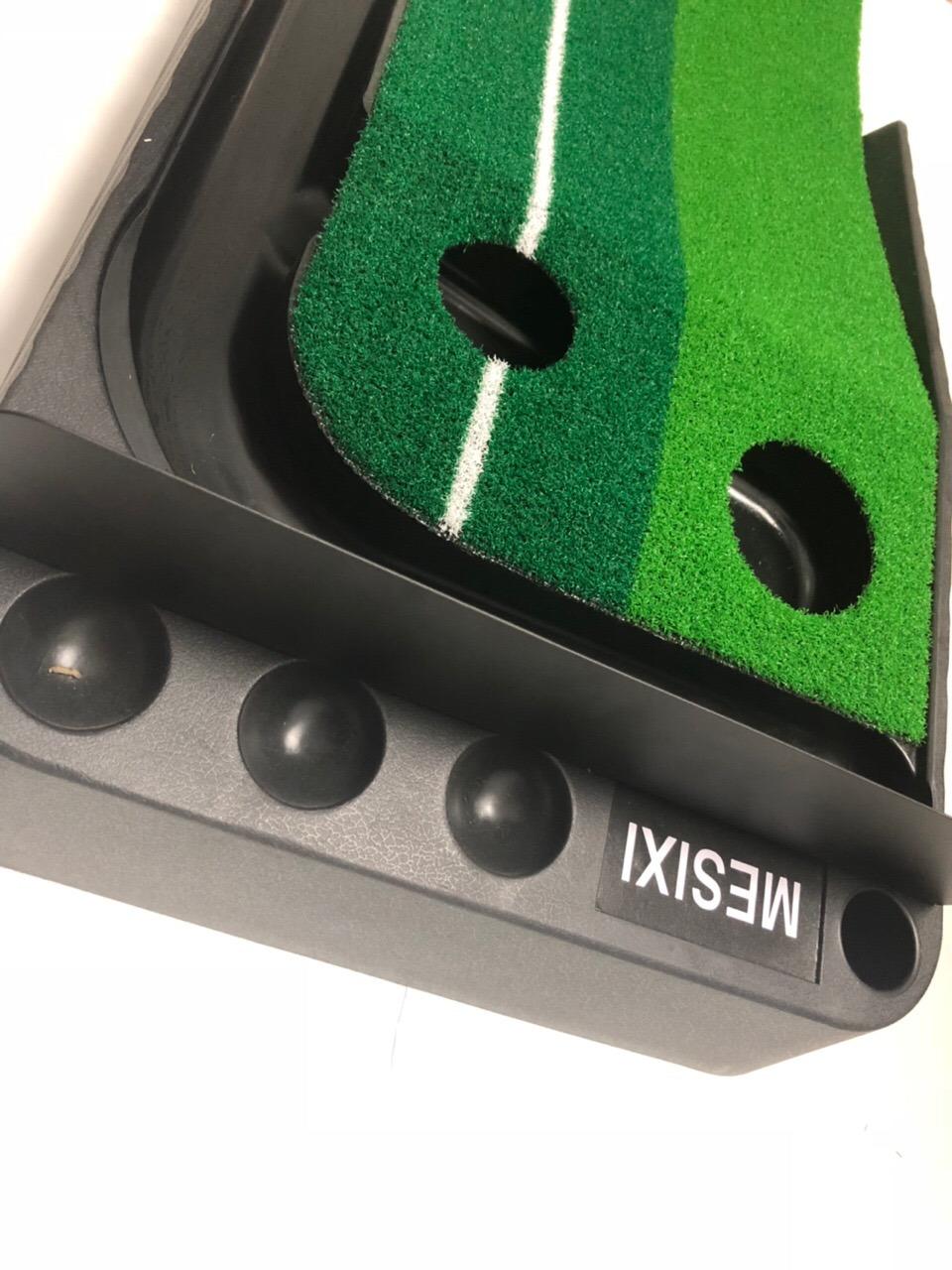
The rubber backing holds it in place on hardwood, tile and carpet, which is rare for a mat this light at 1600 grams. You can move it between rooms or take it with you rather than committing floor space to it.
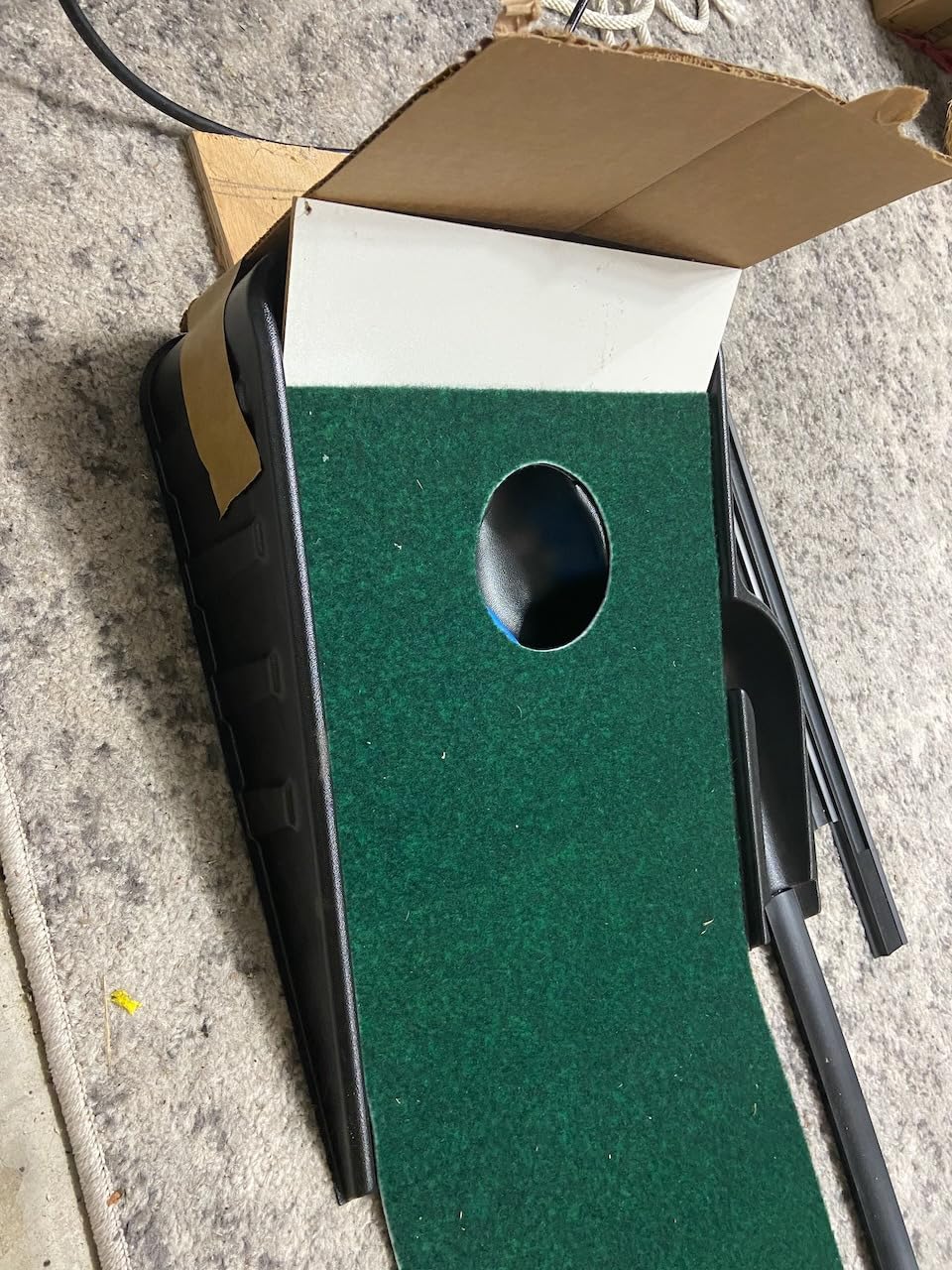
Behind the hole, a collector catches missed putts and sends them back down the runway. It is a small piece of engineering that makes the whole practice loop feel continuous.
Who it suits
Pick this if you are working on face control and stroke consistency over short distances rather than pace. The alignment guides are structured drills disguised as a game, and that is exactly what most golfers need help with.
It is also a good second purchase alongside a full hitting mat, giving you a putting station that stores away in seconds.
Who should skip it
The supplied hole is generous, and many owners add a cardboard insert to tighten it. If you care about realistic cup behaviour, know that you may want to modify it out of the box.
The runway is also only 9 feet long, so longer putts are not really possible, and the plastic return-track pieces feel cheap next to the carpet. Firmly struck putts can travel past the mat and across the room.
3. GoSports Elite Golf Hitting Mat – Best for Full Swings
GoSports Golf Hitting Mat – Elite 5 x 4 ft – 15 mm Artificial Turf Training Mat for Indoor/Outdoor Swing Practice, Includes 3 Rubber Tees
5 x 4 foot hitting area
15mm commercial-grade turf
EVA foam base with non-slip backing
Pros
- Holds up under thousands of shots and outdoor exposure
- Deep turf gives genuine fairway feedback so fat shots are obvious
- EVA foam base absorbs impact and helps with elbow tendinitis
- Large enough to stand on and swing a driver
- Six tee holes plus three rubber tees
Cons
- Arrives folded and the centre crease can persist past the recommended flattening period
- The crease area sinks underfoot and is awkward to hit from
- Heaviest option in this group
If you are swinging a driver in a garage, this is the mat we would point you at first. At 60 by 48 inches it gives you room for a full stance and a finish without chasing the ball off the edge, and the 15mm turf is deep enough to feel like a fairway rather than a rug.
The owner feedback on durability is unusually consistent for this category. Long-term buyers report thousands of shots and year-round outdoor use without visible wear, and several mention that rotating the mat spreads wear and extends its life. No green residue transfers to clubs.
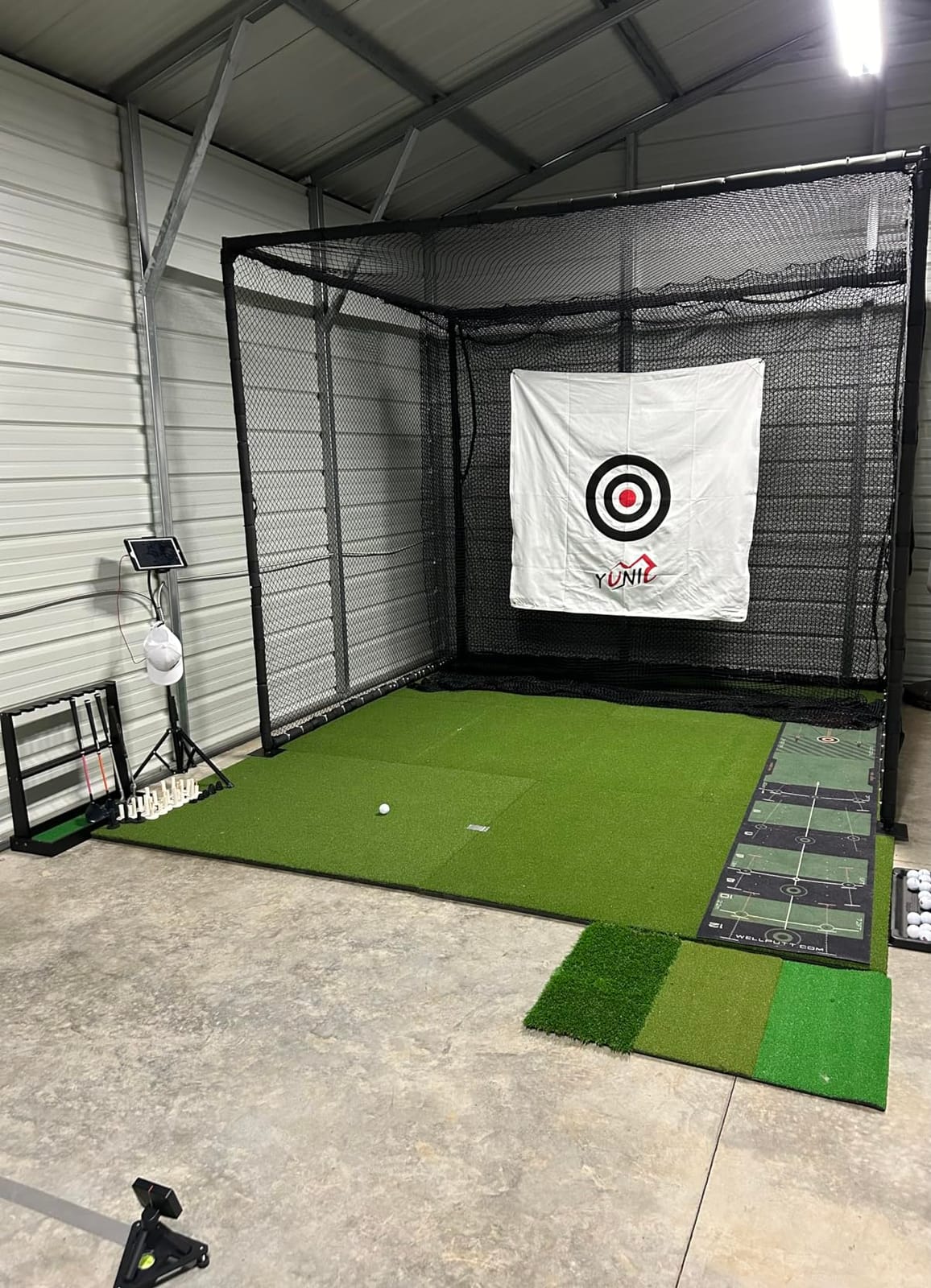
The EVA foam base does the work you care about if you already have elbow or wrist issues. Owners with elbow tendinitis specifically credit the base with reducing jarring on fat shots, which is the strike most likely to send shock up the lead arm.
Six integrated tee holes plus three rubber tees at 1.5, 2.25 and 3.5 inches cover most swing types, and the non-slip backing keeps the whole mat planted on concrete.
Who it suits
This suits golfers practising drivers and long irons who want a surface that survives volume. It also pairs naturally with a net and impact screen, and if you add a launch monitor later the size is already right.
Owners who share a mat with a partner will appreciate how well it handles being hit from both sides.
Who should skip it
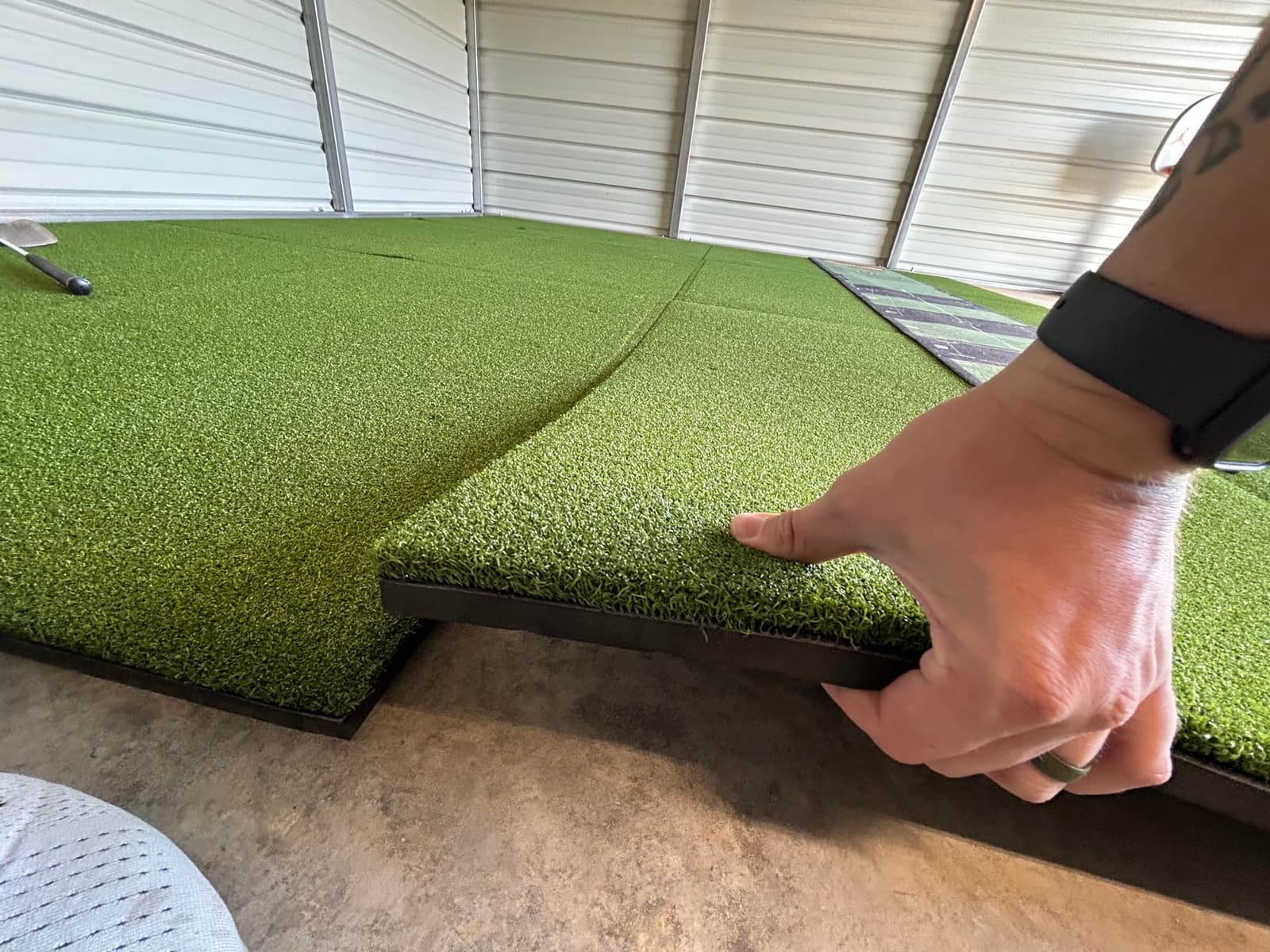
It arrives folded, and that centre crease is the single most repeated complaint. For some units it persists well past the recommended flattening period, and the crease area sinks underfoot, which makes that strip of surface awkward to hit from.
At 11.48 kilograms it is the heaviest mat in this group, so repositioning it indoors is a two-person job. A few owners also report turf tearing on the smaller 5 by 3 foot version after limited use.
4. CHAMPKEY Synthetic Turf Hitting Mat – Most Versatile
CHAMPKEY Premium Synthetic Turf Golf Hitting Mat | Heavy Duty Rubber Base Golf Practice Mat | Come with 1 Rubber Tee and 9 Plastic Tees(Green,13″ x 17″)
13 x 17 inch portable mat
16mm turf over a rubber base
9 plastic tees included
90 day warranty
Pros
- 16mm turf gives a believable fairway or tee-box feel
- Heavy rubber base absorbs shock and does not smell
- Bundle includes 9 plastic tees plus a rubber tee holder
- Light enough to carry in a golf bag
- Entry-level build suits casual and junior practice
Cons
- 13 x 17 inch footprint is tight for full swings
- Thin footprint gives little stability on off-centre strikes
- Only a 90 day warranty
This is one of the most useful entry items on the list. At 13 by 17 inches it is not a driver mat, but the 16mm turf over a heavy rubber base produces a far more believable contact than the thin foam mats at similar cost levels.
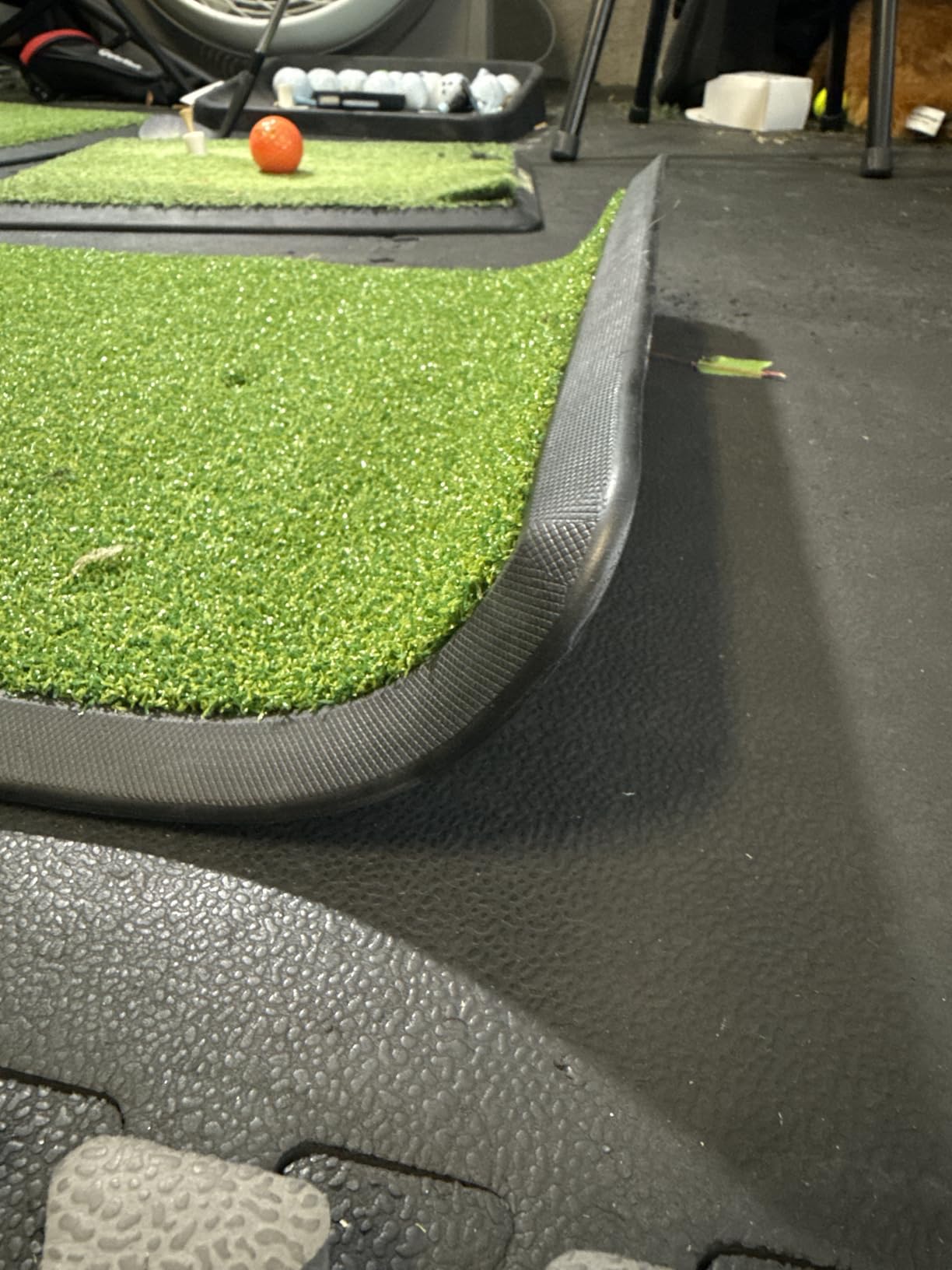
The rubber base is genuinely useful: it absorbs shock, grips the floor and, as owners note, does not smell. That last point matters more than it sounds in a garage in summer.
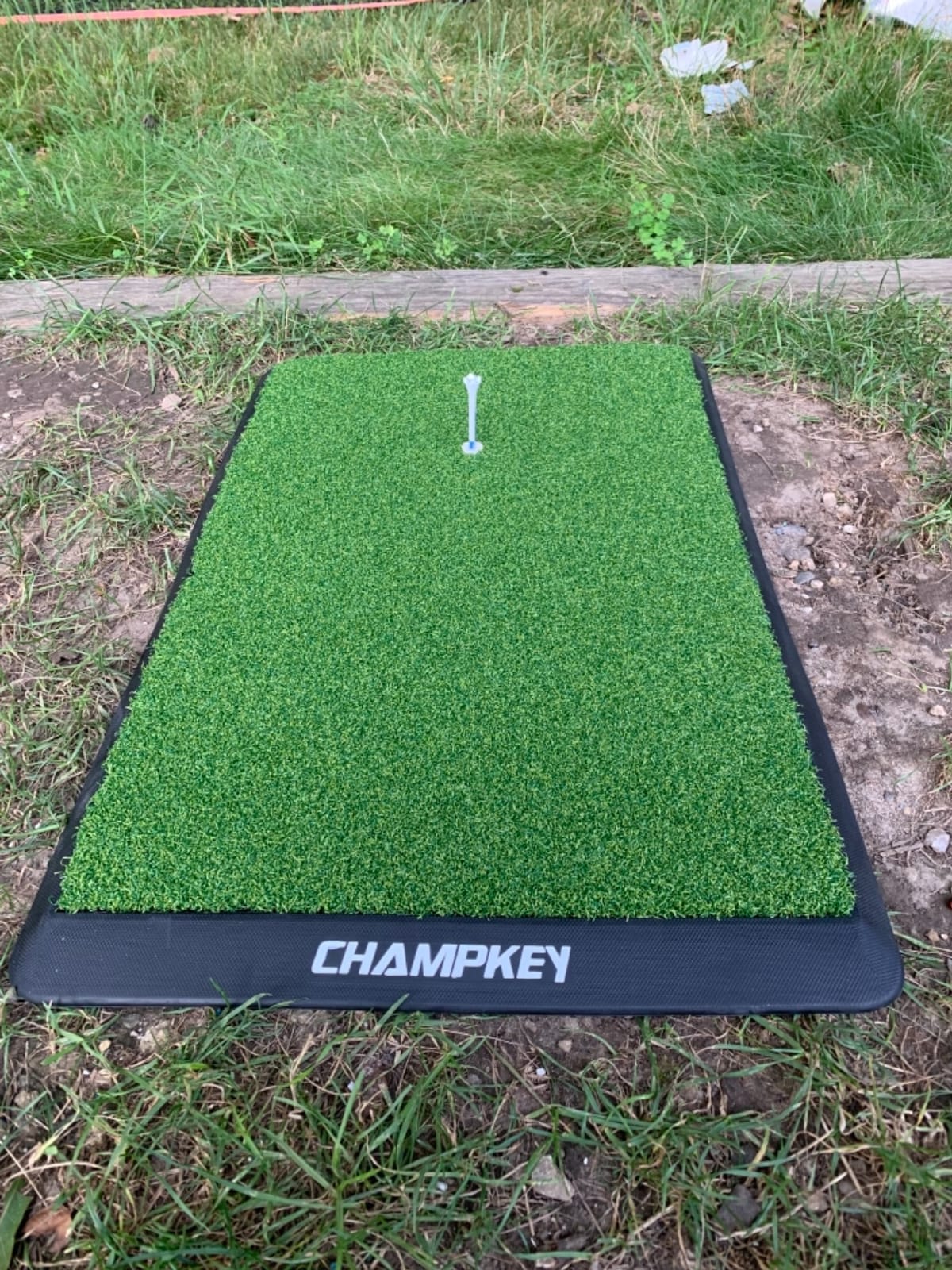
The accessory bundle is unusually generous for the money. You get nine plastic tees and a rubber tee holder, which is more than many mats twice the size include, and the whole thing folds small enough to drop into a golf bag.
For juniors learning contact, or for anyone who wants a travel mat for a hotel room or a park, that combination of turf quality and portability is hard to argue with.
Who it suits
This is the right buy for warm-ups, chipping, short irons and travel. Reviewers consistently describe it as a budget travel and warm-up mat rather than a full practice station, which is exactly how you should treat it.
It also makes sense as a second mat for a junior in the household, small enough to be moved by a child and cheap enough that a damaged one does not hurt.
Who should skip it
Skip it for driver work. The 13 by 17 inch area is tight for a full swing, and the thin footprint gives limited stability or feedback when you strike off-centre.
Turf also wears sooner than commercial-grade mats, and the 90 day warranty is the shortest here. If you want a mat you will keep for years, look further down the list.
5. COSPOPTIC Golf Hitting Mat with Swing Path Feedback – Best Swing Feedback Mat
COSPOPTIC Golf Hitting Mat with Swing Path Feedback, Heavy-Duty Rubber Base Anti-Slip Golf Training Mat, Extra Replaceable Surface, Portable Practice Mat for Home Office Garage Yard Indoor Outdoor
16 x 12 inch impact mat
Swing path tracing surface
EVA polyester and rubber build
Pros
- Impact surface traces the swing path instantly
- Immediate visual feedback without slow-motion video
- Textured rubber base grips concrete hardwood carpet and tile
- Lightweight enough for a golf bag or suitcase
- Includes a spare velvet turf mat
Cons
- Velvet surface wears fast and one steep swing can mark it
- Shifts if you take a divot while swinging
- Very small hitting area limits it to short swings
This is the odd one out in the list. Rather than imitating a fairway, the impact surface records where the clubhead actually touched, so you see toe, centre and heel contact as it happens. It is instant swing path feedback without a camera.
For golfers working on strike location, that replaces the awkward loop of filming a swing and reviewing it in slow motion. The base is textured rubber that grips concrete, hardwood, carpet and tile, and the whole mat weighs 2.5 ounces.
It also includes a spare velvet turf mat, which is a smart inclusion given how quickly felt surfaces wear on this kind of product.
Who it suits
This suits a golfer who needs visual strike feedback more than realistic turf, and anyone practising in a small space where a full mat will not fit. It is also a genuinely portable option for a hotel room or a patio.
With more than two thousand owner reviews, it is clearly a widely used product despite the niche feature set.
Who should skip it
The velvet impact surface is not very durable. One owner reports visible damage from a single steep swing, so treat it as a feedback tool rather than a workhorse surface.
It can also shift if you take a divot mid-swing, and the low profile means the ball sits above stance level for some golfers. The 16 by 12 inch area is for short, controlled swings only.
6. Perfect Practice Standard 9 Foot Putting Mat – Best Long Putting Green
Perfect Practice Standard 9’6″ Putting Mat – Indoor Putting Green
9.5 foot long putting mat
Crystal velvet true-roll surface
Two holes with alignment guides
Magnetic ball return track
Pros
- Full 9 foot 6 inch length suits short and longer putts
- Crystal velvet gives consistent speed and smooth roll
- Regulation and reduced holes plus pace markers
- Magnetic return track keeps practice continuous
- Stands up to heavy use including being walked on
Cons
- Some units arrive with curled or warped edges that break the roll
- Difficult to flatten fully even after weighting or ironing
- Needs a permanently level floor area
- Occasional shipments missing rail sections
Where the SKLZ Accelerator Pro gives you drills, this one gives you a longer runway and a more realistic roll. At 9 feet 6 inches you can work on putts that actually mean something, rather than everything finishing at three feet.
The crystal velvet surface delivers a smooth, consistent roll with the same speed from one end to the other. Two holes, one regulation and one reduced, plus alignment guides and pace markers let you rehearse both control and pace reading.
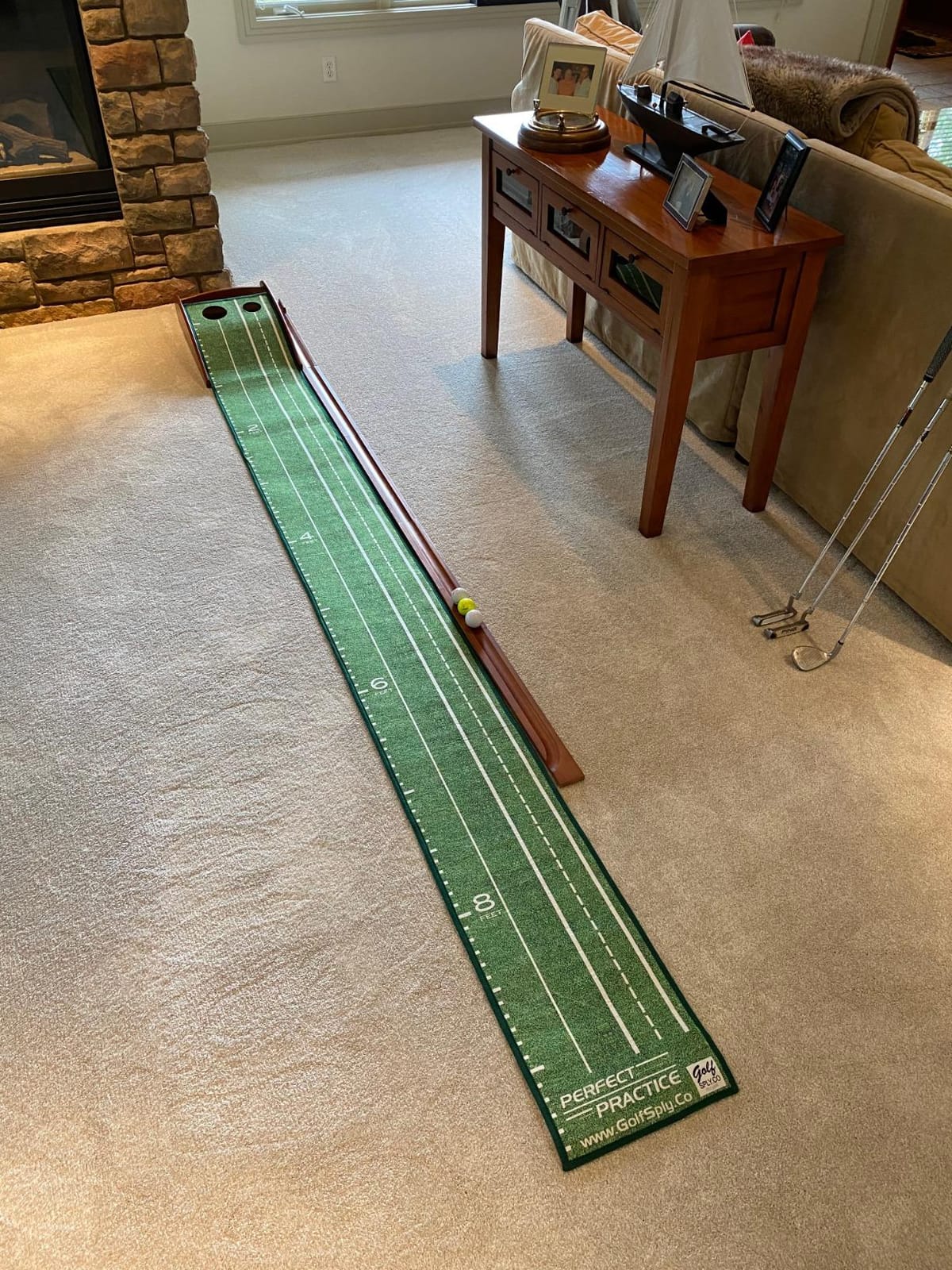
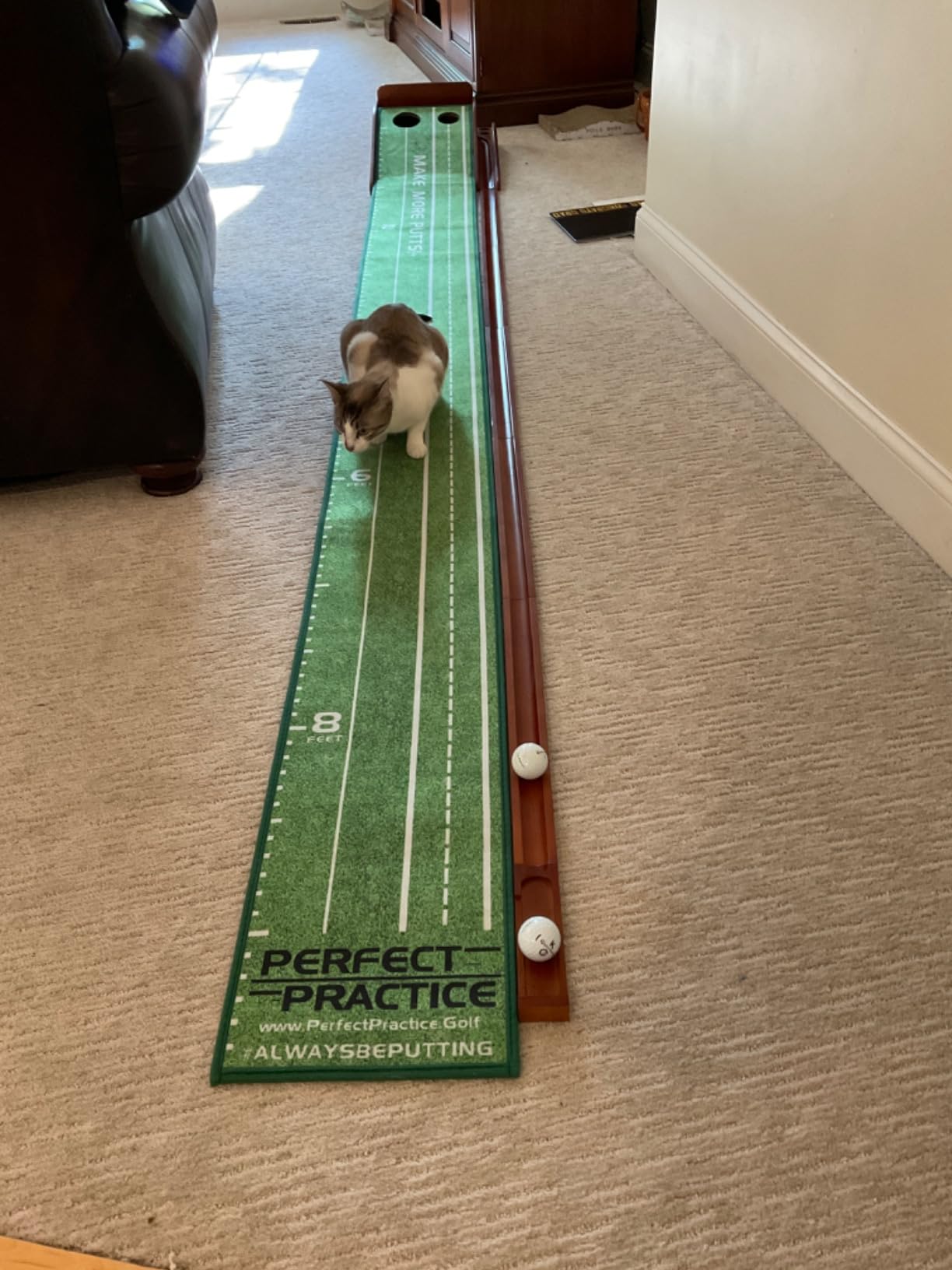
A magnetic return track runs the ball back down the mat, which minimises the ball chasing that ruins putting practice. Owners report it standing up to heavy use, including being walked on by many people at an event.
At 8 ounces it is light, but the mat is long and narrow at 9.5 feet by 6 inches, so you need a straight run of floor rather than an open square area.
Who it suits
This suits golfers at the stage where pace control matters more than face squaring. The full-length runway lets you practise the putts you actually face on a course, and the dual-hole setup lets you work on both control and read.
It pairs well with a full hitting mat in a garage where you have a long, clear strip of floor to spare.
Who should skip it
The recurring problem is curled edges. Some units arrive warped and stay curled even after weighting or ironing, and a curled edge makes the ball break off line, which defeats the purpose of the smooth roll.
It also needs a permanently level floor, and some shipments arrive missing rail sections so balls sink into the mat. It costs more than shorter putting mats and needs its floor space permanently assigned.
7. GoSports Tri-Turf XL Golf Mat – Best for Three Lies
GoSports Tri-Turf XL Golf Hitting Mat – 24×24 in Golf Practice Mat for Indoor/Outdoor Training, Fairway Rough Tee Turf, Portable Golf Mat for Backyard, Garage & Golf Simulator Use
24 x 24 inch hitting area
Three turf zones for different lies
Rubber base
4 square feet of hitting area
Pros
- 24 x 24 inch area allows a comfortable stance for full swings
- Three turf zones for fairway rough and tee practice
- Heavy rubber base stays stable on concrete and protects grass
- Strong owner feedback on turf feel and stability
- Lightweight and easy to move between sessions
Cons
- 24 inch square footprint is tight for full driver swings
- Thin base offers limited shock absorption
- Narrow strips split the three turf zones
- Not ideal for launch monitor or ball dispenser setups
Most mats give you one lie. This one gives you three, with separate fairway, rough and tee turf zones so you can rehearse different lies without moving the ball to a different part of the house.
The artificial grass gives realistic contact that owners credit with improving ball striking and swing path. The heavy rubber base keeps it stable on concrete, patios and lawns, and it protects grass underneath from divots when you use it outside.
At 24 by 24 inches it covers 4 square feet of hitting area, and it folds and moves easily between the garage and the backyard.
Who it suits
This suits golfers who want to work on more than one contact type. Practising off a tee lie, a fairway lie and a rough lie in the same session exposes swing problems that a single surface hides.
It is also a good choice if you split your time between indoors and outdoors and want one mat that handles both floors.
Who should skip it
A 24 inch square is tight for a full driver swing without stepping off the mat, and the base is thin, so shock absorption is limited compared with the thicker mats here.
Splitting the surface into three zones leaves each strip fairly narrow. It is also a poor match for a launch monitor or an automated ball dispenser, which needs a clear, flat, uninterrupted area.
8. SAPLIZE Foldable Golf Hitting Mat – Best Foldable Dual-Turf Mat
SAPLIZE 23″ x 16″ Foldable Golf Hitting Mat, 2-in-1 Golf Turf Grass Mat, Rough and Fairway for Hitting, Chipping and Putting Golf Practice and Training Mat for Indoor/Outdoor
23 x 16 inch folding mat
10mm EVA foam backing
Dual fairway and rough turf
1 year warranty
Pros
- About 40 percent more hitting surface than typical 3-in-1 collapsible mats
- 10mm EVA base absorbs impact over repeated shots
- Upgraded glue layer keeps turf attached longer
- Dual turf simulates fairway and rough on one mat
- Folds flat and lays out immediately
Cons
- Fold lines can persist and disrupt the ball roll
- Small 23 x 16 inch area limits full driver swings
- Thin turf wears faster under high volume
- No alignment guides beyond the single rubber tee
This is the mat we would suggest if your storage space is the deciding factor. It folds flat, lays out without bending, and gives you roughly 40 percent more hitting surface than the typical three-in-one collapsible mat you see advertised.
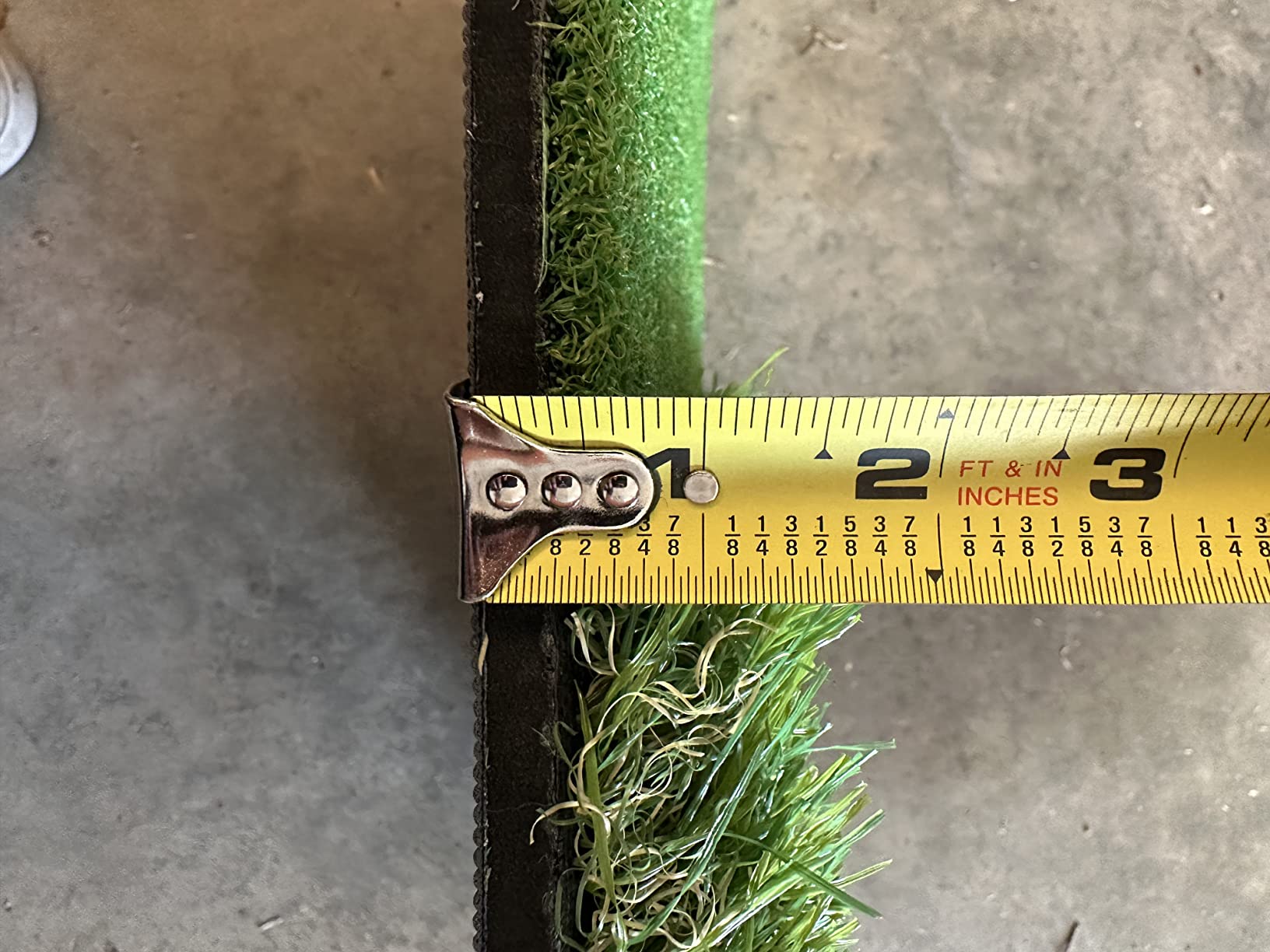
The 10mm EVA foam base does real work on impact. Owners mention protection for both wrists and clubs over repeated sessions, which is the main reason to pay more than a flat rubber mat.
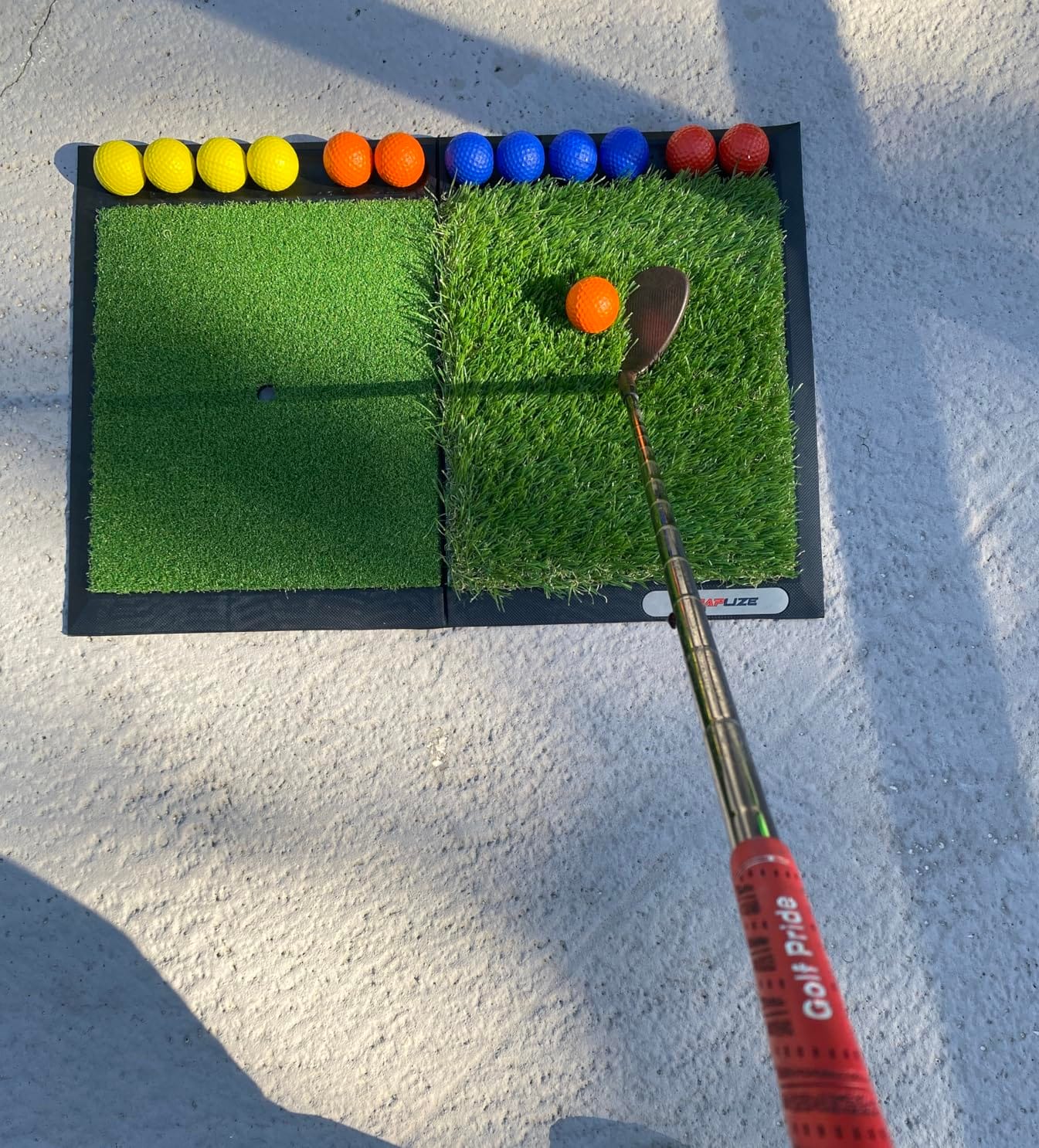
Dual turf gives you fairway and rough on a single mat, and the upgraded glue layer is a small but meaningful detail. Delamination, where turf peels away from the base, is the most common failure in this category, and this mat was built to resist it.
At 735 grams it is light enough to carry with one hand, and it includes a rubber tee. The warranty runs one year.
Who it suits
This suits apartment and basement golfers where a permanent mat is impossible. If your swing room is also your storage room, a mat that folds and disappears is worth more than a larger one you cannot put away.
It is also a solid short-game station, giving you two lies and a cushioned base for irons and wedges.
Who should skip it
Skip it for driver work. The 23 by 16 inch area limits full swings, and the thin turf wears faster under high-volume practice than the deeper piles here.
Fold lines can also persist and slightly disrupt the ball roll in spots. There are no alignment guides or extra tee markers beyond the single supplied rubber tee.
9. Bltend 36mm Golf Hitting Mat – Best for Joint Protection
Bltend Elite Golf Hitting Mat: 5x4ft 21mm Golf Mat Practice Outdoor Indoor
5 x 4 foot mat
36mm turf and EVA backing
6 tee holes
Includes 9 balls and 7 tees
Pros
- 36mm build is among the thickest in this group
- Cushioned EVA backing absorbs impact
- Does not slide on concrete garage floors
- No visible wear after thousands of shots
- 6 tee holes suit both handednesses
Cons
- Ends curl up and resist flattening even after weighting
- Edge hump can send chips and putts off line
- Bundled rubber tees are too short for driver shots
- Heavy and bulky to reposition indoors
Thickness is the headline here. At 36mm across the turf and the EVA backing, this is one of the thickest mats we found in this category, and thickness is what determines how much of a driver strike reaches the floor.
Owners describe the feel as dense and cushioned but still close to real grass, and report no visible wear after thousands of shots. Several specifically note that it does not slide on a concrete garage floor, which is where most mats let you down.
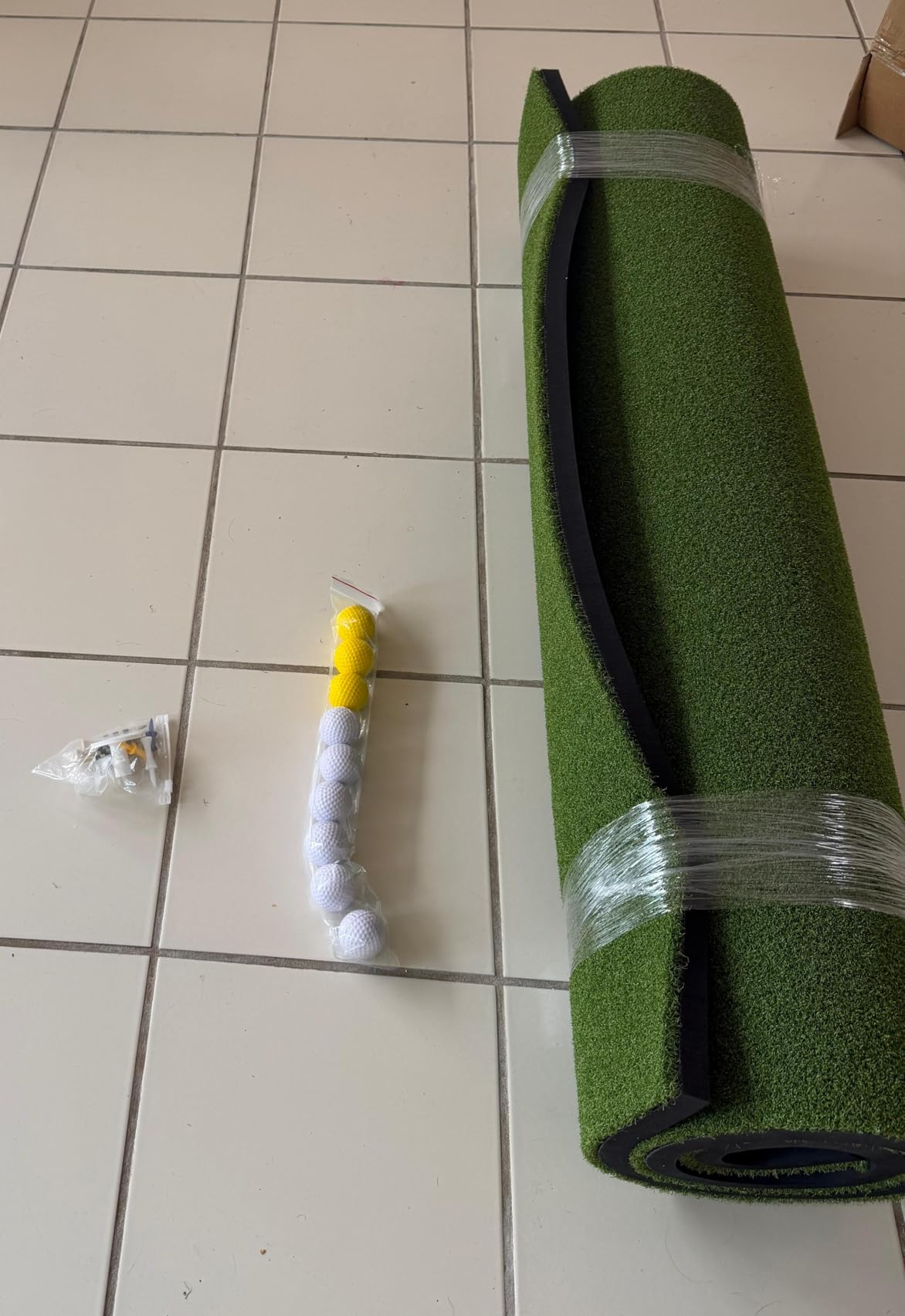
The 5 by 4 foot surface with six tee holes works for golfers of either handedness, which makes it easier to share in a mixed household. The kit also includes nine practice balls and seven tees, so you can start hitting the day it arrives.
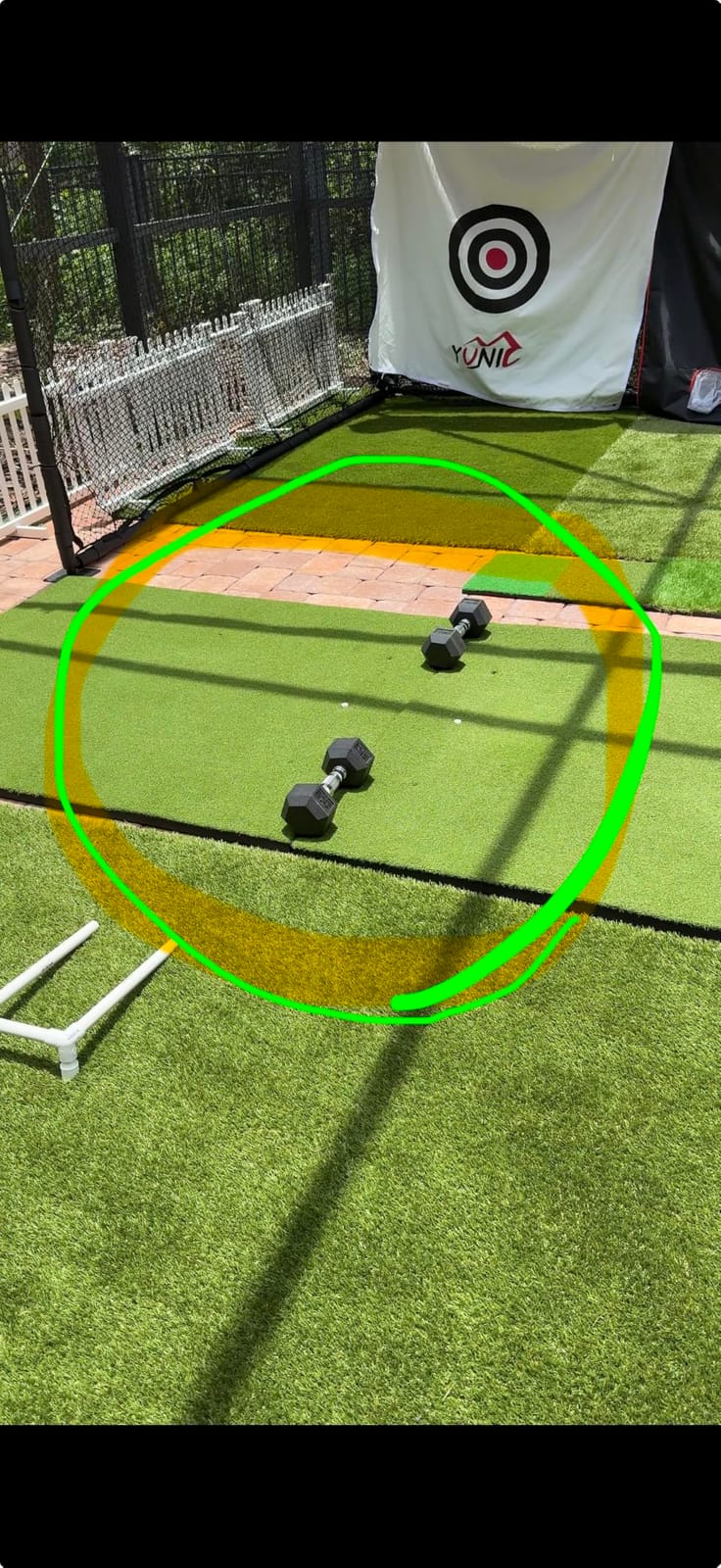
At 12 pounds, this is a mat you place once rather than reposition often. Plan the layout before you bring it into the garage.
Who it suits
This is our pick for anyone with existing wrist or elbow trouble, and for heavier hitters who strike the ground hard on mishits. The cushioning does the most work exactly when you need it most.
It is also the strongest option here for a fixed garage bay or a simulator build where stability matters more than portability.
Who should skip it
The edges curl and resist flattening, which is the most repeated complaint. Owners also report a hump at the edges that can send a chip or putt drifting off line before contact.
The bundled rubber tees are too short for driver shots, so you will need to buy taller tees separately. At 12 pounds it is heavy and awkward to move around indoors.
10. Ywitio Premium Dual-Turf Golf Mat – Best Warranty Cover
Premium Dual-Turf Golf Mat: 5x4ft, 6x4ft, 21mm to 50mm Thickened Base for Backyard, Driving Range, Indoor & Outdoor Practice Hitting, Swing & Chipping (Pro 5x4ft 21mm to 45mm Base)
5 x 4 foot dual-turf mat
21mm to 45mm EVA base
High-density PP turf
2 year service
Pros
- High-elasticity EVA base absorbs shock and protects wrists
- Large 5 x 4 foot footprint with room for driving and chipping
- Dual turf for rough and fairway lies
- High-density PP turf resists tearing
- 2 year after-sale service is the longest here
Cons
- Rolled and folded mats take time to settle fully flat
- Fixed-thickness variants differ from advertised options
- Synthetic turf feel is less realistic than fairway-grade mats
- Bulkier and heavier than compact travel mats
Warranty length is the top trust signal on golf forums, and this is the only mat here with two years of after-sale cover. For buyers who intend to put real volume through a mat, that matters more than any spec line.
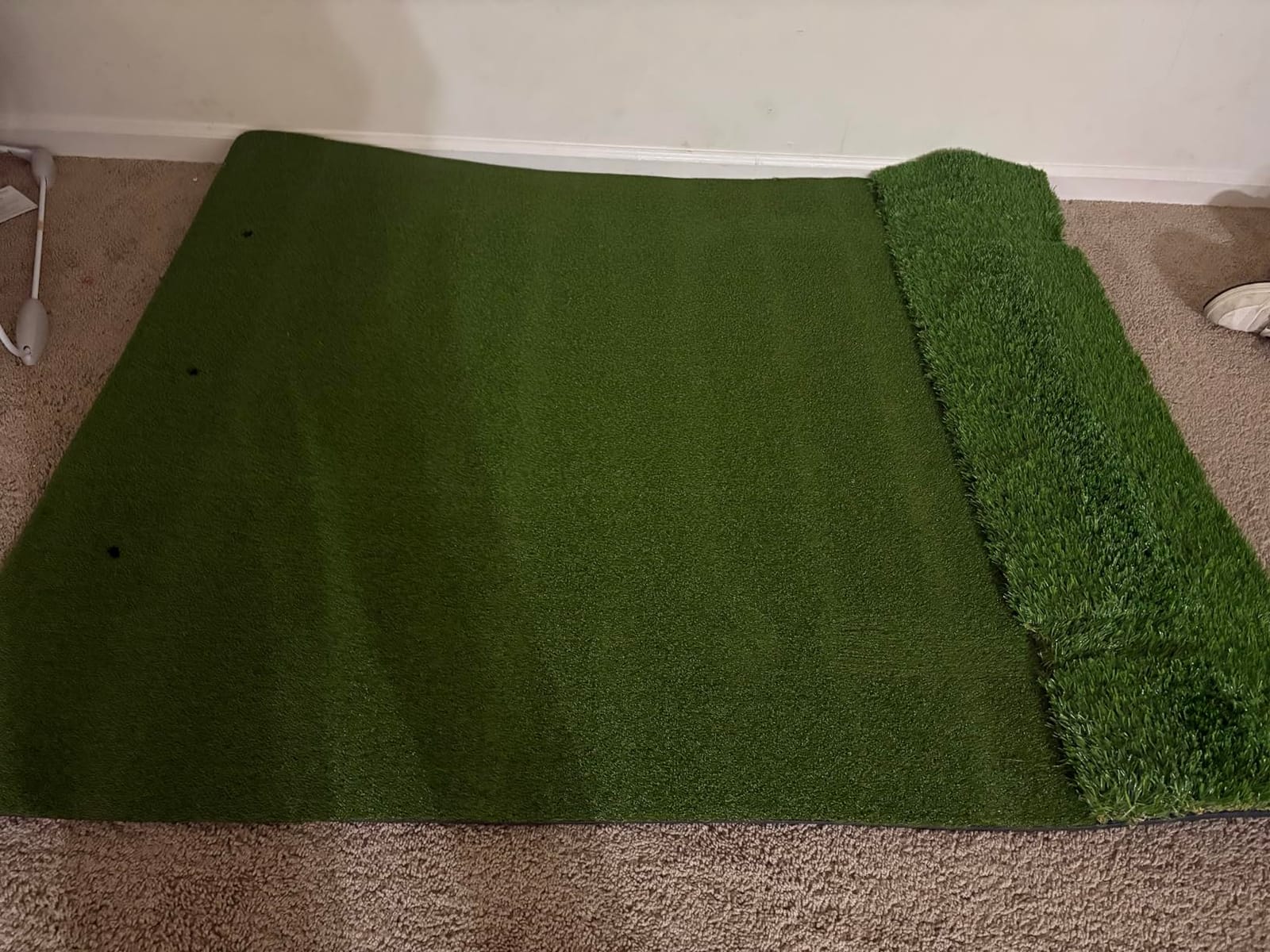
The high-elasticity EVA base absorbs shock and protects wrists and clubs, and the 5 by 4 foot footprint leaves enough space for both driving and chipping practice. It also rolls up for storage despite its size, which is rarer than it sounds for a mat this wide.
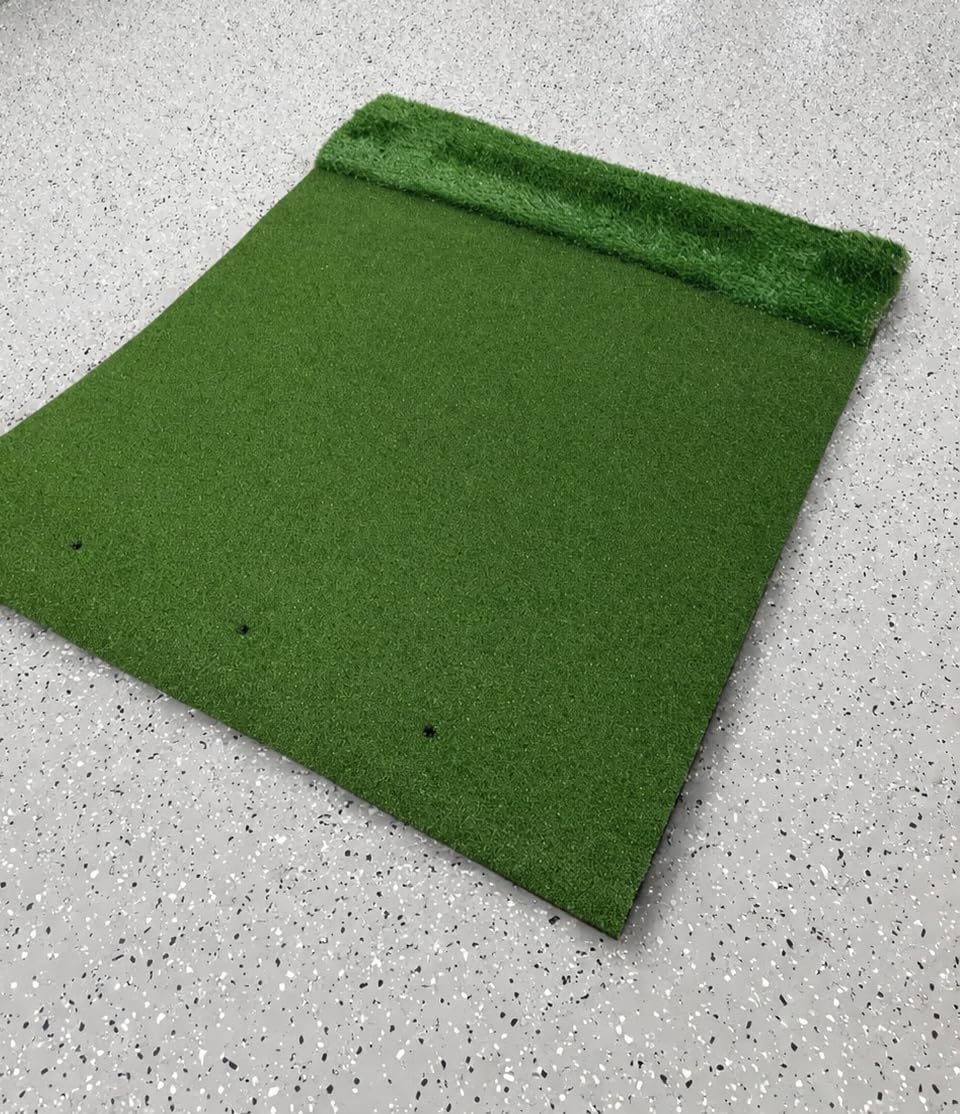
The turf is high-density polypropylene with both rough and fairway sections. Owners describe the material as wear-resistant and resistant to tearing, and the package includes three coloured tees and three rubber tees.
At 5.99 kilograms it is a substantial mat. Treat it as a semi-permanent fixture rather than something you shift around.
Who it suits
This suits buyers who want a fixed home station with a decent warranty behind it, and golfers who want both lies on one mat. The dual turf lets you rehearse a rough contact and a fairway contact in the same session.
It is a sensible middle option for a garage bay that has room for a full mat but not for a permanent simulator build.
Who should skip it
Rolled and folded mats of this size take time to settle flat, and owners report the settling period as noticeable. Be prepared to lay it out well before you intend to hit.
Some fixed-thickness variants do not match the advertised 50mm options, so check the specific listing carefully. The synthetic turf feel is also less realistic than higher-end fairway-grade mats.
11. Ponsonbay Golf Mat with Integrated Ball Tray – Best for Ball Organisation
Ponsonbay Integrated Golf Hitting Mat with Ball Tray, Thickening Golf Mats Practice Outdoor & Indoor Artificial Turf Matt with 3 Tees 5 ft x 4 ft 1.02 in Thick
5 x 4 foot mat at 1.02 inch thick
EVA base 0.39 to 0.59 inch
Ball tray holds 100 balls
2 year warranty
Pros
- Built-in tray holds 100 balls within reach and saves bending
- Thick high-density EVA absorbs impact without jarring the arms
- Three tee heights at 2.4 2.8 and 3.1 inch suit all levels
- Holds up under heavy use with 2000 plus iron shots reported
- Rolls flat and stores compactly
Cons
- Slides on grass or dirt though it holds on concrete
- Takes time to lay fully flat after unrolling
- Tee hole rim can eventually tear
- Strike zone turf wears and compacts
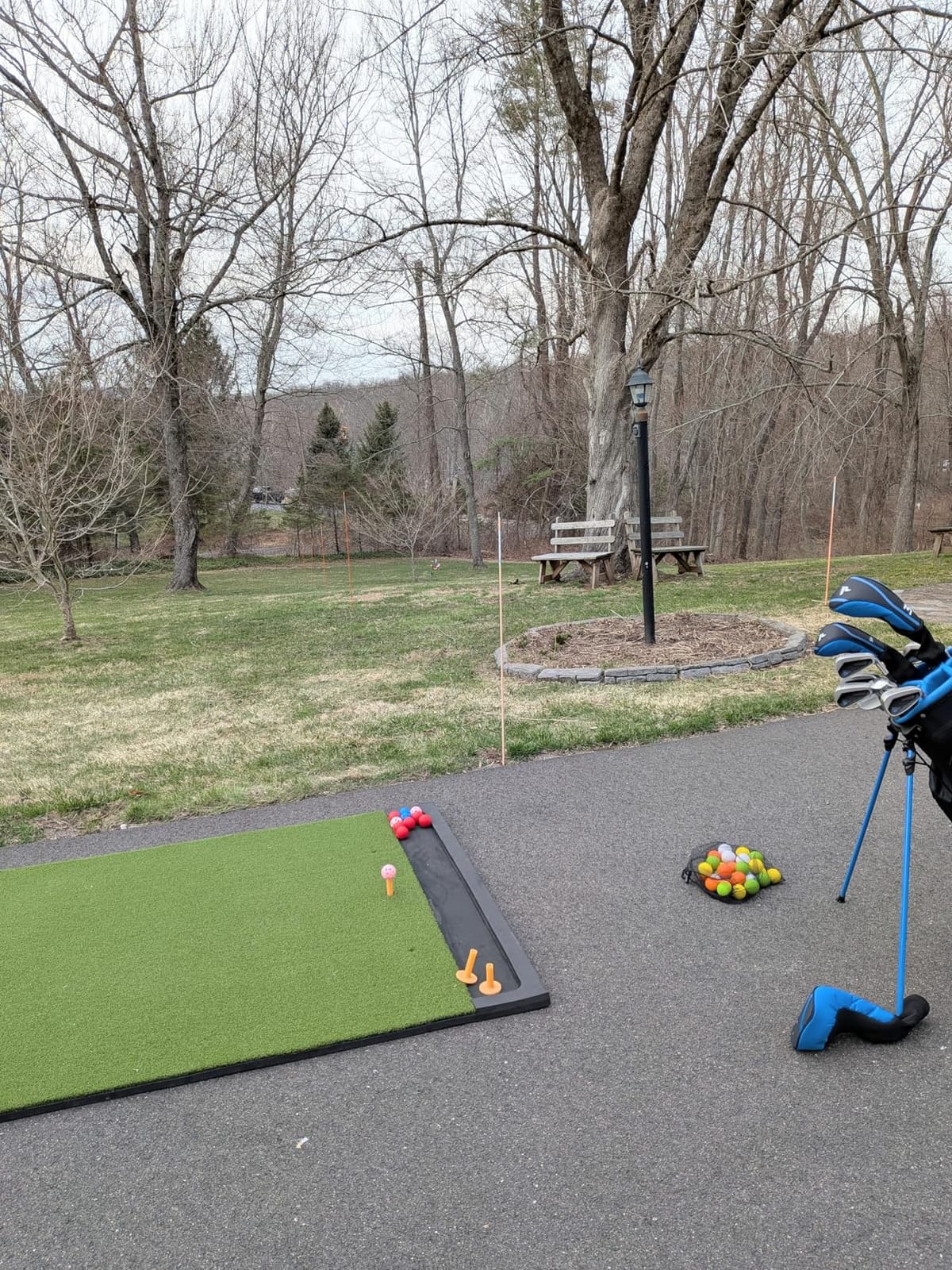
The ball tray is the idea here. It holds up to 100 balls within reach of your stance, which removes the most irritating interruption in high-volume practice: bending down to find one.
Underneath, the high-density EVA base runs up to 0.39 to 0.59 inch, on a mat measuring 1.02 inch overall. Owners credit it with cushioning enough to practise full swings without the jarring shock that thinner mats produce, and several mention no arm pain during long sessions.
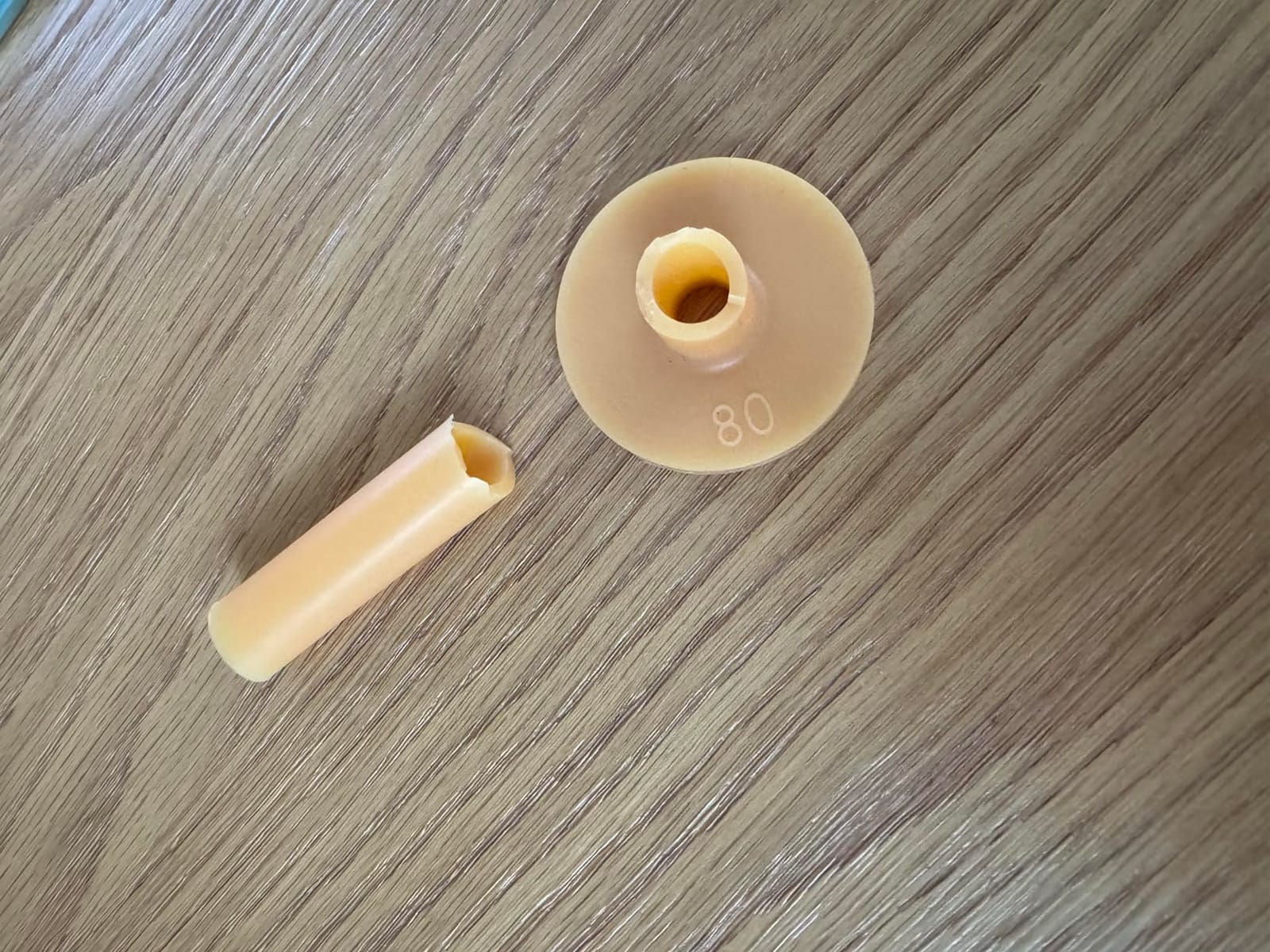
Three tee positions at 2.4, 2.8 and 3.1 inch cover everything from short irons to driver. One owner reports more than 2000 iron shots with the mat returning to shape afterwards, which is a useful durability data point at this price.
It rolls up for storage and transport, and carries a two year warranty.
Who it suits
This suits golfers who hit a bucket of balls rather than a dozen, because the tray keeps the session moving. It is also a good pick for anyone who has already found that bending down for balls kills their practice rhythm.
For garages and basements on hard surfaces, it is stable exactly where you need it to be.
Who should skip it
It slides on grass or dirt, so it is a poor choice for backyard use on soft ground, even though it holds firmly on concrete. It also needs time to lie flat after being unrolled.
Owners report the tee hole rim eventually tearing and the strike zone turf wearing and compacting over time. The ball tray itself is described as feeling cheap.
12. Golfguru 5×4 Golf Hitting Mat – Best Starter Kit
Golfguru Golf Mat 5x4FT, 21mm Dense Elite Turf with 10 Balls & 9 Tees
21mm total: 16mm turf plus 5mm EVA
5 x 4 foot size
6 tee holes
Includes 10 balls and 9 tees
Pros
- Commercial-grade turf gives a fairway-like feel
- Complete set with 10 PU balls 4 tees 3 step-down tees and 2 rubber tees
- Cushioned 5mm EVA absorbs impact across thousands of swings
- 6 tee holes suit golfers of either handedness
- Non-slip foam base stays stable on hard floors
Cons
- 21mm profile is thinner than premium heavy-duty mats
- Turf shows wear in the strike zone over extended use
- Foam padding can compress and lose rebound over time
- Folding crease can leave a training line in the turf
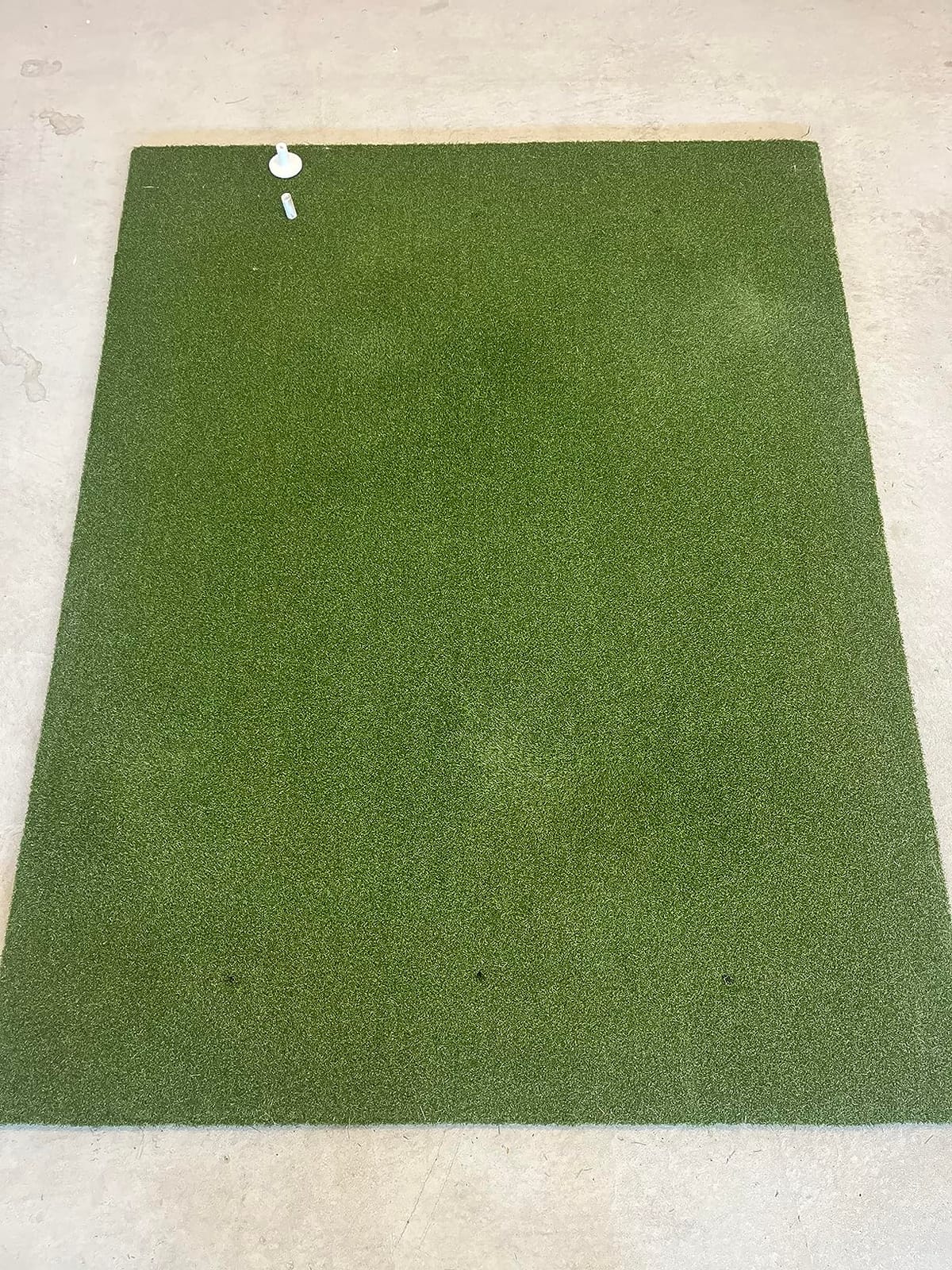
This is the most complete starter package on the list. You get the 5 by 4 foot mat plus ten PU balls, four tees, three step-down tees and two rubber tees, which is everything a beginner needs to start hitting balls rather than air.
The 21mm total build breaks down as 16mm of artificial grass over a 5mm EVA pad, with a 5mm PVC non-slip foam base underneath for stability on hard floors. Owners describe the turf as commercial-grade for the money.
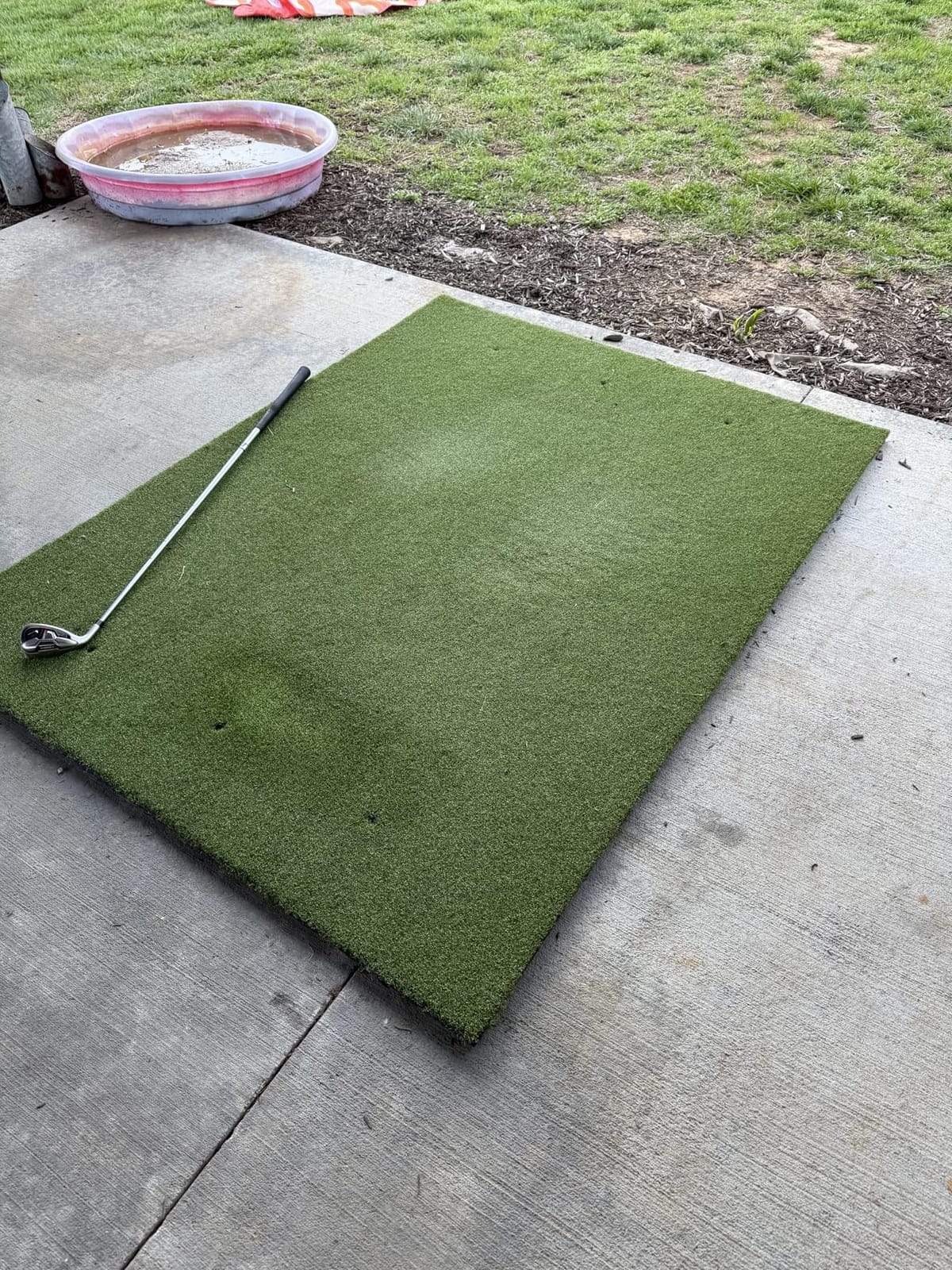
Six tee holes serve golfers of either handedness, and an integrated anti-tearing layer adds longevity. Reviewers treat it as a value-for-money home practice kit for garages, basements and backyards.
Roughly three-quarters of its ratings are five stars, with a small number of critical durability notes concentrated in the strike zone.
Who it suits
This suits anyone starting out who wants a full kit in one box rather than assembling balls, tees and a mat separately. The step-down tees are a genuinely useful addition for new golfers working on strike height.
It works in a garage, shed, basement or poolside, and the foldable design suits smaller spaces.
Who should skip it
At 21mm it is thinner than the premium heavy-duty mats here, so if you have joint issues the thicker options are a better fit. Artificial turf in the strike zone does show wear over extended use, and the foam padding can compress and lose rebound.
Folding for storage leaves a crease that can put a visible training line into the turf.
Buying Guide for Home Golf Mats
How thick should a golf hitting mat be?
For driver work on a hard floor, look for a total build of 30mm or more, which is what separates a mat that feels like grass from one that feels like carpet. The 15mm to 16mm pile height is the realistic-feel benchmark in this category, and the foam base beneath it decides how much of a mishit reaches your joints.
Watch how thickness is described. Some listings quote turf height alone, others quote the whole mat, and a 0.59 inch figure can mean very different things depending on what is counted. The Golfguru listing, for example, breaks its 21mm total down explicitly as 16mm grass plus 5mm EVA, which is the clarity you want.
What size mat do you need for a full swing?
A 5 by 4 foot mat is the practical minimum for a driver swing, because you need room to stand and finish without the ball running off the edge. A 5 by 5 foot mat gives extra margin for bigger swingers or for hitting from the corner. Anything around 16 by 12 inches is a short-game or warm-up mat, not a swing mat.
You also need room around the mat, not just on it. Most owners who clip balls off the edge are standing on a mat that is correctly sized but placed too close to a wall.
Hitting mat, hitting strip, 2-in-1 or simulator flooring?
A full hitting mat gives you a realistic stance and a complete swing. A hitting strip is a narrow, heavily cushioned mat built for irons and wedges, where contact feels precise and fat shots are punished harder. A 2-in-1 adds a putting surface at one end, which saves floor space in a small room. Simulator flooring is a different product entirely, a tiled or roll-out surface built to carry a launch monitor and software.
If you are not yet running a simulator, a mat plus a net is enough. When you are ready to add data, our guide to the best golf launch monitors covers what works in a low-ceiling garage.
What to put under a golf mat on concrete
This is the question that comes up most on simulation forums, and the safest answer is to raise the mat rather than pad it. A user on Reddit r/Golfsimulator put it plainly: for the sake of your joints, put that hitting mat on a platform, because isolation foam and a plywood glue-up work perfectly.
The build is simple. Cut a piece of plywood a few inches larger than your mat, glue a layer of interlocking horse stall foam tiles to the top, then set your mat on the platform. The foam isolates the strike from the slab, and the plywood keeps the surface flat and stable. For most home setups this is a weekend project that costs less than the difference between two mats.
If you would rather not build anything, put the densest mat you can afford directly on the concrete and limit volume until you know how your joints respond. Thin foam mats on concrete are the combination most likely to cause trouble.
Tee insertion and handedness
Check whether the mat accepts real wooden tees or only its own built-in holes. Built-in holes are convenient but they lock you into one ball height, and many golfers find that drilling your own tees into dense turf gives a far more realistic flight. The Bltend and Golfguru mats here use six tee holes that serve golfers of either handedness, which is the arrangement to look for in a shared household.
Several tee holes matter more than one. Moving the ball position lets you work through driver, mid-iron and wedge without repositioning your stance every time.
Durability, warranty and lifespan
Warranty length is the clearest quality signal a buyer can get, and it is the number golfers quote most often on forums. Everything here is covered between three months and two years, with two years the top end. A 90-day warranty tells you how a brand expects the product to be used.
Wear always appears first in the strike zone, in the few inches around the tee. Rotate the mat periodically and the wear spreads out. Thicker turf survives longer simply because there is more material above the base to absorb the blow.
Maintenance and storage
Sweep debris out of the turf regularly, because fragments underfoot change ball contact. If your mat folds, expect a crease: weight it down for a few days after unfolding. Mats that arrive rolled need longer to settle flat, sometimes more than a single practice session.
Store folding mats flat rather than on their side, and roll rolling mats with the turf facing outward. Keep them away from damp garage corners, which encourages edge curl.
Frequently Asked Questions
What is the best golf mat for home practice?
The PUTT-A-BOUT Par Three is our top pick overall for putting, and the GoSports Elite is our best hitting mat for full swings. If you only need one product and you mean full shots, buy the hitting mat: a 5 by 4 foot surface with 15mm turf and an EVA foam base handles drivers and irons on a hard floor. Add a putting mat later, not at the start.
Are golf practice mats worth it?
Yes, if you practise indoors or on concrete and would otherwise not practise at all. A mat gives you a consistent contact point and absorbs impact that would otherwise travel into your wrists and elbows. The value drops sharply if you already have access to a range or a good piece of grass. Treat a mat as a consistency tool, not a skill replacement.
How thick should a golf hitting mat be?
For driver work, look for a total build of 30mm or more, including the turf and the foam base. A 15mm to 16mm pile height is the realistic-feel benchmark, and the foam beneath it is what absorbs a mishit. Check whether the listed thickness refers to turf alone or the whole mat, because manufacturers quote it both ways and the difference is significant.
What is the best golf hitting mat for concrete floors?
Choose a dense mat with a thick EVA base, such as the GoSports Elite or the Bltend 36mm, and place it directly on the slab so the mat itself provides the cushioning. For longer sessions, raise it on a plywood platform glued to interlocking horse stall foam. That isolates the strike from the concrete and is the fix most recommended on golf simulation forums.
What size golf mat do I need for a full swing?
A 5 by 4 foot mat is the practical minimum for a driver swing, because you need room for your stance and finish without the ball running off the edge. A 5 by 5 foot mat suits larger swings or corner position. Mats around 16 by 12 inches are short-game and warm-up surfaces, not swing mats. Leave clearance around the mat too.
What is the best golf mat for a backyard practice?
Use a mat with a rubber base that will not slide on soil and is light enough to move between sessions. The GoSports Tri-Turf XL offers fairway, rough and tee zones in a portable format. The Bltend and Ponsonbay mats are heavier and steadier, which suits a fixed spot but makes them harder to reposition. Avoid anything with a deep tray if you plan to move it often.
What is the best golf putting mat for home use?
The PUTT-A-BOUT Par Three is our pick for most homes because it rolls out flat instantly and offers five holes at a very low cost. Choose the Perfect Practice Standard 9 Foot instead if you want a full-length runway for realistic long putts and pace control. The SKLZ Accelerator Pro is better for short-putt alignment drills, and its ball return keeps sessions continuous.
Do golf mats hurt your joints?
A thick mat on a soft floor should not. A thin mat on concrete can, because the jarring from a mishit travels straight into the wrists, elbows and shoulders. The most common complaint from golfers is pain after hitting fat shots off hard ground. Fix it with a thicker mat, by raising the mat on a plywood and foam platform, or by reducing volume while your joints adapt.
The Bottom Line on Golf Mats for Home Practice in 2026
If you want one recommendation, take the PUTT-A-BOUT Par Three as the safest all-round buy. It rolls out flat in seconds, works immediately for five different putts, and carries the strongest owner feedback of anything on this list. For full swings, the GoSports Elite is the matching hitting mat.
Its 5 by 4 foot area, 15mm turf and EVA foam base handle drivers and irons on concrete, and owners report thousands of shots without visible wear. Flatten the centre crease before your first session and it is hard to argue with as a default station.
For joint protection specifically, the Bltend 36mm is the thickest build here and the most forgiving on a mishit. For realistic long putts, the Perfect Practice Standard is the upgrade.
Whichever you choose, put it on something. A plywood and foam platform under a mat costs a fraction of the mat itself and is the difference between practising for years and practising for a month.
Once you are hitting consistently, our guide to the best home golf simulators covers what to add next, and our picks for the best golf rangefinders will help you get to a course when the weather allows.