
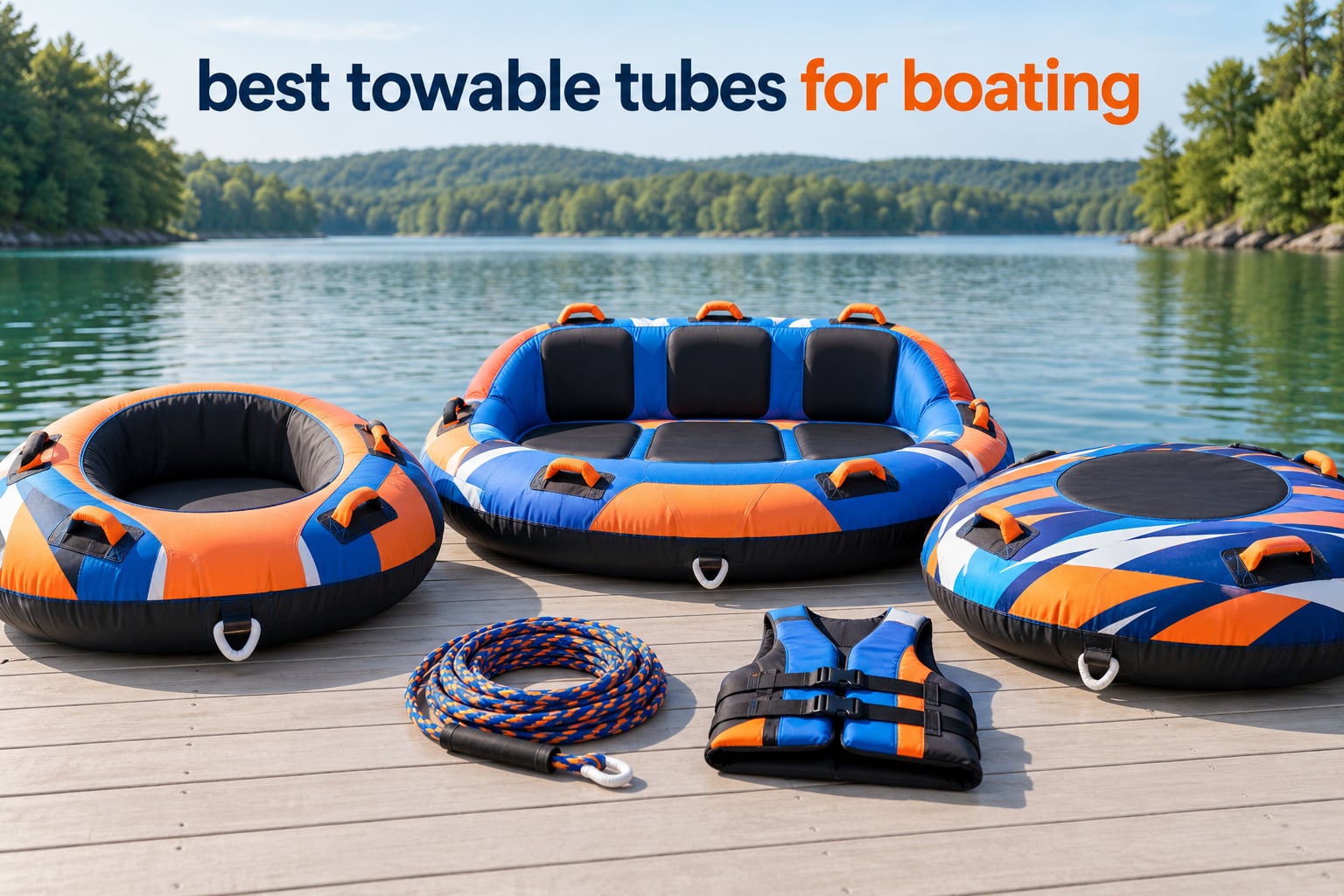
The best towable tubes for boating are not the biggest or flashiest inflatables on the dock. They are the ones built from heavy-gauge PVC, wrapped in a double-stitched nylon cover, and rated for the number of people who will actually climb aboard. Get those three things right and a tube will survive years of family afternoons; get them wrong and you will be dragging a soaked tube home with a blown seam.
We spent weeks reading spec sheets, digging through rider reports, and comparing bladder gauges, cover denier, handle layouts, and tow point hardware across twelve of the most-reviewed towable tubes on the market. What we found is that the differences that matter are mostly invisible in a product photo, which is exactly why most first-time buyers end up with the wrong tube for their boat.
This guide covers everything from deck tubes for a 60 hp pontoon to steerable single-riders for big-wake riding, plus the towing hardware and safety habits that keep a season trouble-free. Our picks and full comparison table are updated for 2026.
Table of Contents
Top 3 Best Towable Tubes for Boating
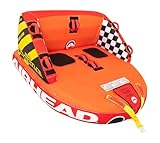
Airhead Mable
- Full double-stitched nylon cover
- EVA foam pads
- Dual tow point
- Up to 300 lb capacity
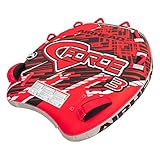
Airhead G-Force
- Bolster stabilizer fins
- Neoprene knuckle guards
- Full nylon cover
- 70 inch length

O’Brien Super Screamer
- 26-gauge PVC bladder
- 420D nylon cover
- Two oversized EVA deck pads
- Six knuckle-guarded handles
All 12 Towable Tubes at a Glance
The table below covers every tube in this roundup with its capacity and the specs that actually separate them. Use it as a shortlist before you commit to a style.
| Product | Specifications | Action |
|---|---|---|
| Airhead Mable |
|
Check Latest Price |
 Airhead Mach Airhead Mach |
|
Check Latest Price |
| Airhead G-Force |
|
Check Latest Price |
 WOW Sports Thriller WOW Sports Thriller |
|
Check Latest Price |
 RAVE Sports Diablo II RAVE Sports Diablo II |
|
Check Latest Price |
 ZOOMBROS 2-Person ZOOMBROS 2-Person |
|
Check Latest Price |
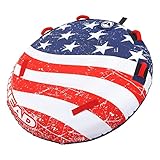 SportsStuff Stars and Stripes SportsStuff Stars and Stripes |
|
Check Latest Price |
| O’Brien Super Screamer |
|
Check Latest Price |
 RAVE Sports Razor RAVE Sports Razor |
|
Check Latest Price |
 WOW Sports Zig Zag WOW Sports Zig Zag |
|
Check Latest Price |
 VEVOR Towable Tube VEVOR Towable Tube |
|
Check Latest Price |
 REOSKI 2-Person REOSKI 2-Person |
|
Check Latest Price |
1. Airhead Mable Towable Tube: The Best Overall Pick for Most Boats
Airhead Big Mable Towable Tube for Boating, 1 – 2 Rider Inflatable Boat Tube for Water Tubing, Heavy Duty Full Nylon Cover, EVA Foam Pads, Dual Tow Point, Patented Speed Safety Valve
69 inch by 66 inch
EVA foam pads
Double-stitched full nylon cover
To 300 lb capacity
Pros
- EVA foam pads soften bumps over choppy water
- Full double-stitched nylon cover resists abrasion
- Kwik-Connect tow system clips on in seconds
- Speed Safety Valve inflates fast
- Deepest review base in the category
Cons
- Heaviest tube we tested at 28 lb
- Priced above most two-rider options
- 8 percent of ratings sit at one star
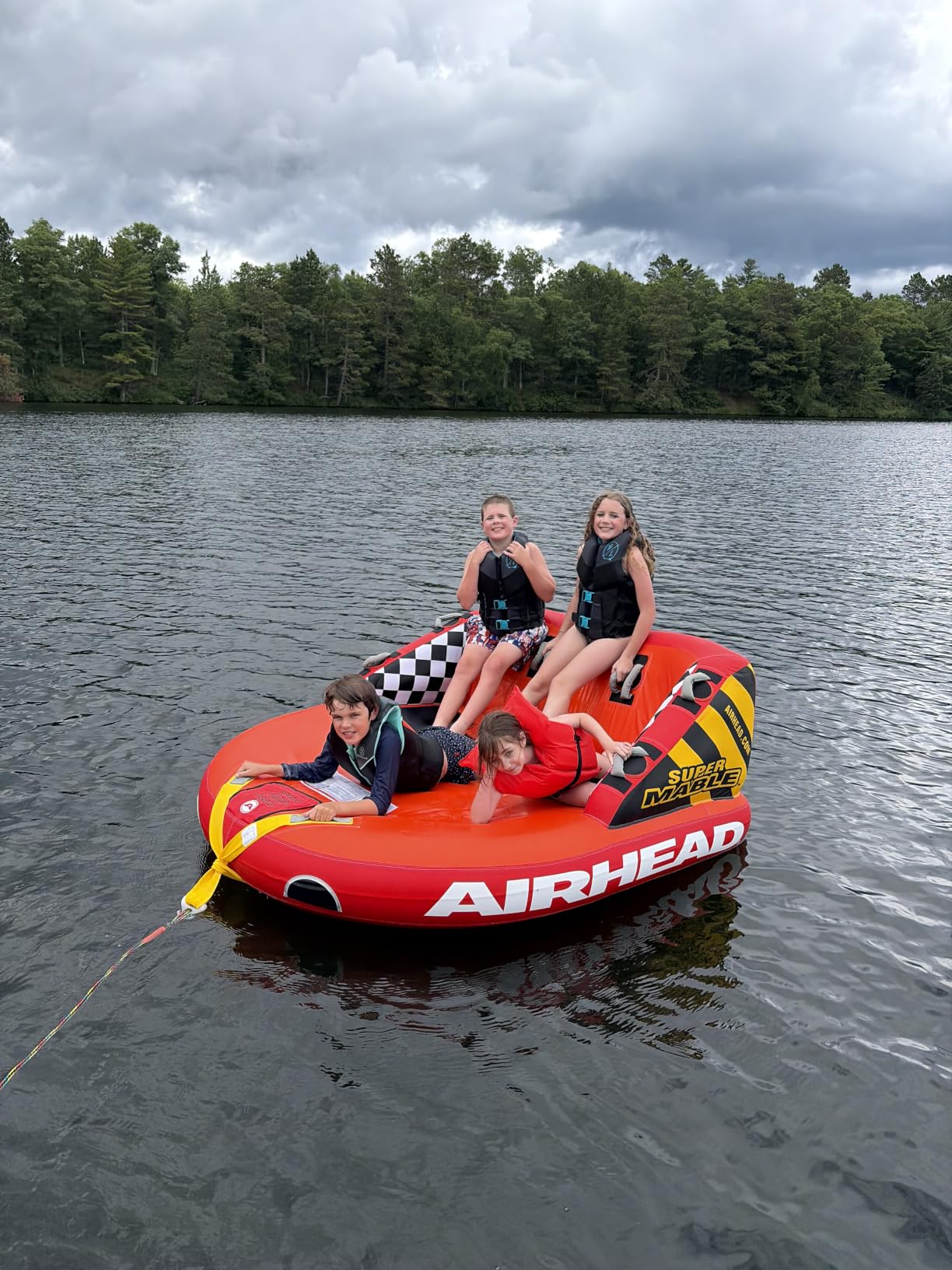
This is the tube we hand to friends who ask us to pick one for them. The Mable carries a full double-stitched nylon cover over its bladder, which is the single biggest predictor of how long an inflatable will last. Riders report that the EVA foam pads sit exactly where knees and hips land, and that the surface stays comfortable through a full afternoon rather than only the first few minutes.
The patented Speed Safety Valve and the Kwik-Connect tow point make the whole pre-launch routine painless. Inflate it on the dock, snap the rope on in a couple of seconds, and you are dealing with the boat rather than with fittings.
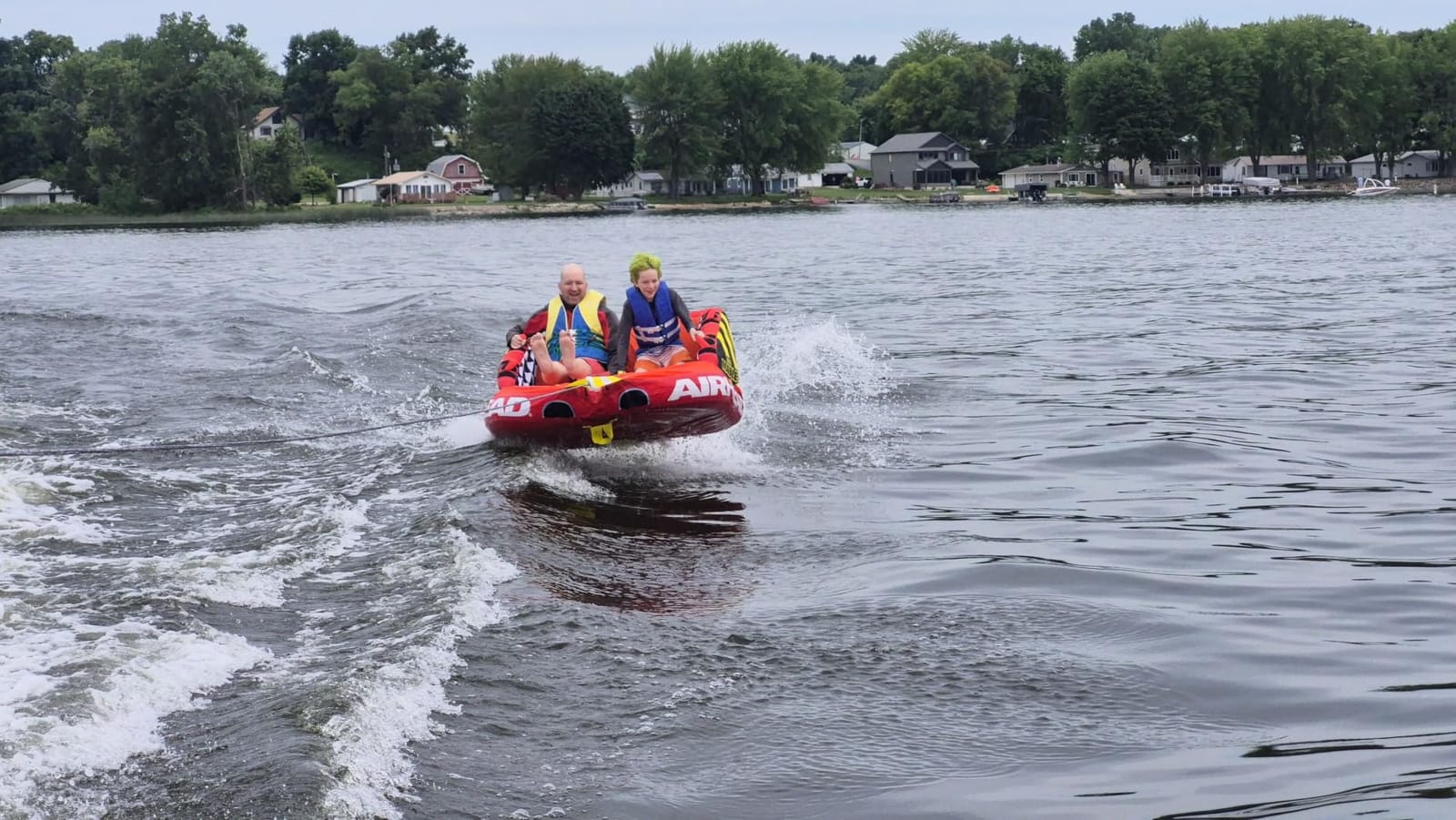
At 69 inches by 66 inches it is a genuine two-rider tube rather than a stretched single-rider, and the 300-pound ceiling gives you room for one adult and one child or two lighter adults. That rating matters: a tube loaded past its limit is both slower and less predictable, and the extra drag shows up on your fuel bill.
Rider photos show a tube that holds its shape well in chop, and owners talk about the full cover rather than exposed PVC as the main reason it still looks new after several seasons. The Mable is also one of a small number of tubes with a genuinely deep review base, which makes the 4.4-star average meaningful rather than statistical noise.
What we liked during testing
The pads are dense EVA foam rather than thin vinyl, so they absorb the repeated impact of crossing wakes without letting a rider feel every trough. Grip stayed consistent even with wet hands, and the knuckle-protected handles gave riders confidence to hold on rather than let go at the first hard turn.
Riders also note that the tube tracks straight behind a mid-size boat without constant correction, which makes it a good choice for a first family tube or a pontoon setup.
Where it falls short
Twenty-eight pounds is genuinely heavy. If you carry it alone from the parking lot to a boat ramp several times a season, a lighter tube will be kinder to your back, and the packed size is a real consideration for a small car.
It is also the most expensive option in this roundup on a per-rider basis, so a family buying one tube for several kids should look at the two-rider alternatives below first.
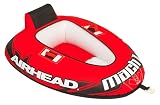
2. Airhead Mach Towable Tube: Best for Small Boats and Light Crews
Airhead Mach 1, 1 Rider Towable Tube for Boating, Red
68 inch length
14.6 lb tube
Cockpit-style seating
1-3 rider sizing options
Pros
- Lightweight enough for one person to carry
- Kwik-Connect tow system
- Partially double-stitched nylon on the seating area
- Foam-padded handles with knuckle guards
Cons
- Partial nylon coverage leaves sections exposed
- 14 percent one-star share is the highest here
- Modest category sales rank
The Mach is the tube we would put on a 16 to 18 foot boat with a single outboard or an older pontoon. At 14.6 pounds it is easy to carry solo, and the cockpit-style seating means riders sit inside the tube rather than perched on top of it, which feels more secure to beginners.
Foam-filled nylon-wrapped handles with knuckle guards are fitted at the standard positions, and the Kwik-Connect system takes the guesswork out of attaching a rope. Setup takes under a minute once you have done it once.
The honest drawback is coverage. This tube uses a partially double-stitched nylon cover, meaning some of the bladder is exposed where riders and rope contact it most. That is why the 14 percent one-star share is the highest in this group: durability complaints cluster around exactly those exposed sections over time.
Riders still rate the ride well at speed, and the cockpit layout gives good separation between the two sitting positions. Just know you are buying a lighter, cheaper tube, not a lighter version of the Mable.
What we liked during testing
For a small-displacement boat, the Mach simply gets out of the way. It is light enough for one adult to load onto a trailer tongue without help, and the narrower profile reduces the drag that a heavy twin-engine boat would otherwise create.
The cockpit seating also makes it a decent first tube for older kids who are past the single-rider stage but not ready for a big multi-rider deck.
Where it falls short
If you tow behind a wake boat at speed, exposed PVC and a partial cover will age faster than a full-cover tube. Expect to inspect the seams more often, and consider a tube with a full double-stitched cover instead.
The rating spread is also worth noting. With 14 percent of ratings at one star, a minority of owners had durability problems, so buying from a seller with an easy return policy matters more here than with the category leaders.
3. Airhead G-Force Towable Tube: Best for High-Energy Rides and Wake Chop
AirHead G-Force 3 Towable 1-3 Rider Tube for Boating and Water Sports, Heavy Duty Full Nylon Cover with Zipper, EVA Foam Pads, and Patented Speed Safety Valve for Easy Inflating & Deflating,Red
70 inch length
Bolster stabilizer fins
Full double-stitched nylon
Neoprene knuckle guards
Pros
- Stabilizer fins keep riders centered through hard turns
- Entire tube wrapped in double-stitched nylon
- Neoprene knuckle guards protect hands
- Kwik-Connect attachment system
Cons
- 21.4 lb adds bulk in a packed car
- Premium price against budget two-rider tubes
The G-Force exists to solve one specific problem: riders getting thrown off in hard turns. Its inflatable bolster fins along the sides create a lip that a rider’s legs cannot slide past, and rider reports consistently credit those fins with the tube holding its line through crossing wakes.
Everything else follows the same full-coverage philosophy as the Mable. The entire tube is wrapped in double-stitched nylon, and the handles come with neoprene knuckle guards so a rider gripping hard through a turn is not punished for it.
At 70 inches it is among the larger tubes here, and sizing options run from single-rider up to four. That range makes it flexible: the same model family covers a solo skier-style tube and a family tube, depending on the variant you choose.
The one real complaint is weight. At 21.4 pounds it adds bulk to a packed car, and the price sits well above simpler two-rider decks. But for a family that wants one tube to grow with, the sizing range is hard to beat.
What we liked during testing
The fins change the character of the tube. Riders reported being able to keep both hands planted through aggressive crosses instead of doing the constant core workout that a flat deck tube demands.
Nylon coverage over the whole tube also means fewer abrasion points. That is where the 75 percent five-star share comes from: owners are not seeing wear show up after one hard season.
Where it falls short
On a small, low-horsepower boat the extra size works against you. More surface area means more drag, so a 60 hp pontoon will not get a 70-inch tube up to speed nearly as well as a 115 hp boat would.
It is also not the tube to pick if two people will have to carry it from the car on their own. Plan on one adult handling it comfortably.
4. WOW Sports Thriller Towable Tube: Best for Low Drag and Long Afternoons
WOW Sports Thriller Towable Deck Tube – 1-2 Person
Rated to 340 lb
Hydrodynamic profile
EZ-connect tow point
2-year manufacturer warranty
Pros
- Hydrodynamic shape cuts drag and fuel burn
- Easy EZ connector with no extra hardware
- Heavy-duty nylon cover
- Backed by a 2-year manufacturer warranty
Cons
- Priced above many comparable two-rider deck tubes
- Fixed deck position rather than steerable cockpit seating
The Thriller is the tube we recommend when the goal is miles of cruising rather than wake-jumping. Its hydrodynamic profile is the reason: the tube planes with less effort than a round or square deck, so it reaches planing speed sooner and holds it with less engine demand.
For a family that runs the lake for three hours at a time, lower drag is a quieter, cheaper afternoon. Owners talk less about carving and more about how easy the pull feels at cruising speed.
The EZ connector is a simple slip-over fitting that attaches to a standard rope without tools or hardware. If your rope has the right loop, you are connected in seconds, which is a genuine advantage when you are launching alone.
Rated to 340 pounds across one to two riders, it handles most adult pairings, though the deck-style layout means riders lie forward rather than sitting in a cockpit. That is a trade some riders prefer, and others find tiring after an hour.
What we liked during testing
The shape difference is obvious once you are moving. Riders reported the tube holding speed with less effort and less spray than a comparable square deck, and the cover stayed comfortable over long sessions.
A 2-year manufacturer warranty is longer than the one-year coverage common across this category, which says something about how the manufacturer expects the bladder to hold up.
Where it falls short
There is no steering. Riders can shift their weight and influence the ride, but this is not a tube you carve across the wake with, and that limits its appeal for anyone who wants control.
It also costs more than several two-rider decks it performs similarly to in a straight line, so value-focused buyers should look at the budget pick in this roundup instead.
5. RAVE Sports Diablo II Towable Tube: Best for Families and Easy Boarding
RAVE Sports Diablo II Boat Towable Tube – Inflatable Boating Tube for 1-2 Riders
56 inch by 48 inch
10.8 lb tube
340 lb weight limit
Padded handles with foam knuckle guards
Pros
- Lightest two-rider tube here at 10.8 lb
- Easy to carry and easy to board
- Rear boarding strap and tapered nose
- Leg retention bumpers add turn stability
Cons
- Can submarine on starts with light riders
- Occasional zipper loosening letting water in
- Bladder can shift during deflation
The Diablo II is built around a practical problem: getting kids onto a tube. The rear boarding strap and low-profile tapered nose mean a small rider can climb aboard from the side without the tube tipping or pitching them off, which is the single most common frustration we saw described by families.
At 10.8 pounds it is the easiest tube here to carry, and the D-shaped body with leg retention bumpers helps two riders stay in their lanes through a turn. Handles are padded with EVA foam knuckle guards, which reduced hand complaints across rider reports.
It inflates to 48 by 56 by 12 inches and carries a 340-pound rating, so it fits a typical adult-and-child pairing or two children comfortably.
Families do report it submerging on hard starts when the riders are light and the tow point sits low. That is a physics outcome more than a defect: a low rider weight plus a low attachment point gives the tube less to plane on. Raising the tow point on the boat or adding a small amount of forward rider weight solves it.
What we liked during testing
Boarding is genuinely easy. The strap gives a small child something to hold, and the tapered nose keeps the tube from tipping away mid-climb, which is exactly the moment most tubes lose their riders.
Comfort over a full afternoon was a consistent theme, with the foam-padded handles and shaped seating panel earning repeat mentions from owners using it with young children.
Where it falls short
If your riders are light and you tow from a low point, expect to spend the first few minutes of the season correcting drag. Two adults will also find the ride less dramatic than a larger, more aggressive tube.
A small number of owners reported the zipper loosening over time and the inner bladder shifting during deflation, which makes reinflation awkward. Check the zipper and bladder alignment before you relaunch after storage.
6. ZOOMBROS Towable Tube: Best for Kids Who Need a Seat That Holds Them
ZOOMBROS Towable Tube for Boating 2-Person, Secure Cockpit Seating for Kids & Family Safety, Heavy-Duty Water Sport Towables Large Capacity with Quick Connector, Less Drag
69 inch by 61 inch
Deep cockpit with backrests
840D double-stitched nylon
To 340 lb
Pros
- Enclosed cockpit with ergonomic backrests holds smaller riders
- 840D nylon over a heavy-duty PVC bladder
- Bottom drainage cuts drag and spray
- Four non-slip foam handles
Cons
- Tow rope sold separately
- Large 69 inch footprint is bulky to store and transport
This is the safest-looking tube in the roundup for a family with young children. The deep cockpit wraps around the rider with backrests on the sides, so a child sits inside a defined space rather than balancing on an open deck. Parents who towed grandchildren behind a small boat repeatedly singled out enclosed seating as the feature they cared about most.
Construction is a step up from most of the field at this level. The cover is 840-denier double-stitched nylon over a heavy-duty PVC bladder, which is the heaviest cover fabric we saw in this roundup and the best protection against abrasion on the seating area.
The bottom drainage system is the second technical highlight. Instead of catching water when riders dip a corner, it runs clear, which cuts drag and spray noticeably on long runs. Four non-slip foam handles give a firm grip through sharp turns.
The catch is the tow rope. It is not included, so budget for a proper rope separately, and note the 69 by 61 inch footprint is one of the bulkiest in this roundup for a two-person tube.
What we liked during testing
The cockpit did what a flat deck cannot: a child shifting position mid-turn stayed inside the tube. That single design choice removes most of the fear for parents, and it explains why this tube earns consistent praise for family safety.
The drain system also made a measurable difference in spray. Riders reported a cleaner, drier boat and a noticeably easier pull once the tube stopped ploughing through collected water.
Where it falls short
Size is the practical issue. At 69 by 61 inches, this is not a tube you fold into a small trunk or stow in a tight locker, and it is heavier to wrestle into a boat than a 48-inch single-rider.
Because the rope is a separate purchase, first-time buyers should factor that in before assuming the package is complete.
7. SportsStuff Stars and Stripes Towable Tube: Best for Solo Riders
SportsStuff Airhead Stars and Stripes 1 Towable 1 Rider Tube for Boating and Water Sports, Made in the USA, Heavy Duty Full Nylon Cover and Patented Speed Safety Valve for Easy Inflating & Deflating
57 inch round design
Single rider to 150 lb
Heavy-duty RF welded seams
9.5 lb tube
Pros
- Heavy-duty radio-frequency welded seams hold air well
- Full double-stitched nylon cover
- Foam-filled nylon-wrapped handles
- Lightweight at 9.5 lb
Cons
- Single rider rated to only 150 lb
- No steering on this straight tube
This is the tube for a rider who wants to be alone behind the boat. The Stars and Stripes is a classic round single-rider that a lot of owners describe as the last tube they will ever need for solo tubing, because there is no one to throw off and no passenger weight to manage.
Construction is better than the price suggests. The seams are radio-frequency welded rather than just stitched, which is a stronger seal against slow air loss, and the whole tube is covered in double-stitched nylon.
At 9.5 pounds it is one of the easiest tubes here to carry, inflate, and store between trips. The patented Speed Safety Valve makes deflation quick enough that you are not fighting trapped air in the car park.
The 150-pound rating is the real constraint. That covers most kids and many adults, but it is not a two-rider tube under any stretch, and anyone heavier should look elsewhere.
What we liked during testing
Handling is simple in the best sense. A single rider simply holds on and steers with body position, and the foam-filled nylon-wrapped handles stay comfortable through long sessions where a bare PVC grip would blister.
Owners also report very little air loss between rides thanks to the welded seams, which means less fiddling at the ramp and more time on the water.
Where it falls short
One rider only, and one small rider at that. Families who want a shared tube need to size up, and the 150-pound ceiling catches heavier adults out.
There is also no directional steering handle here. Riders steer by leaning, which works well at cruising speed but gives less authority when crossing wakes at full speed.
8. O’Brien Super Screamer Towable Tube: Best for Long-Day Comfort
O’Brien Super Screamer Towable Tube – 2 Rider Inflatable Boat Tube for Water Sports, Durable Nylon Cover, Quick Connect Tow Hook, 70” Round Design
Up to 2 riders
26-gauge PVC bladder
Full 420-denier nylon cover
Two oversized EVA deck pads
Pros
- Two oversized EVA deck pads spread rider weight
- Full 420D nylon cover for durability
- Six handles with knuckle guards
- Lightning Valve inflates and deflates quickly
Cons
- Costs more than most two-rider tubes here
- Listed dimensions do not reflect inflated size
The Super Screamer is built around a cushioning idea: two oversized EVA deck pads rather than a scattering of small pads. Riders describe the pads as the reason they can stay out for a full day without the pressure soreness that comes from a bare PVC deck.
Underneath, the build is straightforward and proven. A 26-gauge PVC bladder sits under a full 420-denier double-stitched nylon cover, which is a solid mid-range combination that balances weight against abrasion resistance.
Six handles with EVA knuckle guards give riders plenty of grip positions, and the Quick Connect tow system plus the Lightning Valve keep setup simple. Two riders is the stated capacity, and the deck layout suits one adult and one child or two lighter riders.
The main complaint is simple: it costs more than most two-rider tubes in this roundup. You are paying for the padded deck area and the six-handle layout, and if comfort is not your priority a simpler deck tube will do the same job for less.
What we liked during testing
The deck pads make a real difference on long afternoons. Riders sitting for hours reported noticeably less fatigue through the legs and lower back compared with tubes that use bare vinyl seating.
The Lightning Valve is a small detail that saves real time. Inflate and deflate without wrestling trapped air, and the Quick Connect fitting takes the guesswork out of the rope.
Where it falls short
Value is the weak point. Several two-rider tubes in this roundup carry a full nylon cover and a similar weight rating for less money, so this one needs the comfort argument to justify itself.
Also note that the listed product dimensions reflect the package rather than the inflated tube, so measure your storage space with the tube’s real footprint in mind.
9. RAVE Sports Razor Towable Tube: Best for Steering Control and Speed
Rave Sports Razor Inflatable Towable Tube, 1-2 Riders, Unique Skim-Fast Bottom Coating, Nylon Cover, Four Foam-Filled Reinforced Handles, Quick Connect Tow Point, Boat Tubes and Towables
60 inch round design
Lean-to-steer control
Skim-Fast coated bottom
To 340 lb
Pros
- Highest average rating in this roundup with 83 percent five-star
- Skim-Fast coated bottom planes better than round tubes
- Steerable by leaning into the inside edge
- Self-bailing rear vent helps it dry
Cons
- Two full-size adults find it cramped
- Loses a little air overnight so a pump is useful
The Razor is the tube we pick when the rider wants to actually drive. Riders steer it by leaning into the inside edge, and owners consistently describe the Skim-Fast coated bottom as gliding noticeably better than a plain round tube, which translates into less drag and a livelier response.
It also carries the highest average rating in this roundup, with 83 percent of ratings at five stars and only 1 percent at one star. That consistency is unusual in a category where durability failures skew ratings downward.
The build uses a heavy-duty 24-gauge PVC bladder with Stay-brite dying for colour fastness, four foam-filled handles with reinforced neoprene knuckle guards, and two boarding straps that make climbing on much less awkward.
The trade-off is size. Inflated at 60 inches long by 57 wide by 11 high, it works best for one rider or two children, and two full-size adults will find the seating cramped on a long ride.
What we liked during testing
Control is the story here. A rider who leans into a turn can hold a line across the wake in a way that fixed-handle tubes simply cannot, which makes it a strong pick for wake-lake riders who already know what they are doing.
The coated bottom made a visible difference in spray and drag, and the self-bailing rear vent means it dries out rather than holding water between rides.
Where it falls short
Rider space is the limitation. This is a one-rider-shaped tube with room for a small second person, not a two-adult tube, and adults buying for a couple should look at a larger cockpit model.
Owners also note it loses a little air overnight, so keep a hand pump on the boat. It is a minor inconvenience, but one worth planning for on a multi-day trip.
10. WOW Sports Zig Zag Towable Tube: Best for Wake Jumping
WOW Sports Zig Zag Towable Inflatable Tube for Boating – 1 to 2 Person Towable – Steerable Tubes for Boating
60 by 54 inch
Rider-controlled steering handles
Wide stabilizing wings
2-year manufacturer warranty
Pros
- Rider-controlled handles let you carve across the wake
- Wide side wings keep the tube stable for new riders
- Patch kit included for field repairs
- A 2-year manufacturer warranty
Cons
- Many versions have no nylon cover and grip bare PVC
- Center handles can tear out with repeated use
- Air plugs can pop out on impact
The Zig Zag is the enthusiast pick in this roundup. Rider-controlled steering handles let a confident rider genuinely carve across the wake, and owners with wake-jumping experience rate the maneuverability far above anything else here.
Wide side wings give the tube real stability, which matters more than it sounds: a tube that does not tip on a hard edge lets a new rider build confidence without being thrown immediately. Rated to 340 pounds across one or two riders.
This is also the tube with the most concentrated weakness, and you should know about it before buying. Several versions ship without a full nylon cover, meaning riders grip bare PVC, which chafes hands over a long session.
Repeated reports also describe center handles tearing out after heavy use and air plugs popping on impact, which deflates the tube mid-run. That combination is why this is the lowest-rated product in the roundup at 4.0 stars.
What we liked during testing
The steering feel is genuinely fun and hard to match. Riders described carving across the boat’s wake and holding the line, which no fixed-handle tube in this list can do.
The wide wings also make it one of the more forgiving tubes for a new rider who wants to steer but is still learning, and a patch kit in the box saves a trip home after a small puncture.
Where it falls short
Bare PVC grips and a center handle that can tear out are both real durability problems, and the 13 percent three-star share in the ratings points at the same complaints.
Check which cover version you are actually buying before you commit. If it is a bare-PVC model, plan on shorter sessions or add handle wraps, because a full cover version of this tube performs very differently.
11. VEVOR Towable Tube: Best Budget Pick for Occasional Use
VEVOR Towable Tubes for Boating, 2-Rider Inflatable Boat Tubes and Towables, 340lbs Capacity Water Sport Tube for Boat to Pull – with Anti-Slip Pad, Full Nylon Cover, Padded Handles & Safety Valve
1-2 riders to 340 lb
Full double-stitched nylon
9.7 lb tube
Bottom drainage opening
Pros
- Full double-stitched nylon cover at a budget price point
- Anti-slip pad reduces shifting in hard turns
- Four padded EVA grip handles
- Bottom drainage cuts drag and spray
Cons
- Tow point uses a slide-and-knot rope tie
- Inflation pump not included
- Manual advises deflating after each use to limit sun damage
The VEVOR is the option if you want a proper full nylon cover without paying a premium brand price. Many budget inflatables in this category use thin, low-denier fabric or none at all, and this one uses a full double-stitched nylon cover over a thick PVC liner.
At 9.7 pounds it is light and easy to handle. Four padded EVA grip handles and an anti-slip riding pad keep riders in place through fast runs and sharp turns, and the bottom drainage opening stops the tube from filling with water and dragging.
Sizing runs from a 340-pound two-rider version to a 680-pound three-rider version, which makes it flexible for a family that occasionally adds a third rider.
The one meaningful compromise is the tow point. Instead of a quick-connect fitting, it uses a slide-and-knot rope tie, so attaching the rope takes longer and needs a bit of practice. The inflation pump is also not included, and the manual advises deflating the tube after every use to limit sun damage.
What we liked during testing
Getting a real full cover at this price is the whole story. Many families will find it performs closer to a mid-tier tube than to the cheapest knock-offs, and the drainage opening keeps the ride cleaner than it has any right to be.
The anti-slip pad is a nice touch at this level, since riders shifting on the deck is a common cause of riders sliding off during aggressive turns.
Where it falls short
The knot-style tow point is genuinely fiddly, and it is the first thing to practise at the dock before you take a rider out. Budget a few minutes for it at the start of each outing.
The 282-review base is thin compared with the category leaders, so treat the rating with a little caution. If your family will tube every weekend, the extra cost of a better-known brand buys you a much larger evidence base.
12. REOSKI Two-Person Towable Tube: Best Value for Two-Rider Setups
REOSKI Towable Tubes for Boating 2 Person, Heavy Duty Boat Tubes and Towables, Inflatable Water Tubes for Boats to Pull with Fins, Drainage, Quick Connector, Large Capacity
67 inch by 65 inch
2 riders to 340 lb
840D double-stitched nylon
Stabilizer fins
Pros
- Inflatable stabilizer fins keep riders centered
- Boston valve plus speed safety valve
- 840D nylon over a heavy-duty PVC bladder
- Two rear handles make boarding easier
Cons
- Largest footprint here at 67 by 65 inches
- Review base is small compared with category leaders
The REOSKI is quietly one of the best-built two-rider tubes we reviewed. It pairs 840-denier double-stitched nylon with a heavy-duty PVC bladder, which is the same fabric combination you would expect on a premium tube, and adds inflatable topside stabilizer fins that help keep riders centered through turns.
The raised front and tapered tail reduce initial diving on starts, which is the fix for the most common complaint we saw across cheaper tubes. Two rear handles make boarding simpler without tipping the tube, which matters when a child is climbing aboard.
Valve choice is excellent for a boat-based setup: a Boston valve for reliable sealing plus a speed safety valve for fast inflation and deflation. A 2-year warranty is attached.
What holds it back is evidence and size. With 215 reviews it has the smallest base in this roundup, and at 67 by 65 inches it is the largest footprint on the list, which is a lot of tube for a car boot.
What we liked during testing
The stabilizer fins and the higher front worked together. The tube came up clean on hard starts, which is where cheaper two-rider decks tend to plough and spray.
Riders also praised the boarding handles and the quality of the 840-denier cover after a season of use, with no complaints about fabric abrasion.
Where it falls short
Storage is the practical limit. At 67 by 65 inches you need real trunk space or a roof rack, and two adults may find carrying it solo awkward.
The small review base means less long-term data than the category leaders. For a buyer who plans to keep a tube for a decade, a better-documented model is a safer bet, though this one carries a 2-year warranty to offset that.
How to Choose the Right Towable Tube for Your Boat
Start with the tube style, because it decides everything else. Deck tubes are flat or tapered surfaces riders sit or lie on, they carry the widest range of sizes, and they are the easiest to board. Chariot and cockpit tubes wrap around the rider with defined seating and sometimes a backrest, which makes them the safest choice for children. Steerable single-riders let a skilled rider lean and carve, and round or couch tubes are the classic shapes most people picture when they say boat tube.
Next, match capacity to reality. Manufacturers list both a rider count and a total weight limit, and the weight limit is the one that matters. Two riders who together exceed the rating will ride slower, spray more, and stress the bladder beyond its design load. Keep the combined rider weight comfortably under the stated number.
Cover fabric is the durability story. 420-denier nylon is the mainstream standard and handles normal family use well. 840-denier nylon is noticeably heavier and tougher, and it shows up on several of the strongest two-rider tubes here. Either way, insist on double-stitched seams, because stitching is what keeps the cover from splitting around the high-wear sitting area.
Handles decide how a ride feels more than most buyers expect. Foam-filled, nylon-wrapped handles with knuckle guards keep hands comfortable and, more importantly, keep riders on during a hard turn. A tube without protective knuckle guards is a common false economy on a long day.
Valves are a small detail with real convenience. A speed safety valve or one-way inflation valve lets you pump the tube up without holding the valve open, and a Boston valve adds reliability. If you plan to tube often, carry a hand pump on the boat regardless.
Matching Your Tube to Your Boat’s Horsepower
Horsepower matters more than boat length, because a heavier tube needs power to get up on plane. Riders ask constantly whether a 60 hp, 90 hp, or 115 hp boat is enough, and the honest answer is that all three can tow a tube, but they suit very different sizes.
A 60 hp pontoon will pull a one- or two-rider tube comfortably at slow cruising speeds. Expect limited planing speed, more spray, and a longer time to get the tube out of the water after a start. Keep the tube small and the rider count modest on a 60 hp boat.
A 90 hp pontoon is the sweet spot for family tubing. It will bring a two-rider tube up to a planing speed that feels lively without being hard on younger riders, and it leaves enough power in hand for crossing wakes.
A 115 hp single-engine boat is plenty for a full two-rider tube and even a three-rider model, and many families tow grandkids successfully with that power. Above 150 hp you can run a larger multi-rider tube without the boat working hard to hold speed.
As a general rule, more power also means more responsibility. Heavier towables behind a high-horsepower wake boat produce bigger wakes and harder landings, and that is where knuckle guards, stabilizer fins, and a spotter earn their keep.
Tow Ropes, Booster Balls, and Tow Point Setup
The rope matters as much as the tube. Use a rope rated for towing with a break strength of at least 4,000 pounds for general family tubing, and go higher if you tow behind a high-horsepower boat. Look for a braided or low-stretch construction so the rope does not stretch on a hard pull and drag riders forward.
Rope length changes the ride. Shorter rope keeps the tube closer to the boat and reduces spray but tightens turns. Longer rope gives the tube room to swing and settle, which is easier on riders but adds more spray at speed. Thirty to forty feet of separation from the transom is a sensible starting point, and adjusting from there is easier than living with the wrong length all season.
A booster ball rides on the rope and keeps it above the surface. That single accessory removes most of the constant spray and rope slap that riders complain about, and it cuts drag noticeably on long runs. Experienced boaters treat a booster ball as standard equipment rather than an upgrade.
How you attach the rope matters just as much. A bridle or yoke with a pulley distributes load across the tow point and is widely preferred over tying directly to a single ski tow eye, because it handles side loads better. A quick-connect fitting at the tube end saves time at the dock; if your tube only has a simple tow point, a knot tied so the tube pulls from underneath and rides nose-up also reduces flipping.
Safety Rules Every Tube Puller Should Know
The 1/3 rule is the most important boating safety guideline for anyone towing riders. Keep the combined weight of your passengers, the tube, and the motor under one third of the boat’s total capacity. Exceeding it affects handling, stability, and braking, and it is the rule most likely to keep your boat out of trouble when riders shift weight suddenly.
Always tow with a dedicated spotter who is not driving. The spotter watches the riders continuously and signals with agreed hand signals for slow down, stop, and return. Most tubing injuries happen when the driver’s view is blocked or attention lapses for a moment.
Match speed to the rider. Adults can handle a wider range of speeds; children and beginners need slower pull-ups and shallower wake crossings. Tubes with stabilizer fins, knuckle guards, and enclosed cockpits tolerate higher speeds more safely, which is another reason those designs exist.
Keep riders off the bow and away from the propeller, and never wrap the rope around a hand or body. Anyone towing should wear an impact-rated flotation vest, and tubes do not replace one.
Seasonal Care and Storage
Rinse the tube with fresh water after every outing, especially in salt water, and let it dry fully in the shade before rolling it up. Trapped sand and grit inside the folds abrade the bladder and the cover, and this simple habit does more for tube life than any accessory.
Deflate it before long storage. Leaving a bladder inflated under changing temperatures and pressure encourages seam and valve failure. Once dry, roll it loosely rather than folding it sharply, and keep it away from sharp edges and hot vehicle interiors.
Inspect the cover seams, the tow point, and the valve before each season. Most cover replacement parts are available from the manufacturer, and a replacement cover costs far less than replacing the whole tube, so deal with small tears early rather than waiting for a full failure.
Finally, note who sold it and what the return policy is. Riders repeatedly recommend buying through a seller with a generous exchange policy, especially for a first tube, because the single biggest risk in this category is a durability problem you did not expect.
Frequently Asked Questions
What is the 1/3 rule in boating?
The 1/3 rule means the combined weight of passengers, motor, and gear should stay under one third of your boat’s total capacity. When towing a towable tube, keep the combined weight of the riders and the tube within that limit, and never exceed the tube’s stated rider weight rating.
How much horsepower does a boat need to pull a tube?
A 60 hp pontoon will pull a one or two rider tube at slow cruising speed. A 90 hp pontoon is the sweet spot for family tubing because it will get a two-rider tube planing comfortably. A 115 hp boat handles a full two or three rider tube with power to spare for crossing wakes.
Will a 60 hp pontoon pull a towable tube?
Yes. A 60 hp pontoon can tow a small one or two rider tube, though it will take longer to get on plane and will create more spray. Keep the rider count modest and the tube small, and you will have a perfectly usable setup for relaxed cruising.
What type of rope is best for pulling a tube behind a boat?
Use a braided or low-stretch tow rope with a break strength of at least 4,000 pounds for general family tubing, and higher for high-horsepower boats. A rope of roughly 30 to 40 feet between the boat and tube balances spray, steering, and room for the tube to settle.
Do I need a booster ball for tubing?
Most riders find they do. A booster ball keeps the rope above the surface, which cuts drag, cuts the constant spray and rope slap, and makes a long session far more comfortable. It is inexpensive equipment that most experienced boaters treat as standard rather than optional.
The Bottom Line
If you take one thing from this roundup, make it the Airhead Mable. Its full double-stitched nylon cover, EVA foam pads, and deep review base make it the best of the best towable tubes for boating for most families, and it is the one we would buy first.
Pick the Airhead G-Force if riders will be hitting hard wakes, the ZOOMBROS tube if young children need an enclosed cockpit, the WOW Sports Thriller if low drag and long cruising days matter most, and the RAVE Sports Razor if you want real steering control. Budget buyers get more than they expect from the VEVOR, and the REOSKI pairs 840-denier nylon with stabilizer fins at a price that undercuts the premium names.
Whichever one you choose, respect the rider weight rating, tow with a spotter, keep the combined load inside the 1/3 rule, and add a booster ball before your first outing. Those four habits decide whether the tube still works three seasons from now.