
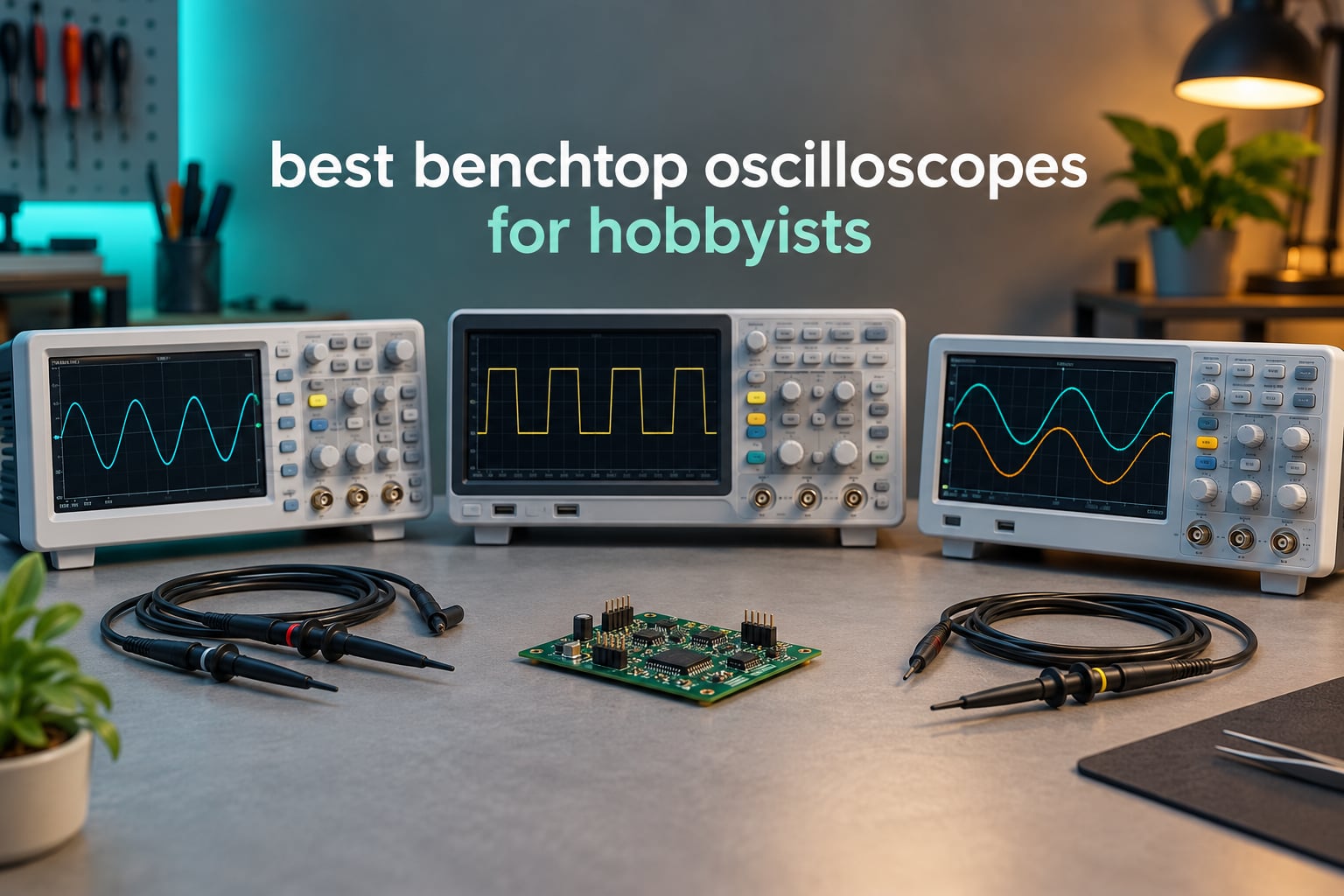
A multimeter tells you what a voltage is right now. An oscilloscope tells you what it did on the way there: how fast the edge rose, whether the ringing after that edge was a badly damped trace or a real oscillation, how much noise sits on the rail while your microcontroller is sleeping. That difference is why a scope is usually the first instrument a hobbyist buys after a multimeter, and why the best benchtop oscilloscopes for hobbyists now cluster in a narrow band of prices where the differences are spec sheets and firmware rather than capability.
This roundup covers ten of those scopes, from a three-in-one handheld that fits in a pocket to four-channel bench instruments with 200 MHz bandwidth and standard protocol decoding. We updated it for 2026 and grouped everything by what it does on a real bench rather than by headline numbers alone.
One warning before the first product, because it is the question that comes up more than any other on electronics forums: every bench scope with a mains power cord has a ground clip tied to earth. Clipping that ground to a hot ground in a live circuit can short your circuit, your board, or your house wiring. Nothing in this list changes that fact. The later section on ground reference covers how to work safely around it.
Table of Contents
What Is a Good Oscilloscope for a Hobbyist?
A good oscilloscope for a hobbyist gives you 100 MHz of bandwidth, at least 1 GSa/s sampling, 14 Mpts or more of record length, standard I2C SPI and UART decoding, and two to four channels, without paying for laboratory features you will never touch. That spec set covers Arduino, ESP32, Raspberry Pi Pico, switching supply, audio and 3D printer work. Below 50 MHz you will outgrow it within a year.
The short version: buy the widest bandwidth your project list demands, buy channels for the number of rails you need to watch at once, and treat memory depth as the feature that saves you when a glitch only appears every few minutes.
Top 3 Benchtop Oscilloscopes For Hobbyists (October 2026)
Siglent SDS1202X-E
- 200 MHz bandwidth
- 1 GSa/s sampling
- 14 Mpts record length
- Standard serial decode
All 10 Best Benchtop Oscilloscopes for Hobbyists at a Glance in 2026
| Product | Specifications | Action |
|---|---|---|
| Siglent SDS1202X-E |
|
Check Latest Price |
 Siglent SDS1104X-E Siglent SDS1104X-E |
|
Check Latest Price |
 Rigol DS1054Z Rigol DS1054Z |
|
Check Latest Price |
 Rigol DS1202Z-E Rigol DS1202Z-E |
|
Check Latest Price |
 FNIRSI 2C53T FNIRSI 2C53T |
|
Check Latest Price |
 FNIRSI 1013D Plus FNIRSI 1013D Plus |
|
Check Latest Price |
 HANMATEK DOS1102 HANMATEK DOS1102 |
|
Check Latest Price |
 Hantek DSO2D15 Hantek DSO2D15 |
|
Check Latest Price |
 Rigol DHO804 Rigol DHO804 |
|
Check Latest Price |
 Siglent SDS1104X-U Siglent SDS1104X-U |
|
Check Latest Price |
1. Siglent SDS1202X-E – the 200 MHz two-channel scope most hobbyists should buy
Siglent Technologies SDS1202X-E 200 mhz Digital Oscilloscope 2 Channels, Grey
200 MHz bandwidth
1 GSa/s sampling
14 Mpts record length
2 analog channels
Pros
- 1 GSa/s real-time sampling
- 14 Mpts record length for long captures
- Serial trigger and decode for I2C SPI UART RS232 CAN and LIN
- 200 MHz bandwidth in a two-channel bench chassis
Cons
- Only two channels so multi-rail work means swapping probes
- Menu-driven layout carries a learning curve
I have had one of these on the bench long enough that it is the scope I hand to beginners. The 200 MHz figure is the real deal rather than a marketing figure doubled by a firmware option, and it means switching nodes, clock lines and audio circuits all stay inside the flat part of the amplitude response.
Two analog channels is the honest limitation. On a three-rail board you will end up moving probes between captures, which is workable but slow. Reviewers say the same thing about the machine: strong on capture, limited on simultaneous visibility.
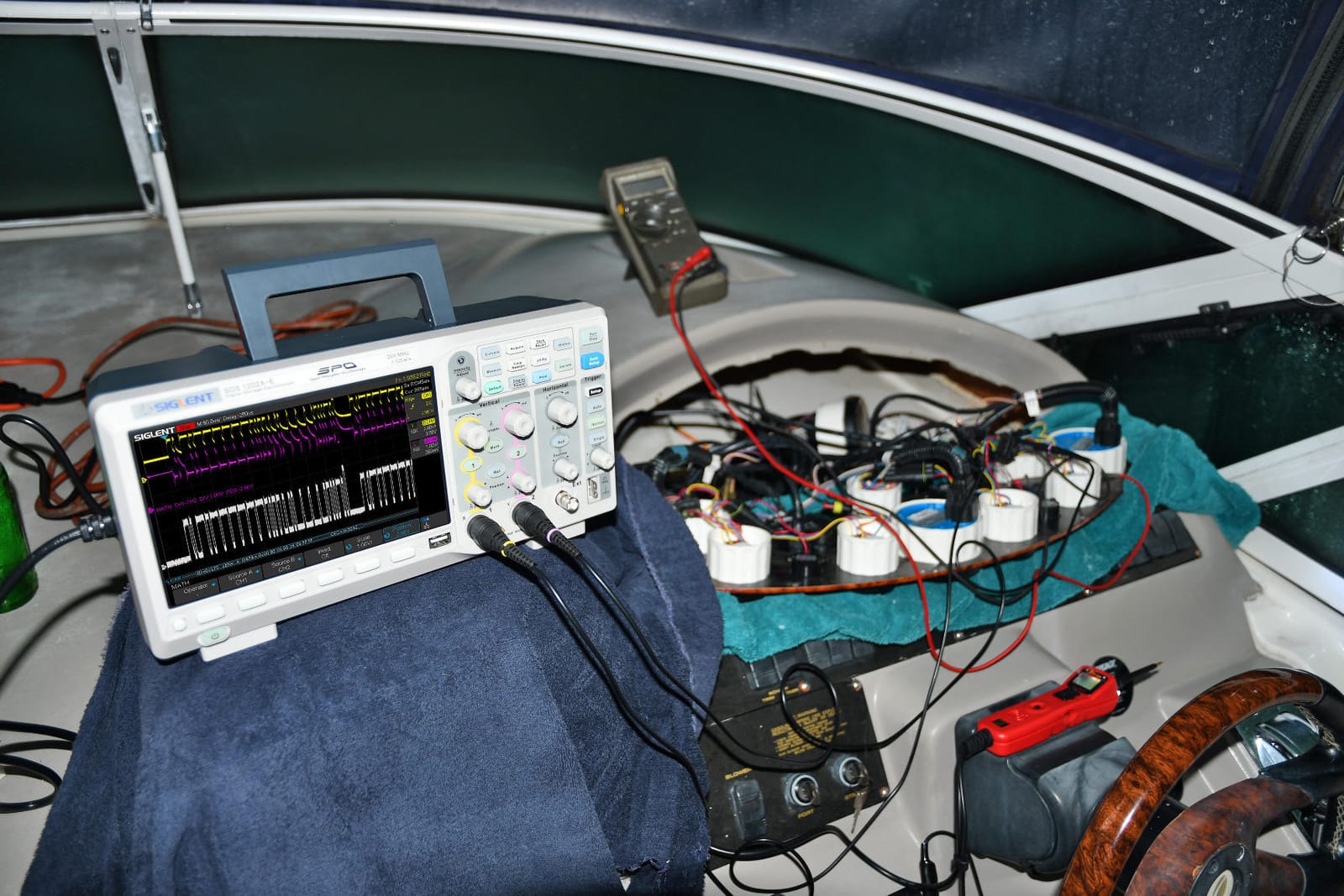
The record length is what separates it from the cheaper two-channel sets. At 14 Mpts you can hold a long acquisition and zoom into a region of it later, which is exactly what you need when a fault appears once every few minutes. The serial decoders for I2C SPI UART RS232 CAN and LIN are enabled in base firmware with nothing to unlock.
The knock I hear most is the menu structure. Functions sit a few levels deep and take an afternoon to make muscle memory. Owners coming from an analog scope tend to grumble about that for a week and then stop noticing it.
When this is the right pick for your bench?
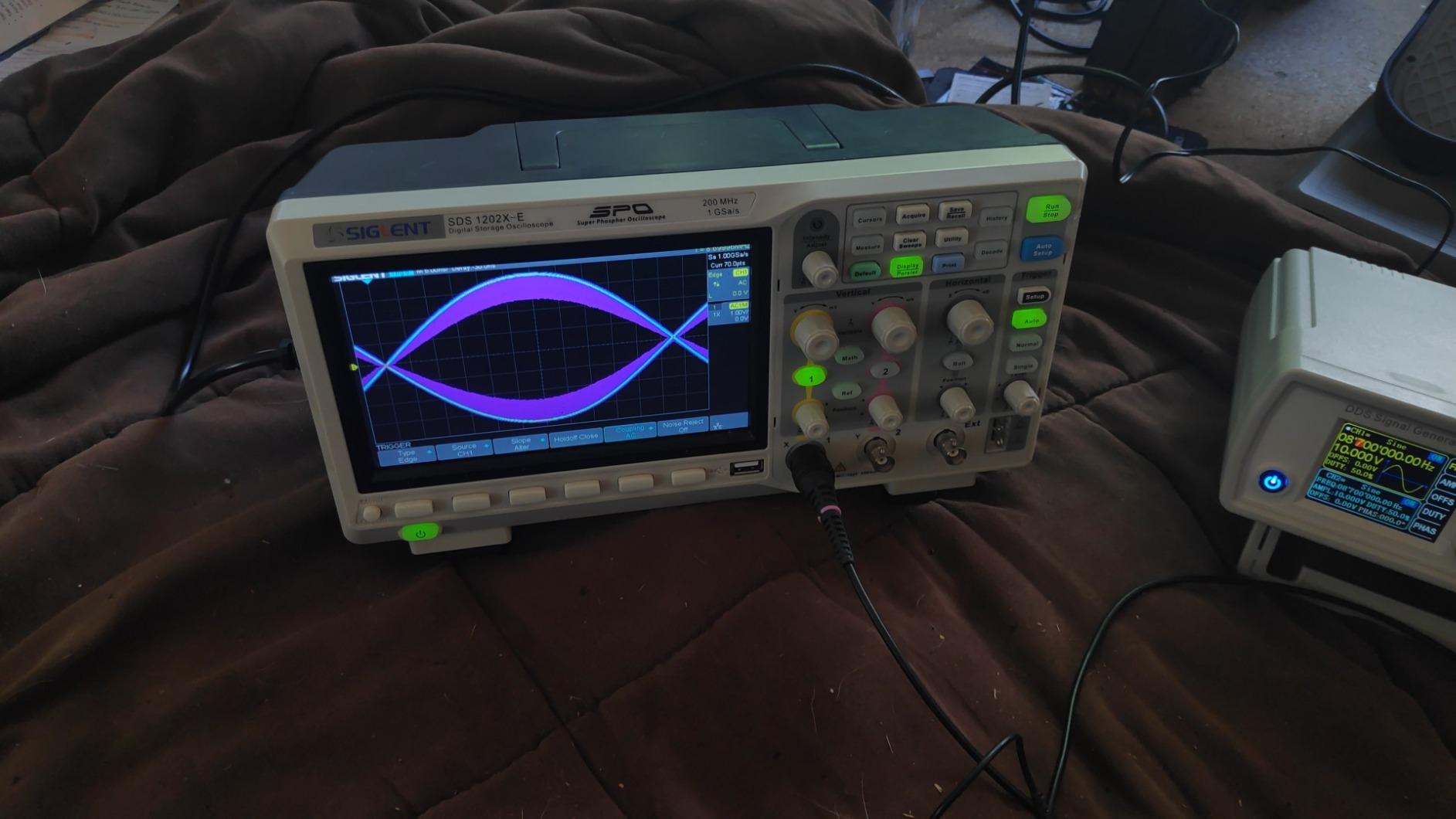
Choose it if your work is single-rail or two-rail, if you care more about how deep you can capture than how many channels you can watch, and if you would rather not deal with licensed options. It suits Arduino and ESP32 timing work, class-D and small audio stages, and hobby mains-side probing done through an isolation transformer.
When it will disappoint you?
Skip it if your day is spent watching three or four rails at once, or if you need CAN or LIN on a bus that runs continuously. It is also not the instrument for RF work, where you would want several hundred megahertz of headroom before the -3dB rolloff starts eating your amplitude.
2. Siglent SDS1104X-E – the four-channel dual-ADC scope with every decoder standard
Siglent Technologies SDS1104X-E 100Mhz Digital Oscilloscope 4 Channels Standard Decoder, Grey
100 MHz bandwidth
4 analog channels
Standard I2C SPI UART CAN LIN decode
4 passive probes included
Pros
- Dual-ADC architecture keeps sampling high with several channels active
- Every common serial decoder unlocked in base firmware
- 14-division waveform area on a responsive display
- Built-in web server plus Ethernet for remote viewing
- Four 100 MHz probes and calibration certificate in the box
Cons
- Push-to-select knob overshoots into the next menu item
- Optional MSO and AWG modules cost close to a whole second scope
- Audible cooling fan at close working distance
This is the highest-rated scope in the group and the one I recommend the moment someone has moved past their first year of tinkering. The dual-ADC architecture is the part that matters technically: it means you keep a high sampling rate with multiple channels enabled, which is the exact problem that makes budget scopes frustrate people.
Forum owners consistently describe it as competitive with or better than the well-known Rigol at a similar tier. Element14 reviewers put it differently, noting the Siglent screen is easier to read while the Rigol’s higher-resolution panel is more crowded and catches glare.
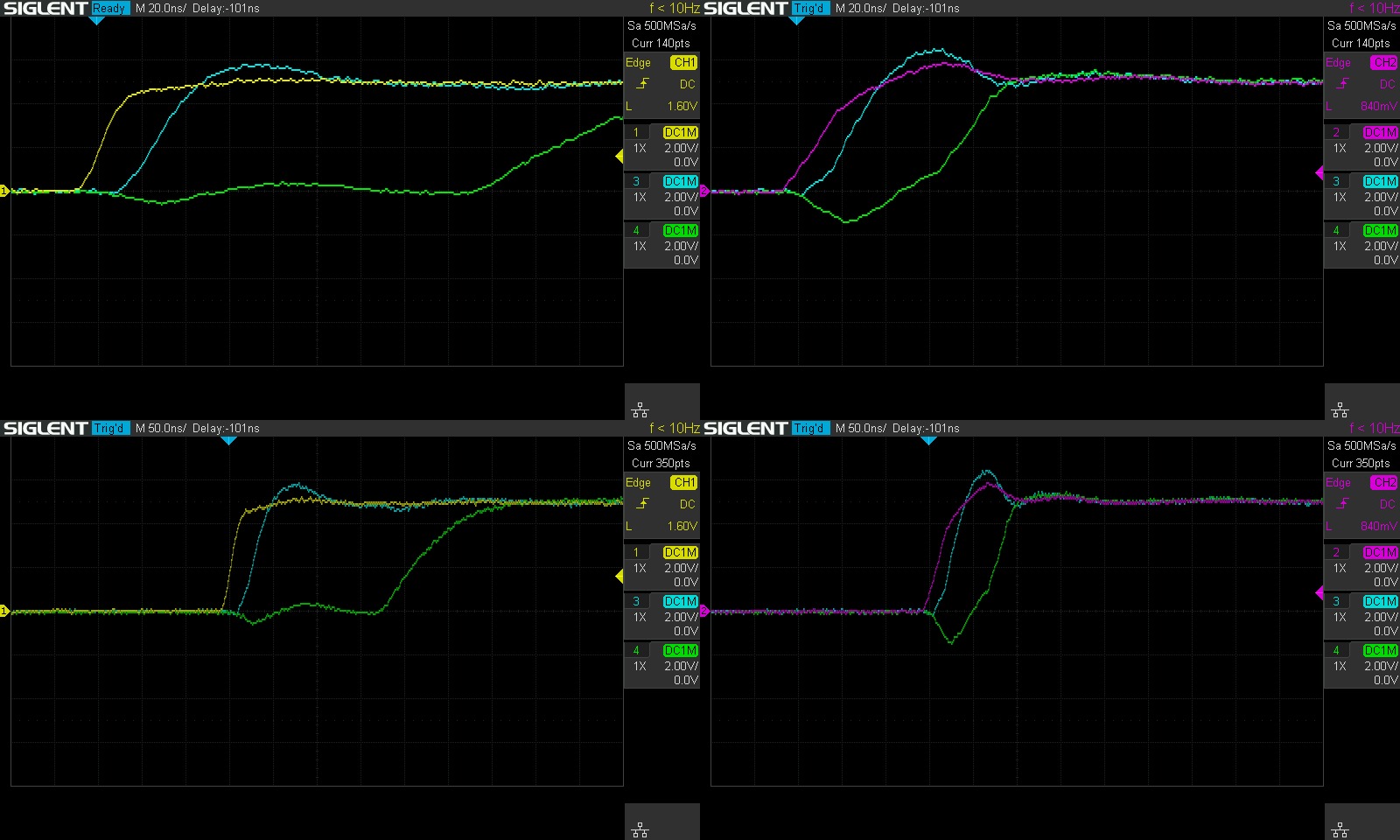
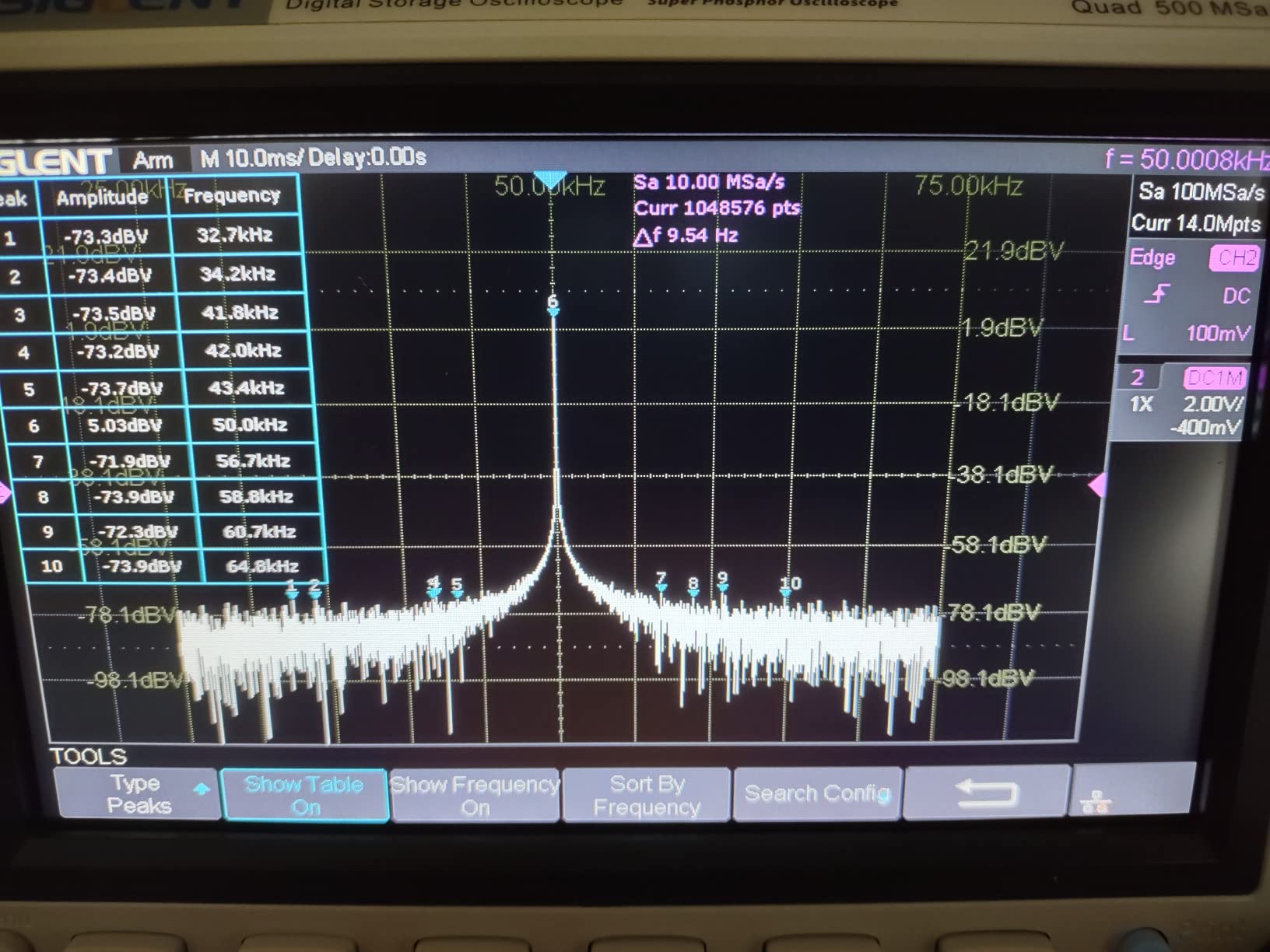
All the serial decoders you actually use, I2C SPI UART/RS232 CAN and LIN, run in the base firmware with no license purchase. Optional 16-channel mixed-signal and AWG modules exist but reviewers flag them as expensive, so budget for them only if you know you need them.
Owners regularly call out the network port and built-in web server as a quiet advantage. Screen sharing to a laptop for a second opinion does not need any extra software, which removes a task that normally eats twenty minutes on cheaper instruments.
What you gain by paying for four channels?
Four channels is about concurrency, not quality. Debugging an SPI bus means clock, MOSI, CS and a trigger reference on screen together instead of three captures stitched in your head. The same applies to a buck converter where input, switch node, output and inductor current sense all matter at the same instant.
What to watch out for?
Bandwidth is software-locked at 100 MHz even though the hardware is described as 200 MHz-capable, unless you apply the paid upgrade. The push-to-select knob overshoots into adjacent menu entries, the fan is audible at close range, and the clock loses its date on power-off unless you configure network time sync.
3. Rigol DS1054Z – four channels and 24 Mpts of memory depth
Rigol DS1054Z Digital Oscilloscope, 50MHz, 4 Channel, 1GSa/s, Best Value
50 MHz bandwidth
4 analog channels
24 Mpts memory
Rich trigger set plus serial decode
Pros
- 24 Mpts single-channel and 12 Mpts dual-channel memory depth
- RS232/UART I2C SPI decode plus FFT enabled in base firmware
- Intensity-graded persistence display exposes intermittent glitches
- Four channels with LAN USB Host and USB Device connectivity
- Three-year warranty with free legitimate firmware upgrades
Cons
- Select knob is mushy and jumps a step when pressed
- Fan noise is noticeable at the bench
- Included probes are middling and awkward to tune
The DS1054Z has been the default recommendation on electronics forums for years, and the reason is memory depth. Twenty-four megapoints single-channel, twelve dual, is more record length than most scopes in this list give you at twice the bandwidth, and record length is what determines how long an intermittent event stays visible.
That persistence and intensity-graded display is a quiet second advantage. When a rail drops out for two microseconds every few seconds, a frame-count-limited scope may never sample it. A scope capturing tens of thousands of waveforms per second with intensity grading will paint it onto the screen.
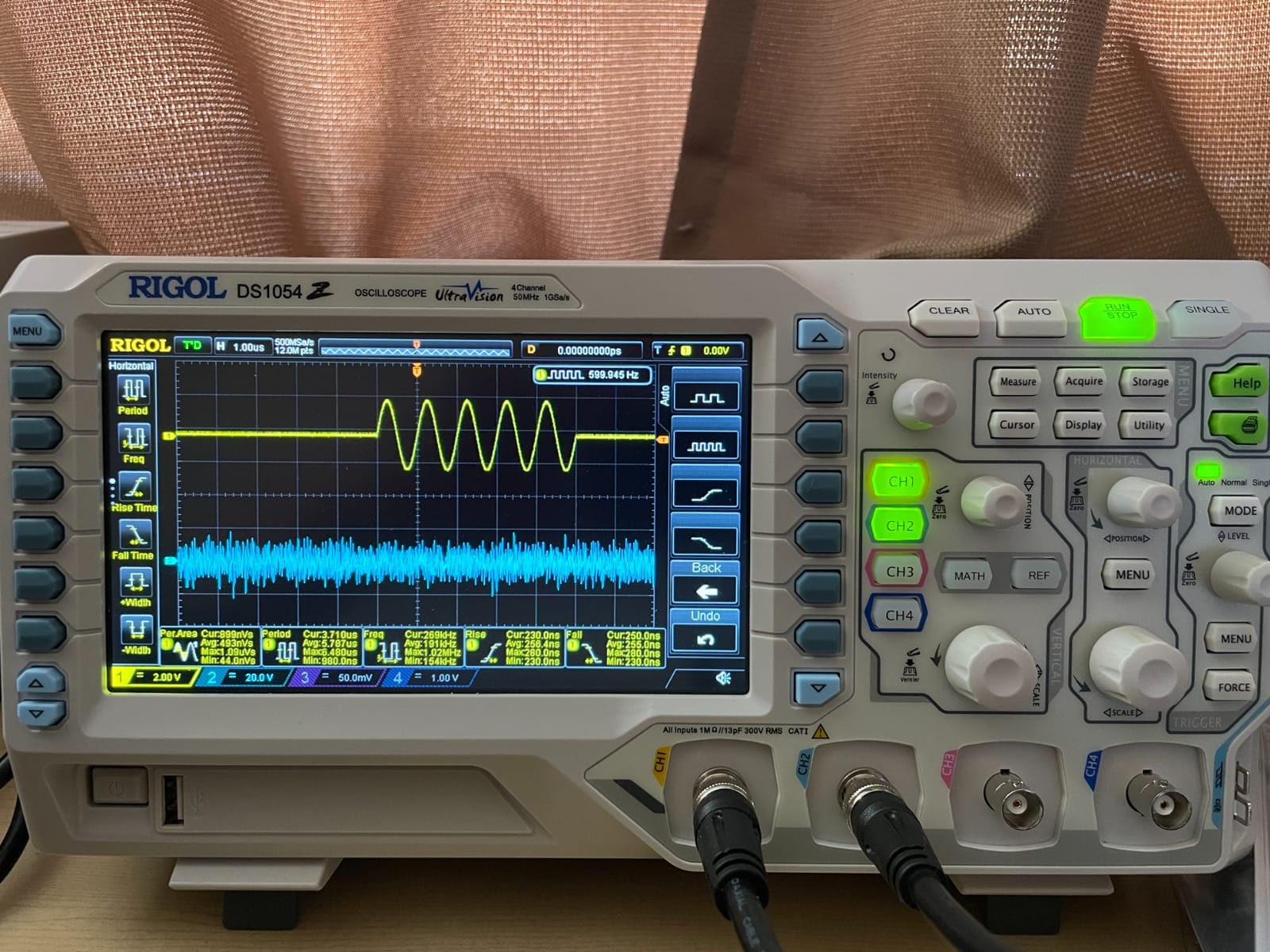
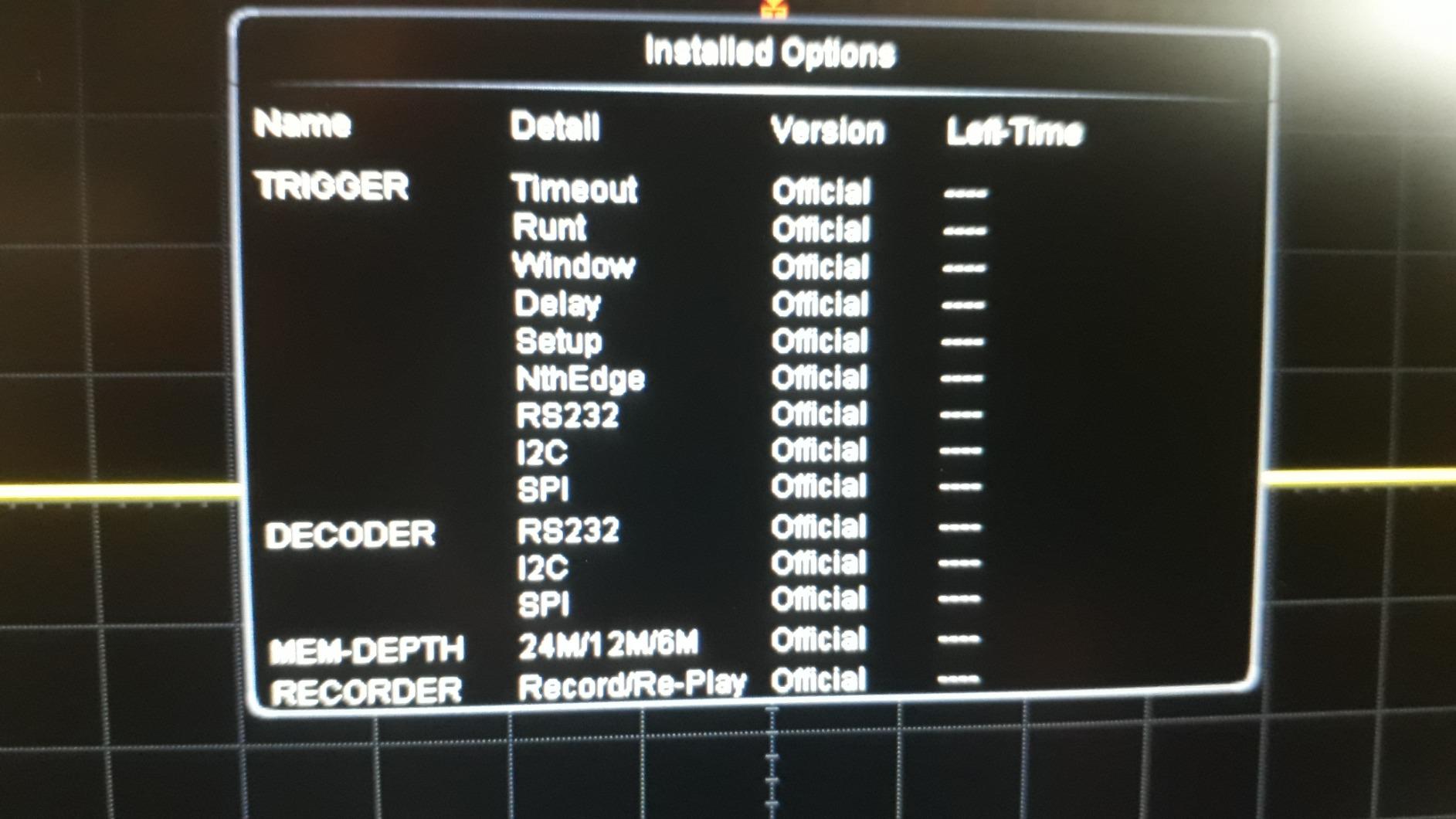
Feature density is genuinely high for the money. Serial bus trigger and decode for RS232/UART, I2C and SPI, plus FFT, are all on from the box, and the interface set includes USB Host, USB Device and LAN with LXI, which means scripted measurements work with standard VISA tooling.
The documentation matters more than buyers expect. Owners cite the on-screen help and a decade of community tutorials as the reason they chose an older platform over a newer one, and that holds up if you are the kind of person who searches for an answer instead of guessing.
Deciding whether 50 MHz is enough for you
Fifty megahertz covers audio, microcontroller clocks, relays, servos, LED drivers and most low-voltage digital buses with room to spare. It is the right choice for beginners, for education benches, and for anyone who mostly debugs firmware rather than fast analog edges.
The reasons people regret it
Switching regulators and anything with fast edges will sit above 50 MHz, so traces look rounded and you may chase phantom problems. Owners also complain about the mushy rotary encoder, the fan, small on-screen fonts, and channel two and four colours being hard to tell apart. A separate set of decent probes is worth budgeting for.
4. Rigol DS1202Z-E – 200 MHz bandwidth with the memory depth kept
RIGOL DS1202Z-E Digital Oscilloscope, 200MHz, 2 Channel, 1GSa/s Sampling
200 MHz bandwidth
2 analog channels
24 Mpts memory depth
External trigger input
Pros
- 200 MHz bandwidth and 1 GSa/s sampling at an entry-level price
- 24 Mpts memory that holds depth at high sample rates
- Bright 7-inch display with intensity grading
- All trigger decode and bandwidth options ship enabled
- Bundled probes are better than expected
- Three-year warranty on the main unit
Cons
- Multifunction knob overshoots when pressed
- USB 2.0 front port makes bulk export slow
- Soft-key legends permanently occupy screen edges
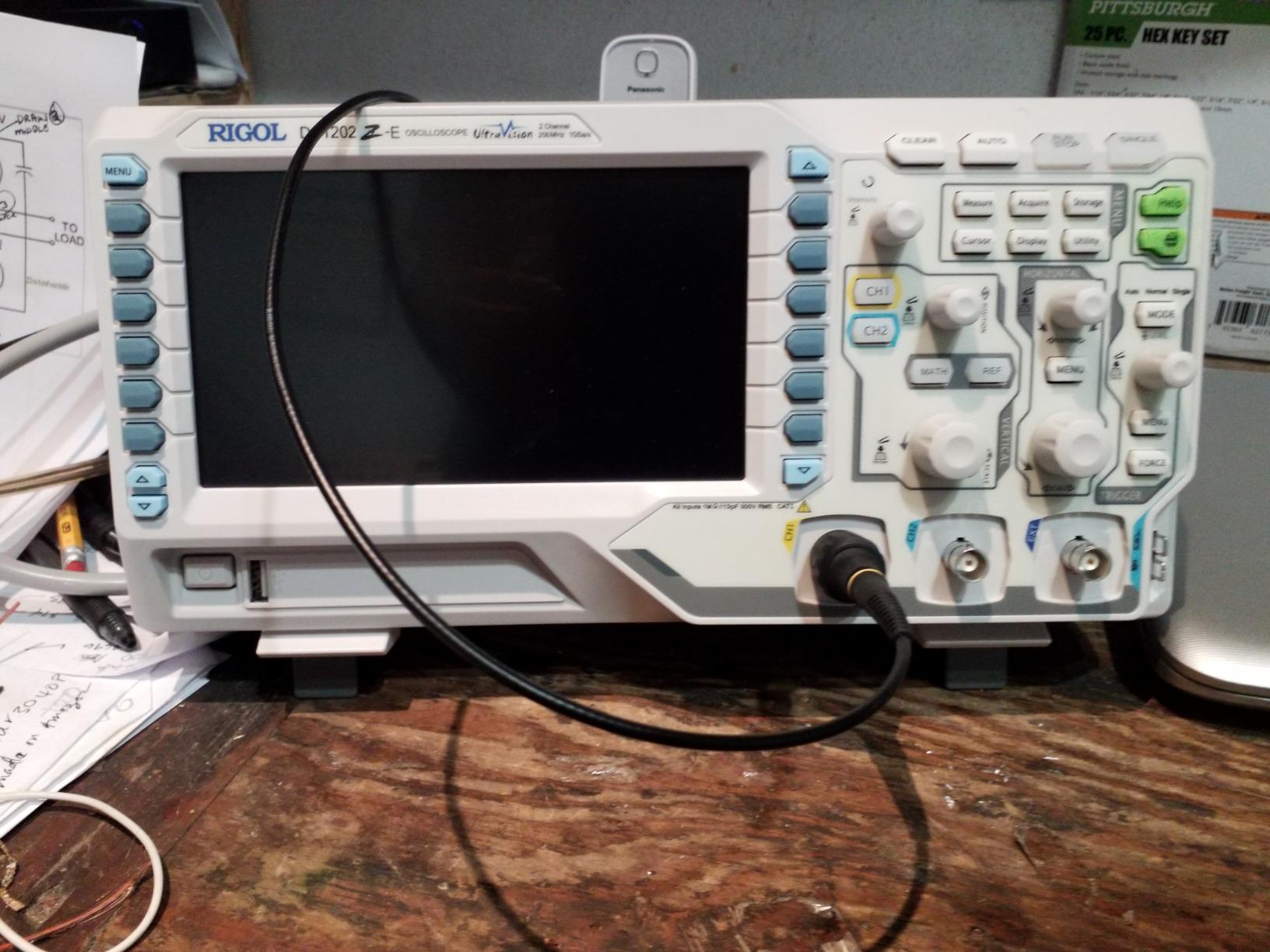
This is the rare combination of wide bandwidth and deep memory at a hobbyist price. Most rivals give you 200 MHz with a short record, or deep record with narrow bandwidth, and force a choice. Here you get both, plus an external trigger input that the four-channel Rigol lacks.
On a switching bench that combination is worth understanding. You can zoom the timebase out to catch a ripple problem across a full switching cycle, then still resolve individual edges at 200 MHz, without the display dropping samples when you tighten the timebase.
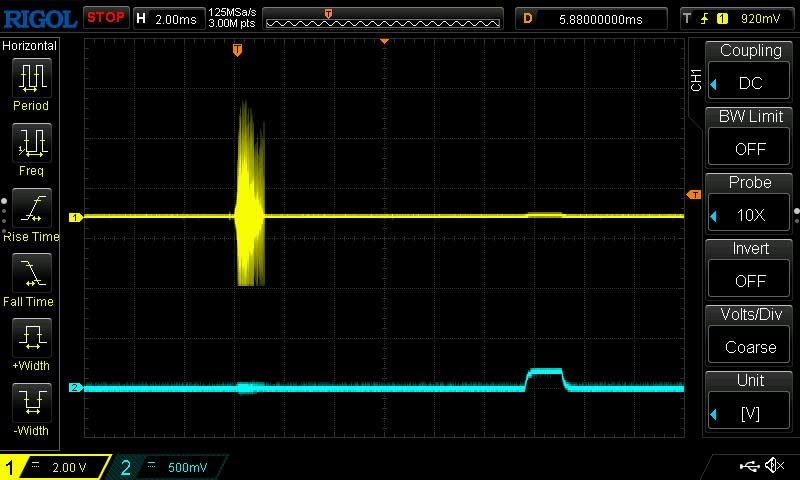
Every paid option ships enabled with no time limit, which is friendlier than buying a base scope and discovering later that the decoder you need sits behind a license key. The 7-inch WVGA panel is bright enough for a well-lit bench and intensity grading makes jitter and noise visible.
Reviewers single out the bundled probes as better than expected, with shrouded BNC connectors that do not let you clip onto adjacent pins. That saves a purchase most buyers would otherwise make soon after arrival.
When this fits your project list?
It suits hobbyists working on switch-mode power supplies, motor control, class-D audio, USB and fast digital edges, especially anyone who wants to watch a long capture and a sharp edge in the same session. Two channels are adequate when the design has two interesting nodes.
Where it frustrates owners?
Menu depth costs real learning time and reviewers are candid about it. The USB 2.0 front port makes pulling 24 Mpts of data off the scope painfully slow, full-resolution captures do not transfer over the network with the vendor software, and soft-key legends can never be hidden from the waveform area.
5. FNIRSI 2C53T – the portable three-in-one for field and automotive work
FNIRSI 2C53T 3-in-1 50MHz 2CH Oscilloscope Multimeter DDS Signal Generator
50 MHz bandwidth
250 MSa/s sampling
1 Kpts depth
Built-in multimeter and DDS generator
Pros
- Scope multimeter and DDS signal generator in a 400 g body
- 3000 mAh battery with Type-C charging for field work
- Protection module rated for continuous input up to 400 V
- Includes 10X probe clip probe multimeter probe Type-C cable and case
Cons
- 1 Kpts record depth limits long low-frequency captures
- 2.8-inch LCD is small for detailed waveform work
- DDS generator stops at 50 kHz
- 8 percent one-star reviews reflect reliability gripes
This is not a bench scope and pretending otherwise would be dishonest, but it is the highest-volume seller in the category and it solves a real problem: getting a waveform off a car, a boat or a field sensor without dragging a mains-powered instrument across town.
The value is in the combination. A 19999-count multimeter, a two-channel 50 MHz scope and a DDS generator covering 13 waveforms up to 50 kHz live in one 400 gram body that runs on a 3000 mAh battery. For testing a sensor harness or probing an alternator diode, that is genuinely more capable than what you would carry otherwise.
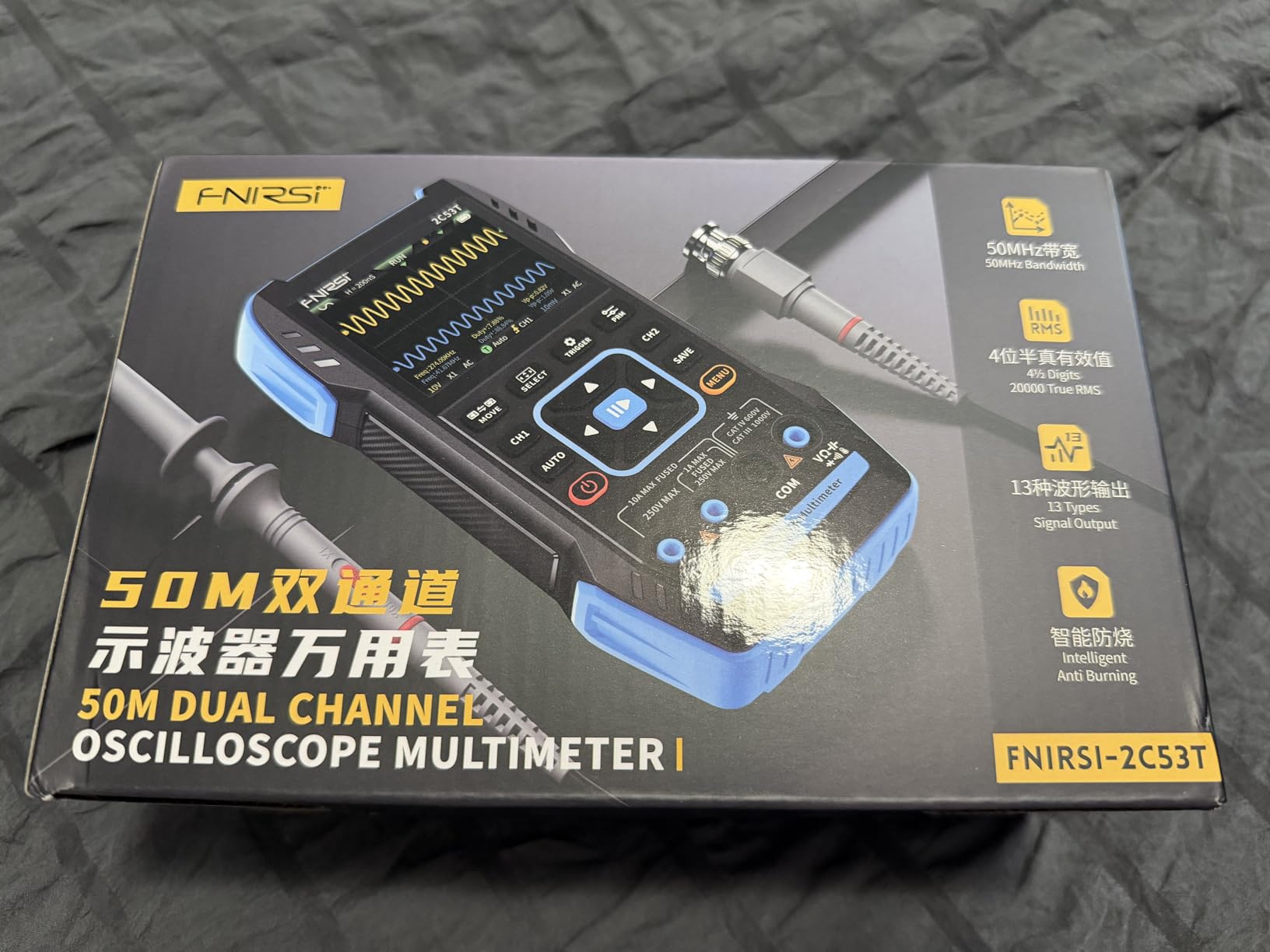
The built-in high-voltage protection module tolerating continuous input up to 400 V is the spec that makes automotive use reasonable. Buyers consistently praise it, along with the reference waveform comparison and image export to a PC over Type-C.
This generation added math operations, cursor measurement, persistence and XY mode over the earlier version, which pushes it from a quick checker toward something you can do real work on. Reviewers still call the 4.3 average the weakest in this roundup, with the small screen and shallow memory doing most of the damage.
When it is the right tool?
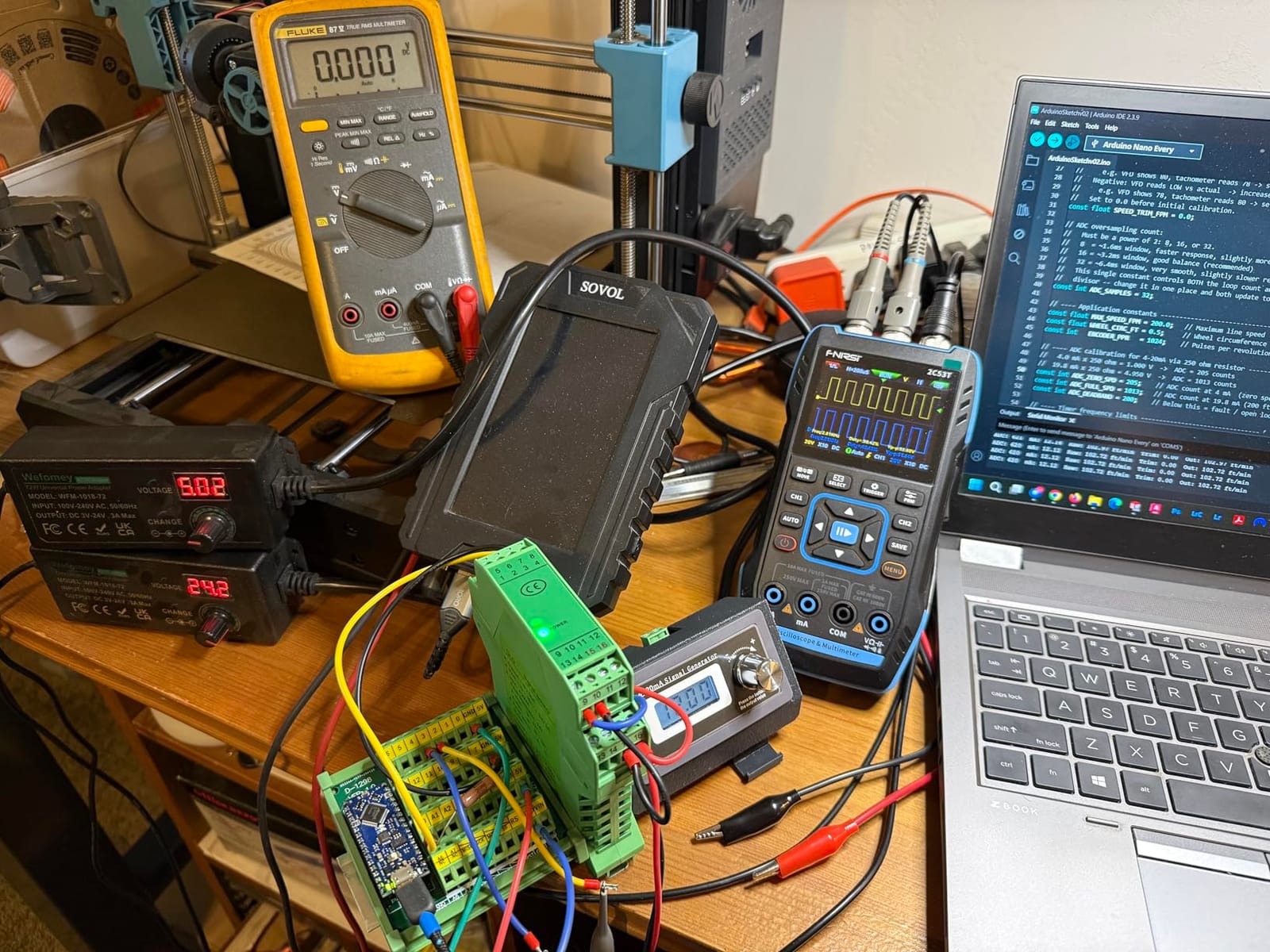
Reach for it when you are outside, working on 12 V automotive circuits, chasing an intermittent sensor, or you want a signal generator to test a filter without buying a second box. It is also a low-risk first scope if your work is mostly continuity and slow signals.
Where it falls short on a bench?
A 1 Kpts record depth means long, slow waveforms are truncated badly, and a 2.8-inch LCD makes detailed inspection awkward. There is no wired protocol decoding, so embedded debugging stops at visual inspection. Treat it as a field instrument that occasionally sits at the bench, not the reverse.
6. FNIRSI 1013D Plus – a 7-inch touchscreen with 100 MHz and a battery
FNIRSI 1013D Plus 100MHz Oscilloscope, 2 Channel Oscilloscope 7″ TFT Touch
100 MHz bandwidth
1 GSa/s sampling
7-inch capacitive touchscreen
6000 mAh battery
Pros
- Touchscreen navigation is far faster than button-driven scopes
- 100 MHz per channel with 1 GSa/s at a low price
- Protection module tolerates continuous input up to 400 V
- 6000 mAh battery gives about four hours untethered
- 1 GB storage holds 1000 screenshots and waveform sets
Cons
- Only two analog channels
- No I2C or SPI decoding for embedded work
- FFT is a rough harmonic estimate
- 9 percent one-star share hints at firmware issues
Everything about this one is built around the screen. Capacitive touch with gesture cursor measurement means you pinch to zoom a region of the trace directly, which on a button-driven scope takes four menu steps and a dial turn. For a beginner learning to read waveforms, that difference is bigger than any spec on the sheet.
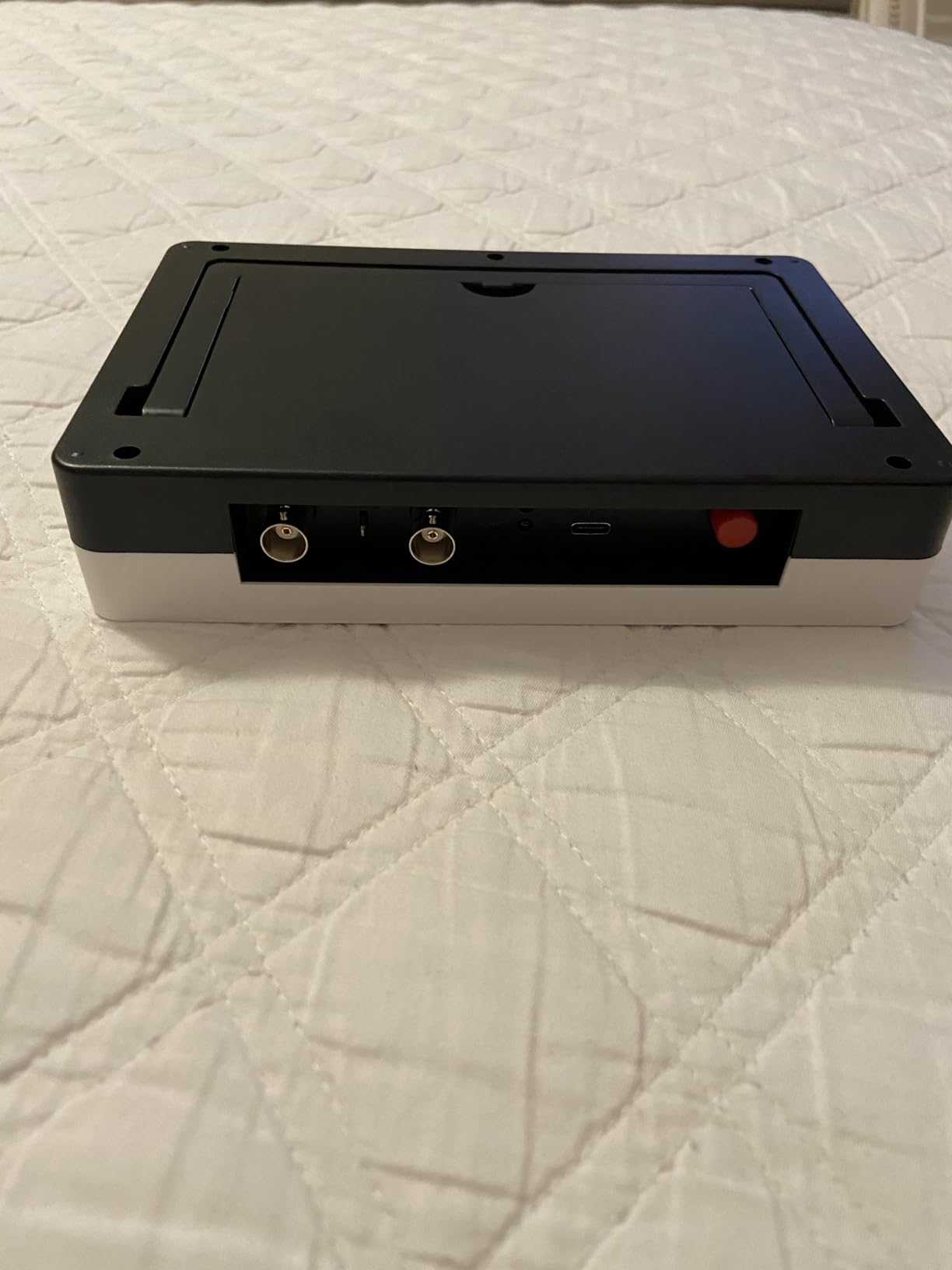
The rest of the package is unusually complete for the money. One gigabyte of internal storage keeps up to 1000 screenshots and 1000 waveform data sets with thumbnail browsing, and a 6000 mAh battery delivers roughly four hours of untethered work.
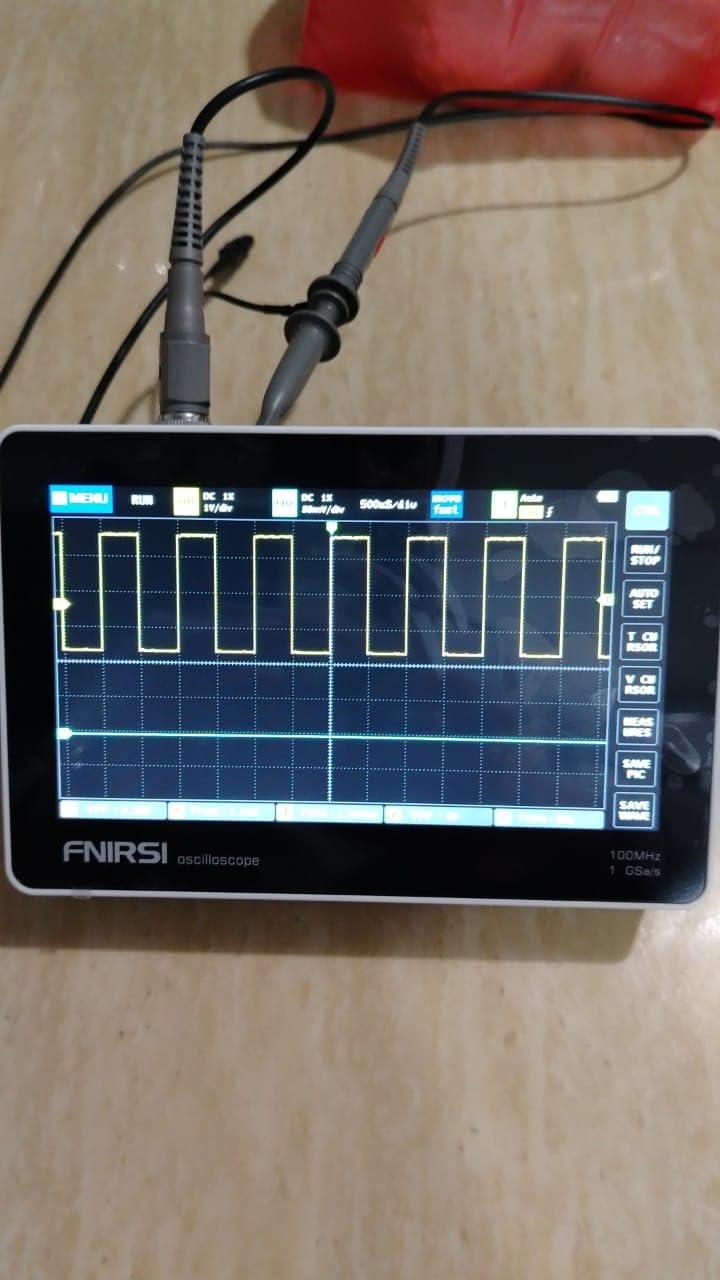
Single, normal and automatic trigger modes are all present, which is more than some cheaper units offer. Lissajous mode and FFT viewing round it out for audio work, though reviewers are clear that the FFT is a rough estimate of harmonic content rather than an analysis tool.
Buyers note occasional firmware and reliability complaints, and a 9 percent one-star share reflects that. It is worth powering it on and running through a self-test the day it arrives rather than assuming it works.
Where it earns its place?
It makes sense for learning, for field service, and for anyone who wants a big readable screen with a hundred megahertz of bandwidth and no licensing. Battery operation also lets you float the scope ground relative to a circuit powered from a USB power bank, which sidesteps the earth-reference problem in low-voltage work.
Where it will not go far enough?
Two channels, no serial bus decode. If your projects are I2C or SPI peripherals, you will be reading bit timing off a screen by eye, which is slow and error prone. Consider whether a used four-channel scope with decoding would serve you better for the same money.
7. HANMATEK DOS1102 – 110 MHz with scripting support for automated benches
HANMATEK 110mhz Bandwidth DOS1102 Digital Oscilloscope with 2 Channels and Screen 7 inch / 18 cm, TFT-LCD Display, Portable Professional Oscilloscope Kit with 500 MS/s *2 Sampling Rate
110 MHz bandwidth
500 MS/s on two channels
10K point record
SCPI and LABVIEW support
Pros
- 110 MHz and 500 MS/s per channel on two channels
- 7-inch 800x480 true-color display
- 6-digit hardware frequency meter from 2 Hz to 20 MHz
- 30 automatic measurements with custom menus
- SCPI and LABVIEW scripting for automated test
Cons
- Record depth of about 10K points limits long bursts
- Only 16 waveform groups stored on the device
- Two channels limit multi-rail debugging
- Seller-copy feature claims are untested independently
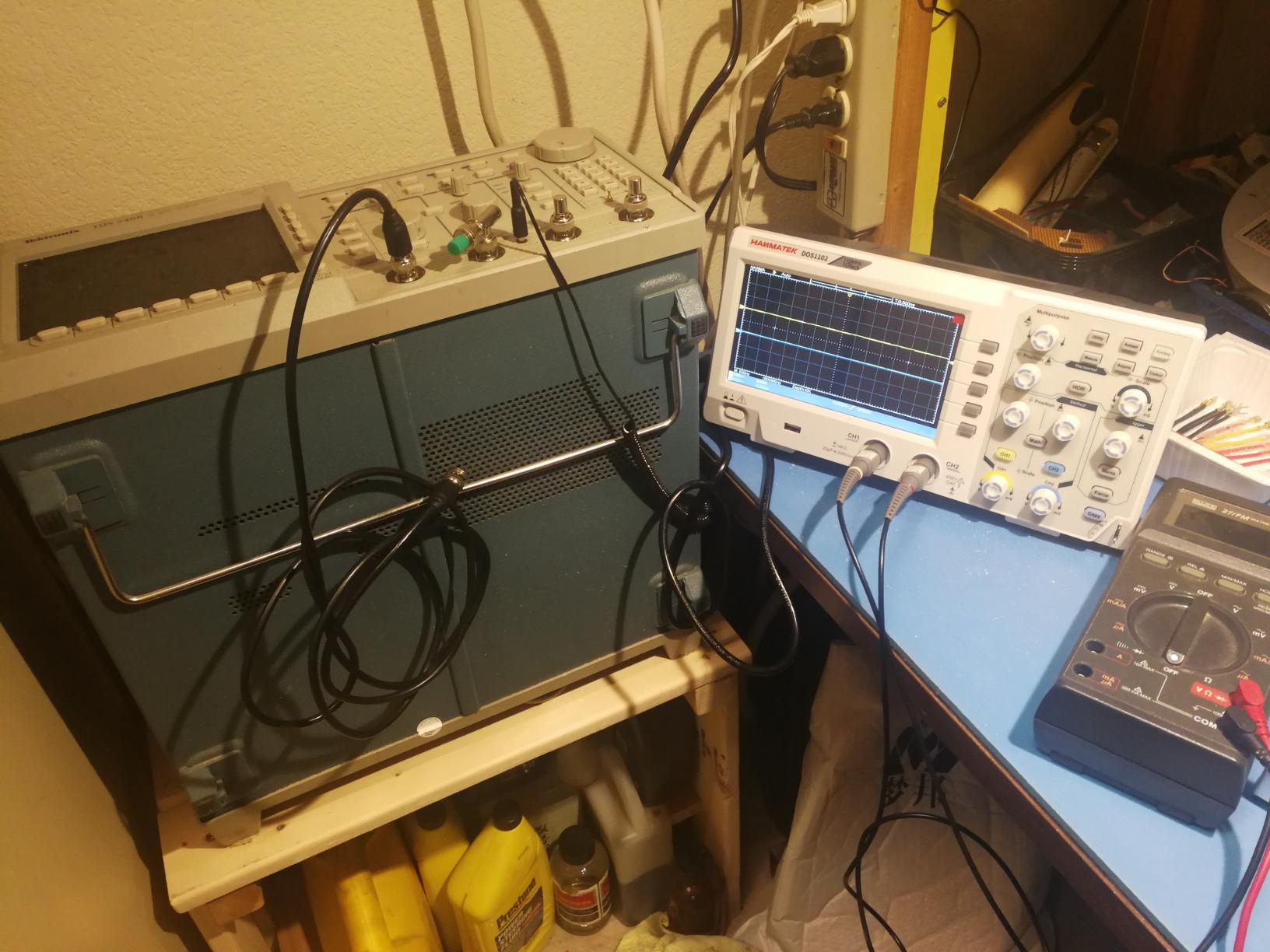
The distinguishing feature here is automation. SCPI compliance and LABVIEW communication mean this scope can sit in a script that sweeps a filter, logs results and flags failures without anyone watching the screen. For a home lab doing repeated measurements, that changes the value calculation more than raw bandwidth does.
On the bench it is a competent instrument: 110 MHz bandwidth with 500 MS/s across two channels, a time base from 2 ns/div to 1000 s/div, vertical scale from 20 mV/div to 5 V/div, and probe attenuation selectable from 1X through 1000X.
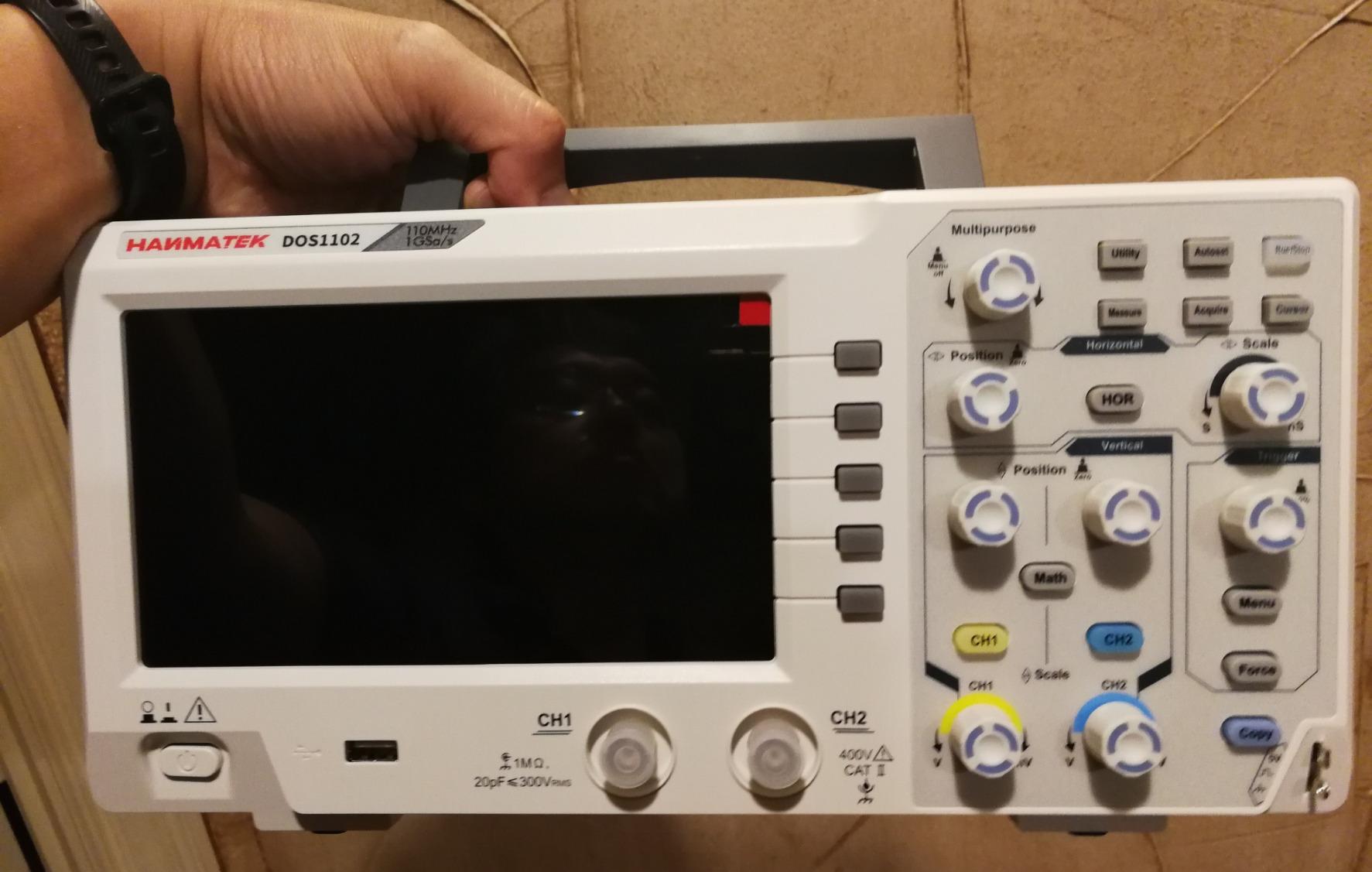
The 7-inch true-color panel with 65535 colours and 2000:1 contrast is large relative to the body, and the built-in 6-digit hardware frequency meter covers 2 Hz to 20 MHz with current measurement, which is handy for checking a clock or a sensor output rate.
Be sceptical about part of the listing. Reviewers point out that claims around LABVIEW communication, secondary development and power consumption come from seller copy rather than independent testing. We would verify those yourself before planning an automated workflow around them.
Reasons to pick it
Automation scripts, repeated measurements, and a need for 100 megahertz of bandwidth on two channels without spending much. The wide probe attenuation range also makes it reasonable for high-voltage work at the low end, provided you use an appropriately rated probe.
Reasons to look elsewhere
Record depth of roughly 10K points is the weak point. It stores at least 16 waveform groups, which is not enough history for intermittent fault hunting, and it will not hold the long captures you want on switching circuits. Two channels also rules out multi-rail viewing.
8. Hantek DSO2D15 – 150 MHz with five serial decoders and an optional generator
Hantek DSO2D15 Digital Storage Lab Oscilloscopes150MHz Bandwidth 2CH
150 MHz bandwidth
2 analog channels
5 serial protocol decoders
Optional waveform generator
Pros
- 150 MHz bandwidth below the price of comparable four-channel models
- Variants with an integrated arbitrary waveform generator
- Firmware updates resolve early instability and enable UART decode
- 14 trigger modes and five serial decode types
- Built-in square wave and ground posts for probe calibration
Cons
- Slow CPU makes the display lag during updates
- Can lock up when trigger or channel settings are wrong
- Measurements drift above roughly 5 MHz
- Auto Set does not reliably acquire a signal
At 150 MHz with two channels and standard serial protocol trigger and decode, this is more bandwidth per unit of money than most of the list. Reviewers who bought it call it a genuine full-featured bench scope rather than a toy, and the second-highest rating in this roundup backs that up.
The single most useful tip from the review data is to apply the firmware updates from the manufacturer. Owners report that the updates fix much of the early instability and enable UART trigger and decode, which resolves the most common complaint about earlier units.
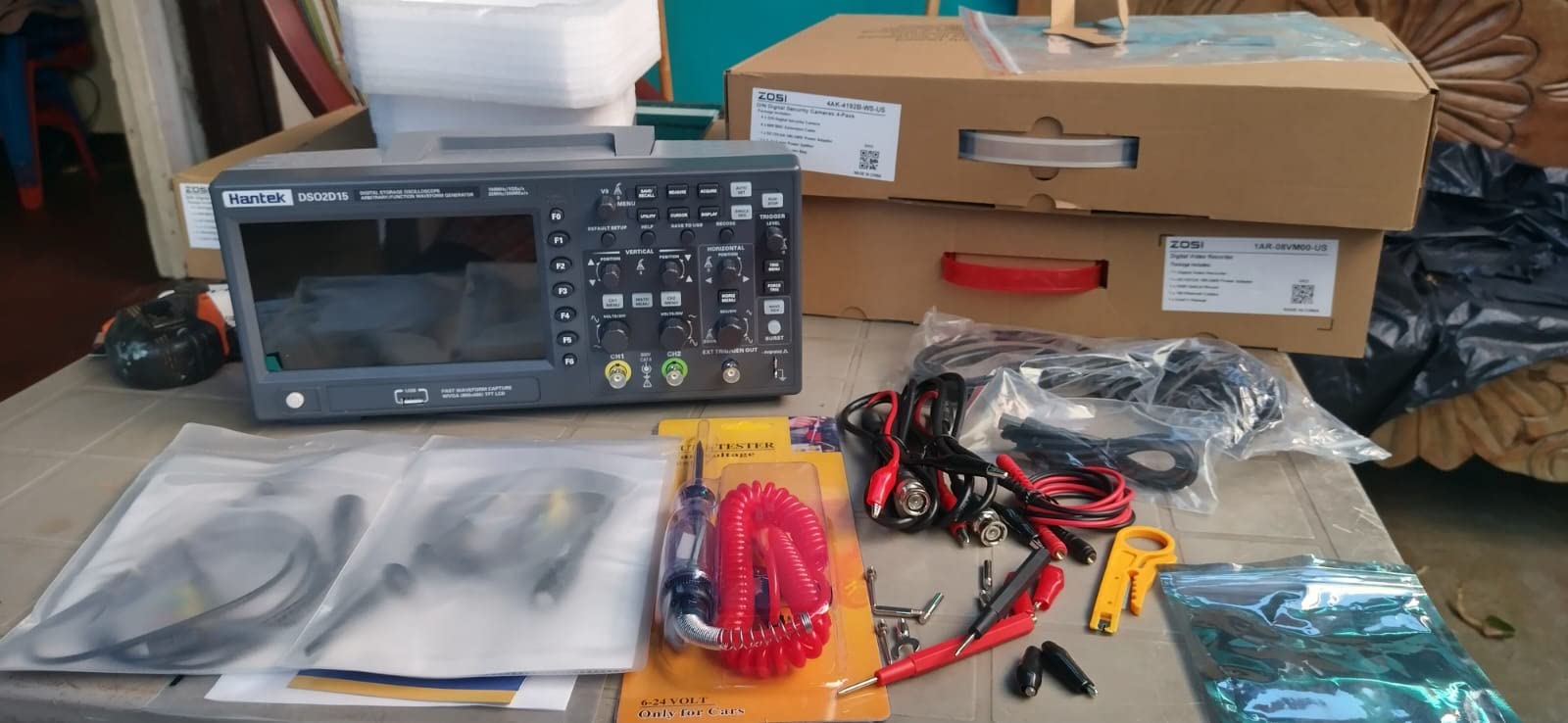
Variants exist with an integrated arbitrary waveform generator, which turns the scope into a two-box bench in one chassis. Testing a filter stage or an amplifier response becomes a single-cable job instead of dragging out a separate function generator.
The square wave output post and ground post for probe calibration is a small detail that shows the design was aimed at bench use. A 68-page manual and firmware downloads are available from the manufacturer, though no printed instructions are in the box.
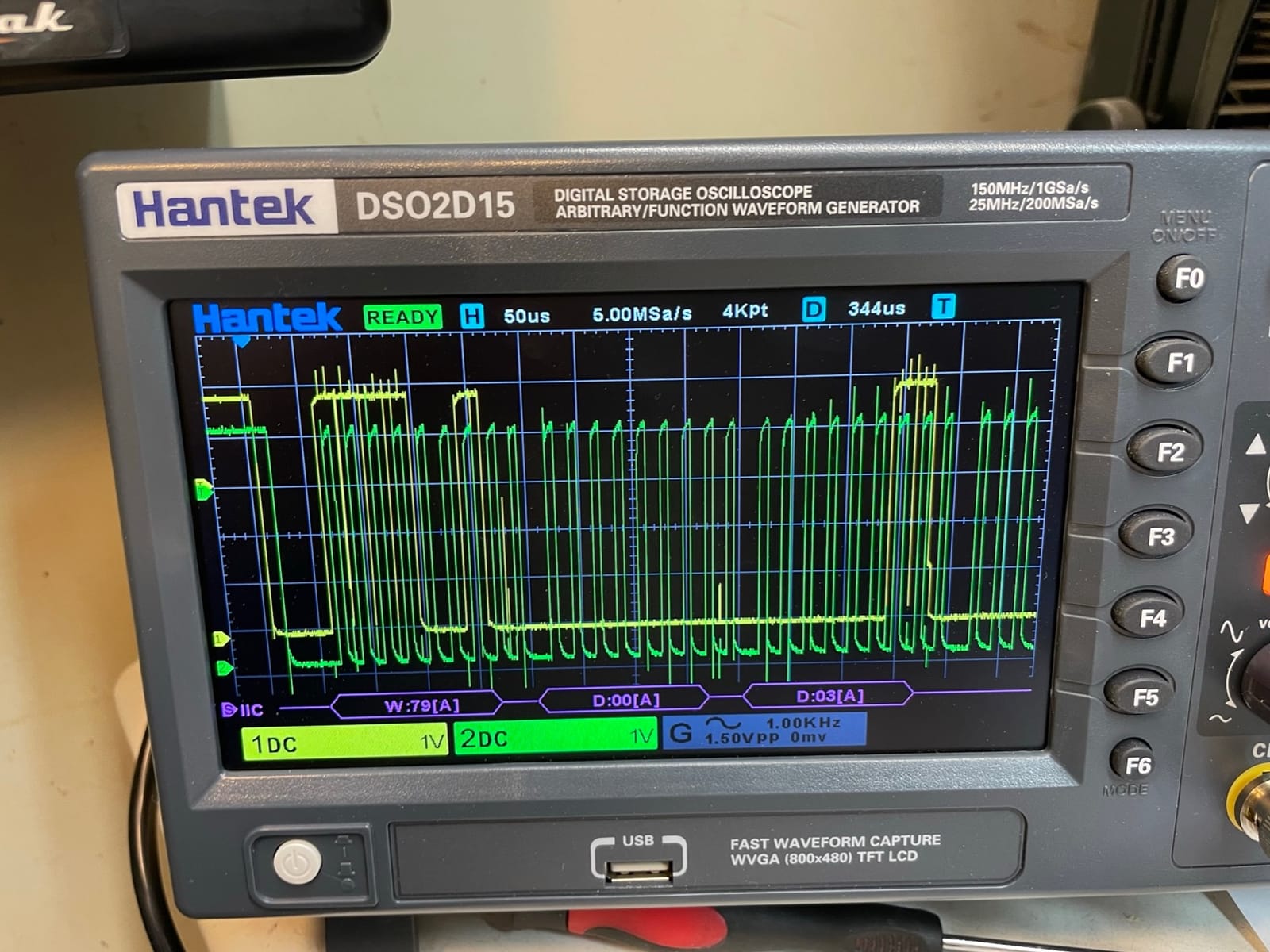
What it is good for?
It suits hobbyists who want serial decode, 150 MHz of headroom, and the option of a built-in generator for amplifier and filter testing. Solid build quality, colour-coded channel buttons and durable controls make it feel more serious than the tier suggests.
What owners complain about?
The CPU is slow, so the display lags during updates even though acquisition is handled by the FPGA. Misconfigured trigger or channel settings can lock the unit up until you power cycle it, measurements lose accuracy above roughly 5 MHz, and Auto Set does not reliably acquire a signal, so expect to tune triggers manually.
9. Rigol DHO804 – the 12-bit resolution answer for power supply work
RIGOL DHO804 Portable Digital Oscilloscope, 70MHz, 4CH, 12-Bit Resolution
70 MHz bandwidth
4 analog channels
12-bit vertical resolution
25 Mpts memory depth
Pros
- 12-bit vertical resolution gives cleaner traces and lower noise
- Four channels with up to 25 Mpts at any sample rate
- UltraAcquire to 1000000 wfms/s with 256-level intensity grading
- Responsive 7-inch 1024x600 touchscreen
- Browser Web Control over LAN and USB-C powerable
Cons
- 70 MHz ceiling for RF and fast digital work
- Half the 1.25 GSa/s disappears with a second channel on
- Ultra Sigma software is dated and awkward to install
- Faint pitched fan whine
Bit depth is the specification nobody in this price bracket used to talk about. An 8-bit converter gives you 256 vertical steps across the screen, so a small ripple riding on a 24 V rail consumes a handful of those steps and shows up as noise. Twelve bits gives you 4096 steps, and owners consistently describe the traces as noticeably finer with lower apparent noise.
That matters most on switching power supplies, motor phases, sensor outputs and anything where a small signal sits on top of a large one. If your projects are analog and power related rather than fast digital, the resolution buys more than extra bandwidth would.
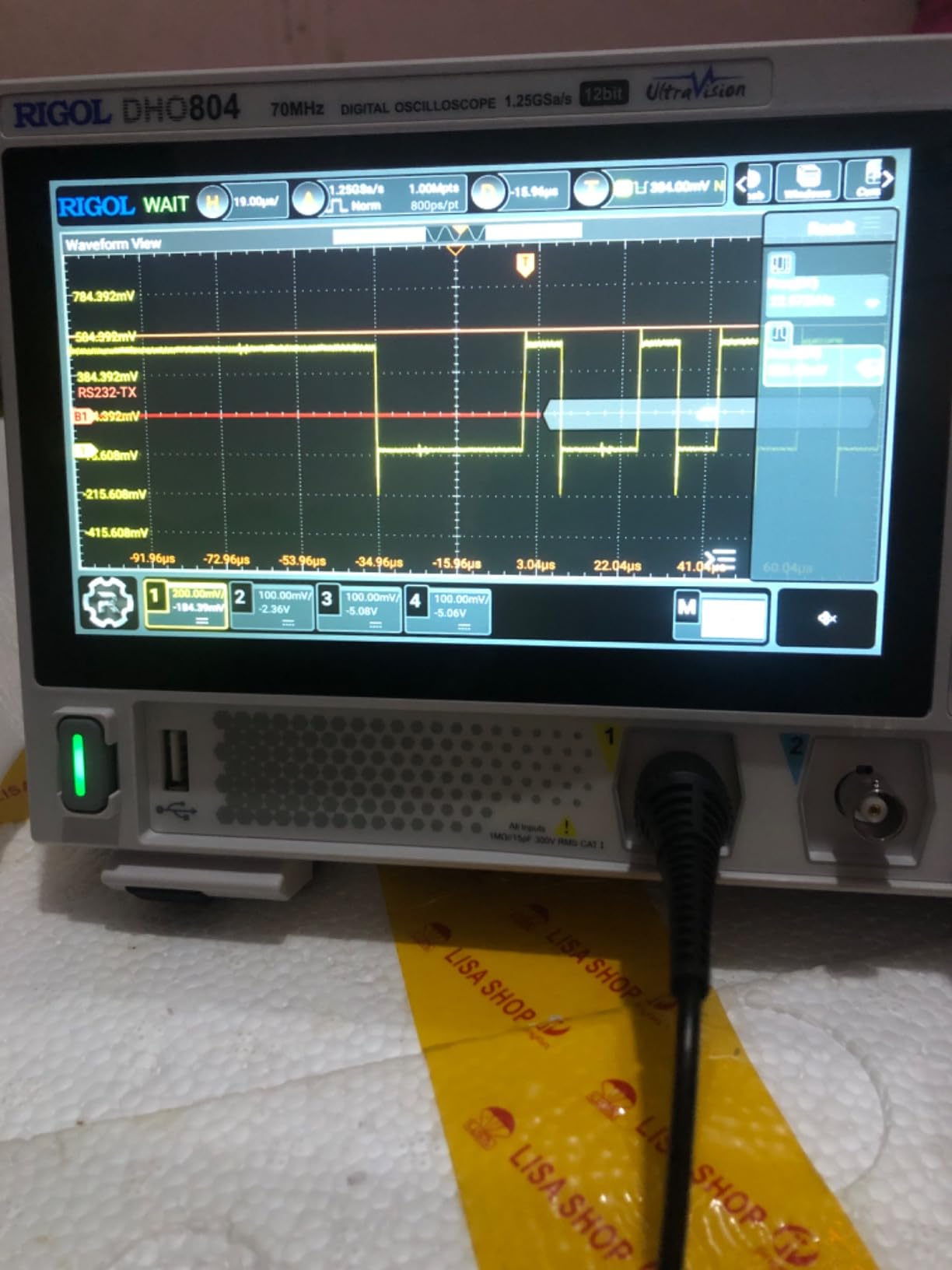
The acquisition side is strong too. UltraAcquire captures up to 1000000 waveforms per second with 256-level intensity grading, peak detect catches glitches down to 1.6 ns, and 41 automatic measurements plus FFT up to 1 Mpts are standard. Memory stays at up to 25 Mpts regardless of sample rate, which is rare.
The interface is the newest design here: a 7-inch 1024×600 touch screen with a Flex Knob and an Android-based UI, plus a built-in web interface that serves a responsive remote-control window in a browser over LAN or a WiFi dongle. It also runs from a USB-C power bank for field use.
Why 12 bits is worth paying for?
If you are chasing a 50 mV ripple on a 12 V rail, a 10 mV spike on a sensor line, or clean sine waves from an oscillator, vertical resolution is the limiting factor, not bandwidth. The Flex Knob and touch interface also make long measurement sessions less fiddly than a button-only panel.
What holds it back?
Seventy megahertz is a real ceiling for RF and fast digital work. Half the advertised 1.25 GSa/s disappears as soon as a second channel is enabled, memory beyond the standard configuration may need an upgrade, and screenshot transfer to a PC still depends on dated proprietary Ultra Sigma software, which is why the 4.3 average sits lower than the star spread suggests.
10. Siglent SDS1104X-U – Super Phosphor display for slow and communication signals
Siglent Technologies SDS1104X-U 100MHz Super Phosphor Digital Oscilloscopes 4 Channels
100 MHz bandwidth
4 analog channels
14 Mpts record length
Super Phosphor display
Pros
- Four channels at 100 MHz and 1 GSa/s in one chassis
- Super Phosphor display reads low-frequency signals well
- Measurements computed across the full 14 Mpts
- Standard decode for I2C SPI UART CAN and LIN
- Remote control over the network with VISA drivers
Cons
- Cooling fan is loud for the air it moves
- 800x480 screen resolution limits on-screen detail
- Position knobs are not very sensitive
- About 15 second startup time
The Super Phosphor display is the reason to look at this model. Persistence effects render long-period and low-frequency waveforms, communication bursts and slowly decaying tails in colours that show how much time the signal spent at each level, which conventional LCD-style rendering flattens into a single trace.
Owners who upgraded from decades-old analog gear describe the jump as dramatic. Four channels at 100 MHz and 1 GSa/s, with a 14 Mpts record length and measurements computed across the full memory, is a lot of capability in one box.
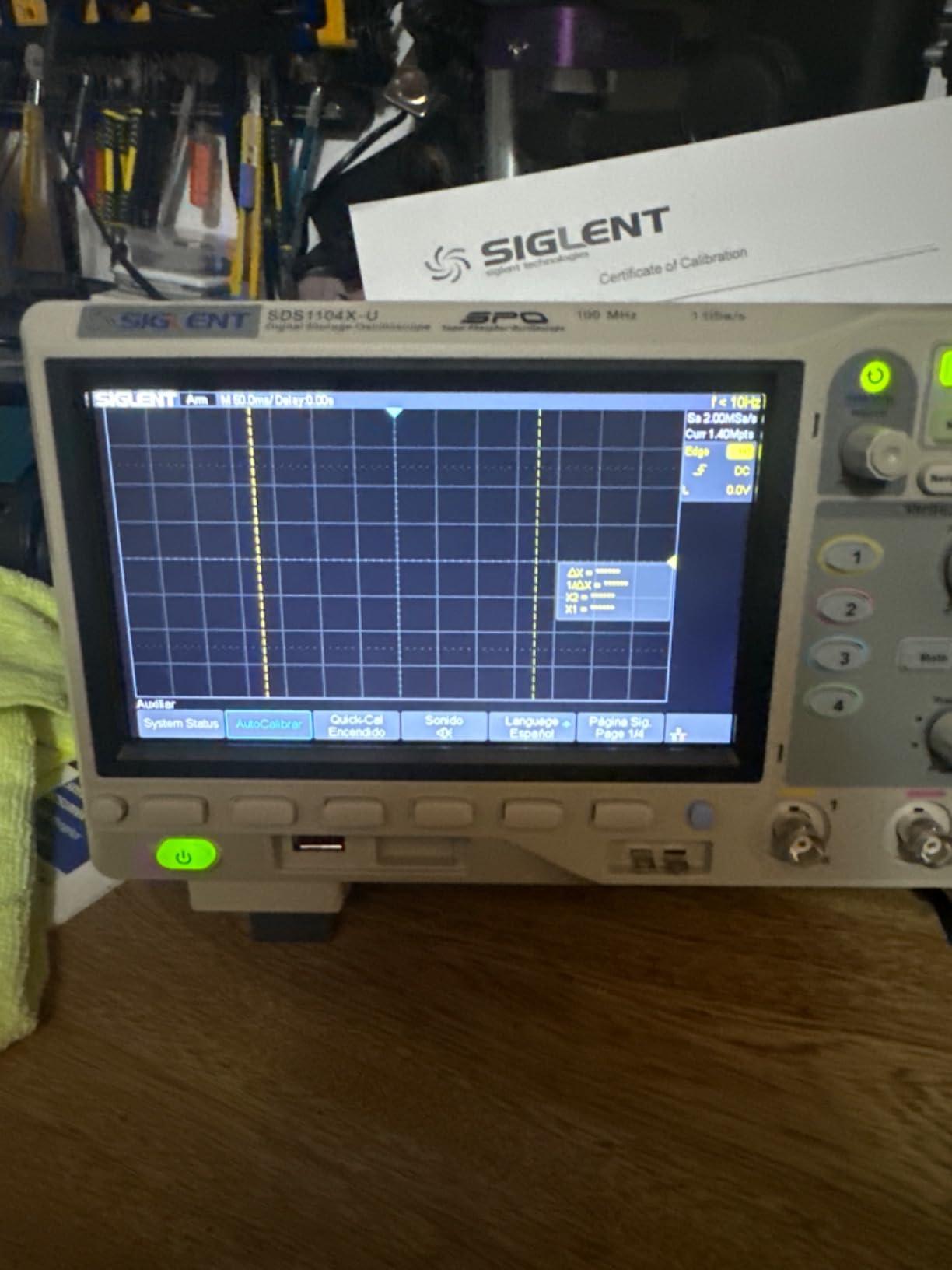
Single trigger mode with a displayed impulse delay time is genuinely useful for catching short-lived events, and the extra channels save the probe-swapping that dominates a two-channel session. The front panel is intuitive enough that a quick-start guide gets a new user running.
Serial bus triggering and decoding for IIC, SPI, UART, CAN and LIN is standard rather than licensed, and remote control works over the network with VISA drivers under Windows, which suits scripted measurements.
Where the display pays off?
Modulation, slow sensor signals, timer and PWM duty work, audio at low amplitudes, and any signal where the interesting information is in how long it lingers at a level. It is also a comfortable four-channel starter for embedded work that mixes slow buses with fast clocking.
What to live with?
The fan is aggressively loud for the amount of air it moves, which matters more than it sounds when the scope sits at arm’s length. The 800×480 screen resolution is on the low side, the position knobs are not very sensitive, startup takes about 15 seconds, and automatic detection features such as parity and space marking are limited enough to require manual analysis.
How to Choose a Benchtop Oscilloscope for Your Bench?
Bandwidth is the headline number and the easiest to overpay for. It is the -3dB point: the frequency at which the displayed amplitude drops to about 70 percent of the true value. A common rule of thumb is to buy three to five times the highest frequency you expect to see, so a 100 MHz scope is comfortable for signals up to about 20 to 30 MHz. Buying 200 MHz for a 5 kHz audio board is money spent on nothing.
Sample rate is the second number, and the one most often misread. Nyquist says you need at least twice the highest frequency, but that only guarantees you can reconstruct the shape. Real practice is to want five to ten times so the trace has enough points to look smooth and so successive samples show the edge clearly. Watch the fine print, because many scopes halve their rate when a second channel is enabled, which is exactly the point where you needed it most.
Memory depth, quoted in Mpts, decides how long a capture you can keep. A 1 Kpts scope shows you a sliver of time. Fourteen to twenty-five Mpts lets you record a whole burst, then zoom into a region and inspect events that only appear occasionally. This is the feature most worth paying up for on a cheap scope and the one most often cut.
Channels are about concurrency. Two channels handles most single-rail and two-rail designs. Four channels matters when you need clock, data, chip select and an enable on screen together during SPI debugging, or when watching input, switch node, output and current sense on a buck converter at the same instant.
Vertical resolution is new to this tier and worth understanding. Eight bits divides the screen into 256 steps, so a small ripple on a large rail is barely a few pixels tall. Twelve bits gives 4096 steps, which is why the Rigol DHO804 produces visibly cleaner traces on power supply work.
Triggering is the feature beginners use worst and suffer for. A scope restarts its sweep repeatedly, so unless a trigger holds the sweep at the same point in the signal cycle the trace scrolls and is unreadable. Set the trigger source to your clock or pulse signal, choose edge triggering, and adjust the level until the display locks. Auto Set is a starting point, not a solution.
Probes matter more than most buyers expect. Cheap probes distort fast edges, and the compensation adjustment screw on the front is there to align the probe with the scope’s input. Hantek and the Rigol DS1202Z-E get credit for usable bundled probes; the Rigol DS1054Z and the FNIRSI units do not. Check what is in the box before assuming you are covered.
Ground Reference Safety: Why the Earth Clip Matters?
Every scope on this list except the battery-powered handhelds takes mains power, and every one of them ties the ground clip on channel one to protective earth. That ground is not a measurement reference you can float. Clip it onto a point that is not at earth potential and you have created a short circuit through your building’s wiring.
This is the single most common source of anxiety among first-time scope buyers, and it is well founded. Mains-side power supply debugging with a standard bench scope can destroy the board, the probe, the scope, or your house. The advice on electronics forums is consistent: do not do it.
There are three real ways forward. An isolation transformer between the bench supply and the circuit removes the earth reference, though it does not remove every hazard and must be correctly rated. A differential probe measures two points without grounding either one, at a cost. A USB-powered or battery scope such as the FNIRSI 2C53T or the FNIRSI 1013D Plus can be powered from an isolation source so the scope ground is not earth-referenced.
For everything below mains voltage, the honest advice is simpler: keep the ground clip on the actual ground of the circuit you are probing, and treat the earth connection as fixed.
Frequently Asked Questions
What is a good oscilloscope for a hobbyist?
A good oscilloscope for a hobbyist provides at least 100 MHz bandwidth, 1 GSa/s sampling, 14 Mpts or more of record length, standard I2C SPI and UART decoding, and two to four analog channels. That covers Arduino, ESP32, Raspberry Pi Pico, audio, motor control and switching supply projects. Look for decoders enabled in base firmware rather than sold as licenses, and check that memory depth does not collapse when you use two channels.
Is Siglent a good oscilloscope brand?
Yes. Siglent has become one of the two default choices for hobbyists, alongside Rigol. Owners of the SDS1104X-E and SDS1202X-E report being happy with the build, the standard serial decoding and the value for money. The main criticisms are menu depth, some twitchy knobs and loud cooling fans on certain models.
Which brand of oscilloscope is considered the best?
For hobbyists the shortlist is Rigol, Siglent and Hantek, with FNIRSI covering the portable and low-cost end. Siglent usually delivers more bandwidth and decoding per unit of money, Rigol has the deepest community documentation and now offers 12-bit resolution in the DHO series, and Hantek provides bandwidth and decode at the lowest cost with the least polish.
What is the best and most affordable oscilloscope?
The most affordable option that still does real bench work is the Rigol DS1054Z, which pairs four channels with 24 Mpts of memory and standard serial decoding and FFT. For portable or automotive work the FNIRSI 2C53T costs less and combines a scope, a 19999-count multimeter and a DDS signal generator in one battery-powered body.
How much bandwidth do I need for an oscilloscope?
Pick roughly three to five times the highest frequency you expect to measure. For Arduino, ESP32, audio and low-voltage power circuits, 100 MHz is the practical target. Wideband switching regulators and fast digital edges justify 150 to 200 MHz. Going above that rarely pays off unless you work on RF or high-speed serial links.
Can you use a bench oscilloscope on AC mains?
Not safely with a standard earth-referenced bench scope. The ground clip is tied to protective earth, so clipping it to a hot conductor creates a short circuit. Use an isolation transformer, a properly rated differential probe, or a scope powered from an isolated USB supply instead. If you are unsure which situation you are in, do not attempt mains probing.
Conclusion: Which Benchtop Oscilloscope Should You Buy in 2026?
If you are starting out and want the safest buy for Arduino, ESP32, audio and general electronics work, the Siglent SDS1202X-E is our pick: real 200 MHz bandwidth, 1 GSa/s sampling, 14 Mpts of record and every serial decoder included.
If you need to watch several rails at once, the Siglent SDS1104X-E adds four channels with a dual-ADC front end and is the highest-rated instrument in this roundup. If you mostly debug firmware rather than fast analog edges, the Rigol DS1054Z gives you four channels and 24 Mpts of memory with everything unlocked. When small signals ride on large rails and you want cleaner traces, look at the 12-bit Rigol DHO804.
Whichever you pick, read the ground reference section before your first afternoon with it, and check whether the probes in the box are ones you want to work with. That one hour of reading is worth more than any spec difference between these ten.