
Most of the beginner snowboards available now are complete packages: a board, bindings and boots in one box. That is a genuine advantage, because a first-timer who buys a board alone still has to find compatible hardware before they can ride anything. What matters more than the badge on the box is the profile and the flex.
Here is the short answer. A beginner snowboard should have a soft-to-medium flex (roughly 1-3 out of 10), a rocker or hybrid camber profile, and a twin or directional twin shape. Those three specs, in that order, are what makes a board easy to catch, hold and progress your first turns on.
This roundup covers ten boards we have read in detail, cross-checked against rider reviews and the spec sheets manufacturers publish. We looked at profile, core construction, included hardware, sizing options and the length of the review history behind each one, because a 4.7 rating built on fifty reviews tells you something different from a 4.4 built on more than four hundred.
Every product below is written in the order it appears in the comparison table, so you can jump between the overview and the detail without losing your place. If you would rather skip straight to advice, our beginner turntable picks follow the same structure we use here: short verdicts, honest drawbacks, and no filler.
Table of Contents
Top 3 Beginner Snowboards (October 2026)

System MTN and APX Complete Package
- Camber-rocker-camber profile
- 3D poplar core
- Bindings and boots included
- 3 year warranty

Burton Riglet 90cm Snowboard
- Flat Top Bend profile
- Easy Bevel catch-free edges
- Retractable tow tether
- Weighs 3 pounds

Camp Seven Drifter Complete Package
- Complete men's package
- Poplar wood core
- APX bindings and boots
- Sizes 8 through 13
Best Snowboards for Beginners in 2026 at a Glance
All ten boards, compared side by side. Use this table to narrow the field, then read the full verdict for the two or three that match your weight, boot size and the terrain you actually ski.
| Product | Specifications | Action |
|---|---|---|
| System MTN and APX Complete Package |
|
Check Latest Price |
| Burton Riglet 90cm Snowboard |
|
Check Latest Price |
| Camp Seven Drifter Complete Package |
|
Check Latest Price |
 System Juno and Mystic Women’s Package System Juno and Mystic Women’s Package |
|
Check Latest Price |
 Symbolic Arctic Complete All-Mountain Package Symbolic Arctic Complete All-Mountain Package |
|
Check Latest Price |
 Valdez Summit and APX Complete Package Valdez Summit and APX Complete Package |
|
Check Latest Price |
 Burton After School Special 80cm Package Burton After School Special 80cm Package |
|
Check Latest Price |
 System Flite and Mystic Women’s Package System Flite and Mystic Women’s Package |
|
Check Latest Price |
 Camp Seven Redwood and Summit Package Camp Seven Redwood and Summit Package |
|
Check Latest Price |
 STAUBER Matte Summit 143cm Package STAUBER Matte Summit 143cm Package |
|
Check Latest Price |
1. System MTN and APX Complete Men’s Package: The One Most Beginners Should Buy
System MTN and APX Complete Men’s Snowboard Package (156 cm, Boot Size 10)
Camber-rocker-camber
3D poplar core
APX bindings and boots
3 year warranty
Pros
- Board arrives with sharp factory edges and a 3D poplar core
- APX boots are heat-moldable and comfortable
- Complete package costs less than repeated rentals
- Deepest review history in the group at 462 ratings
Cons
- Bindings draw the most criticism and a few report breakage
- Boot laces are less convenient than buckles
- Needs detuning before first ride
This is the package we keep coming back to, and the reason is the review count rather than the star rating. Four hundred and sixty-two ratings is more field history than anything else in this roundup, which means the durability claims have actually been tested by a few seasons of owners rather than a handful of early adopters.
The camber-rocker-camber profile is the part that matters for a new rider. Camber underfoot gives you something to press into when you want to steer, while the rocker sections in the nose and tail lift those ends off the snow so they stop catching on a flat turn. That combination is close to the ideal beginner setup.
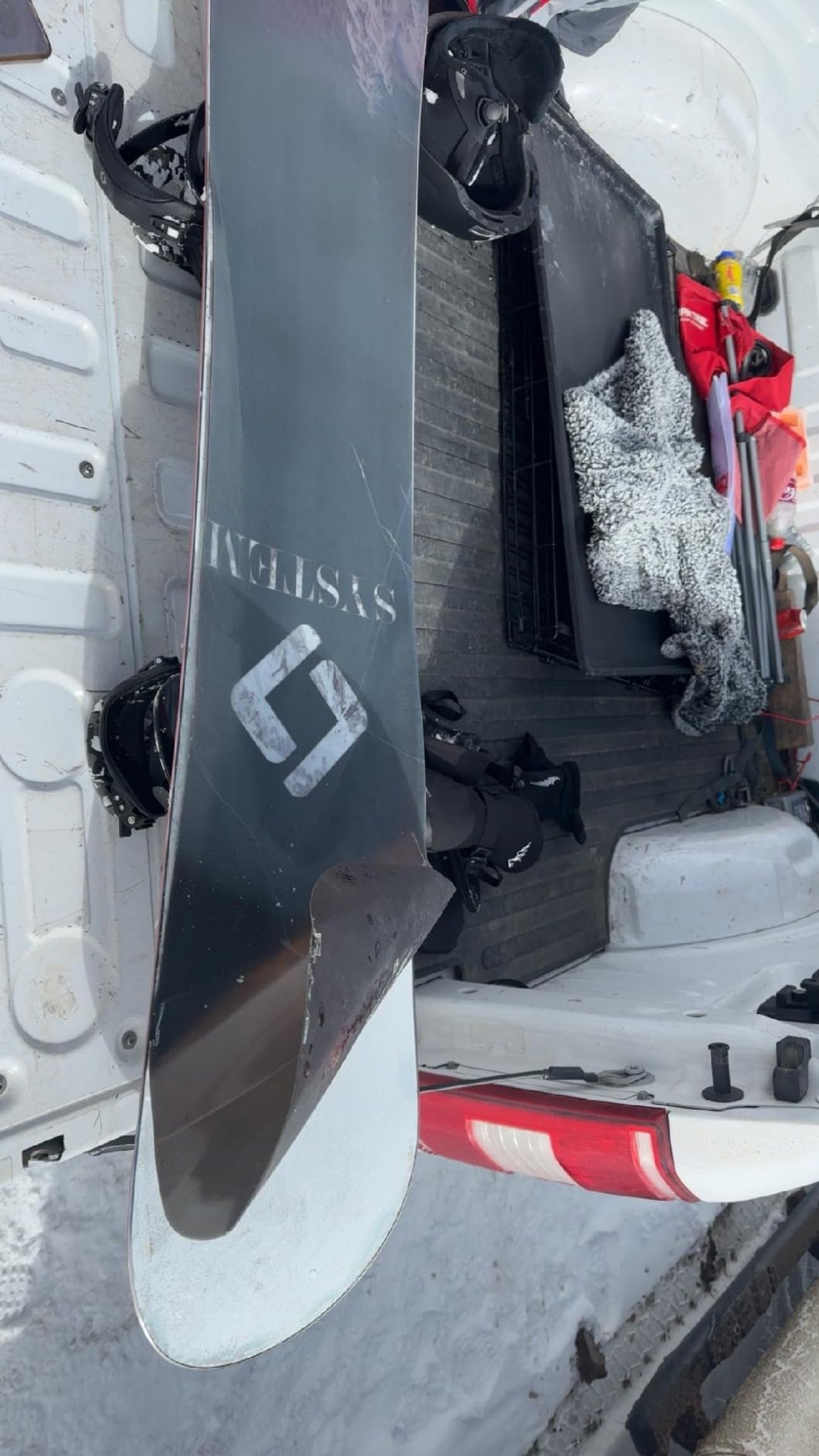
The core is a tip-to-tail poplar construction with two high-density stringers and an artisan-grade heartwood center stringer. In plain terms, it is a wooden board with extra reinforcement along the load paths, which explains why owners report it holding up over multiple seasons with annual sharpening and waxing.
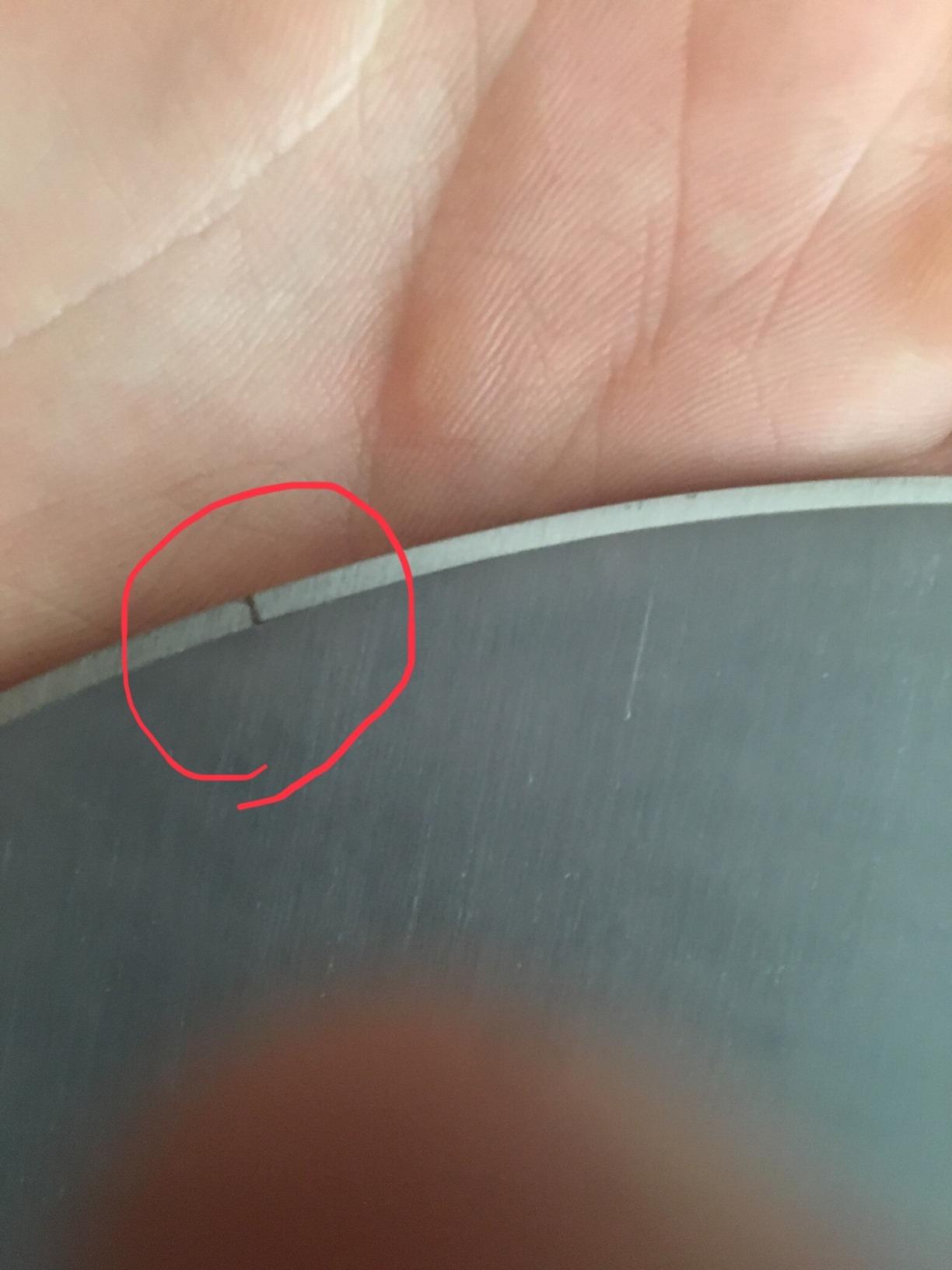
Bindings and boots are the honest weak spot. The APX bindings use a full-length EVA base pad and aluminum four-tooth ratchets, and they feel sturdier than most bundled hardware, but a few buyers report front bindings or strap release mechanisms failing inside the first season. Reviewers also flag that the board arrives with sharp tips and tails and needs detuning at a shop before the first ride.
What you get for the money
You get a board, bindings and boots in one purchase, and the boots use Thermofit heat-moldable liners with metal hooks and an articulating cuff. Owners describe them as true to size and easy to walk in, and they are the most-praised part of the bundle after the board itself.
Compare that with a full rental setup, which also includes a helmet and a lift ticket you do not own. Across two or three days of riding, the package math works out well, and you still own the hardware afterward.
Who should look elsewhere
If you are shopping for a child under 50 pounds, this board is the wrong shape entirely. Riders with large feet who need a wide waist should also look at a wide option instead, since the standard waist here is the main thing that limits it.
Buyers who care about the look of their boots should expect to replace them in year one. Several reviewers describe the boots as functional but plain, and treat them as a deliberate upgrade later rather than a disappointment.
2. Burton Riglet 90cm Snowboard: The Best First Board for a Toddler
Kids’ Burton Riglet Snowboard, 90cm
90cm board
Flat Top Bend
Easy Bevel edges
Retractable tow tether
Pros
- 4.8 average across 165 ratings
- Easy Bevel makes catching an edge nearly impossible
- Weighs 3 pounds so a toddler can carry it
- Foot pads give grip while standing still
Cons
- Bindings and boots must be bought separately
- Tow tether is short and awkward for adults
- Plastic construction is not adult-capable
Before we talk specs, the useful thing to know about this board is that most families never take it onto a lift. They use it on carpet, in the garden and in the snow to teach a small child how to stand, shuffle and balance. In that role it is very hard to argue with, because the twin shape and symmetrical twin flex keep a board this light steady under a small child.
The Flat Top Bend is described by Burton as a stability and balance profile with continuous edge control, and the Easy Bevel does the work that new riders actually need: it lifts the contact points off the snow so the edges are very difficult to catch. For a child who is still falling on every direction change, that single feature removes most of the frustration.
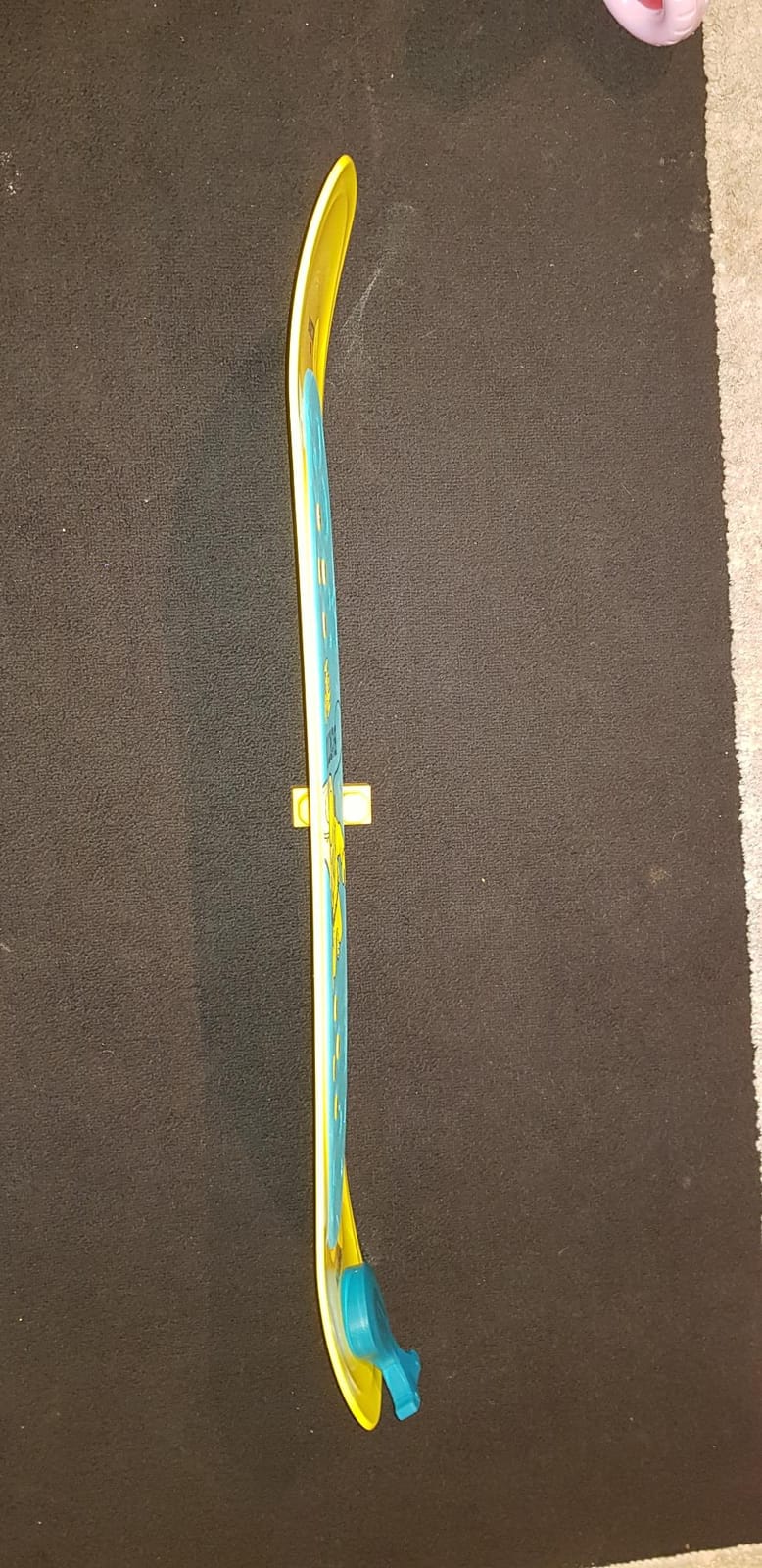
The 50-pound weight capacity is the number to check first. It is a hard ceiling, and it is why this board is aimed at big kids rather than adults, however confident an adult feels on carpet. The board itself weighs 3 pounds and measures 36 by 9 inches.
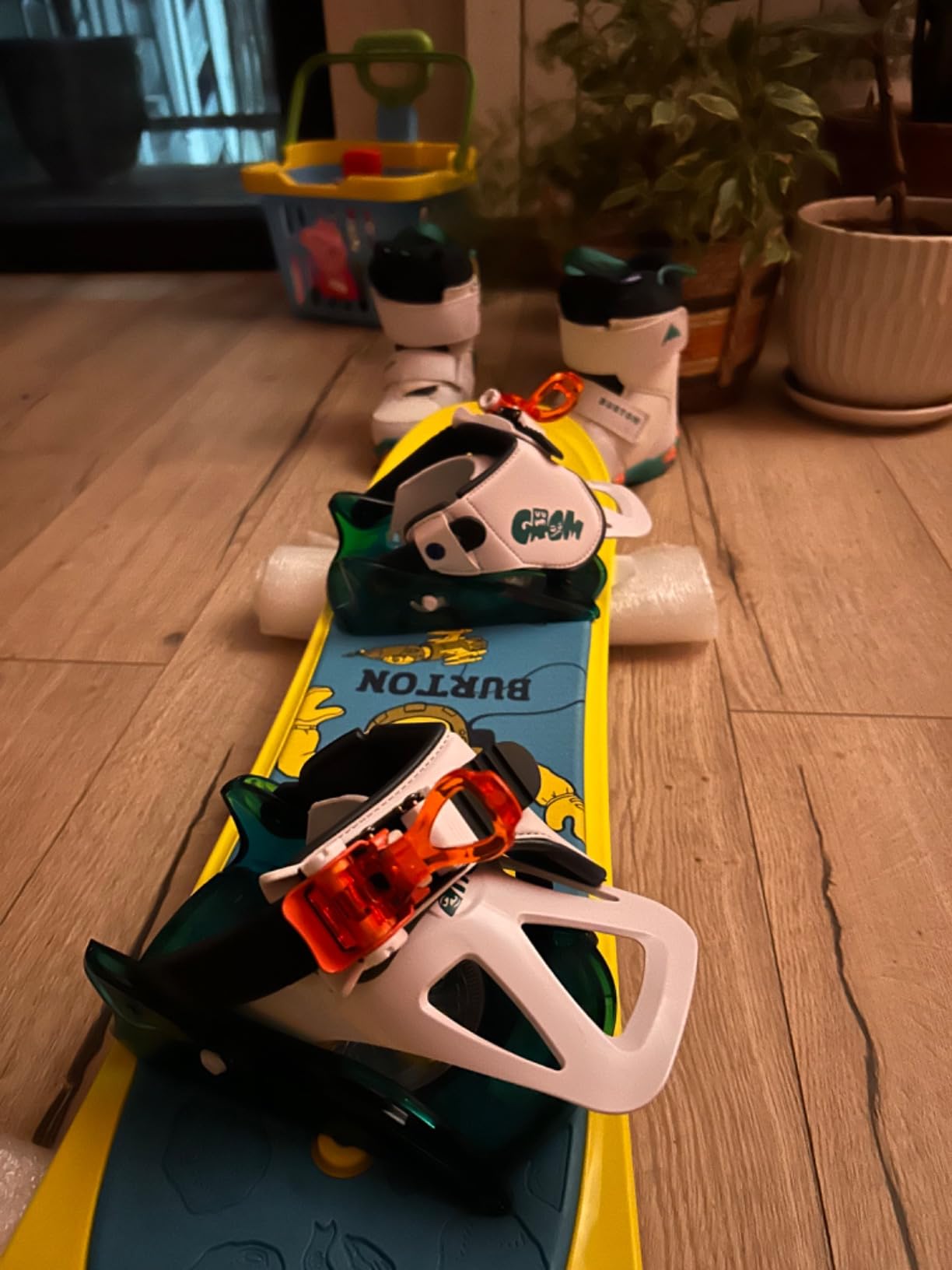
There is one genuinely clever accessory: the retractable Riglet tether, a tow strap that pulls a learning rider along while an adult walks behind. Parents use it on flat ground and gentle slopes. The complaint about it is not the concept but the length, since reviewers report the strap is short and awkward for adults who spend the day bent over.
Using it as a training tool
Flat ground practice is where this board earns its rating. With a 4.8 average across 165 reviews and a foot-pad surface that grips a boot, a child can stand, shift weight and shuffle for several minutes without the board sliding away underneath them.
Several families describe the same progression: indoors first, then grass, then a small snowy hill, always with the tether. That sequence works because the board changes behaviour very little between surfaces.
What you need to add
Bindings and boots are not included, and this is the single most common complaint in the reviews. Plan for a full hardware purchase on top of the board, sized for the child’s boot size, before this becomes a snow setup rather than a balance trainer.
Also worth knowing: the construction is plastic and sturdy rather than adult-capable. Nobody is riding this at 160 pounds, and treating it as a long-term board for a growing child means budgeting for a real snowboard later.
3. Camp Seven Drifter and APX Complete Men’s Package: The Best Value Pick
Camp Seven Drifter and APX Men’s Complete Snowboard Package New (153 cm, Boot Size 11)
Complete men's package
Poplar core
APX bindings and boots
Boot sizes 8-13
Pros
- Strong 4.6 average across 148 ratings with a 76 percent five-star share
- Poplar core keeps the package light
- Boot sizes 8-13
- Board
- bindings and boots all included
Cons
- Boots come in whole sizes only
- Less review history than the System packages
The Drifter exists because bundling a board with the APX bindings and boots is the most efficient way to get a rideable setup, and Camp Seven has done it with hardware that is already well regarded. Buy the three pieces separately from the same tiers and you would spend considerably more for an equivalent first package.
Build a poplar wood core with EVA elements, which is the standard recipe for a light, forgiving beginner board. The value here is not exotic materials, it is getting a complete, working setup in one box rather than assembling it from parts.
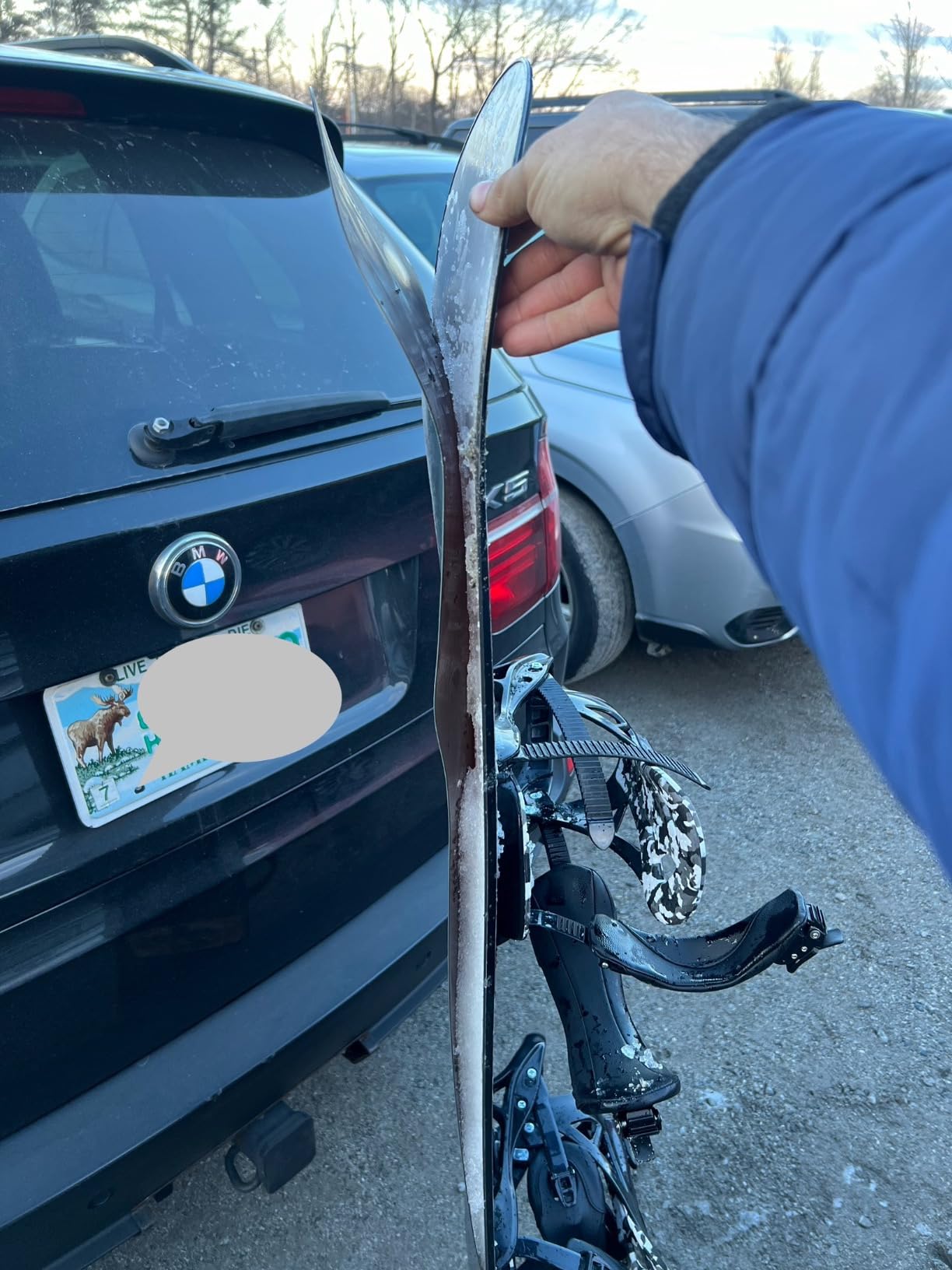
Boot sizing runs from 8 through 13, which covers most adult feet in this lineup and gives parents room to buy for a child who is still growing. It is the wide size range, more than the specific board length, that makes this package attractive for a family with one beginner rather than a dedicated snowboarder.
The category placement is worth noting too: it ranks near the top of the Freeride Snowboards category, which suggests consistent demand rather than a seasonal spike. The 4.6 average across 148 ratings with a 76 percent five-star share is a solid, well-distributed result rather than a rating propped up by a few enthusiastic reviews.
Who it suits
This is a good pick for an adult starting lessons this season, or a teenager who will likely be on rental boards for a while and wants to own something that fits from day one. The poplar core keeps the whole package light, which matters when you are spending your first sessions just walking to and from lifts.
It also works as a seasonal rental replacement. Owners who ride a handful of days a year can keep this in a garage, wax it once a season, and stop paying daily rental rates.
What to check before you commit
Boots are whole sizes only, and half-size riders report extra toe room as a result. Measure your feet in centimetres, not in shoe sizes, before ordering, because a boot that is a size too large is harder to fix than a board that is slightly wrong.
The other limitation is straightforward: 148 ratings is less history than the System packages have. Nothing in the feedback suggests a structural problem, it simply means less long-term evidence.
4. System Juno and Mystic Complete Women’s Package: The Best Fit for Women Starting Out
2020 System Juno and Mystic Complete Women’s Snowboard Package (145 cm, Boot Size 7)
CRCX centered rocker
Female-specific bindings
Beginner skill level
3 year warranty
Pros
- Listed at beginner skill level
- CRCX centered rocker is very catch-free
- Siren Mystic bindings shaped for women
- Boot sizes 6 through 10 cover smaller feet
Cons
- Boots only offered in whole sizes
- Smaller review base than the men's packages
This package is the one we would point a first-time female rider to, and the reason is the hardware rather than the graphics. The Siren Mystic bindings and Siren Lux boots are built specifically for women, and the Lux boots include a gel patch behind the highback that relieves the pressure point many riders hit on long days.
The profile is CRCX: a full rocker through the centre of the board paired with mild camber in the tip and tail. In practice that means a board that floats easily in soft snow while still giving you pop and control out of the contact points. For someone who has never linked a turn, forgiving is the priority, and this profile delivers it.
Mounting hardware is bundled, so the package is ride-ready out of the box. That is a small detail that removes a genuinely frustrating trip to a shop, and it is listed alongside the bindings, boots and board in the box contents.
Where it fits your riding
The centered rocker suits a rider who spends most of the first season on green runs and bunny hills, where catching an edge is the most common cause of a fall. Riders who quickly move onto ice and hardpack will notice the centered profile giving up some edge hold compared with a cambered board.
It is also a good board for anyone who wants a package they can grow into without a new purchase, because rocker is forgiving at speed rather than only at low speed.
Where the fit gets awkward
Boots are offered in whole sizes from 6 through 10, so half-size riders will need to measure carefully. This is a recurring limitation across the packages in this roundup rather than a fault unique to this one, but it matters if you have ever had trouble finding a comfortable boot.
With 123 ratings the field history is shorter than the men’s System package has, so there is less evidence about how it ages over a decade. Reviews do describe a 4.6 average with 81 percent five-star, which is a positive distribution.
5. Symbolic Arctic Complete All-Mountain Package: The Most Accessories in One Box
Symbolic Arctic 2025 Snowboard & Bindings & Boots & Leash & Stomp Pad Complete Package (13 Mens Black Boots & Black Bindings, 170cm Wide Hybrid Rocker)
Board, bindings, boots, leash
Leash, stomp pad and gaiter
Wide board option
Men's sizes 11-15
Pros
- Longest accessory list of any package here
- Board handles jumps
- carving and tail presses
- Boots fit true to size
- Regular or wide board options
Cons
- Bindings and boots are the weakest components
- Tops and edges nick easily
- One-star reviews focus on boot build quality
Nobody else in this roundup includes a leash, a stomp pad and a gaiter in the box. For a first-timer who does not yet know what those items are for, that removes three research tasks and three purchases, and the stomp pad in particular is one you would otherwise have to research before the first lift ride.
The board itself is described as an all-mountain design for freeride and freestyle, in thermoplastic polyurethane, with bindings and boots offered in men’s sizes 11 through 15. The package weighs 30 pounds, which is heavy, and part of that is simply the volume of accessories in the box.
Buyers consistently single out the finish and colourway. A black, blue and grey scheme is not going to stand out on a lift line, but the visual quality draws praise in reviews, and for a package at this level that is a reasonable tiebreaker.
How it rides once assembled
Setup is described as quick and straightforward, with the package ready to ride shortly after opening. First-season riders report the board handling jumps, carving and tail presses without complaint, which is a positive sign for the core strength.
Durability is where the feedback turns. Multiple buyers report the topsheet and edges getting knicks and cuts on easy slopes within a day, which suggests a board that is more at home on a progression-focused learner terrain than on hardpack or ice.
Where to be careful
The bindings and boots are the components people replace first. Reports of binding failure soon after first use and heavy criticism of boot build quality account for the 7 percent one-star share, and that is the trade-off for the accessory bundle.
One further detail matters if anything goes wrong: the seller will not replace a board damaged on the hill. Edge damage is the most common warranty situation for any new board, so read the terms before you buy rather than after your first scrape.
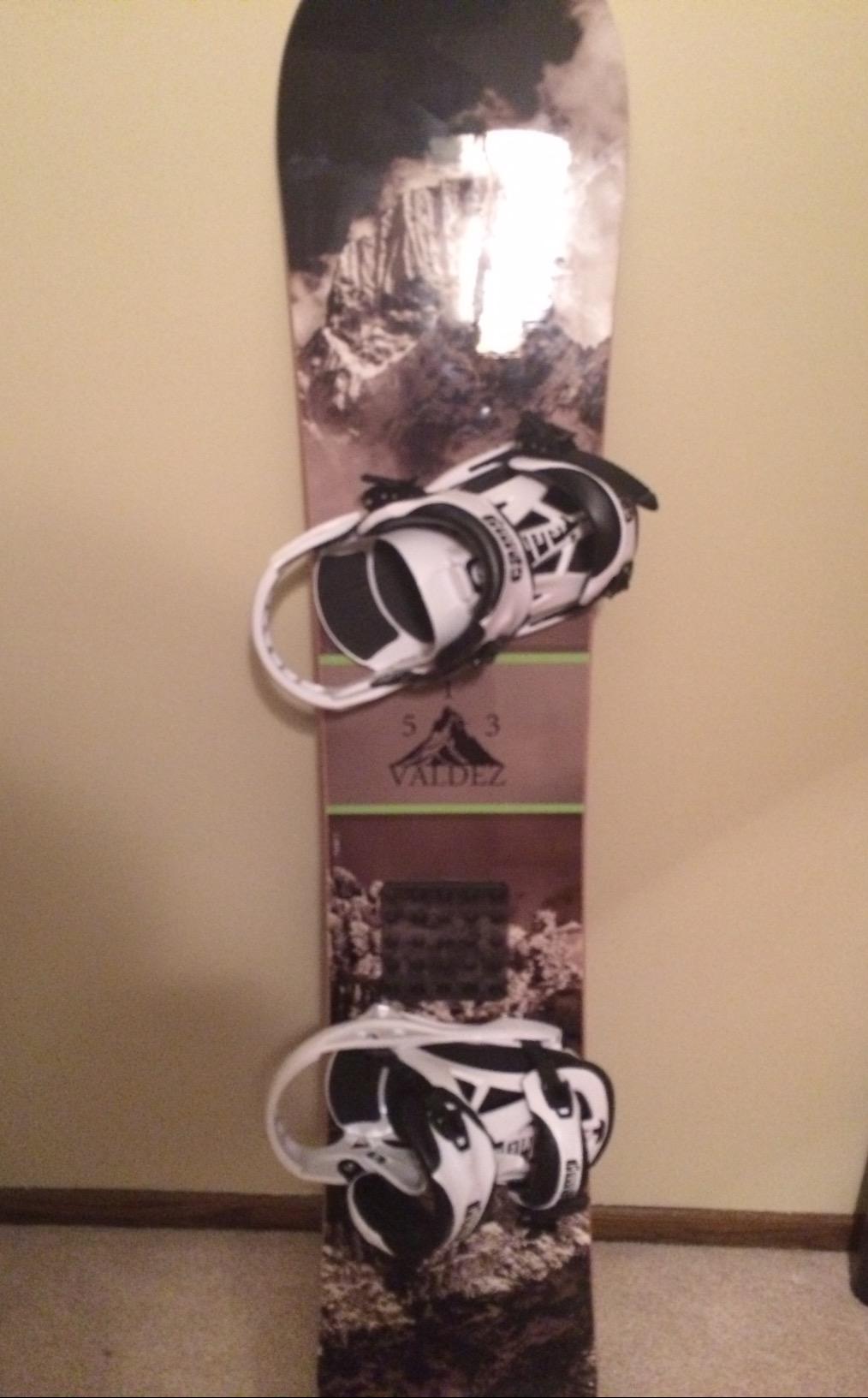
6. Valdez Summit and APX Men’s Complete Package: Best Once You Can Already Turn
Package-Camp Seven Valdez CRC Snowboard-153 cm-Camp Seven Summit Bindings-System APX Snowboard Boots 9
CRCX full center rocker
DD2 Edgelock core
Summit bindings and APX boots
Boot sizes 8-13
Pros
- 4.7 average with 88 percent five-star ratings
- Handles rough and icy conditions far better than rental boards
- Serviceable board that survives seasons of use
- Available in boot sizes 8-13
Cons
- Centered rocker is hard to learn on
- Included boots are lower quality than board and bindings
- One package arrived without the binding mounting hardware
One of the best-rated complete packages in the group at 4.7, and the reviews reveal both why and who it is wrong for. Several riders bought more than one set, one per child, and describe the board as the best value they have found for riding hard, icy terrain where a rental board would be dead weight.
The core is DD2, a dual-density construction with Edgelock, using hand-selected poplar and high-density edge stringers. Summit bindings carry a full-length EVA base pad, an either-or toe strap, gel-insert contoured straps and aluminum four-tooth ratchets, and there is a three-year manufacturer warranty on the whole package.
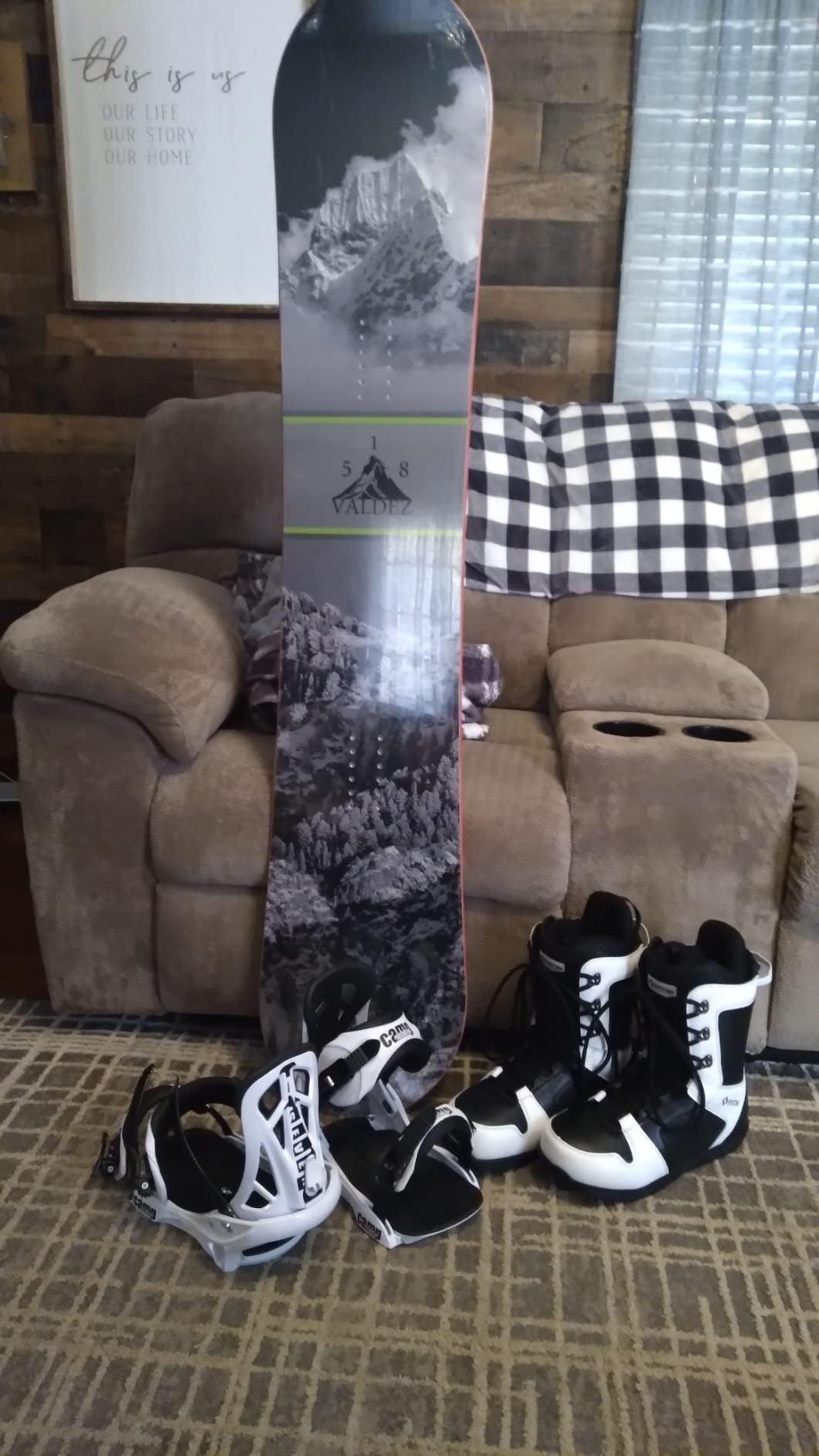
The catch is the CRCX full center rocker. Owners who bought it as a first board report struggling to learn on it, and several now ride it only after mastering the basics elsewhere. That is a real trade-off: the profile that helps a board hold an edge on ice also reduces the forgiveness a total beginner relies on.
Serviceability is a genuine plus. Owners report that a shop wax and edge returns the board to like-new condition, and that the bindings screws stayed tight and the hardware held up through real use.
The case for buying it second
If you plan to take lessons for a season on something forgiving and then move to a board that can hold an edge on hardpack, this is a strong second purchase. The edge hold and stability at speed are the features riders praise first once they can actually link turns.
The longer board sizes also let a child grow into the package before needing new boots, which extends the useful life considerably for a family.
The case against buying it first
If you are starting from standing on a magic carpet, the centered rocker is working against you. Several reviewers describe it explicitly as a poor choice for a complete first season, and that is a repeated enough sentiment to weight heavily.
The bundled APX boots are also the component buyers most often replace, and they come in whole sizes only, which leaves extra toe room for half-size riders. One package also arrived without the binding mounting hardware, so check the box before you leave the shop.
7. Burton After School Special 80cm Package: The Best Kids Board With Bindings Included
Kids’ Burton After School Special Snowboard and Binding Package, 80cm
80cm board
Bindings pre-mounted
Fly 900G wood core
Extruded base
Pros
- 4.8 average with 89 percent five-star ratings from 83 reviews
- A real snowboard rather than a plastic toy
- Bindings arrive premounted so nothing to assemble
- Used indoors and outdoors over a multi-year span
Cons
- Tow rope is not included
- Binding ratchets can snag on boots
- Boards often run small so sizing up is advised
The distinction that matters here is that this is a genuine snowboard, not a plastic training toy. It has a wood core, biax fiberglass and an extruded base, and it is meant to be ridden on snow once a child is ready. Parents single that out as rare, because most boards sold for small children are moulded plastic.
Bindings come pre-mounted, which means nothing to assemble. That removes the single most common stumbling block in buying a first board, and the twin shape and twin flex keep a small rider balanced whether they are regular or switch. The board weighs 5.6 pounds and measures 41.25 by 10.75 inches.
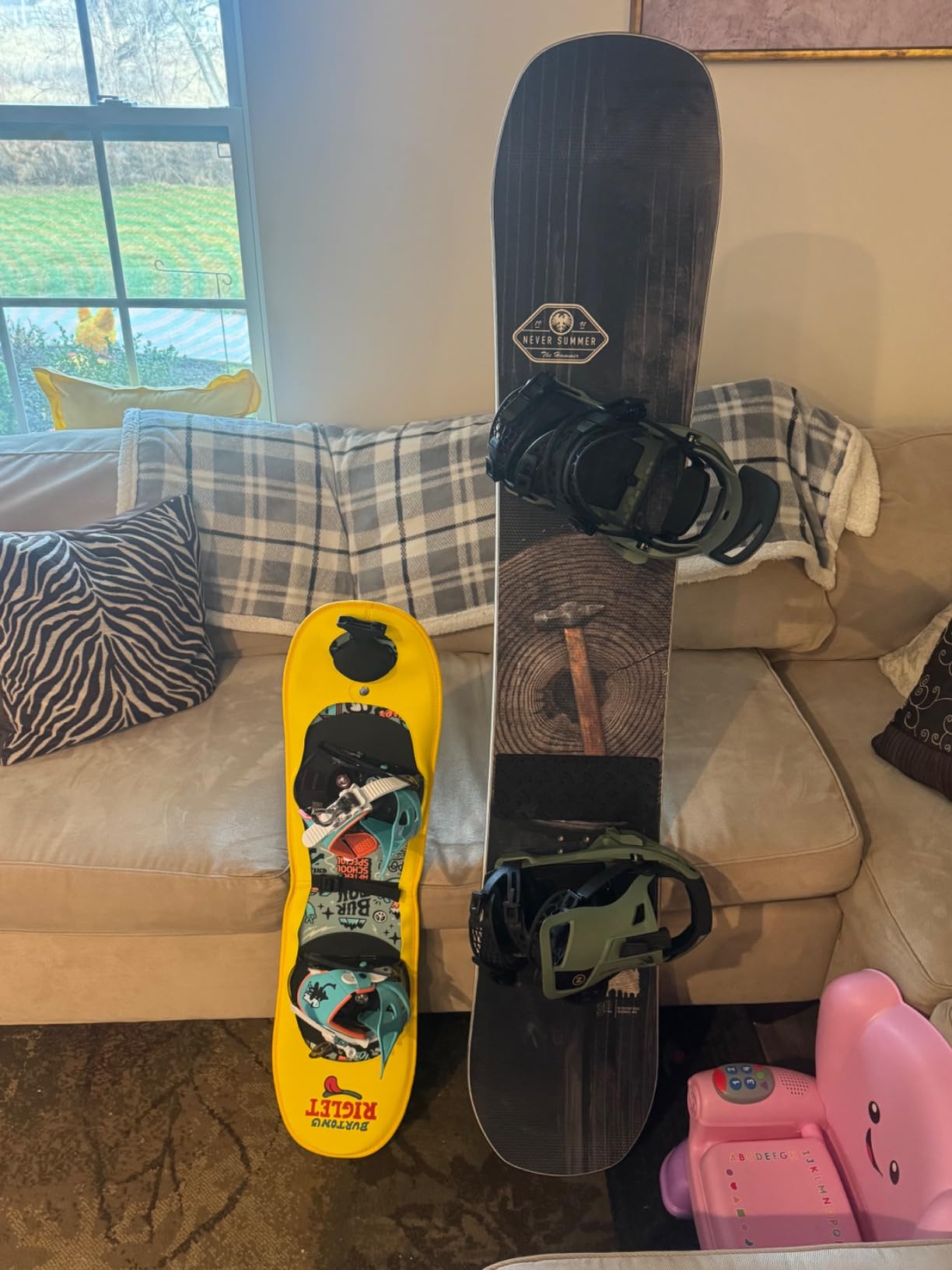
The profile is Flat Top Bend with Easy Bevel, the same forgiving combination as the Riglet, plus a Fly 900G core that blends two wood species for a torsionally soft flex. The biax fiberglass is what keeps the board soft enough to be forgiving while still delivering enough pop to ride properly.
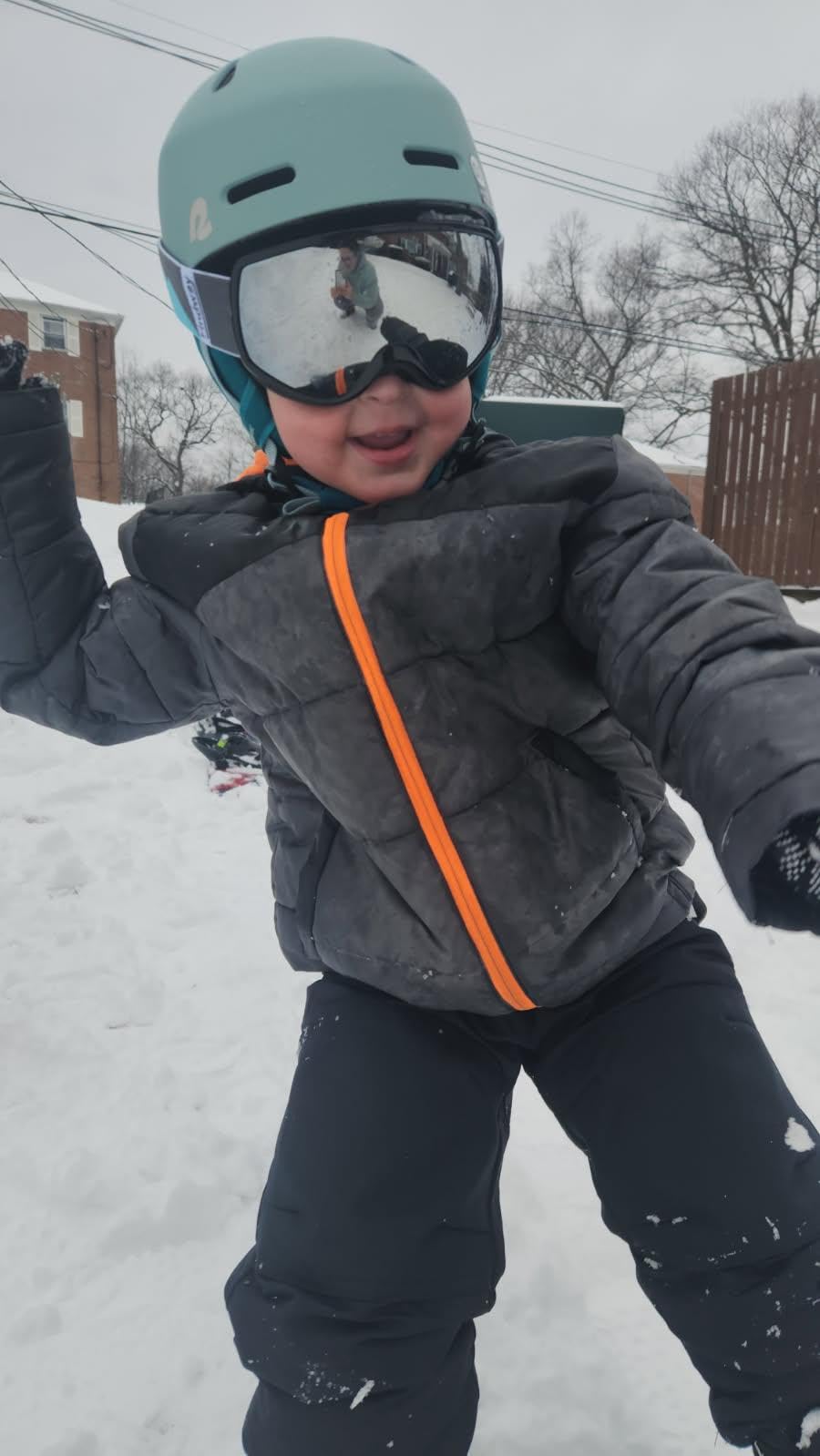
Lifespan is the standout claim in the reviews. Families describe multi-year use, one from roughly age one and a half through age five, alternating between carpet indoors and real snow outdoors. That is unusual value for a first board.
Sizing advice that keeps coming up
Buyers repeatedly recommend sizing up, and the reason is a pattern rather than a preference: children grow faster than boards. A 50-pound capacity applies to this board, and 80cm, 90cm and 100cm versions exist, so a parent buying for a four-year-old should think hard about which end of that range to pick.
If you want a tow system, the Riglet option pairs with this board, but the tow rope itself is not included. That is the most common complaint in the reviews and it is an easy one to solve at checkout.
Which children this suits
It suits a child who is past the balance-training stage and ready for actual lessons, with real boots and bindings, on a family day out. The extruded base is low maintenance and adds speed and strength without demanding much upkeep.
It is less suited to a very small child learning to stand. For that stage, a purpose-built board with grippy foot pads and a tow tether does the job better.
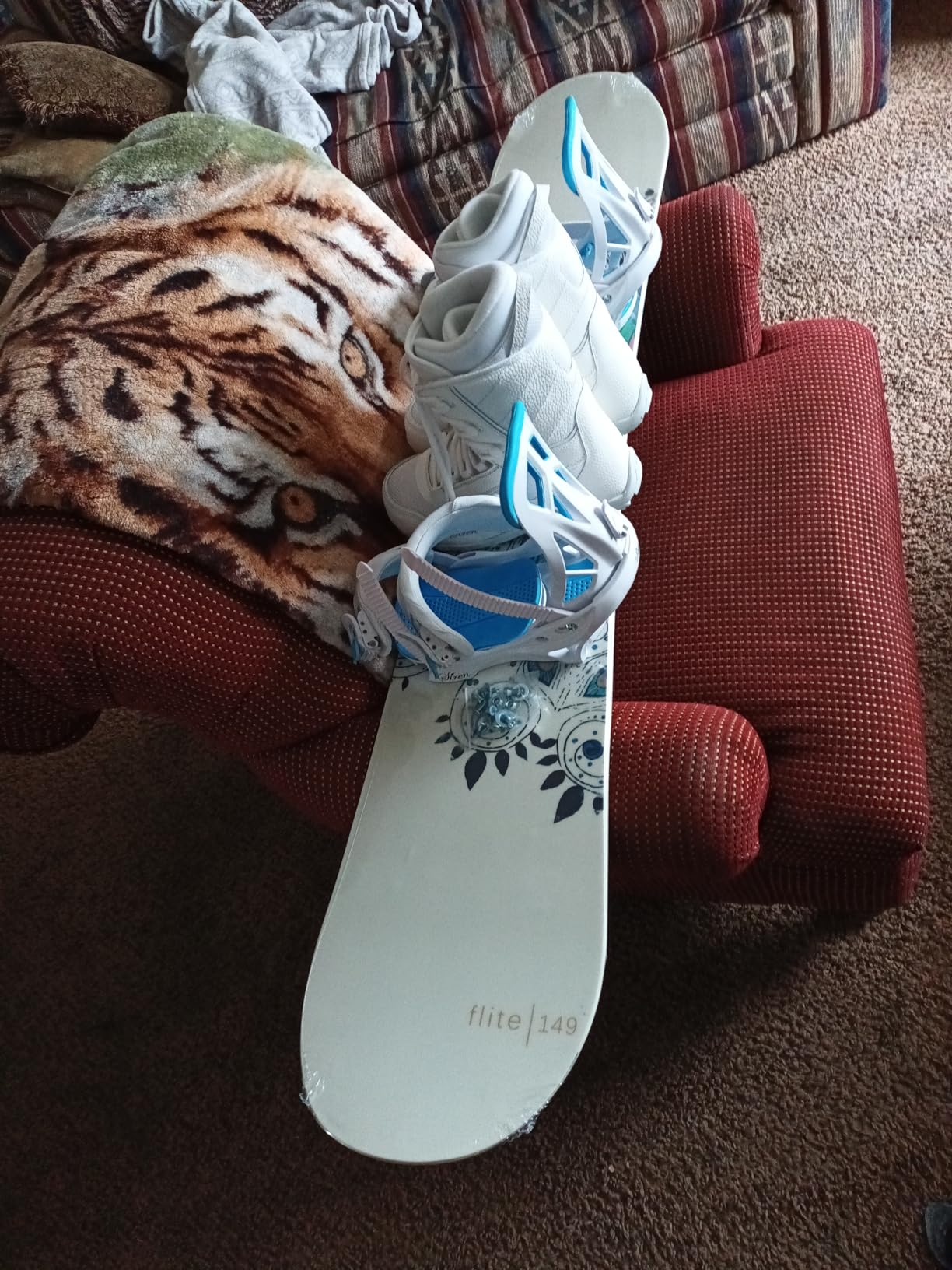
8. System Flite and Mystic Women’s Package: The Comfort-Focused Women’s Option
Package-System Flite Women’s Snowboard-146 cm-Siren Mystic Bindings-Siren Lux Women’s Snowboard Boots-6
Flatrock camber profile
Female-specific flex
Siren Mystic bindings
Siren Lux boots
Pros
- Female-specific flex and lightweight core
- Mystic bindings use gel padded toe and heel straps
- Lux boots are comfortable enough to wear indoors
- Entry point below the Juno women's package
Cons
- Lowest average rating in the group at 4.2
- Specified for intermediate and advanced riders
- Whole-size boot options only
We include this one with a clear caveat, because the fit hardware is genuinely good and the ride characteristics are aimed at a rider further along than most people reading this page. The Flite uses a flatrock camber profile, a female-specific flex and a lightweight core, and it is listed for intermediate and advanced skill levels.
The best thing about it is the Siren hardware. The Mystic bindings use a full-length EVA base pad with gel-padded toe and heel straps, and the Lux boots are built around comfort to a degree reviewers rarely see in bundled gear. Women in the reviews tend to find them noticeably more comfortable than generic hardware, and one buyer wears them around the house.
A flatrock camber profile sits between flat and camber. It gives a slightly more responsive feel than a pure flat board while remaining more stable than full camber, which is a reasonable middle ground for a rider working on edge control.
Why the rating is lower
At 4.2 across 81 ratings, this is the lowest average in the roundup, with 11 percent three-star and 6 percent two-star reviews. The distribution matters more than the average: it suggests a consistent group of buyers who expected a beginner package and got something with more performance bias.
That is a mismatch problem, not a quality problem. Riders who already link turns and want something that progresses tend to like it. Riders who want the most forgiving board available tend to be frustrated by the same responsiveness.
Who should consider it
If you are returning to snowboarding after years, can already ride green runs comfortably, and have struggled to find comfortable boots in a male-shaped package, this is a fair option. The entry point is lower than the Juno package and the fit story is the strongest part of it.
Boots run in whole sizes from 6 through 10, and there is a three-year warranty on the package. Check the sizing before ordering, for the same reason as the other women’s package in this roundup.
9. Camp Seven Redwood and Summit Package: Best for Riders Who Progress Quickly
Package-Camp Seven Redwood Snowboard 160 cm-Camp Seven Summit Bindings-System APX Boot 11
RCRX rocker camber rocker
Beginner and intermediate
Summit bindings and APX boots
Boot sizes 8-13
Pros
- Explicitly labeled for beginner and intermediate riders
- Elongated camber underfoot gives real edge hold
- Bindings hold up and ratchets run smooth after one run
- Arrives ready to ride with easy setup
Cons
- Bindings and boots can wear out within a few sessions
- Smallest but one review base here at 55 ratings
The RCRX profile is the most interesting piece of engineering in this roundup. It places rocker zones in the tip and tail for a catch-free ride, then keeps an elongated camber section underfoot so you still get real edge hold. Most rocker boards give you one or the other; this one is an attempt at both.
Reviewers confirm the theory holds up. Riders report moving from bunny hills to intermediate terrain in about eight weeks, which is exactly what you want from a first board: enough forgiveness to survive the first sessions, enough edge control to feel progress once the turns arrive. It is labeled for beginner and intermediate riders.
Construction details are conventional and solid. Summit bindings use a full-length EVA base pad, an either-or toe strap, gel-insert contoured straps and aluminum four-tooth ratchets, and the APX boots come with metal hooks, Thermofit heat-moldable liners and an articulating cuff. Boot sizes run 8 through 13.
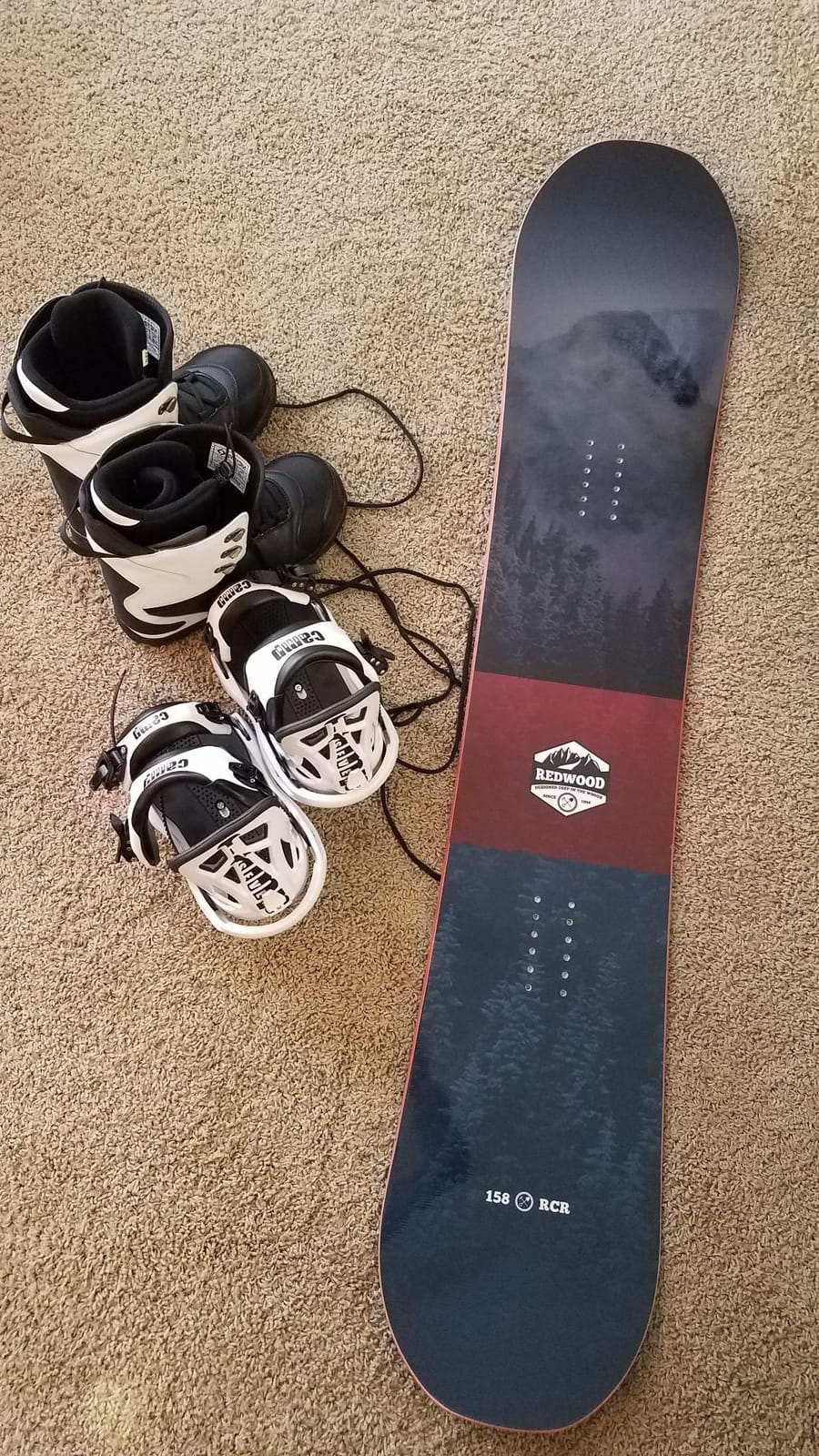
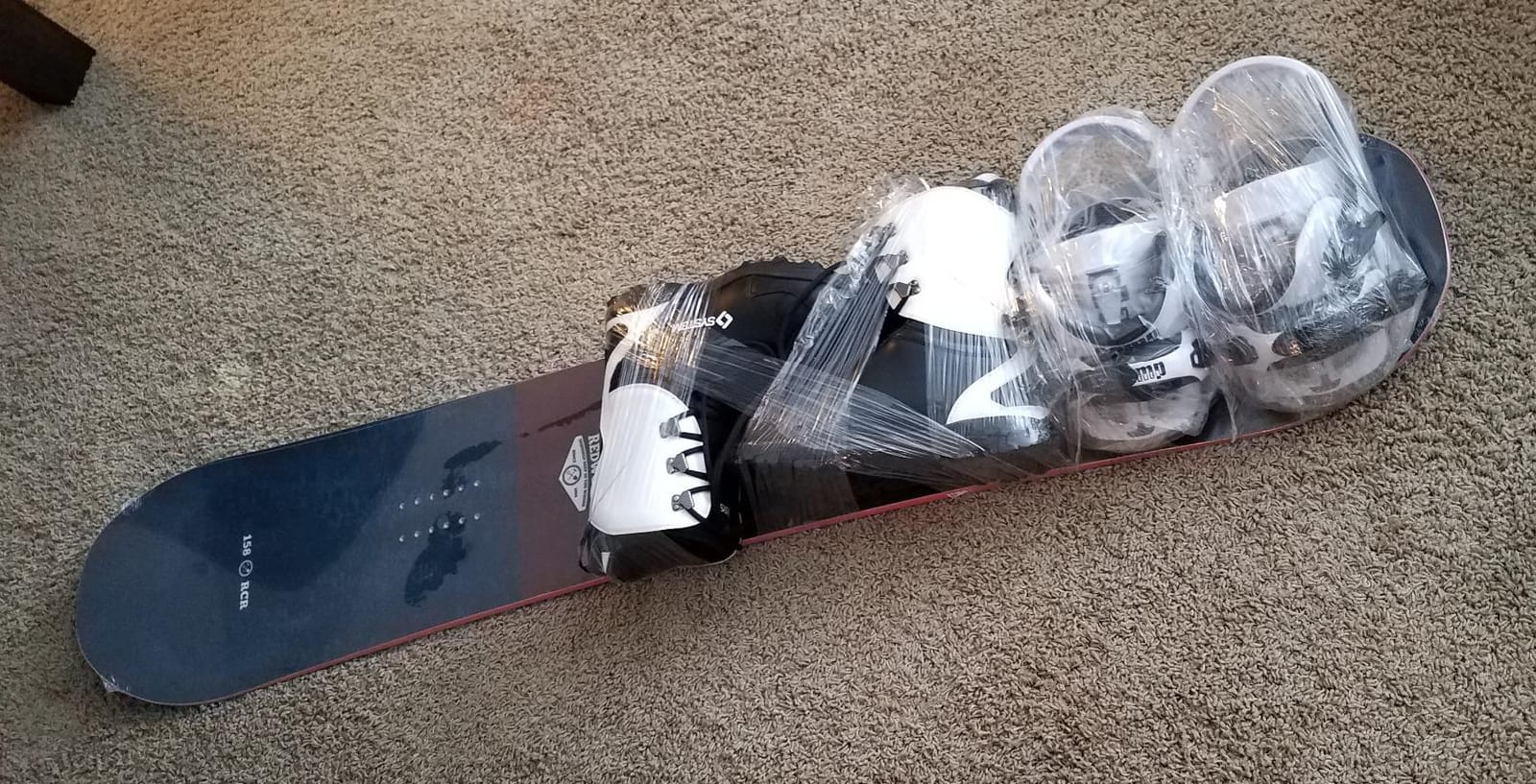
One buyer reported that the board needed no wax on its first outing and arrived ready to use, and another had a defective ratchet replaced free of charge. Both are small details, but they are the kind of service story that tells you something about how a brand handles a package rather than a board alone.
Why this suits a fast learner
Because it has a genuine underfoot camber section, the board rewards a rider who is starting to press into turns. You do not have to unlearn anything when you move up from this board, which is the argument for buying once rather than twice.
It also suits a household where one board serves more than one skill level. A partner who already rides and a child who is starting can both use it, and the beginner rating on the box removes any guesswork.
The soft-goods trade-off
Owners who plan to keep the package long-term should budget for a hardware refresh. The bindings and boots are the components that wear out fastest, with some riders reporting degradation within about four runs, and several reviews flag replacing both within the first season.
The 55-rating base is the smallest here apart from the STAUBER package, so the 4.7 average comes from a thinner pool of owners. The consistency of the feedback matters more than the size of the pool in this case, and it is notably uniform.
10. STAUBER Matte Summit 143cm Package: The Budget Board With a Wide Size Range
STAUBER Matte Summit Snowboard & Binding Package Sizes 128, 133, 138, 143, 148,153,158, & 161- Best All Terrain, Twin Directional, Hybrid Profile – Adjustable Bindings – Designed for All Levels 143
Twin directional hybrid profile
Adjustable bindings
Sizes from 128 to 161cm
143cm model
Pros
- Entry-level complete board and binding package
- Bindings are easy to adjust
- Easy to control for smaller adults and older kids
- Matte finish draws consistent compliments
Cons
- Adjustable bindings can be far too large for small boot sizes
- Toe or heel strap sticks when loading a chairlift
- Smallest review base at 32 ratings
The reason this board is worth including is the size range. STAUBER offers the Matte Summit in eight lengths from 128cm to 161cm, which is wider than anything else in this roundup and covers a small child and a tall adult from the same model. The 143cm version here suits a rider around 5 foot 4 inches and roughly 100 pounds.
The profile is a twin directional hybrid, which is a reasonable compromise between a true twin and a strongly directional board. It rides regular and switch while still giving a bit of directional control, and it is described as all-terrain and suited to all ability levels.
Adjustable bindings are included, and several buyers including adults in their fifties and sixties describe the board as a satisfying return-to-snowboard setup. The matte finish is complimented often enough that it is worth mentioning as a detail rather than a gimmick.
What the adjustable bindings get wrong
Both of the specific complaints in the reviews concern the included bindings. The main issue is sizing: for a small boot size such a size 6, the adjustable range can be far too large, which leaves a loose connection between boot and board and makes control harder than it needs to be.
The second issue is the strap. The toe or heel strap that comes off for chairlift loading is reported to stick frequently, and that is an irritating detail on a mountain where you queue for lifts several times a day. Several buyers recommend pairing the board with separately purchased bindings, which is also the better route for a rider who plans to keep it.
Who it works for
This is the pick for someone who knows their size will be hard to match elsewhere, or for a small adult who finds most boards too demanding. Control is described as easy, and a lighter board is easier to get moving on flat ground.
It is the least certain pick here, with 32 ratings the smallest review base in the roundup. Nothing in the feedback is alarming, but the evidence base is thin, so we would pair it with a shop visit and a fitting rather than buying blind.
What to Look for in a Beginner Snowboard
If you only remember three things from this guide, remember these. They are the same three criteria that shape every recommendation above.
A soft flex rating, roughly 1-3 out of 10. Soft flex bends under light pressure, which makes mistakes forgiving and reduces the effort needed to control the board.
A rocker or hybrid camber profile. Rocker lifts the nose and tail off the snow so the board does not catch an edge, and hybrid adds a small camber section underfoot for control.
A twin or directional twin shape. A twin board can be ridden regular or switch from day one, and a directional twin adds a little stability without the commitment of a one-way board.
One important warning from the rider community: do not buy the softest board available. On r/snowboarding, the repeated correction is that a board that is too soft wastes money, because a soft board feels unstable in a way new riders describe as wobbly rather than forgiving. A medium-soft flex is the sweet spot most experienced riders point to.
How to Pick Your First Snowboard in Five Steps
1. Decide your terrain first. Groomed runs and lessons call for an all-mountain board. If you know you will spend the season in a park, or on deep snow far from the lift, your priorities shift and some of the boards above drop out.
2. Choose the shape. Twin or directional twin for nearly everyone learning. Strongly directional boards are for riders with a settled stance who want forward performance, and rider communities repeatedly warn against one as a first purchase.
3. Pick the profile. Rocker or hybrid for the most forgiving ride. Full camber is sharper and more responsive, which is why it is a second or third board rather than a first.
4. Settle the flex. Soft-to-medium, and avoid the softest board in the range. A softer board is not automatically a better beginner board.
5. Size by weight, then check the boot fit. Waist width matters more than raw length, and it is the detail that decides whether you get toe or heel drag all season.
One warning about flex ratings before you start comparing them: they are not standardized across brands. A 3 out of 10 from one manufacturer is not the same board as a 3 out of 10 from another, which is the single most common source of confusion in shop conversations and on forums.
What Size Snowboard Do You Need?
Height is the most common sizing advice online and the least useful on its own. Weight, ability and terrain all move the answer, and forum threads regularly describe sizing advice as contradictory because different sources use different rules. A weight-to-length starting point is more reliable.
For a first-season rider on groomed terrain, most adults land in the 147-155 range, which is the band riders on r/snowboarding most often mention for a typical first board. Children starting out sit much lower, in the 80-100 range, which is why the two child boards here are offered at those lengths.
So how do you convert weight to length? Here is the starting point most shops work from. Treat it as a range to test in a shop rather than a final answer.
Under 90 pounds (roughly 40 kg): look at 128-138 cm, or a dedicated child board with bindings that fit small boots.
90-120 pounds (40-55 kg): 138-143 cm works well, and shorter boards are easier to control at this weight.
120-150 pounds (55-68 kg): 143-150 cm, the most common first-board range for adults of average build.
150-180 pounds (68-82 kg): 150-155 cm, or one step longer if you ride fast.
180 pounds (82 kg) and above: 155-161 cm, and consider a wide waist width.
Waist width is the number that actually prevents toe and heel drag. The wider the waist relative to your boot size, the less your heel will catch as you lean into a turn. Riders with larger boot sizes report drag as a persistent frustration, and the fix is a wide board or a wider stance, not a shorter board.
A useful physical check from shop fitting: your boot should extend past the board edge by no more than a couple of centimetres at the widest point. More than that and the board is too short for your stance.
Camber vs Rocker vs Flat: Which Profile for Beginners?
For a total beginner, rocker or hybrid camber is the answer. Camber is faster and more responsive but it rewards a rider who already knows how to press an edge, and it is the profile most often blamed for a first season that stalls.
Camber is a single continuous arch from tail to nose, with the middle lifted off the snow. It gives strong pop, precise edge hold and a lively feel under hard pressure. Rider style: all-mountain and freestyle. Ability: intermediate and up.
Rocker curves upward at both ends, lifting the nose and tail so they do not dig in. It floats in powder and makes catching an edge very difficult. Rider style: powder and all-mountain. Ability: beginner to intermediate.
Flat camber has zero arch, which gives a loose, skate-like feel and is the most forgiving of the three. It is easy to ride and easy to progress out of, though it has less edge hold than the alternatives. Rider style: freestyle and beginner terrain. Ability: beginner.
Hybrid camber splits the difference with a raised section between the feet and varying rise at the ends. The Camp Seven Redwood in this roundup is the clearest example, with rocker zones in the tip and tail and an elongated camber section underfoot. Rider style: all-mountain. Ability: beginner to intermediate.
Can a beginner use a camber snowboard? Yes, but it is not the recommendation we would make. Lessons on camber build good habits faster for some riders, and plenty of people learn on it happily. Expect more falls, though, and consider switching to rocker for the first season if progress stalls.
Soft vs Stiff: Choosing the Right Flex
Soft-to-medium flex is right for a first board. A soft board bends under light pressure, so a small lean produces a turn rather than a skid, and errors are absorbed instead of amplified.
There is a persistent forum myth worth repeating: the softest board is not the best beginner board. Riders report that an over-soft board feels unstable and twitchy at speed, and that a medium-soft flex is the sweet spot. This is also the advice that helps you avoid buying twice.
Stiff boards are faster, more stable at speed and better at absorbing big impacts, which is why park riders and heavier riders move toward them. A stiff board makes a new rider work twice as hard for every input, and it is the most common first-season regret in our reading of the reviews.
How soft is too soft? If you cannot hold an edge at all on a moderate slope, the board is too soft for you. If you can press the board into a turn and it responds, that is the range you want.
Twin vs Directional Twin vs Directional Shapes
Choose a twin or directional twin for your first board. Both are symmetric enough to ride switch, and rider communities consistently recommend them for beginners because they remove an entire variable from the learning curve.
A true twin has identical nose and tail dimensions and identical flex from tip to tip. It is the classic freestyle shape, stable in both directions, and forgiving in every orientation.
A directional twin looks almost identical but the nose is marginally wider and longer. Most riders never go switch on one, but it will not feel odd if they try. It is a small step up in forward performance.
A directional board has a noticeably longer nose, a shorter tail and often a set-back stance. It floats in powder and holds a line far better, and riders repeatedly warn against one as a first board, because a directional board makes switch riding awkward or impossible.
If you are not sure which direction you will ride in, a twin board removes the question entirely. That is worth more to a beginner than any performance advantage a directional shape offers.
Board Plus Bindings Plus Boots: The Full Beginner Setup
This is where first-timers get caught out, because a board on its own is not a snowboard. You need bindings that match your boot type, and boots that fit. Most of the packages above bundle all three, which is exactly why they dominate this roundup.
Here is what the full setup contains and why each piece matters.
Board. The largest single cost, and the part that lasts longest if you wax and sharpen it.
Bindings. Soft goods by design. They are the most common first replacement in nearly every set of reviews in this roundup, and the component most likely to fail inside a season.
Boots. Fit matters more than price. Whole-size-only bundles are the single most common sizing complaint, so measure your feet in centimetres.
Helmet and goggles. Not included in any package here. This is a non-negotiable purchase, and a rental helmet is fine for a first season.
Lessons. The line item that most improves a first season, and the one most first-timers skip.
Where packages save real money is bundling. Riders repeatedly note that the board-plus-bindings bundle is where the savings sit, and a few add a separate pair of bindings later once the included ones wear out, which is a sensible order of operations.
On step-in versus strap bindings, for a first-timer, straps win. Step-in systems are easier to get into without help, but the boards in this roundup come with strap bindings, and the hardware is interchangeable enough that it is not worth designing your purchase around.
The same test-first principle applies to any hobby kit you are buying for someone else. Our beginner kids drone picks work the same way: shortlist by the one spec that actually matters, then check the failure reports before you commit.
Best Snowboard Brands for Beginners
Three brands dominate what is available for a genuine first board, and the reason is variety of size rather than performance.
Burton covers both early stages of a child’s snowboarding life, with the Riglet and the After School Special aimed at different ages. Both are beginner-labelled and both carry a multi-year warranty on the snowboards with traditional mounting inserts.
System fields several packages for adult beginners, with the MTN, a dedicated women’s package and a flatrock option for progressing riders. The APX bindings and boots reappear across several of these bundles, which tells you the brand is confident in its own soft goods.
Camp Seven fields three adult packages here, from a beginner-labelled rocker-camber board to a centered-rocker board built for edge hold. The Summit bindings and APX boots recur across their range in the same way.
The honest caveat: brand matters far less than profile, flex and size. A correctly sized beginner-profile board from any of these brands will serve a new rider well.
Frequently Asked Questions
What type of snowboard is best for a beginner?
Look for a soft-to-medium flex of roughly 1-3 out of 10, a rocker or hybrid camber profile, and a twin or directional twin shape. Soft flex absorbs mistakes, rocker keeps the nose and tail from catching an edge, and a twin shape lets you ride switch from the first day. A complete package with bindings and boots included is usually the simplest way to get started.
What size snowboard is best for a beginner?
Size by weight rather than height. Most adults start around 147-155 cm, which covers the common 120-180 pound range. Under 90 pounds points to 128-138 cm, and riders above 180 pounds are usually better on 155-161 cm with a wider waist. Waist width matters more than length for preventing toe and heel drag.
What flex is best for beginner snowboarders?
Soft-to-medium, roughly 1-3 out of 10 on a typical brand scale. Soft flex bends under light pressure so mistakes are forgiving. Avoid the softest board available, which riders report feels unstable rather than forgiving, and note that flex ratings are not standardized between brands, so a 3 out of 10 from one manufacturer is not the same as a 3 out of 10 from another.
Is camber or flat better for beginners?
For a total beginner, rocker or flat is more forgiving than camber because it is less likely to catch an edge. Camber is faster, more responsive and holds an edge better, which is why most riders treat it as a second or third board. Flat camber is the loosest and most forgiving, rocker floats in powder, and hybrid camber gives a small underfoot section for control.
Should a beginner ride a twin or a directional board?
A twin or directional twin. Both are symmetric enough to ride switch, which removes a variable from the learning curve, and rider communities consistently recommend them for first boards. A directional board has a longer nose, a shorter tail and often a set-back stance, which helps in powder but makes switch riding awkward. Add that to a short first season and it is the wrong call.
Do I need a wide snowboard as a beginner?
Only if your boot size is large. Waist width is what prevents toe and heel drag, so riders with bigger boots should measure their feet in centimetres and compare against the board waist before buying. A too-narrow board causes persistent drag in every turn and cannot be fixed by changing stance. A wide board paired with narrower boots causes its own problem, so match the two together.
Conclusion: Which Beginner Snowboard Should You Buy?
Buy a complete package with bindings and boots, choose a rocker or hybrid profile with soft-to-medium flex, and size it by your weight. The System MTN and APX package is the one we would buy first, because it has the deepest review history in this roundup and a profile that suits a new rider without locking them out of progress.
Book one lesson before you buy if you can. An hour with an instructor tells you your weight, stance and stance width far more accurately than a sizing chart, and it will save you from the single most common beginner mistake of buying twice.
Riders who are just starting out in 2026 have more good options than at any point in the last decade, and every board here is a better deal than a season of rental fees. Our beginner camera lens guide follows the same rule: test first, then commit to the gear that fits how you actually use it.