
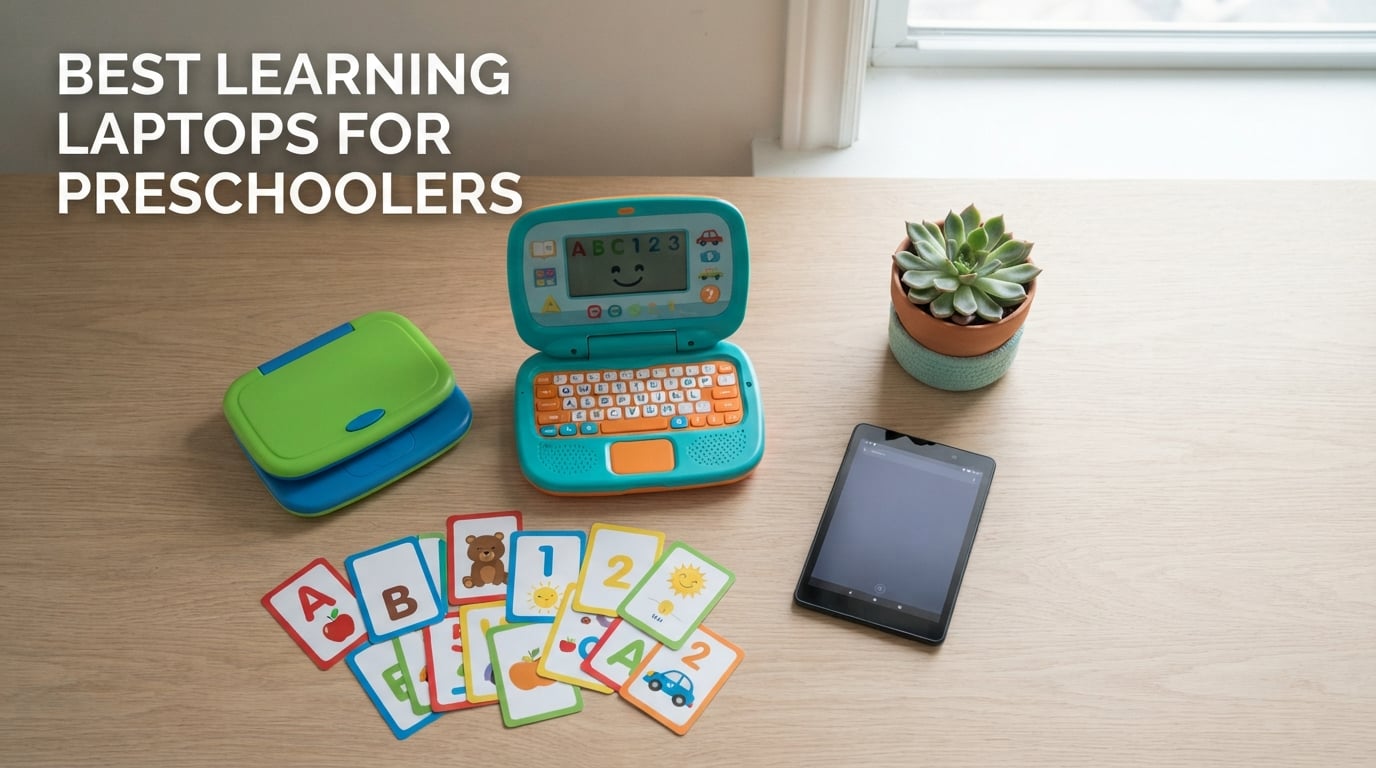
A learning laptop for a preschooler is a device built for ages roughly 2 to 5 that combines age-appropriate content such as letters, numbers, phonics, shapes and simple games with a build that can survive small hands. When parents search for the best learning laptops for preschoolers, they are usually working through one big fork in the road: a toy-style electronic laptop that runs a fixed set of activities with no setup, or a real computer with parental controls.
Our team spent weeks putting these ten machines through the routine a preschool day actually looks like: letters and number recognition, shape matching, cause-and-effect play, and a lot of dropped-device testing. Every pick below runs on AA batteries or an internal rechargeable cell, works offline, and needs no account to start.
We also made the calls that most roundups skip: which screens stay readable in a dim living room, which models a two-year-old can operate without adult rescue, and which content a four-year-old who already knows the alphabet will master in a fortnight. The full breakdown starts with our top three, then walks through all ten picks.
Table of Contents
Top 3 Best Learning Laptops for Preschoolers in 2026

LeapFrog LeapTop Touch
- Flip screen converts laptop to tablet
- Keyboard with letters A-Z and numbers 1-10
- Five learning modes
- Parent name customisation

VTech Tote and Go Laptop
- 20 activities with progressive levels
- Attached mouse included
- 30 rock country and jazz melodies
- Customisable name and avatar
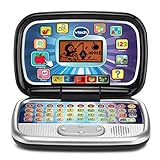
VTech Play Smart Laptop
- 30 leveled activities
- Beginner Spanish vocabulary
- Personalisable name and avatar
- Logic and music games
All 10 Picks Compared in 2026
| Product | Specifications | Action |
|---|---|---|
| LeapFrog 2-in-1 LeapTop Touch |
|
Check Latest Price |
| VTech Tote and Go Laptop |
|
Check Latest Price |
| VTech Play Smart Preschool Laptop |
|
Check Latest Price |
 Lexibook Unicorn Educational Laptop Lexibook Unicorn Educational Laptop |
|
Check Latest Price |
 VTech Toddler Tech Laptop VTech Toddler Tech Laptop |
|
Check Latest Price |
 LeapFrog ABC and 123 Laptop LeapFrog ABC and 123 Laptop |
|
Check Latest Price |
 LESHITIAN 80-Activity Kids Laptop LESHITIAN 80-Activity Kids Laptop |
|
Check Latest Price |
 HAIOUMM 48-Mode Colour Screen Laptop HAIOUMM 48-Mode Colour Screen Laptop |
|
Check Latest Price |
 ZeenKind Bilingual Spanish-English Laptop ZeenKind Bilingual Spanish-English Laptop |
|
Check Latest Price |
 LeapFrog My First STEAM Laptop LeapFrog My First STEAM Laptop |
|
Check Latest Price |
1. LeapFrog 2-in-1 LeapTop Touch – Best Overall for Ages 2-5
LeapFrog 2-in-1 LeapTop Touch
Ages 24 months to 5 years
Flip screen converts to tablet mode
3 AA batteries
1.3 lb
Pros
- Flip screen turns it into a touch tablet
- Letter keys A-Z and numbers 1-10
- Five learning modes covering ABCs numbers games music and messages
- Parents can customise it so the child spells their own name
- Carry handle suits small children
Cons
- Audio loops the same phrases and songs repeatedly
- Screen and sound quality are modest
The hinge is the whole trick: swivel the screen and the same device becomes a touch tablet, so a two-year-old who cannot yet point at a letter can still tap a shape game. It weighs 1.3 pounds and measures a little over 10 inches wide.
LeapFrog rates it for 24 months through 5 years, and it is the only pick in this roundup with that spread. Five learning modes cover ABCs, numbers, games, music and messages, and the keyboard carries letters A-Z plus numbers 1-10.
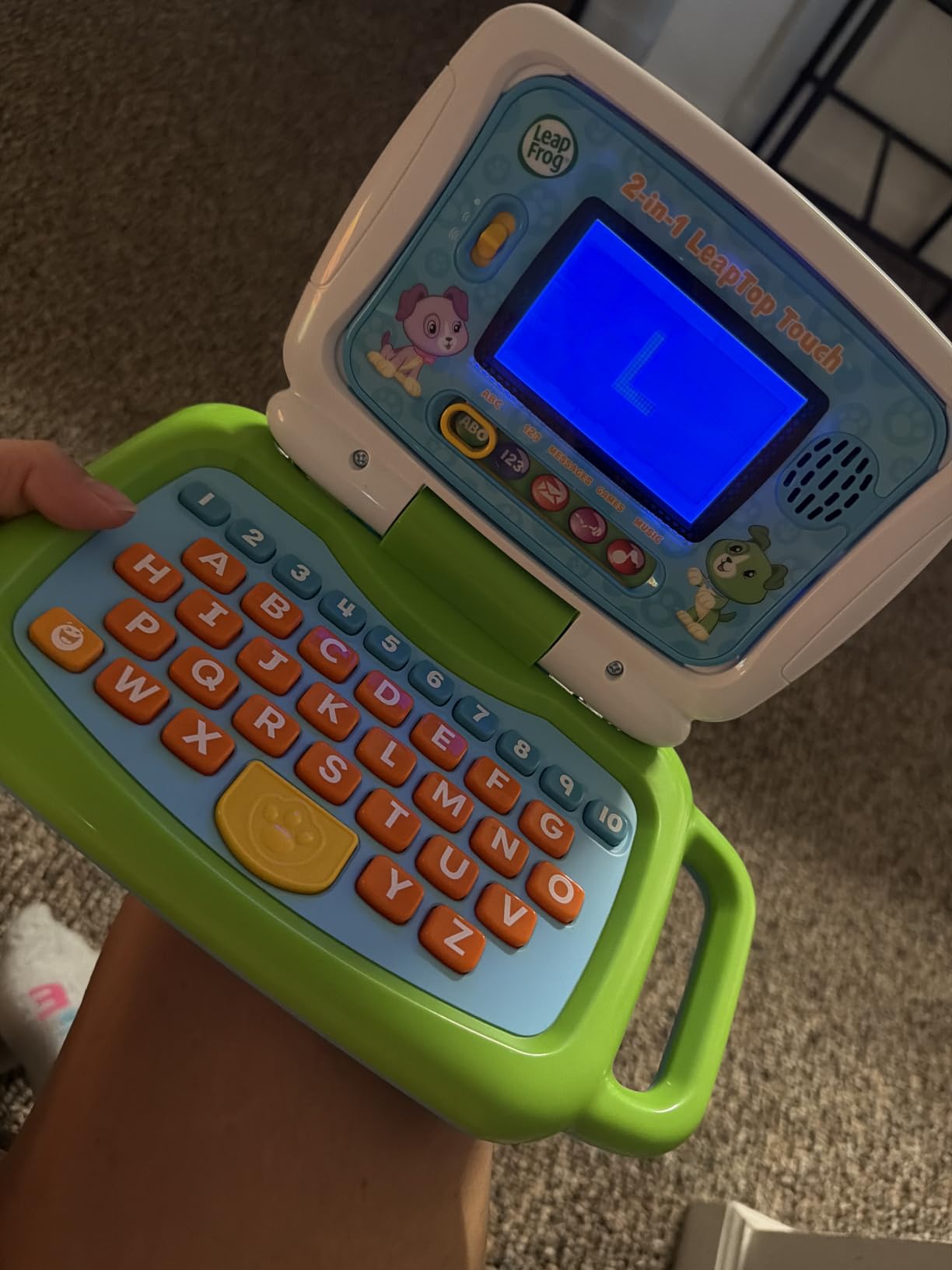
The role-play layer separates it from a generic keyboard toy. Children send pretend emails to a character called Scout, and parents can set a name so a toddler watches the toy spell it letter by letter.
It runs on 3 AA batteries, and the ones in the box are for demonstration only. Sound is loud by design at this age, and there is no volume limit on the device itself.
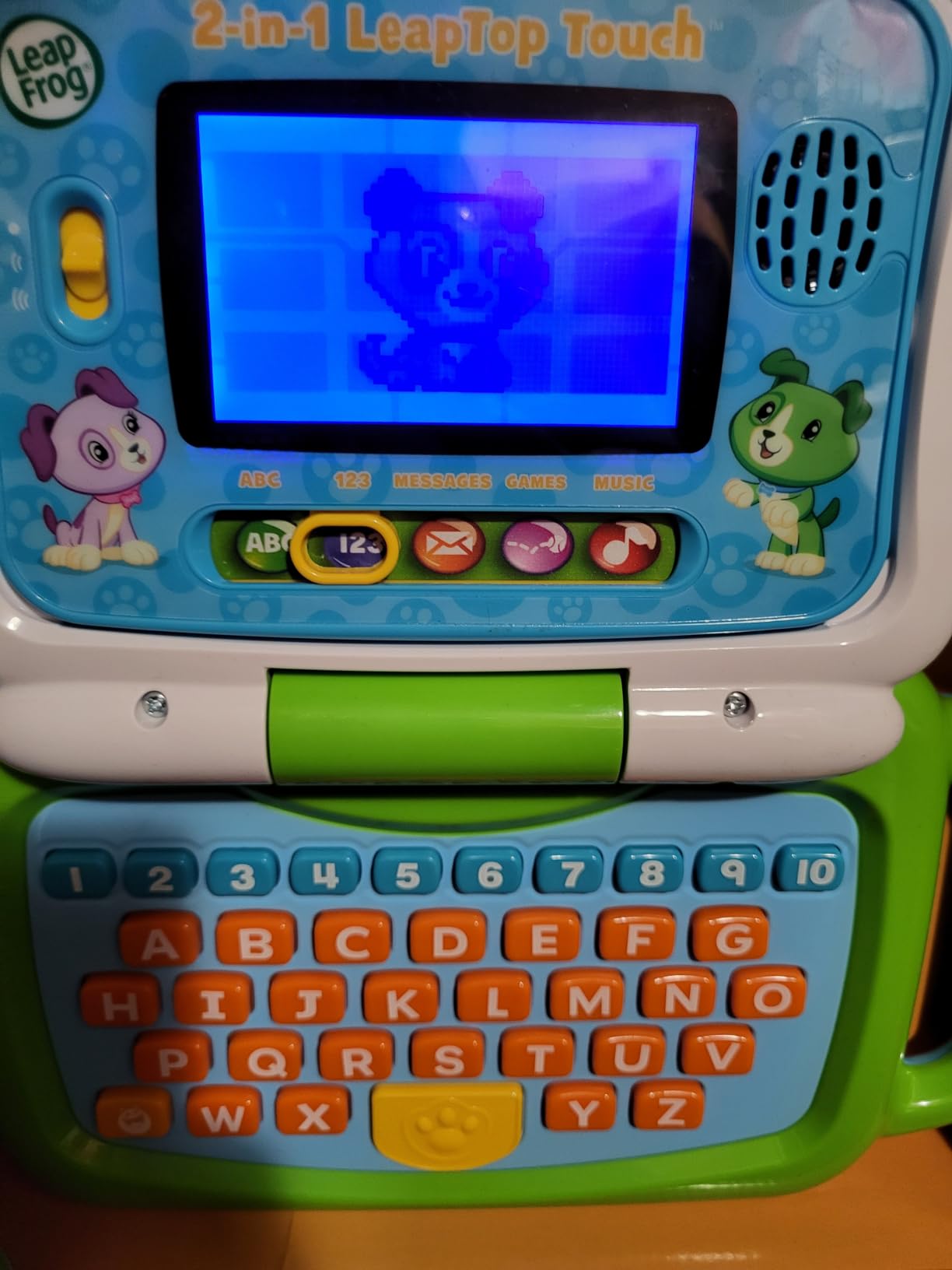
Does it hold a child’s attention
Reviewers describe children as absorbed for long stretches, and 30k-plus ratings back that up. It is frequently bought as a birthday gift rather than as a teaching tool.
What you should know before buying
The most common complaint is audio repetition: the same songs and phrases cycle often enough that adults tire before children do. Screen and sound quality are what you would expect at this tier.
2. VTech Tote and Go Laptop – Best Value Pick
VTech Tote and Go Laptop, Orange
Ages 3-6
20 activities with levels
Attached mouse
30 melodies
1.8 lb
Pros
- Progressive difficulty levels that keep improving
- Attached mouse teaches mouse skills most toy laptops skip
- Customisable with name age and avatar
- 30 rock country and jazz melodies
- Built-in carry handle
Cons
- Screen is not backlit and is hard to read in low light
- Speaker can stop working after several months
This is the one we recommend when a family wants the longest usable life per pound. VTech rates it for 36 months to 6 years, and the activity count is the reason: 20 activities teaching more than 60 words, spelling, shapes, logic and animals, split into progressive levels.
Progressive levels matter more than raw activity count. A four-year-old who has mastered letter recognition can move into spelling and logic content instead of hitting a ceiling in week two, and reviewers note the toy grows with the child rather than being outgrown quickly.
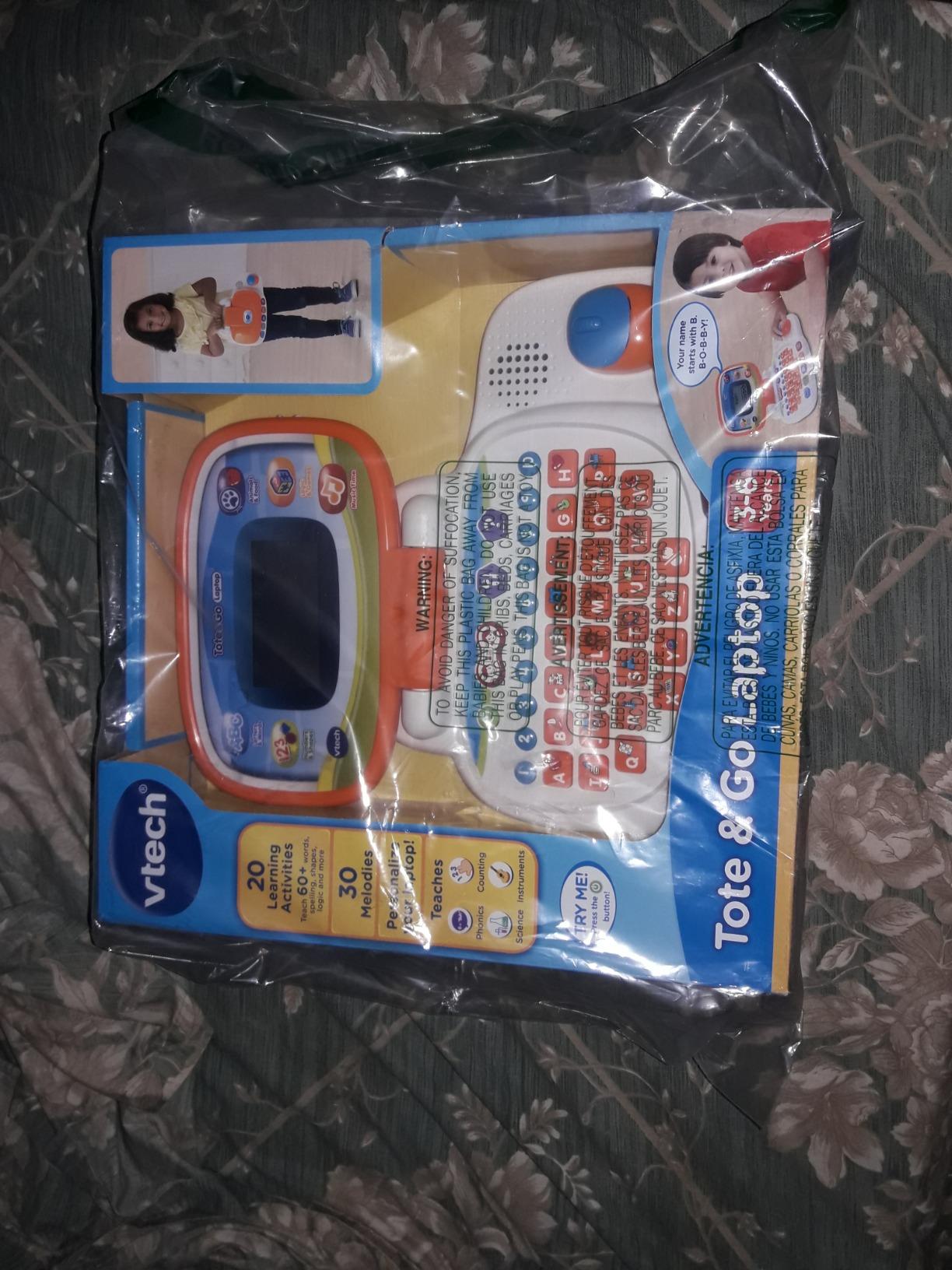
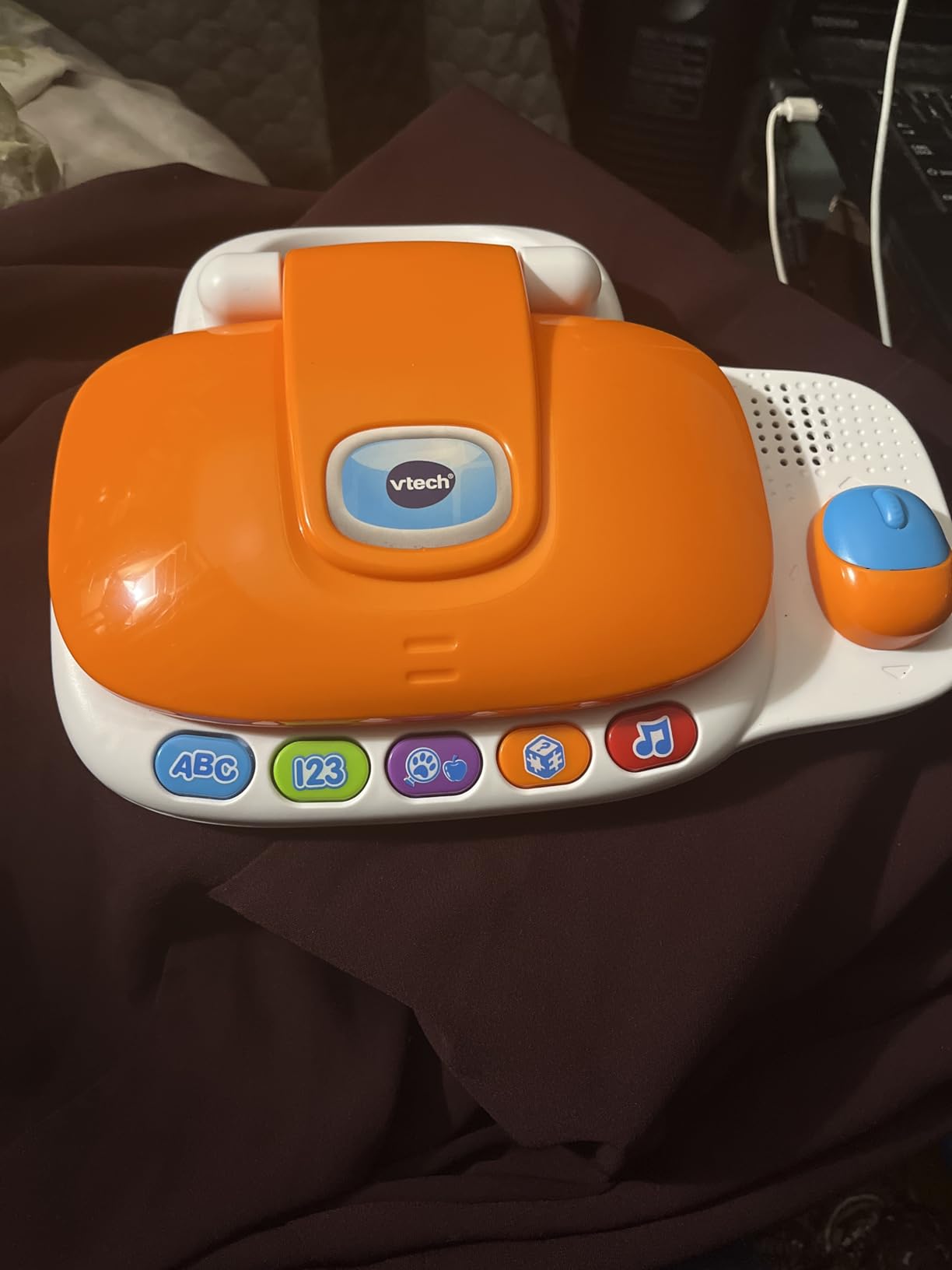
The attached mouse is a quiet differentiator. Most toy laptops here give you a keyboard and nothing else, so a child arriving from a family computer has to learn mouse control from scratch. It is built in, along with 30 melodies in rock, country and jazz styles.
Customisation goes deeper than a first name: age, favourite food and avatar are all set through the same menu. A carry handle on top means it moves between rooms without being carried awkwardly by the screen.
Is the screen readable in a normal play room
This is the one real drawback and it is not minor. The screen is not backlit, and manual contrast adjustment helps with ambient light but does not fully solve evening or overcast-afternoon use. Position it near a window during the day.
How it survives daily handling
At 1.8 pounds it is the heaviest toy laptop here, which helps it feel substantial rather than flimsy. Audio hardware failing after several months is a secondary theme in reviews, and the short warranty does little to soften that. Treat the speaker as the part most likely to need replacing.
3. VTech Play Smart Preschool Laptop – Most Versatile
VTech Play Smart Preschool Laptop, Black
Ages 3-6
30 leveled activities
Beginner Spanish words
2 AA batteries
1.2 lb
Pros
- 30 leveled activities across letters numbers shapes and animals
- Introduces beginner Spanish vocabulary and letters
- Personalisable with name age and avatar
- Adult-styled black design children like
- Full-size keyboard layout
Cons
- Content depth is basic once letters and numbers are mastered
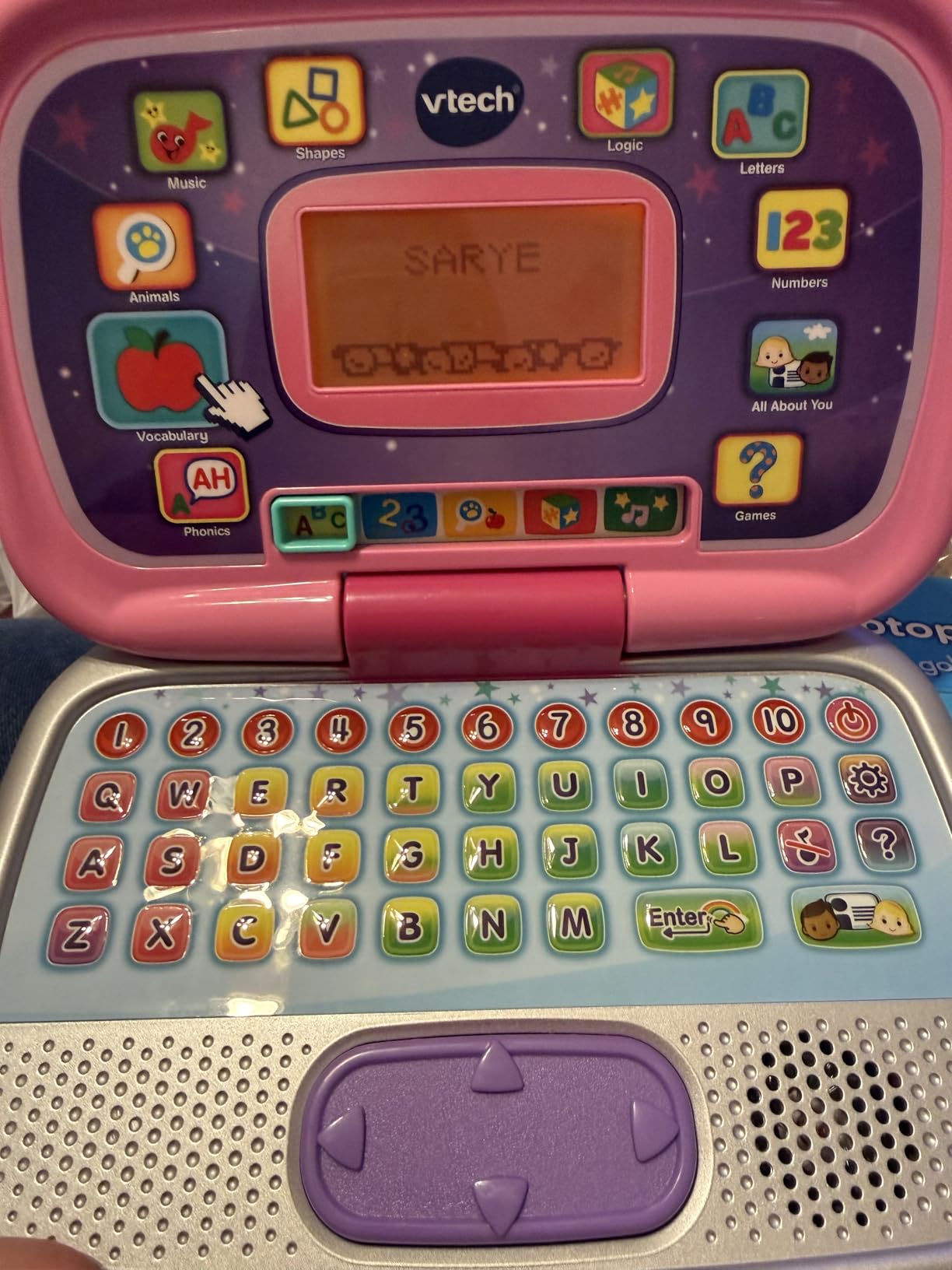
Where the Tote and Go focuses on variety, this one focuses on breadth of subject. Thirty leveled activities cover letter identification, letter sounds, shapes, numbers, categorising foods into fruits and vegetables, logic puzzles, animal sounds and footprints, plus an instrument-recognition music game.
The Spanish content is the reason it earns its place in bilingual or dual-language households. Activities introduce beginner Spanish words alongside English letters and numbers, which is exposure rather than instruction, but more than any other pick here offers at the same age.
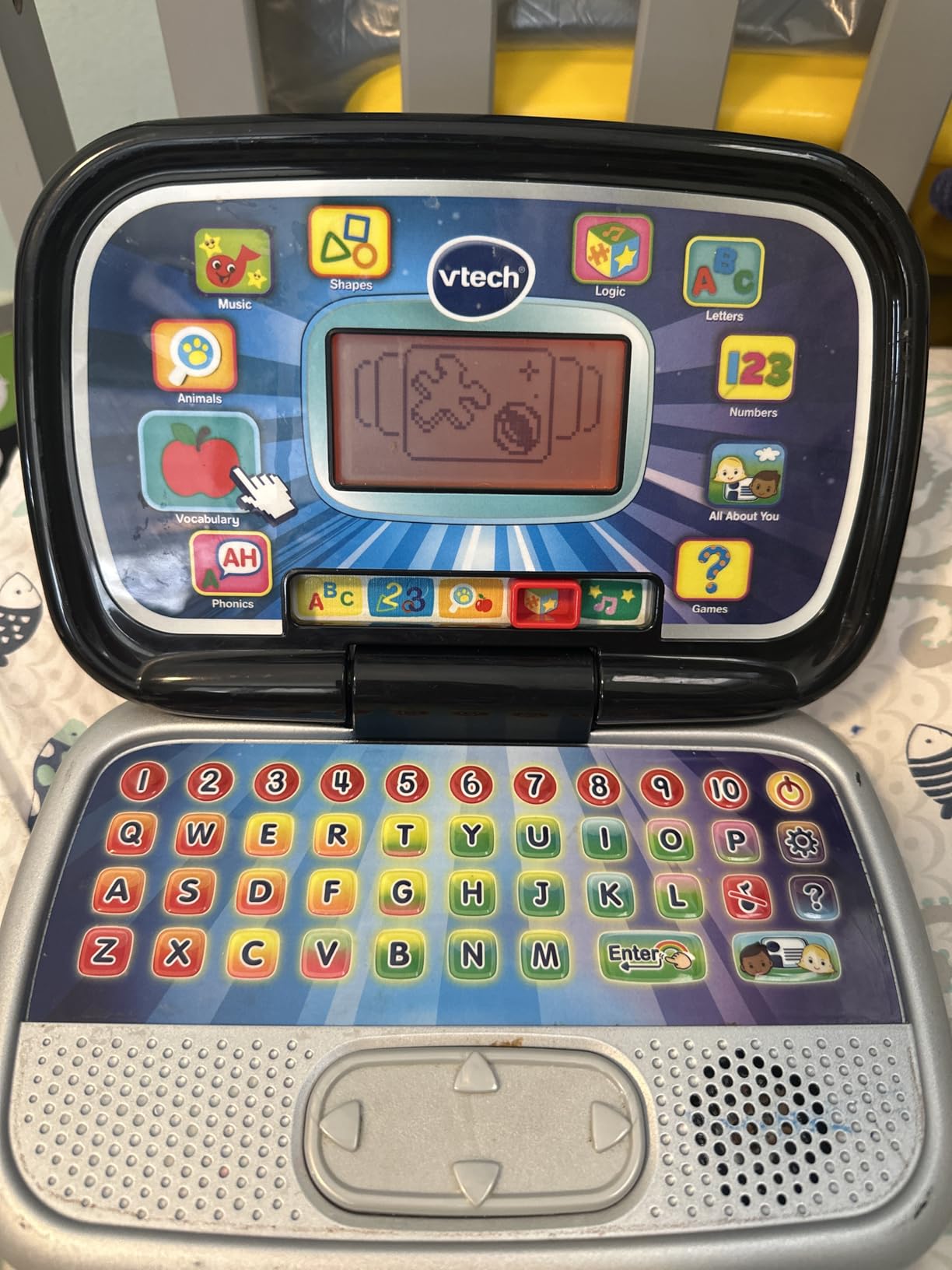
At 1.2 pounds and just under 10 inches wide, it is lighter and smaller than the Tote and Go, which suits three-year-olds who struggle with bulk. The black, adult-styled casing is deliberate, because preschoolers who want to imitate a parent’s laptop engage more with this than with a bright toy.
Personalisation again covers name, age and avatar, and the keyboard is full-size so early typing practice happens naturally.
When a child will outgrow this one
Expect a shorter useful window here than with the Tote and Go. The clearest theme in reviews is that content depth is basic, so a child who already knows letters and numbers can master it quickly. For a child starting from scratch it is excellent; for an advanced four-year-old it is a stepping stone.
Whether the Spanish track is actually useful
Think of it as vocabulary exposure alongside English content, not as bilingual teaching. Families already running Spanish at home report it reinforces what the child hears elsewhere. Families with no Spanish in the household may simply skip those activities and still get good value from the other 20-odd modes.
4. Lexibook Unicorn Educational Laptop – Best for Ages 4 and Up
Lexibook, Unicorn Educational Laptop for Kids, JC598UNIi2
Ages 4 and up
124 activities
Bilingual English and Spanish
640 g
Mouse included
Pros
- 124 activities spanning English and Spanish maths typing logic and music
- Realistic mouse included for mouse skills
- Multiple difficulty levels to learn then test
- Logic memory and speed games
- Three month manufacturer warranty
Cons
- Small screen makes activities hard to read
- Some models power off unexpectedly after short use
- Setup is confusing without the manual
The activity count here is the highest in the set: 124 activities covering English and Spanish, mathematics, typing, general knowledge, logic, music and clock reading. Lexibook rates it for 4 years and up, and that floor is the honest limit of the content.
Learning is split from testing, with multiple difficulty levels, so a child works through material and then faces quizzes on it. Logic, memory and speed games follow, along with music notes and melody playing.
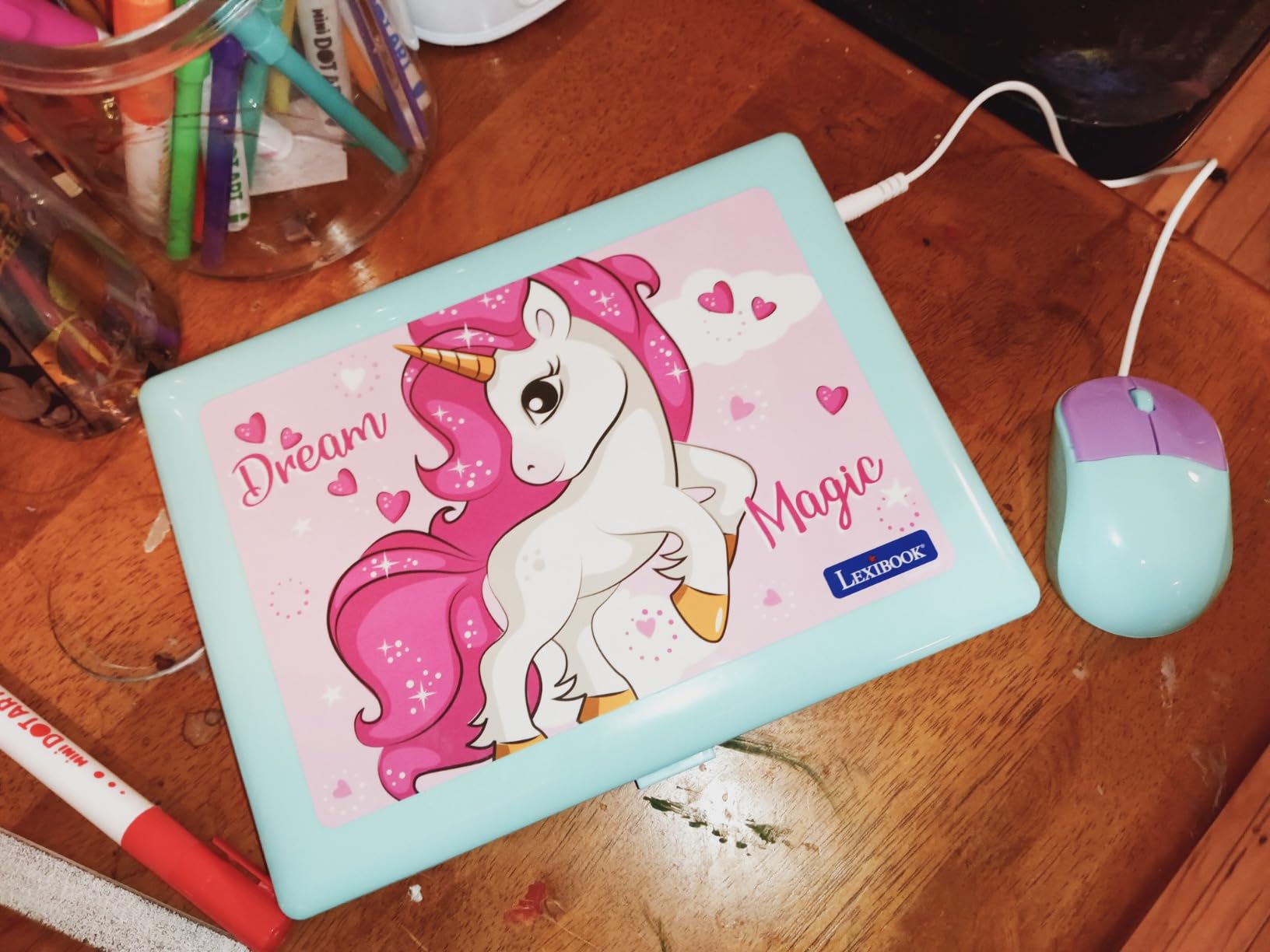
At 640 grams with a slim body and a realistic mouse, it sits closer to laptop ergonomics than most toy plastic here. Parents of younger children report strong engagement with the alphabet games and the Spanish function in particular.
Note the warranty: three months, which is short by the standards of the category and worth keeping in mind if the device is handled roughly.
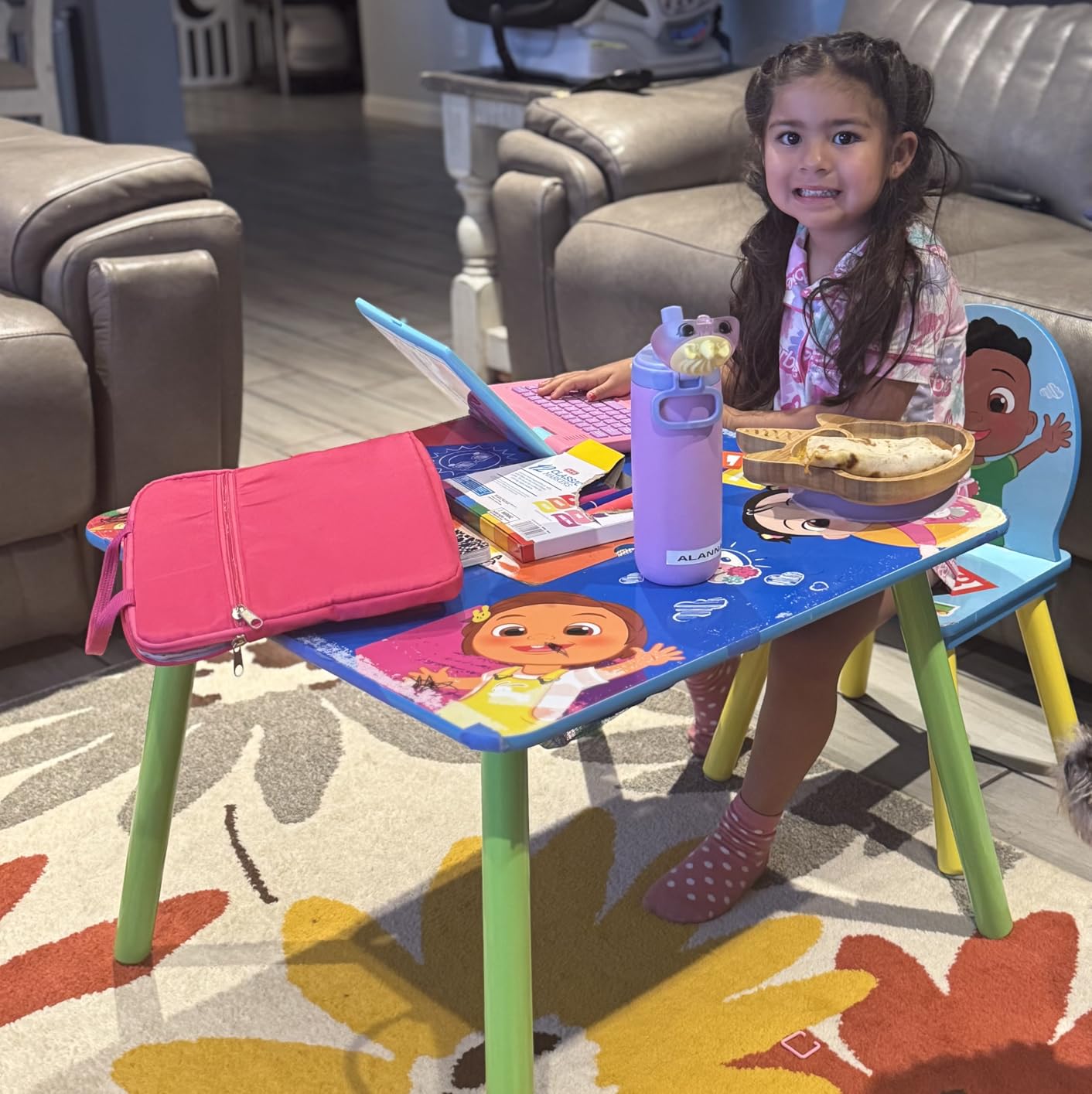
Whether the age rating matches the content
Feedback splits sharply by age, which is the most useful thing to know here. Parents of 2 to 4 year olds report strong engagement; parents of older children describe the content as basic and easy to bore with past about age 5 or 6.
What to watch out for
The small screen is the most common complaint, with activities hard to read at a normal sitting distance. A recurring cluster of reviews also describes models powering off after a few minutes or needing repeated battery changes, which points to a battery compartment issue rather than a child error.
5. VTech Toddler Tech Laptop – Best for Toddlers Ages 1-3
VTech Toddler Tech Laptop
Ages 12-36 months
Five app buttons
Mirrored emoji screen
3 AA batteries
15.8 oz
Pros
- Purpose-built for toddlers from 12 months
- Spinning disc and slider give real fine-motor practice
- Mirrored screen with light-up emojis
- Lightweight and compact for car rides
- Five simple app buttons are easy to find
Cons
- Very limited content mostly the same emoji on screen
- Circular dial is hard for children around one year old
This is the youngest-device pick here and the only one rated from 12 months. That rating is accurate: every other model in this roundup assumes a child who can point at a letter, while this one assumes a child still exploring cause and effect with a spinner.
Five app buttons open weather, email, camera, calendar and music activities, and pressing them triggers numbers, first words, songs and phrases. That is the entire curriculum, and the simplicity is the point.
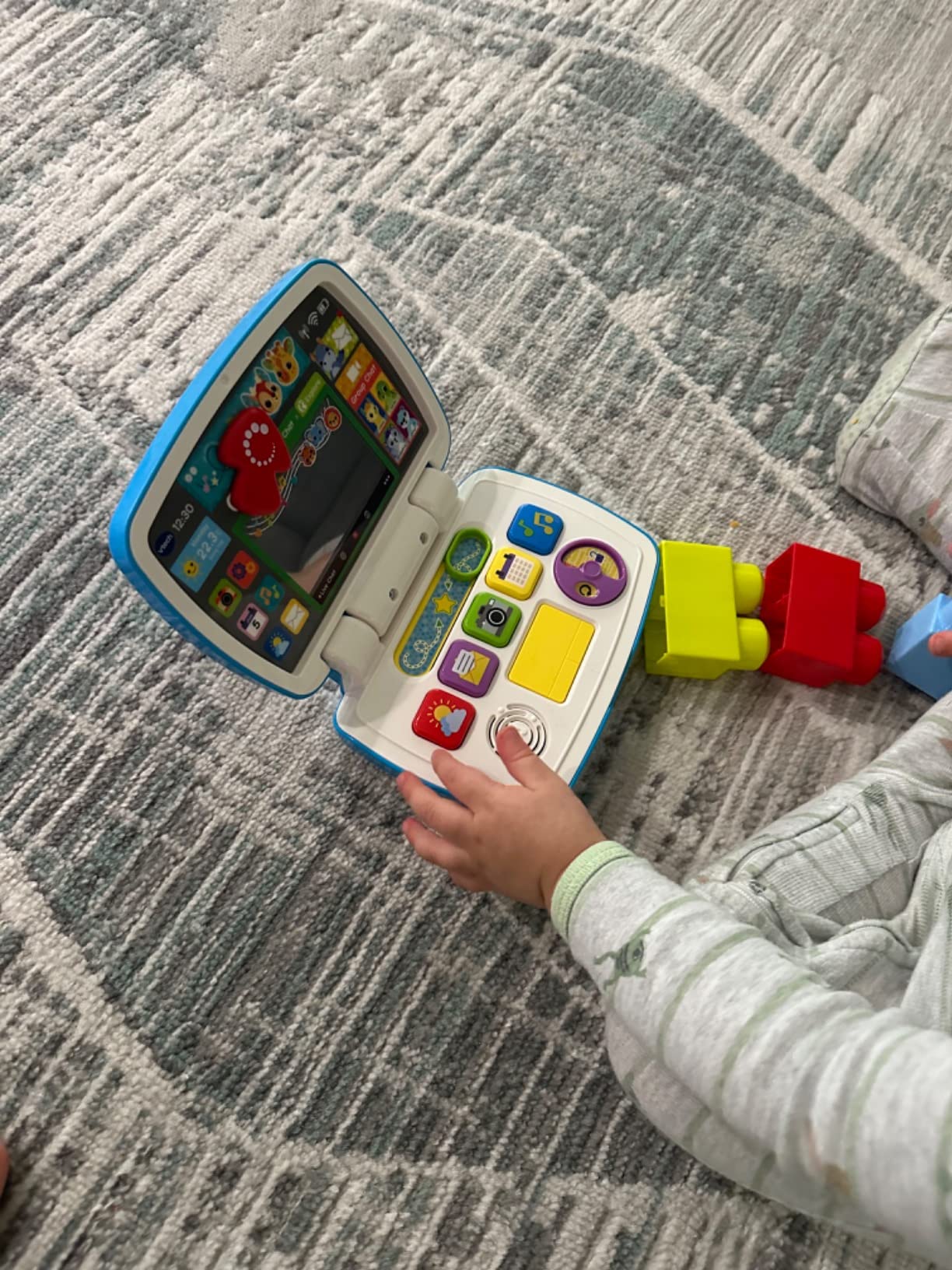
The mirrored screen is the standout feature. It reflects the child’s face and adds light-up emoji with starry eyes and smiles, so the play is partly about seeing yourself rather than about content on a display.
Fine-motor practice comes from the physical controls: a spinning disc, a slider, buttons and an arrow that slides across to choose an animal. At 15.84 ounces it is the lightest device here and easily portable for car rides.
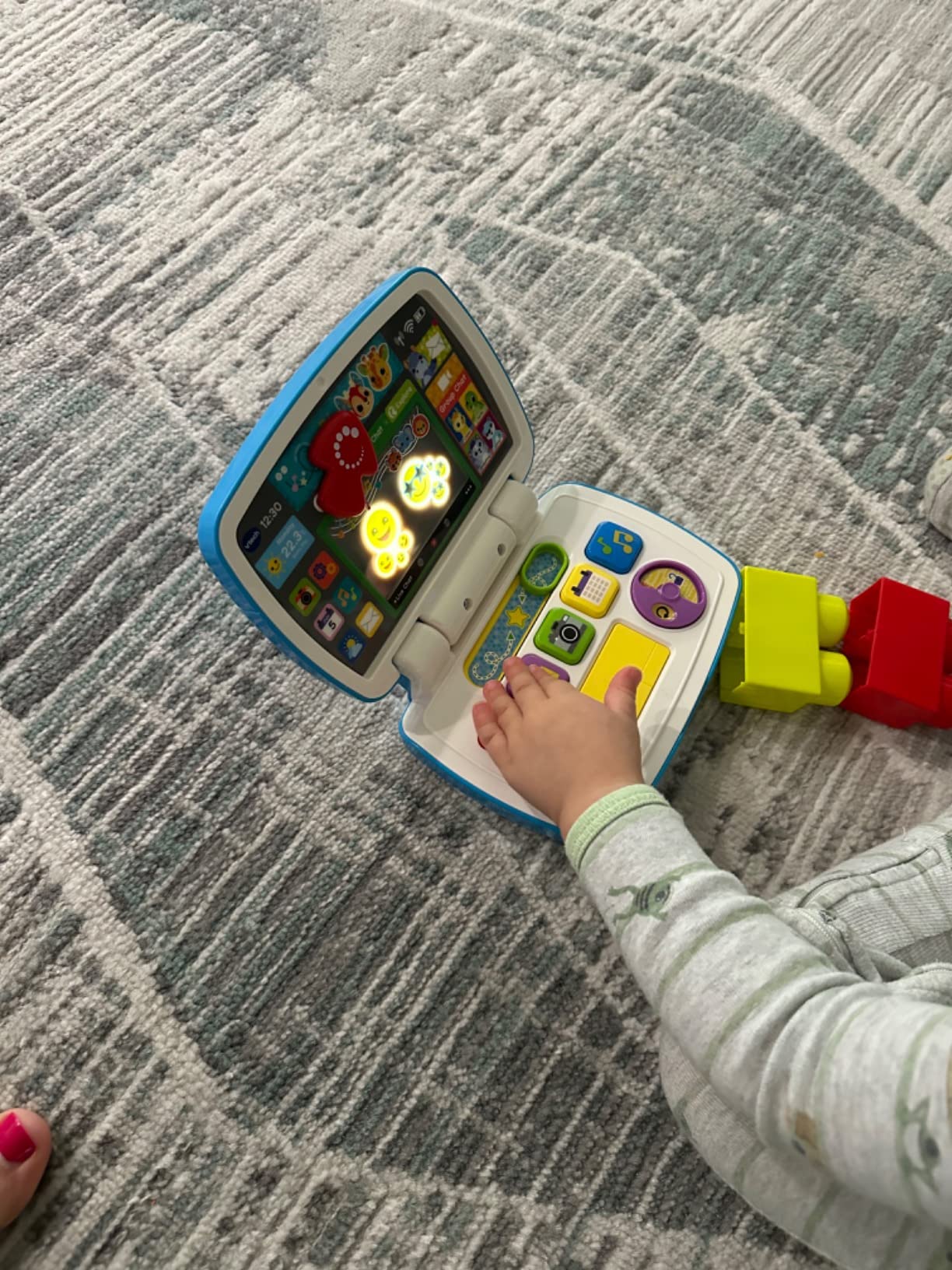
Whether it suits a two-year-old rather than a one-year-old
A two-year-old will get more out of it, but the content is thin enough that a child who already chatters moves on quickly. The circular dial is also reported as difficult around the one-year mark.
When to skip this and move up
If you are looking for a broad curriculum, this is the wrong device. Reviews are clear that the feature set is deliberately basic, and buyers wanting letter recognition, spelling or maths should step up a tier.
6. LeapFrog ABC and 123 Laptop – Best for Early Coding
LeapFrog ABC and 123 Laptop for Preschoolers Ages 3-7 Years, Green
Ages 3 and up
11 activities
Block coding for beginners
4 AA batteries
1.6 lb
Pros
- 11 activities on letters counting and basic computer skills
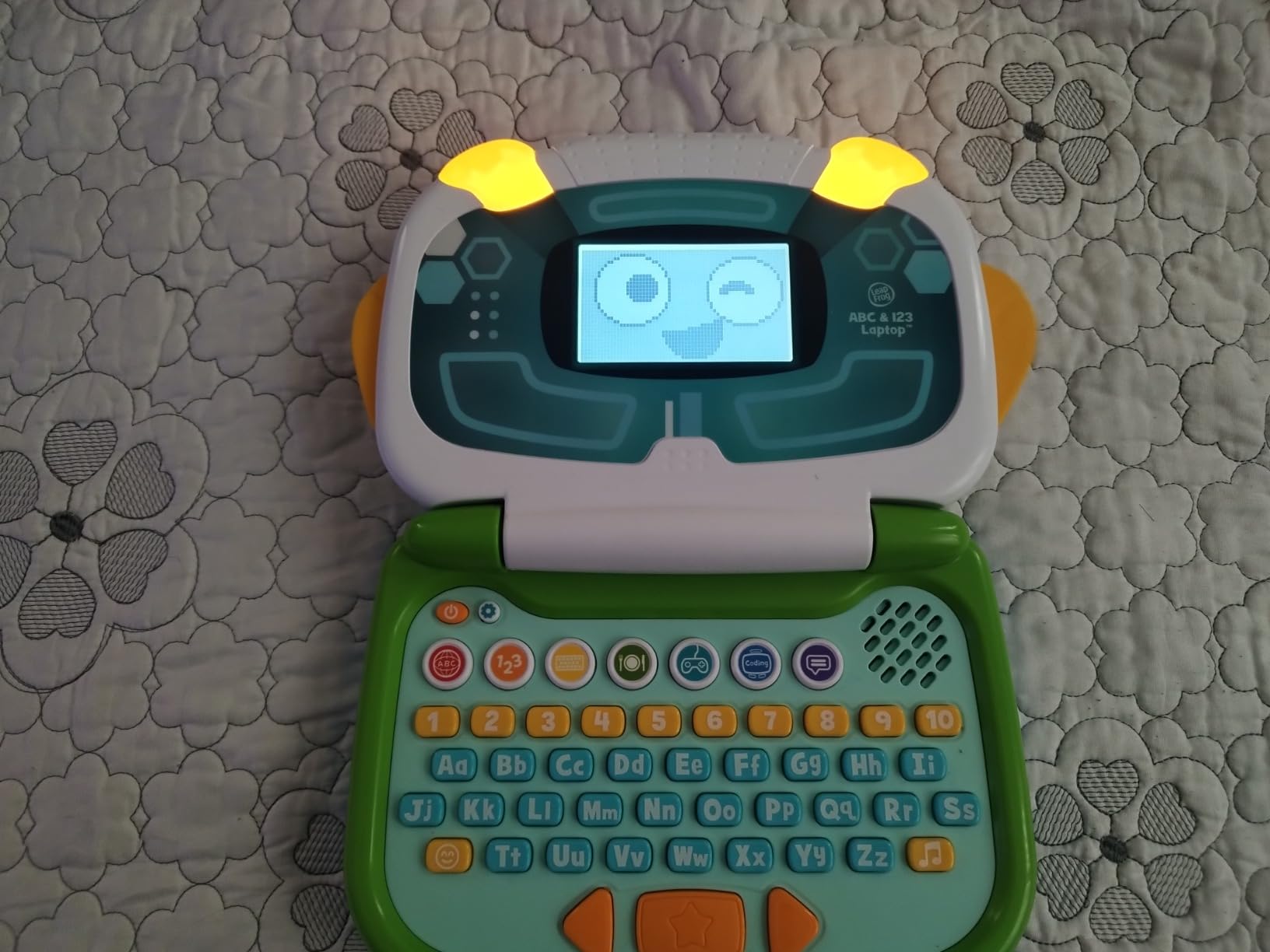
- Animated character Pixel with moving hands and lit antenna
- Simple block coding programs for young learners
- Full QWERTY keyboard
- Many parents prefer it to handing over a tablet
Cons
- Screen can fail to render fully when buttons are pressed quickly
- Audio is English only which limits bilingual households
This is the only pick here with a real coding layer aimed at beginners. Children build simple block programs to clean or cuddle a character called Pixel, an unusually early introduction to sequencing logic.
Pixel is also the engagement engine. His face animates, his hands move, and his antenna lights up while he talks, tells jokes, sings and dances.
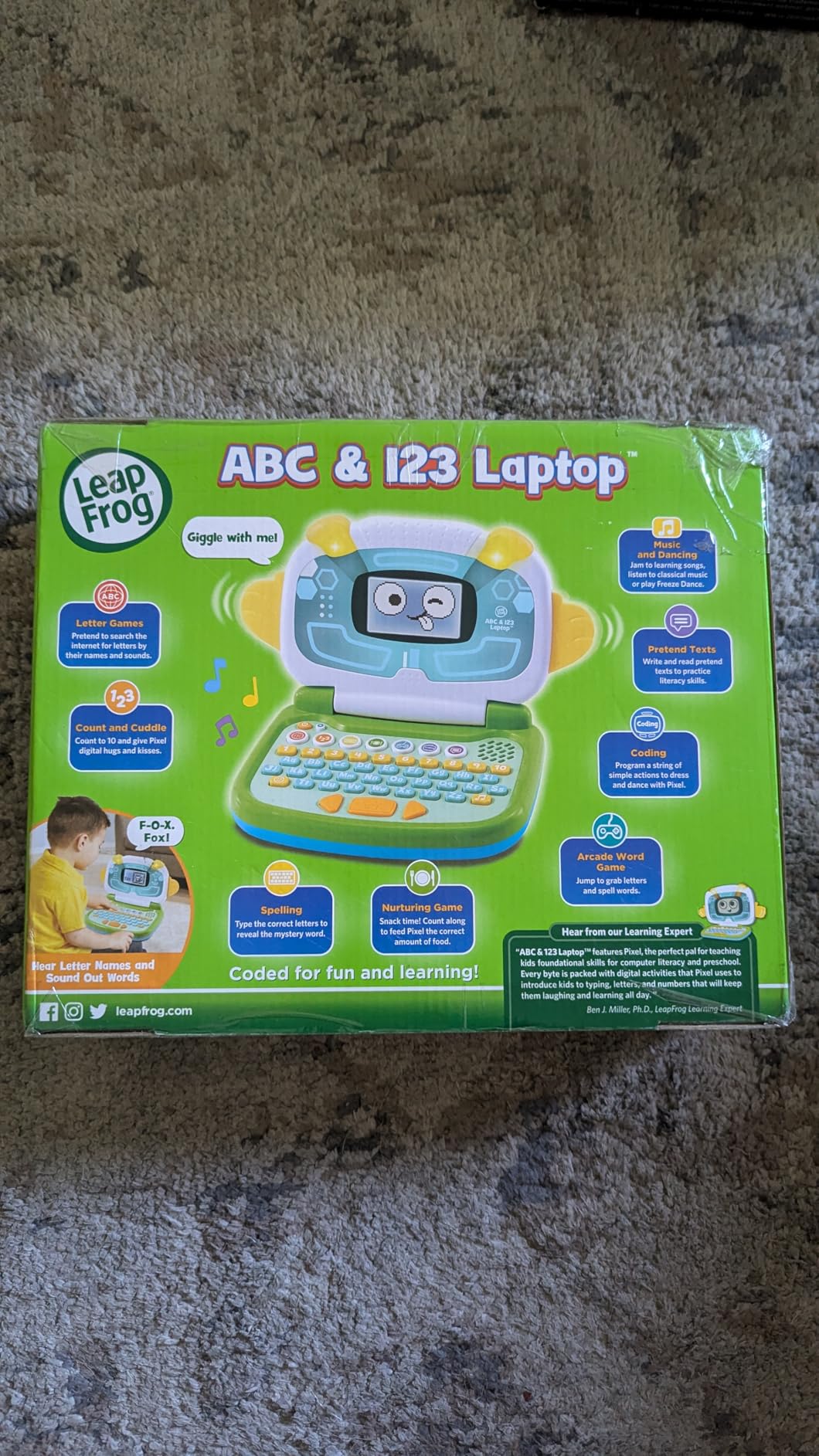
Eleven activities cover letters, counting and basic computer skills, and pressing letter or number keys plays their names with animations. A text-message exchange feature with a second character, Chip, bridges towards reading. The QWERTY keyboard is properly laid out rather than abbreviated.
Worth knowing: several families of nonverbal and autistic children report using it as a lightweight communication aid, since the predictable character responses give a child something to point at.
Whether it beats a tablet for the same child
Many parents say yes, and the reason is interruption. A toy laptop offers no video feeds, so the child asks for it rather than being handed it.
Known weaknesses to plan around
Screen responsiveness is the recurring issue: quick repeated presses can leave the display failing to render fully or lagging. Audio is English only, which limits it for bilingual families compared with the Lexibook or ZeenKind options.
7. LESHITIAN Kids Laptop – Best for Ages 5 and Up
LESHITIAN Kids Laptop – 80 Learning Activities to Learn Alphabet, Words, Mathematics, Play Games and Music – Educational Learning Computer for Kids Ages 5+
Ages 5-10
80 activities
Standard keyboard and mouse
Internal battery
1 kg
Pros
- 80 activities across alphabet words maths games and music
- Real standard keyboard layout teaches button placement
- Dual-button mouse supports fine motor skills
- Adjustable volume control
- Slim design sized for an easy handgrip
Cons
- Content is repetitive and shallower than the activity count implies
- Rating spread is wide with a large share of one-star reviews
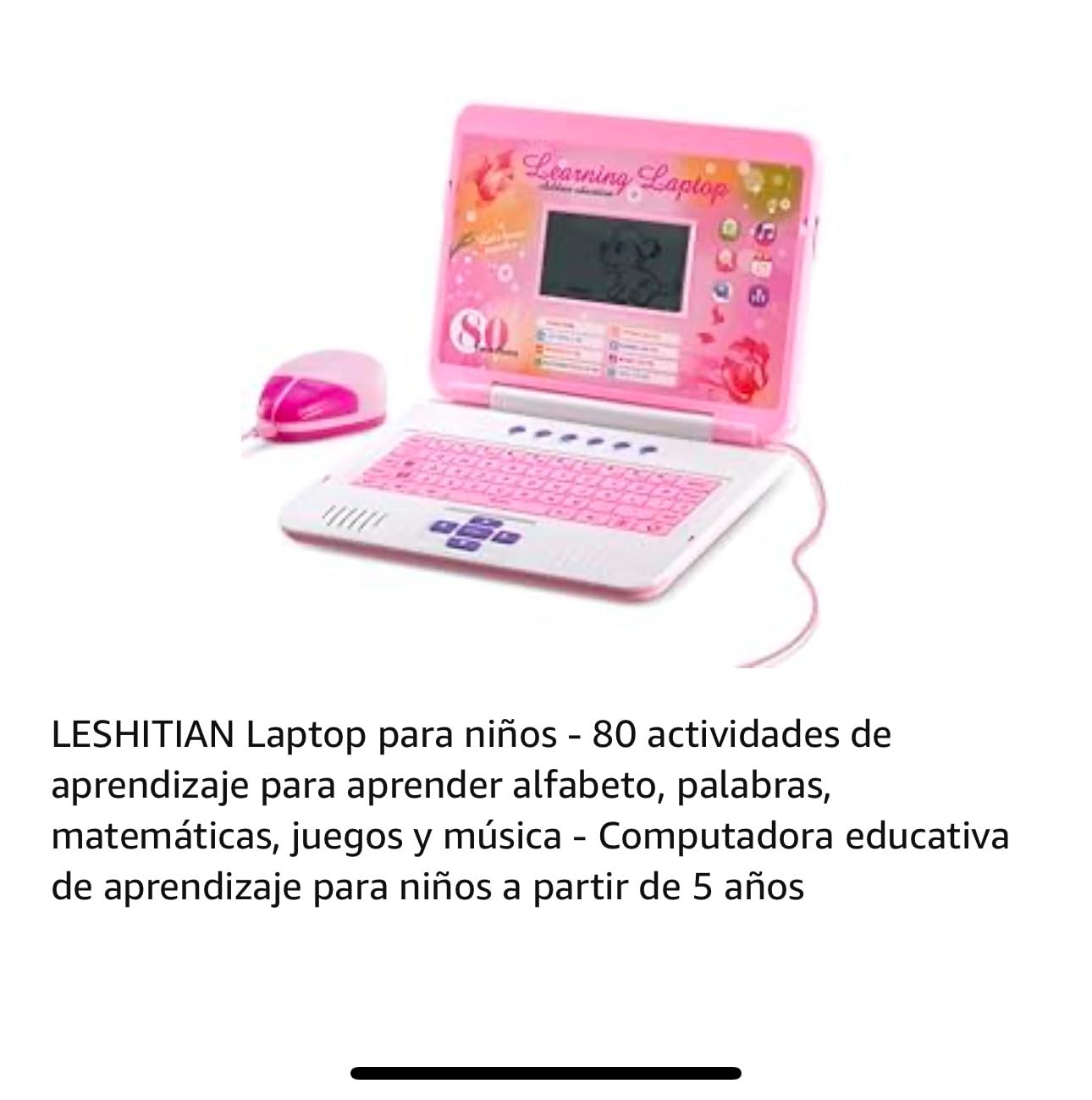
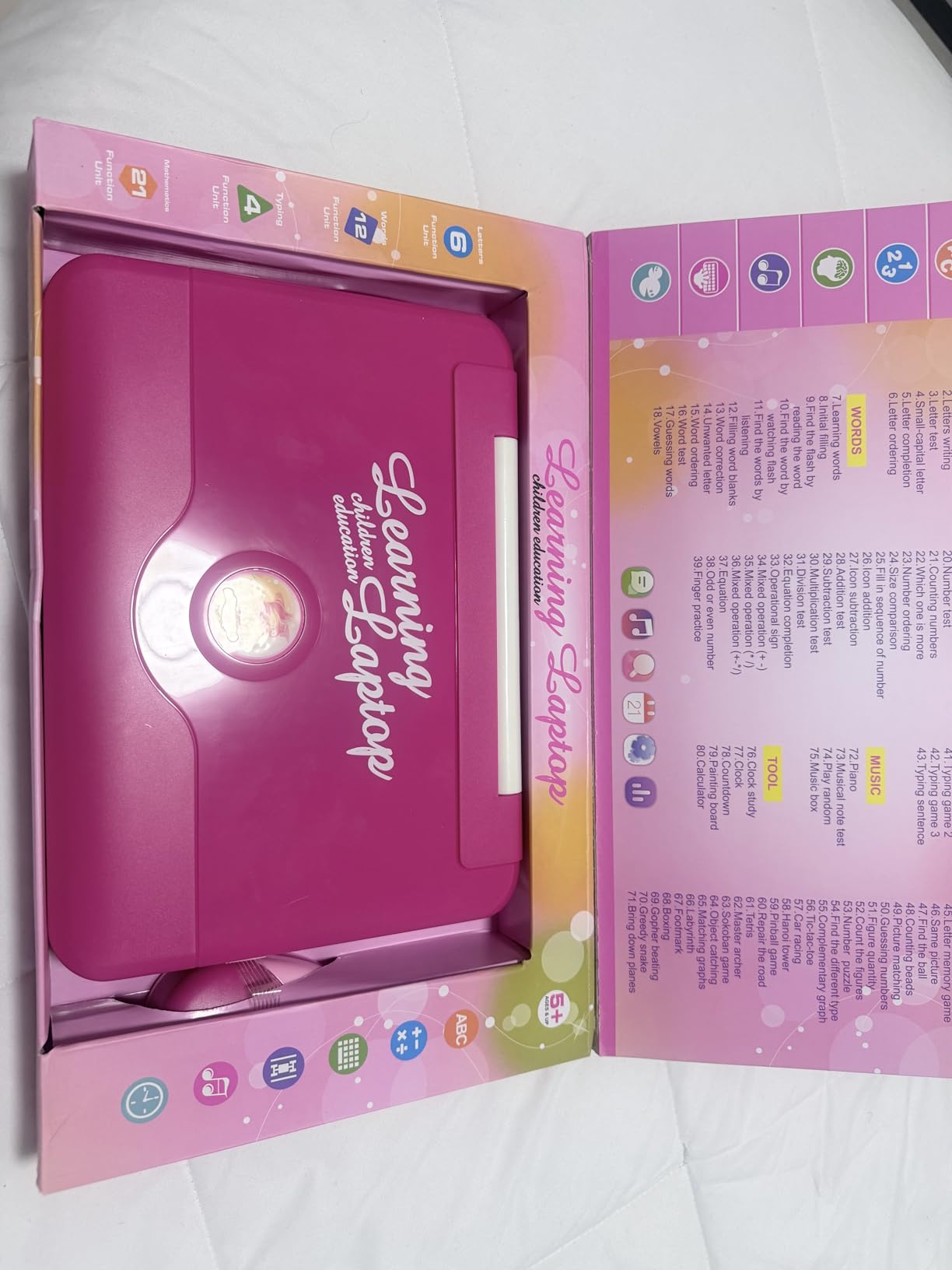
This one targets the older end of the preschool window, with a manufacturer recommendation of 5 to 10 years. It claims 80 activities spanning alphabet, words, mathematics, games and music, and the hardware follows a real-laptop pattern rather than a toy one.
The keyboard is a real standard layout with familiar button placement, so a child learning to type is not learning to find keys later, and the dual-button mouse is included specifically to build hand-eye coordination.
It weighs 1 kg and runs on an internal rechargeable-style battery, which removes the standing hunt for fresh AA batteries before a session. Volume is adjustable.
There is also a knowledge test mode with harder questions, framed as a challenge rather than a repeat of the same drill.
Whether 80 activities is really 80 activities
This is the most important thing to know before buying. Reviewers describe the content as repetitive and shallower than the number suggests, with a wide rating spread and a large share of one-star feedback. Count is not the differentiator here; depth is.
Whether the age rating is honest
At 5 to 10 years this is the least preschool-appropriate pick here, and it earns a place because kindergartners already reading fluently often want something more advanced. If your child is three, the LeapFrog and VTech options serve the developmental stage better.
8. HAIOUMM 48-Mode Kids Laptop – Best for a Colour Screen
Kids Laptop, Educational Color Screen Laptop with 48 Learning Modes, Laptop for Kids Ages 5+
Ages 5-10
48 learning modes
4.3 inch colour screen
Rechargeable battery
Pros
- Largest colour screen in this group at 4.3 inch
- Rechargeable battery with USB cable included
- 48 learning modes across nine subjects
- Working volume control
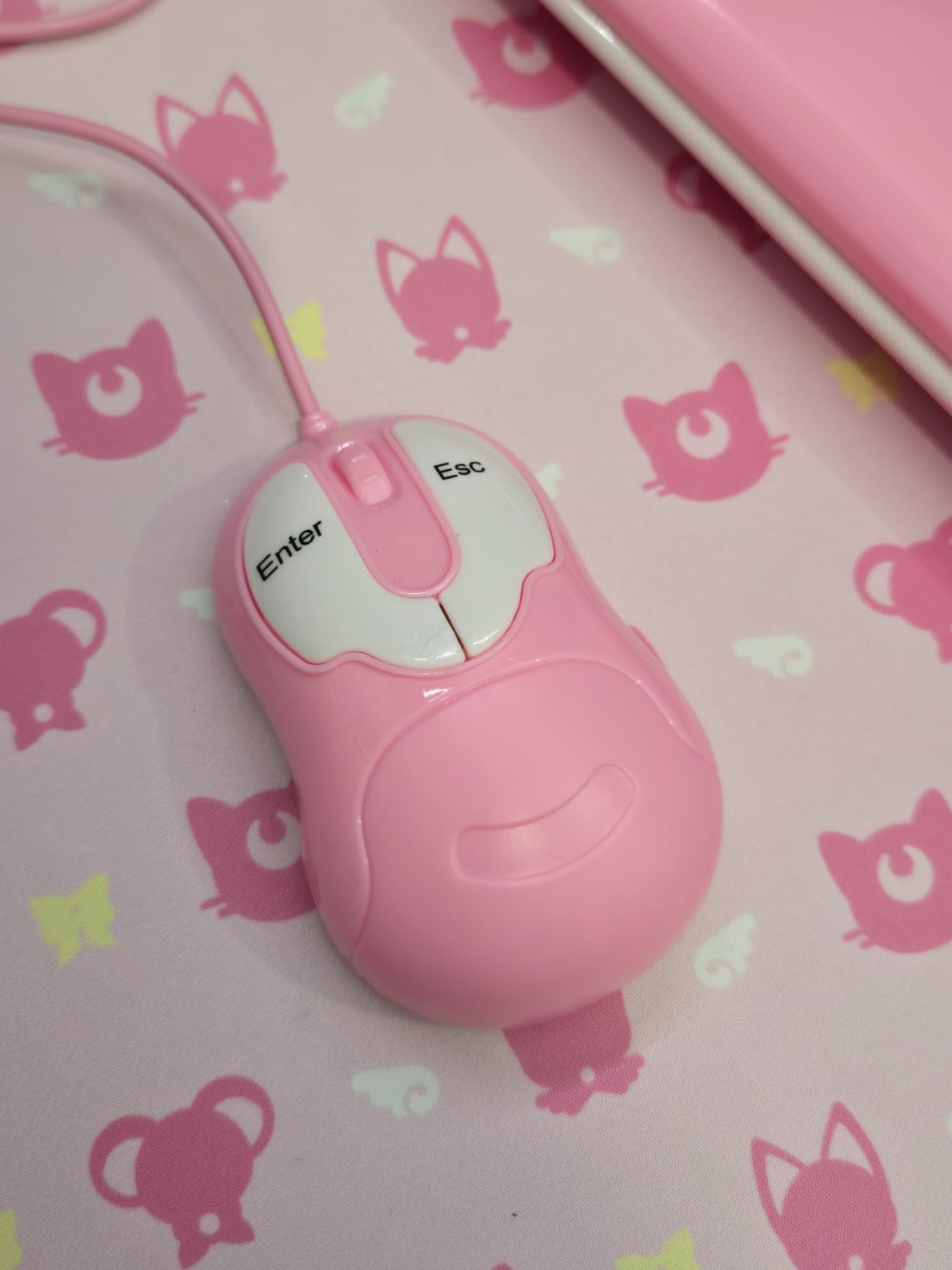
- Realistic keyboard and mouse design
Cons
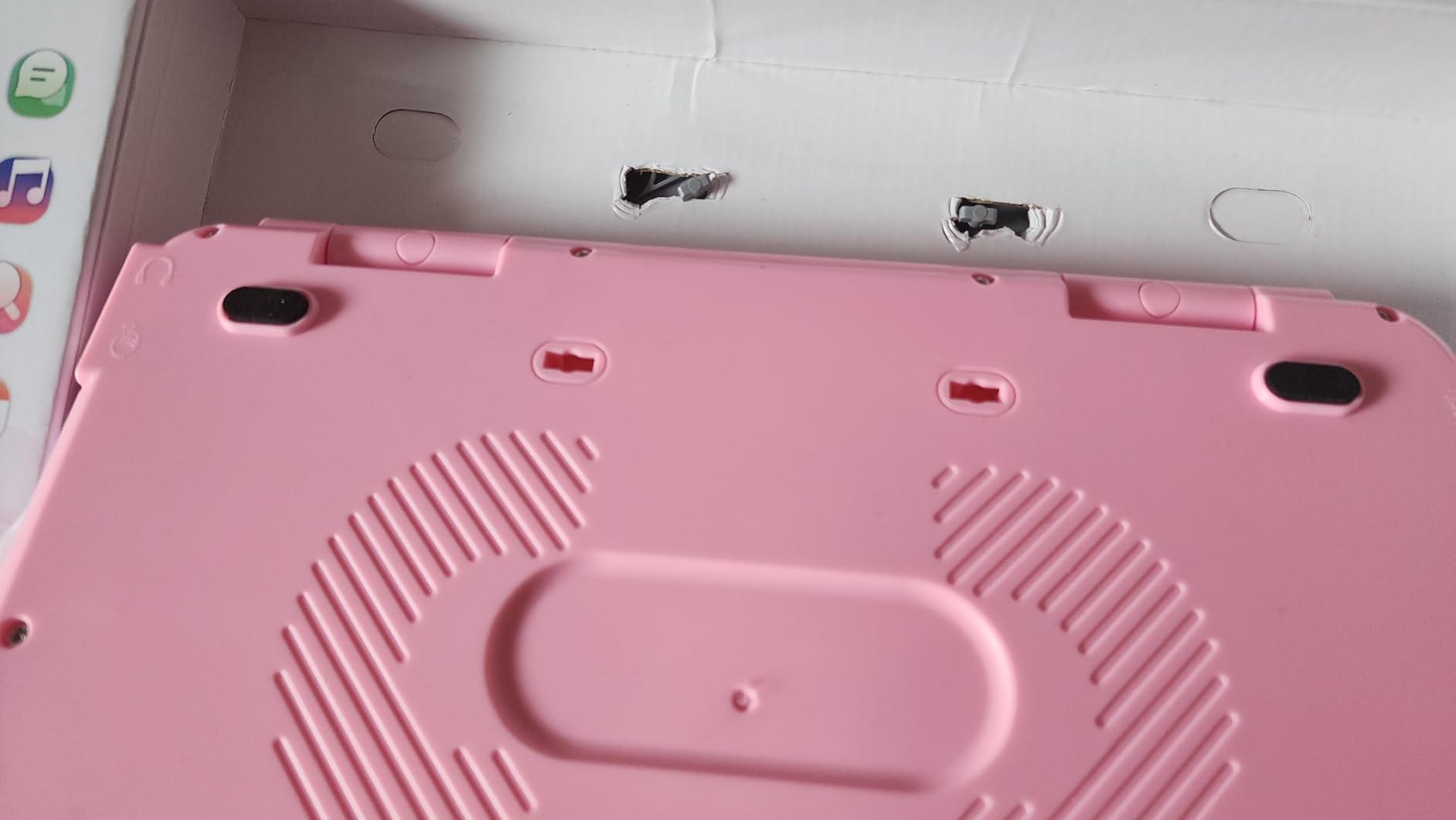
- Some models arrive defective or will not power on
- Music content is uneven in quality
Most toy laptops in this category ship with a monochrome screen. This one has a 4.3 inch TFT colour display, and parents single it out for readability above everything else. A protective film on the screen needs peeling off on arrival.
Forty-eight learning modes span alphabet, mathematics, colours, animals, general knowledge, logic, music, clock reading and calendar. Clock and calendar content is useful for kindergarten readiness in a way letter drills are not.
The rechargeable battery with an included USB cable is the practical winner. No standing search for spare cells before a session, and it charges from the same cable family as the rest of your devices.
It weighs 0.95 kg, heavier than the smaller toy laptops, so it is more of a fixed table device than a carry-around toy.
Whether the colour screen changes the learning value
It changes clarity, not curriculum. A colour screen makes shape and animal activities easier to read at a distance, which matters for a child sitting further back than you would expect. The nine subjects are broad rather than advanced.
What to check when it arrives
There is a recurring cluster of reviews about models arriving defective, failing to power on, or showing flickering black-and-white, so test it on arrival. Music content is also criticised as uneven, with some songs sounding off.
9. ZeenKind Bilingual Spanish-English Laptop – Best for Bilingual Homes
Zeenkind Spanish English Toy Laptop, Learning Toys for Kids 3+ Years Old Spanish Learning Bilingual Toy Computer for Kids, Educational Computer Toys with Alphabet Numbers Words Spelling Math
Ages 3 and up
Spanish and English audio
Six learning modes
3 AA batteries
0.28 kg
Pros
- Bilingual Spanish and English audio across six modes
- Covers words alphabet numbers addition and subtraction
- Spelling quiz and reading activities
- Spanish nursery rhymes with lighting effects
- Lightweight for a three-year-old's hands
Cons
- Very small screen and footprint
- Spanish drills lack explanatory context beyond pictured words
- Silicone keyboard can pull out of the frame
- Six month manufacturer warranty
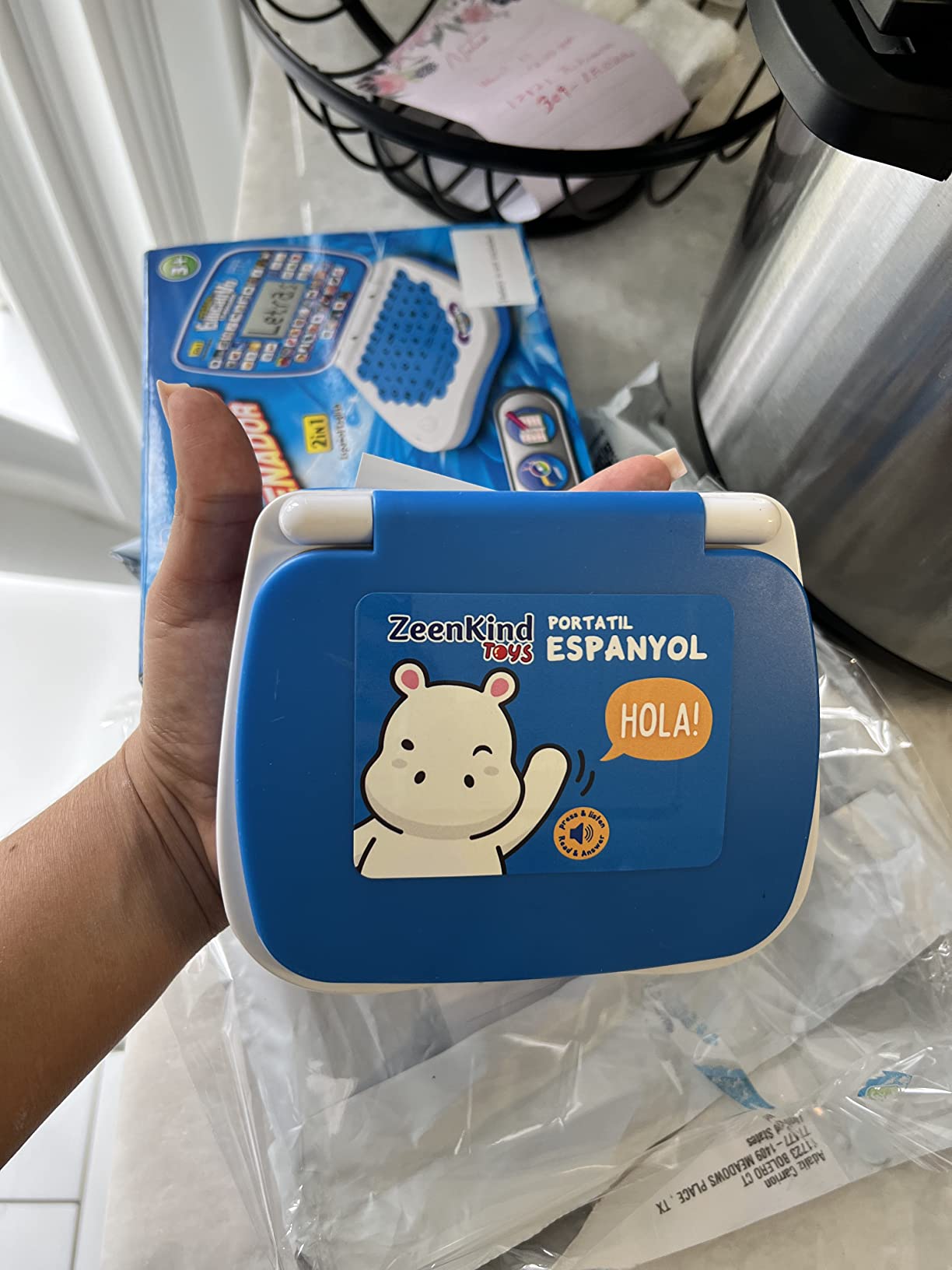
Spanish-English audio is the entire proposition here. Six play and learning modes run in two languages, covering words, alphabet, numbers, addition and subtraction, plus spelling, quiz and reading activities.
It also plays Spanish nursery rhymes with a lighting effect, which is the part families who are not fluent actually use. Singing along does more for early bilingual exposure than drilling vocabulary.
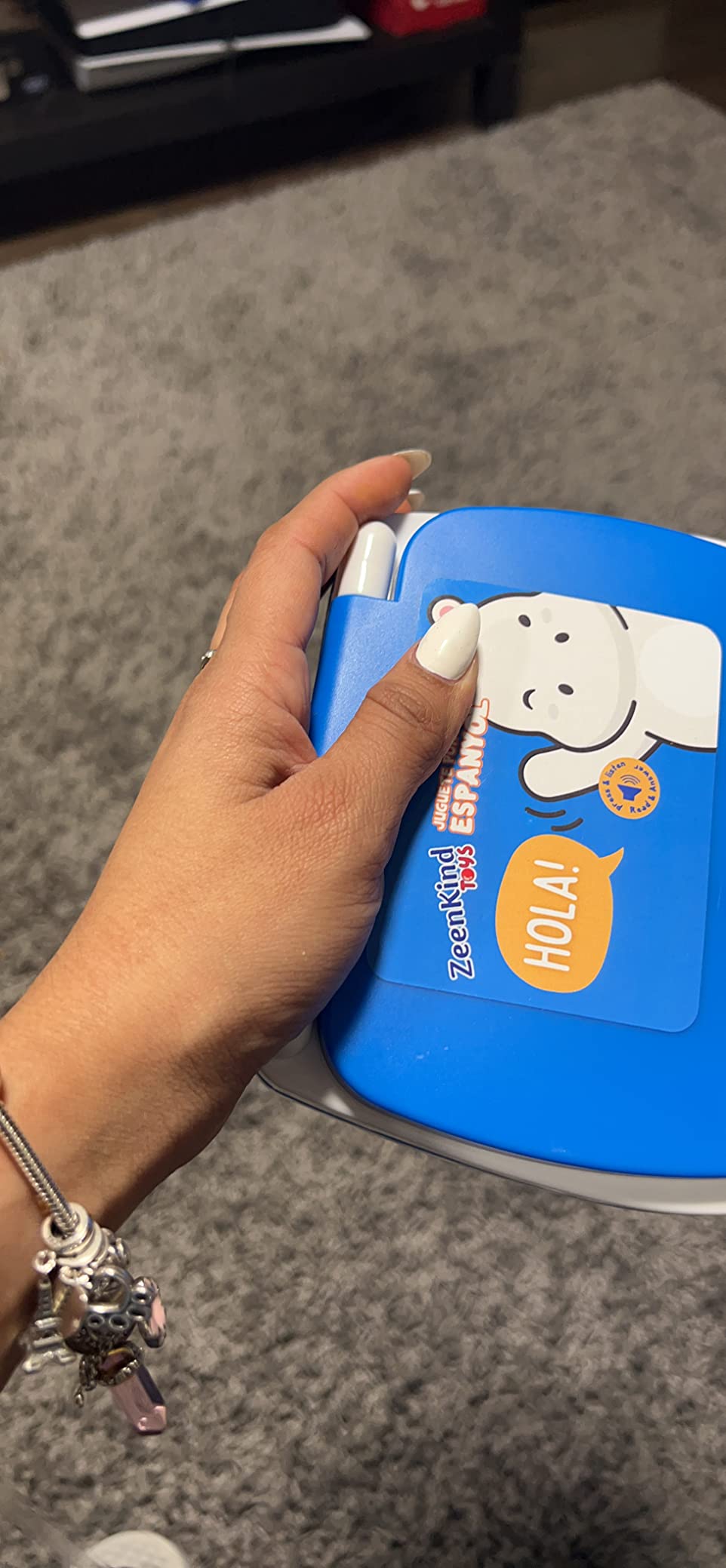
At 0.28 kg this is by far the lightest device in the roundup, and its footprint is small enough for a three-year-old to hold in two hands.
The warranty is six months against manufacturer defects, the longest stated cover among the toys here, though it does not cover normal wear from daily handling.
Whether the Spanish content teaches or just drills
It drills. Reviewers note that Spanish activities give little explanatory context beyond the pictured words, so there is no grammar teaching and no sentence building. Families running Spanish at home rate it well for alphabet sounds and nursery rhymes; families without a Spanish context get far less from it.
Why this scores lowest in the set
Two physical issues drive the weaker rating. The screen and footprint are very small, and the silicone keyboard is reported to pull out of the frame and be difficult to refit. Audio pronunciation of even the alphabet is described as inconsistent by some users. If the concept appeals but the build worries you, the Lexibook is the sturdier bilingual option.
10. LeapFrog My First STEAM Laptop – Best for STEAM Play
LeapFrog My First STEAM Laptop
Ages 3 and up
Guided STEAM activities
Shape matching and counting
2 AA batteries
1.2 lb
Pros
- Introduces the full STEAM framework through guided activities
- Hands-on themes including plant growing and fossils
- Robot and machine building plus shape matching
- Good natural step up from a younger LeapFrog laptop
- Solid sound quality and build
Cons
- Black-and-white pixel screen looks dated
- Activities lean heavily on a few repeated buttons
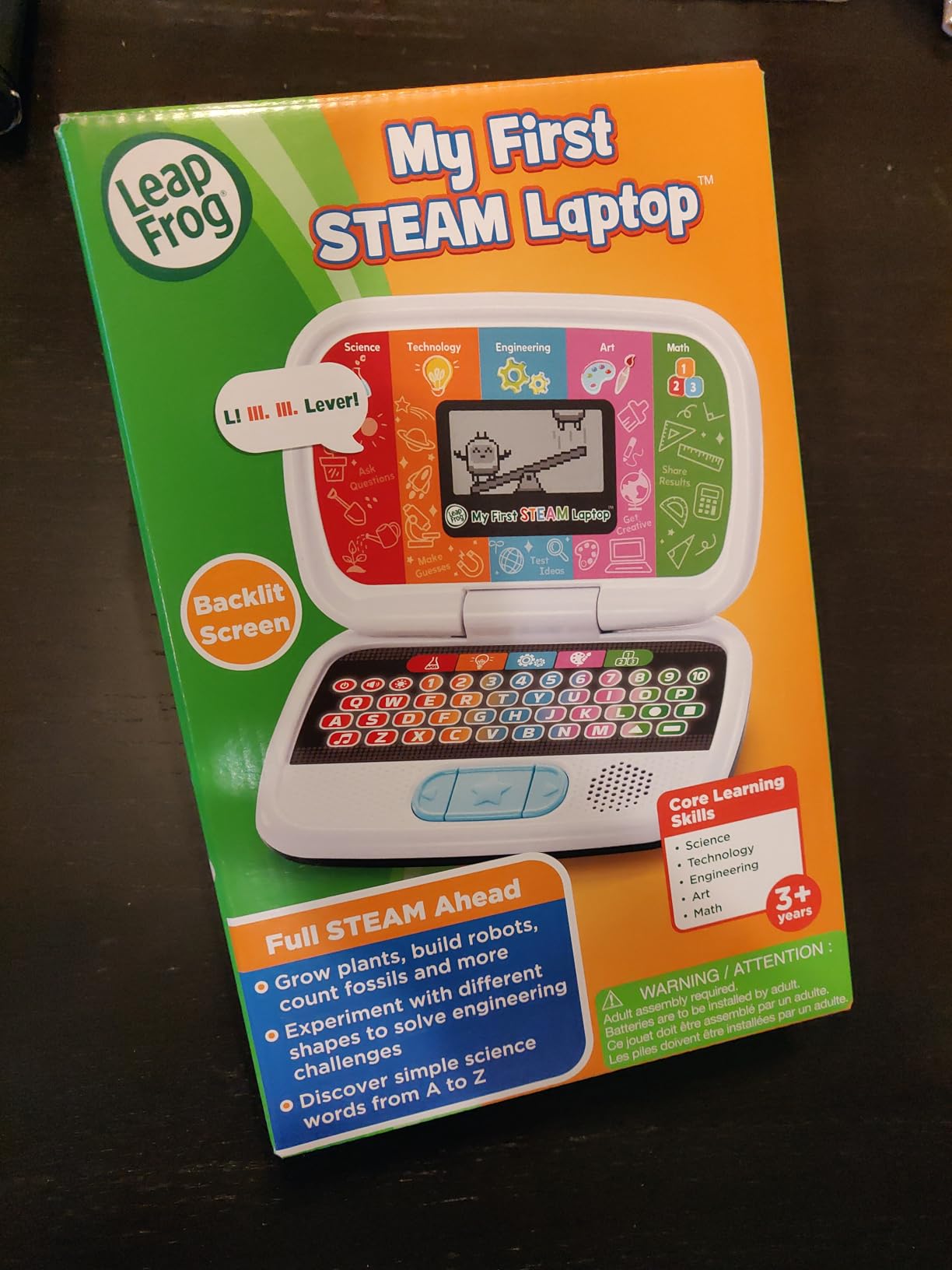
Science, technology, engineering, art and maths is the whole curriculum here, guided by two characters, Dr. Frankensteam and STEAM-Bot. The themes are the strongest part: growing plants, investigating fossils, learning why sunlight matters, and building robots and machines.
There is also shape-to-part matching, imaginative animal design, and counting practice using dinosaur bones and test tubes.
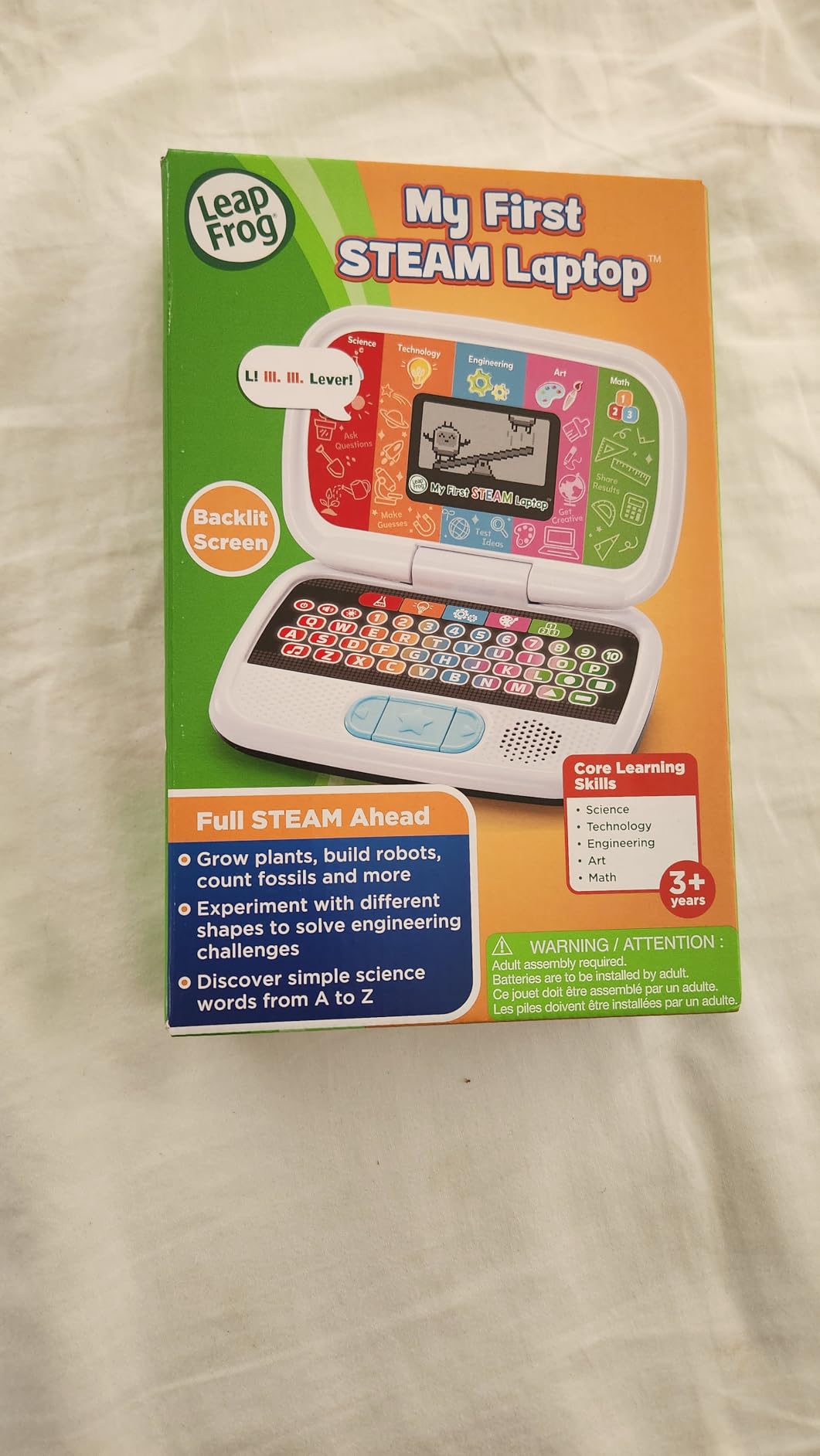
At 1.2 pounds and 9.33 inches wide, it matches the Play Smart Preschool Laptop in size, which makes it a comfortable step up for a child moving through the LeapFrog range. It runs on 2 AA batteries.
Sound quality and build are both rated well, which is worth noting for a device whose screen is the weakest part.
Whether it suits a child who cannot read yet
Yes, and that is the correct audience. Reviews are clear that it suits children who have not yet mastered letters and numbers, since the activities are guided by characters rather than by text.
Where the hardware holds it back
The black-and-white pixel screen looks dated next to the colour models, and the programming, while well built, is shallower than the theme implies. Activities also lean heavily on a small number of repeated buttons.
How to Choose a Learning Laptop for a Preschooler
Every device in this roundup is a toy-style electronic laptop, which is the right category for ages 2 to 5. That is worth stating plainly, because parents searching this topic often find real 2-in-1 convertible hardware and assume it is the same product at a different size. A toy laptop teaches through a fixed set of pre-loaded activities with no account and no internet, which is also why it has no screen-time controls: there is nothing to control. A real laptop runs an operating system, needs a parent-managed account, and gives you genuine app filtering.
For a three-year-old the toy path is right. The switch to real hardware usually makes sense around age 6 or 7, when a child can read instructions and has a real school workload. Our guide to the best touchscreen laptops covers the convertible options worth looking at then. If your child moves on to school machines, the laptop buying guide explains the specs that matter for bigger workloads. For Chromebooks specifically, check the auto-update expiry date before buying, because Google stops security updates when that window closes and a device bought for a five-year-old may still be in use at eleven.
Match the age rating to the child. A device rated for 12 to 36 months will bore a four-year-old within weeks. One rated 5 and up will frustrate a three-year-old who cannot read the instructions. The honest age floors here are 12 months for the Toddler Tech, 24 months for the LeapTop Touch, 36 months for most of the rest, and 4 years for the Lexibook.
Check screen size before everything else. The most common complaint across reviews is unreadable displays. The HAIOUMM’s 4.3 inch colour screen and the Tote and Go’s adjustable contrast are the two answers here. A non-backlit screen in a dim room is the most common reason parents regret a purchase.
Weigh portability against battery hassle. Devices over about 1 kg are table-bound. Anything using AA batteries needs a spare set on hand, and the batteries in the box are for demonstration only. The rechargeable HAIOUMM removes that task entirely.
Set up controls before the child touches the device. That applies to anything with an account. On Chrome OS that means Google Family Link, on Windows it is Microsoft Family Safety, and on a Fire tablet it is Amazon Kids mode. A pure toy laptop has nothing to configure, which is genuinely the main appeal of this category.
Set a session length you will actually keep. Short and frequent beats one long block at this age, and most of these devices have no built-in timer. Parents consistently describe installing restrictions before first use as the step that makes the difference.
Budget for the accessory layer. None of these come with a case, and a soft sleeve does more for survival than any feature on the spec sheet.
Frequently Asked Questions
What is the best educational laptop for a 3-year-old?
The VTech Toddler Tech Laptop is built for 12 to 36 months and uses a spinning disc, a slider and five app buttons for cause-and-effect play rather than reading. If your child is closer to 3 and can sit with letters, the LeapFrog LeapTop Touch rated from 24 months to 5 years is the stronger pick.
What is the best laptop for a 3-year-old?
Most three-year-olds should start with a toy-style electronic laptop rather than a real computer, because there is nothing to configure and no risk of reaching an unrestricted app. The LeapFrog LeapTop Touch fits the age range exactly and converts from a keyboard to a touch tablet as motor skills develop.
What is the best educational laptop for a 4-year-old?
At four, a child can handle progressive levels and logic content, so the VTech Tote and Go Laptop with 20 leveled activities is a strong fit for ages 3 to 6. For bilingual households the Lexibook Unicorn laptop covers English and Spanish across 124 activities but has a small screen.
Can a 4 year old use a laptop?
Yes, in short supervised sessions alongside hands-on play rather than instead of it. At this age the device works best for letter and number recognition, shape matching, phonics and cause-and-effect practice. Pediatric guidance generally points to keeping recreational screen time limited and co-viewing, so treat the laptop as an activity rather than as entertainment.
Is a Chromebook or laptop better for kids?
For ages 2 to 5, neither is the right answer, because a real machine needs a parent-managed account, filtered apps and screen-time limits that a five-year-old cannot navigate safely. Toy-style laptops handle that problem by having nothing to restrict. Chromebooks become the better option around age 6 or 7, when check the auto-update expiry date first.
Conclusion: The Best Learning Laptops for Preschoolers in 2026
The LeapFrog 2-in-1 LeapTop Touch wins this roundup because it is the only pick rated from 24 months all the way to 5 years, and because the flip screen lets the same device grow with a child’s motor skills. The VTech Tote and Go Laptop is the better value for families starting at three who want the longest useful life, and the VTech Toddler Tech Laptop is the right call if you are starting before age two.
Keep sessions short, set your own limits, and treat any of these as an activity rather than a replacement for the physical play that matters most at this stage. Our picks were last checked for 2026, and every recommendation reflects what reviewers of each model actually reported.