
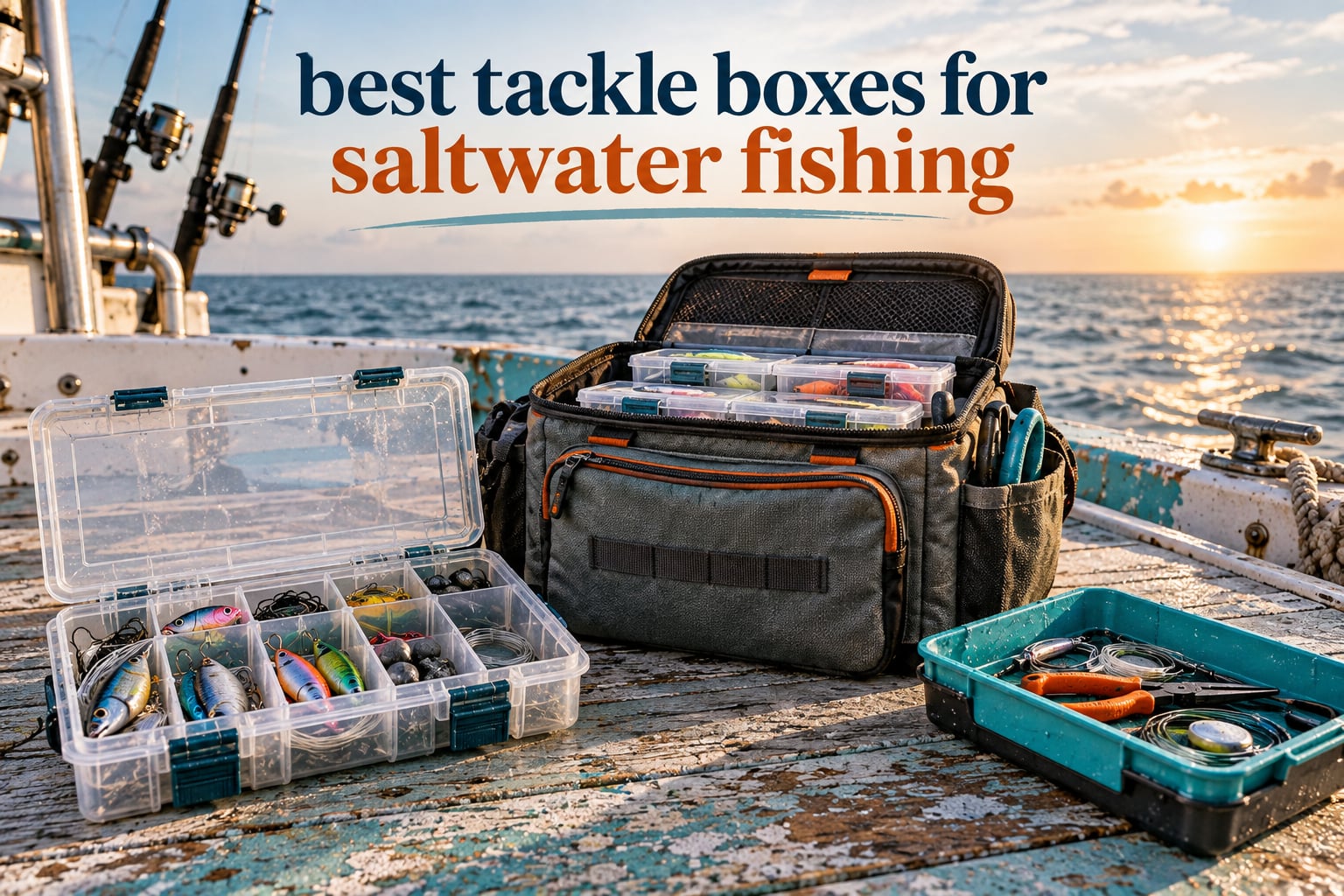
Salt does two things to a tackle box that freshwater never asks of it. It eats the metal, so hooks dull, split rings seize and wire leaders snap at the knot, and it works its way into plastic hardware until latches and hinges crumble. A box that looked fine at the ramp can be a rust tray by the end of a July trip on the Gulf.
That is why the best tackle boxes for saltwater fishing are not simply the boxes with the most compartments. They are the ones that fight corrosion, seal properly, and still open with cold or wet hands after six hours of casting. We spent weeks putting twelve candidates through that lens: hard cases, soft bags, a backpack, and two boxes built specifically around corrosion-inhibiting materials.
Two winners stand out early. The Plano Guide Series 3600 Field Box is our overall pick because it is the only unit here rated fully submersible to one metre, and it carries the largest volume of owner feedback in the group at more than 3,700 reviews. The Flambeau T4P Pro Multiloader is our answer to the rust question, because its Zerust-infused dividers actively inhibit corrosion on the metal you store inside them.
Everything else, including the soft-bag and backpack options that most surf and offshore anglers actually carry, is broken down below with what each one does well and where it falls short.
Table of Contents
Top 3 Picks for Saltwater Tackle Storage (October 2026)

Plano Guide Series 3600 Field Box
- Submersible to 1 meter
- Dri-Loc O-ring seal
- clear polycarbonate body

Plano Two-Tray Tackle Box
- Rust-proof brass latch
- deep base plus top-access tray
- adjustable dividers

Plano 3540 Waterproof Stowaway
- Dri-Loc seal
- three cam-action latches
- stacks with other Stowaways
The Plano Guide Series 3600 Field Box takes the top slot on the strength of a genuine watertight seal and the highest review count of any box in this roundup. The Plano Two-Tray is the value pick for anglers who organise by tray rather than by compartment and care more about hardware corrosion than about submersion.
The Plano 3540 StowAway earns the most-reviewed badge with over 7,500 ratings behind it, and its stacking design makes it the natural building block for a modular saltwater kit. If you only buy one thing, buy the Field Box. If you plan to build a system, start with the 3540.
All 12 Best Saltwater Tackle Boxes and Bags Compared in 2026
| Product | Specifications | Action |
|---|---|---|
| Plano Guide Series 3600 Field Box |
|
Check Latest Price |
 Reaction Tackle Saltwater Tackle Bag XL Reaction Tackle Saltwater Tackle Bag XL |
|
Check Latest Price |
| Plano Two-Tray Tackle Box |
|
Check Latest Price |
| Plano 3540 Waterproof StowAway |
|
Check Latest Price |
 KastKing KarryAll Tackle Bag KastKing KarryAll Tackle Bag |
|
Check Latest Price |
 KastKing KarryAll Backpack with Rod Holder KastKing KarryAll Backpack with Rod Holder |
|
Check Latest Price |
 Flambeau Outdoors 6383 3-Tray Tackle Box Flambeau Outdoors 6383 3-Tray Tackle Box |
|
Check Latest Price |
 Ghosthorn Waterproof 3600 Tackle Box Ghosthorn Waterproof 3600 Tackle Box |
|
Check Latest Price |
 Flambeau T4P Pro Multiloader Flambeau T4P Pro Multiloader |
|
Check Latest Price |
 Baitium XTRAseal Waterproof Tackle Box Baitium XTRAseal Waterproof Tackle Box |
|
Check Latest Price |
 Sheffield 12680 Marine Storage Box Sheffield 12680 Marine Storage Box |
|
Check Latest Price |
 PLUSINNO Expandable Tackle Bag PLUSINNO Expandable Tackle Bag |
|
Check Latest Price |
Every row above is a real unit we considered for salt exposure, and the spread matters. Five are gasket-sealed and can take spray or submersion, four are soft-sided and trade that protection for capacity and comfort, and three are general marine or storage cases that anglers repurpose for rigging hardware.
1. Plano Guide Series 3600 Field Box: Best Overall for Saltwater Fishing
Plano Guide Series 3600 Field Box Waterproof Case, Medium, Waterproof Dry Box with Wrist Strap for Boat, Kayak, and Camping, Outdoor Gear Storage, 11″L x 7″W x 4″H, Clear/yellow
11 x 7 x 4 inch
Submersible to 1 meter for 30 minutes
Dri-Loc O-ring seal
1.3 pounds
Pros
- Genuinely waterproof Dri-Loc O-ring seal
- Impact-resistant crush-proof polycarbonate
- Clear body for instant lure ID
- Soft rubber interior pads
- Slips inside standard Plano tackle bags
Cons
- Single undivided cavity with no built-in dividers
- Stiff cam latches need real pressure to seat
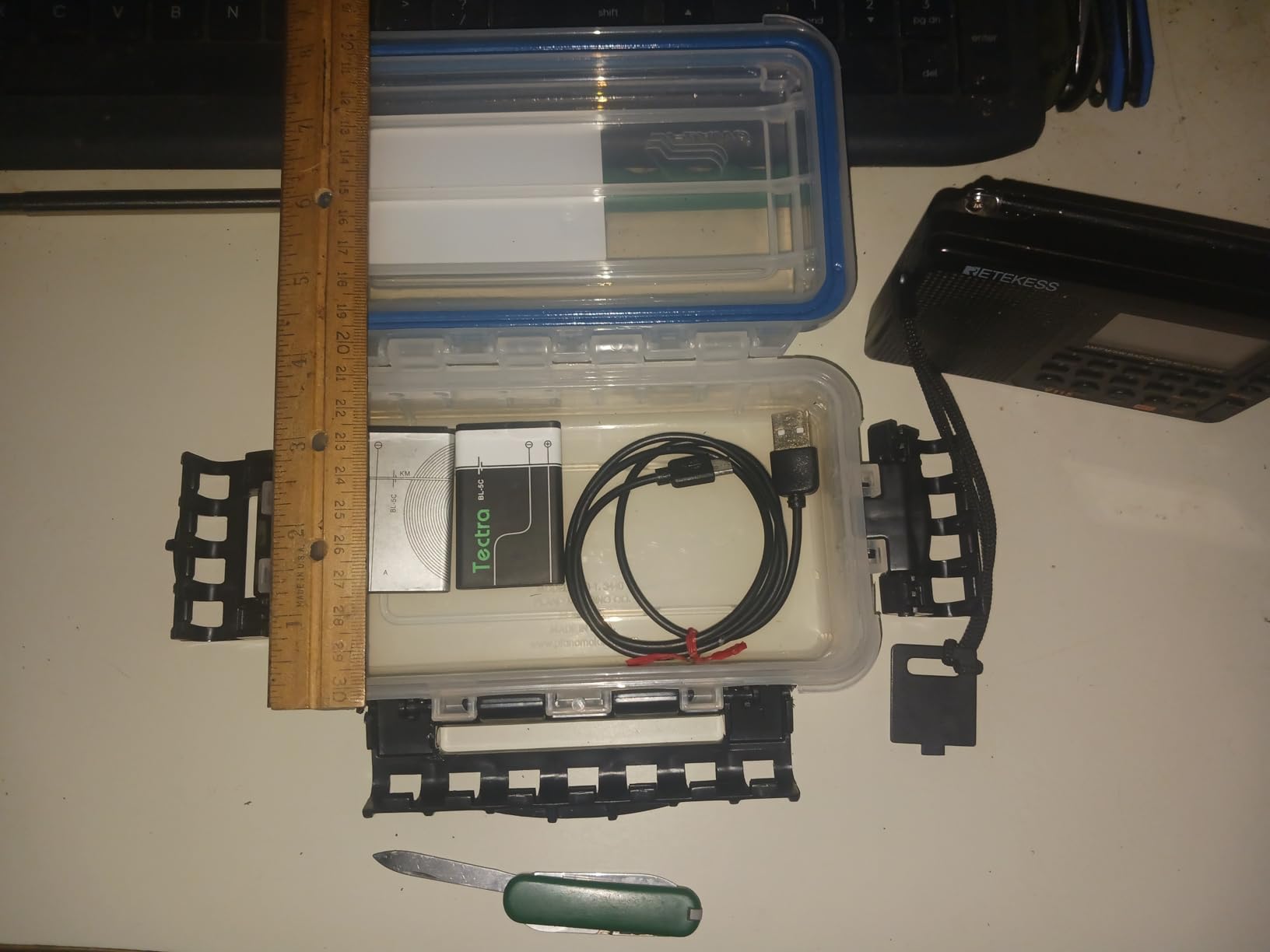
This is the box we ended up carrying most. The sealing claim is specific rather than vague, which is what made us trust it: rated fully submersible to one metre of water for up to 30 minutes through a Dri-Loc O-ring seal, held by three heavy-duty cam-action clasps. We dropped it off a transom with a phone and a spare reel inside and neither came out damp.
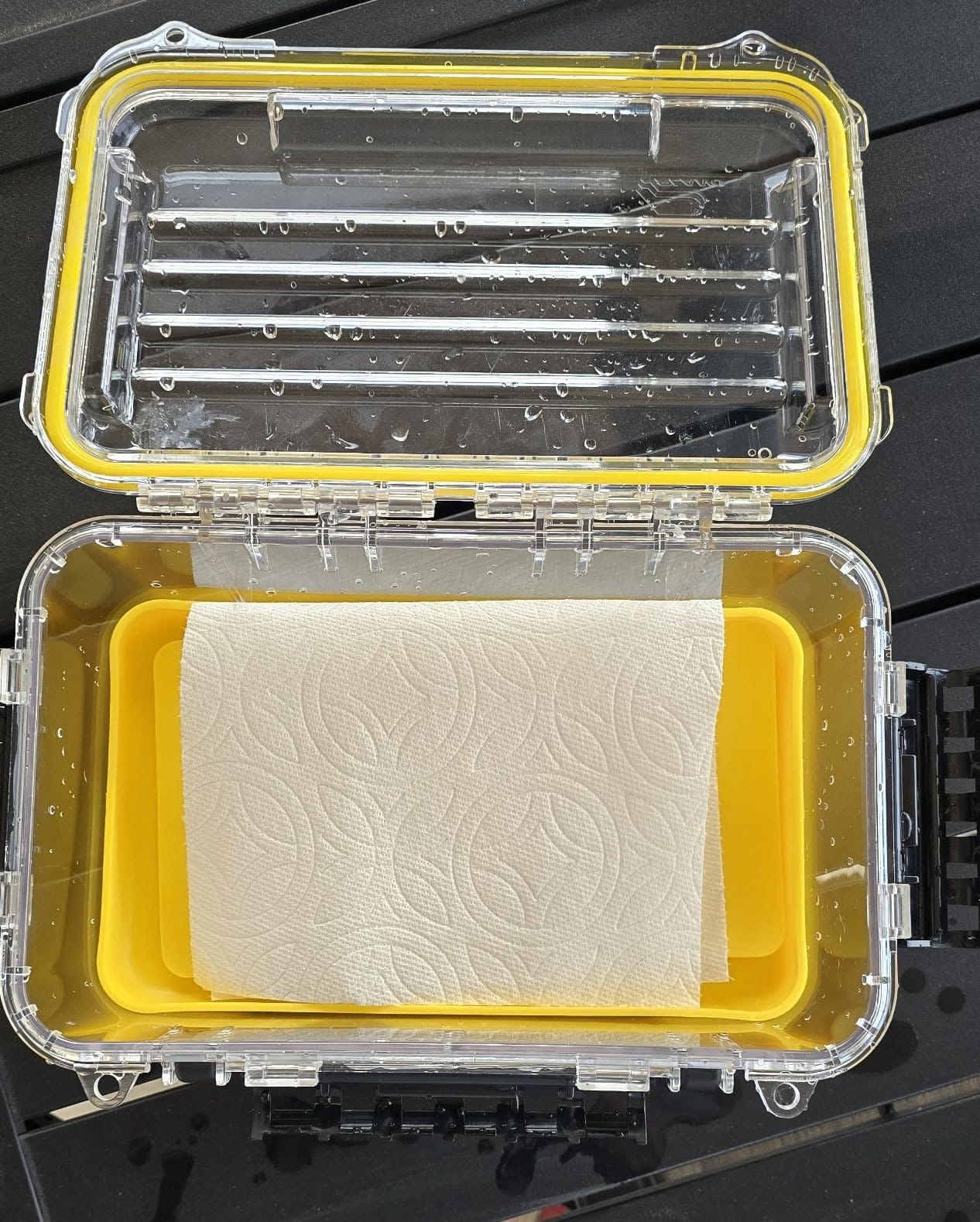
The polycarbonate body is the other half of the story: impact-resistant and crush-proof, which matters when the box takes a knock off a gunwale or gets dropped on a wet dock. Interior slip-resistant rubber pads keep fragile items from skating across the base in a seaway.
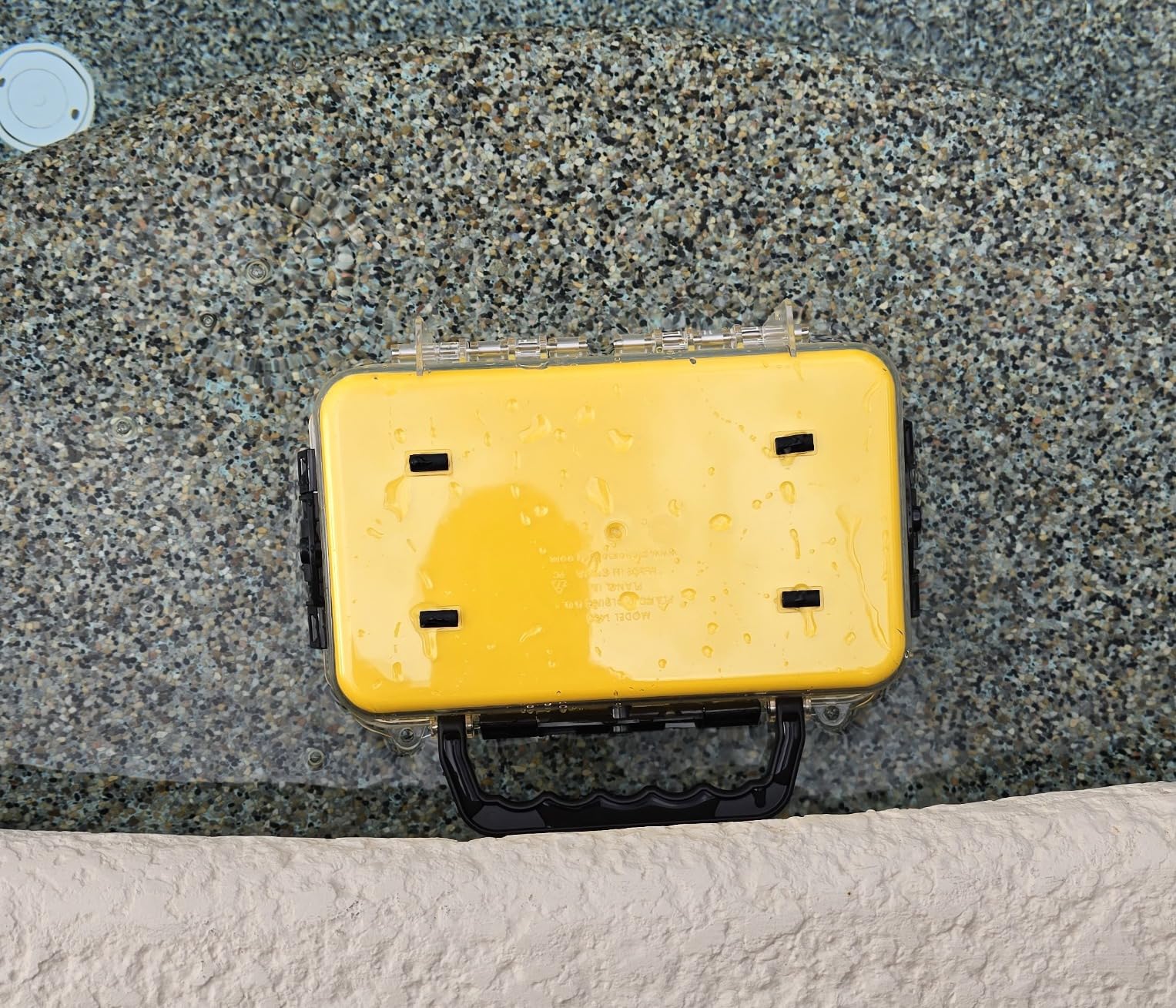
The clear body is genuinely useful rather than decorative. You can find a specific plug without opening anything, which saves time when the tide is moving, and the 11 by 7 by 4 inch footprint drops straight into the tray slots of most Plano tackle bags.
What the seal actually protects
Rust needs metal, moisture and time. A closed box in humid salt air supplies all three, so once hooks sit wet inside a box that breathes, corrosion works on them for weeks. A gasket-sealed box removes the moisture variable, which is why owners report dry tackle after storage.
The trade-off is honest. This is a single undivided cavity, so it will hold terminal tackle, spare hooks and a rig box, but it will not sort a spread of soft plastics. You are meant to add dividers or use it as an outer shell around smaller trays.
Where it suits you best
This suits boat-based and kayak anglers who need one reliable waterproof carrier for phones, keys, first-aid kit and a single rig at a time. Kayak paddlers like the wrist strap and the fact that it floats if it goes over the side.
It is a weaker fit if you need organised compartments out of the box, or if your load is breakable items that need rigid separation. Surveyors and anglers report that the cam latches are stiff to close, particularly one-handed with cold fingers, so plan to seat all three deliberately rather than snapping them shut.
2. Reaction Tackle Saltwater Tackle Bag XL: Best for Large Boat-Based Loads
Reaction Tackle Saltwater Fishing Tackle Bags, Water Resistant 1000D PVC Tackle Box Bag with Removable Dividers, Fits 3600 and 3700 Trays, XL
27 x 14.5 x 16 inch
Holds up to 12 3700-size trays
1000D PVC construction
2.95 kg
Pros
- Holds up to 12 3700-size trays
- Water-resistant 1000D PVC sheds water
- Removable dividers for custom layouts
- Multiple straps for flexible carry
- Built specifically for saltwater trips
Cons
- Soft sides give no crush protection
- Bulky footprint when lightly loaded
Capacity is the whole argument here. The XL configuration is rated to hold up to 12 full-size 3700 trays plus small trays in the side pockets, inside a 27 by 14.5 by 16 inch shell. That is a full day of offshore structure, chart and rigging kit in one bag.
The 1000D PVC construction is rated water-resistant rather than waterproof, and in practice it sheds spray, rain and wet deck surfaces without soaking through. There is no gasket and no submersion rating, and owners are clear that this is a splash and rain product, not a dunking product.
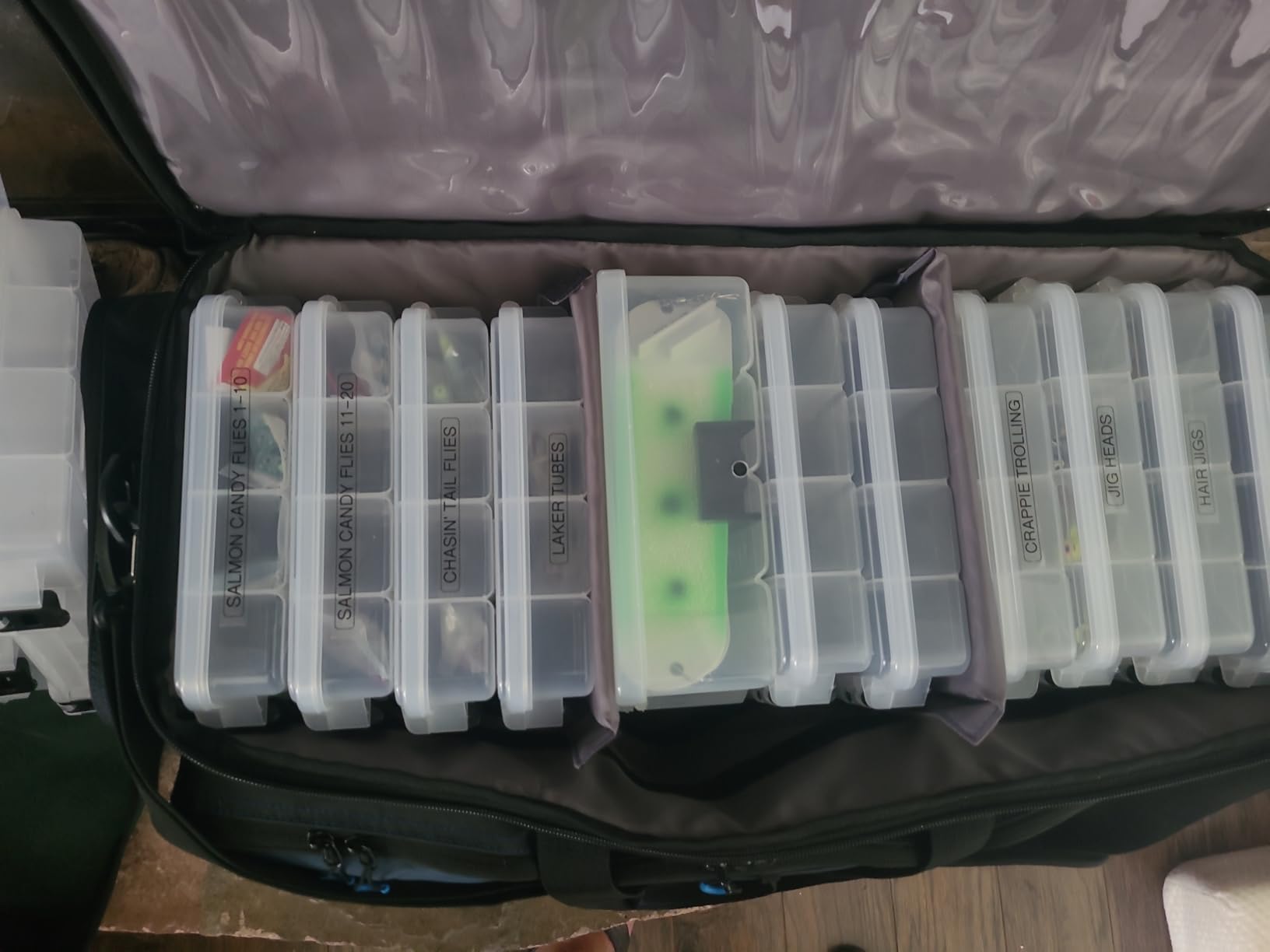
Removable dividers let you carve the interior into whatever shape your operation needs, which solves the classic complaint about fixed-compartment boxes that cannot take a modern swimbait or an oversized jig. Multiple straps give you shoulder, hand or cross-body carry depending on how far you are walking.
Why tray capacity matters more than compartment count
The community default, from what we saw in angler discussions, is to run four or five small boxes inside one larger carrier. That approach beats a single fixed grid because each tray can be pulled out and read at a glance. The cost is that cheap supplied trays crack, and anglers end up buying replacements anyway.
Counting tray slots rather than dividers is the smarter spec to compare. A box that advertises 30 compartments often ships fewer dividers than it has slots, which is how tiny swivels end up migrating between cells and tangling your leaders.
Where it suits you best
This is a strong pick for anglers running a full-size centre console or bay boat who organise by tray and want everything off the deck and into one carry. It also suits trip-based offshore fishing where you carry clothing and food alongside the tackle.
It is a poor fit for a walk-in surf launch or a pier trip where you carry a light load, because at 2.95 kg empty the empty bag itself becomes the weight. It also offers nothing to a kayaker who needs something that sits low and tight rather than tall and wide.
3. Plano Two-Tray Tackle Box: Best Value for a Salt-Air Setup
Plano Two-Tray Tackle Box, Green/Tan, Rust-Proof Brass Latch, Top-Access Tray with Deep Storage, Made in the USA, Portable Fishing Gear Storage Organizer
12.75 x 6.5 x 7.5 inch
Rust-proof brass front latch
Two-tier storage
2.4 pounds
Pros
- Solid brass latch resists corrosion
- Deep base fits knives and line reels
- Top-access tray for quick lure access
- Thick plastic resists tipping when open
- Adjustable tray dividers
Cons
- Not water resistant and must stay out of spray
- Top tray arms can feel wobbly under heavy load
The headline detail here is the hardware. The front latch is solid brass, and brass does not seize the way plated steel does after a season of salt spray. Latch and hinge seizing is the most common complaint in angler threads about saltwater storage, so a rust-proof latch here is a real differentiator.
Storage is two-tier: a deep lower section for bulkier items like knives and spare line reels, and a top-access tray with adjustable dividers that lets you reach lures without opening the whole box. That tray is the feature we used most, because you are not digging through a full box with wet hands.
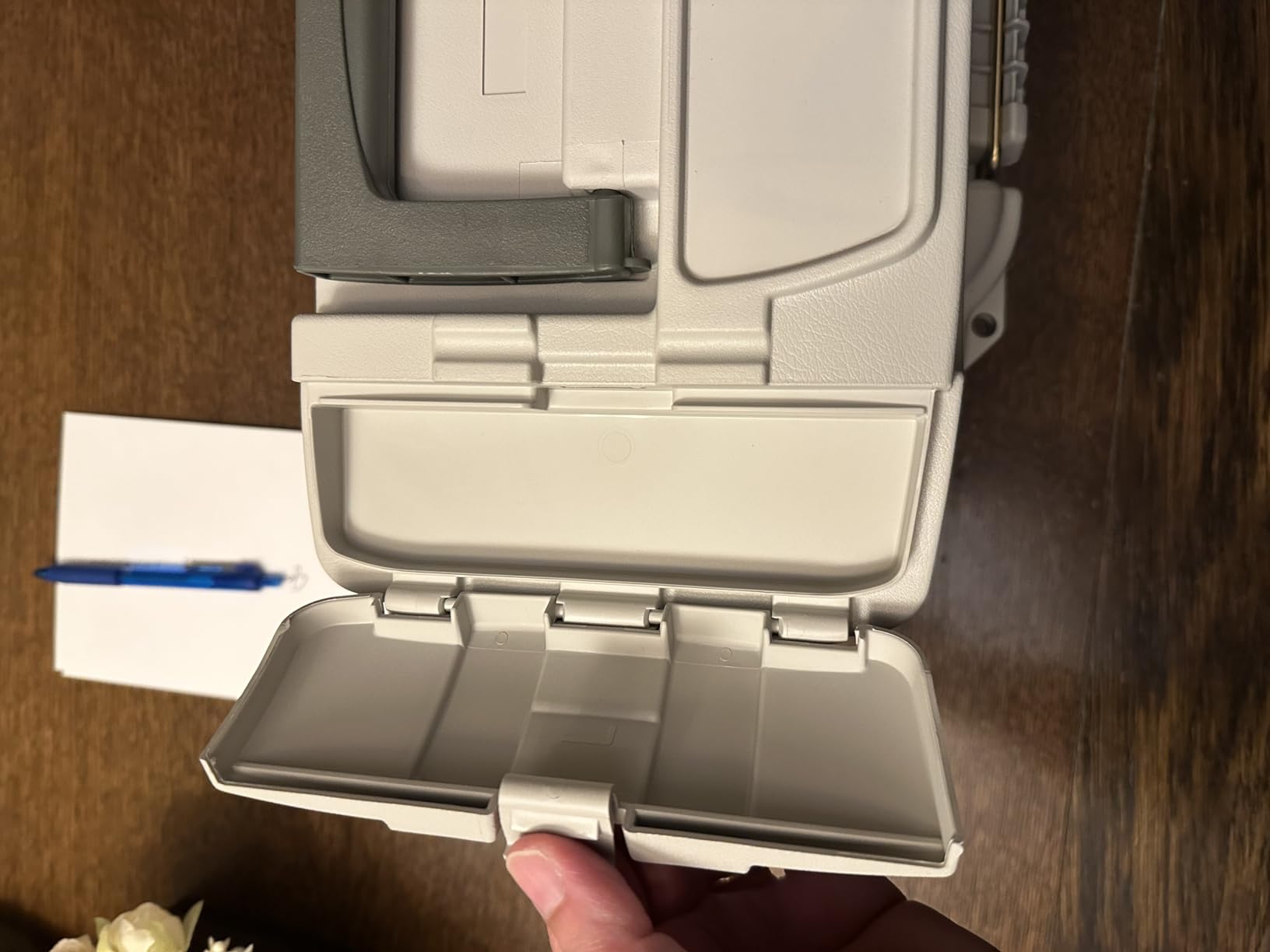
The plastic is thick enough that the box stays stable when it is resting open on a deck, which matters more than it sounds when you are trying to pick a hook off a moving surface. It is made in the USA and the finish is closer to the toolboxes anglers already trust than to thin plastic cases.
What water resistance means in practice
This box is listed as not water resistant, and you should believe that literally. It is designed for spray and damp air, not for rain getting inside or for sitting in a wet truck bed. The brass latch protects the hardware; it does not seal the box.
If your main enemy is corrosion rather than water, that is exactly the trade you want. If your main enemy is rain, keep this box inside a larger sealed shell or a bag with a gasket and you will get years out of it.
Where it suits you best
This suits shore-based, pier and bank anglers who want organised storage and care more about hardware longevity than about waterproofing. It also works well as a top box sitting inside a bigger carrier.
Reviewers do note two limitations worth planning around: the top tray arms can feel wobbly when the tray is heavily loaded, and an overfilled tray can catch the front of the box and stop the lid closing fully. Load the tray lightly and this box performs well for the money.
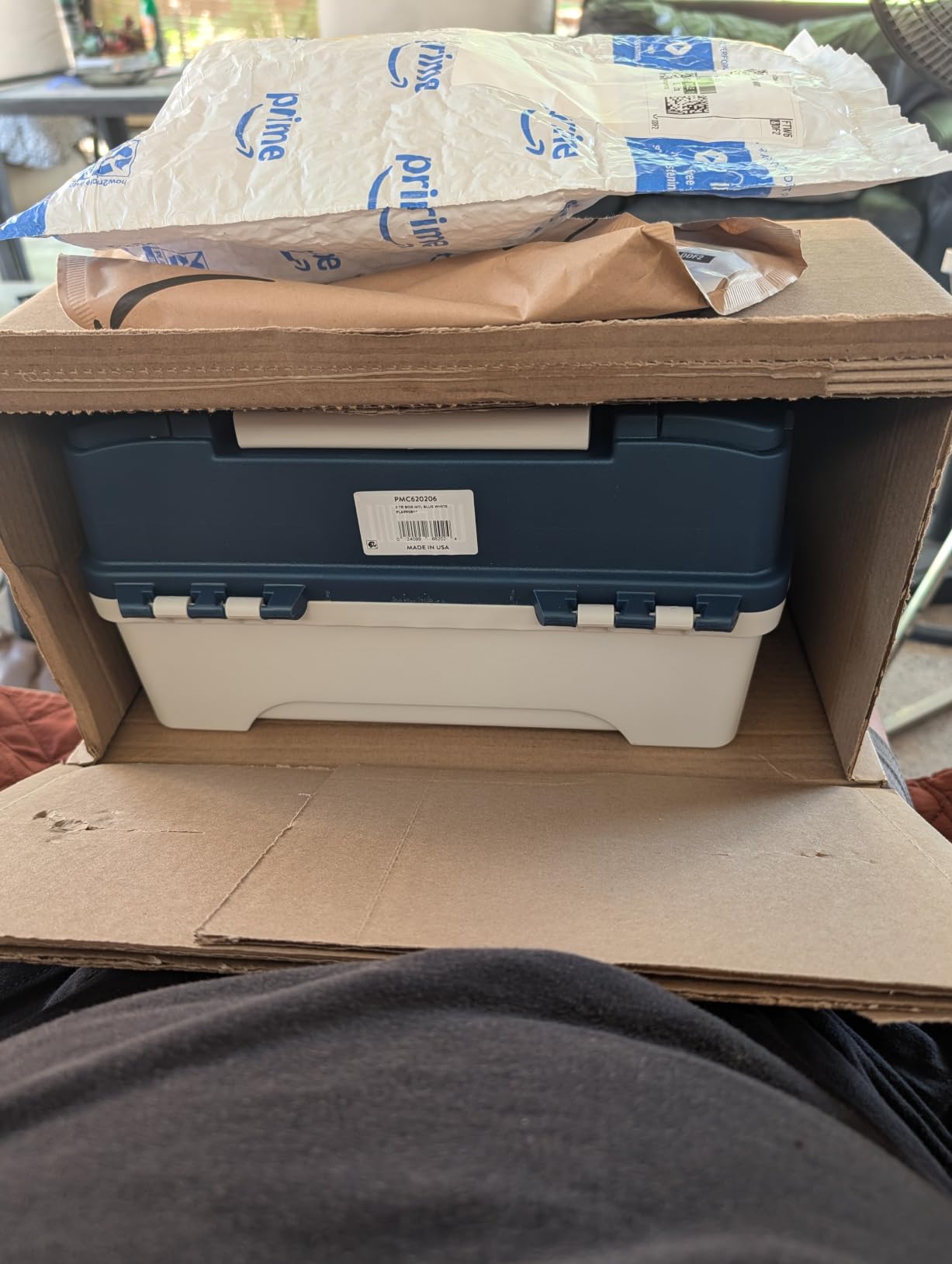
4. Plano 3540 Waterproof StowAway: Most-Reviewed Modular Tray
Plano 3540 Waterproof Stowaway
10 x 7 x 1 inch
Dri-Loc O-ring gasket seal
Three cam-action latches
3 to 18 compartments
Pros
- Genuine Dri-Loc waterproof seal
- Heavy cam-action latches resist accidental opening
- Independently moulded hinges resist cracking
- Removable dividers
- Lightweight and buoyant
Cons
- Less interior volume than standard 3700 boxes
- Stiff clasps need force to close
With more than 7,500 ratings on file, the 3540 StowAway carries the deepest owner history in this roundup, and the pattern is consistent: people buy one, then buy three or four more because they stack. The airtight seal means the case floats if it goes in the water, which matters on a kayak or a skiff.
Removable dividers let the compartment count move from 3 up to 18. Independently moulded hinges resist cracking, and three tight-sealing cam-action latches will not pop open on their own in rough water.
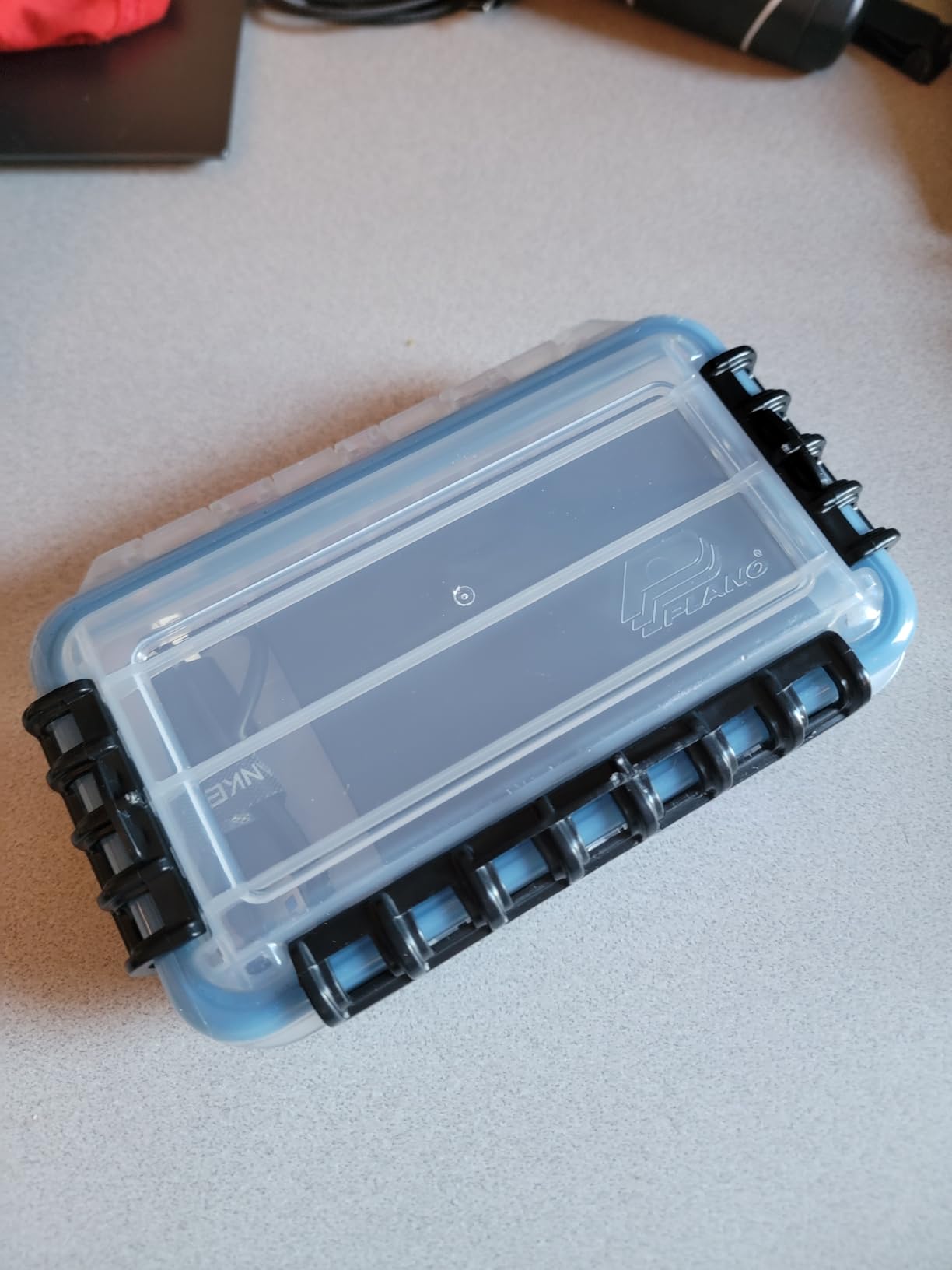
The honest drawback is interior volume. Because the waterproof latches are physically larger than the cheap snap latches on a standard 3700 tray, you fit less inside the same footprint. Anglers moving to it from a cheaper box notice this immediately, so treat it as a premium tray rather than a volume upgrade.
Why stacking beats one big box
A single large box fails as a system. Lose it overboard or drop it on rocks and everything is gone. A stack of sealed trays spreads that risk, lets you open only the tray holding the bait you are casting, and lets you rebalance the load between them as the trip goes on.
This is exactly the setup that experienced saltwater anglers describe running, and the reason the 3600 and 3700 footprint family has become a standard. Pick one size, stick to it, and buy bags and boxes that accept that footprint.
Where it suits you best
The 3540 is the right pick for kayakers, wading anglers and boat anglers who want sealed modular storage at low weight. At around 0.1 kg per unit you can carry several without noticing them.
Two cautions from owner feedback. The clasps are stiff and take real force, which is frustrating with weak or cold hands, and the reduced internal volume means big soft plastics and oversized jigs can be tight. If your load is heavy offshore tackle, look at the deeper tray sizes instead.
5. KastKing KarryAll Tackle Bag: Best for Beach and Pier Trips
KastKing KarryAll Fishing Tackle Bag, Saltwater & Freshwater Gear Storage
13 x 11 x 11 inch
20L capacity
Holds up to 6 3600-size trays
600D oxford with PVC lining
Pros
- Water-resistant 600D oxford with hydrophobic coating
- Holds six 3600-size trays plus small gear
- Padded shoulder strap and handle
- MOLLE straps and integrated pliers holder
- Rubber non-slip foot pads
Cons
- Soft sides give no rigid protection
- Zipper closure less secure in heavy surf spray than a hard case
Soft bags win on beach and pier trips for one reason, and experienced anglers say it plainly: a soaked bag is a nuisance while a ruined hard box is a loss. This 20L bag carries up to six 3600-size lure boxes plus loose small gear, so it holds a serious saltwater load without turning into a walk you regret.
Construction is 600D oxford with a hydrophobic coating on the outside and an inner PVC layer, which sheds spray and rain. MOLLE straps, an integrated pliers holder, a mesh pocket for scales and fish controllers, and a hidden water cup pocket cover the accessory side of things that anglers usually end up improvising.
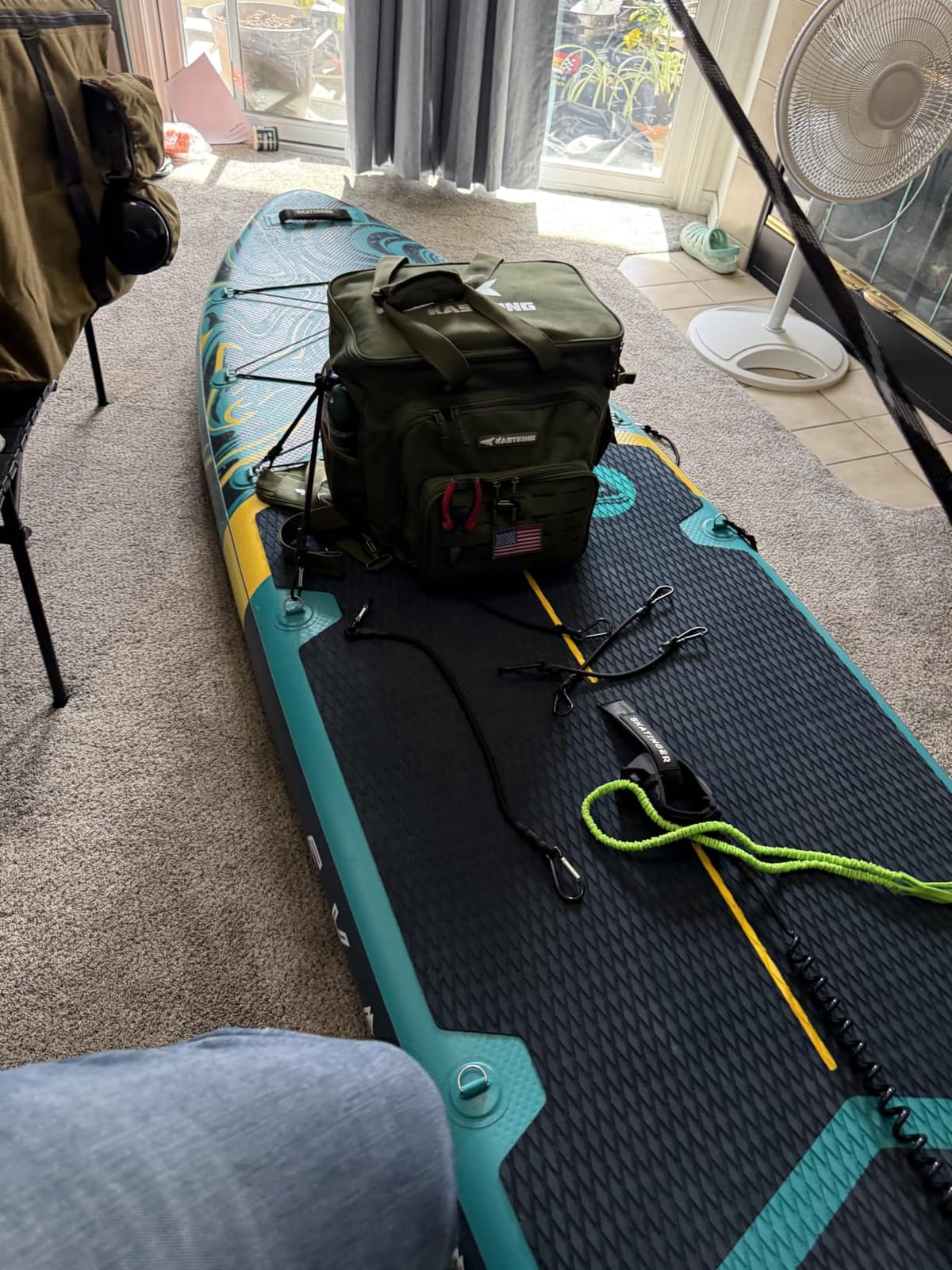
Carry is where it wins outright. The padded shoulder strap and web handle stay comfortable when six trays are loaded, and rubber non-slip foot pads keep the bag stable on wet sand or a slick dock edge.
Hard box versus soft bag, honestly
A hard case wins on three axes: it stops water getting in, it stops glass bottles and electronics from being crushed, and it survives being thrown. A soft bag wins on comfort, capacity and the price of failure, because a torn seam is a repair and a cracked hard shell is a replacement.
For surf and pier work, the deciding question is how far you walk. If it is a short walk and you value a sealed box, take the hard case. If it is a long walk over soft sand with a heavy load, the bag is the better tool, and you can nest sealed trays inside it.
Where it suits you best
This bag suits shore-based, surf and pier anglers who carry a full kit to the water and want organisation without a hard shell. It also works well as the outer layer of a modular system, with sealed trays inside and soft plastics in the outer pockets.
The weakness is spray exposure. A zipper is a zipper, and heavy surf spray over a long session will eventually find it. Reviewers are also candid that there is no rigid structure, so fragile electronics need their own sealed container inside the bag.
6. KastKing KarryAll Backpack with Rod Holder: Best for Multi-Day Offshore Trips
KastKing KarryAll Fishing Backpack with Rod Holder 4 Tackle Boxes, Khaki
40L large size
13 x 10.24 x 17.72 inch
Fits four 3600 tackle boxes
1.35 kg
Pros
- Water-resistant PVC-coated 600D oxford
- 40L compartment fits four 3600 tackle boxes
- 14 dedicated pockets
- Padded breathable back and reflective straps
- Non-slip composite base
Cons
- Soft-sided build gives no crush protection
- Bulky 40L size when lightly loaded
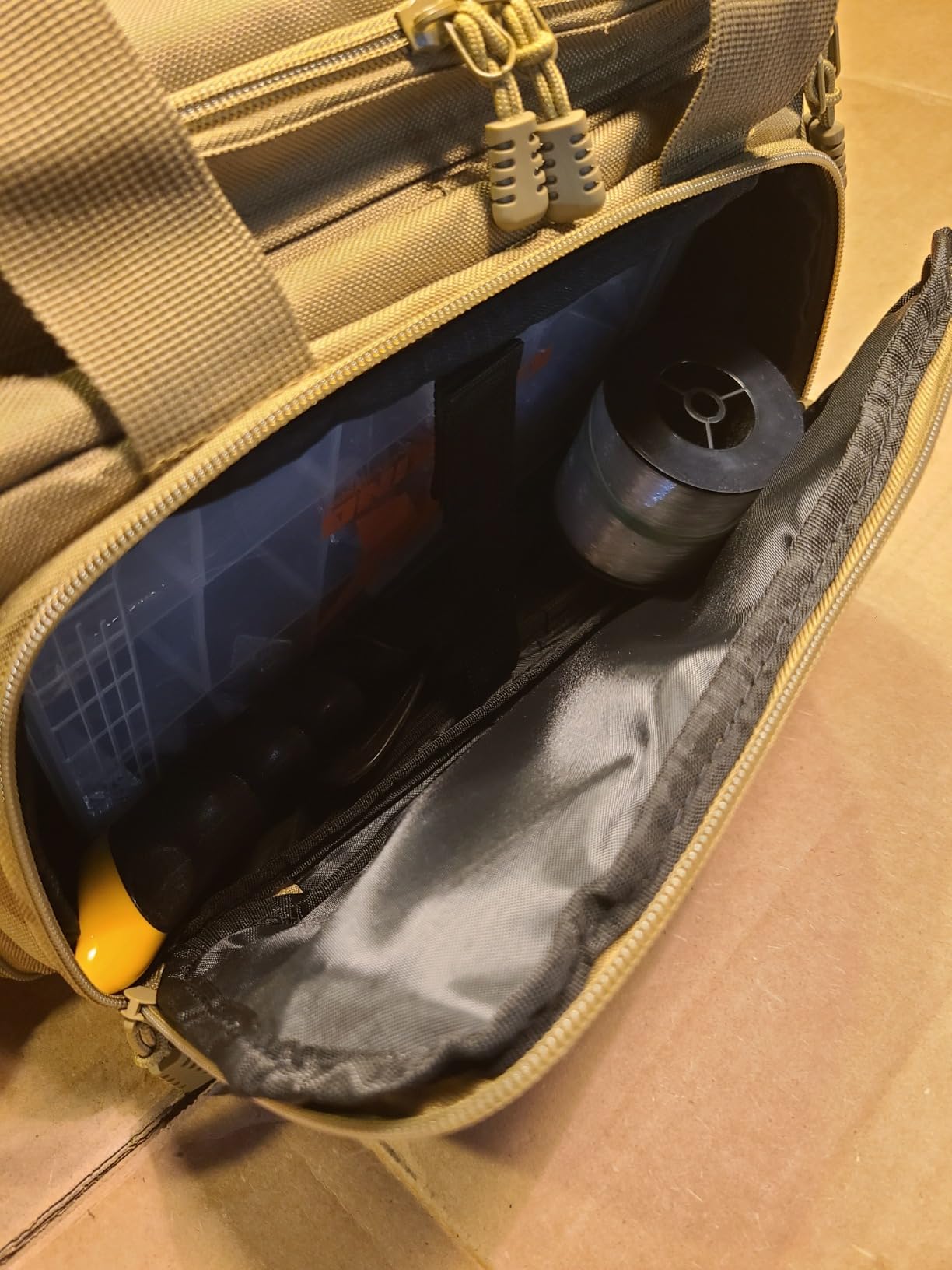
This is the trip bag rather than the session bag. At 40 litres it takes a foldable padded partition that splits into two equal spaces, and owners load it with four 3600 tackle boxes plus clothing, food and layers for a multi-day trip. For offshore fishing where you leave the ramp before dawn and get back after dark, that is the difference between a good day and a miserable one.
Organisation is the standout number: 14 dedicated pockets for tackle boxes, rods, pliers, sunglasses and tools, with integrated rod holders on the outside. The harness is a breathable cushion-padded back with adjustable foam shoulder straps carrying reflective stripes, which matters when you are carrying weight down a ramp in the dark.
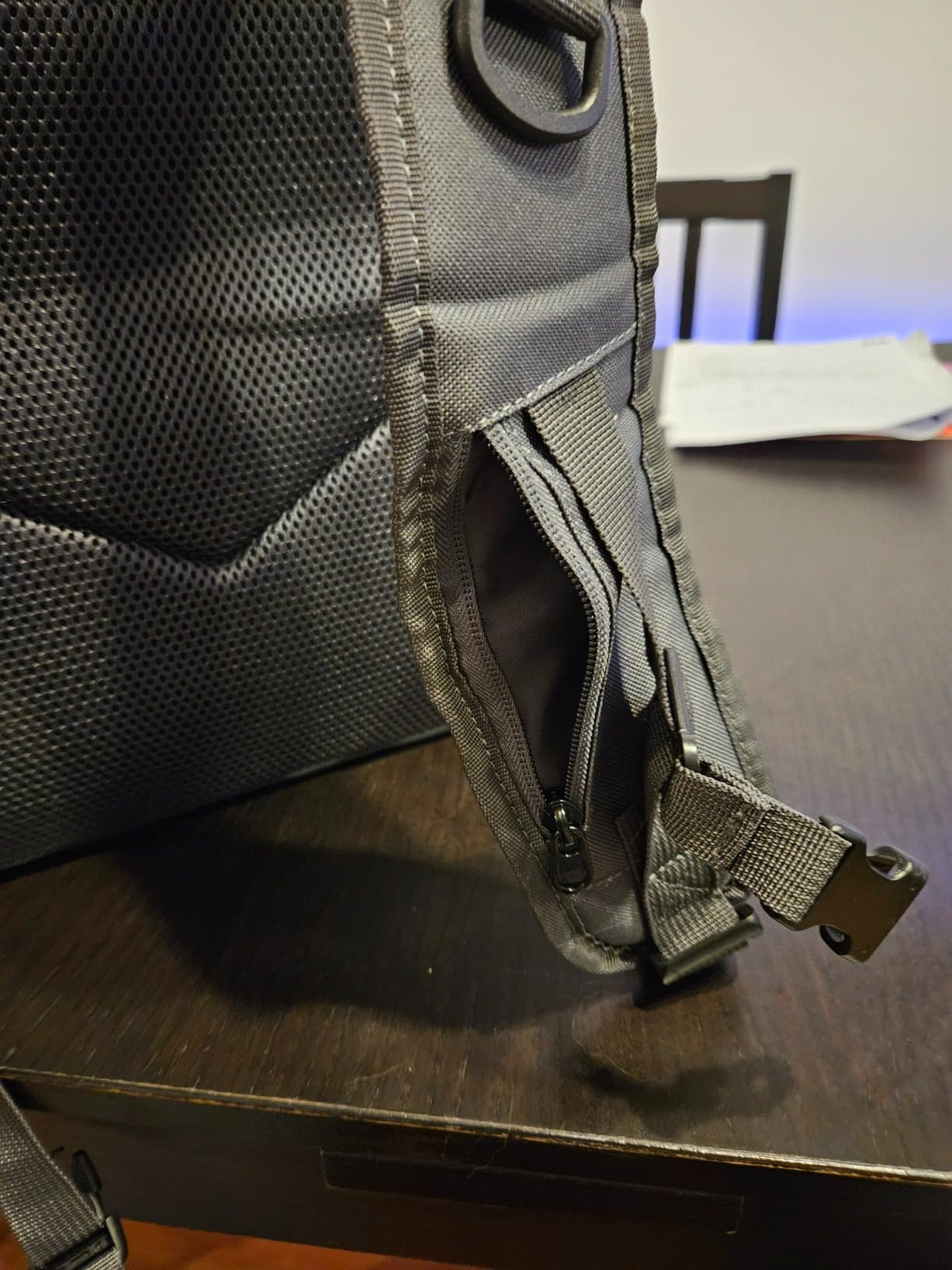
The base is a fully water-resistant non-slip composite with two non-skid pads, so the bag stays put on a wet deck rather than sliding every time you bend down to change a lure.
When a backpack beats a shoulder bag
A backpack distributes roughly twice the load across two shoulders and keeps your hands free, which is the difference between carrying a rig down a ramp and carrying it one-handed while holding a rod. If you are walking more than a few hundred metres with heavy tackle, a backpack is the right shape.
The trade-off is that a backpack on a small boat takes up a lot of deck space, and you will eventually take it off and put it somewhere to free yourself up. Think of it as the transport between the vehicle and the deck, not the storage you keep at your feet all day.
Where it suits you best
This is the pick for offshore and pelagic anglers running multi-day trips, and for anyone who carries clothing and food as well as tackle. It also works as a general travel or hiking pack when you are not fishing.
The drawbacks are consistent in owner feedback. The 40L footprint is unwieldy for a shore session with a light load, and the soft-sided build gives no crush protection. Reviewers also note the styling reads as a general travel pack rather than a purpose-built fishing pack, which matters if you want kit that looks like fishing kit.
7. Flambeau Outdoors 6383 3-Tray Tackle Box: Best for Maximum Organization
Flambeau Outdoors 6383 3-Tray Tackle Box, 32 Compartments, Frost Green
16 x 9 x 8.25 inch
32 compartments with 13 dividers
Cantilever 3-tray layout
3.8 pounds
Pros
- Cantilever trays show every compartment at a glance
- 32 compartments with 13 removable dividers
- All-weather oil-resistant resin
- Large bulk base for bigger equipment
- Strong value against similar boxes
Cons
- Bulky 3.8 pound weight when fully loaded
- Sticky latch action on open and close
- Trays can feel flimsy at full extension
The cantilever tray design is the reason to consider this box. Three trays lift out and stack like steps, so every compartment is visible at once instead of you digging layer by layer. With 32 compartments, 13 removable dividers, a flip-top lid compartment and a roomy base, this is the most organised option we tested.
The body is an all-weather, oil-resistant resin, made in the USA by a company building boxes since 1947. Draw-Tite latches hold the lid shut and Tip-Guard posts prop the trays when open, which stops them folding shut on your fingers.
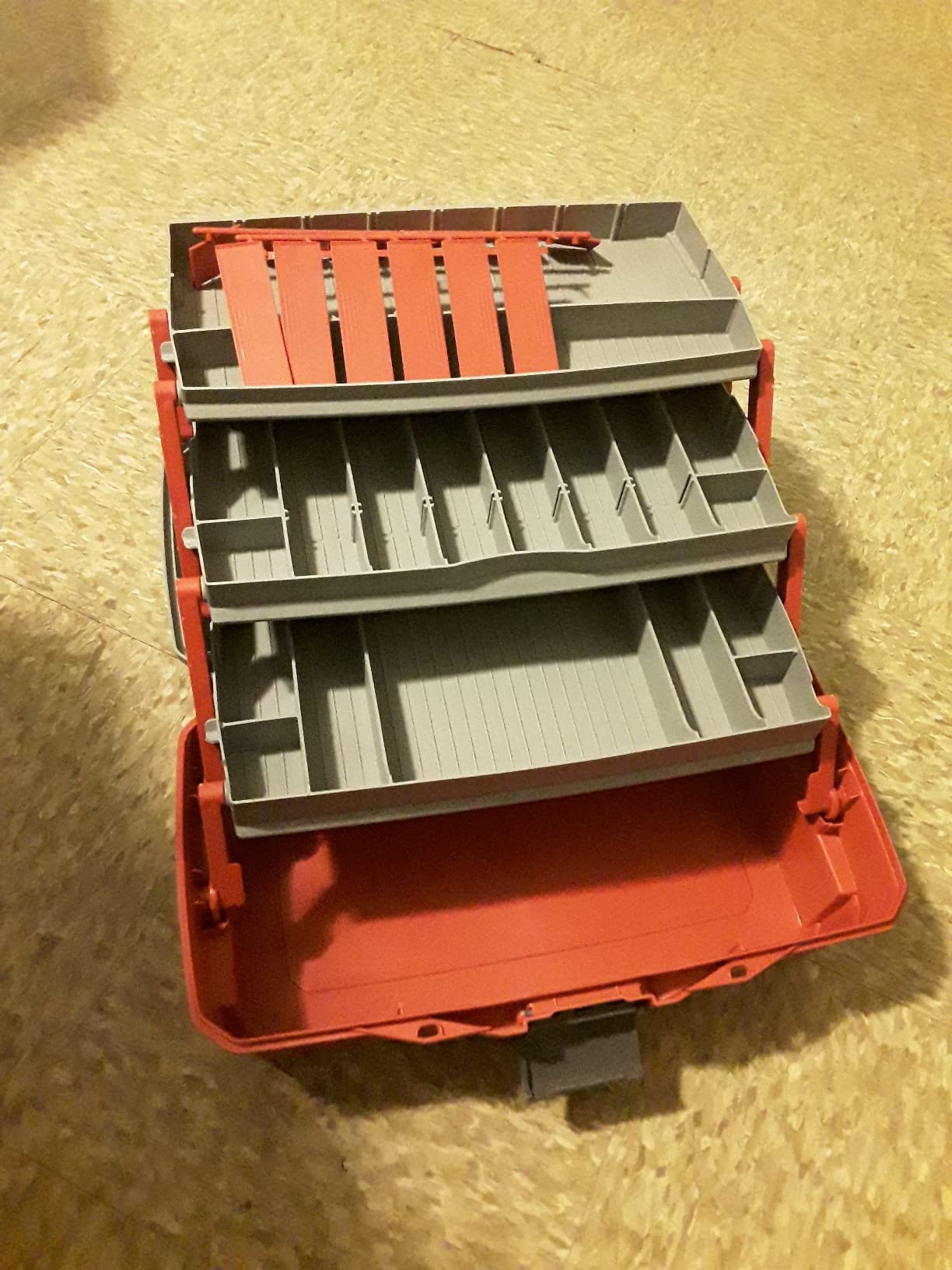
This is the classic answer for an angler who fished out of fixed-compartment boxes for years and wants the same layout with better materials. Owners frequently describe it as better value than comparable premium boxes, and with over 8,000 ratings the long-term durability picture is well documented.
Why cantilever beats a grid layout
A fixed grid works until you switch to modern tackle. Swimbaits, oversized jigs and long soft plastics do not fit compartments sized for older plugs, and once they are forced in everything shifts and tangles. A cantilever system with removable dividers lets you change the layout between trips instead of buying a new box.
The flip side is bulk. Three trays plus a base take up more volume than a flat tray, and this box weighs 3.8 pounds before you put anything in it. That is a shore-angling or boat-anchorage tool rather than something you carry down a beach.
Where it suits you best
This box suits anglers who fish from a stationary position and want to see all their tackle at once, particularly boat and pier anglers running a lot of variety. It also works as a shore box on a picnic table or dock.
Reviewers are consistent about the drawbacks. The latch action feels sticky and less smooth on repeated opening and closing, and the trays can feel slightly flimsy at full extension, so heavy sinkers and lead weights are better kept in the base rather than the upper trays.
8. Ghosthorn Waterproof 3600 Tackle Box: Best Budget Waterproof Tray
Ghosthorn Waterproof Fishing Tackle Box Organizer 3600 Lure Storage 1 Pack
3600 footprint
Enhanced 2 inch height
O-ring seal with three cam latches
24 compartments
Pros
- O-ring seal and three cam latches give a real waterproof closure
- Construction roughly twice as thick as typical boxes
- Taller 2 inch profile fits larger plugs
- Pre-cut dividers seat against the base
- BPA-free transparent body
Cons
- Divider layout is pre-cut and not freely reconfigurable
- Tight seal can trap moisture against wet lures
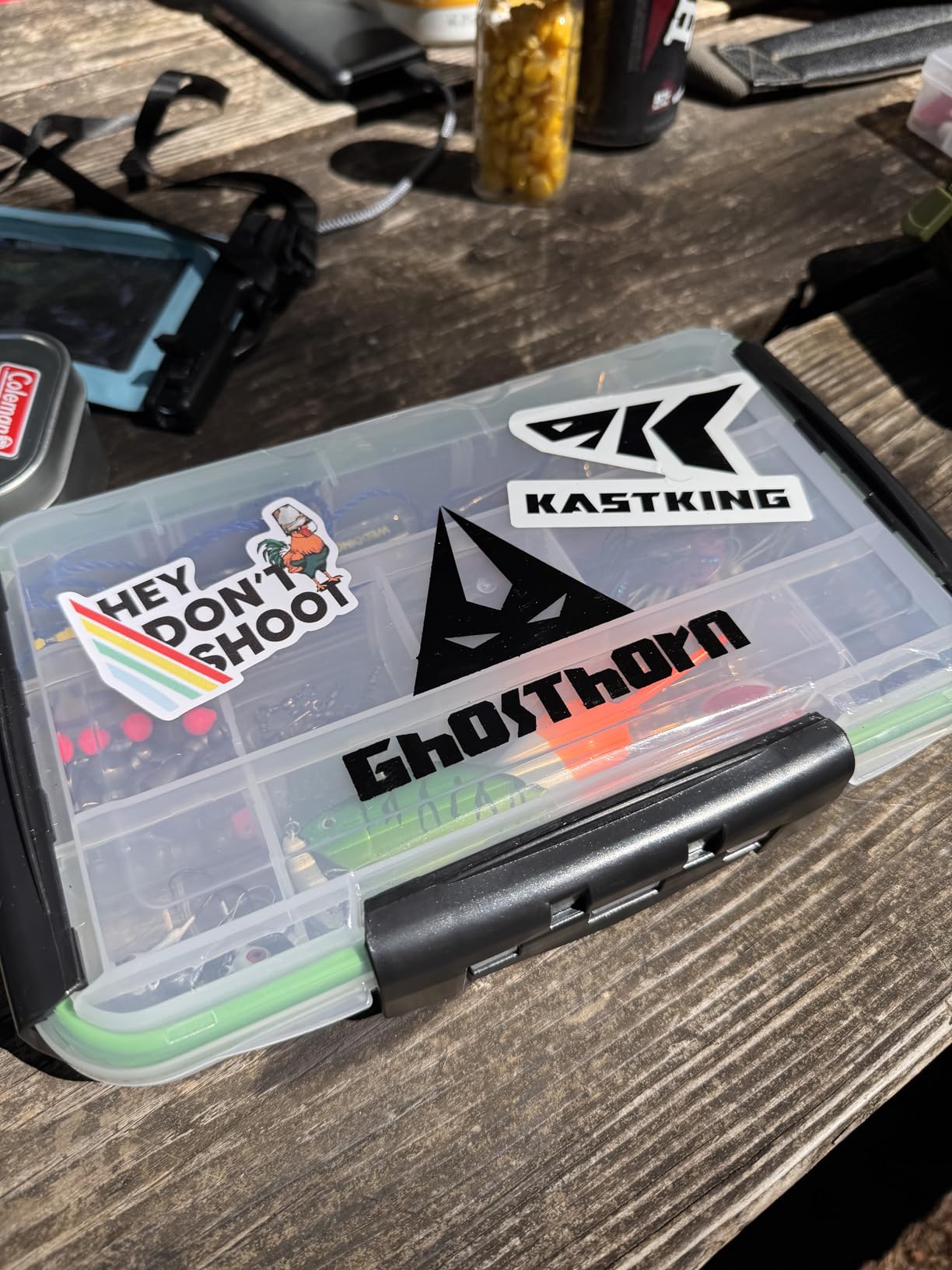
This is the budget answer to the rust problem, and wall thickness is the reason. The shock- and wear-resistant hard plastic and resin body is roughly twice as thick as a typical tray, which is what stops a thin box cracking under heavy lures or getting knocked off a tailgate.
The closure is an O-ring seal plus three tight cam-action latches, and the taller 2-inch profile gives more vertical room than a standard shallow tray. That height is why it fits larger plugs and swimbaits a standard tray will not accept, and it is a more useful upgrade than extra dividers.
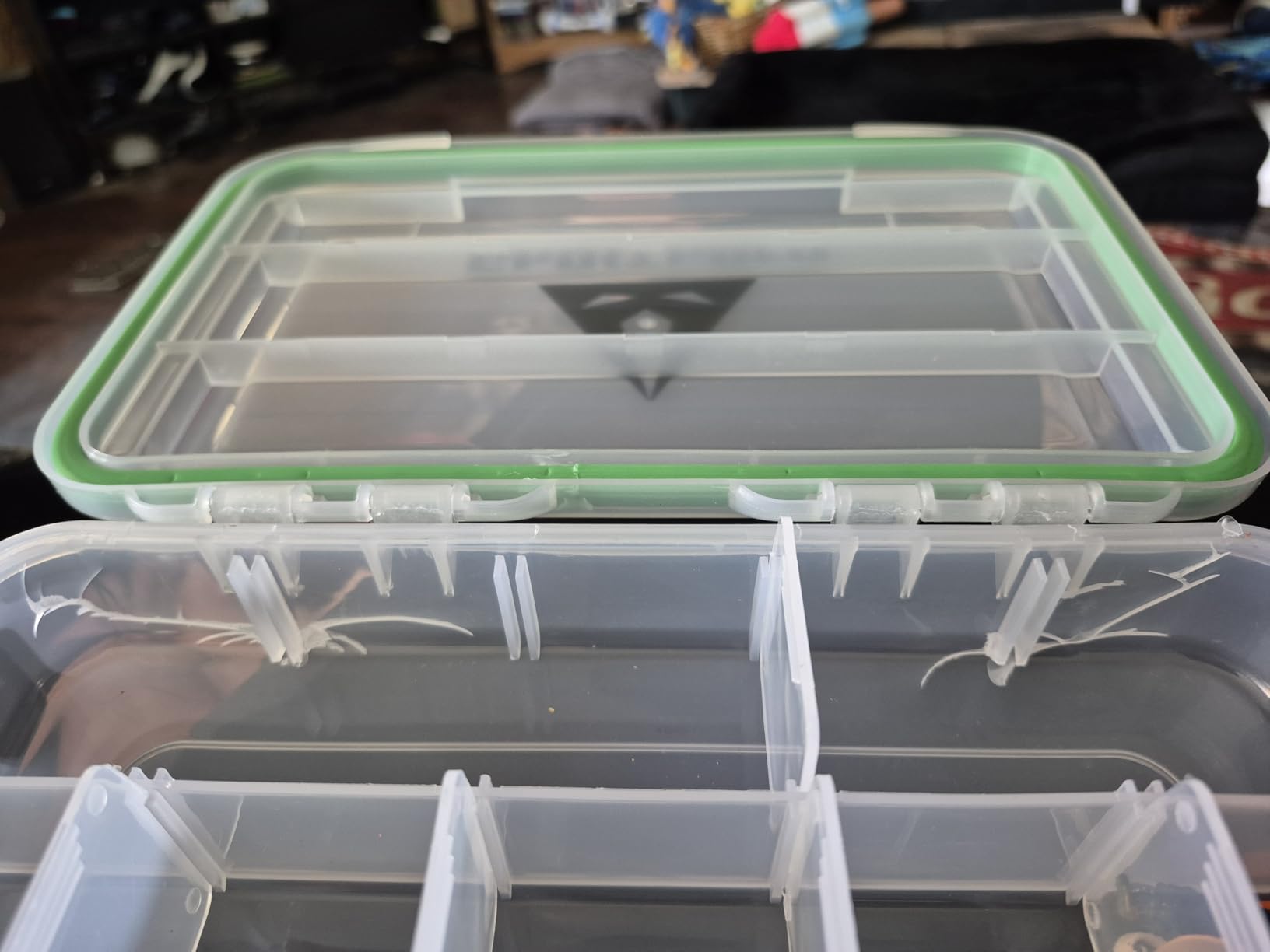
Dividers are pre-cut, not freely reconfigurable, so you are choosing from a fixed set of cell sizes. That is a limitation compared with removable dividers, though the pre-cut ones do seat against the bottom, which stops small tackle migrating between cells during a rough trip.
Taller trays versus more compartments
When you are choosing between a shallow box with many compartments and a taller box with fewer, ask what your biggest lure actually is. A taller tray that fits the plug you use beats a shallow tray with forty cells, every time. Height and wall thickness protect the lure; compartments only organise around it.
The other thing worth understanding is that a very tight seal is not always a gift. If you store lures wet, an airtight box holds that moisture against the hooks, and owners recommend opening the box after a trip to let it air out rather than latching it shut on damp tackle.
Where it suits you best
This suits anyone building a modular saltwater kit on a sensible budget, since it matches the standard 3600 footprint and stacks with other standard trays. It is a good second box or a boat locker box.
The limitations are real: pre-cut dividers limit you to the supplied layout, and the tight seal needs a drying habit to go with it. If you need fully adjustable compartments, step up to a tray with removable dividers instead.
9. Flambeau T4P Pro Multiloader: Best for Rust Defense
Flambeau Outdoors T4P Pro Multiloader Tackle Box, 5 Zerust Tuff Tainers
13.5 x 9.625 x 12 inch
Five Zerust Tuff Tainers included
Zerust VCI dividers
Four line dispensing ports
Pros
- Zerust VCI dividers actively inhibit rust
- Five Tuff Tainers give a complete modular set
- Four line dispensing ports run multiple lines
- Translucent flip-top for terminal tackle
- Carry handle and snap-tight latch
Cons
- Outer box is not water resistant
- Deep 12 inch body is bulky on shore
- Bundled Tuff Tainers must be removed to reach the base
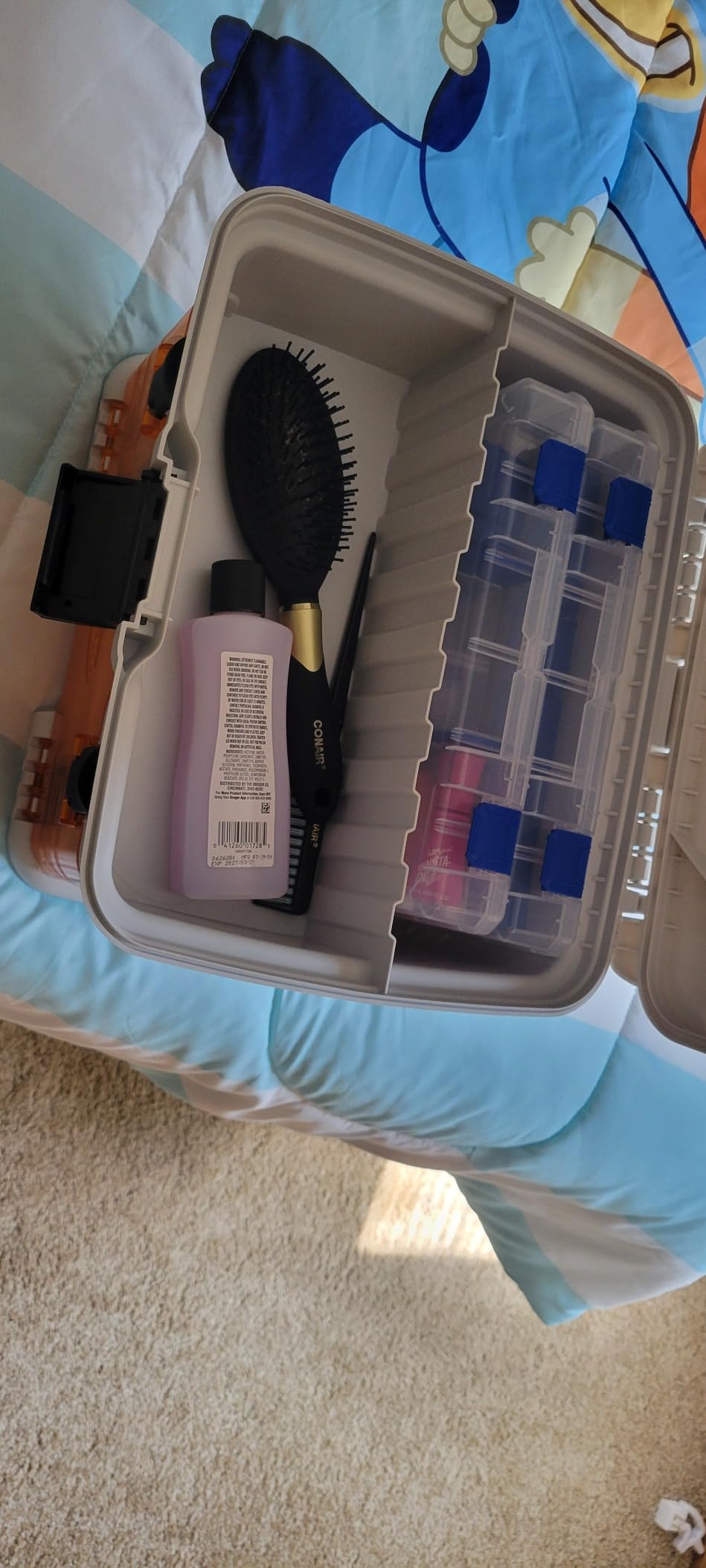
This is the only box here built around corrosion inhibition rather than corrosion avoidance. Zerust technology infuses the dividers with a vapour-phase inhibitor formula that forms a protective layer on the metal stored inside, protecting hooks and split rings directly rather than keeping damp salt air out. Reviewers single it out as the standout feature for saltwater.
It also ships with a complete modular set: five Flambeau Tuff Tainers in three sizes, one 1002, two 3003 and two 4007. You can organise by lure type on day one instead of buying trays separately, which answers the question anglers ask most often about trays.
The translucent flip-top lid covers six quick-access terminal tackle compartments, and four line dispensing ports let several lines run at once without tangling, which suits multi-rod offshore setups. A sturdy carry handle and snap-tight latch handle transport on boat, bank or pier.
How Zerust and similar technologies work
Corrosion happens when metal reacts with moisture and salt in the air. Most tackle storage tries to remove the moisture with a gasket, which works until the box is opened or the seal ages. Vapour-phase inhibitors take the other approach: they release a compound that binds to the metal surface and slows the reaction chemically.
The practical point is that these two approaches solve different problems. A sealed box protects against water but not against a box that has been closed damp for a week. An inhibitor box protects the metal inside even if humidity gets in. For long-term storage of corrosion-prone tackle such as circle hooks, wire leaders and expensive plugs, the second is the better tool.
Where it suits you best
This is the pick for anglers who leave tackle in a boat, garage or locker for weeks at a time and come back to dull hooks and pitted split rings. It also suits anyone storing high-value offshore tackle that would be expensive to replace.
Be clear about the limits. The outer box is not water resistant, so it protects against corrosion rather than water ingress, and the 12-inch depth makes it bulky for shore work. Reviewers also note that the bundled Tuff Tainers have to be removed to reach the main compartment.
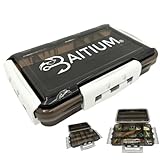
10. Baitium XTRAseal Waterproof Tackle Box: Best for Kayak Anglers
Baitium XTRAseal Waterproof Fishing Tackle Box Organizer, Tackle Boxes With Dividers, Fishing Box, Tacklebox for Fishing, 3600 Tackle Tray 3700, Plastic Storage Organizer, Fishing Gear – 3600
3600 size: 10.6 x 6.7 x 2 inch
XTRAseal waterproof gasket
Triple latch closure
30 compartments
Pros
- Very tight waterproof seal with strong latches
- Stacked lid grooves stop sections mixing
- Sturdy plastic that survives kayak use
- Standard 3600 and 3700 footprints
- Good value against premium equivalents
Cons
- Fewer dividers than compartment slots
- Molded-in dividers on some variants
- Tight seal can trap moisture against wet lures
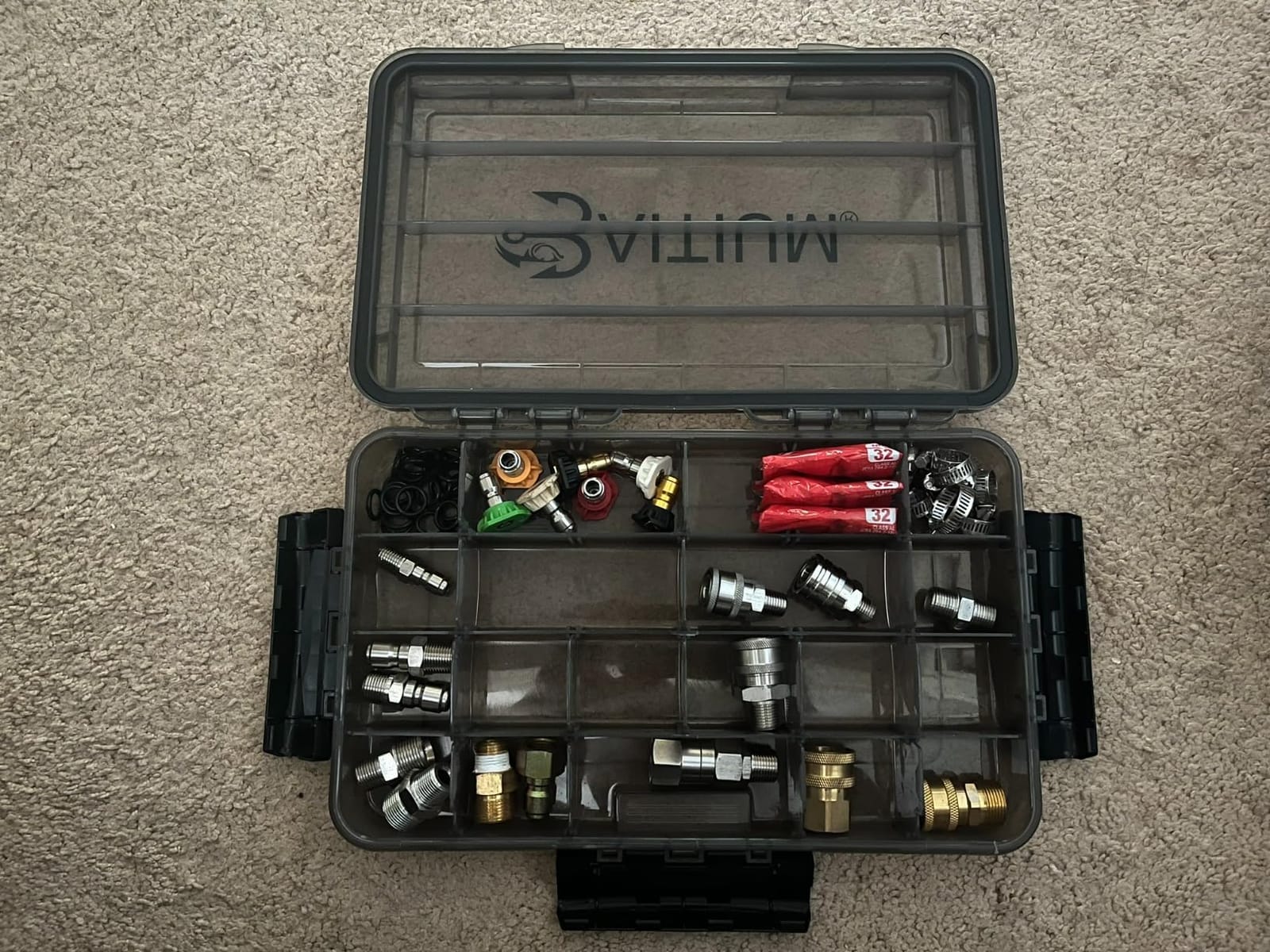
Kayak anglers drove a lot of the feedback here, and the praise is specific: owners report the plastic holds its shape after years of use in a kayak where gear is loaded, unloaded and sat on constantly. The XTRAseal waterproof gasket with a triple latch closure gives a tight seal, and the clear dividers mean you can see your terminal tackle without opening anything.
It is made in standard footprints, a 3600 at 10.6 by 6.7 by 2 inch and a 3700 variant at 14 by 9 by 2.1 inch, so it slots into bags and cases built for those sizes. The listing marks it for both saltwater and freshwater use, and owners treat it as a good value alternative to comparable premium trays.
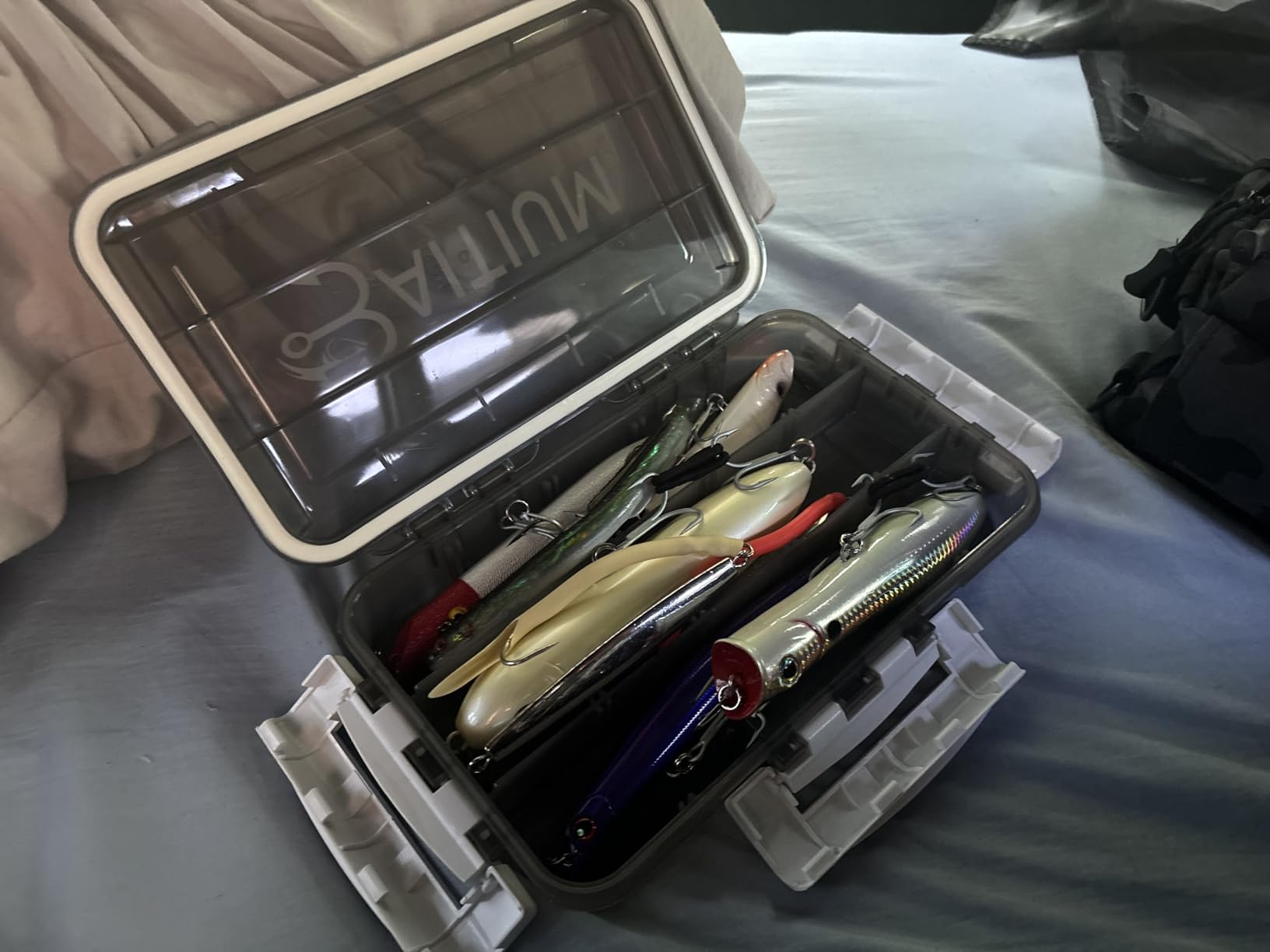
One design detail we liked: grooves in the lid match the lower box so contents cannot slide between sections when the kayak rolls or you tip it to get in and out.
Counting dividers, not slots
Advertised compartment counts are marketing numbers. What matters is how many actual dividers ship with the box. Owners here note that the compartment count exceeds the divider count, which is exactly how small hooks and swivels migrate between cells and end up tangled on your leaders. Check the divider count before you buy.
A second recurring note is that interior dividers on some variants are moulded in rather than removable. If your storage plan changes with the season, that flexibility matters more than the nominal compartment number.
Where it suits you best
This box suits kayak and small-boat anglers who want a properly sealed tray at a standard footprint and a sensible outlay. It also works as a secondary storage box on a boat deck.
The drawbacks are consistent. The plastic is thinner than premium comparable boxes, the tight seal can trap moisture against wet hooks if you close up a wet load, and the supplied divider layout is the main compromise here.
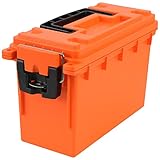
11. Sheffield 12680 Marine Storage Box: Best for Boat and Dock Gear
Sheffield 12680 Marine Storage Box, Dry Box Made in USA, Water Resistant Container for Boat and Dock Gear, Small Parts Organizer with Latch, Stackable
11.25 x 5 x 7.25 inch
4.1 litre capacity
Compression-fit rubber gasket lid
Polypropylene
Pros
- Compression-fit gasket lid keeps out rain and spray
- Three locking options secure contents
- Stackable base-to-lid interlock
- Lightweight yet rigid
- Bright orange is easy to spot on a dock
Cons
- Single undivided compartment
- Thin polypropylene walls feel flimsy
- Limited small-parts capacity
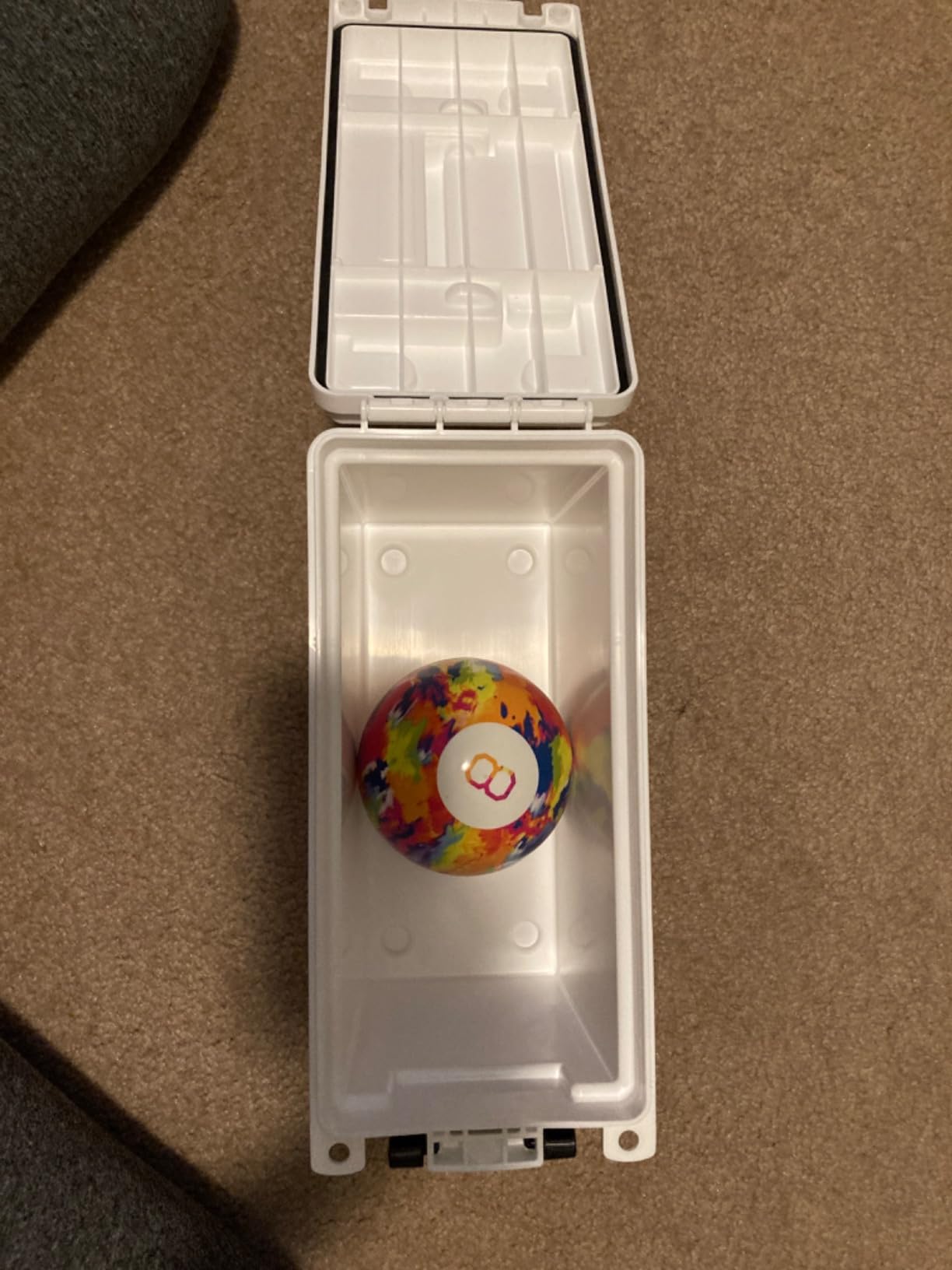
This is a purpose-built marine storage box rather than a fishing-specific one, and that is its advantage. The compression-fit lid with a rubber gasket is built to seal out moisture and dust in harsh saltwater and freshwater conditions, and reviewers report it doing exactly that on boat decks and in transit. Three locking options deter tampering while the box is stored or shipped.
The base-to-lid interlock allows stable stacking with other Sheffield boxes, so a boat owner can build a tidy vertical storage column on the deck or in a garage. It is also lockable, and the bright orange finish is genuinely visible, which saves you hunting for it in a locker.
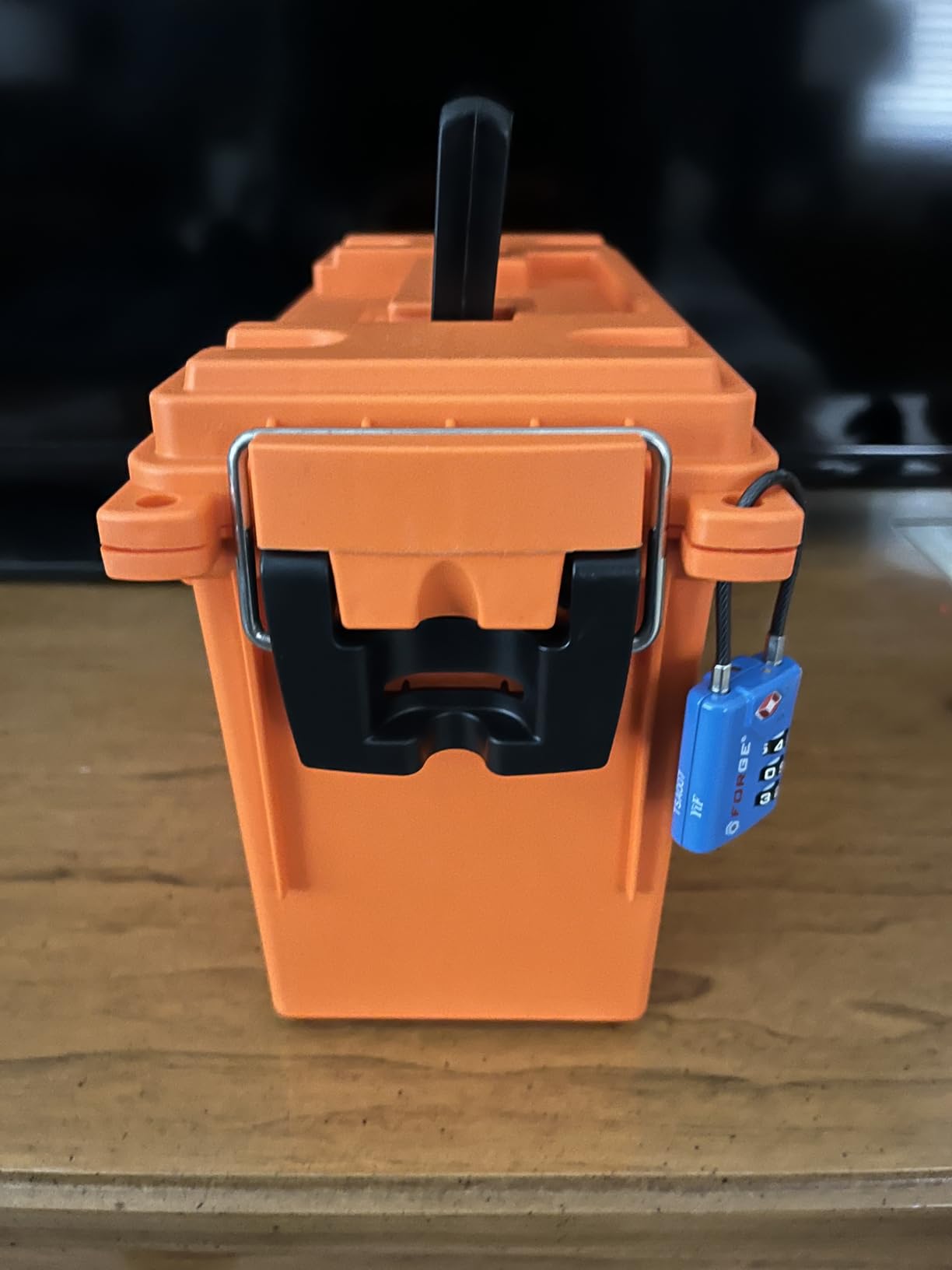
It carries a Sheffield limited lifetime warranty, which is a signal about how the company expects the moulded polypropylene body to hold up over time.
When a general marine box beats a tackle box
A tackle tray organises lures. A marine storage box secures gear that would be a problem if it got wet or walked off, and it does that better because the gasket and the lock are the whole design. Rigging hardware, terminal tackle bulk, spare hooks, gloves and small tools are all better in this box than rattling around loose in a tackle bag.
It also stacks, which a tackle tray does not. For a boat that stays in the water for weeks, a stack of sealed boxes is a better answer than one large open case.
Where it suits you best
This suits boat owners, dock anglers and anyone who needs lockable, stackable, splash-proof storage rather than lure organisation. Owners also use it for camping, craft and general small-parts storage.
The main drawback is that it has a single undivided main compartment, so it organises nothing on the inside. The thin polypropylene walls also feel flimsy next to heavier marine boxes, and 4.1 litres is enough for tools and short tackle loads rather than a full day of lures.
12. PLUSINNO Expandable Tackle Bag: Best for Growing Capacity
PLUSINNO Tackle Bag – Expandable Fishing Bag for Saltwater & Freshwater – Water Resistant Fishing Gear Shoulder Bag For Men, All-purpose Carrying Bags for Outdoors
16.5 x 10.4 x 11 inch compact
Expands to 19.6 x 10.4 x 11 inch
31L to 37L
13 pockets
Pros
- Waterproof-coated 900D polyester
- Zip-expand design from 31L to 37L
- Holds 10 to 12 tackle boxes
- Thirteen pockets including a pliers slot
- Stands upright when partially loaded
Cons
- Soft-sided build gives no rigid protection
- Bulky at full expansion
- Coating handles splash but is not submersible
The expandable design solves a specific problem: committing to a bag size before you know whether your offshore or shore load is going to be a nine-tray day or a twelve-tray day. A zip-expand system takes it from 31L holding around 10 tackle boxes to 37L holding up to 12, including 3700-size boxes, in seconds.
Material is 900D high-density polyester with a waterproof coating and reinforced X-stitching that owners say holds up against abrasion from rocks and branches. There are 13 storage pockets including mesh side pockets, two front panel pockets and a dedicated fish pliers slot, plus ergonomic padded straps.
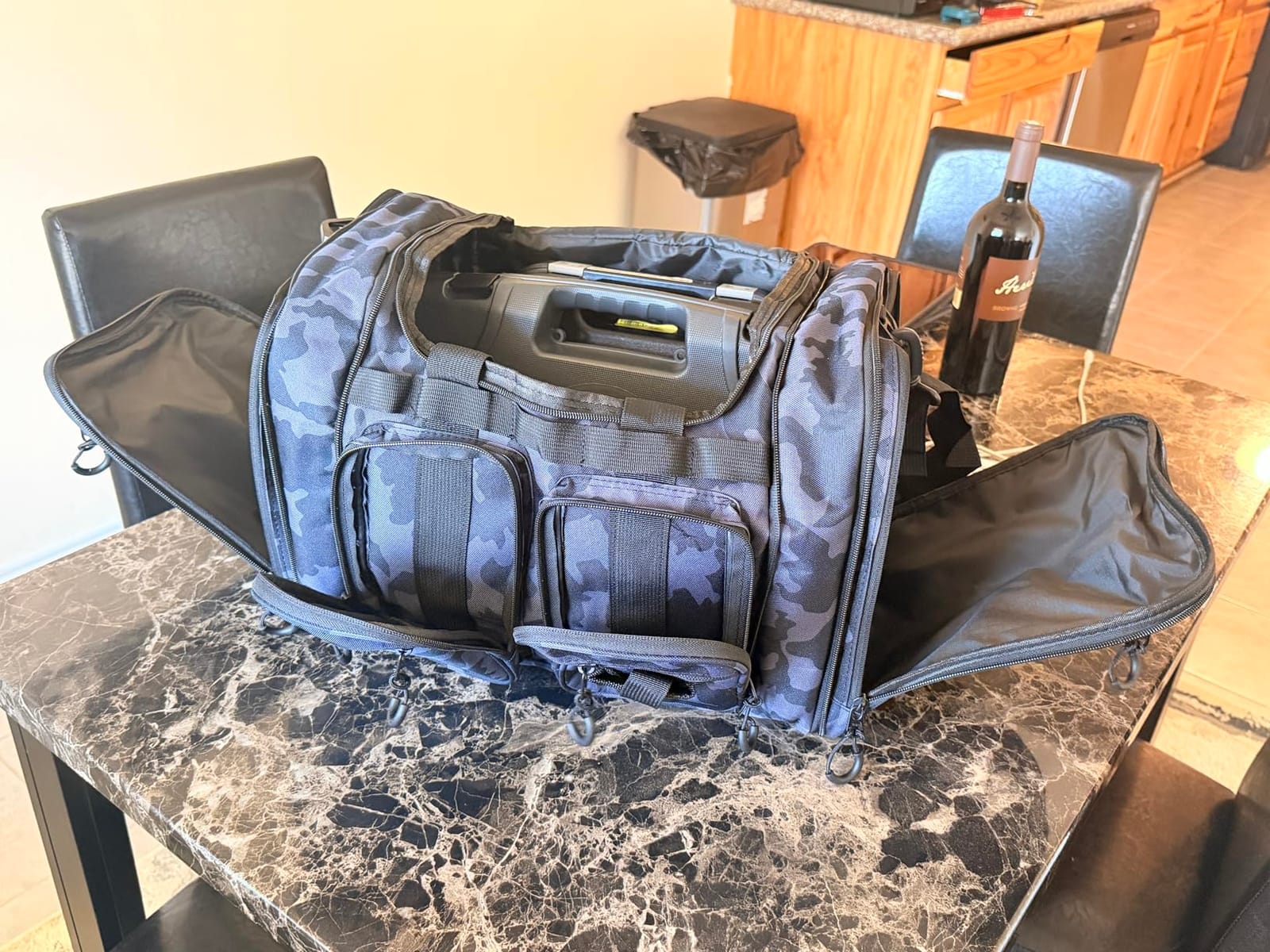
It is also a bag that holds its shape and stands upright when partially loaded, which matters more than it sounds when you are laying it down on a dock and want to grab one thing rather than everything.
Planning capacity before you buy
The recurring mistake in this category is underbuying. Anglers pick a bag that fits a day on the pontoon, then move to a trip where they need room for extra tackle, spare clothing and a cooler. A bag that expands or a bag with more volume than you need now costs far less than replacing a torn one at the end of a season.
The other planning question is tray footprint. A bag that accepts 3700 trays but not 3600 trays limits you later, so check the stated tray capacity and match it to the tray standard you have settled on.
Where it suits you best
This bag suits shore and kayak anglers whose capacity needs change week to week, and it doubles as a range or travel bag, which owners mention often. It suits a growing saltwater setup better than a fixed-size bag.
The limitations are honest ones. At full expansion the footprint is large, especially for light loads, and the soft-sided build gives no crush protection for fragile items. The coating handles splashes and sudden rain but is not submersible, so do not plan to dunk it.
How We Evaluated 12 Saltwater Tackle Boxes
We compared these twelve products against the four things that actually decide whether a tackle box survives salt: corrosion behaviour, sealing, tray and divider layout, and how it carries under load. Each unit was assessed on its material specification, closure design, hardware, dimensions, weight and real owner feedback at scale, then judged against the way saltwater anglers describe their own failures on the water.
We weighted owner feedback heavily, because this is a category where lab claims and lived experience diverge. A box can have a beautiful gasket and still fail if the hinges crack in season two. We read how anglers describe rust appearing on lures, latches seizing and cheap supplied trays cracking, since those patterns repeat across angler forums. The same forum-first discipline shapes our other gear testing, including our [Android TV box roundup](https://www.webdigi.net/best-android-tv-boxes/).
What to Look for in a Saltwater Tackle Box
Corrosion resistance. There are three approaches, and they are worth distinguishing. Gasket sealing keeps humid salt air out. Vapour-phase inhibitors such as Zerust, infused into dividers, protect the metal inside directly. Marine-grade or stainless hardware stops latches and hinges from seizing, which is the failure most anglers hit first. The best boxes combine at least two.
Water resistance versus waterproof. These terms are used loosely and they mean different things. Water-resistant means spray and rain will not soak through the fabric or shell. Waterproof means a rated seal, and some boxes carry a specific submersion figure with a time limit. Check the rating rather than the marketing word.
Tray sizing. The 3600 and 3700 numbers are a standard naming system used across the whole industry. A 3600 tray is the small shallow tray that most inshore anglers run, and a 3700 tray is the longer, wider standard tray that holds more. The number is not a capacity measurement, it is a footprint designation that tells you which bags and boxes will accept the tray.
Dividers versus compartment slots. Always count the dividers that ship, not the slots advertised. Pre-cut dividers limit you to a fixed layout, while removable dividers let you adapt the box between species and seasons. This is also why cheap supplied trays get replaced, since thin, low-quality trays crack and their dividers do not seat properly.
Hardware. Latches, hinges, screws and zippers are the components that die first in salt air. Brass and stainless hardware resist seizing where plated steel does not. Check whether hinges are moulded as separate parts, because integrated flexing hinges are what crack.
Portability. A 3.8-pound box is fine on a deck and terrible on a long beach walk. Weight, strap padding, and whether the bag stands upright when set down all matter more than most spec sheets admit. So does whether it has a handle at all, since hard boxes without one become a two-handed carry.
Which Tackle Box Fits Where You Fish
Fishing from a boat with a deck and a console? Choose a hard case or a modular tray system, because you have somewhere dry to put it and you will drop things. A sealed box like the Plano Guide Series 3600 Field Box or a stack of StowAway trays handles that well, and a bag sits inside a console locker rather than on your feet.
Fishing from the surf or a long beach walk? Choose a soft bag. The reason is simple: a soaked bag is a nuisance and a cracked hard box is a loss. A padded shoulder bag or a backpack carries more, survives a sand bath, and costs less to replace when it does fail.
Fishing from a kayak? Choose small sealed trays. You want low, compact boxes that sit in a deck hatch or strapped to the bow, and you want them to float if they go over. Standard-footprint trays stack and clip into systems, which matters when every gram counts.
Fishing from a pier or jetty? This is where the hard box earns its place, because you are stationary and can set a 3-tray cantilever box on the planks and see everything at once. Add a small marine storage box for rigging hardware you do not want wet.
Travelling with gear, including on a plane? Choose a backpack or a bag with a range-bag footprint. Padded straps and a rod holder matter when you are moving through terminals and down ramps rather than walking on sand.
Keeping a Saltwater Tackle Box Working
No competitor covers this, and it is the difference between a box that lasts one season and one that lasts five. Rinsing salt off gear after every trip is the single most repeated recommendation among saltwater anglers, and it is not about cleanliness, it is about stopping the chemistry.
Step one: rinse with fresh water. Salt crystallises out of damp boxes and settles on hooks and split rings, and that crystal is what attacks the metal. A quick freshwater rinse at the ramp or at the wash-down hose removes it before it dries.
Step two: air dry fully before closing. This is where most damage is done by well-meaning anglers. A tight seal closed over damp tackle traps moisture against the hooks and makes the airtight box work against you. Leave the lid open or the tray out overnight.
Step three: clean the seals. Wipe the gasket and the latch faces with a damp cloth and check for grit in the hinge. Salt on a rubber gasket becomes an abrasive that wears the seal, and grit in a hinge is how hinges crack.
Step four: rinse soft plastics separately. Salt degrades soft plastics and makes them go sticky against each other, so keep swimbaits and craws in their own compartments or their own bag rather than piled in one tray.
Step five: check hardware every few trips. Look at latch springs and screws for early rust and rinse them. Brass hardware responds to this and steel does not.
Frequently Asked Questions
What are the best tackle boxes for saltwater fishing?
The best tackle boxes for saltwater fishing combine corrosion protection with a real seal. Our top pick is the Plano Guide Series 3600 Field Box, rated submersible to one metre for up to 30 minutes with a Dri-Loc O-ring seal. For rust defense, the Flambeau T4P Pro Multiloader uses Zerust-infused dividers that protect metal directly. For beach and pier work, a soft bag like the KastKing KarryAll is the more sensible choice because a soaked bag costs far less than a ruined hard box.
What is the difference between a 3600 and 3700 tackle box?
The difference is footprint, not capacity. A 3600 tray is the smaller shallow tray most inshore anglers run, and a 3700 tray is the longer, wider standard tray that holds more. Both numbers are industry footprint designations, so a bag or box that accepts 3700 trays will usually accept 3600 trays too. Pick one standard and commit to it, because mixing footprints is why angler gear ends up scattered.
What is the best tackle bag for offshore fishing?
For offshore fishing the best tackle bag is one that holds the tray count you need and carries that load comfortably. The Reaction Tackle XL bag holds up to 12 full-size 3700 trays in 1000D PVC with removable dividers. For multi-day trips where you also carry clothing and food, the KastKing KarryAll 40L backpack fits four 3600 boxes across 14 dedicated pockets with a padded harness.
Should I get a hard tackle box or a soft bag for saltwater?
Choose a hard box if your priority is keeping water out, protecting fragile electronics and surviving rough handling. Choose a soft bag if you are walking a long way, carrying a heavy load, or fishing from shore, because a soaked bag is a nuisance while a ruined hard shell is a replacement cost. Many inshore anglers run both, putting sealed trays inside a soft bag.
How do I stop hooks rusting in a tackle box?
Stop hooks rusting by removing all three requirements rust needs: metal, moisture and time. Rinse the box and tackle with fresh water after every trip, air dry everything fully before closing the lid, and never latch a box shut over damp lures. For long-term storage, use vapour-phase corrosion inhibitors such as Zerust, which release a compound that coats the metal and slows the reaction directly.
How do I clean salt water out of my tackle box?
Rinse the box with fresh water after every trip, paying attention to the gasket, the latch faces and the hinge. Open the lid or remove the trays and let everything air dry fully before closing. Wipe the rubber seal with a damp cloth to remove grit and salt crystals, because dried salt becomes abrasive and wears the gasket out faster than normal use does.
Final Word on Saltwater Tackle Storage in 2026
There is no single best tackle box for saltwater fishing, because the answer depends entirely on where you fish and how long your gear sits in a closed container. If we had to pick one, the Plano Guide Series 3600 Field Box gives the strongest combination of a rated seal, rugged polycarbonate and proven long-term owner satisfaction.
Match the format to the platform: sealed hard cases for the deck, soft bags for the walk to the beach, small sealed trays in the kayak, and a vapour-phase inhibitor box for anything that will sit unopened for weeks. Whatever you choose, rinse it in fresh water, dry it fully, and it will still be doing this job next season.