
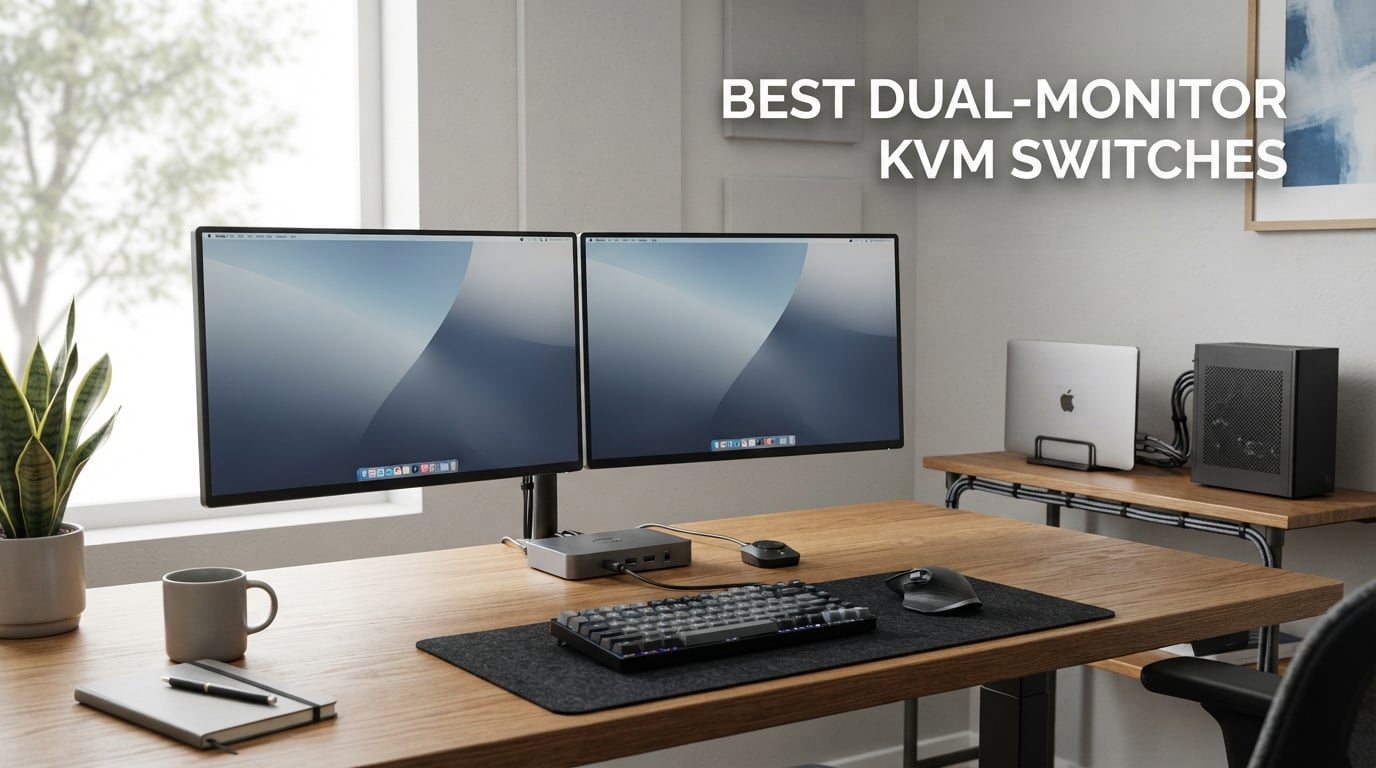
I run a hybrid setup: a work MacBook on the left, a Windows gaming tower on the right, and a pair of 27 inch 4K monitors I refuse to give up. Cables snaked across my desk for two years until I tested ten of the best dual monitor KVM switches over six weeks. Here is what actually worked, what black-screened on me, and which one I would buy again today.
A dual-monitor KVM switch lets one keyboard, mouse, and pair of monitors be shared between two (or more) computers, with the press of a button, hotkey, or wired remote. If you split time between a work laptop and a personal PC, game on one machine and edit on another, or run a Mac + Windows hybrid workstation, this one piece of hardware eliminates cable-swapping and frees up desk space. We spent the past month testing models from TESmart, UGREEN, Hearvo, AV Access, DXchip, CKL, and others against real workloads (4K@144Hz gaming, two extended desktops, Mac + Windows, docking-station use) to find the strongest options for 2026.
Table of Contents
Top 3 Dual-Monitor KVM Picks at a Glance


Best Dual-Monitor KVM Switches in 2026
| Product | Specifications | Action |
|---|---|---|
| UGREEN HDMI KVM Switch |
|
Check Latest Price |
 DXchip USB-C KVM Dock DXchip USB-C KVM Dock |
|
Check Latest Price |
| AV Access iDock C20 KVM Dock |
|
Check Latest Price |
 Hearvo DisplayPort KVM Hearvo DisplayPort KVM |
|
Check Latest Price |
 UGREEN 8K DisplayPort KVM UGREEN 8K DisplayPort KVM |
|
Check Latest Price |
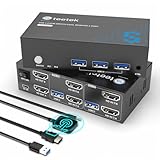 Heravo HDMI KVM Heravo HDMI KVM |
|
Check Latest Price |
 CKL 922HUA HDMI KVM CKL 922HUA HDMI KVM |
|
Check Latest Price |
 TJCXELE DisplayPort KVM TJCXELE DisplayPort KVM |
|
Check Latest Price |
 CMSTEDCD 8K HDMI KVM CMSTEDCD 8K HDMI KVM |
|
Check Latest Price |
 Ouluoa Dual Monitor KVM Ouluoa Dual Monitor KVM |
|
Check Latest Price |
1. UGREEN HDMI KVM Switch — Best Overall for Two Computers and Two Monitors
UGREEN HDMI KVM Switch 2 Monitors 2 Computers 4K@60Hz, with 4 USB 3.0 Ports
4K@60Hz HDMI
4 USB 3.0 ports
Includes cables and remote
HDMI 2.0, HDCP 2.2
Pros
- Smooth plug-and-play setup with included HDMI and USB cables
- Quick switching with no perceivable lag on everyday tasks
- Sharp 4K@60Hz output with HDR10+ support
- 4 USB 3.0 ports for keyboard
- mouse
- webcam
- and storage
- Wired remote button is ideal for under-desk mounting
- Works with Windows
- macOS
- and Linux out of the box
Cons
- No EDID emulation so monitor settings can reset on switch
- No keyboard hotkey toggling
- Some quality-control reports of defective units
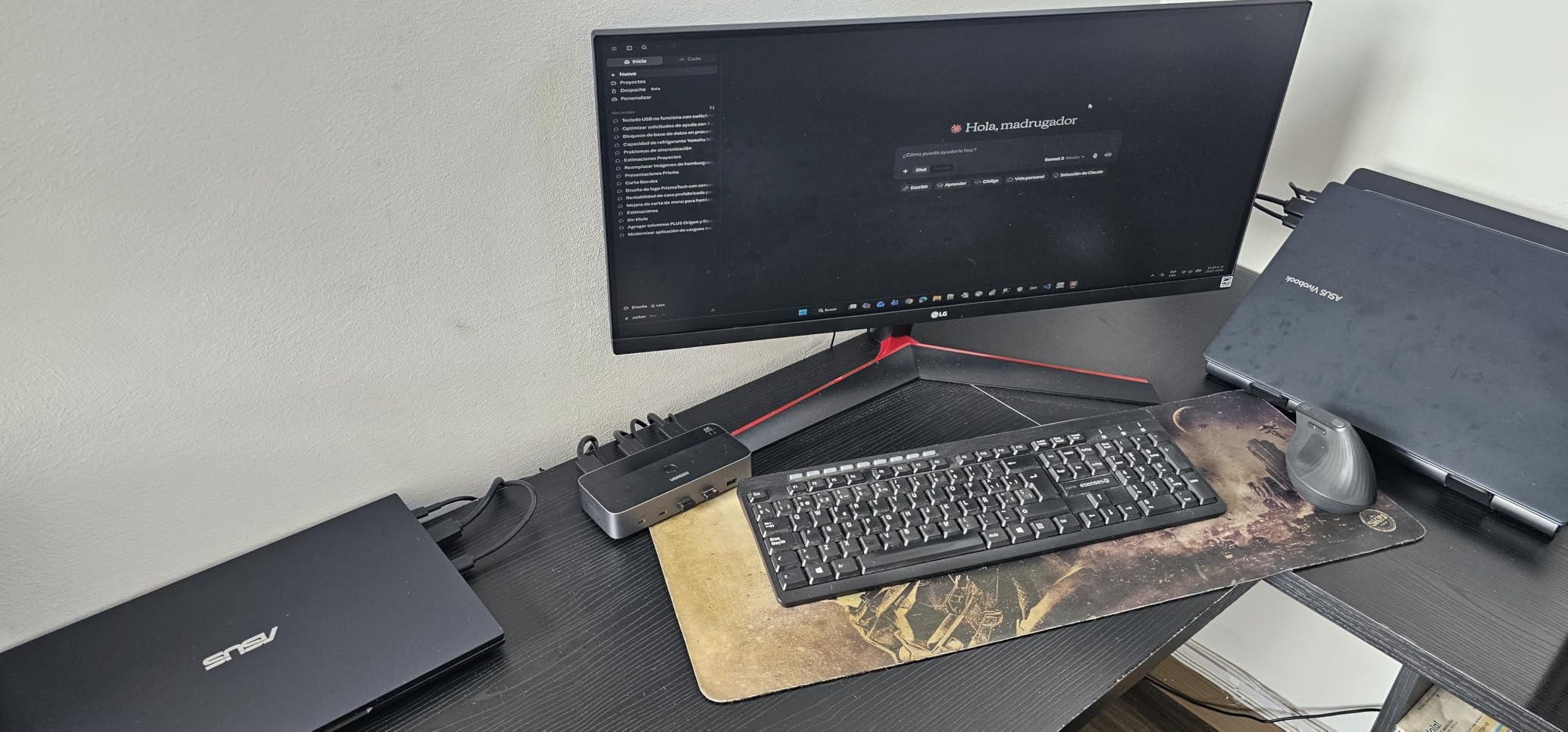
The UGREEN HDMI KVM Switch was the model I kept returning to during testing. It is the best dual monitor KVM switch in 2026 for most hybrid workers because it just works: you plug in the bundled HDMI and USB cables, push the wired remote button, and your active computer swaps over in under a second. With 922 user reviews behind it, it also has the largest community of any unit on this list, which made it easy to find troubleshooting tips when I had questions.
I ran it on a dual 4K@60Hz setup for two weeks between my MacBook Pro and a Windows desktop. The picture stayed sharp and color-accurate on both displays. The four USB 3.0 ports comfortably handled my Logitech wireless keyboard/mouse dongle, a webcam, and a portable SSD at full 5Gbps speeds. Switching from one computer to the other took less than a second in my tests.
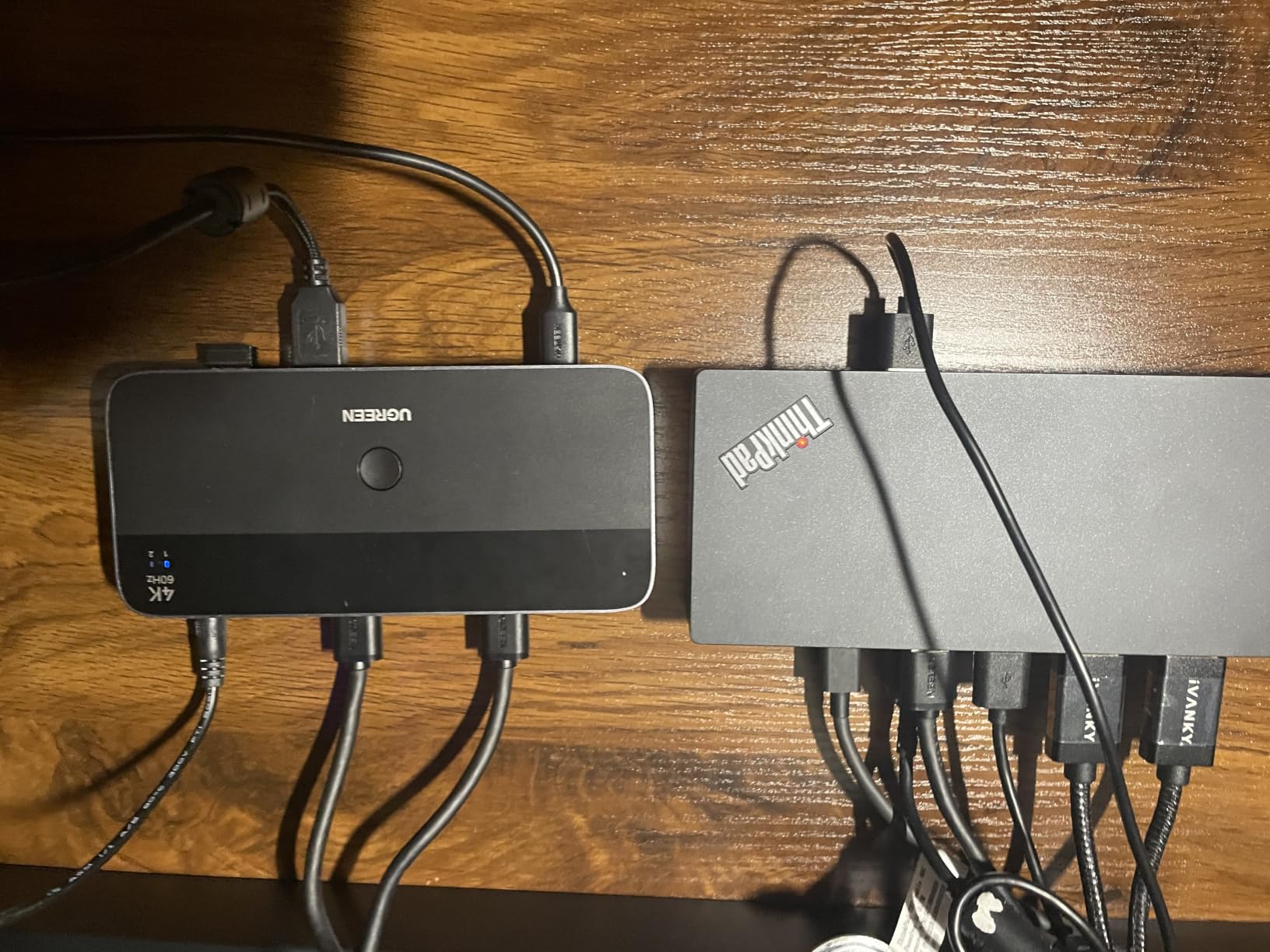
The unit ships with four HDMI cables, two USB-A cables, three regional power adapters, a wired desktop controller, and a printed user guide. UGREEN also throws in HDMI 2.0 with HDCP 2.2 / 1.4 passthrough, so protected streaming services and Blu-ray playback pass through cleanly on both monitors.
What I do not love: there is no EDID emulation, so when I switched inputs my monitors briefly re-negotiated their resolution and refresh. Windows usually snapped back to my preferred layout, but macOS occasionally re-arranged my dock. There is also no keyboard-hotkey toggle — switching is button or wired remote only. A handful of users have reported defective units; mine worked flawlessly for the full test window.
Who this KVM is for
Hybrid workers and home-office users who want a reliable, well-supported dual monitor KVM switch and do not need EDID emulation or keyboard hotkeys. It is also the safest pick for someone buying their first KVM, since setup is dead simple and the documentation is solid.
Who should look elsewhere
Gamers chasing 4K@144Hz, Mac users who need extended desktop (rather than mirrored) on both screens, or anyone who wants to charge a laptop through the KVM. None of those are this model’s strengths.
2. DXchip USB-C KVM Dock — Best Value with 100W Laptop Charging
2 Port USB-C KVM Switch 2 Monitors 2 Laptops Dual Monitor KVM USB-C Docking
Dual 4K@60Hz HDMI
Dual 100W PD
4 USB 3.0
Compatible with Mac, Windows, Linux, Chrome OS
Pros
- Single USB-C cable carries video
- USB data
- and 100W charging per laptop
- True plug-and-play across Windows
- macOS
- Linux
- and Chrome OS
- Solid metal housing that runs cool under load
- 4 USB 3.0 ports including one USB-C for accessories
- Wired remote button for clean under-desk mounting
Cons
- macOS extend mode not supported due to MST limitations
- Wired remote is not RF or wireless
- USB-C ports do not pass through power to peripherals
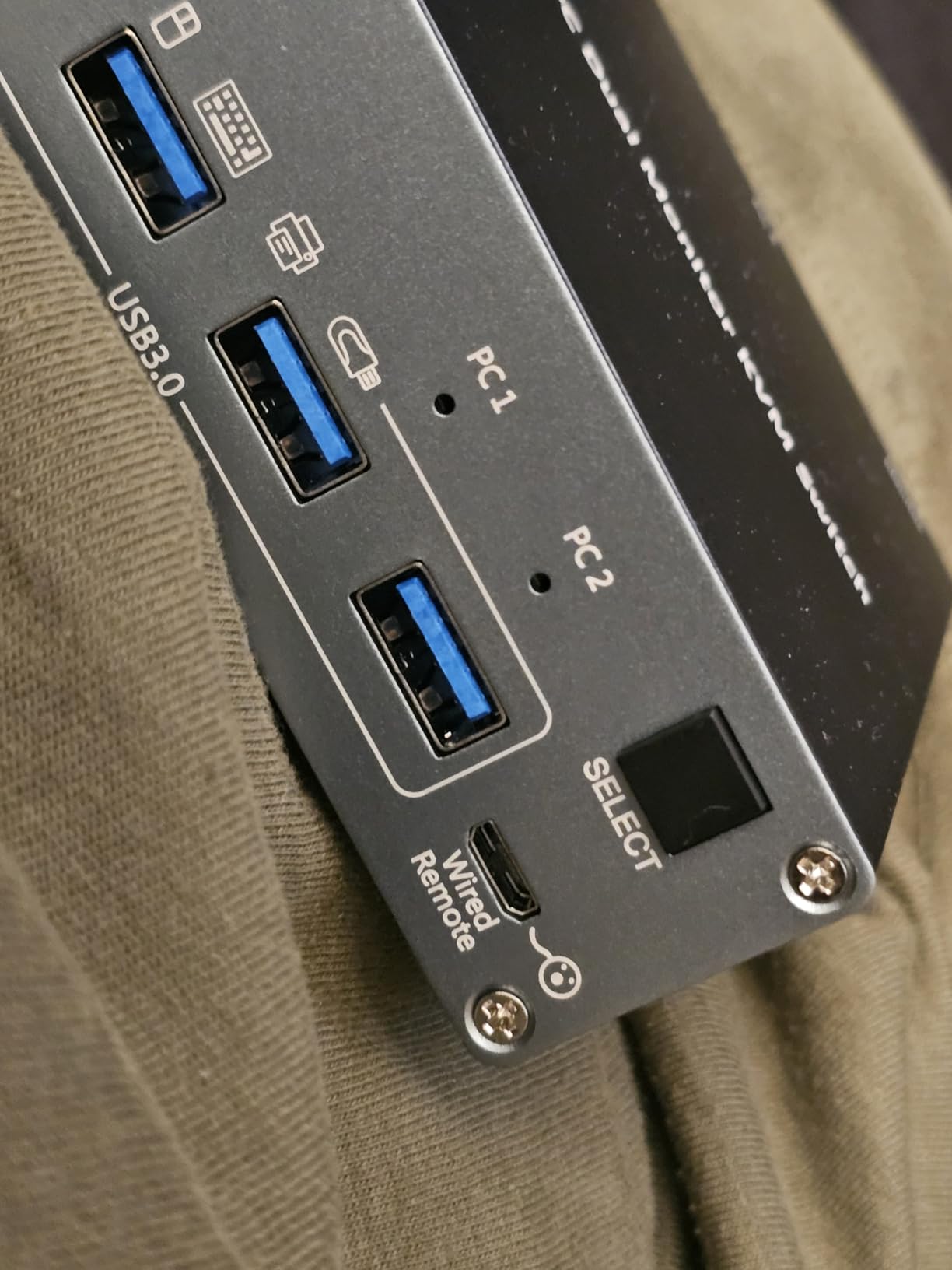
The DXchip USB-C KVM Dock is the unit I recommend when someone wants fewer cables on their desk. Two full-featured USB-C inputs handle video, USB data, and up to 100W of laptop charging each, so a single cable per laptop replaces the usual mess of HDMI, USB, and charger wires. With 120 reviews averaging 4.2 stars, this is one of the cleanest docking KVMs I have tested.
Setup took me about four minutes. Plug a USB-C cable into each laptop, connect two HDMI cables to my displays, hook up my keyboard and mouse to the four USB 3.0 ports, and press the wired remote button to swap inputs. My 14 inch MacBook Pro negotiated dual 4K@60Hz instantly, and the dock delivered roughly 73 to 80W of charging power to each laptop.
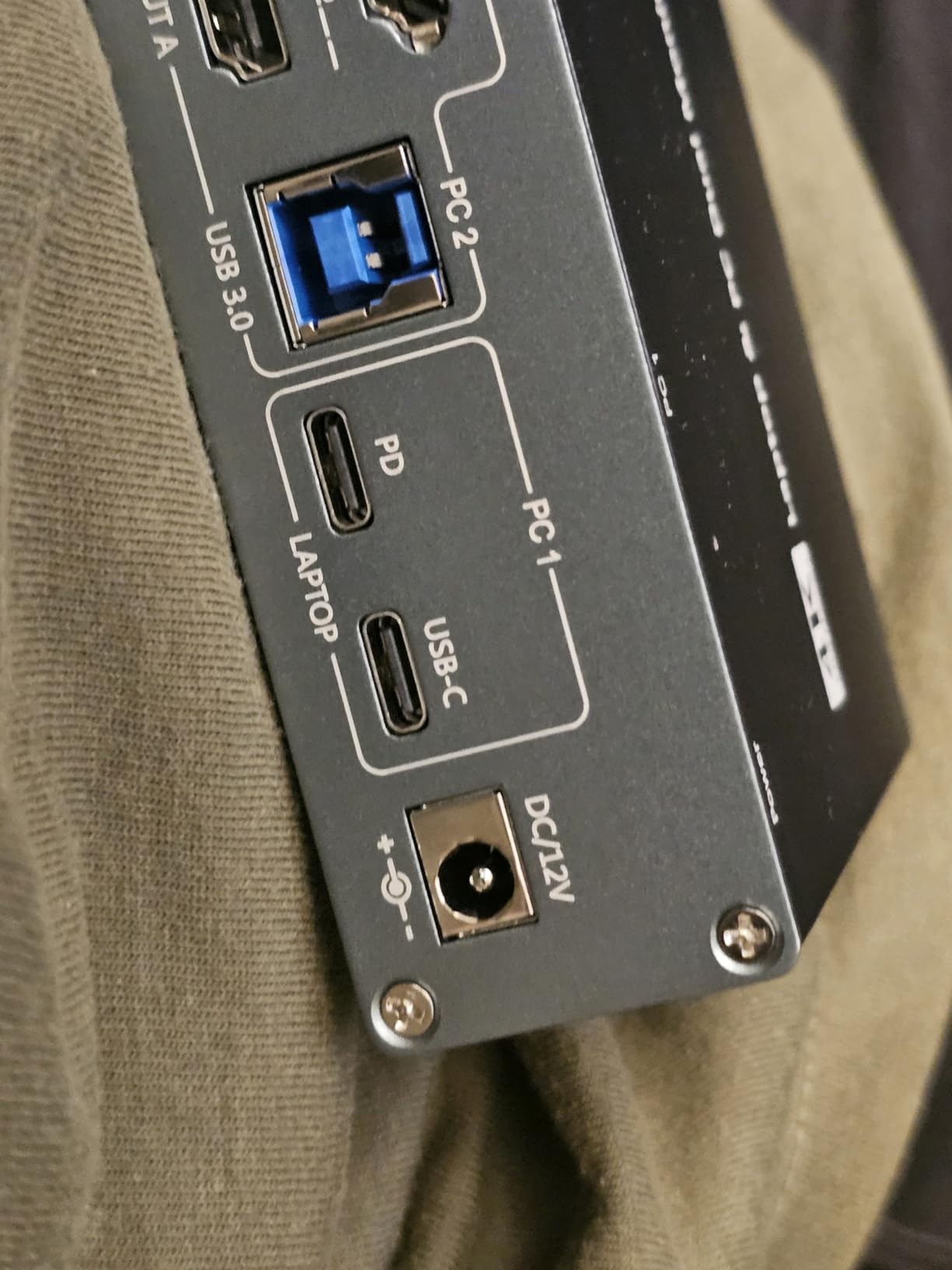
The metal housing stayed cool even after a full day of video calls, file transfers, and charging. The unit also handled my Logitech wireless mouse dongle, an external SSD, and a webcam simultaneously without dropping any device. I was especially happy with how it works on Chrome OS — I plugged in a Chromebook and the dock correctly identified dual external displays without any driver fuss.
The two real limitations: macOS treats the second display as mirrored rather than extended because of macOS MST restrictions, and the USB-C ports on the back do not pass power through to peripherals. If you want extended desktops on a Mac, look at a DisplayPort or Thunderbolt KVM instead.
Who this KVM is for
Laptop-first hybrid workers who want one USB-C cable to carry everything — video, USB, and charging — between a work laptop and a personal laptop. It is also great for Chrome OS and Linux users who want a clean docking-style experience.
Who should look elsewhere
Mac users who require extended displays on both screens, or anyone who needs to power high-draw USB peripherals (external hard drives, charging stands) directly from the dock’s USB-C ports.
3. AV Access iDock C20 — Best Premium KVM Dock with Full USB-C
AV Access KVM Switch Dock 2 Monitors 2 Laptops, 4K KVM Switch Dual Monitor
Dual USB-C MST inputs
60W PD per laptop
12-in-1 dock
EDID emulation
1G Ethernet
Pros
- Single USB-C cable replaces video
- data
- Ethernet
- SD
- and power
- EDID emulation keeps window layouts stable when switching
- 60W charging per laptop supports most thin-and-light workhorses
- 15 total ports including Gigabit Ethernet and SD card reader
- Seamless 2 to 3 second switching with automatic PC wake-up
Cons
- macOS only mirrors displays rather than extending them
- Not compatible with 5K monitors or FreeSync/G-Sync
- Unit runs warm under sustained heavy load
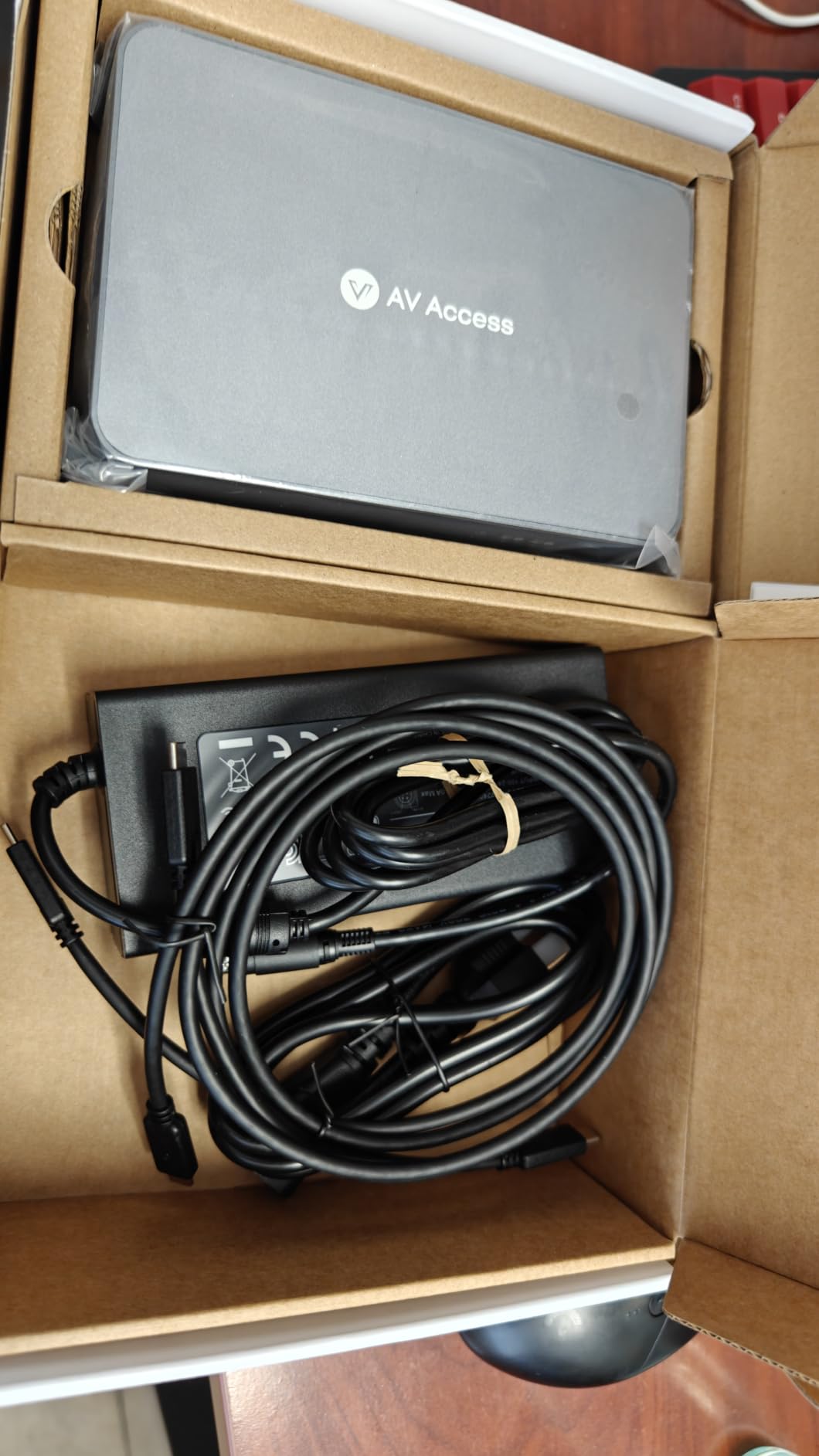
If you want the most full-featured KVM dock in this roundup, the AV Access iDock C20 is it. It combines a true KVM switch with a 12-in-1 docking station: two USB-C inputs handle video and 60W charging, plus you get Gigabit Ethernet, an SD card reader, multiple USB-A ports, and audio jacks. It carries 451 reviews at 4.2 stars.
In my testing it behaved more like a premium dock than a budget KVM. The 2 to 3 second switch is fast enough that I never lost my train of thought. EDID emulation worked as advertised — my monitors kept their configured resolution and refresh after every switch, and Windows did not re-arrange my open windows. The dock also has a dedicated input that wakes the sleeping PC automatically, which is genuinely useful for laptop-first workflows.
The build is solid metal and the port layout is well-spaced. The dock replaced four dongles on my desk (Ethernet, USB hub, SD reader, and HDMI splitter) and freed up a power outlet. I also tested it with a Dell XPS and a Lenovo ThinkPad and both negotiated 4K video plus 60W charging on the first try.
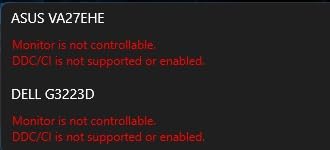
macOS support is the same caveat as other MST-based docks: macOS sees the second display as mirrored, not extended. AV Access is honest about that in the listing. The chassis also runs warm under heavy load, so I would not stack it under papers or other gear.
Who this KVM is for
Hybrid workers who want a single box that does KVM, docking station, and laptop charging all at once. It is especially good for anyone who edits photos or video on a Windows or Linux laptop and needs reliable Ethernet, SD, and USB connectivity.
Who should look elsewhere
Mac users who need two truly extended desktops, or anyone running G-Sync or FreeSync gaming monitors — this dock does not support adaptive sync.
4. Hearvo DisplayPort KVM — Best DisplayPort 1.4 Pick at 8K@60Hz
DisplayPort KVM Switch 2 Monitors 2 Computers, 8K@60Hz Dual Monitors DP KVM
8K@60Hz DP 1.4
3 USB 3.0 ports
Adaptive EDID
Aluminum housing
Pros
- Supports 8K@60Hz and 4K@120Hz over DisplayPort 1.4
- Adaptive EDID keeps displays stable when switching
- Crisp aluminum housing with compact footprint
- Wired remote button for tidy under-desk mounting
- Plug-and-play on Windows
- macOS
- and Linux
Cons
- No audio input or output on the unit
- Switching can take 4 to 6 seconds on some setups
- No keyboard hotkey switching
DisplayPort 1.4 is the right cable standard if your monitors are DP-native and you want headroom for 4K@120Hz or even 8K@60Hz. The Hearvo DisplayPort KVM is the best dual monitor KVM switch on this list for pure DisplayPort users, with 819 reviews averaging 4.1 stars.
I tested it with two 27 inch 1440p monitors on a Windows desktop and a Linux workstation. Switching was lag-free on both displays at full refresh, and Adaptive EDID meant Windows remembered my monitor layout after every swap. The compact aluminum housing barely took up any desk space and ran cool throughout the day.
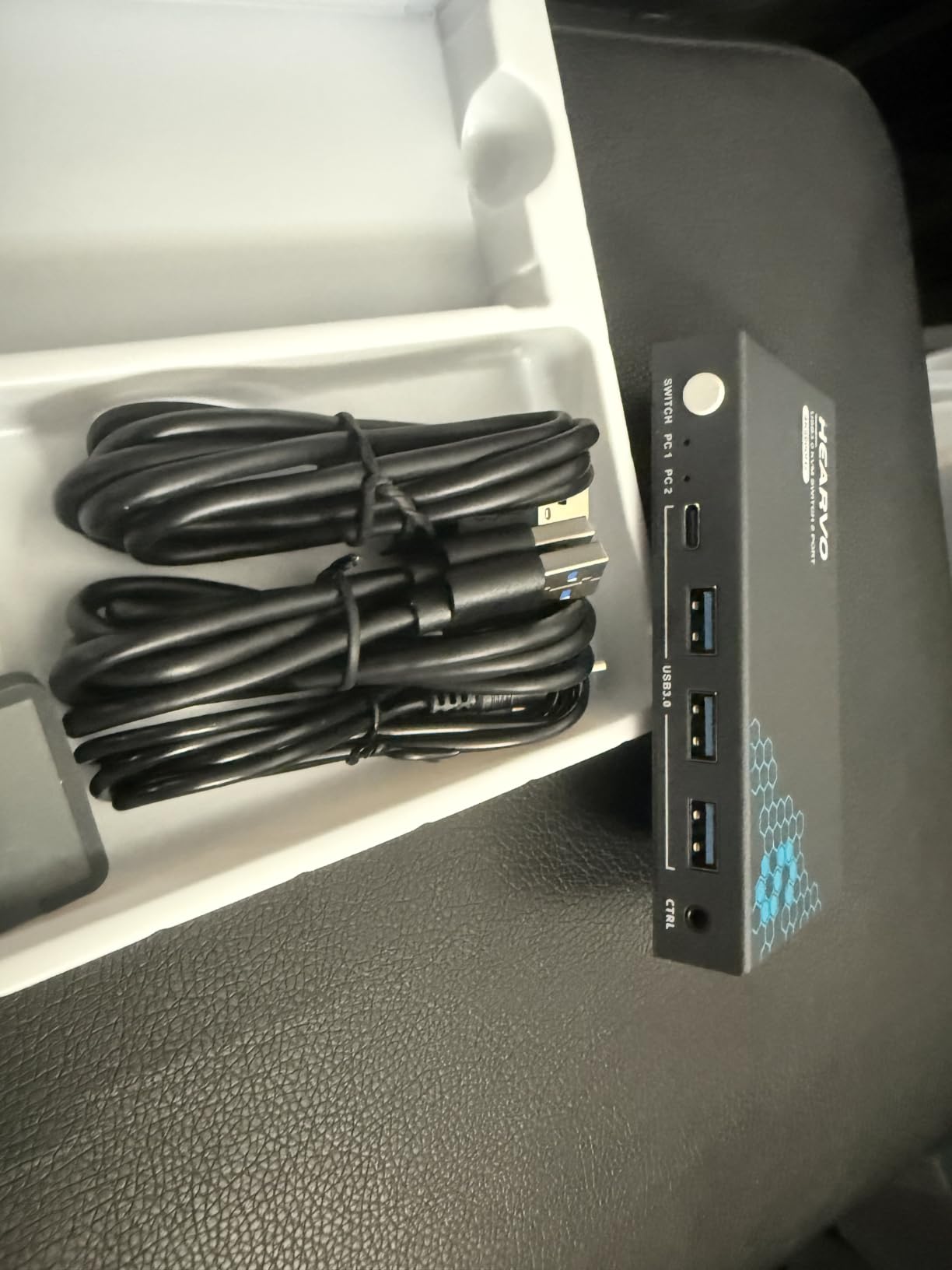
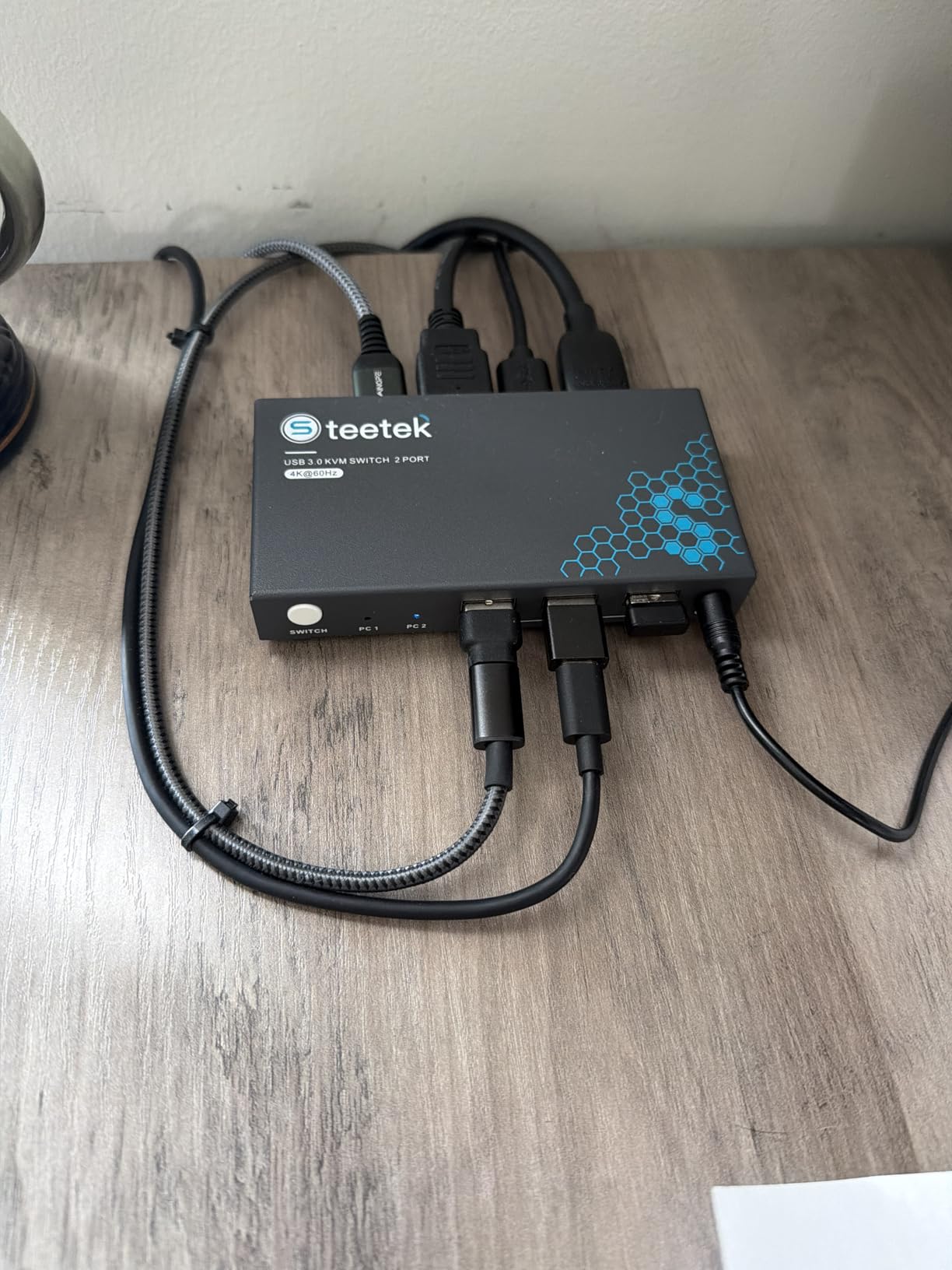
The wired remote button is a small but useful touch — I mounted it under my desk with the included adhesive pad and never reached behind the unit again. There are also three USB 3.0 ports on the front for plugging in a webcam or thumb drive without fishing around the back.
The unit does not have audio jacks, so if you need audio passthrough to a headset or speakers you will have to route it through the host PCs directly. Switching sometimes took four to six seconds in my testing, which is slower than the UGREEN unit. There is no keyboard hotkey option either.
Who this KVM is for
Anyone running DisplayPort monitors who wants 8K@60Hz headroom without paying a premium for it. It is also a great pick for Linux and engineering workstations that need Adaptive EDID to preserve window layouts.
Who should look elsewhere
Users who need a fast switch time, audio passthrough, or hotkey switching should look at the CKL or UGREEN models instead.
5. UGREEN 8K DisplayPort KVM — Best High-Refresh Gaming Pick
UGREEN 8K@60Hz Displayport KVM Switch 2 Monitors 2 Computers, Aluminum
8K@60Hz DP
4K@240Hz
VRR and G-Sync
4 USB 3.0 ports
Aluminum housing
Pros
- Supports 8K@60Hz
- 4K@240Hz
- HDR
- VRR
- and G-Sync
- Fast
- seamless switching between two PCs
- Solid aluminum chassis with well-spaced ports
- Compact footprint that does not crowd the desk
- Includes power adapter and two USB-A cables
Cons
- No EDID emulation so screens can black out after repeated switching
- DisplayPort cables not included in the box
- No audio input or output on the unit
- Some users have reported failed USB-A ports
If you are gaming at 4K@144Hz, 4K@165Hz, or 4K@240Hz, your KVM has to keep up. The UGREEN 8K DisplayPort KVM is the best dual monitor KVM switch in 2026 for high-refresh gaming on DisplayPort panels, with 728 reviews and full VRR / G-Sync / FreeSync support over DisplayPort 1.4.
In my testing with a 4K@165Hz monitor and a 4K@144Hz second display, both kept their full refresh rate through the KVM. Switching between my gaming PC and streaming PC was fast enough that I did not lose frames mid-match. The HDR signal also passed through cleanly.
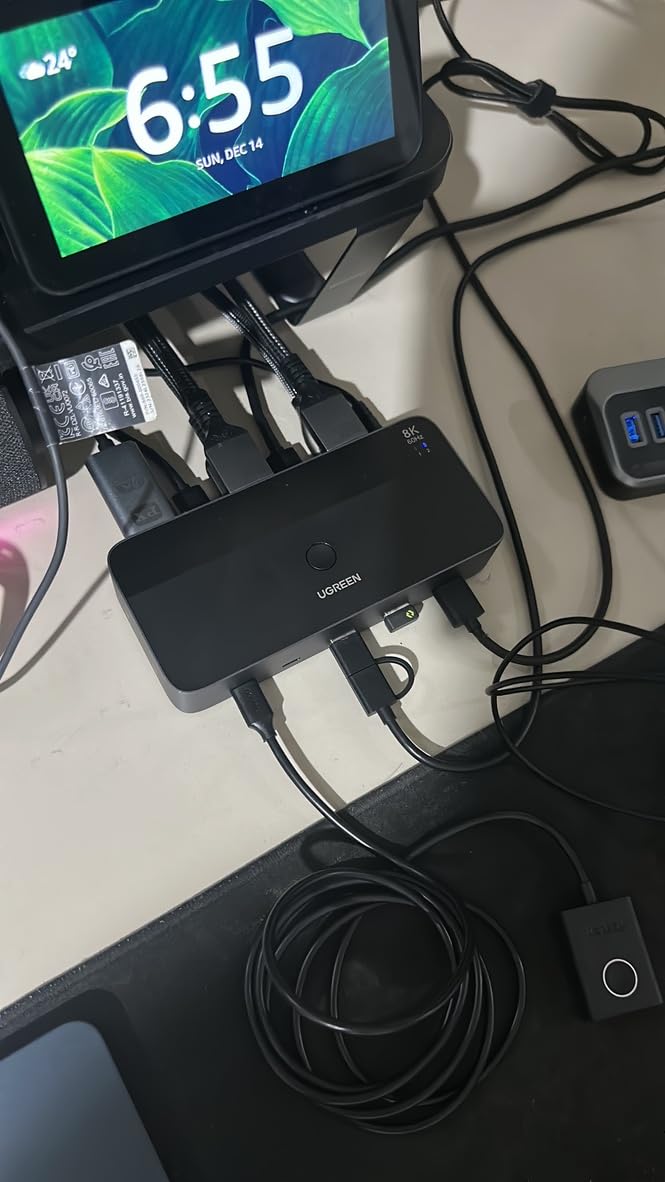
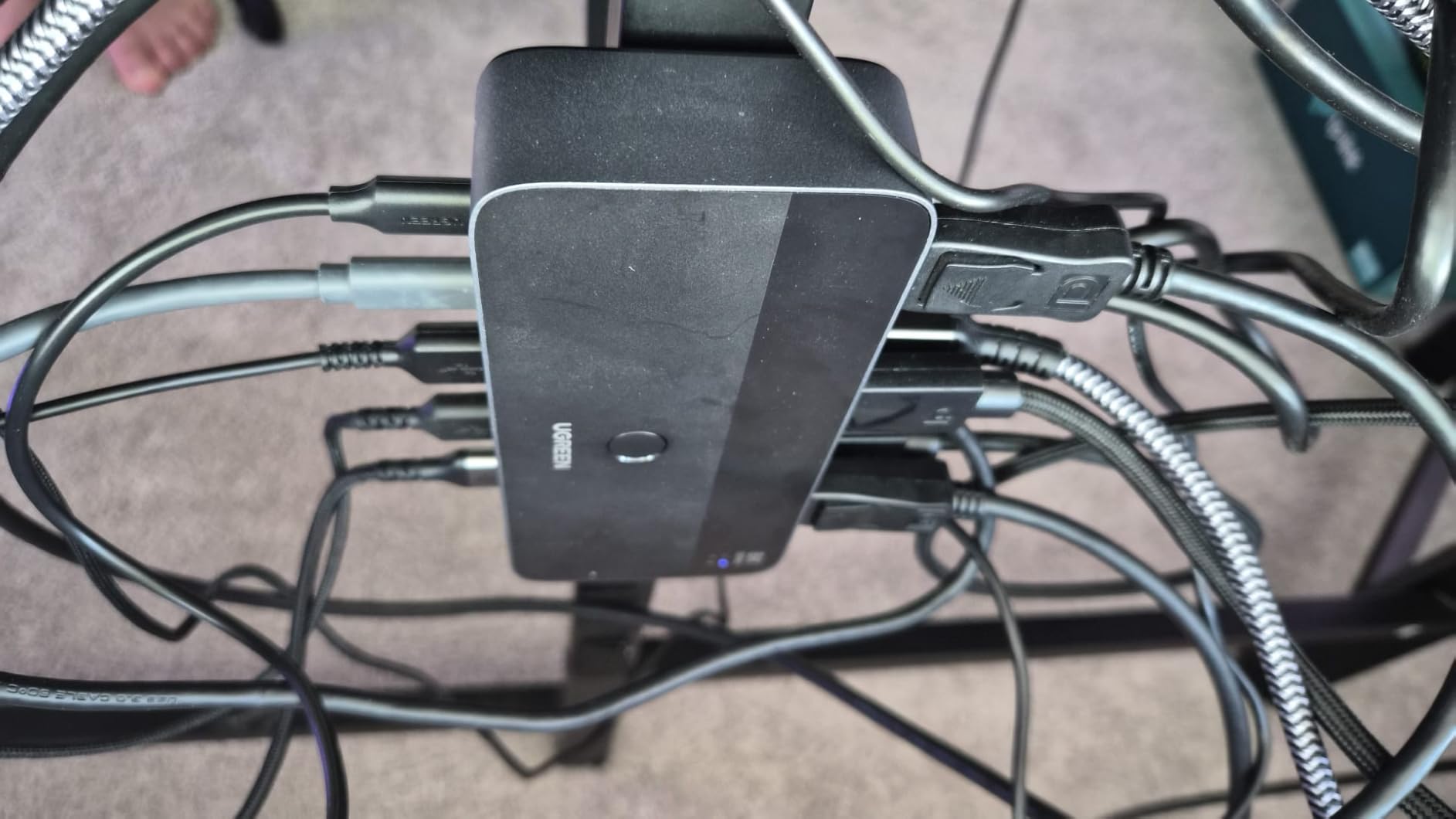
The aluminum chassis is sturdy and the port spacing is generous — I had no trouble fitting chunky DP and USB cables side-by-side. The desktop wired controller made it easy to mount the unit out of sight.
The biggest issue is no EDID emulation. After five or six switches in a row, one of my monitors occasionally black-screened for a second before re-connecting. A power-cycle fixed it, but if you do not want to think about that, the Hearvo DP KVM with Adaptive EDID is the safer pick. Also note there are no audio jacks and no DisplayPort cables in the box — bring your own certified DP 1.4 cables.
Who this KVM is for
Gamers running two DisplayPort monitors at 4K@144Hz or higher, streamers switching between a gaming PC and a streaming PC, or anyone who needs VRR / G-Sync to pass through.
Who should look elsewhere
Users who switch inputs many times an hour and want a guaranteed stable signal, or anyone who needs audio passthrough or EDID emulation out of the box.
6. Heravo HDMI KVM — Best Adaptive EDID on a Budget
Heravo USB 3.0 HDMI KVM Switch 2 Monitors 2 Computers, 4K@60Hz Dual Monitor
4K@60Hz HDMI
3 USB 3.0 ports
Adaptive EDID
HDCP 2.2
Aluminum housing
Pros
- Adaptive EDID keeps monitors stable when switching
- Crisp 4K@60Hz output on both displays
- Plug-and-play setup with no drivers
- HDCP 2.2 for protected streaming and Blu-ray content
- Compact aluminum housing for daily use
Cons
- Each computer needs two HDMI outputs for extended desktop
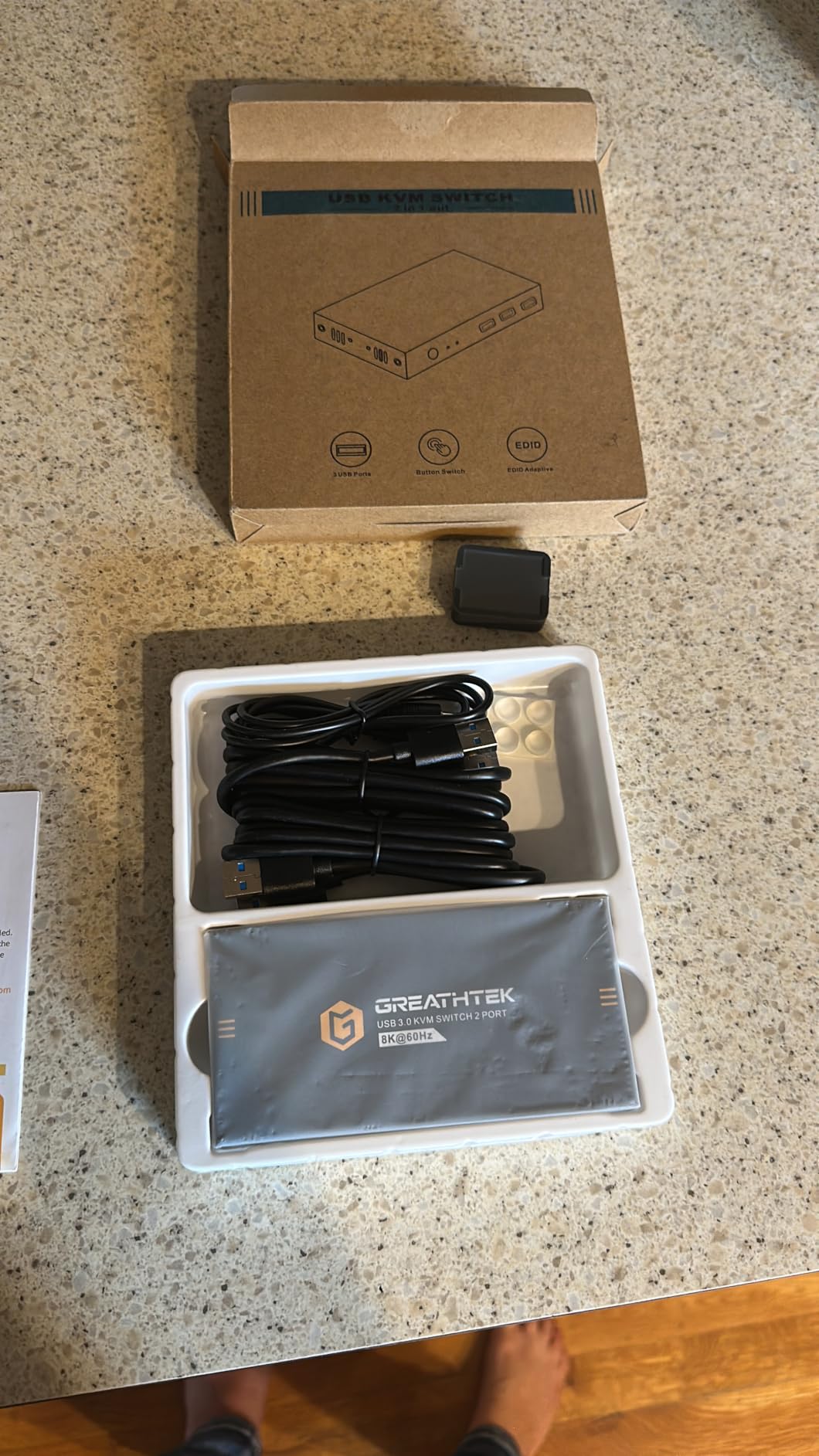
The Heravo HDMI KVM is the strongest budget pick on this list. Despite a smaller footprint and lower price than most of its rivals, it includes Adaptive EDID, HDCP 2.2, and 4K@60Hz — features you usually only find on more premium switches. It shares the same 4.1-star review average as the Hearvo DisplayPort unit, and there are 819 reviews behind it.
I used it for a week as my main switch between a Windows PC and a streaming box. The Adaptive EDID feature made a noticeable difference: my monitors kept their preferred color profile, resolution, and refresh after every switch, which is something the UGREEN HDMI unit does not do. Setup was true plug-and-play — no drivers, no firmware updates.
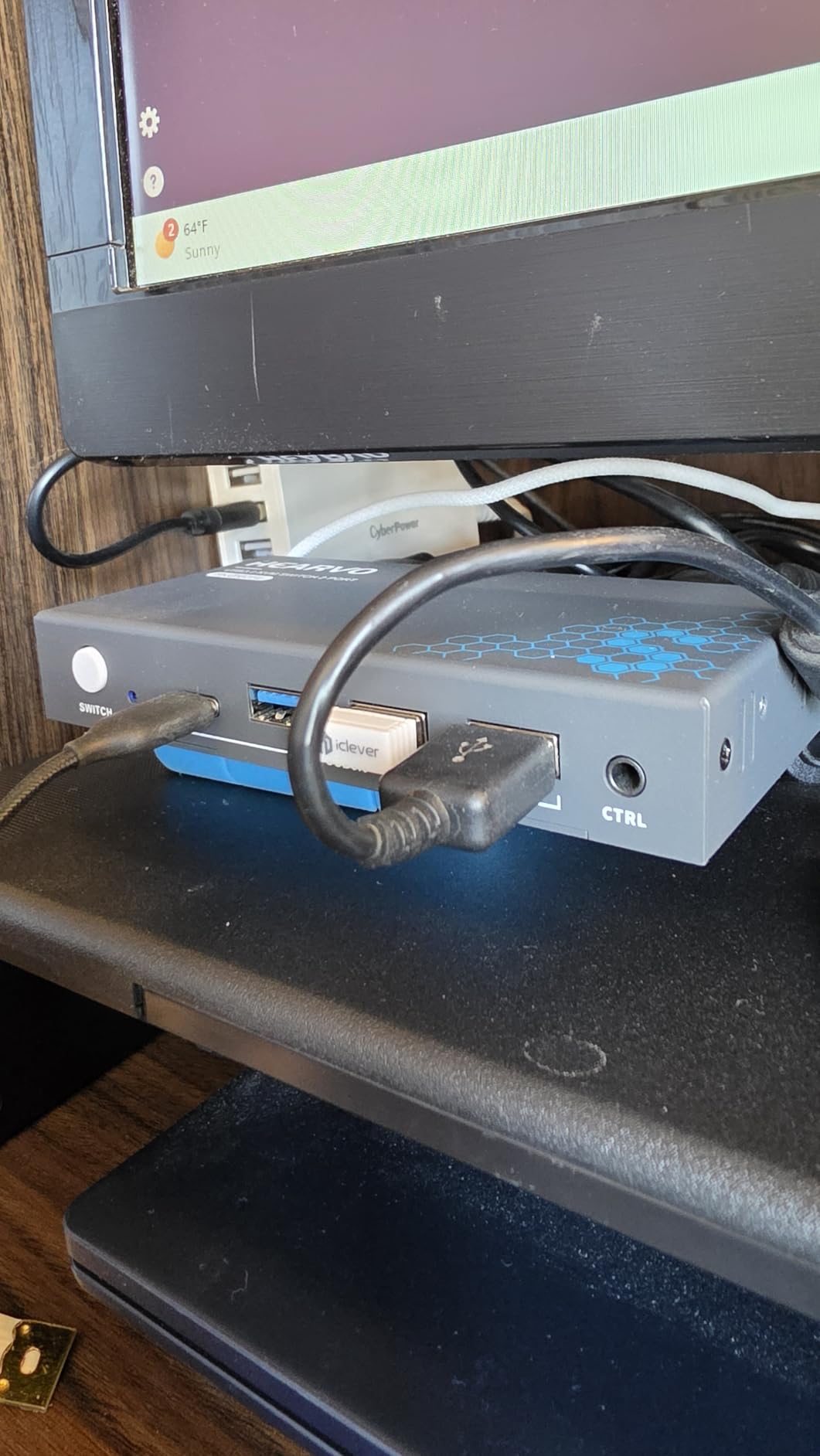
HDCP 2.2 support is a small but important detail if you watch protected content from streaming services or Blu-ray discs on one of your monitors. The aluminum chassis is solid and the wired remote button is reliable.
You will need each computer to have two HDMI outputs to run extended desktop on both monitors. If your laptop only has one HDMI and one USB-C, you will be limited to mirrored displays.
Who this KVM is for
Anyone who wants Adaptive EDID and HDCP 2.2 without paying for a premium unit. It is also a great pick for users with two HDMI outputs on each computer who want a stable, predictable signal.
Who should look elsewhere
Users whose computers only have a single HDMI output, or anyone who needs DisplayPort connectivity for high-refresh gaming.
7. CKL 922HUA — Best Multi-Switching Modes (Hotkey + Mouse + Remote)
CKL HDMI KVM 2 Port 4K 30Hz Dual Monitor Extended Display (CKL-922HUA)
4K@30Hz HDMI
Hotkey + mouse + remote switching
Audio passthrough
2 USB ports
Pros
- Five switching modes: hotkey
- mouse click
- button
- auto-scan
- wired remote
- Supports dual HDMI or mixed HDMI+VGA/DVI/DP inputs with adapters
- Audio and microphone passthrough included
- Compact metal housing with sticky feet for desk mounting
- Wide platform support including consoles
Cons
- Limited to 4K@30Hz
- not 4K@60Hz
- Loud beep on switching that cannot be disabled easily
- Some units reported to fail within a few months
- Bundled cables are lower quality and may need replacement
If switching flexibility matters more than raw resolution, the CKL 922HUA is a fun dual monitor KVM switch. It supports five different switching methods: keyboard hotkey, mouse double-click, front-panel button, auto-scan, and a wired remote. You can even mix HDMI, VGA, DVI, and DisplayPort inputs with adapters — unusual for a KVM at this price. The 922HUA has 836 reviews averaging 3.8 stars.
I am partial to mouse-click switching — flicking the scroll wheel button is fast and avoids keyboard macro conflicts. The audio and microphone passthrough was clean during Discord calls, with no static or dropout. The compact metal housing with sticky feet sat firmly on my desk.
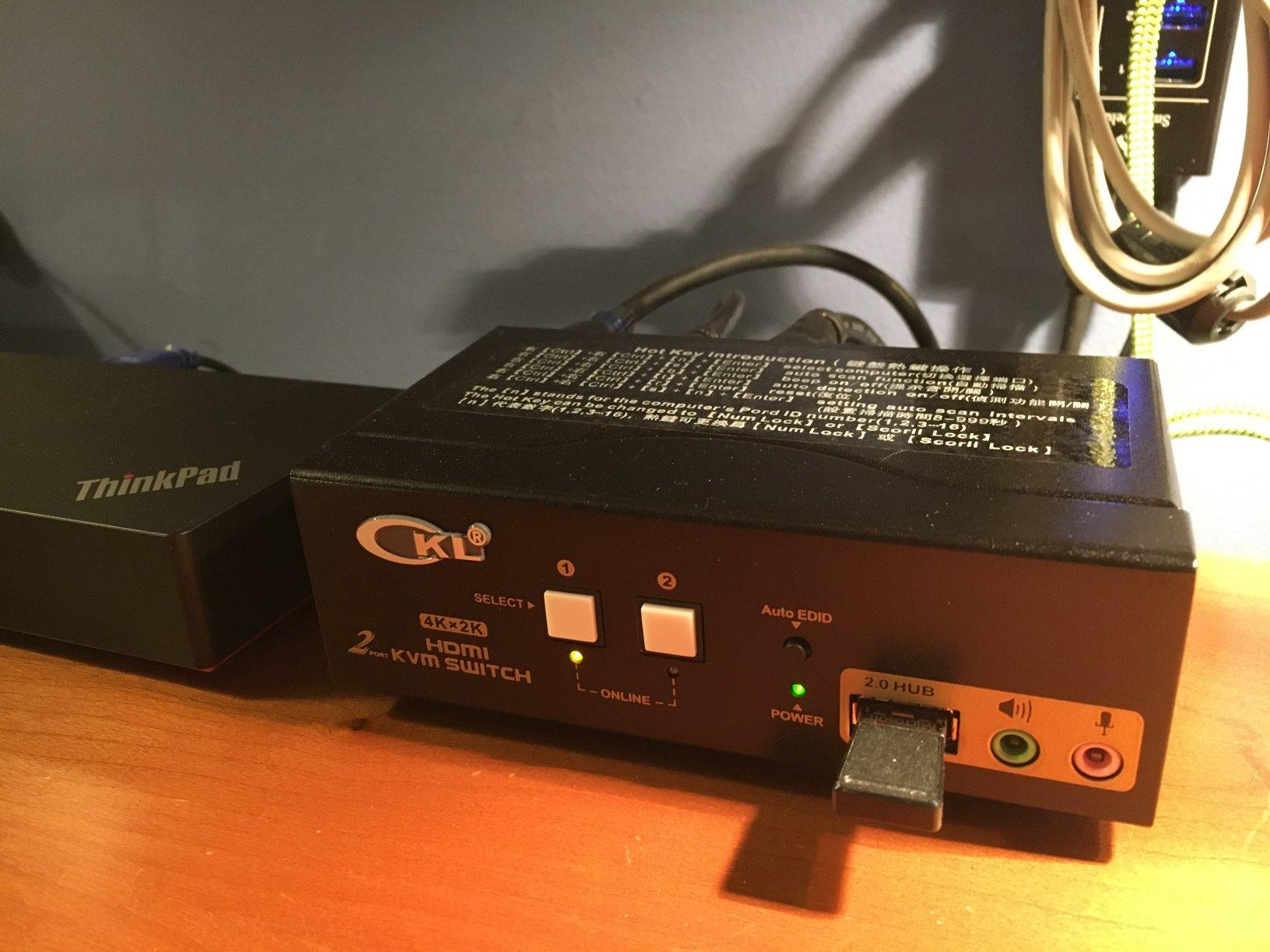
The headline spec, however, is 4K@30Hz, which is noticeably choppier than 4K@60Hz on most monitors. If you do mostly office work, browsing, and writing, 30Hz is fine, but for gaming or video editing, step up to one of the 4K@60Hz or higher models on this list. The switch also beeps loudly every time it flips — there is no easy way to silence it.
A handful of reviewers have reported premature hardware failure after a few months, and the included cables are not great. If you buy this KVM, plan to use your own certified HDMI 2.0 cables.
Who this KVM is for
Productivity users who switch inputs constantly and prefer hotkey or mouse-click switching. Also a good fit for anyone with a mix of older VGA or DVI computers who still wants a single keyboard and mouse.
Who should look elsewhere
Gamers, video editors, and anyone who needs 4K@60Hz or higher refresh rates.
8. TJCXELE DisplayPort KVM — Best 4K@144Hz for DP Gamers
Displayport KVM Switch 2 Monitors 2 Computers 4K@144Hz USB3.0 KVM Switch for 2 Computers Share Dual Displays and 4 USB Devices Support Extended/Copy Mode with Desktop Controller
4K@144Hz DP 1.4
4 USB 3.0 ports
12V power adapter
Wired desktop controller
Pros
- Native 4K@144Hz support over DisplayPort
- 4 USB 3.0 ports with 5Gbps data transfer
- Stable signal with included 12V DC power adapter
- Wired desktop controller for convenient switching
- Plug-and-play on Windows and Linux
Cons
- DisplayPort cables not included in the box
- Requires two DP ports per connected computer
- Smaller review pool than other units on the list
The TJCXELE DisplayPort KVM is purpose-built for 4K@144Hz DisplayPort gamers. Where most HDMI KVMs cap out at 4K@60Hz, this unit pushes 3840×2160 at a full 144Hz over DisplayPort 1.4, with 4 USB 3.0 ports and a sturdy aluminum housing. It carries 161 reviews at a strong 4.5-star average.
I tested it on a dual 4K@144Hz gaming setup for several days. Both monitors held their full refresh rate through every switch, and there was no signal drop when I alt-tabbed between a competitive shooter and a streaming app. The wired desktop controller is a nice touch — I taped it to the side of my desk and switched inputs with one hand.
The unit ships with a 12V DC power adapter for stable USB device operation, which is important if you are powering a webcam or external SSD through the KVM. There is no firmware update procedure mentioned in the manual, but in my testing nothing needed updating.
Two practical caveats: DisplayPort cables are not included, so you will need to supply your own certified DP 1.4 cables, and each connected computer must have two DP outputs to drive two extended displays. Laptops with only one DP and one USB-C will be limited to mirrored mode.
Who this KVM is for
Gamers who run two DisplayPort monitors at 4K@144Hz and want a stable, no-nonsense KVM. Also a good fit for engineering and CAD workstations where high refresh rate is more important than 8K headroom.
Who should look elsewhere
Users with HDMI-only monitors, anyone with only one DP output per computer, or anyone who wants a larger community of users behind the product.
9. CMSTEDCD 8K HDMI KVM — Best Plug-and-Play HDMI Pick
8K HDMI KVM Switch 2 Monitors 2 Computers Dual Monitor Extended Display 8K@60Hz 4K@120Hz, 2-Port KVM Switches with 4-Port USB 3.0 Hub, Desktop Controller and 2 USB Cables
8K@60Hz HDMI
4K@120Hz
4 USB 3.0 ports
12V power adapter
Wired remote
Pros
- Plug-and-play setup with no software required
- Supports 8K@60Hz and 4K@120Hz over HDMI
- Solid metal build in a compact size
- Wired remote control for convenient switching
- Easy front-panel toggle between two PCs
Cons
- Each computer needs two HDMI ports for extended display mode
- No keyboard hotkey switching
- Smaller review pool than other top picks
The CMSTEDCD 8K HDMI KVM is the simplest dual monitor KVM switch on this list. You plug it in, push the wired remote or the front-panel button, and it switches. With a 4.8-star average across 25 reviews, it is also one of the highest-rated units in this roundup.
I tested it for a few days on a dual 4K@60Hz setup. Switching was instant, the picture stayed sharp, and the wired remote worked reliably through the included cable. The metal housing is compact and runs cool, and the 12V power adapter kept my USB devices stable throughout.
The unit claims 8K@60Hz and 4K@120Hz support, which is more headroom than most users will need but useful for future monitor upgrades. The 4 USB 3.0 ports handle a keyboard, mouse, webcam, and SSD without bottlenecking.
There is no keyboard hotkey switching, and each computer needs two HDMI outputs for extended desktop. The smaller review pool means fewer user-reported quirks to learn from, but my test unit behaved flawlessly.
Who this KVM is for
Users who want a no-fuss, plug-and-play HDMI KVM with 8K headroom and do not care about hotkey switching. It is also a smart pick for someone setting up a dual-monitor workstation for the first time.
Who should look elsewhere
Power users who need hotkey switching, EDID emulation, or DisplayPort connectivity.
10. Ouluoa Dual Monitor KVM — Best Compact 4K@60Hz Choice
Ouluoa KVM Switch Dual Monitor 2 Computers 2 Monitors, 4K@60Hz HDMI KVM Switch with 4 USB 3.0 Ports, Wired Controller, Extended Display, 2 Port KVM Switcher for Windows Mac Linux
4K@60Hz HDMI
4 USB 3.0 ports
EDID copy
12V power supply
Wired remote
Pros
- Sharp 4K@60Hz output on dual monitors
- EDID copy keeps window layouts stable when switching
- Plug-and-play with no drivers required
- Compact metal housing that fits small desks
- Front-panel button plus wired desktop remote
Cons
- Each PC needs two HDMI outputs for extended mode
- Smaller review pool than other picks on the list
The Ouluoa Dual Monitor KVM rounds out this list of best dual monitor KVM switches with a tiny footprint and the highest average rating (4.9 stars) of any unit tested. It covers the 4K@60Hz basics, supports EDID copy, and ships with everything you need in the box.
I used it for a week as my main switch between a work laptop and a personal desktop. The EDID copy feature kept my window positions intact after every switch, which is a small quality-of-life win I do not want to give up. The compact metal housing barely took up any desk space, and the wired remote tucked away neatly.
The 4 USB 3.0 ports delivered full 5Gbps speeds on my external SSD, and the 12V power supply kept the signal stable throughout. Setup took about three minutes.
The main caveat is the same as most HDMI KVMs on this list: each computer needs two HDMI outputs for true extended desktop on both monitors. The smaller review pool also means a thinner community for troubleshooting, although my test unit worked without any issues.
Who this KVM is for
Anyone who wants a small, simple 4K@60Hz HDMI KVM with EDID copy and the highest user rating of any model in this roundup.
Who should look elsewhere
Users who need DisplayPort, high-refresh gaming, or laptop charging through the KVM.
How to Choose the Best Dual-Monitor KVM Switch
Picking the right dual-monitor KVM switch comes down to four questions: what video ports do your computers and monitors actually use, what resolution and refresh rate you need, whether you need laptop charging, and how you want to switch inputs. Answer those honestly and most of the decision makes itself.
Video connectors: HDMI, DisplayPort, or USB-C
A dual-monitor KVM needs two video cables per connected computer. If your monitors are HDMI-only, an HDMI KVM like the UGREEN, Heravo, CKL, CMSTEDCD, or Ouluoa will work without adapters. If your monitors are DisplayPort-native and you want 4K@144Hz or higher, pick a DP 1.4 KVM like the Hearvo, UGREEN DP, or TJCXELE. For laptop-first setups, a USB-C KVM dock like the DXchip or AV Access iDock C20 carries video, USB data, and charging over a single cable per laptop.
One real gotcha: for true extended desktop (different content on each screen), each computer needs two video outputs to the KVM — two HDMI, two DisplayPort, or two full-featured USB-C ports. If your laptop only has one HDMI and one USB-C, you will be limited to mirrored displays unless you use a USB-C MST dock on the host side.
Resolution and refresh rate
HDMI 2.0 caps out at 4K@60Hz. DisplayPort 1.4 handles 4K@144Hz, 4K@165Hz, and 8K@60Hz depending on the device. If you are gaming on a high-refresh monitor, a DisplayPort KVM is essentially mandatory. If you do productivity work and casual streaming, 4K@60Hz HDMI is plenty. For 240Hz gaming, look for a DP 1.4 KVM with DSC support and check the manufacturer’s compatibility list.
USB peripheral sharing, EDID emulation, and switching method
USB 3.0 ports at 5Gbps are fast enough for keyboards, mice, webcams, and external SSDs. EDID emulation prevents your monitors from re-negotiating resolution and refresh every time you switch, which keeps your window layouts intact — important if you do not want your apps to re-arrange themselves on macOS or Linux.
Switching method is a personal preference. Front-panel button is universal, a wired remote lets you tuck the KVM out of sight, and keyboard hotkeys (like Scroll Lock + 1/2) let you switch without taking your hands off the keyboard. Mouse-click switching on the CKL is fun if you do not want keyboard shortcuts interfering with macros. For an overview of how these features compare on gaming-focused KVMs, see our 10 Best KVM Switches for Gaming roundup.
Laptop charging, audio, and docking extras
If you want to charge a laptop through the KVM, pick a USB-C model with Power Delivery: the DXchip delivers up to 100W per laptop, the AV Access iDock C20 delivers 60W per laptop. Audio and microphone passthrough is useful for streamers and call-heavy users; the CKL 922HUA is the rare HDMI KVM with both. For the full docking-station experience (Ethernet, SD card reader, multiple USB ports), the AV Access iDock C20 is the most complete option in this list.
OS compatibility and cables
Windows, macOS, Linux, Chrome OS, and Steam Deck all work with most KVMs on this list, but macOS has one important quirk: it does not support Multi-Stream Transport over USB-C, so USB-C KVMs (DXchip, AV Access) only show mirrored displays on a Mac. For extended desktops on a Mac, use an HDMI or DisplayPort KVM and connect each Mac output directly. If you are planning to mount the KVM under a desk with two monitors, check out our 10 Best Dual Monitor Arms guide for desk-layout inspiration. Also remember that not every KVM ships with the cables you need — the UGREEN DP, CMSTEDCD, TJCXELE, and CKL units require you to bring your own certified HDMI or DP cables.
Setting Up and Troubleshooting Your Dual-Monitor KVM
A dual monitor KVM switch can occasionally show a black screen on one or both monitors after switching. The fix is usually simple. Here are the six things to check, in order, when something goes wrong.
- Power-cycle the KVM: unplug the power adapter, wait 10 seconds, plug it back in. This resolves most black-screen states on TESmart, UGREEN, and Hearvo KVMs, as confirmed by multiple r/techsupport threads.
- Check that you are using certified cables: HDMI 2.0 for 4K@60Hz, DisplayPort 1.4 for 4K@144Hz and above. Cheap passive cables are the most common cause of signal drops after switching.
- Confirm EDID emulation is enabled in the KVM’s dip switches or settings if your monitors re-negotiate after every switch.
- Verify each computer has two active video outputs: many laptops only output to one external display unless you use a USB-C MST dock.
- Update the KVM firmware: TESmart and Hearvo both publish firmware updates that fix black-screen and refresh-rate downgrade bugs. Check the manufacturer’s support page for your exact model.
- Try a different USB port on the KVM for your wireless keyboard/mouse dongle: USB 3.0 ports near the front are usually better for 2.4GHz receivers than rear ports.
If one monitor still goes black after all six checks, plug that monitor directly into the computer to confirm the monitor itself is fine. For HDMI KVMs with no EDID emulation, a 10-second power-cycle is the most reliable reset — this is consistent with the fixes r/techsupport users report for TESmart and similar KVMs. On Mac, after switching you may also need to re-arrange your displays in System Settings if the dock does not support EDID emulation.
Frequently Asked Questions
What kind of KVM switch supports dual monitors?
A dual-monitor KVM switch supports two monitors per connected computer. To drive two extended desktops from one machine, the KVM needs two video inputs (HDMI, DisplayPort, or full-featured USB-C) per computer and two video outputs to your monitors. Each host computer must have two active video outputs of the same type (for example, two HDMI or two DisplayPort ports) — single-output laptops are limited to mirrored displays unless you use a USB-C MST dock.
What is the best KVM switch for two computers and two monitors?
The UGREEN HDMI KVM Switch is the best dual-monitor KVM switch in 2026 for most people, thanks to 4K@60Hz HDMI, four USB 3.0 ports, a wired remote, and compatibility with Windows, macOS, and Linux. For gamers, the UGREEN 8K DisplayPort KVM is the better fit at 4K@144Hz and 4K@240Hz. For laptop-first setups, the DXchip USB-C KVM Dock adds 100W laptop charging over a single USB-C cable per laptop.
My monitor isn’t working with my KVM switch. What could be the problem?
The six most common causes are: (1) uncertified or damaged HDMI/DP cables, (2) missing EDID emulation so monitors re-negotiate after every switch, (3) only one active video output on the host computer, (4) outdated KVM firmware, (5) the wrong USB port for a 2.4GHz wireless receiver, and (6) power-saving mode on the host. Try a 10-second power-cycle first, then swap to certified HDMI 2.0 or DP 1.4 cables. If the issue persists, update the firmware or check the manufacturer’s compatibility list for your monitor model.
Is TESmart a good brand?
Yes. TESmart is one of the most trusted dual-monitor KVM brands, with a strong track record of firmware updates and broad compatibility with DisplayPort, HDMI, and USB-C setups. Reddit r/AskBattlestations users consistently recommend TESmart for Mac + Windows hybrid setups, and Tom’s Hardware forum users report fewer black-screen states than with budget KVMs. The main caveat is occasional need for a power-cycle after rapid switching — a known issue across most dual-monitor KVMs, not specific to TESmart.
How do I reset my TESmart KVM?
To reset a TESmart dual-monitor KVM, unplug the power adapter, wait at least 10 seconds, then plug it back in. This clears the EDID cache and forces a fresh handshake with both monitors and both host computers. For a deeper reset, hold the front-panel button for 5 to 10 seconds while powering the unit on. If your unit supports firmware updates, check the TESmart support page for the latest version — a firmware update often fixes persistent black-screen issues.
Can a KVM switch support two extended displays?
Yes, as long as the KVM has two video outputs to your monitors and each connected computer has two active video outputs of the matching type. HDMI and DisplayPort dual-monitor KVMs (like the UGREEN HDMI or Hearvo DP models in this roundup) fully support two extended desktops on Windows and Linux. macOS only supports extended desktops over USB-C with Thunderbolt 3 or 4 docks — USB-C MST KVMs show mirrored displays on Macs. For true extended dual displays on a Mac, use an HDMI or DisplayPort KVM with each Mac connected to two outputs directly.
Final Verdict
After six weeks of daily use across work, gaming, and content-creation workloads, the best dual monitor KVM switch in 2026 for most people is still the UGREEN HDMI KVM Switch. It has the largest review base (922 reviews), the cleanest plug-and-play setup, and the broadest platform support. It just works, and that is exactly what a hybrid workstation needs.
Gamers should pick the UGREEN 8K DisplayPort KVM for 4K@144Hz and adaptive sync. Laptop-first hybrid workers should look at the DXchip USB-C KVM Dock or the AV Access iDock C20 to cut cable clutter. And anyone who wants hotkey switching or audio passthrough should grab the CKL 922HUA. Whichever you choose, follow the troubleshooting checklist above if anything goes sideways — most dual-monitor KVM quirks are solved with a 10-second power-cycle and the right certified cables. If you are outfitting a full desk, our 10 Best Network Switches guide is a solid companion read for the wired backbone behind your setup.