
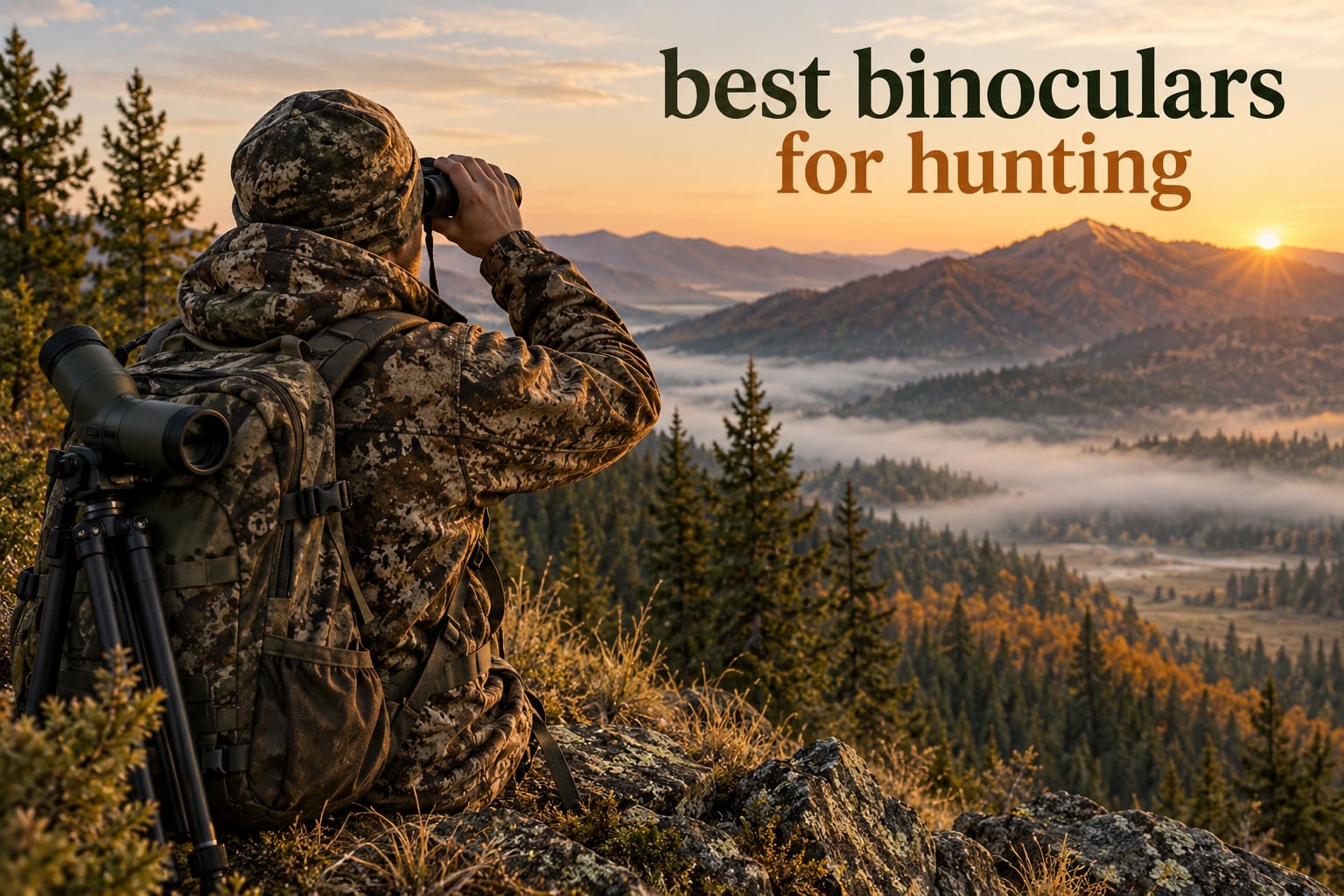
Most hunters never choose binoculars on purpose. They buy the pair somebody in the hunting campground told them to buy, carry it for nine seasons, and quietly blame themselves when the buck at 400 yards stays a smudge. The right pair comes down to three numbers: how much you magnify, how big the front lens is, and how many ounces you are willing to carry from dawn to dark. Get those three right and everything else is preference.
Our best overall pick is the Vortex Crossfire HD 10×42. Across more than 4,000 owner ratings it holds a 4.8 average, it is nitrogen purged and O-ring sealed, and at 1.4 pounds it disappears against your chest for a full day of walking. If you want one recommendation and nothing else, that is the one. For the widest field of view, the Nikon PROSTAFF P3 8×42 is hard to beat, and for dawn and dusk glassing where brightness beats everything, the Celestron Nature DX 12×56 pulls in more light than anything else in this group.
A word on how this guide was built. We compared the published specifications of ten widely sold hunting binoculars, then cross-checked them against thousands of owner reviews to see which claims survive real use and which do not. Owner ratings and review counts are quoted from the retailer listing and attributed as such. Prices move constantly, so confirm the current figure on the retailer page before you commit. Nothing here was laboratory-measured by us; where a manufacturer publishes a figure and owners dispute it, we say so.
Table of Contents
Top 3 Hunting Binocular Picks (October 2026)


Best Binoculars for Hunting by Category in 2026
Every pick below wins a specific slot rather than a generic ranking. The configuration, the weight and the light-gathering of each one are listed in the comparison table right underneath, and the full review follows in the same order.
Best overall: Vortex Crossfire HD 10×42 – the balance of brightness, weight, sealing and owner satisfaction that works in almost any hunting terrain.
Best value: Vortex Diamondback HD 10×42 – a dielectric prism coating and argon purging put it a real optical step above the entry tier, and the harness and case come in the box.
Best budget: Vortex Triumph HD 10×42 – full-size 10×42 glass with 17 mm eye relief and a transferable lifetime warranty at the entry rung.
Best wide field of view: Nikon PROSTAFF P3 8×42 – a 377-foot sweep at 1000 yards, 20.2 mm eye relief and 8x power that stays steady when you pan.
Best for glasses wearers: Nikon PROSTAFF P3 8×42 – 20.2 mm eye relief clears most eyeglass lenses without pulling the eyecups down.
Best ED glass for colour-critical glassing: Nikon Monarch M5 8×42 – extra-low dispersion elements and a phase-corrected dielectric prism hold colour and micro-contrast at pre-dawn.
Best low light and open country: Celestron Nature DX 12×56 – 56 mm objectives are the largest in this group, and 12x identifies animals you would otherwise lose in the draws.
Best long scanning sessions: Celestron Nature DX 8×42 – a 7.4-degree field of view and individual focus let one hunter share glass with a whole family.
Best waterproofing: Bushnell H2O 10×42 – an IPX7 submersion rating and nitrogen purging hold up in rain, spray and humidity.
Best entry optics: Bushnell PowerView 10×42 – a compact roof-prism body with attached lens caps, useful as a beater glass or a backup pair.
| Product | Specifications | Action |
|---|---|---|
| Vortex Crossfire HD 10×42 |
|
Check Latest Price |
| Vortex Diamondback HD 10×42 |
|
Check Latest Price |
| Vortex Triumph HD 10×42 |
|
Check Latest Price |
 Nikon PROSTAFF P3 8×42 Nikon PROSTAFF P3 8×42 |
|
Check Latest Price |
 Nikon Monarch M5 8×42 Nikon Monarch M5 8×42 |
|
Check Latest Price |
 Celestron Nature DX 12×56 Celestron Nature DX 12×56 |
|
Check Latest Price |
 Athlon Neos G2 HD 8×42 Athlon Neos G2 HD 8×42 |
|
Check Latest Price |
 Bushnell H2O 10×42 Bushnell H2O 10×42 |
|
Check Latest Price |
 Bushnell PowerView 10×42 Bushnell PowerView 10×42 |
|
Check Latest Price |
 Celestron Nature DX 8×42 Celestron Nature DX 8×42 |
|
Check Latest Price |
1. Vortex Crossfire HD 10×42 – Best Overall Hunting Binoculars
Vortex Crossfire HD 10×42 Binoculars
10x42
4.2mm exit pupil
15mm eye relief
Nitrogen purged
1.4 lb
Pros
- HD optical system with fully multi-coated lenses
- Waterproof fogproof and shockproof with nitrogen purging
- Tripod adaptable with adjustable twist-up eyecups
- Rubber armor grip works one-handed or with gloves
- Transferable unconditional lifetime VIP warranty
Cons
- 15mm eye relief forces eyeglass wearers to lower the eyecups
- 10x power shakes on distant moving animals
- 42mm objective gathers less light than 50mm-class designs
The Crossfire HD is the pair I recommend first to almost anyone, and the reason is arithmetic rather than marketing. A 42 mm objective at 10x produces a 4.2 mm exit pupil, which is the small disc of light your eye receives. At dawn on opening day your own pupil is wider than that, so you are using the glass efficiently rather than throwing light away. It is the same configuration the hunting community has converged on, and owner ratings of 4.8 across more than 4,000 reviews reflect a build that rarely disappoints.
Physically, it is a roof-prism binocular in a rubber-armored body with fully multi-coated lenses, nitrogen purging and O-ring seals. Those three things – roof prism, purging, seals – are what separate a hunting binocular from a general-use pair. The roof prism survives knocks, the purge stops internal fogging during the walk from a cold truck to a warm ridge, and the seals keep rain out entirely. The twist-up eyecups and a centre focus wheel finish a package that works with or without eyeglasses.
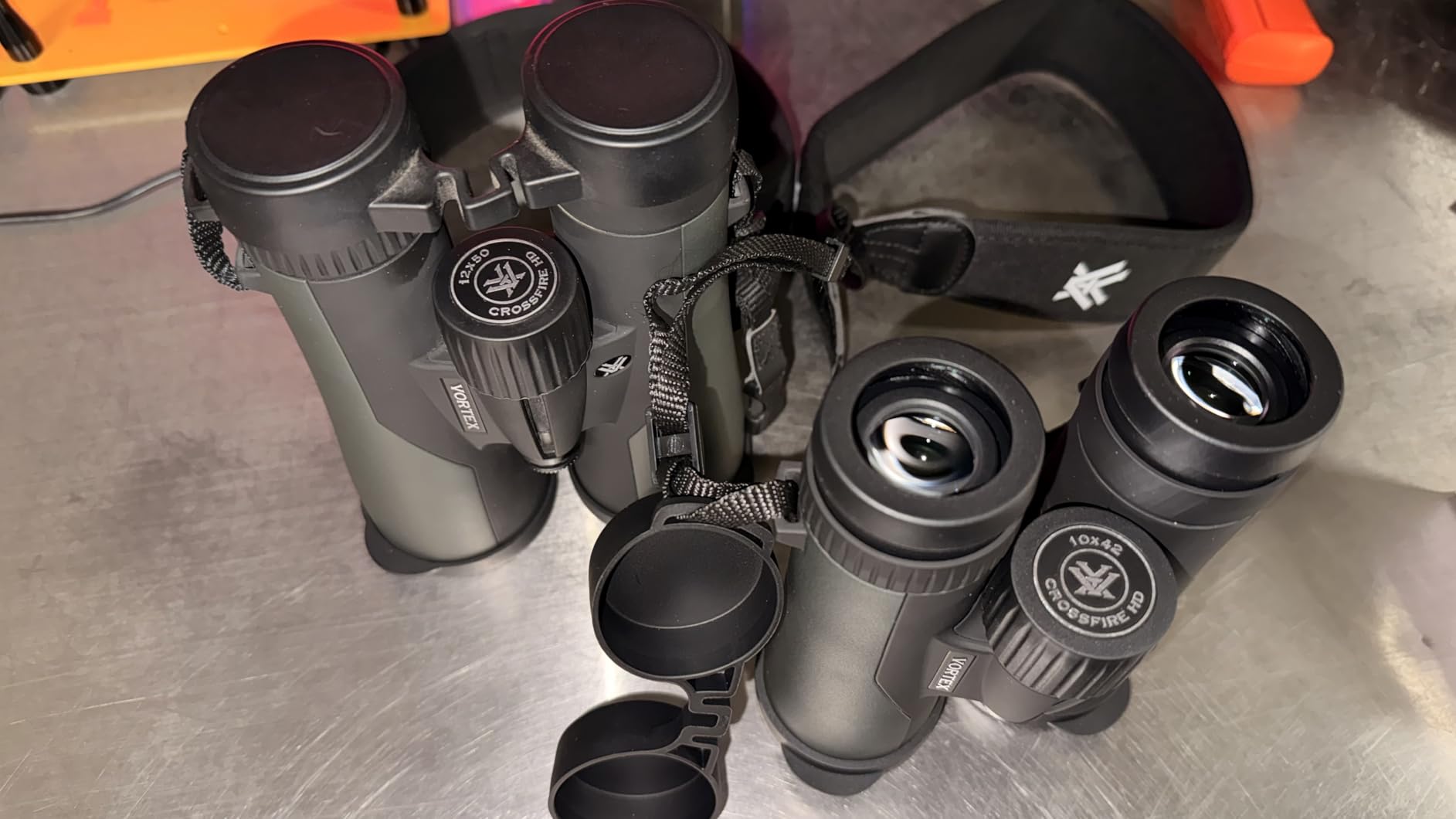
What you give up is modest but real. Eye relief is 15 mm, which is short enough that glasses wearers typically need the eyecups twisted fully down before the field clears. Hand shake at the full 10x is the other recurring complaint, and no amount of coating fixes it: sustained 10x on a distant, moving animal needs a rest or a braced position. The included kit is a GlassPak case, a comfort neck strap, tethered objective covers and a Rainguard eyepiece cover, but no chest harness.
Relative brightness is listed at 17.64, which simply reflects the 42 mm objective at 10x. For comparison, the 8×42 designs in this guide sit near 28, and that difference is exactly why an 8×42 can look brighter to your eye in dim timber even though its glass is no better. The Diamondback HD adds a dielectric prism coating and argon purging to this same core design, and it is the better buy if your hunting stretches past opening morning or past the first year of use.
Who the Crossfire HD suits
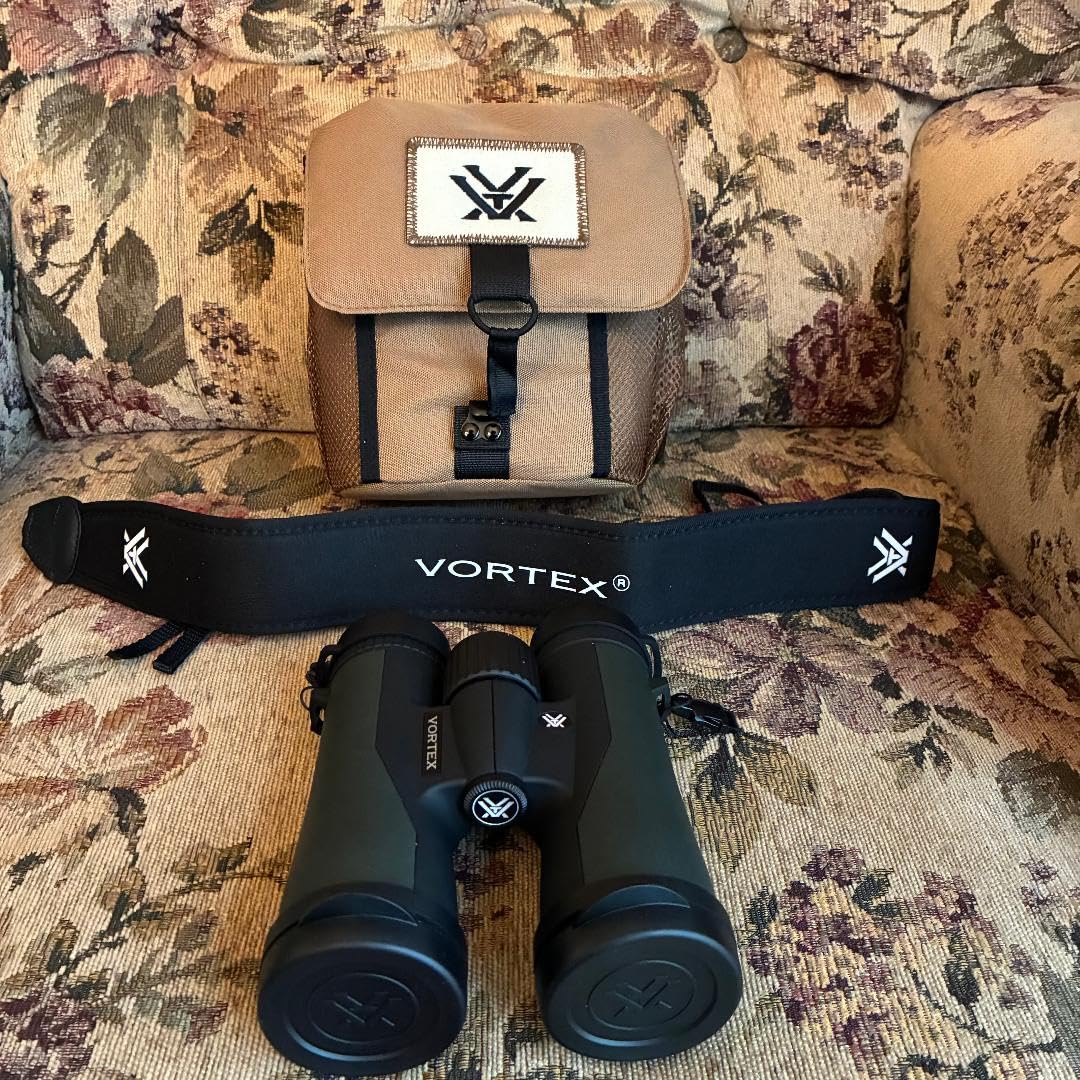
It suits the hunter who walks. At 1.4 pounds it is one of the lighter full-size 10×42 bodies, which matters when the glass is on a neck strap from first light to last. It also suits anyone who wants a single pair that works in eastern timber, western draws and open country without a second purchase. The roof-prism durability and the transferable lifetime VIP warranty make it a sensible first serious pair, and the tripod-adaptable threads let you glass a canyon rim without buying a different binocular.
Where the Crossfire HD falls short
For a hunter who wears prescription glasses, 15 mm of eye relief is the deal-breaker that is not one. If you have wide frames or strong prescriptions, test the eyecups at a retailer before committing, or move up to an 8×42 with 20 mm of eye relief. It is also not the brightest option here: if your primary glassing window is the last twenty minutes of light, a larger objective or a lower magnification will serve you better. For pure low-light brightness, look at the Celestron Nature DX 12×56.
2. Vortex Diamondback HD 10×42 – Best Value Hunting Binoculars
Vortex Diamondback HD 10×42 Binoculars
10x42
4.2mm exit pupil
Dielectric prism coating
Argon purged
1.3 lb
Pros
- Dielectric prism coating gives a brighter more colour-true image
- Argon purging and O-ring seals handle rain snow and temperature swings
- Lightest full-size 10x42 in this group at 1.3 lb
- Harness and hard case included
- Rubber armor and shock-resistant build
Cons
- 15mm eye relief is short for eyeglass wearers
- 10x produces noticeable hand shake on moving animals
- Argon-purged seals add slight weight versus nitrogen designs
The Diamondback HD is the same 10×42 shape as the Crossfire with two meaningful upgrades, and those two upgrades are the entire reason to spend the difference. The first is a multi-layer dielectric coating on the roof prisms, which reflects more light through the glass than a standard silver coating and holds colour far better. The second is argon purging instead of nitrogen, which keeps the internal fogging protection in place across wider temperature extremes. On a November ridgeline at first light, that combination is worth more than another digit of magnification.
Owner ratings sit at 4.8 across more than 3,500 reviews, and the pattern in those reviews is consistent. People upgrading from entry-level glass single out brightness and colour accuracy first, durability second. That makes sense optically: roof prisms bounce light along a folded path, so without a dielectric coating a good share of the image is lost at each bounce. A roof prism without a phase-corrected and dielectric coating is exactly the money-saving trick the cheapest manufacturers make, and it is the reason the cheapest glass always looks duller than it should.
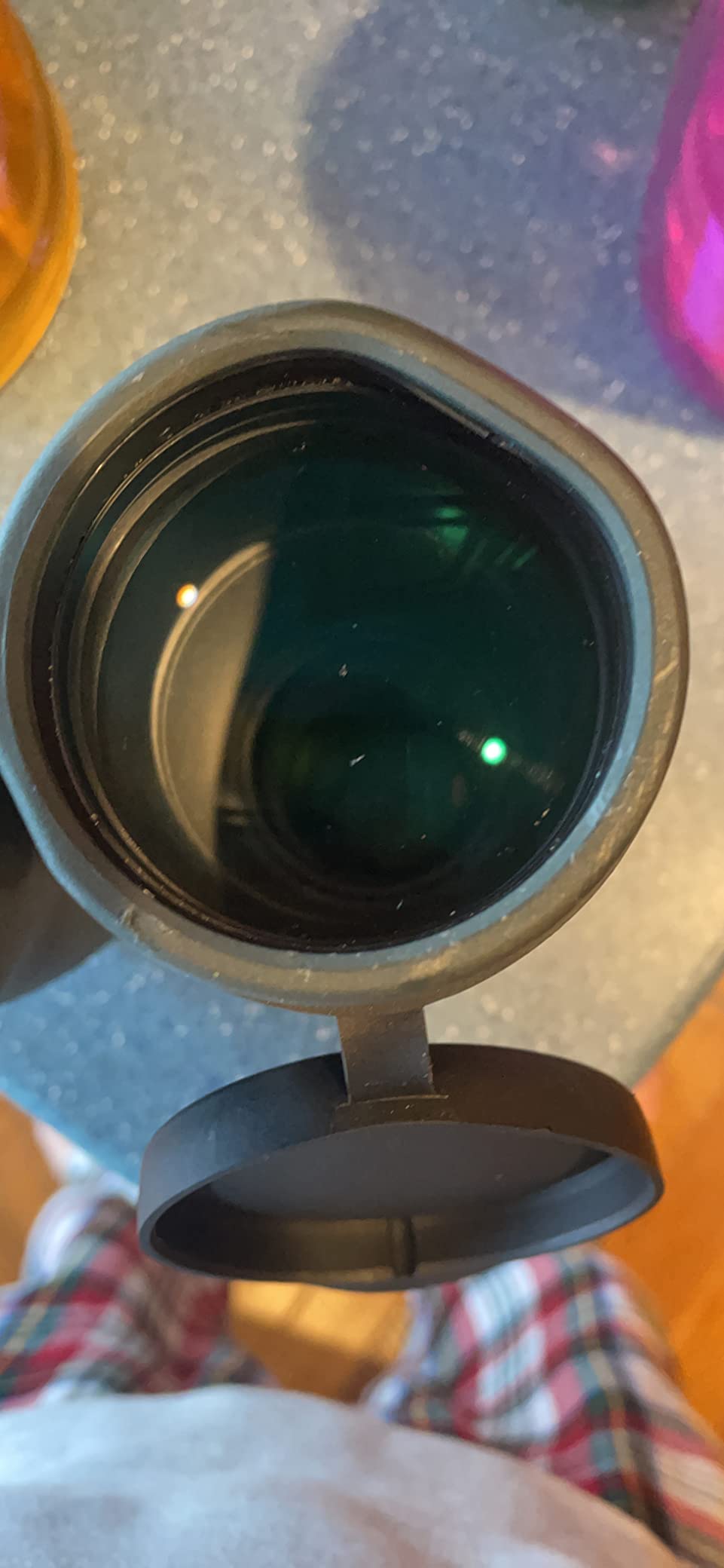
At 1.3 pounds this is the lightest full-size 10×42 in the group, which is genuinely surprising given the argon-sealed body. The field of view is 330 feet at 1000 yards, or 6.3 degrees apparent – wide enough to scan a basin and find movement, tighter than the wide-sweep 8x42s. Diopter adjustment runs to plus or minus three diopters, tripod threads are standard, and the box includes a GlassPak case, a GlassPak chest harness, a comfort neck strap, tethered objective covers and a Rainguard eyepiece cover.
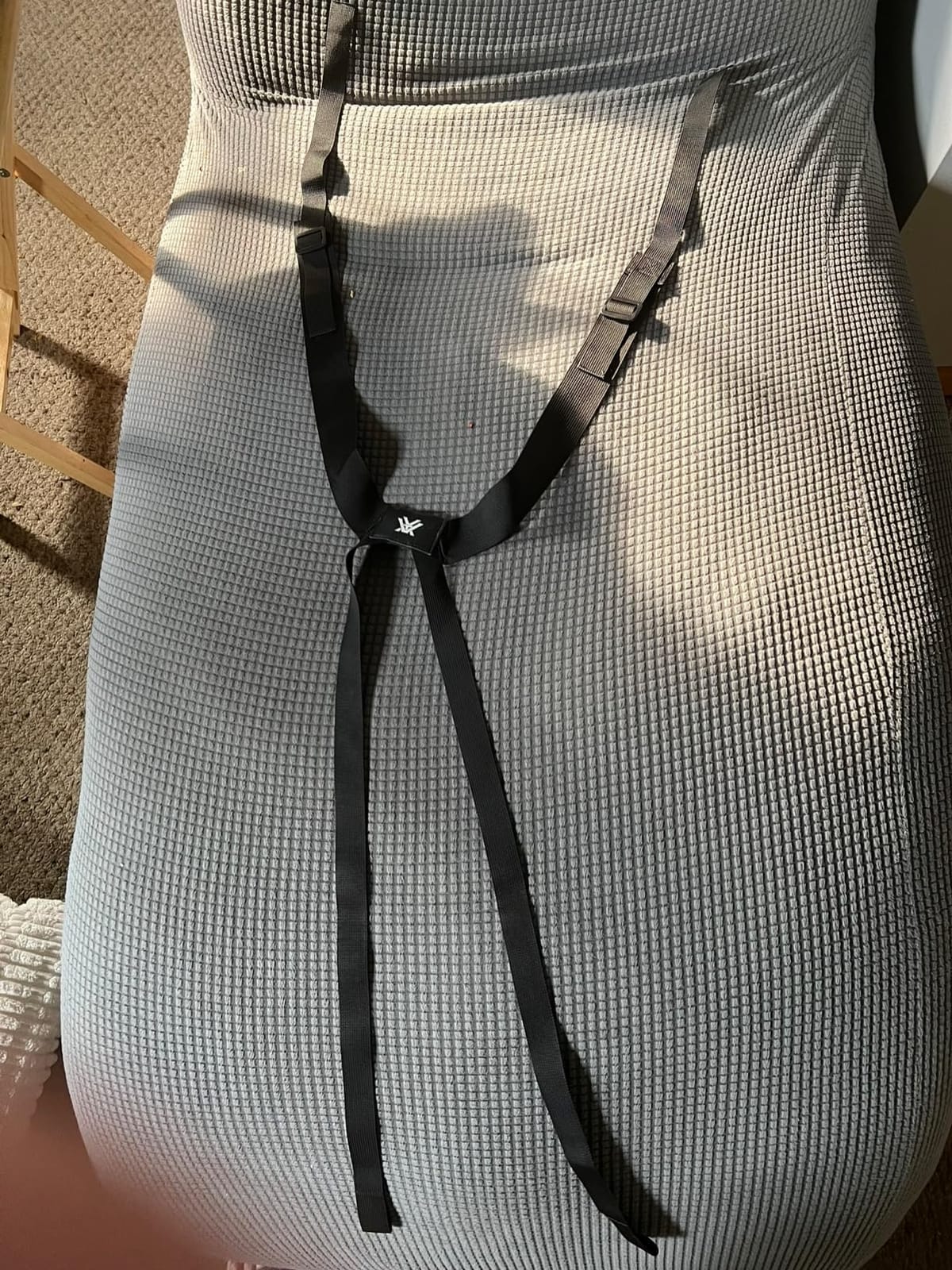
That included harness is worth more than it sounds. A chest harness is a separate accessory for most competitors, and getting one into your kit and comfortable is the difference between a binocular you carry all day and one that stays in the truck. Owners on hunting forums treat the presence of a harness as a practical sign the maker thought about the sport rather than about photography. Eye relief remains 15 mm, so the same glasses caveat applies, and 10x hand shake is unchanged from the Crossfire.
Who the Diamondback HD suits
It suits hunters who glass at both ends of the day, who hunt in weather that varies, and who want a chest harness without a second order. The dielectric coating is the single most visible difference in the field: colours hold up on a dark buck against grey timber instead of washing out, and the image looks cleaner in heavy canopy shade. If you hunt deer, elk or predator across varied terrain and want one pair to last a decade, this is the value pick of the group.
Where the Diamondback HD falls short
It is not a low-light specialist. A 4.2 mm exit pupil at 10x is respectable but not generous, and in deep shade before civil twilight a lower magnification or a larger objective wins. It also will not suit a hunter whose priority is a wide sweep across open country rather than identification at distance. For pure scanning across a wide basin, an 8×42 with a 7-degree-plus field sees more per glance. And if you wear thick prescription frames, 15 mm eye relief will not clear them comfortably.
3. Vortex Triumph HD 10×42 – Best Budget Hunting Binoculars
Vortex Triumph HD 10×42 Binoculars
10x42
17mm eye relief
HD optics
2.3 lb
Pros
- 17mm eye relief is unusually generous for a 10x42
- HD optics and fully multi-coated lenses at the entry rung
- Nitrogen purged waterproof and fogproof
- Adjustable GlassPak harness and case included
- Plus or minus five diopter range
- Transferable lifetime VIP warranty
Cons
- Heaviest 10x42 in this group at 2.3 lb
- Field of view figures in the published listing are inconsistent
- 10x is harder to hold steady than an 8x when panning
The Triumph HD answers the question most first-time buyers actually have: can entry-level glass be good, or is cheap glass a mistake? It can. This is a full-size 10×42 with HD optical elements, fully multi-coated lenses, a roof prism, nitrogen purging and full rubber armor, and it carries a transferable unconditional lifetime warranty. Owners rate it 4.7 across more than 2,300 reviews, with the recurring comment that the image quality exceeds what the tier suggests.
The headline spec is eye relief. At 17 mm, this is longer than most 10x42s in this group, including two models that cost substantially more, and it is the number that decides whether you can hunt in your glasses. Diopter adjustment runs to plus or minus five diopters, which is the widest range here, so it can be dialled in for almost any pair of eyes. The eyecups adjust and the body is tripod adaptable, so nothing about this glass is a placeholder.
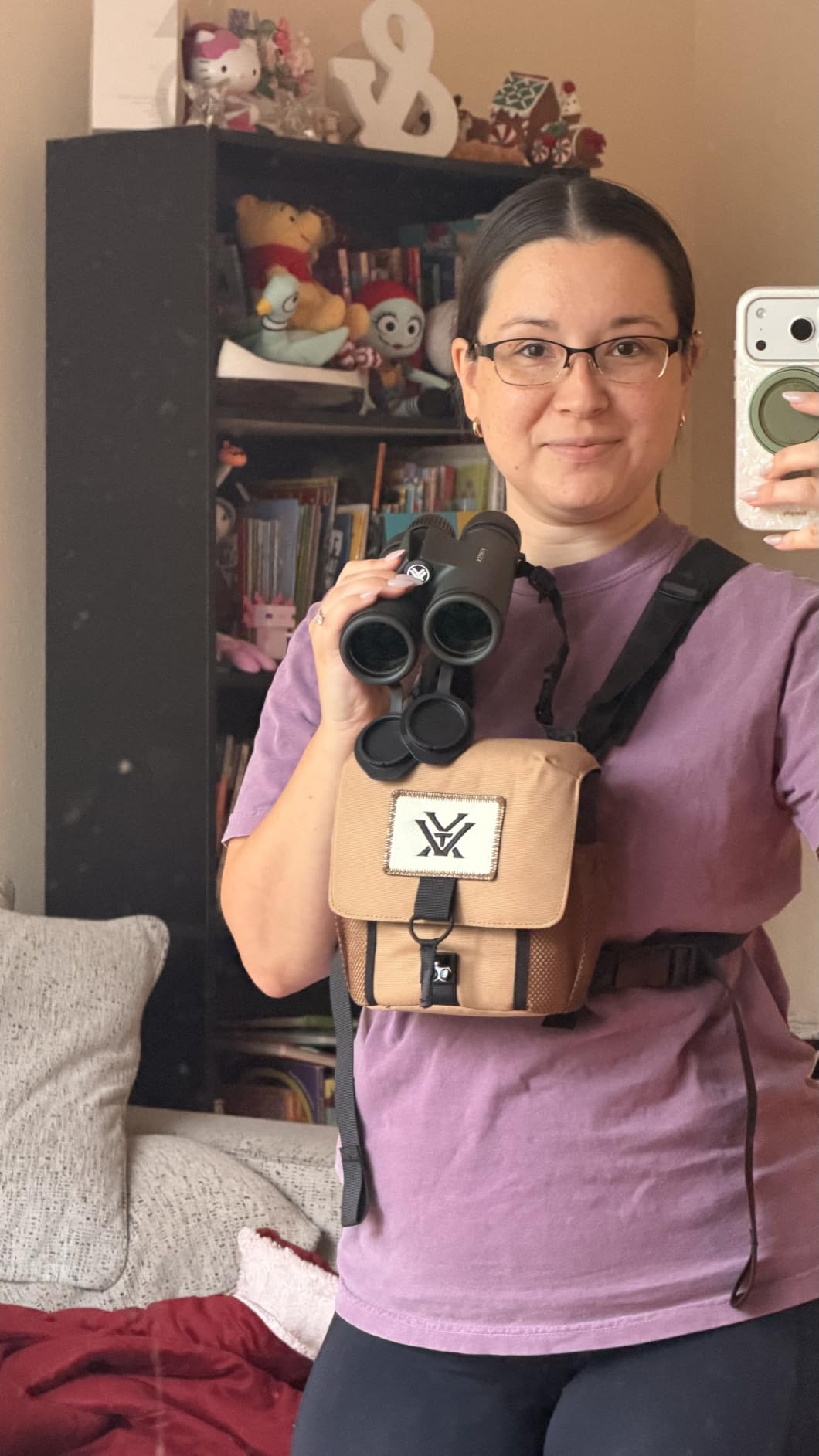
The cost is weight. At 2.3 pounds it is the heaviest 10×42 in this group, and on a long stalk or a hot desert ridge that difference reaches your shoulders before your eyes. The polycarbonate chassis absorbs knocks well, and the rubber armor gives a secure grip with gloves, but the mass is real. Reviewers also note that the published field-of-view figures for this listing are internally inconsistent, so treat the exact sweep figure with caution and judge it in person rather than on a spec sheet.
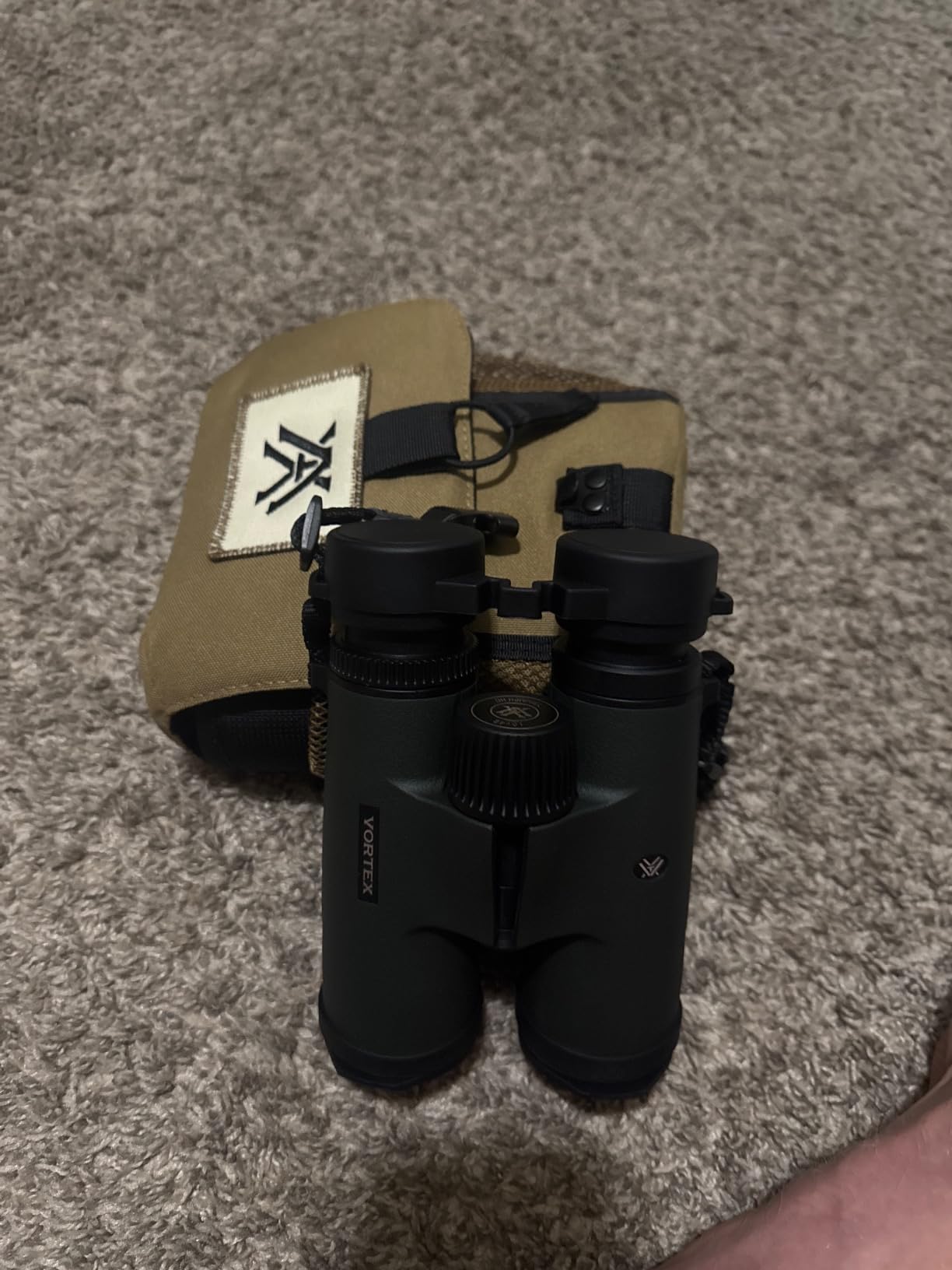
Inside the box you get a GlassPak chest harness, a GlassPak case, a comfort neck strap, tethered objective lens covers and eyepiece covers. A lifetime VIP warranty on a model at this rung is unusual and is the strongest argument for it: if something breaks, the cost of failure is zero. Magnification is fixed at 10x, so small game at distance can be harder to pick out than with an 8x, and the 4.2 mm exit pupil is the same limitation the Crossfire has.
Who the Triumph HD suits
It suits new hunters building a first serious kit, glasses wearers on a budget, and anyone who wants a spare pair to leave in the truck. The 17 mm eye relief and the five-diopter range make it the most accommodating glass here for mixed faces and varied prescriptions, and the included harness removes a purchase you would otherwise have to make. If you are outfitting a young hunter or a family member, the adjustable fit and the warranty are both strong arguments.
Where the Triumph HD falls short
At 2.3 pounds it is heavy for a walk-in glass, and that is the reason this is not our top pick despite the strong owner numbers. If your hunting is a long day on foot with the glass constantly in hand, the lighter Crossfire or Diamondback will serve you better. It is also strictly a 10x, so if you scan a wide basin rather than identify distant animals, a wider 8×42 field suits the task. And nothing replaces entry-level glass at true pre-dawn low light.
4. Nikon PROSTAFF P3 8×42 – Best Wide Field of View for Tracking Game
Nikon PROSTAFF P3 8×42 Binocular | Waterproof, fogproof, rubber-armored Full-Size Binocular, wide field of view & long eye relief | Official Nikon USA Model
8x42
20.2mm eye relief
5mm exit pupil
377 ft at 1000 yd
1.3 lb
Pros
- 377 foot field of view at 1000 yards is among the widest here
- 20.2mm eye relief clears most eyeglass lenses
- 8x power stays steady when panning
- 5mm exit pupil holds up well at dawn and dusk
- Lightweight 1.3 lb body with a rubber grip
Cons
- No ED glass so colour fringing appears on high-contrast edges
- Diopter ring is stiff to adjust
- 8x will not resolve fine distant detail like 10x or 12x
- Included neck strap has no fixed loop
The 8×42 is the configuration most strongly associated with handheld hunting glass, and the PROSTAFF P3 is the clearest reason why. At 8x, hand shake becomes manageable without a rest, which means you can hold a buck in the trees for the twenty seconds it takes to confirm it, and its 377-foot field of view at 1000 yards means you find movement sooner. The wide sweep is the single most useful hunting feature that does not appear in a spec list, and it is the reason experienced hunters scan with 8x and switch to glass with magnification only after the animal is located.
The exit pupil here is 5 mm, produced by dividing the 42 mm objective by 8x, and that is the second reason to like this format. A 5 mm exit pupil sits closer to a dark-adapted eye than a 4.2 mm one, so an 8×42 frequently gives a visibly brighter image in dim timber than a pricier 10×42. Eye relief of 20.2 mm is the longest in this group, and the turn-and-slide eyecups are designed around it. For a hunter who wears prescription glasses, that combination removes the single most common buying mistake in this category.
Owner ratings stand at 4.7 across 640 reviews, and reviewers repeatedly call 8×42 the sweet spot for handheld general use while noting they can be dialled in without glasses. The optics are multilayer-coated with a silver-alloy prism coating, the body is fiberglass-reinforced polycarbonate with rubber armor, and O-ring seals with nitrogen filling handle rain, snow and temperature swings. Nikon’s limited lifetime warranty applies, which is less absolute than an unconditional lifetime policy but is a real long-term commitment.
The trade-offs are all consequences of the format. Eight power will not separate a species at a mile the way a 12x will, and the absence of extra-low dispersion glass means some purple fringing around high-contrast edges – visible when a whitetail’s shoulder cuts against sky. The diopter ring is stiff, which is annoying when you are trying to fine-correct for one eye in the dark, and the included neck strap has no fixed loop, so the slack swings when you move. None of these are deal-breakers; all of them are worth knowing before you order.
Who the PROSTAFF P3 suits
It suits eastern and timber hunters, anyone who wears glasses, and anyone who spends more time scanning than identifying. The 377-foot sweep at 1000 yards means far more ground in a single glance, which is what turns a luck encounter into a located animal. At 1.3 pounds it is light enough for all-day carry, and the 5 mm exit pupil makes it the most forgiving format in dim canopy and heavy shade.
Where the PROSTAFF P3 falls short
It is the wrong tool for a hunter who needs to identify animals at extreme distance, where 8x simply does not carry enough detail. It is also the weakest glass optically: no ED elements means colour and contrast fall away sooner at dusk than on the premium models, and reviewers who own both describe the difference as noticeable in heavy shade. If your hunt is western open country with long glassing distances, look at a 10×42 or a 12×56 instead.
5. Nikon Monarch M5 8×42 – Best Extra-Low Dispersion Glass for Pre-Dawn
NIKON Monarch M5 Binoculars | Waterproof Fogproof ED Glass Optics with Dielectric Prism Coating | Bright High-Resolution Outdoor Binoculars for Birdwatching, Hiking & Wildlife, 8×42
8x42
ED glass
5.3mm exit pupil
19.5mm eye relief
1.4 lb
Pros
- ED glass sharply reduces chromatic aberration and colour fringing
- Phase-corrected dielectric prism coating keeps images bright in low light
- 48.2 degree apparent field of view with close focus to 8.2 ft
- 19.5mm eye relief works with eyeglasses
- Waterproof fogproof and nitrogen purged
Cons
- 335 foot field of view is narrower than the PROSTAFF P3 8x42
- 8x magnification limits identification range on far-off animals
- Premium pricing makes it a step up rather than an entry purchase
The Monarch M5 is where optical engineering actually changes what you see, and the specific technology is extra-low dispersion glass. ED elements disperse colours less than standard glass, which means a dark animal’s edge against a bright sky stays sharp instead of splitting into purple and green fringes. For hunting, that matters most at first light when silhouettes appear against a bright horizon – the moment where most missed animals are missed, because the image is smeared and low-contrast exactly when identification matters.
Adding to that, the roof prisms here are phase-corrected and dielectric-coated. A roof prism splits the incoming light into two paths that are supposed to recombine in step; when they do not, the interference costs resolution and micro-contrast, which is the fine texture that separates a deer from a branch. Phase correction fixes the step, and the dielectric coating reflects more light than a standard coating. The published exit pupil is 5.3 mm, slightly wider than the 5 mm of a standard 8×42, which means marginally less light is lost to the prisms at pre-dawn.
Owner ratings are 4.7 across 369 reviews, and the dominant theme in them is colour and brightness. Buyers upgrading from standard 8x42s describe the image as more natural, particularly in dawn light and heavy forest shade. Close focus to 8.2 feet is a genuinely useful hunting specification that most buyers never discover: you can focus on a bird or a track sign without swapping to another pair. The apparent field of view of 48.2 degrees is wide, and eye relief of 19.5 mm with twist-up click-stop eyecups keeps glasses wearers comfortable.
The real field of view is 335 feet at 1000 yards, which is narrower than the PROSTAFF P3 8×42 and the Celestron Nature DX 8×42. If scanning breadth is your priority, this is the wrong 8×42. Nikon’s warranty is limited lifetime rather than unconditional, and the model sits at the premium rung, so it is a step up rather than a starting point. The weight of 1.4 pounds is fine for all-day carry.
Who the Monarch M5 suits
It suits the hunter who glasses at absolute first light, and the bow hunter who needs clean, bright, colour-true images on game inside 40 yards. Extra-low dispersion glass earns its cost precisely when contrast is lowest, which is dawn, dusk and deep shade. It also suits anyone who uses one pair for hunting and for wildlife viewing and wants colour that looks right rather than greenish. At 19.5 mm of eye relief, glasses wearers can use it comfortably.
Where the Monarch M5 falls short
At 8x it inherits the whole 8×42 limitation: no amount of glass quality will identify an animal that is genuinely too far away for eight power. The narrower real field of view than two rivals in this group is a real cost to scanning efficiency. And because this is a premium model, buyers who glass occasionally may get more usable performance for less elsewhere. The right question is not whether it is the best binocular here – it is whether you hunt often enough to notice ED glass.
6. Celestron Nature DX 12×56 – Best Low-Light and Open Country Glass
Celestron Nature DX 12×56 Premium Binoculars for Dawn & Dusk Observation
12x
56mm objective
4.6mm exit pupil
16mm eye relief
2.5 lb
Pros
- 56mm objectives are the largest here and give a genuinely bright dawn and dusk image
- 12x identifies distant animals no 8x or 10x can resolve
- BaK-4 phase-coated prisms give good contrast for the class
- 16mm eye relief works for eyeglass wearers
- Built-in tripod adapter socket for long sessions
Cons
- 2.5 lb plus 12x needs a tripod or rest beyond 15 to 20 minutes
- Narrowest field of view in the group at 5.5 degrees
- No ED glass so purple fringing appears at the field edge
- One owner reports focus that is hard to find and hold
There is one way to get more light into your eye at dawn, and it is to make the objective lens larger. The Celestron Nature DX 12×56 has 56 mm objectives – larger than anything else in this group – and the arithmetic rewards you: 56 divided by 12 gives a 4.6 mm exit pupil, a little wider than a standard 10×42 despite the higher magnification, and the physical light-gathering area of a 56 mm lens is well over half again that of a 42 mm one. Combined with 12x power to identify what you find, this is the open-country and long-light glass in the roundup.
Owner ratings are 4.4 across 317 reviews, the lowest average here, and that number deserves respect rather than a shrug. The reviews show a bimodal pattern: owners who need maximum light and magnification at dawn and dusk rate it very highly, while owners who expected an all-purpose hunting binocular find it too specialised. That is exactly what the format is for, and the rating is a warning about fit rather than about quality. The phase-coated BaK-4 prisms and fully multi-coated lenses deliver good contrast and colour for the class.
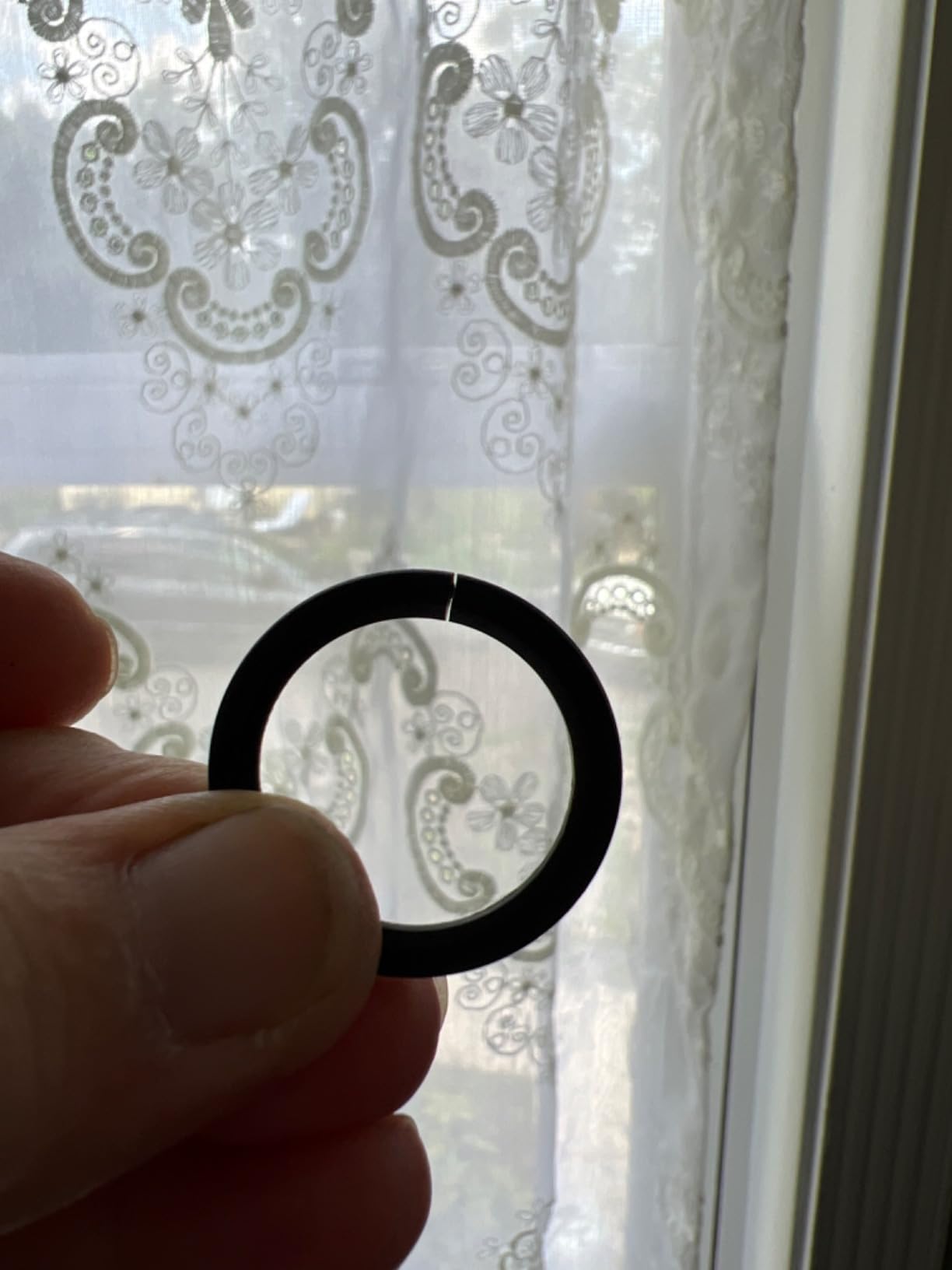
Two practical details matter enormously with this glass. First, the built-in tripod adapter socket: with 12x magnification and a 2.5-pound body, holding the image steady by hand for more than fifteen or twenty minutes is genuinely difficult, and a tripod or window rest is not optional for long sessions. Second, the interpupillary distance range needs the covers and a slim adapter removed to close fully for narrow faces, which is a real fit issue for some wearers despite the 16 mm of eye relief. The body is rubber-armored polycarbonate, waterproof, nitrogen purged, and Celestron’s limited lifetime warranty applies with US-based support.
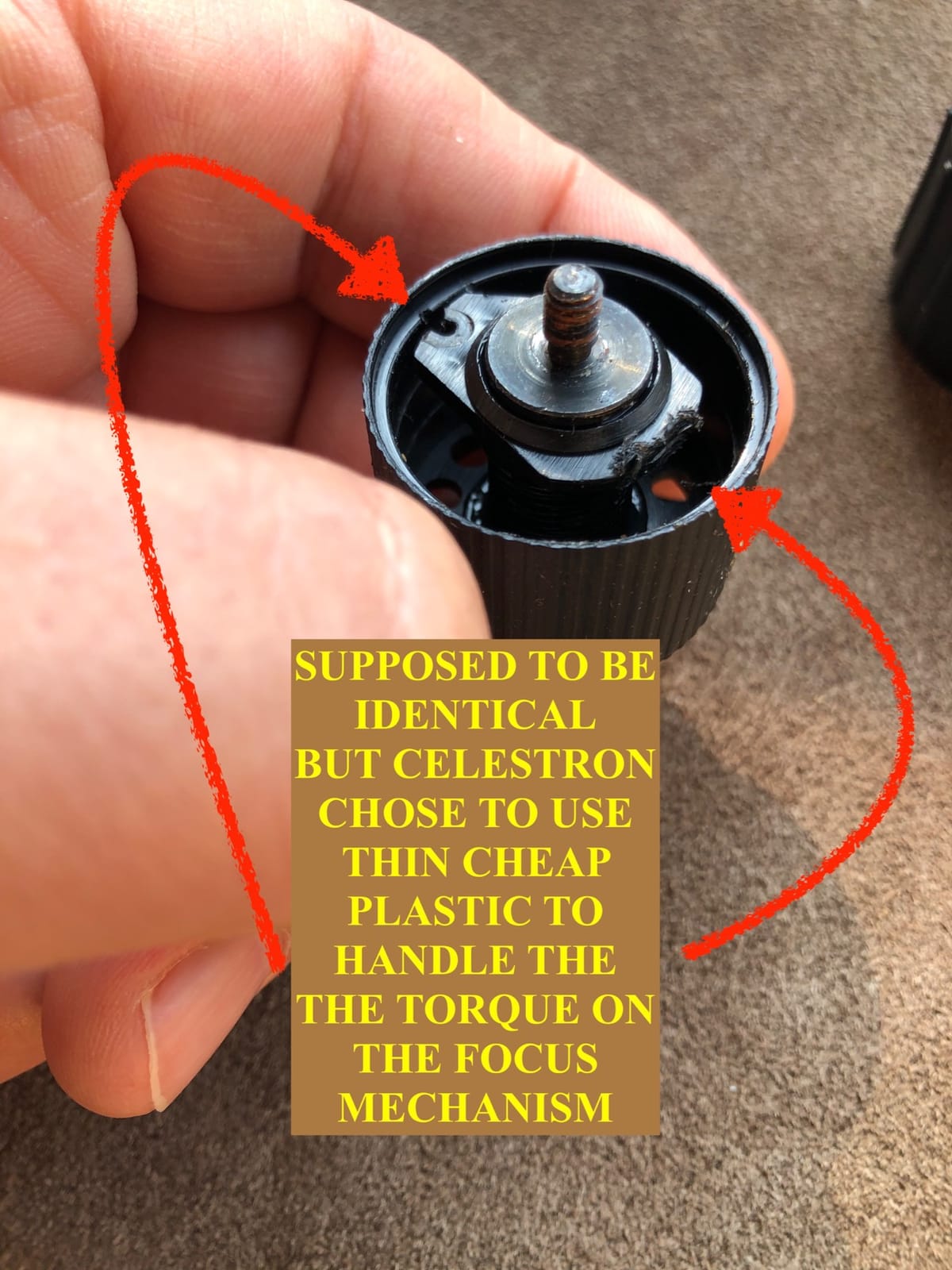
Chromatic aberration is present – there is no ED glass – and reviewers see purple fringing at the outer field edge, where the animal rarely is. The 5.5-degree field of view is the narrowest in the group, which makes finding moving game harder and demands a deliberate scanning routine. One detailed owner report describes difficulty finding and holding focus, with the image going soft at high magnification; that is a minority view, but it is worth testing if you buy from a retailer with a straightforward return process.
Who the Celestron 12×56 suits
It suits the western hunter working open country who glasses distant ridge lines and basins and wants identification range and brightness together. It suits anyone whose core glassing window is the last twenty minutes before legal light and the first twenty after. Glassing from a vehicle, a tripod or a fixed position suits this format naturally, because the constraints of weight and shake are what it trades for. Predator hunters calling at dusk are a natural fit as well.
Where the Celestron 12×56 falls short
It is not an all-day carry glass. Two and a half pounds hanging on a chest for eight hours of walking is punishing, and 12x hand-held is unpleasant at best. The 5.5-degree field means you will find game more slowly than with a wide 8×42, and 8x class users get a more comfortable, wider experience in timber. If your hunt is eastern deer from a treestand or a ground blind at moderate distances, this is more glass than the task needs.
7. Athlon Neos G2 HD 8×42 – Best Lightweight 8×42 with Wide Glassing
Athlon Optics 8×42 Neos G2 HD Binoculars with Eye Relief for Adults and Kids, High-Powered Binoculars for Hunting, Birdwatching, and More
8x42
5.25mm exit pupil
17mm eye relief
7 degree field
1.3 lb
Pros
- BaK-4 prisms and multi-coated optics give a bright sharp image for the tier
- Large 5.25mm exit pupil holds up at dawn and dusk
- 1.3 lb composite body is easy on long stalks
- Waterproof and fog-proof sealed
- Soft case strap caps and cloth included
Cons
- Some buyers find the field of view narrower than the 7 degree listing
- Diopter range reported as tight by at least one owner
- Clarity ranks below Athlon's higher-end models
- Slight vibration noted at maximum magnification
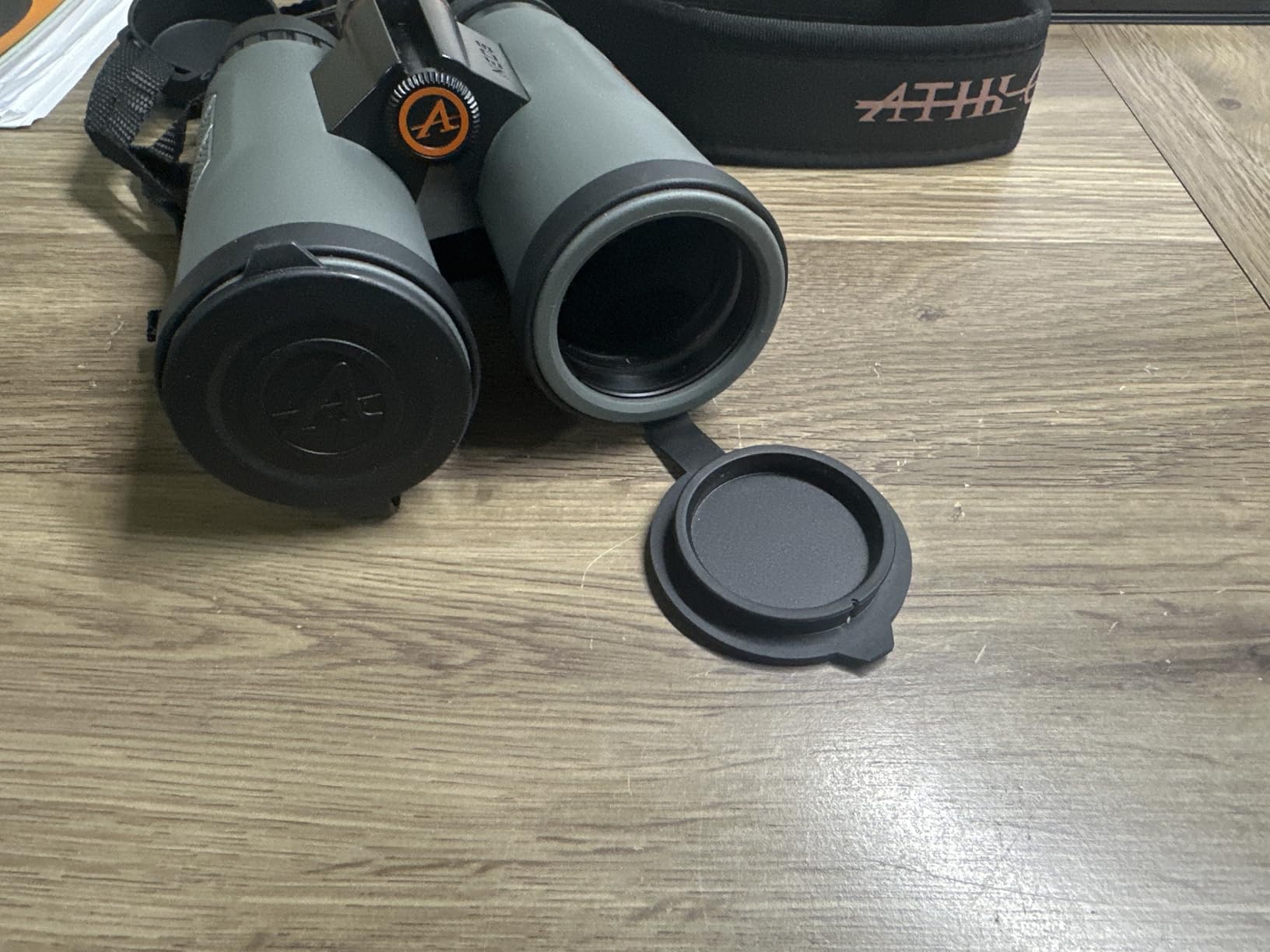
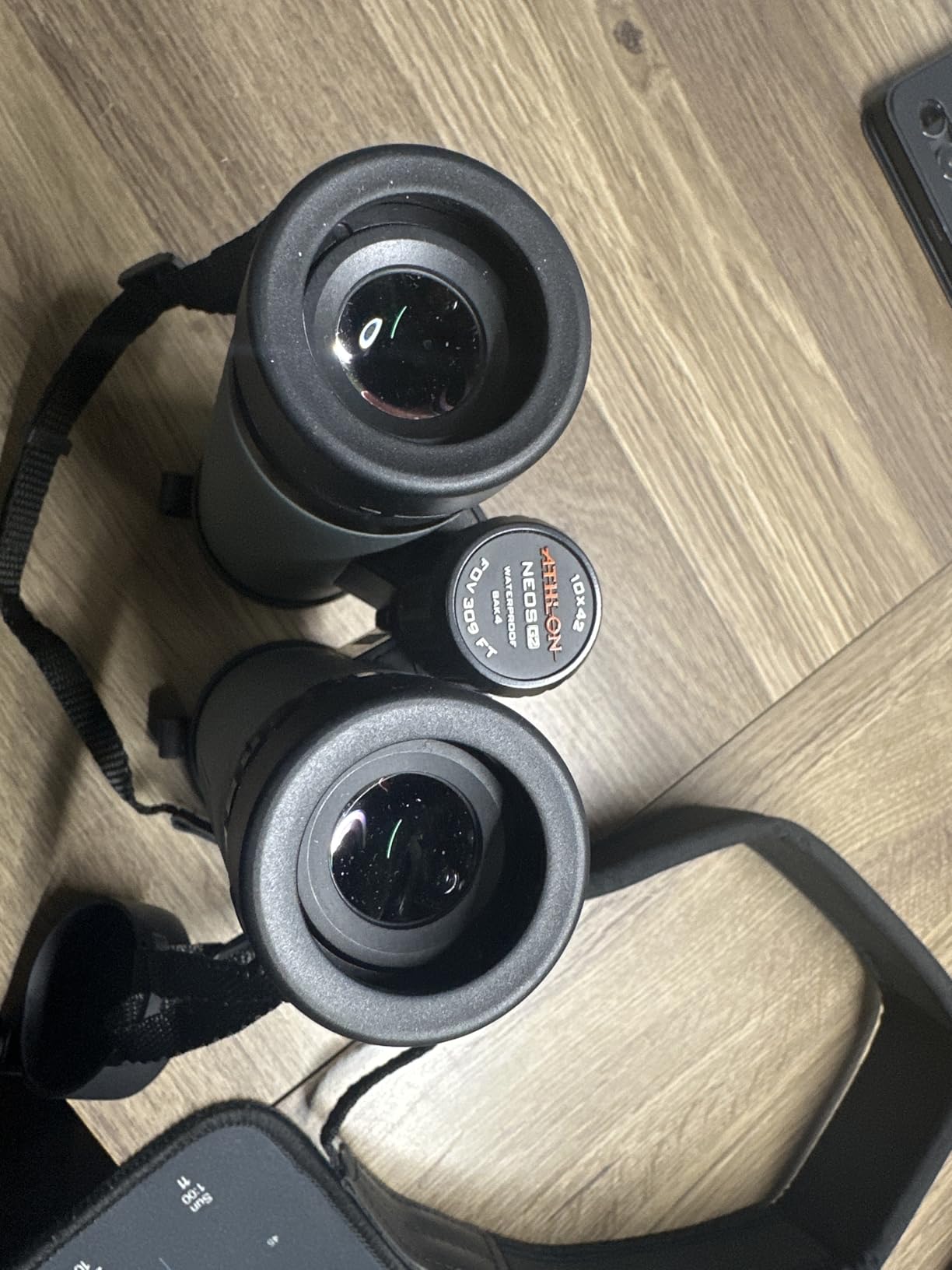
The Athlon Neos G2 HD is a straightforward 8×42 that gets two things unusually right for its tier: a BaK-4 prism and a large exit pupil. BaK-4 is the better prism glass, and many manufacturers quietly fit the inferior BK-7 instead to save a few dollars, so finding it at this level is meaningful. The exit pupil of 5.25 mm, from a 42 mm objective at 8x, is among the widest here and gives a bright image in dim light. Owner ratings are 4.5 across 238 reviews, and reviewers comparing it against costlier Vortex, Canon and Leupold models generally rate it the best value of the group.
At 1.3 pounds with a composite chassis, it is one of the lightest full-size 8x42s you can carry, and the 7-degree field of view is wide enough that subjects are easy to acquire. Eye relief is 17 mm on the specification sheet, though buyers frequently report numbers closer to 20 mm, which is the kind of discrepancy worth checking in person. Diopter adjustment is listed at plus or minus five diopters, and a waterproof, fog-proof sealed body handles rain and snow – one owner reported a pair surviving fifteen months of rain, snow and summer heat before starting this comparison.
There is a data caution here. The retailer listing for this product carries a set of key features and bullets that describe a 30 mm cantilever rifle-scope mount rather than a binocular, which is listing contamination rather than anything about the product. The title, model name, model number, optical specifications, images and every customer review all describe an 8×42 binocular, and those are the reliable data. If you are auditing specifications, this is exactly the kind of internal contradiction worth walking away from.
The recurring complaints are consistent: a field of view that feels narrower than the listed figure suggests, a diopter range some owners find tight, and clarity that does not reach Athlon’s own higher-end models. One user noted slight vibration at maximum magnification, which is a reminder that 8x still shakes on a distant animal if you are not braced. The kit includes a soft case, a padded neck strap, lens caps and a cleaning cloth, plus a lifetime warranty. No chest harness is included, which is a gap for a full-day carry.
Who the Athlon Neos G2 HD suits
It suits a hunter who wants wide scanning, low weight and a large exit pupil without paying for a premium badge. The 1.3-pound body and 5.25 mm exit pupil make it a good choice for dawn and dusk work in eastern timber, and the waterproof, fog-proof sealing covers the weather that comes with long seasons. It is also a sensible pair for a young hunter or as a lightweight backup that lives in a pack rather than a truck.
Where the Athlon Neos G2 HD falls short
It is not the sharpest glass here, and owners rank it below Athlon’s own higher-end models on clarity. If you spend long hours identifying animals at distance, the extra resolution of HD or ED glass is worth paying for. The tight-feeling diopter is a genuine annoyance for anyone whose eyes are not perfectly matched, and the field-of-view discrepancy between the listing and owner experience means you should judge the sweep in person. There is no chest harness in the box.
8. Bushnell H2O 10×42 – Best Waterproof Hunting Binoculars
Bushnell H2O 10×42 Waterproof Binoculars
10x42
IPX7 rated
4.2mm exit pupil
15.6mm eye relief
Pros
- IPX7 rating for submersion to 30 minutes and nitrogen purging
- BaK-4 prisms with fully multi-coated glass for a crisp bright image
- Internal focus gives smooth transitions and a natural field of view
- Substantial build that users read as quality
- Twist-up eyecups suit eyeglass wearers
- Case strap and microfiber cloth included
Cons
- Noticeably heavy for its class which tires the arms
- Diopter adjustment is very stiff
- Included soft case is thin and minimally padded
- 15.6mm eye relief is short at full eyecup extension
The Bushnell H2O is the one to buy if your hunting happens where things get wet. Its IPX7 rating means submersion to a metre for up to 30 minutes, and it is nitrogen purged and O-ring sealed on top of that. For hunters working shorelines, river drainages, coastal elk country or any place where a rainstorm is a normal Tuesday, that is not a minor specification – it is the reason the pair exists. Reviewers upgrading from cheaper glass single out the waterproofing first and the BaK-4 clarity second.
Owner ratings stand at 4.5 across 364 reviews, with owners frequently saying the optics rival binoculars costing far more. The optical system is all-glass, fully multi-coated, with premium BaK-4 prisms, which is a good specification set for the tier. Internal focus gives smooth transitions and what owners describe as a natural-feeling field of view, and several reviewers note that the body feels solid and substantial rather than thin. The soft-touch rubber housing has grip texture on the sides, bridge and grip runners, which matters when the glass is wet or gloved.
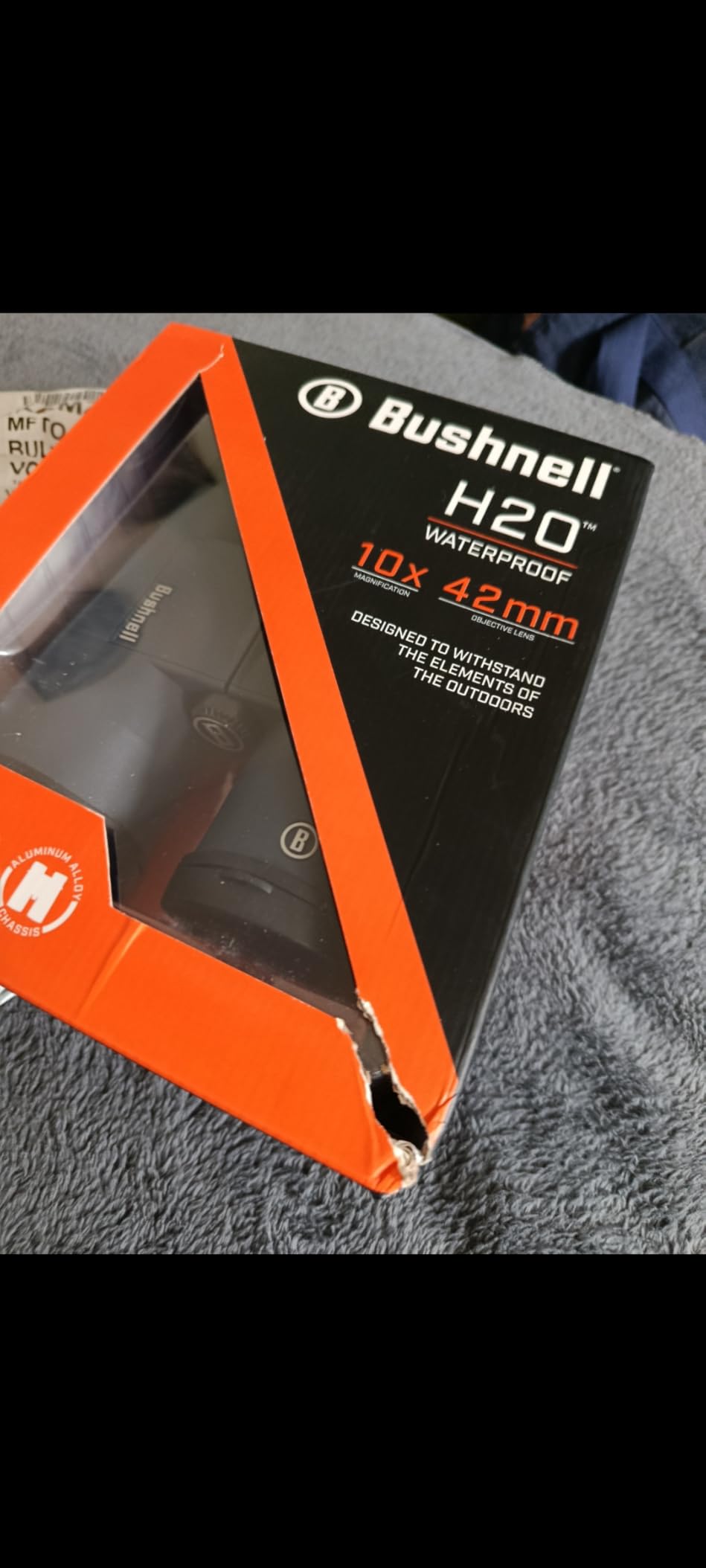
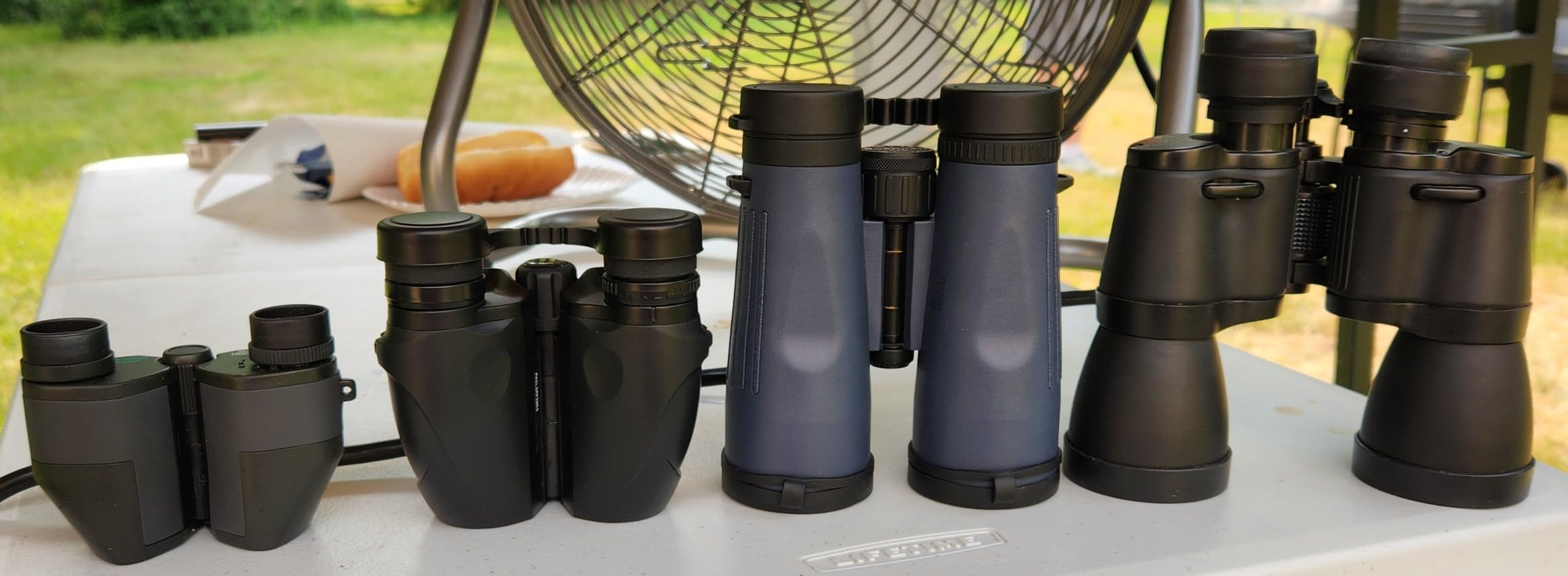
The weaknesses cluster around weight and small ergonomics. The aluminium chassis is listed at 907 g, which owners consistently call heavy for a supposedly compact model, and a light rain that would not bother a lighter glass makes this one tiring by hour eight. The diopter ring is very stiff, so correcting for one eye takes real effort. The included case is thin and minimally padded, which is a poor protection for a binocular with this reputation for durability. Eye relief of 15.6 mm is short at full eyecup extension, and the twist-up eyecups help but do not eliminate the issue for thick frames.
One more caution for anyone auditing specifications: the magnification and field-of-view fields in the listing data are internally inconsistent, even though the title, model number and reviews all confirm 10×42. Close focus is 12 feet, tripod compatibility is included, and the front caps are attached so they cannot be lost in the field. The warranty is Bushnell’s Ironclad coverage, which is a limited-term commitment rather than an unconditional lifetime policy.
Who the Bushnell H2O suits
It suits hunters whose glass is exposed to water by default: waterfowl and coastal hunting, sheep and goat country with persistent drizzle, boat-based game scouting, and anyone who has watched a pair of open glass fog up on a cold river crossing. The internal focus and natural field of view also make it a comfortable pair for following moving subjects, and the rubber grip works when the glass is wet.
Where the Bushnell H2O falls short
Weight is the main cost, and it directly limits how long you can carry the glass. The stiff diopter ring is a daily irritation for anyone whose eyes are not perfectly matched, and the thin case offers little protection in a pack or a truck bed. If you hunt in dry country and mostly from a vehicle, that sealing advantage matters less and the weight matters more. Glasses wearers with wide frames should test the eyecups first.
9. Bushnell PowerView 10×42 – Best Entry Optics for a Backup Pair
Bushnell PowerView 10×42 Compact Roof Prism Binoculars, Black
10x42
Compact roof prism
Telescoping eyecups
Attached lens caps
Pros
- Owners report the optics hold clarity and adjustment after years of use
- Telescoping eyecups give glasses wearers a clean in-focus view
- Compact and light enough to carry on a neck strap
- Rubber-armored build stands up to heat and field use
- Attached front caps flip down and cannot be lost
- Soft-shell case included
Cons
- 10x power is below what some reviewers consider sufficient for open-country work
- Some owners report intermittent blackouts they could not diagnose
- Progressive lens wearers must find the right eye-cup position to avoid dark edges
- Detailed optical specification data was not published for this listing
The PowerView 10×42 exists because every hunter eventually needs a second pair. It lives in the truck, it gets handed to a companion or a young hunter, and it takes the knock when something is dropped from a stand. Owner ratings of 4.6 across 895 reviews describe exactly that pattern: durability and value, with owners describing the build as well made and the eye cups as unusually useful for glasses wearers. The compact roof-prism design and attached front lens caps – which flip down and cannot be lost – are thoughtful details in a pair this cheap.
It is also a legitimately usable hunting binocular on its own for close-to-medium work. Ten power is enough to identify game at ordinary eastern and mixed-terrain distances, and the soft-shell case means it is easy to keep in a pack. The telescoping or fold-down eyecups let progressive lens wearers dial in a clean, unvignetted view, which is a real advantage for hunters over forty who need distance correction in their everyday lenses.
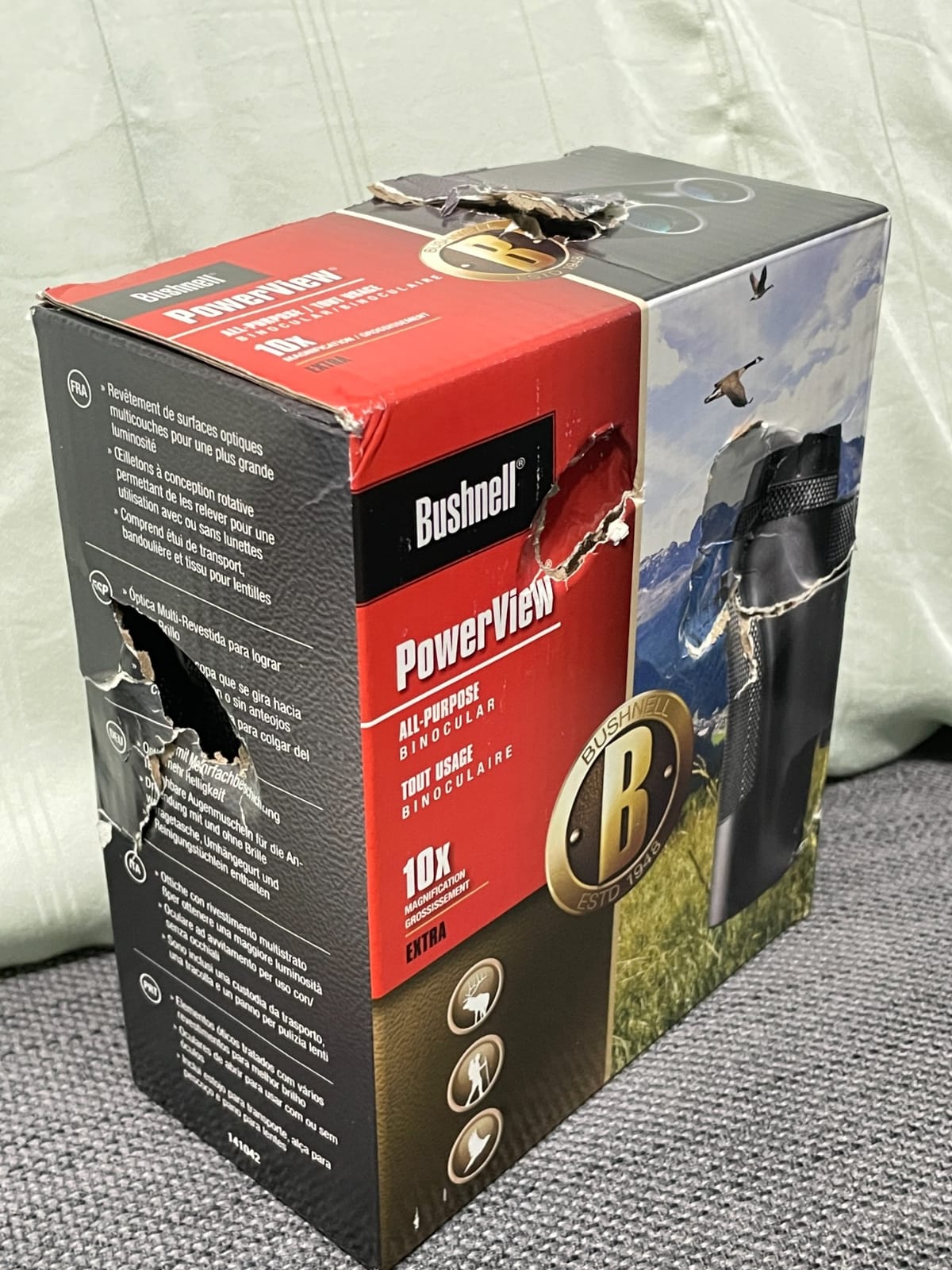
Two cautions. First, several owners report intermittent blackouts they could not diagnose, which is a real-world reliability concern that a review average smooths over. If the pair you receive behaves that way, a return window is essential. Second, 10x is simply below what some reviewers consider sufficient for long-range or open-country work, and the 10x hand shake is present here as everywhere else at this magnification. The published data for this listing is also thinner than the others here – weight, dimensions and model number were not returned – so treat the specification sheet as incomplete rather than minimal.
What is confirmed is the configuration: 10x magnification through 42 mm objectives, a roof prism in black, internal focus, telescoping eyecups, attached front lens caps with a tetherable rear cap, and a soft-shell case. That is a coherent and sensible package for the role. Do not expect premium coatings, phase correction or a lifetime warranty from this tier, and do not expect the image to hold colour at dusk the way an ED-glass model will.
Who the PowerView suits
It suits anyone who needs a durable, low-cost second pair, a pair to hand to a new hunter, or a glass that can sit in a vehicle without anxiety. Glasses wearers who need adjustable eye-cup position will find the telescoping mounts useful, and owners who have had theirs for years report the adjustment still holds. For scouting routes, checking water and general wildlife viewing, the magnification is more than adequate.
Where the PowerView falls short
It is not the pair to build a season around. Optical performance sits at the entry tier, with none of the dielectric, ED or phase-correction advantages of the models above it, and the reported intermittent blackouts are a genuine reliability concern. It also gives you no specification transparency – the weight and dimensions are not published – so if all-day carry weight is your deciding factor, this is the wrong tool. Buy it as a beater glass and a backup, and spend your real money elsewhere.
10. Celestron Nature DX 8×42 – Best for Long Scanning Sessions
Celestron Nature DX 8×42 Waterproof Binoculars for Bird Watching & Outdoors
8x42
7.4 degree field
17.5mm eye relief
5.25mm exit pupil
Pros
- 7.4 degree field and 388 foot coverage at 1000 yards is the widest true field here
- 8x power eliminates the shake of 10x and 12x models
- 17.5mm eye relief lets many eyeglass wearers hunt without glasses
- Individual focus lets one pair serve a whole family including strong prescriptions
- Focus described as buttery smooth and easy to set up
- Waterproof nitrogen purged and fully rubber armored
Cons
- No ED glass so detail and colour fade sooner in low light
- Some owners report eyecup retaining screws backing out over time
- Individual focus means both barrels are adjusted separately
- Included neck strap is of poor quality
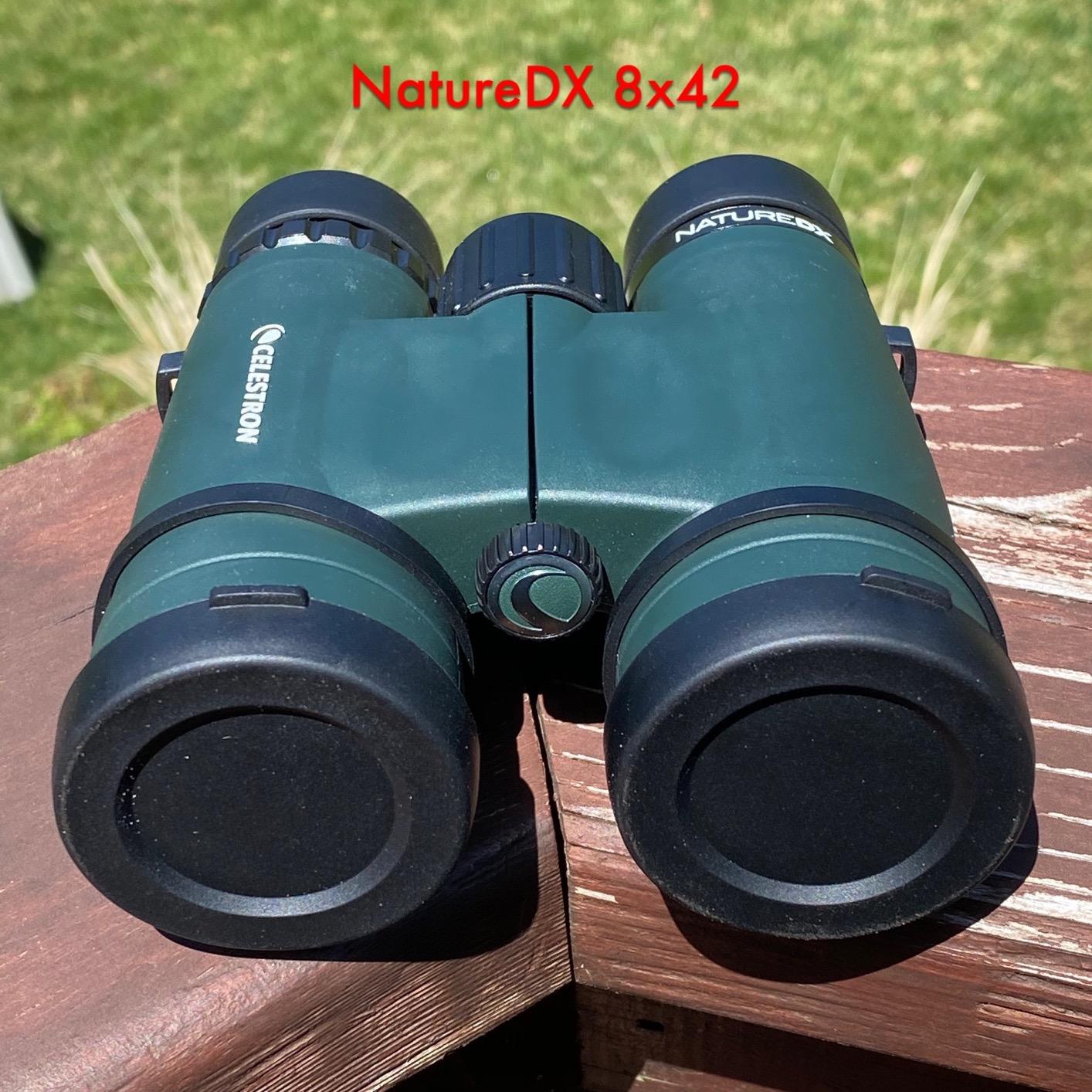
The widest field of view in this group belongs to the Celestron Nature DX 8×42, and for a specific kind of hunting that matters more than any other specification here. At 7.4 degrees apparent field of view and 388 feet of coverage at 1000 yards, you take in more of the scene per glance than with anything else on this list. For long scanning sessions, a bow hunter working a clearcut edge or a spotter glassing a whole basin, that is the difference between a productive morning and a boring one. The exit pupil of 5.25 mm is also among the widest, which supports pre-dawn use.
It carries the deepest review base in the group, with just over 4,000 owner ratings at 4.6, and the most-cited strength in those reviews is the combination of wide field and steady 8x power. Individual focus – rather than a centre focus wheel – means each barrel is adjusted separately, and one owner reported dialling the pair in single-handed for every family member from a nine-year-old to an eighty-year-old, including a 20/400 prescription. That is the kind of fit flexibility no centre-focus binocular in this list can match.
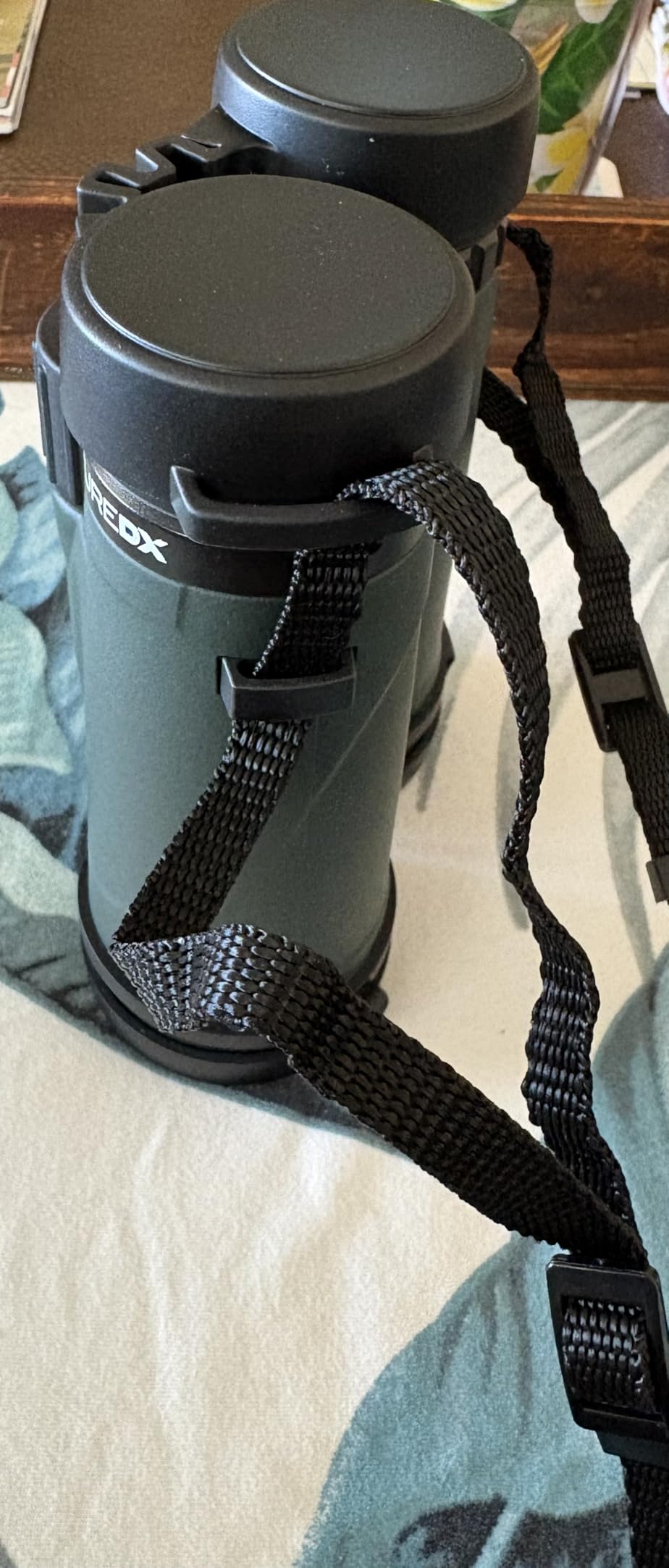
The weakness, and it is consistent across reviews, is low light. With no extra-low dispersion glass, detail and colour wash out at dusk sooner than on the premium models, and owners who own both describe the difference plainly. The phase-coated BaK-4 roof prisms with fully multi-coated lenses do well for the tier, but they do not create light that is not there. If your hunt depends on the last twenty minutes of light, the Monarch M5 8×42 or the Celestron 12×56 serves you better.
There is also a durability note worth knowing: some owners report the eyecup retaining screws backing out over time, which required a warranty replacement. Celestron’s lifetime warranty handled it without hassle, which tells you something useful about the brand’s support. Focus is described as buttery smooth and easy to set up, though the initial interpupillary adjustment takes practice, and the included neck strap is of poor quality. The body is 1.8 pounds, rubber armored, waterproof, nitrogen purged, and has a built-in tripod adapter socket for extended sessions.
Who the Celestron Nature DX 8×42 suits
It suits hunters whose method is scanning: the spotter working a basin, the bow hunter covering a clearing edge, and anyone who shares a pair with family members of different ages and prescriptions. The 8x power holds a steady image without a rest, so long glassing sessions in one position are genuinely comfortable. Eye relief of 17.5 mm with adjustable eyecups lets many glasses wearers hunt without removing their lenses, and the built-in tripod socket lets you switch to braced glassing when an animal shows up.
Where the Celestron Nature DX 8×42 falls short
Low light is the limit, and it is a real one for dawn and dusk hunting. Without ED glass the image loses contrast and colour before the premium models do, and 8x will not identify a distant animal that needs 10x or 12x. The 1.8-pound body is heavier than the lighter 8x42s here, which adds up on a long walk, and individual focus takes practice to get right. The included strap is poor enough that you will want to replace it with a chest harness.
How to Choose Hunting Binoculars
Most buying mistakes in this category come from buying a brand instead of a configuration. Work through these six decisions in order and the model choice becomes obvious on its own.
1. Pick the configuration that matches your terrain
Magnification sets how far you can identify; objective diameter sets how bright the image is. Divide the objective by the magnification and you get the exit pupil in millimetres, and that number decides whether the glass is dim at dawn. The figures are arithmetic, not marketing, which is why they cannot be spun.
8×42 – 5.25 mm exit pupil. Thick timber and eastern brush. Widest field, steadiest image, holds up best at dawn. Fails to identify at long distance.
10×42 – 4.2 mm exit pupil. Mixed terrain, deer, general big game. The all-round answer and the community consensus format.
12×50 – 4.2 mm exit pupil. Open western country and dawn or dusk glassing. More identification range, more shake, heavier.
12×56 – 4.6 mm exit pupil. The brightest long-range option in this guide. Needs a tripod or rest for long sessions.
8x – the same exit-pupil argument as 8×42, with a smaller body.
12×42 – rare for a reason. A 42 mm objective at 12x gives a 3.5 mm exit pupil, which is too dim for dawn and dusk. The premise of the question is wrong.
So to answer the two most common questions directly: for deer hunting, 10x is the workhorse and 8x is better in thick timber, which is why 10×42 sits at the centre of almost every roundup on this topic. Between 10×42 and 12×50, choose 10×42 for handheld all-round work and 12×50 for open country and low light where you can brace or tripod. And yes, 12×50 binoculars are good for deer hunting – excellent when the deer is at distance in low light, and the wrong tool for tracking a whitetail through brush at forty yards.
2. Set your weight ceiling before you look at brands
The community line is blunt: any optic over about 30 ounces becomes too heavy to carry all day. That is not fastidiousness, it is arithmetic – a pound and a half of glass hanging from your neck for ten hours is a shoulder problem by Thursday. Most of the picks here weigh between 1.3 and 1.8 pounds, which sits comfortably under the ceiling; the 2.3 and 2.5 pound models need a chest harness to be practical.
3. Check the eye relief if you wear glasses
Eye relief is the distance from the last lens to your eye, and it determines whether the field of view clears your eyeglass lens. Sixteen to seventeen millimetres is comfortable for most prescriptions; fourteen to fifteen millimetres can vignette, meaning you lose the edges of the image until you twist the eyecups down. Above 20 mm, as on the Nikon PROSTAFF P3 at 20.2 mm, most wearers can hunt without touching the eyecups at all. If you are buying a 15 mm model, test it with your actual frames.
4. Understand glass and coatings in about three minutes
A roof prism splits and folds light, and without a phase-corrected coating the two paths recombine out of step, which costs resolution and micro-contrast – the fine texture that separates a deer from a branch. Dielectric prism coatings reflect more light than standard silver ones, which is the single most visible upgrade in this category and the reason the Diamondback HD looks cleaner than the Crossfire HD. Extra-low dispersion glass like the Monarch M5 disperses colours less than standard glass, so silhouettes against a bright sky stay sharp instead of fringing. And prism glass matters: BaK-4 is better than the BK-7 that many manufacturers fit silently.
None of these technologies fix an aperture problem. A 4.2 mm exit pupil at dawn is dim no matter how many coatings are on the glass, which is why the low-light slot in this guide is won on objective diameter rather than on glass type.
5. Budget for the harness, not just the binocular
Most hunters carry their glass wrong. A neck strap puts the load asymmetrically on one shoulder and swings while you walk; a chest harness centres the weight and holds the glass still, and it is a separate accessory for several brands in this group. Pair a harness with the weight of the glass: the 1.3 to 1.4 pound models are comfortable on a neck strap or a harness, while the 2.3 and 2.5 pound models are only realistic on a chest harness. Owners on hunting forums regularly treat a missing or uncomfortable harness as the reason glass stays in the truck, and harness-to-binocular pairing is a bigger practical factor than most buyers expect.
6. Read the warranty, and check the glass on arrival
An unlimited, unconditional lifetime warranty – Vortex’s VIP, and equivalents from SIG Sauer and Leupold – is a genuine differentiator, because a binocular dropped from a treestand is replaced rather than repaired at cost. Limited lifetime and materials-and-workmanship warranties are real but weaker. Separately, check collimation as soon as the glass arrives: hold it at arm’s length, focus on a distant straight edge such as a power line, and confirm both sides merge into one line with no break or colour fringe. A slight bow in the image means the barrels are out of alignment, and it is far easier to return than to live with.
Frequently Asked Questions
What is better, 10×42 or 12×50 for hunting?
For all-round handheld hunting, 10×42. Both give a 4.2 mm exit pupil, so brightness is identical, but 10x is steadier, lighter to carry and easier to locate moving game with. Choose 12×50 for open western country and dawn or dusk glassing where identification range matters more than sweeping and steadiness.
Which is better for deer hunting, 8×42 or 10×42?
10×42 for most deer hunters, 8×42 in thick timber and eastern brush. An 8×42 gives a 5.25 mm exit pupil against the 10×42’s 4.2 mm, a wider field of view and a much steadier image, so it holds up better at dawn and dusk and is easier to track a moving deer. The 10×42 resolves more detail at range, so it is the better choice in open and mixed terrain.
Should I get 8x or 10x binoculars for hunting?
Get 8x if you hunt in timber, wear glasses, spend long hours scanning, or hunt in low light with a glass you must hold steady. Get 10x if you hunt mixed or open terrain and need to identify animals at distance. The community consensus is 10x as the workhorse, with 8x as the timber and dawn answer.
Are 12×50 binoculars good for deer hunting?
Yes for open country and low light, no for all-day handheld carry. Twelve power identifies distant deer far better than 10x, and a 50 mm objective gathers more light for dawn and dusk. The cost is weight and hand shake, which makes it a poor choice for tracking deer through brush at close range or for hunters who carry glass all day.
What are the top 5 binoculars for hunting?
The Vortex Crossfire HD 10×42 for best overall, the Vortex Diamondback HD 10×42 for best value, the Vortex Triumph HD 10×42 at the budget rung, the Nikon PROSTAFF P3 8×42 for the widest field of view and best glasses fit, and the Celestron Nature DX 12×56 for low light and open country.
What binocular magnification is best for deer hunting?
Ten power for most deer hunters, because it resolves enough detail at range while staying hand-holdable. Eight power if you hunt in thick timber or glass in low light and need a wider, steadier view. Twelve power only if you can brace the glass or use a tripod, otherwise hand shake costs you more than the extra magnification gains.
What binoculars work if you wear prescription glasses?
Look at eye relief first. Above 16 mm most wearers can hunt without adjustment, and 20 mm or more is comfortable with almost any frame. The Nikon PROSTAFF P3 8×42 at 20.2 mm and the Nikon Monarch M5 8×42 at 19.5 mm are the safest choices here. Models at 15 mm, including the Crossfire HD and Diamondback HD, work but usually need the eyecups twisted fully down.
The Best Binoculars for Hunting in 2026
If you only buy one pair, buy the Vortex Crossfire HD 10×42. It is the configuration the hunting community has settled on for good reason – a 4.2 mm exit pupil that is efficient at dawn, a roof prism and nitrogen purging that survive the season, 1.4 pounds that disappear against your chest, and an owner rating of 4.8 across more than 4,000 reviews. It is not the brightest glass and not the widest, and that is the trade. Those exist, and they are in this guide under the awards they actually win.
Upgrade to the Diamondback HD if you want a brighter, more colour-true image from a dielectric prism coating. Go 8x with the PROSTAFF P3 if you hunt in timber or wear glasses. Choose the 12×56 if your hunt lives in the last twenty minutes of light. Check the current figure on the retailer page, and confirm the fit with your own glasses before the order goes through.