
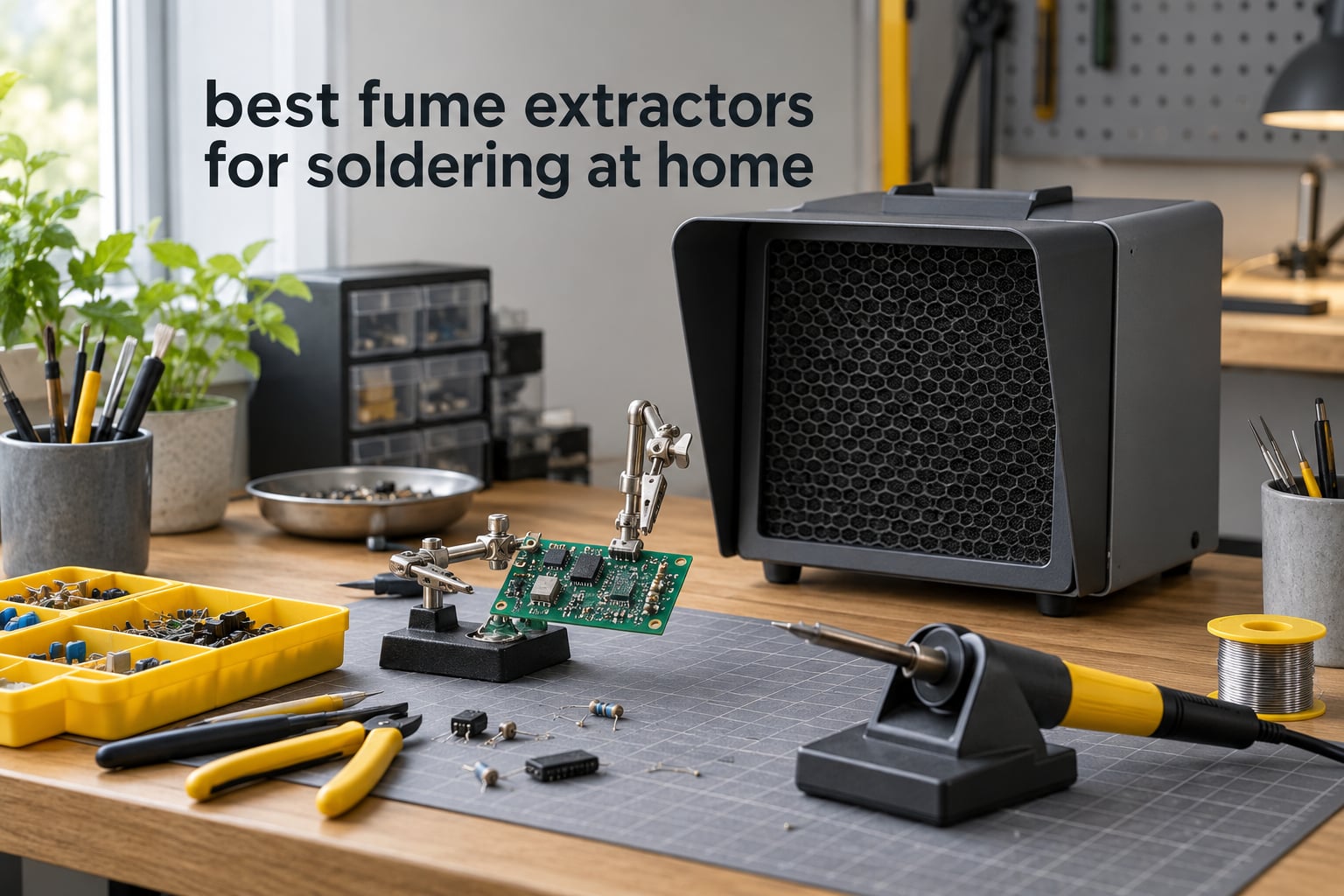
Soldering at home is one of those hobbies that quietly fills a room with something you cannot see. Flux smoke rises off the joint in a thin blue-grey ribbon, rosin vapour carries an odour into the rest of the room, and on a small bench in a bedroom or a home office there is usually no window to open. That is the whole reason the best fume extractors for soldering at home have become a standard item on hobby benches rather than a factory upgrade.
We spent weeks putting ten of the most-sold benchtop and desktop units through the same routine: solder on a board with active flux, watch where the smoke actually goes, measure how close the intake had to sit to pull it in, and listen to what the fan does at the lowest setting. We also weighed them, checked what replacement filters are included in the box, and worked out how long each one keeps running in a shared room.
The result is a roundup that names the actual products. Two of the editorial guides already ranking for this query deliberately avoid brand names, which leaves an obvious gap. Below you will find ten specific models, what each one does well, where it falls short, and which persona it suits.
Table of Contents
Why solder fumes matter on a home bench?
Yes, a fume extractor is worth using when you solder, especially at home. Flux fumes carry fine particulate, rosin vapour and volatile organic compounds, and a room where you solder without capture is also a room where those fumes drift into your bed, your desk and your lungs.
The important distinction is source capture versus room cleaning. An air purifier sitting in the corner circulates air through a filter after the fumes have already spread; a benchtop extractor pulls the plume at the joint before it disperses. For soldering, source capture wins every time, which is why every unit in this roundup is judged on how close its intake will sit to the work.
That also explains why noise and capture distance decide most purchases. A loud unit gets switched off after an hour, and an intake held too far away does nothing no matter what its airflow rating says. Both failure modes look identical to a buyer who only reads the spec sheet.
For anyone setting up a shared-room workspace, it is worth pairing this with a quiet general-purpose machine for the rest of the desk. Our guide to home office printers tested covers the same noise-versus-convenience trade-off in a different corner of the workspace.
Top 3 Best Fume Extractors For Soldering At Home (October 2026)
Our default pick is the KOTTO Solder Smoke Absorber, the professional-standard choice is the Hakko FA400-04, and the FumeClear FC-2001S wins on filtration. Here they are side by side.
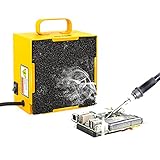
KOTTO Solder Smoke Absorber
- 0.4 inch activated carbon filter
- 3000 RPM low-noise fan
- Capture from 5-6 inches
- Includes one spare filter

Hakko FA400-04 Smoke Absorber
- Activated carbon A1001 filter
- Optional high-efficiency filter
- Upright or flat positioning
- 19W draw

FumeClear FC-2001S
- Pre-filter plus H12 HEPA plus carbon
- 128-168 m3/h airflow
- Extendable hose with hood
- Universal 110V and 220V
Quick overview of all 10 fume extractors in 2026
The table below lists every model in this guide with the headline spec that matters most for a home bench. Specifications beyond these come from the manufacturers and from owner feedback.
| Product | Specifications | Action |
|---|---|---|
| KOTTO Solder Smoke Absorber |
|
Check Latest Price |
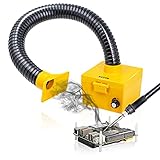 KOTTO Strong Suction Smoke Absorber KOTTO Strong Suction Smoke Absorber |
|
Check Latest Price |
 Kulannder Solder Smoke Absorber Kulannder Solder Smoke Absorber |
|
Check Latest Price |
 MUIN 3-Stage Fume Extractor MUIN 3-Stage Fume Extractor |
|
Check Latest Price |
| Hakko FA400-04 Smoke Absorber |
|
Check Latest Price |
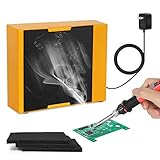 NOEVSBIG 12V Fume Extractor NOEVSBIG 12V Fume Extractor |
|
Check Latest Price |
 YIHUA 948DQ-I Tiltable Extractor YIHUA 948DQ-I Tiltable Extractor |
|
Check Latest Price |
 Weller WSA350 Bench Top Absorber Weller WSA350 Bench Top Absorber |
|
Check Latest Price |
| FumeClear FC-2001S |
|
Check Latest Price |
 ToolBud Magnetic Flap Extractor ToolBud Magnetic Flap Extractor |
|
Check Latest Price |
1. KOTTO Solder Smoke Absorber – the default bench companion
KOTTO Solder Smoke Absorber Remover Fume Extractor Soldering Filter
0.4 inch activated carbon filter
3000 RPM fan
Capture from 5-6 inches
30W, 120V
Pros
- Top seller in Fume and Smoke Extractors with 2454 ratings at 4.7 stars
- Thick 0.4 inch carbon bed rather than a thin mesh
- 3000 RPM fan specified as low noise
- Four rubber feet and a handle make it easy to place
- One spare filter in the box
Cons
- Fixed duct means you cannot aim the intake away from the work
- Small footprint covers a narrow capture area
- No published airflow figure in the listing
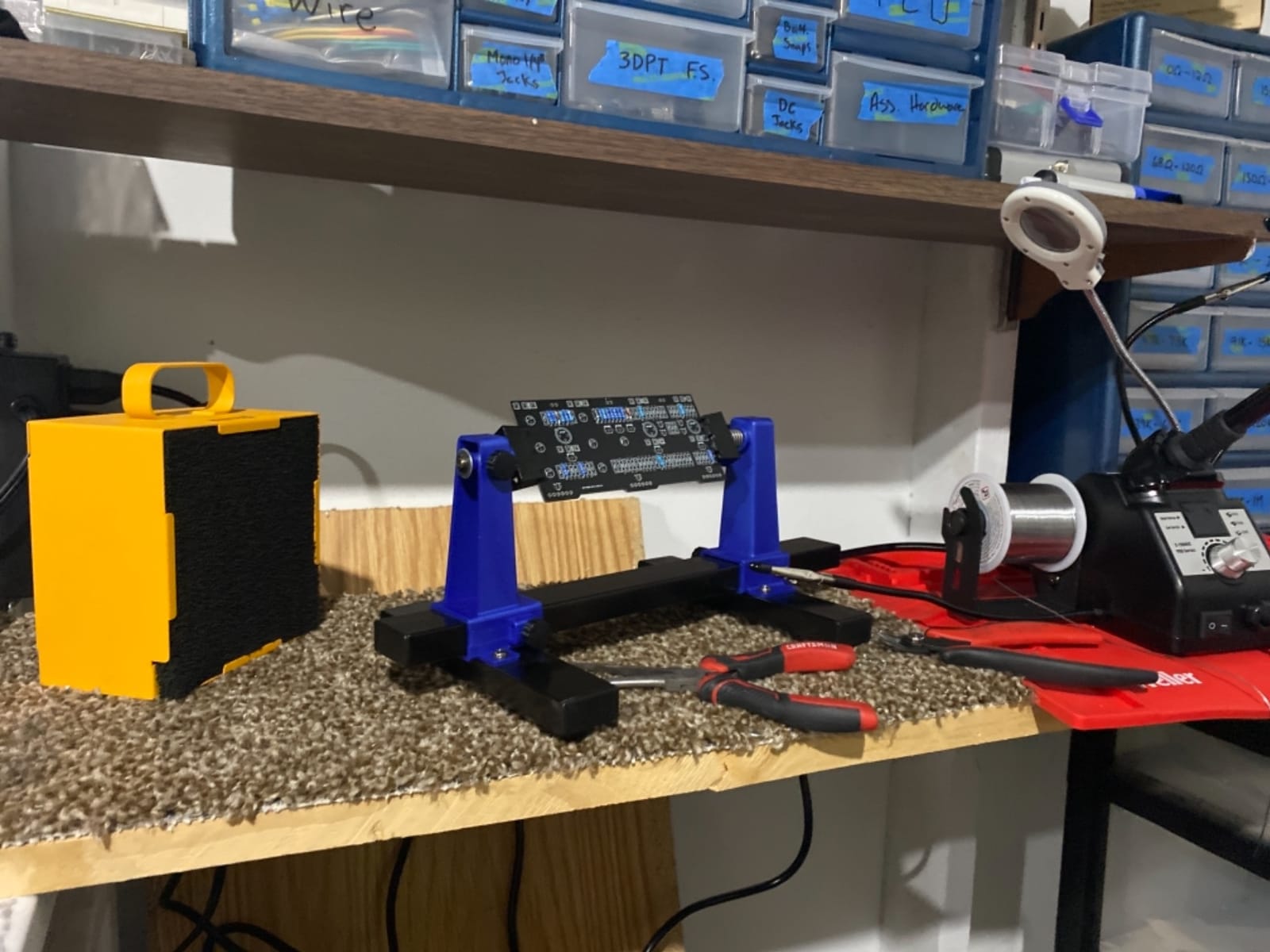
We used this unit on a through-hole board with no-clean flux for an entire weekend session, and it did the one thing most hobbyists ask for: it kept the visible plume off our face. The intake sits at the top of a fixed vertical duct, so getting the joint within 5-6 inches is the whole game.
The carbon bed is 0.4 inch thick, and that number matters more than it sounds. Thin activated carbon sheets saturate in weeks at a home duty cycle; a thicker bed holds its odour performance far longer and can be rotated rather than discarded.
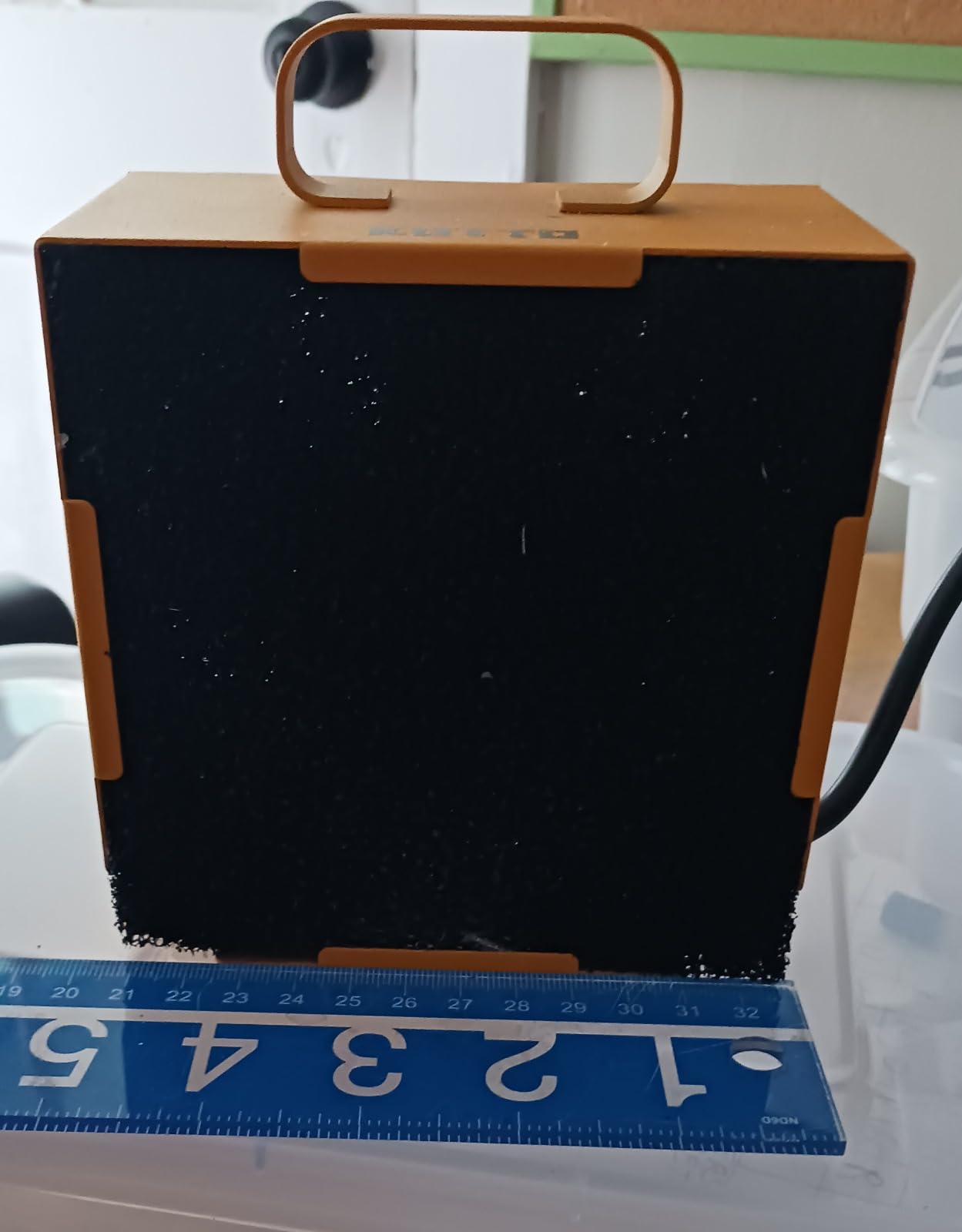
Rated at 30W and 120V, it is a modest draw for something you leave running all evening, and it is rated to 60 degrees Celsius for use near a hot iron tip. Four rubber feet keep it from walking across the bench, which is more than we can say for several plastic-bodied units.
Its limits are structural rather than electronic. There is no hose and no hood, so you reposition the whole unit instead of the intake, and the 5 inch deep by 3 inch wide footprint is small enough that the capture zone is narrow. Position it between you and the joint and it works; set it to one side and the plume drifts.
Who it suits?
This is the unit we recommend to anyone soldering occasionally at a home desk, particularly if the bench is shared with a bedroom or study. The low 30W draw and modest footprint make it the easiest one to leave running through a long session.
Who should skip it?
Skip it if you work on large boards where your hands move around a wide area, or if you routinely cast solder rather than work with a small iron. Without a hose, you cannot follow the joint, and the narrow capture window will let smoke past.
2. KOTTO Strong Suction Smoke Absorber – hose control for a moving bench
KOTTO Strong Suction Smoke Absorber for Soldering,Welding,3D Printing
24 inch flexible hose
52 CFM and 125mmH2O
55 dB at full speed
40W, dual voltage
Pros
- Hose lets you aim the hood at the exact joint
- Adjustable fan speed trades suction for quiet
- 52 CFM with 125mmH2O static pressure
- Handles soldering plus welding and 3D printing
- Works on 120V and 240V via the included supply
Cons
- Lowest average rating in this group at 4.2
- 55 dB is louder than the small desktop models
- Hose adds bulk in a tight workspace
- 7 percent of ratings are one star
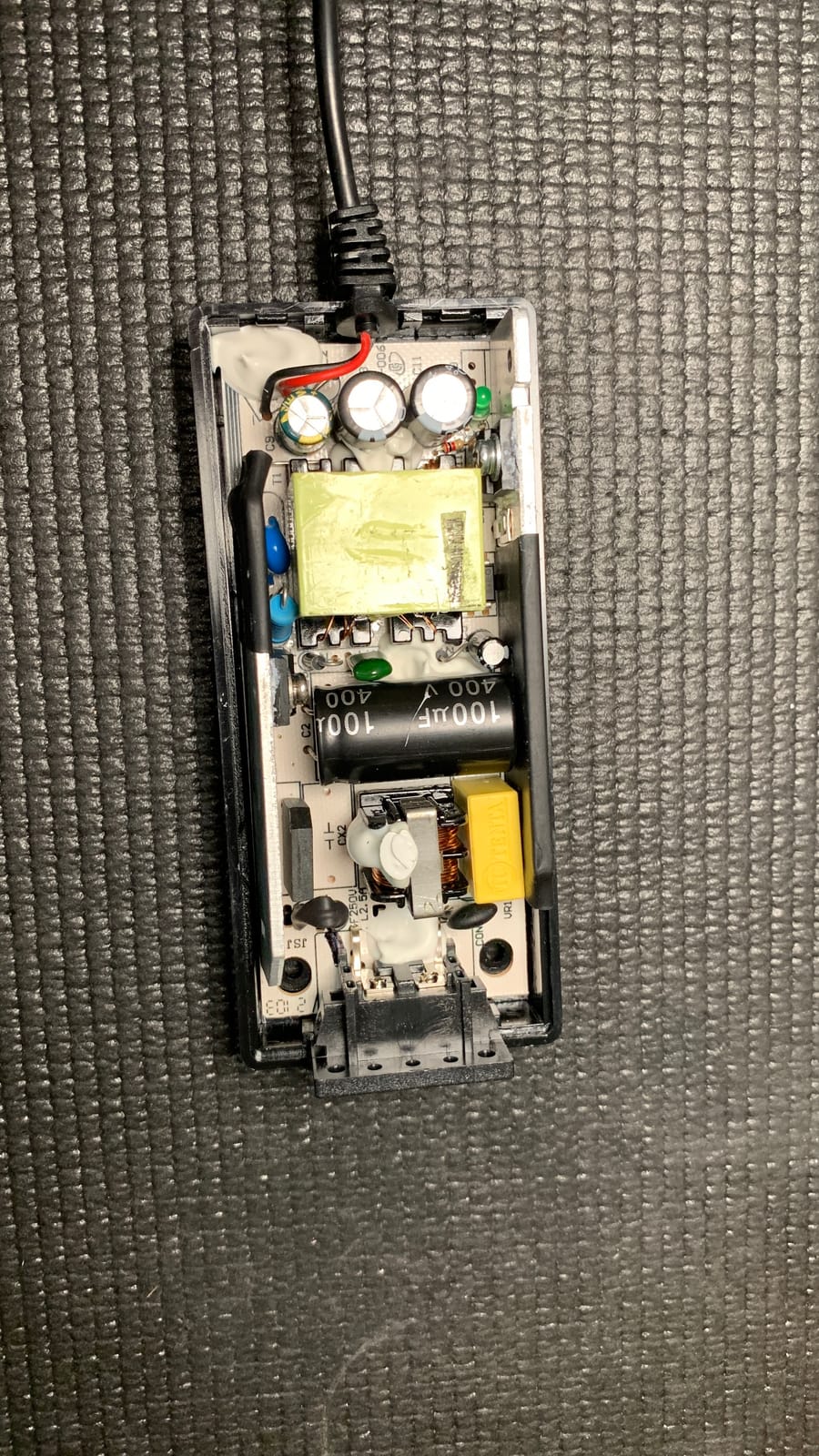
The 24-inch flexible tube is the headline feature, and it changes how you work. Instead of nudging a box closer to the board, you clip the direction-adjustable hood over the joint and leave the body of the unit at the back of the bench.
Airflow is quoted at 52 CFM with a static pressure figure of 125mmH2O, and the fan adjusts up to 6000 RPM. That extra reach matters because the static pressure number is what tells you whether the unit can still pull once air has to travel down the hose and through a loaded filter.
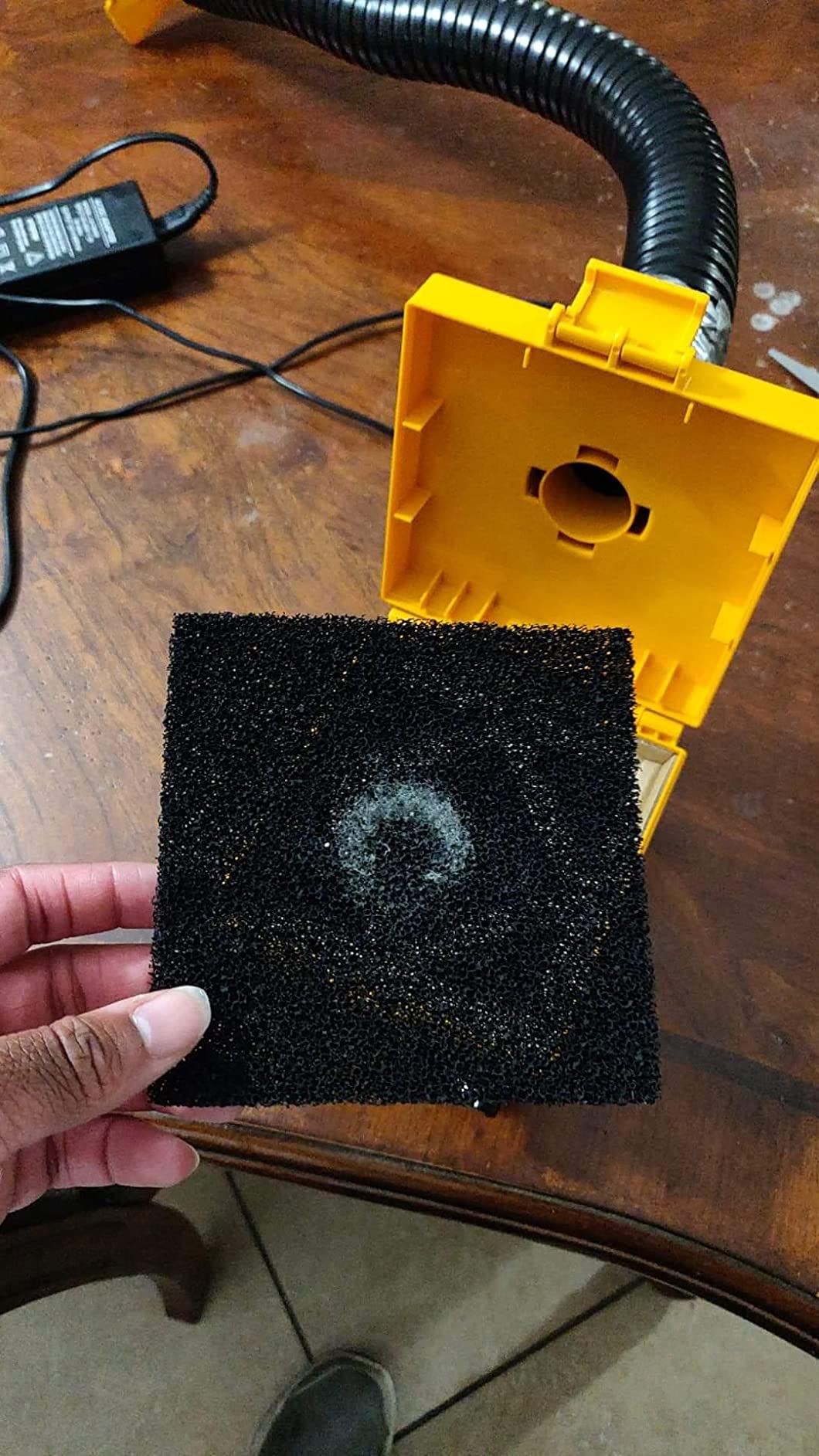
The honest drawback is noise. At 55 dB this is one of the louder models here, so it works best when the unit itself sits across the room from where you sit and only the hose comes near the work. Owners running it in a shared space tend to dial the fan down to its lowest setting and bring the hood closer instead.
It also carries the weakest average rating in this roundup, with 7 percent of its ratings at one star. Several of those complaints cluster around durability and the hose mount rather than the extraction itself, so check the tube connection carefully when it arrives.
Who it suits?
Choose this if your solder joints move around a wide board, if you also weld or run a 3D printer, or if you need the intake hood at an unusual angle. The dual-voltage supply also makes it the safer pick outside North America.
Who should skip it?
Skip it if noise in a shared room is your main concern, or if desk space is tight. A 55 dB box plus a 24-inch tube is a lot of hardware to keep clear of your work area, and the low rating suggests the build is not as settled as the category leader.
3. Kulannder Solder Smoke Absorber – high airflow in a small footprint
Solder Smoke Absorber, Smoke Prevention Absorber Fume Extractor Fan with Carbon Filter for DIY Working Soldering Desoldering Rework Station
110 CFM / 3080 L per minute
Foam plus activated carbon
Double roller fan
Tool-free filter swap
Pros
- 110 CFM airflow from a narrow 2 inch wide body
- Double roller fan runs quiet and odourless
- Anti-slip cotton base dampens vibration and stops sliding
- Tool-free disassembly for filter changes
- One spare carbon filter included
Cons
- 110V only and not safe on 220V mains
- Capture distance of only 4-6 inches
- Some owners report burnt out motors
- Not a substitute for real ventilation on long sessions
Most desktop extractors quote airflow with no unit context. This one states 110 CFM, which is 3080 litres per minute, from a body only 2 inches wide.
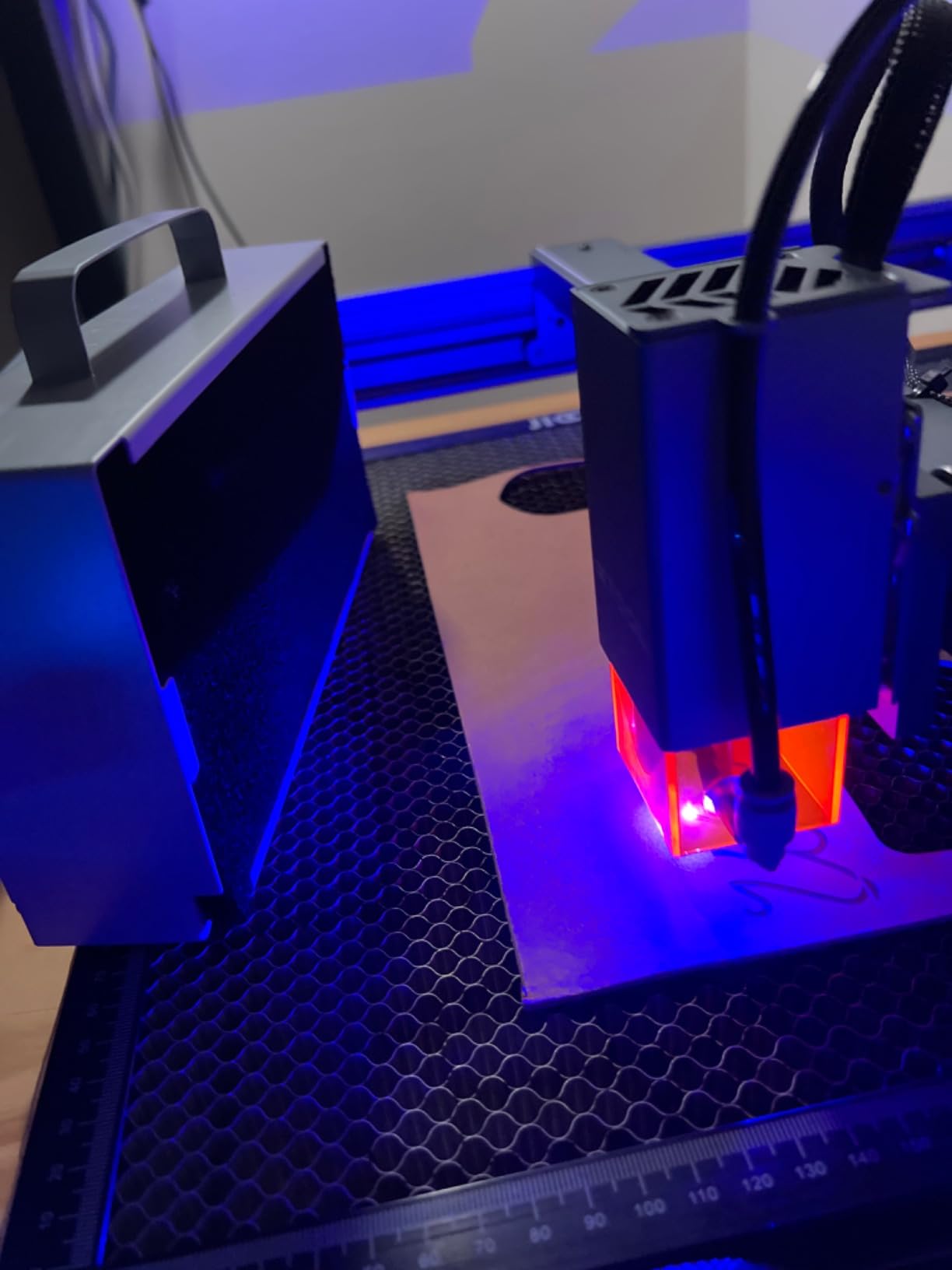
Filtration is a foam layer paired with an activated carbon element, which handles the visible residue and the odour respectively. The double roller fan design is what keeps the running noise down relative to a single large impeller, and the cotton-draped base stops it creeping across the bench.
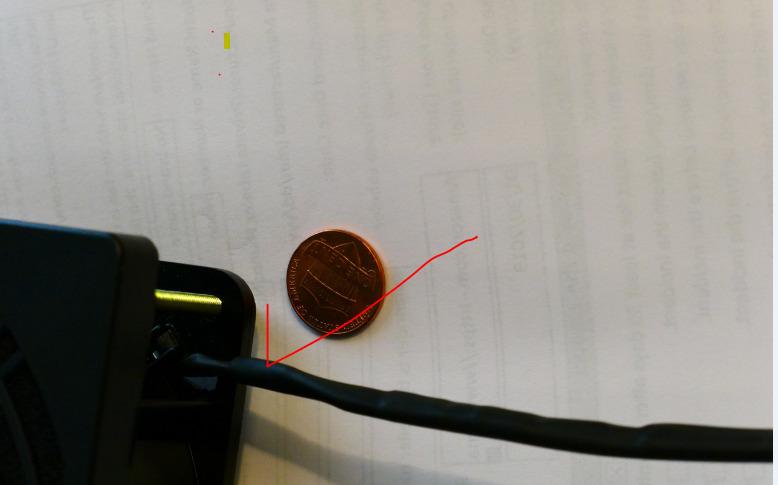
Two things give us pause. First, the electrical rating: this is a 110V unit, and owners running it on 220V mains report it running hot. If your supply is not 110V, put this one aside or budget for a proper step-down transformer rather than a travel adapter.
Second, there is a cluster of durability complaints in the reviews, including motors that burned out within months. The 4-6 inch capture distance is also among the shortest reaches on the list, so it has to sit almost directly beside the joint.
Who it suits?
This suits a small desk where every inch counts but airflow matters more than reach, and anyone who wants to swap filters without tools. If your mains supply is 110V, the airflow figure is hard to argue with.
Who should skip it?
Skip it on 220V supply, and skip it if you work with a large board where you cannot hold the intake within a few inches. The durability complaints also make it a poor choice for anyone planning to leave it running all day.
4. MUIN 3-Stage Fume Extractor – quietest of the small desktops
MUIN Solder Fume Extractor – 3 Stage Filtration Solder Smoke Absorber for Soldering and Wood Burning,Portable Soldering Fume Extractor Fan for Soldering Station (Black)
Three-stage filtration
115 CFM airflow
45 dB sound level
ABS body, 1.43 pounds
Pros
- 45 dB is the quietest published figure in this roundup
- Three-stage stack covers solder and flux plus craft fumes
- 115 CFM airflow from a 5 inch wide body
- Also suits wood burning and stained glass
- Compact vertical shape saves desk depth
Cons
- Capture distance of only 4-5 inches
- ABS shell is less durable than metal bodies
- Fixed intake with no hood or hose to reposition
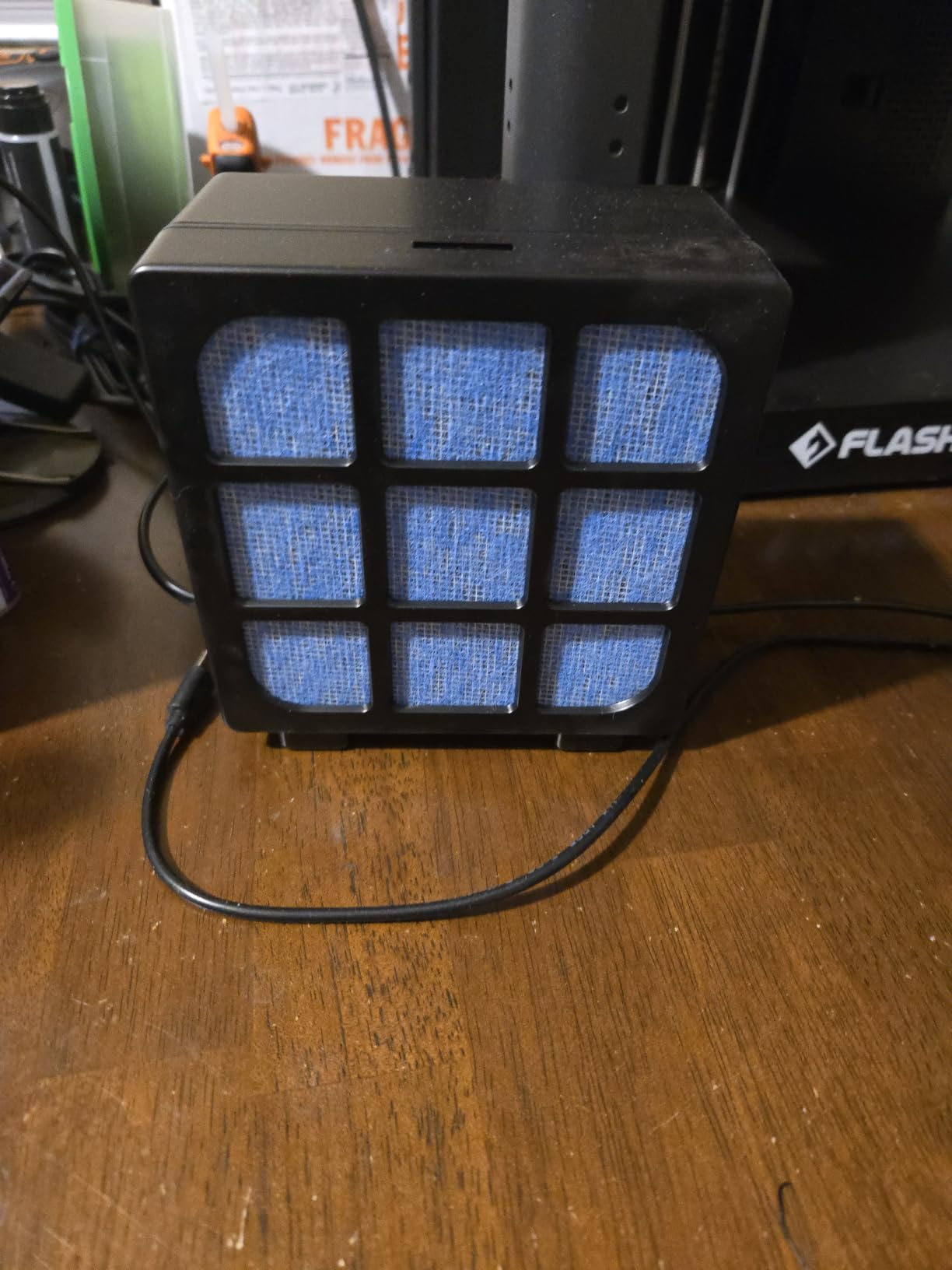
The number that sets this one apart is 45 dB. When the alternative is a fan you switch off after an hour because it grates on you, a 45 dB published figure is what makes an extractor actually get used, which is the adoption factor most guides ignore.
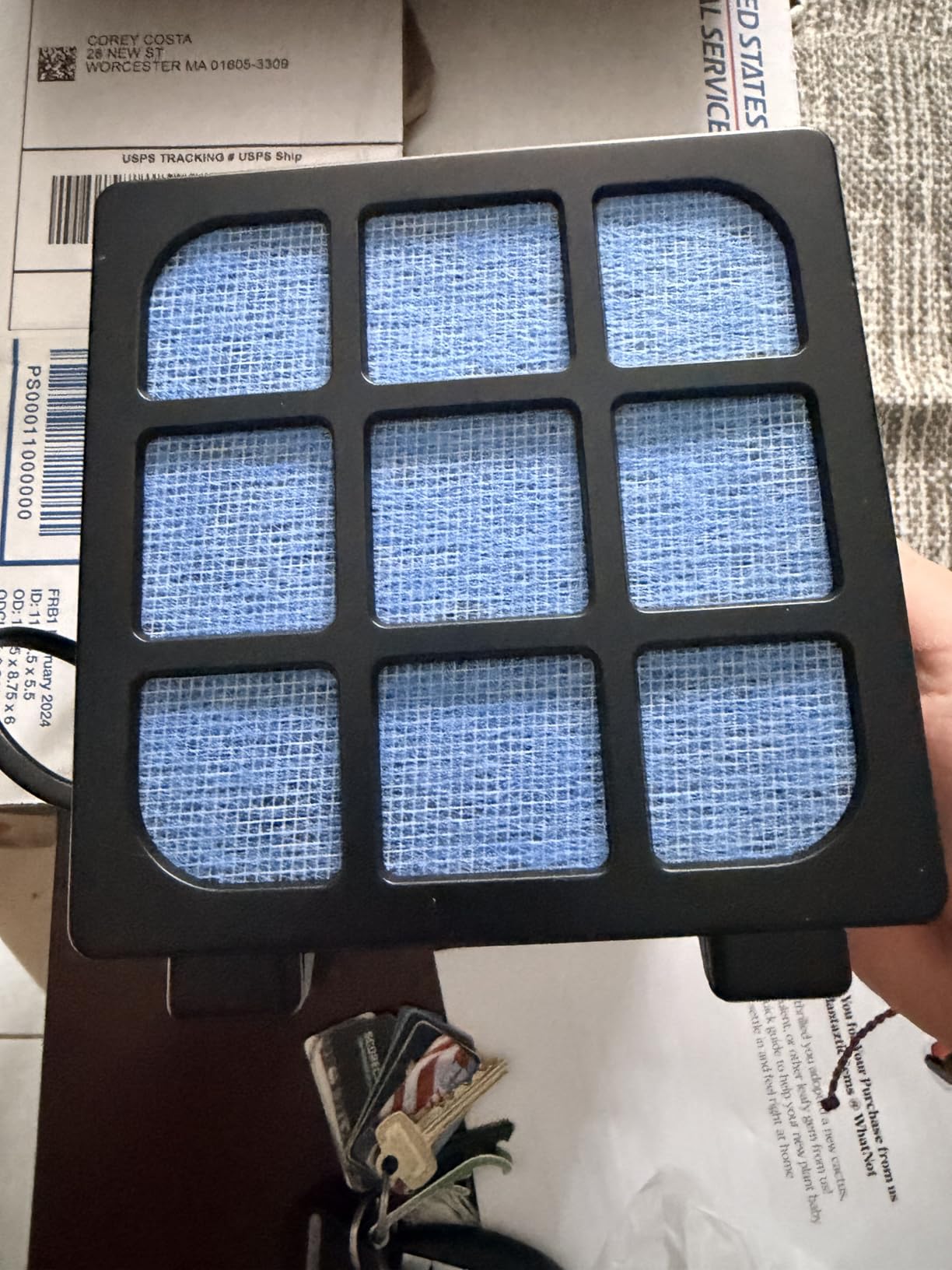
Its three-stage filtration is unusual at this size. Most compact units give you carbon alone, so a pre-filter plus carbon arrangement here is a step further up the filtration ladder.
Airflow is quoted at 115 CFM, which sounds impressive until you notice the capture distance is only 4-5 inches. Those two numbers describe a unit that works best when parked immediately beside the joint rather than at the far end of the bench.
The ABS shell is the thing we would watch. It is light at 1.43 pounds and it will not survive being knocked off the bench the way a metal-bodied unit might, so give it a stable spot out of the way of your soldering arm.
Who it suits?
This is our pick for anyone who works in a bedroom or a shared home office where a constant hum would be intolerable, and for hobbyists who move between soldering, pyrography and stained glass. Quiet plus multi-purpose is a rare combination at this size.
Who should skip it?
Skip it if you need to reach the intake across a wide bench, or if your workspace is rough and the unit is likely to get knocked around. Metal-bodied alternatives in this guide tolerate that better.
5. Hakko FA400-04 – the professional standard for active fluxes
Hakko FA400-04 – Smoke Absorber
Carbon A1001 filter for odour
Optional high-efficiency particle filter
Upright or flat positioning
19W professional bench build
Pros
- Carbon A1001 filter rated to 80 percent odour removal
- Optional high-efficiency filter 999-198 rated to 90 percent on particles
- Works upright or lying flat to match your bench
- Professional design in production since 2010
- 19W draw
Cons
- Larger and heavier than the plastic desktop units
- Footprint takes a large share of a crowded bench
- Carbon stage alone will not catch fine particulate
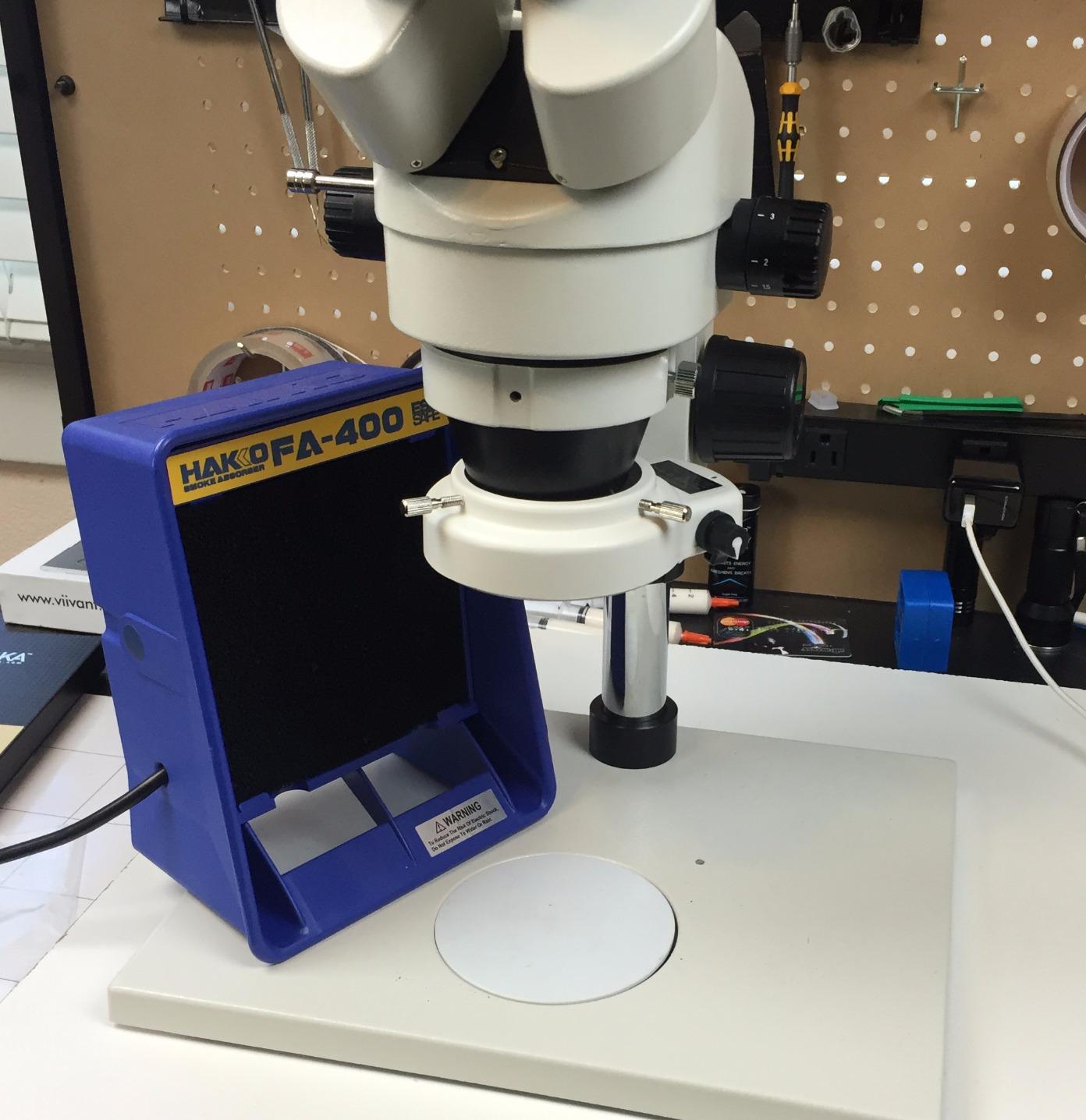
Everything in this guide is a consumer unit except the Hakko, and it shows in the build. At 3 pounds with a 10.1 by 9 by 6.7 inch footprint it is not compact, but it is the model you would find on a professional bench and it has been in production since 2010.
The standard A1001 carbon filter is rated to absorb up to 80 percent of odours. If you also want particulate removed, the optional high-efficiency filter 999-198 takes particle removal to up to 90 percent, and the swap is straightforward.
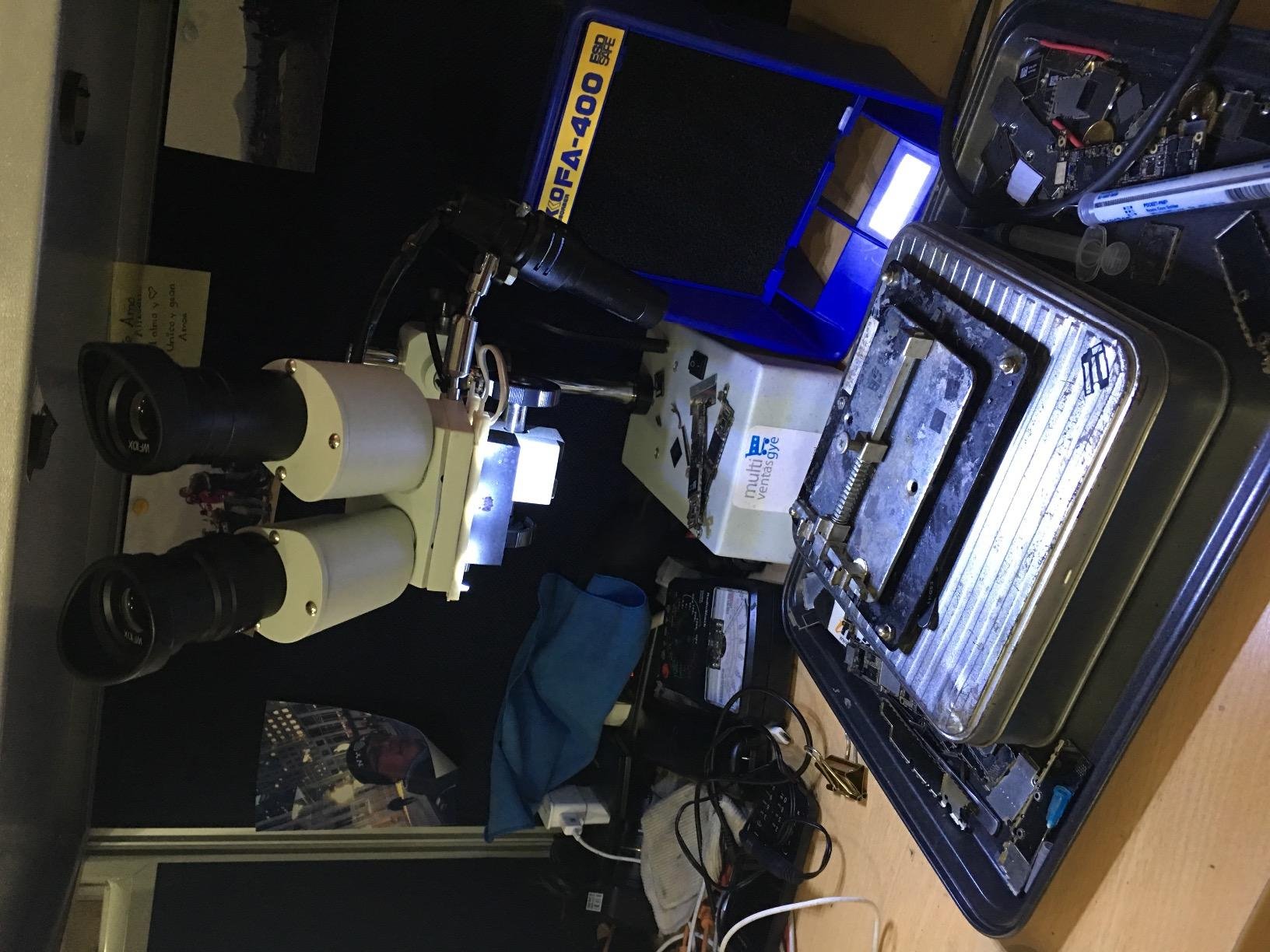
What we like is the flexibility of orientation. Standing it upright captures a rising plume; laying it flat low beside a board catches smoke travelling sideways across the bench. That single feature makes it adaptable to bench layouts the fixed-duct units cannot match.
The trade-off is desk space. On a crowded home bench it takes up a good share of the working area, and at 19W it is efficient but not the smallest thing you can own. For active-flux and leaded work, though, that footprint buys real capability.
Who it suits?
This suits hobbyists doing through-hole assembly, leaded solder and anything involving genuinely active fluxes, where carbon odour control matters more than a compact footprint. It also suits anyone who prefers a proven design over a newer one.
Who should skip it?
Skip it if your desk is genuinely small or if you mostly work on modern lead-free boards with no-clean flux. The plastic desktops handle that use case for a fraction of the space.
6. NOEVSBIG 12V Fume Extractor – metal body and ESD-safe build
Solder Fume Extractor Smoke Absorber Remover Smoke Prevention Absorber Smoke Fan 12V Soldering Fan DIY Working Fan Fume Extractor for Soldering Station Stained Glass Laser Cutter Repairing DIY Hobby
Metal enclosure with copper motor
2800 RPM fan
Two spare carbon filters included
ESD-safe materials
Pros
- Metal enclosure and copper motor outlast plastic rivals
- ESD-safe construction protects sensitive boards
- Two spare carbon filters rather than the usual one
- Rubber feet and handle make it stable and portable
- Light at 1.72 pounds
Cons
- 2800 RPM is the slowest fan speed in this roundup
- Fixed intake with no hood or hose
- 110V rating limits use on 220V supply
The reason to consider this unit is the enclosure. A pure copper motor inside a metal shell, running at 2800 RPM, is a different proposition electrically from the plastic-bodied units it competes with, and the 1.72 pound weight in your hand tells you as much.
ESD-safe materials matter more than most buyers realise. If your bench sits next to a live electronics project, a unit that does not itself build a static charge is a sensible piece of kit to have within reach of the work.
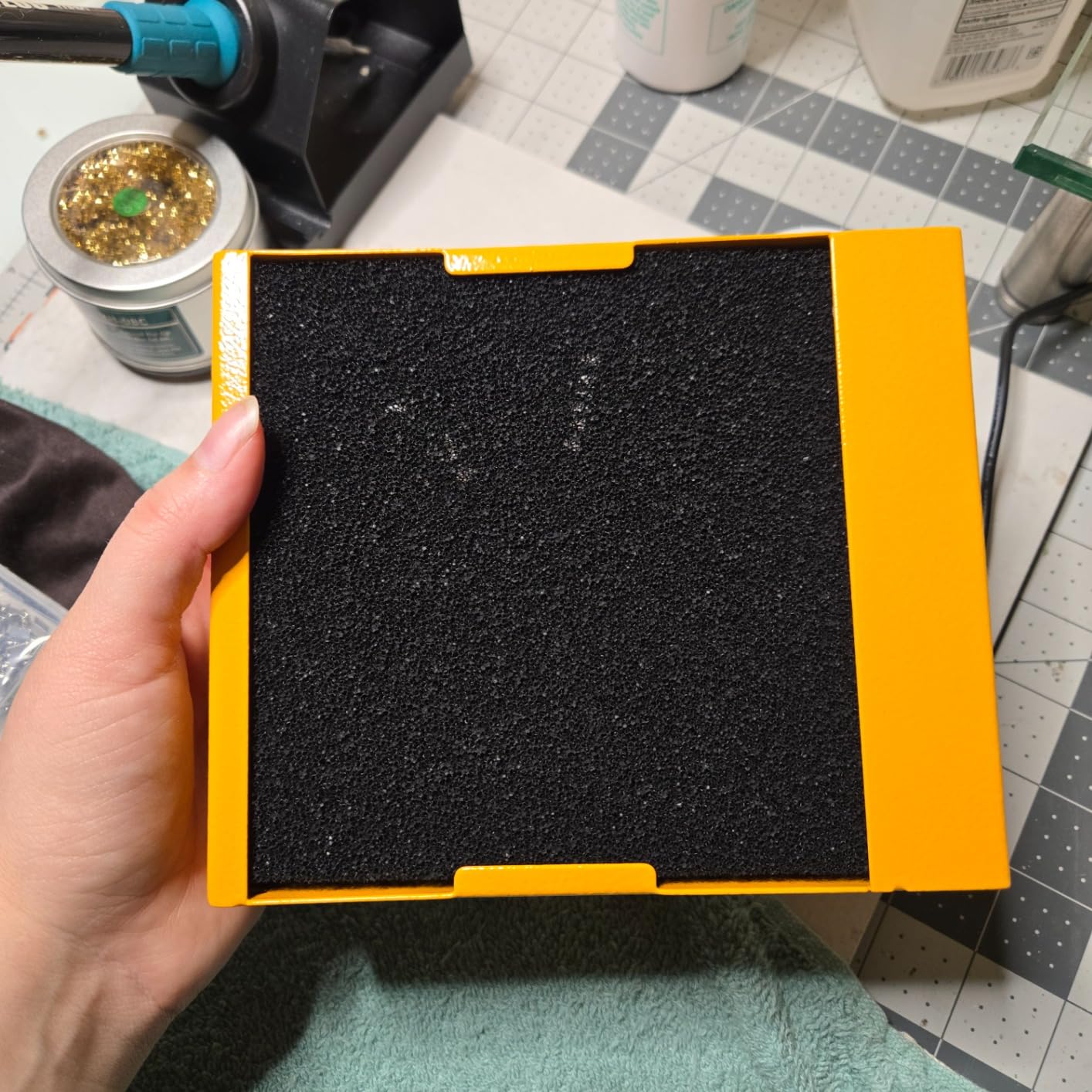
Two spare carbon filters come in the box, which is double the usual allotment. Add the four rubber feet and the carrying handle and you have a unit that is easy to move to whichever end of the bench you are working at.
The limitation is the 2800 RPM fan, the slowest turning here, paired with a fixed intake and no hose. Combine the two and you need the unit parked within a few inches of the joint, close enough that you must plan your bench layout around it.
Who it suits?
This is a good match for PCB rework and repair benches where ESD discipline already exists, and for anyone who has had a plastic-bodied extractor crack or stop after a year. The spare filter allowance also suits infrequent users who forget to reorder.
Who should skip it?
Skip it if you need to capture across a wide area or run on 220V supply. The 110V plug is the harder limitation, since it is a wiring specification rather than something an adapter solves cleanly.
7. YIHUA 948DQ-I – tiltable stand and eight spare filters
YIHUA 948DQ-I Solder Fume Extractor with Tiltable Angle, Dual-filtering
30-degree tiltable stand
Dual front and rear adsorbers
Side fenders
Five-blade low-noise fan
Pros
- Tiltable 30-degree stand is unique in this category
- Front and rear adsorbers handle particles and odours
- Eight spare adsorbers included
- 12-month manufacturer coverage with support
- Only 5W power draw
Cons
- Effective capture distance of about 10 cm
- Listed housing material is wood
- 110-127V US plug only
- Side fenders can crowd the work area
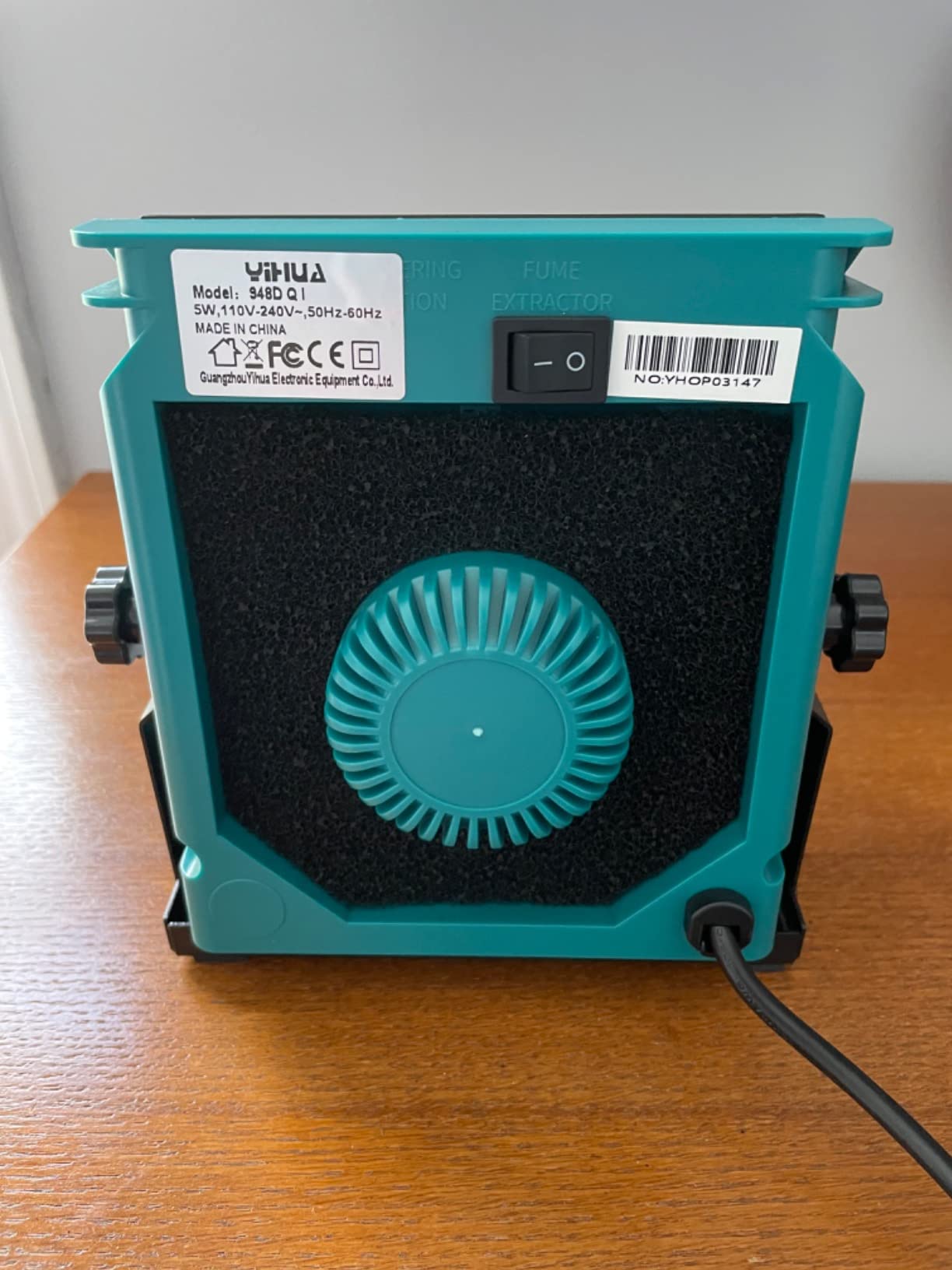
The tiltable stand is the feature nobody else in this roundup offers. A 30-degree tilt changes the intake geometry so you can angle the face toward a joint without dragging the whole unit across the bench, which is a genuine improvement over fixed upright positioning.
Filtration uses adsorbers at both the front and the rear of the unit, so air passes through media twice on its way through. That dual-path arrangement helps with both the particulate and the odour, and the side fenders limit the turbulent air that would otherwise disturb the plume.
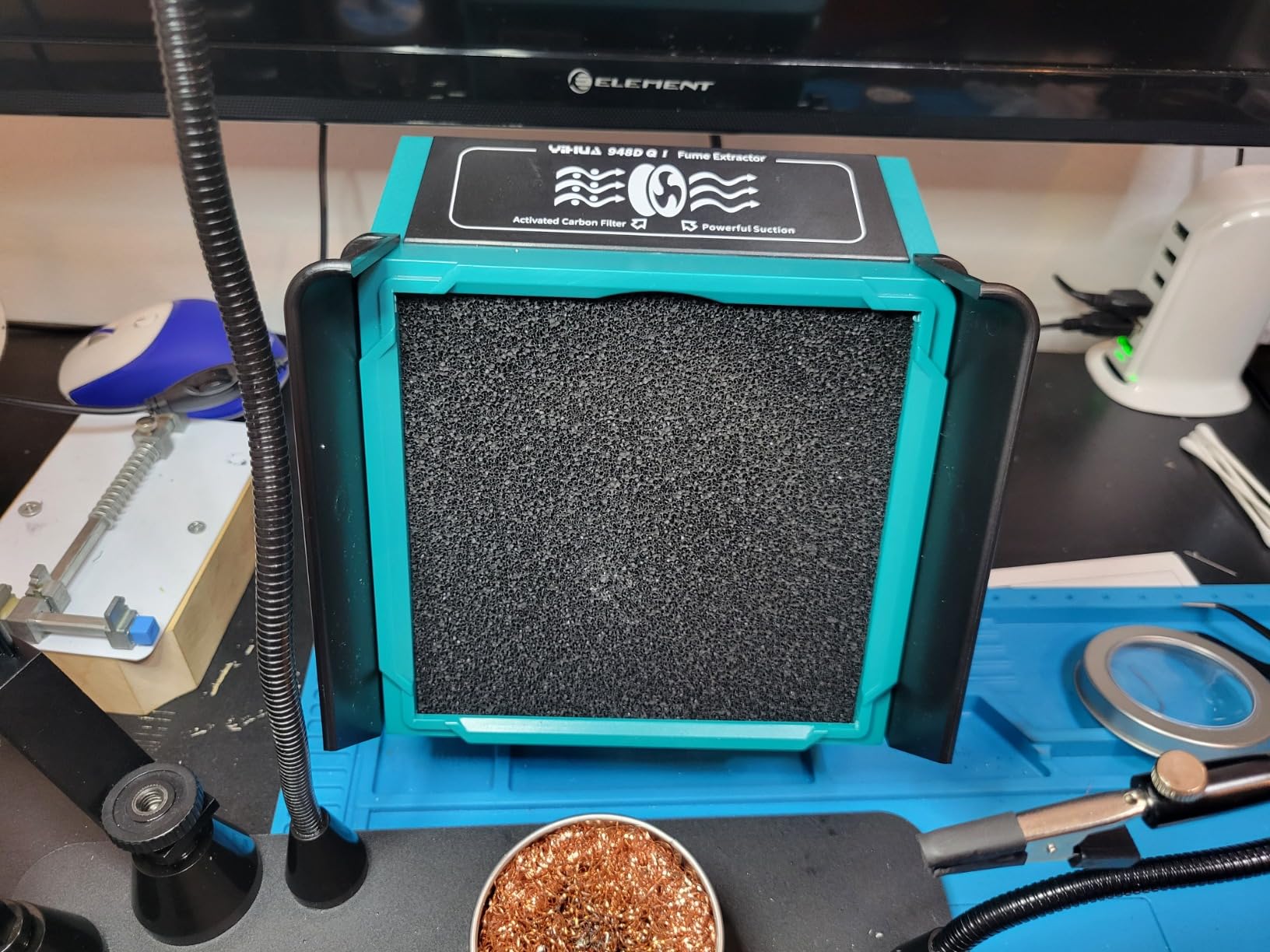
Eight spare filtration adsorbers in the box is far more than any rival here, and paired with the 5W draw it means a casual hobbyist can go years without ordering a replacement. The five-blade fan is listed as low noise, though no decibel figure is published.
Two cautions. The effective working distance is about 10 cm, which is genuinely short, and the listing describes the housing material as wood, which will not handle heat or impact the way metal does. If your iron habitually parks close to the unit, place it carefully.
Who it suits?
Best suited to occasional weekend soldering, craft work and stained glass, and to anyone who wants to stop thinking about filters for a couple of years. The tilt also helps if your joints sit at an unusual angle on the bench.
Who should skip it?
Skip it for production work or for anyone who needs reach. A 10 cm working distance leaves you soldering around the unit rather than beside it, and the wood housing is a poor choice near a very hot tip.
8. Weller WSA350 Bench Top Smoke Absorber – built for active flux jobs
Weller Genuine 120v Bench Top Smoke Absorber | WSA350
Replaceable carbon-activated filter
ESD-safe construction
Quiet 20W fan
Designed for active fluxes
Pros
- Carbon-activated replaceable filter
- ESD-safe construction
- Quiet 20W fan
- Designed for workspaces using more active fluxes
- Includes a WSA350F replacement filter
Cons
- Single-stage carbon filtration with no particle option
- No published airflow figure in the listing data
- Less compact than the plastic desktops
The Weller WSA350 was designed for a specific job: removing flux fumes from a soldering bench working with more active fluxes. That is exactly the through-hole, leaded and repair work where rosin vapour is heaviest and where carbon media earns its place.
At 20W it is among the lowest draws here, and owners consistently describe it as adding little noise to a workspace. That matters if you are soldering in a room where conversation or concentration matters more than raw extraction volume.
At 2 pounds it is easy to move between the parts of the bench you work at, and the replacement filter is supplied in the box. The ESD-safe carbon design means it can sit right next to a live board without concerns about static.
Who it suits?
This suits hobbyists doing through-hole and leaded work, and anyone who wants a proven bench companion with a widely available replacement filter. The WSA350F cartridge is a standard part rather than a proprietary consumable.
Who should skip it?
Skip it if you need particulate filtration, since the carbon stage alone will not stop fine flux residue, and skip it if you need a published airflow figure to plan your capture distance. The listing data gives neither.
9. FumeClear FC-2001S – the strongest filtration stack here
FumeClear FC-2001S Solder Fume Extractor Portable, Activated Carbon Filter
Pre-filter plus H12 HEPA plus high-iodine carbon
128-168 m3/h airflow
Extendable hose with hood
Universal voltage
Pros
- H12 HEPA stage paired with high-iodine activated carbon
- Coconut shell carbon rated 500-700mg/g iodine content
- Works on both 110V and 220V supply
- Extendable hood that holds position
- Lifetime warranty and CE plus FCC certification
Cons
- Louder than the small plastic units at 55 dB
- Hose is shorter than advertised at roughly 58 cm
- Low exhaust can recirculate air when close to a wall
- Smallest review base in this roundup at 113 ratings
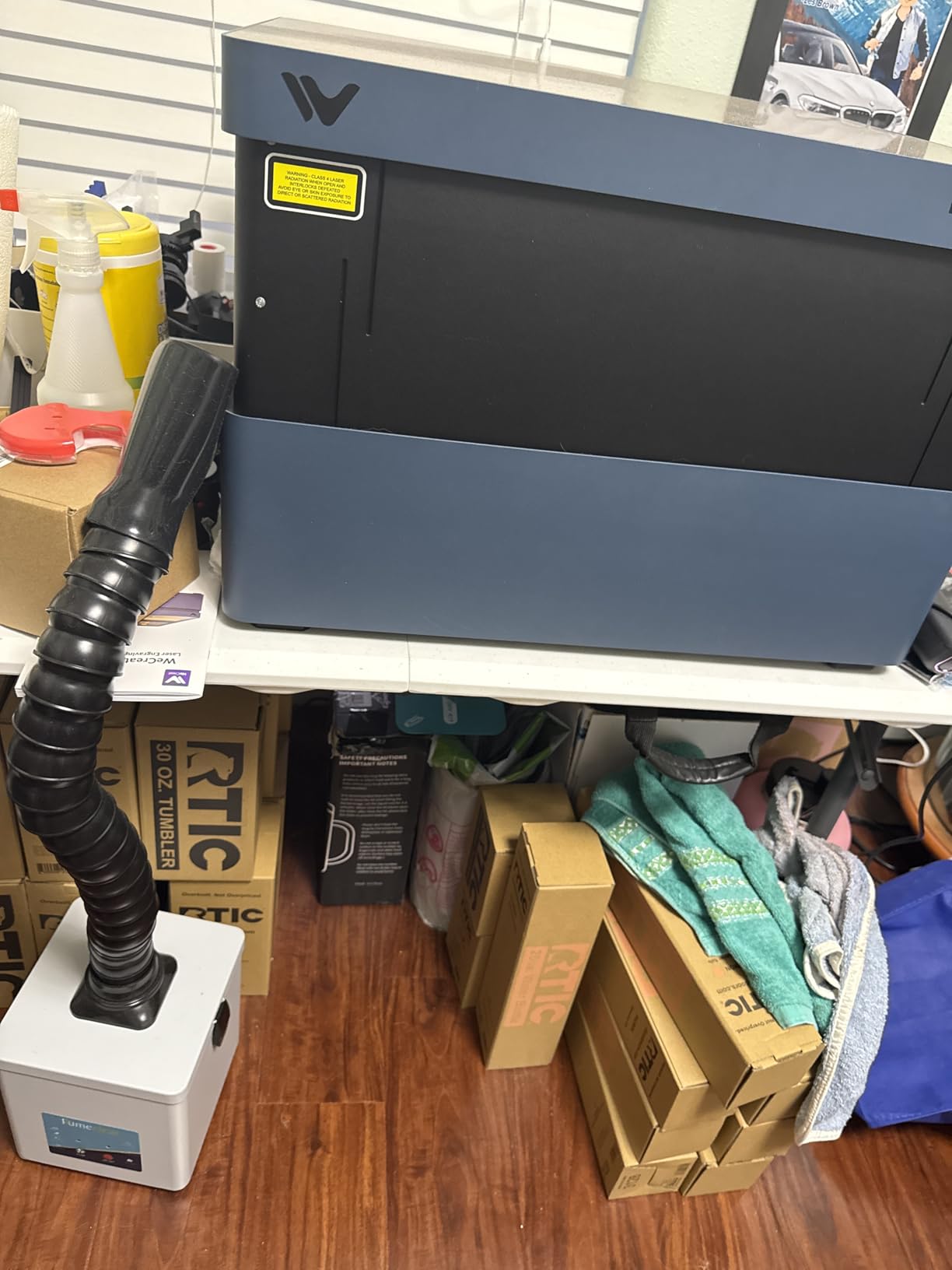
If your concern is filtration rather than suction, this is the pick. It stacks a pre-filter, an H12 HEPA stage rated at 99.99 percent on fine particles, and a coconut shell activated carbon with 500-700mg/g iodine content for the vapour and odour.
The carbon iodine number is the detail worth understanding. Iodine loading is what gives activated carbon its affinity for the organics in flux vapour, so a higher figure means more of the stuff you cannot see gets held rather than released back into the room.
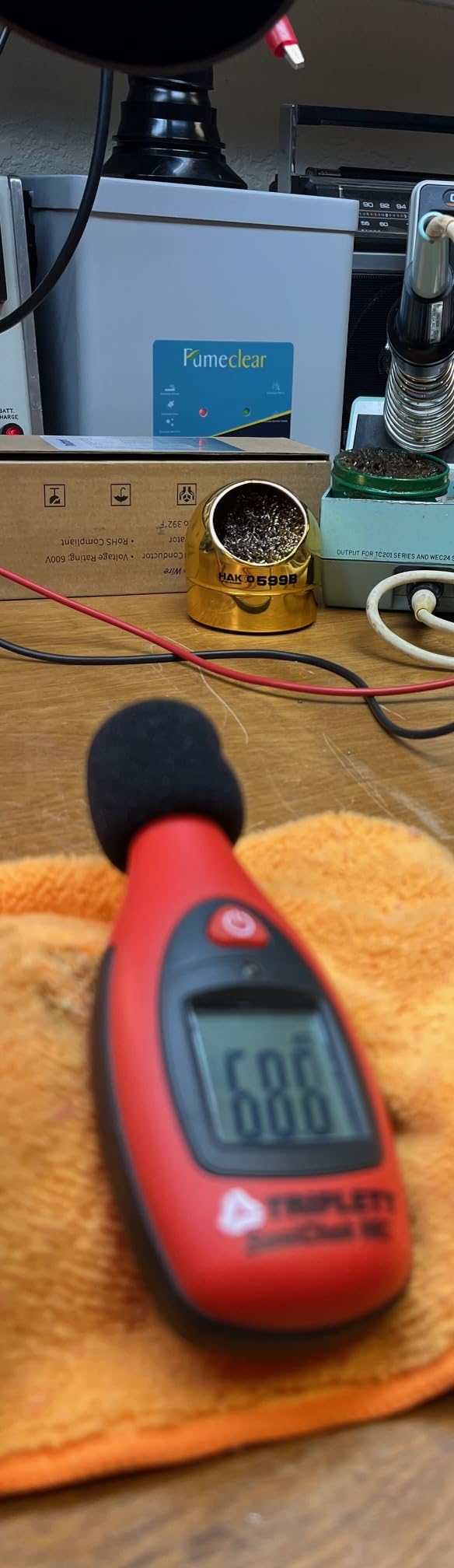
Airflow is quoted at 128-168 cubic metres per hour across settings, and the extendable hose with hood gives you the reach the fixed-duct units lack. It also runs on both 110V and 220V without an external supply, which removes the voltage problem that rules out several rivals.
Three caveats. The hose measures roughly 58 cm rather than the advertised 80 cm, so plan your reach around the shorter figure. The exhaust exits low, and a unit pushed against a wall can push air forward across the bench. And at 55 dB it is not a bedroom-quiet machine.
Who it suits?
This suits anyone soldering in a small apartment with no window vent, where pulling fumes at the source matters more than low noise, and anyone outside the US thanks to the universal voltage. It also filters particulate as well as odour, which the carbon-only units here do not.
Who should skip it?
Skip it if silence is your top priority, or if you want long-term evidence of reliability. With 113 ratings it is the newest listing here, and the lifetime warranty plus CE and FCC certification are the main reassurances.
10. ToolBud Magnetic Flap Extractor – heavy iron body at a compact size
Upgraded ToolBud Solder Fume Extractor with Removable Magnetic Flaps
Iron construction at 2.23 pounds
3000 RPM motor
Two detachable magnetic side flaps
Two spare carbon filters
Pros
- Iron body feels far more substantial than plastic rivals
- Magnetic flaps widen the capture area
- Effective from 6-10 inches per owners
- Rigid carbon filters hold their shape
- Two spare filters and spare rubber feet included
Cons
- Magnetic flaps are floppy and hard to pose
- Audible fan noise with no low-speed control
- 110V only
- Smaller than the product photos suggest
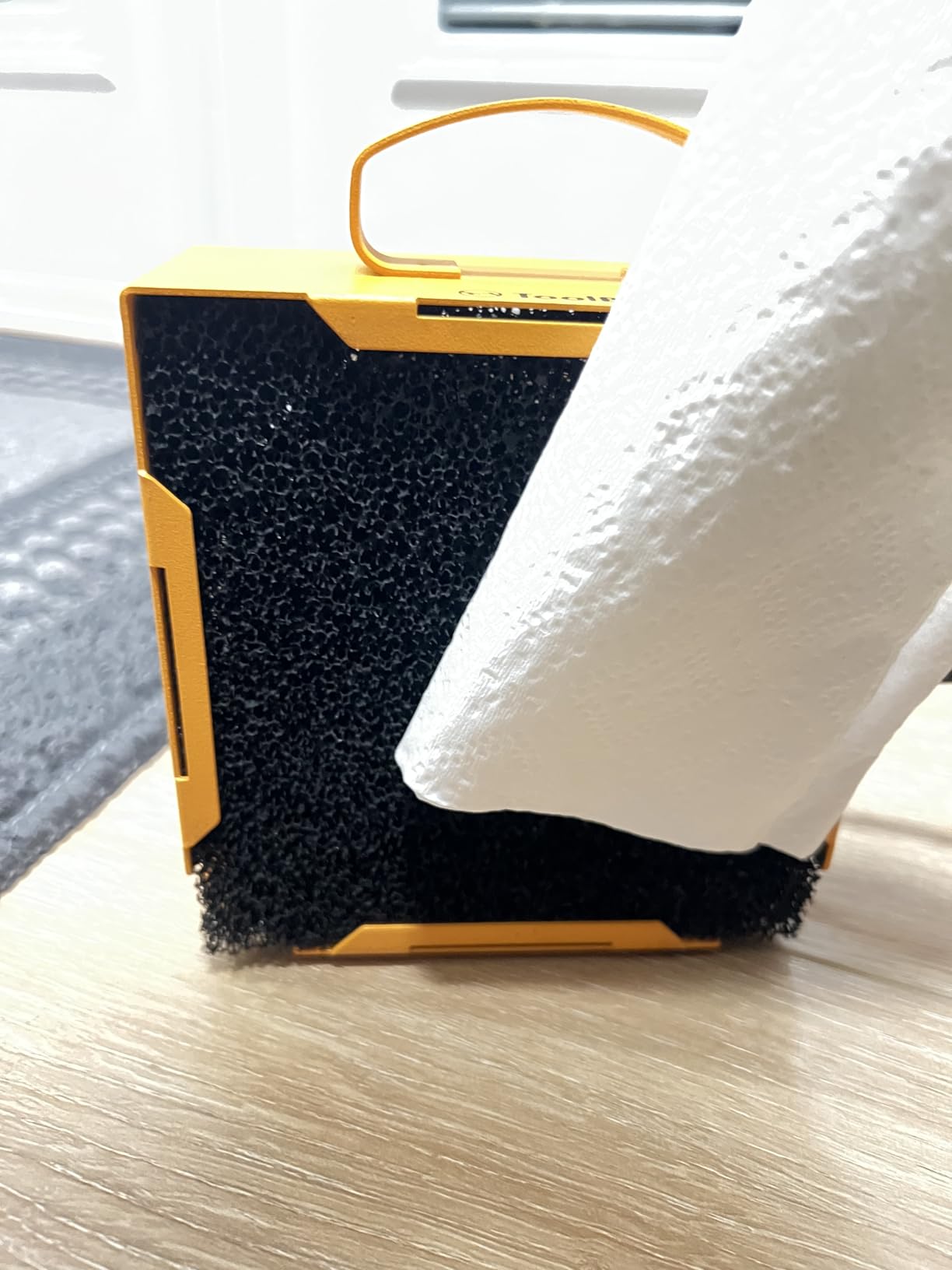
An iron body is unusual in a category dominated by ABS plastic, and it changes how the unit handles. At 2.23 pounds it stays put on the bench instead of skating when a hot iron or a moving elbow brushes past, and it takes the knocks that crack plastic shells.
The magnetic side flaps are the interesting part. Two detachable panels extend the intake area so smoke drifting slightly off-centre still gets funnelled in, and owners report effective pull from 6-10 inches, which is a longer reach than the 4-6 inch range of the smaller fixed-intake units here.
The 3000 RPM motor sits between the quiet small units and the higher-speed hose models. There is no low-speed setting, so it runs at one level, which is why some owners reach for an external dimmer to soften the sound in a quiet room.
Two replacement carbon filters and spare rubber feet come in the box, and the rigid filters hold their shape rather than folding. The recurring gripes are the weak flap magnets, the single noise level and a 110V plug, plus a package that is smaller than the photographs imply.
Who it suits?
This suits anyone who wants a metal-bodied unit without giving up a compact footprint, and hobbyists working on larger boards where the 6-10 inch reach is genuinely useful. The detachable filters make maintenance straightforward.
Who should skip it?
Skip it if you need a variable fan speed, if you run on 220V supply, or if you work in a quiet shared room where continuous running noise would get on your nerves.
How to choose a fume extractor for a home bench?
Five things decide whether a fume extractor gets used every session or pushed to the back of the desk: airflow and capture distance, filter media, noise, footprint, and the cost of replacement filters. Here is how each one behaves in practice.
1. Treat capture distance as the real limit, not CFM
Published airflow is quoted at the intake with clean filters and no hose restriction, so it is an upper bound rather than a working figure. Capture velocity falls off sharply with distance, which is why every model here has a stated working range of 4-6 inches, 5-6 inches, 6-10 inches or about 10 cm. Plan your bench around that number.
Positioning rules are simple. Keep the intake within the stated range of the joint, aim it slightly past the joint so the plume is drawn away rather than across your face, and run the unit on the lowest setting that still clears the smoke. A low setting with a close intake beats maximum speed across the room.
2. Match the filter stack to the fume
A pre-filter catches large particles and protects the stage behind it, a HEPA stage traps fine particulate, and activated carbon absorbs the vapour and the odour. Flux fumes are a gas-phase problem first, so a HEPA-only unit removes the visible smoke while leaving the smell behind. Two models here go further: the FumeClear FC-2001S combines H12 HEPA with high-iodine carbon, and the Hakko FA400-04 accepts an optional high-efficiency particle stage.
3. Use noise as the deciding factor
Published noise figures here range from 45 dB on the MUIN to 55 dB on the KOTTO hose model and the FumeClear. The quieter end suits a bedroom bench; the louder end suits a workshop where you can place the unit away from where you sit. A unit you switch off after an hour extracts nothing.
4. Budget for filters, not just the unit
Every model here consumes filters, and the running cost is what decides long-term value. Check what is included in the box before you look anywhere else: the YIHUA includes eight spare adsorbers, the NOEVSBIG and ToolBud include two, and several others include one. Look for rigid filters that hold their shape, and check that a replacement is a standard part rather than a proprietary consumable.
Two triggers mean it is time to change a filter: you notice odour returning while the fan still sounds strong, or airflow drops noticeably at the same fan setting. A rising noise level from a clogged pre-filter is the third signal.
5. Match the form factor to the room
Fixed-intake desktop units tend to be the smallest and quietest here, but they only work at very close range. Hose models reach further and cost you desk space and some quiet. Articulated arms are the pro tier. If you are building a bench inside a small home office, the footprint competes with everything else you need on the surface, and our tested home office desktop computers guide covers the same space-versus-specs reasoning.
DIY fume extractor vs buying one
A DIY extractor built from a box fan, an activated carbon filter and a mesh screen is a legitimate answer for occasional work, and forum hobbyists have long argued its case. It is cheap, it is quiet if you use a variable-speed fan, and it teaches you something. It is also a compromise on seal and on safety.
The practical DIY build goes like this: choose a fan with a speed control rather than a fixed-speed box fan, attach the activated carbon filter directly to the intake with a close-fitting clamp rather than a loose mesh, line the intake with a washable pre-filter so dust does not load the carbon, and run it through a fused plug with proper earthing. Seal every joint, because a leaky build recirculates the air it just filtered.
Where DIY wins: low usage, a large bench area you can place it on, and a tolerance for building and maintaining it yourself. Where buying wins: filtration media you cannot fabricate, a proper sealed housing, electrical safety you do not have to invent, and a warranty. For most home hobbyists a purpose-built unit is the better long-term decision, which is why all ten picks above are purpose-built.
Frequently Asked Questions
What is the best smoke extractor for soldering?
For most home benches the KOTTO Solder Smoke Absorber is the strongest all-round pick, holding the top sales position in the category with 2454 reviews at a 4.7 average. Its 0.4 inch activated carbon bed and 3000 RPM fan clear fumes from 5-6 inches, and it runs quietly enough to leave on through a session. If your priority is filtration rather than reach, the FumeClear FC-2001S adds an H12 HEPA stage and high-iodine carbon.
Should I use a fume extractor when soldering?
Yes. Flux fumes carry fine particulate, rosin vapour and volatile organic compounds, and without capture they settle into the room rather than away from you. A benchtop extractor pulls the plume at the joint before it disperses, which an air purifier in the corner cannot do because it only cleans air that has already spread. Keep the intake within a few inches of the joint and run it on the lowest setting that still clears the smoke.
How close should the extractor nozzle be to the solder joint?
Within the distance each manufacturer states, which is typically 4-6 inches for compact desktop units and up to 6-10 inches for larger bodies. Capture velocity drops sharply with distance, so airflow ratings quoted at the intake do not translate to the far end of the bench. Aim the intake slightly past the joint so the plume is drawn away from your face, and use the lowest fan speed that still clears the smoke.
How long do fume extractor filters last?
It depends on duty cycle and flux type, so watch the signals rather than the calendar. Change a filter when odour returns while the fan still sounds strong, or when airflow drops noticeably at the same fan setting, which means the pre-filter is loaded. Active-flux and leaded work load carbon far faster than modern no-clean flux on modern boards. Check the included spares, because several models bundle one or two replacements and the YIHUA includes eight.
Do HEPA filters remove paint fumes?
No. HEPA filters capture airborne particles, not gases or vapour, so they trap the visible smoke from soldering but do nothing for the odour. Solder fumes also need a gas-phase stage, which is what activated carbon provides, and high-iodine carbon holds more of the organics found in flux vapour. A HEPA-only unit removes what you can see while leaving what you smell in the room.
How do I ventilate for soldering in a room with no window?
Source capture is the whole answer when no window can be opened. Choose an extractor with an activated carbon stage so odours are absorbed rather than released, and keep the intake close to the joint. The FumeClear FC-2001S is the strongest fit for this case because its H12 HEPA stage removes fine particulate and its high-iodine carbon absorbs vapour, and it runs on both 110V and 220V supply. Running two lower-speed models beats one loud unit you switch off.
Our final pick for a home soldering bench
After working through all ten, the KOTTO Solder Smoke Absorber is our default recommendation in the best fume extractors for soldering at home category. It has the largest review base in the group, a 4.7 average, a thick carbon bed and a fan quiet enough to keep running, and it takes up almost no bench space.
Pick the FumeClear FC-2001S instead if your room has no window vent or you filter particles as well as odour, the Hakko FA400-04 if you do active-flux through-hole work and have desk space, and the MUIN three-stage extractor if noise in a shared room decides everything. Whichever you choose, put the intake within its stated reach, run it on low, and change the filter when the smell comes back.
That last point is the difference between an extractor that improves your bench and one that sits in a corner after a month. Start it before the first joint, not after the room already smells.