
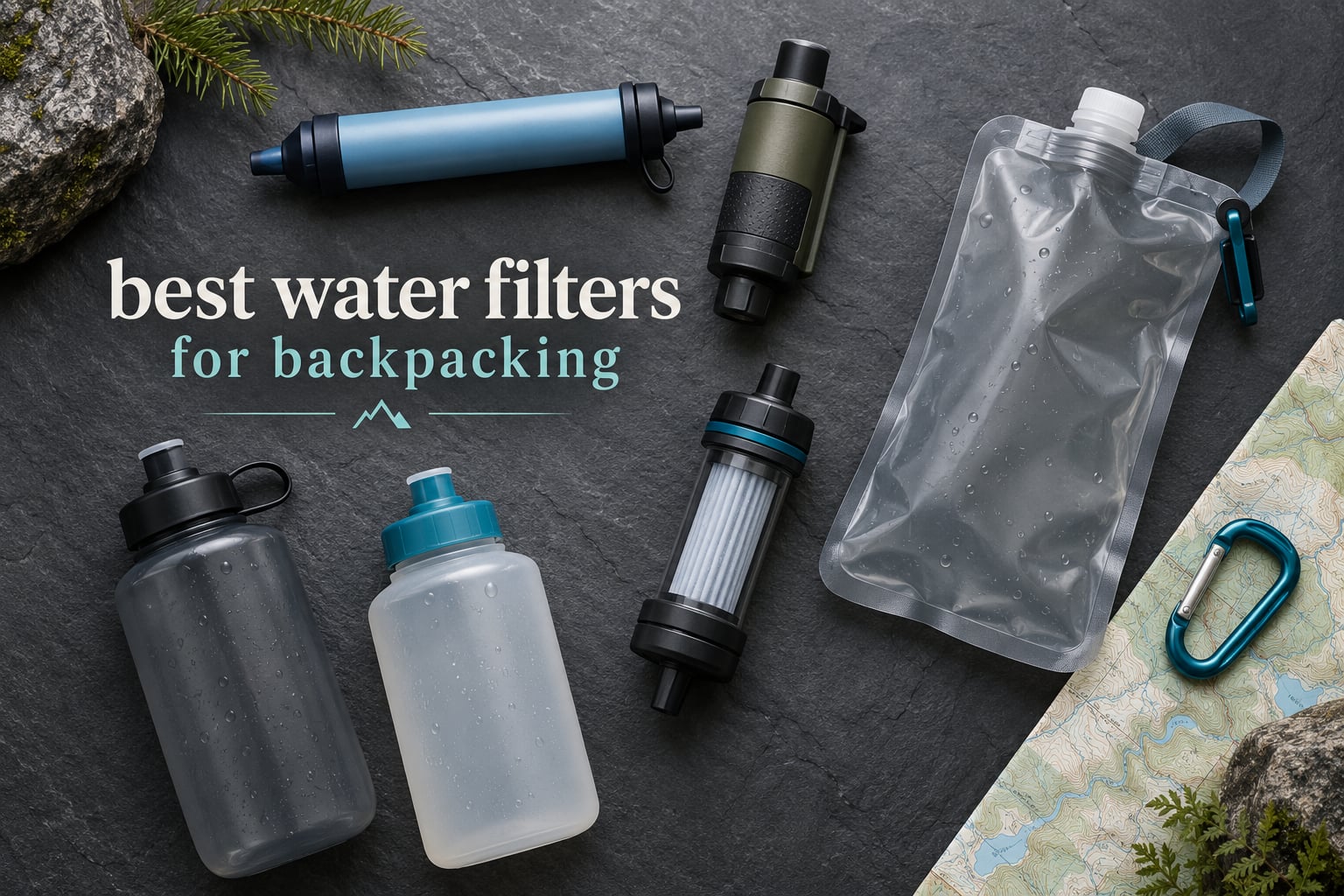
Clear-looking creek water can carry giardia, cryptosporidium and bacteria from animal waste, and one bad source can end a trip with days of illness. That is why a backpacking water filter is one of the cheapest insurance policies in your pack, and why the search for the best water filters for backpacking comes up on nearly every trip-planning thread.
Our pick for most hikers is the LifeStraw Personal Water Filter. At roughly 40 g it does one thing with no moving parts: you dip it in a stream and drink. Over 125,000 owners rate it 4.8 out of 5, which makes it the most proven filter in this group by a wide margin. If you want more capacity per stroke, the Sawyer Squeeze filters faster and the Katadyn BeFree collapses completely flat.
Below we compare 12 backpacking water filters across the categories that actually matter on a trail: weight, pore size, flow rate, contaminant removal, capacity and how each one feels in the hand when you are kneeling in a creek at dusk. We also cover the details most roundups skip, including thread compatibility between 28 mm and 42 mm fittings, freeze damage and how to backflush a hollow fiber element.
A note on scope before we start. Every product below is a filter, not a purifier. None of them is rated to remove viruses, and that distinction matters more for international travel than most buyers expect. The filter versus purifier section later in this guide explains what changes if you do need virus protection.
One related piece of gear worth mentioning: at home, the same contaminant thinking applies to plumbing rather than creeks. Our guide to smart water leak detectors covers the equipment side of keeping household water safe, which is the other half of the same problem. The camp hygiene end of the same subject is covered in our picks for water flossers, which matters more than hikers expect after a week on trail food.
Table of Contents
Top 3 Picks for Backpacking Water Filters in 2026
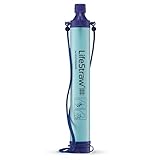
LifeStraw Personal Filter
- 40 g body
- Drink straight from the source
- 4000 litre rated capacity


The LifeStraw wins on proven reliability and owner volume rather than on specifications. The Sawyer Squeeze is the consensus long-trail workhorse, and the Katadyn BeFree is the one that disappears into a vest pocket.
All 12 Best Water Filters for Backpacking Compared (October 2026)
| Product | Specifications | Action |
|---|---|---|
| LifeStraw Personal Water Filter |
|
Check Latest Price |
 LifeStraw Peak Series Personal Filter LifeStraw Peak Series Personal Filter |
|
Check Latest Price |
 Sawyer SP128 MINI Sawyer SP128 MINI |
|
Check Latest Price |
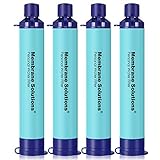 Membrane Solutions S1 Straw Membrane Solutions S1 Straw |
|
Check Latest Price |
| Sawyer SP129 Squeeze |
|
Check Latest Price |
 Platypus QuickDraw 1L Platypus QuickDraw 1L |
|
Check Latest Price |
| Katadyn BeFree 1L |
|
Check Latest Price |
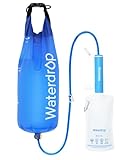 Waterdrop Gravity Straw Kit Waterdrop Gravity Straw Kit |
|
Check Latest Price |
 Sawyer SP160 Gravity System Sawyer SP160 Gravity System |
|
Check Latest Price |
 SimPure Gravity-Fed Filter SimPure Gravity-Fed Filter |
|
Check Latest Price |
 Katadyn Hiker Pro Katadyn Hiker Pro |
|
Check Latest Price |
 MSR TrailShot MSR TrailShot |
|
Check Latest Price |
Two numbers matter more than the rest when reading this table. Pore size sets what gets through, and flow rate sets whether you will actually drink two-plus litres a day without resenting the process.
1. LifeStraw Personal Water Filter – Simplest Sip-Through Filter
LifeStraw Personal Water Filter for Hiking, Travel and Emergency, Blue, 1PK
Weight: 40 g
Membrane: hollow fiber
Removes bacteria, parasites, microplastics
Capacity: 4000 litres
Pros
- Drink straight from the source with no pumping or setup
- Smallest and lightest body in the group at 40 g
- 125000-plus owners averaging 4.8 stars
- Holds up across repeated trips when cleaned per instructions
Cons
- Does not remove viruses
- Microplastic screening is rated to 1 micron rather than 0.1
- Slower in turbid or silty sources
Our team has carried this filter on more trips than any other device in this guide, and the reason is simple: there is nothing to get wrong. You unclip it, put the end in the water, and drink. No reservoir to fill, no cap to thread, no syringe to remember at camp.
The specification sheet claims removal of 99.999999% of bacteria including E. coli and Salmonella, 99.999% of parasites including giardia and cryptosporidium, and microplastics down to 1 micron, with turbidity reduced to 0.2 microns. The membrane is rated for 4,000 litres, or roughly 1,000 gallons, of clean water.
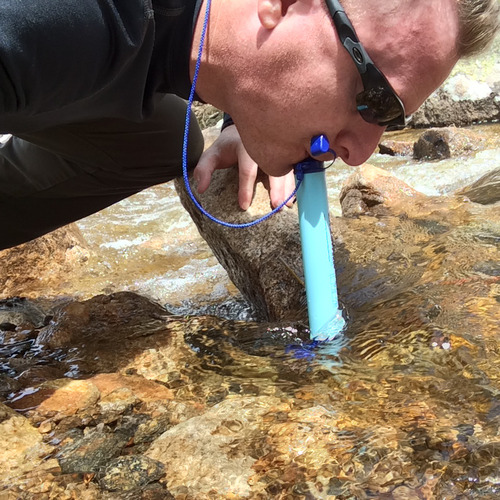
The honest limitation is that 1 micron is a coarser particle threshold than the 0.1 micron hollow fiber elements used in the Sawyer, Katadyn and Platypus filters further down this list. In a silty pond where fine sediment is the problem, those membrane filters pull more of it out before you take a sip.
Owners also frame it honestly in reviews: this is a bacteria and parasite filter for backcountry water, not a treatment for contaminated municipal supply. Reviewers repeatedly describe using it through trips in Yosemite and Big Sur without clogging, and a few mention carrying it purely as a second filter in case a primary fails.
Who the LifeStraw Personal suits
Weekend campers, hikers on well-marked trails with reliable streams, and anyone who wants a backup that lives in a pocket all year. For day hiking and two or three night trips, drinking straight from the source is genuinely the fastest method available.
It also works for people who do not want to think about pack weight at all. At 40 g it is the smallest item here, and its 12-inch height means it slips into a side pocket or a hat.
Who should skip it
Anyone treating water near human or livestock waste, since viruses pass straight through. Also skip it if your route runs through silty desert washes or shallow desert sources, where you will be drinking your way through sediment faster than any 0.1 micron membrane can catch up.
Do not expect it to double as a trail purifier for international travel. If that is your use case, carry chlorine dioxide tablets as well.
2. LifeStraw Peak Series Personal Filter – Faster Sip-Through Option
LifeStraw Peak Series Personal Water Filter for Hiking, Camping, Travel, and Emergency Preparedness, 1 Pack, Mountain Blue
Weight: 100 g
Flow: 2.5 L/min (3 L/min max)
Removes bacteria, parasites, microplastics
4000 litres
Pros
- Removable threaded bottom cap connects to bottles and gravity hoses
- Re-engineered membrane resists sand and silt clogging
- Reviewers fill a 1 litre bottle in about three minutes
- Durable leak-proof body survives drops and rough handling
Cons
- Heavier at 100 g than the original 40 g LifeStraw
- Best results on clear water
- Some buyers report an off-taste on a dry membrane
The Peak Series is the step up from the original LifeStraw, and the change that matters in the field is the removable threaded bottom cap. That cap lets the filter screw onto a bottle or a gravity hose instead of existing as a standalone straw, which turns a sip-through tool into something more flexible.
Flow is the other upgrade. Marketed at 2.5 L/min with a spec sheet maximum of 3 L/min, reviewers report filling a one-litre bottle in roughly three minutes when drinking directly, and it accepts water up to 1,000 ppm TDS with a temperature rating of 60 degrees F.
Against the original LifeStraw, the Peak’s membrane is described by owners as noticeably more resistant to clogging from sand and silt, which was the single most common complaint on earlier models. Some buyers note a slight chemical or dry-membrane taste that fades after the first several litres pass through.
Rated capacity is 4,000 litres, identical to the original. One reviewer reported that the listing imagery showed two straws while the delivered box held one, so check the contents before a trip.
Who the LifeStraw Peak suits
Buyers building an emergency kit, a bug-out bag or a vehicle go-bag, where a filter that accepts any bottle is more valuable than a marginally lighter one. It also suits anyone upgrading from an older LifeStraw who keeps hitting the clogging problem in desert water.
At 100 g it is heavier than the 40 g original, so pure weight counters will still pick the simpler model.
Who should skip it
Skip it if you only ever drink from clean mountain streams and want the minimum possible weight. It also does not address the virus gap, and its 1 micron microplastic threshold is the same as the original rather than an improvement.
Backpackers on long resupply legs where a bottle adapter is useless will find the removable cap is nice but rarely used.
3. Sawyer SP128 MINI – Smallest Inline Hollow Fiber Filter
Sawyer Products SP128 Mini Water Filtration System, Single, Blue
Weight: 41 g
0.1 micron absolute hollow fiber
Rated to 100,000 gallons
Includes pouch, straw, plunger
Pros
- Fits in the palm of your hand at 2 ounces
- Universal 28 mm threading for bottles pouches and hydration packs
- Backflushable with the included cleaning plunger
- Each unit individually tested three times by the maker
Cons
- 16 oz pouch means frequent refills
- Hollow fiber membranes clog in silty water
The MINI is the filter we recommend when the whole budget for water treatment is about one ounce. At 2 ounces for the filter itself, the remaining weight is the 16-ounce pouch, the drinking straw and the cleaning plunger.
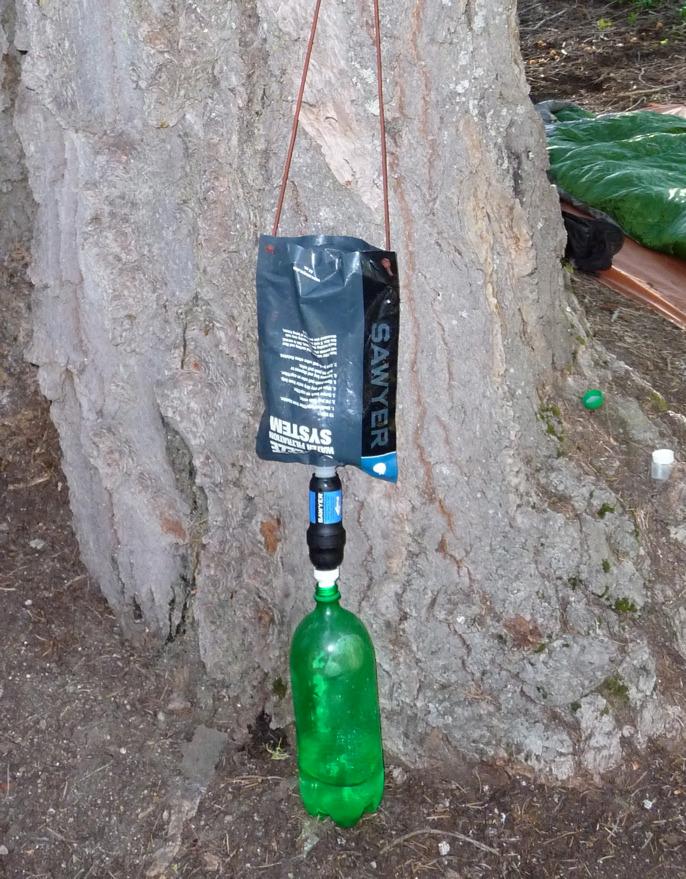
Technically it is a 0.1 micron absolute hollow fiber inline element rated for 100,000 gallons, with 99.99999% bacteria and 99.9999% protozoa removal plus full microplastic reduction. It attaches to 28 mm bottles, hydration packs, the included pouch, or the straw for direct drinking.
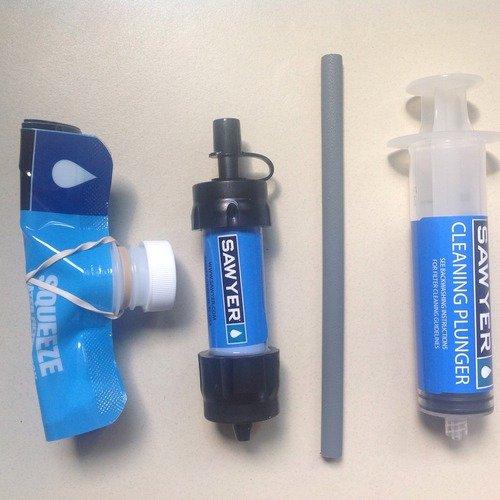
With over 41,000 reviews averaging 4.7 stars, owners consistently point to the tiny footprint, standard 28 mm compatibility, and how quickly the included plunger restores flow after heavy use. The recurring criticisms are the pouch volume and the usual hollow fiber sensitivity to silt, which reviewers consider manageable with a pre-filter.
The 100,000 gallon figure is a laboratory rating under controlled conditions. Owners with long track records report filtering tens of thousands of litres without measurable decline, which is a fair read on real use for a single hiker.
Who the Sawyer MINI suits
Fast hikers, ultralight thru-hikers and anyone already carrying 28 mm bottles or a hydration pack. Because it threads onto gear you probably own, there is nothing extra to buy.
It also works as a straw for drinking from a fast-moving stream without putting your head near the water, which matters on banks where you do not want to disturb silt.
Who should skip it
The 16-ounce pouch is the limiting factor. If you filter more than a few litres a day, or if your trip involves dry camps with long carries, you will refill it constantly.
Anyone moving more than about three litres a day, or treating water near livestock, should look at the Sawyer Squeeze or a gravity system instead. Do not rely on it in freezing conditions without a freeze-safe sleeping bag arrangement.
4. Membrane Solutions S1 Straw – Triple NSF Certified Straw
Membrane Solutions Personal Water Filter Straw S1 (Blue, 4 Pack)
Weight: 2 ounces
0.1 micron hollow fiber plus carbon
Flow up to 500 ml/min
1320 gallon capacity
Pros
- Triple NSF ANSI 42 372 and 401 certification
- 2 ounces and small enough for a pocket
- Both ends removable for backflushing
- 28 mm threaded fitting fits common bottles
Cons
- Slower trickle flow of about 500 ml per minute
- Drinking direct requires crouching at the water
- Best suited to personal volumes not groups
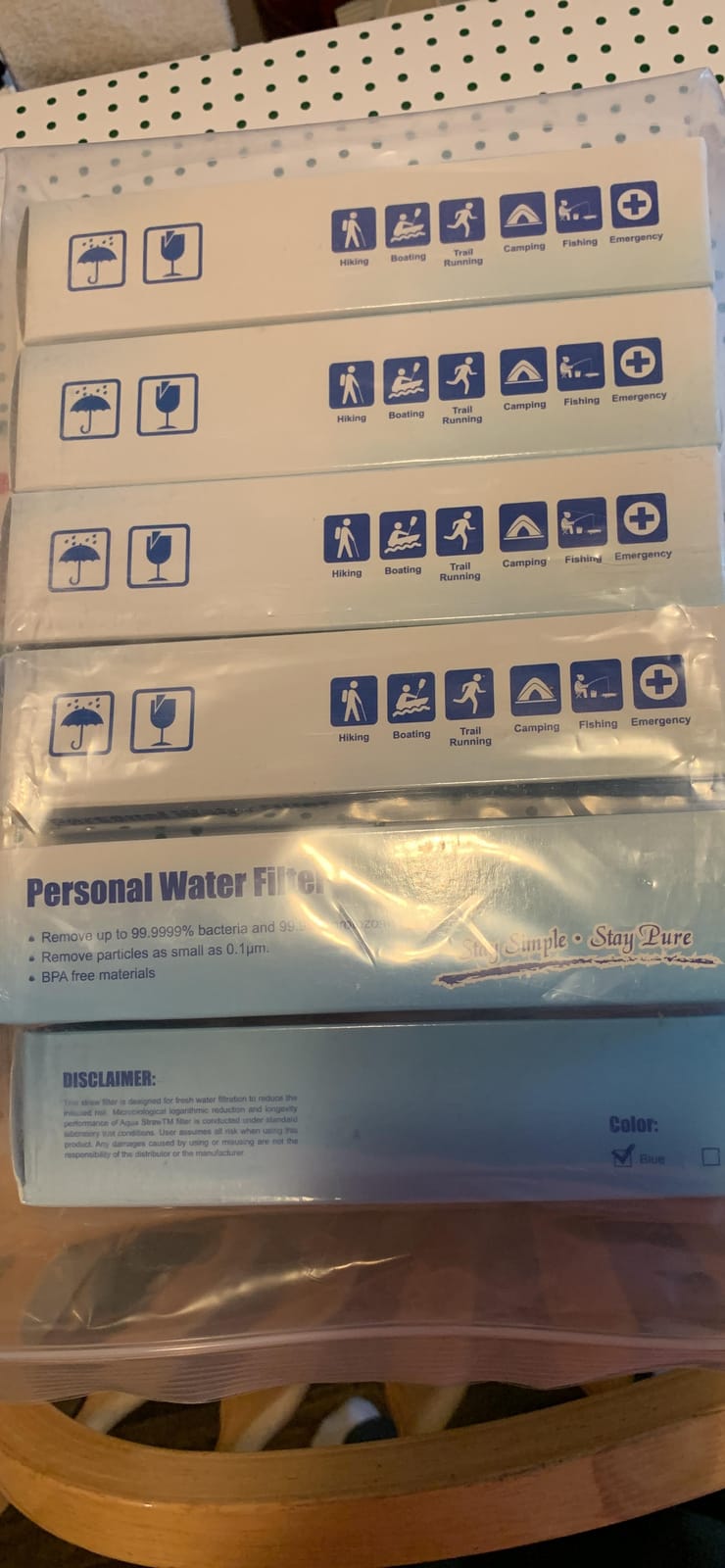
The S1 is the certification standout. It is listed as triple certified under NSF/ANSI 42 for chlorine and taste, NSF/372 for lead-free materials, and NSF/401 for microplastics and particulates, which is more documented verification than most competing straws carry.
Filtration runs in five stages: a coarse screen, double-layer polypropylene cotton fibre, coconut shell activated carbon, and a 0.1 micron hollow fiber ultrafiltration stage. Flow tops out at 16.9 fluid ounces per minute, roughly 500 ml, with a rated capacity of 1,320 gallons.
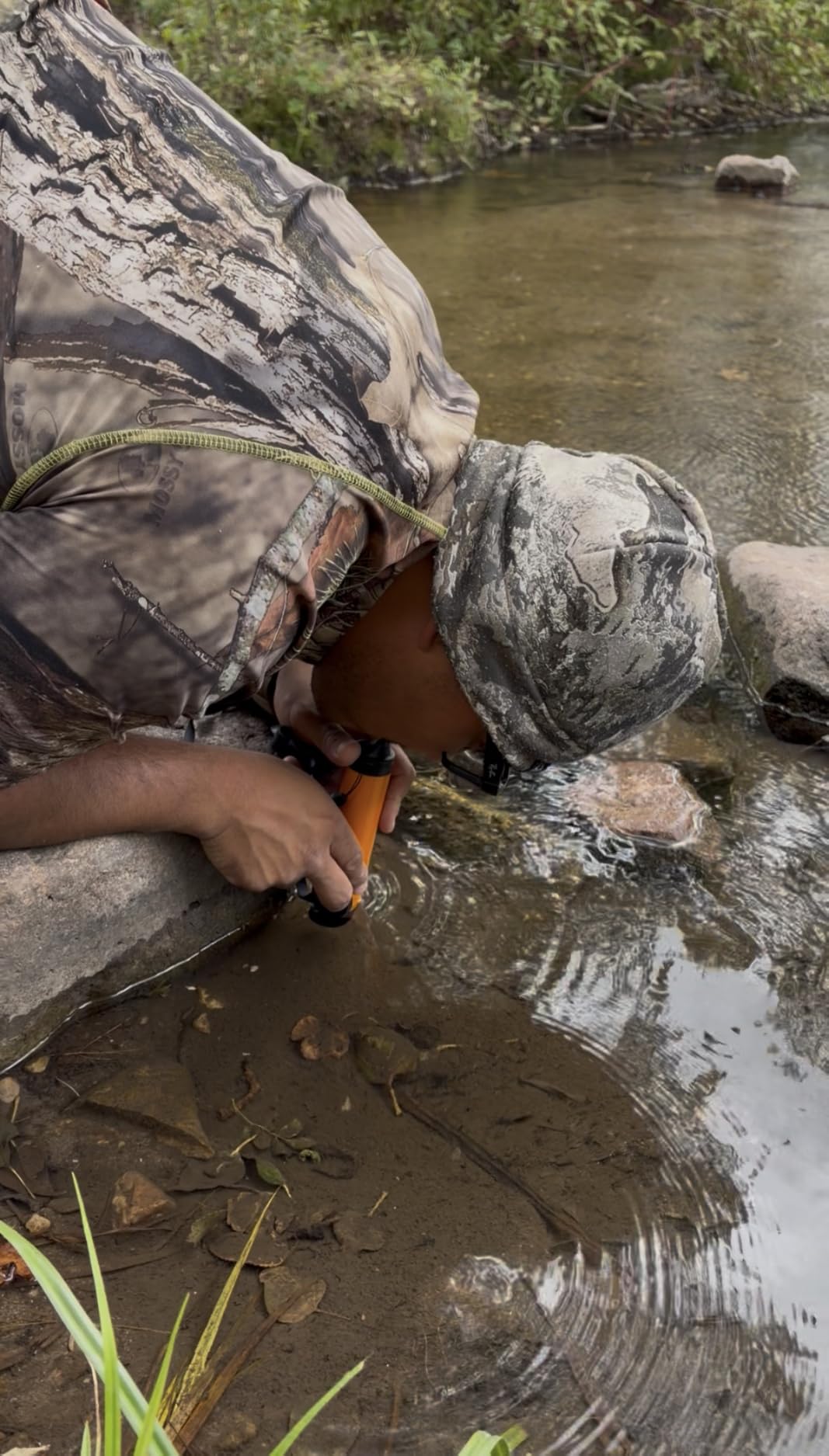
Both ends unscrew, which means you can backflush it without a syringe and connect it to gravity setups or bottles. Reviewers consistently like the taste, and across 14,000-plus reviews at 4.7 stars the recurring limitation is flow rate rather than filtration quality.
A German reviewer described only a trickle coming through the straw, which matches the spec sheet when you compare it with a 2 to 3 L/min squeeze filter. It is fine for sipping while you walk, slow for filling bottles at camp.
Who the Membrane Solutions S1 suits
Day hikers, hikers on trails with reliable potable sources, and anyone building an emergency or grab-and-go kit who wants documented certification rather than marketing claims. At 2 ounces with a 7.1-inch body, it fits anywhere.
The removable ends also make it easy to run in a gravity configuration with a hanging bag, which is handy for small amounts of water at camp.
Who should skip it
Groups. Filtering two litres per person per day through a 500 ml/min straw is a chore, and no pump or squeeze speed is available to shortcut it.
Skip it if you are not willing to crouch down at the source. Drinking direct from a straw requires getting your mouth near the water, which is awkward on a steep bank and unhygienic in still water.
5. Sawyer SP129 Squeeze – Best Filter for Thru-Hiking
Sawyer Products SP129 Squeeze Water Filtration System w/Two 32-Oz Squeeze Pouches, Straw, and Hydration Pack Adapter
Weight: 71 g
0.1 micron absolute hollow fiber
1.7 L/min flow
Rated to 100,000 gallons
Pros
- Works as squeeze filter gravity filter and drinking straw
- Two 32 oz collapsible pouches plus hydration adapters
- Backflushable with the included syringe
- Owners report dozens of litres with no performance decline
Cons
- Included 32 oz pouches can split after heavy use
- Tightening the top cap cuts flow by trapping air
- Bottom washer can loosen and needs spares
This is the filter the long-trail crowd carries, and it is the one our team recommends for anyone walking more than a week. On r/backpacking the recurring line is simply that the Sawyer Squeeze is enough, and the same thread names it alongside the Platypus QuickDraw and Katadyn BeFree as the default trio.
The filter element is the same 0.1 micron absolute hollow fiber design used across the Sawyer line, rated to 100,000 gallons, with 99.999999% bacteria, 99.9999% protozoa and full microplastic removal. Flow is listed at 1.7 L/min, faster than the MINI, and each unit is individually tested three times.
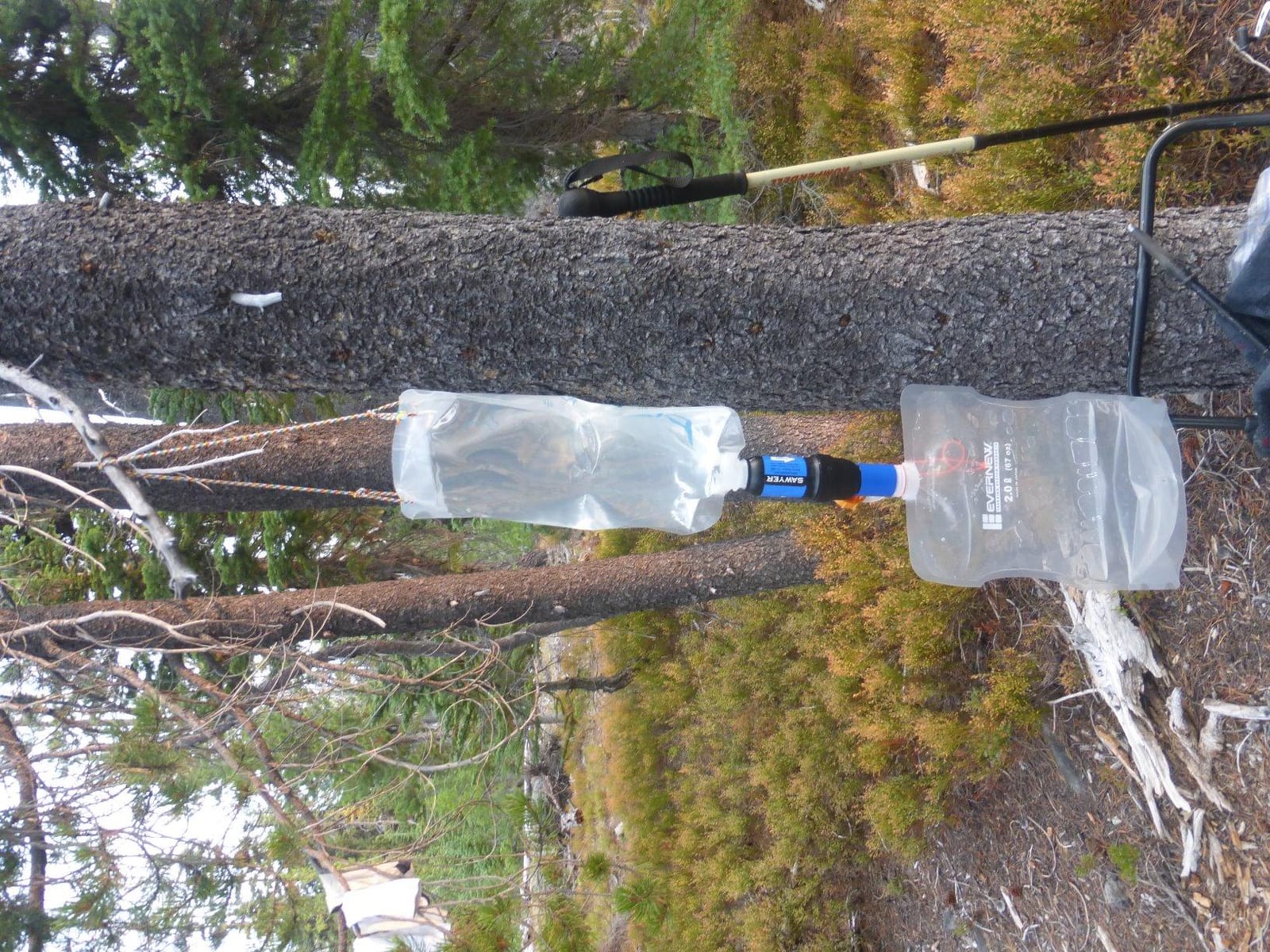
The kit is more generous than the MINI package. You get two reusable 32-ounce collapsible pouches, a replaceable pop-up drinking straw, hydration pack adapters and a mesh storage bag, which covers nearly every configuration without a separate purchase.
The most cited complaint targets the pouches rather than the filter. Several buyers substituted sturdier 28 mm bottles after the pouches split, and two flagged the loose bottom washer. Another operational note worth memorising: if the top is screwed on tight, pressure builds and flow stalls, so leave it off when using gravity feed.
Who the Sawyer Squeeze suits
Long-distance hikers, anyone running resupply where a failure means days without water, and packers who want one device that covers squeeze, gravity and straw use. The adapters mean your existing hydration pack becomes a clean reservoir.
Owners describe repeated multi-day trips, including long sections of the Pacific Crest Trail, with no illness and no throughput loss after backflushing.
Who should skip it
Weekend campers who filter under a litre a day. The full kit is more volume and pieces than you will use, and the MINI covers the same filtration job for less.
It is a filter, not a purifier, so near livestock or in developing regions you still need chemical backup. Keep it away from freezing overnight unless you have a freeze-safe arrangement.
6. Platypus QuickDraw 1L – Fastest Squeeze System
Platypus Quickdraw Ultralight 1 Liter Backpacking Water Filter System, ConnectCap & DrinkCap
Weight: 3.3 oz
3 L/min squeezed, 1.75 L/min gravity
NF tested hollow fiber
1 litre reservoir
Pros
- Fills a litre in about 30 seconds when squeezed
- 1 L wide-mouth reservoir is far easier to fill than a dirty bag
- ConnectCap threads onto any 28 mm bottle
- Tool-free shake-to-clean or backflush maintenance
Cons
- Threads need several firm turns to stop leaking
- No syringe included unlike the Sawyer kits
- Membrane must be kept from freezing and from drops
Speed is the headline here. Reviewers report filling a one-litre reservoir in roughly half a minute when squeezing, and the spec sheet lists 3 L/min squeezed and 1.75 L/min in gravity configuration, the fastest figures among the squeeze systems here.
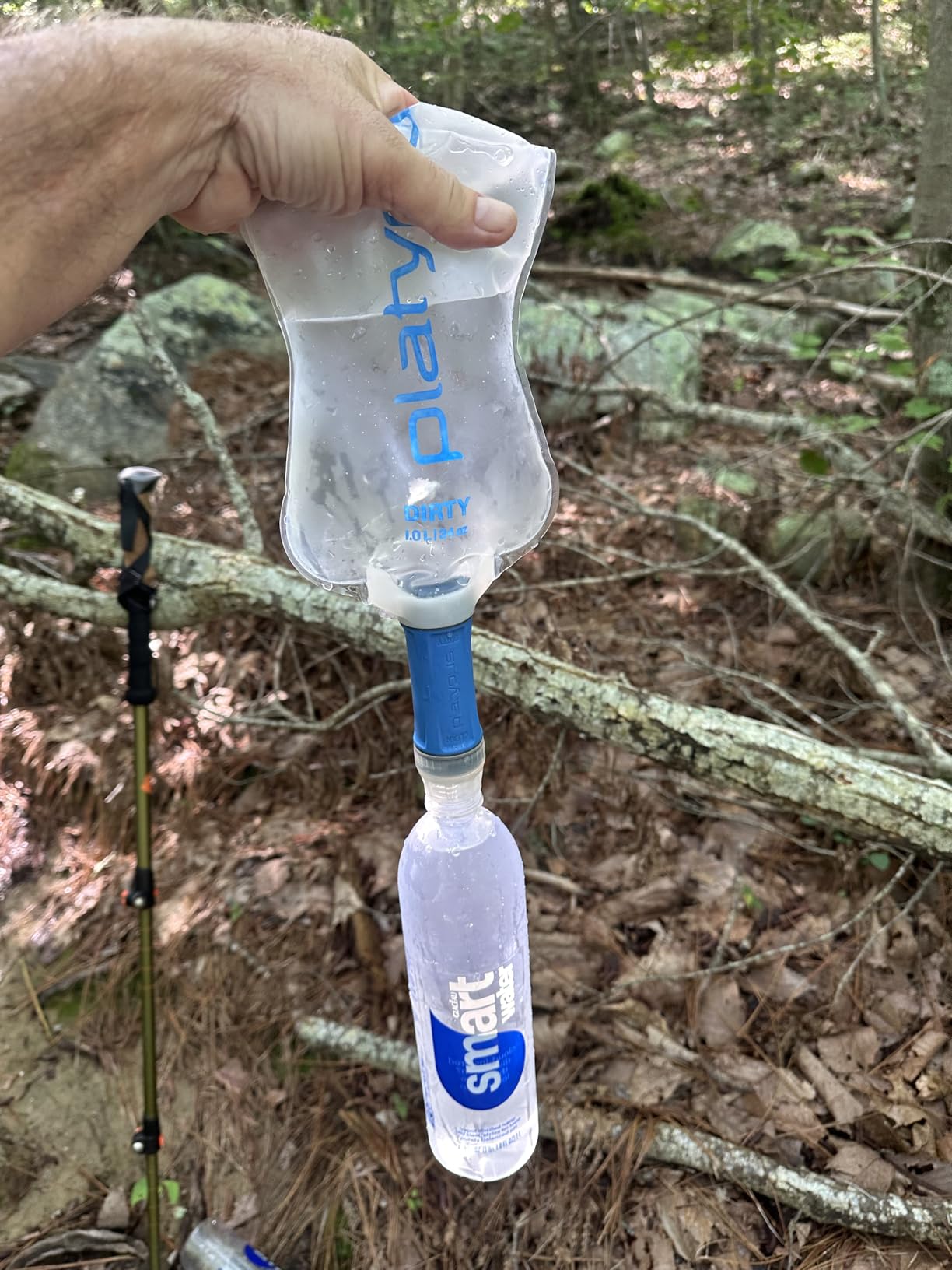
The reservoir is the other differentiator. It is a wide-mouth bottle with a carry handle rather than a collapsing dirty bag, so filling it from a fast-moving stream is far less annoying. The ConnectCap threads onto any 28 mm bottle, including SmartWater bottles and some Cnoc bags.
Comparative reviewers testing it against the Katadyn BeFree, LifeStraw stainless and Sawyer Squeeze consistently rank it fastest or near-fastest, with the best taste among 0.1 to 0.2 micron hollow fiber units after a short break-in period. The membrane is individually tested to the NSF and EPA P231 protocol for 99.9999% bacteria and 99.9% protozoa removal.
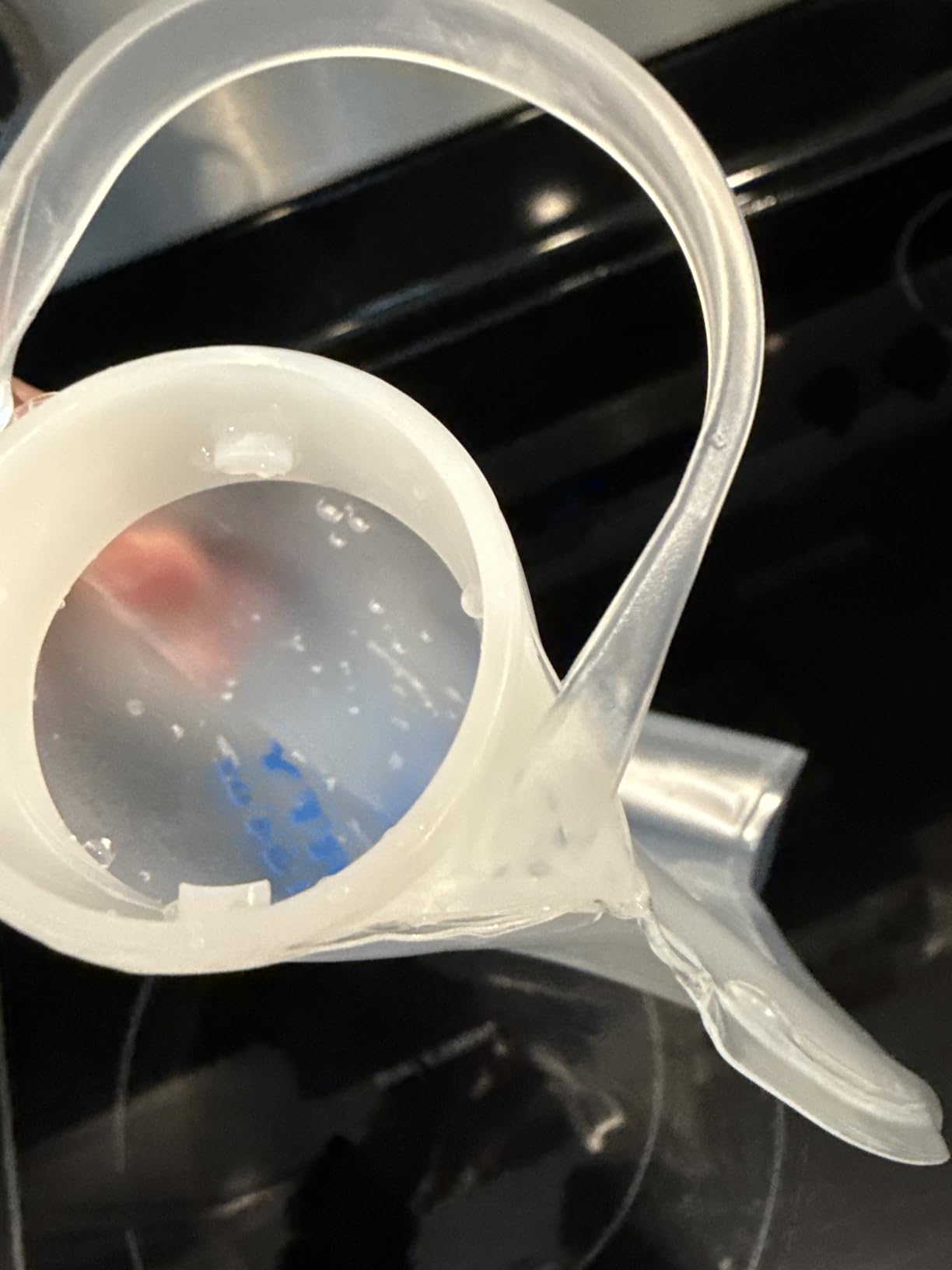
Two practical notes. The threads need more turns than most people expect and under-tightening leaks, and no syringe is included, so cleaning relies on the shake-to-clean method or the included backflush gasket. TDS support is listed at 500 ppm, lower than the Sawyer and Katadyn limits.
Who the Platypus QuickDraw suits
Hikers in dry country where every litre counts, basecamp campers filtering large volumes, and anyone who hates fiddling with collapsing bags. If you already own 28 mm bottles, the ConnectCap means no adapters to buy.
It is also a good pick for groups of two, since filling and passing around a bottle beats handing each person a dirty bag.
Who should skip it
Buyers who want the longest possible record of long-term field use. This is a newer listing with a much smaller review base than the Sawyer and Katadyn models, so there is less field history to lean on.
Skip it if your water is very hard, since the 500 ppm TDS ceiling is the lowest here, and treat it as a filter only, with no virus capability.
7. Katadyn BeFree 1L – Best Filter That Packs Flat
Katadyn BeFree AC 2-Stage Filter Collapsible Travel Water Bottle 1L, Clear
Weight: 2.24 ounces
0.1 micron hollow fiber
2 L/min flow
Up to 1000 litre capacity
Pros
- Collapses completely flat in a vest or running shorts
- Fill squeeze drink with no pump or tablets
- Fast 2 L/min flow for a squeeze filter
- Shake or swish to clean with no tools or disassembly
Cons
- Hollow fiber cannot be allowed to freeze
- Plastic or chemical taste when the membrane is dry
- Flow drops on silty water until you swish it
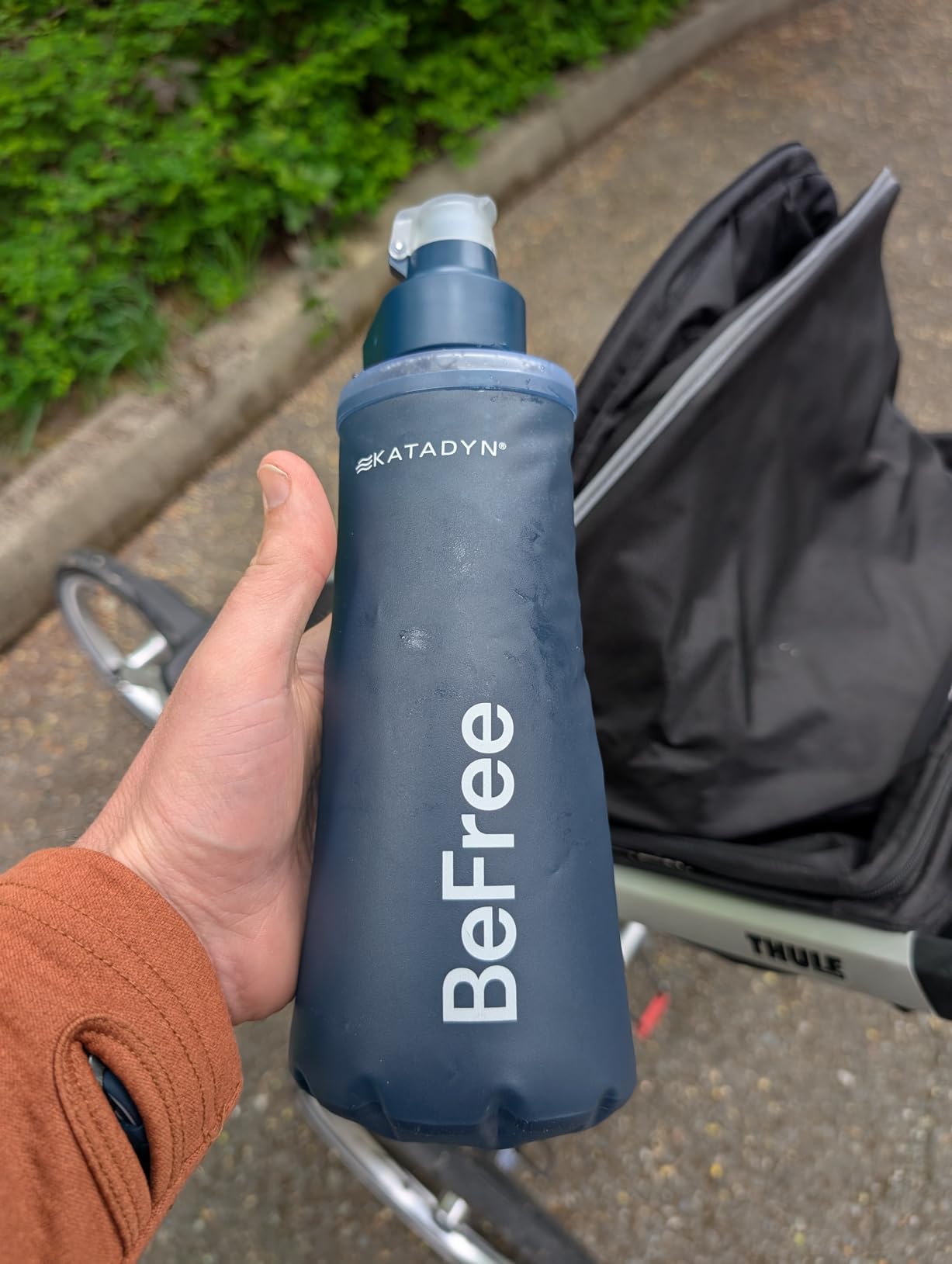
The BeFree solves a problem most filters ignore: how small can a one-litre system be when empty. The collapsible bottle folds flat enough to slide into running shorts or a cycling jersey, and it refills to shape when you want to use it.
The 0.1 micron hollow fiber membrane filters sediment and fine particles at 2 L/min with up to 1,000 litres of rated capacity. You fill, squeeze and drink, with no pump, no chemicals and no setup, and TDS support is listed to 1,000 ppm.
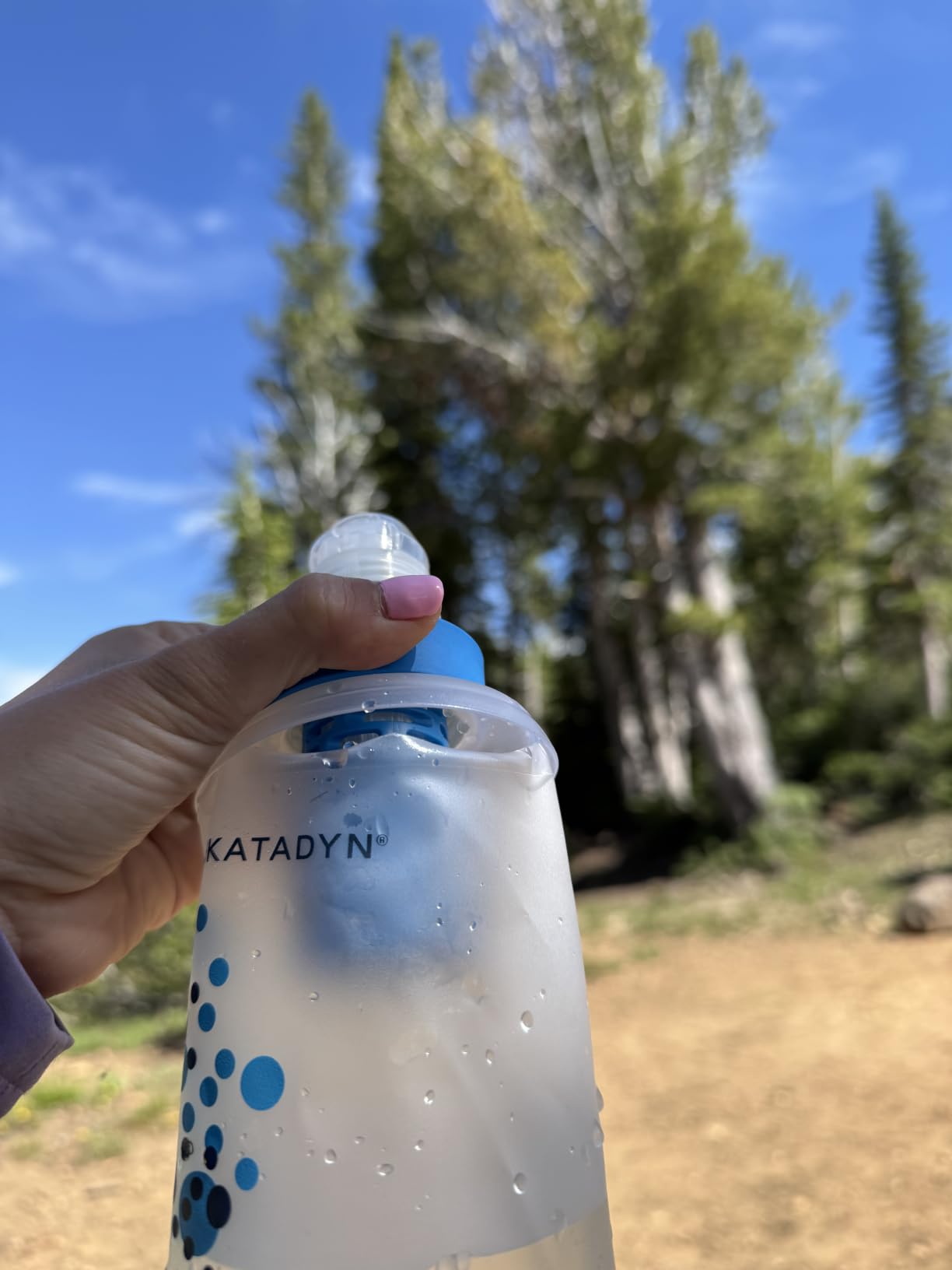
Cleaning is where Katadyn beats the field. No syringe, no disassembly. You shake or swish the bottle in water and the membrane clears, which removes the single most common carry item for Sawyer and Platypus users. Katadyn has built water treatment gear since 1928.
This set carries the widest spread of ratings in the group, with a five-percent one-star cluster. Reviews cluster around taste on a dry membrane and freeze damage, and experienced users point out that the bottle can only be partly emptied between uses, so it keeps some weight in the pack.
Who the Katadyn BeFree suits
Runners, fast hikers, cyclists on tour and anyone who counts every gram. The flat-packing behaviour also suits people who carry water in a vest and refill at sources rather than carrying litres.
Users migrating from syringe-based filters tend to rate it highest precisely because of the cleaning method, accepting a shorter rated life in exchange for zero maintenance tools.
Who should skip it
Winter trips. The hollow fiber cannot be allowed to freeze, and this is the most frequently mentioned failure mode across its reviews. Also skip it if you dislike plastic or chemical taste, which some buyers report on the first litres.
Silty water is the other weak point. Flow drops until you swish the bottle, so carry a pre-filter cloth if your route runs through sediment-heavy sources.
8. Waterdrop Gravity Straw Kit – Complete Gravity Kit for Groups
Waterdrop Gravity Water Filter Straw, Camping Water Filter, 0.1 Micron
Weight: 4.64 ounces
0.1 micron ultrafiltration
700 ml/min gravity flow
1400 gallon capacity
Pros
- Kit includes a 1.5 gallon gravity bag and 16 oz pouch
- 700 ml/min is fast for a gravity system
- Disassemblable ends make backflushing straightforward
- Clear good-tasting output with no aftertaste
Cons
- 300 ppm TDS ceiling is the lowest in this group
- Only a 30-day limited warranty
- Slower on turbid water like all hollow fiber elements
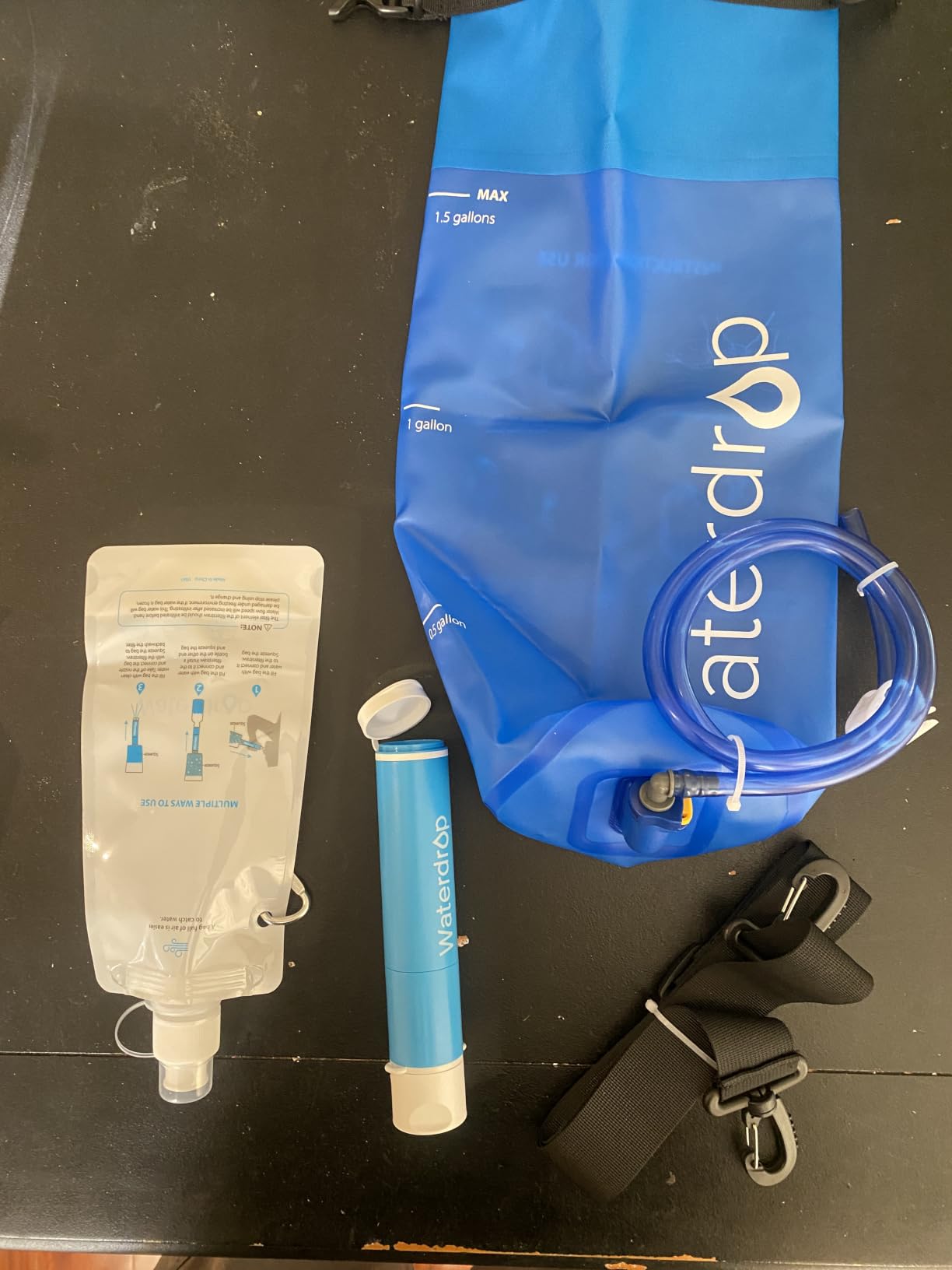
Most gravity setups sell you a straw and leave the bag as an extra purchase. This kit ships with a 1.5 gallon gravity bag and a 16-ounce pouch, so a pair of campers can start filtering at camp the moment they arrive.
Filtration runs in five stages around a 0.1 micron ultrafiltration membrane, reducing chlorine, particulates, sediment, sand, dirt and odor. Rated capacity is 1,400 gallons, or about 5,300 litres, and flow reaches up to 700 ml/min, which is genuinely quick for a system with no moving parts.
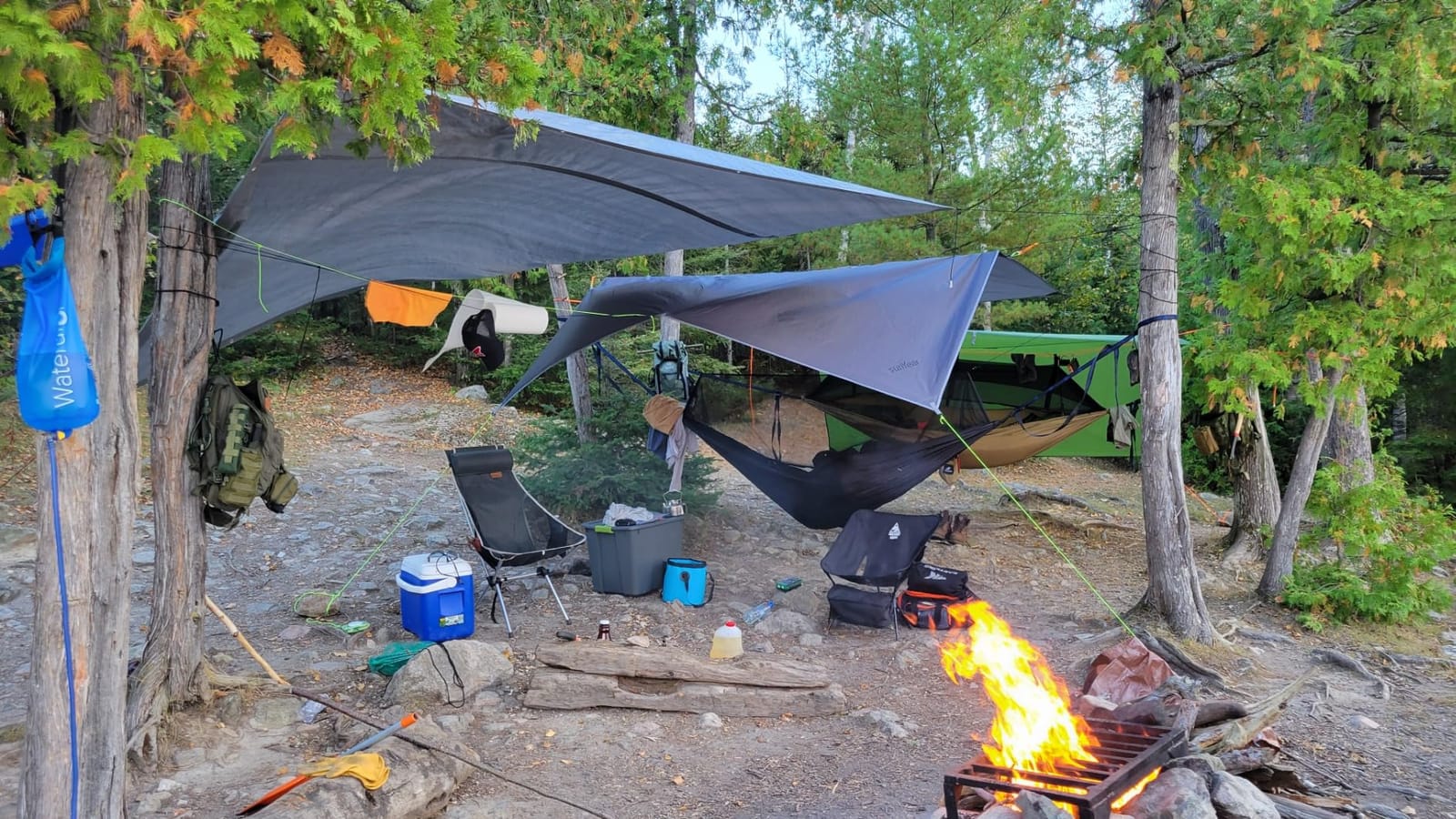
Both ends of the straw disassemble, so you can backflush it and connect it to bags or bottles. Reviewers repeatedly highlight value and the fact that nothing else needs buying, and the practical tip that appears most often is running water through the membrane before first use to improve the taste.
The number worth knowing is the 300 ppm TDS ceiling, the lowest in this group. In very hard desert water you will notice, and the warranty is limited to 30 days, far shorter than the Sawyer and Katadyn positions.
Who the Waterdrop kit suits
Pair campers and small groups who want hands-free camp filtering without buying a separate reservoir. It is also a clean gift for anyone starting out, because the box contains a complete setup.
Owners like the flavour of the output, and the 1,400 gallon rating covers many seasons of weekend trips.
Who should skip it
Anyone moving large daily volumes who needs speed, since 700 ml/min is minutes per litre. Backpackers carrying a hydration pack should note that there is no pump, so every litre waits on gravity.
Skip it in freezing conditions, since hollow fiber membranes are damaged by ice, and treat the 30-day warranty as the honest limit on after-sale support.
9. Sawyer SP160 Gravity System – Hands-Free Camp Filtering
Sawyer Products SP160 One Gallon Gravity Water Filtration System w/Dual-Threaded Mini Filter, Blue/White/Clear
Weight: 43 g
0.1 micron dual threaded MINI filter
1 gallon reservoir
2000 ppm TDS support
Pros
- Gravity does the work with no pumping at camp
- About three minutes per litre of good tasting output
- Interchangeable with existing MINI filters
- Easy to backflush with the included plunger
Cons
- One gallon bag is hard to fill from shallow water
- Semi-rigid bag does not compress flat and crinkles loudly
- Included adapter can trap air and stall flow
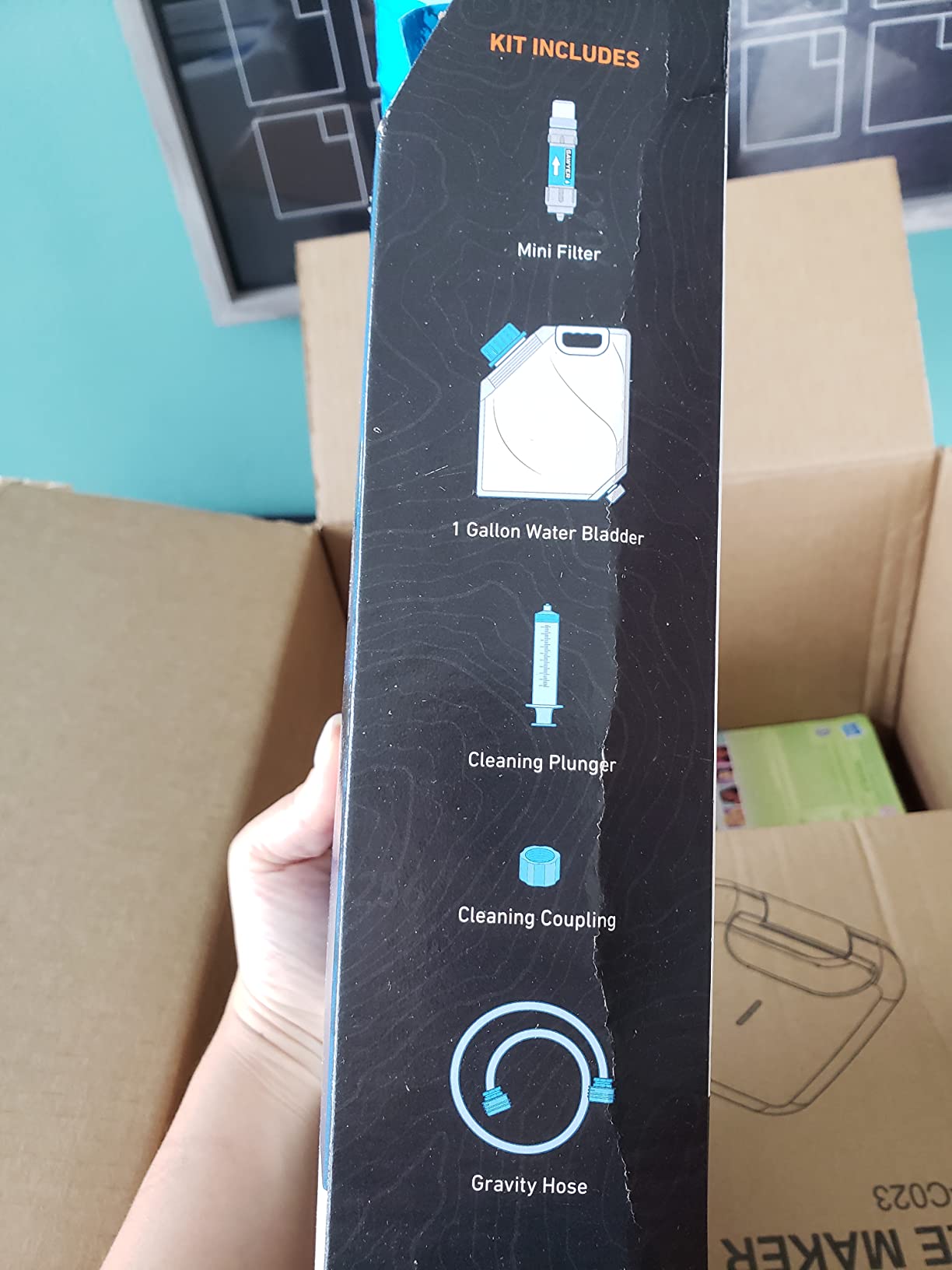
The SP160 turns the same 2-ounce MINI element into a camp system. You fill a one-gallon wide-mouth bladder, hang it, and the filter produces roughly one litre every three minutes of clean water while you cook, sort gear or sleep.
The filter is a 0.1 micron absolute dual-threaded MINI, individually tested three times, rated to 100,000 gallons, and supporting water up to 2,000 ppm TDS, the highest limit among the products here. The dual thread lets the cap operate as a quick on and off function.
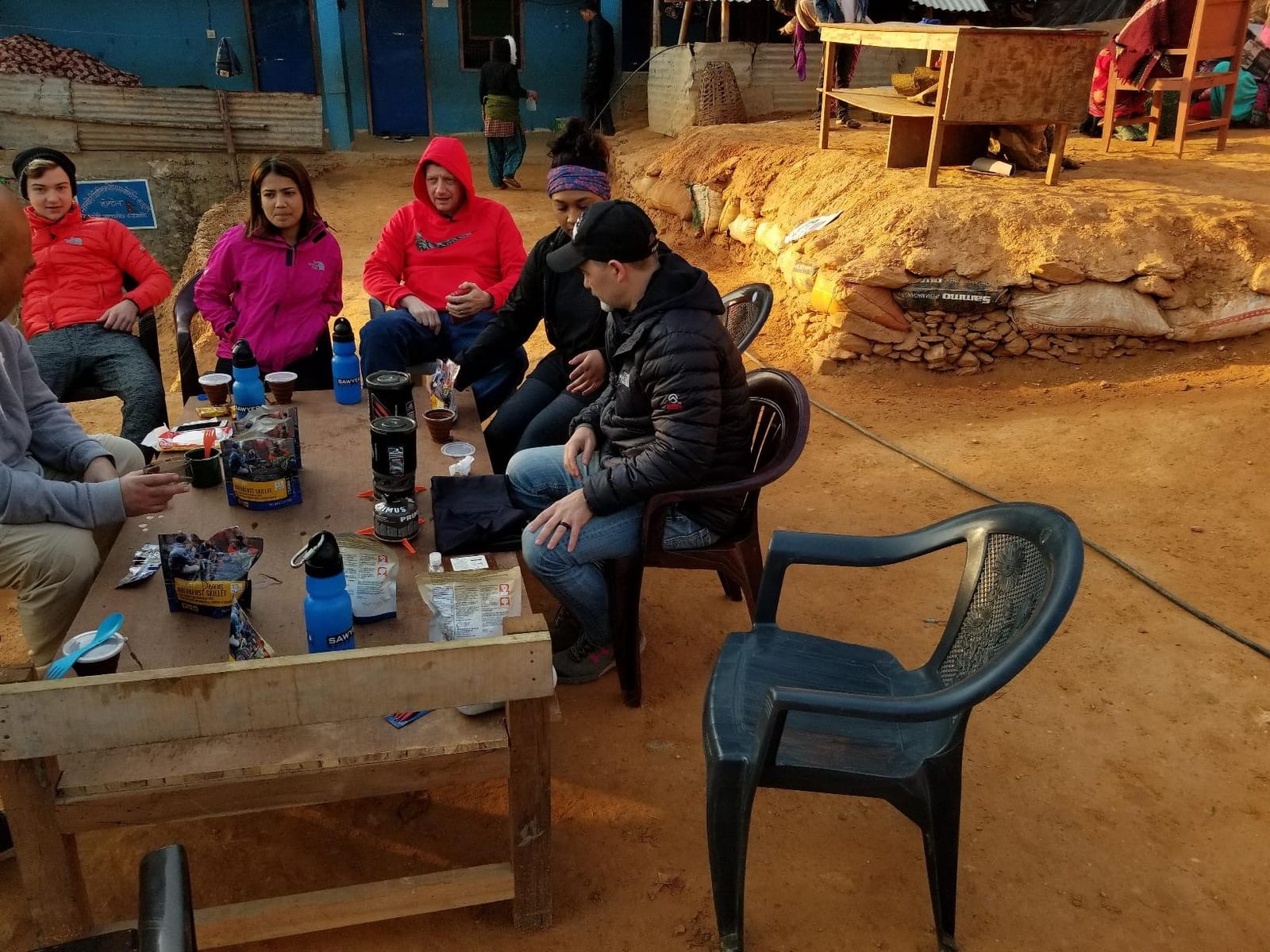
Owners reliably praise the filter itself: clean taste, steady flow and easy backflushing with the included plunger. Their complaints go to the reservoir. The inlet placement on the bag is the single most-repeated criticism, appearing from both seasoned and first-time users, who advise bringing a ladle or second container for shallow streams.
Other notes: the semi-rigid bag does not compress flat when empty and its cap protrudes, and it is loud and crinkly when handled. The included male-to-male bottle adapter can trap air pressure and stall flow until you break the vacuum.
Who the Sawyer SP160 suits
Camp-based trips, basecamp weekenders and car-camping-with-a-hike setups where overnight filtering volume matters more than packed size. It is also a good second device for anyone who already owns MINI filters, since the element is interchangeable.
Reviewers report about three minutes per litre, which is fine when you hang it and walk away.
Who should skip it
Fast hikers and anyone moving daily, because gravity produces litres per hour, not per minute. The 43 g figure also excludes the awkwardness of a bag that never packs flat.
Skip it if your water comes from shallow sources like desert seeps or potholes. That inlet placement makes filling the bladder the hardest part of the system, which is a real limitation on slow-moving water.
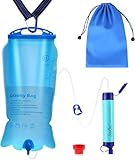
10. SimPure Gravity-Fed Filter – Lightweight Hanging System
SimPure Portable Gravity-Fed Water Filter with 3L Bag
Weight: 3.2 ounces
0.1 micron plus carbon stages
27 litres per hour
5000 litre lifespan
Pros
- Under 3 ounces and rolls up completely flat
- Tree strap enables hands-free hanging filtration
- Input catch tray stops unfiltered water reaching clean side
- Doubles as a personal straw or bottle mounted filter
Cons
- The 3L bag holds closer to 2.3 litres when full
- Air bubbles can stall startup until purged
- Debris clogs it quickly and the slim bag is hard to dry
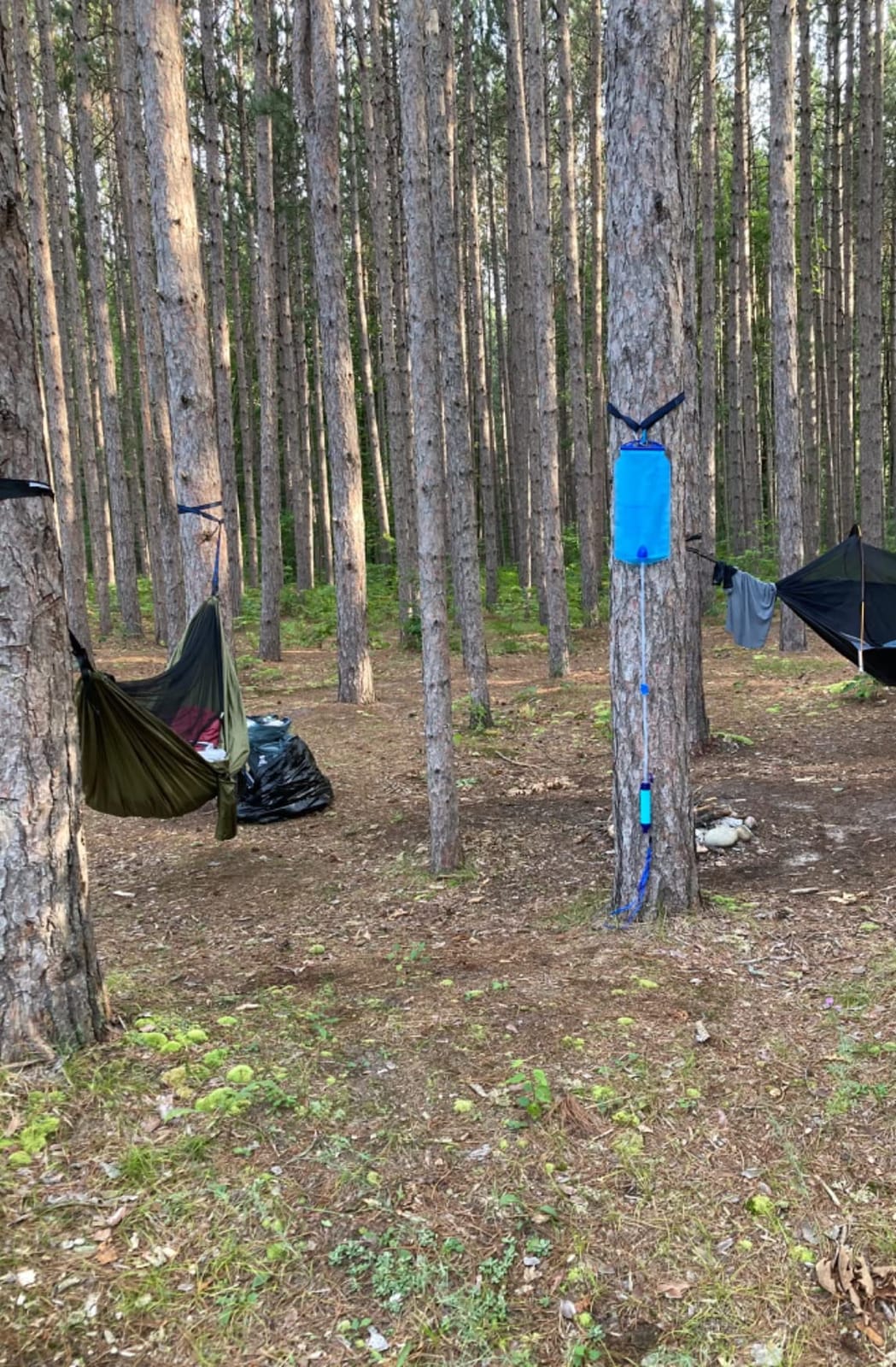
This is a gravity system for people who refuse to give up the tree strap. Hang the 3-litre bag from any branch or line, attach the strap and filter, and walk away while 27 litres an hour move through a 0.1 micron hollow fiber stage.
Beyond the membrane there is a 5 micron coconut shell activated carbon stage and a 0.2 micron polypropylene fibre stage, so chlorine and odor get addressed as well as sediment. Lifespan is listed at 5,000 litres, or 1,320 gallons, with TDS support up to 1,000 ppm.
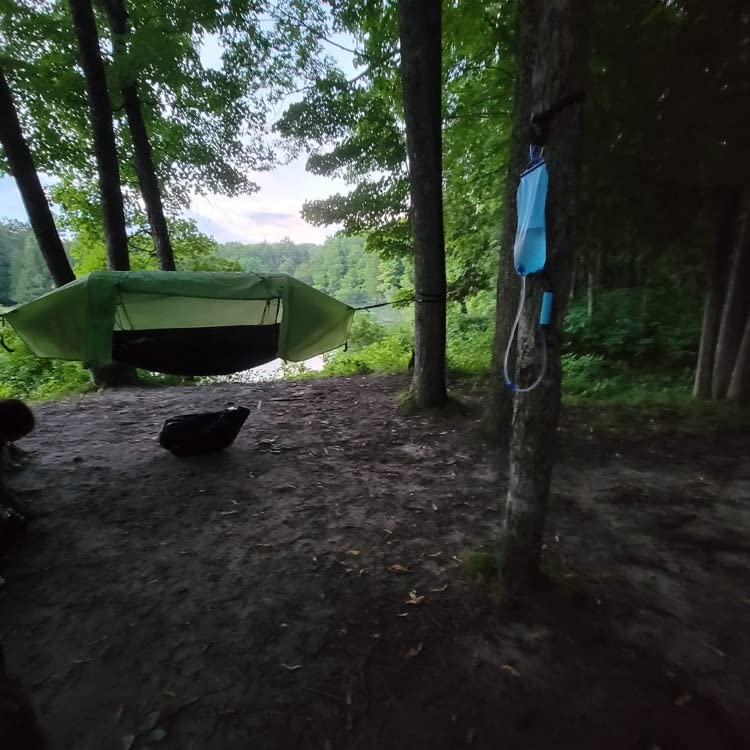
Two design details stand out. The filter can be used as a personal straw, with the 29.5-inch extension tube, or mounted on a water bottle, and the input catch tray prevents unfiltered water running down the hose into the clean side, a failure mode that quietly contaminates cheaper setups.
Owners report the flow rate compares favourably with a name-brand filter in direct testing, and one two-year owner saw no change in opinion. The negative reviews are specific rather than general: a strong plastic and chemical taste on one unit, a bag that overstates capacity, and a cracked straw filter found in the box.
Who the SimPure suits
Camp-first hikers who filter on arrival and then stop thinking about it, plus anyone who wants a straw, a gravity filter and a bottle adapter in one package. The recurring field tip is to set it up as soon as you reach camp so it drips while you work.
At 3.2 ounces it is one of the lighter gravity options, and the tree strap is the reason most owners buy it.
Who should skip it
Anyone who cares about uniform quality control, since a small share of reviews describe cracked-in-box units and strong chemical taste. Inspect the straw connection before you leave home.
Do not count on the 3-litre label. Owners fill the bag to roughly 2.25 to 2.4 litres, and the slim material is awkward to dry fully after washing, which matters on multi-week trips in damp camps.
11. Katadyn Hiker Pro – Best Pump for Shallow Sources
Katadyn Hiker Pro Transparent Hand Pump Water Filter
Weight: 11.2 ounces
0.2 micron pleated glass fiber
Pumps 1 litre per minute
1150 litre cartridge
Pros
- Pumps a litre of clean water per minute
- Transparent body shows cartridge condition at a glance
- Intake pre-filter keeps debris out of the cartridge
- Quick-connect output fits most bottles and hydration packs
Cons
- Heaviest unit in the group at 11.2 ounces
- Replacement cartridges cost more than the pump
- One owner reported a valve failure after 300 to 400 gallons
Pumps earn their place when water is shallow, slow or silty. The Katadyn Hiker Pro has pumped water treatment since the original Hiker, and reviewers describe decades of use across multiple units with housings replaced under warranty.
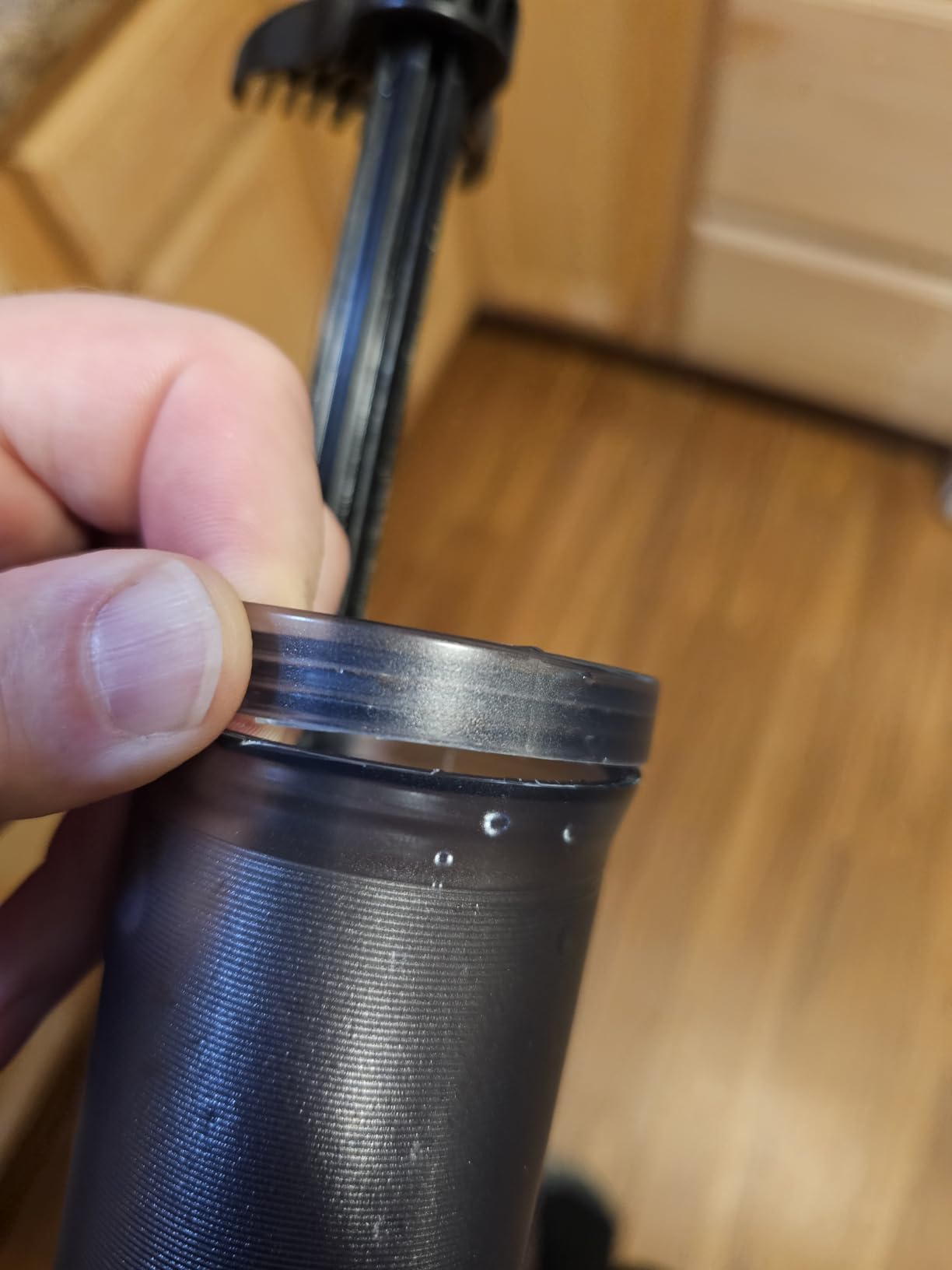
Output is about 1 litre per minute through a 0.2 micron pleated glass fibre cartridge rated to 1,150 litres. The transparent body is the practical feature: you can see the cartridge and know whether it needs cleaning or replacing instead of guessing.
An activated carbon granule stage improves taste, and a cleanable filter protector extends cartridge life. The intake hose carries a modular pre-filter, and the output uses quick-connect fittings with an Easy Fill bottle adapter and a 1/4 inch hydration connector included.
Durability is where the one-star reviews sit. At 11.2 ounces this is the heaviest item in the guide, cartridge pricing draws complaints from high-mileage owners, and one owner reported a valve failure without warning after 300 to 400 gallons. Another unit broke after short use, though the manufacturer replaced the housing.
Who the Katadyn Hiker Pro suits
Desert backcountry, shallow seeps, alpine tarns and any trip where sources are too shallow to dunk a bottle into. A pump also lets you filter from a source you would rather not put your face near.
Long-serving owners treat it as a lifetime purchase, and the visible cartridge removes the guesswork from maintenance on multi-week trips.
Who should skip it
Fast hikers. Pump output degrades as the cartridge fouls, so near the end of cartridge life the same litres take far more strokes, and 11.2 ounces is a real pack weight for solo travel.
Skip it for one or two night trips. The cartridge rating of 1,150 litres and the running cartridge cost only make sense for someone filtering all season.
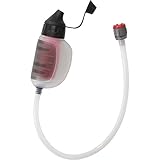
12. MSR TrailShot – Filter With No Dirty Bag Step
MSR TrailShot Ultralight Backpacking and Camping Squeeze Water Filter
Weight: 5.44 ounces
Hollow fiber membrane
1 litre per minute
2000 litre capacity
Pros
- Integrated pre-filter removes the dirty bag step entirely
- Filters a litre in 60 seconds with one hand
- Backflushes without a syringe using the pump itself
- Neutral taste with no plastic hints
Cons
- Does not remove viruses so pair it with tablets where risk is high
- Soft tubing picked up nicks and no protective bag is included
- Not suitable where pesticides are present
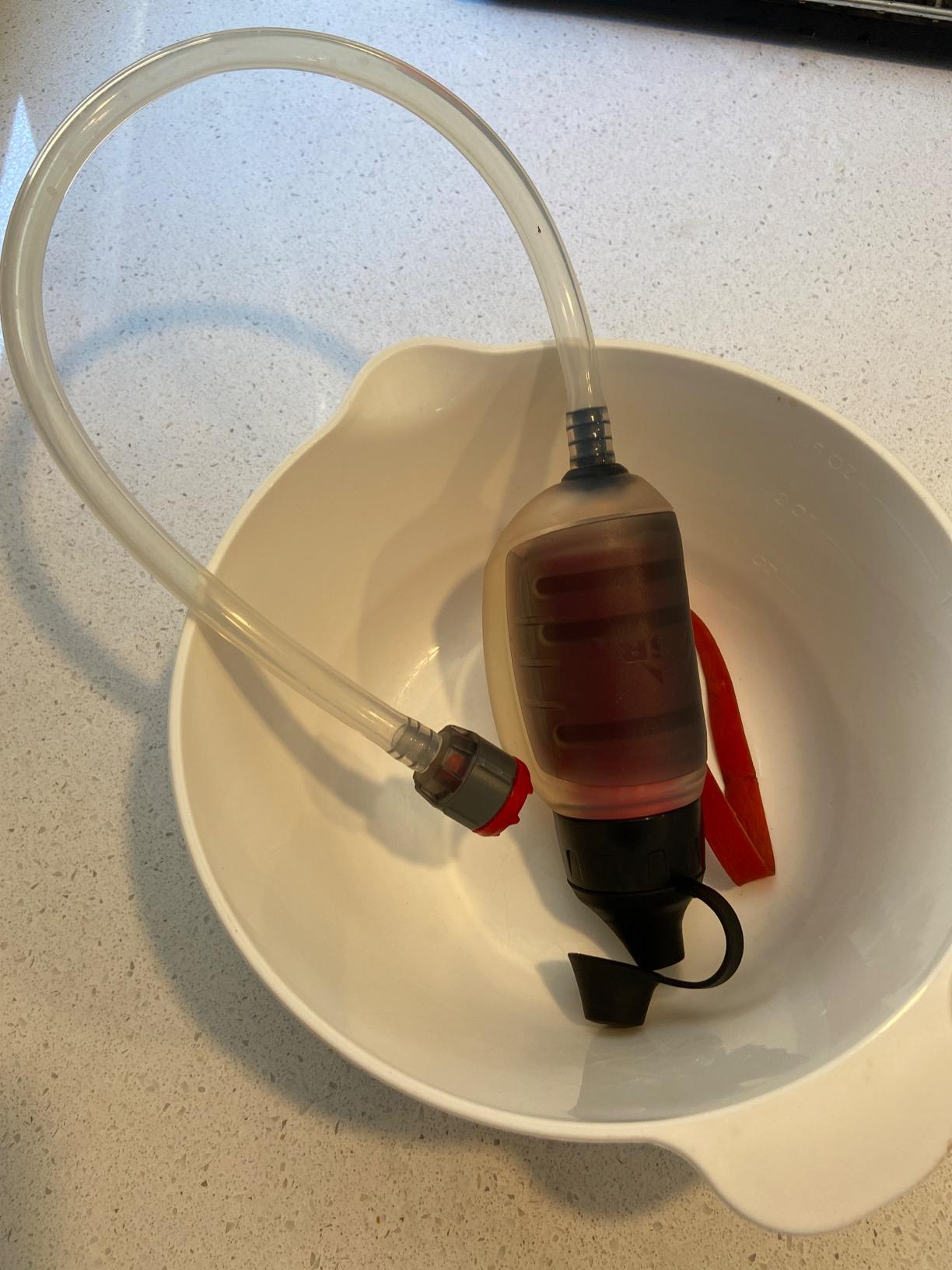
The TrailShot removes the step most hikers hate. Because the pre-filter is integrated into the body, you pump straight from the source without filling a separate dirty bag, which means no transferring filthy water across your camp and no laying down in it to fill a pouch.
Output is about 1 litre in 60 seconds using one hand, through a 5-ounce hollow fiber membrane rated to 2,000 litres and removing 99.9999% bacteria and 99.9% protozoa. TDS support goes to 1,000 ppm, with a lower temperature rating of 33 degrees F.
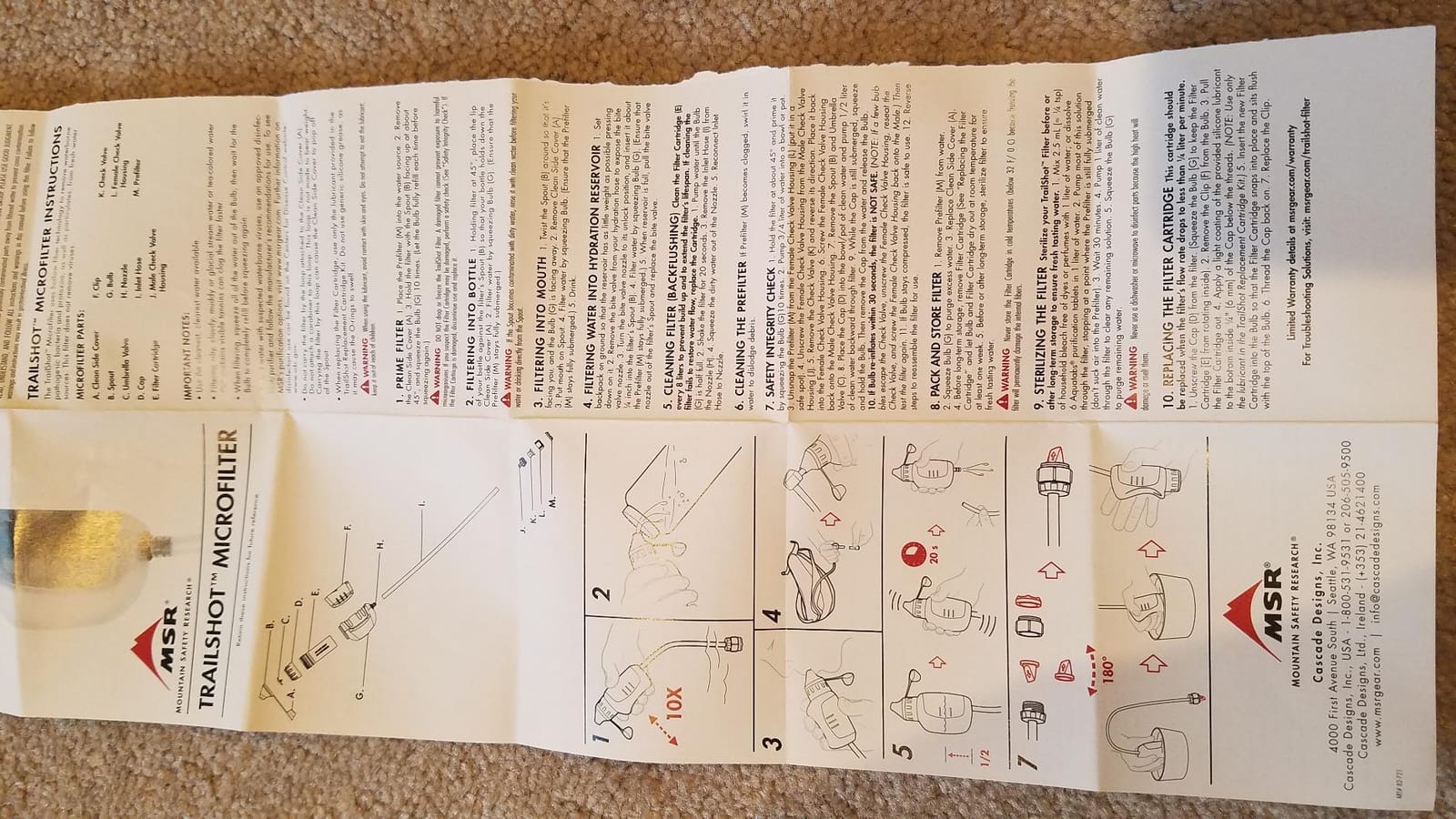
It also backflushes without a syringe, using the pump itself, which removes the syringe most hollow fiber owners carry. One reviewer used it for more than two weeks in the Boundary Waters and reported no scratches. Taste is described as neutral with no plastic hints.
The physical complaint is narrow: the soft rubber tubing picked up small nicks with use and no protective bag is included, and one reviewer wished the tubing were longer. Several reviewers are careful to state the category limit rather than the product, noting it filters bacteria and protozoa but not viruses.
Who the MSR TrailShot suits
Campers who hate dirty bags, families sharing a campsite, and anyone filtering from shallow or awkward sources where filling a separate bag is the hardest part of the job. The one-handed pump also works while you are moving.
Anyone who already owns a dirty bag for dirty water storage will get on well with it, since it sidesteps transferring water twice.
Who should skip it
Buyers who need virus removal, and reviewers in high human-waste areas pair it with boiling or chlorine dioxide tablets instead of relying on it alone. It also does nothing about chemicals or pesticides.
The 33 degree F temperature rating is the lowest here, so cold-weather users should treat it with the same caution as any hollow fiber element.
Filter vs Purifier: What Each One Actually Removes
Every product in this guide is a filter. None is rated to remove viruses, and that is not a marketing detail you can skip. A filter physically strains out particles larger than its pore size, which covers protozoa like giardia and cryptosporidium, most bacteria, sediment and microplastics.
Viruses measure around 0.02 micron. The hollow fiber elements in this roundup run at 0.1 micron and the Katadyn Hiker Pro cartridge at 0.2 micron, so viruses pass straight through all of them. A purifier closes that gap with an absolute pore rating or a chemical or light-based stage.
For domestic trips in the United States and Canada, a filter handles the realistic risk. For international travel, high-human-waste areas, or any water downstream of farms and settlements, carry chlorine dioxide drops or tablets alongside your filter. They reach the virus range, and the trade-off is a chlorine taste plus a wait time of up to four hours for cryptosporidium, so they work best as a treated reserve rather than your daily drink.
If your route never touches questionable water, treat that second bottle as optional. Forum discussion on r/backpacking is consistent on one point: almost everyone carries a chemical backup regardless of which mechanical filter they trust.
How to Choose a Backpacking Water Filter
Six questions narrow this down quickly. Work through them in order and the shortlist usually drops to two models.
1. How much water do you drink per day? Solo hikers use two to three litres daily; groups of four use ten or more. Under four litres a day and a squeeze or straw filter is plenty. Above that, move to a gravity system for camp and keep a squeeze filter for midday top-ups.
2. What does your water source look like? Fast clear streams suit almost anything. Seeps, desert potholes and silty runoff favour a pump with an intake pre-filter, because you need suction more than you need membrane surface. Glacial milk needs pre-filtering before the water ever reaches the element.
3. How much weight can you spare? Personal straws sit between 40 g and 100 g. Ultralight squeeze filters run 2 to 3 ounces for the filter itself. Gravity kits and pumps add reservoirs, and the Katadyn Hiker Pro at 11.2 ounces sits well above everything else here.
4. How much flow do you need? Claimed and experienced flow diverge. The Sawyer Squeeze is listed at 1.7 L/min, the Katadyn BeFree at 2 L/min and the Platypus QuickDraw at 3 L/min squeezed, while the Membrane Solutions straw manages roughly 500 ml/min. If you filter while walking, anything under 1 L per minute will feel slow.
5. What is your virus risk? If any part of your route crosses human or livestock waste, add chemical treatment or choose a virus-rated purifier from another category. None of the twelve filters here covers it.
6. Will it freeze on your trip? Every hollow fiber membrane here can be destroyed by freezing, and damage is silent. If you will be below freezing, plan for a freeze-safe arrangement before the trip rather than after.
One more consideration that gets skipped: how you will clean it. Squeeze filters with a syringe need one more item in your pack, while the Katadyn BeFree cleans with a shake and the Platypus QuickDraw with a shake or its backflush gasket.
Cold-weather trips add their own layer of gear decisions, from how you stay warm between water stops to what you wear in a freezing river. We cover that separately in our picks for cold water surfing wetsuits, and the same freeze-protection logic applies to membranes.
Thread Compatibility: Why 28mm and 42mm Matter
Most inline filters use standard 28 mm threads, the same fit as SmartWater bottles. The Sawyer MINI and Squeeze, the Platypus QuickDraw ConnectCap and the Membrane Solutions S1 all run on 28 mm, and the LifeStraw Peak uses a removable threaded bottom cap that screws onto bottles and gravity hoses.
The exception worth knowing is the Katadyn BeFree, whose bottle uses a proprietary wider thread rather than the standard 28 mm. Hikers regularly report buying a BeFree expecting it to fit their existing bottles and finding it does not, which is the single most common purchasing mistake in this category.
The practical fix is to buy the filter first and the bottle second. For 28 mm systems that means picking a sturdy SmartWater bottle or a Cnoc bag instead of relying on the collapsible pouches in the box, since owners across the Sawyer range report those pouches splitting after repeated folding.
Maintenance, Backflushing and Cold Weather
Flow loss means a clogged membrane, not contaminated water. A hollow fiber element slows down when silt coats the outside, and cleaning restores it. Slow flow is a maintenance signal rather than a safety failure.
Backflushing is the standard fix for syringe-equipped systems like the Sawyer range. Fill the backflush syringe with clean water, attach it to the clean side of the filter, push water through until it runs clear, then disconnect and store the filter dry. Doing this at the end of a filtering day keeps the element from baking silt into place.
Filters without a syringe clean by shaking or swishing. The Katadyn BeFree is swished in the source water, and the Platypus QuickDraw offers shake-to-clean or a backflush using the included gasket. The Waterdrop and Membrane Solutions straws both unscrew at the ends for a manual backflush.
On freezing, the rule for every hollow fiber membrane here is that a frozen element can be damaged invisibly. The common field approach is to sleep with the filter inside a sleeping bag or dry bag at the start of the evening, then filter with it before it rewarms. If you know it froze, the honest advice from owners is to replace the element rather than hope, and to keep a chemical backup for those camps.
One small habit that prevents damage as well: never let a filter element drop onto rock or get compressed in a full pack. Every hollow fiber membrane in this guide shares that weakness, and it is why the 2-ounce models that are easy to lose are also the easiest to break.
Frequently Asked Questions
What is the best water filter for backpacking?
For most hikers the LifeStraw Personal Water Filter is the best starting point, because it weighs about 40 g, needs no pumping and carries the largest owner base in this roundup at over 125,000 reviews. Long-distance hikers usually prefer the Sawyer Squeeze for its faster 1.7 L/min flow and hydration adapters. All of these are filters, not purifiers, so virus protection needs separate treatment.
What is the difference between a backpacking water filter and a water purifier?
A filter strains out anything larger than its pore size, which covers protozoa such as giardia and cryptosporidium, most bacteria, sediment and microplastics. A purifier also inactivates viruses, which measure around 0.02 micron and pass through every filter in this guide. Choose a filter for normal domestic backcountry travel and add chemical treatment for high-risk or international routes.
How long do backpacking water filters last?
Rated capacity depends on the design. Hollow fiber elements are listed from 1,000 litres on the Katadyn BeFree up to 100,000 gallons on the Sawyer models, while the Katadyn Hiker Pro cartridge is rated at 1,150 litres. Owners filtering tens of thousands of litres report no measurable decline, but real replacement timing depends far more on silt and cleaning habits than on the printed rating.
What happens if a backpacking water filter freezes?
Ice can damage a hollow fiber membrane, and the damage is invisible because the element still looks intact. Keep filters inside a sleeping bag or dry bag overnight on freezing trips and use them before they rewarm. If a filter has actually frozen, the safer choice is to replace the element, since no field test reliably confirms the membrane still performs.
Do I really need to filter water in the backcountry?
Yes, even when water looks perfectly clear. Wildlife and livestock waste introduce giardia, cryptosporidium and bacteria that are invisible to the naked eye, and a single contaminated source can end a trip with days of illness. A filter is among the lightest and cheapest pieces of safety gear you can carry, and it removes the decision from every camp.
How often should you backflush a backpacking water filter?
Backflush whenever flow slows noticeably, and at the end of any day when you filtered from silty or murky water. Squeeze systems such as the Sawyer range use a syringe and reverse flow until the water runs clear. Filters without a syringe, including the Katadyn BeFree and Platypus QuickDraw, clean by shaking or swishing instead. Slow flow indicates a clogged membrane, not contaminated water.
The Bottom Line on Backpacking Water Filters
The LifeStraw Personal Water Filter is the best water filter for backpacking for most readers, because it does one job, weighs about 40 g and has the deepest owner history in the group. Choose it if you want zero fuss and you filter under a couple of litres a day.
Move up to the Sawyer Squeeze for long trails where a failure costs days, to the Platypus QuickDraw for speed in dry country, and to the Katadyn BeFree when every gram and every carried tool matters. For camps and groups, a gravity kit such as the Waterdrop or Sawyer SP160 does the work overnight while you sleep.
Whatever you pick, buy the filter before the bottle so the threads line up, and carry chlorine dioxide as a backup whenever human or livestock waste is anywhere upstream. That is the complete 2026 field kit: one filter, one bottle that fits it, and a chemical reserve for water your filter cannot handle.