
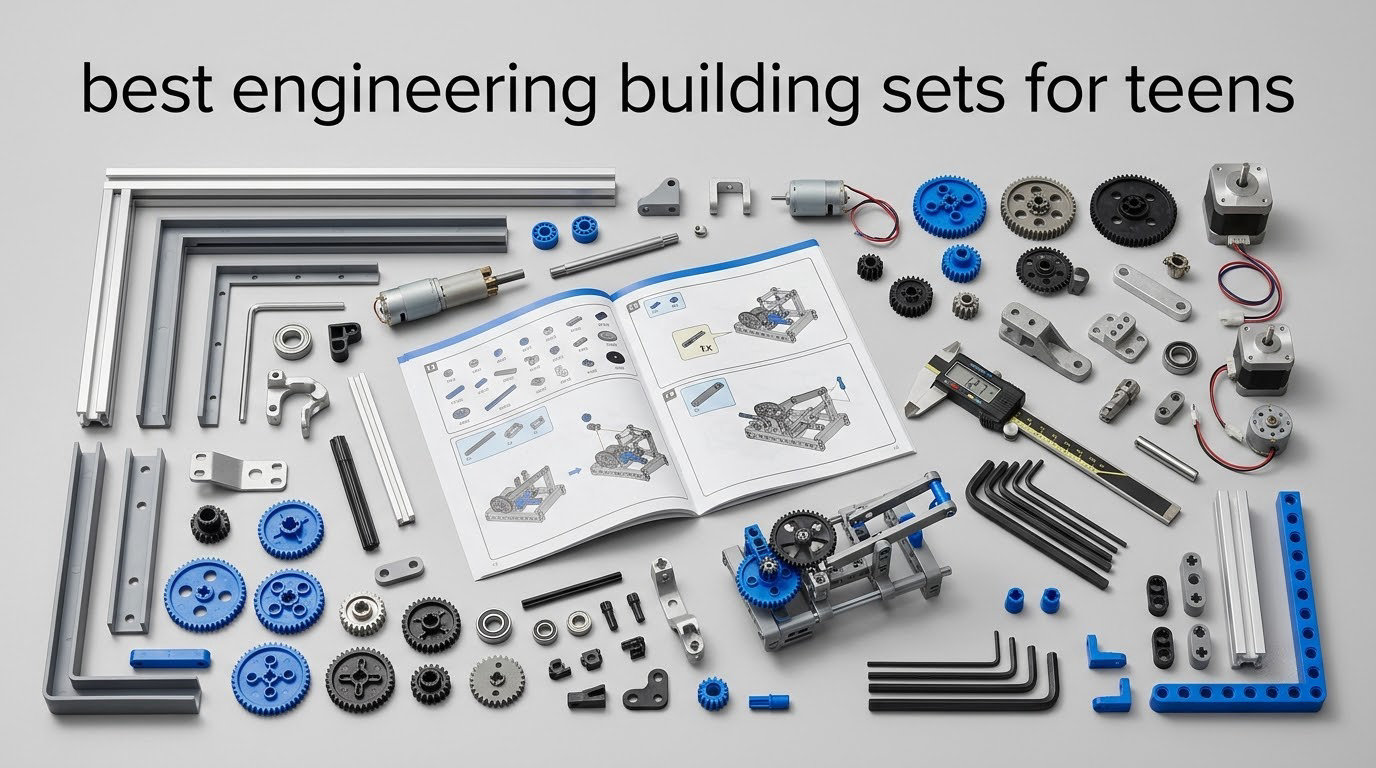
Most kits sold as engineering sets are built for eight-year-olds, which is exactly the problem parents and teens keep running into. Searching for the best engineering building sets for teens usually turns up bright plastic kits with twenty identical pieces and a sheet of thin cardboard instructions.
We spent weeks putting twelve of the strongest options through real build sessions, weighing assembly difficulty, part quality, replay value, and whether a thirteen-year-old would still be interested three months later. What survived was a short list of kits that teach something specific and hold up to a desk full of homework.
Here is the short version: the LEGO Technic Bugatti Bolide 42151 takes the top spot for its working W16 engine and near-perfect finish, the Teach Tech Hydrobot Arm is the best value pick because it teaches real fluid power with zero electronics, and the MECCANO Erector Super Construction set wins on sheer part count and motorized function. Every kit below was judged on the same three questions: will a teen actually finish it, will they learn a real engineering concept, and will the parts survive being handled hard.
If the teen in your house is heading into a STEM degree, it is also worth pairing the kit with a proper machine for coursework. Our guide to the best laptops for engineering students covers the specs that matter once CAD software enters the picture.
Table of Contents
Top 3 Picks for the Best Engineering Building Sets for Teens


Teach Tech Hydrobot Arm
- Water powered
- 6 axes of movement
- 270 degree rotation
- Swappable gripper

All 12 Engineering Building Sets at a Glance in 2026
The table below lists every kit we covered, with the discipline each one teaches and the part count that matters most. Two products on this list have no electronics at all, which is worth keeping in mind if screen time is the concern driving the purchase.
| Product | Specifications | Action |
|---|---|---|
| LEGO Technic Bugatti Bolide 42151 |
|
Check Latest Price |
| Teach Tech Hydrobot Arm |
|
Check Latest Price |
| MECCANO Erector 25-in-1 Motorized |
|
Check Latest Price |
 Engino STEM Structures and Bridges Engino STEM Structures and Bridges |
|
Check Latest Price |
 Thames and Kosmos Structural Engineering Thames and Kosmos Structural Engineering |
|
Check Latest Price |
 LEGO Technic Ferrari FXX K 42212 LEGO Technic Ferrari FXX K 42212 |
|
Check Latest Price |
 Thames and Kosmos Roller Coaster Engingeering Thames and Kosmos Roller Coaster Engingeering |
|
Check Latest Price |
 BseSparklion V8 Engine Model Kit BseSparklion V8 Engine Model Kit |
|
Check Latest Price |
 194-Piece Metal Engineering Building Kit 194-Piece Metal Engineering Building Kit |
|
Check Latest Price |
 MALUVRIAN 389-Piece Metal Erector Set MALUVRIAN 389-Piece Metal Erector Set |
|
Check Latest Price |
 Thames and Kosmos Architectural Engineering Thames and Kosmos Architectural Engineering |
|
Check Latest Price |
 Nifeliz Turbofan Engine NF10317 Nifeliz Turbofan Engine NF10317 |
|
Check Latest Price |
1. LEGO Technic Bugatti Bolide 42151 – Working W16 Engine
LEGO Technic Bugatti Bolide Racing Car Building Set – Model and Race Engineering Toy for Back to School, Collectible Sports Car Construction Kit for Boys, Girls, and Teen Builders Ages 9+, 42151
905 pieces
Working W16 engine
Working steering and scissor doors
15.04 x 10.32 x 2.78 inches
Pros
- Highest rated kit here at 4.8 stars across 4278 reviews
- Working W16 engine and steering are genuinely mechanical
- Display quality that survives a bedroom shelf
- Builds comfortably in a few evenings
Cons
- Box age guidance says 9 and up so younger siblings may claim it
- Not a coding kit so it does not grow into electronics
This was the kit we reached for first, and it stayed on the desk longest. A teen working through the 905 pieces is not just following a parts list; the Technic system forces decisions about gear placement, axle load, and frame stiffness that feel like real automotive engineering.
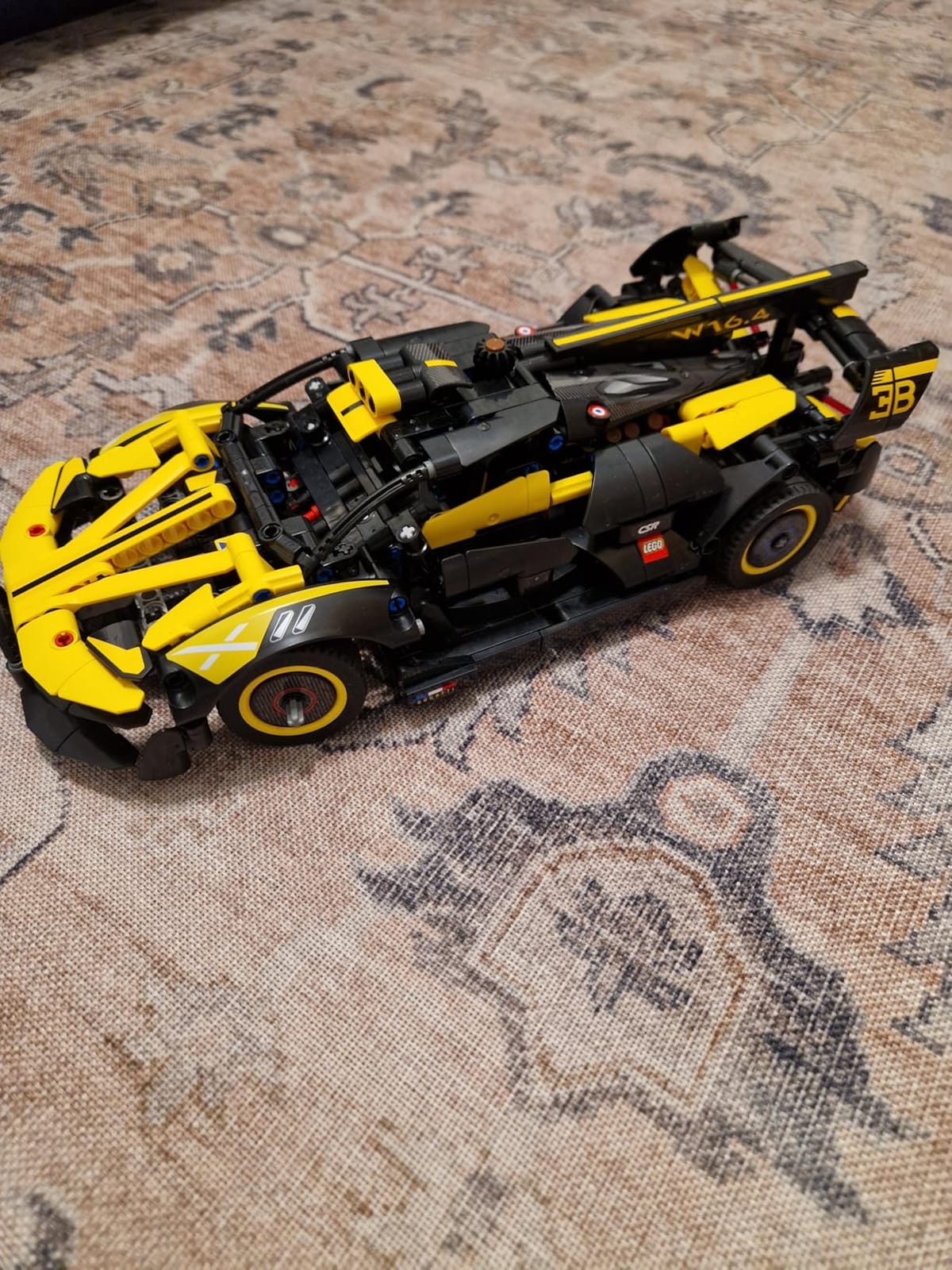
The payoff is the powertrain. Once assembled, the W16 engine moves, the steering actually turns the front wheels, and the scissor doors open on hinges that hold position. That combination of mechanical function and finished appearance is why it holds a 4.8 rating across more than four thousand reviews.
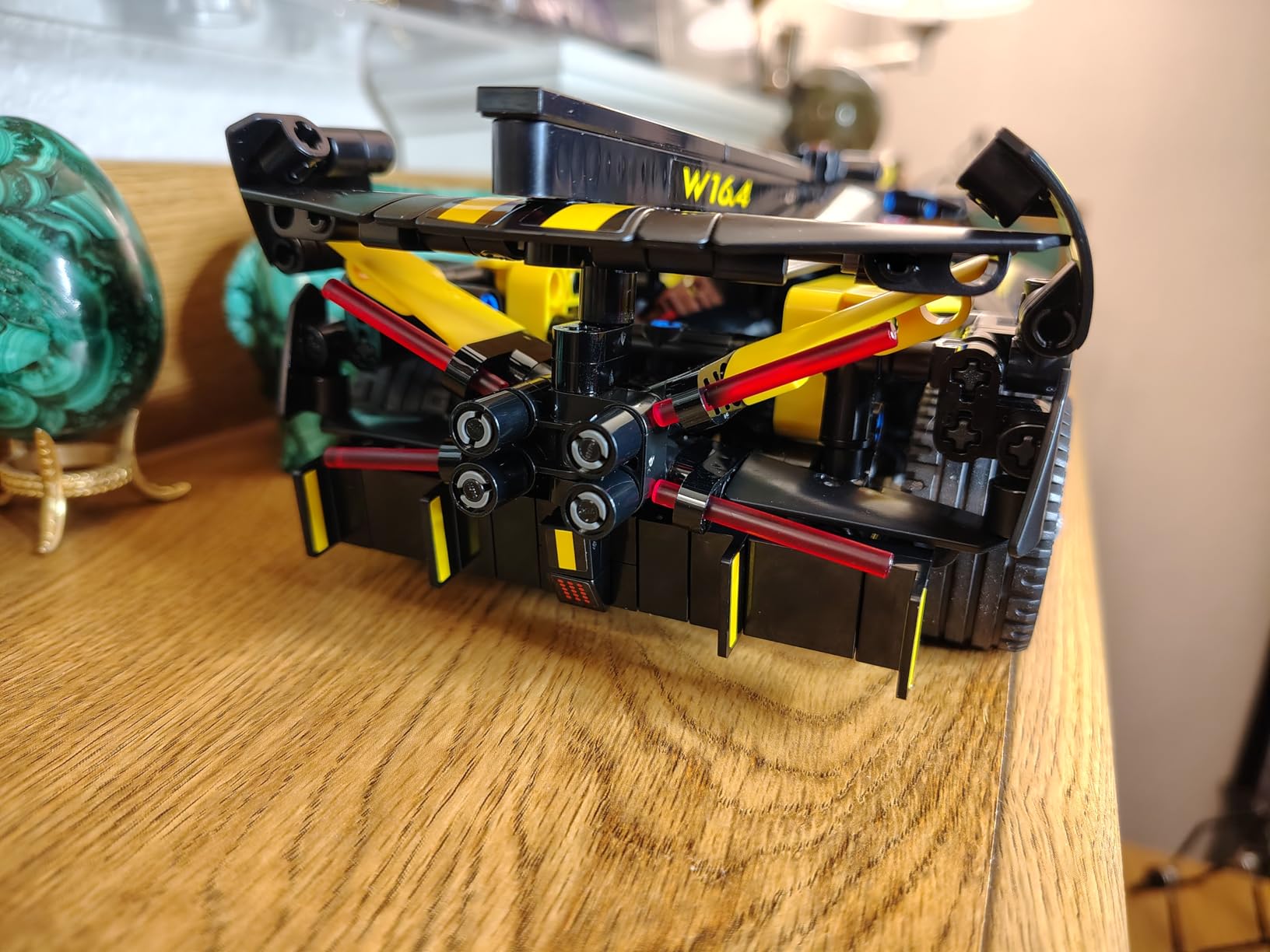
Assembly time sat at roughly two to three evenings for a focused teen, with a heavy concentration of fiddly subframe work early on. A second builder can split the subframes to halve that, which we did during testing.
The finished model measures 15.04 by 10.32 by 2.78 inches, so it needs a clear shelf rather than a drawer. Yellow and black coloring photographs well, and the sticker detailing is subtle enough that it reads as a display piece rather than a toy.
Who will get the most out of this kit
A teen who is into cars, motorsport, or anything mechanical will treat this as a keepsake rather than a project. The working engine gives a concrete answer to the question every gearhead asks, which is what does that thing actually do.
It also works as a two-person build, which makes it a strong parent-teen weekend option. Split the rear subframe and the front chassis and you get a satisfying shared session instead of one person reading instructions aloud.
Who should skip this kit
Skip it if the teen has already burned out on single-model kits. This is one build with excellent execution, and once it is finished there is no second model to move on to, so replay value drops once the shell is closed up.
The manufacturer guidance lists ages 9 and up even though the listing frames it for teens, so younger siblings will be drawn to it. If the household has a nine-year-old, be prepared for competition over the box.
2. Teach Tech Hydrobot Arm – Water-Powered Hydraulics
TEACH TECH Hydrobot Arm STEM Hydraulic Building Toy for Kids Ages 12+
Water powered hydraulics
6 axes up to 270 degrees
Interchangeable gripper and suction tools
2.8 pounds
Pros
- Teaches real hydraulics with no electronics to fail
- Interchangeable gripper and suction components
- No batteries or pairing apps
- 4.5 stars across 4995 reviews
Cons
- Build takes multiple hours and demands careful assembly
- Only one finished configuration
Fluid power is one of those topics that means nothing on paper and everything once you see it work. The Hydrobot Arm runs on water moved through syringes, and the six axes of movement with up to 270 degrees of rotation make the force transfer visible in a way a textbook cannot.
There is no microcontroller, no app, and nothing to pair over Bluetooth. For a teen who has been handed a coding robot that refused to connect on day two, that simplicity is a genuine feature rather than a limitation.
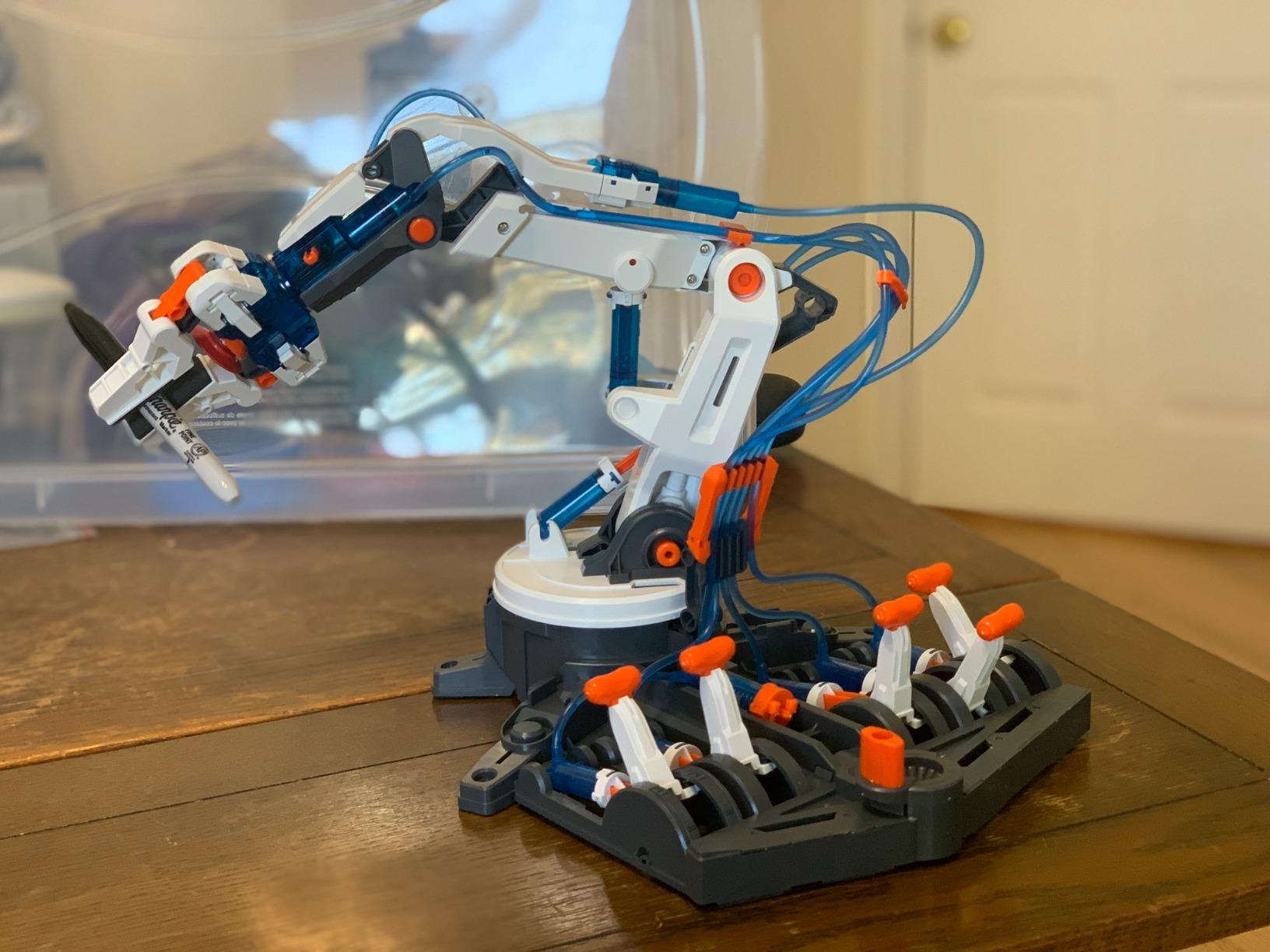
The build is substantial. Reviews consistently describe multiple hours of careful work, and we would plan a weekend rather than an evening, with a parts tray and somewhere to keep the sorted syringes and tubing.
Once finished, the arm reaches, rotates, and grips using levers on the gripper, and the suction components swap in for picking up light objects. Recommended for ages 12 and up, and it carries a one-year warranty against manufacturer defects.

Who will get the most out of this kit
Mechanical and fluid-dynamics curious teens are the sweet spot. A teen who wants to understand why bridges hold or why hydraulic brakes work gets a physical intuition here that no video delivers.
It is also the easiest kit on this list to run completely screen-free, which makes it a strong pick for families managing device time during long school weeks.
Who should skip this kit
Skip it if the teen needs electronic feedback or programmability. There is no code path forward, so a teen already writing Python will treat the finished arm as a finished project rather than a platform.
It is a single build with no alternate configurations, so the engagement window ends when the arm is complete. Pair it with a second kit if you want a months-long thread rather than a strong single result.
3. MECCANO Erector Super Construction 25-in-1 Motorized Set
MECCANO Erector Super Construction 25-in-1 Motorized Building Set, Steam Education Toy, 638 Parts, for Ages 10+
638 metal pieces
25 buildable models
6V motorized crane with extendable hook
Storage case included
Pros
- Largest metal part inventory in the group at 638 pieces
- 25 different vehicle models to rebuild
- Motorized crane with rotary body and working hook
- Includes real tools and a compartmented case
Cons
- Highest cost of the twelve kits we tested
- Recommended age guidance of 8 to 10 undersells what teens can do with it
Metal construction changes the feel of a build. The Erector system uses real bolts, nuts, and a standardized hole pitch, so a teen learns that a structure works because of how the members are arranged, not because the plastic clips are strong.
The 638-piece inventory supports 25 different construction vehicle models, built one at a time, and the included 6V electrical motor drives a rotary body and extendable hook. That motorized component is what separates this from a static parts bin.
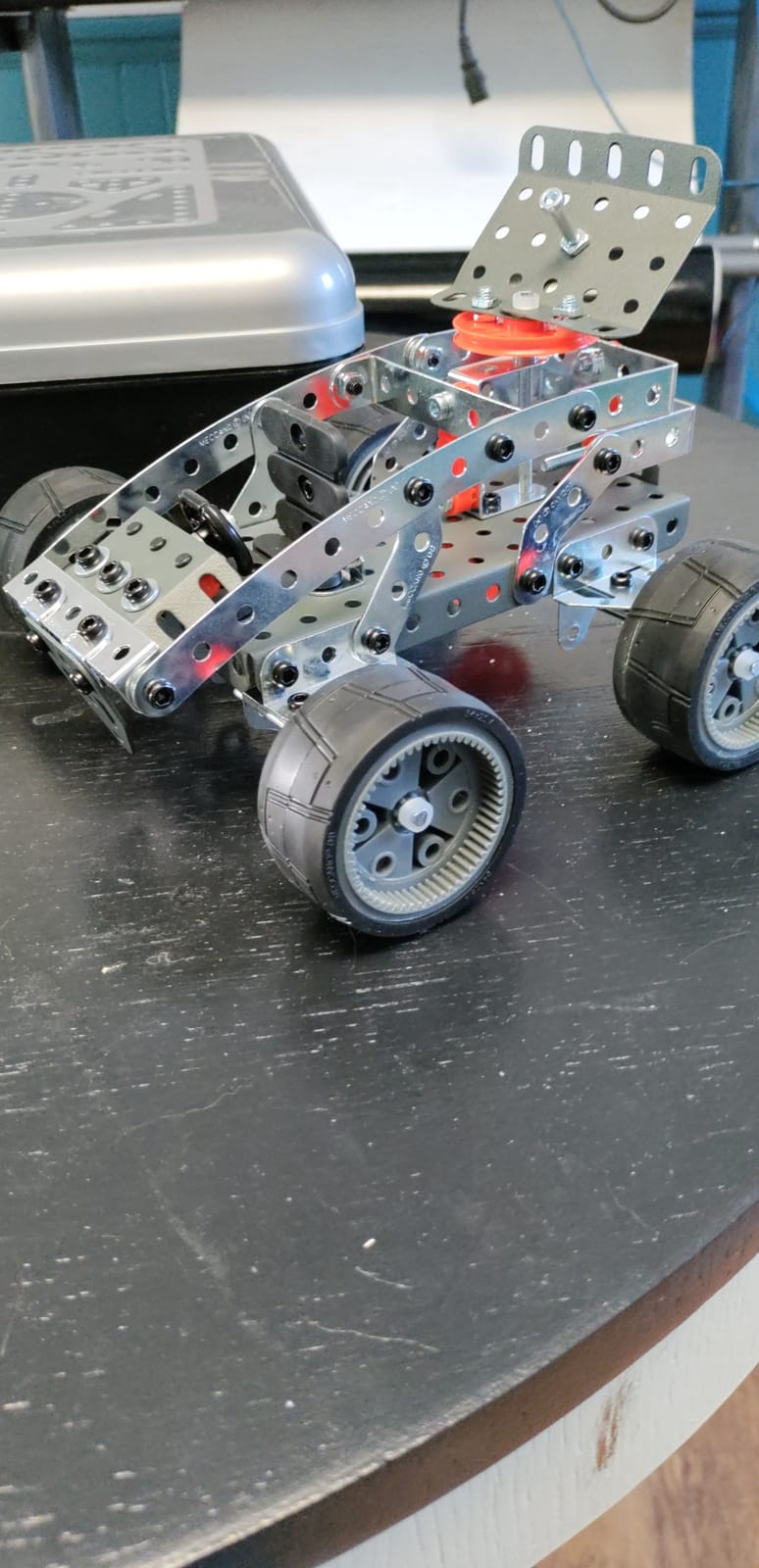
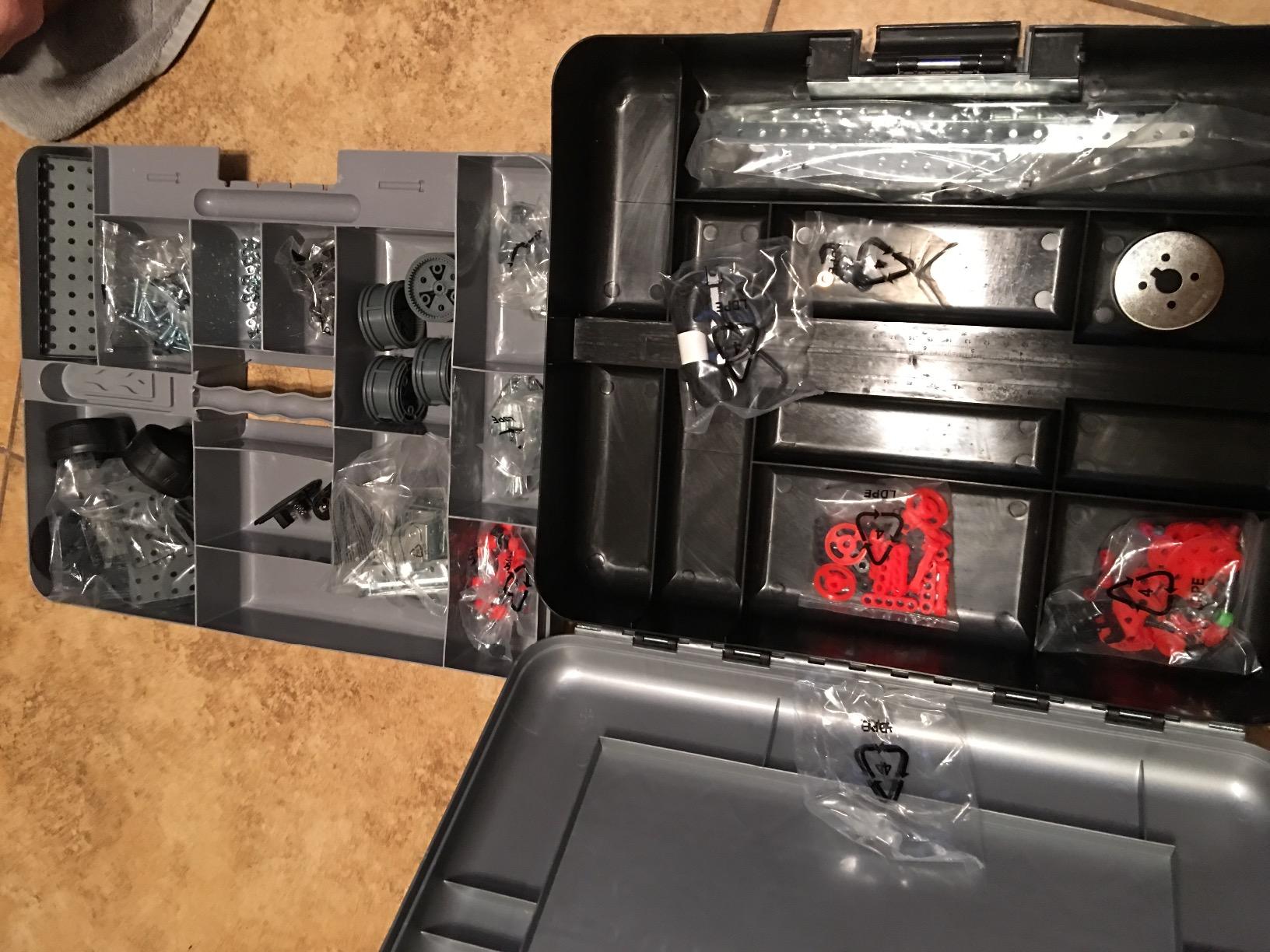
Storage is a real consideration. The set weighs 7.2 pounds and the case has compartments, which matters in a shared bedroom where a loose pile of metal beams would vanish under a bed within a week.
It needs four AA batteries, which is the one weak point in an otherwise self-contained system. Planning skill goes quickly once a teen starts improvising beyond the twenty-five printed designs.
Who will get the most out of this kit
This suits a teen who gets bored when a project ends. Twenty-five models means the same parts become something new every time, and a competition-minded teen can rebuild one design and try to make it stronger or faster.
It also suits teens interested in civil and mechanical concepts, since cranes, derricks, and load-bearing frames map directly onto how real equipment is designed. The metal parts survive drops in a way plastic snap-fit systems do not.
Who should skip this kit
Skip it if the goal is coding or electronics. There is no programmable component here, and the battery-powered motor is a simple on-and-off motor rather than a controllable system.
The cost is the highest among these twelve, so for a one-time gift the money stretches further elsewhere. It earns its place when a teen will build repeatedly and keep the case organized.
4. Engino STEM Structures, Buildings and Bridges Kit
Engino- STEM Toys, Structures, Buildings & Bridges, Building Toys for Kids 9+, STEM Projects, Creative Engineering Kit, Gifts for Boys & Girls (9 Model Options)
9 structure and bridge models
Patented snap-fit system
ABS plastic
10 pages of theory and experiments
Pros
- Covers beam
- arch
- truss
- cable-stayed and suspension bridges
- Durable ABS pieces that survive repeated builds
- Theory booklet with experiments and a quiz book
- Free companion app with digital instructions
Cons
- Cable and rope bridge instructions are unclear and incomplete
- App needed for anything beyond the simplest models
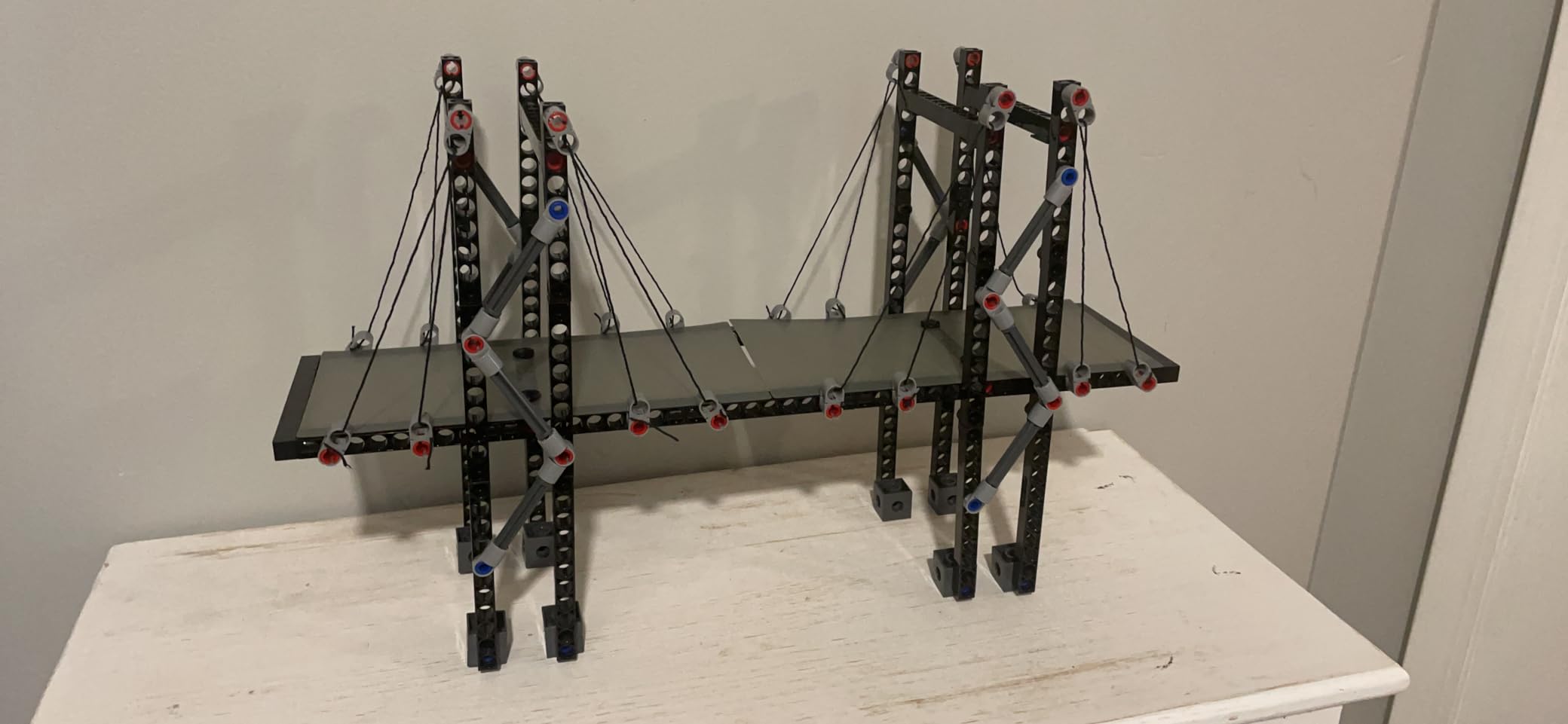
The subject here is structural engineering, and the model list is unusually well chosen. A house, a pyramid, a beam bridge, an arch bridge, a truss bridge, a cable-stayed bridge, and a suspension bridge each demonstrate a different way of carrying load.
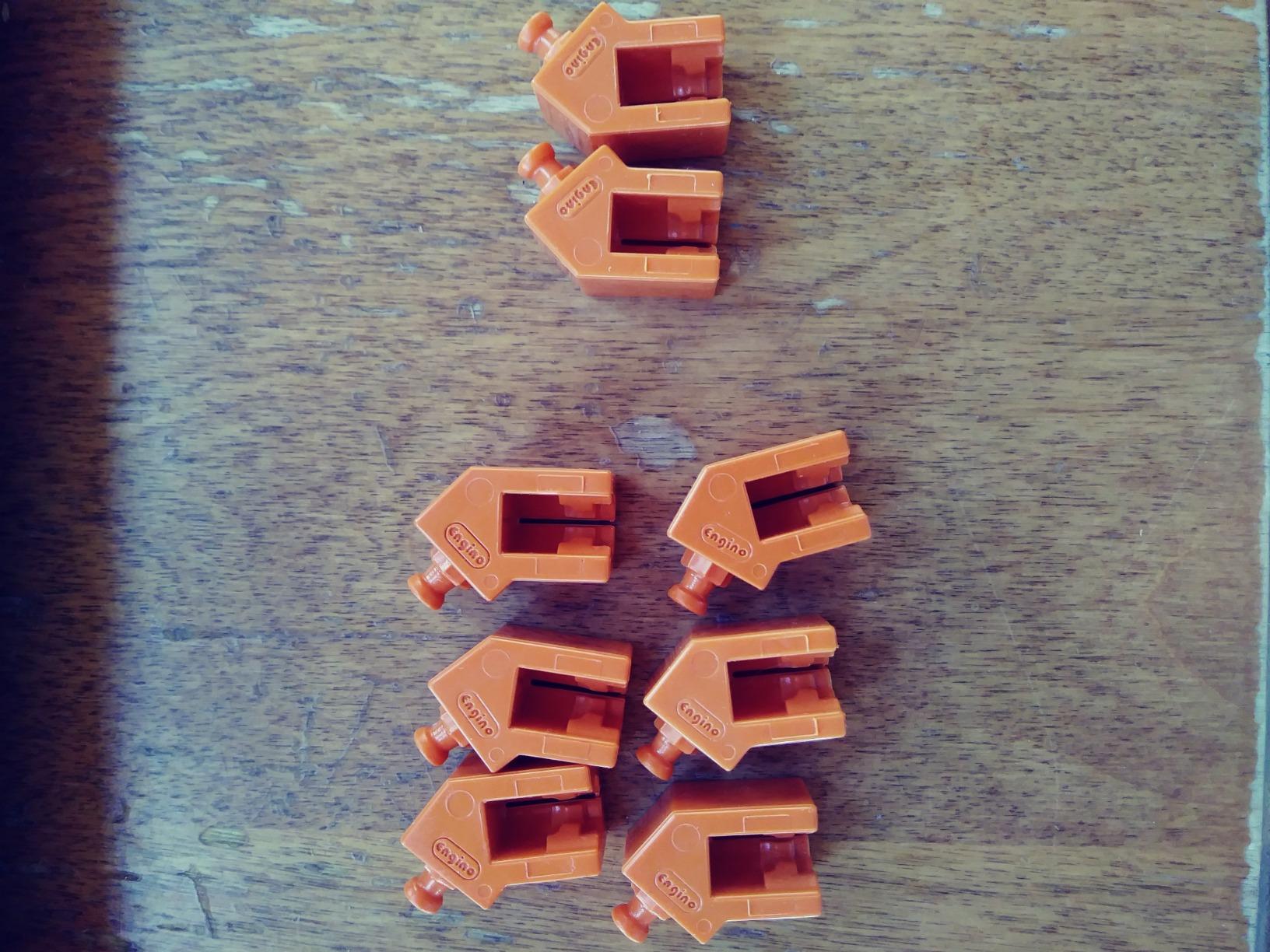
The patented snap-fit system connects in multiple directions, which is what makes the truss and suspension models possible. A single-axis system would not hold the geometry these structures need.
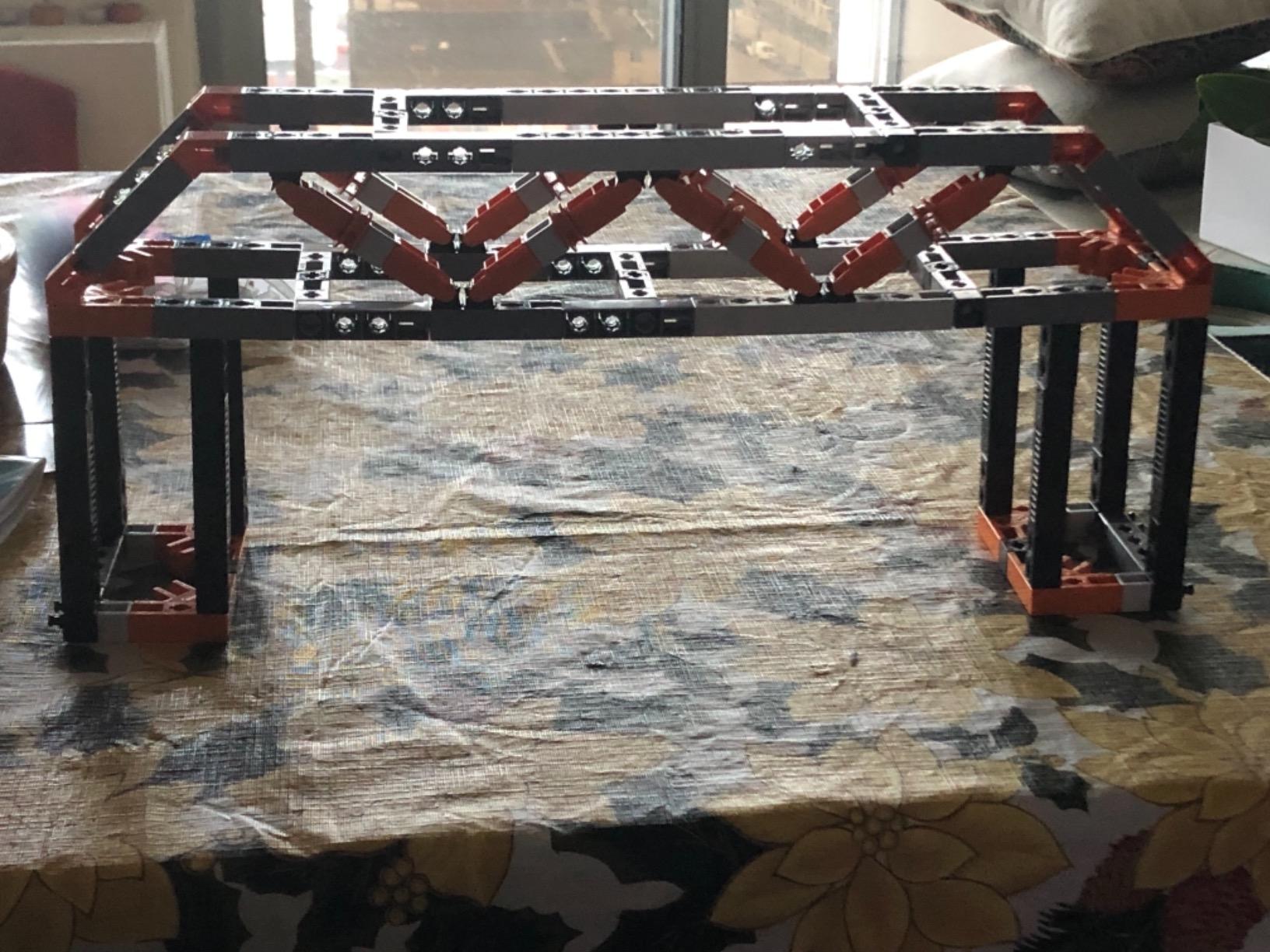
Ten pages of theory, facts, and experiments come with it, plus a three-page quiz book. For a homeschool setting, that written material is often the most valuable part, since it turns a building session into something with an assessment attached.
Our main frustration was documentation. Several reviews report that the cable and rope bridge instructions are unclear or incomplete, and the app becomes necessary for anything past the simplest models. We found the same gap during testing.
Who will get the most out of this kit
A teen who wants to understand why structures fail will love comparing the arch and truss models side by side. The kit is best treated as an experiment platform rather than a single model, and it rewards redesigning weak points with extra pieces.
It is also a good bridge between elementary snap-together kits and metal construction systems, which makes it a natural fit for a twelve or thirteen-year-old stepping up.
Who should skip this kit
Skip it if the household has no reliable tablet access, since the app drives the harder builds. Nine models also runs out quickly for a teen who builds fast and wants variety.
For older teens working toward real structural analysis, the theory pages are a good start but the model scale is closer to a classroom demonstration than to engineering practice.
5. Thames and Kosmos Structural Engineering – Bridges and Skyscrapers
Thames & Kosmos | Structural Engineering: Bridges & Skyscrapers | Science & Engineering Kit | Build 20 Models | Learn about Force, Load, Compression, Tension | Parents’ Choice Gold Award Winner, Blue
20 models
285+ interchangeable plastic pieces
36-page illustrated manual
Intermediate skill level
Pros
- 20 models each tied to a structural concept
- Heavily illustrated manual makes complex builds accessible
- Used in real physics and mechanics classes
- Sturdy enough to reuse across projects
Cons
- Some plastic joints crack after about a year of use
- Included yellow disassembly tool grips poorly
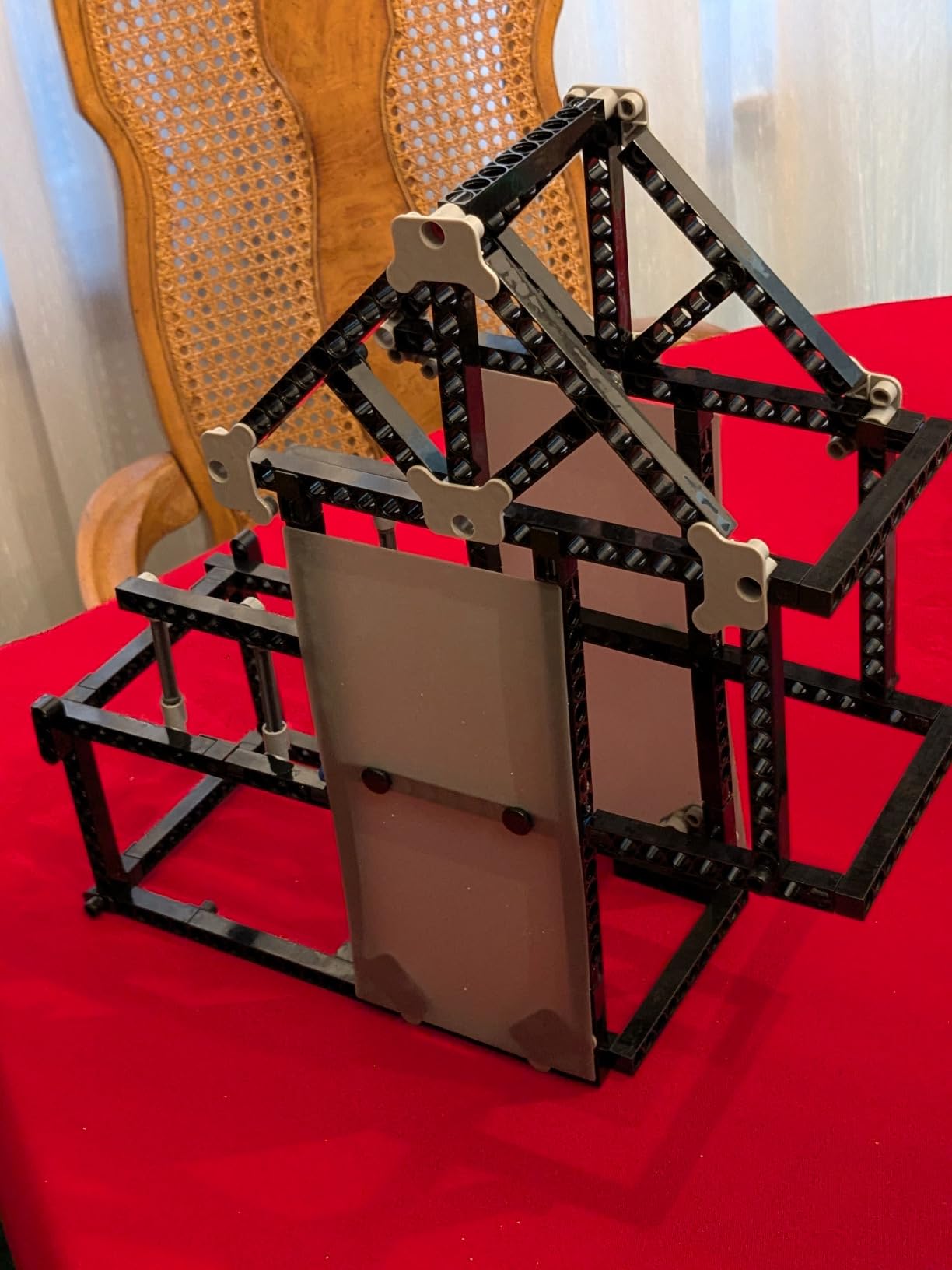
Twenty models is the largest set count on this list, and each one is chosen to demonstrate force, load, compression, or tension. That structure is why teachers keep ordering it. A class can move through the sequence over a term and cover a coherent unit on how loads travel through a structure.
The manual carries 36 pages of illustrated experiments and assembly guidance, and the illustration density is high enough that a teen can work through most builds without an adult reading every step aloud. Rated as an intermediate skill level, ages 8 to 14.
Durability was the one consistent complaint. A minority of reviews report plastic pieces and tight joints cracking after roughly a year of regular use, so a teen who treats the set as a permanent shelf piece may run into joint failure after the novelty passes.
The supplied yellow disassembly tool also gets criticism for grip. Bringing a separate flat-head screwdriver for stubborn joints is a small but real time saver during our sessions.
Who will get the most out of this kit
Teens who enjoy experiment logs and measurement respond well here. Adding weight to a model and watching which geometry holds is a genuine structural engineering exercise, and the twenty models give plenty of room to repeat it.
For homeschool families and co-ops, this is the one we would buy for two kids. The parts are reusable and the models can be rebuilt, and a 1-year warranty against manufacturer defects covers early failures.
Who should skip this kit
Skip it if durability under heavy handling matters. A teen who drops tools, builds fast, or treats the set as a construction yard rather than a model kit will stress the joints faster than the manual intends.
The age range tops out at 14, so a sixteen-year-old who has built metal sets before may find the challenge level thin. It pairs better as a first structural kit than as a primary one.
6. LEGO Technic Ferrari FXX K 42212 – Working Differential and V12
LEGO Technic Ferrari FXX K Toy Car – Building Toy for Girls & Boys, Ages 10+ – Cool Birthday Gift for Kids – Race Car Model for Play & Display – 42212
897 pieces
Working differential with moving pistons
Opening hood and butterfly doors
11 in long when complete
Pros
- Working differential with realistic piston movement
- 4.8 stars across 1012 reviews with 88 percent five-star
- LEGO Builder app gives 3D zoom and progress tracking
- Advanced build that still finishes within a few days
Cons
- Some subassemblies feel more fragile than other Technic models
- Single model with no alternate configurations
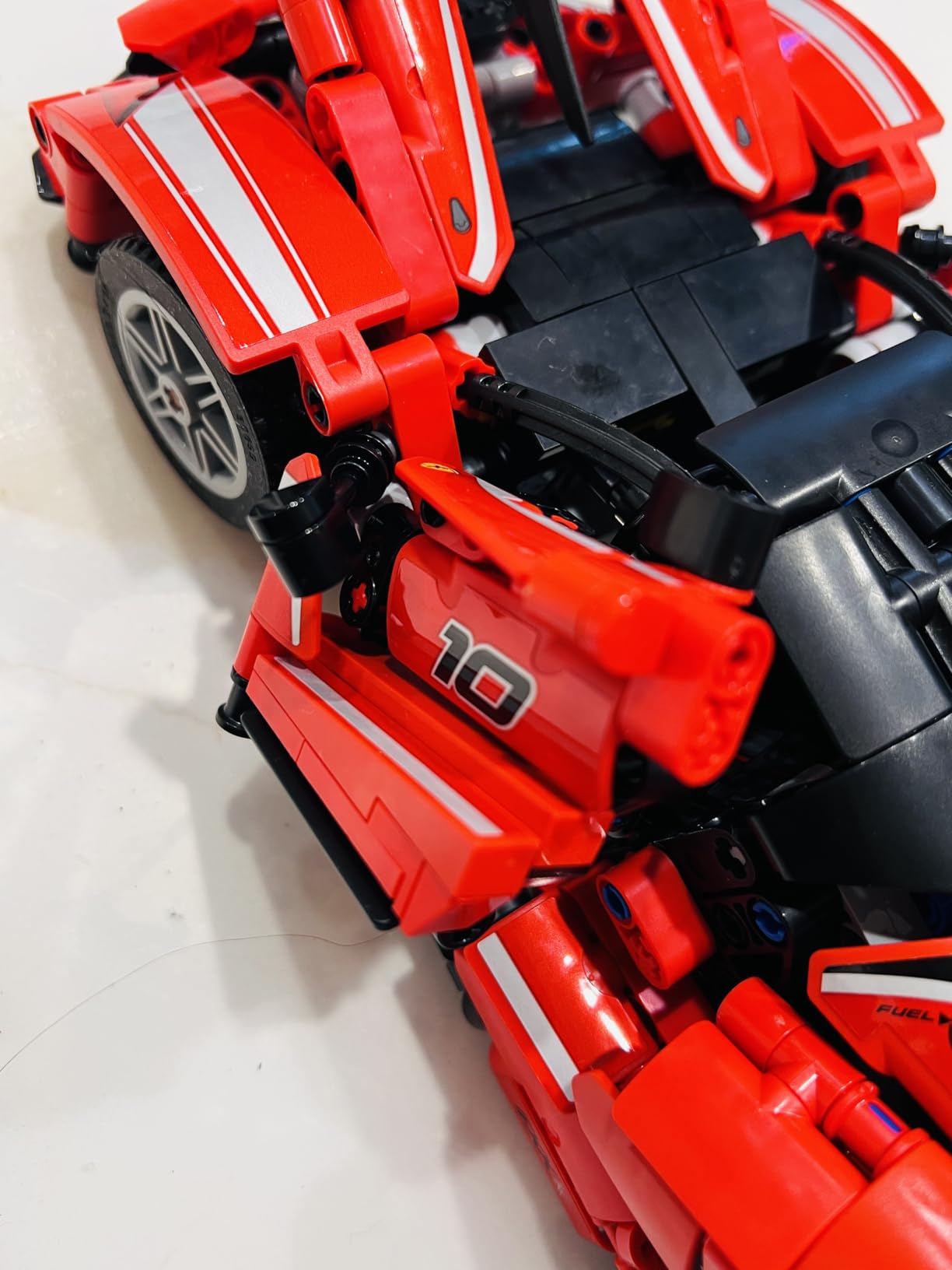
The mechanical centerpiece is the working differential with moving pistons, and it is the part teens point at first. Opening the hood exposes a detailed V12 engine, and the butterfly doors move on a working hinge mechanism rather than a decorative flap.
With 897 pieces, this is a serious build, but reviewers consistently report it finishing within a few days for a focused builder. The LEGO Builder app supports 3D zoom, rotation, and progress tracking, which helps when a step is genuinely hard to read on paper.
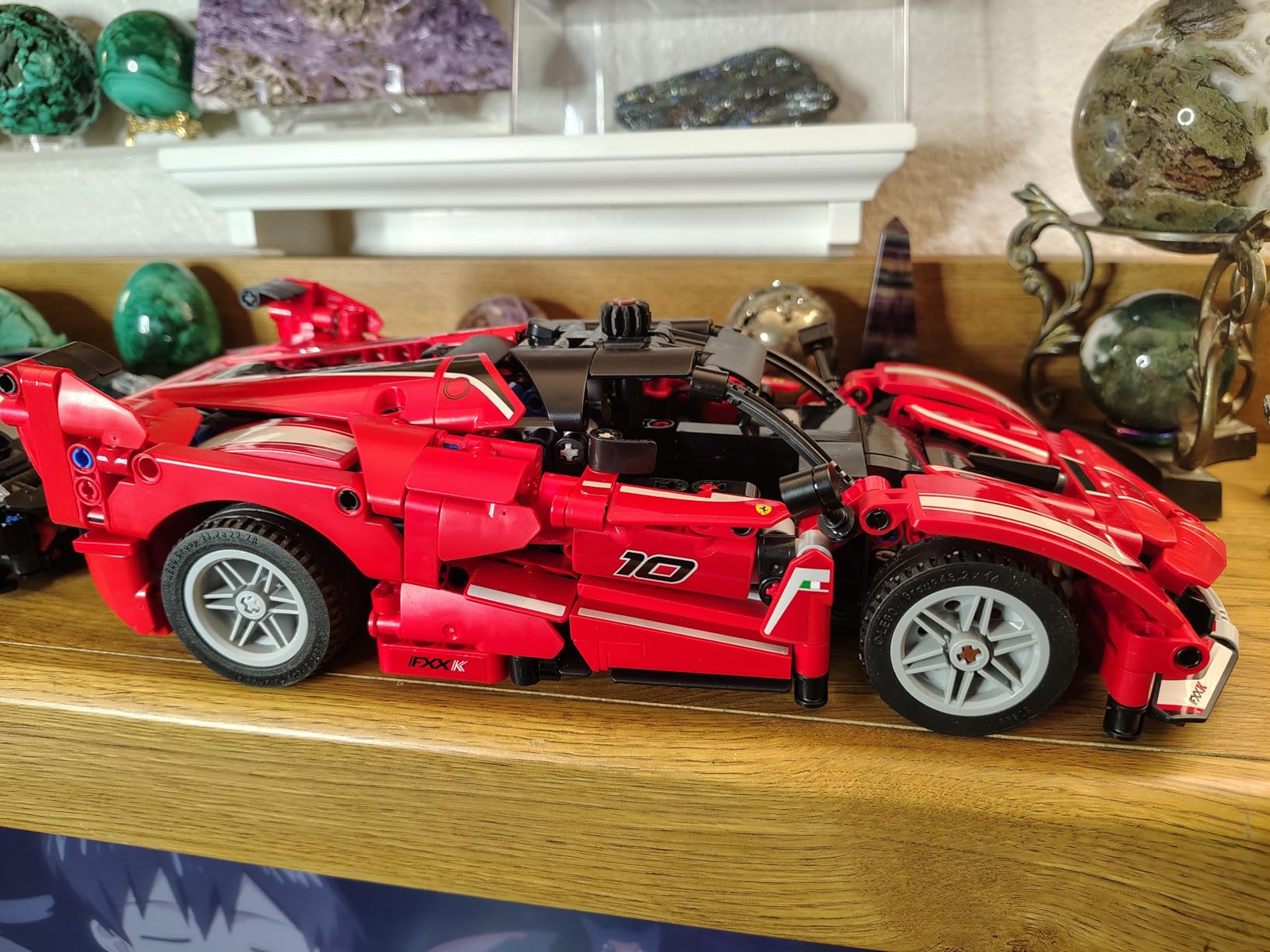
The completed model measures over 3 inches high, 11 inches long, and 4.5 inches wide, which is a slightly larger footprint than the Bugatti. The signature racing red finish makes it a strong display piece on a shelf.
Our testing turned up one recurring concern: some subassemblies feel more fragile than other Technic builds we have handled. Display first, drive it second, is the approach we would recommend.
Who will get the most out of this kit
Teens who care about how power moves through a drivetrain will find the differential fascinating. Watching pistons move while the wheels turn out to be the payoff moment for anyone curious about automotive engineering.
It also works for a parent and teen building together, since the piece count splits cleanly into front and rear subassemblies. Ages 10 and up per the manufacturer.
Who should skip this kit
Skip it if the teen wants programmable or sensor-driven behavior. This is a mechanical model, and while the app tracks progress, it does not drive the car.
Like the Bugatti, it is a single finished model. A teen who has already built several Technic cars will get more from a kit with multiple configurations or an electronics path.
7. Thames and Kosmos Roller Coaster Engingeering
Thames & Kosmos | Roller Coaster Engineering STEM Kit | Design, Build, Experiment w/ Working Models | Explore Physics, Forces, Motion, Energy, Velocity & More | Solve Building Challenges
Build and test working coasters
Hands-on physics experiments
Reusable plastic system
32-page full-color manual
Pros
- Teaches potential versus kinetic energy through direct testing
- Manual is clear enough for older kids to build unaided
- Adding coins to the carriage tests load capacity
- No batteries required
Cons
- Launch ramp and coaster car can crack after a few uses
- Pieces pop apart during assembly and need firm pressure
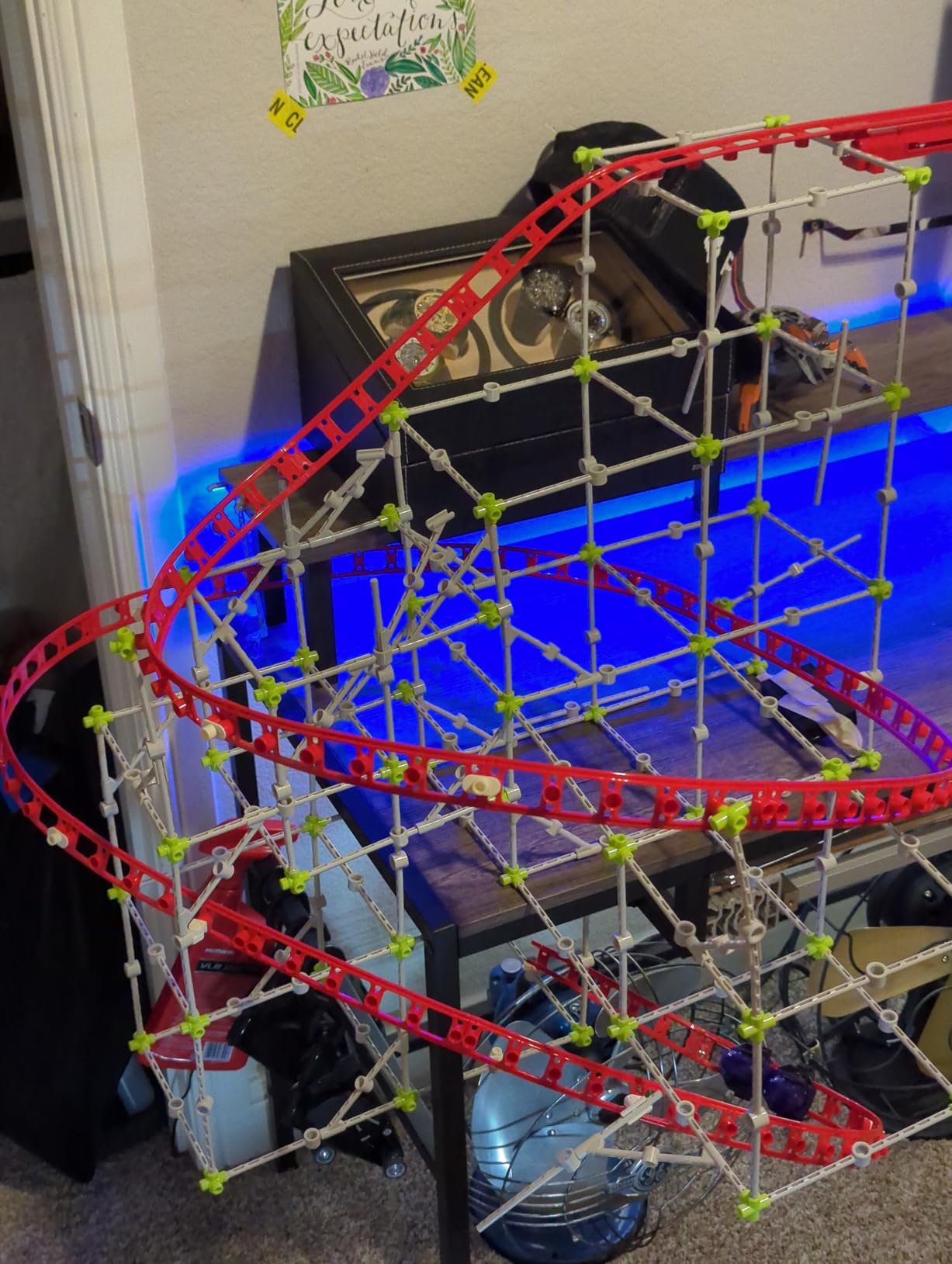
This kit turns a physics equation into a thing you can watch fail. Teens design a track, run a car down it, then change the drop height or the curve and see what happens to the speed at the bottom. That feedback loop is the entire appeal.
The 32-page full-color manual pairs step-by-step assembly with scientific explanations on force, motion, energy, and gravity. No batteries are required, and the manufacturer lists ages 6 to 18, which makes it flexible for mixed-age siblings.
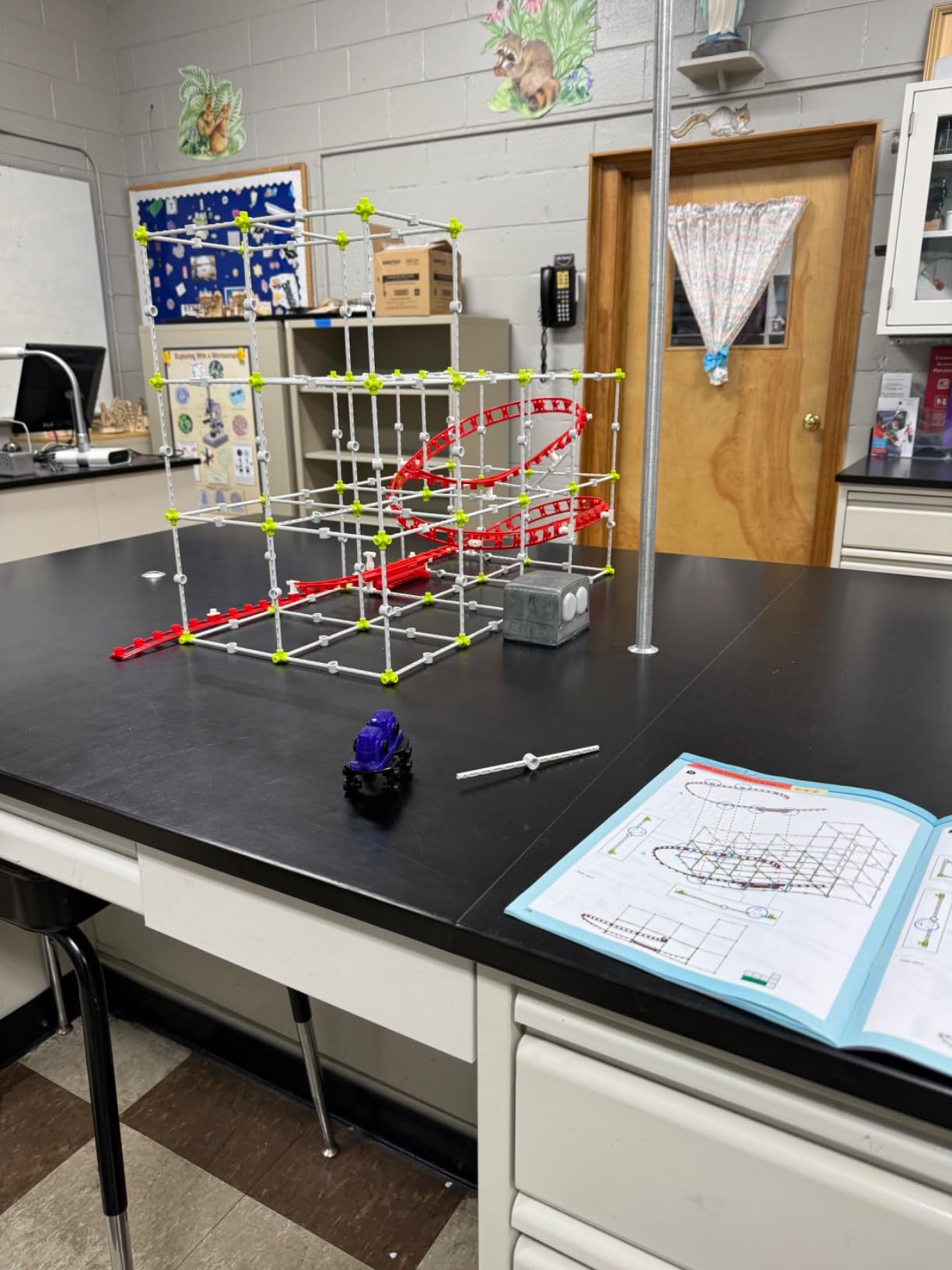
Durability is the weak point. Reviews flag that the launch ramp and coaster car can crack after only a few uses, and several mention pieces popping apart mid-assembly and needing firm pressure to refit. Budget for a replacement part if the car takes a fall.
Adding coins to the carriage to test how much load the structure carries is a natural extension. It converts a model into an experiment bench, which extends engagement well past the first build.
Who will get the most out of this kit
A teen who enjoys measuring and predicting is the ideal user. The potential versus kinetic energy lesson becomes memorable the first time a design fails at the loop and succeeds after a change in track shape.
It suits parent-teen building too, since the manual is readable by an eight-year-old with a teenager supervising. That makes it a good first engineering kit in a household.
Who should skip this kit
Skip it if the teen handles builds roughly. The car and ramp are the parts that break, and both take the full force of a launch. Fragile plastic does not survive a workbench culture.
There is no programming or electronics path, so a teen already writing code will not find a next step here beyond custom track designs.
8. BseSparklion V8 Engine Model Kit That Runs
BseSparklion V8 Engine Model Kit that Runs, Build Your Own Mini Visible Car Motor, Physical Science Experiment Building Set for Adults & Teens, STEM Toy Gift for Boys 14+ (703 PCS)
703 pieces
Transparent cylinder heads
USB powered motor
No batteries required
Pros
- Working model that visibly shows how a V8 cycles
- Turbocharger detail and compact V8 layout
- USB power avoids battery running costs
- ASTM and CPSIA tested ABS material
Cons
- 703 unlabeled pieces and weak instructions cause mis-assembly
- Feels more like construction than a precise engine model
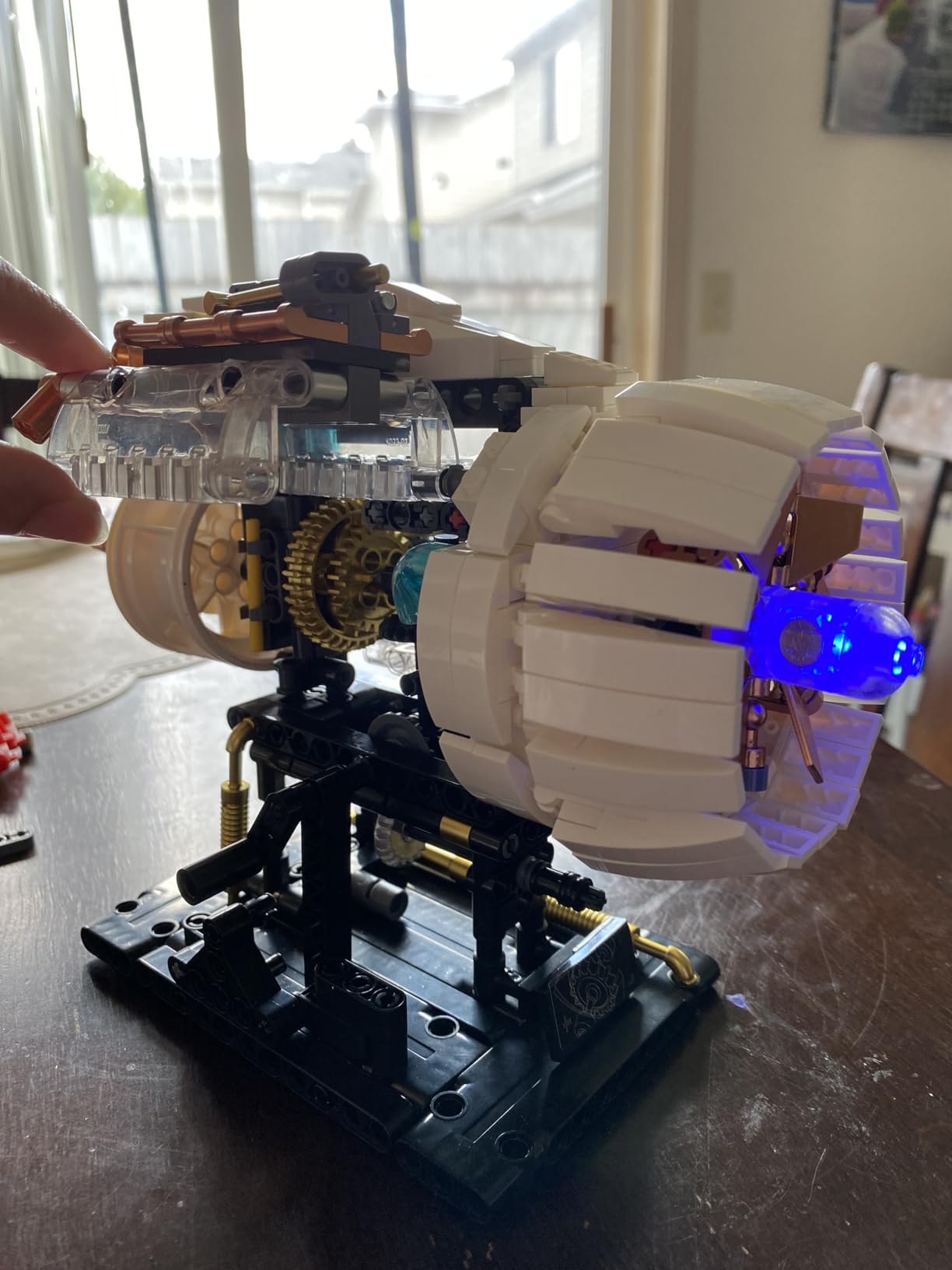
Teen car fans tend to have a very specific question about engines, and this kit answers it visually. The transparent cylinder heads let you watch simulated piston movement, and the included motor is driven by a USB charging cable rather than batteries.
At 703 pieces it is a full day of work, and reviews frequently describe around a day of build time. The turbocharger detail and compact V8 layout give the finished model presence on a desk, and the ABS material is tested to ASTM and CPSIA standards.
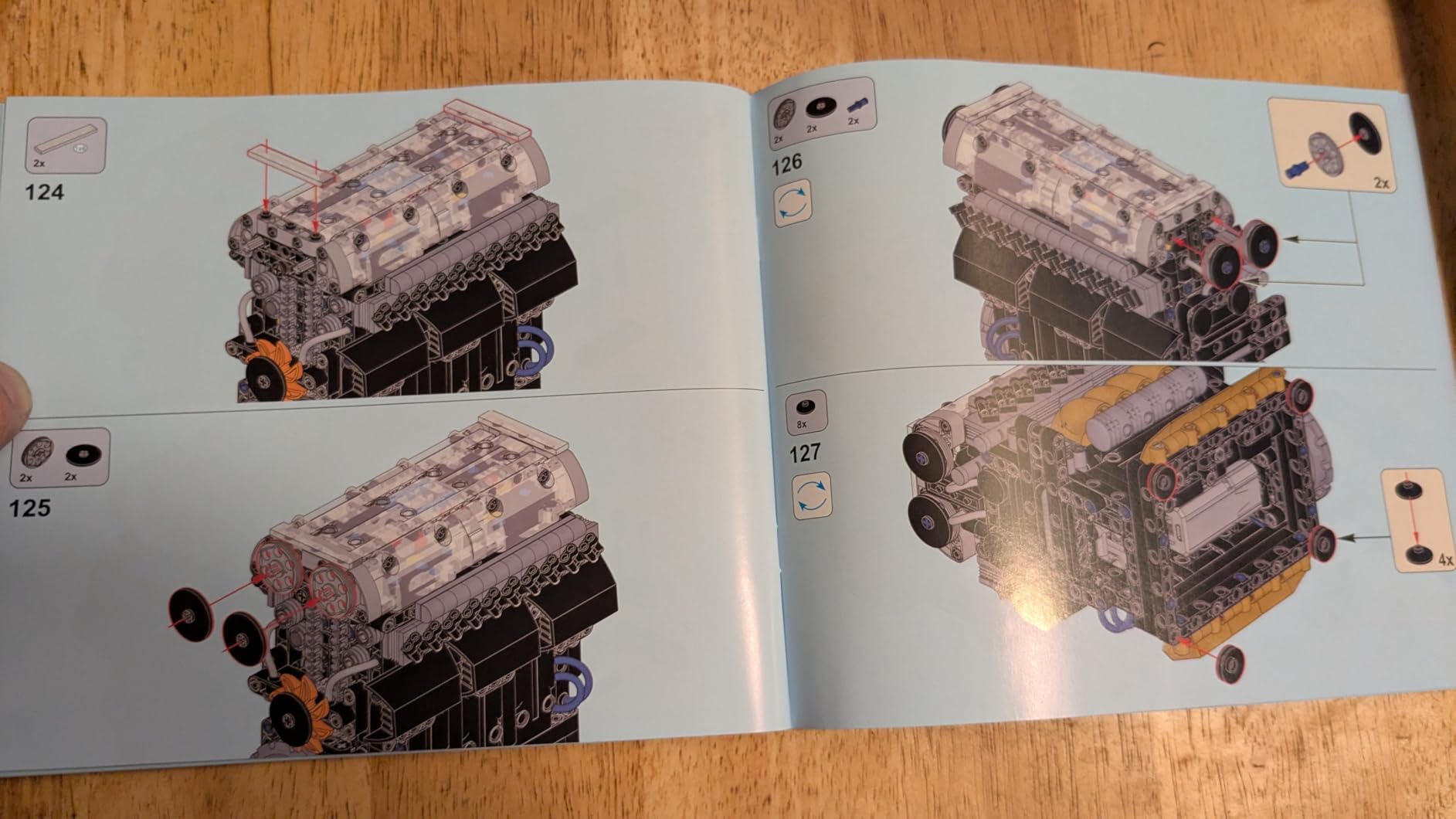
The build experience is where opinions split. The most common complaint is that the pieces are unlabeled and several share similar colors with slightly different shapes, which causes mis-assembly and rework for builders who are otherwise experienced.
It also feels more like construction than a precision part-by-part engine model, which sets expectations for anyone used to kits with sorted trays. Budget extra sorting time before starting.
Who will get the most out of this kit
This is a strong gift for a teen already following motorsport or working on cars. The working model gives them a talking point, and the running motor turns an assembly job into something they demonstrate to friends.
USB power is a real quality-of-life win over AA batteries, which is one of the most common complaints we saw in forum threads about kits in this category. Ages 14 and up per the manufacturer.
Who should skip this kit
Skip it if the teen is impatient. Sorting 703 unlabeled pieces before a single part goes together is the part of this build most likely to end the session early.
It is also a single model with a fixed outcome, so once the motor runs there is little left to experiment with. Teens who want to keep modifying hardware will outgrow it faster than they will outgrow a multi-build set.
9. 194-Piece Metal Engineering Building Kit
Jixin Xyzhi Buildable 3D Metal Engineering Kit 194-Piece STEM Set for Ages 8-16 Develops Logic Skills DIY Project Ideal Gift for Kids (Blue)
194 metal components
2 mechanical designs
Includes screwdriver and wrench
No power source required
Pros
- Metal components at an accessible price point
- Tool kit included so nothing extra is needed to finish
- Older kids complete it in roughly an hour or two
- Solid mini-meccano style exercise in spatial reasoning
Cons
- Finished model is very small and disappointed some buyers
- Two designs means limited replay value
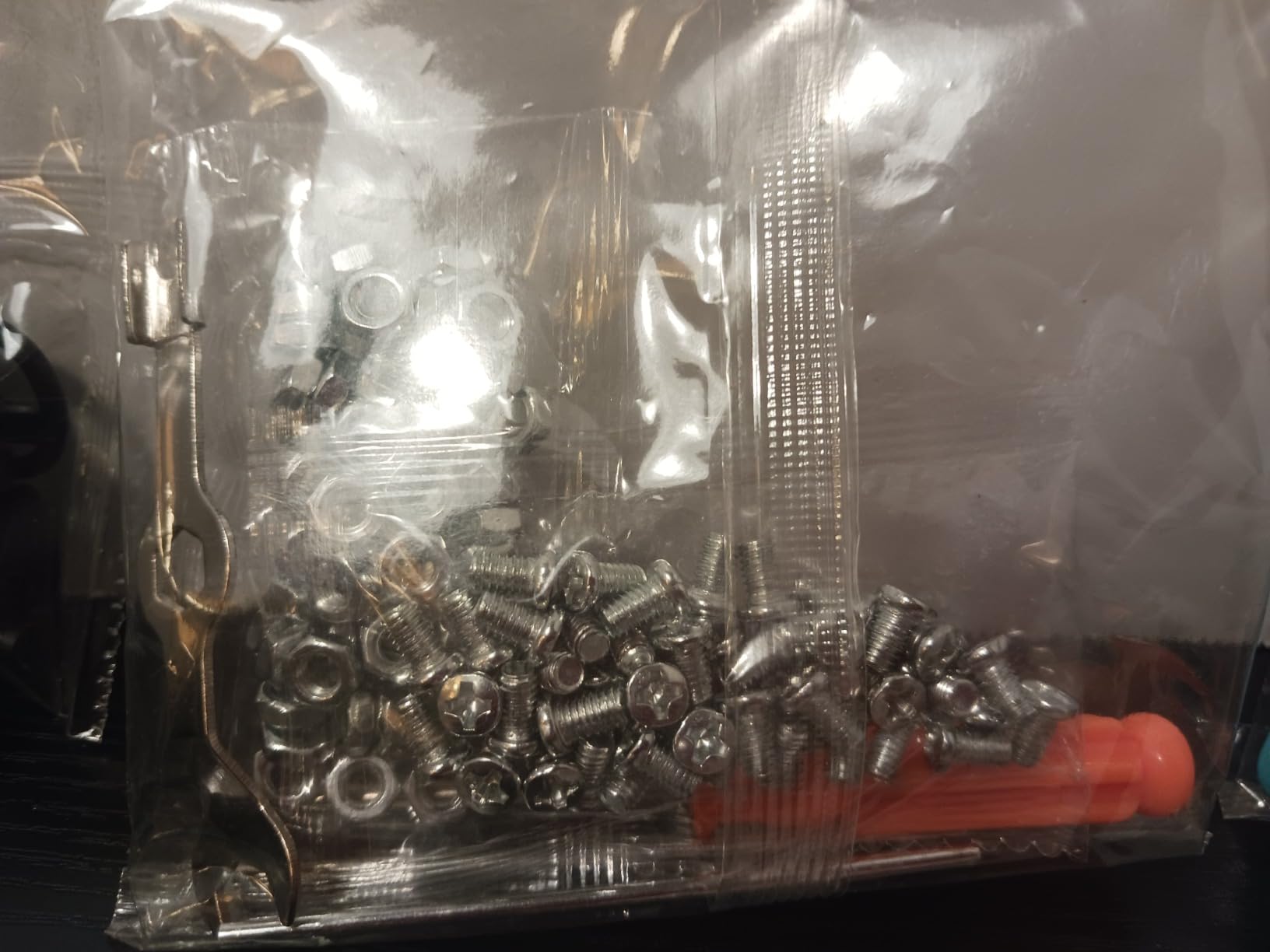
This is the entry point for a teen who has never used a metal construction system. The 194 precision-engineered components fasten with real hardware, and the box includes a small screwdriver and a small wrench so the build can start immediately.
It assembles quickly. Reviewers put the build at roughly an hour or two for older kids, which makes it the one kit on this list a teen can finish in a single sitting and still feel the accomplishment.
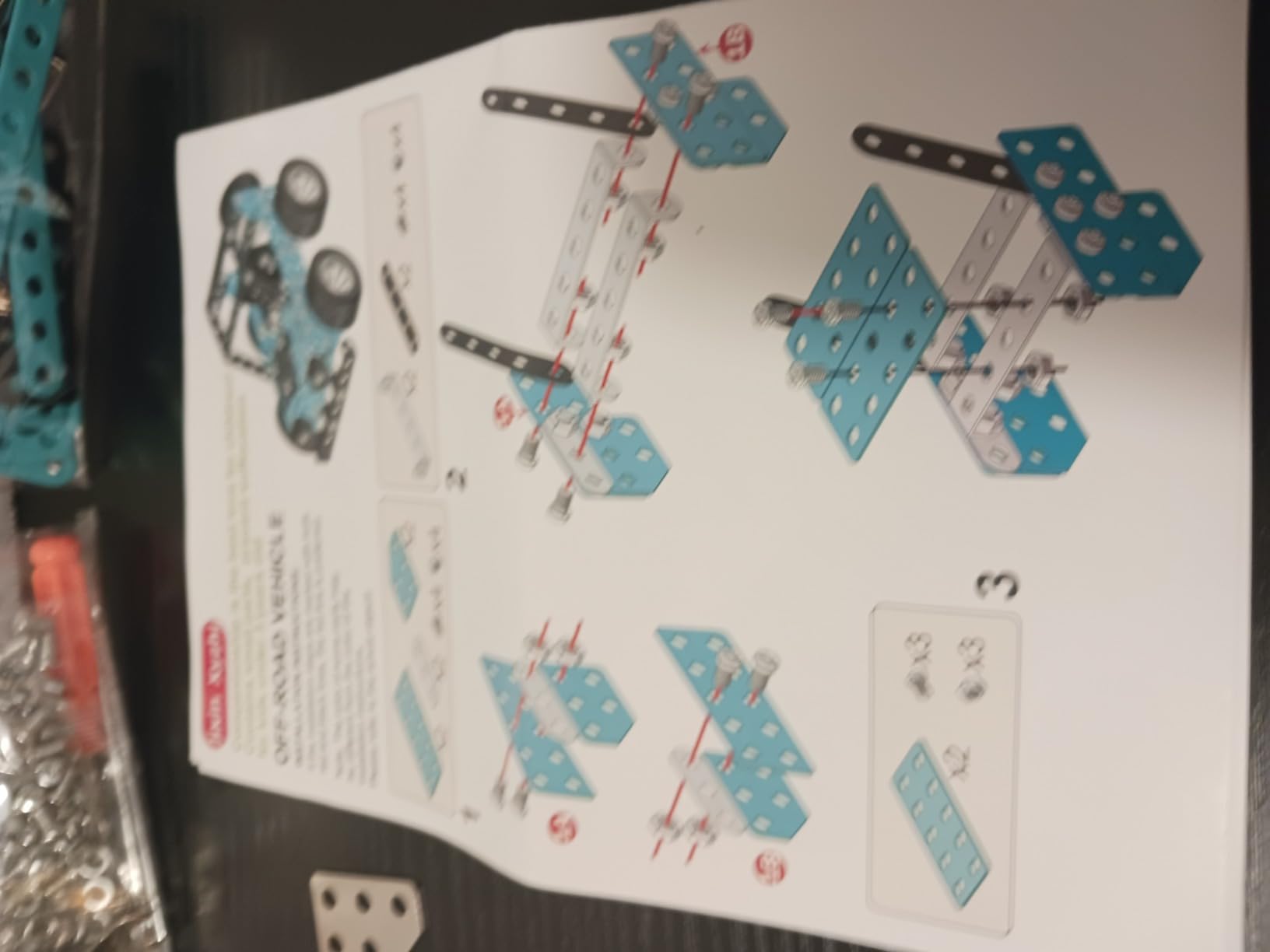
The limitation is scale. Buyers who expected a substantial model report being disappointed by the small finished size, and some returned it for that reason. Know the dimensions before buying: 4.92 by 3.74 by 3.15 inches for the whole kit.
It builds two mechanical designs, one at a time, with no power source required. That makes it a quiet, focused activity rather than something that draws an audience.
Who will get the most out of this kit
A thirteen or fourteen-year-old who has outgrown plastic snap-together kits but is not ready for a multi-week project. The short build gives a fast first win, which is the single best predictor that a teen will come back for a bigger kit.
For a family testing whether metal construction holds interest before investing in a larger system, this is a sensible trial purchase.
Who should skip this kit
Skip it if the teen wants a display model or a long project. Two designs and a small footprint mean the kit is finished before the novelty of metal parts wears off.
Teens who already build with a metal system will not find enough here. Treat it as a stepping stone, not a destination.
10. MALUVRIAN 389-Piece Metal Erector Set
MALUVRIAN Erector Set for Boys & Girls – Metal Model Kits for Adults, Teens & Advanced Kids – Stem Toys – Build A Robot or Excavator – Educational & Engineering Toys – Building Kit | 389 pcs
389 pieces
Build a robot or an excavator
Bolts and nuts require fine motor skills
Marketed for teens and adults
Pros
- Genuinely challenging build for experienced teens and adults
- Uses almost all metal parts for each finished model
- Displayable result that looks like a real machine
- Good for building with a younger sibling
Cons
- Some sets reported missing parts and poorly stamped holes
- Part of the pieces are not metal and are not fully Meccano compatible
Difficulty is the selling point here. Bolting and nutting 389 pieces in tight spaces demands fine motor control and a steady sorting system, and reviewers describe it as engaging for advanced kids and adults rather than for younger children.
Each model, a robot or an excavator, uses almost all the metal parts, so the finished result has real visual mass. At 9.37 by 6.81 by 1.77 inches the kit is compact enough to live in a drawer but substantial enough to sit on a desk.
Quality control is uneven between production batches. Reviews report missing parts and poorly stamped holes that need reaming, so checking the inventory against the instructions before starting saves an evening.
One recurring complaint: a portion of the pieces are not metal and are not fully compatible with Meccano parts. If a teen plans to combine this with a metal system they already own, test a joint fit first.
Who will get the most out of this kit
This suits a teen who finds plastic kits trivial and wants a build that resists them. Several reviews mention it holding the attention of both younger and older family members for about an hour a day across a week.
It also works well as a shared build, since sorting pieces and holding the frame while bolts go in is naturally a two-person job.
Who should skip this kit
Skip it if your priority is a reliable, complete set. The missing-part reports and the mixed material issue are more common here than with the larger branded systems on this list.
Teens who get frustrated by reaming holes or hunting for a replacement bolt will not enjoy it. Check the parts list against the manual on day one and keep spare hardware nearby.
11. Thames and Kosmos Architectural Engineering
Thames & Kosmos Architectural Engineering | Science Experiment & Model Building Kit | Build 26 Models of Structures & Structural Elements | A Parents’ Choice Gold Award Winner 14.6 Inches
26 models of structures
Steel-look flexible plastic pieces
44-page manual with design prompts
Parts compatible with other Thames and Kosmos kits
Pros
- Progresses from trusses and arches to scaled real buildings
- Flexible parts mimic steel frames and hold up to remodelling
- Cross-compatible with other Thames and Kosmos engineering kits
- Open-ended design prompts in the 44-page manual
Cons
- Part count supports roughly one large structure at a time
- Packaging suggests metal parts but the pieces are plastic
The progression is what separates this from a generic bridge kit. It starts with basic trusses, arches, and domes, then moves to scaled-down versions of real-world buildings, so a teen follows the same order an architect would follow from simple members to a full elevation.
The flexible building pieces mimic steel frames, which lets them bend slightly rather than snapping under load. All parts are compatible with other Thames and Kosmos engineering and physics kits, so a household that already owns the Structural Engineering or Roller Coaster set can combine inventories.

One expectation to correct before buying: the part count supports roughly one large structure at a time, not twenty-six models kept standing simultaneously. Reviewers consistently note that the marketing implies more simultaneous build capacity than the pieces allow.
Packaging imagery suggests metal parts, but the components are plastic. It holds up well despite that, and a 1-year warranty covers manufacturer defects. No batteries required, and the manual runs 44 pages in full color.
Who will get the most out of this kit
Teens who draw buildings, watch construction documentaries, or want to explore architecture rather than machinery are the natural fit. The open-ended design prompts let them start from the manual and then diverge on their own.
It is also a strong classroom and homeschool set, since the same pieces can be rebuilt repeatedly across a term. Popular with builders aged 8 to 12, but older teens who enjoy design work keep going with it.
Who should skip this kit
Skip it if the teen wants electronics, mechanics, or a finished collectible. Everything here is a structure, and the reward is the design process rather than a working machine.
If you are hoping to display twenty-six completed buildings at once, plan for a second set or accept that the kit will be rebuilt rather than accumulated.
12. Nifeliz Turbofan Engine – 2216-Piece Working Model
Nifeliz Turbofan Building Set, Engines Series, NF10317
2216 pieces in numbered bags
Hand-cranked dual-direction motion
Semi-exposed gear train
4 storage boxes included
Pros
- Every gear
- shaft
- and joint is engineered to move
- Semi-exposed design shows the working gear train
- Numbered bags and 4 storage boxes make a long build manageable
- Metallic painted parts give an authentic engineered look
Cons
- High complexity means a long patience-heavy assembly
- One-star reviews at 7 percent reflect the difficulty and cost
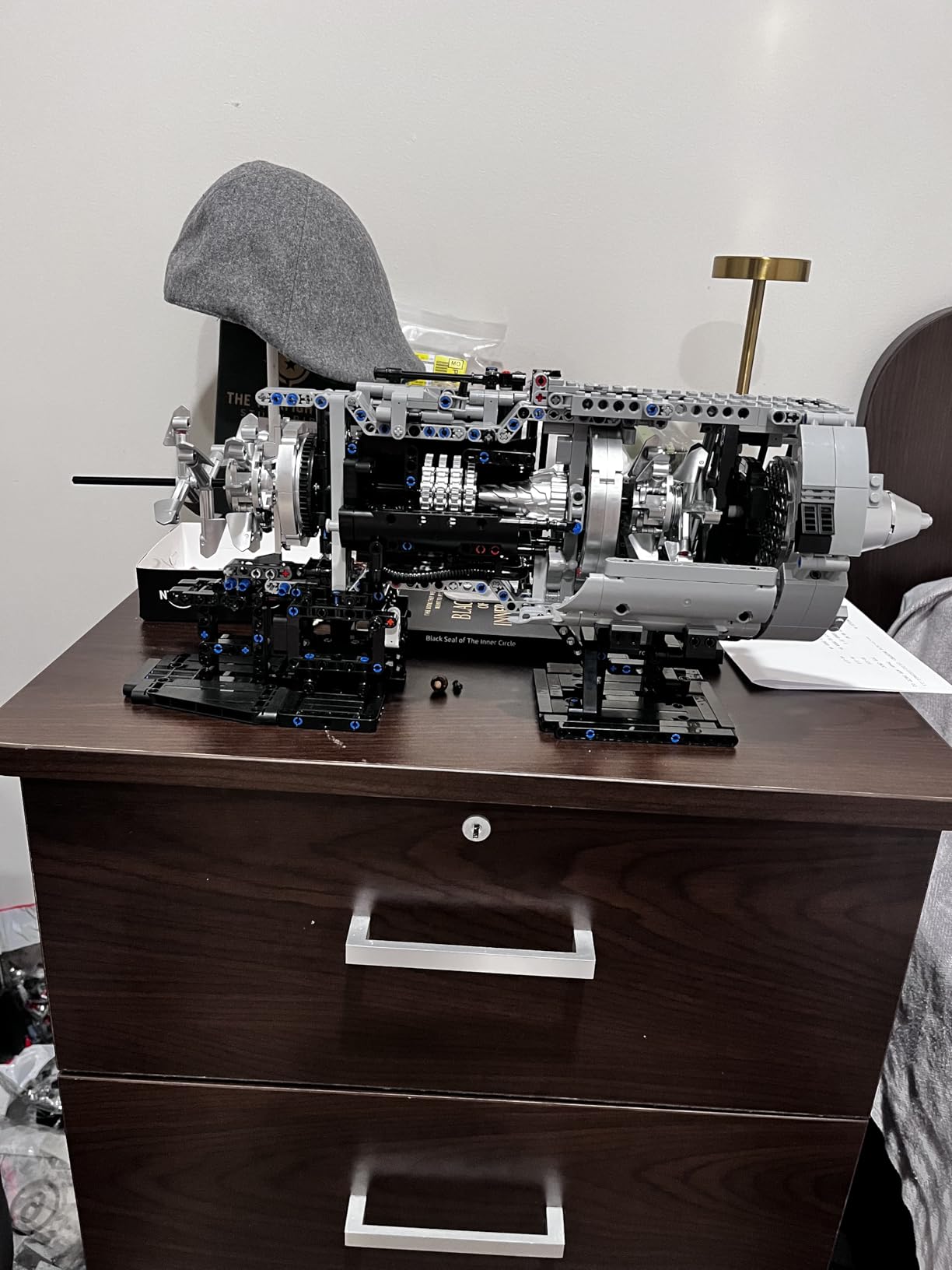
At 2,216 pieces, this is the largest build in the group and the only one that models an entire gas turbine rather than a single mechanism. The semi-exposed design leaves the gear train visible, so turning the crank shows the linked parts moving in different directions and at different speeds.
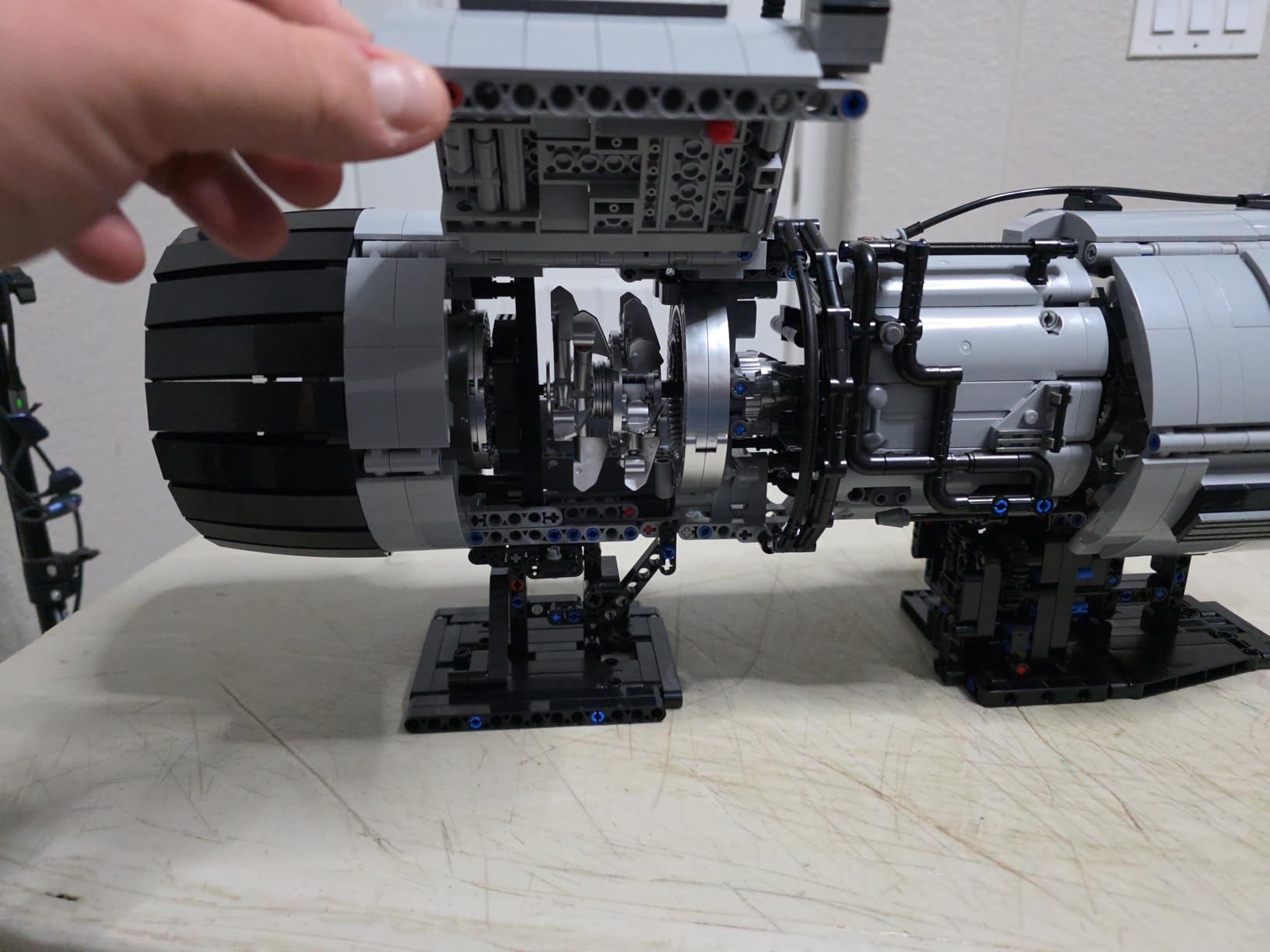
The kit targets teens and adults, and the 3.53 kg weight and 19.69-inch length mean it is a display piece rather than a portable model. Storage is handled properly: parts arrive in numbered bags and four storage boxes are included, which is the difference between an organized build and a lost afternoon.
Reviewers rate the mechanical execution highly, calling it a true working mechanism rather than a static model. They also flag the difficulty honestly, with one-star reviews sitting at 7 percent because the assembly is long and the finished result can disappoint at this cost.
There is no battery and no motor. Power comes entirely from the hand crank, which means it works indefinitely and never needs charging, but it also means the motion speed is set by the builder.
Who will get the most out of this kit
This is the one to buy for a teen who is genuinely into mechanical engineering and willing to commit. The payoff is a display-grade model where every joint was designed to move, which is a different experience from a kit built to be posed.
It also makes a strong father-son or parent-teen project given the patience required. Sorting 2,216 pieces into labeled bags is itself a lesson in inventory management, and the included boxes prevent the build from stalling.
Who should skip this kit
Skip it for a teen who abandons long builds. A project this size needs a plan, a dedicated surface, and several sessions, and there is no partial version to enjoy along the way.
It is also the second most expensive kit here, so it only makes sense when the finished display model is the goal rather than a stepping stone to something else.
How to Choose an Engineering Building Set for Teens
The single biggest mistake is filtering by age label. Most kits on the shelf are marked for eight-year-olds even when a fifteen-year-old would get more from them, and the number printed on the box tells you about the smallest intended user, not the ceiling. Filter by the concept taught and the build length instead.
1. Match the kit to a specific engineering discipline
Structural kits such as the Engino bridges set, the Thames and Kosmos Structural Engineering set, and the Architectural Engineering set teach load paths, tension, and compression. Mechanical kits such as the Hydrobot Arm, the Nifeliz turbofan, and the V8 engine model teach force transfer and gear ratios. A teen who gravitates toward one subject will ignore the other ten options on the shelf.
Ask a simple question first: does the teen want to know why a bridge stands up, or how a machine moves? That answer narrows twelve products to three or four.
2. Check replay value before anything else
Kits abandoned after a single build were the most common complaint we found across forum discussions, and it is the most common reason a set ends up unused within a month. Multi-build systems such as the MECCANO Erector set with 25 models or the Engino set with nine structures keep the parts in rotation for far longer.
A useful rule: if a kit has fewer than five configurations, treat it as a display piece and accept that the interest will fade once it is complete.
3. Decide between block coding and text coding early
Block coding is drag-and-drop programming where blocks snap together like puzzle pieces. A teen can build working logic without typing syntax, which removes the barrier to programming logic itself. Text coding in Python or C requires typing but scales to real projects, robotics platforms, and eventually college coursework.
The practical advice is to match the current skill, not the aspiration. A teen with no coding experience will get more from learning control logic on a block-based system, and a teen already writing Python will find block-based kits boring within a week. None of the twelve kits here require coding, which is worth weighing honestly if the goal is a software pathway.
If the eventual target is text-based programming, it helps to build the physical intuition first, then move to a microcontroller platform. Skills transfer from gear ratios to PID control far more smoothly than the reverse.
4. Budget for parts, storage, and consumables
Large kits need a place to live. The Nifeliz turbofan includes four storage boxes, the MECCANO set includes a compartmented carrying case, and smaller kits with hundreds of loose pieces need a tray at minimum. A teen who cannot put the parts back in order will stop building long before the kit runs out of models.
Also check the power source. Kits that need AA batteries carry an ongoing cost and a supply problem, while USB power and hand-crank mechanisms avoid both. The V8 model kit and the turbofan both skip batteries entirely.
5. Be honest about adult supervision
Younger teens, roughly twelve to fourteen, benefit from a first session alongside an adult to catch misaligned pieces early. Older teens generally do not, and the documentation quality matters more than the difficulty. Kits with heavy illustrated manuals, such as the 36-page Structural Engineering guide, let a teen work independently; kits that depend on an app for the harder models need a device nearby.
Missing pieces were a recurring complaint across reviews, so open the box and verify the inventory against the manual before the first build starts. It takes ten minutes and saves an evening.
6. Consider which engineering path interests the teen
For civil and structural interest, start with bridge and architecture kits where loads are visible. For mechanical interest, a geared or hydraulic model shows motion transfer in a way that plastic snap-together kits cannot. For electrical and software interest, none of these twelve will be enough, and a microcontroller platform is the honest next purchase rather than another construction set.
A teen exploring engineering careers benefits more from depth in one discipline for a few months than from a broad survey of all of them. Pick one, go deep, then rotate.
Our other guides cover adjacent ground for a household building a full setup, including the basics of prompt engineering once a teen starts programming rather than building, and a plain-language explanation of what social engineering means for families worried about the online side of a hobby that now often includes documentation downloads and app logins.
Frequently Asked Questions
What is a good engineering gift for a teenager?
The LEGO Technic Bugatti Bolide 42151 is the strongest all-round gift: 905 pieces, a working W16 engine, working steering, and scissor doors, rated 4.8 stars across 4278 reviews. For a gift under a smaller budget, the Engino structures kit covers nine bridge and structure models with a theory booklet. For a teen who wants a motor that actually runs, the BseSparklion V8 engine model uses USB power and no batteries.
What are some good building kits for teenagers?
Pick by discipline. Structural interest suits the Engino bridges set or Thames and Kosmos Structural Engineering. Mechanical interest suits the Teach Tech Hydrobot Arm for hydraulics or the Nifeliz turbofan for gearing. Automotive interest suits the LEGO Technic Bugatti and Ferrari sets or the V8 engine model. Metal construction fans respond best to the MECCANO Erector 25-in-1 set, which supports 25 models from 638 metal pieces.
What are some good kits for engineering students?
For high school and early college students, prioritize systems with reusable parts and written theory rather than single models. The Thames and Kosmos Structural Engineering set pairs 20 models with a 36-page experiment manual and is used in real physics classes. The Architectural Engineering set adds 44 pages of design prompts and cross-kit compatibility for building a larger library over a term.
Which engineering kit is best for a beginner teenager?
Start with something that finishes. The 194-piece metal engineering kit assembles in roughly an hour or two for older kids and includes the screwdriver and wrench needed, which gives a fast first win. From there, the Engino bridges kit and the Thames and Kosmos Roller Coaster set build replayability with multiple models and experiments before moving to a large project like the Nifeliz turbofan.
Are these kits good for reducing screen time?
Most of them are fully screen-free. The Teach Tech Hydrobot Arm, the Engino bridges set, both Thames and Kosmos structural kits, the Roller Coaster set, the metal engineering kit, and the Nifeliz turbofan all run without an app or electronics. A few rely on a companion app for instructions, so check whether a device is needed before buying for a teen whose screen time you are actively managing.
Are metal or plastic building sets better for teens?
Metal lasts longer and teaches structural thinking, because joints depend on arrangement rather than clip strength. The MECCANO Erector set uses 638 metal pieces and real tools, and the Nifeliz turbofan uses 2,216 ABS pieces designed so every gear and shaft moves. Plastic systems like the Engino and Thames and Kosmos sets are easier to assemble quickly and often include more written theory material to offset the lower durability.
The Best Engineering Building Sets for Teens, Final Word
After twelve builds, the winners separate cleanly by what a teen wants out of the experience. The LEGO Technic Bugatti Bolide 42151 takes the top spot for mechanical function and finish quality, the Teach Tech Hydrobot Arm is the best value for teaching real hydraulics with no electronics, and the MECCANO Erector Super Construction set is the pick when replay value across many builds matters most.
For structure and theory, the Engino and Thames and Kosmos kits carry the field. For a teen ready for a serious long-term project, the Nifeliz turbofan offers 2,216 pieces and a working gear train, provided the patience is there.
The most useful advice from parents in forum discussions is to start with something that finishes in a weekend, then move bigger. A teen who completes one kit will ask for the next one, and that request is the only reliable signal worth waiting for.
These are our picks for the best engineering building sets for teens in 2026, and every kit above has been chosen for the concept it teaches, the parts it holds, and whether a teenager would still want it on the desk a month from now.