
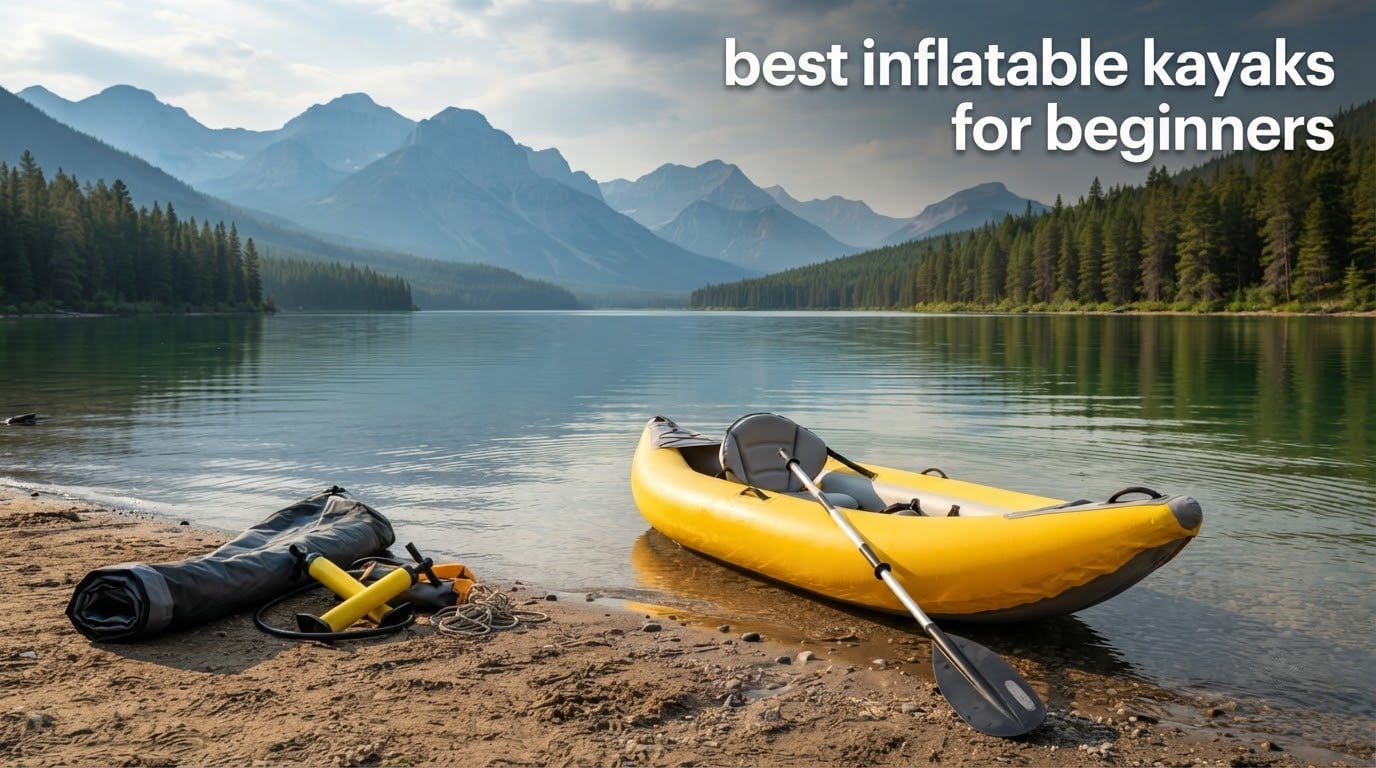
Are inflatable kayaks worth buying? Yes, for most first-time paddlers. An inflatable kayak deflates into a duffel you can store in an apartment or an RV, costs far less than a hard shell plus roof rack, and its wide hull is harder to tip than a narrow fiberglass boat. The trade-off is slower tracking and less speed on open water.
That last paragraph is the honest version of the pitch. If your goal is covering distance fast on a lake, a rigid boat wins. If your goal is getting on the water from a small parking lot, a hotel room, or a trailhead without a roof rack, the best inflatable kayaks for beginners are the smarter buy.
We reviewed and compared ten of the most-widely-sold inflatable kayaks for 2026, reading the spec sheets, the customer review patterns, and what owners actually say after a season or two of use. Ten boats is more than any editorial roundup on this topic currently covers, because they split cleanly into solo, tandem, fishing, portage, and long-trip use cases that a shorter list would blur together.
Three questions decide almost everything: are you paddling solo or tandem, calm lakes or moving water, and solo or with a partner in the boat. Get those answers first and the rest of this guide narrows to two or three models.
One more note before we start. Nothing here replaces a hands-on paddling lesson or advice from a club or outfitter near you. Inflatable boats are forgiving, not foolproof, and water temperature matters more than most first-time buyers expect.
Table of Contents
Top 3 Best Inflatable Kayaks for Beginners (2026)
The three picks below cover the widest range of beginner situations: an easy all-rounder, the lowest-cost credible starter, and the lightest boat you can carry to a remote launch.
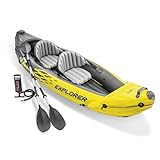
Intex Explorer K2
- Two-person 400 lb capacity
- 35 lb packed weight
- Inflates in 5 to 10 minutes

Quick Comparison of All 10 Inflatable Kayaks (October 2026)
Every boat below is in the same table so you can compare the numbers that actually change the experience: seating, load rating, packed weight, hull width, and warranty.
| Product | Specifications | Action |
|---|---|---|
| Intex Explorer K2 Inflatable Kayak Set |
|
Check Latest Price |
| Intex Challenger K1 Inflatable Kayak |
|
Check Latest Price |
 Sevylor QuickPak K1 Inflatable Kayak Sevylor QuickPak K1 Inflatable Kayak |
|
Check Latest Price |
 Intex Dakota K2 Inflatable Kayak Set Intex Dakota K2 Inflatable Kayak Set |
|
Check Latest Price |
 Bestway Hydro Force Inflatable Kayak Set Bestway Hydro Force Inflatable Kayak Set |
|
Check Latest Price |
 Goplus 12.5 ft Tandem Inflatable Kayak Goplus 12.5 ft Tandem Inflatable Kayak |
|
Check Latest Price |
 Bestway Hydro-Force Koracle X1 Fishing Kayak Bestway Hydro-Force Koracle X1 Fishing Kayak |
|
Check Latest Price |
 Advanced Elements Island Voyage 2 Advanced Elements Island Voyage 2 |
|
Check Latest Price |
 Retrospec Coaster Inflatable Kayak Retrospec Coaster Inflatable Kayak |
|
Check Latest Price |
 OCEANBROAD Drop-Stitch Inflatable Kayak OCEANBROAD Drop-Stitch Inflatable Kayak |
|
Check Latest Price |
1. Intex Explorer K2 Inflatable Kayak Set – Best Overall for Beginners
INTEX Explorer Inflatable Kayak 2-Person Portable Set with Paddles and Pump
Weight: 35 lb
Cap: 400 lb
10.3 ft tandem
90-day warranty
Pros
- Sets up in 5 to 10 minutes with the included pump
- Easy for one person to carry at 35 lb
- Very stable on lakes and mild rivers
- Folds into a car trunk
- Bright yellow hull stays visible
Cons
- Included 86 inch paddles are short for taller paddlers
- Seats sit close together and can clash
- Bobbier than a hard shell on a straight line
The Explorer K2 is the boat we keep coming back to, and it earns the top spot on the sheer weight of evidence behind it. Thirty thousand reviews at a 4.4 average is not a thin sample. It is the most thoroughly used beginner inflatable on the market right now, and owners on r/Kayaking describe the budget Intex tier as genuinely dependable for casual paddling rather than a disposable first attempt.
Everything you need arrives in one box: two 86 inch aluminium paddles, two inflatable seats with backrests, a high-output pump, and a repair patch. That completeness matters for a first-timer, because the most common beginner regret in forum threads is buying a bare hull and then discovering the pump, paddles, and bag are separate purchases.
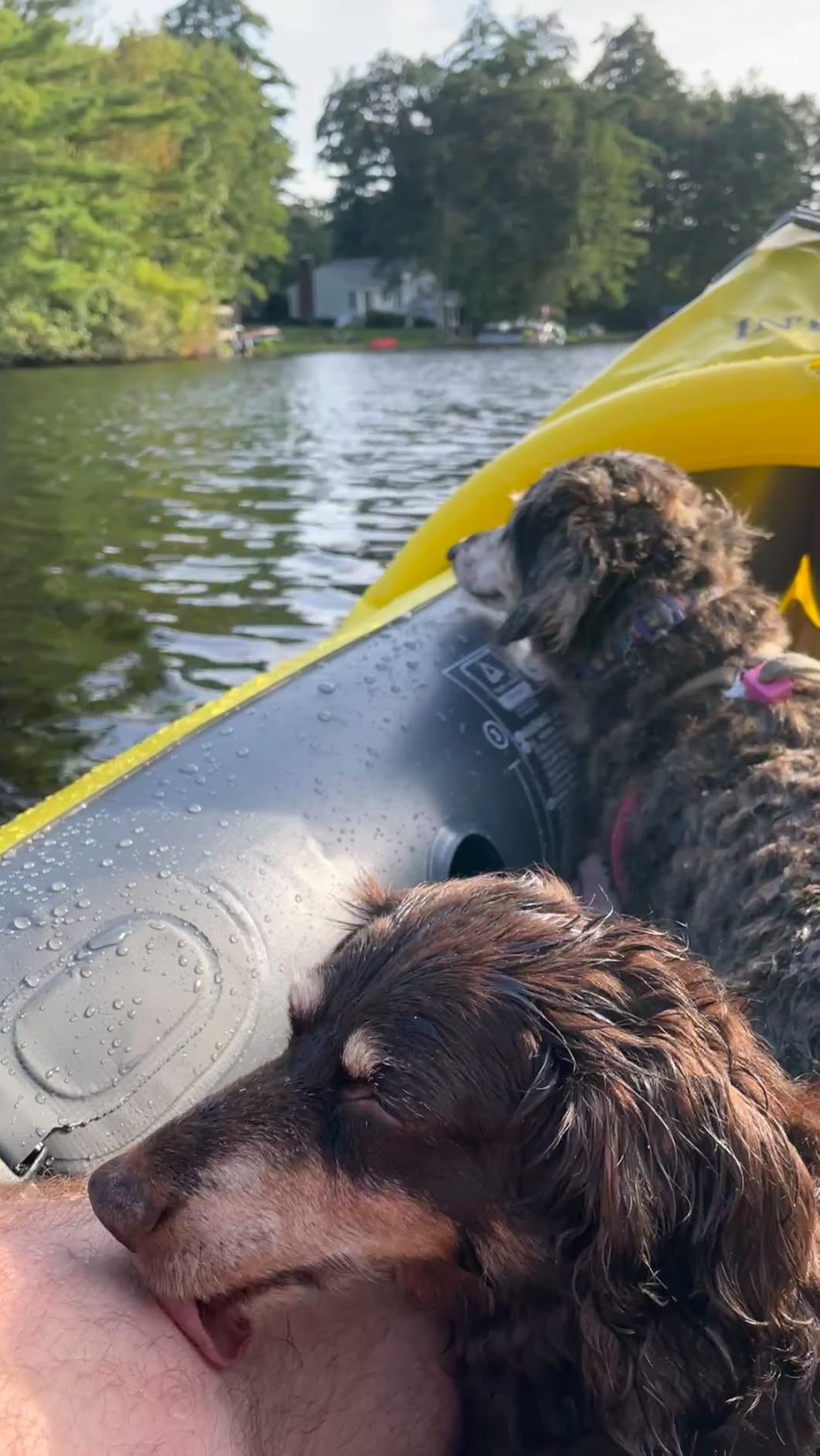
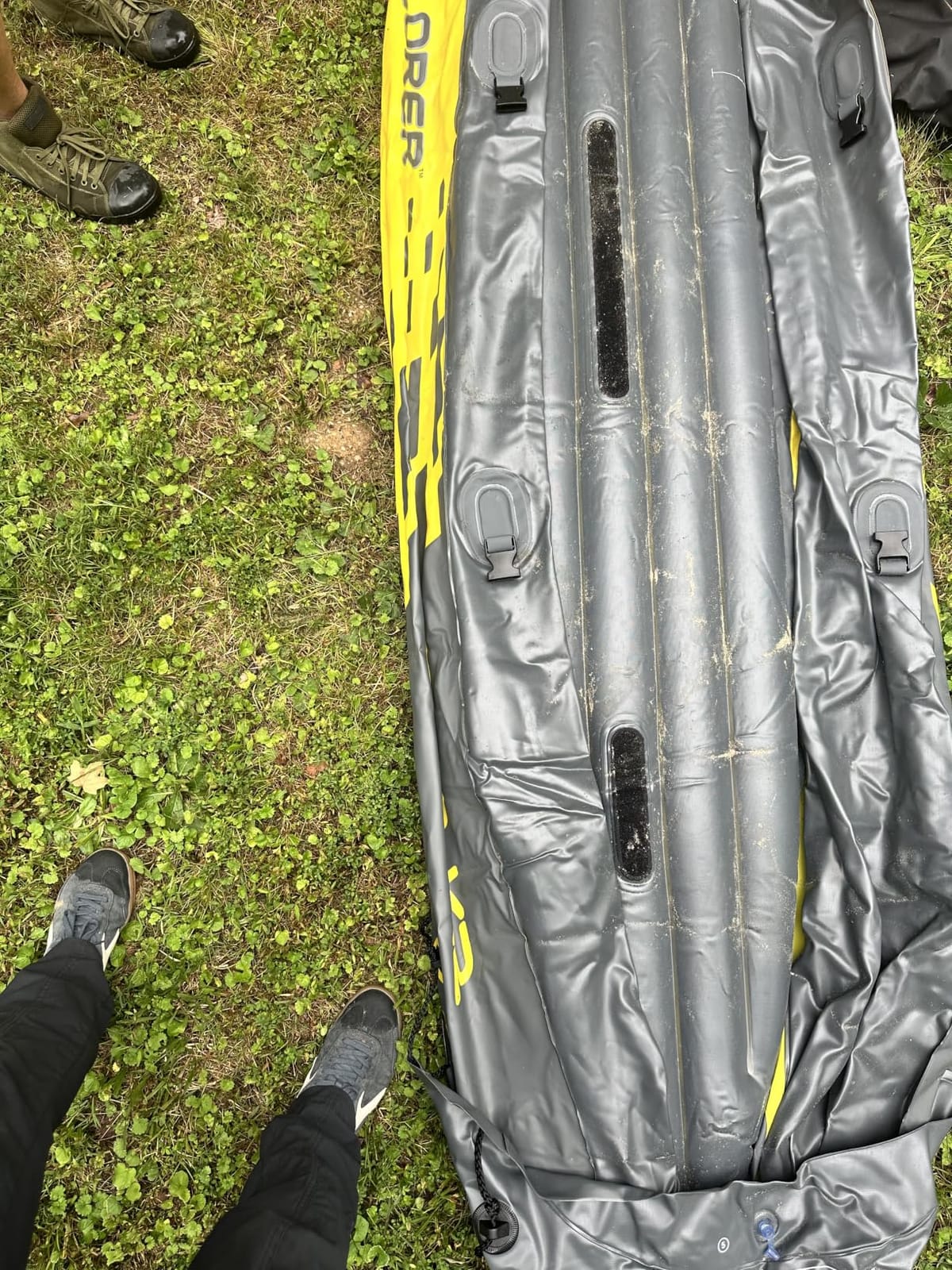
Underneath, the boat uses an inflatable I-beam floor, low-profile deck, and high-buoyancy side chambers with a removable skeg. The I-beam floor is the part that matters for feel: an open inflatable floor is floppy and tiring to sit in, while an I-beam gives you something to brace your legs against.
Setup takes about five to ten minutes with the included hand pump, and deflation through the Boston valves is faster still. Owners routinely report that the whole pack-down cycle is the main annoyance, not the paddling. Fold it wet and the creases trap moisture, which is exactly how you end up with mildew in the bag.
What the 400 lb capacity actually means for one paddler
Four hundred pounds is a combined rating for paddler plus gear, not a solo limit. One adult, a dog, or one adult with a cooler all fit comfortably. Two adults under about 350 lb combined is the realistic sweet spot.
The real constraint is the deck width of three feet and the seat spacing. Two taller paddlers will find their knees meeting, and reviewers specifically call out the included paddles as too short for anyone over roughly six feet. Budget for a pair of longer paddles as a first upgrade.
Where this boat will frustrate you
The inflatable seats are air-filled chairs with backrests, and they are not rigid. Lean hard into a turn and you will feel them move. Anyone who wants a solid seat for long days will want to swap in an aftermarket seat sooner or later.
It also sits high in the water, which makes it responsive but wind-sensitive. On a gusty afternoon an inflatable hull with a lot of surface area can feel like a sail, and this is a lake-and-mild-river boat, not open-water or whitewater hardware.
2. Intex Challenger K1 Inflatable Kayak – Best Budget Pick
INTEX 68305EP Challenger K1 Inflatable Kayak Set: Includes Deluxe 86in Kayak Paddles and High-Output Pump – Adjustable Seat with Backrest – Removable Skeg – 1-Person – 220lb Weight Capacity
Weight: 26 lb
Cap: 220 lb
9 ft solo
90-day warranty
Pros
- SuperStrong PVC that shrugs off abuse
- Light at 26 lb for portage
- Inflates in about 5 to 10 minutes
- Trunk-friendly packed size
- Good forward tracking for the class
Cons
- Included paddle is short and can crack
- Seat valve can leak when you lean on it
- Awkward dry and fold cycle
- Tracking suffers without the skeg
If your budget is the deciding factor and you plan to paddle flat water, the Challenger K1 is the shortest path from zero experience to a boat in your trunk. Owners repeatedly call it an ideal inexpensive first kayak, and the durability reports stretch across multiple seasons of hard use.
The hull uses Intex SuperStrong PVC, and the removable skeg is what keeps it pointing straight instead of wandering. That skeg matters more than the spec sheet suggests: without it seated, the boat tracks poorly, and it is the first thing to snap off on a rocky launch.
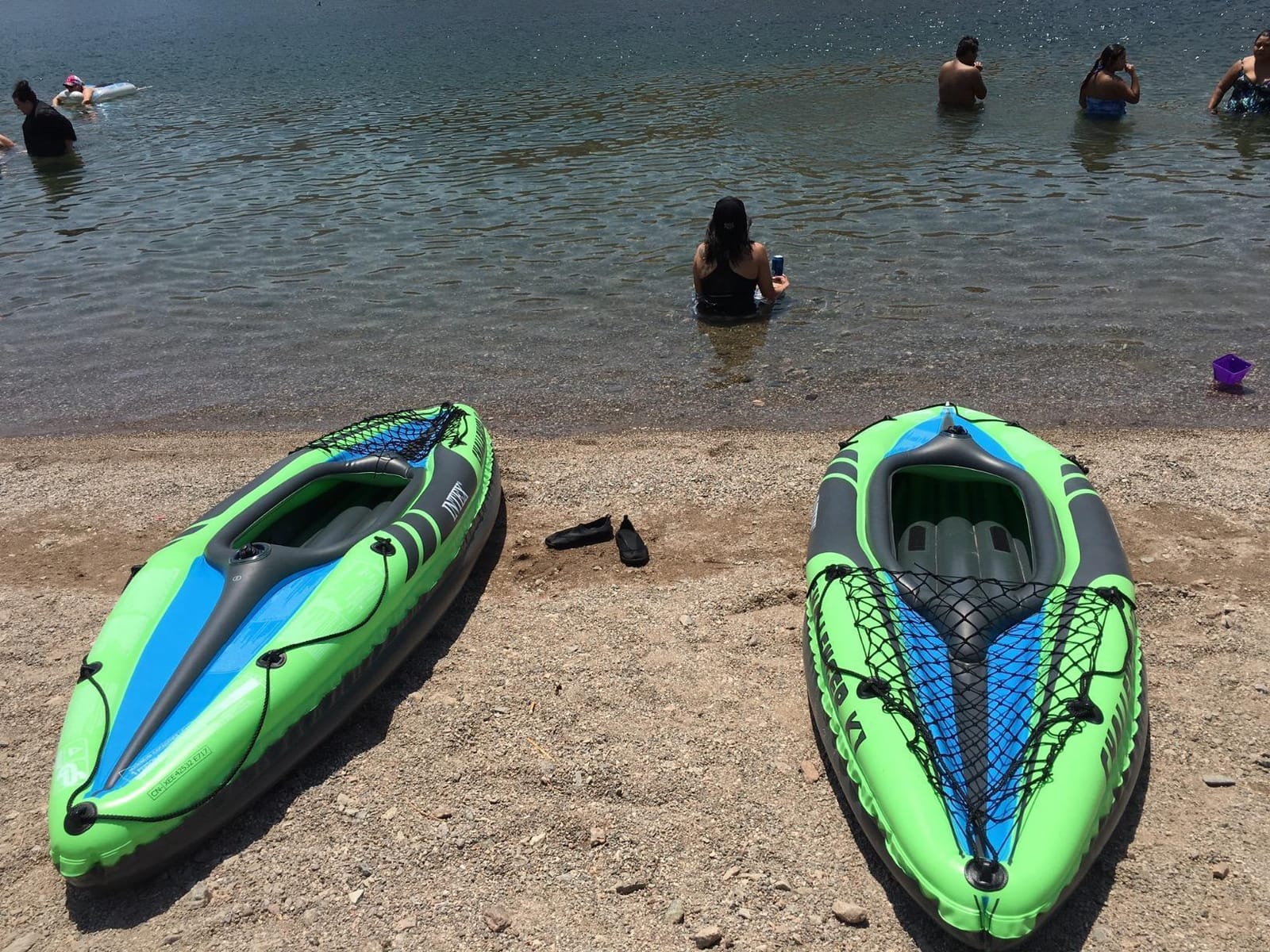
At nine feet by 30 inches, it is narrower and shorter than the Explorer K2, which makes it noticeably twitchier in a crosswind. On a calm lake that is a fair trade for 26 pounds of carry weight and a packed size that disappears into a corner of the car.
The 220 lb rating is comfortable for a single paddler up to about 190 lb with a day pack. Heavier paddlers should look at a wider boat such as the Bestway Hydro Force or the Bestway Koracle X1, both of which carry noticeably more load on a similar footprint.
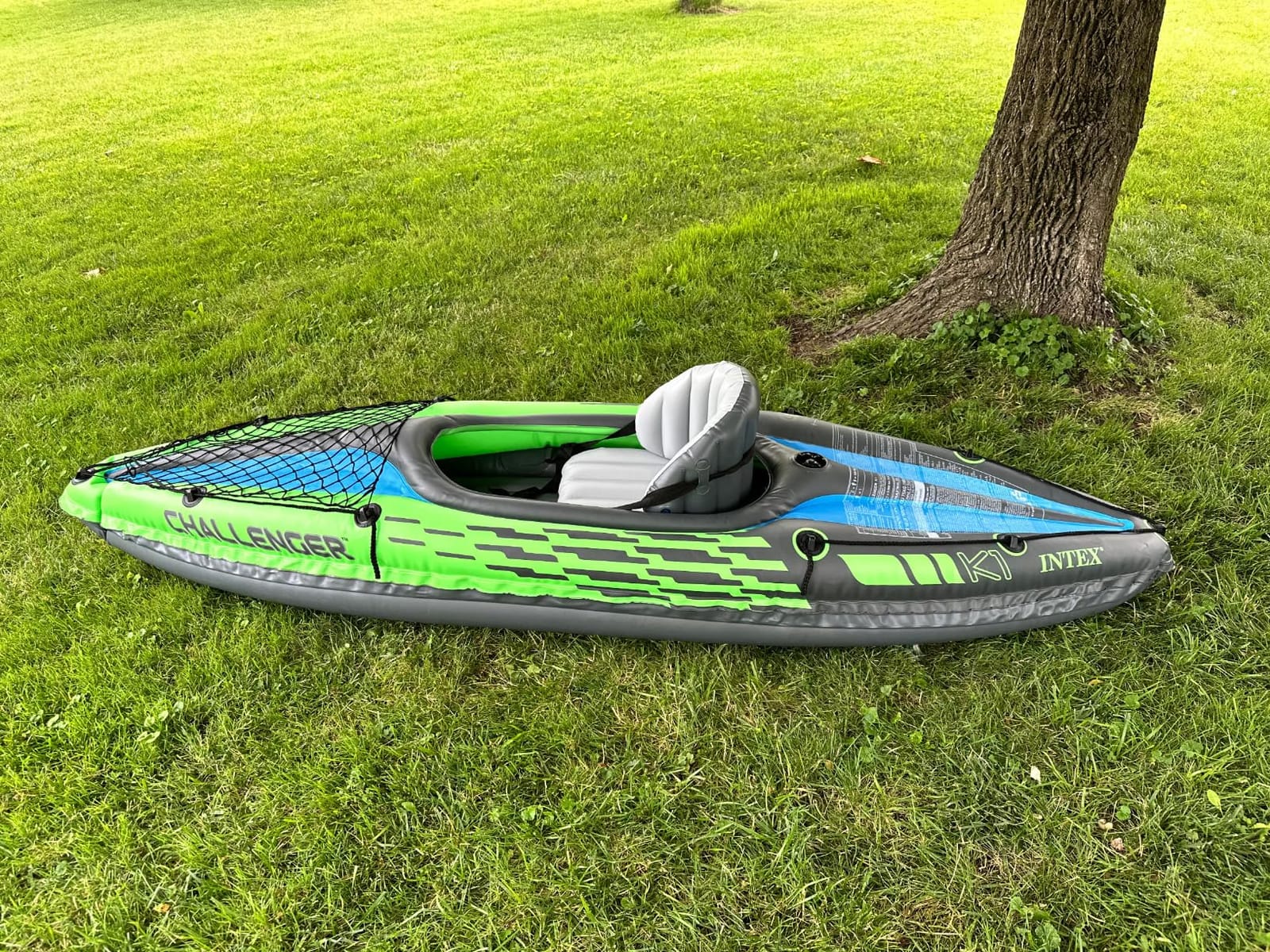
Getting in and out of the Challenger
An open deck with a low-profile side makes this one of the easier boats to board. Sit on the side deck, slide in, then swing your legs inside rather than trying to step over a high coaming.
Do it in knee-deep water rather than from a slippery bank, and keep both hands on the grab line until your hips are fully inside. The most common beginner capsize happens during boarding, not during paddling.
Where this boat will frustrate you
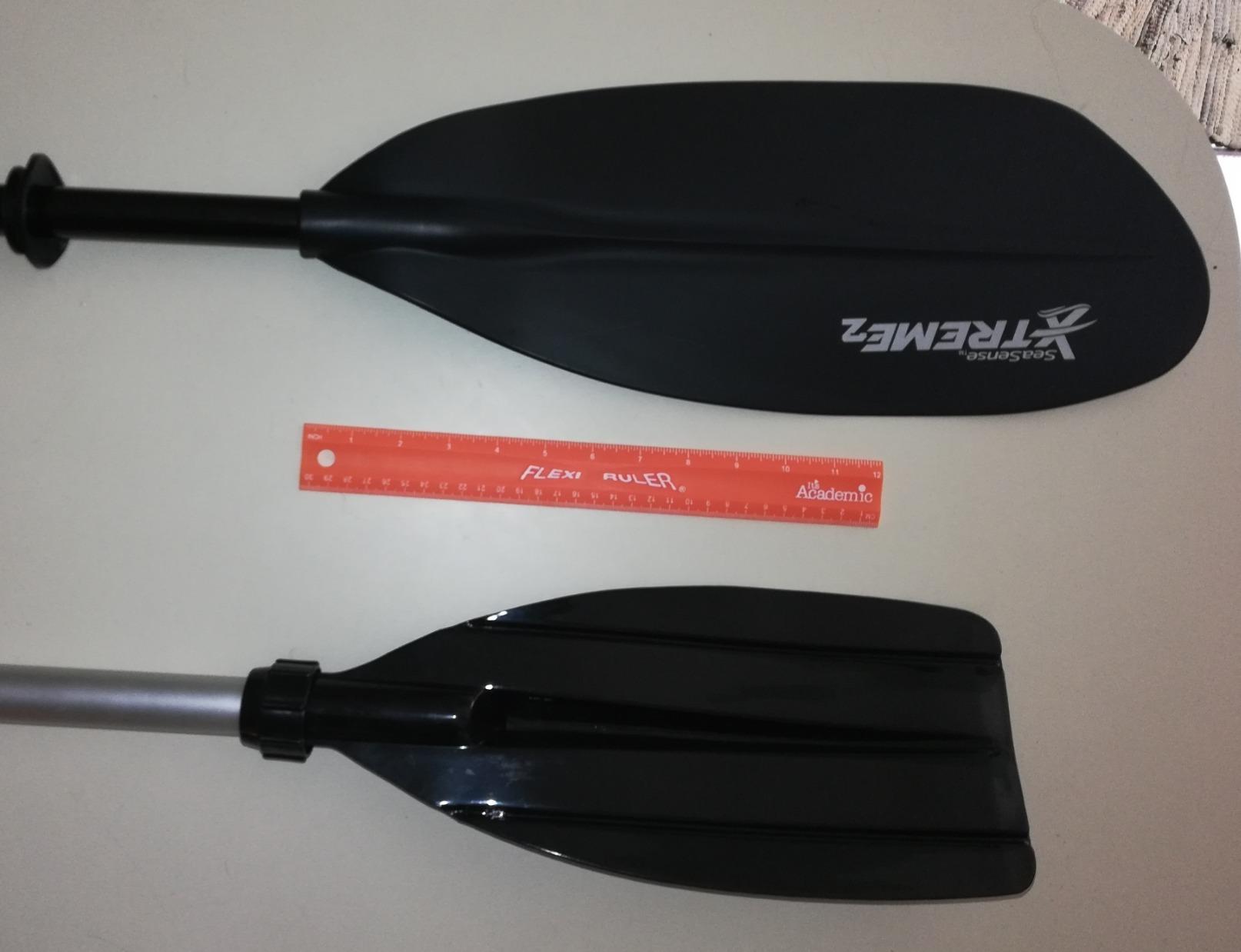
The included paddle is the weak link. Reviewers report it being short and, in some cases, cracking at the blade. Treat it as a placeholder and buy a proper paddle before your first real outing.
The seat backrest valve can also deflate when a paddler leans back on it hard, which turns a stable boat into an unstable one mid-stroke. And the deflate, dry, refold routine is genuinely tedious on a boat with this many creases, so budget fifteen minutes at the end of each trip.
3. Sevylor QuickPak K1 Inflatable Kayak – Best Value for Backpackers
Sevylor QuickPak K1 1-Person Inflatable Kayak, Kayak Folds into Backpack with 5-Minute Setup, 21-Gauge PVC Construction; Hand Pump & Paddle Included
Weight: 20.3 lb
Cap: 400 lb
Packed: 31 in
Sole kayak
Pros
- Backpack system converts into the seat
- Lightest carry weight in this group
- Multiple chambers limit total air loss
- Tarpaulin bottom resists abrasion
- Dual lock valves and multi-position footrest
Cons
- Tracking is slower than hard shell boats
- Backpack seat gives less back support
- Bungee storage is small for larger gear
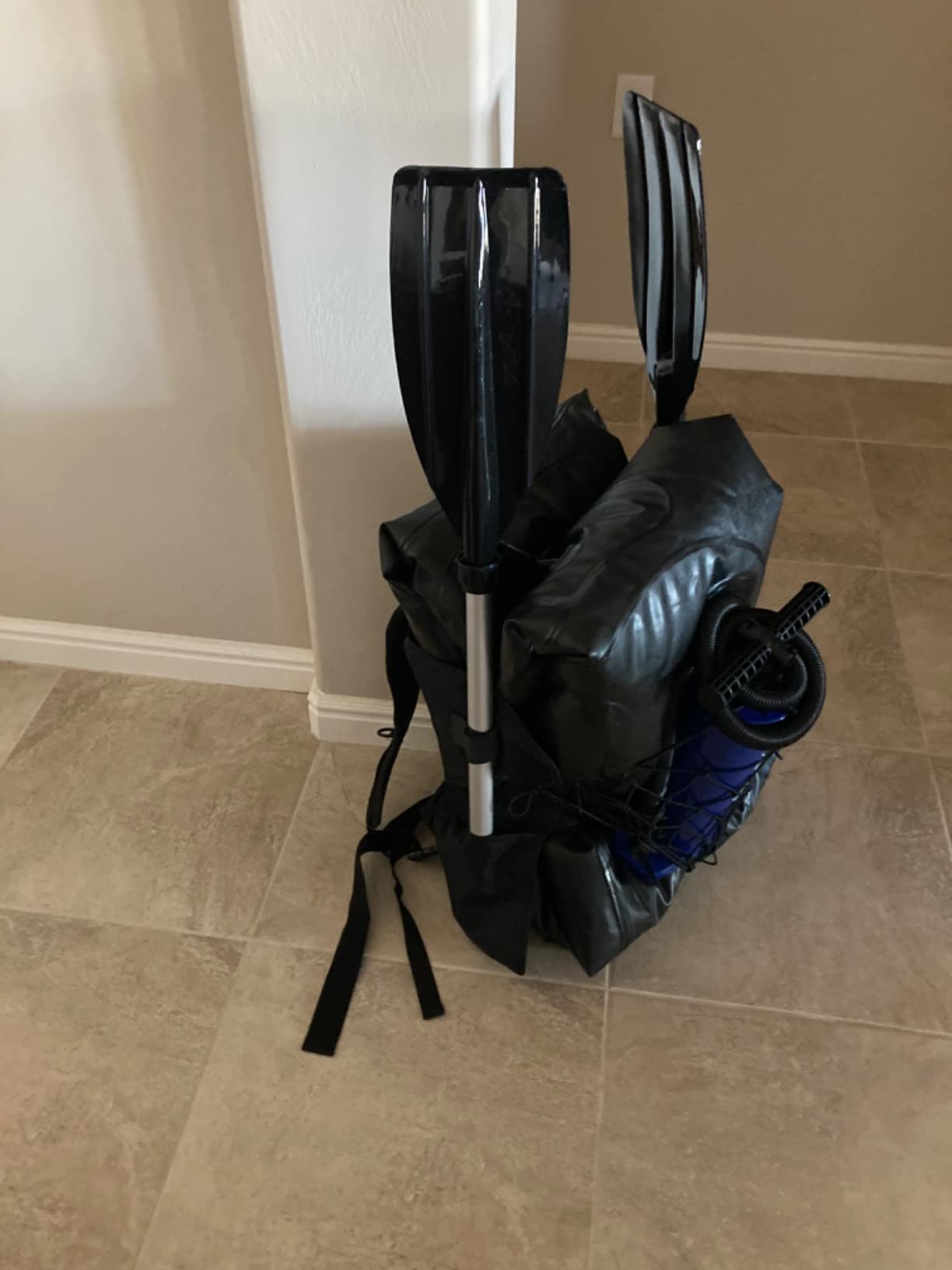
The Sevylor QuickPak is the answer to a specific beginner problem: getting a kayak to a launch that is a fifteen-minute walk from the car park. At 20.3 pounds and a packed length of about 31 inches, it is genuinely carryable on your back or over one shoulder, and the seat doubles as the backpack harness.
That trick means you are not carrying a boat plus a seat plus a bag. Everything nests into one load, which is the difference between a boat you use and a boat that stays in the cupboard because carrying it is a chore.
Construction is 21-gauge PVC with a tarpaulin bottom, a multi-chamber airtight system, and Double Lock valves. The chambers are the part beginners underestimate: if one side takes a puncture, the other chambers keep the boat shape enough to paddle back to shore rather than needing an immediate rescue.
The 400 lb capacity figure is generous for a solo boat and leaves plenty of margin for a heavier paddler or a load of gear. Performance is adequate rather than fast, with owners describing it as suited to calm lakes instead of open water or chop.
Where the 20-pound saving comes from
It comes from a soft hull and a seat with no frame. There is no rigid floor to stiffen the boat, so it flexes under your weight and feels looser on its lines than the Explorer K2.
That flexibility is the trade. You get the lightest pack in this roundup and you give up some tracking precision. On flat water for day trips, most beginners will not notice the difference; on a river with current, they will.
What to watch on your first outing
The backpack-style seat has less back support than a framed or framed-aluminum seat, so on a long paddle you will feel it in your lower back. Paddle sitting upright rather than leaning back, and take breaks.
Storage is the other limitation. The bungee area handles a day pack and a jacket, not a cooler for a full day of fishing. Plan on a dry bag lashed to the deck for anything bulky.
4. Intex Dakota K2 Inflatable Kayak – Best Tandem for Family Outings
INTEX Dakota K2 Inflatable Kayak 2-Person Portable Set with Paddles & Pump
Weight: not listed
Cap: 400 lb
10.4 ft tandem
Two dry bags
Pros
- Dual-skeg system for straight tracking
- Very stable with two people aboard
- Three air chambers and thick vinyl
- Includes two dry bags and a carry bag
- Grab line and handles at both ends
Cons
- High on the water and wind sensitive
- Tight leg room for two adults
- 86 inch paddles suit the boat's width poorly
- Carry bag too small for the hull
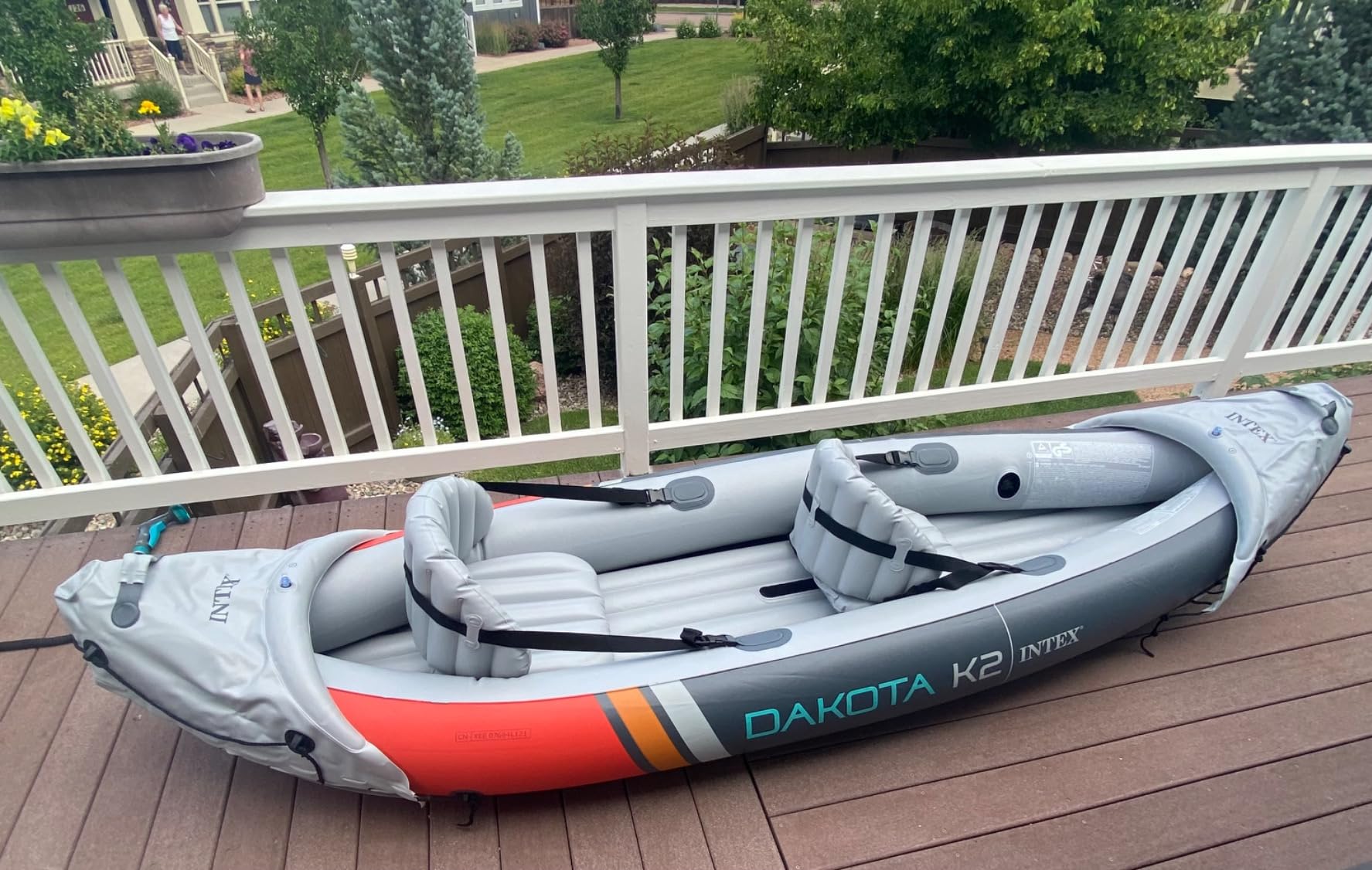
The Dakota K2 is built around a dual-skeg system: a long skeg for straight-line tracking and a short skeg you can switch to for quicker turns. On a ten-foot tandem with two adults aboard, that system is the difference between paddling in a straight line and crabbing across the lake.
Setup runs about ten to eleven minutes with the high-volume hand pump, which is longer than the smaller Intex boats simply because there is more hull to fill. The box also includes two dry bags, a nice touch for a family trip where nobody wants a soaked phone or sandwich.
Stability is the headline here. With two adults seated, reviewers describe it as hard to tip, and three separate air chambers with an I-beam floor give it a solid feel for a vinyl inflatable. If your beginner goal is a boat the whole household can share, this is a strong pick.
The problem is wind. This boat rides high, which makes it responsive in calm conditions but pushes easily in a gust. Families often get their first taste of kayaking on an afternoon with a rising breeze, and the Dakota is not the boat you want to be learning in when that happens.
Fitting two paddlers in a ten-foot tandem
Two average-size adults fit. Two tall adults do not. Leg room is tight by design, and the 36 inch width means knees and paddle blades will cross at the front of the boat.
If you are both over six feet, a longer tandem such as the 12.5 foot Goplus gives you real seating room. If you are paddling with a child in the middle position, the Dakota works better than its dimensions suggest.
Accessory complaints worth knowing
The supplied 86 inch paddles are mismatched to a boat this wide. Buy longer paddles, or you will be constantly correcting for short reach.
Two smaller details annoy owners repeatedly: the carry bag is too small for the deflated hull, and the side chamber seams can rub a paddler’s forearm during a long forward reach. Both are cheap to fix once you know about them.
5. Bestway Hydro Force Inflatable Kayak Set – Widest Cockpit for Larger Paddlers
Hydro-Force Cove Champion X1 Inflatable Kayak Set 9′
Weight: not listed
Cap: 220 lb
9 ft solo
32 in wide
Pros
- Firm rigid floor when inflated
- Multiple grab handles for solo carry
- Three air chambers with valves at one end
- Box includes paddle pump fins bag and patch
- Wide cockpit suits larger paddlers
Cons
- Included seats are uncomfortable for lower back
- Supplied paddle is too short and drips
- Carry bag is flimsy in heat
- Fins require deeper water to board
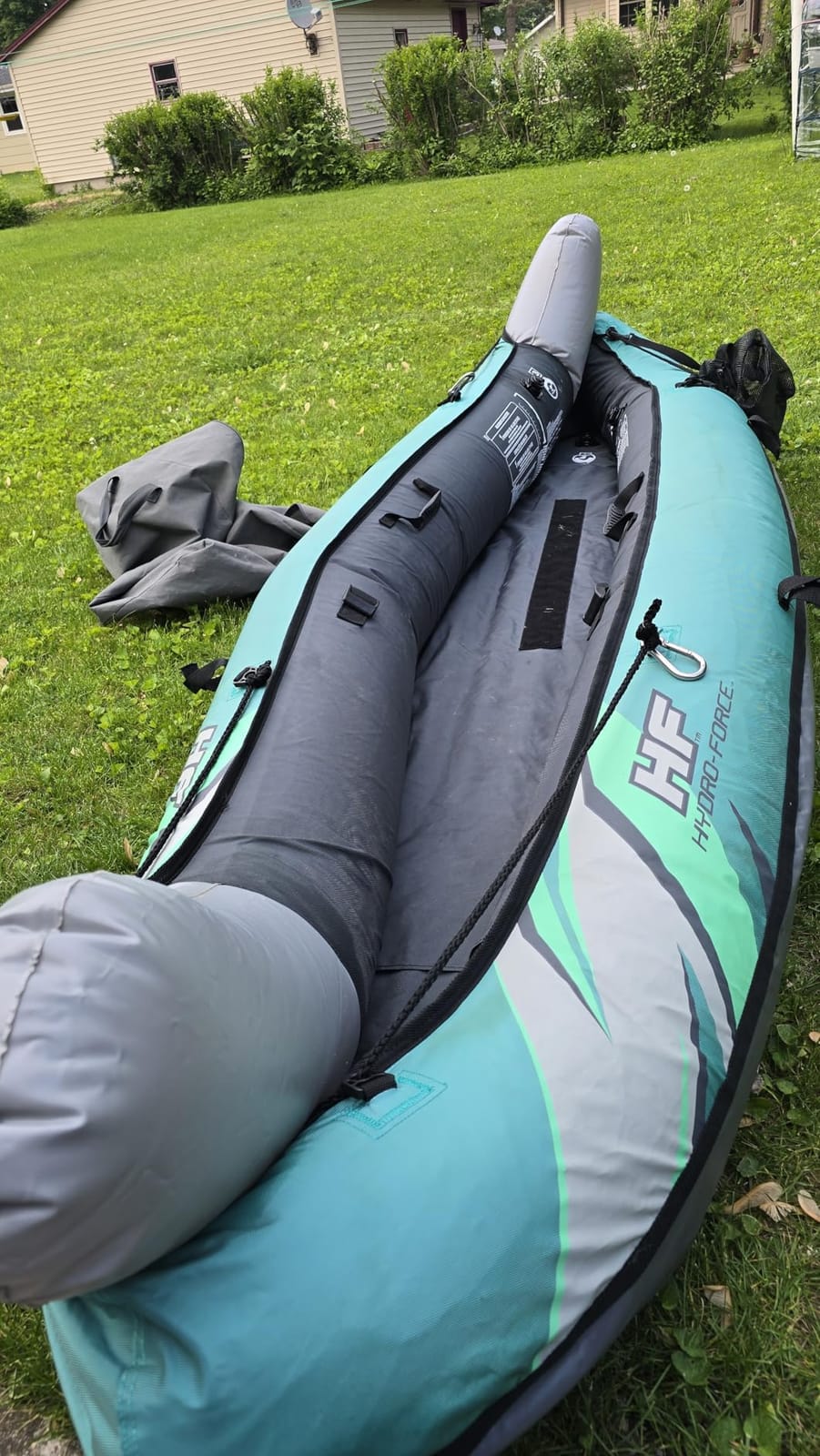
At 32 inches across, this is one of the widest solo boats in the roundup, and width is the single most useful spec for a first-time paddler. Paddlers on forums describe the rule of thumb consistently: go short and wide with a shallow to moderate V for beginners, because that combination resists tipping on your first outing.
The floor inflates firm and rigid, which makes it far less tiring to sit in than an open-bottom inflatable. Owners frequently report the boat is tougher than expected and well suited to calm lakes and gentle rivers.
The 220 lb rating looks modest next to the Explorer K2’s 400 lb, but on a 9 foot solo hull that number is realistic rather than inflated. One paddler plus a light day pack sits comfortably inside it.
All three air chambers have their valves grouped at one end, which speeds up inflation and pack-down considerably. For a boat you will pump up at a car park and deflate at the same car park, those sixty seconds matter more than the spec sheet admits.
Why width matters more than length for beginners
Length drives tracking. Width drives forgiveness. A longer boat cuts through water and holds a line; a wider boat simply refuses to tip when you lean, paddle unevenly, or drop a paddle in.
For your first twenty hours on the water, forgiveness wins. You can always trade up to a longer boat later, and by then you will know whether you want speed or steadiness.
Boarding problem to know before launch day
This boat uses keel fins that need deeper water to load and unload. On a shallow sandy launch that means wading out to knee depth, which is intimidating if you have never done it and adds a wet crossing to every trip.
Check the water depth at your launch first, and if it is ankle to shin deep, attach the fins after you are already sitting in the boat in water you can stand in. Also replace the supplied seats early, because comfort complaints dominate the reviews here.
6. Goplus 12.5 ft Tandem Inflatable Kayak – Highest Load Rating
Goplus Inflatable Kayak, 2-Person Kayak Set for Adults with 507 LBS Weight Capacity, 2 Aluminium Oars, EVA Padded Seat, 2 Fins, Hand Pump, Carry Bag, Repair Kit, Portable Touring Kayaks (Blue)
Weight: 39 lb
Cap: 507 lb
12.5 ft tandem
EVA seats
Pros
- 507 lb load rating in a 12.5 ft package
- Reinforced laminated PVC with anti-slip floor
- Three-chamber construction for safety margin
- Two fins for beginner-friendly control
- Three-level adjustable footrest
Cons
- Only a three-month warranty
- Longer deflate and fold cycle
- Included hand pump inflates it slowly
When the question is how much weight a boat will carry, the answer is 507 pounds, and no other inflatable in this roundup goes higher. That number covers two adults plus a child plus gear, which makes this the boat to look at if your family does not fit the 400 lb ceiling of the Intex tandems.
It is also one of the longest boats here at 12.5 feet, and length is where tracking comes from. Reviewers call out roominess and stability, and the 37 inch width adds forgiveness on top of the straight-line performance.
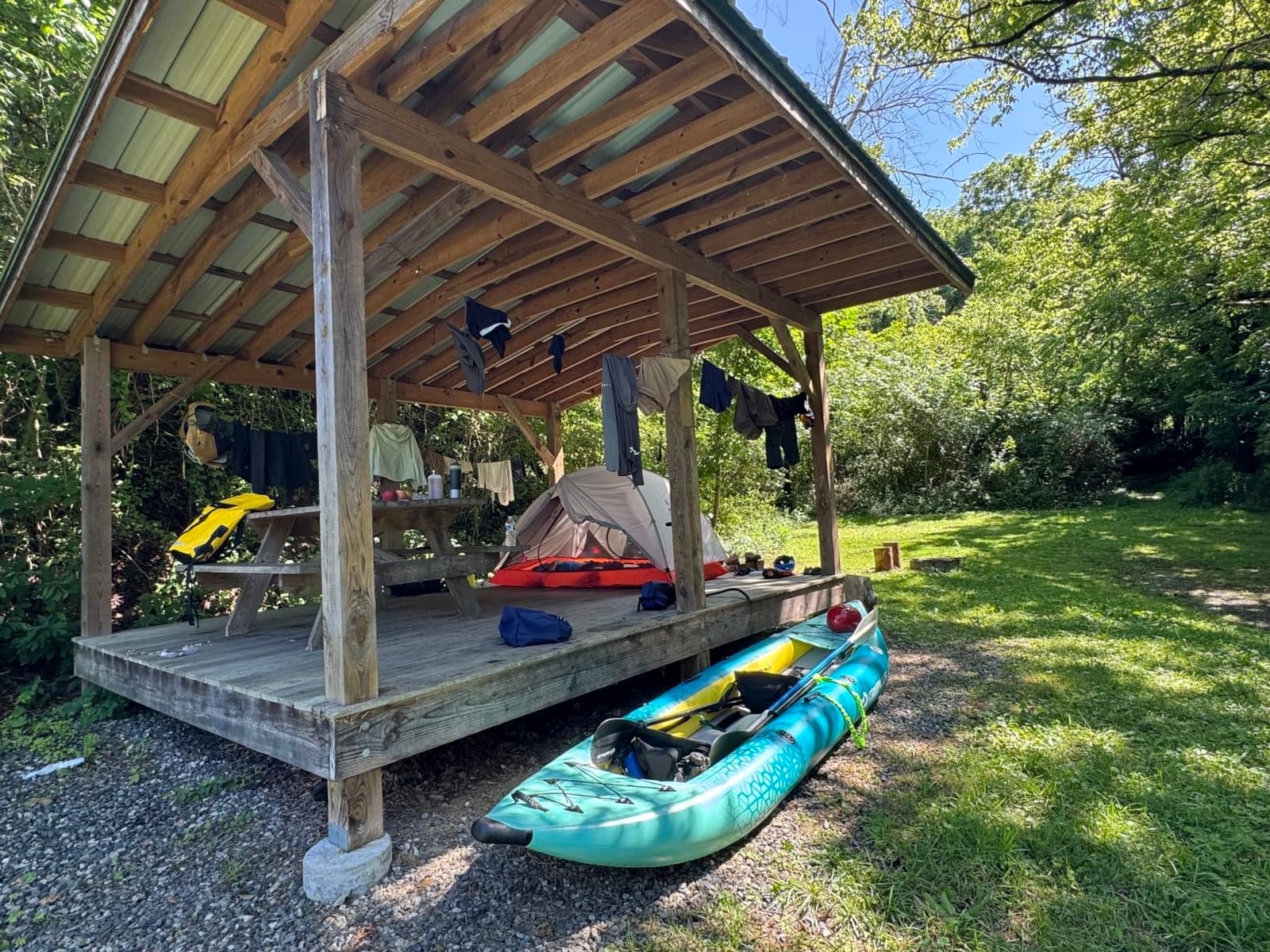
Construction is reinforced laminated PVC over mesh with a premium three-chamber layout, a drain hole, and an anti-slip floor. The adjustable EVA seats and three-level footrest are a genuine upgrade over the inflatable air-chair seats on the cheaper models, and long paddlers can dial in leg position rather than stretching.
Two fins are included, which gives beginners a simple form of directional control without needing to learn a rudder deployment sequence in their first hour on the water.
Why the warranty length matters here
This boat carries a three-month warranty, the shortest in the roundup by a wide margin. Compare that with the two years on the Sevylor QuickPak and the three-year limited warranty on the Advanced Elements Island Voyage 2.
On a boat built from laminated PVC with welded seams, a short warranty signals lower confidence in the seams than a longer one does. For a first purchase that you hope to keep for years, that is a fair reason to weigh this boat against the alternatives.
The honest drawback: setup and pack-down time
A twelve-foot hull with three chambers takes longer to inflate with the included hand pump and longer to deflate and fold than a nine-foot solo. Plan twenty minutes at the end of the trip rather than ten.
The repair kit is included with a wrench and patches, which is a good sign, but check that you have adhesive for any patch you apply. A dry patch over a damp boat is a temporary fix at best.
7. Bestway Hydro-Force Koracle X1 Inflatable Fishing Kayak Set – Best for Kayak Fishing
Bestway Hydro-Force Koracle X1 Inflatable Fishing Kayak Set 9’4″
Weight: 7.3 kg
Cap: 331 lb
9 ft 4 in solo
36 in wide
Pros
- Inflata-Shield hull resists punctures and grips well
- 331 lb capacity on a solo hull
- Built-in backrest plus four footrests
- Two removable fins in different sizes
- Built-in rod holder and oar clasps
Cons
- Solo boat only
- Single included paddle
If your reason for wanting a kayak is fishing rather than touring, this is the one to start with. The built-in rod holder and oar clasps are the kind of detail that usually costs extra and usually matters after four hours of sitting still in the same spot.
The Inflata-Shield material is the brand’s puncture and stretch-resistant fabric, and it pairs with the widest beam of any solo hull in the roundup at 36 inches. A 331 lb capacity on a solo fishing hull is generous, and the built-in backrest with four footrests means you can work a lure without your legs falling asleep.
Two removable fins in different sizes let you swap between tracking for open water and hold for shallow weed beds, which is the single most useful fishing upgrade on this boat. It is a 4.4-rated boat with a strong five-star share, though the review count is far smaller than the Intex models, so treat long-term durability data as thinner.
One note on expectation setting: this is a fishing kayak, and a rod holder is a holder, not a downrigger or a motor mount. If your plan involves trolling or a motor, check the accessory mount layout before you commit.
Best for fishing, less ideal for fast touring
A wide beam prioritises stability over speed. You will be stable enough to cast from a seated position, and you will not be sliding across flat water at pace.
For a beginner who wants fish rather than kilometres, that is the correct trade. If you will do long paddles as well as fishing sessions, look at the OCEANBROAD drop-stitch boat, which tracks far better at the cost of weight.
8. Advanced Elements Island Voyage 2 – Best Tracking and Solo-to-Tandem Switch
Advanced Elements Island Voyage 2 Inflatable Kayak, Yellow
Weight: 31.5 lb
Cap: 400 lb
11 ft convertible
3-year warranty
Pros
- Converts between solo and tandem seating
- Rigid aluminum rib floor tracks like a hard shell
- Light enough at 31.5 lb for one-person portage
- Backpack-style carry system
- Three-year limited warranty
Cons
- Sold as kayak only without a pump
- Costs more than vinyl inflatables
- Higher profile takes more effort in wind
This is the boat to buy if you are not sure whether you will be paddling alone or with a partner in two years. The aluminium ribbed floor and convertible seating mean one boat covers a solo outing today and a tandem trip later without a second purchase.
The frame is the real upgrade. As paddling.com puts it, this hybrid inflatable and folding design helps rigidity and tracking, and owners highlight the aluminium rib floor as the step up from plain vinyl. On an eleven-foot hull that tracks like a hard shell, you will notice the difference the first time you stop paddling and the boat keeps going straight.
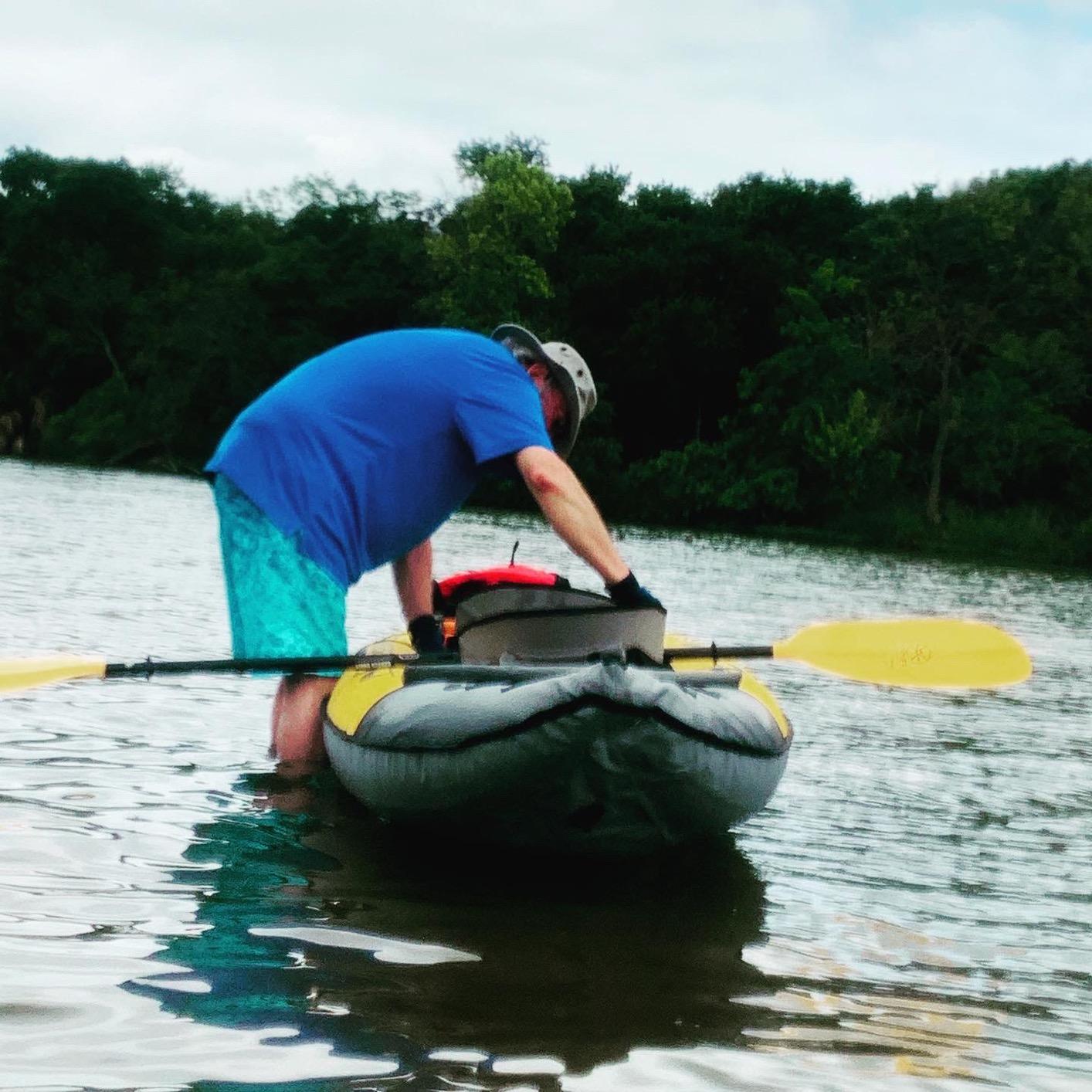
Warranty is three years limited on kayaks bought after January 2023, which is the longest coverage here. That matters for a boat at this price point because seams and valves are the components that age.
At 400 lb capacity and 37 inches wide, it fits two adults with room. And at 31.5 lb it is still within one-person carry range, though it is noticeably heavier than the Sevylor or Retrospec packs.
Plan on buying a pump separately
This listing is the kayak only, without a pump. Budgeters miss this constantly and end up deflating the boat at the launch and walking back to the car for equipment. Buy a pump before the first trip.
While you are spending, buy a decent seat too. The frame gives you a stable platform, and pairing it with a supportive seat is where the money on a boat like this is best spent.
Wind is the trade-off for better tracking
That stiffer hull sits higher, and a higher profile catches more wind. Owners note it takes more effort in wind and chop than the softer vinyl boats, which paddle more quietly through a gust.
If your local water is sheltered lake or slow river, this is a strength. If you paddle an exposed coast or a wide lake in spring, choose a lower-profile boat and accept slower tracking.
9. Retrospec Coaster Inflatable Kayak – Best for Solo Portage
Retrospec Coaster Inflatable Kayak for Adults, Fishing Kayak, Fishing
Weight: 23 lb
Cap: 220 lb
9 ft 10 in solo
Deflates to 24.5 in
Pros
- Light at 23 lb for solo carrying
- 900 denier fabric with tarpaulin hull
- Assembles in minutes by unrolling and clipping
- Room for a paddler and a dog
- Single and tandem versions available
Cons
- Slower and less precise tracking than rigid kayaks
- Low-profile seating feels cramped on long trips
- PFD not included for you or a dog
The Coaster is the most modern-looking package in this roundup, and its 900-denier fabric with a heavy-duty tarpaulin hull is a step up in abrasion resistance from the vinyl used on the budget models. Owners point out that it goes together in minutes: unroll, add the fins, inflate the chambers, snap in the seat.
At 23 pounds it is a genuinely single-person carry, and it deflates to a package of about 24.5 by 17 by 10 inches. That is small enough for a hall closet, an RV bay, or the boot of a small car with no roof rack.
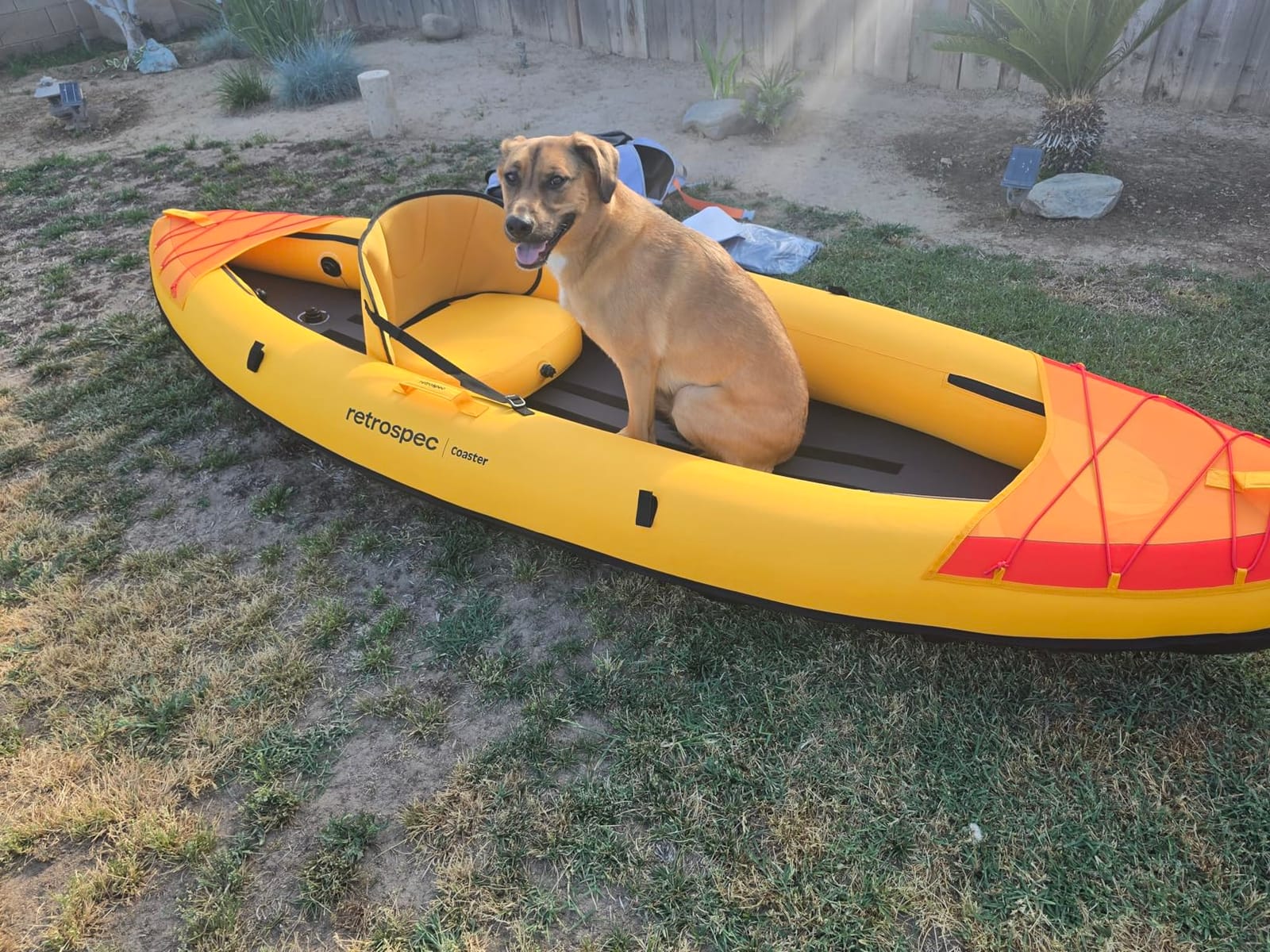
It is also marketed for a paddler plus a dog, which is a real differentiator for a lot of beginners. Just remember that a flotation device for a passenger is on you to buy, for the animal as well as for yourself.
The 37 inch width on a solo hull is unusually generous, and it is the main reason this boat feels planted for its size. Single paddlers under roughly 190 lb with light gear sit comfortably inside the 220 lb rating.
The honest limits of a soft solo hull
Tracking and speed trail hard-shell boats, and owners say so plainly. This is a boat for getting to a spot and enjoying it, not for covering distance.
The low-profile seating also feels cramped past a couple of hours, so on a full-day trip add a backrest or a seat upgrade. For half-day outings on sheltered water, neither issue comes up.
What the dual-action pump does for you
The included low-pressure dual-action pump pushes air on both the push and the pull stroke, which cuts setup time meaningfully compared with a single-action hand pump.
Check the pressure with a gauge rather than by hand. Under-inflated boats flex, feel unstable, and get harder to paddle, and that is the most common self-inflicted problem in this whole category.
10. OCEANBROAD Drop-Stitch Inflatable Kayak – Best for Long Trips
OCEANBROAD Inflatable Sit-in Kayak(NO HIN), 1 Person/2 Person Touring Kayak
Weight: 51.7 lb
Cap: 500 lb
13.8 ft tandem
Drop-stitch floor
Pros
- Drop-stitch floor feels rigid under the paddler
- Holds a straight line when you stop paddling
- Inflates in about 5 to 6 minutes
- Stable in two-foot waves and moderate wind
- Large carry bag holds boat and gear
Cons
- Heaviest boat in this roundup at 51.7 lb
- Included seat straps mount too low and collapse
- Included footrest is thin
- Tracking drops in sustained wind over 10 mph
This is the only drop-stitch boat in the roundup, and that construction is the answer to the classic complaint about inflatables: they flex. A drop-stitch core inflates hundreds of thousands of tiny threads into a floor that behaves like a rigid panel, and owners consistently describe the difference as immediately obvious under the paddler.
At 13.8 feet it is the longest hull here, and the payoff is tracking. Reviews report that it holds a straight line when you stop paddling, and that it stayed stable in two-foot waves and moderate wind.
Construction is heavy-duty vinyl with a drop-stitch floor, three air chambers, and Halkey-Roberts valves, which are the standard marine valve and the easiest to find replacement parts for. The removable floor detaches for drying, and there is a drain hole to help with the water you inevitably collect.
Owners compare the value favourably against premium inflatable brands, and manufacturer support is reported as responsive. At 4.4 stars with 94 reviews, the rating is strong but the sample is young. With no customer photos in the listings for this model, the written owner feedback is the most useful signal here.
Is 51.7 pounds too heavy to be a beginner boat?
Only if you have to carry it far. Two people can manage it from a car park to a launch comfortably, which covers most lake and river trips. For solo hiking to a remote put-in, the Sevylor QuickPak at 20.3 pounds is a far more sensible choice.
If it fits in your vehicle with no roof rack, the weight is a non-issue for the vast majority of paddlers buying a first boat.
Replace the seat before your second trip
The most common complaint by far is the included seat: its backrest straps mount too low and collapse, and the seat zipper will not stay closed, so back support disappears on a long day. Many buyers replace the seat outright.
The included footrest is also thin. Both are cheap upgrades that transform a long trip from uncomfortable to fine, and both are worth doing before you commit a whole weekend to a paddle.
How to Get In and Out of an Inflatable Kayak Without Tipping
One of the hardest parts of kayaking is just getting in and out of the kayak easily, as Bassmaster put it in its first-adventure advice. It is the single most common fear in beginner forums, and it is also the most avoidable one. Nearly every beginner capsize happens at the boarding step, not during paddling.
Board in knee-deep water, not from a bank. Wading out takes fifteen seconds and removes the balance problem entirely. Kneel beside the boat with the grab line in one hand and the seat pushed forward.
Sit first, legs second. Lower your backside onto the seat before you bring your legs in. Trying to step over the deck while standing is what flips most boats.
Slide, do not climb. Put one hand on the grab line and one on the opposite side tube, then swing your hips in as one movement.
Keep both hands on the boat until your knees are in. The moment you release both to adjust something, you are a standing person on a floating surface.
Attach the fins while seated in shallow water. Sponson-style boats need the rear fin in place, and fitting it from a kneeling position avoids wading out to chest depth.
Reverse the whole sequence to get out. Move to shallow water, unclip the fins, then step out on the same side you boarded from.
For anyone with limited mobility, the same rules matter more, and the open-deck models help. The Bestway Hydro Force with its 32 inch cockpit gives the most room to maneuver a stiff leg over the side, and the wide tandem models give you a second platform to steady yourself against.
Safety Basics Every Beginner Needs Before Launching
An inflatable kayak is more forgiving than a hard shell, and that confidence is exactly how beginners end up in trouble. Wear a properly fitted personal flotation device every single time, without exception, and check the fit before you leave the car rather than at the ramp.
The 120 degree rule, in plain language
If the water is 60 degrees Fahrenheit, you have about an hour before cold-water shock becomes a serious problem. The general rule is 120 degrees minus the water temperature in degrees Fahrenheit, in minutes. At 50 degrees of water you have roughly 70 minutes, and at 70 degrees you have about 50 minutes.
That is the number that drives the clothing decision, and it is why an inflatable kayak in autumn is a different proposition from the same boat in July.
Cold water, weather, and wind
Below about 60 degrees of water, a wetsuit or a drysuit is the sensible choice, and a cotton top is the worst option available because wet cotton strips heat fast. Many paddlers also carry a change of clothes in a dry bag for the ride home.
Wind deserves equal attention. Inflatable hulls have a lot of surface area and behave like a sail, and that is a genuine hazard rather than a theoretical one. Do not paddle these boats in gusty conditions, and if you are caught out, paddle toward the nearest shoreline rather than fighting to hold a line across open water.
The gear that actually matters
A pump is necessary if you have an inflatable kayak, so confirm yours is in the bag before every trip. Beyond that, carry a whistle on a lanyard, a bailer or sponge, a spare paddle if you can afford one, a dry bag with a change of clothes, a bail of drinking water, sun protection, and your phone sealed in a waterproof case.
Keep a leash debate in mind: leashes are debated because a leash can hold a capsized paddler under water in current. Beginners on flat water are better served by a whistle and a clear plan to swim to shore.
How to Choose an Inflatable Kayak: 9 Criteria That Matter
Once you know the water you will paddle and the number of seats you need, the buying decision narrows to nine things. Rank them in this order and most of the choice makes itself.
1. Width before length
The most useful rule in this whole category comes from paddling.com: beginners should start with a short, wide kayak with a shallow to moderate V on the bottom. Short is forgiving, wide resists tipping, and a shallow V keeps you from digging a rail into the water when you lean.
Aim for 32 inches of width or more as a beginner. Every boat in this roundup below that line is a boat you will be correcting constantly in your first month.
2. Hull construction and what it does to feel
An open or I-beam floor is soft, cheap, and tiring over a long session. A drop-stitch floor inflates into a rigid panel and feels markedly better, at the cost of weight and pump time. An aluminium rib frame sits between the two and is the reason the Advanced Elements boat tracks like a hard shell.
3. Maximum capacity with real headroom
The number on the box is paddler plus gear. A 220 lb rating on a solo boat is comfortable for one person up to about 190 lb with a day pack. Heavier paddlers should be looking at the 331 lb and 400 lb boats, and the Goplus at 507 lb covers two adults plus a child.
For tall paddlers, footrest adjustability matters as much as capacity. Boats with adjustable footrests, like the Koracle X1 and the Goplus, let a six-foot-three paddler set leg position instead of stretching.
4. Packed weight and packed size
Even lightweight inflatables run from about 20 pounds to over 50 pounds once paddles, pump, and bag are added. That is awkward to carry on foot, and it is the reason so many boats never leave the garage. Measure the distance from your car to the water.
5. Skeg, rudder, or fin
A skeg or fin resists sideways slip and gives you straight-line tracking. A rudder steers the boat by turning the stern. Beginners benefit from both, but a skeg that can detach is worse than no skeg, so check that it seats properly and know how it fits.
6. Pump included, and how good it is
One of the ten boats here is sold without a pump, and one includes only a simple hand pump. A dual-action pump cuts setup time noticeably. Budget for a pressure gauge too, because a boat pumped to feel firm rather than to the printed PSI will feel unstable.
7. Inflation pressure and how it changes the boat
Low-pressure vinyl boats run around 2 to 3.5 PSI, and drop-stitch boats run considerably higher. Higher pressure means a stiffer, better-tracking hull and a longer pump. Under-inflating is the most common beginner error and it produces a wobbly boat that feels like a different product.
8. Materials, punctures, and the bottom
A tarpaulin bottom or a drop-stitch core is the fix for the puncture anxiety that shows up constantly in beginner forums. Rocky launches and dragging the boat are normal, and the bottom construction is what decides whether that is a scuff or a hole.
9. Warranty, brand support, and parts
Warranties in this roundup range from three months to three years. Longer coverage signals more confidence in seams and valves, which are the parts that age first. Prefer brands with replacement valves and patches you can buy separately, since a boat with no parts support is a boat you cannot keep on the water.
Honest drawbacks worth weighing first
Inflatables paddle slower and track less precisely than hard shells, and they are more wind-sensitive because of their surface area. Many of the supplied seats are uncomfortable after two hours, and the deflate, dry, and fold routine is tedious on any of them. Every model here needs drying properly before storage, or you will find mildew in the bag in spring.
Your First Paddle Day Checklist
Most first outings go well when the gear is sorted before the car park. Run through this once and the day becomes about learning rather than logistics.
Properly fitted PFD, checked by a second person before you leave.
Whistle on a lanyard around your neck, not in a bag.
Pump in the car, plus a pressure gauge if you have one.
Paddles sized for you, not the ones in the box.
Spray skirt if you are on moving water or cold water; skip it on a warm calm lake.
Phone in a waterproof case, plus a bailer or sponge for bilge water.
Drinking water, sun protection, and a wind layer.
A route you have looked at, with an exit point if the weather turns.
A partner, and a check-in time if you are alone.
Ten minutes set aside for deflation, drying, and folding at the end.
If you only change one thing on that list, change the paddles. Almost every review complaint in this category traces back to a supplied paddle that is too short for the paddler.
Drying and Storing an Inflatable Kayak Without Mold
Forgetting to dry the boat before packing it away is a near-universal regret in owner reviews, and it is entirely avoidable. Open the valves, lay the hull out in the shade with the deck facing up, and let air move through the chambers for at least an hour.
Absorb standing water with a towel or a sponge before you start folding. Folding a wet boat traps moisture in the creases, and that trapped moisture is what grows mildew. On humid days, add a second drying session indoors before the boat goes into its bag.
Is it okay to leave an inflatable kayak inflated?
Briefly, yes. Leaving a boat inflated indoors protects the fabric from creasing and keeps it ready to go, and storage in a climate-controlled space is not the same as leaving it outside in sun and rain. What you should not do is leave it inflated for months in an unheated garage, where temperature swings work the seams and material over time.
The long-storage routine that works
Deflate fully, dry completely, roll loosely rather than folding sharp, and store the bag somewhere dry and out of direct sunlight. Check the pressure and seams every few months, and keep the repair kit with the boat rather than in a drawer.
That last habit matters more than it sounds. A five-dollar patch kit sitting in a bag is what turns a punctured boat into a fifteen-minute repair instead of a lost season.
Frequently Asked Questions
Are inflatable kayaks worth buying?
For most first-time paddlers, yes. You avoid a roof rack, a large storage problem, and the higher cost of a hard shell, and a wide inflatable hull is harder to tip than a narrow fiberglass boat. The trade-offs are slower tracking, less speed on open water, more sensitivity to wind, and a deflate-dry-fold routine after every trip. Renting first for a season is a sensible way to test the water temperature and the carrying distance before you buy.
Which kayak is the easiest for a beginner to get into?
Open-deck models with low side tubes are the easiest to board, and the Bestway Hydro Force with its 32 inch wide cockpit gives the most room to maneuver. Board in knee-deep water rather than from a bank, sit down on the seat before bringing your legs in, and keep both hands on the boat until your knees are inside. Attaching keel fins after you are seated and already in shallow water avoids wading out to chest depth.
What is the most stable inflatable kayak?
Stability comes from width, so the widest boats here are the most forgiving: the Bestway Hydro Force at 32 inches and the Bestway Koracle X1 at 36 inches. For a two-person boat, the Goplus at 37 inches and 507 pounds of capacity holds steady with adults plus gear aboard. Beginners should also pick a shallow to moderate V hull, which resists tipping without catching your paddle edge.
What PSI should I inflate my kayak to?
Inflate to the pressure printed on the hull, not to what feels firm. Low-pressure vinyl models such as the Intex boats run around 3 PSI, and the Goplus lists a maximum of 2.18 PSI, while drop-stitch models run much higher. Under-inflating gives you a soft, wobbly boat that feels unstable and tires your legs. A cheap pressure gauge is the single most useful upgrade for a beginner.
Do inflatable kayaks puncture easily?
It depends entirely on the bottom construction. Plain vinyl floors pick up punctures on rocky launches, while tarpaulin bottoms, high-denier fabric, and drop-stitch cores resist them. Several boats here use tarpaulin or 900 denier materials, and the Bestway Inflata-Shield and Goplus reinforced laminated PVC add further protection. Carry the included repair kit with the boat, and never launch a boat that feels soft, because low pressure is often what causes a puncture.
What is the 120 rule for kayaking and when does it apply?
It is a guideline for how long you can survive in cold water: 120 degrees Fahrenheit minus the water temperature in degrees Fahrenheit gives you a rough number of minutes before cold-water shock becomes dangerous. At 60 degree water you have about an hour, and at 50 degrees about 70 minutes. It is the reason to wear a wetsuit or drysuit on an autumn paddle and to carry dry spare clothes.
Where to Start: Our Final Verdict for Beginners
Start with the Intex Explorer K2. It is the most thoroughly reviewed beginner inflatable we found, it arrives with everything you need, and its 400 lb capacity and three-foot width cover solo paddling, a partner, or a dog without a second purchase. For the lowest sensible outlay, the Challenger K1 does the same job solo nine pounds lighter.
If you will carry the boat to the water, choose the Sevylor QuickPak at 20.3 pounds. If you will fish, choose the Bestway Koracle X1 with its rod holder and 36 inch beam. If you are unsure whether you will be solo or tandem in two years, the Advanced Elements Island Voyage 2 converts between the two and tracks noticeably better than the plain vinyl boats.
Whichever one you pick, buy a proper pair of paddles in your first week and take one lesson before you go alone. If you enjoy it, the next boat you buy can be the hard shell, and you will already know which one you want.
Before your next purchase decision, our beginner camera guide covers the other hobby where people overbuy the wrong gear on the first try, and our lens roundup for beginners goes deeper on the accessories that actually change results.