
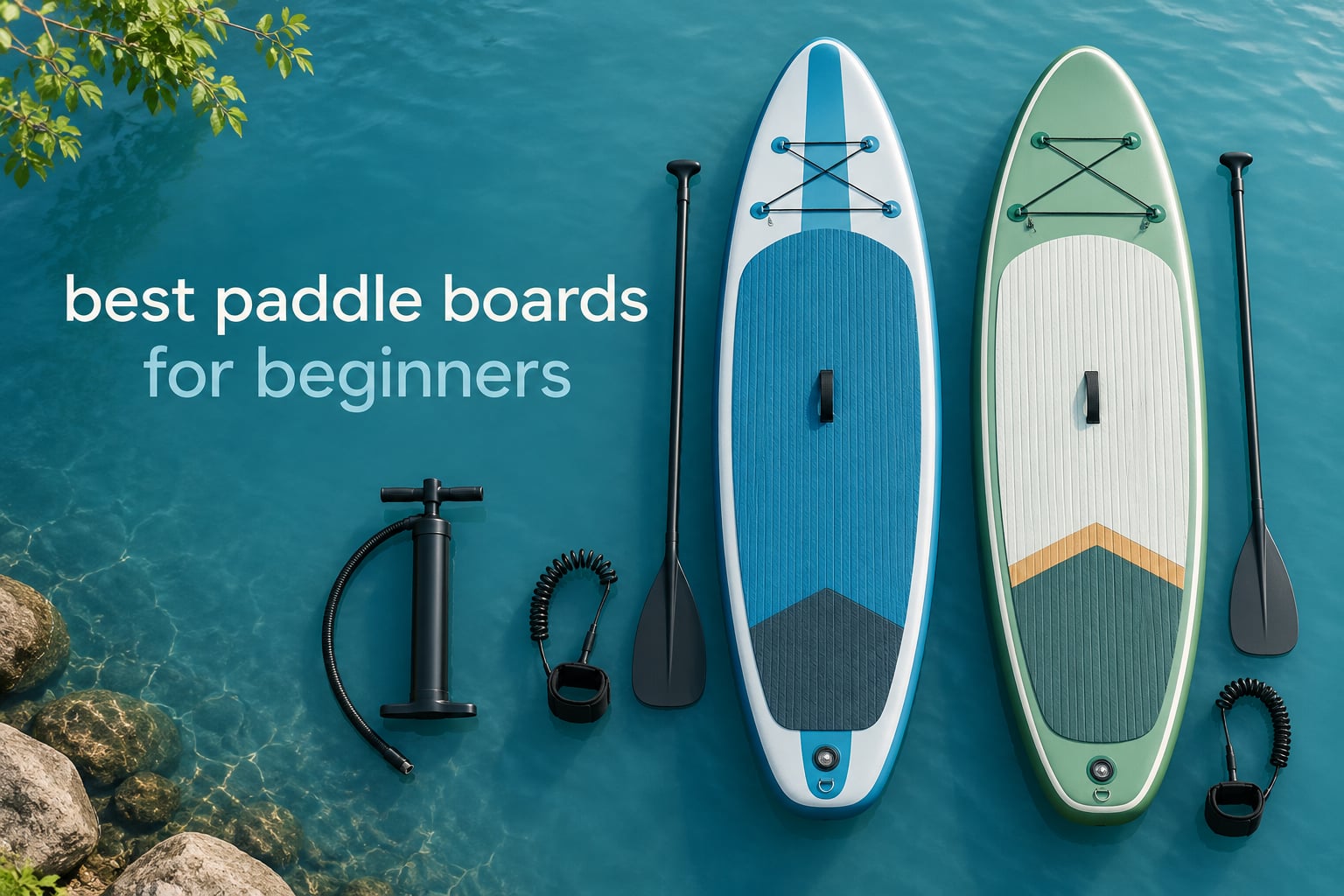
Picking your first stand up paddle board feels harder than it should. Every listing shouts about thickness and pounds of capacity, and almost none of them tell you the one number that actually decides whether you will still be paddling in October: the width of the deck under your feet. We spent weeks comparing the ten boards below on that single axis, plus the length, the listed capacity, the packed weight and what genuinely lands in the box.
Short version: if you are new to the best paddle boards for beginners, you want a deck between 32 and 36 inches wide, a length of 10 to 11.5 feet, and enough listed capacity to cover your own body weight with room to spare for gear. Anything narrower than 32 inches will feel twitchy, and anything with a capacity that barely clears your weight will flex under you. Everything else on the spec sheet is a nice-to-have.
One honest note before we start. All ten boards here are inflatables. That is deliberate. Hardboards are faster and last longer, but they need a roof rack, a storage spot and a short walk to the water, which quietly rules them out for most people buying a first board. We cover the tradeoff later in the guide so you know what you are giving up. If you are still torn after reading, tell us your budget, your height and weight, and whether you are paddling a lake, a river or open surf, and we will point you at one board.
Table of Contents
Top 3 Best Paddle Boards for Beginners in 2026


Quick Overview: 10 Beginner Paddle Boards in 2026
Every board below is an inflatable SUP with a 6 inch thickness, because thickness below that is where flex turns into wobble for a new paddler. Read across the deck width column first, then the capacity column.
| Product | Specifications | Action |
|---|---|---|
| Roc Inflatable SUP 10’6" |
|
Check Latest Price |
 FunWater Inflatable SUP with Kit FunWater Inflatable SUP with Kit |
|
Check Latest Price |
| Niphean 10’6" Inflatable SUP |
|
Check Latest Price |
 SereneLife 10′ Inflatable SUP SereneLife 10′ Inflatable SUP |
|
Check Latest Price |
 FBSPORT 11′ Premium SUP FBSPORT 11′ Premium SUP |
|
Check Latest Price |
| Skatinger 11’6" Super Wide SUP |
|
Check Latest Price |
 FEATH-R-LITE 10′ Inflatable SUP FEATH-R-LITE 10′ Inflatable SUP |
|
Check Latest Price |
 ZLX 11’6" Inflatable SUP ZLX 11’6" Inflatable SUP |
|
Check Latest Price |
 Sloosh 10’6" Inflatable SUP Sloosh 10’6" Inflatable SUP |
|
Check Latest Price |
 Portal 10’6" Inflatable SUP Portal 10’6" Inflatable SUP |
|
Check Latest Price |
1. Roc Inflatable SUP 10’6″ – Our Best Overall Beginner Board
Roc Inflatable Stand Up Paddle Board 10′ 6″ with Premium SUP Paddle Board Accessories, Wide Stable Design, Non-Slip Comfort Deck for Youth & Adults (Ocean Current)
126 inch L x 33 inch W x 6 inch thick
350 lb weight limit
PVC with EVA deck
3 year warranty
Pros
- 33 inch deck gives confident balance for a first outing
- 350 lb capacity covers most adults plus a dog
- 3 year manufacturer warranty
- Complete accessory pack with paddle leash pump and bag
- Backpack is genuinely small when deflated
Cons
- Front carrying strap can break after limited use
- 10 to 15 minutes of hand pumping to fully inflate
- Large fin clip is awkward to disengage by hand
The Roc board is the one we kept reaching for. It sits at 126 inches by 33 inches by 6 inches, which is the sweet spot of this entire roundup: wide enough that a sloppy stance does not end you, narrow enough that turning toward a friend does not feel like driving a truck. For a first season, that balance matters more than any performance spec.
Owners consistently describe it as holding pressure and staying leak-free across multiple summers of regular use, and the deck grip gets called out as a genuine strength. It is also the single most-reviewed board here by a wide margin, which means you will find plenty of long-term accounts from people who actually paddled it rather than one weekend.
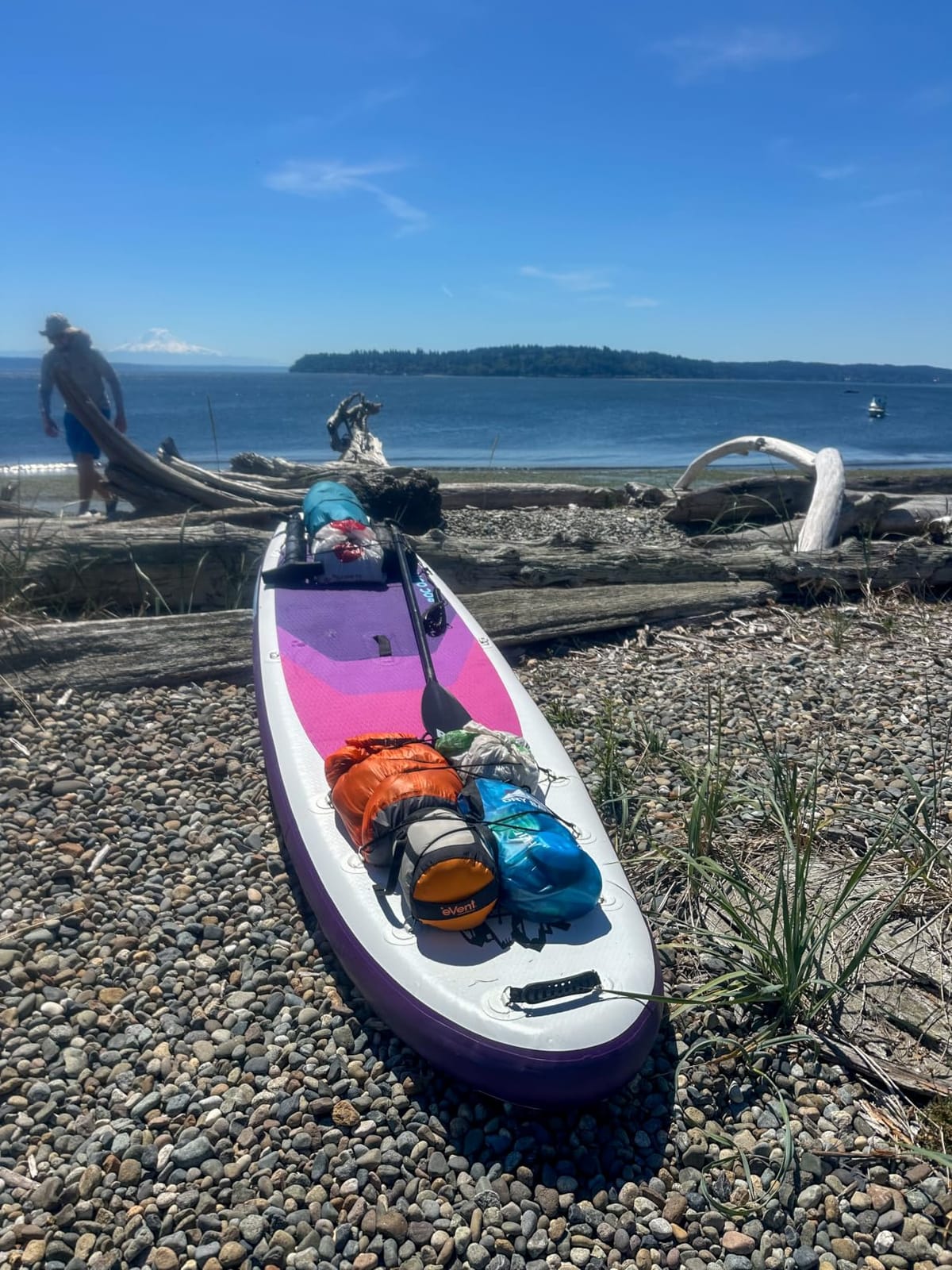
The listed capacity of 350 pounds is generous without being theoretical, and the material is rated by the manufacturer at 50 percent stronger than competing boards. The bungee cargo area at the front holds a dry bag and a water bottle without them sliding around, and the reversible paddle doubles as a kayak paddle if you want to sit down and rest.
The one friction point that comes up again and again is inflation. Getting to full pressure with the included manual pump takes 10 to 15 minutes, and several owners recommend an electric pump straight away. If pumping is going to spoil your first outing, budget for that before the board leaves your hands.
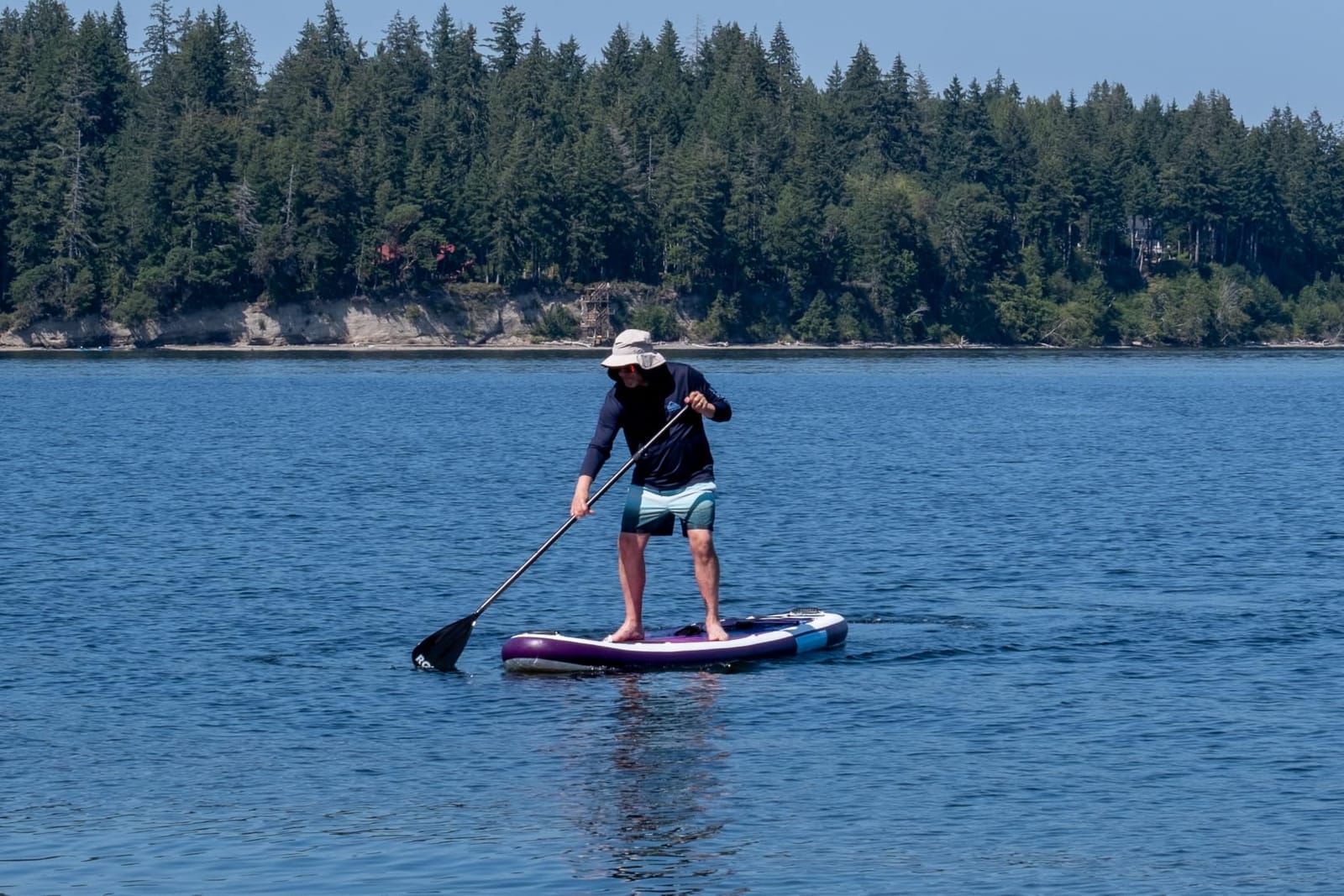
Is the Roc wide enough if you are a heavier paddler
At 33 inches it is not the widest board in this list, but the 6 inch thickness means it holds its shape well under load. If you weigh under 250 pounds and paddle on a lake or slow river, the extra stability of a 35 inch deck will not change your experience much.
If you are over 250 pounds, or you regularly take a dog aboard, look at the Skatinger instead. Its 35 inch deck and 450 pound capacity leave far more margin, and you will feel the difference on a windy afternoon.
What you compromise with this board
The fin system is the weak spot. The large center fin is what makes the board track straight, but it clips on with a mechanism that several owners find genuinely hard to release by hand, so expect a fight every time you pack the board down.
The front carrying strap also shows up as a durability complaint from owners who have dragged the board to the launch more than a few times. It is not a deal breaker, but hold the board by the side handles instead and it will outlast your expectations.
2. FunWater Inflatable SUP – Best Complete Kit in the Box
FunWater Inflatable Stand Up Paddle Board with Beginners SUP Accessories
131.9 inch L x 33.9 inch W x 6 inch thick
15 psi max pressure
300 lb weight limit
EVA deck
Pros
- Largest accessory bundle in the roundup
- 33.9 inch deck is one of the wider beginner platforms
- Anti-slip EVA deck pad cushions bare feet and knees
- Three detachable fins give balanced tracking
- Center handle makes solo carrying straightforward
Cons
- Manual inflation with the included pump takes real effort
- 4.4 rating trails the category leaders
- Build consistency reported as mixed
The FunWater is the pick if you want to walk to the lake the same afternoon it arrives. The box contains the paddle, the fins, a pump, a backpack, a leash and a phone bag, which is more than most competitors include and means you are not making a second shopping trip before your first paddle stroke.
At 131.9 inches by 33.9 inches by 6 inches, the platform is fractionally longer and slightly wider than the Roc. Reviewers describe it as a balance of stability and maneuverability rather than a flat, barge-like ride, which is the right characterization for someone still learning to steer.

The upgraded EVA deck pad is the feature buyers mention most. It grips well when wet and adds cushioning you feel after twenty minutes of kneeling, which matters because every beginner spends the first ten minutes of every session on their knees. The three detachable fins keep the board tracking without feeling locked into a straight line.
Reviewers also highlight the elastic cord cargo area as more secure than it sounds, and the center handle as the reason one person can manage the whole board alone. This is a well-thought-out kit for the money.
Is a 33.9 inch deck too much board for a small paddler
No, but be honest about the weight. This is one of the heavier kits in the group, and the packed weight is listed at roughly 11.93 kg. If you plan to carry your board a long way from the car, test the lift before you commit.
If your priority is the smallest possible load to haul, the FEATH-R-LITE is lighter to move even though its deck is narrower. If your priority is forgiveness on the water, this wider deck is the better trade.
What you compromise with this board
The 4.4 rating is the second lowest here, and the reviews behind it point to some inconsistency in build quality between units. If you are fussy about finishes and seams, read a few of the critical reviews before ordering.
The included pump is manual and takes real effort to bring the board to its 15 psi rating. That is the single most common regret in the reviews, and it is an easy fix with an electric pump.
3. Niphean Inflatable SUP 10’6″ – Best Value for Two Up or a Dog
Niphean Inflatable Stand Up Paddle Board with SUP Accessories,Green Wood
126 inch L x 33 inch W x 6 inch thick
450 lb weight limit
20 psi max pressure
19 lb packed
Pros
- 450 lb capacity fits two adults or a family and a pet
- 20 psi rating gives a rigid hard-board-like feel
- 11 D-rings accept a kayak seat cooler or linked boards
- 3 year manufacturer guarantee with 30 day returns
Cons
- 19 lb is heavy for a single-carrier hike
- Included pump gauge reads unreliably
- Nose angles slightly upward and can catch in chop
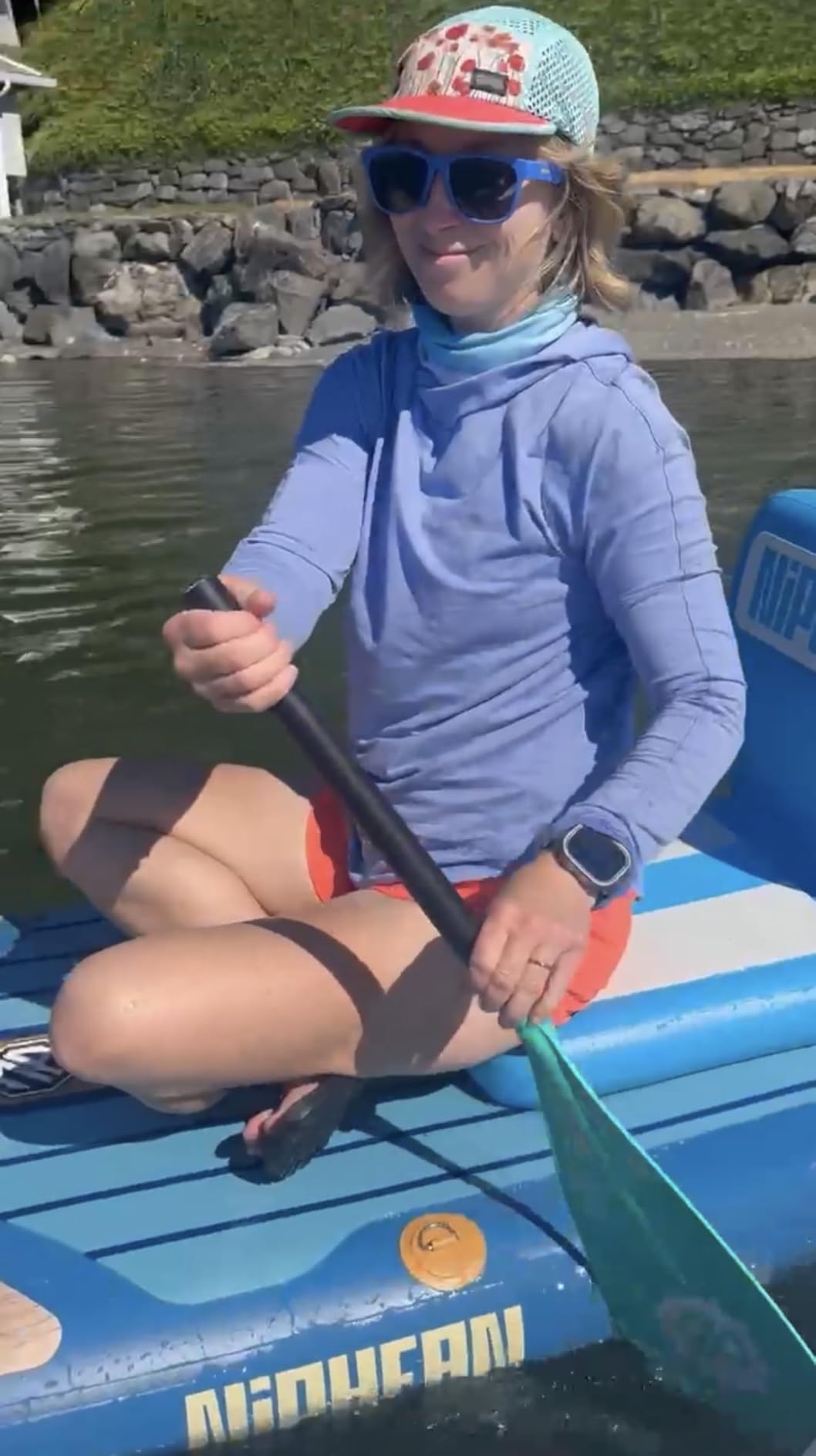
Everything in the box, including the adjustable paddle, three detachable fins, a safety leash, a pump, a backpack, a waterproof phone bag and a repair kit. The 450 pound listed capacity is the joint-highest here, and it is the reason this board turns up in so many conversations about beginners who want to share the board.
Reviewers call the stability exceptional for first-timers and specifically credit the StabilTrac center fin with improving both balance and tracking. At 20 psi the board feels closer to a rigid epoxy board than a bouncy inflatable, which is exactly what you want while your technique is still rough.
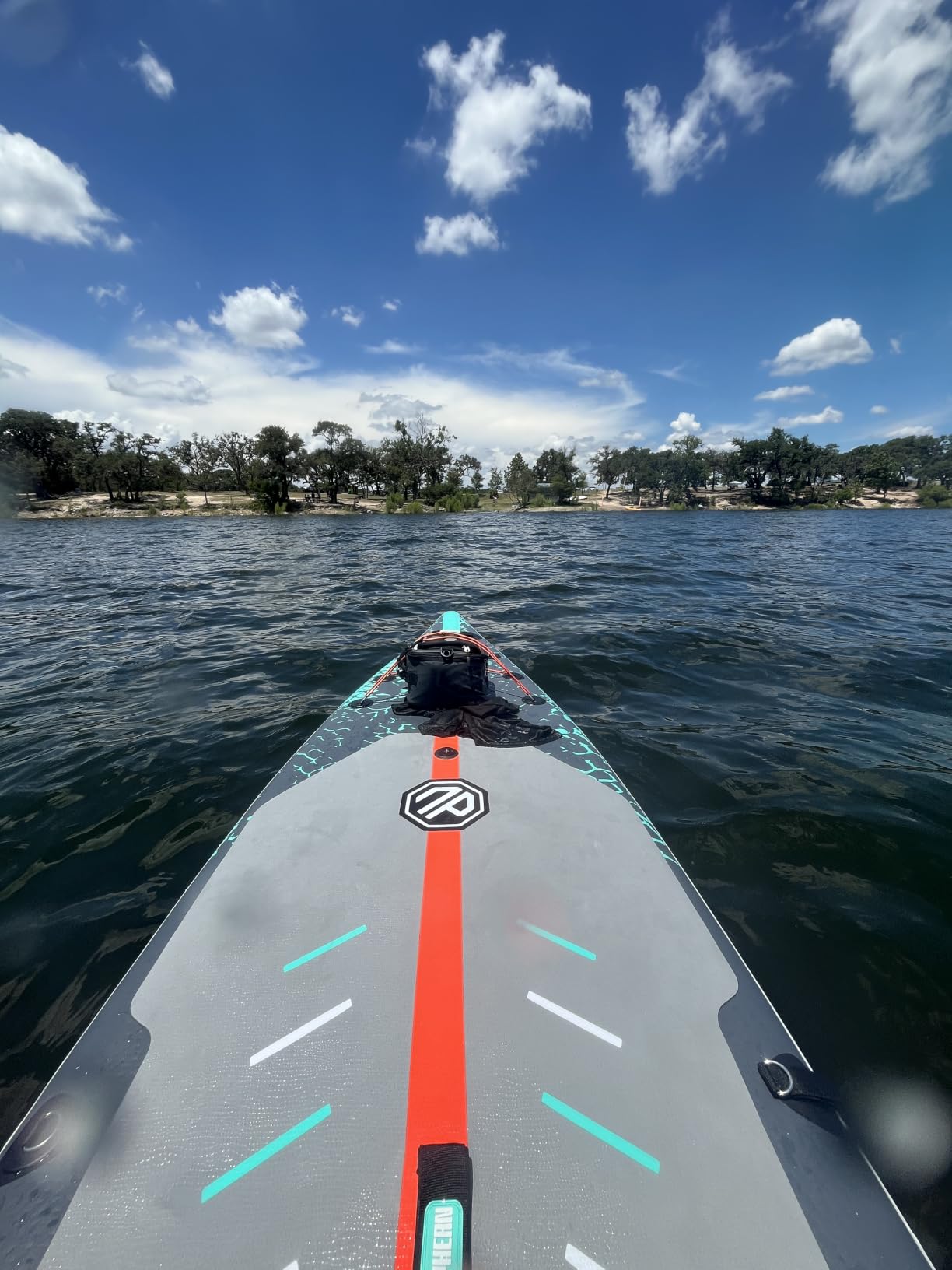
The 11 D-rings are unusually useful. You can bolt on a kayak seat, strap a cooler, or link two boards together for a longer stable platform. The anti-slip EVA deck is described as durable and grippy, and the double handles plus detachable tail fins make dragging the board to the water a one-person job.
It is also portable in the way that matters. Owners note it fits in a car without roof racks, which removes one of the most common reasons people abandon a rigid board.
Does the 450 pound capacity mean the board feels soft under one rider
Not at 20 psi. The high pressure rating is what lets this board hold shape with a single person aboard, and it also means you will need a pump that can deliver real pressure. Under-inflating it to 15 psi is leaving the board’s main advantage unused.
Owners do report a slightly sporty nose profile that can catch in chop. On mirror-flat water that is irrelevant; on a breezy afternoon you will feel it, and the Niphean is not the board for open surf.
What you compromise with this board
The packed weight of 19 pounds is on the heavy side, and reviewers who carry it any distance mention it. Add a backpack, a paddle and a pump and you are carrying a real load from the car to the launch.
Two smaller annoyances: the hand pump’s PSI gauge does not read reliably, and the paddle shaft can get uncomfortably hot in direct sun. Neither is serious, but both are avoidable with an electric pump and a paddle cover.
4. SereneLife 10′ Inflatable SUP – Best Budget Entry Point
SereneLife Inflatable Stand Up Paddle Board – Wide Stable Design, Non-Slip Deck for Adults & Youth with Premium Paddle Board Accessories: Carry Bag, Dual Action Pump, Paddle, Ankle Leash – 10′
120 inch L x 32 inch W x 6 inch thick
Double-layer PVC
275 lb weight limit
15 psi
Pros
- Lowest entry cost of the roundout
- Double-layer drop stitch resists punctures well
- Pumps up firm and feels close to a hard board
- Carry bag has a ventilated window for wet gear
- Long-standing owner reports of years of family use
Cons
- 32 inch deck is less forgiving than 33 to 35 inch boards
- Single-bladed paddle is included
- Pump gauge does not register until near maximum
The SereneLife is the board we would put in front of someone who is genuinely undecided about whether they even like paddleboarding. It is the least expensive way to find out, and the reviews suggest it will outlast that decision.
Long-standing owners frequently report the board still performing after years of heavy family use, with deck grip, tracking and value for money rated highest. That long-term track record matters more than any spec line, because most beginners buy a board they will grow out of rather than one they will keep for a decade.
The material is double-layer drop stitch reinforced PVC, which is a step up from single-layer shells in puncture resistance and in how firmly it holds pressure. At full inflation it feels closer to a hard board than the price suggests, and reviewers consistently single that out.
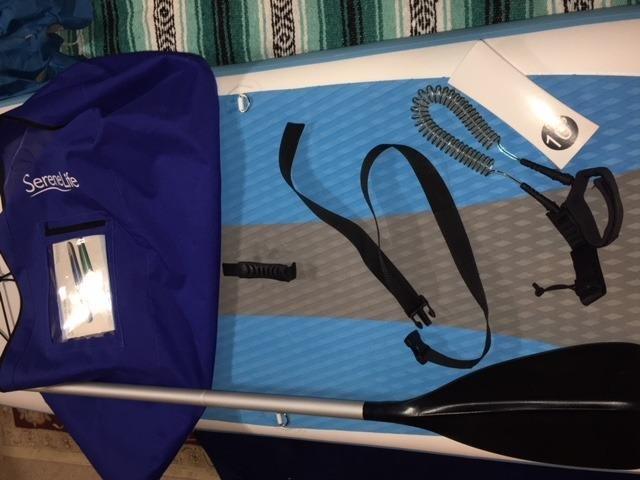
The kit includes a three-piece aluminum paddle, a leash, a removable fin, a repair kit and a backpack. The bag’s ventilated webbed window for wet gear is a small touch that shows someone thought about how a board actually gets used.
Is 32 inches wide enough for a beginner
It clears the beginner floor, so yes for most adults on flat water. It is one inch narrower than the Roc and nearly four narrower than the Skatinger, and that gap shows up under heavier riders or in any kind of chop.
If you weigh under 180 pounds and paddle a lake, the 32 inch deck is fine and you will notice the extra agility. Above that, step up a size.
What you compromise with this board
The capacity figure of 275 pounds is the lowest here that still works for an adult, which leaves very little margin for a second rider, a dog or a cooler. This is a one-person board and should be treated as one.
The included paddle is single-bladed, which is a real downgrade against the three-piece adjustable paddles elsewhere. Budget for a replacement early, and check the pump gauge carefully, since it does not register until near maximum pressure.
5. FBSPORT 11′ Premium SUP – Best for Long Lakes and Yoga
FBSPORT 11′ Premium Stand Up Paddle Board, Yoga Board with SUP Accessories & Carry Bag | Wide Stance, Surf Control, Non-Slip Deck, Leash, Paddle and Pump for Youth & Adult (MintGreen)
11 foot L x 33 inch W x 6 inch thick
15 psi max pressure
280 lb weight limit
Pros
- 11 foot length tracks straight on open water
- 33 inch deck keeps a wide stance stable
- Triple-fin setup with one large removable fin
- Soft non-slip deck pad reduces fatigue and falls
Cons
- 280 lb capacity is low for two riders
- Coiled ankle leash is not ideal in open surf
- Heavier at roughly 13.49 kg
Length is the whole argument here. An 11 foot board glides straighter and carries more speed per stroke than a 10 foot board, and reviewers rate the wide stance plus the length combination as very stable for standing. If your water is a long lake rather than a pond, that extra foot is worth more than any feature on the list.
The military-grade thickened drop-stitch material keeps the board light for its size while still feeling durable underfoot, and the soft non-slip deck pad reduces both fatigue and the number of falls new paddlers take.
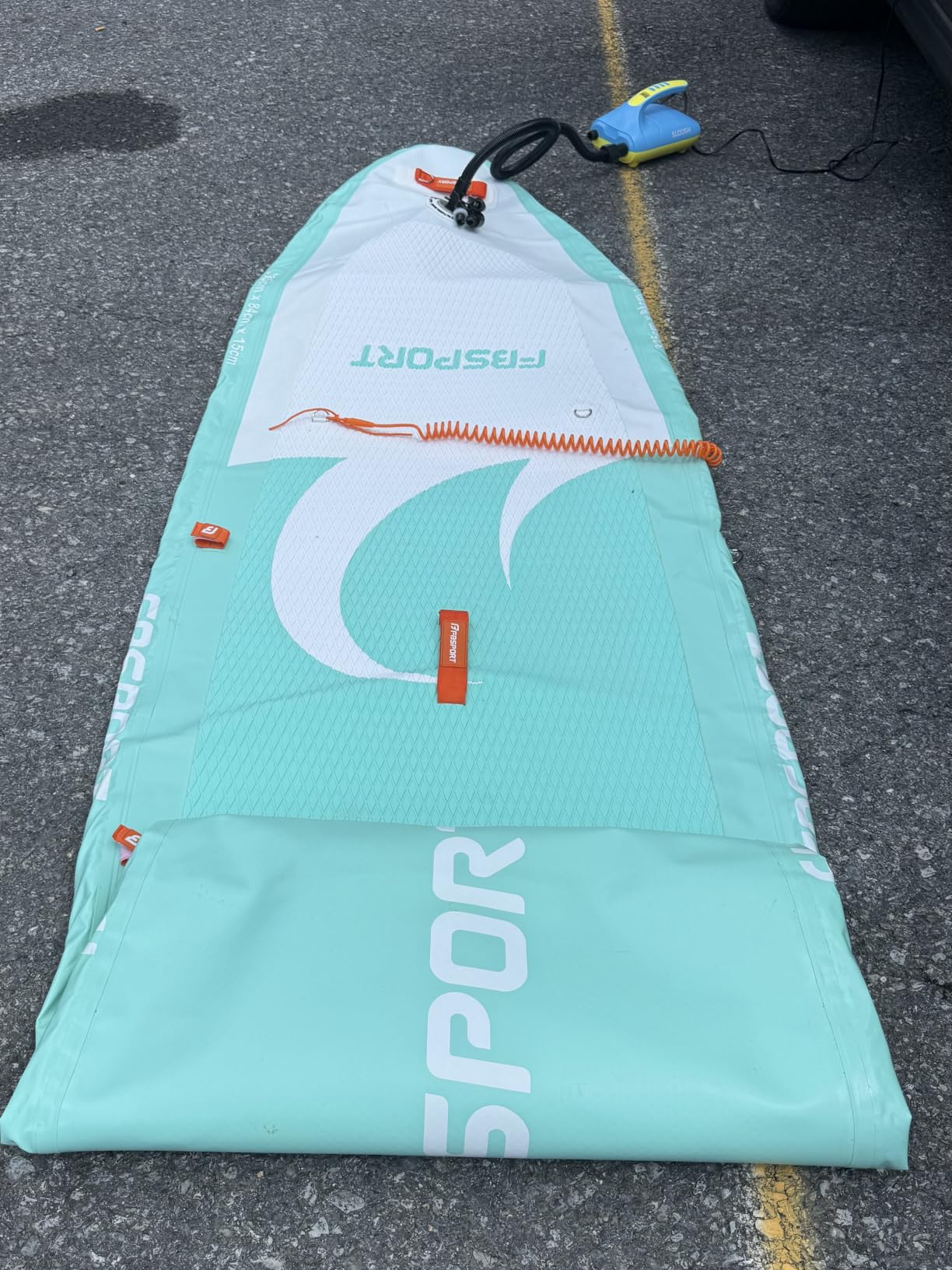
The triple-fin setup, including one large removable fin, improves both speed and steering. You can pull the big fin for flat-water cruising and drop it in for shallower spots, which is a flexibility you do not get from a fixed two-fin board.
The bundle is complete out of the box with the board, paddle, leash, pump and carry bag. Buyers rate the package highly for what comes with it, and the listed uses cover sea, lakes, rivers and small waves.
Is 11 feet too long for a total beginner
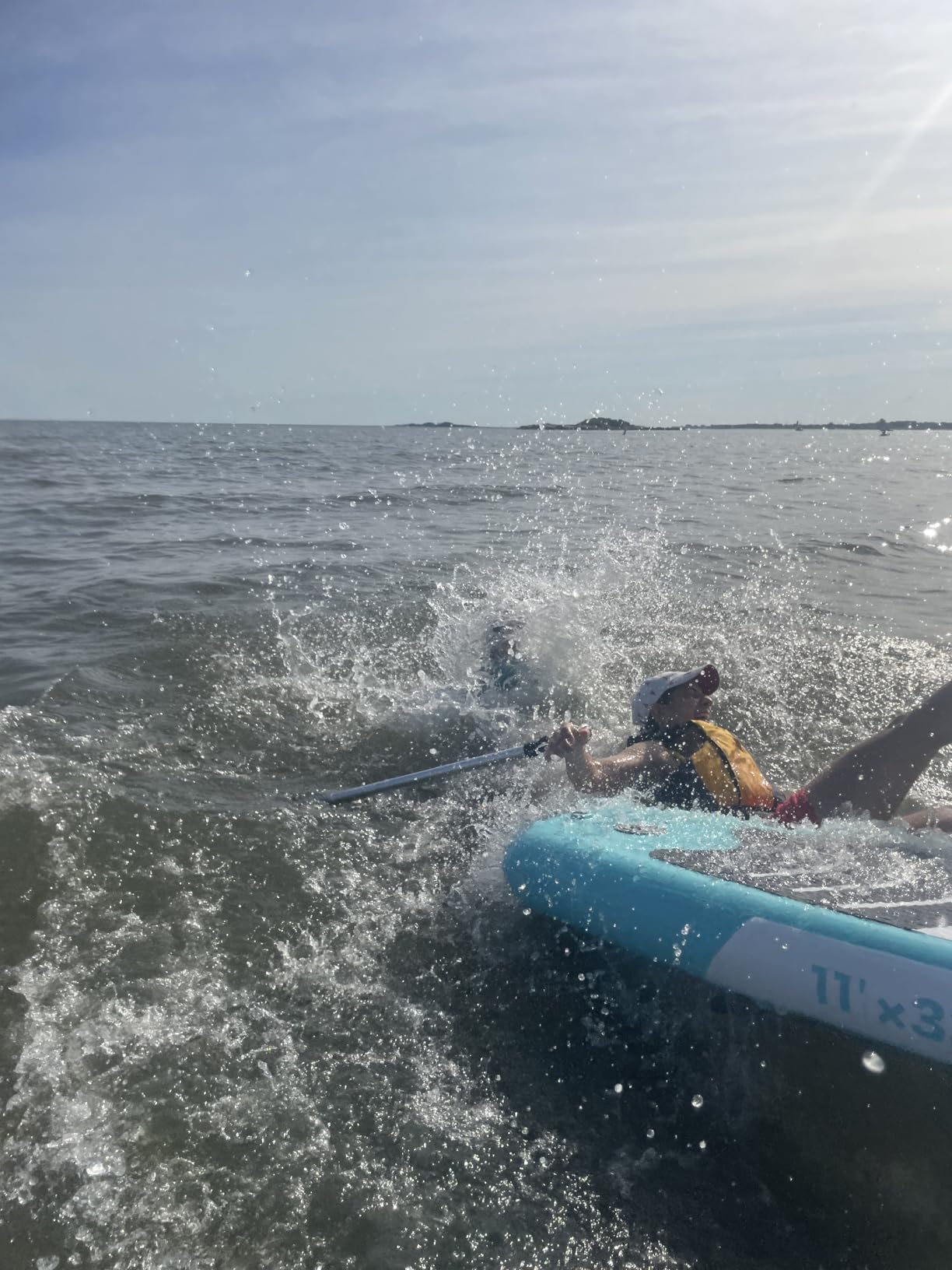
Longer boards feel more stable, not less, once you are standing. The trade is turning: a longer board needs more effort to pivot, which matters if your water is full of obstacles or you plan to surf small waves.
For open water and yoga poses, where you want glide and a stable platform, 11 feet is a good pick. For tight spots and chop, look at a 10 foot 6 inch board.
What you compromise with this board
The 280 pound listed capacity is the second lowest in this roundup and rules out a second adult rider. If you want to share the board or bring a large dog, this is not the one.
The included leash is a coiled ankle type, which is fine on a lake but can snag in open ocean surf. And at roughly 13.49 kg this is not a lightweight carry despite the length.
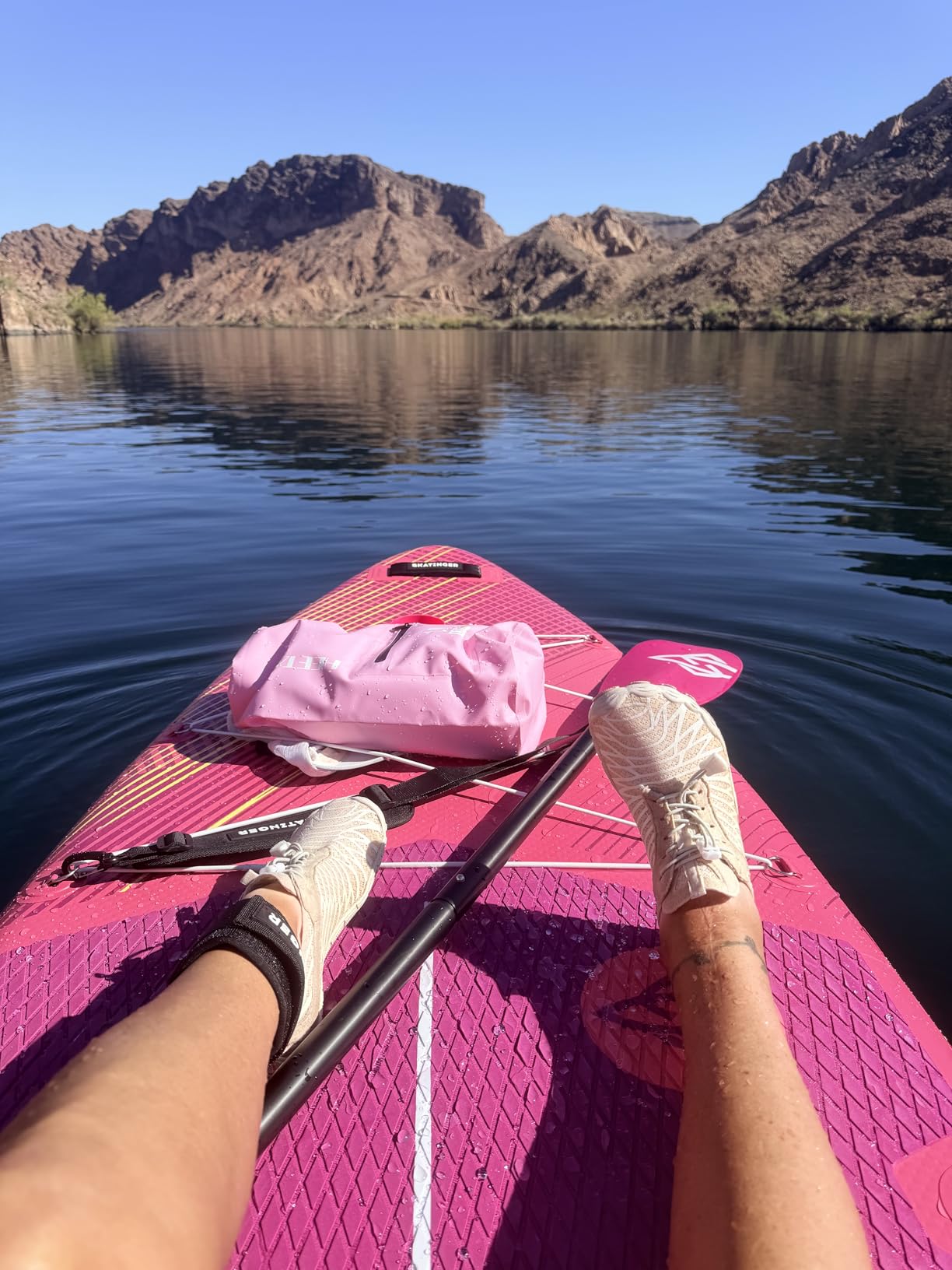
6. Skatinger 11’6″ Super Wide SUP – Best for Big Riders and Families
Skatinger 11’6×35″ Super Wide Inflatable Paddle Board, Ultra Stable Stand Up Paddleboards for 450lb/3 People/Family/Big Size w/Shoulder Strap, 100L Backpack, Ultra-Light All-Round Sup Board, Blue
138 inch L x 35 inch W x 6 inch thick
450 lb weight limit
20 psi rated
Pros
- 35 inch deck is the widest here and extremely stable
- 450 lb capacity fits two adults plus a child or dog
- 1680D backpack with chest hip and side straps
- Three handles plus a shoulder strap make solo carrying manageable
Cons
- Reaching 15 PSI by hand is exhausting in heat
- Instructions are not very detailed
- Kayak seat is not included
This is the board to look at if your body weight is the thing worrying you. At 138 inches by 35 inches by 6 inches it is both the longest and the widest board we tested, and owners describe it as exceptionally stable and genuinely family-friendly.
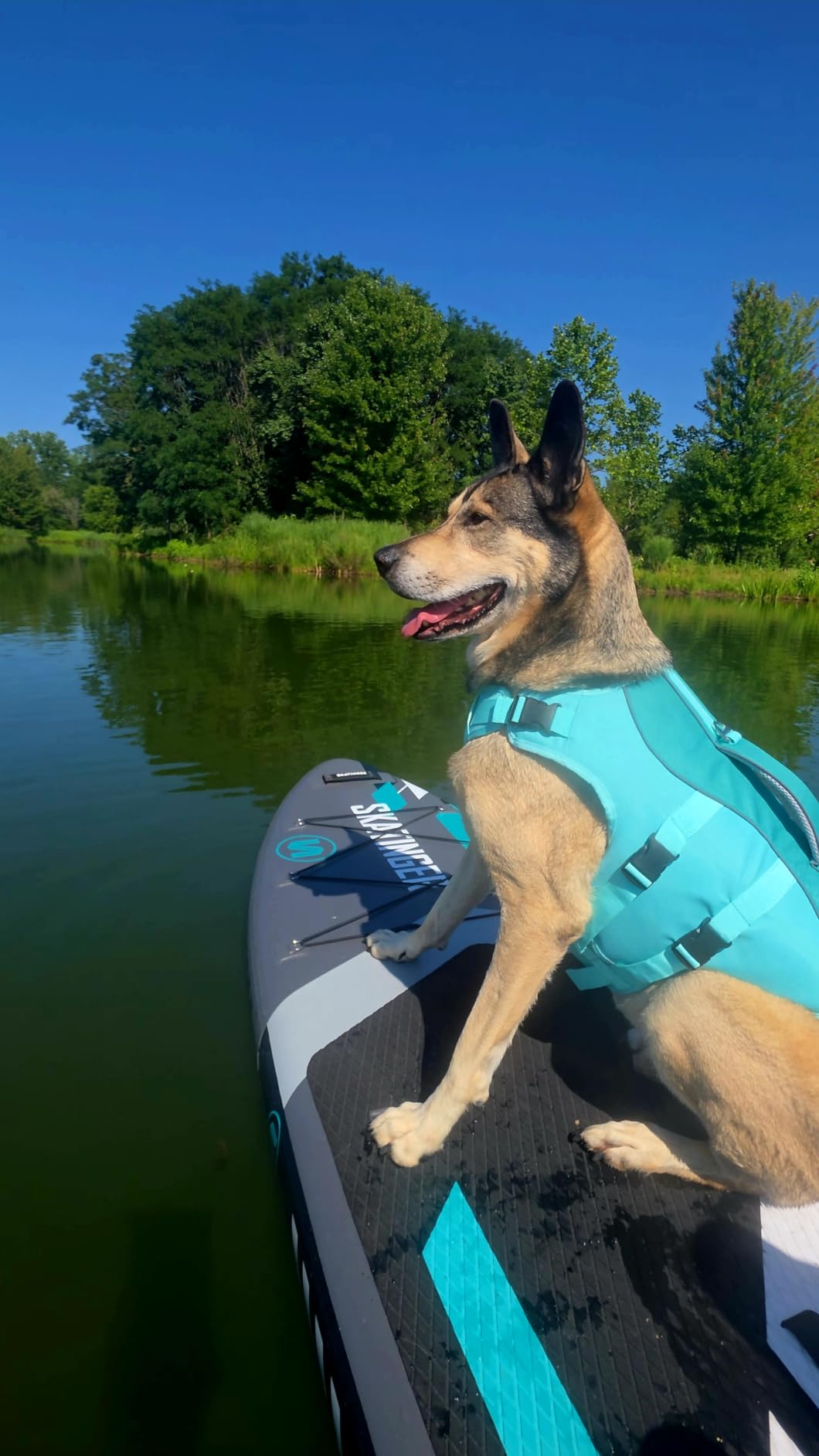
The 450 pound listed capacity is the joint-highest here, and it is what lets two adults plus a child or a dog share one board. That turns a single-purpose purchase into the whole summer’s watercraft.
The 10 inch US big fin is the reason it tracks straight in light chop despite the size, and the dual-layer sidewall construction holds pressure well with no reported leaks over a year of use. Reviewers mention pressure retention more than they mention almost anything else.
The 1680D backpack with chest, hip and side straps is far more durable than a standard bag, and the review consensus singles it out by name. With three central D-rings you can add a kayak seat or a shoulder strap later.
Is a 35 inch deck too unwieldy for one person learning
It is wide, but wide is forgiving, and beginners consistently find wide boards easier to stand on. What you trade away is maneuverability in tight water and a slightly heavier carry at 19.8 pounds.
If your water is open and your goal is shared outings with family or a dog, the extra width is exactly what you want. If you plan to paddle narrow creeks, pick something closer to 33 inches.
What you compromise with this board
The manual pump is the dominant complaint across the reviews. Owners report that reaching 15 PSI by hand is exhausting, especially in heat, and the single most common recommendation is to buy an electric pump instead of fighting the included one.
The instructions are also described as not very detailed, which matters more than usual on a board this wide because the dual bungee system is easy to set up wrong. And the kayak seat some buyers expect is not included.
7. FEATH-R-LITE Inflatable SUP – Best for Lightweight Travel
FEATH-R-LITE Inflatable Stand Up Paddle Board with Beginner SUP Accessories
118.1 inch L x 31.5 inch W x 6 inch thick
330 lb weight limit
18.9 lb packed weight
Pros
- Shortest overall length keeps the packed bag compact
- Three-fin system gives balanced handling
- Anti-slip EVA deck grips well
- Complete accessory set for immediate use
Cons
- 31.5 inch deck is narrower than the beginner sweet spot
- Lowest rating here at 4.3 with 8 percent one-star reviews
- 18.9 lb is heavy for its size
The pitch here is portability. At 118.1 inches it is the shortest board in the roundup, and buyers cite how easily it carries when deflated. If your water is a fifteen-minute walk from a car park or your storage is a hall closet, the compact packed size is the deciding factor.
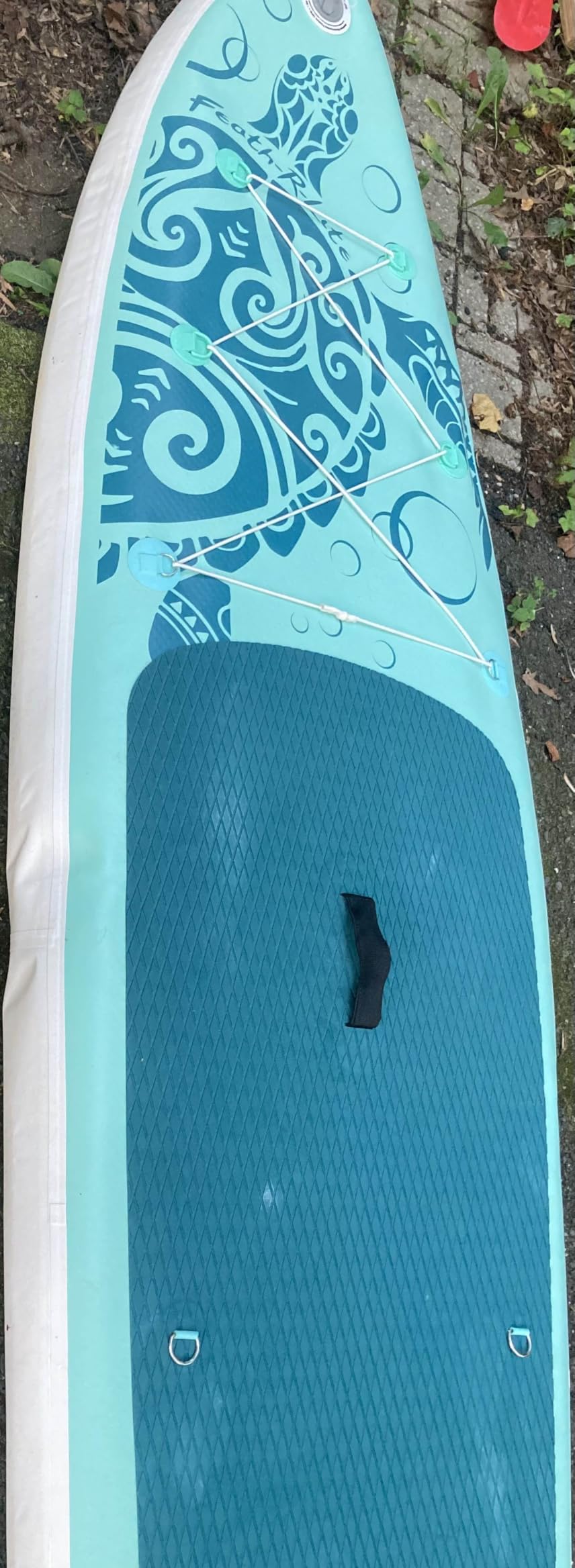
Everything else is competent. The three-fin system gives balanced handling and maneuverability, the EVA deck holds grip, and the box includes the paddle, fins, leash, pump, backpack, phone bag and repair kit. The turtle graphic colorways are a genuine curiosity for a board that has to live in your hallway.
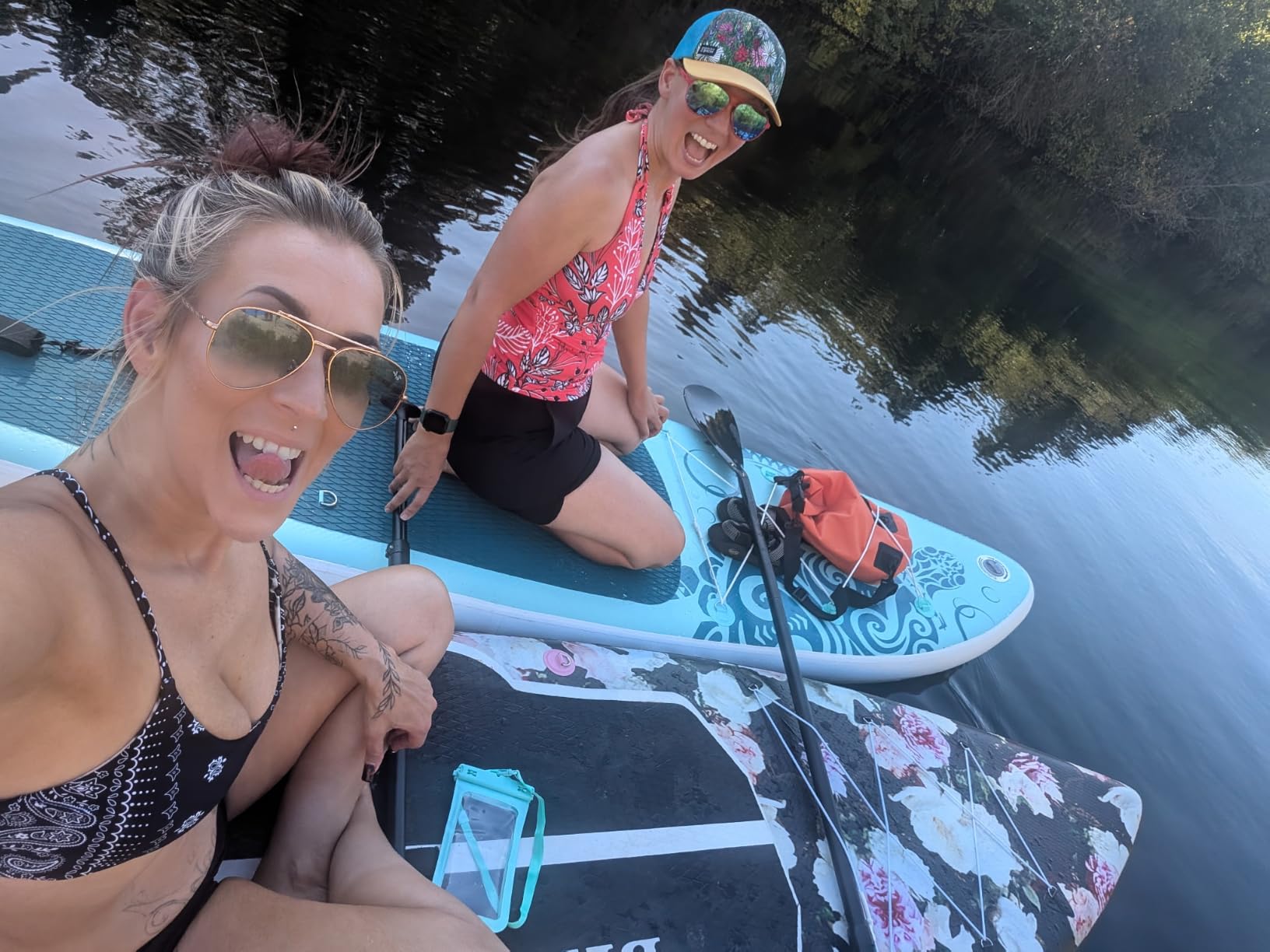
Where it falls down is width, and the reviews are unusually honest about that. A 31.5 inch deck sits just below the beginner threshold we use throughout this guide, so a new paddler will feel more wobble here than on any other board we tested.
Less satisfied buyers focus on rigidity and on the deck width relative to their expectations. That is a fair complaint, and it is the reason this board sits below the heavier hitters in our ranking despite a perfectly reasonable feature list.
Is 31.5 inches too narrow for a first board
It is at the edge. It will work on mirror-flat water for a lighter paddler, but it gives away the forgiveness that makes the first ten sessions fun. We would not recommend it to someone whose main worry is falling over.
If portability is your real constraint, this board works. If stability is your real constraint, add two inches of width and accept a slightly larger bag.
What you compromise with this board
The 4.3 rating is the lowest in this group, with about 8 percent of reviews at one star. That points to a wider spread of build experience than the top boards, so inspect the seams carefully when it arrives.
It is also heavier than you would expect at 18.9 pounds, which undercuts the portability argument somewhat. The listed dimension of 31.5 inches also differs from the 33 inch platform described in the feature copy, so check the actual deck before ordering.
8. ZLX 11’6″ Inflatable SUP – Best for Distance Paddling
ZLX Inflatable Paddle Board, 11’6″/10’6″ x 33″ Stable Stand Up Paddleboard
138 inch L x 33 inch W x 6 inch thick
15 psi working pressure
3 year warranty
Pros
- Removable StabilTrac center fin visibly improves beginner balance
- Slender 11 foot 6 inch touring shape glides fast and tracks straight
- 33 inch deck stays stable with two riders seated
- Front and rear bungee systems with 14 D-rings for gear
Cons
- 28.2 lb total with accessories is the heaviest kit here
- Paddle gauge does not register below roughly 6 to 7 PSI
- Kayak conversion paddle insert clasp loosens
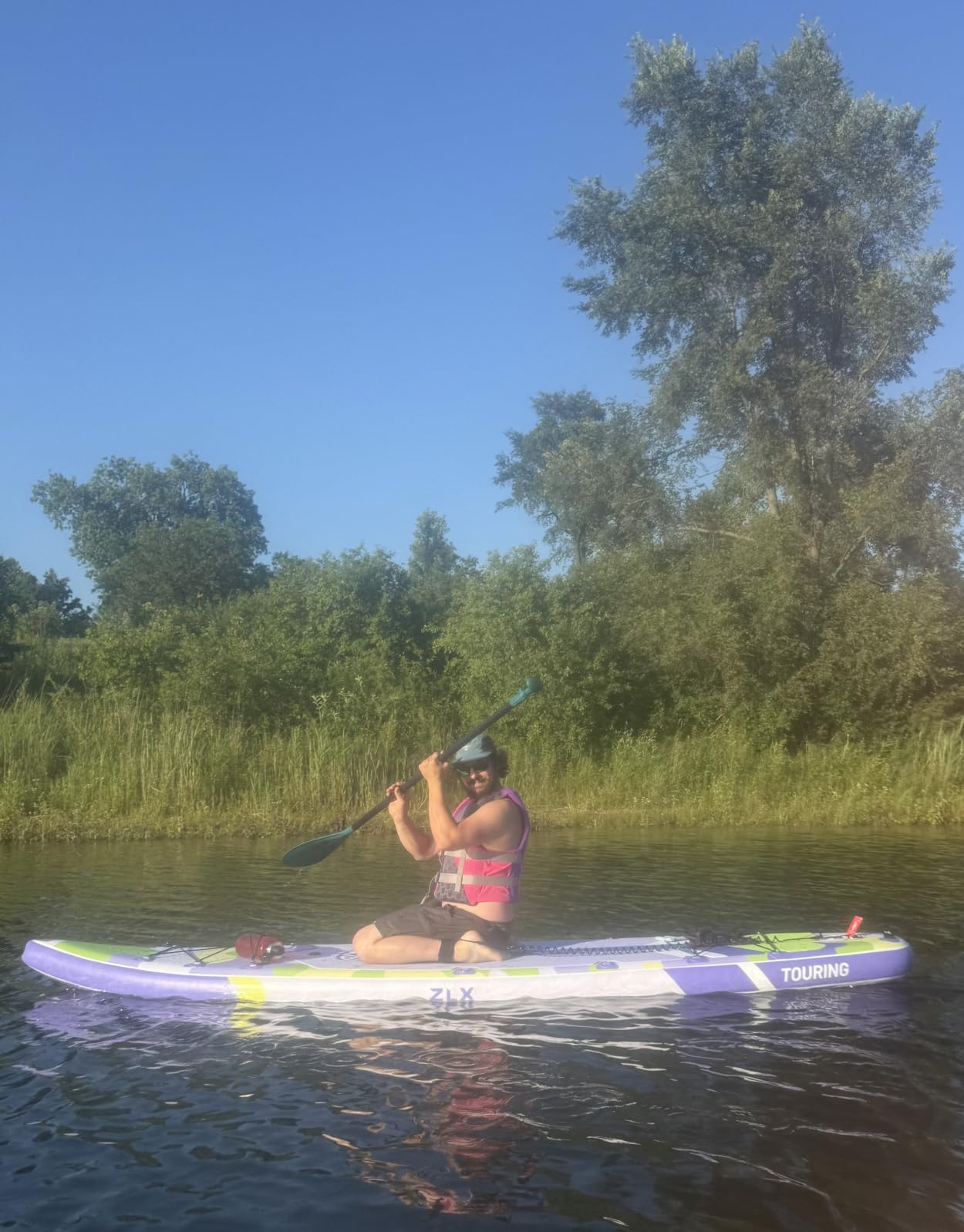
If your plan is to cover distance rather than loop around a bay, the ZLX is the shape you want. The slender 11 foot 6 inch touring profile glides fast and tracks straight, and that long nose is the clearest performance difference between this board and the rest of the list.
What makes it interesting for a beginner is the removable StabilTrac center fin. Owners consistently report that it gives new paddlers noticeably better balance, so you get the tracking benefits of a center fin without having to learn to turn around it while you are still finding your feet.
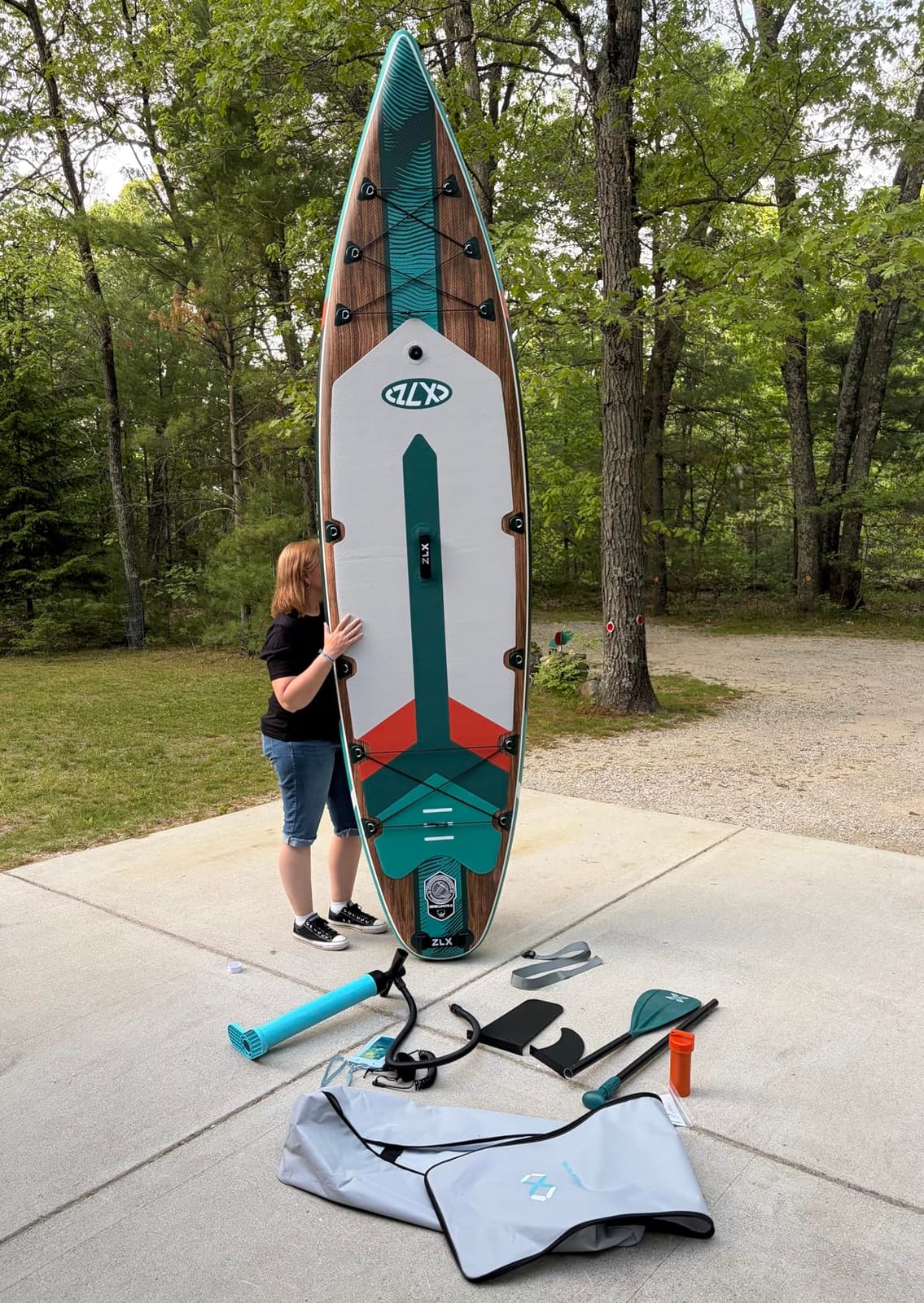
The 33 inch deck stays stable even with two riders sitting, which is unusual for a board this long. Front and rear bungee systems plus 14 D-rings give you serious cargo options for a day trip, and the high-density drop-stitch material reaches 12 to 15 psi comfortably.
Customer service also gets called out for resolving warranty issues quickly, and the board carries a 3 year warranty with parts availability stated for three years after purchase.
Does the long nose make this board harder to turn
Yes, and that is the deal. Long boards resist pivoting, which is fine when you are covering ground in a straight line and annoying when you are working around a shoreline or through boat traffic.
Start on open water. Once you are comfortable turning, the tracking and glide are noticeably better than any 10 foot board here.
What you compromise with this board
The packed weight of 28.2 pounds with accessories is the heaviest kit in this roundup, and owners say so. Rear and center handles make it manageable, but this is not the board to hike in on a solo trip.
The paddle gauge does not register below roughly 6 to 7 PSI, which causes real confusion when you are inflating, and the kayak conversion insert clasp loosens and the insert is easily lost. Some owners also report glue yellowing after UV exposure, which is cosmetic rather than structural.
9. Sloosh 10’6″ Inflatable SUP – Best Rigid Feel Under Your Feet
SLOOSH Inflatable Stand Up Paddle Board, 10’6″ Paddle Boards with Premium Accessories, Non-Slip EVA Deck, Ultra-Light Carry Bag Pump, Ripple SUP for Youth & Adults of All Skill Levels, Misty Breeze
126 inch L x 33 inch W x 6 inch thick
20 psi max pressure
300 lb weight limit
Pros
- FortaFusion core feels rigid and hard-board-like at 20 psi
- Dual-action pump cuts inflation time by roughly 30 percent
- Round nose and wide tail improve first-timer stability
- Three reinforced handles plus a padded backpack
Cons
- 300 lb listed capacity is modest for two riders
- Heavier than ultralight boards at 15.22 kg
- Smallest review base in this group at 498 reviews
The Sloosh’s pitch is rigidity. The FortaFusion core with double-layer mesh-reinforced sidewalls is rated to 20 psi, and owners describe the board as feeling rigid and hard-board-like at that pressure. If flex under your feet is the thing you fear most, that is the answer.
The round nose and wide tail shape is a deliberate stability choice, and reviewers call out how much easier it makes things for first-timers compared with a narrow pointed nose.

The dual-action pump is the sleeper feature here. Owners report it cuts inflation time by roughly 30 percent against a standard pump, which goes directly at the complaint that appears on almost every other board in this roundup.
Three reinforced handles plus a fully padded backpack make transport reasonable, and the tri-fin setup tracks without feeling locked in. The listing copy also notes a 450 lb figure for a child or pet, which is worth knowing given the stated spec weight limit below.

Does a 20 psi rating mean you must inflate it to 20 psi
No. Inflate to the manufacturer’s recommended pressure and no higher, because over-inflating above spec can stress the seams. The rating is a ceiling and a measure of build quality, not a target.
What it does mean is that this board has the material to feel firm at a normal 15 to 18 psi, so you will get more of the hard-board experience out of it than from boards rated to 15.
What you compromise with this board
The listed weight capacity is 300 pounds, while the listing copy uses a 450 lb figure for a child or pet. Where those conflict, follow the spec sheet, and that means this is effectively a one-adult board.
It is also on the heavy side at 15.22 kg, and with 498 reviews it has the smallest review base in the group. Long-term durability data is simply thinner here than for the boards with five-figure review counts.
10. Portal 10’6″ Inflatable SUP – Best Modular Setup
PORTAL SUP Inflatable Paddle Board for Adults, 10’6” Stand Up Paddleboards, Non-Slip Deck Blow up Paddle Boards with Adjustable Paddle, Carry Bag, Emergency Repair Kit
126 inch L x 33 inch W x 6 inch thick
300 lb weight limit
Steel D-rings
Pros
- Stainless steel D-rings accept a kayak seat or linking two boards
- Two fixed fins plus a detachable snap-in center fin for direction
- Quick 10 minute inflation and 5 minute deflation
- Crisp-cross safety bungees keep gear in place
Cons
- Smallest review count here at 463
- Heavier than lighter competitors at 17.8 lb
- Only a 1 year manufacturer warranty
The Portal is the one to buy if you already know you will want to reconfigure. The stainless steel D-rings let you bolt on a kayak seat, clip in a shoulder strap, or link two boards together into one long stable platform, and that flexibility is the main reason to pick it.
At 126 by 33 by 6 inches with a 300 pound listed capacity, the fundamentals are exactly right for a beginner. Owners highlight straightforward setup, stable tracking and a well-organized accessory kit.
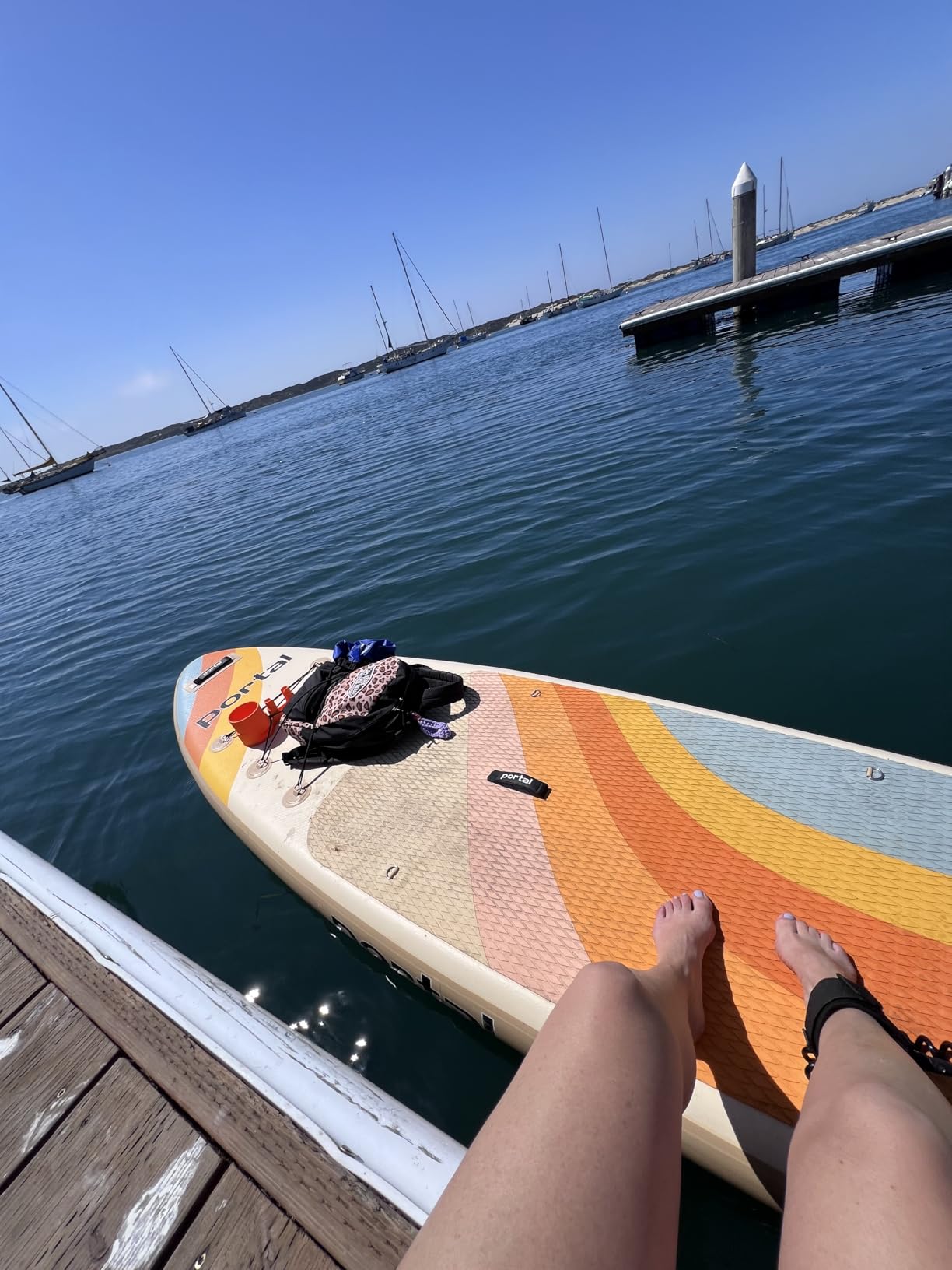
The fin layout is genuinely well thought out: two fixed fins for tracking plus a detachable snap-in center fin you can add when you want directional control and remove when you are in shallow or moving water. That is more adjustability than most boards at this level offer.
Fast setup matters more than it sounds. Owners report about 10 minutes to inflate and 5 minutes to deflate, which makes spontaneous sessions realistic. The crisp-cross safety bungees keep a bag or a package from sliding off the deck.

Is a 300 lb capacity enough if you are a larger paddler
It is enough for one adult under 250 pounds with a normal amount of gear. It is not enough for a second rider, and for anyone heavier you would be pressing the limit with no margin, which makes the board feel soft and unpredictable.
If you are over 250 pounds or you want to share the board, the Niphean or the Skatinger both give you 450 pounds and far more room.
What you compromise with this board
At 463 reviews it has the smallest review base of the ten, so there is less long-term durability feedback available. Treat the first few outings as a shakedown period.
The 17.8 pound packed weight is heavier than lighter competitors, and the warranty is listed at one year rather than the three years offered by several boards here. That is the main reason this board sits at the end of our ranking despite sensible specs.
How to Choose a Paddle Board for Beginners
Pick the type first, then the length, then the width, then the capacity, then the kit. Work through those in order and the choice makes itself. If you are still comparing options after this, our guides to beginner gear for a new hobby and picks that suit smaller users follow the same principle: match the tool to the person, not to the marketing.
Step 1: inflatable or hardboard
Start here because it eliminates half the market. An inflatable deflates into a backpack, stores in a closet, fits in most cars and travels in a suitcase. A rigid epoxy or soft-top board needs a roof rack, a garage and a walk to the water. If any of those are problems, inflatable is the only answer.
Step 2: choose a length between 10 and 11.5 feet
Length is speed and tracking. Ten feet is agile and easy to pivot, which suits small lakes, rivers and beginners who will fall over. Eleven feet glides straighter and carries you further per stroke, which suits open water and yoga. Beyond 11.5 feet you are into touring territory and you will feel every mistake.
Step 3: aim for a deck 32 to 36 inches wide
This is the single most important spec for a beginner, and the one most listings bury. Width is what stops a wobble becoming a swim. Below 32 inches the board feels twitchy under a beginner, and at 33 to 35 inches you can stand with a relaxed stance and focus on paddling technique instead of balance. The 35 inch end of the band is worth it if you are heavier or sharing the board.
Step 4: check the capacity against your body weight
Pick a board rated at least 50 pounds above your own weight. A board loaded to its limit flexes, and flex reads to a beginner as instability. This is also where the 250 pound ceiling bites, because the most common complaint from heavier riders is not falling over, it is a board that feels vague and unstable even when they are technically within the rating.
Step 5: check what the kit actually includes
You need a paddle, a pump, a leash, a carry bag and a repair kit to get started. Some boards throw in a phone bag or a kayak seat, which is welcome but not essential. A board that ships without a leash or with a single-bladed paddle means a second purchase before your first session.
Step 6: budget for an electric pump
Hand pumping a 6 inch board to full pressure takes 10 to 20 minutes, and it comes up as the single most common complaint in the reviews of nearly every board here. For paddleboards in this category, an electric pump is not a luxury. It is the difference between a spontaneous Saturday and a chore, and it is the first upgrade we would make.
Width, Length and Thickness Matched to Your Body Weight
Here is the rule we use, expressed as bands rather than a table so it works on any screen. Find your weight, then take the width and length from that line and add at least 50 pounds of margin on the capacity figure.
Under 130 pounds: a 32 to 33 inch deck and 10 feet is plenty. You can go narrower and shorter to save pack weight, though a 6 inch thickness is still worth it.
130 to 200 pounds: this is the core beginner range. Aim for 33 inches wide and 10 to 11 feet, with a capacity of 275 to 350 pounds.
200 to 250 pounds: step up to 33 to 35 inches and favour 6 inch thickness inflated to 15 PSI or above. A 350 pound capacity gives you useful margin.
250 pounds and over: go wide and go high capacity. A 35 inch deck rated at 450 pounds, inflated to the maximum PSI the manufacturer allows, is the combination that stops the board feeling vague. Do not buy a 32 inch board at this weight and expect it to behave.
Across every band, the 6 inch thickness held up. Nothing in this roundup dropped below it, and it is the difference between a board that feels solid underfoot and one that bends with every stroke.
Inflatable vs Hardboard for a First SUP
An inflatable wins on storage, price, transport and forgiveness. A rigid board wins on feel, durability and low weight in the water. For a first purchase, that trade almost always favours the inflatable, because the storage and transport problems are permanent daily annoyances while the performance gap only matters once you are already good.
Consider a hardboard only if you already have a roof rack, a storage spot and a short walk to the water. Beginners who live near the water sometimes buy rigid and never regret it. Beginners in apartments rule it out immediately, and we agree with them.
The Starter Kit: Pump, Paddle, Leash and PFD
Your board covers maybe two thirds of what you need. The rest is a short list that people routinely forget: a properly fitting personal flotation device, a coiled or quick-release SUP leash, an electric pump, and a paddle upgrade if the included one is single-bladed or an aluminium three-piece.
The PFD is not optional and should fit snugly before you ever get on the water. The leash is what keeps the board with you in a fall and, in moving water, what keeps the board from becoming a hazard to someone behind you. Forums repeatedly ask whether a leash is required on flat water, and the short answer is that experienced paddlers carry one every time.
Your First Ten Minutes on the Water
Start on flat water in light wind, away from boat traffic. Inflate to the manufacturer’s recommended PSI, not to the maximum the valve accepts. A soft board feels unstable in a way that has nothing to do with your balance.
Kneel at the centre of the deck with one hand on the handle, look at the horizon, and step up one foot at a time into a stance perpendicular to the board. Keep your knees soft, your feet apart, and paddle with the blade angled away from you using your core rather than your arms. Most people are standing and paddling within ten minutes, and almost everyone falls at least once before that.
Frequently Asked Questions
What is the best paddleboard to buy for beginners?
For most first-time paddlers the Roc 10 foot 6 inch inflatable is the strongest starting point: a 33 inch wide deck sits in the middle of the beginner band, 6 inch thickness holds shape at pressure, and 350 pounds of listed capacity covers nearly every adult. Choose the Skatinger instead if you are over 250 pounds or want to share the board.
What is the best size paddle board for a beginner?
A deck between 32 and 36 inches wide and a length of 10 to 11.5 feet long covers almost every beginner. The 33 inch range is the most forgiving, while 35 inches suits heavier paddlers and families. Pair that with at least 50 pounds of margin above your body weight on the capacity rating.
Is a 10 foot or 11 foot paddle board better?
Ten feet is agile and easier to pivot, which suits small lakes, rivers and beginners. Eleven feet tracks straighter and glides further per stroke, which suits open water, yoga and faster cruising. For a first board on a lake, an 11 foot length at 33 inches wide is the more forgiving of the two.
What size paddle board does a 200 lb person need?
At 200 pounds you want a 33 to 35 inch wide deck, 10.5 to 11 feet long, and a listed capacity between 350 and 450 pounds. Six inch thickness inflated to 15 PSI or more matters at this weight, because a thinner or narrower board flexes under you and that flex reads as instability.
What PSI should I inflate my paddle board to?
Inflate to the pressure printed by the manufacturer, which is usually 15 to 18 PSI for a 6 inch board. The maximum pressure listed in the specs is a ceiling, not a target, and going above it can stress the seams. A board that feels soft at the correct pressure is usually under-inflated rather than badly made.
The Best Paddle Boards for Beginners in 2026
The Roc 10 foot 6 inch remains our pick for the best paddle boards for beginners in 2026, because a 33 inch deck with 6 inch thickness and a 350 pound rating covers almost every beginner without asking you to compromise. Buy the Niphean if you want two-up capacity, and the Skatinger if your weight or your family is the deciding factor.
Whatever you choose, add an electric pump, a properly fitting PFD and a leash to the basket before you consider the purchase finished. Those three items cost less than a single season of lessons and they are what turn a first outing into a habit. If you are still weighing up choices, our beginner buying guide approach applies here too: match the spec to the person, not to the marketing.